Try the new view →
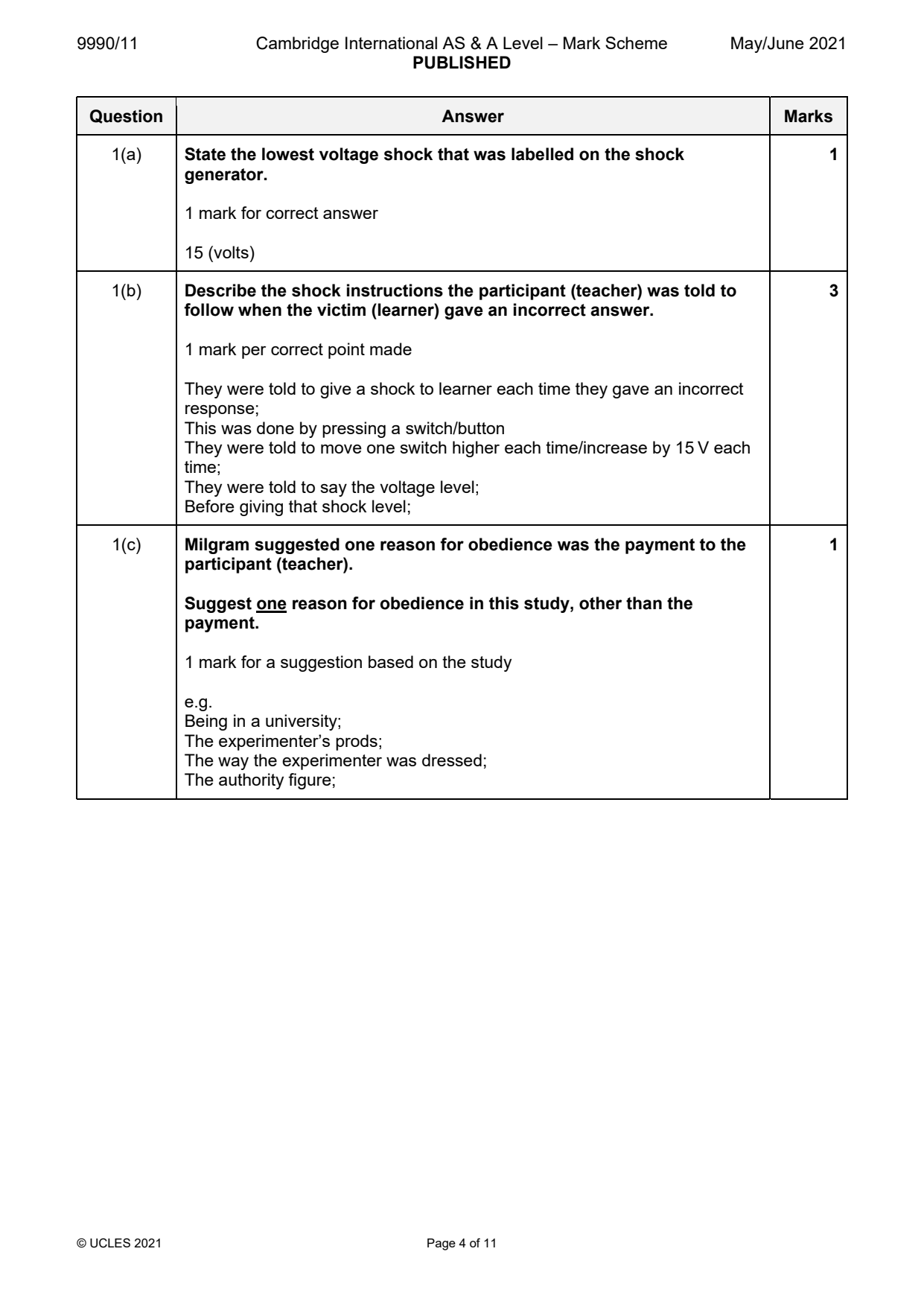
9990-2021-mj-11-q01
May/June 2021 · Paper 11 · Question 1 · 5 marks
1(a) State the lowest voltage shock that was labelled on the shock 1
generator.
1 mark for correct answer
15 (volts)
1(b) Describe the shock instructions the participant (teacher) was told to 3
follow when the victim (learner) gave an incorrect answer.
1 mark per correct point made
They were told to give a shock to learner each time they gave an incorrect
response;
This was done by pressing a switch/button
They were told to move one switch higher each time/increase by 15 V each
time;
They were told to say the voltage level;
Before giving that shock level;
1(c) Milgram suggested one reason for obedience was the payment to the 1
participant (teacher).
Suggest one reason for obedience in this study, other than the
payment.
1 mark for a suggestion based on the study
e.g.
Being in a university;
The experimenter’s prods;
The way the experimenter was dressed;
The authority figure;
© UCLES 2021 Page 4 of 11
Official mark scheme pages: 4 · source PDF URL
9990-2021-mj-11-q02
May/June 2021 · Paper 11 · Question 2 · 6 marks
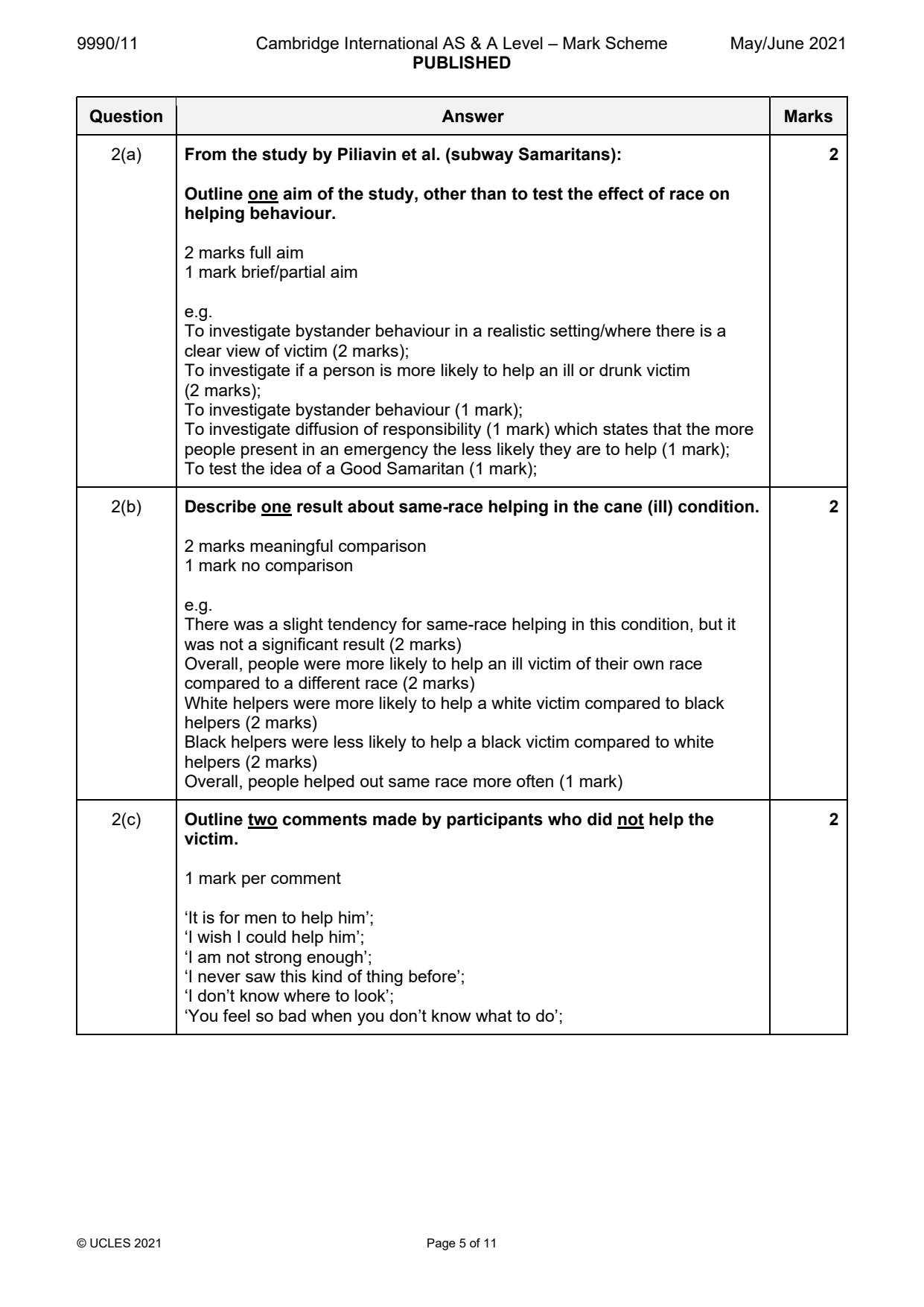
2(a) From the study by Piliavin et al. (subway Samaritans): 2
Outline one aim of the study, other than to test the effect of race on
helping behaviour.
2 marks full aim
1 mark brief/partial aim
e.g.
To investigate bystander behaviour in a realistic setting/where there is a
clear view of victim (2 marks);
To investigate if a person is more likely to help an ill or drunk victim
(2 marks);
To investigate bystander behaviour (1 mark);
To investigate diffusion of responsibility (1 mark) which states that the more
people present in an emergency the less likely they are to help (1 mark);
To test the idea of a Good Samaritan (1 mark);
2(b) Describe one result about same-race helping in the cane (ill) condition. 2
2 marks meaningful comparison
1 mark no comparison
e.g.
There was a slight tendency for same-race helping in this condition, but it
was not a significant result (2 marks)
Overall, people were more likely to help an ill victim of their own race
compared to a different race (2 marks)
White helpers were more likely to help a white victim compared to black
helpers (2 marks)
Black helpers were less likely to help a black victim compared to white
helpers (2 marks)
Overall, people helped out same race more often (1 mark)
2(c) Outline two comments made by participants who did not help the 2
victim.
1 mark per comment
‘It is for men to help him’;
‘I wish I could help him’;
‘I am not strong enough’;
‘I never saw this kind of thing before’;
‘I don’t know where to look’;
‘You feel so bad when you don’t know what to do’;
© UCLES 2021 Page 5 of 11
Official mark scheme pages: 5 · source PDF URL
9990-2021-mj-11-q09
May/June 2021 · Paper 11 · Question 9 · 10 marks
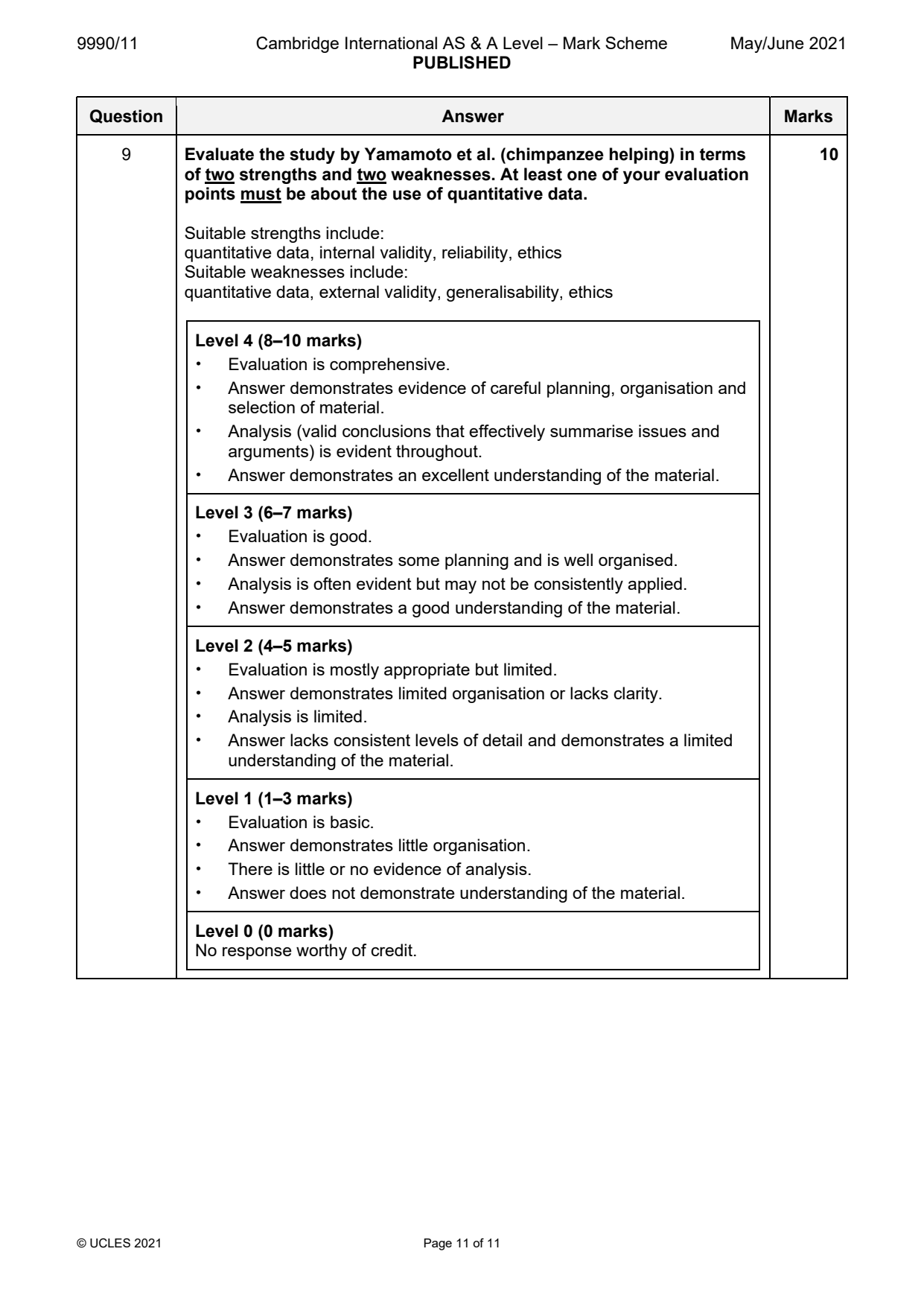
9 Evaluate the study by Yamamoto et al. (chimpanzee helping) in terms 10
of two strengths and two weaknesses. At least one of your evaluation
points must be about the use of quantitative data.
Suitable strengths include:
quantitative data, internal validity, reliability, ethics
Suitable weaknesses include:
quantitative data, external validity, generalisability, ethics
Level 4 (8–10 marks)
• Evaluation is comprehensive.
• Answer demonstrates evidence of careful planning, organisation and
selection of material.
• Analysis (valid conclusions that effectively summarise issues and
arguments) is evident throughout.
• Answer demonstrates an excellent understanding of the material.
Level 3 (6–7 marks)
• Evaluation is good.
• Answer demonstrates some planning and is well organised.
• Analysis is often evident but may not be consistently applied.
• Answer demonstrates a good understanding of the material.
Level 2 (4–5 marks)
• Evaluation is mostly appropriate but limited.
• Answer demonstrates limited organisation or lacks clarity.
• Analysis is limited.
• Answer lacks consistent levels of detail and demonstrates a limited
understanding of the material.
Level 1 (1–3 marks)
• Evaluation is basic.
• Answer demonstrates little organisation.
• There is little or no evidence of analysis.
• Answer does not demonstrate understanding of the material.
Level 0 (0 marks)
No response worthy of credit.
© UCLES 2021 Page 11 of 11
Official mark scheme pages: 11 · source PDF URL
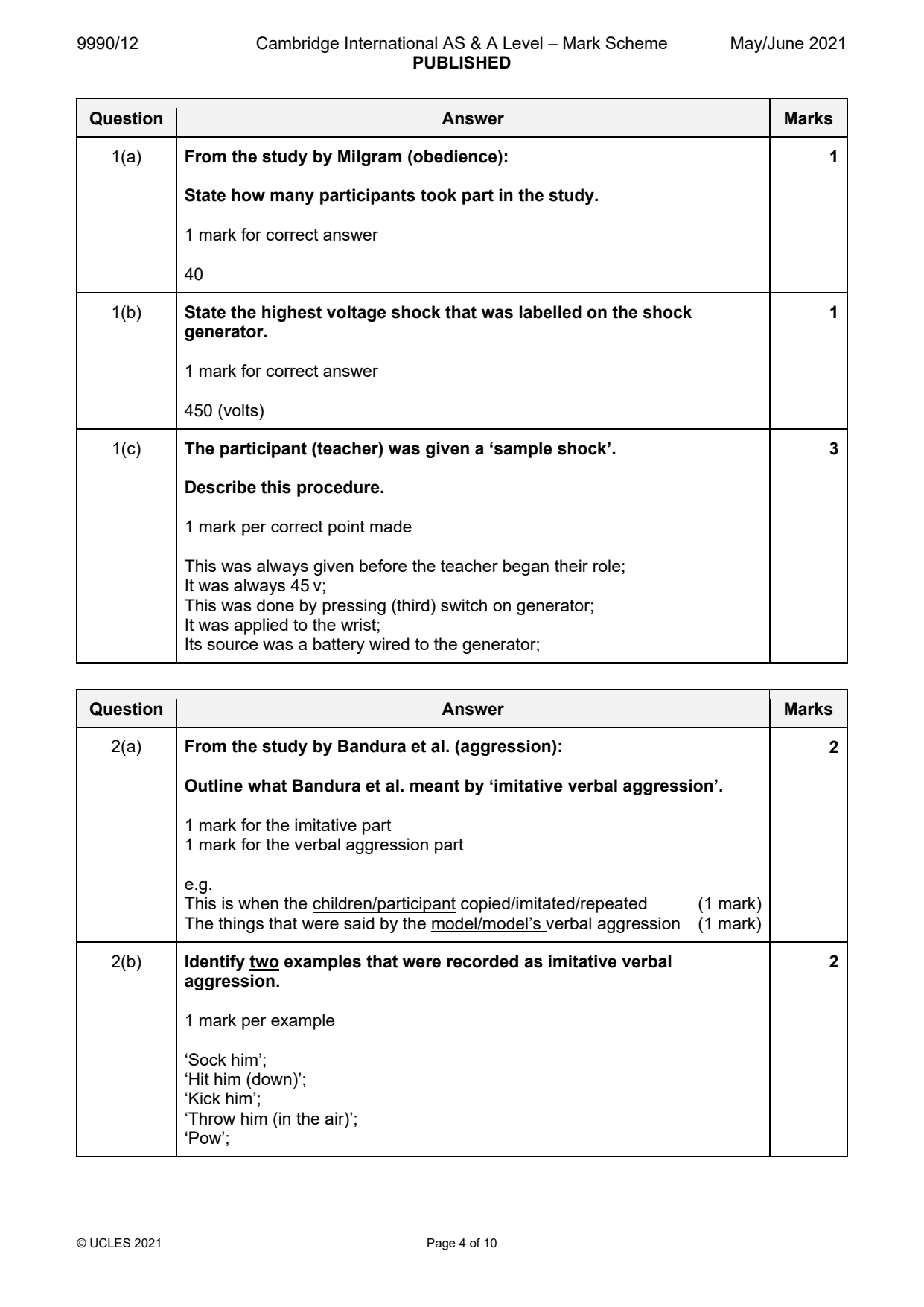
9990-2021-mj-12-q01
May/June 2021 · Paper 12 · Question 1 · 5 marks
1(a) From the study by Milgram (obedience): 1
State how many participants took part in the study.
1 mark for correct answer
40
1(b) State the highest voltage shock that was labelled on the shock 1
generator.
1 mark for correct answer
450 (volts)
1(c) The participant (teacher) was given a ‘sample shock’. 3
Describe this procedure.
1 mark per correct point made
This was always given before the teacher began their role;
It was always 45 v;
This was done by pressing (third) switch on generator;
It was applied to the wrist;
Its source was a battery wired to the generator;
Question Answer Marks
Official mark scheme pages: 4 · source PDF URL
9990-2021-mj-12-q08
May/June 2021 · Paper 12 · Question 8 · 12 marks
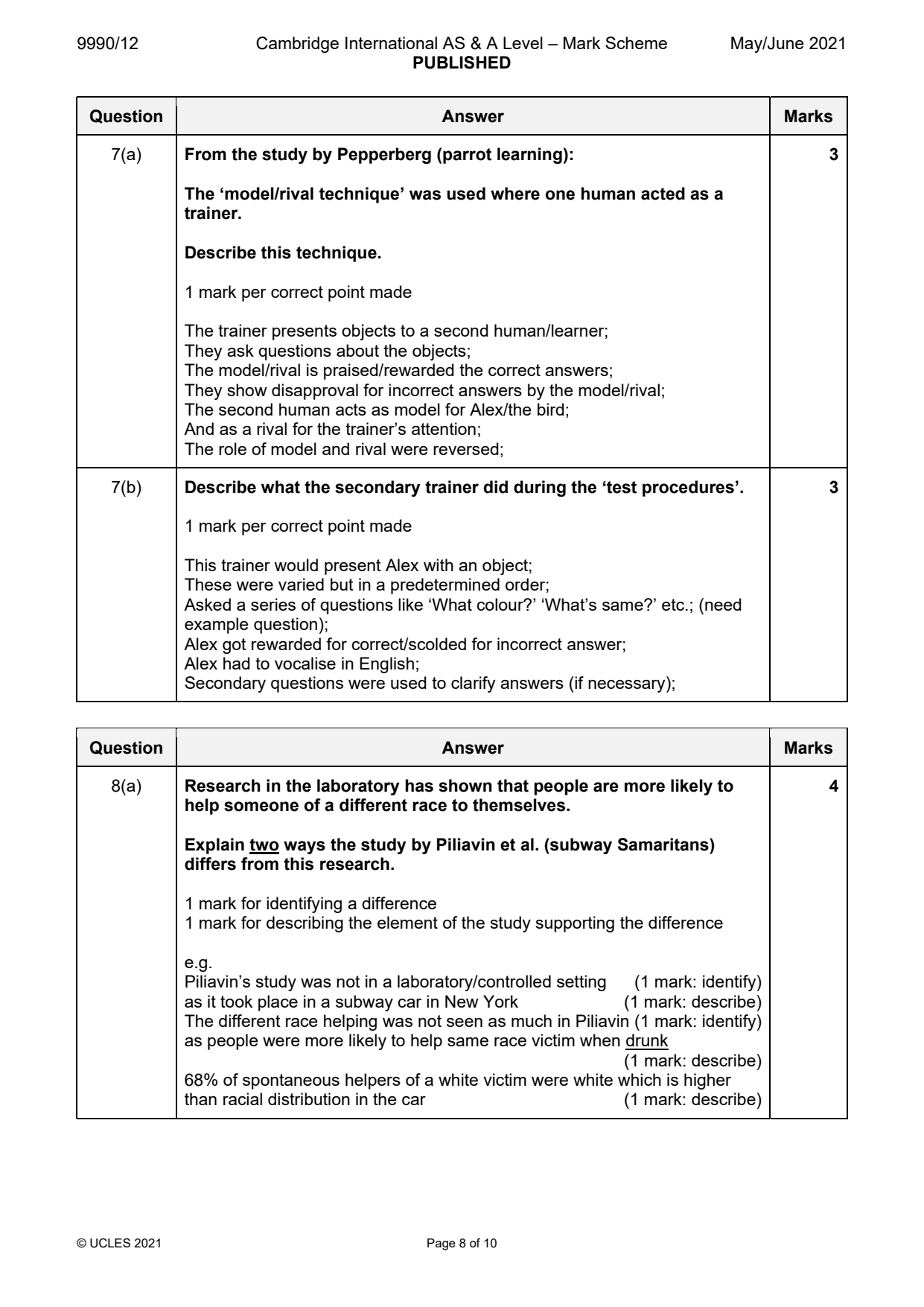
8(a) Research in the laboratory has shown that people are more likely to 4
help someone of a different race to themselves.
Explain two ways the study by Piliavin et al. (subway Samaritans)
differs from this research.
1 mark for identifying a difference
1 mark for describing the element of the study supporting the difference
e.g.
Piliavin’s study was not in a laboratory/controlled setting (1 mark: identify)
as it took place in a subway car in New York (1 mark: describe)
The different race helping was not seen as much in Piliavin (1 mark: identify)
as people were more likely to help same race victim when drunk
(1 mark: describe)
68% of spontaneous helpers of a white victim were white which is higher
than racial distribution in the car (1 mark: describe)
© UCLES 2021 Page 8 of 10
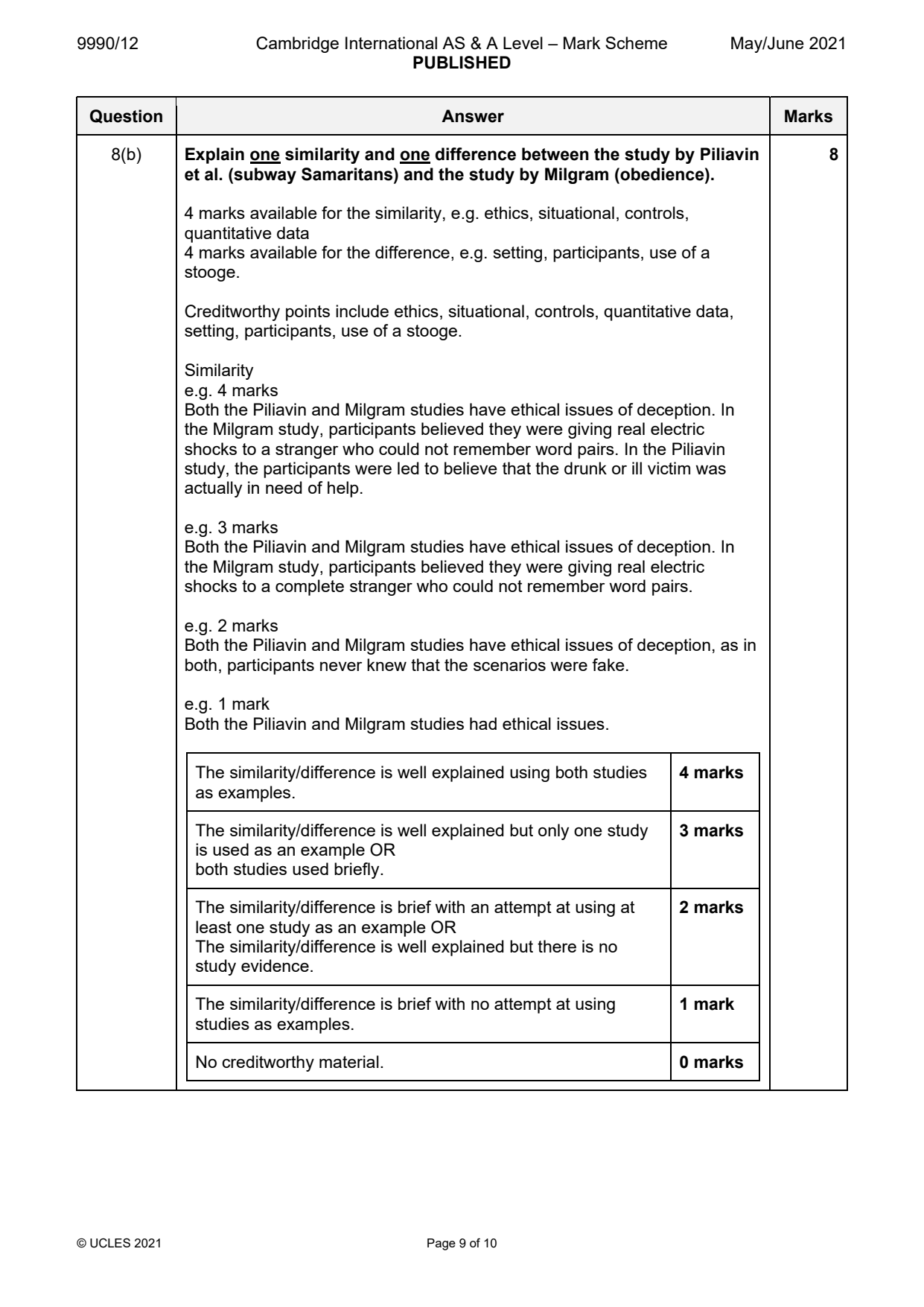
8(b) Explain one similarity and one difference between the study by Piliavin 8
et al. (subway Samaritans) and the study by Milgram (obedience).
4 marks available for the similarity, e.g. ethics, situational, controls,
quantitative data
4 marks available for the difference, e.g. setting, participants, use of a
stooge.
Creditworthy points include ethics, situational, controls, quantitative data,
setting, participants, use of a stooge.
Similarity
e.g. 4 marks
Both the Piliavin and Milgram studies have ethical issues of deception. In
the Milgram study, participants believed they were giving real electric
shocks to a stranger who could not remember word pairs. In the Piliavin
study, the participants were led to believe that the drunk or ill victim was
actually in need of help.
e.g. 3 marks
Both the Piliavin and Milgram studies have ethical issues of deception. In
the Milgram study, participants believed they were giving real electric
shocks to a complete stranger who could not remember word pairs.
e.g. 2 marks
Both the Piliavin and Milgram studies have ethical issues of deception, as in
both, participants never knew that the scenarios were fake.
e.g. 1 mark
Both the Piliavin and Milgram studies had ethical issues.
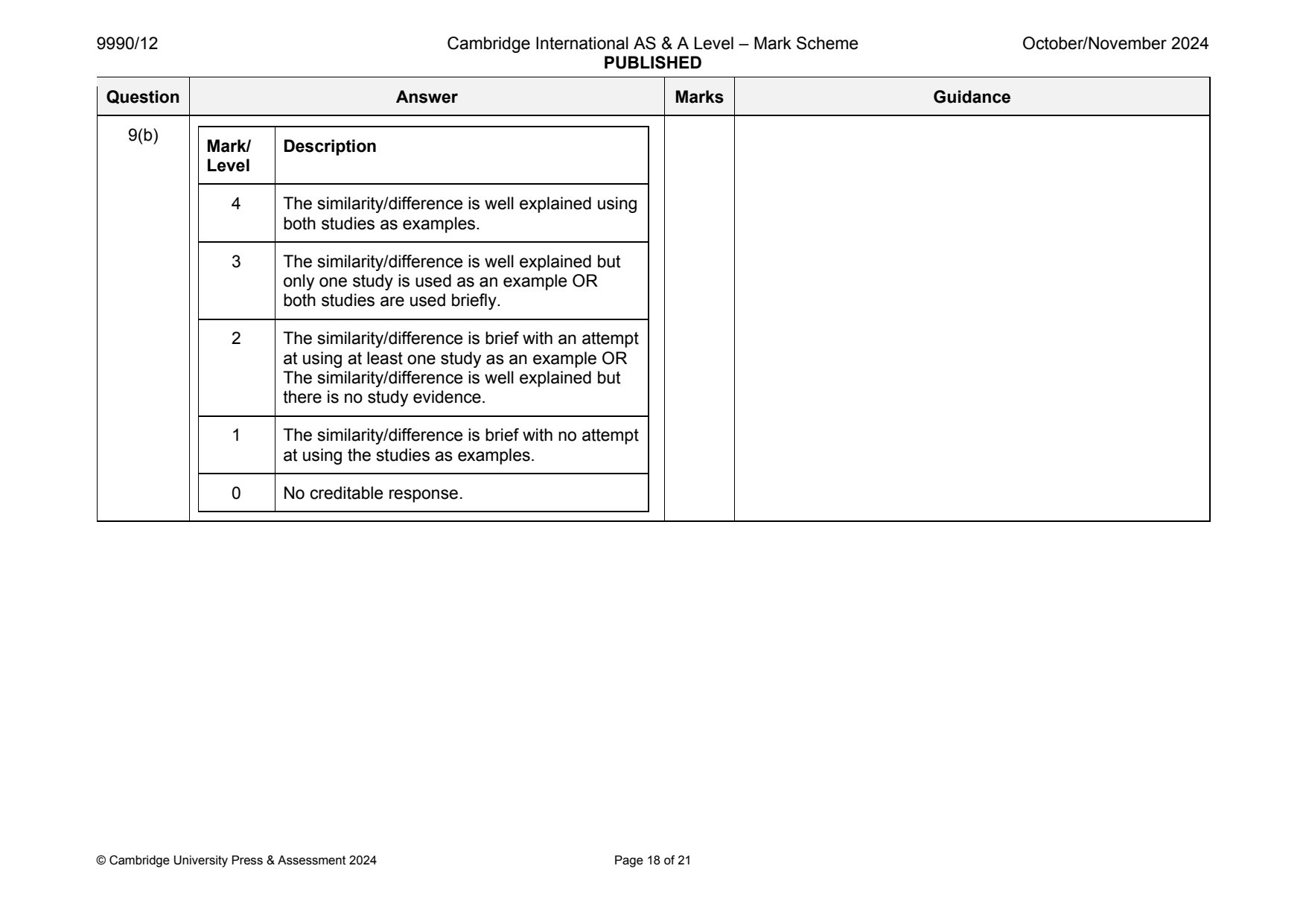
The similarity/difference is well explained using both studies 4 marks
as examples.
The similarity/difference is well explained but only one study 3 marks
is used as an example OR
both studies used briefly.
The similarity/difference is brief with an attempt at using at 2 marks
least one study as an example OR
The similarity/difference is well explained but there is no
study evidence.
The similarity/difference is brief with no attempt at using 1 mark
studies as examples.
No creditworthy material. 0 marks
© UCLES 2021 Page 9 of 10
Official mark scheme pages: 8, 9 · source PDF URL
9990-2021-mj-13-q05
May/June 2021 · Paper 13 · Question 5 · 5 marks
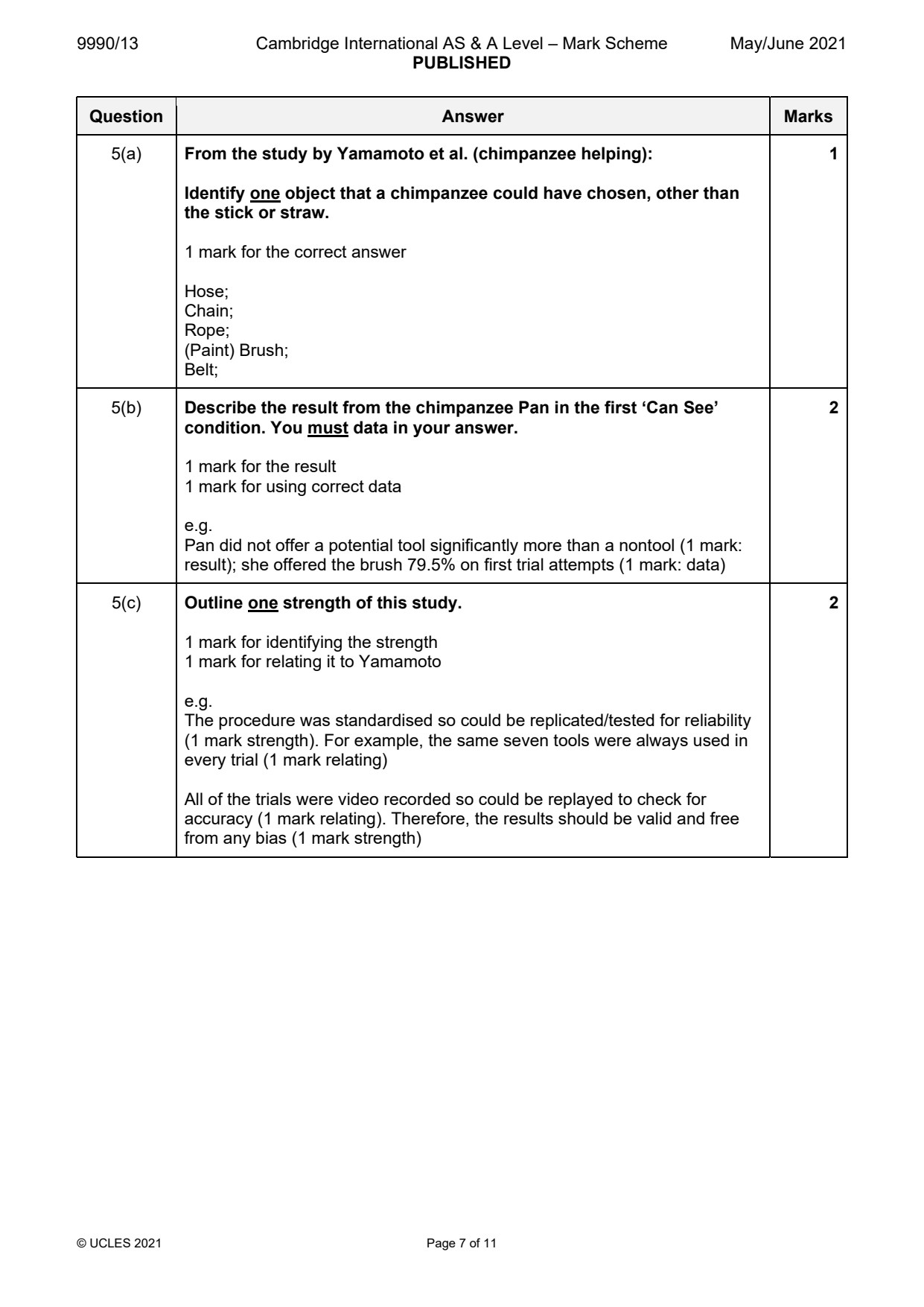
5(a) From the study by Yamamoto et al. (chimpanzee helping): 1
Identify one object that a chimpanzee could have chosen, other than
the stick or straw.
1 mark for the correct answer
Hose;
Chain;
Rope;
(Paint) Brush;
Belt;
5(b) Describe the result from the chimpanzee Pan in the first ‘Can See’ 2
condition. You must data in your answer.
1 mark for the result
1 mark for using correct data
e.g.
Pan did not offer a potential tool significantly more than a nontool (1 mark:
result); she offered the brush 79.5% on first trial attempts (1 mark: data)
5(c) Outline one strength of this study. 2
1 mark for identifying the strength
1 mark for relating it to Yamamoto
e.g.
The procedure was standardised so could be replicated/tested for reliability
(1 mark strength). For example, the same seven tools were always used in
every trial (1 mark relating)
All of the trials were video recorded so could be replayed to check for
accuracy (1 mark relating). Therefore, the results should be valid and free
from any bias (1 mark strength)
© UCLES 2021 Page 7 of 11
Official mark scheme pages: 7 · source PDF URL
9990-2021-mj-13-q07
May/June 2021 · Paper 13 · Question 7 · 6 marks
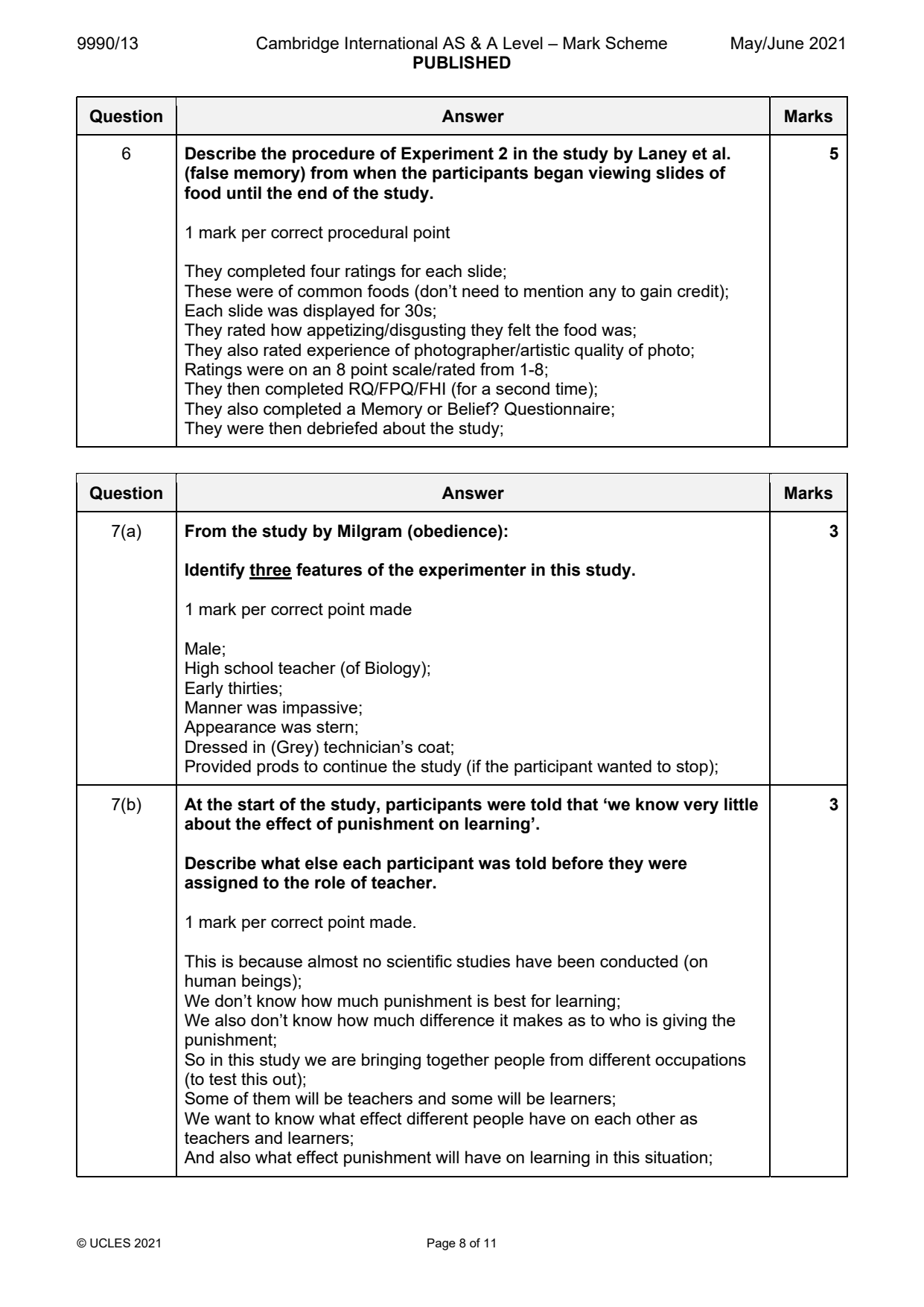
7(a) From the study by Milgram (obedience): 3
Identify three features of the experimenter in this study.
1 mark per correct point made
Male;
High school teacher (of Biology);
Early thirties;
Manner was impassive;
Appearance was stern;
Dressed in (Grey) technician’s coat;
Provided prods to continue the study (if the participant wanted to stop);
7(b) At the start of the study, participants were told that ‘we know very little 3
about the effect of punishment on learning’.
Describe what else each participant was told before they were
assigned to the role of teacher.
1 mark per correct point made.
This is because almost no scientific studies have been conducted (on
human beings);
We don’t know how much punishment is best for learning;
We also don’t know how much difference it makes as to who is giving the
punishment;
So in this study we are bringing together people from different occupations
(to test this out);
Some of them will be teachers and some will be learners;
We want to know what effect different people have on each other as
teachers and learners;
And also what effect punishment will have on learning in this situation;
© UCLES 2021 Page 8 of 11
Official mark scheme pages: 8 · source PDF URL
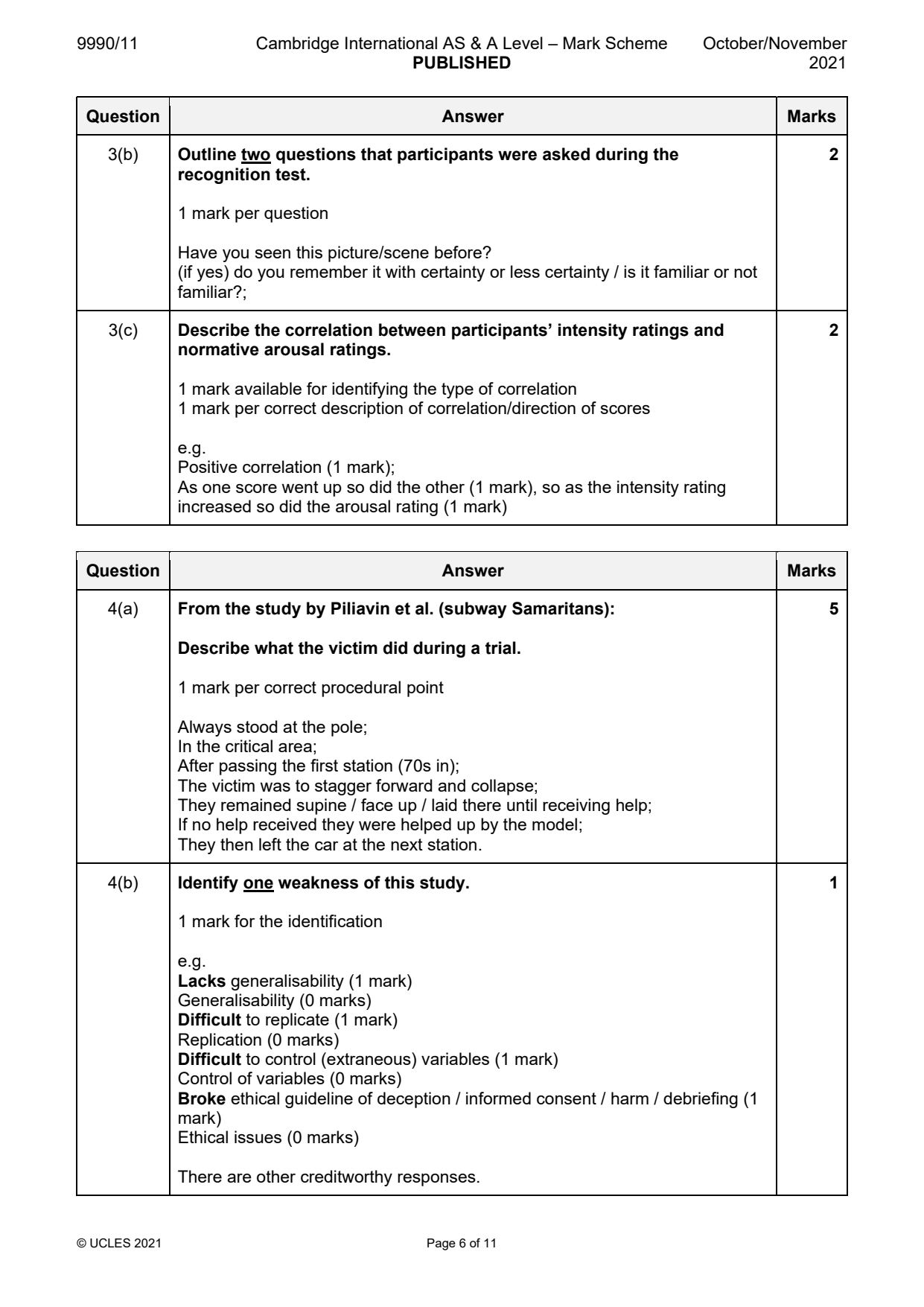
9990-2021-on-11-q04
Oct/Nov 2021 · Paper 11 · Question 4 · 6 marks
4(a) From the study by Piliavin et al. (subway Samaritans): 5
Describe what the victim did during a trial.
1 mark per correct procedural point
Always stood at the pole;
In the critical area;
After passing the first station (70s in);
The victim was to stagger forward and collapse;
They remained supine / face up / laid there until receiving help;
If no help received they were helped up by the model;
They then left the car at the next station.
4(b) Identify one weakness of this study. 1
1 mark for the identification
e.g.
Lacks generalisability (1 mark)
Generalisability (0 marks)
Difficult to replicate (1 mark)
Replication (0 marks)
Difficult to control (extraneous) variables (1 mark)
Control of variables (0 marks)
Broke ethical guideline of deception / informed consent / harm / debriefing (1
mark)
Ethical issues (0 marks)
There are other creditworthy responses.
© UCLES 2021 Page 6 of 11
Official mark scheme pages: 6 · source PDF URL
9990-2021-on-11-q08
Oct/Nov 2021 · Paper 11 · Question 8 · 12 marks
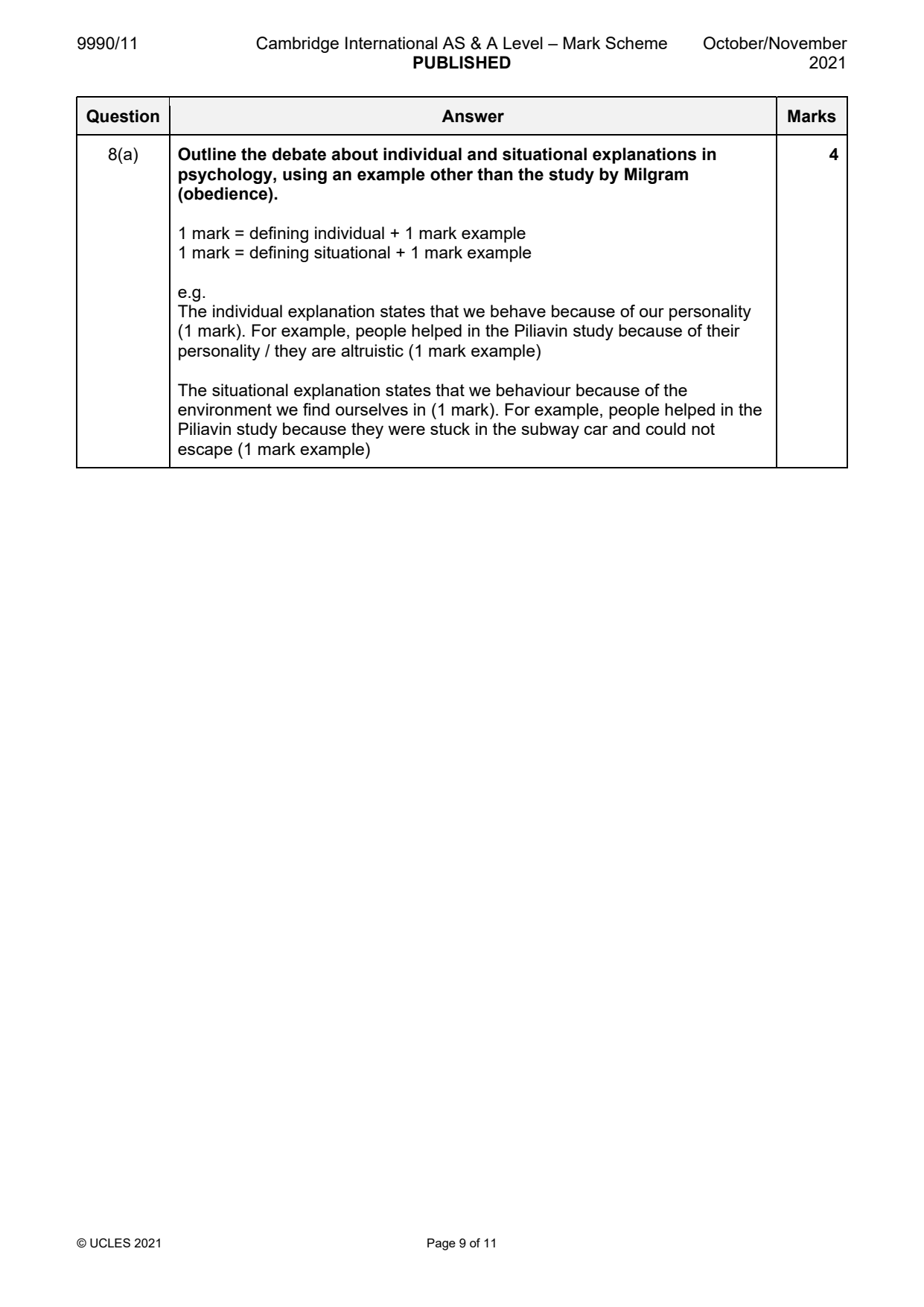
8(a) Outline the debate about individual and situational explanations in 4
psychology, using an example other than the study by Milgram
(obedience).
1 mark = defining individual + 1 mark example
1 mark = defining situational + 1 mark example
e.g.
The individual explanation states that we behave because of our personality
(1 mark). For example, people helped in the Piliavin study because of their
personality / they are altruistic (1 mark example)
The situational explanation states that we behaviour because of the
environment we find ourselves in (1 mark). For example, people helped in the
Piliavin study because they were stuck in the subway car and could not
escape (1 mark example)
© UCLES 2021 Page 9 of 11
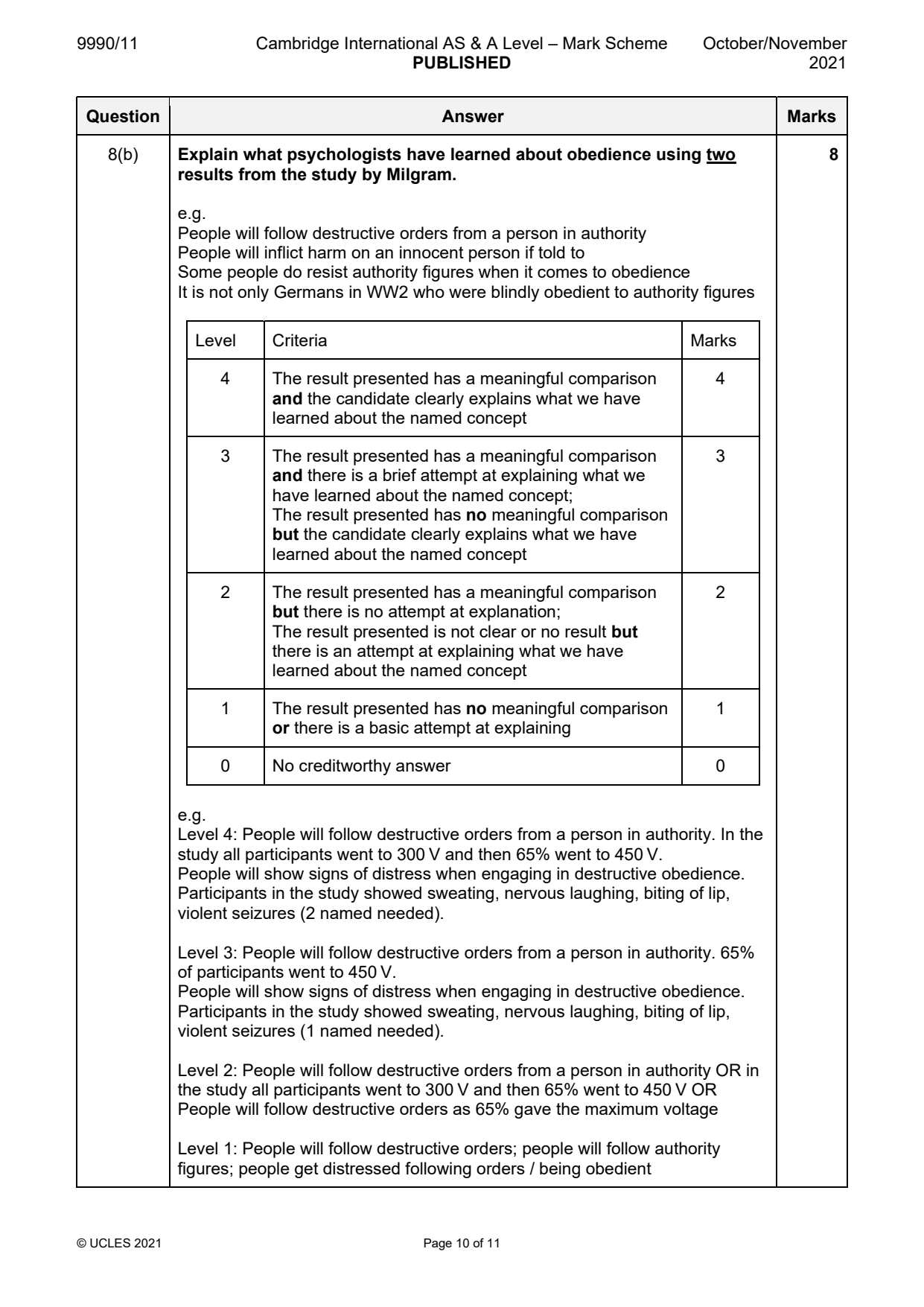
8(b) Explain what psychologists have learned about obedience using two 8
results from the study by Milgram.
e.g.
People will follow destructive orders from a person in authority
People will inflict harm on an innocent person if told to
Some people do resist authority figures when it comes to obedience
It is not only Germans in WW2 who were blindly obedient to authority figures
Level Criteria Marks
4 The result presented has a meaningful comparison 4
and the candidate clearly explains what we have
learned about the named concept
3 The result presented has a meaningful comparison 3
and there is a brief attempt at explaining what we
have learned about the named concept;
The result presented has no meaningful comparison
but the candidate clearly explains what we have
learned about the named concept
2 The result presented has a meaningful comparison 2
but there is no attempt at explanation;
The result presented is not clear or no result but
there is an attempt at explaining what we have
learned about the named concept
1 The result presented has no meaningful comparison 1
or there is a basic attempt at explaining
0 No creditworthy answer 0
e.g.
Level 4: People will follow destructive orders from a person in authority. In the
study all participants went to 300 V and then 65% went to 450 V.
People will show signs of distress when engaging in destructive obedience.
Participants in the study showed sweating, nervous laughing, biting of lip,
violent seizures (2 named needed).
Level 3: People will follow destructive orders from a person in authority. 65%
of participants went to 450 V.
People will show signs of distress when engaging in destructive obedience.
Participants in the study showed sweating, nervous laughing, biting of lip,
violent seizures (1 named needed).
Level 2: People will follow destructive orders from a person in authority OR in
the study all participants went to 300 V and then 65% went to 450 V OR
People will follow destructive orders as 65% gave the maximum voltage
Level 1: People will follow destructive orders; people will follow authority
figures; people get distressed following orders / being obedient
© UCLES 2021 Page 10 of 11
Official mark scheme pages: 9, 10 · source PDF URL
9990-2021-on-12-q04
Oct/Nov 2021 · Paper 12 · Question 4 · 6 marks
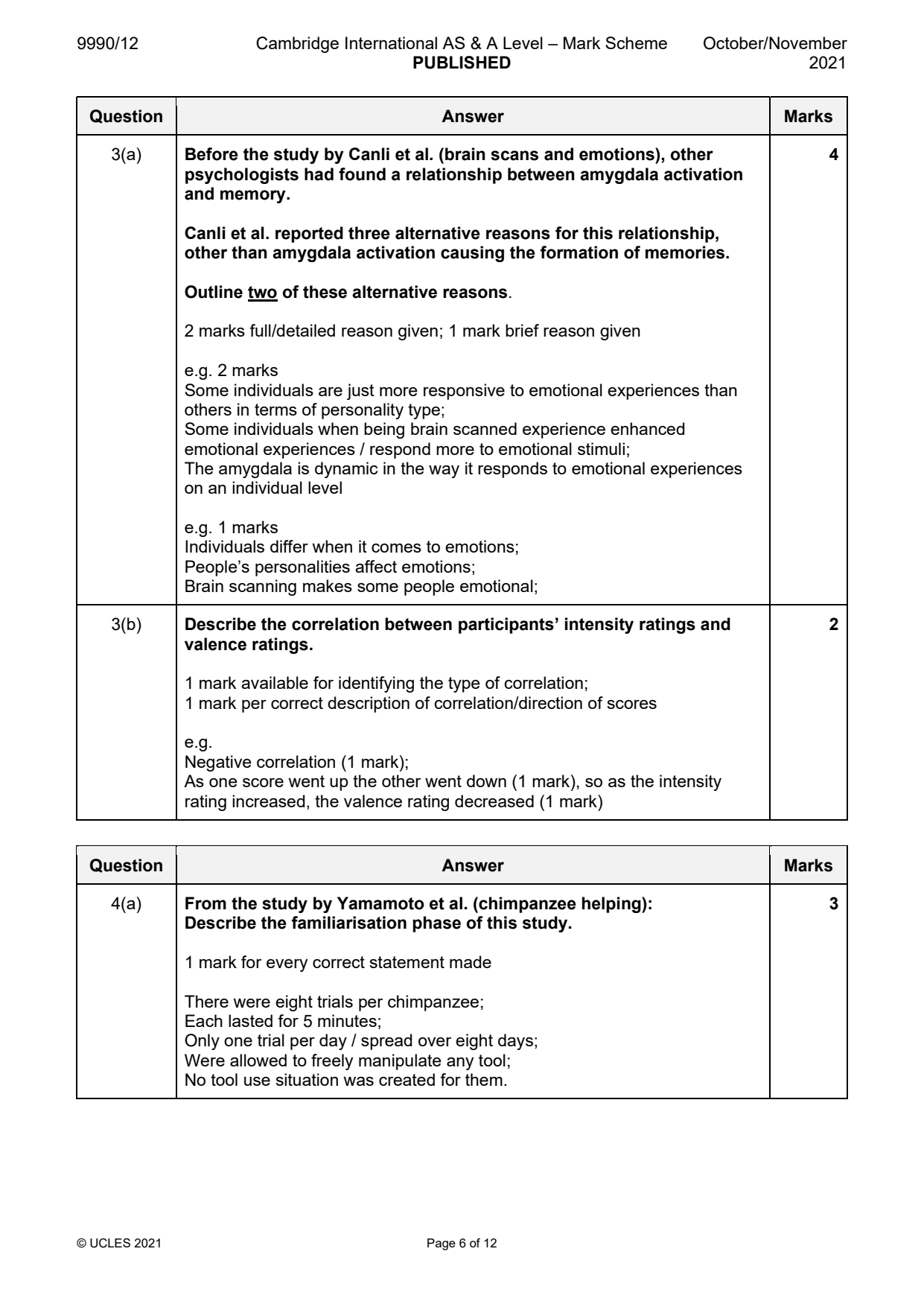
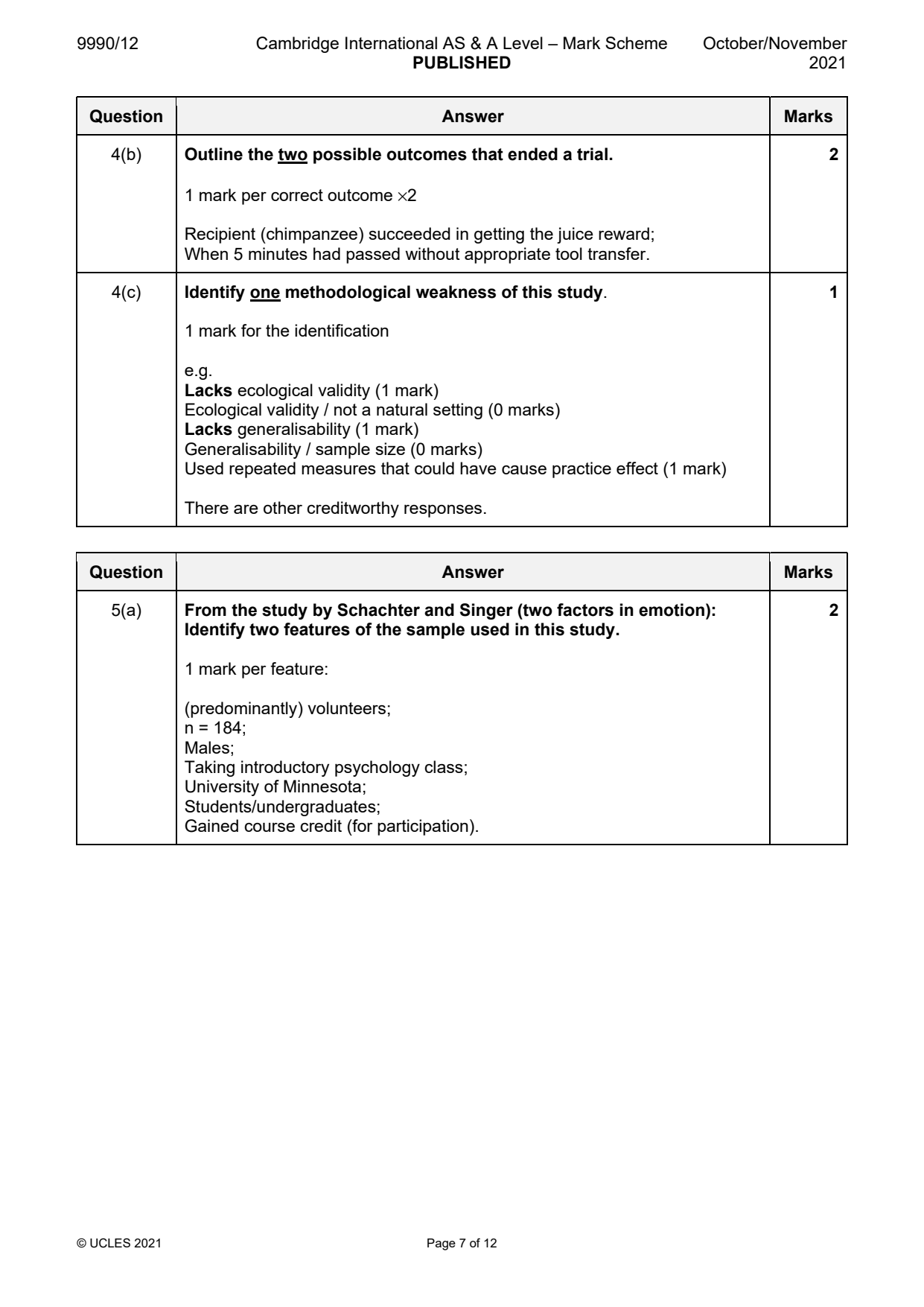
4(a) From the study by Yamamoto et al. (chimpanzee helping): 3
Describe the familiarisation phase of this study.
1 mark for every correct statement made
There were eight trials per chimpanzee;
Each lasted for 5 minutes;
Only one trial per day / spread over eight days;
Were allowed to freely manipulate any tool;
No tool use situation was created for them.
© UCLES 2021 Page 6 of 12
4(b) Outline the two possible outcomes that ended a trial. 2
1 mark per correct outcome ×2
Recipient (chimpanzee) succeeded in getting the juice reward;
When 5 minutes had passed without appropriate tool transfer.
4(c) Identify one methodological weakness of this study. 1
1 mark for the identification
e.g.
Lacks ecological validity (1 mark)
Ecological validity / not a natural setting (0 marks)
Lacks generalisability (1 mark)
Generalisability / sample size (0 marks)
Used repeated measures that could have cause practice effect (1 mark)
There are other creditworthy responses.
Question Answer Marks
Official mark scheme pages: 6, 7 · source PDF URL
9990-2021-on-12-q07
Oct/Nov 2021 · Paper 12 · Question 7 · 6 marks
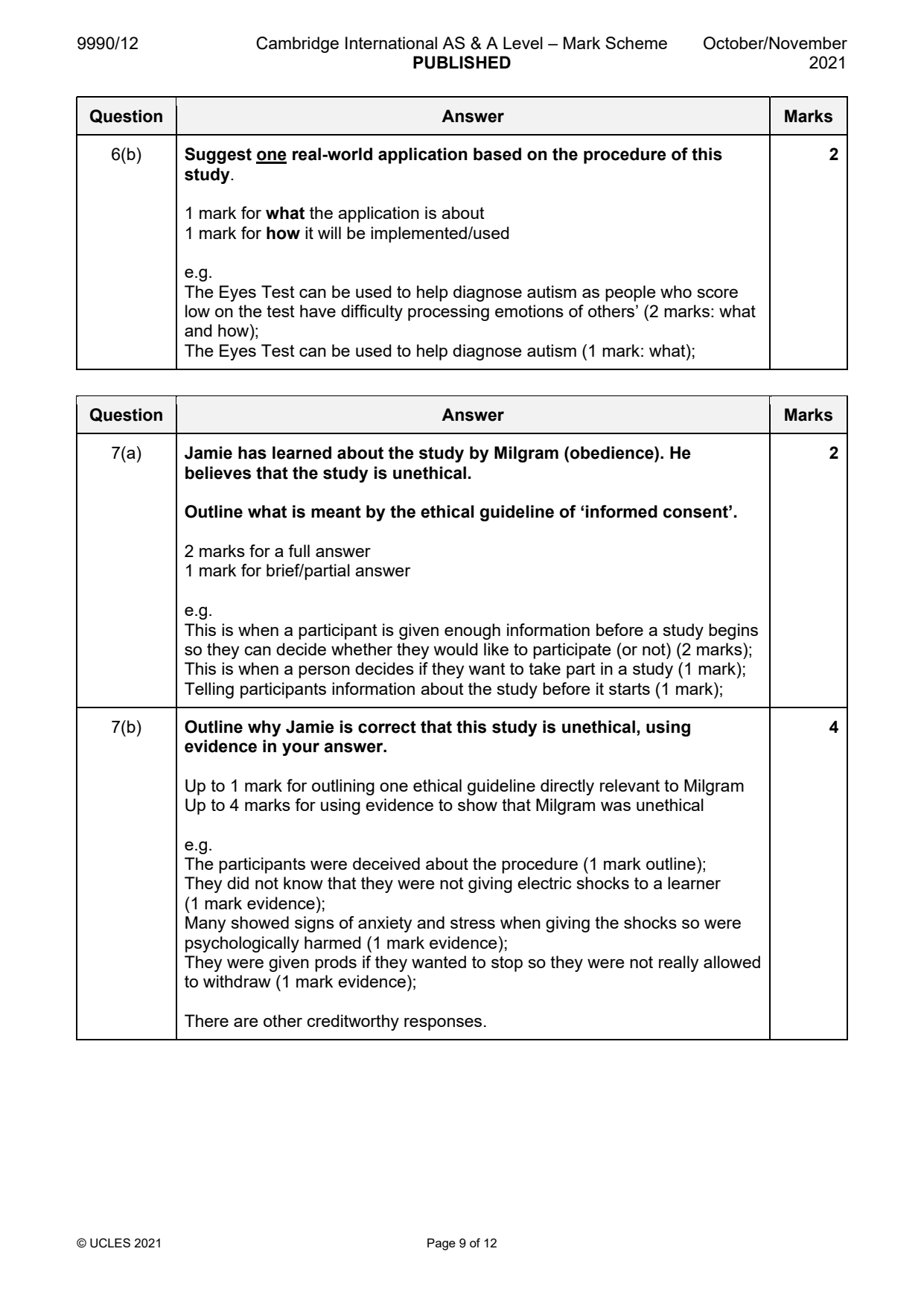
7(a) Jamie has learned about the study by Milgram (obedience). He 2
believes that the study is unethical.
Outline what is meant by the ethical guideline of ‘informed consent’.
2 marks for a full answer
1 mark for brief/partial answer
e.g.
This is when a participant is given enough information before a study begins
so they can decide whether they would like to participate (or not) (2 marks);
This is when a person decides if they want to take part in a study (1 mark);
Telling participants information about the study before it starts (1 mark);
7(b) Outline why Jamie is correct that this study is unethical, using 4
evidence in your answer.
Up to 1 mark for outlining one ethical guideline directly relevant to Milgram
Up to 4 marks for using evidence to show that Milgram was unethical
e.g.
The participants were deceived about the procedure (1 mark outline);
They did not know that they were not giving electric shocks to a learner
(1 mark evidence);
Many showed signs of anxiety and stress when giving the shocks so were
psychologically harmed (1 mark evidence);
They were given prods if they wanted to stop so they were not really allowed
to withdraw (1 mark evidence);
There are other creditworthy responses.
© UCLES 2021 Page 9 of 12
Official mark scheme pages: 9 · source PDF URL
9990-2021-on-13-q02
Oct/Nov 2021 · Paper 13 · Question 2 · 5 marks
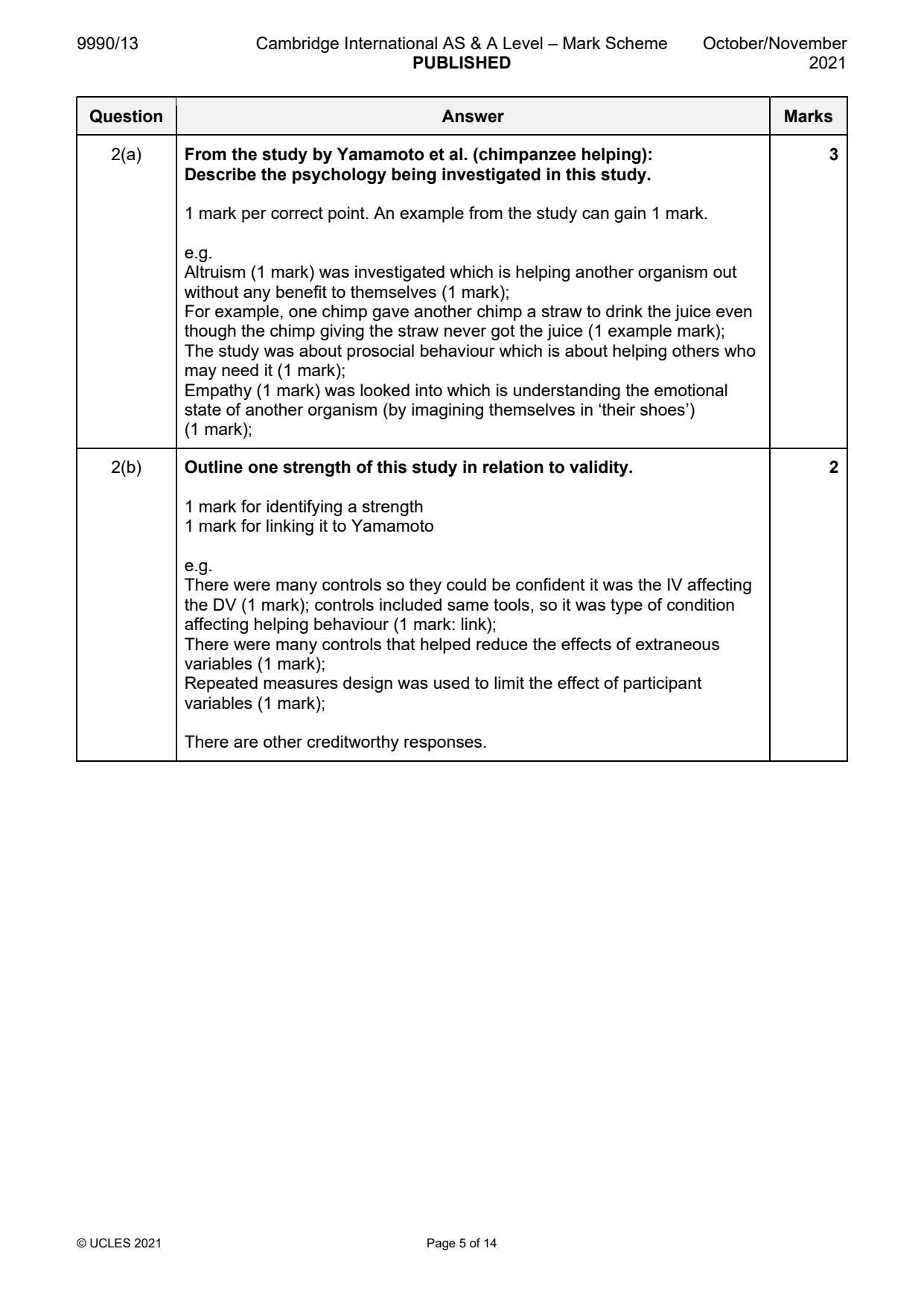
2(a) From the study by Yamamoto et al. (chimpanzee helping): 3
Describe the psychology being investigated in this study.
1 mark per correct point. An example from the study can gain 1 mark.
e.g.
Altruism (1 mark) was investigated which is helping another organism out
without any benefit to themselves (1 mark);
For example, one chimp gave another chimp a straw to drink the juice even
though the chimp giving the straw never got the juice (1 example mark);
The study was about prosocial behaviour which is about helping others who
may need it (1 mark);
Empathy (1 mark) was looked into which is understanding the emotional
state of another organism (by imagining themselves in ‘their shoes’)
(1 mark);
2(b) Outline one strength of this study in relation to validity. 2
1 mark for identifying a strength
1 mark for linking it to Yamamoto
e.g.
There were many controls so they could be confident it was the IV affecting
the DV (1 mark); controls included same tools, so it was type of condition
affecting helping behaviour (1 mark: link);
There were many controls that helped reduce the effects of extraneous
variables (1 mark);
Repeated measures design was used to limit the effect of participant
variables (1 mark);
There are other creditworthy responses.
© UCLES 2021 Page 5 of 14
Official mark scheme pages: 5 · source PDF URL
9990-2021-on-13-q03
Oct/Nov 2021 · Paper 13 · Question 3 · 6 marks
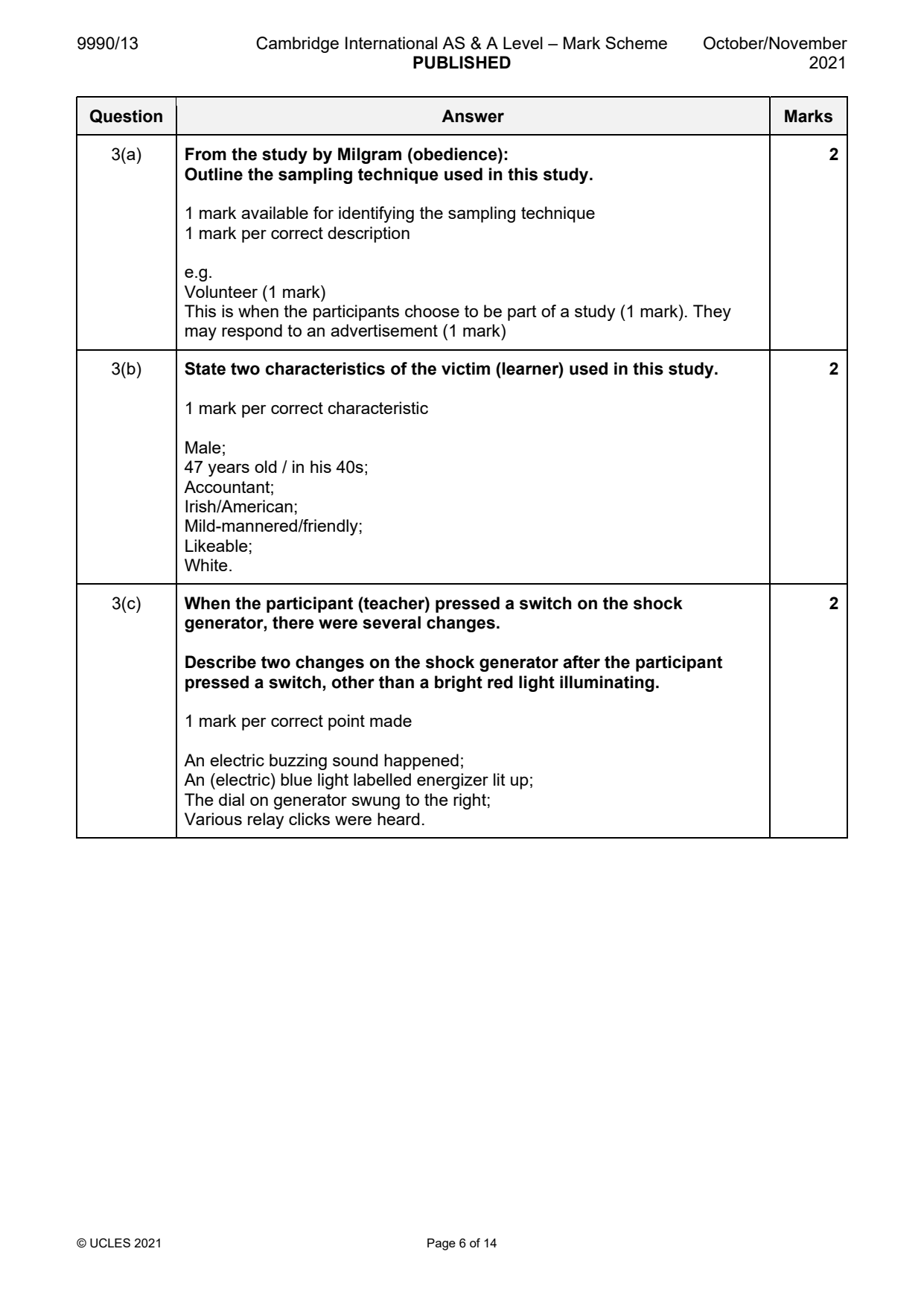
3(a) From the study by Milgram (obedience): 2
Outline the sampling technique used in this study.
1 mark available for identifying the sampling technique
1 mark per correct description
e.g.
Volunteer (1 mark)
This is when the participants choose to be part of a study (1 mark). They
may respond to an advertisement (1 mark)
3(b) State two characteristics of the victim (learner) used in this study. 2
1 mark per correct characteristic
Male;
47 years old / in his 40s;
Accountant;
Irish/American;
Mild-mannered/friendly;
Likeable;
White.
3(c) When the participant (teacher) pressed a switch on the shock 2
generator, there were several changes.
Describe two changes on the shock generator after the participant
pressed a switch, other than a bright red light illuminating.
1 mark per correct point made
An electric buzzing sound happened;
An (electric) blue light labelled energizer lit up;
The dial on generator swung to the right;
Various relay clicks were heard.
© UCLES 2021 Page 6 of 14
Official mark scheme pages: 6 · source PDF URL
9990-2021-on-13-q09
Oct/Nov 2021 · Paper 13 · Question 9 · 10 marks
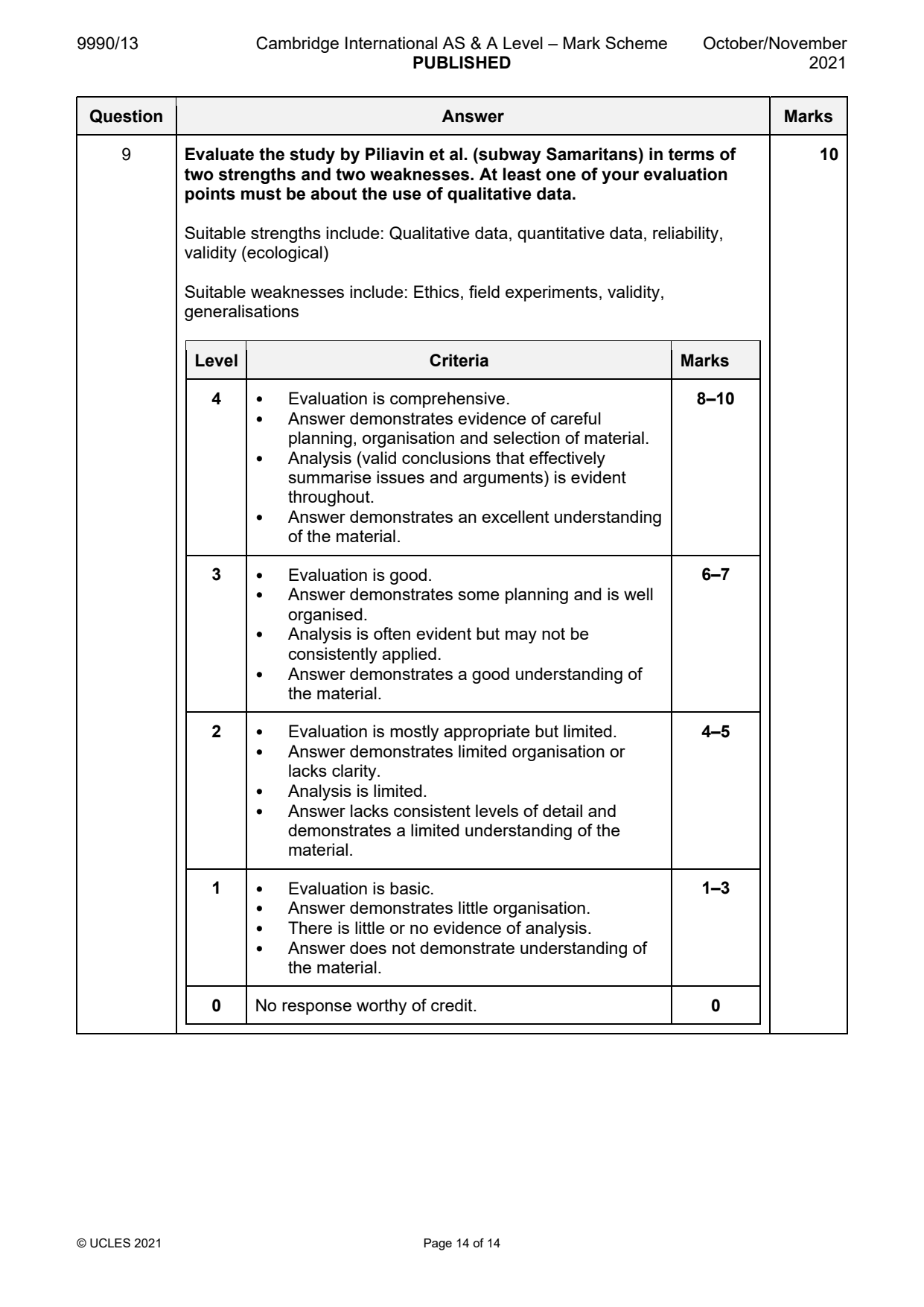
9 Evaluate the study by Piliavin et al. (subway Samaritans) in terms of 10
two strengths and two weaknesses. At least one of your evaluation
points must be about the use of qualitative data.
Suitable strengths include: Qualitative data, quantitative data, reliability,
validity (ecological)
Suitable weaknesses include: Ethics, field experiments, validity,
generalisations
Level Criteria Marks
4 • Evaluation is comprehensive. 8–10
• Answer demonstrates evidence of careful
planning, organisation and selection of material.
• Analysis (valid conclusions that effectively
summarise issues and arguments) is evident
throughout.
• Answer demonstrates an excellent understanding
of the material.
3 • Evaluation is good. 6–7
• Answer demonstrates some planning and is well
organised.
• Analysis is often evident but may not be
consistently applied.
• Answer demonstrates a good understanding of
the material.
2 • Evaluation is mostly appropriate but limited. 4–5
• Answer demonstrates limited organisation or
lacks clarity.
• Analysis is limited.
• Answer lacks consistent levels of detail and
demonstrates a limited understanding of the
material.
1 • Evaluation is basic. 1–3
• Answer demonstrates little organisation.
• There is little or no evidence of analysis.
• Answer does not demonstrate understanding of
the material.
0 No response worthy of credit. 0
© UCLES 2021 Page 14 of 14
Official mark scheme pages: 14 · source PDF URL
9990-2022-mj-11-q04
May/June 2022 · Paper 11 · Question 4 · 6 marks
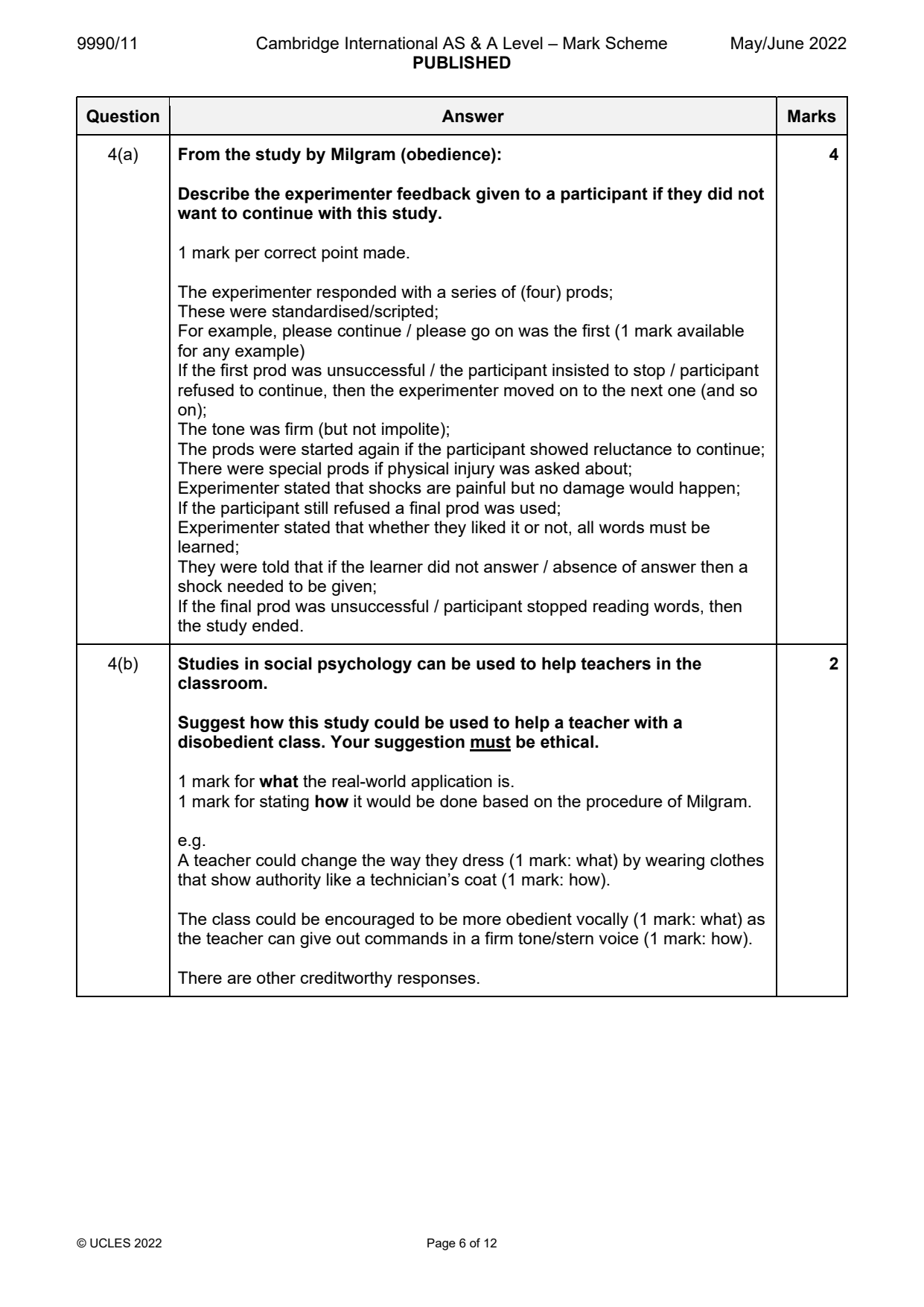
4(a) From the study by Milgram (obedience): 4
Describe the experimenter feedback given to a participant if they did not
want to continue with this study.
1 mark per correct point made.
The experimenter responded with a series of (four) prods;
These were standardised/scripted;
For example, please continue / please go on was the first (1 mark available
for any example)
If the first prod was unsuccessful / the participant insisted to stop / participant
refused to continue, then the experimenter moved on to the next one (and so
on);
The tone was firm (but not impolite);
The prods were started again if the participant showed reluctance to continue;
There were special prods if physical injury was asked about;
Experimenter stated that shocks are painful but no damage would happen;
If the participant still refused a final prod was used;
Experimenter stated that whether they liked it or not, all words must be
learned;
They were told that if the learner did not answer / absence of answer then a
shock needed to be given;
If the final prod was unsuccessful / participant stopped reading words, then
the study ended.
4(b) Studies in social psychology can be used to help teachers in the 2
classroom.
Suggest how this study could be used to help a teacher with a
disobedient class. Your suggestion must be ethical.
1 mark for what the real-world application is.
1 mark for stating how it would be done based on the procedure of Milgram.
e.g.
A teacher could change the way they dress (1 mark: what) by wearing clothes
that show authority like a technician’s coat (1 mark: how).
The class could be encouraged to be more obedient vocally (1 mark: what) as
the teacher can give out commands in a firm tone/stern voice (1 mark: how).
There are other creditworthy responses.
© UCLES 2022 Page 6 of 12
Official mark scheme pages: 6 · source PDF URL
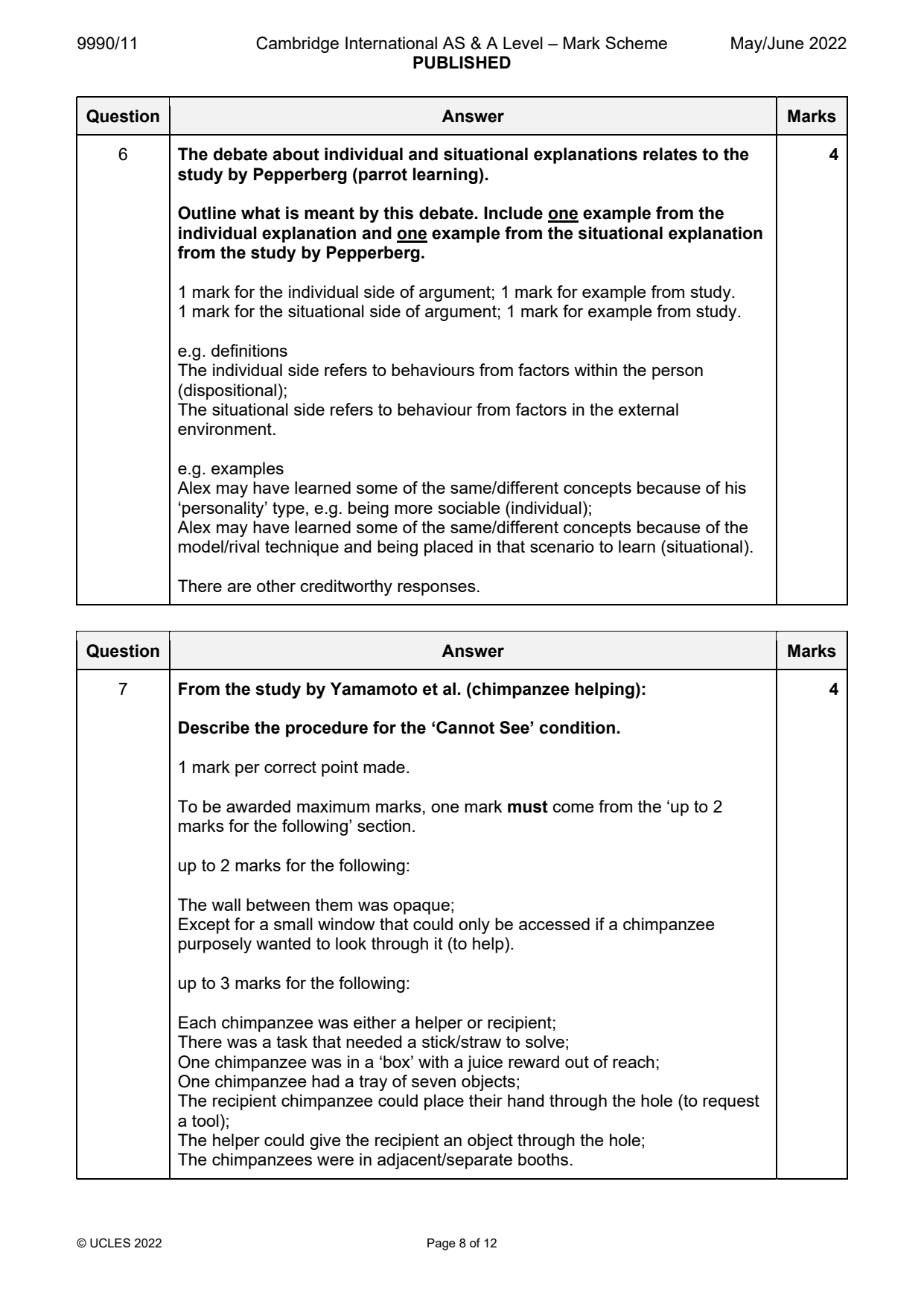
9990-2022-mj-11-q07
May/June 2022 · Paper 11 · Question 7 · 4 marks
7 From the study by Yamamoto et al. (chimpanzee helping): 4
Describe the procedure for the ‘Cannot See’ condition.
1 mark per correct point made.
To be awarded maximum marks, one mark must come from the ‘up to 2
marks for the following’ section.
up to 2 marks for the following:
The wall between them was opaque;
Except for a small window that could only be accessed if a chimpanzee
purposely wanted to look through it (to help).
up to 3 marks for the following:
Each chimpanzee was either a helper or recipient;
There was a task that needed a stick/straw to solve;
One chimpanzee was in a ‘box’ with a juice reward out of reach;
One chimpanzee had a tray of seven objects;
The recipient chimpanzee could place their hand through the hole (to request
a tool);
The helper could give the recipient an object through the hole;
The chimpanzees were in adjacent/separate booths.
© UCLES 2022 Page 8 of 12
Official mark scheme pages: 8 · source PDF URL
9990-2022-mj-12-q01
May/June 2022 · Paper 12 · Question 1 · 4 marks
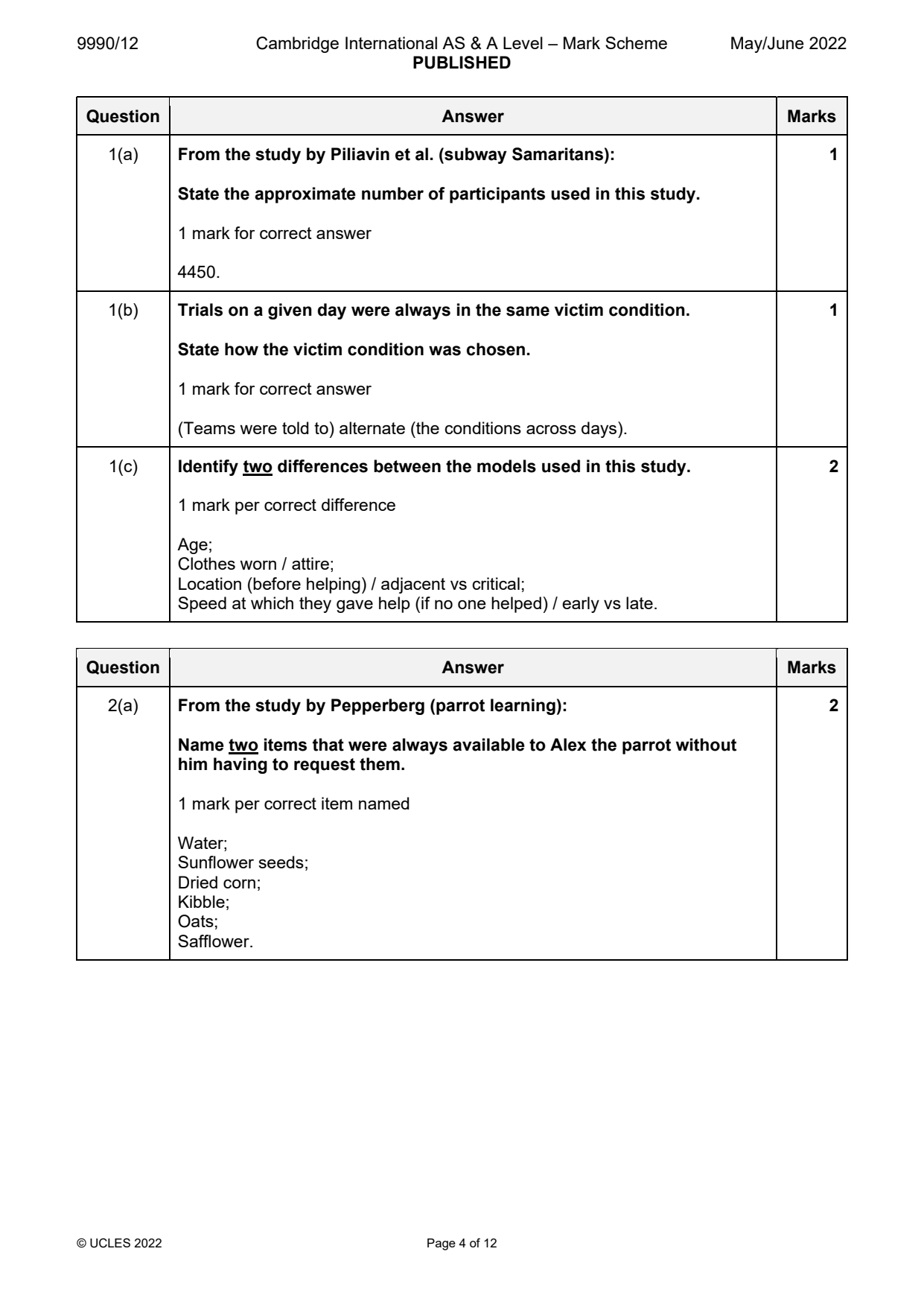
1(a) From the study by Piliavin et al. (subway Samaritans): 1
State the approximate number of participants used in this study.
1 mark for correct answer
4450.
1(b) Trials on a given day were always in the same victim condition. 1
State how the victim condition was chosen.
1 mark for correct answer
(Teams were told to) alternate (the conditions across days).
1(c) Identify two differences between the models used in this study. 2
1 mark per correct difference
Age;
Clothes worn / attire;
Location (before helping) / adjacent vs critical;
Speed at which they gave help (if no one helped) / early vs late.
Question Answer Marks
Official mark scheme pages: 4 · source PDF URL
9990-2022-mj-12-q04
May/June 2022 · Paper 12 · Question 4 · 6 marks
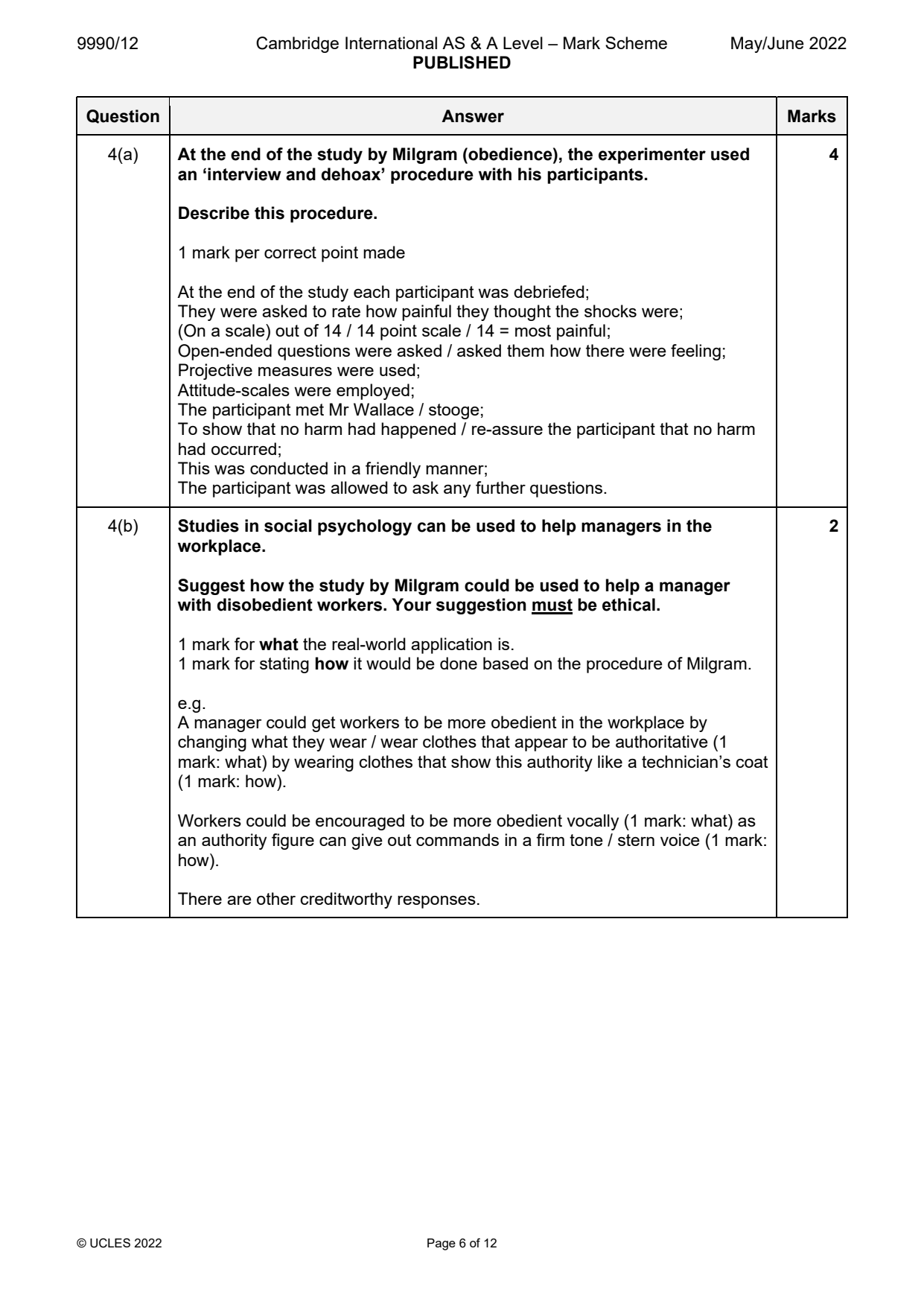
4(a) At the end of the study by Milgram (obedience), the experimenter used 4
an ‘interview and dehoax’ procedure with his participants.
Describe this procedure.
1 mark per correct point made
At the end of the study each participant was debriefed;
They were asked to rate how painful they thought the shocks were;
(On a scale) out of 14 / 14 point scale / 14 = most painful;
Open-ended questions were asked / asked them how there were feeling;
Projective measures were used;
Attitude-scales were employed;
The participant met Mr Wallace / stooge;
To show that no harm had happened / re-assure the participant that no harm
had occurred;
This was conducted in a friendly manner;
The participant was allowed to ask any further questions.
4(b) Studies in social psychology can be used to help managers in the 2
workplace.
Suggest how the study by Milgram could be used to help a manager
with disobedient workers. Your suggestion must be ethical.
1 mark for what the real-world application is.
1 mark for stating how it would be done based on the procedure of Milgram.
e.g.
A manager could get workers to be more obedient in the workplace by
changing what they wear / wear clothes that appear to be authoritative (1
mark: what) by wearing clothes that show this authority like a technician’s coat
(1 mark: how).
Workers could be encouraged to be more obedient vocally (1 mark: what) as
an authority figure can give out commands in a firm tone / stern voice (1 mark:
how).
There are other creditworthy responses.
© UCLES 2022 Page 6 of 12
Official mark scheme pages: 6 · source PDF URL
9990-2022-mj-12-q10
May/June 2022 · Paper 12 · Question 10 · 10 marks
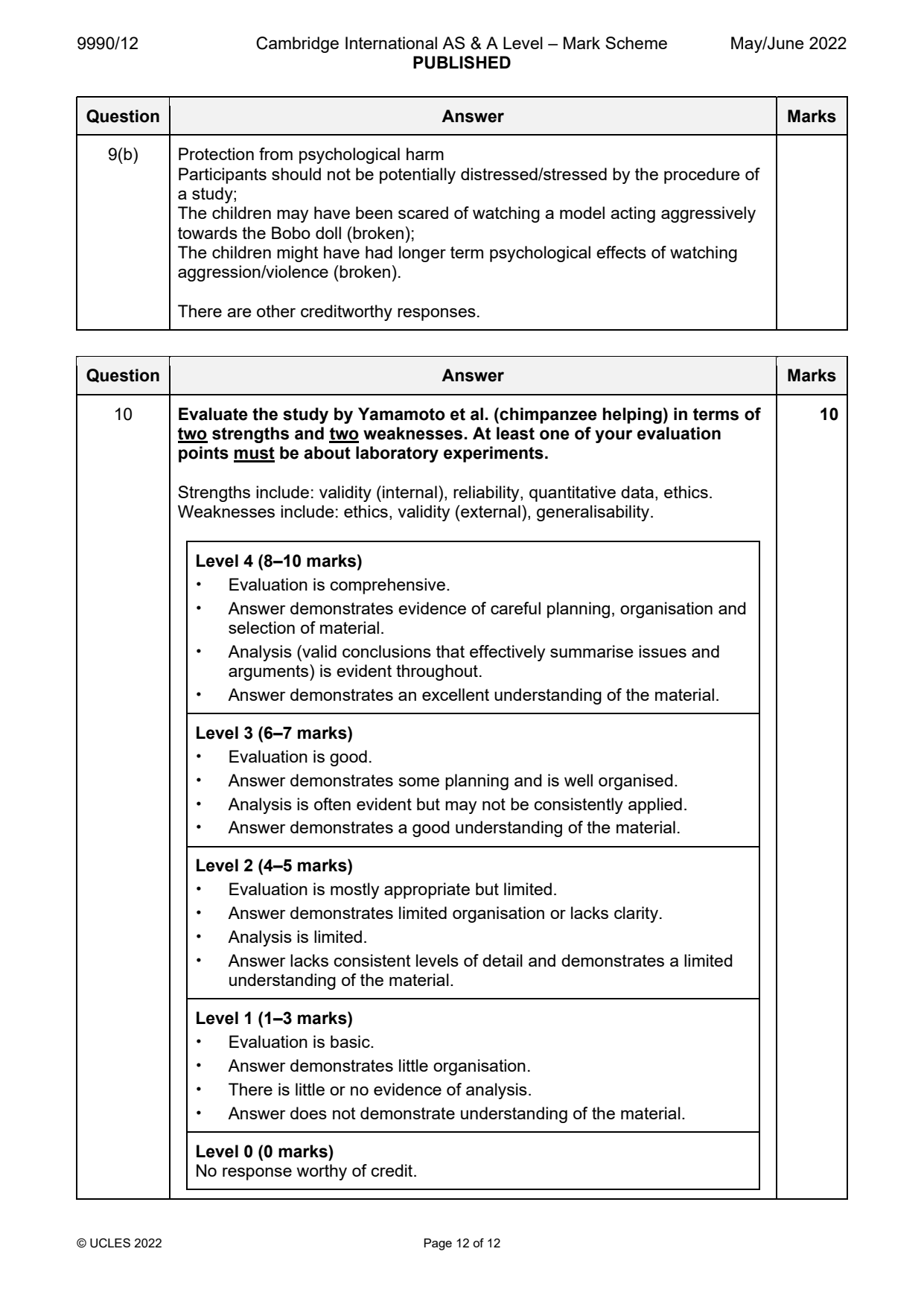
10 Evaluate the study by Yamamoto et al. (chimpanzee helping) in terms of 10
two strengths and two weaknesses. At least one of your evaluation
points must be about laboratory experiments.
Strengths include: validity (internal), reliability, quantitative data, ethics.
Weaknesses include: ethics, validity (external), generalisability.
Level 4 (8–10 marks)
• Evaluation is comprehensive.
• Answer demonstrates evidence of careful planning, organisation and
selection of material.
• Analysis (valid conclusions that effectively summarise issues and
arguments) is evident throughout.
• Answer demonstrates an excellent understanding of the material.
Level 3 (6–7 marks)
• Evaluation is good.
• Answer demonstrates some planning and is well organised.
• Analysis is often evident but may not be consistently applied.
• Answer demonstrates a good understanding of the material.
Level 2 (4–5 marks)
• Evaluation is mostly appropriate but limited.
• Answer demonstrates limited organisation or lacks clarity.
• Analysis is limited.
• Answer lacks consistent levels of detail and demonstrates a limited
understanding of the material.
Level 1 (1–3 marks)
• Evaluation is basic.
• Answer demonstrates little organisation.
• There is little or no evidence of analysis.
• Answer does not demonstrate understanding of the material.
Level 0 (0 marks)
No response worthy of credit.
© UCLES 2022 Page 12 of 12
Official mark scheme pages: 12 · source PDF URL
9990-2022-mj-13-q02
May/June 2022 · Paper 13 · Question 2 · 4 marks
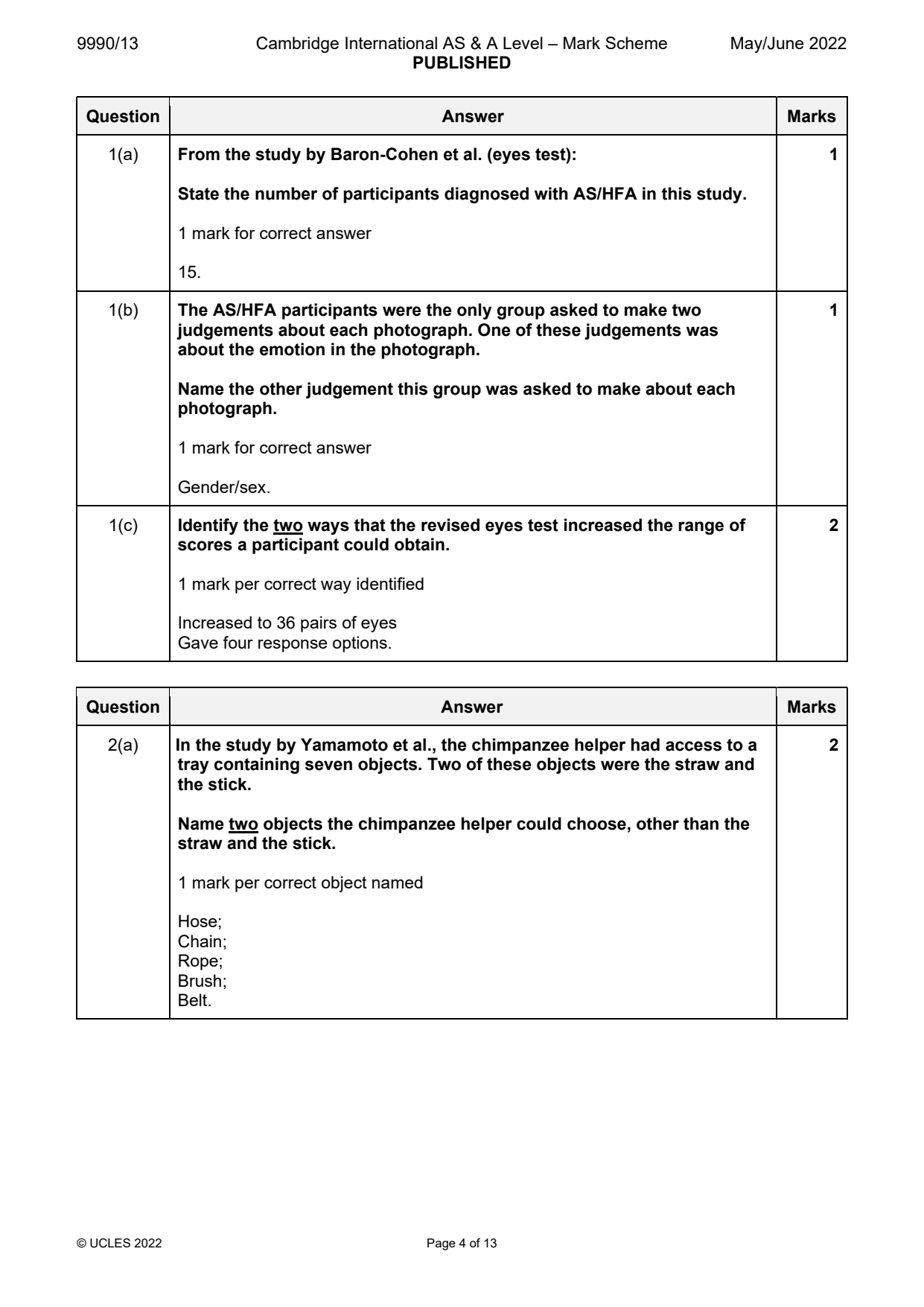
2(a) In the study by Yamamoto et al., the chimpanzee helper had access to a 2
tray containing seven objects. Two of these objects were the straw and
the stick.
Name two objects the chimpanzee helper could choose, other than the
straw and the stick.
1 mark per correct object named
Hose;
Chain;
Rope;
Brush;
Belt.
© UCLES 2022 Page 4 of 13
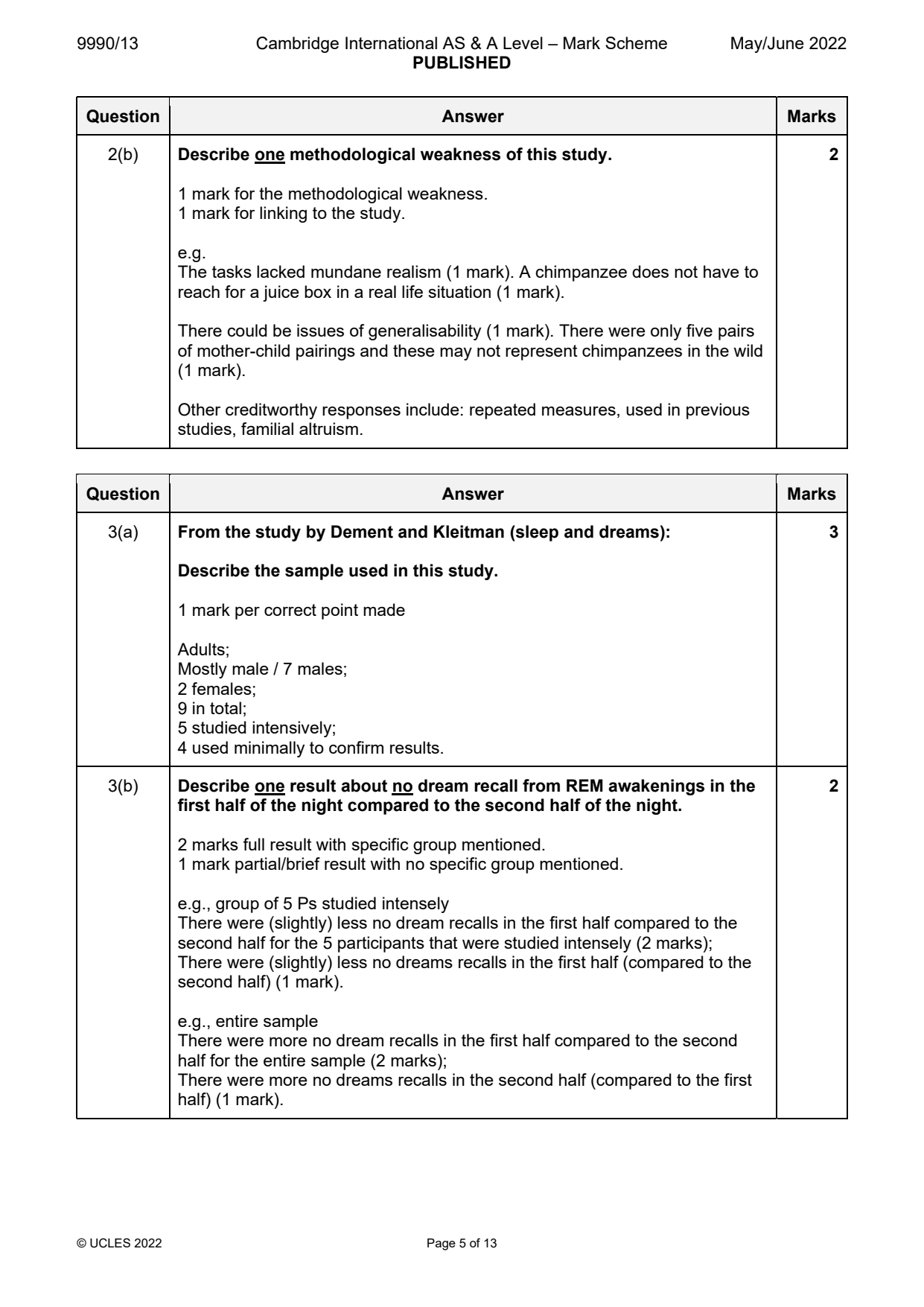
2(b) Describe one methodological weakness of this study. 2
1 mark for the methodological weakness.
1 mark for linking to the study.
e.g.
The tasks lacked mundane realism (1 mark). A chimpanzee does not have to
reach for a juice box in a real life situation (1 mark).
There could be issues of generalisability (1 mark). There were only five pairs
of mother-child pairings and these may not represent chimpanzees in the wild
(1 mark).
Other creditworthy responses include: repeated measures, used in previous
studies, familial altruism.
Question Answer Marks
Official mark scheme pages: 4, 5 · source PDF URL
9990-2022-mj-13-q04
May/June 2022 · Paper 13 · Question 4 · 6 marks
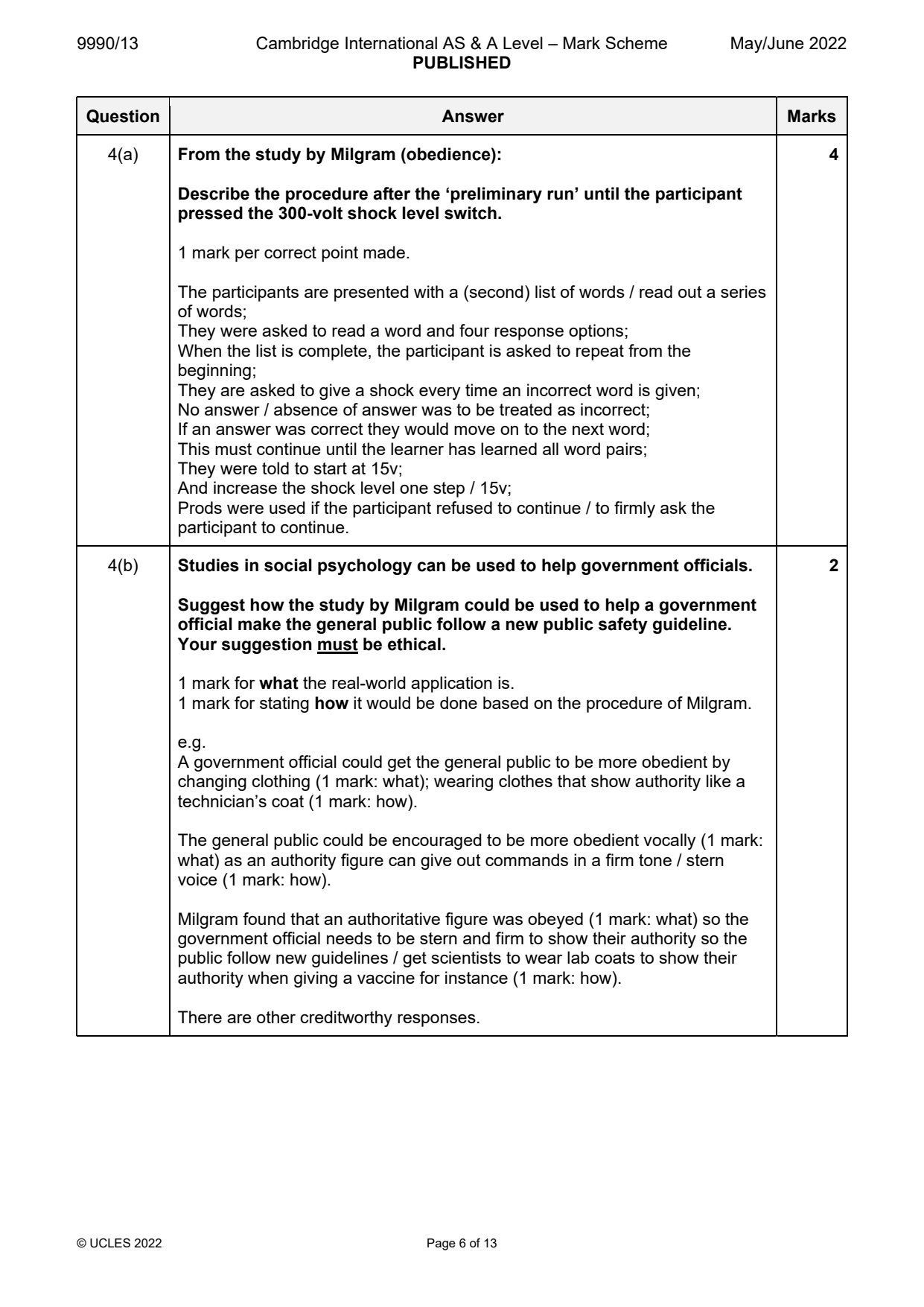
4(a) From the study by Milgram (obedience): 4
Describe the procedure after the ‘preliminary run’ until the participant
pressed the 300-volt shock level switch.
1 mark per correct point made.
The participants are presented with a (second) list of words / read out a series
of words;
They were asked to read a word and four response options;
When the list is complete, the participant is asked to repeat from the
beginning;
They are asked to give a shock every time an incorrect word is given;
No answer / absence of answer was to be treated as incorrect;
If an answer was correct they would move on to the next word;
This must continue until the learner has learned all word pairs;
They were told to start at 15v;
And increase the shock level one step / 15v;
Prods were used if the participant refused to continue / to firmly ask the
participant to continue.
4(b) Studies in social psychology can be used to help government officials. 2
Suggest how the study by Milgram could be used to help a government
official make the general public follow a new public safety guideline.
Your suggestion must be ethical.
1 mark for what the real-world application is.
1 mark for stating how it would be done based on the procedure of Milgram.
e.g.
A government official could get the general public to be more obedient by
changing clothing (1 mark: what); wearing clothes that show authority like a
technician’s coat (1 mark: how).
The general public could be encouraged to be more obedient vocally (1 mark:
what) as an authority figure can give out commands in a firm tone / stern
voice (1 mark: how).
Milgram found that an authoritative figure was obeyed (1 mark: what) so the
government official needs to be stern and firm to show their authority so the
public follow new guidelines / get scientists to wear lab coats to show their
authority when giving a vaccine for instance (1 mark: how).
There are other creditworthy responses.
© UCLES 2022 Page 6 of 13
Official mark scheme pages: 6 · source PDF URL
9990-2022-mj-13-q10
May/June 2022 · Paper 13 · Question 10 · 10 marks
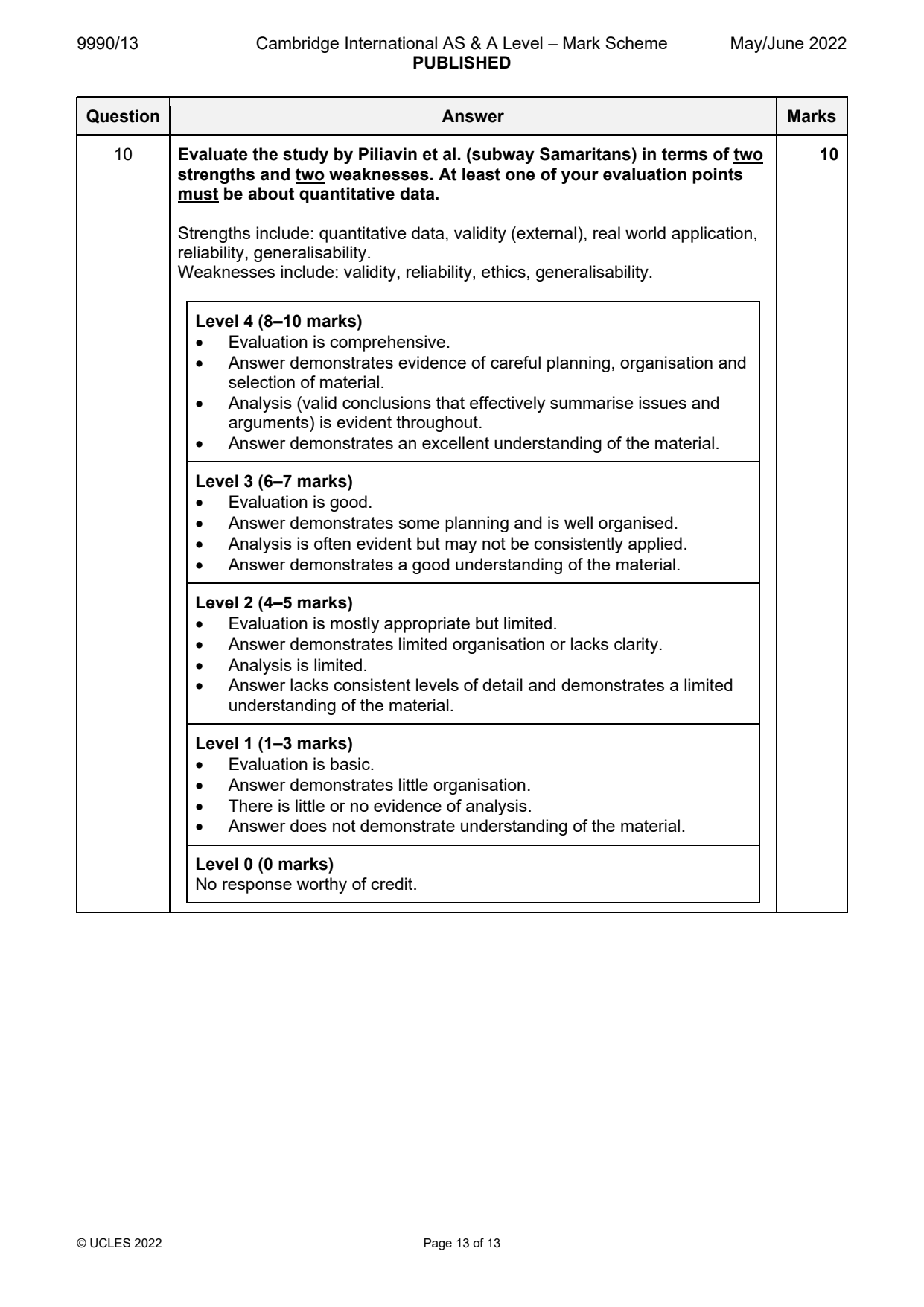
10 Evaluate the study by Piliavin et al. (subway Samaritans) in terms of two 10
strengths and two weaknesses. At least one of your evaluation points
must be about quantitative data.
Strengths include: quantitative data, validity (external), real world application,
reliability, generalisability.
Weaknesses include: validity, reliability, ethics, generalisability.
Level 4 (8–10 marks)
Evaluation is comprehensive.
Answer demonstrates evidence of careful planning, organisation and
selection of material.
Analysis (valid conclusions that effectively summarise issues and
arguments) is evident throughout.
Answer demonstrates an excellent understanding of the material.
Level 3 (6–7 marks)
Evaluation is good.
Answer demonstrates some planning and is well organised.
Analysis is often evident but may not be consistently applied.
Answer demonstrates a good understanding of the material.
Level 2 (4–5 marks)
Evaluation is mostly appropriate but limited.
Answer demonstrates limited organisation or lacks clarity.
Analysis is limited.
Answer lacks consistent levels of detail and demonstrates a limited
understanding of the material.
Level 1 (1–3 marks)
Evaluation is basic.
Answer demonstrates little organisation.
There is little or no evidence of analysis.
Answer does not demonstrate understanding of the material.
Level 0 (0 marks)
No response worthy of credit.
© UCLES 2022 Page 13 of 13
Official mark scheme pages: 13 · source PDF URL
9990-2022-on-11-q05
Oct/Nov 2022 · Paper 11 · Question 5 · 5 marks
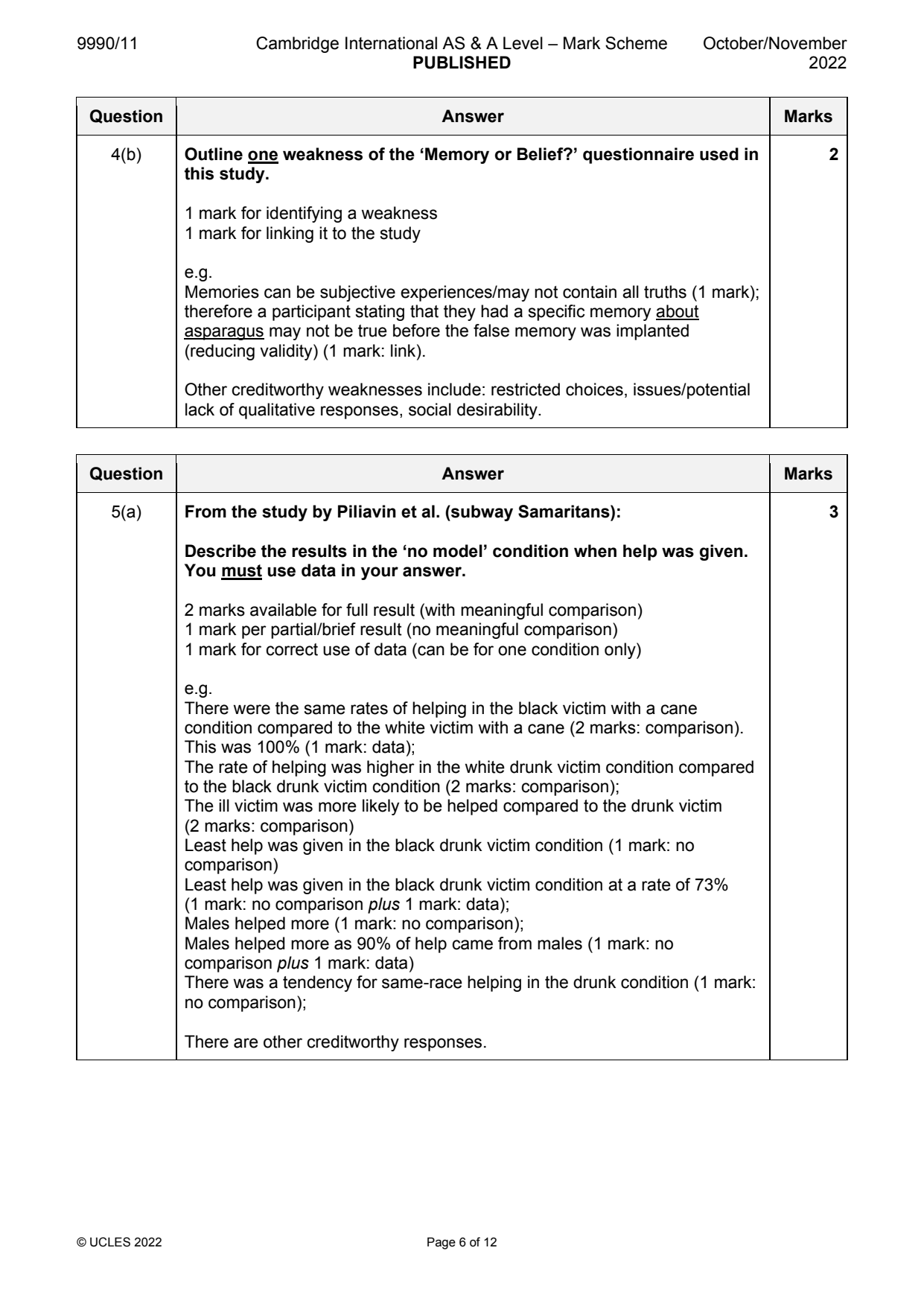
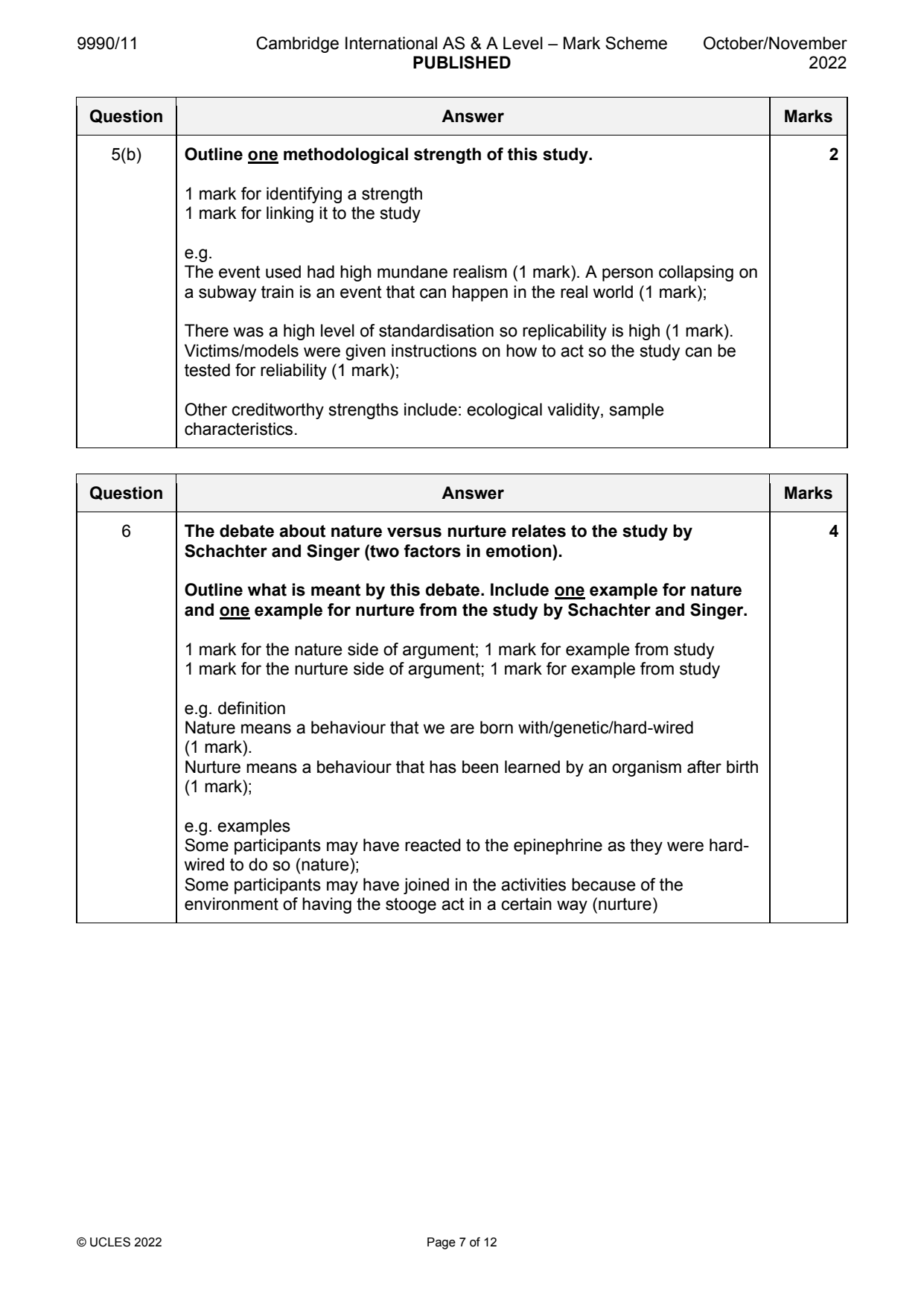
5(a) From the study by Piliavin et al. (subway Samaritans): 3
Describe the results in the ‘no model’ condition when help was given.
You must use data in your answer.
2 marks available for full result (with meaningful comparison)
1 mark per partial/brief result (no meaningful comparison)
1 mark for correct use of data (can be for one condition only)
e.g.
There were the same rates of helping in the black victim with a cane
condition compared to the white victim with a cane (2 marks: comparison).
This was 100% (1 mark: data);
The rate of helping was higher in the white drunk victim condition compared
to the black drunk victim condition (2 marks: comparison);
The ill victim was more likely to be helped compared to the drunk victim
(2 marks: comparison)
Least help was given in the black drunk victim condition (1 mark: no
comparison)
Least help was given in the black drunk victim condition at a rate of 73%
(1 mark: no comparison plus 1 mark: data);
Males helped more (1 mark: no comparison);
Males helped more as 90% of help came from males (1 mark: no
comparison plus 1 mark: data)
There was a tendency for same-race helping in the drunk condition (1 mark:
no comparison);
There are other creditworthy responses.
© UCLES 2022 Page 6 of 12
5(b) Outline one methodological strength of this study. 2
1 mark for identifying a strength
1 mark for linking it to the study
e.g.
The event used had high mundane realism (1 mark). A person collapsing on
a subway train is an event that can happen in the real world (1 mark);
There was a high level of standardisation so replicability is high (1 mark).
Victims/models were given instructions on how to act so the study can be
tested for reliability (1 mark);
Other creditworthy strengths include: ecological validity, sample
characteristics.
Question Answer Marks
Official mark scheme pages: 6, 7 · source PDF URL
9990-2022-on-11-q09
Oct/Nov 2022 · Paper 11 · Question 9 · 12 marks
9(a) Describe the psychology being investigated in the study by Milgram 4
(obedience).
1 mark for each correct statement
Examples from the study Milgram can gain credit (max 1)
e.g.
The study was investigating if obedience is socialised;
Testing out the situational hypothesis of the environment affecting our
behaviour;
Obedience is about how much we follow the orders of an authority figure;
The agentic state refers to when we give up our free will for the good of the
authority figure;
The autonomous state refers to when we follow our own morals and are not
swayed by others;
In this study the effect of prods was looked at to see if people would give an
electric shock to a stranger (example mark);
Moral strain is experienced when we follow an authority figure but do not
agree with it;
© UCLES 2022 Page 10 of 12
9(b) Explain one similarity and one difference between the study by 8
Milgram (obedience) and one other study from the social approach.
4 marks available for the similarity, e.g. ethics, situational, controls,
quantitative data
4 marks available for the difference, e.g. species, setting, participants
Similarity
e.g. 4 marks
Both the Milgram and Piliavin studies have ethical issues of deception. In
the Milgram study, participants believed they were giving real electric
shocks to a complete stranger who could not remember word pairs. In the
Piliavin study, the participants were led to believe that the drunk or ill victim
was actually in need of help.
e.g. 3 marks
Both the Milgram and Piliavin studies have ethical issues of deception. In
the Milgram study, participants believed they were giving real electric
shocks to a complete stranger who could not remember word pairs
e.g. 2 marks
Both the Milgram and Piliavin studies have ethical issues of deception as in
both participants never knew that the scenarios were fake.
e.g. 1 mark
Both the Milgram and Piliavin studies had ethical issues.
Level Descriptor Mark
4 The similarity/difference is well explained using 4 marks
both studies as examples
3 The similarity/difference is well explained but only 3 marks
one study is used as an example OR
both studies used briefly
2 The similarity/difference is brief with an attempt at 2 marks
using at least one study as an example OR
The similarity/difference is well explained but
there is no study evidence
1 The similarity/difference is brief with no attempt at 1 mark
using studies as examples
0 No creditworthy material 0 marks
© UCLES 2022 Page 11 of 12
Official mark scheme pages: 10, 11 · source PDF URL
9990-2022-on-12-q06
Oct/Nov 2022 · Paper 12 · Question 6 · 4 marks
6 The debate about individual and situational explanations relates to the 4
study by Milgram (obedience).
Outline what is meant by this debate. Include one example from the
individual explanation and one example from the situational
explanation from the study by Milgram.
1 mark for the individual side of argument; 1 mark for example from study
1 mark for the situational side of argument; 1 mark for example from study
e.g. definitions
The individual side refers to behaviours from factors within the person
(dispositional);
The situational side refers to behaviour from factors in the external
environment.
e.g. examples
Some participants may have been more obedient because of their
‘personality’ type, e.g. being more submissive (individual);
Some participants refused to continue whilst others went to 450 v
(individual);
Some participants may have been more obedient because of the
experiment or prods given to make them continue shocking (situational);
Some participants may have been more obedient due to the presence of an
authority figure (situational).
There are other creditworthy examples.
© UCLES 2022 Page 9 of 14
Official mark scheme pages: 9 · source PDF URL
9990-2022-on-12-q08
Oct/Nov 2022 · Paper 12 · Question 8 · 6 marks
8(a) From the study by Piliavin et al. (subway Samaritans): 2
Name two features of the sample in this study.
1 mark per correct feature:
About 4450 participants;
New York City;
Subway passengers;
45% black / 55% white;
Opportunity sampled;
Mean number of people per car was 43.
8(b) Two friends, Saad and Amina, are discussing this study in terms of 4
generalisability.
Saad believes the study does have generalisability but Amina believes
the study does not have generalisability.
Outline why you think either Saad or Amina is correct, using evidence
from the study.
1 mark per point made, with:
Up to 2 marks for any relevant information from the study / facts about the
sample.
Up to 3 marks for explanation(s), including who can/cannot be generalised
to.
e.g. Saad
There was a very large amount of people who were participants / 4450
participants (1 mark: information) representing a potential wide range of
occupations/cultures/background (1 mark: information) so they could easily
represent the helping behaviour of many other different people (1 mark:
explanation).
The sample was large with both genders represented (1 mark: information).
e.g. Amina
They were all from one location on a subway (1 mark: information) which is
restrictive in terms of the type of people used in the sample (1 mark:
explanation). It might be that the results only apply to subway passengers
and not rural-living people (1 mark: explanation) and it is possible that the
same people were ‘regulars’ on this route (1 mark: explanation).
They only used a sample from New York/Bronx (1 mark: information) so this
may not represent the helping behaviour of people with different cultural
customs (1 mark: explanation).
They only used victims that were black or white (1 mark: information).
The victims were only males (1 mark: information).
© UCLES 2022 Page 11 of 14
Official mark scheme pages: 11 · source PDF URL
9990-2022-on-13-q06
Oct/Nov 2022 · Paper 13 · Question 6 · 4 marks
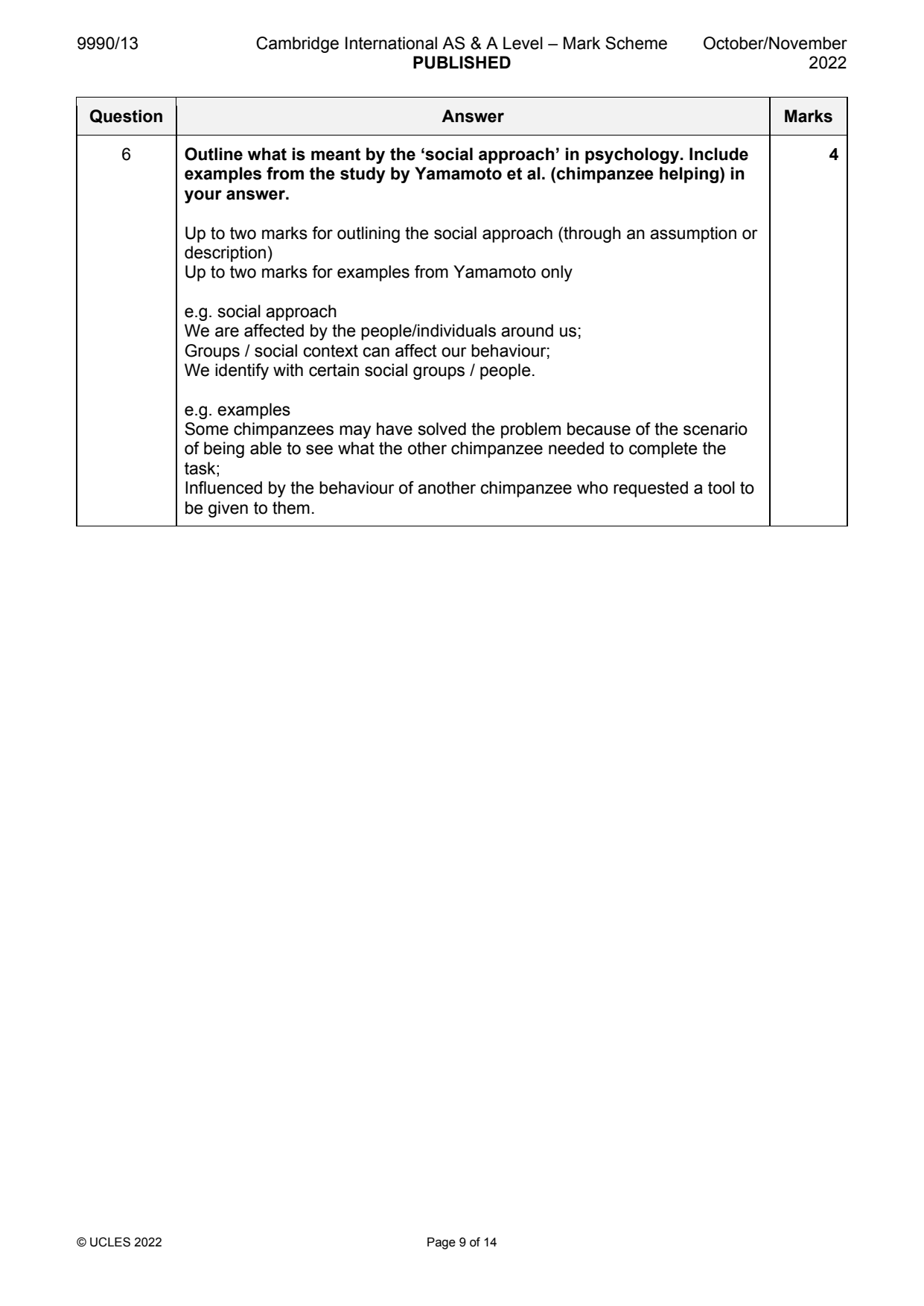
6 Outline what is meant by the ‘social approach’ in psychology. Include 4
examples from the study by Yamamoto et al. (chimpanzee helping) in
your answer.
Up to two marks for outlining the social approach (through an assumption or
description)
Up to two marks for examples from Yamamoto only
e.g. social approach
We are affected by the people/individuals around us;
Groups / social context can affect our behaviour;
We identify with certain social groups / people.
e.g. examples
Some chimpanzees may have solved the problem because of the scenario
of being able to see what the other chimpanzee needed to complete the
task;
Influenced by the behaviour of another chimpanzee who requested a tool to
be given to them.
© UCLES 2022 Page 9 of 14
Official mark scheme pages: 9 · source PDF URL
9990-2022-on-13-q10
Oct/Nov 2022 · Paper 13 · Question 10 · 10 marks
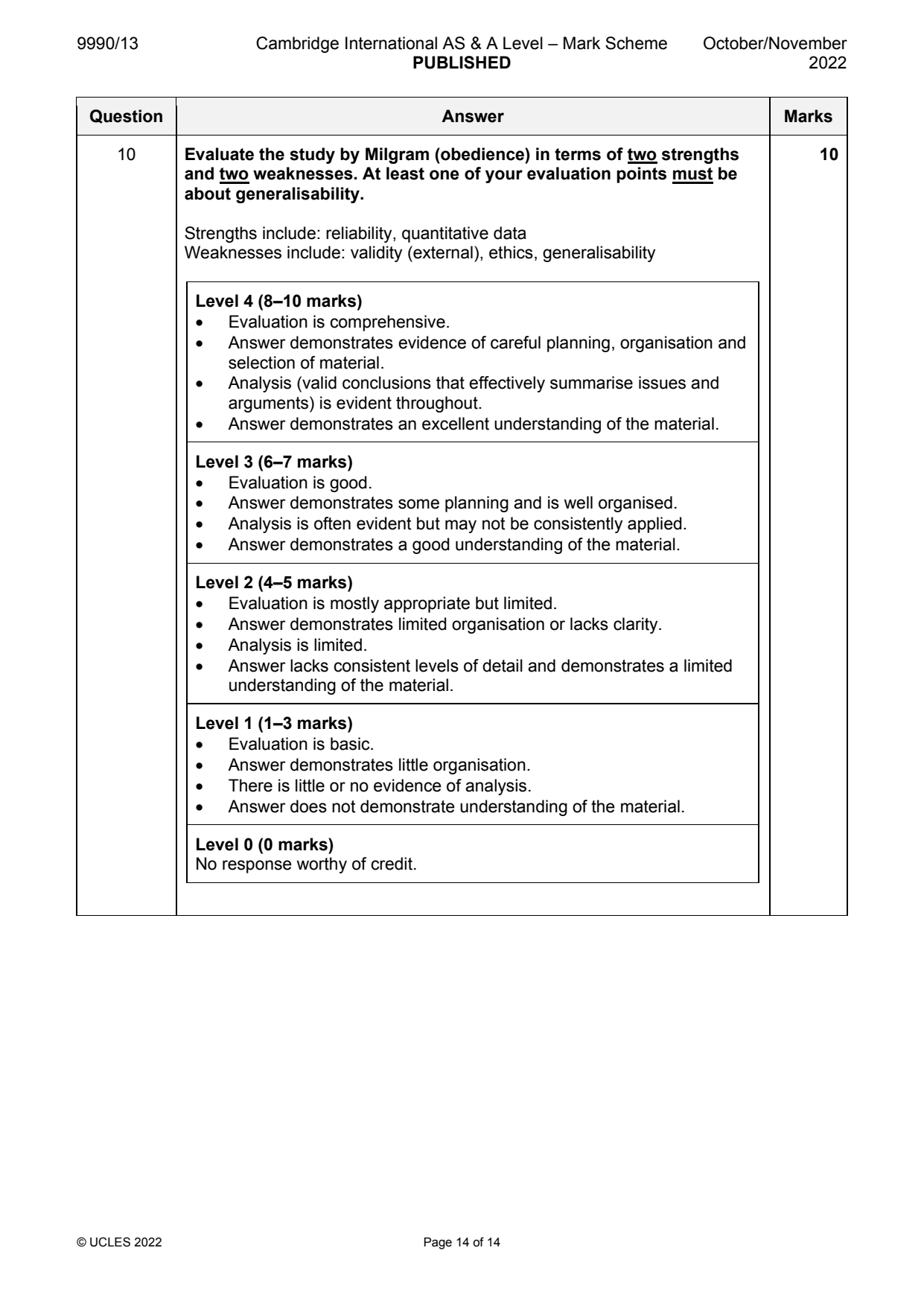
10 Evaluate the study by Milgram (obedience) in terms of two strengths 10
and two weaknesses. At least one of your evaluation points must be
about generalisability.
Strengths include: reliability, quantitative data
Weaknesses include: validity (external), ethics, generalisability
Level 4 (8–10 marks)
• Evaluation is comprehensive.
• Answer demonstrates evidence of careful planning, organisation and
selection of material.
• Analysis (valid conclusions that effectively summarise issues and
arguments) is evident throughout.
• Answer demonstrates an excellent understanding of the material.
Level 3 (6–7 marks)
• Evaluation is good.
• Answer demonstrates some planning and is well organised.
• Analysis is often evident but may not be consistently applied.
• Answer demonstrates a good understanding of the material.
Level 2 (4–5 marks)
• Evaluation is mostly appropriate but limited.
• Answer demonstrates limited organisation or lacks clarity.
• Analysis is limited.
• Answer lacks consistent levels of detail and demonstrates a limited
understanding of the material.
Level 1 (1–3 marks)
• Evaluation is basic.
• Answer demonstrates little organisation.
• There is little or no evidence of analysis.
• Answer does not demonstrate understanding of the material.
Level 0 (0 marks)
No response worthy of credit.
© UCLES 2022 Page 14 of 14
Official mark scheme pages: 14 · source PDF URL
9990-2023-mj-11-q04
May/June 2023 · Paper 11 · Question 4 · 6 marks
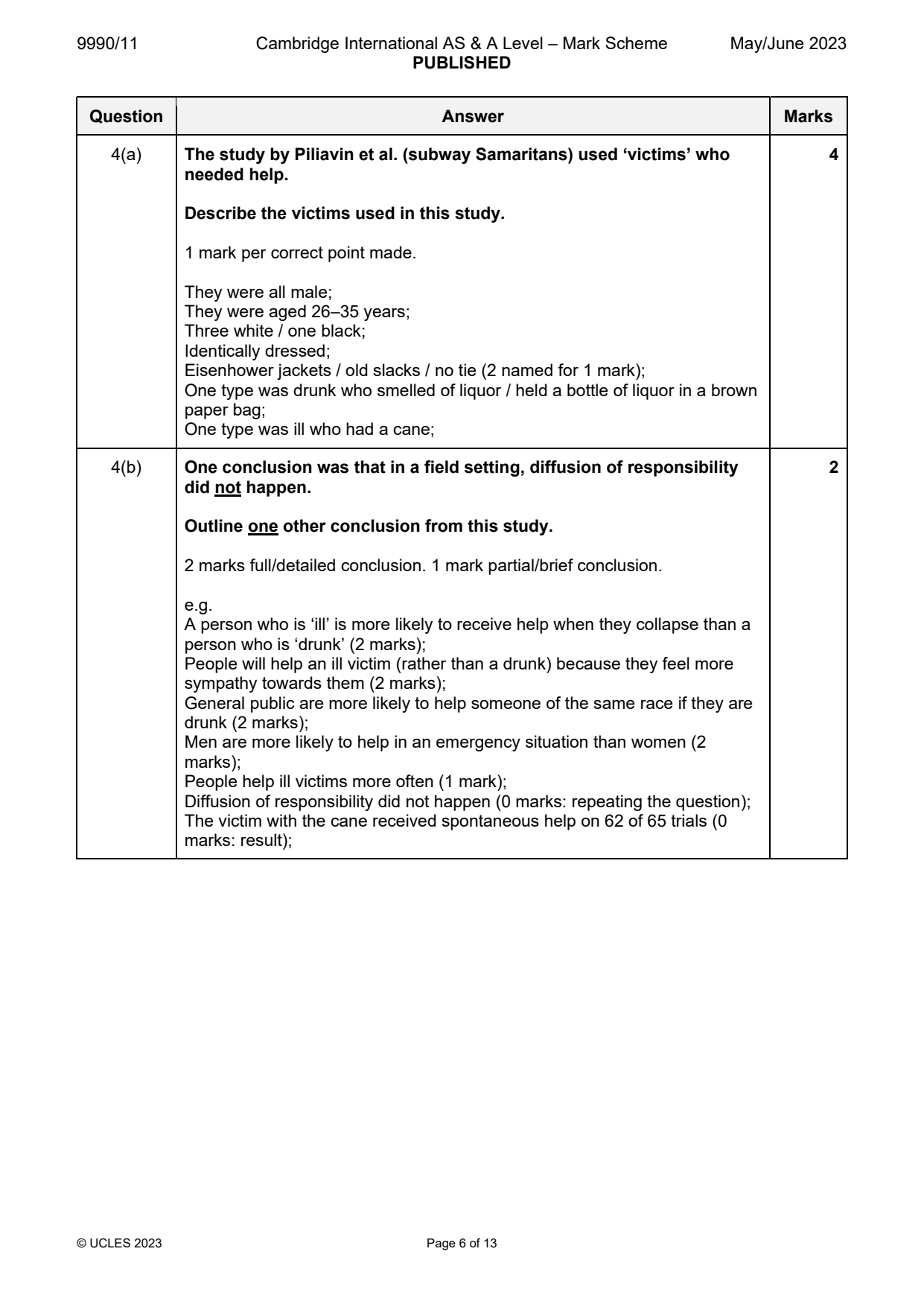
4(a) The study by Piliavin et al. (subway Samaritans) used ‘victims’ who 4
needed help.
Describe the victims used in this study.
1 mark per correct point made.
They were all male;
They were aged 26–35 years;
Three white / one black;
Identically dressed;
Eisenhower jackets / old slacks / no tie (2 named for 1 mark);
One type was drunk who smelled of liquor / held a bottle of liquor in a brown
paper bag;
One type was ill who had a cane;
4(b) One conclusion was that in a field setting, diffusion of responsibility 2
did not happen.
Outline one other conclusion from this study.
2 marks full/detailed conclusion. 1 mark partial/brief conclusion.
e.g.
A person who is ‘ill’ is more likely to receive help when they collapse than a
person who is ‘drunk’ (2 marks);
People will help an ill victim (rather than a drunk) because they feel more
sympathy towards them (2 marks);
General public are more likely to help someone of the same race if they are
drunk (2 marks);
Men are more likely to help in an emergency situation than women (2
marks);
People help ill victims more often (1 mark);
Diffusion of responsibility did not happen (0 marks: repeating the question);
The victim with the cane received spontaneous help on 62 of 65 trials (0
marks: result);
© UCLES 2023 Page 6 of 13
Official mark scheme pages: 6 · source PDF URL
9990-2023-mj-11-q07
May/June 2023 · Paper 11 · Question 7 · 4 marks
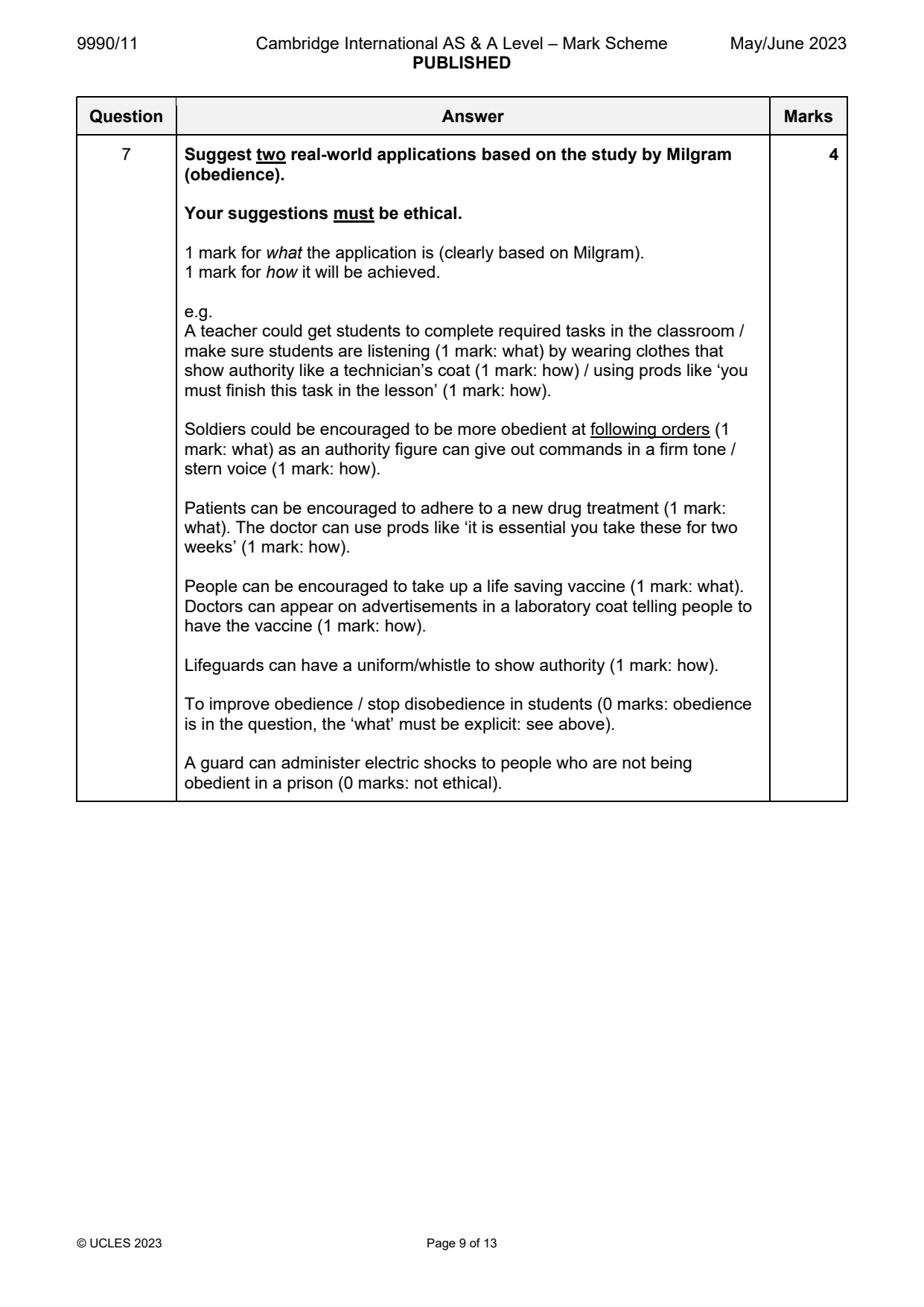
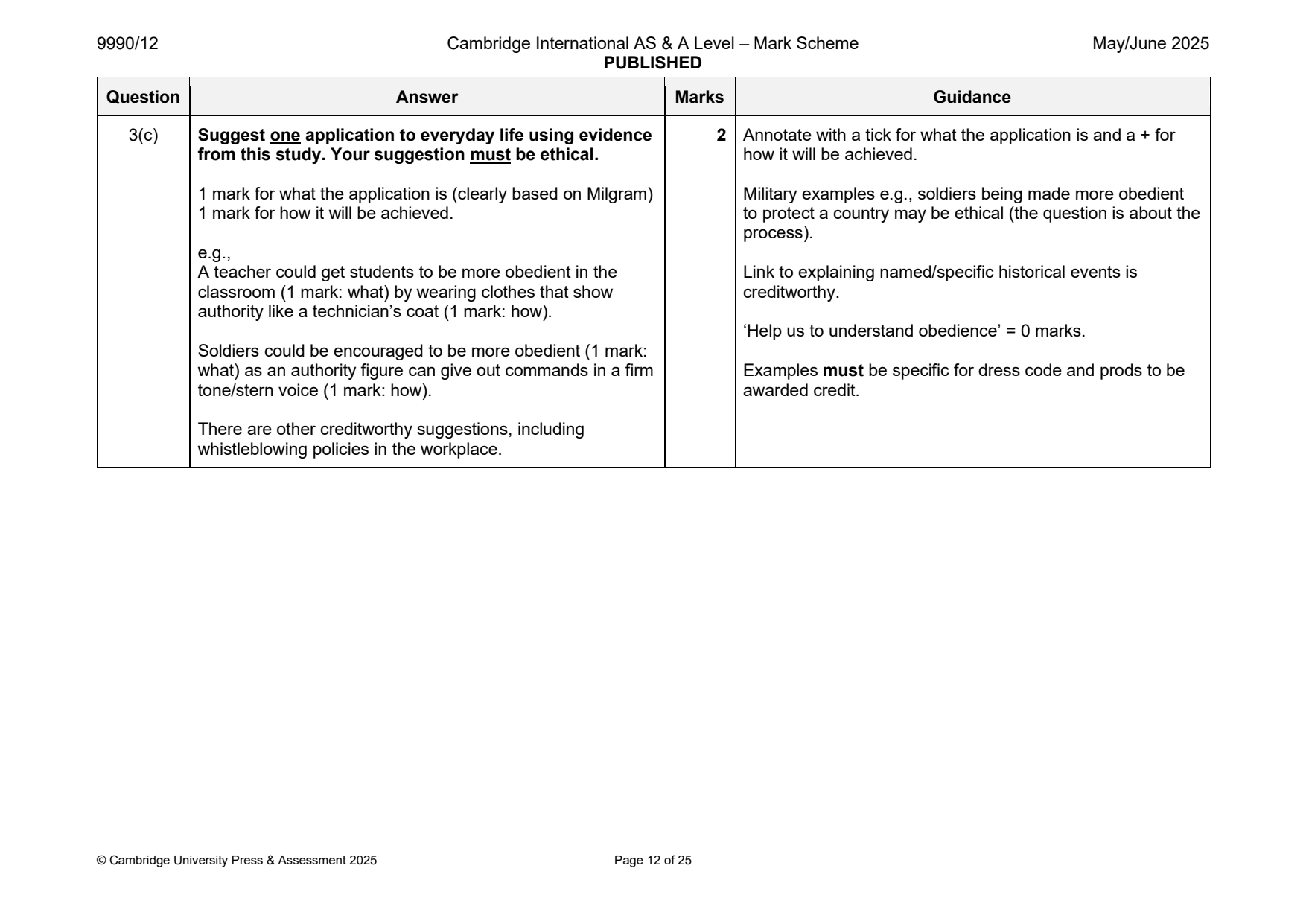
7 Suggest two real-world applications based on the study by Milgram 4
(obedience).
Your suggestions must be ethical.
1 mark for what the application is (clearly based on Milgram).
1 mark for how it will be achieved.
e.g.
A teacher could get students to complete required tasks in the classroom /
make sure students are listening (1 mark: what) by wearing clothes that
show authority like a technician’s coat (1 mark: how) / using prods like ‘you
must finish this task in the lesson’ (1 mark: how).
Soldiers could be encouraged to be more obedient at following orders (1
mark: what) as an authority figure can give out commands in a firm tone /
stern voice (1 mark: how).
Patients can be encouraged to adhere to a new drug treatment (1 mark:
what). The doctor can use prods like ‘it is essential you take these for two
weeks’ (1 mark: how).
People can be encouraged to take up a life saving vaccine (1 mark: what).
Doctors can appear on advertisements in a laboratory coat telling people to
have the vaccine (1 mark: how).
Lifeguards can have a uniform/whistle to show authority (1 mark: how).
To improve obedience / stop disobedience in students (0 marks: obedience
is in the question, the ‘what’ must be explicit: see above).
A guard can administer electric shocks to people who are not being
obedient in a prison (0 marks: not ethical).
© UCLES 2023 Page 9 of 13
Official mark scheme pages: 9 · source PDF URL
9990-2023-mj-12-q06
May/June 2023 · Paper 12 · Question 6 · 6 marks
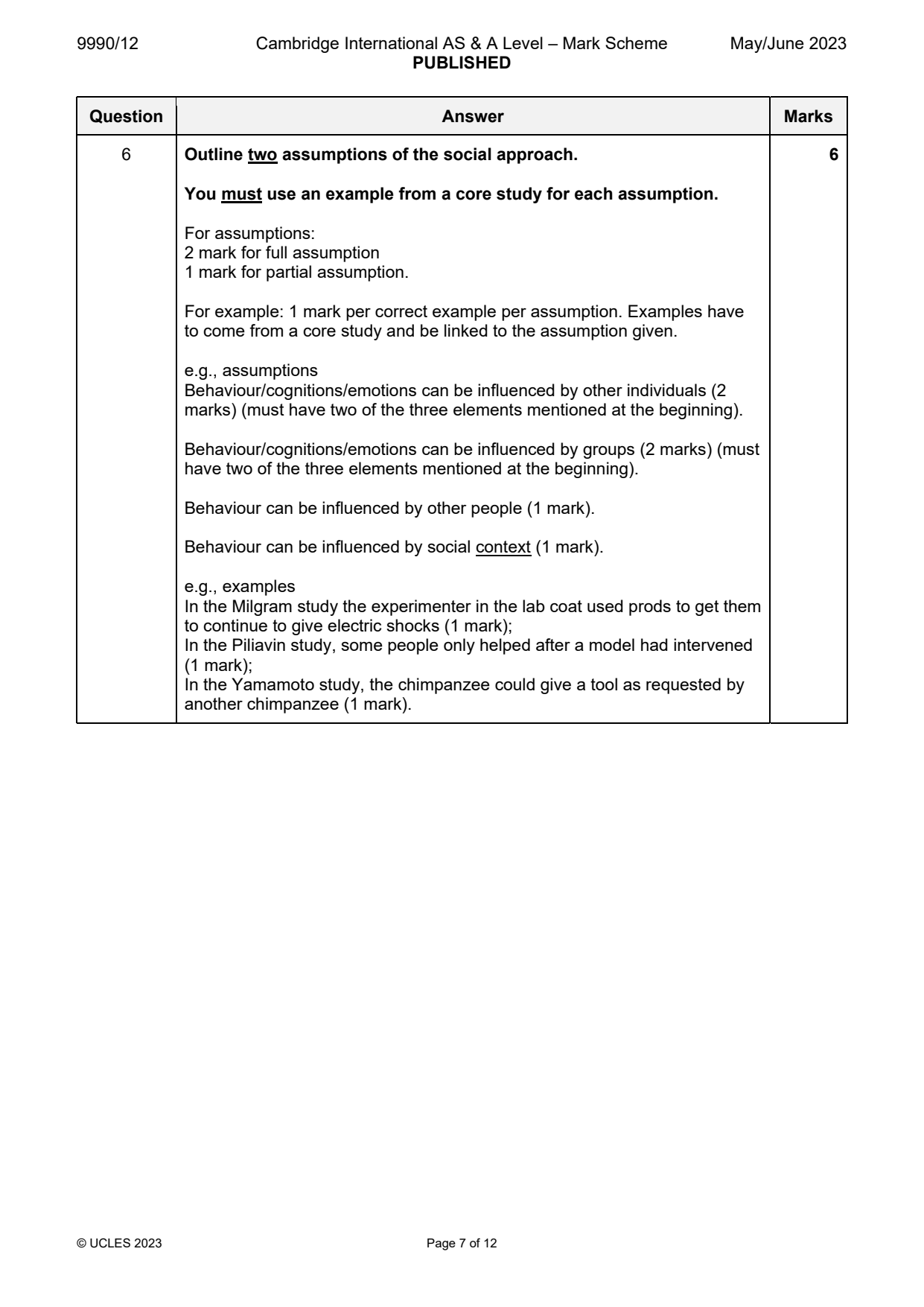
6 Outline two assumptions of the social approach. 6
You must use an example from a core study for each assumption.
For assumptions:
2 mark for full assumption
1 mark for partial assumption.
For example: 1 mark per correct example per assumption. Examples have
to come from a core study and be linked to the assumption given.
e.g., assumptions
Behaviour/cognitions/emotions can be influenced by other individuals (2
marks) (must have two of the three elements mentioned at the beginning).
Behaviour/cognitions/emotions can be influenced by groups (2 marks) (must
have two of the three elements mentioned at the beginning).
Behaviour can be influenced by other people (1 mark).
Behaviour can be influenced by social context (1 mark).
e.g., examples
In the Milgram study the experimenter in the lab coat used prods to get them
to continue to give electric shocks (1 mark);
In the Piliavin study, some people only helped after a model had intervened
(1 mark);
In the Yamamoto study, the chimpanzee could give a tool as requested by
another chimpanzee (1 mark).
© UCLES 2023 Page 7 of 12
Official mark scheme pages: 7 · source PDF URL
9990-2023-mj-12-q08
May/June 2023 · Paper 12 · Question 8 · 6 marks
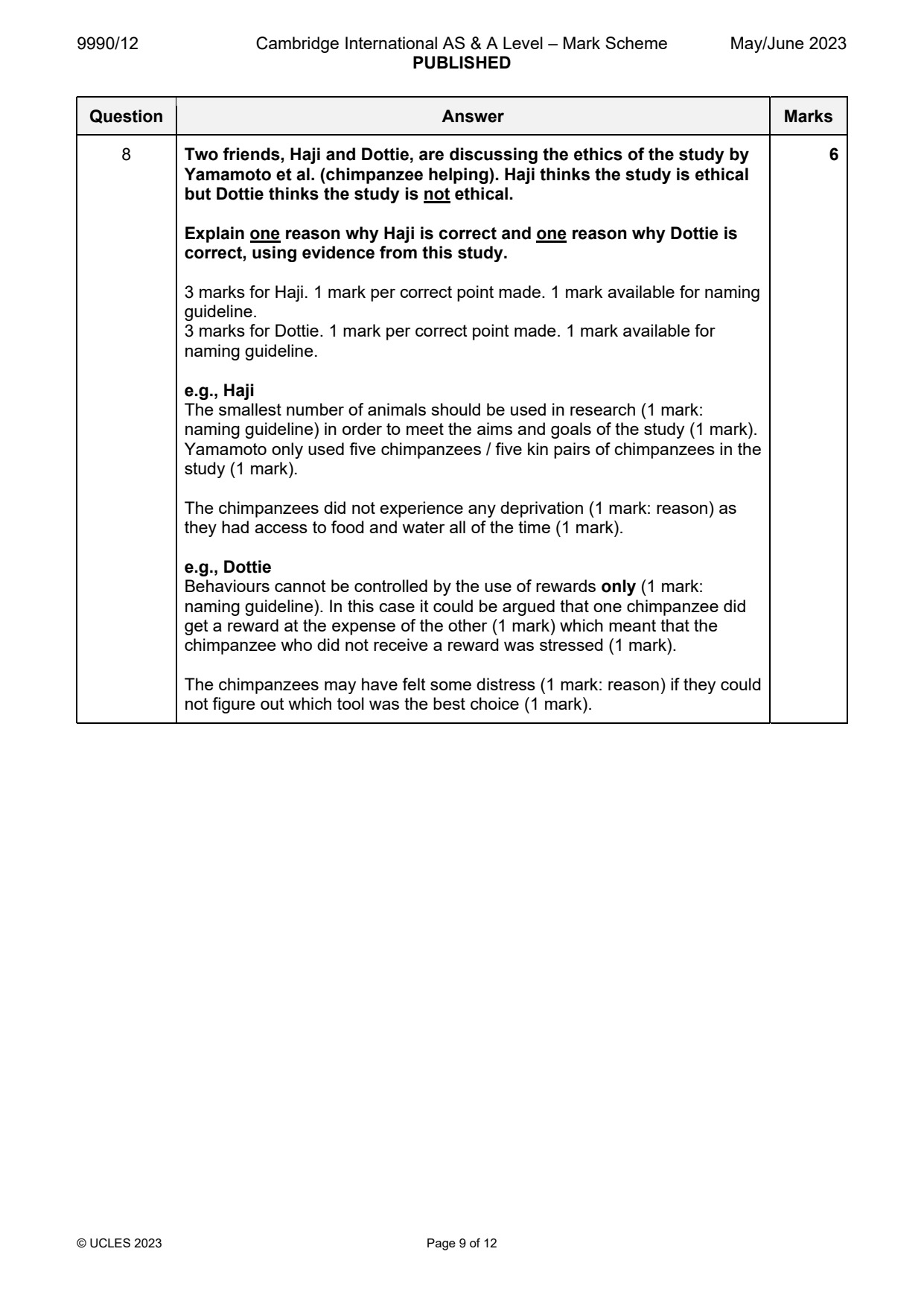
8 Two friends, Haji and Dottie, are discussing the ethics of the study by 6
Yamamoto et al. (chimpanzee helping). Haji thinks the study is ethical
but Dottie thinks the study is not ethical.
Explain one reason why Haji is correct and one reason why Dottie is
correct, using evidence from this study.
3 marks for Haji. 1 mark per correct point made. 1 mark available for naming
guideline.
3 marks for Dottie. 1 mark per correct point made. 1 mark available for
naming guideline.
e.g., Haji
The smallest number of animals should be used in research (1 mark:
naming guideline) in order to meet the aims and goals of the study (1 mark).
Yamamoto only used five chimpanzees / five kin pairs of chimpanzees in the
study (1 mark).
The chimpanzees did not experience any deprivation (1 mark: reason) as
they had access to food and water all of the time (1 mark).
e.g., Dottie
Behaviours cannot be controlled by the use of rewards only (1 mark:
naming guideline). In this case it could be argued that one chimpanzee did
get a reward at the expense of the other (1 mark) which meant that the
chimpanzee who did not receive a reward was stressed (1 mark).
The chimpanzees may have felt some distress (1 mark: reason) if they could
not figure out which tool was the best choice (1 mark).
© UCLES 2023 Page 9 of 12
Official mark scheme pages: 9 · source PDF URL
9990-2023-mj-13-q02
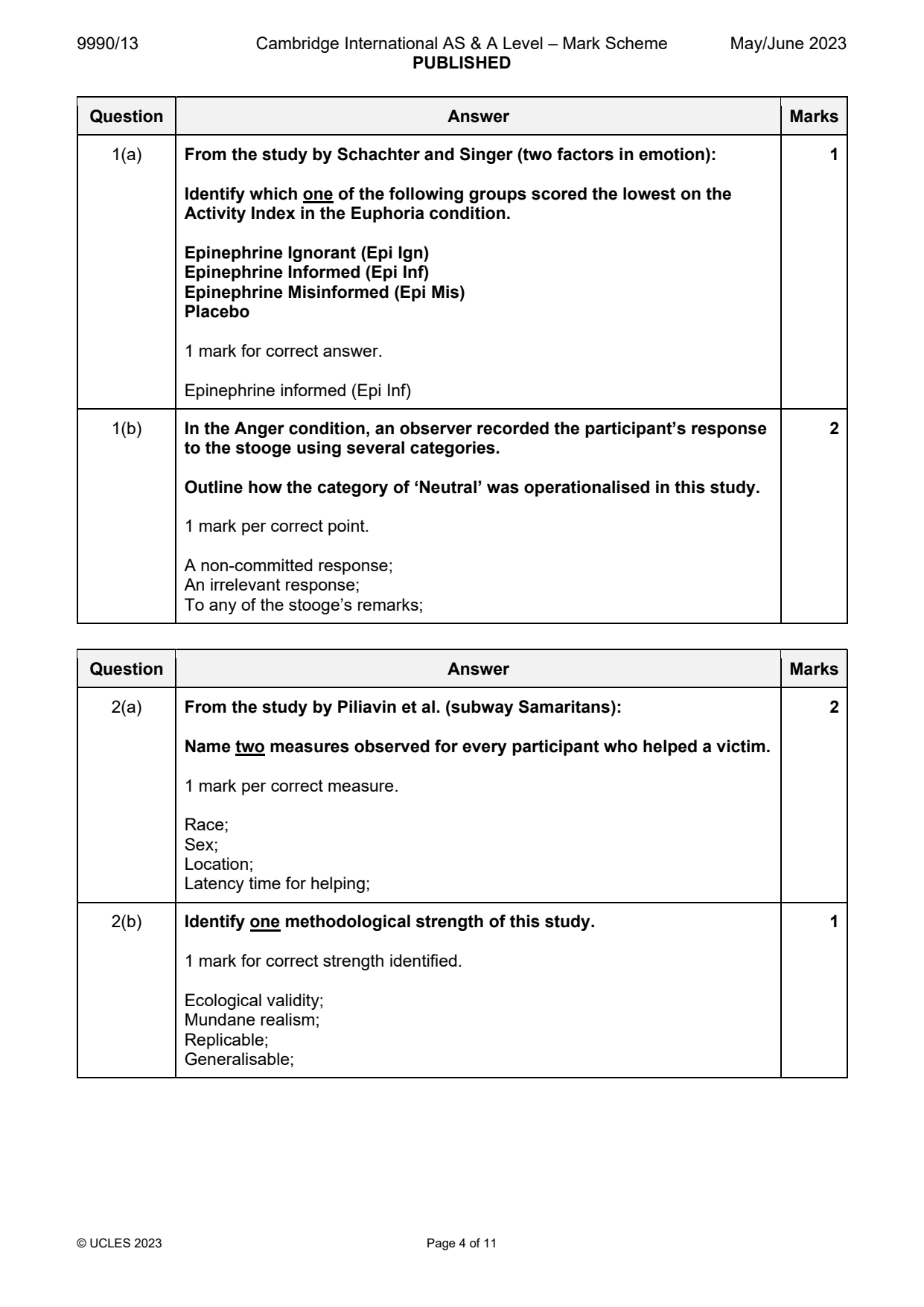
May/June 2023 · Paper 13 · Question 2 · 3 marks
2(a) From the study by Piliavin et al. (subway Samaritans): 2
Name two measures observed for every participant who helped a victim.
1 mark per correct measure.
Race;
Sex;
Location;
Latency time for helping;
2(b) Identify one methodological strength of this study. 1
1 mark for correct strength identified.
Ecological validity;
Mundane realism;
Replicable;
Generalisable;
© UCLES 2023 Page 4 of 11
Official mark scheme pages: 4 · source PDF URL
9990-2023-mj-13-q04
May/June 2023 · Paper 13 · Question 4 · 6 marks
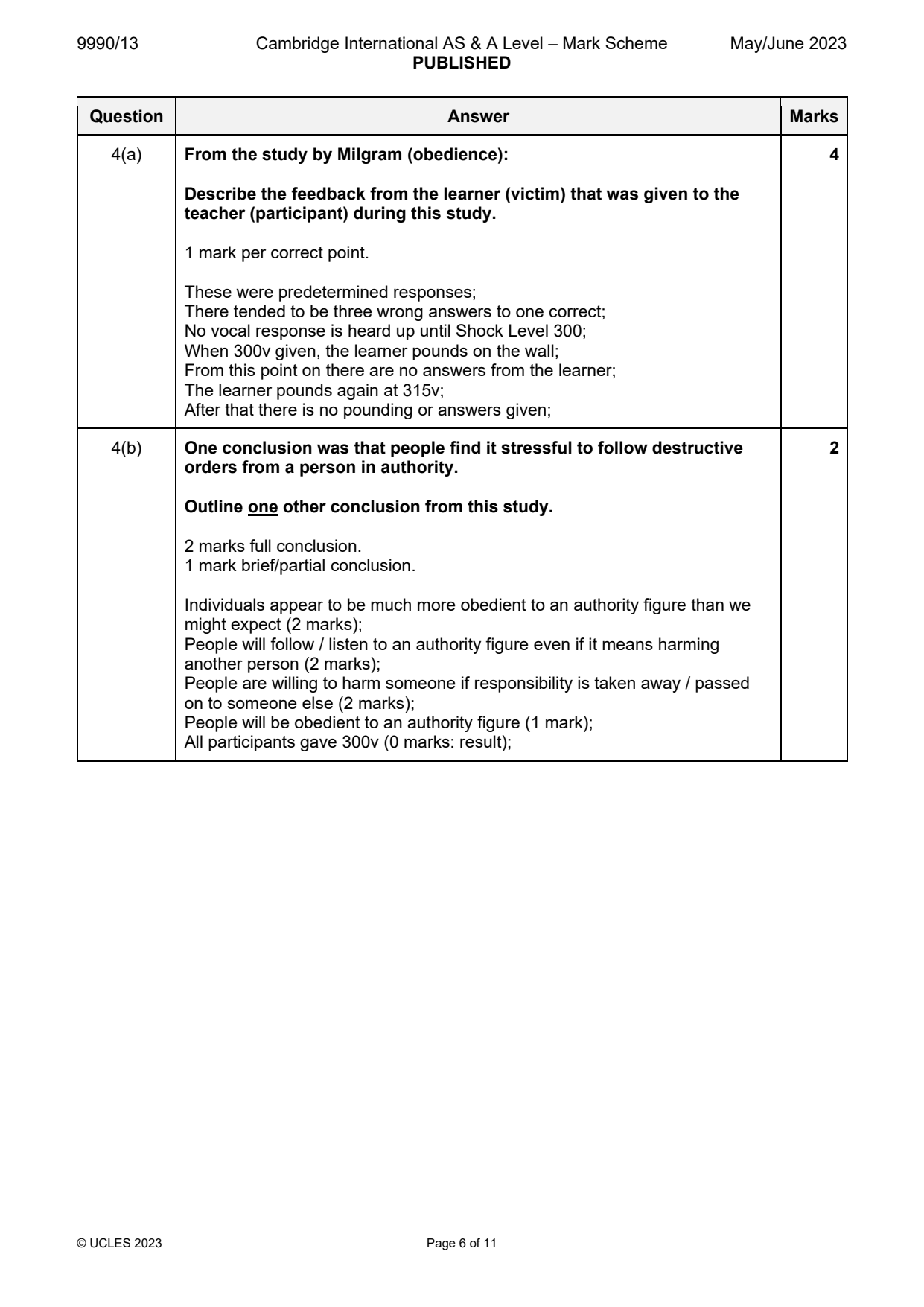
4(a) From the study by Milgram (obedience): 4
Describe the feedback from the learner (victim) that was given to the
teacher (participant) during this study.
1 mark per correct point.
These were predetermined responses;
There tended to be three wrong answers to one correct;
No vocal response is heard up until Shock Level 300;
When 300v given, the learner pounds on the wall;
From this point on there are no answers from the learner;
The learner pounds again at 315v;
After that there is no pounding or answers given;
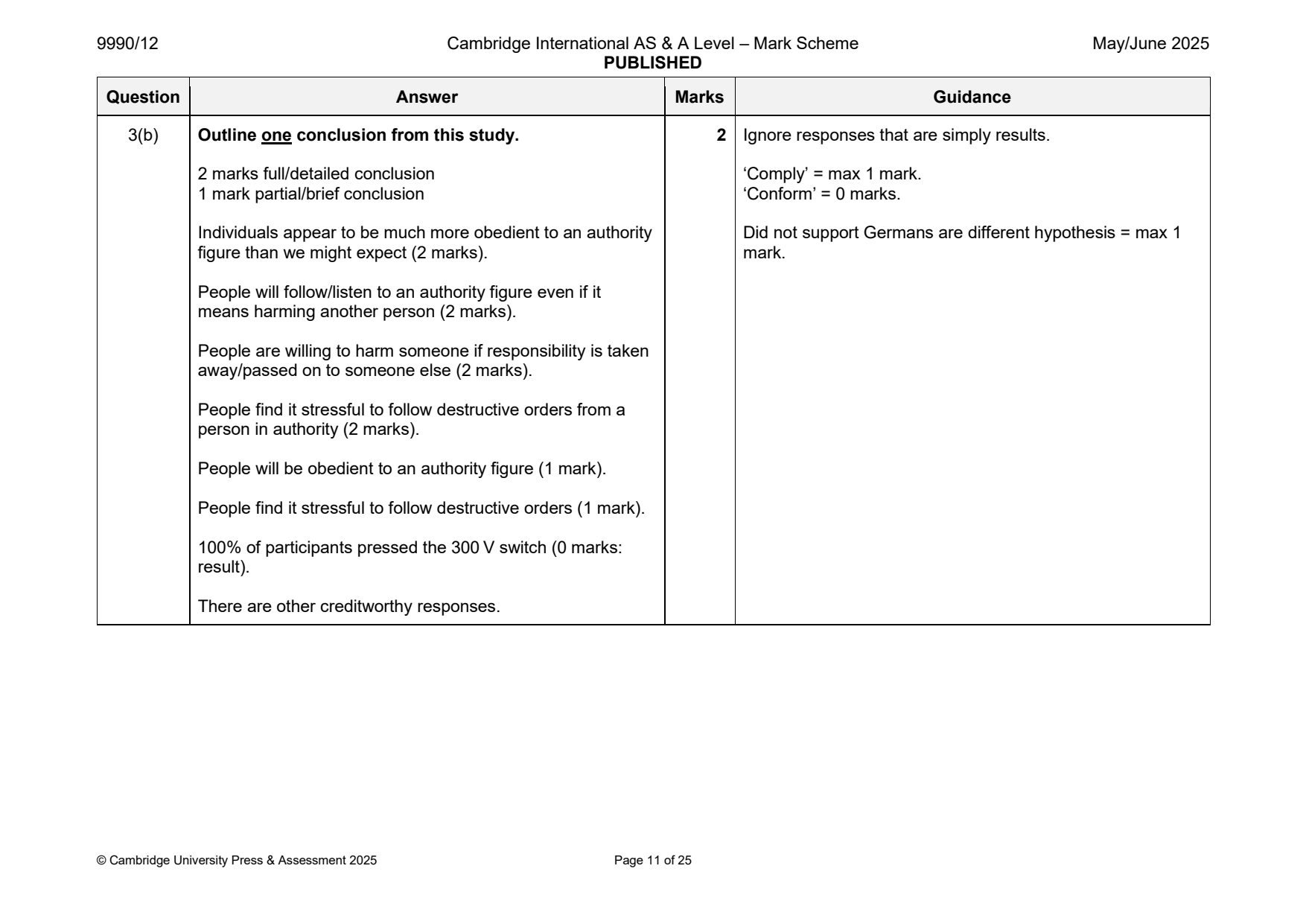
4(b) One conclusion was that people find it stressful to follow destructive 2
orders from a person in authority.
Outline one other conclusion from this study.
2 marks full conclusion.
1 mark brief/partial conclusion.
Individuals appear to be much more obedient to an authority figure than we
might expect (2 marks);
People will follow / listen to an authority figure even if it means harming
another person (2 marks);
People are willing to harm someone if responsibility is taken away / passed
on to someone else (2 marks);
People will be obedient to an authority figure (1 mark);
All participants gave 300v (0 marks: result);
© UCLES 2023 Page 6 of 11
Official mark scheme pages: 6 · source PDF URL
9990-2023-on-11-q02
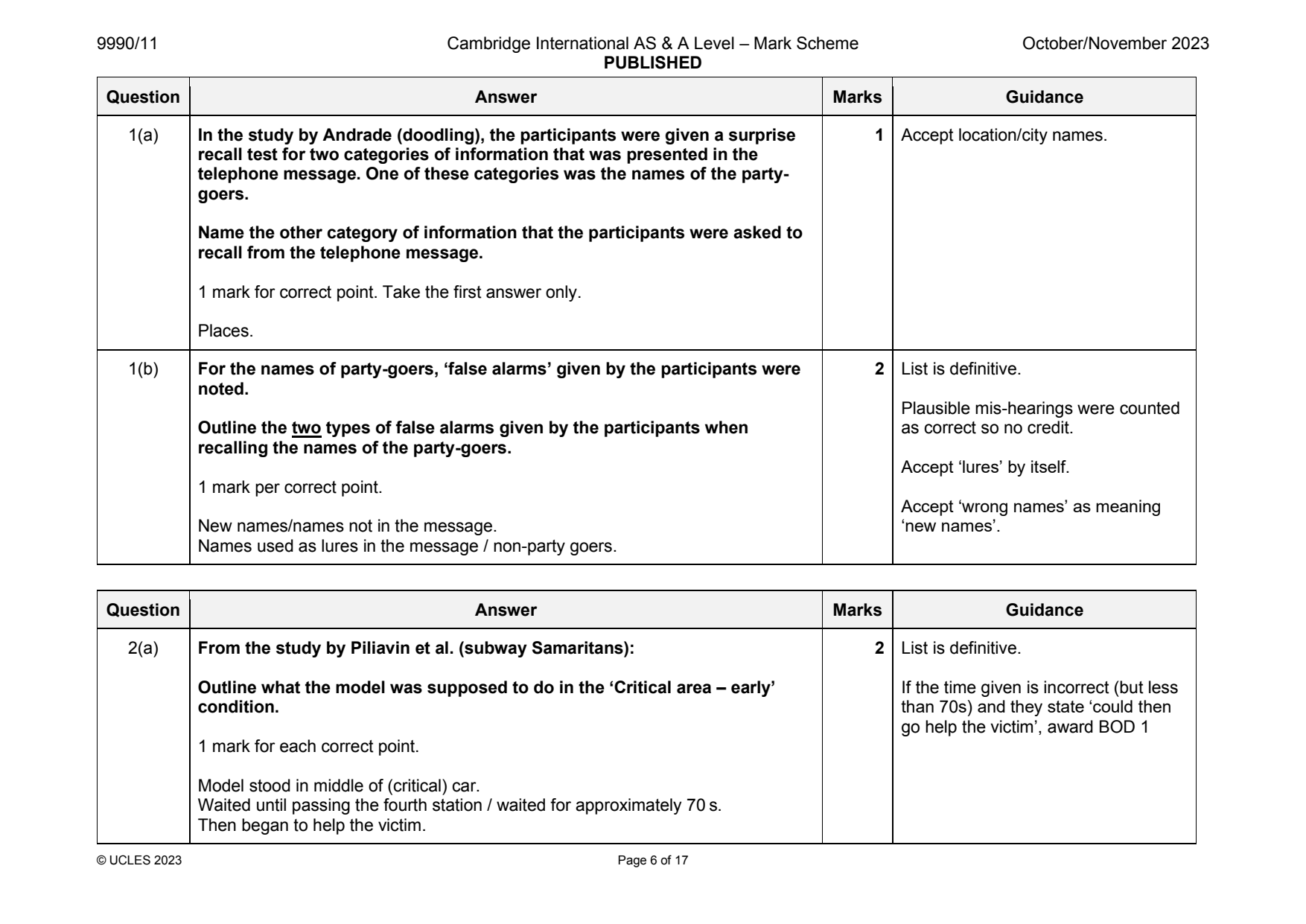
Oct/Nov 2023 · Paper 11 · Question 2 · 4 marks
2(a) From the study by Piliavin et al. (subway Samaritans): 2 List is definitive.
Outline what the model was supposed to do in the ‘Critical area – early’ If the time given is incorrect (but less
condition. than 70s) and they state ‘could then
go help the victim’, award BOD 1
1 mark for each correct point.
Model stood in middle of (critical) car.
Waited until passing the fourth station / waited for approximately 70 s.
Then began to help the victim.
© UCLES 2023 Page 6 of 17
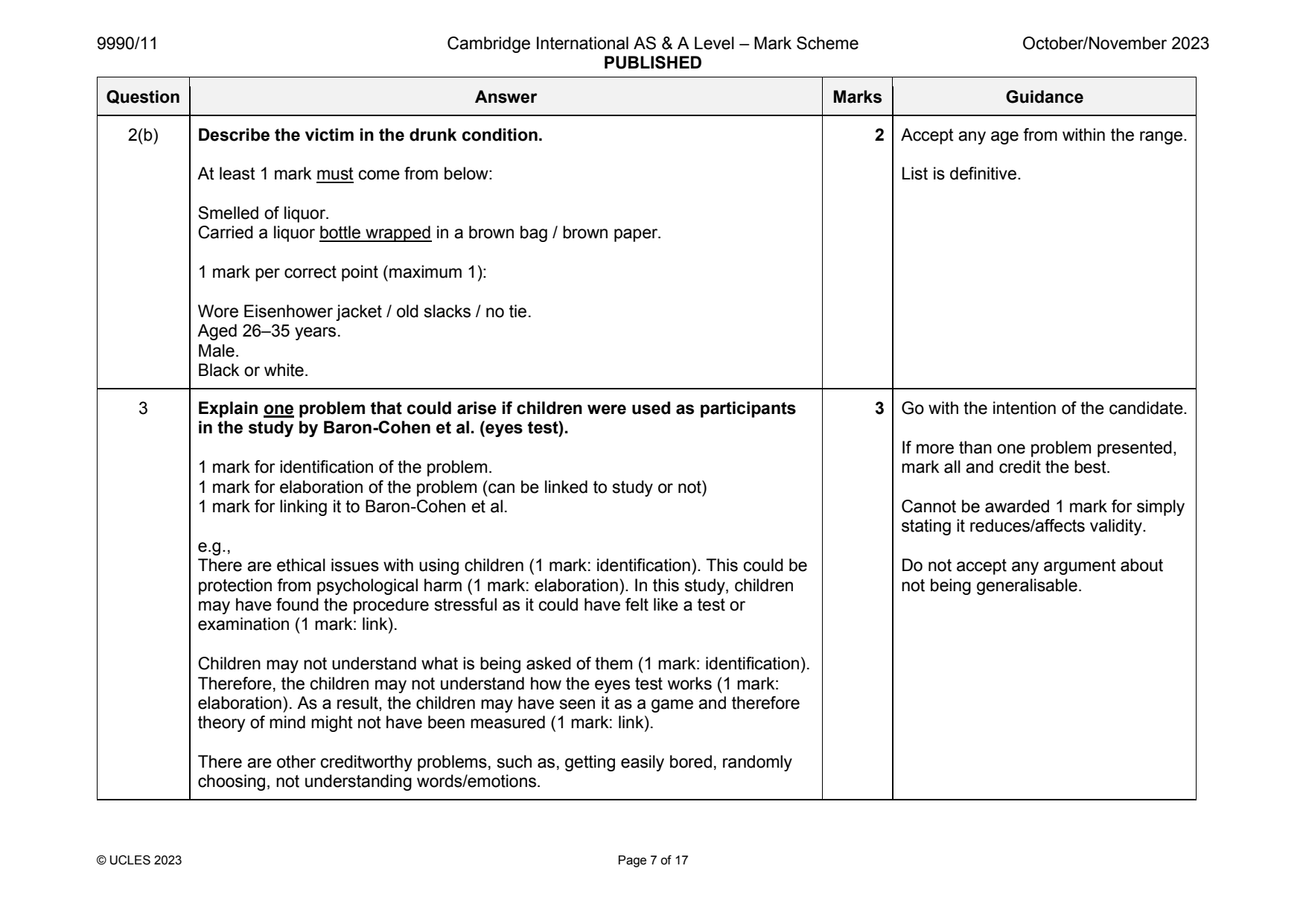
2(b) Describe the victim in the drunk condition. 2 Accept any age from within the range.
At least 1 mark must come from below: List is definitive.
Smelled of liquor.
Carried a liquor bottle wrapped in a brown bag / brown paper.
1 mark per correct point (maximum 1):
Wore Eisenhower jacket / old slacks / no tie.
Aged 26–35 years.
Male.
Black or white.
Official mark scheme pages: 6, 7 · source PDF URL
9990-2023-on-11-q08
Oct/Nov 2023 · Paper 11 · Question 8 · 6 marks
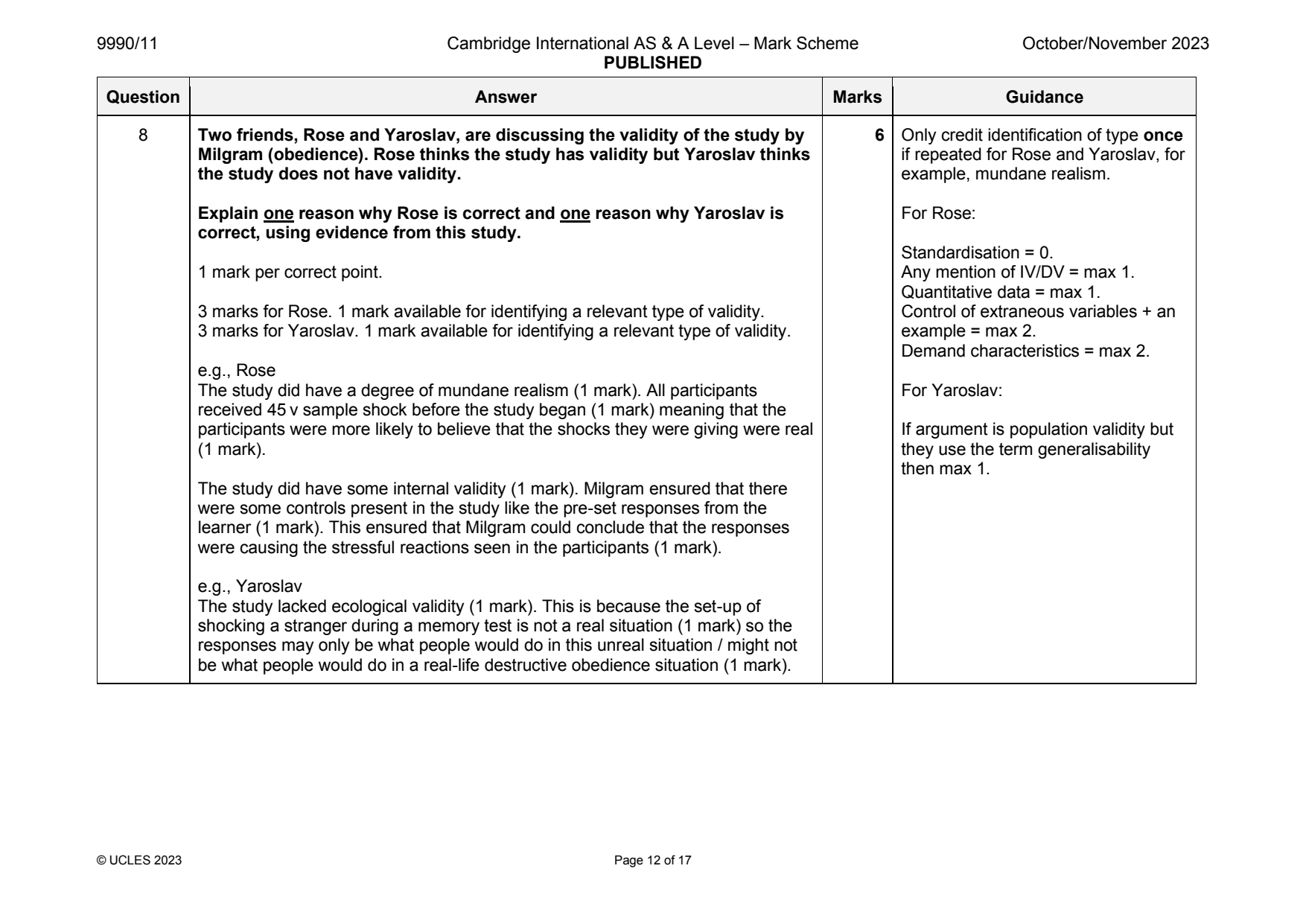
8 Two friends, Rose and Yaroslav, are discussing the validity of the study by 6 Only credit identification of type once
Milgram (obedience). Rose thinks the study has validity but Yaroslav thinks if repeated for Rose and Yaroslav, for
the study does not have validity. example, mundane realism.
Explain one reason why Rose is correct and one reason why Yaroslav is For Rose:
correct, using evidence from this study.
Standardisation = 0.
1 mark per correct point. Any mention of IV/DV = max 1.
Quantitative data = max 1.
3 marks for Rose. 1 mark available for identifying a relevant type of validity. Control of extraneous variables + an
3 marks for Yaroslav. 1 mark available for identifying a relevant type of validity. example = max 2.
Demand characteristics = max 2.
e.g., Rose
The study did have a degree of mundane realism (1 mark). All participants For Yaroslav:
received 45 v sample shock before the study began (1 mark) meaning that the
participants were more likely to believe that the shocks they were giving were real If argument is population validity but
(1 mark). they use the term generalisability
then max 1.
The study did have some internal validity (1 mark). Milgram ensured that there
were some controls present in the study like the pre-set responses from the
learner (1 mark). This ensured that Milgram could conclude that the responses
were causing the stressful reactions seen in the participants (1 mark).
e.g., Yaroslav
The study lacked ecological validity (1 mark). This is because the set-up of
shocking a stranger during a memory test is not a real situation (1 mark) so the
responses may only be what people would do in this unreal situation / might not
be what people would do in a real-life destructive obedience situation (1 mark).
© UCLES 2023 Page 12 of 17
Official mark scheme pages: 12 · source PDF URL
9990-2023-on-12-q05
Oct/Nov 2023 · Paper 12 · Question 5 · 6 marks
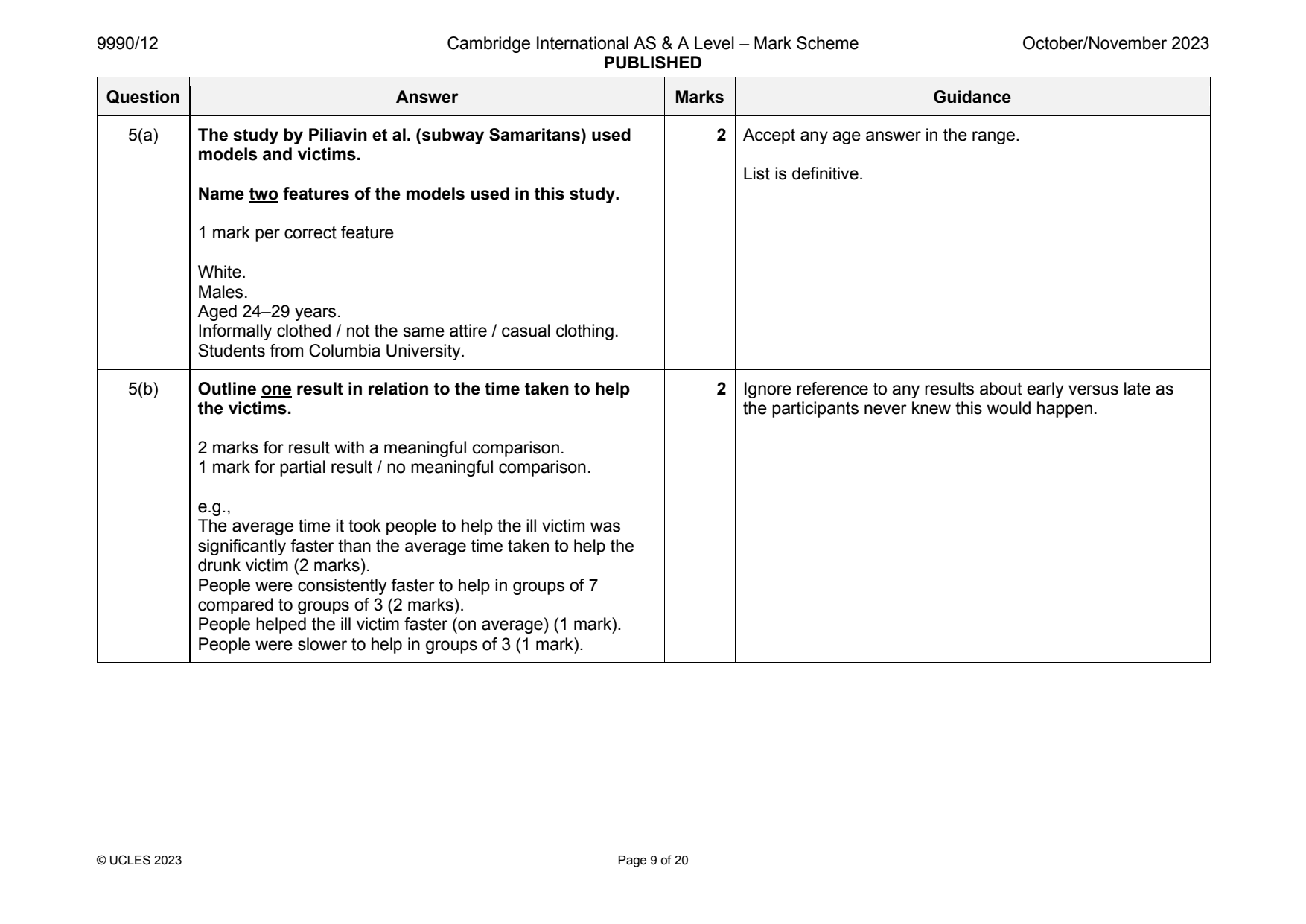
5(a) The study by Piliavin et al. (subway Samaritans) used 2 Accept any age answer in the range.
models and victims.
List is definitive.
Name two features of the models used in this study.
1 mark per correct feature
White.
Males.
Aged 24–29 years.
Informally clothed / not the same attire / casual clothing.
Students from Columbia University.
5(b) Outline one result in relation to the time taken to help 2 Ignore reference to any results about early versus late as
the victims. the participants never knew this would happen.
2 marks for result with a meaningful comparison.
1 mark for partial result / no meaningful comparison.
e.g.,
The average time it took people to help the ill victim was
significantly faster than the average time taken to help the
drunk victim (2 marks).
People were consistently faster to help in groups of 7
compared to groups of 3 (2 marks).
People helped the ill victim faster (on average) (1 mark).
People were slower to help in groups of 3 (1 mark).
© UCLES 2023 Page 9 of 20
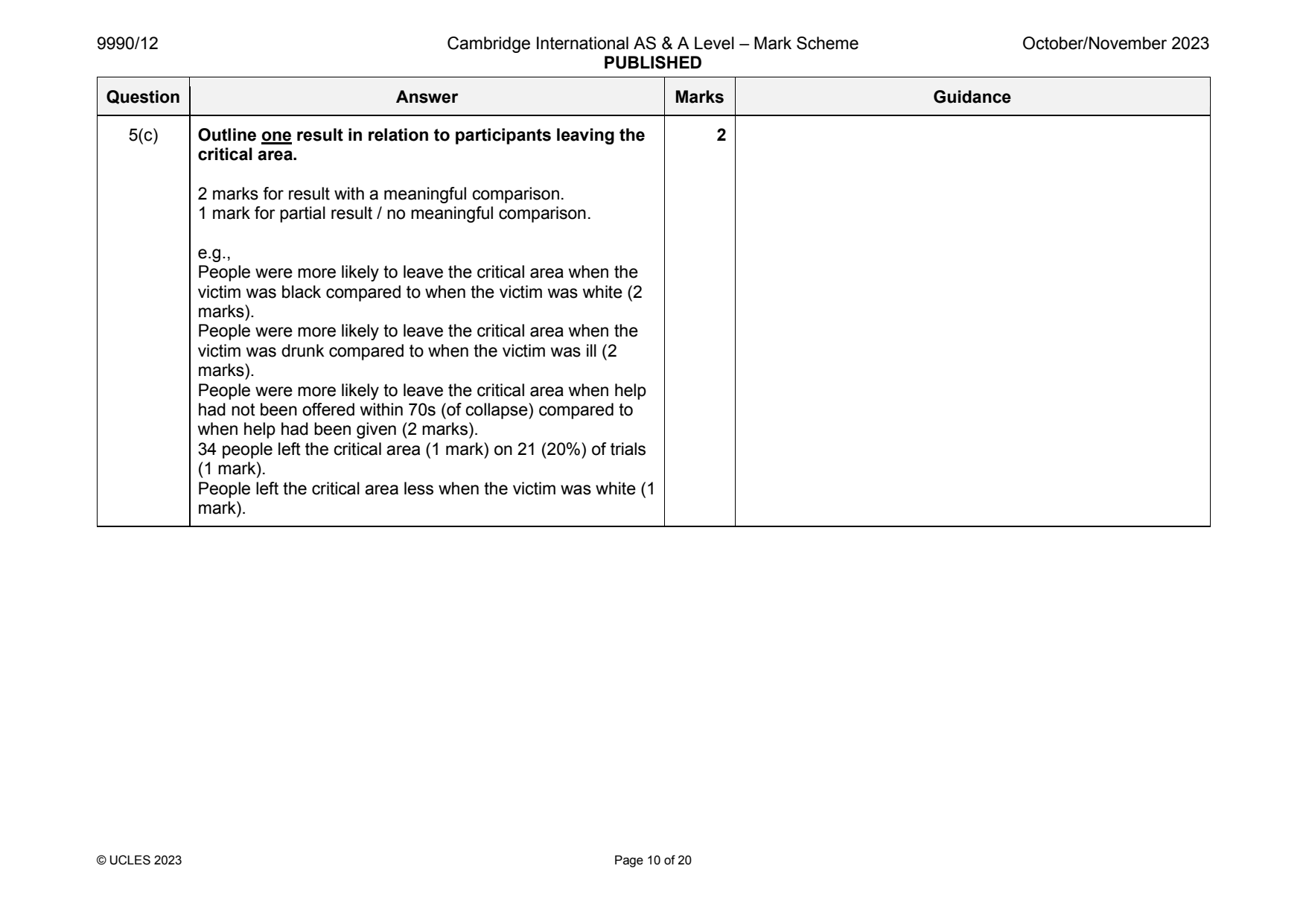
5(c) Outline one result in relation to participants leaving the 2
critical area.
2 marks for result with a meaningful comparison.
1 mark for partial result / no meaningful comparison.
e.g.,
People were more likely to leave the critical area when the
victim was black compared to when the victim was white (2
marks).
People were more likely to leave the critical area when the
victim was drunk compared to when the victim was ill (2
marks).
People were more likely to leave the critical area when help
had not been offered within 70s (of collapse) compared to
when help had been given (2 marks).
34 people left the critical area (1 mark) on 21 (20%) of trials
(1 mark).
People left the critical area less when the victim was white (1
mark).
© UCLES 2023 Page 10 of 20
Official mark scheme pages: 9, 10 · source PDF URL
9990-2023-on-12-q07
Oct/Nov 2023 · Paper 12 · Question 7 · 4 marks
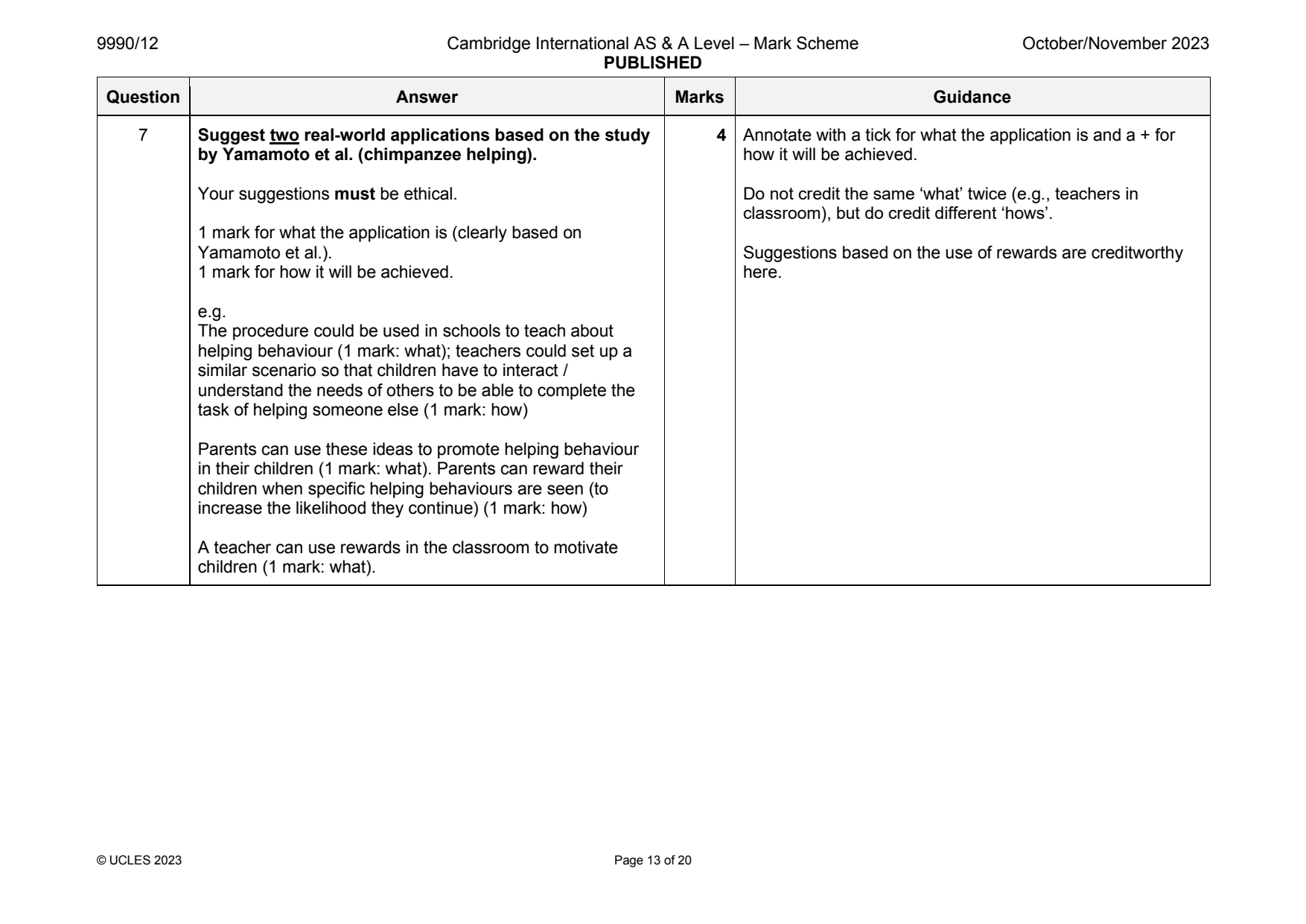
7 Suggest two real-world applications based on the study 4 Annotate with a tick for what the application is and a + for
by Yamamoto et al. (chimpanzee helping). how it will be achieved.
Your suggestions must be ethical. Do not credit the same ‘what’ twice (e.g., teachers in
classroom), but do credit different ‘hows’.
1 mark for what the application is (clearly based on
Yamamoto et al.). Suggestions based on the use of rewards are creditworthy
1 mark for how it will be achieved. here.
e.g.
The procedure could be used in schools to teach about
helping behaviour (1 mark: what); teachers could set up a
similar scenario so that children have to interact /
understand the needs of others to be able to complete the
task of helping someone else (1 mark: how)
Parents can use these ideas to promote helping behaviour
in their children (1 mark: what). Parents can reward their
children when specific helping behaviours are seen (to
increase the likelihood they continue) (1 mark: how)
A teacher can use rewards in the classroom to motivate
children (1 mark: what).
© UCLES 2023 Page 13 of 20
Official mark scheme pages: 13 · source PDF URL
9990-2023-on-12-q10
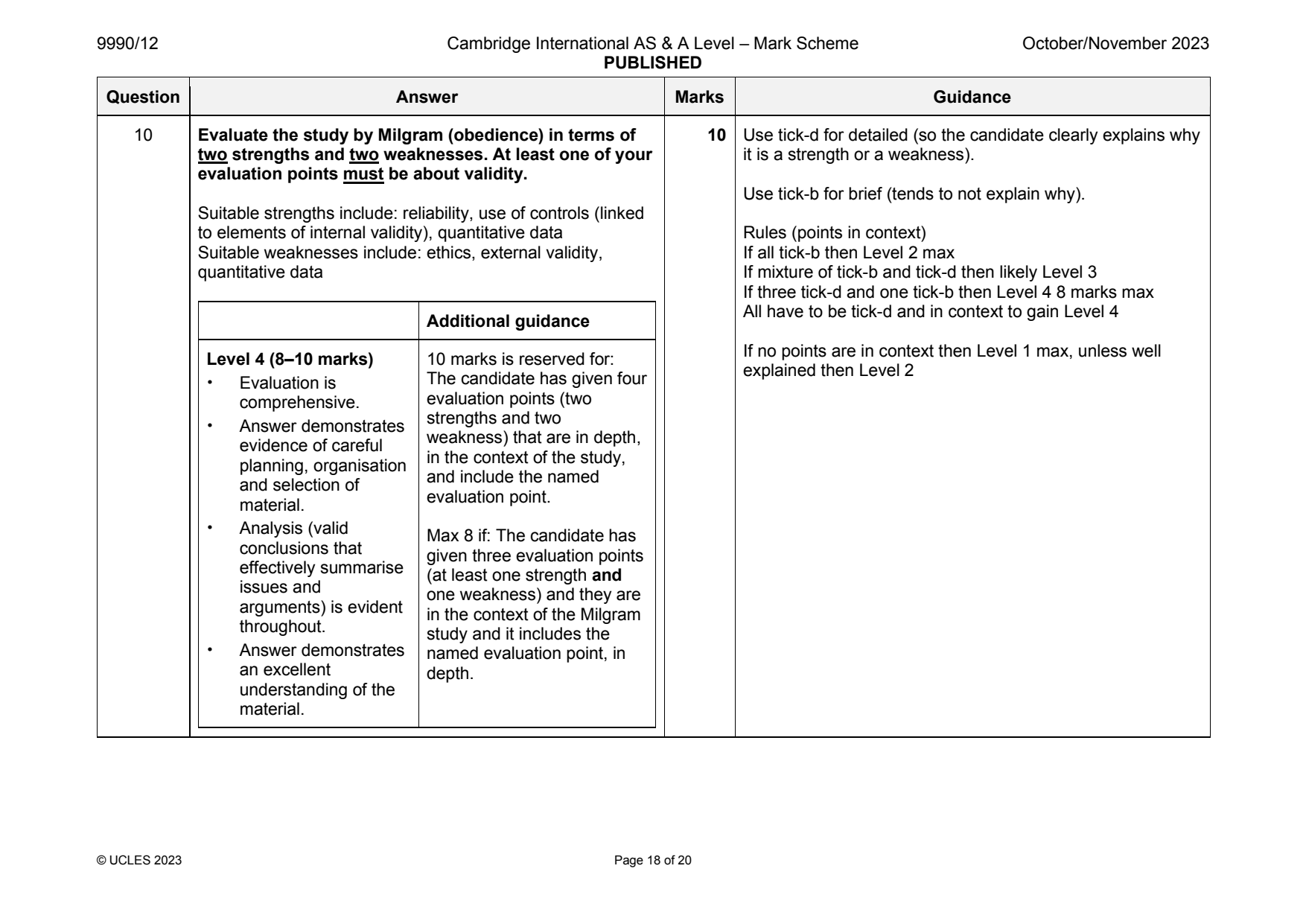
Oct/Nov 2023 · Paper 12 · Question 10 · 10 marks
10 Evaluate the study by Milgram (obedience) in terms of 10 Use tick-d for detailed (so the candidate clearly explains why
two strengths and two weaknesses. At least one of your it is a strength or a weakness).
evaluation points must be about validity.
Use tick-b for brief (tends to not explain why).
Suitable strengths include: reliability, use of controls (linked
to elements of internal validity), quantitative data Rules (points in context)
Suitable weaknesses include: ethics, external validity, If all tick-b then Level 2 max
quantitative data If mixture of tick-b and tick-d then likely Level 3
If three tick-d and one tick-b then Level 4 8 marks max
All have to be tick-d and in context to gain Level 4
Additional guidance
If no points are in context then Level 1 max, unless well
Level 4 (8–10 marks) 10 marks is reserved for:
explained then Level 2
• Evaluation is The candidate has given four
comprehensive. evaluation points (two
strengths and two
• Answer demonstrates
weakness) that are in depth,
evidence of careful
in the context of the study,
planning, organisation
and include the named
and selection of
evaluation point.
material.
• Analysis (valid
Max 8 if: The candidate has
conclusions that
given three evaluation points
effectively summarise
(at least one strength and
issues and
one weakness) and they are
arguments) is evident
in the context of the Milgram
throughout.
study and it includes the
• Answer demonstrates named evaluation point, in
an excellent depth.
understanding of the
material.
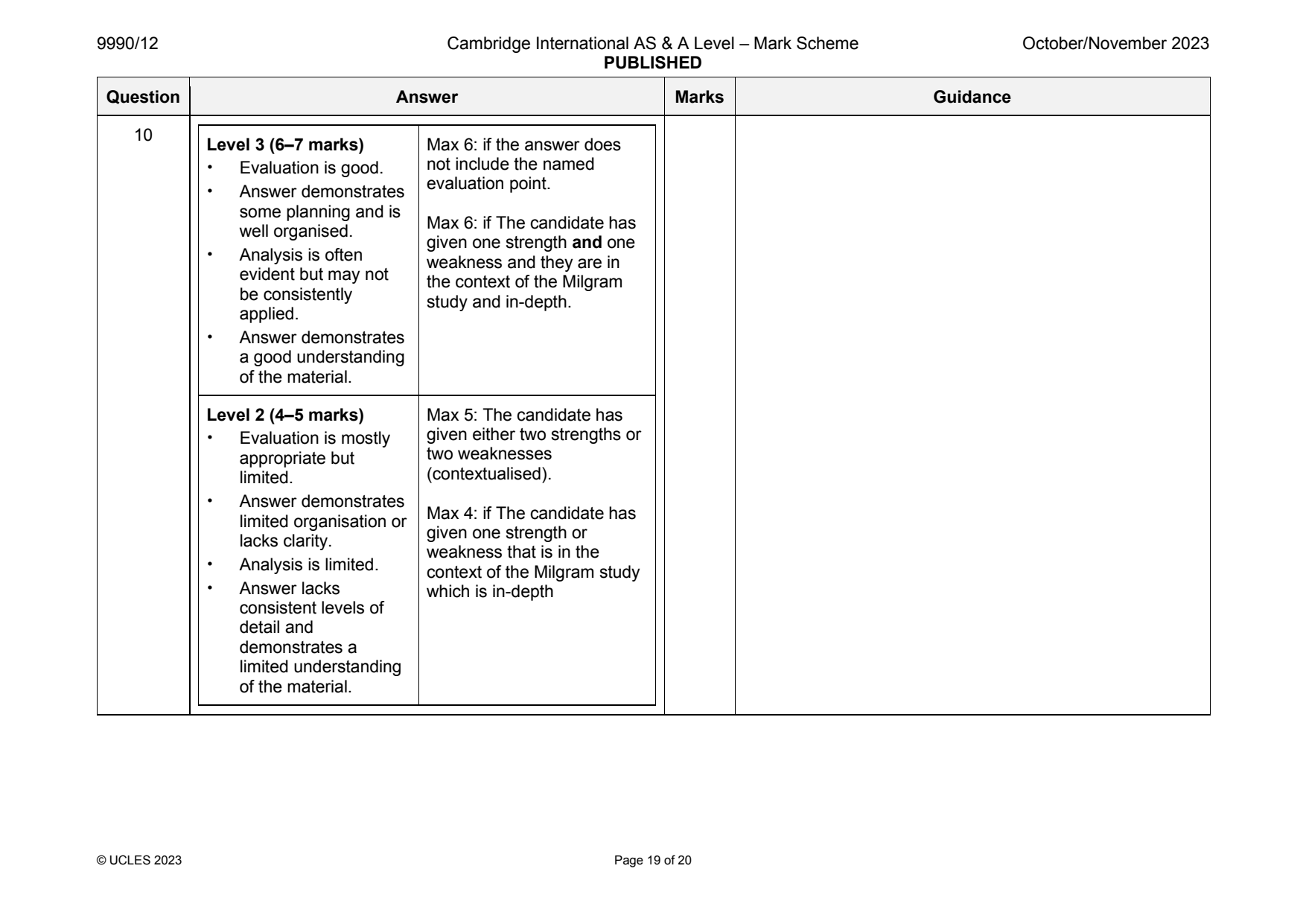
© UCLES 2023 Page 18 of 20
9990/12 Cambridge International AS & A Level – Mark Scheme October/November 2023
PUBLISHED
Question Answer Marks Guidance
10
Level 3 (6–7 marks) Max 6: if the answer does
• Evaluation is good. not include the named
evaluation point.
• Answer demonstrates
some planning and is
Max 6: if The candidate has
well organised.
given one strength and one
• Analysis is often
weakness and they are in
evident but may not
the context of the Milgram
be consistently
study and in-depth.
applied.
• Answer demonstrates
a good understanding
of the material.
Level 2 (4–5 marks) Max 5: The candidate has
• Evaluation is mostly given either two strengths or
appropriate but two weaknesses
limited. (contextualised).
• Answer demonstrates
Max 4: if The candidate has
limited organisation or
given one strength or
lacks clarity.
weakness that is in the
• Analysis is limited.
context of the Milgram study
• Answer lacks which is in-depth
consistent levels of
detail and
demonstrates a
limited understanding
of the material.
© UCLES 2023 Page 19 of 20
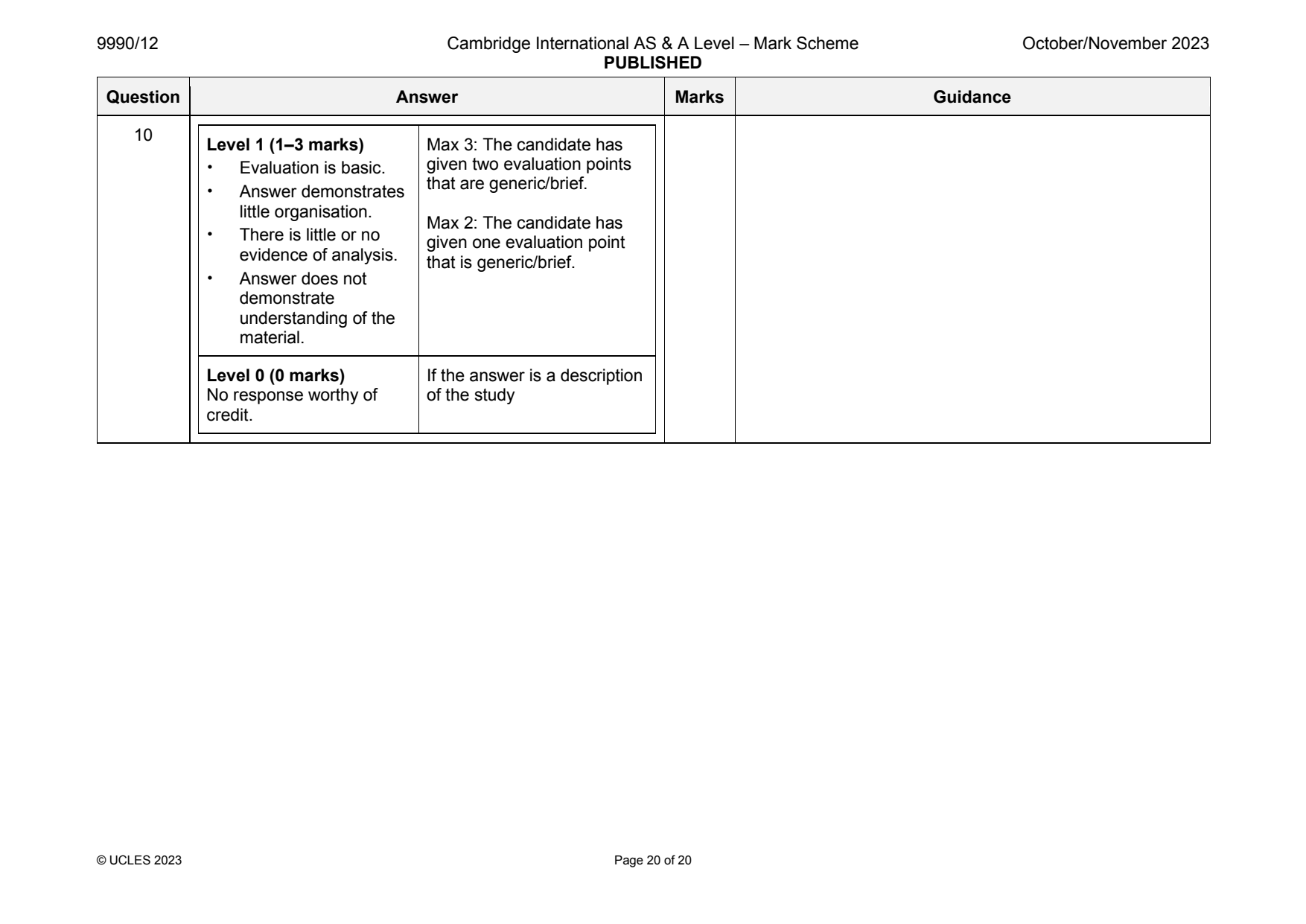
9990/12 Cambridge International AS & A Level – Mark Scheme October/November 2023
PUBLISHED
Question Answer Marks Guidance
10
Level 1 (1–3 marks) Max 3: The candidate has
• Evaluation is basic. given two evaluation points
that are generic/brief.
• Answer demonstrates
little organisation.
Max 2: The candidate has
• There is little or no
given one evaluation point
evidence of analysis.
that is generic/brief.
• Answer does not
demonstrate
understanding of the
material.
Level 0 (0 marks) If the answer is a description
No response worthy of of the study
credit.
© UCLES 2023 Page 20 of 20
Official mark scheme pages: 18, 19, 20 · source PDF URL
9990-2023-on-13-q01
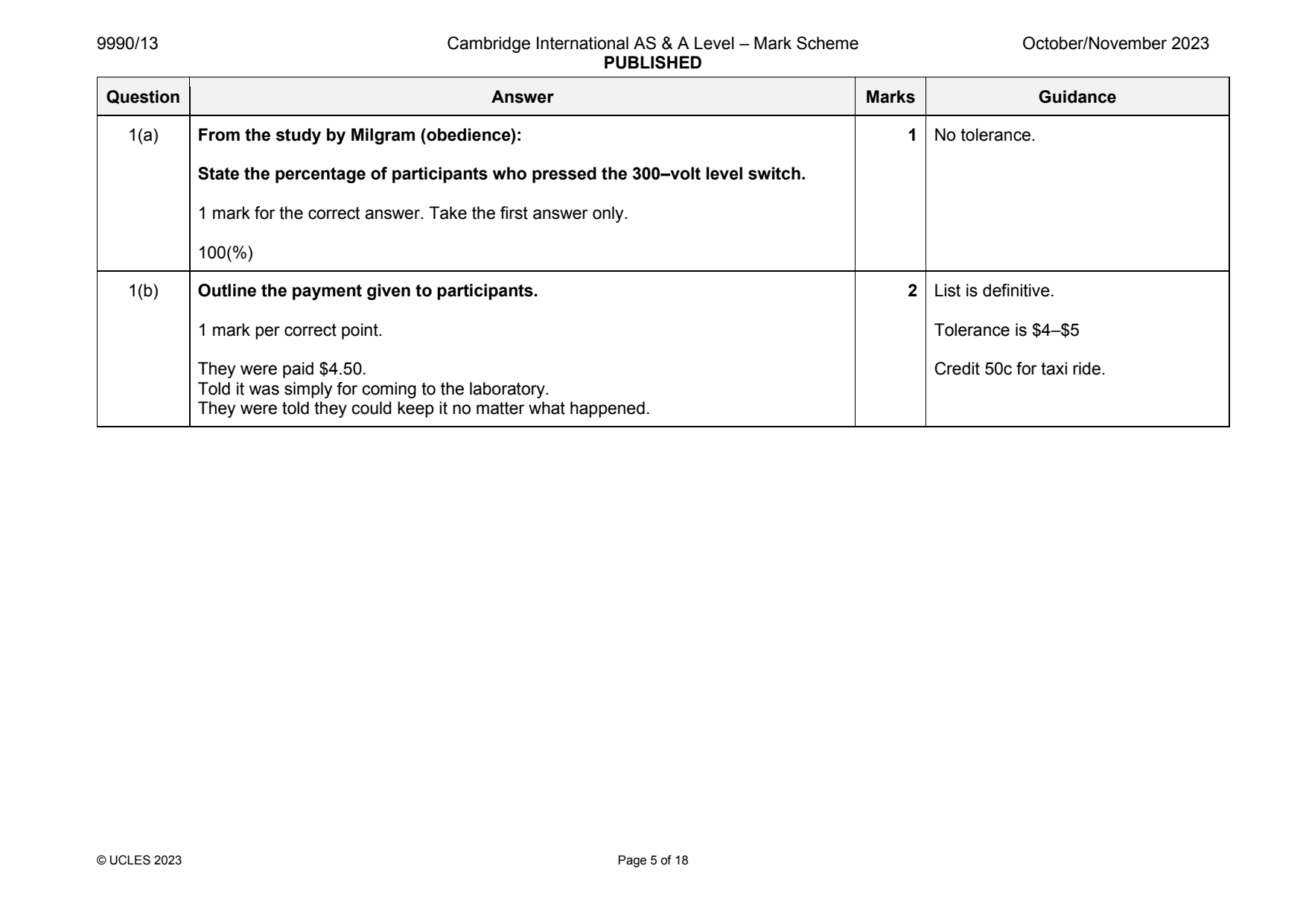
Oct/Nov 2023 · Paper 13 · Question 1 · 3 marks
1(a) From the study by Milgram (obedience): 1 No tolerance.
State the percentage of participants who pressed the 300–volt level switch.
1 mark for the correct answer. Take the first answer only.
100(%)
1(b) Outline the payment given to participants. 2 List is definitive.
1 mark per correct point. Tolerance is $4–$5
They were paid $4.50. Credit 50c for taxi ride.
Told it was simply for coming to the laboratory.
They were told they could keep it no matter what happened.
© UCLES 2023 Page 5 of 18
Official mark scheme pages: 5 · source PDF URL
9990-2023-on-13-q09
Oct/Nov 2023 · Paper 13 · Question 9 · 12 marks
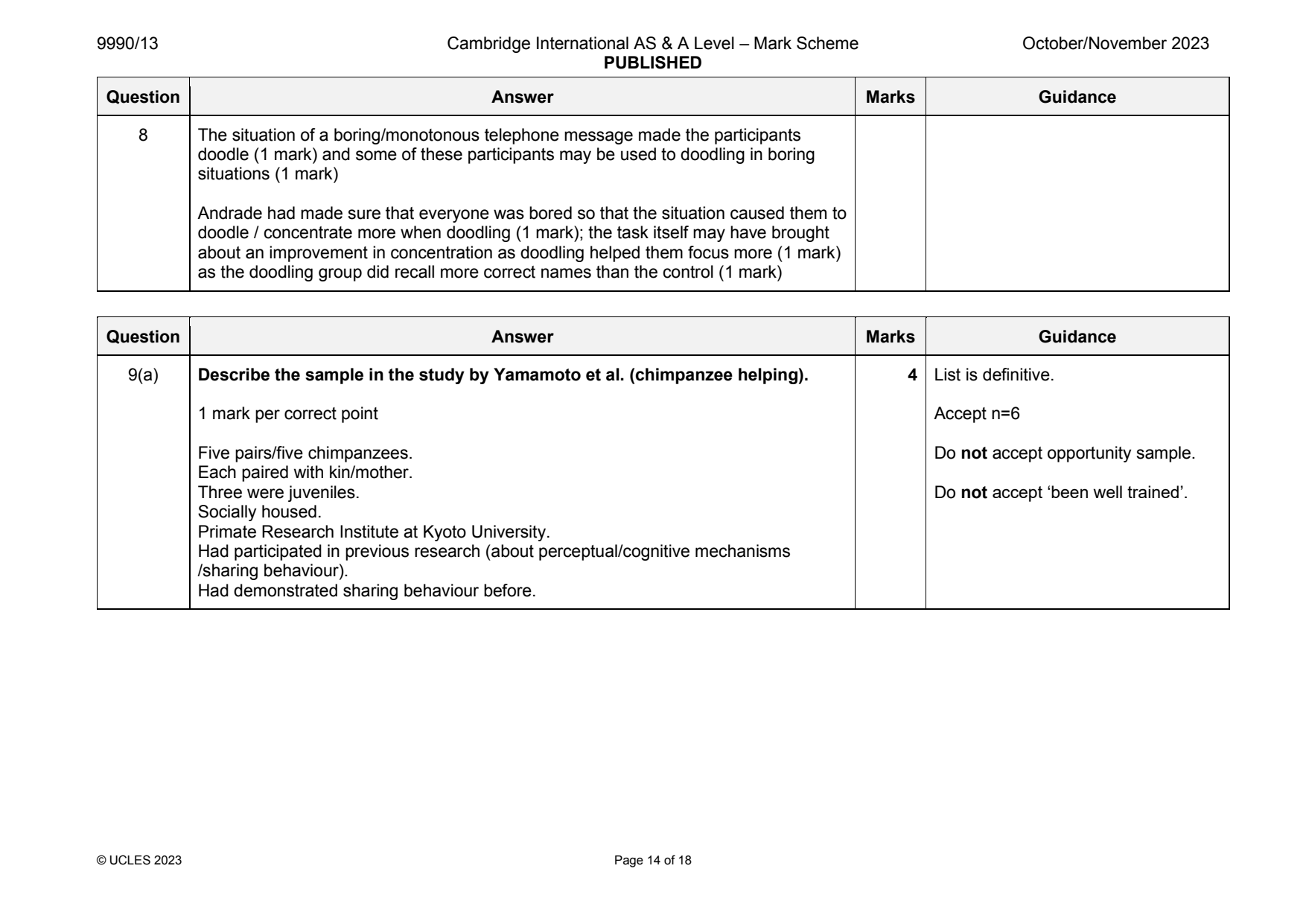
9(a) Describe the sample in the study by Yamamoto et al. (chimpanzee helping). 4 List is definitive.
1 mark per correct point Accept n=6
Five pairs/five chimpanzees. Do not accept opportunity sample.
Each paired with kin/mother.
Three were juveniles. Do not accept ‘been well trained’.
Socially housed.
Primate Research Institute at Kyoto University.
Had participated in previous research (about perceptual/cognitive mechanisms
/sharing behaviour).
Had demonstrated sharing behaviour before.
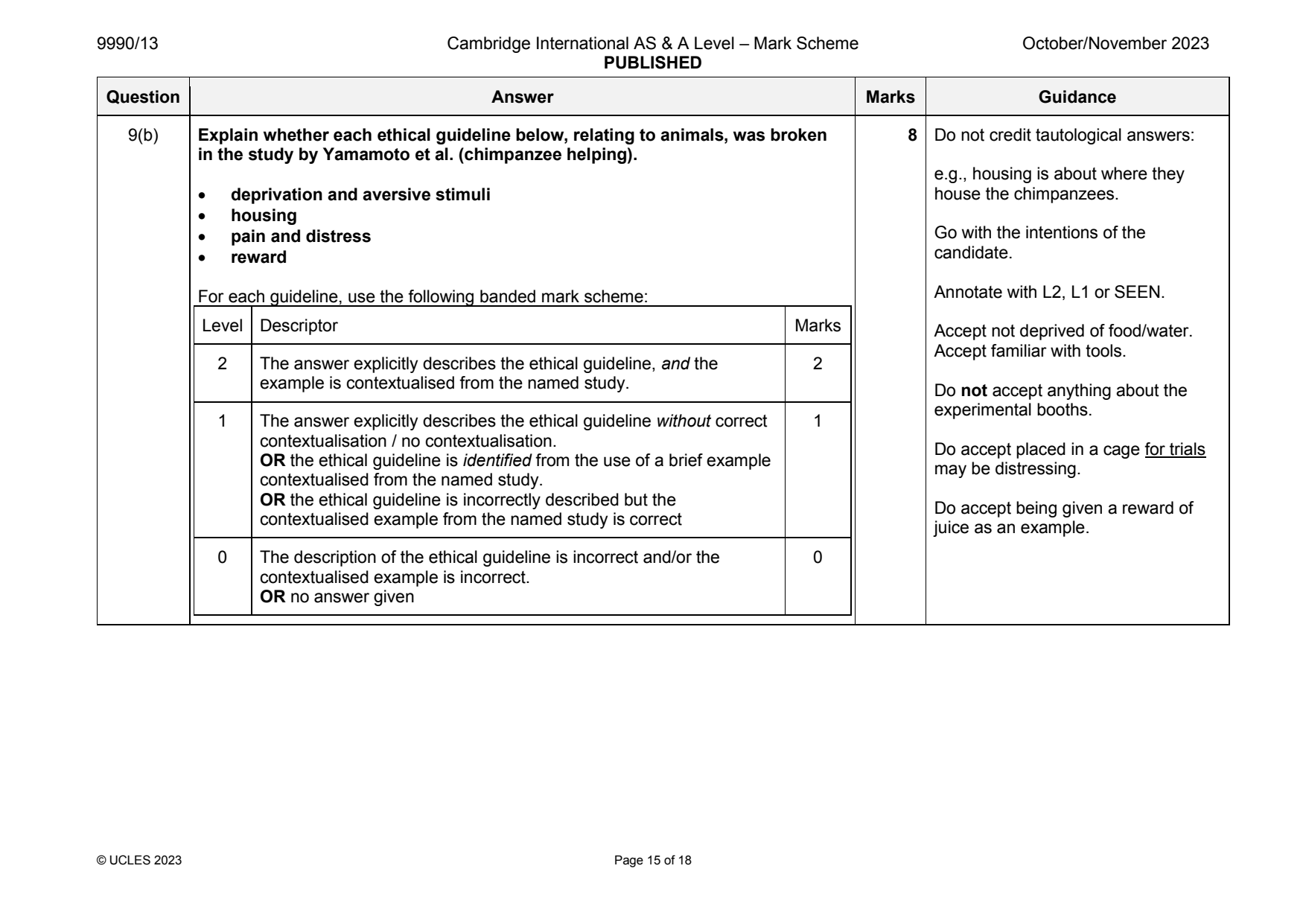
© UCLES 2023 Page 14 of 18
9(b) Explain whether each ethical guideline below, relating to animals, was broken 8 Do not credit tautological answers:
in the study by Yamamoto et al. (chimpanzee helping).
e.g., housing is about where they
• deprivation and aversive stimuli house the chimpanzees.
• housing
• pain and distress Go with the intentions of the
• reward candidate.
For each guideline, use the following banded mark scheme: Annotate with L2, L1 or SEEN.
Level Descriptor Marks
Accept not deprived of food/water.
Accept familiar with tools.
2 The answer explicitly describes the ethical guideline, and the 2
example is contextualised from the named study.
Do not accept anything about the
experimental booths.
1 The answer explicitly describes the ethical guideline without correct 1
contextualisation / no contextualisation.
Do accept placed in a cage for trials
OR the ethical guideline is identified from the use of a brief example
may be distressing.
contextualised from the named study.
OR the ethical guideline is incorrectly described but the
Do accept being given a reward of
contextualised example from the named study is correct
juice as an example.
0 The description of the ethical guideline is incorrect and/or the 0
contextualised example is incorrect.
OR no answer given
© UCLES 2023 Page 15 of 18
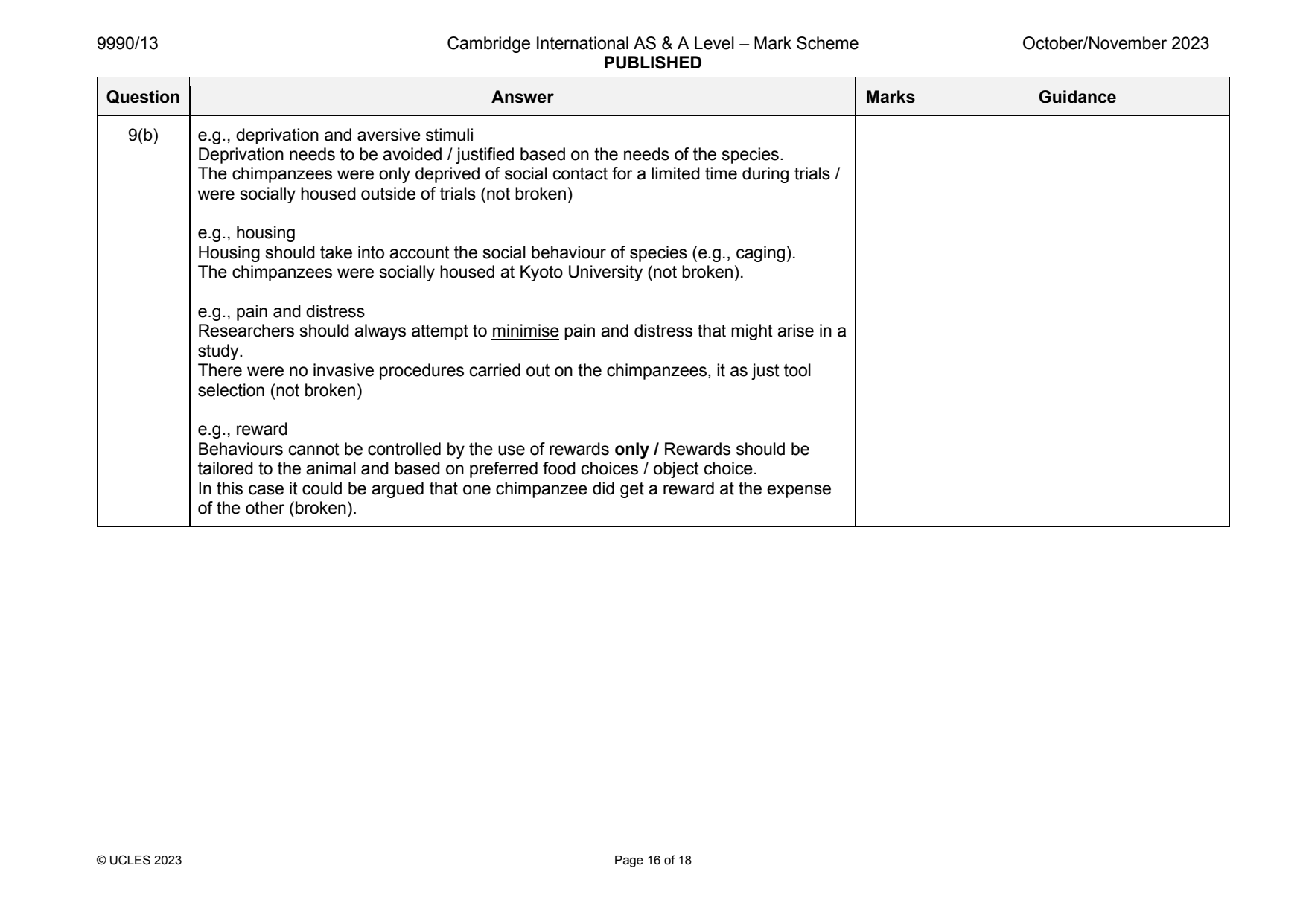
9(b) e.g., deprivation and aversive stimuli
Deprivation needs to be avoided / justified based on the needs of the species.
The chimpanzees were only deprived of social contact for a limited time during trials /
were socially housed outside of trials (not broken)
e.g., housing
Housing should take into account the social behaviour of species (e.g., caging).
The chimpanzees were socially housed at Kyoto University (not broken).
e.g., pain and distress
Researchers should always attempt to minimise pain and distress that might arise in a
study.
There were no invasive procedures carried out on the chimpanzees, it as just tool
selection (not broken)
e.g., reward
Behaviours cannot be controlled by the use of rewards only / Rewards should be
tailored to the animal and based on preferred food choices / object choice.
In this case it could be argued that one chimpanzee did get a reward at the expense
of the other (broken).
© UCLES 2023 Page 16 of 18
Official mark scheme pages: 14, 15, 16 · source PDF URL
9990-2024-m-12-q03
March 2024 · Paper 12 · Question 3 · 4 marks
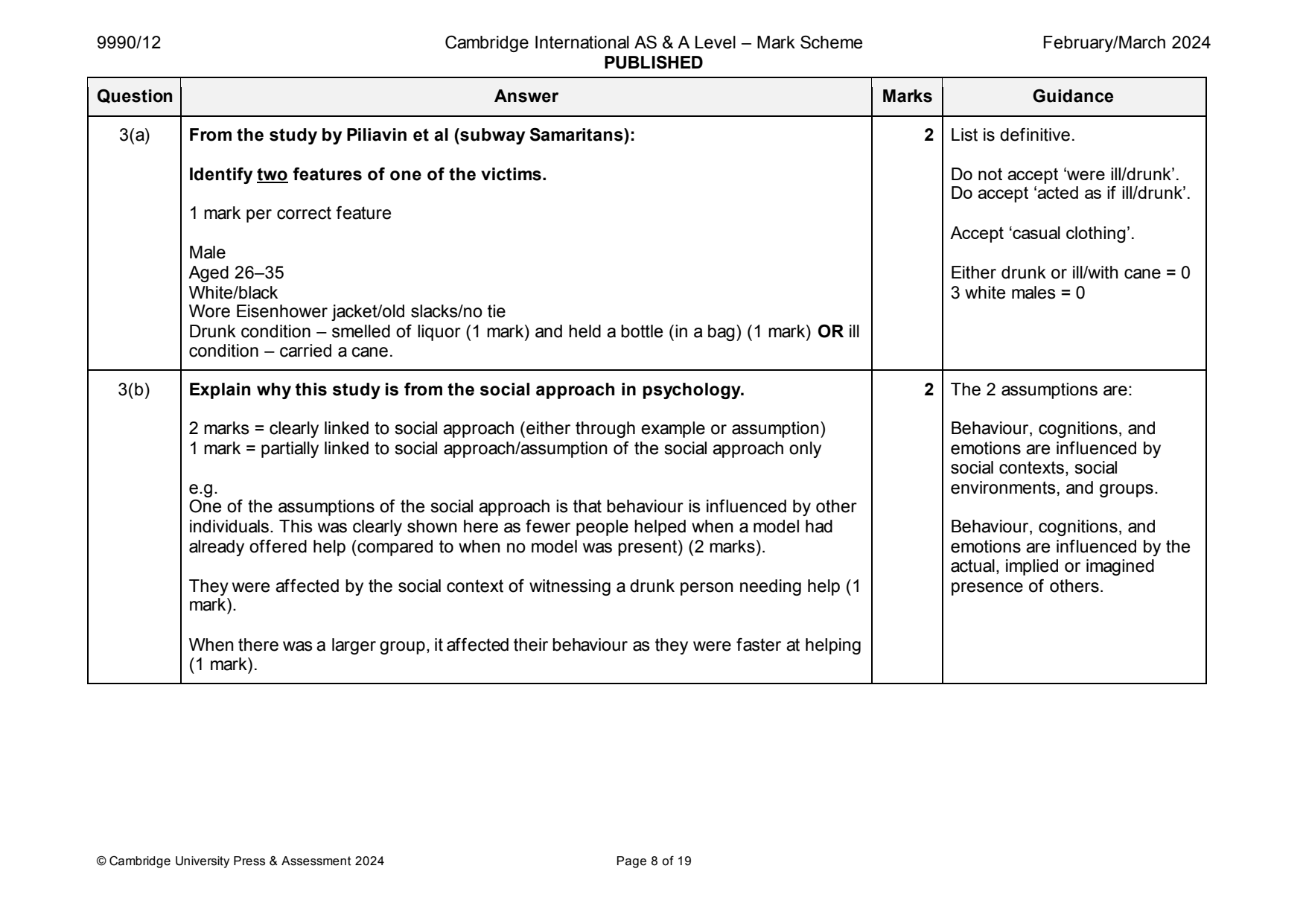
3(a) From the study by Piliavin et al (subway Samaritans): 2 List is definitive.
Identify two features of one of the victims. Do not accept ‘were ill/drunk’.
Do accept ‘acted as if ill/drunk’.
1 mark per correct feature
Accept ‘casual clothing’.
Male
Aged 26–35 Either drunk or ill/with cane = 0
White/black 3 white males = 0
Wore Eisenhower jacket/old slacks/no tie
Drunk condition – smelled of liquor (1 mark) and held a bottle (in a bag) (1 mark) OR ill
condition – carried a cane.
3(b) Explain why this study is from the social approach in psychology. 2 The 2 assumptions are:
2 marks = clearly linked to social approach (either through example or assumption) Behaviour, cognitions, and
1 mark = partially linked to social approach/assumption of the social approach only emotions are influenced by
social contexts, social
e.g. environments, and groups.
One of the assumptions of the social approach is that behaviour is influenced by other
individuals. This was clearly shown here as fewer people helped when a model had Behaviour, cognitions, and
already offered help (compared to when no model was present) (2 marks). emotions are influenced by the
actual, implied or imagined
They were affected by the social context of witnessing a drunk person needing help (1 presence of others.
mark).
When there was a larger group, it affected their behaviour as they were faster at helping
(1 mark).
© Cambridge University Press & Assessment 2024 Page 8 of 19
Official mark scheme pages: 8 · source PDF URL
9990-2024-m-12-q06
March 2024 · Paper 12 · Question 6 · 6 marks
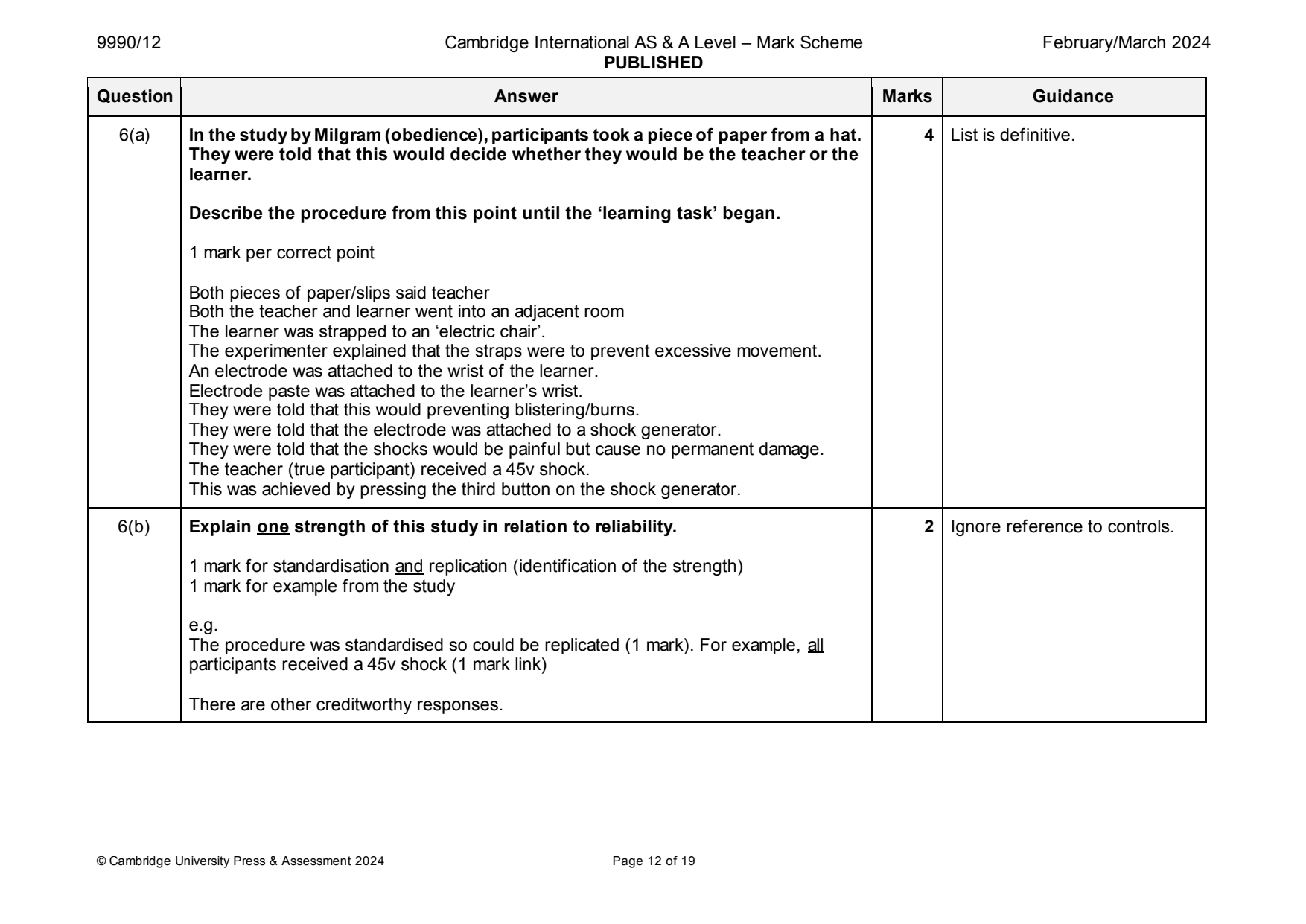
6(a) In the study by Milgram (obedience), participants took a piece of paper from a hat. 4 List is definitive.
They were told that this would decide whether they would be the teacher or the
learner.
Describe the procedure from this point until the ‘learning task’ began.
1 mark per correct point
Both pieces of paper/slips said teacher
Both the teacher and learner went into an adjacent room
The learner was strapped to an ‘electric chair’.
The experimenter explained that the straps were to prevent excessive movement.
An electrode was attached to the wrist of the learner.
Electrode paste was attached to the learner’s wrist.
They were told that this would preventing blistering/burns.
They were told that the electrode was attached to a shock generator.
They were told that the shocks would be painful but cause no permanent damage.
The teacher (true participant) received a 45v shock.
This was achieved by pressing the third button on the shock generator.
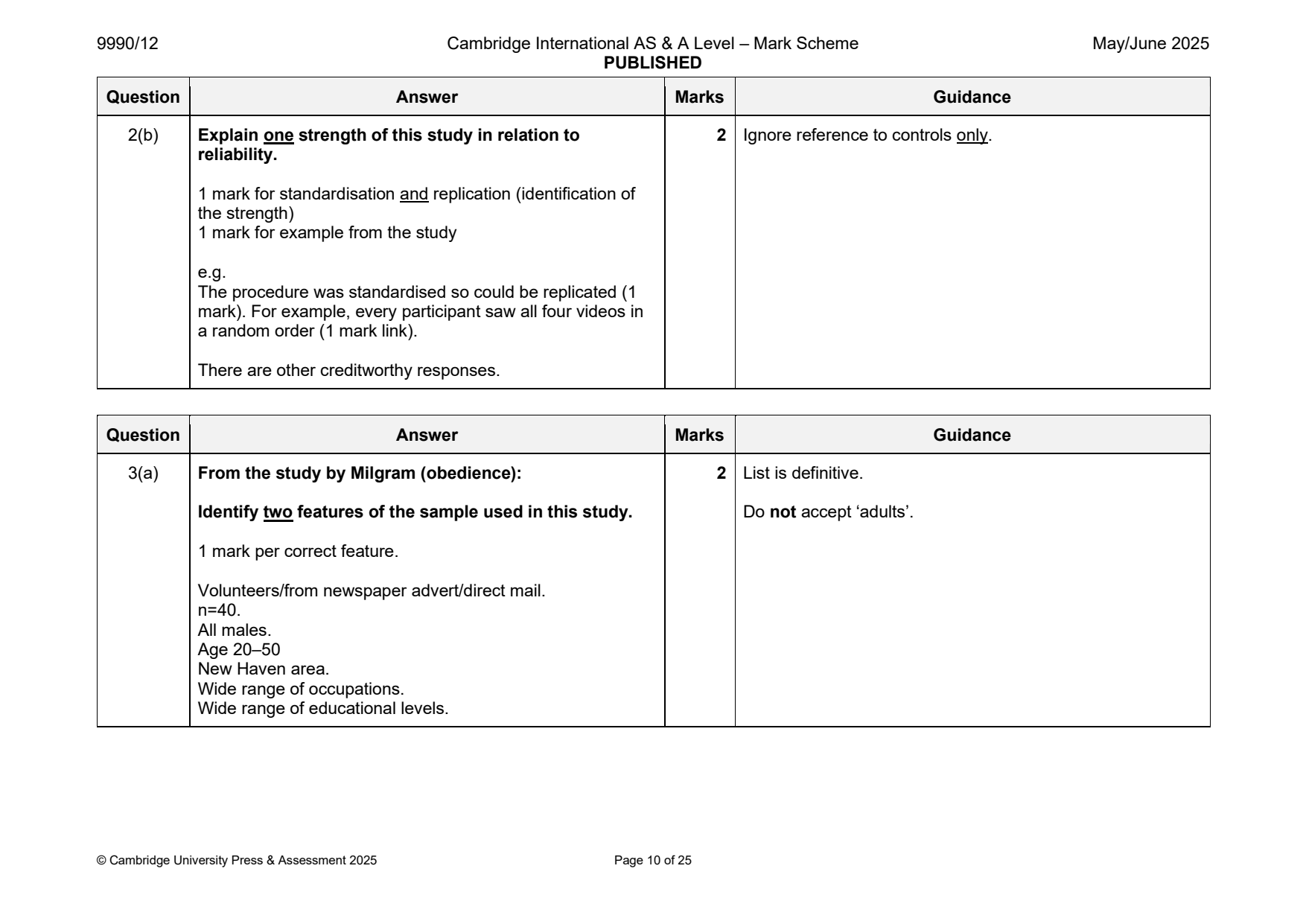
6(b) Explain one strength of this study in relation to reliability. 2 Ignore reference to controls.
1 mark for standardisation and replication (identification of the strength)
1 mark for example from the study
e.g.
The procedure was standardised so could be replicated (1 mark). For example, all
participants received a 45v shock (1 mark link)
There are other creditworthy responses.
© Cambridge University Press & Assessment 2024 Page 12 of 19
Official mark scheme pages: 12 · source PDF URL
9990-2024-mj-11-q02
May/June 2024 · Paper 11 · Question 2 · 4 marks
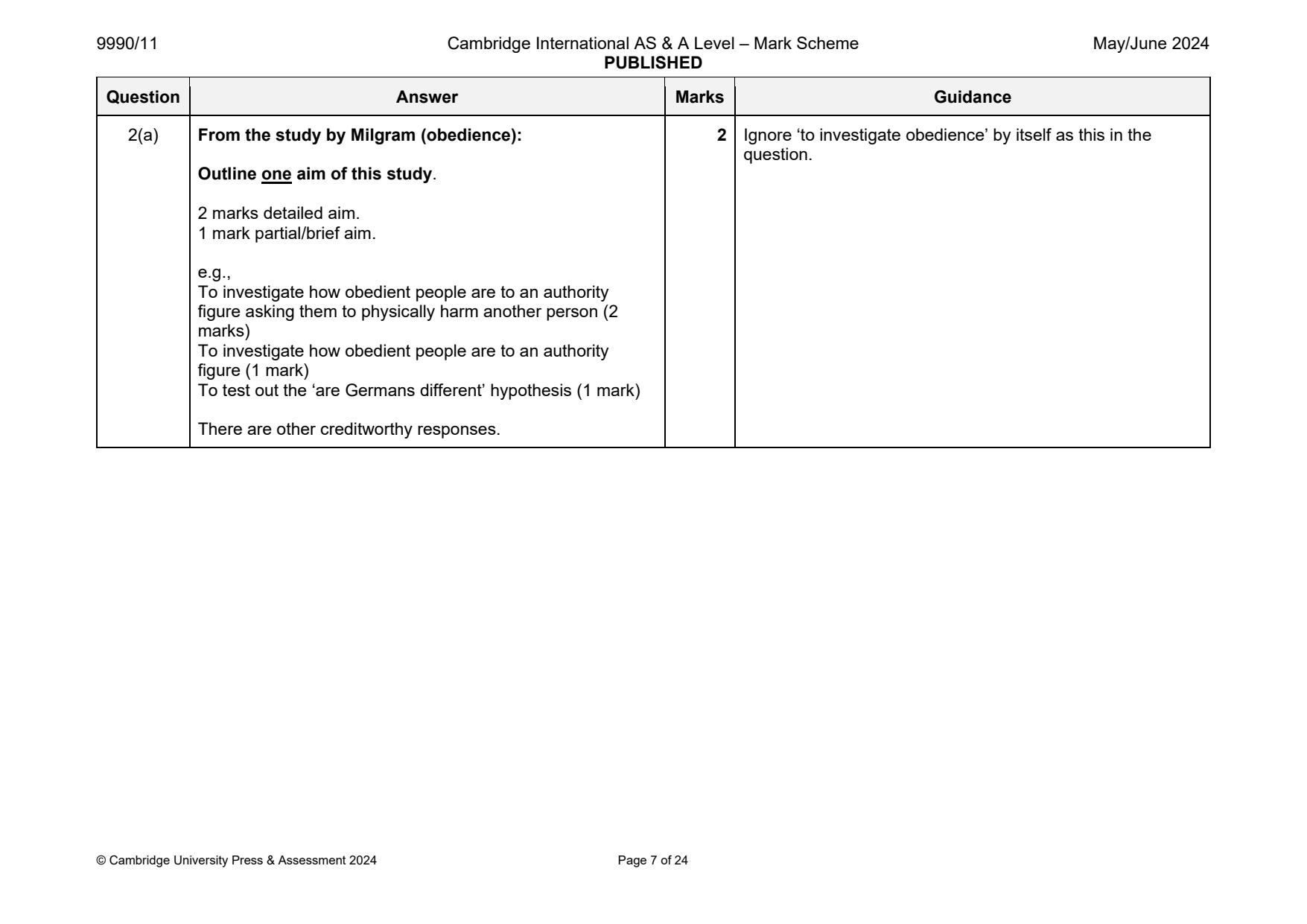
2(a) From the study by Milgram (obedience): 2 Ignore ‘to investigate obedience’ by itself as this in the
question.
Outline one aim of this study.
2 marks detailed aim.
1 mark partial/brief aim.
e.g.,
To investigate how obedient people are to an authority
figure asking them to physically harm another person (2
marks)
To investigate how obedient people are to an authority
figure (1 mark)
To test out the ‘are Germans different’ hypothesis (1 mark)
There are other creditworthy responses.
© Cambridge University Press & Assessment 2024 Page 7 of 24
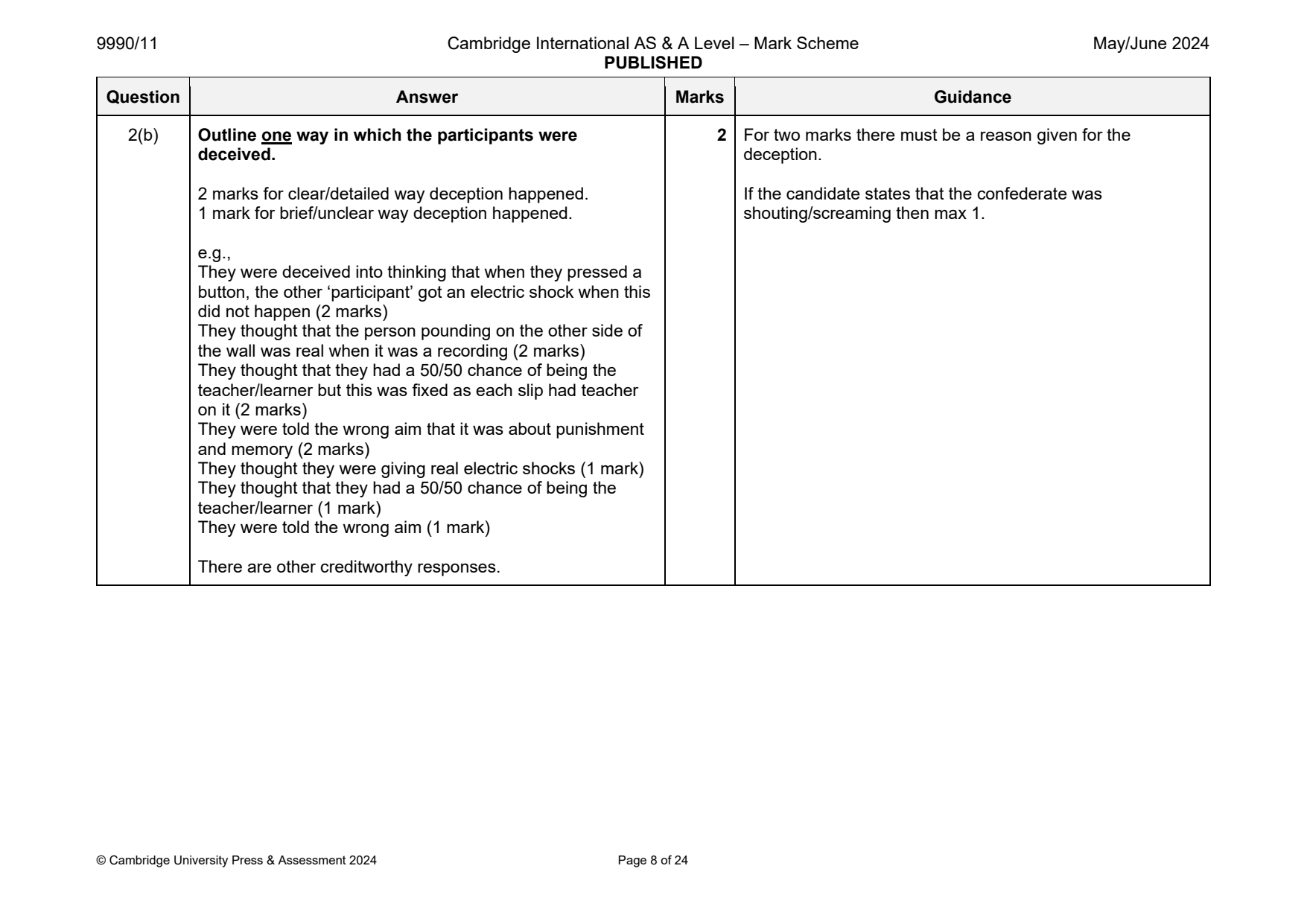
2(b) Outline one way in which the participants were 2 For two marks there must be a reason given for the
deceived. deception.
2 marks for clear/detailed way deception happened. If the candidate states that the confederate was
1 mark for brief/unclear way deception happened. shouting/screaming then max 1.
e.g.,
They were deceived into thinking that when they pressed a
button, the other ‘participant’ got an electric shock when this
did not happen (2 marks)
They thought that the person pounding on the other side of
the wall was real when it was a recording (2 marks)
They thought that they had a 50/50 chance of being the
teacher/learner but this was fixed as each slip had teacher
on it (2 marks)
They were told the wrong aim that it was about punishment
and memory (2 marks)
They thought they were giving real electric shocks (1 mark)
They thought that they had a 50/50 chance of being the
teacher/learner (1 mark)
They were told the wrong aim (1 mark)
There are other creditworthy responses.
© Cambridge University Press & Assessment 2024 Page 8 of 24
Official mark scheme pages: 7, 8 · source PDF URL
9990-2024-mj-11-q06
May/June 2024 · Paper 11 · Question 6 · 5 marks
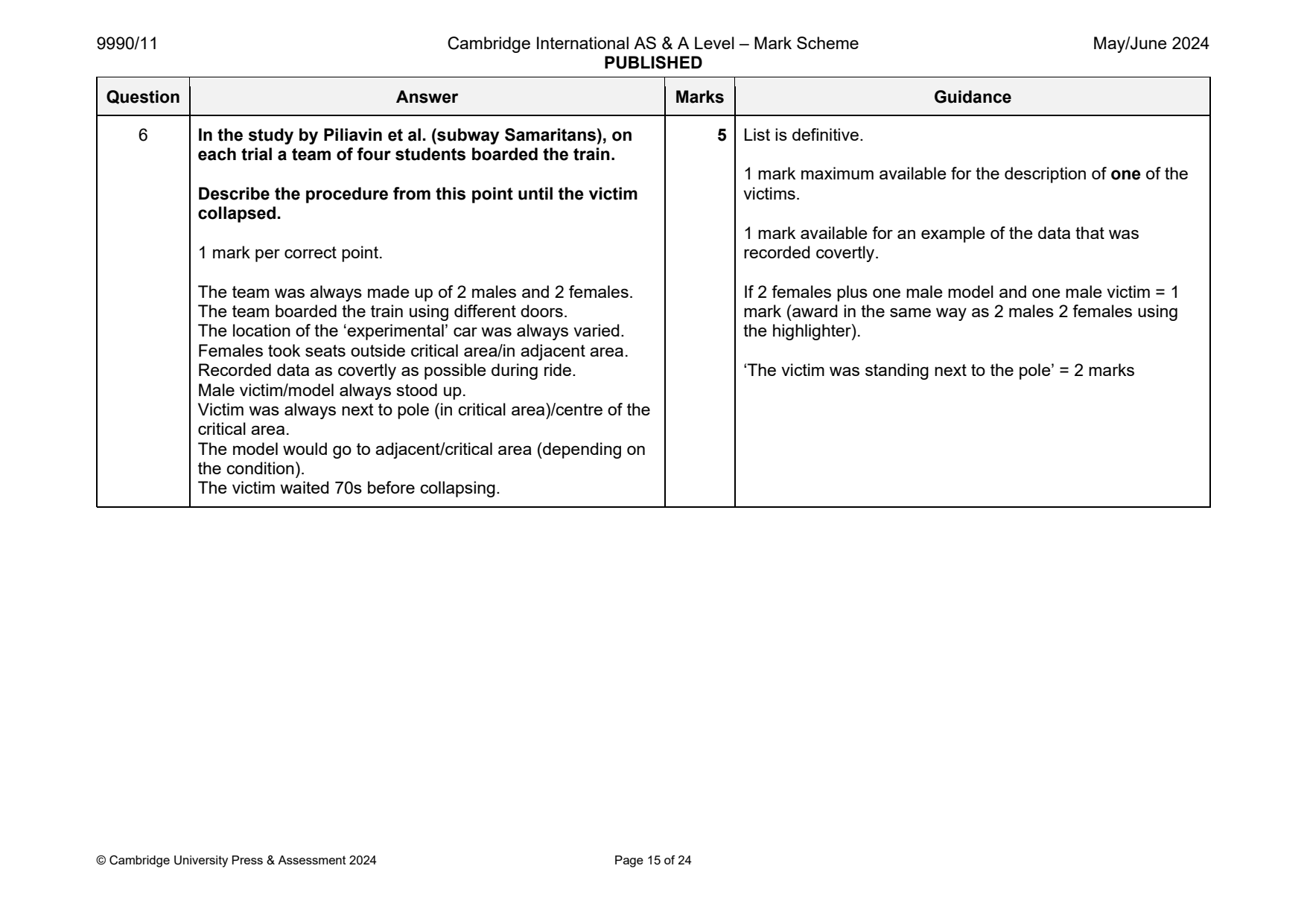
6 In the study by Piliavin et al. (subway Samaritans), on 5 List is definitive.
each trial a team of four students boarded the train.
1 mark maximum available for the description of one of the
Describe the procedure from this point until the victim victims.
collapsed.
1 mark available for an example of the data that was
1 mark per correct point. recorded covertly.
The team was always made up of 2 males and 2 females. If 2 females plus one male model and one male victim = 1
The team boarded the train using different doors. mark (award in the same way as 2 males 2 females using
The location of the ‘experimental’ car was always varied. the highlighter).
Females took seats outside critical area/in adjacent area.
Recorded data as covertly as possible during ride. ‘The victim was standing next to the pole’ = 2 marks
Male victim/model always stood up.
Victim was always next to pole (in critical area)/centre of the
critical area.
The model would go to adjacent/critical area (depending on
the condition).
The victim waited 70s before collapsing.
© Cambridge University Press & Assessment 2024 Page 15 of 24
Official mark scheme pages: 15 · source PDF URL
9990-2024-mj-11-q08
May/June 2024 · Paper 11 · Question 8 · 4 marks
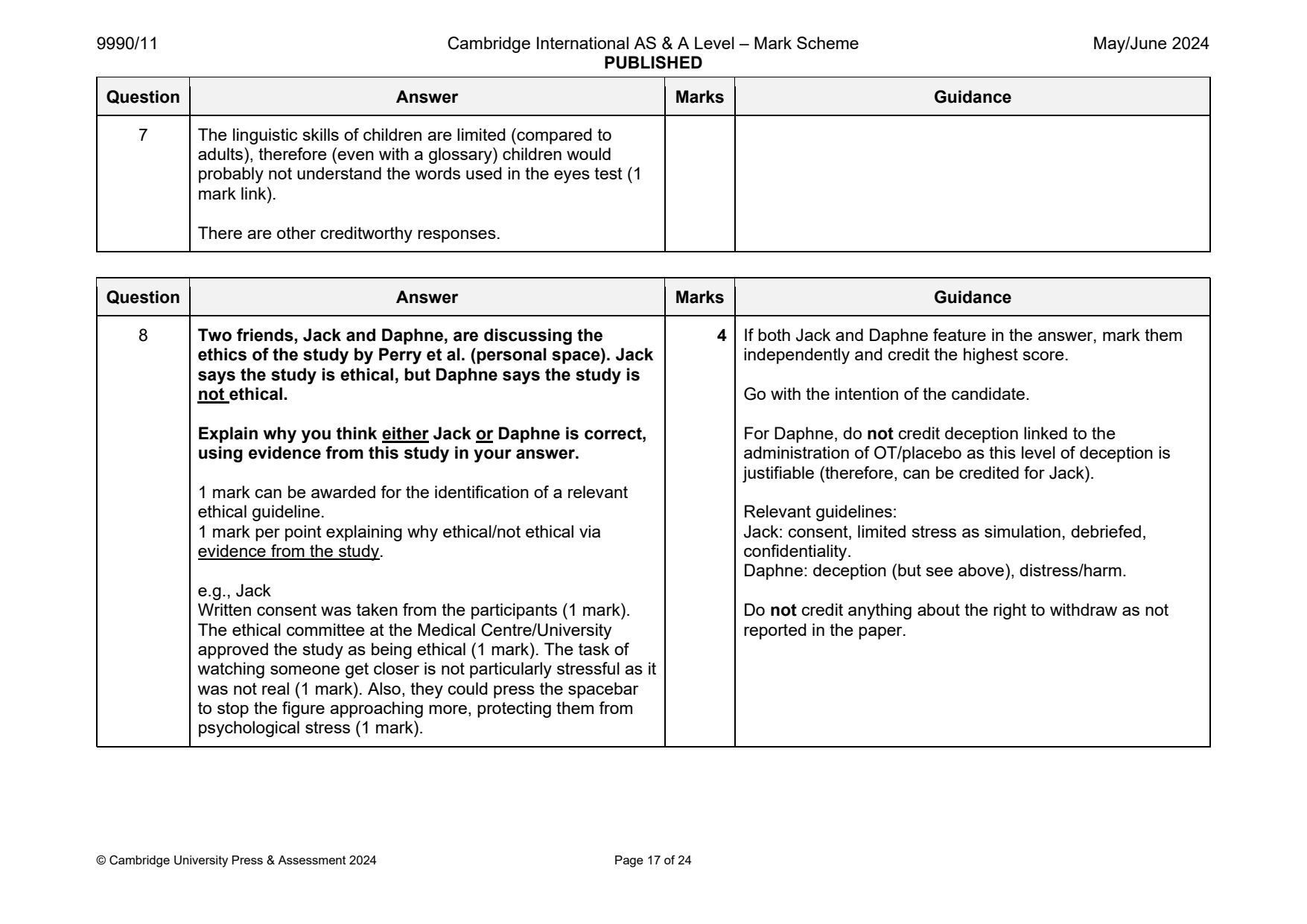
8 Two friends, Jack and Daphne, are discussing the 4 If both Jack and Daphne feature in the answer, mark them
ethics of the study by Perry et al. (personal space). Jack independently and credit the highest score.
says the study is ethical, but Daphne says the study is
not ethical. Go with the intention of the candidate.
Explain why you think either Jack or Daphne is correct, For Daphne, do not credit deception linked to the
using evidence from this study in your answer. administration of OT/placebo as this level of deception is
justifiable (therefore, can be credited for Jack).
1 mark can be awarded for the identification of a relevant
ethical guideline. Relevant guidelines:
1 mark per point explaining why ethical/not ethical via Jack: consent, limited stress as simulation, debriefed,
evidence from the study. confidentiality.
Daphne: deception (but see above), distress/harm.
e.g., Jack
Written consent was taken from the participants (1 mark). Do not credit anything about the right to withdraw as not
The ethical committee at the Medical Centre/University reported in the paper.
approved the study as being ethical (1 mark). The task of
watching someone get closer is not particularly stressful as it
was not real (1 mark). Also, they could press the spacebar
to stop the figure approaching more, protecting them from
psychological stress (1 mark).
© Cambridge University Press & Assessment 2024 Page 17 of 24
9990/11 Cambridge International AS & A Level – Mark Scheme May/June 2024
PUBLISHED
Question Answer Marks Guidance
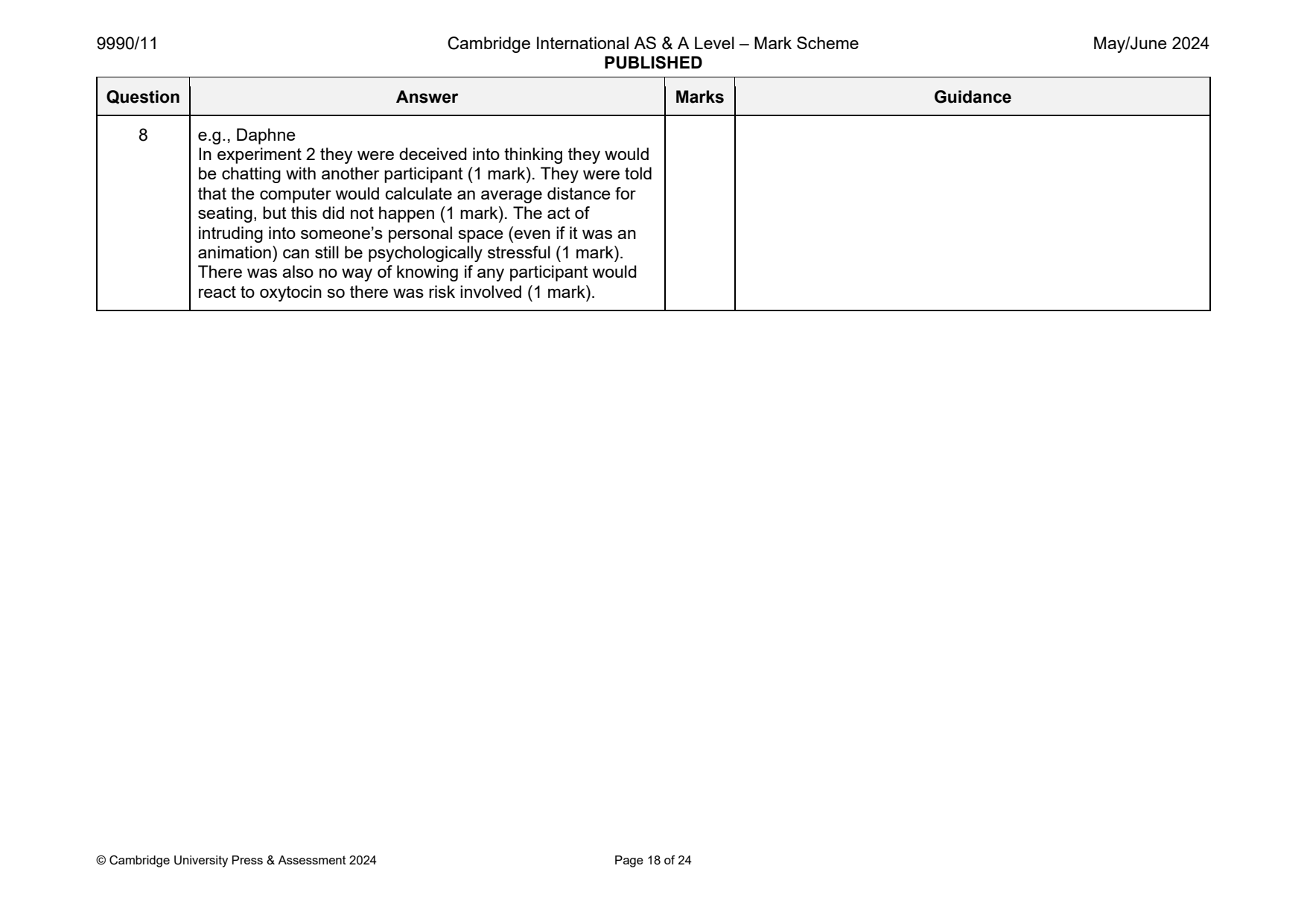
8 e.g., Daphne
In experiment 2 they were deceived into thinking they would
be chatting with another participant (1 mark). They were told
that the computer would calculate an average distance for
seating, but this did not happen (1 mark). The act of
intruding into someone’s personal space (even if it was an
animation) can still be psychologically stressful (1 mark).
There was also no way of knowing if any participant would
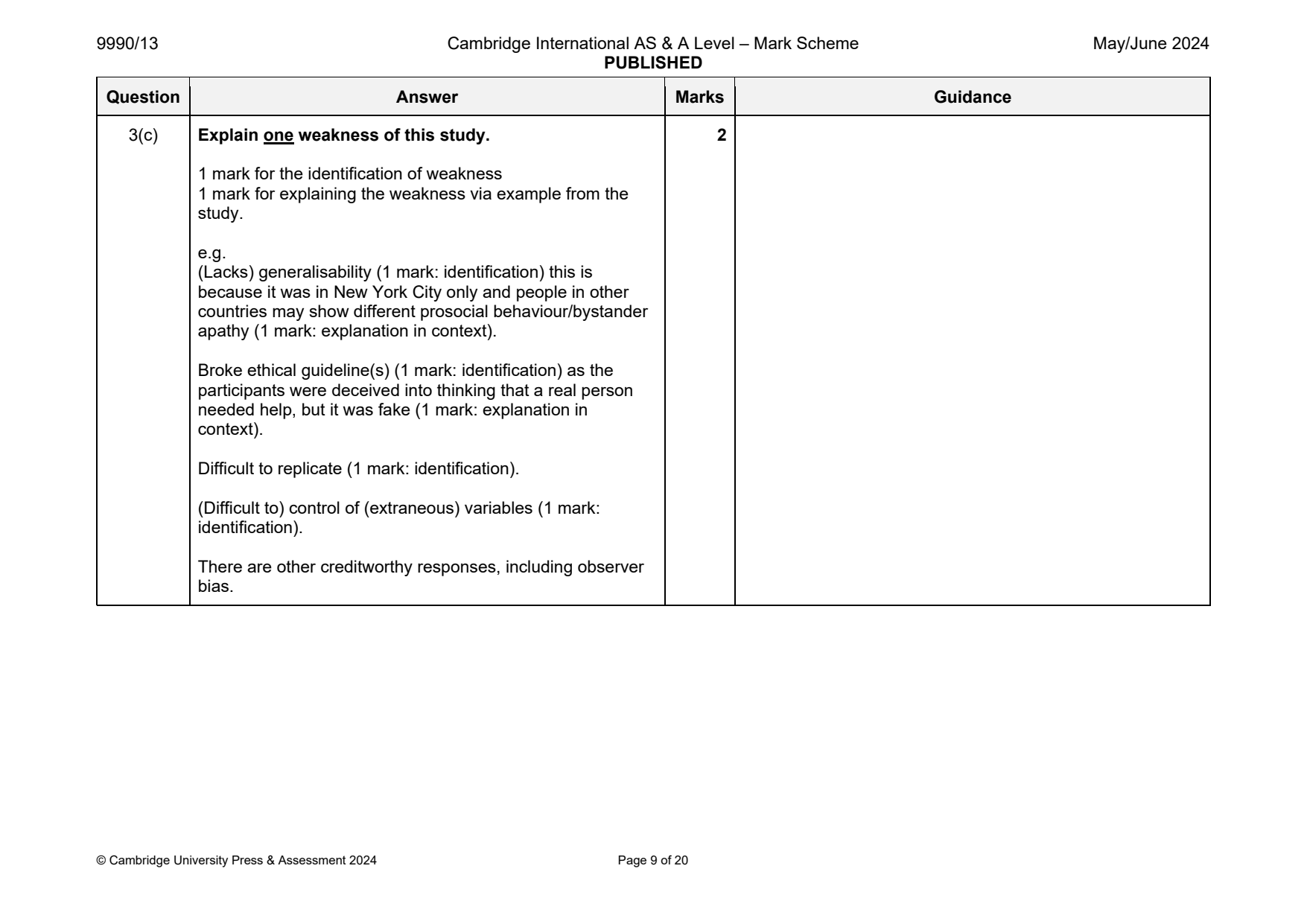
react to oxytocin so there was risk involved (1 mark).
© Cambridge University Press & Assessment 2024 Page 18 of 24
Official mark scheme pages: 17, 18 · source PDF URL
9990-2024-mj-12-q04
May/June 2024 · Paper 12 · Question 4 · 5 marks
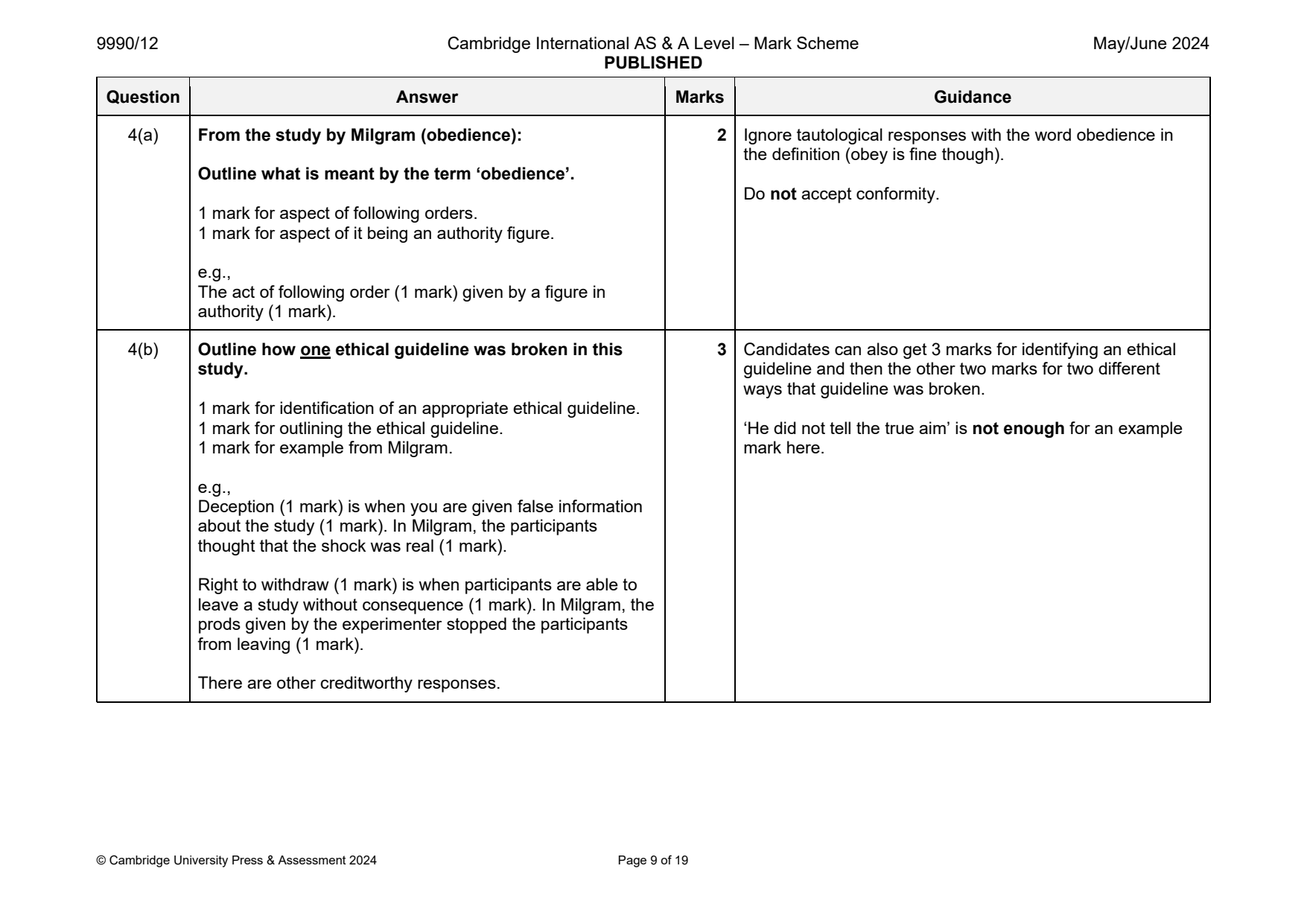
4(a) From the study by Milgram (obedience): 2 Ignore tautological responses with the word obedience in
the definition (obey is fine though).
Outline what is meant by the term ‘obedience’.
Do not accept conformity.
1 mark for aspect of following orders.
1 mark for aspect of it being an authority figure.
e.g.,
The act of following order (1 mark) given by a figure in
authority (1 mark).
4(b) Outline how one ethical guideline was broken in this 3 Candidates can also get 3 marks for identifying an ethical
study. guideline and then the other two marks for two different
ways that guideline was broken.
1 mark for identification of an appropriate ethical guideline.
1 mark for outlining the ethical guideline. ‘He did not tell the true aim’ is not enough for an example
1 mark for example from Milgram. mark here.
e.g.,
Deception (1 mark) is when you are given false information
about the study (1 mark). In Milgram, the participants
thought that the shock was real (1 mark).
Right to withdraw (1 mark) is when participants are able to
leave a study without consequence (1 mark). In Milgram, the
prods given by the experimenter stopped the participants
from leaving (1 mark).
There are other creditworthy responses.
© Cambridge University Press & Assessment 2024 Page 9 of 19
Official mark scheme pages: 9 · source PDF URL
9990-2024-mj-12-q07
May/June 2024 · Paper 12 · Question 7 · 4 marks
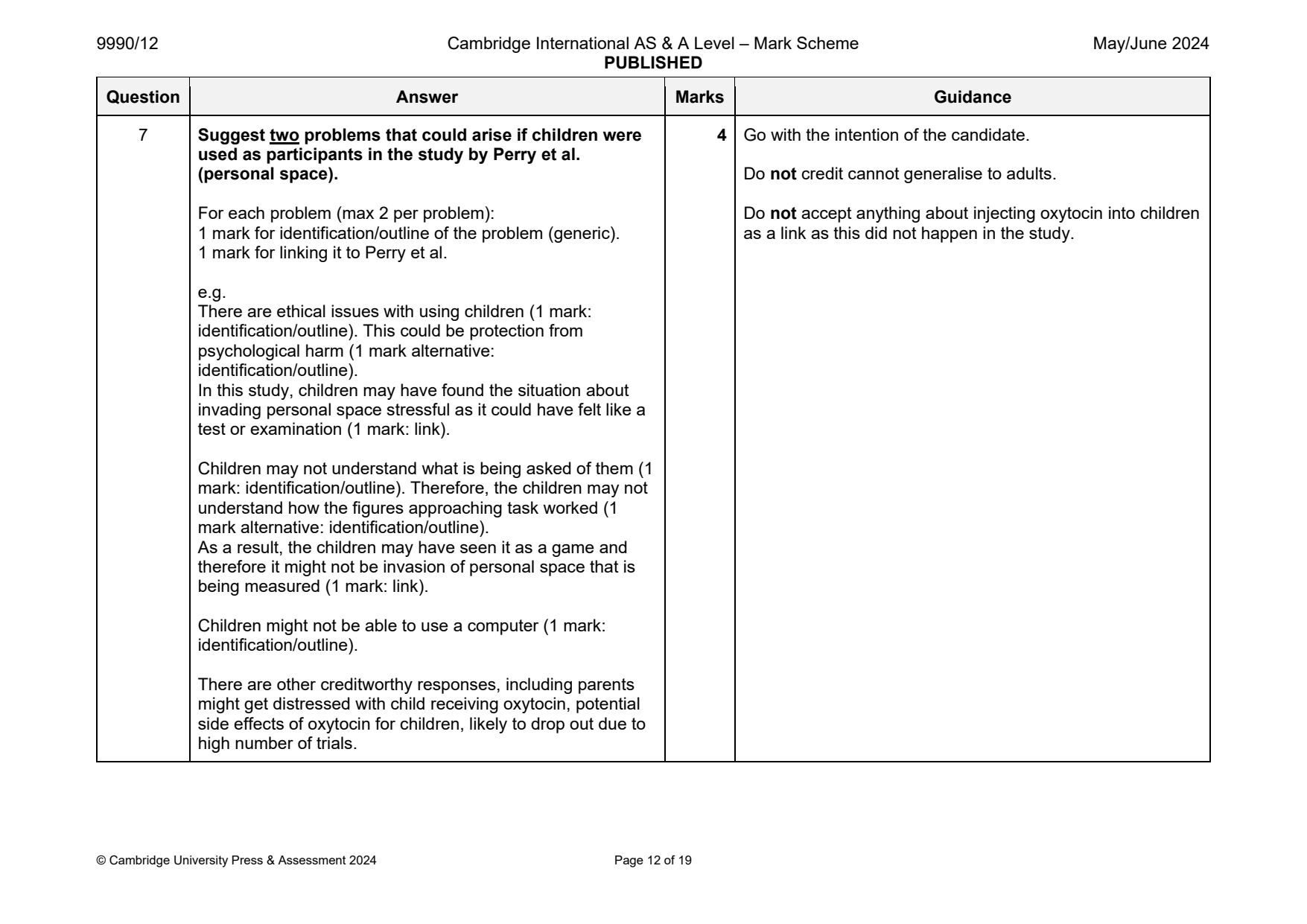
7 Suggest two problems that could arise if children were 4 Go with the intention of the candidate.
used as participants in the study by Perry et al.
(personal space). Do not credit cannot generalise to adults.
For each problem (max 2 per problem): Do not accept anything about injecting oxytocin into children
1 mark for identification/outline of the problem (generic). as a link as this did not happen in the study.
1 mark for linking it to Perry et al.
e.g.
There are ethical issues with using children (1 mark:
identification/outline). This could be protection from
psychological harm (1 mark alternative:
identification/outline).
In this study, children may have found the situation about
invading personal space stressful as it could have felt like a
test or examination (1 mark: link).
Children may not understand what is being asked of them (1
mark: identification/outline). Therefore, the children may not
understand how the figures approaching task worked (1
mark alternative: identification/outline).
As a result, the children may have seen it as a game and
therefore it might not be invasion of personal space that is
being measured (1 mark: link).
Children might not be able to use a computer (1 mark:
identification/outline).
There are other creditworthy responses, including parents
might get distressed with child receiving oxytocin, potential
side effects of oxytocin for children, likely to drop out due to
high number of trials.
© Cambridge University Press & Assessment 2024 Page 12 of 19
Official mark scheme pages: 12 · source PDF URL
9990-2024-mj-12-q08
May/June 2024 · Paper 12 · Question 8 · 4 marks
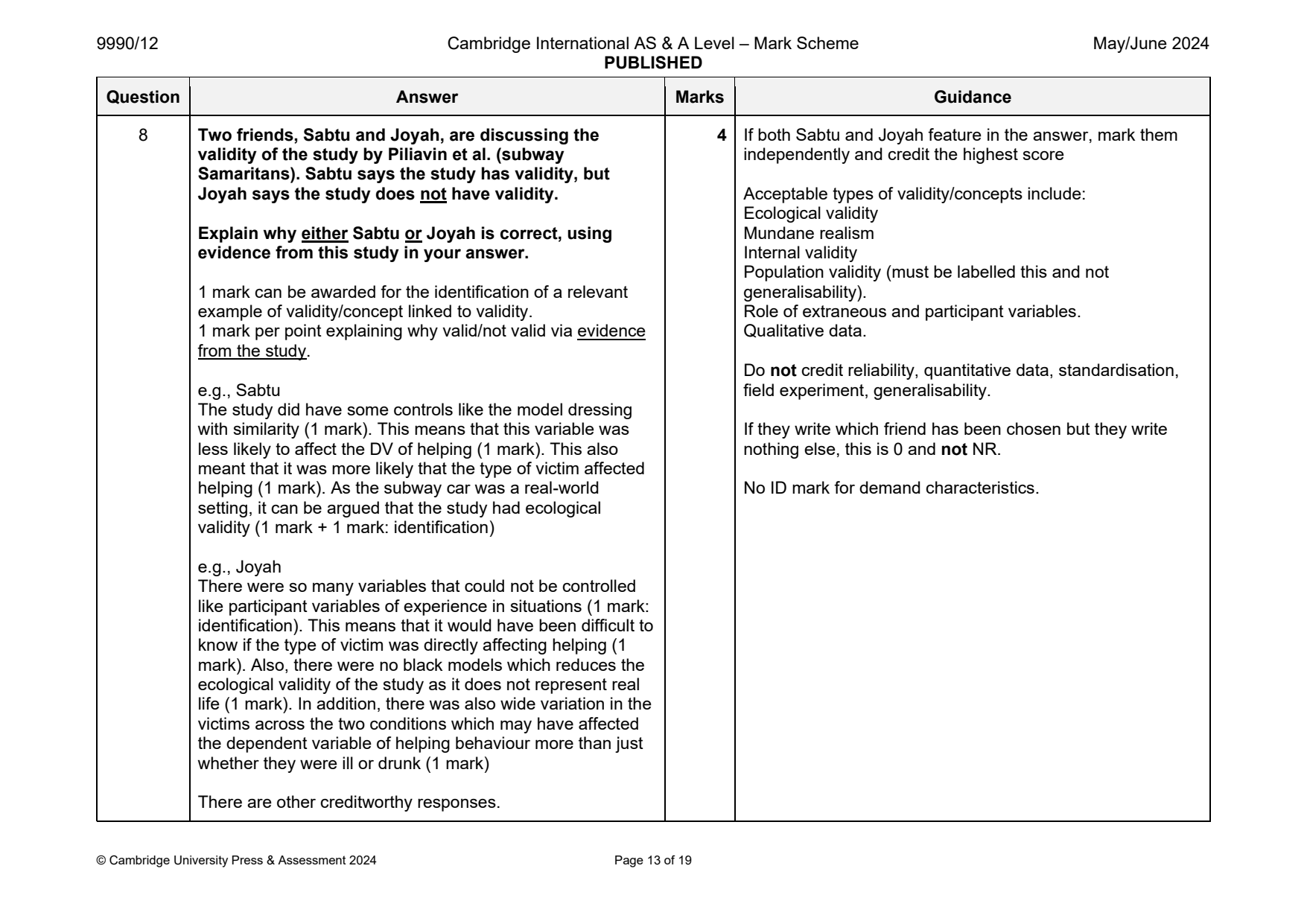
8 Two friends, Sabtu and Joyah, are discussing the 4 If both Sabtu and Joyah feature in the answer, mark them
validity of the study by Piliavin et al. (subway independently and credit the highest score
Samaritans). Sabtu says the study has validity, but
Joyah says the study does not have validity. Acceptable types of validity/concepts include:
Ecological validity
Explain why either Sabtu or Joyah is correct, using Mundane realism
evidence from this study in your answer. Internal validity
Population validity (must be labelled this and not
1 mark can be awarded for the identification of a relevant generalisability).
example of validity/concept linked to validity. Role of extraneous and participant variables.
1 mark per point explaining why valid/not valid via evidence Qualitative data.
from the study.
Do not credit reliability, quantitative data, standardisation,
e.g., Sabtu field experiment, generalisability.
The study did have some controls like the model dressing
with similarity (1 mark). This means that this variable was If they write which friend has been chosen but they write
less likely to affect the DV of helping (1 mark). This also nothing else, this is 0 and not NR.
meant that it was more likely that the type of victim affected
helping (1 mark). As the subway car was a real-world No ID mark for demand characteristics.
setting, it can be argued that the study had ecological
validity (1 mark + 1 mark: identification)
e.g., Joyah
There were so many variables that could not be controlled
like participant variables of experience in situations (1 mark:
identification). This means that it would have been difficult to
know if the type of victim was directly affecting helping (1
mark). Also, there were no black models which reduces the
ecological validity of the study as it does not represent real
life (1 mark). In addition, there was also wide variation in the
victims across the two conditions which may have affected
the dependent variable of helping behaviour more than just
whether they were ill or drunk (1 mark)
There are other creditworthy responses.
© Cambridge University Press & Assessment 2024 Page 13 of 19
Official mark scheme pages: 13 · source PDF URL
9990-2024-mj-13-q01
May/June 2024 · Paper 13 · Question 1 · 5 marks
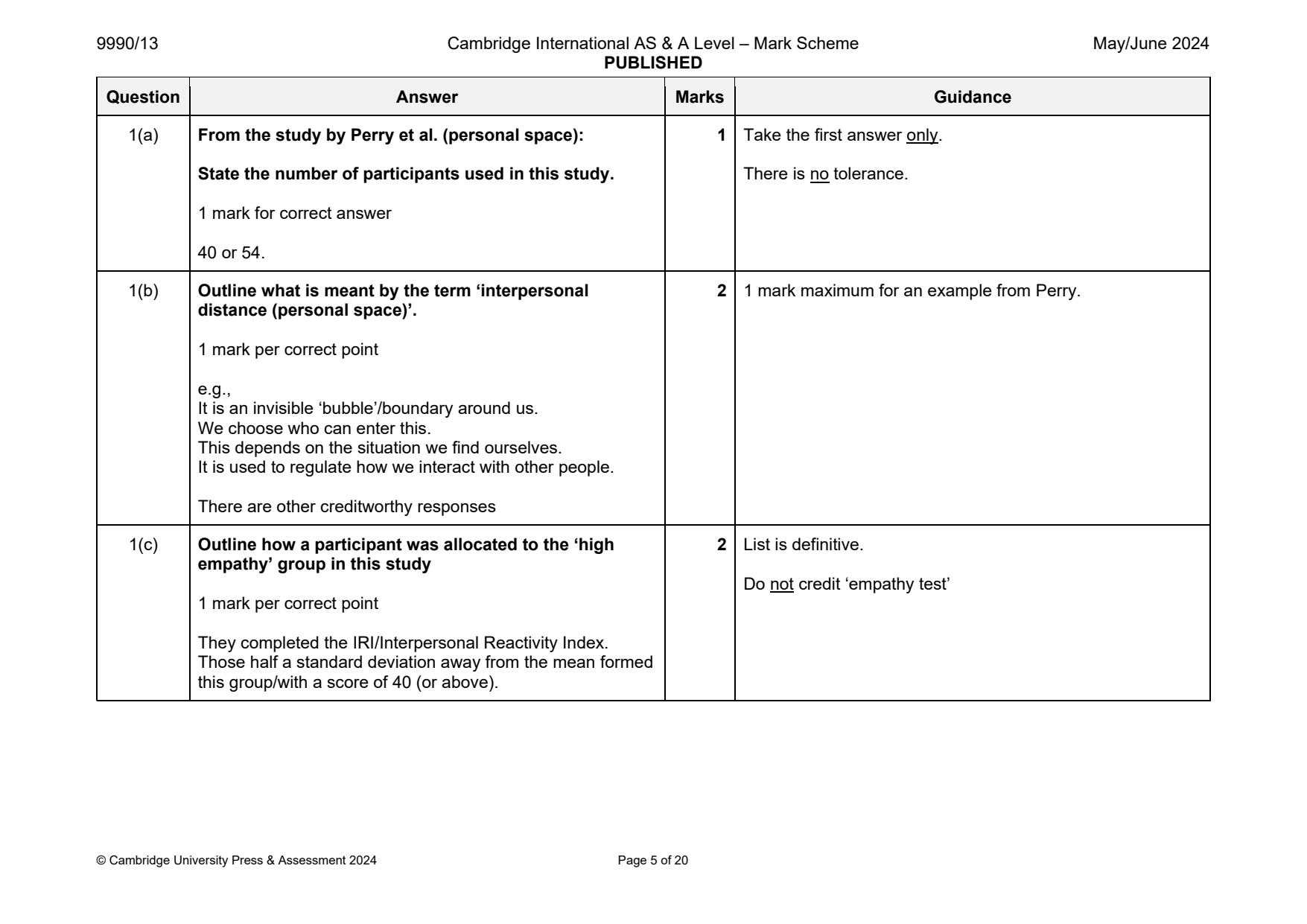
1(a) From the study by Perry et al. (personal space): 1 Take the first answer only.
State the number of participants used in this study. There is no tolerance.
1 mark for correct answer
40 or 54.
1(b) Outline what is meant by the term ‘interpersonal 2 1 mark maximum for an example from Perry.
distance (personal space)’.
1 mark per correct point
e.g.,
It is an invisible ‘bubble’/boundary around us.
We choose who can enter this.
This depends on the situation we find ourselves.
It is used to regulate how we interact with other people.
There are other creditworthy responses
1(c) Outline how a participant was allocated to the ‘high 2 List is definitive.
empathy’ group in this study
Do not credit ‘empathy test’
1 mark per correct point
They completed the IRI/Interpersonal Reactivity Index.
Those half a standard deviation away from the mean formed
this group/with a score of 40 (or above).
© Cambridge University Press & Assessment 2024 Page 5 of 20
Official mark scheme pages: 5 · source PDF URL
9990-2024-mj-13-q03
May/June 2024 · Paper 13 · Question 3 · 6 marks
3(a) From the study by Piliavin et al. (subway Samaritans): 2 Ignore reference to time taken to help = 0.
Outline one result in relation to the race of helper when
the victim was ‘drunk’.
2 marks for the result with a meaningful comparison
1 mark for result with no meaningful comparison
e.g.,
There was more same race helping irrespective of the race
of victim (2 marks)
The victim in the drunk condition was helped more by their
own race (2 marks)
There was the same pattern of same race helping for ill and
drunk victim when victim was white (2 marks)
There was more same race helping when victim was black
and drunk compared to black and ill (2 marks)
There was more same race helping (1 mark)
The race of the helper was more likely to be white (1 mark)
There are other creditworthy responses.
© Cambridge University Press & Assessment 2024 Page 7 of 20
3(b) Outline one result in relation to the number of males in 2 Do accept the group size of 7 vs group size of 3 comparison.
the critical area and the time taken for the victim to
receive help. Do not credit male vs female comparisons.
2 marks for the result with a meaningful Ignore frequency of help.
comparison/relationship
1 mark for result with no meaningful comparison
e.g.,
The more males there were in the critical area the faster the
latency time for help to be given (2 marks).
When the group size was small, people helped faster when
the victim was ill compared to when victim was drunk (2
marks).
Small groups were slow at helping (1 mark).
Large groups were fast at helping (1 mark).
There are other creditworthy responses.
© Cambridge University Press & Assessment 2024 Page 8 of 20
3(c) Explain one weakness of this study. 2
1 mark for the identification of weakness
1 mark for explaining the weakness via example from the
study.
e.g.
(Lacks) generalisability (1 mark: identification) this is
because it was in New York City only and people in other
countries may show different prosocial behaviour/bystander
apathy (1 mark: explanation in context).
Broke ethical guideline(s) (1 mark: identification) as the
participants were deceived into thinking that a real person
needed help, but it was fake (1 mark: explanation in
context).
Difficult to replicate (1 mark: identification).
(Difficult to) control of (extraneous) variables (1 mark:
identification).
There are other creditworthy responses, including observer
bias.
© Cambridge University Press & Assessment 2024 Page 9 of 20
Official mark scheme pages: 7, 8, 9 · source PDF URL
9990-2024-mj-13-q08
May/June 2024 · Paper 13 · Question 8 · 4 marks
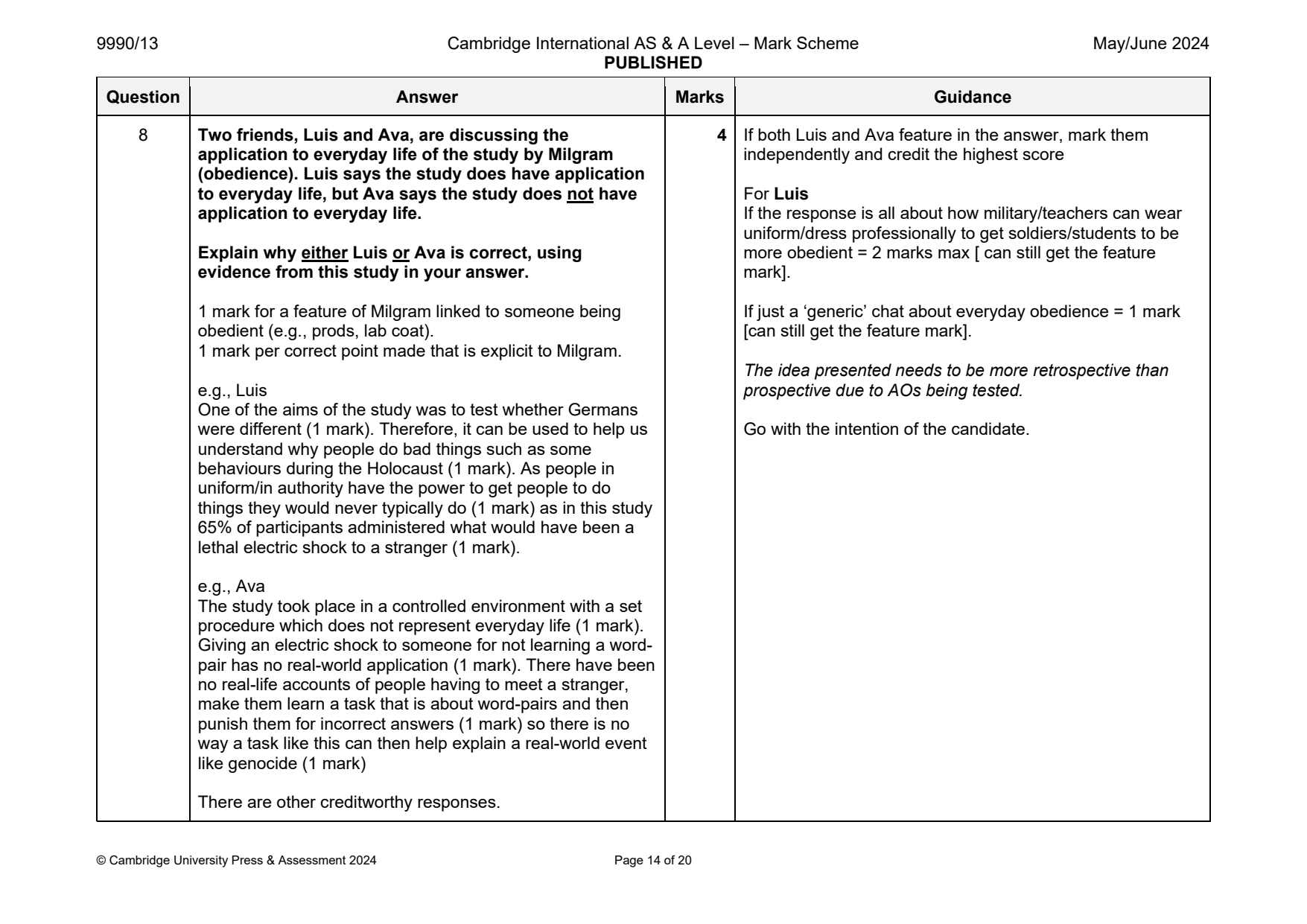
8 Two friends, Luis and Ava, are discussing the 4 If both Luis and Ava feature in the answer, mark them
application to everyday life of the study by Milgram independently and credit the highest score
(obedience). Luis says the study does have application
to everyday life, but Ava says the study does not have For Luis
application to everyday life. If the response is all about how military/teachers can wear
uniform/dress professionally to get soldiers/students to be
Explain why either Luis or Ava is correct, using more obedient = 2 marks max [ can still get the feature
evidence from this study in your answer. mark].
1 mark for a feature of Milgram linked to someone being If just a ‘generic’ chat about everyday obedience = 1 mark
obedient (e.g., prods, lab coat). [can still get the feature mark].
1 mark per correct point made that is explicit to Milgram.
The idea presented needs to be more retrospective than
e.g., Luis prospective due to AOs being tested.
One of the aims of the study was to test whether Germans
were different (1 mark). Therefore, it can be used to help us Go with the intention of the candidate.
understand why people do bad things such as some
behaviours during the Holocaust (1 mark). As people in
uniform/in authority have the power to get people to do
things they would never typically do (1 mark) as in this study
65% of participants administered what would have been a
lethal electric shock to a stranger (1 mark).
e.g., Ava
The study took place in a controlled environment with a set
procedure which does not represent everyday life (1 mark).
Giving an electric shock to someone for not learning a word-
pair has no real-world application (1 mark). There have been
no real-life accounts of people having to meet a stranger,
make them learn a task that is about word-pairs and then
punish them for incorrect answers (1 mark) so there is no
way a task like this can then help explain a real-world event
like genocide (1 mark)
There are other creditworthy responses.
© Cambridge University Press & Assessment 2024 Page 14 of 20
Official mark scheme pages: 14 · source PDF URL
9990-2024-on-11-q04
Oct/Nov 2024 · Paper 11 · Question 4 · 5 marks
4(a) In the study by Milgram (obedience), there was a 5 List is definitive.
‘learning task’. Milgram called this a ‘paired-associate
learning task’. The answer has to be about the learner and not the teacher.
Describe this ‘learning task’ as used in this study. The learning task is different to the shock instructions so
ignore reference to the latter.
1 mark per correct point
Award 1 mark max for:
The P read out a series of word pairs (to the learner). Each incorrect answer received a shock/correct answer
The P then read out one word. moved to next word.
Along with four terms.
The learner then had to indicate which word had been
originally paired/responded with the corresponding word.
This was done by him pressing one of four switches.
This lit up one of four quadrants in the answer box.
© Cambridge University Press & Assessment 2024 Page 11 of 22
Official mark scheme pages: 11 · source PDF URL
9990-2024-on-11-q06
Oct/Nov 2024 · Paper 11 · Question 6 · 6 marks
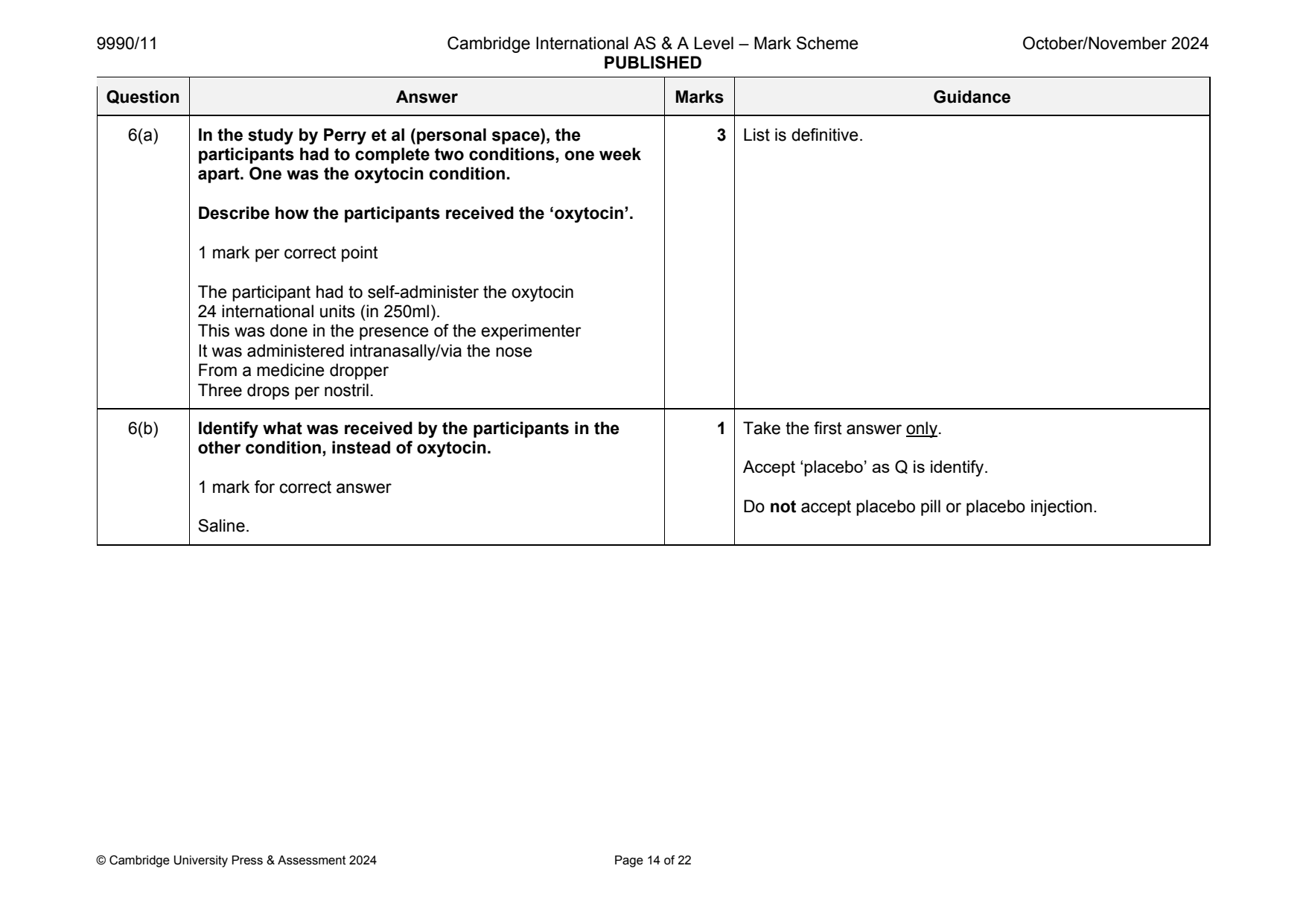
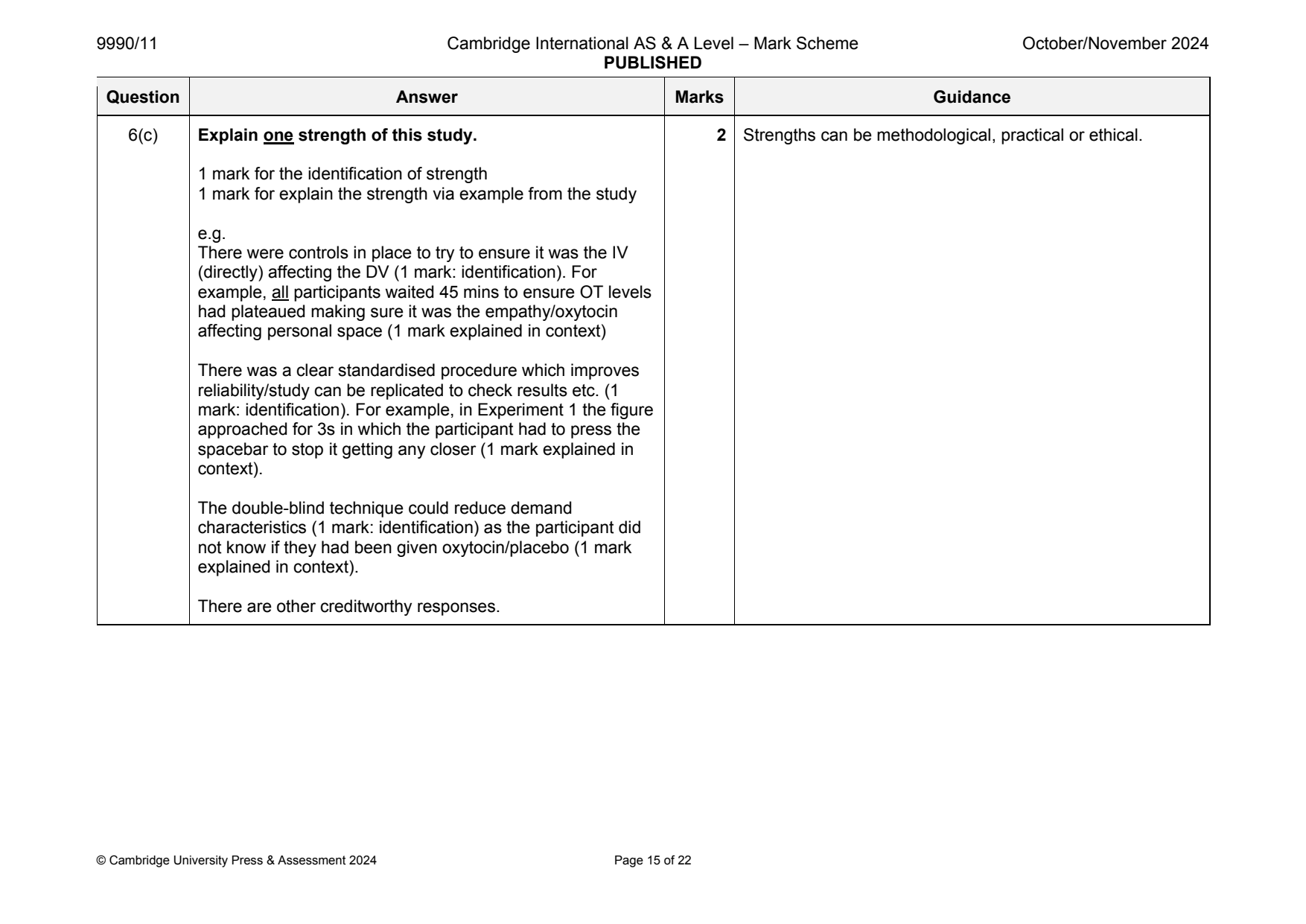
6(a) In the study by Perry et al (personal space), the 3 List is definitive.
participants had to complete two conditions, one week
apart. One was the oxytocin condition.
Describe how the participants received the ‘oxytocin’.
1 mark per correct point
The participant had to self-administer the oxytocin
24 international units (in 250ml).
This was done in the presence of the experimenter
It was administered intranasally/via the nose
From a medicine dropper
Three drops per nostril.
6(b) Identify what was received by the participants in the 1 Take the first answer only.
other condition, instead of oxytocin.
Accept ‘placebo’ as Q is identify.
1 mark for correct answer
Do not accept placebo pill or placebo injection.
Saline.
© Cambridge University Press & Assessment 2024 Page 14 of 22
6(c) Explain one strength of this study. 2 Strengths can be methodological, practical or ethical.
1 mark for the identification of strength
1 mark for explain the strength via example from the study
e.g.
There were controls in place to try to ensure it was the IV
(directly) affecting the DV (1 mark: identification). For
example, all participants waited 45 mins to ensure OT levels
had plateaued making sure it was the empathy/oxytocin
affecting personal space (1 mark explained in context)
There was a clear standardised procedure which improves
reliability/study can be replicated to check results etc. (1
mark: identification). For example, in Experiment 1 the figure
approached for 3s in which the participant had to press the
spacebar to stop it getting any closer (1 mark explained in
context).
The double-blind technique could reduce demand
characteristics (1 mark: identification) as the participant did
not know if they had been given oxytocin/placebo (1 mark
explained in context).
There are other creditworthy responses.
© Cambridge University Press & Assessment 2024 Page 15 of 22
Official mark scheme pages: 14, 15 · source PDF URL
9990-2024-on-12-q03
Oct/Nov 2024 · Paper 12 · Question 3 · 4 marks
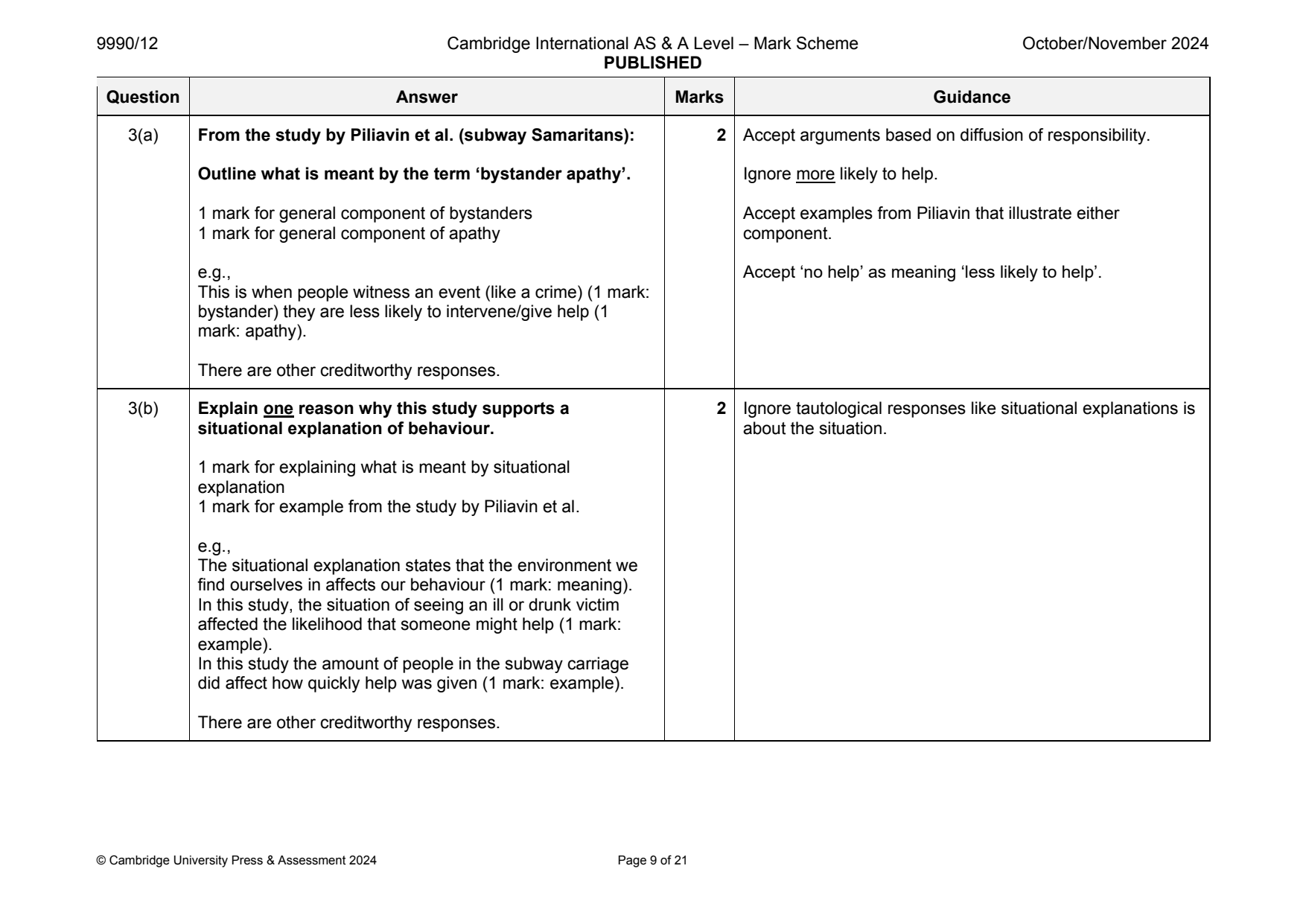
3(a) From the study by Piliavin et al. (subway Samaritans): 2 Accept arguments based on diffusion of responsibility.
Outline what is meant by the term ‘bystander apathy’. Ignore more likely to help.
1 mark for general component of bystanders Accept examples from Piliavin that illustrate either
1 mark for general component of apathy component.
e.g., Accept ‘no help’ as meaning ‘less likely to help’.
This is when people witness an event (like a crime) (1 mark:
bystander) they are less likely to intervene/give help (1
mark: apathy).
There are other creditworthy responses.
3(b) Explain one reason why this study supports a 2 Ignore tautological responses like situational explanations is
situational explanation of behaviour. about the situation.
1 mark for explaining what is meant by situational
explanation
1 mark for example from the study by Piliavin et al.
e.g.,
The situational explanation states that the environment we
find ourselves in affects our behaviour (1 mark: meaning).
In this study, the situation of seeing an ill or drunk victim
affected the likelihood that someone might help (1 mark:
example).
In this study the amount of people in the subway carriage
did affect how quickly help was given (1 mark: example).
There are other creditworthy responses.
© Cambridge University Press & Assessment 2024 Page 9 of 21
Official mark scheme pages: 9 · source PDF URL
9990-2024-on-12-q05
Oct/Nov 2024 · Paper 12 · Question 5 · 6 marks
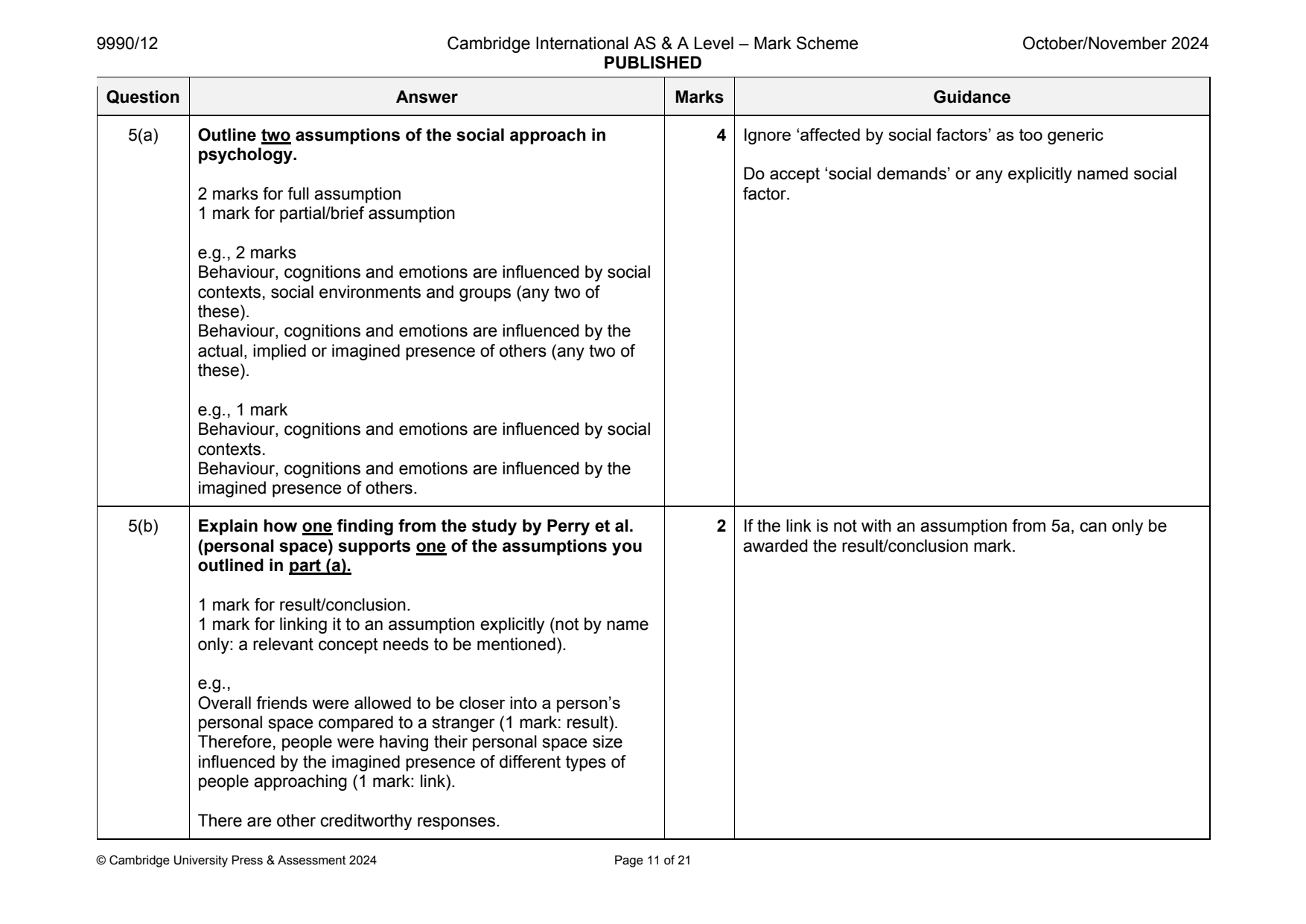
5(a) Outline two assumptions of the social approach in 4 Ignore ‘affected by social factors’ as too generic
psychology.
Do accept ‘social demands’ or any explicitly named social
2 marks for full assumption factor.
1 mark for partial/brief assumption
e.g., 2 marks
Behaviour, cognitions and emotions are influenced by social
contexts, social environments and groups (any two of
these).
Behaviour, cognitions and emotions are influenced by the
actual, implied or imagined presence of others (any two of
these).
e.g., 1 mark
Behaviour, cognitions and emotions are influenced by social
contexts.
Behaviour, cognitions and emotions are influenced by the
imagined presence of others.
5(b) Explain how one finding from the study by Perry et al. 2 If the link is not with an assumption from 5a, can only be
(personal space) supports one of the assumptions you awarded the result/conclusion mark.
outlined in part (a).
1 mark for result/conclusion.
1 mark for linking it to an assumption explicitly (not by name
only: a relevant concept needs to be mentioned).
e.g.,
Overall friends were allowed to be closer into a person’s
personal space compared to a stranger (1 mark: result).
Therefore, people were having their personal space size
influenced by the imagined presence of different types of
people approaching (1 mark: link).
There are other creditworthy responses.
© Cambridge University Press & Assessment 2024 Page 11 of 21
Official mark scheme pages: 11 · source PDF URL
9990-2024-on-12-q09
Oct/Nov 2024 · Paper 12 · Question 9 · 12 marks
9(a) Describe the sample used in the study by Milgram 4 Do credit any data about percentage total for different
(obedience). occupational groups and age ranges (see Table 1 of original
paper)
1 mark per correct point
n=40.
Males.
Volunteer sample/responded to a newspaper advertisement.
Aged 20–50 years.
From New Haven (and surrounding areas).
Wide range of occupations.
Wide range of educational level.
Paid for participation.
© Cambridge University Press & Assessment 2024 Page 16 of 21
9(b) Explain two differences between the study by Milgram 8 Award L1–L4 for each difference
(obedience) and the study by Perry et al. (personal
space). One of the differences must be about ethics. For Level 4 there must be some attempt at explaining the
difference.
Use the marking grid below.
4 marks for the difference (twice), e.g., stooges, ethics, data If both differences do not focus on ethics, then mark both but
collection techniques, generalisability, (ecological) validity. only credit the best.
e.g., difference Use a tick annotation to indicate that one of the differences
4 marks is about ethics.
The studies used stooges in different ways/they were
different ‘types’ (explanation). Milgram used a human stooge Description of studies with no explicit difference = L1
that the participant met beforehand but did not see during Different aims = L1
the duration of the procedure. In the Perry study the Different experimental designs used = 0
participants ‘met’ the animated stooge in various Both volunteer samples so = 0
rooms/scenarios until they felt the stooge was invading
personal space. Ethical differences are:
Consent, harm, right to withdraw, deception.
Example: 3 marks Confidentiality/Debriefing = 0
Milgram used a human stooge that the participant met
beforehand but did not see during the duration of the Rule for ethics:
procedure/ in the Perry study the participants ‘met’ the Explanation = Milgram less ethical and Perry more ethical.
animated stooge in various rooms/scenarios until they felt
the stooge was invading personal space L4: explaining why Milgram less ethical etc. via a named
guideline with explicit examples from both studies.
Example: 2 marks
The studies used stooges in different ways. Milgram used a L3: Describing a difference based on one guideline with
human stooge that the participant met/ Perry used an examples but no explanation OR explanation given but
animated stooge. comparison is on different guideline.
Example: 1 mark L2: Describing a difference with only one example or
The studies used stooges in different ways. compare studies on different guidelines
Overall, Milgram was less ethical/Perry more ethical.
© Cambridge University Press & Assessment 2024 Page 17 of 21
9(b)
Mark/ Description
Level
4 The similarity/difference is well explained using
both studies as examples.
3 The similarity/difference is well explained but
only one study is used as an example OR
both studies are used briefly.
2 The similarity/difference is brief with an attempt
at using at least one study as an example OR
The similarity/difference is well explained but
there is no study evidence.
1 The similarity/difference is brief with no attempt
at using the studies as examples.
0 No creditable response.
© Cambridge University Press & Assessment 2024 Page 18 of 21
Official mark scheme pages: 16, 17, 18 · source PDF URL
9990-2024-on-13-q07
Oct/Nov 2024 · Paper 13 · Question 7 · 4 marks
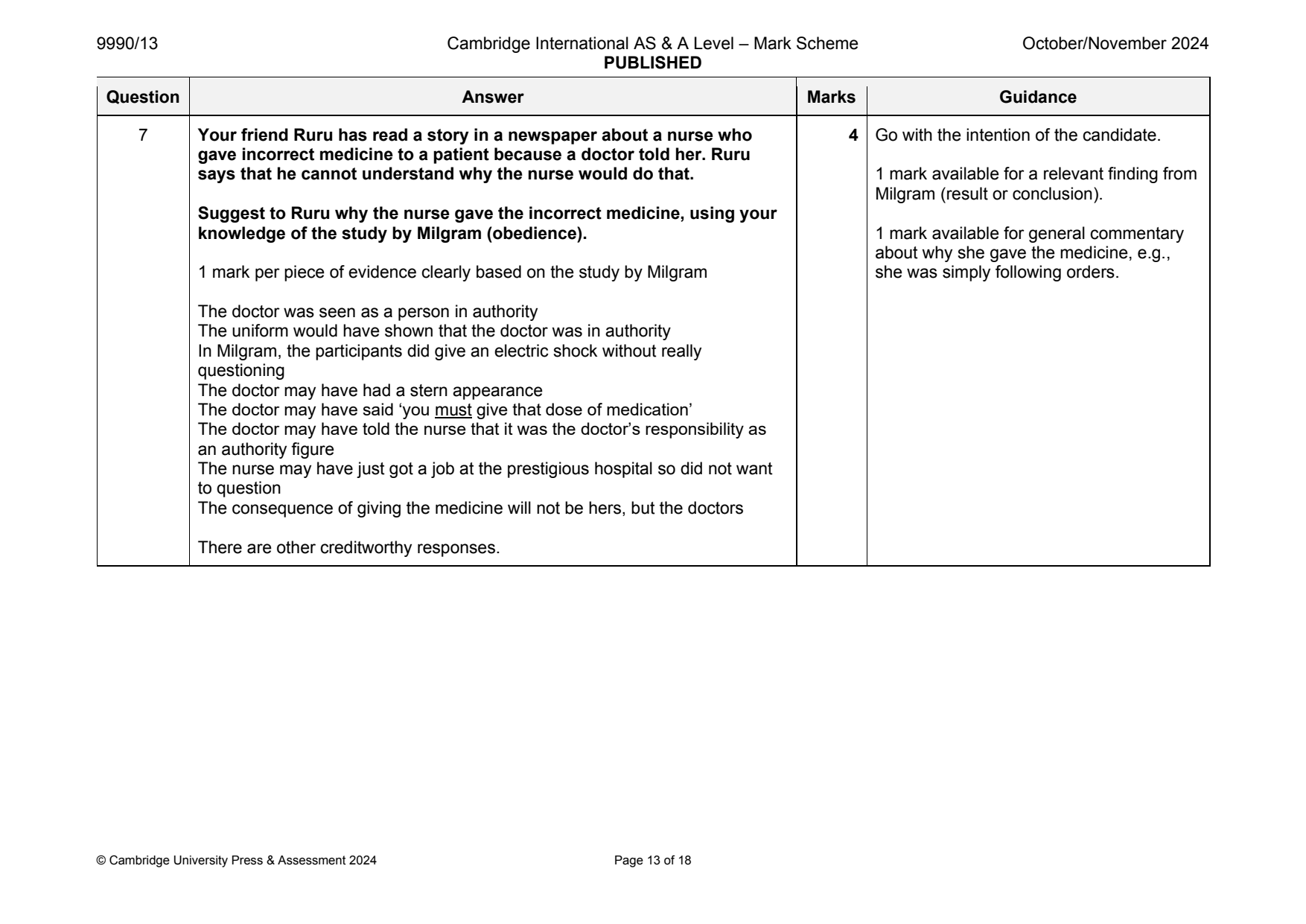
7 Your friend Ruru has read a story in a newspaper about a nurse who 4 Go with the intention of the candidate.
gave incorrect medicine to a patient because a doctor told her. Ruru
says that he cannot understand why the nurse would do that. 1 mark available for a relevant finding from
Milgram (result or conclusion).
Suggest to Ruru why the nurse gave the incorrect medicine, using your
knowledge of the study by Milgram (obedience). 1 mark available for general commentary
about why she gave the medicine, e.g.,
1 mark per piece of evidence clearly based on the study by Milgram she was simply following orders.
The doctor was seen as a person in authority
The uniform would have shown that the doctor was in authority
In Milgram, the participants did give an electric shock without really
questioning
The doctor may have had a stern appearance
The doctor may have said ‘you must give that dose of medication’
The doctor may have told the nurse that it was the doctor’s responsibility as
an authority figure
The nurse may have just got a job at the prestigious hospital so did not want
to question
The consequence of giving the medicine will not be hers, but the doctors
There are other creditworthy responses.
© Cambridge University Press & Assessment 2024 Page 13 of 18
Official mark scheme pages: 13 · source PDF URL
9990-2024-on-13-q10
Oct/Nov 2024 · Paper 13 · Question 10 · 10 marks
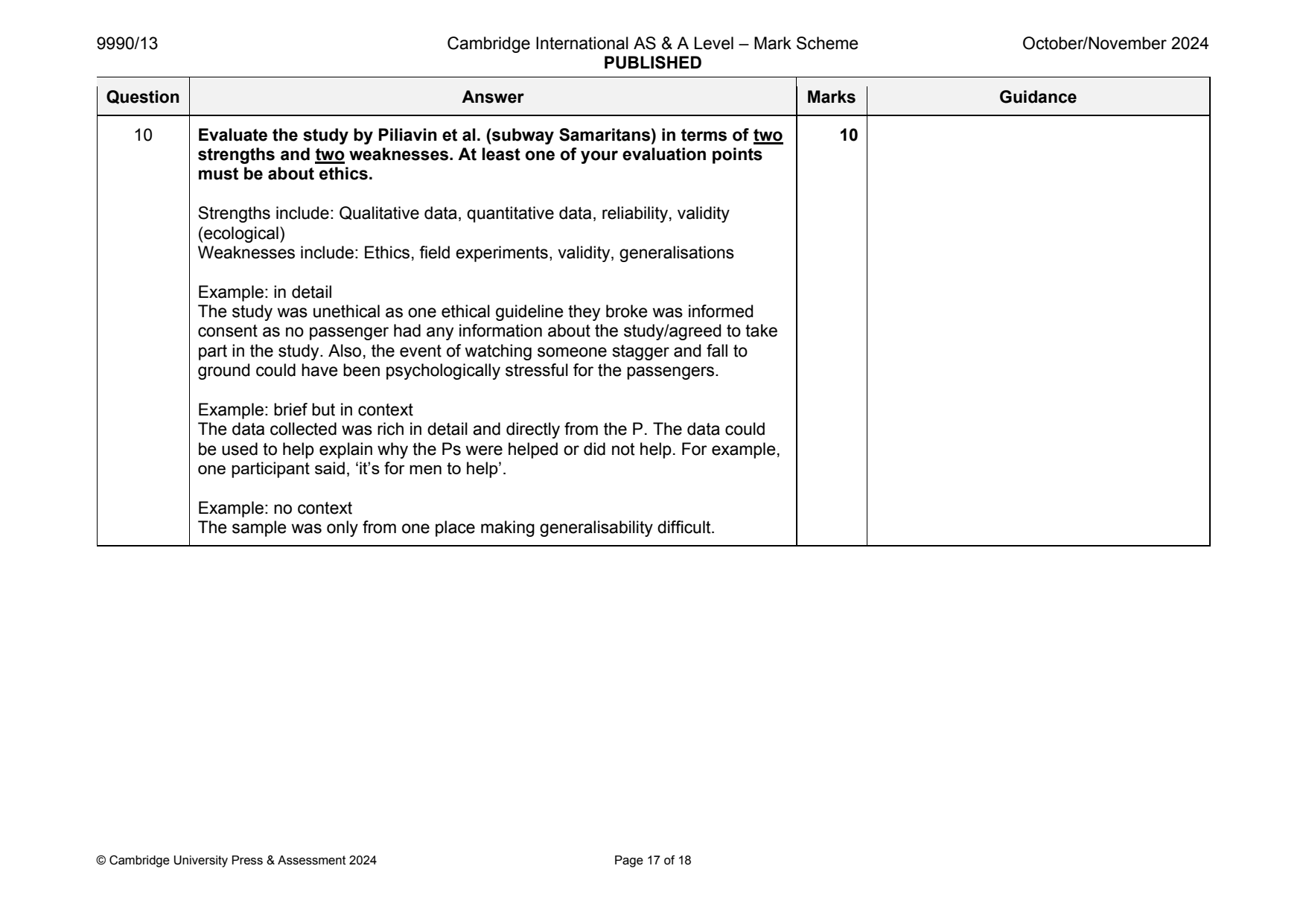
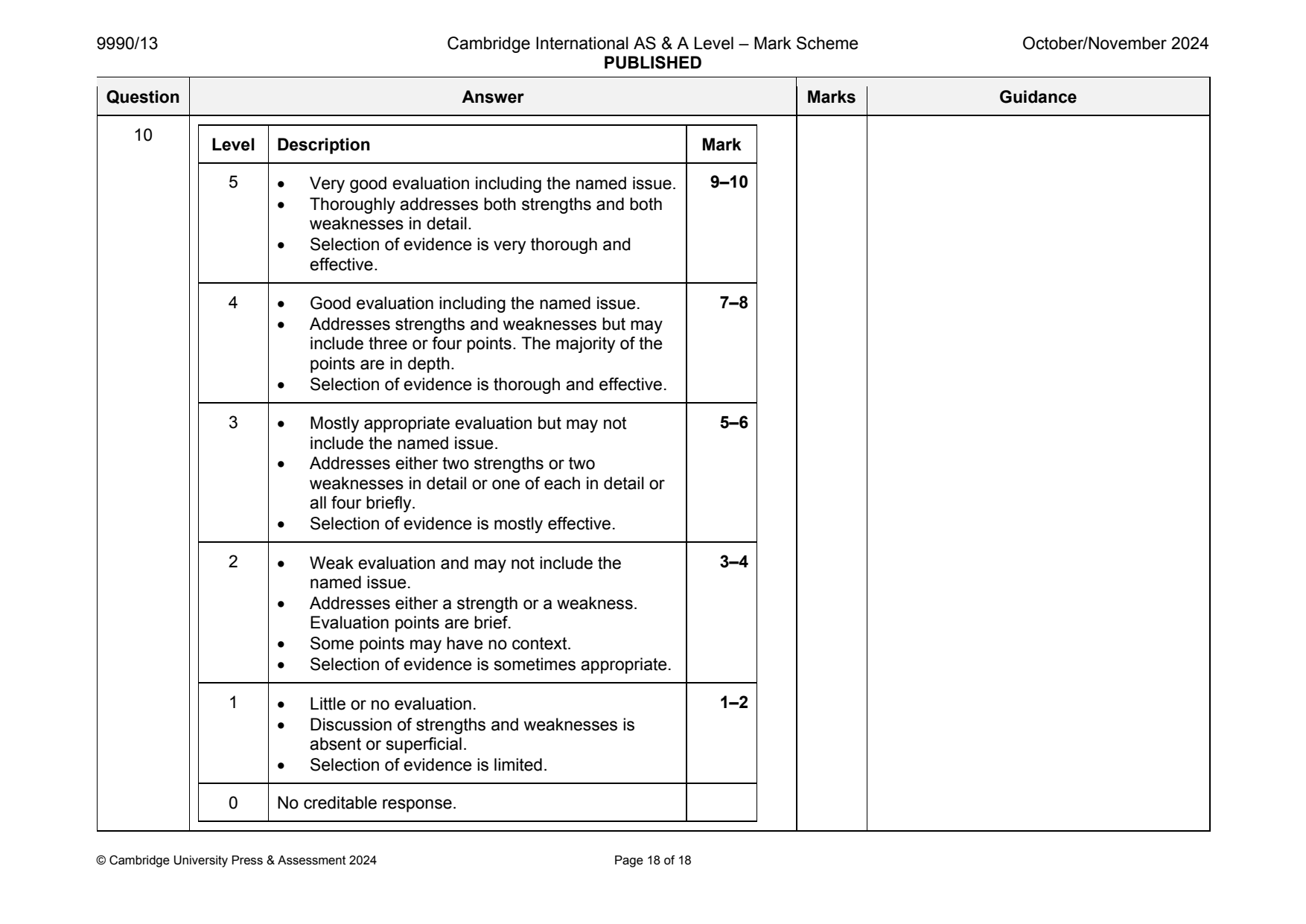
10 Evaluate the study by Piliavin et al. (subway Samaritans) in terms of two 10
strengths and two weaknesses. At least one of your evaluation points
must be about ethics.
Strengths include: Qualitative data, quantitative data, reliability, validity
(ecological)
Weaknesses include: Ethics, field experiments, validity, generalisations
Example: in detail
The study was unethical as one ethical guideline they broke was informed
consent as no passenger had any information about the study/agreed to take
part in the study. Also, the event of watching someone stagger and fall to
ground could have been psychologically stressful for the passengers.
Example: brief but in context
The data collected was rich in detail and directly from the P. The data could
be used to help explain why the Ps were helped or did not help. For example,
one participant said, ‘it’s for men to help’.
Example: no context
The sample was only from one place making generalisability difficult.
© Cambridge University Press & Assessment 2024 Page 17 of 18
9990/13 Cambridge International AS & A Level – Mark Scheme October/November 2024
PUBLISHED
Question Answer Marks Guidance
10
Level Description Mark
5 • Very good evaluation including the named issue. 9–10
• Thoroughly addresses both strengths and both
weaknesses in detail.
• Selection of evidence is very thorough and
effective.
4 • Good evaluation including the named issue. 7–8
• Addresses strengths and weaknesses but may
include three or four points. The majority of the
points are in depth.
• Selection of evidence is thorough and effective.
3 • Mostly appropriate evaluation but may not 5–6
include the named issue.
• Addresses either two strengths or two
weaknesses in detail or one of each in detail or
all four briefly.
• Selection of evidence is mostly effective.
2 • Weak evaluation and may not include the 3–4
named issue.
• Addresses either a strength or a weakness.
Evaluation points are brief.
• Some points may have no context.
• Selection of evidence is sometimes appropriate.
1 • Little or no evaluation. 1–2
• Discussion of strengths and weaknesses is
absent or superficial.
• Selection of evidence is limited.
0 No creditable response.
© Cambridge University Press & Assessment 2024 Page 18 of 18
Official mark scheme pages: 17, 18 · source PDF URL
9990-2025-m-12-q01
March 2025 · Paper 12 · Question 1 · 5 marks
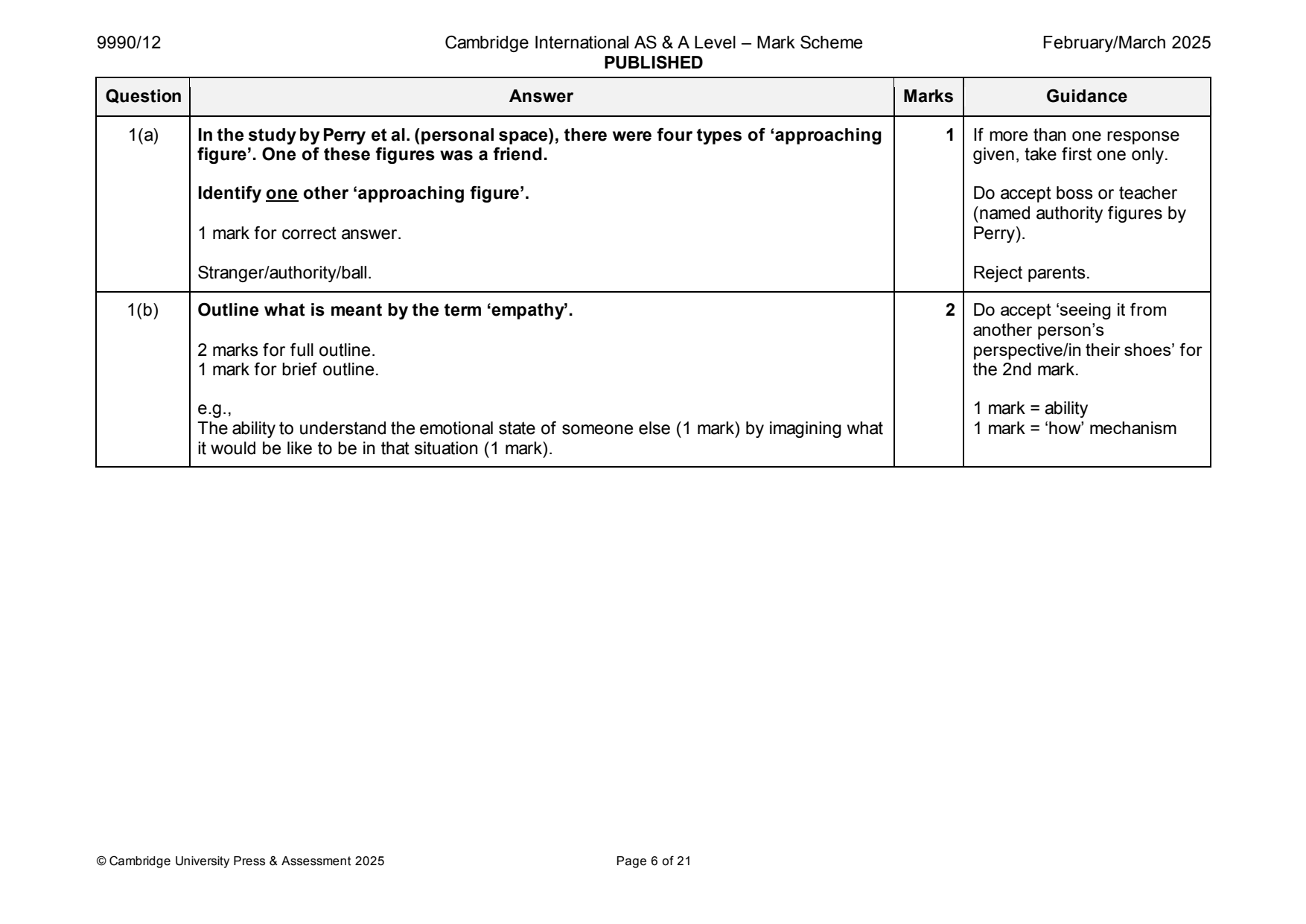
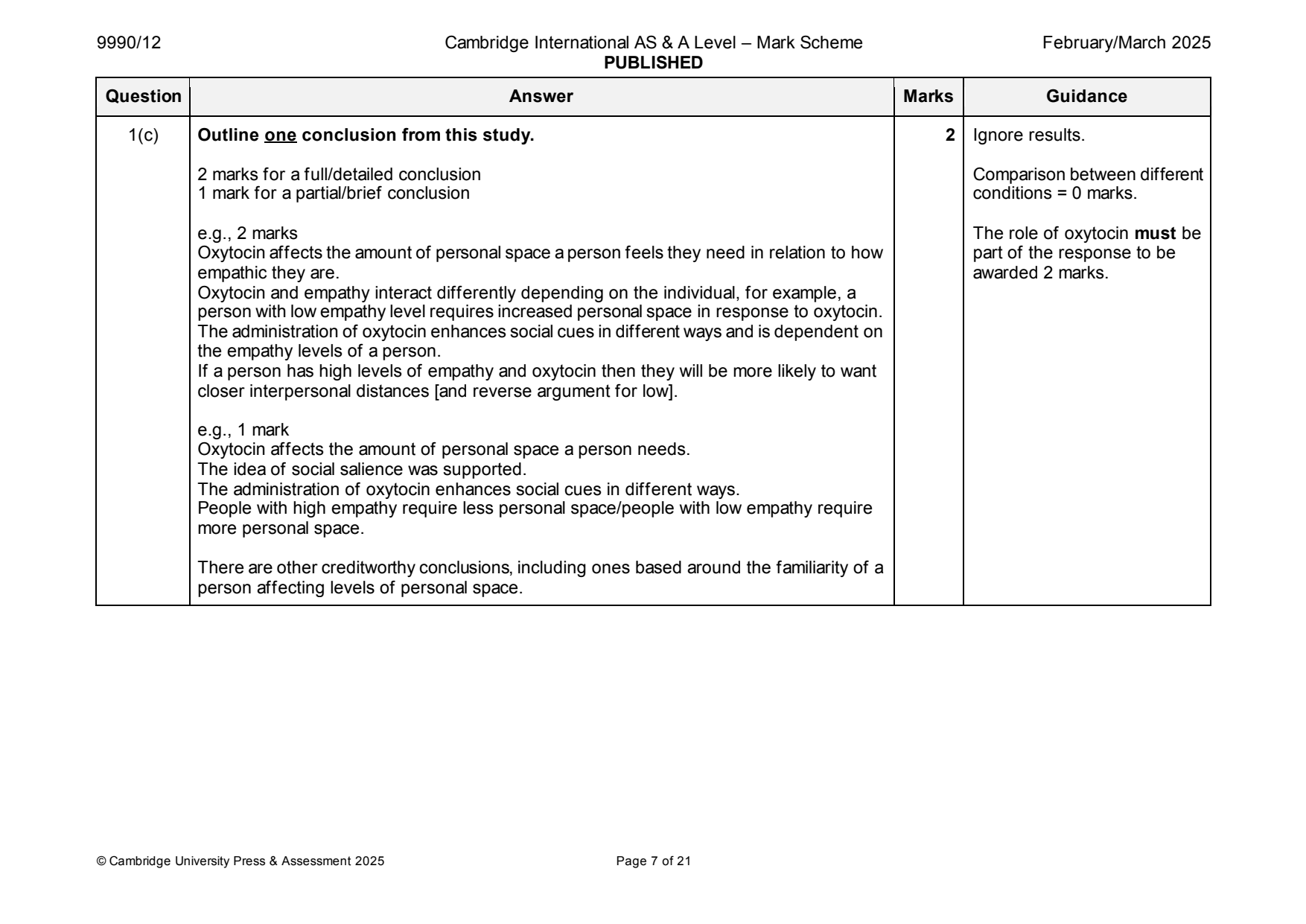
1(a) In the study by Perry et al. (personal space), there were four types of ‘approaching 1 If more than one response
figure’. One of these figures was a friend. given, take first one only.
Identify one other ‘approaching figure’. Do accept boss or teacher
(named authority figures by
1 mark for correct answer. Perry).
Stranger/authority/ball. Reject parents.
1(b) Outline what is meant by the term ‘empathy’. 2 Do accept ‘seeing it from
another person’s
2 marks for full outline. perspective/in their shoes’ for
1 mark for brief outline. the 2nd mark.
e.g., 1 mark = ability
The ability to understand the emotional state of someone else (1 mark) by imagining what 1 mark = ‘how’ mechanism
it would be like to be in that situation (1 mark).
© Cambridge University Press & Assessment 2025 Page 6 of 21
1(c) Outline one conclusion from this study. 2 Ignore results.
2 marks for a full/detailed conclusion Comparison between different
1 mark for a partial/brief conclusion conditions = 0 marks.
e.g., 2 marks The role of oxytocin must be
Oxytocin affects the amount of personal space a person feels they need in relation to how part of the response to be
empathic they are. awarded 2 marks.
Oxytocin and empathy interact differently depending on the individual, for example, a
person with low empathy level requires increased personal space in response to oxytocin.
The administration of oxytocin enhances social cues in different ways and is dependent on
the empathy levels of a person.
If a person has high levels of empathy and oxytocin then they will be more likely to want
closer interpersonal distances [and reverse argument for low].
e.g., 1 mark
Oxytocin affects the amount of personal space a person needs.
The idea of social salience was supported.
The administration of oxytocin enhances social cues in different ways.
People with high empathy require less personal space/people with low empathy require
more personal space.
There are other creditworthy conclusions, including ones based around the familiarity of a
person affecting levels of personal space.
© Cambridge University Press & Assessment 2025 Page 7 of 21
Official mark scheme pages: 6, 7 · source PDF URL
9990-2025-m-12-q08
March 2025 · Paper 12 · Question 8 · 4 marks
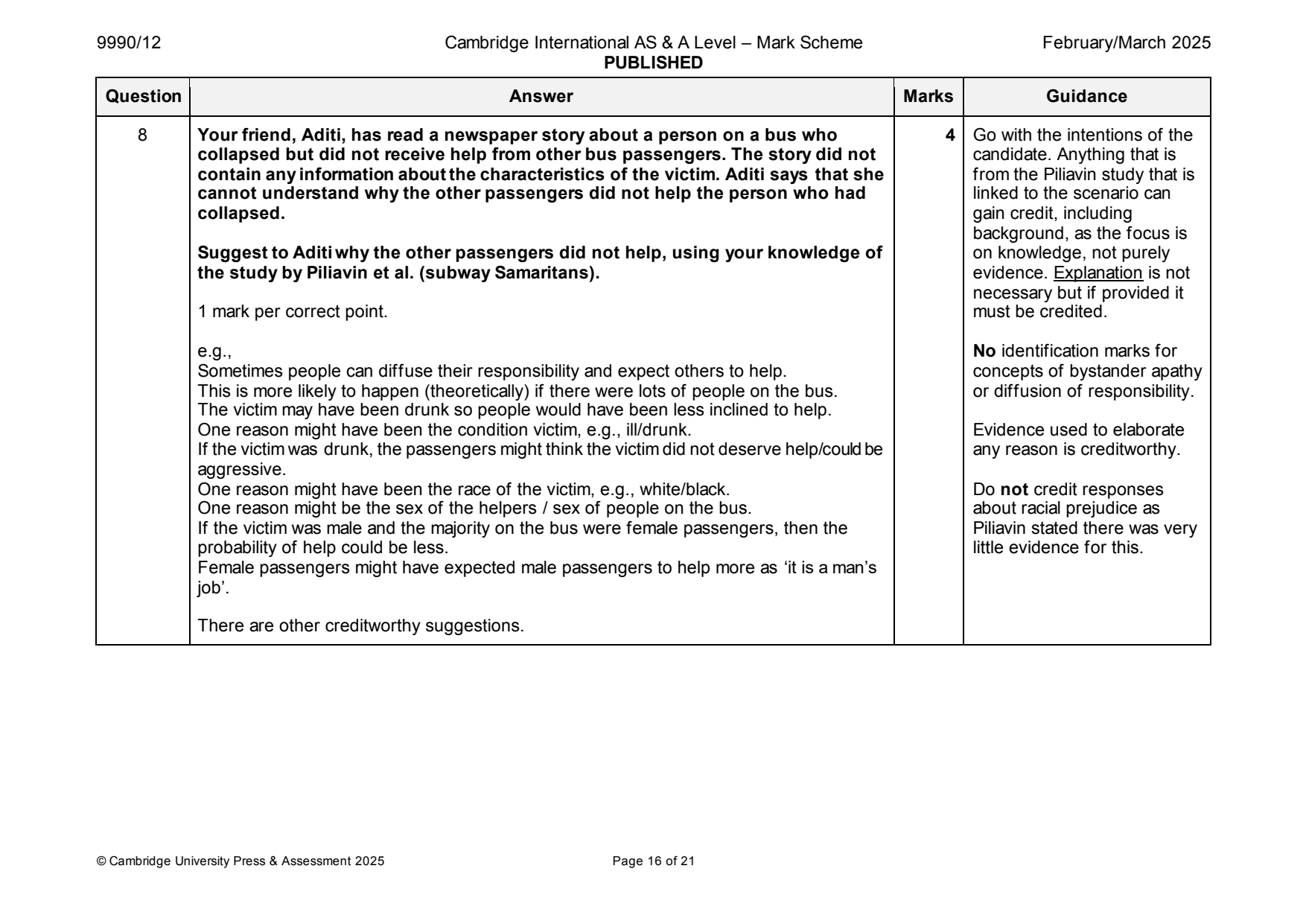
8 Your friend, Aditi, has read a newspaper story about a person on a bus who 4 Go with the intentions of the
collapsed but did not receive help from other bus passengers. The story did not candidate. Anything that is
contain any information about the characteristics of the victim. Aditi says that she from the Piliavin study that is
cannot understand why the other passengers did not help the person who had linked to the scenario can
collapsed. gain credit, including
background, as the focus is
Suggest to Aditi why the other passengers did not help, using your knowledge of on knowledge, not purely
the study by Piliavin et al. (subway Samaritans). evidence. Explanation is not
necessary but if provided it
1 mark per correct point. must be credited.
e.g., No identification marks for
Sometimes people can diffuse their responsibility and expect others to help. concepts of bystander apathy
This is more likely to happen (theoretically) if there were lots of people on the bus. or diffusion of responsibility.
The victim may have been drunk so people would have been less inclined to help.
One reason might have been the condition victim, e.g., ill/drunk. Evidence used to elaborate
If the victim was drunk, the passengers might think the victim did not deserve help/could be any reason is creditworthy.
aggressive.
One reason might have been the race of the victim, e.g., white/black. Do not credit responses
One reason might be the sex of the helpers / sex of people on the bus. about racial prejudice as
If the victim was male and the majority on the bus were female passengers, then the Piliavin stated there was very
probability of help could be less. little evidence for this.
Female passengers might have expected male passengers to help more as ‘it is a man’s
job’.
There are other creditworthy suggestions.
© Cambridge University Press & Assessment 2025 Page 16 of 21
Official mark scheme pages: 16 · source PDF URL
9990-2025-mj-11-q02
May/June 2025 · Paper 11 · Question 2 · 4 marks
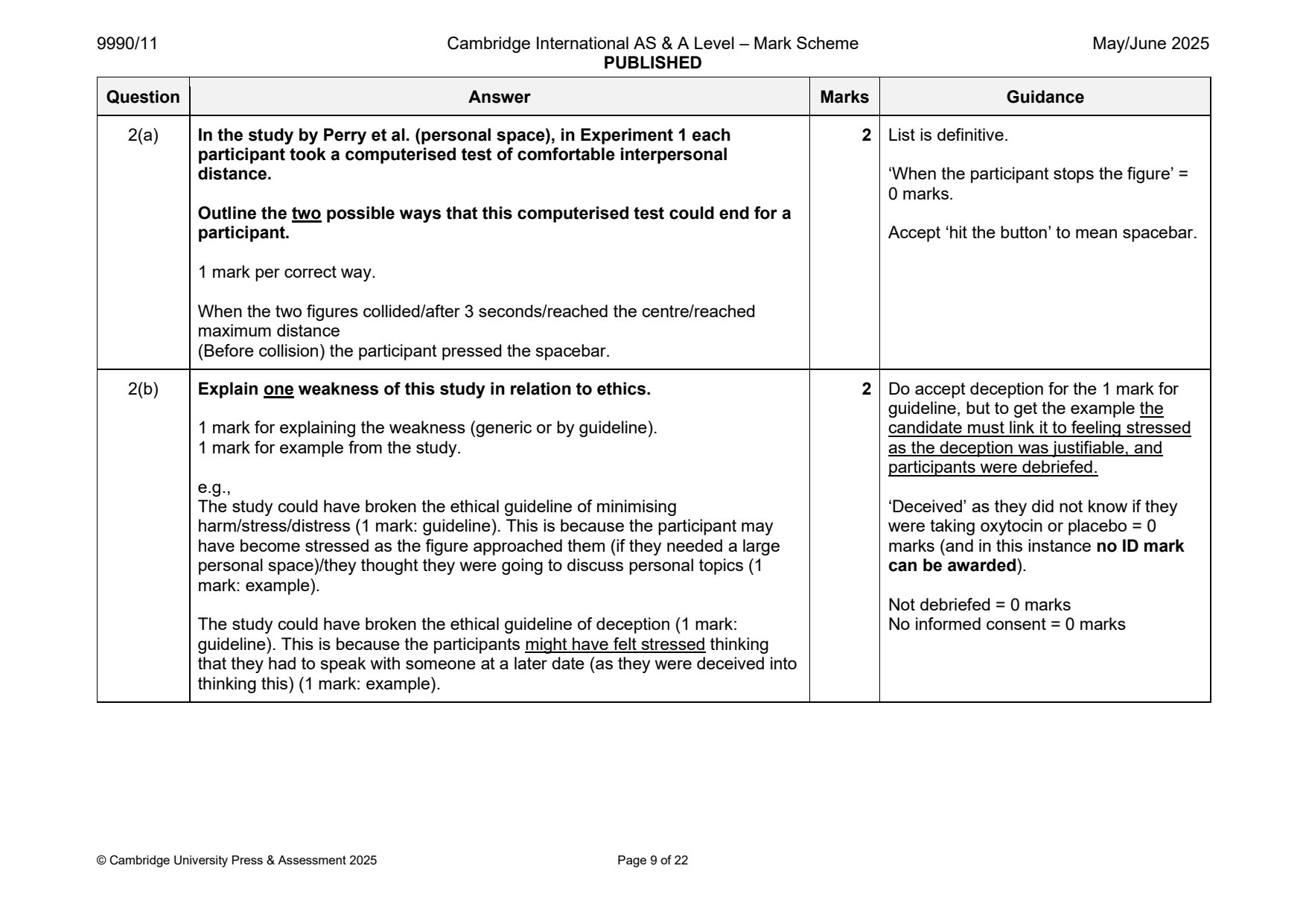
2(a) In the study by Perry et al. (personal space), in Experiment 1 each 2 List is definitive.
participant took a computerised test of comfortable interpersonal
distance. ‘When the participant stops the figure’ =
0 marks.
Outline the two possible ways that this computerised test could end for a
participant. Accept ‘hit the button’ to mean spacebar.
1 mark per correct way.
When the two figures collided/after 3 seconds/reached the centre/reached
maximum distance
(Before collision) the participant pressed the spacebar.
2(b) Explain one weakness of this study in relation to ethics. 2 Do accept deception for the 1 mark for
guideline, but to get the example the
1 mark for explaining the weakness (generic or by guideline). candidate must link it to feeling stressed
1 mark for example from the study. as the deception was justifiable, and
participants were debriefed.
e.g.,
The study could have broken the ethical guideline of minimising ‘Deceived’ as they did not know if they
harm/stress/distress (1 mark: guideline). This is because the participant may were taking oxytocin or placebo = 0
have become stressed as the figure approached them (if they needed a large marks (and in this instance no ID mark
personal space)/they thought they were going to discuss personal topics (1 can be awarded).
mark: example).
Not debriefed = 0 marks
The study could have broken the ethical guideline of deception (1 mark: No informed consent = 0 marks
guideline). This is because the participants might have felt stressed thinking
that they had to speak with someone at a later date (as they were deceived into
thinking this) (1 mark: example).
© Cambridge University Press & Assessment 2025 Page 9 of 22
Official mark scheme pages: 9 · source PDF URL
9990-2025-mj-11-q10
May/June 2025 · Paper 11 · Question 10 · 10 marks
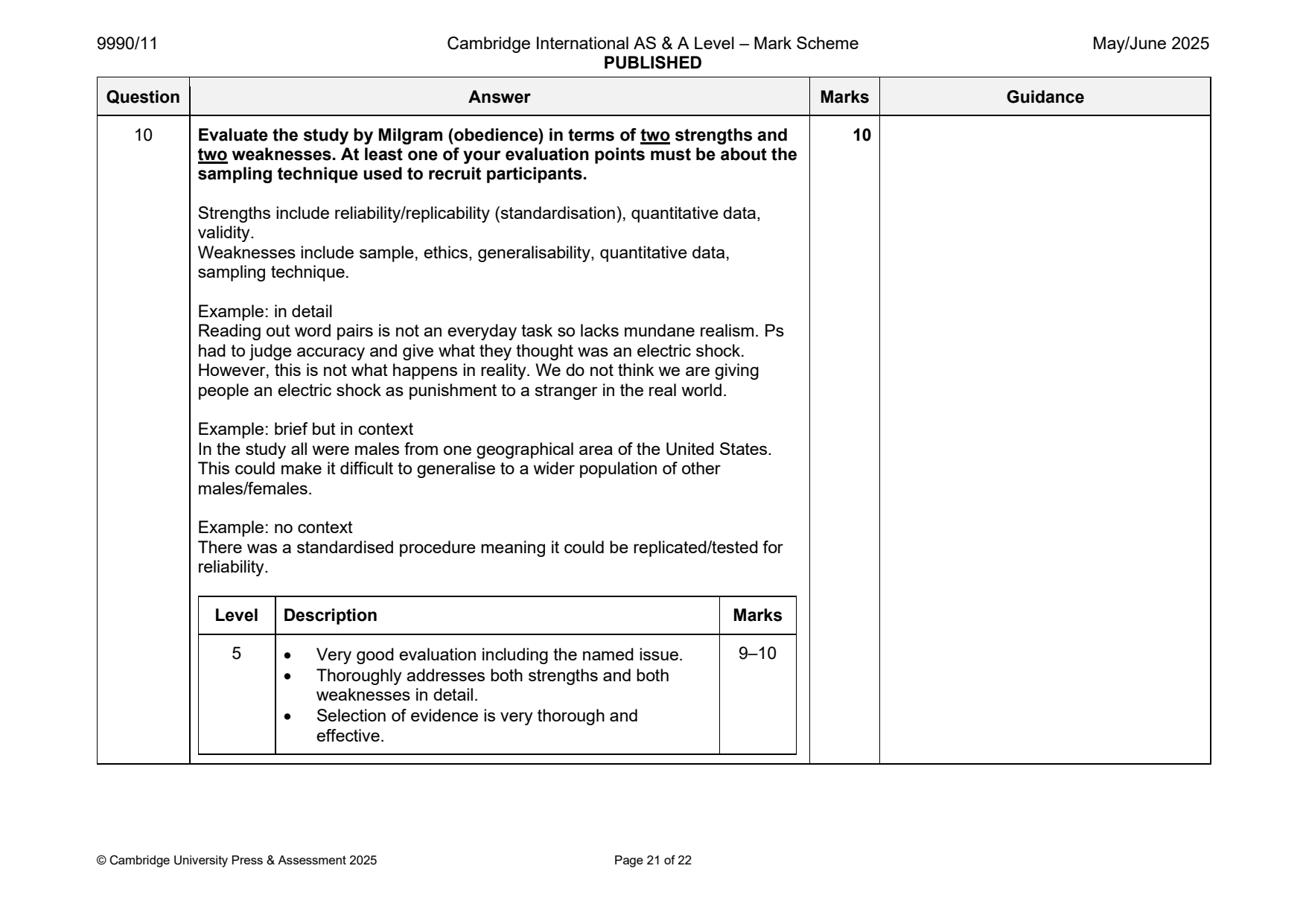
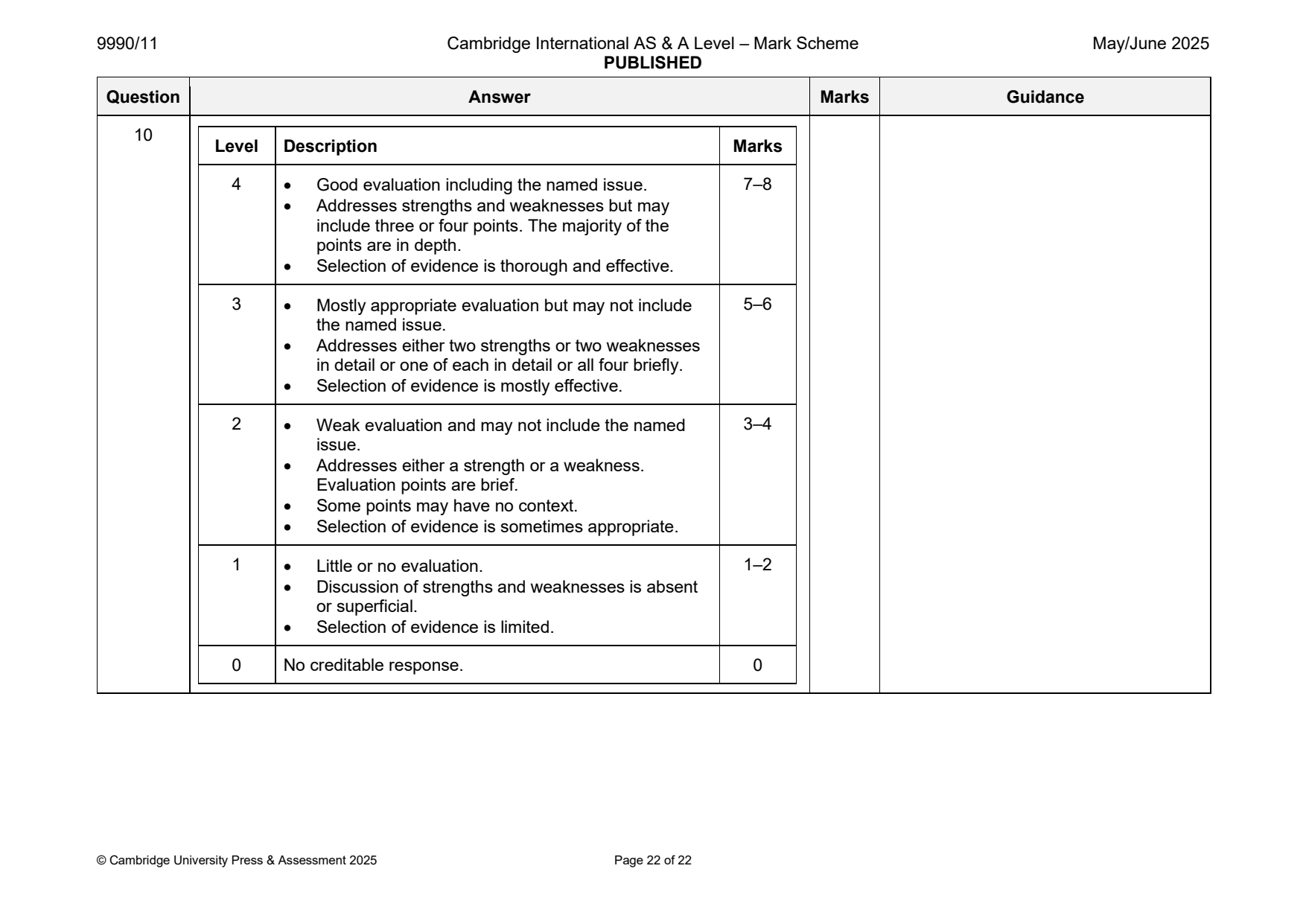
10 Evaluate the study by Milgram (obedience) in terms of two strengths and 10
two weaknesses. At least one of your evaluation points must be about the
sampling technique used to recruit participants.
Strengths include reliability/replicability (standardisation), quantitative data,
validity.
Weaknesses include sample, ethics, generalisability, quantitative data,
sampling technique.
Example: in detail
Reading out word pairs is not an everyday task so lacks mundane realism. Ps
had to judge accuracy and give what they thought was an electric shock.
However, this is not what happens in reality. We do not think we are giving
people an electric shock as punishment to a stranger in the real world.
Example: brief but in context
In the study all were males from one geographical area of the United States.
This could make it difficult to generalise to a wider population of other
males/females.
Example: no context
There was a standardised procedure meaning it could be replicated/tested for
reliability.
Level Description Marks
5 • Very good evaluation including the named issue. 9–10
• Thoroughly addresses both strengths and both
weaknesses in detail.
• Selection of evidence is very thorough and
effective.
© Cambridge University Press & Assessment 2025 Page 21 of 22
9990/11 Cambridge International AS & A Level – Mark Scheme May/June 2025
PUBLISHED
Question Answer Marks Guidance
10
Level Description Marks
4 • Good evaluation including the named issue. 7–8
• Addresses strengths and weaknesses but may
include three or four points. The majority of the
points are in depth.
• Selection of evidence is thorough and effective.
3 • Mostly appropriate evaluation but may not include 5–6
the named issue.
• Addresses either two strengths or two weaknesses
in detail or one of each in detail or all four briefly.
• Selection of evidence is mostly effective.
2 • Weak evaluation and may not include the named 3–4
issue.
• Addresses either a strength or a weakness.
Evaluation points are brief.
• Some points may have no context.
• Selection of evidence is sometimes appropriate.
1 • Little or no evaluation. 1–2
• Discussion of strengths and weaknesses is absent
or superficial.
• Selection of evidence is limited.
0 No creditable response. 0
© Cambridge University Press & Assessment 2025 Page 22 of 22
Official mark scheme pages: 21, 22 · source PDF URL
9990-2025-mj-12-q01
May/June 2025 · Paper 12 · Question 1 · 5 marks
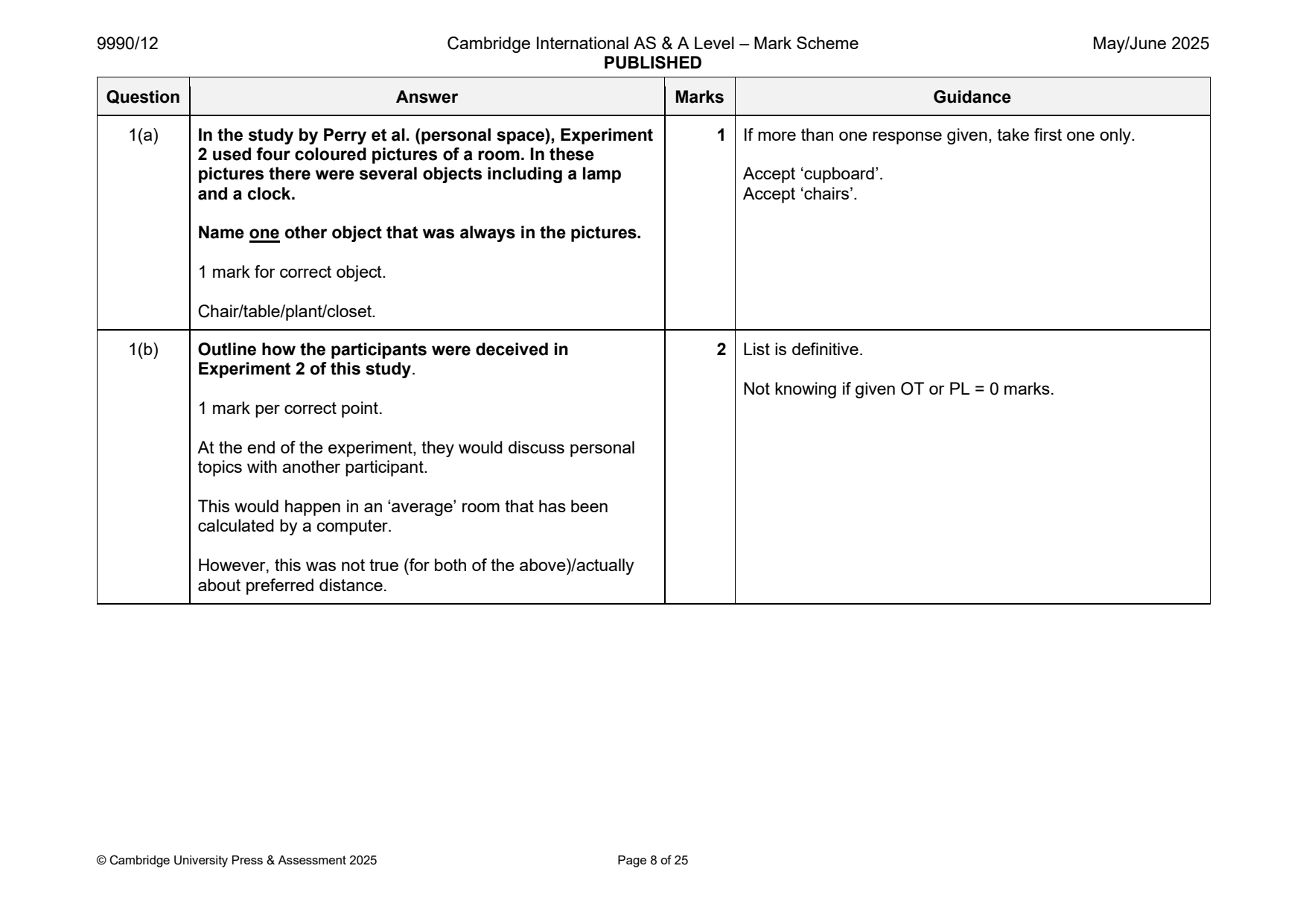
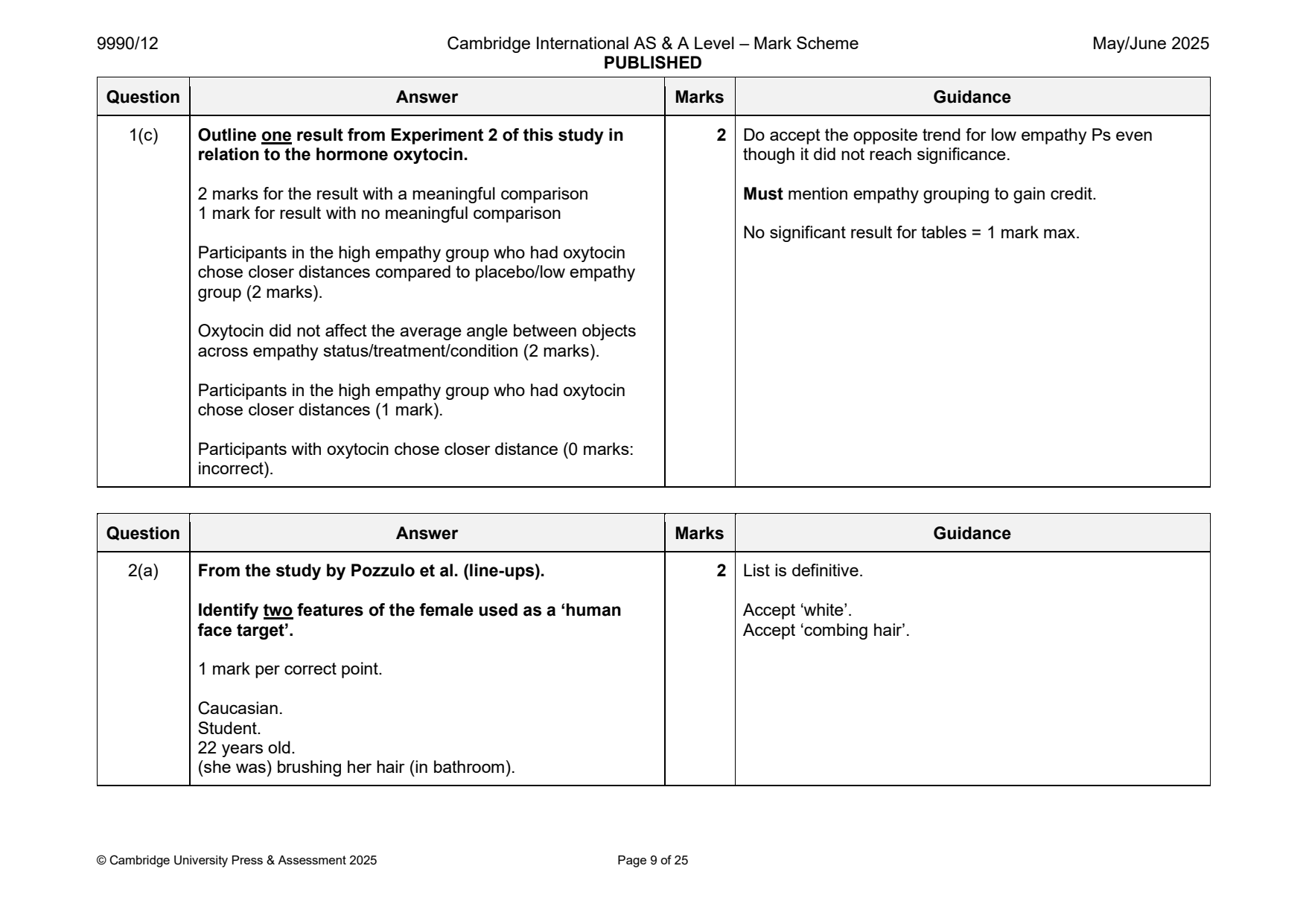
1(a) In the study by Perry et al. (personal space), Experiment 1 If more than one response given, take first one only.
2 used four coloured pictures of a room. In these
pictures there were several objects including a lamp Accept ‘cupboard’.
and a clock. Accept ‘chairs’.
Name one other object that was always in the pictures.
1 mark for correct object.
Chair/table/plant/closet.
1(b) Outline how the participants were deceived in 2 List is definitive.
Experiment 2 of this study.
Not knowing if given OT or PL = 0 marks.
1 mark per correct point.
At the end of the experiment, they would discuss personal
topics with another participant.
This would happen in an ‘average’ room that has been
calculated by a computer.
However, this was not true (for both of the above)/actually
about preferred distance.
© Cambridge University Press & Assessment 2025 Page 8 of 25
1(c) Outline one result from Experiment 2 of this study in 2 Do accept the opposite trend for low empathy Ps even
relation to the hormone oxytocin. though it did not reach significance.
2 marks for the result with a meaningful comparison Must mention empathy grouping to gain credit.
1 mark for result with no meaningful comparison
No significant result for tables = 1 mark max.
Participants in the high empathy group who had oxytocin
chose closer distances compared to placebo/low empathy
group (2 marks).
Oxytocin did not affect the average angle between objects
across empathy status/treatment/condition (2 marks).
Participants in the high empathy group who had oxytocin
chose closer distances (1 mark).
Participants with oxytocin chose closer distance (0 marks:
incorrect).
Question Answer Marks Guidance
Official mark scheme pages: 8, 9 · source PDF URL
9990-2025-mj-12-q03
May/June 2025 · Paper 12 · Question 3 · 6 marks
3(a) From the study by Milgram (obedience): 2 List is definitive.
Identify two features of the sample used in this study. Do not accept ‘adults’.
1 mark per correct feature.
Volunteers/from newspaper advert/direct mail.
n=40.
All males.
Age 20–50
New Haven area.
Wide range of occupations.
Wide range of educational levels.
© Cambridge University Press & Assessment 2025 Page 10 of 25
3(b) Outline one conclusion from this study. 2 Ignore responses that are simply results.
2 marks full/detailed conclusion ‘Comply’ = max 1 mark.
1 mark partial/brief conclusion ‘Conform’ = 0 marks.
Individuals appear to be much more obedient to an authority Did not support Germans are different hypothesis = max 1
figure than we might expect (2 marks). mark.
People will follow/listen to an authority figure even if it
means harming another person (2 marks).
People are willing to harm someone if responsibility is taken
away/passed on to someone else (2 marks).
People find it stressful to follow destructive orders from a
person in authority (2 marks).
People will be obedient to an authority figure (1 mark).
People find it stressful to follow destructive orders (1 mark).
100% of participants pressed the 300 V switch (0 marks:
result).
There are other creditworthy responses.
© Cambridge University Press & Assessment 2025 Page 11 of 25
3(c) Suggest one application to everyday life using evidence 2 Annotate with a tick for what the application is and a + for
from this study. Your suggestion must be ethical. how it will be achieved.
1 mark for what the application is (clearly based on Milgram) Military examples e.g., soldiers being made more obedient
1 mark for how it will be achieved. to protect a country may be ethical (the question is about the
process).
e.g.,
A teacher could get students to be more obedient in the Link to explaining named/specific historical events is
classroom (1 mark: what) by wearing clothes that show creditworthy.
authority like a technician’s coat (1 mark: how).
‘Help us to understand obedience’ = 0 marks.
Soldiers could be encouraged to be more obedient (1 mark:
what) as an authority figure can give out commands in a firm Examples must be specific for dress code and prods to be
tone/stern voice (1 mark: how). awarded credit.
There are other creditworthy suggestions, including
whistleblowing policies in the workplace.
© Cambridge University Press & Assessment 2025 Page 12 of 25
Official mark scheme pages: 10, 11, 12 · source PDF URL
9990-2025-mj-12-q09
May/June 2025 · Paper 12 · Question 9 · 12 marks
9(a) From the study by Piliavin et al. (subway Samaritans): 4 List is definitive.
Describe the two victims used in this study. 1 mark max for:
1 mark for identifying a victim plus 1 mark for a correct What they were wearing
feature of that victim 2. Male
Aged 26–35
e.g., White/black
The first victim was drunk (1 mark). They smelled of n=4
liquor/alcohol (1 mark). The liquor/alcohol bottle was
wrapped in brown paper bag (1 mark: alternative). Only award above if not been awarded 4 marks with drunk/ill
statements.
The second victim was ill (1 mark). They had a (black) cane
(1 mark). They acted sober (1 mark: alternative). Accept ‘sick’ to mean ‘ill’.
Do not accept ‘cane’ as the identifying mark for the ‘ill’
victim.
© Cambridge University Press & Assessment 2025 Page 20 of 25
9(b) Explain two differences between the study by Piliavin et 8 Award L1–L4 for each difference
al. (subway Samaritans) and the study by Perry et al.
(personal space). One of your differences must be about For Level 4 there must be some attempt at explaining the
the sample of participants. difference.
Use the marking grid below. If both differences do not focus on the sample, then mark
4 marks for each difference (twice), e.g., sample, stooges, both but only credit the best, and place an X next to the Q.
ethics, data collection techniques, generalisability,
(ecological) validity. Place a tick next to the difference that is about the sample.
Note: sampling technique does not count as the sample.
Each difference must be based on psychological
principles. At least one feature of each sample must be correct to get
above L2.
e.g.,
4 marks If the sample information about one of the studies is
The studies used stooges in different ways (explanation). incorrect (e.g., give it from a different study to Piliavin or
Piliavin used a human stooge that the participant did not Perry) = L0.
know as acting ill/drunk/was a model. In the Perry study the
participants ‘met’ the animated stooge in various Different aims = L1
rooms/scenarios until they felt the stooge was invading Sample information from only Piliavin or Perry = L1 max.
personal space. Description of two samples only = L2
Example: 3 marks To get L4, the candidate needs to explicitly state what the
The studies used stooges. Piliavin used a human stooge difference is.
that the participant did not know as acting ill/drunk/was a
model and in the Perry study the participants ‘met’ the
animated stooge in various rooms/scenarios until they felt
the stooge was invading personal space.
Example: 2 marks
The studies used stooges. Piliavin used a human stooge
that the acted ill or drunk/Perry used an animated stooge.
Example: 1 mark
The stooges were different/one was human/one was
animated.
© Cambridge University Press & Assessment 2025 Page 21 of 25
9(b)
Mark/Level Description
4 The similarity/difference is well explained
using both studies as examples.
3 The similarity/difference is well explained
but only one study is used as an example
OR
both studies are used briefly.
2 The similarity/difference is brief with an
attempt at using at least one study as an
example OR
The similarity/difference is well explained
but there is no study evidence.
1 The similarity/difference is brief with no
attempt at using the studies as examples.
0 No creditable response.
© Cambridge University Press & Assessment 2025 Page 22 of 25
Official mark scheme pages: 20, 21, 22 · source PDF URL
9990-2025-mj-13-q04
May/June 2025 · Paper 13 · Question 4 · 3 marks
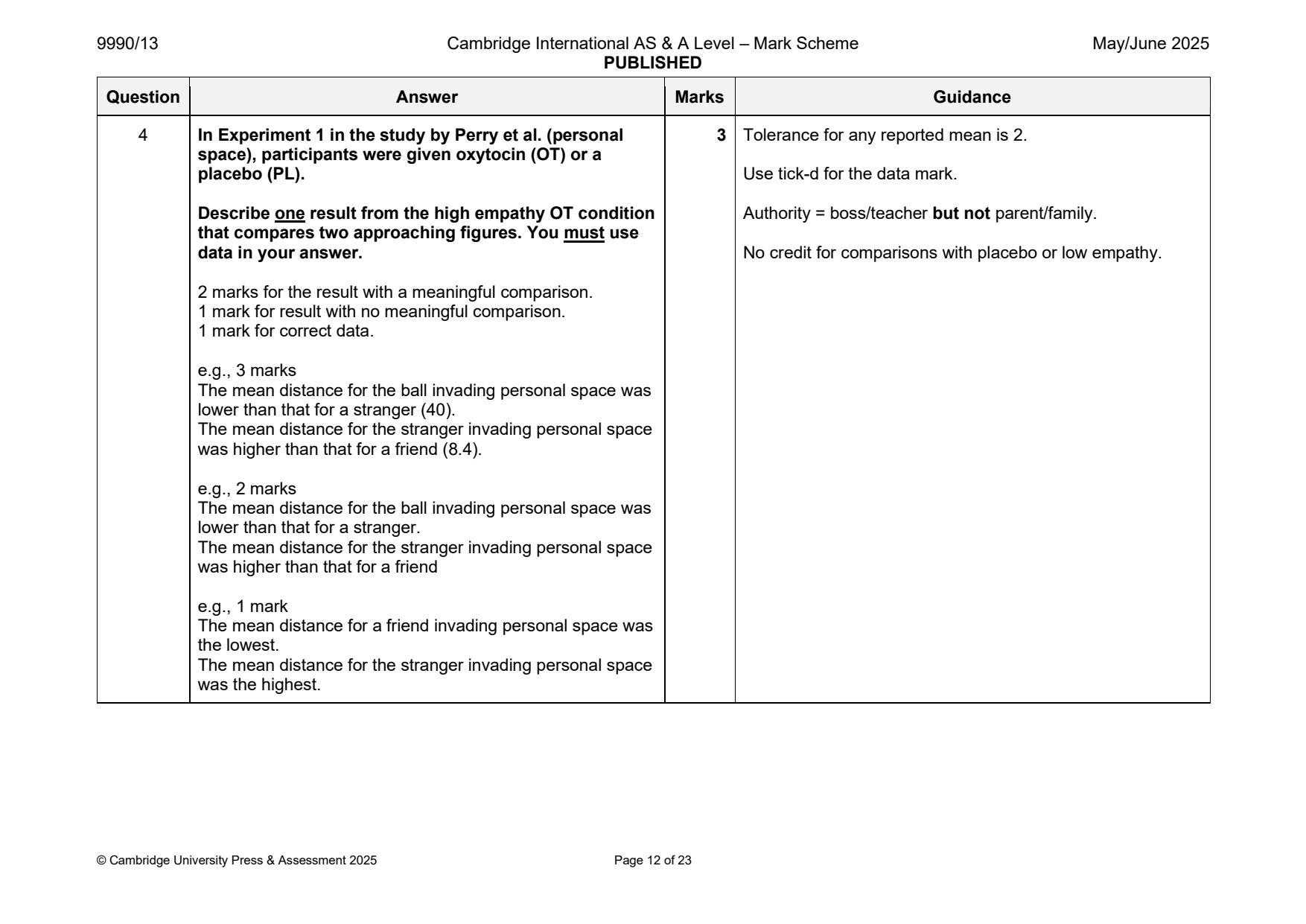
4 In Experiment 1 in the study by Perry et al. (personal 3 Tolerance for any reported mean is 2.
space), participants were given oxytocin (OT) or a
placebo (PL). Use tick-d for the data mark.
Describe one result from the high empathy OT condition Authority = boss/teacher but not parent/family.
that compares two approaching figures. You must use
data in your answer. No credit for comparisons with placebo or low empathy.
2 marks for the result with a meaningful comparison.
1 mark for result with no meaningful comparison.
1 mark for correct data.
e.g., 3 marks
The mean distance for the ball invading personal space was
lower than that for a stranger (40).
The mean distance for the stranger invading personal space
was higher than that for a friend (8.4).
e.g., 2 marks
The mean distance for the ball invading personal space was
lower than that for a stranger.
The mean distance for the stranger invading personal space
was higher than that for a friend
e.g., 1 mark
The mean distance for a friend invading personal space was
the lowest.
The mean distance for the stranger invading personal space
was the highest.
© Cambridge University Press & Assessment 2025 Page 12 of 23
Official mark scheme pages: 12 · source PDF URL
9990-2025-mj-13-q05
May/June 2025 · Paper 13 · Question 5 · 4 marks
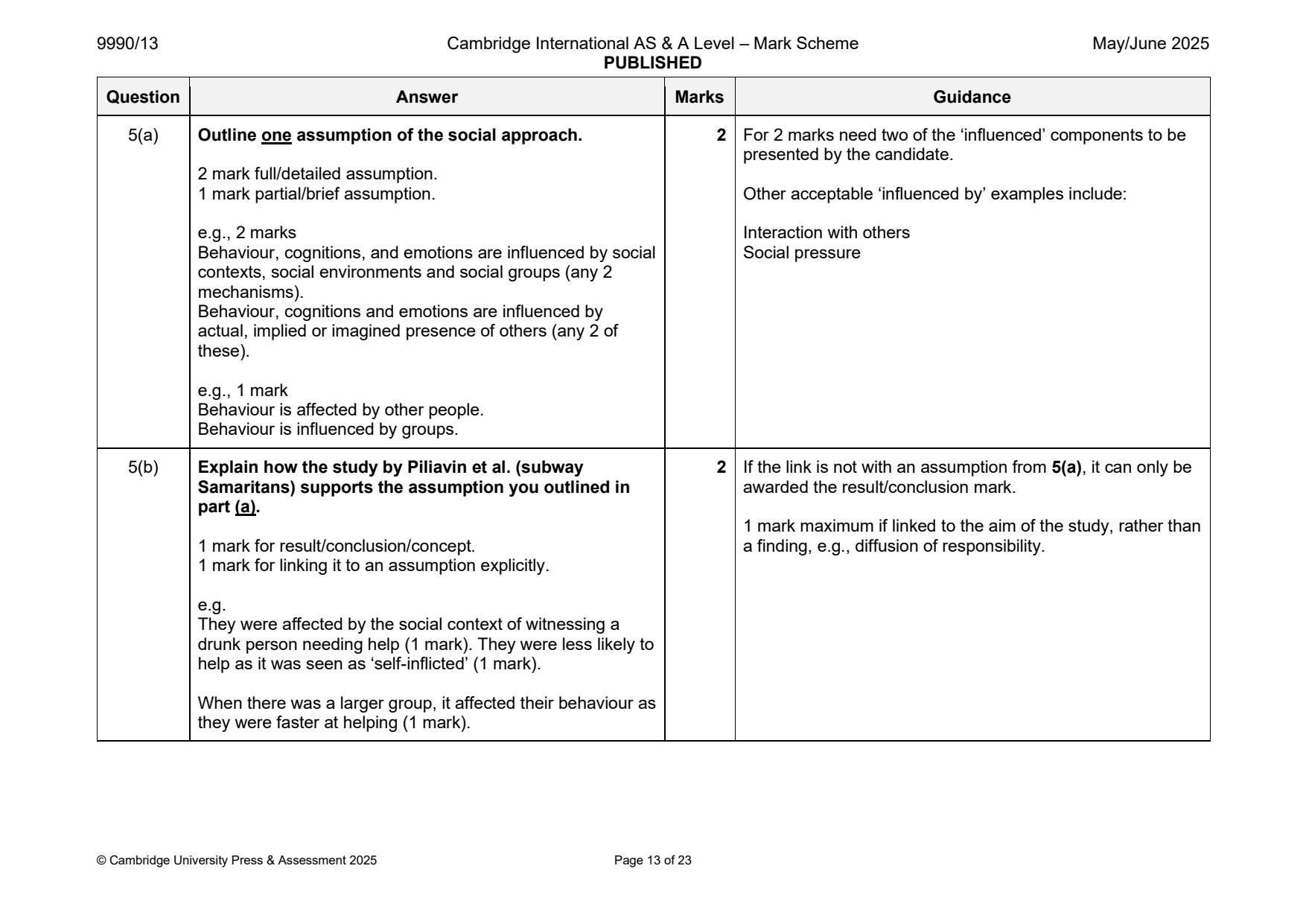
5(a) Outline one assumption of the social approach. 2 For 2 marks need two of the ‘influenced’ components to be
presented by the candidate.
2 mark full/detailed assumption.
1 mark partial/brief assumption. Other acceptable ‘influenced by’ examples include:
e.g., 2 marks Interaction with others
Behaviour, cognitions, and emotions are influenced by social Social pressure
contexts, social environments and social groups (any 2
mechanisms).
Behaviour, cognitions and emotions are influenced by
actual, implied or imagined presence of others (any 2 of
these).
e.g., 1 mark
Behaviour is affected by other people.
Behaviour is influenced by groups.
5(b) Explain how the study by Piliavin et al. (subway 2 If the link is not with an assumption from 5(a), it can only be
Samaritans) supports the assumption you outlined in awarded the result/conclusion mark.
part (a).
1 mark maximum if linked to the aim of the study, rather than
1 mark for result/conclusion/concept. a finding, e.g., diffusion of responsibility.
1 mark for linking it to an assumption explicitly.
e.g.
They were affected by the social context of witnessing a
drunk person needing help (1 mark). They were less likely to
help as it was seen as ‘self-inflicted’ (1 mark).
When there was a larger group, it affected their behaviour as
they were faster at helping (1 mark).
© Cambridge University Press & Assessment 2025 Page 13 of 23
Official mark scheme pages: 13 · source PDF URL
9990-2025-mj-13-q07
May/June 2025 · Paper 13 · Question 7 · 5 marks
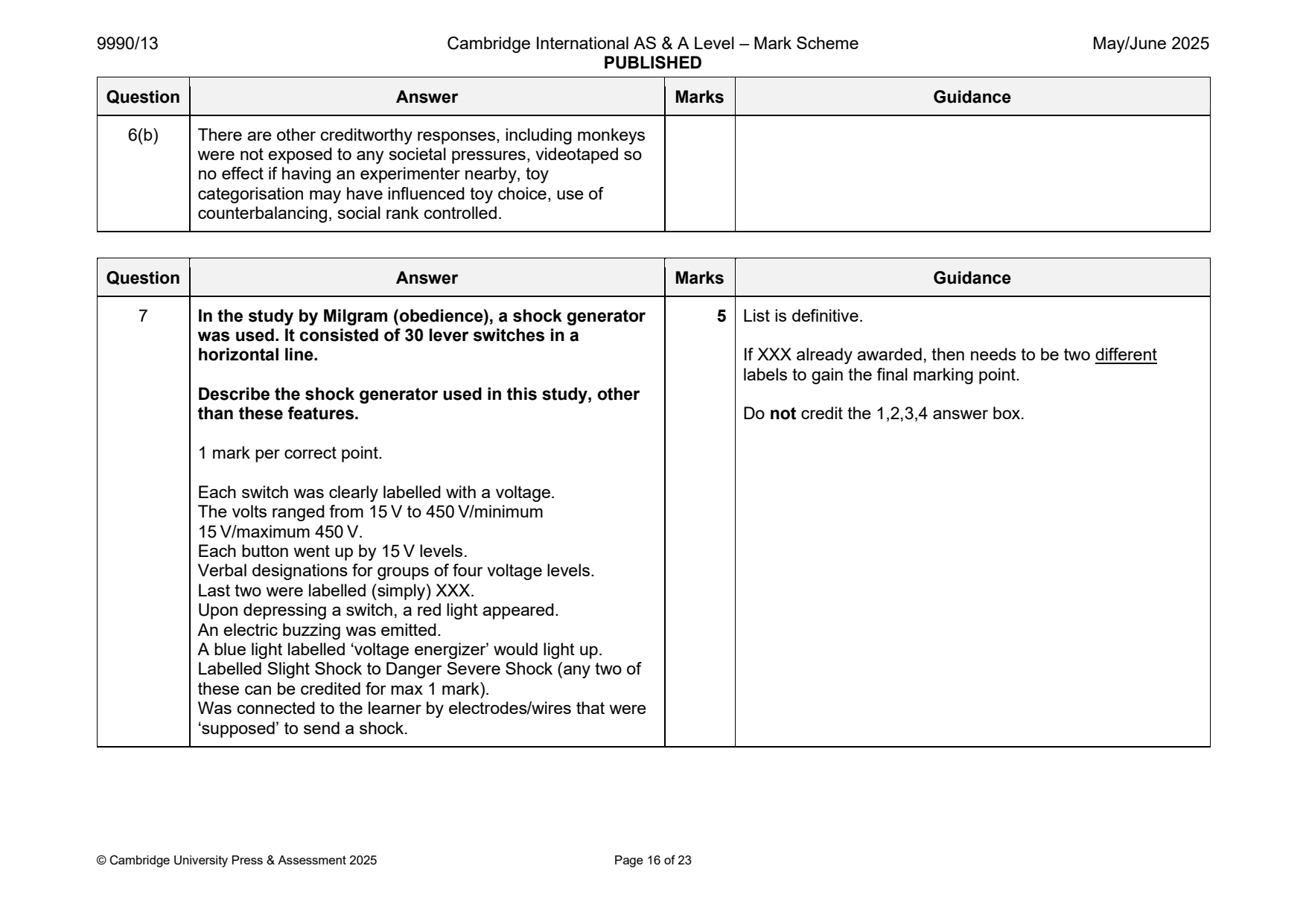
7 In the study by Milgram (obedience), a shock generator 5 List is definitive.
was used. It consisted of 30 lever switches in a
horizontal line. If XXX already awarded, then needs to be two different
labels to gain the final marking point.
Describe the shock generator used in this study, other
than these features. Do not credit the 1,2,3,4 answer box.
1 mark per correct point.
Each switch was clearly labelled with a voltage.
The volts ranged from 15 V to 450 V/minimum
15 V/maximum 450 V.
Each button went up by 15 V levels.
Verbal designations for groups of four voltage levels.
Last two were labelled (simply) XXX.
Upon depressing a switch, a red light appeared.
An electric buzzing was emitted.
A blue light labelled ‘voltage energizer’ would light up.
Labelled Slight Shock to Danger Severe Shock (any two of
these can be credited for max 1 mark).
Was connected to the learner by electrodes/wires that were
‘supposed’ to send a shock.
© Cambridge University Press & Assessment 2025 Page 16 of 23
Official mark scheme pages: 16 · source PDF URL
9990-2025-on-11-q02
Oct/Nov 2025 · Paper 11 · Question 2 · 4 marks
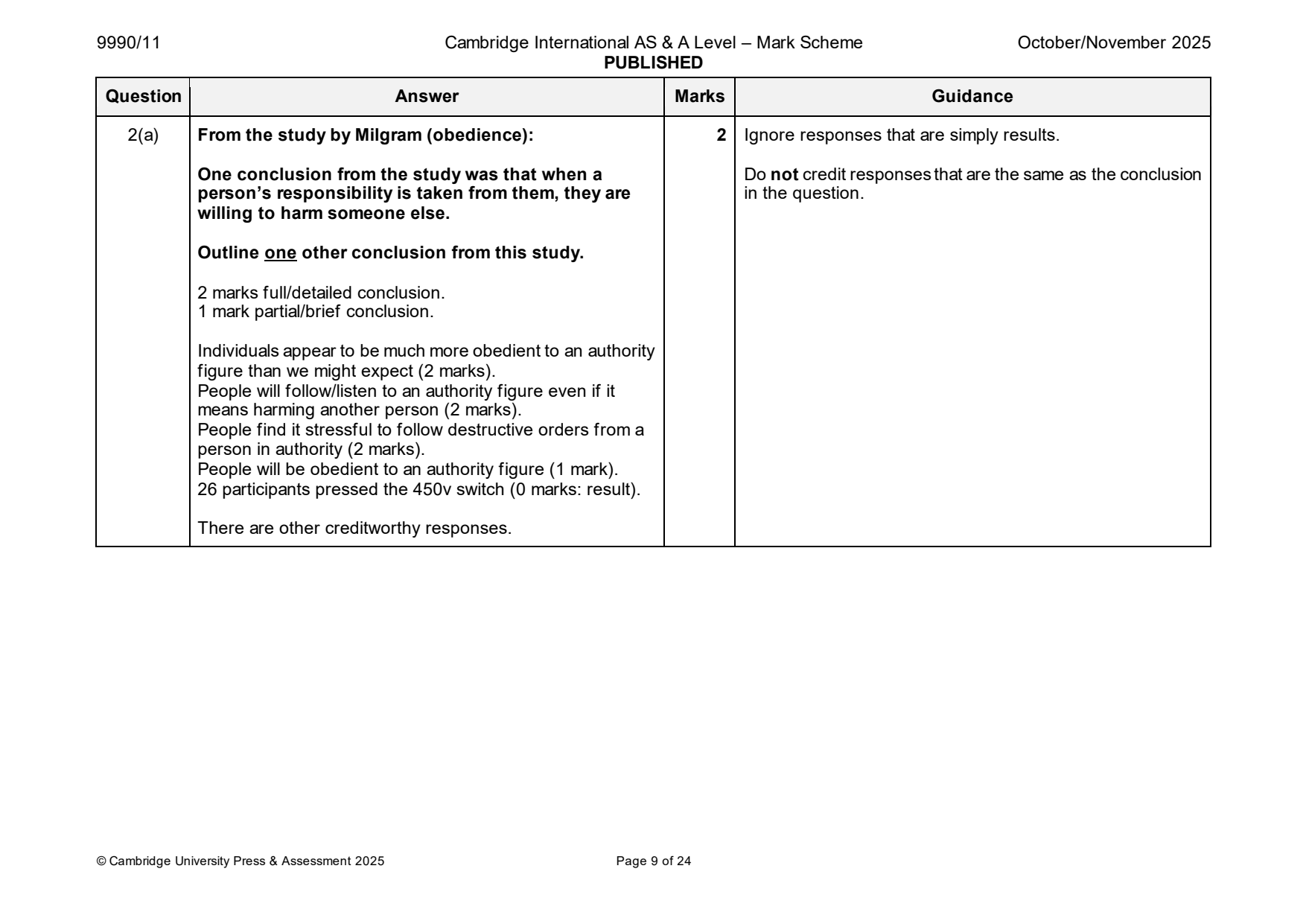
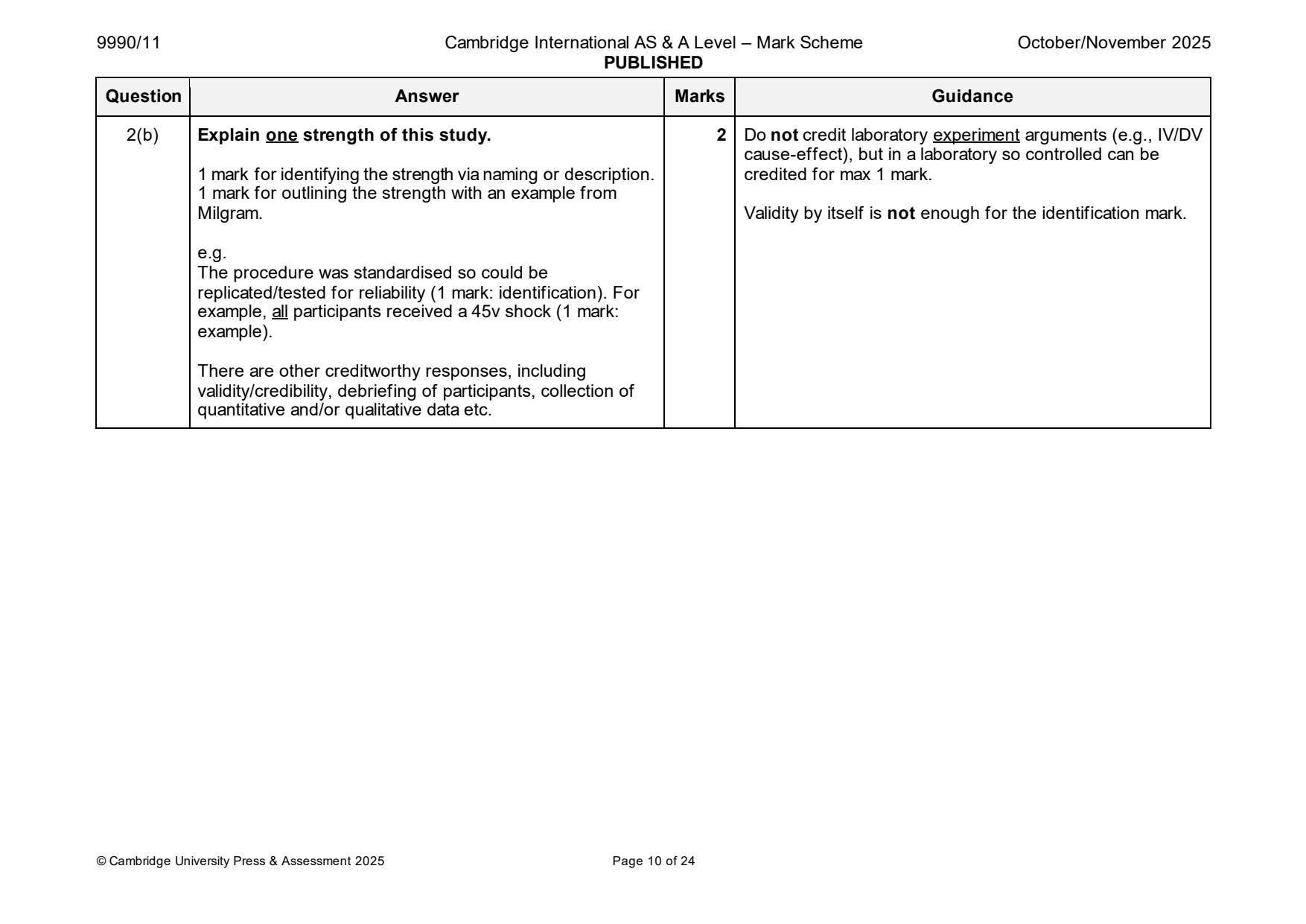
2(a) From the study by Milgram (obedience): 2 Ignore responses that are simply results.
One conclusion from the study was that when a Do not credit responses that are the same as the conclusion
person’s responsibility is taken from them, they are in the question.
willing to harm someone else.
Outline one other conclusion from this study.
2 marks full/detailed conclusion.
1 mark partial/brief conclusion.
Individuals appear to be much more obedient to an authority
figure than we might expect (2 marks).
People will follow/listen to an authority figure even if it
means harming another person (2 marks).
People find it stressful to follow destructive orders from a
person in authority (2 marks).
People will be obedient to an authority figure (1 mark).
26 participants pressed the 450v switch (0 marks: result).
There are other creditworthy responses.
© Cambridge University Press & Assessment 2025 Page 9 of 24
2(b) Explain one strength of this study. 2 Do not credit laboratory experiment arguments (e.g., IV/DV
cause-effect), but in a laboratory so controlled can be
1 mark for identifying the strength via naming or description. credited for max 1 mark.
1 mark for outlining the strength with an example from
Milgram. Validity by itself is not enough for the identification mark.
e.g.
The procedure was standardised so could be
replicated/tested for reliability (1 mark: identification). For
example, all participants received a 45v shock (1 mark:
example).
There are other creditworthy responses, including
validity/credibility, debriefing of participants, collection of
quantitative and/or qualitative data etc.
© Cambridge University Press & Assessment 2025 Page 10 of 24
Official mark scheme pages: 9, 10 · source PDF URL
9990-2025-on-11-q04
Oct/Nov 2025 · Paper 11 · Question 4 · 4 marks
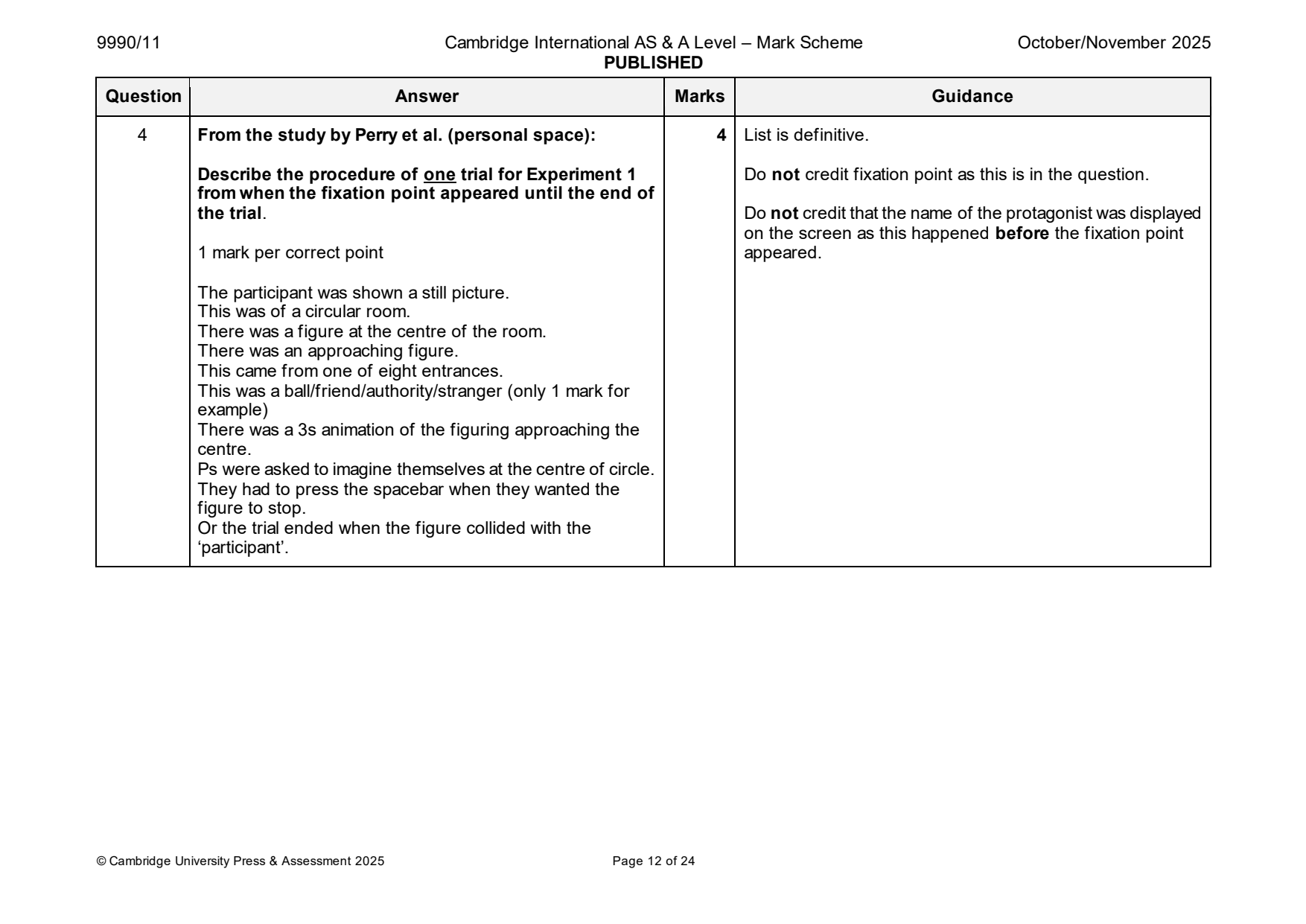
4 From the study by Perry et al. (personal space): 4 List is definitive.
Describe the procedure of one trial for Experiment 1 Do not credit fixation point as this is in the question.
from when the fixation point appeared until the end of
the trial. Do not credit that the name of the protagonist was displayed
on the screen as this happened before the fixation point
1 mark per correct point appeared.
The participant was shown a still picture.
This was of a circular room.
There was a figure at the centre of the room.
There was an approaching figure.
This came from one of eight entrances.
This was a ball/friend/authority/stranger (only 1 mark for
example)
There was a 3s animation of the figuring approaching the
centre.
Ps were asked to imagine themselves at the centre of circle.
They had to press the spacebar when they wanted the
figure to stop.
Or the trial ended when the figure collided with the
‘participant’.
© Cambridge University Press & Assessment 2025 Page 12 of 24
Official mark scheme pages: 12 · source PDF URL
9990-2025-on-11-q07
Oct/Nov 2025 · Paper 11 · Question 7 · 4 marks
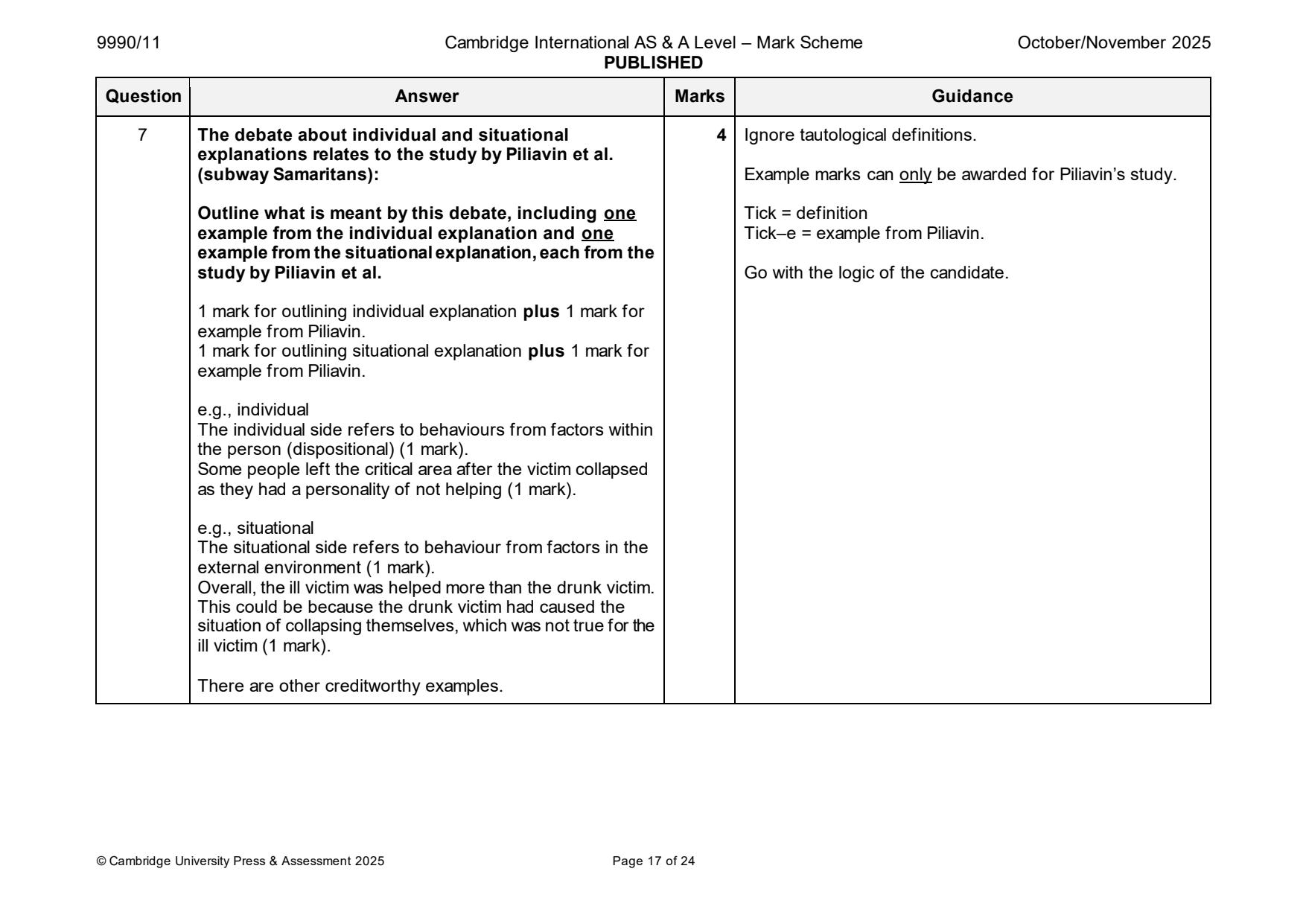
7 The debate about individual and situational 4 Ignore tautological definitions.
explanations relates to the study by Piliavin et al.
(subway Samaritans): Example marks can only be awarded for Piliavin’s study.
Outline what is meant by this debate, including one Tick = definition
example from the individual explanation and one Tick–e = example from Piliavin.
example from the situational explanation, each from the
study by Piliavin et al. Go with the logic of the candidate.
1 mark for outlining individual explanation plus 1 mark for
example from Piliavin.
1 mark for outlining situational explanation plus 1 mark for
example from Piliavin.
e.g., individual
The individual side refers to behaviours from factors within
the person (dispositional) (1 mark).
Some people left the critical area after the victim collapsed
as they had a personality of not helping (1 mark).
e.g., situational
The situational side refers to behaviour from factors in the
external environment (1 mark).
Overall, the ill victim was helped more than the drunk victim.
This could be because the drunk victim had caused the
situation of collapsing themselves, which was not true for the
ill victim (1 mark).
There are other creditworthy examples.
© Cambridge University Press & Assessment 2025 Page 17 of 24
Official mark scheme pages: 17 · source PDF URL
9990-2025-on-12-q01
Oct/Nov 2025 · Paper 12 · Question 1 · 5 marks
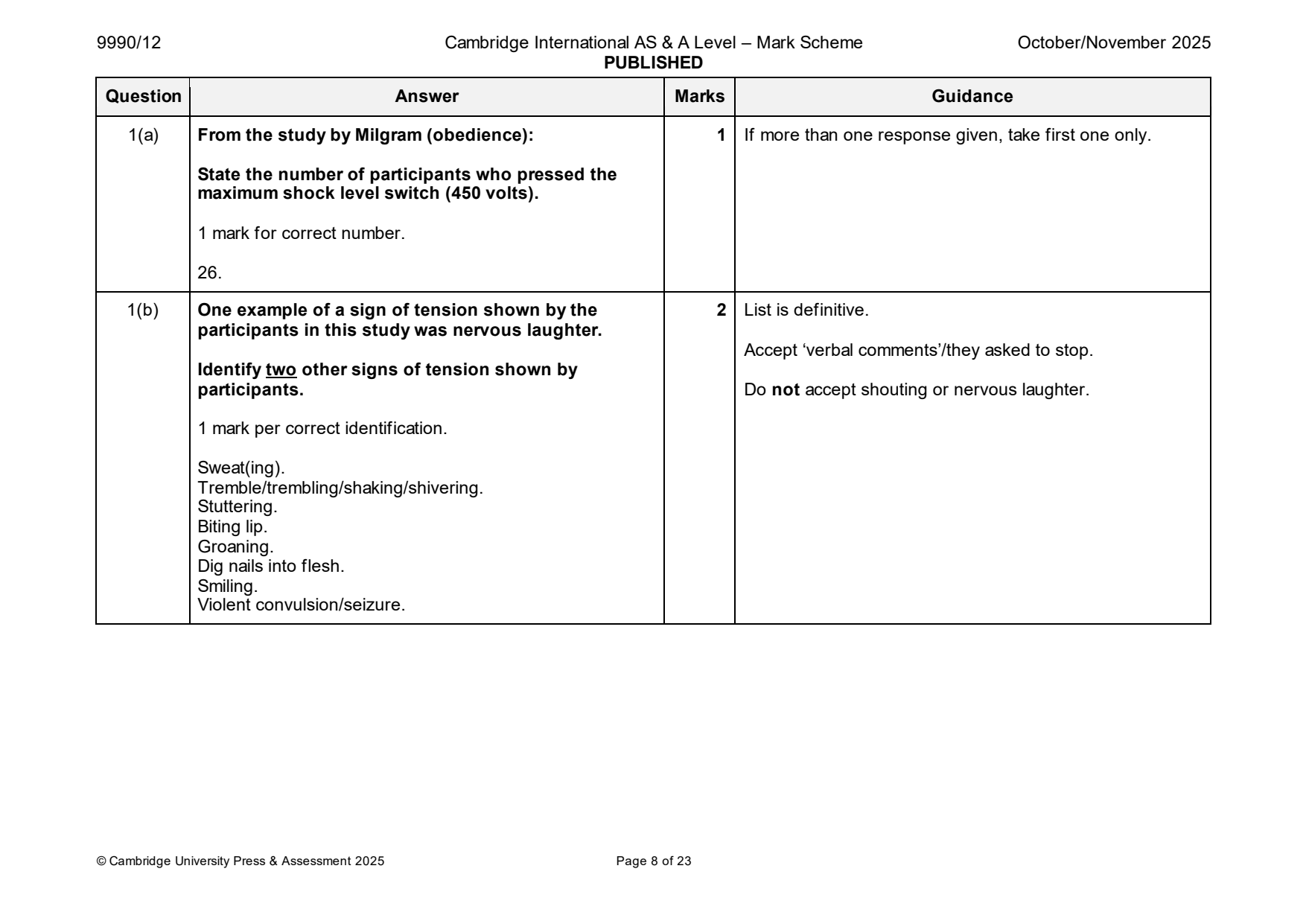
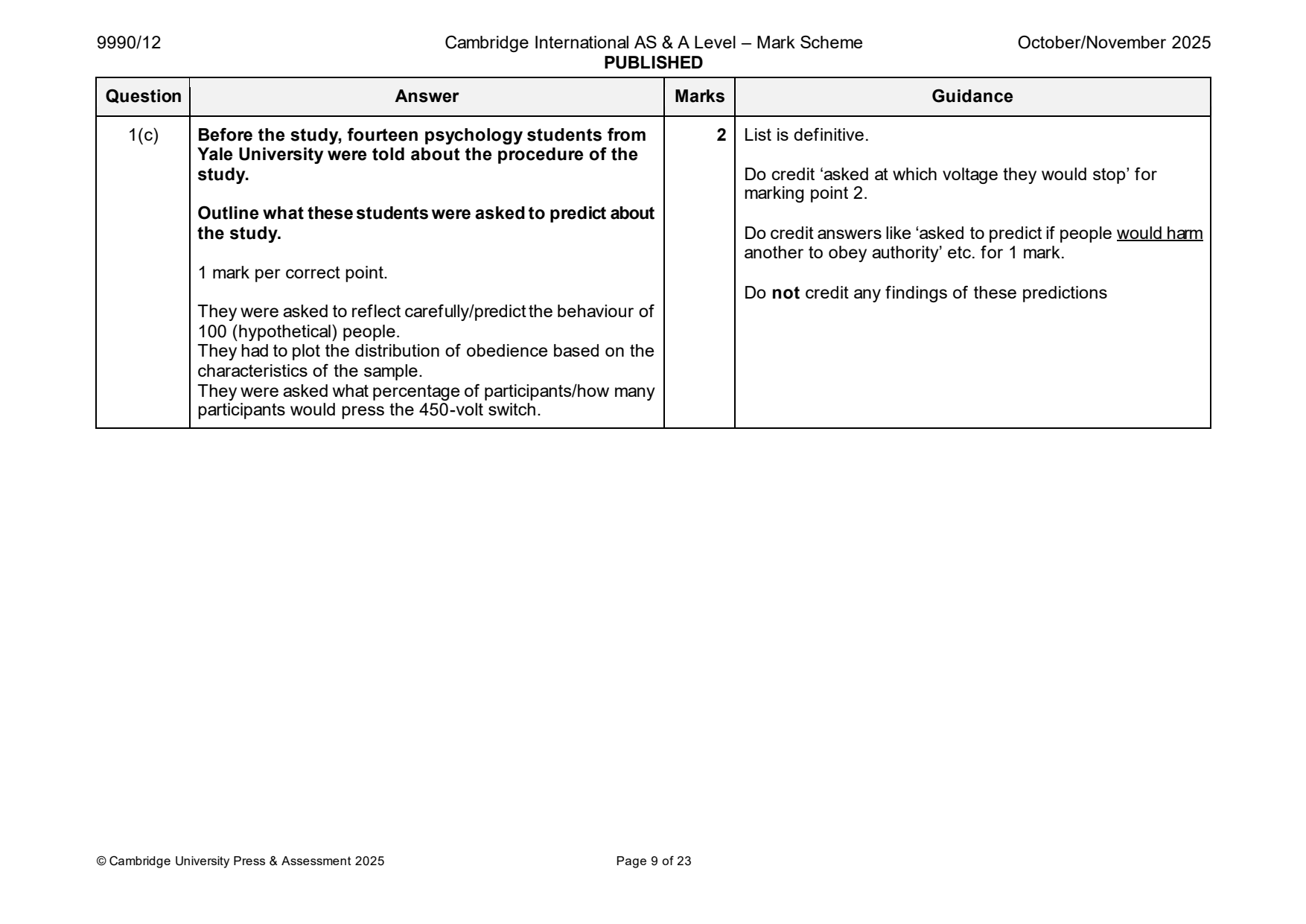
1(a) From the study by Milgram (obedience): 1 If more than one response given, take first one only.
State the number of participants who pressed the
maximum shock level switch (450 volts).
1 mark for correct number.
26.
1(b) One example of a sign of tension shown by the 2 List is definitive.
participants in this study was nervous laughter.
Accept ‘verbal comments’/they asked to stop.
Identify two other signs of tension shown by
participants. Do not accept shouting or nervous laughter.
1 mark per correct identification.
Sweat(ing).
Tremble/trembling/shaking/shivering.
Stuttering.
Biting lip.
Groaning.
Dig nails into flesh.
Smiling.
Violent convulsion/seizure.
© Cambridge University Press & Assessment 2025 Page 8 of 23
1(c) Before the study, fourteen psychology students from 2 List is definitive.
Yale University were told about the procedure of the
study. Do credit ‘asked at which voltage they would stop’ for
marking point 2.
Outline what these students were asked to predict about
the study. Do credit answers like ‘asked to predict if people would harm
another to obey authority’ etc. for 1 mark.
1 mark per correct point.
Do not credit any findings of these predictions
They were asked to reflect carefully/predict the behaviour of
100 (hypothetical) people.
They had to plot the distribution of obedience based on the
characteristics of the sample.
They were asked what percentage of participants/how many
participants would press the 450-volt switch.
© Cambridge University Press & Assessment 2025 Page 9 of 23
Official mark scheme pages: 8, 9 · source PDF URL
9990-2025-on-12-q03
Oct/Nov 2025 · Paper 12 · Question 3 · 4 marks
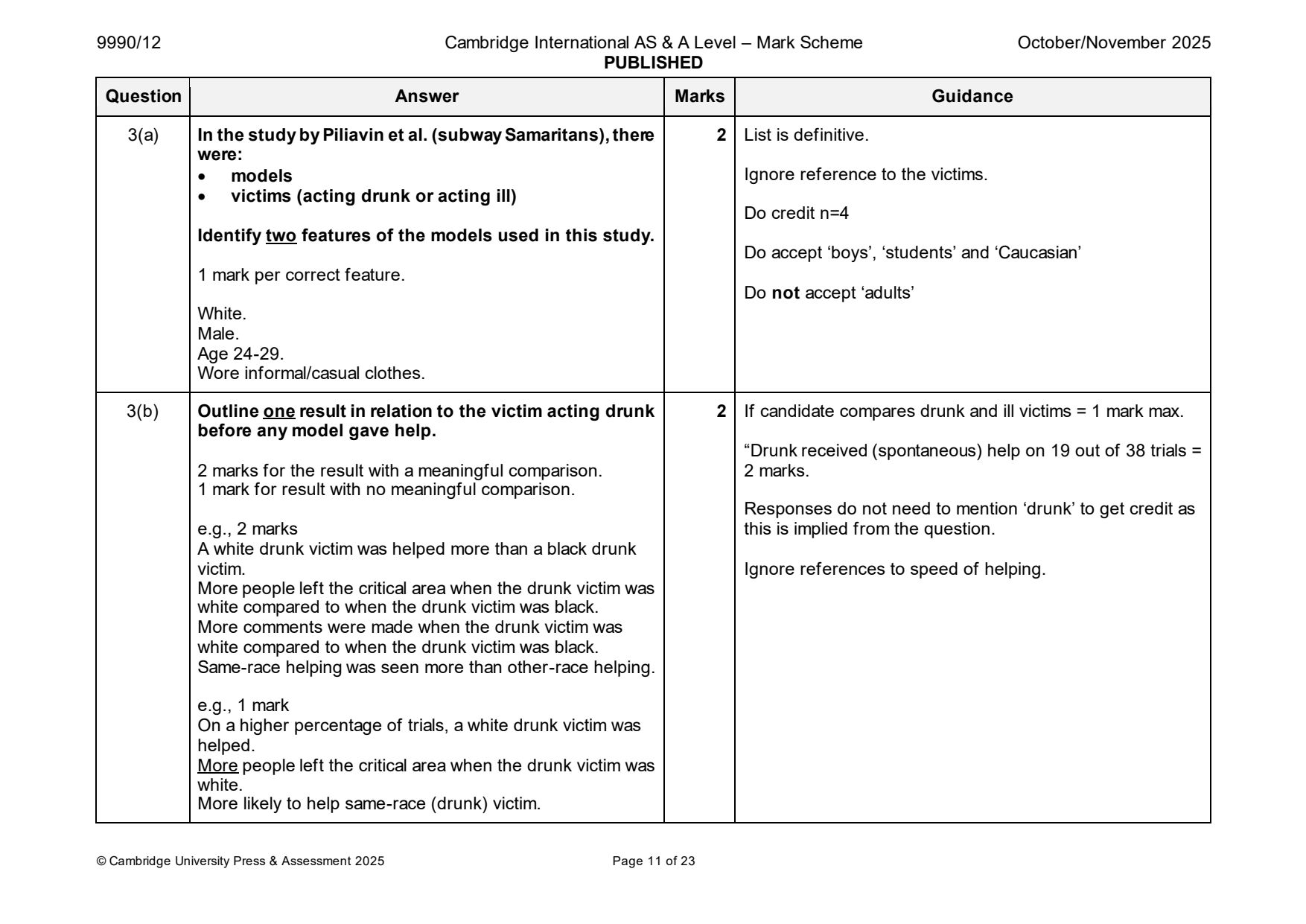
3(a) In the study by Piliavin et al. (subway Samaritans), there 2 List is definitive.
were:
• models Ignore reference to the victims.
• victims (acting drunk or acting ill)
Do credit n=4
Identify two features of the models used in this study.
Do accept ‘boys’, ‘students’ and ‘Caucasian’
1 mark per correct feature.
Do not accept ‘adults’
White.
Male.
Age 24-29.
Wore informal/casual clothes.
3(b) Outline one result in relation to the victim acting drunk 2 If candidate compares drunk and ill victims = 1 mark max.
before any model gave help.
“Drunk received (spontaneous) help on 19 out of 38 trials =
2 marks for the result with a meaningful comparison. 2 marks.
1 mark for result with no meaningful comparison.
Responses do not need to mention ‘drunk’ to get credit as
e.g., 2 marks this is implied from the question.
A white drunk victim was helped more than a black drunk
victim. Ignore references to speed of helping.
More people left the critical area when the drunk victim was
white compared to when the drunk victim was black.
More comments were made when the drunk victim was
white compared to when the drunk victim was black.
Same-race helping was seen more than other-race helping.
e.g., 1 mark
On a higher percentage of trials, a white drunk victim was
helped.
More people left the critical area when the drunk victim was
white.
More likely to help same-race (drunk) victim.
© Cambridge University Press & Assessment 2025 Page 11 of 23
Official mark scheme pages: 11 · source PDF URL
9990-2025-on-12-q06
Oct/Nov 2025 · Paper 12 · Question 6 · 7 marks
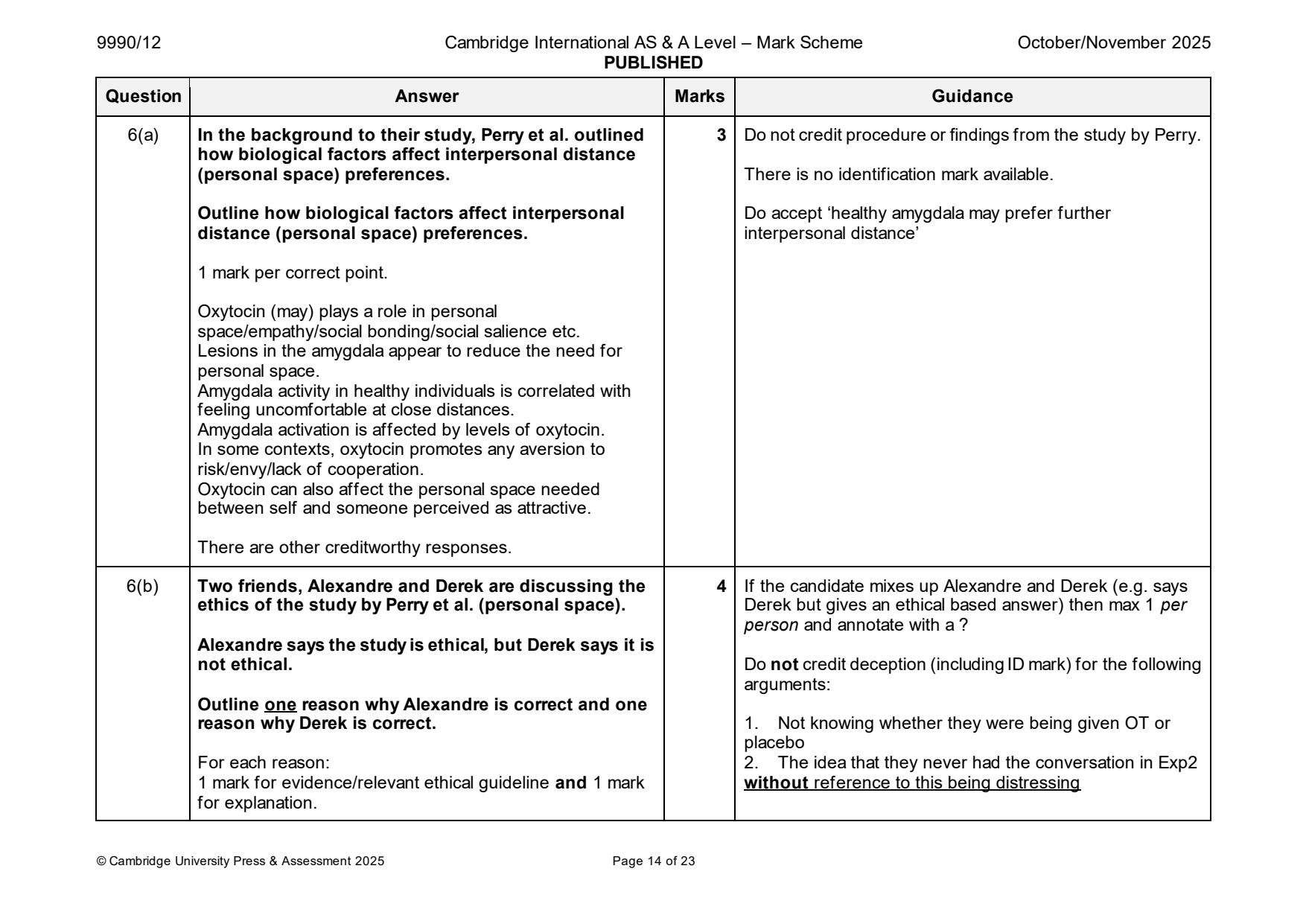
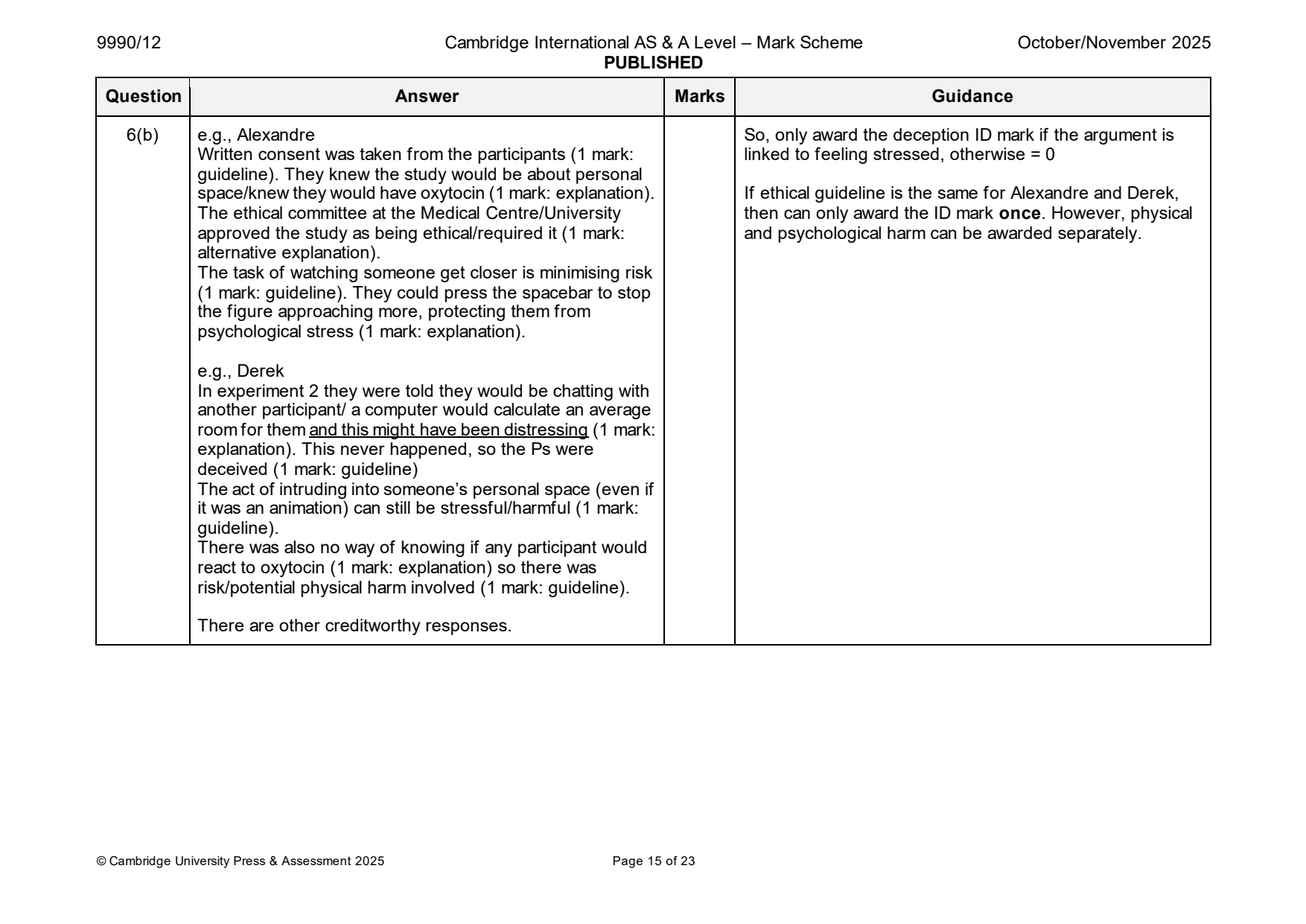
6(a) In the background to their study, Perry et al. outlined 3 Do not credit procedure or findings from the study by Perry.
how biological factors affect interpersonal distance
(personal space) preferences. There is no identification mark available.
Outline how biological factors affect interpersonal Do accept ‘healthy amygdala may prefer further
distance (personal space) preferences. interpersonal distance’
1 mark per correct point.
Oxytocin (may) plays a role in personal
space/empathy/social bonding/social salience etc.
Lesions in the amygdala appear to reduce the need for
personal space.
Amygdala activity in healthy individuals is correlated with
feeling uncomfortable at close distances.
Amygdala activation is affected by levels of oxytocin.
In some contexts, oxytocin promotes any aversion to
risk/envy/lack of cooperation.
Oxytocin can also affect the personal space needed
between self and someone perceived as attractive.
There are other creditworthy responses.
6(b) Two friends, Alexandre and Derek are discussing the 4 If the candidate mixes up Alexandre and Derek (e.g. says
ethics of the study by Perry et al. (personal space). Derek but gives an ethical based answer) then max 1 per
person and annotate with a ?
Alexandre says the study is ethical, but Derek says it is
not ethical. Do not credit deception (including ID mark) for the following
arguments:
Outline one reason why Alexandre is correct and one
reason why Derek is correct. 1. Not knowing whether they were being given OT or
placebo
For each reason: 2. The idea that they never had the conversation in Exp2
1 mark for evidence/relevant ethical guideline and 1 mark without reference to this being distressing
for explanation.
© Cambridge University Press & Assessment 2025 Page 14 of 23
6(b) e.g., Alexandre So, only award the deception ID mark if the argument is
Written consent was taken from the participants (1 mark: linked to feeling stressed, otherwise = 0
guideline). They knew the study would be about personal
space/knew they would have oxytocin (1 mark: explanation). If ethical guideline is the same for Alexandre and Derek,
The ethical committee at the Medical Centre/University then can only award the ID mark once. However, physical
approved the study as being ethical/required it (1 mark: and psychological harm can be awarded separately.
alternative explanation).
The task of watching someone get closer is minimising risk
(1 mark: guideline). They could press the spacebar to stop
the figure approaching more, protecting them from
psychological stress (1 mark: explanation).
e.g., Derek
In experiment 2 they were told they would be chatting with
another participant/ a computer would calculate an average
room for them and this might have been distressing (1 mark:
explanation). This never happened, so the Ps were
deceived (1 mark: guideline)
The act of intruding into someone’s personal space (even if
it was an animation) can still be stressful/harmful (1 mark:
guideline).
There was also no way of knowing if any participant would
react to oxytocin (1 mark: explanation) so there was
risk/potential physical harm involved (1 mark: guideline).
There are other creditworthy responses.
© Cambridge University Press & Assessment 2025 Page 15 of 23
Official mark scheme pages: 14, 15 · source PDF URL
9990-2025-on-13-q02
Oct/Nov 2025 · Paper 13 · Question 2 · 4 marks
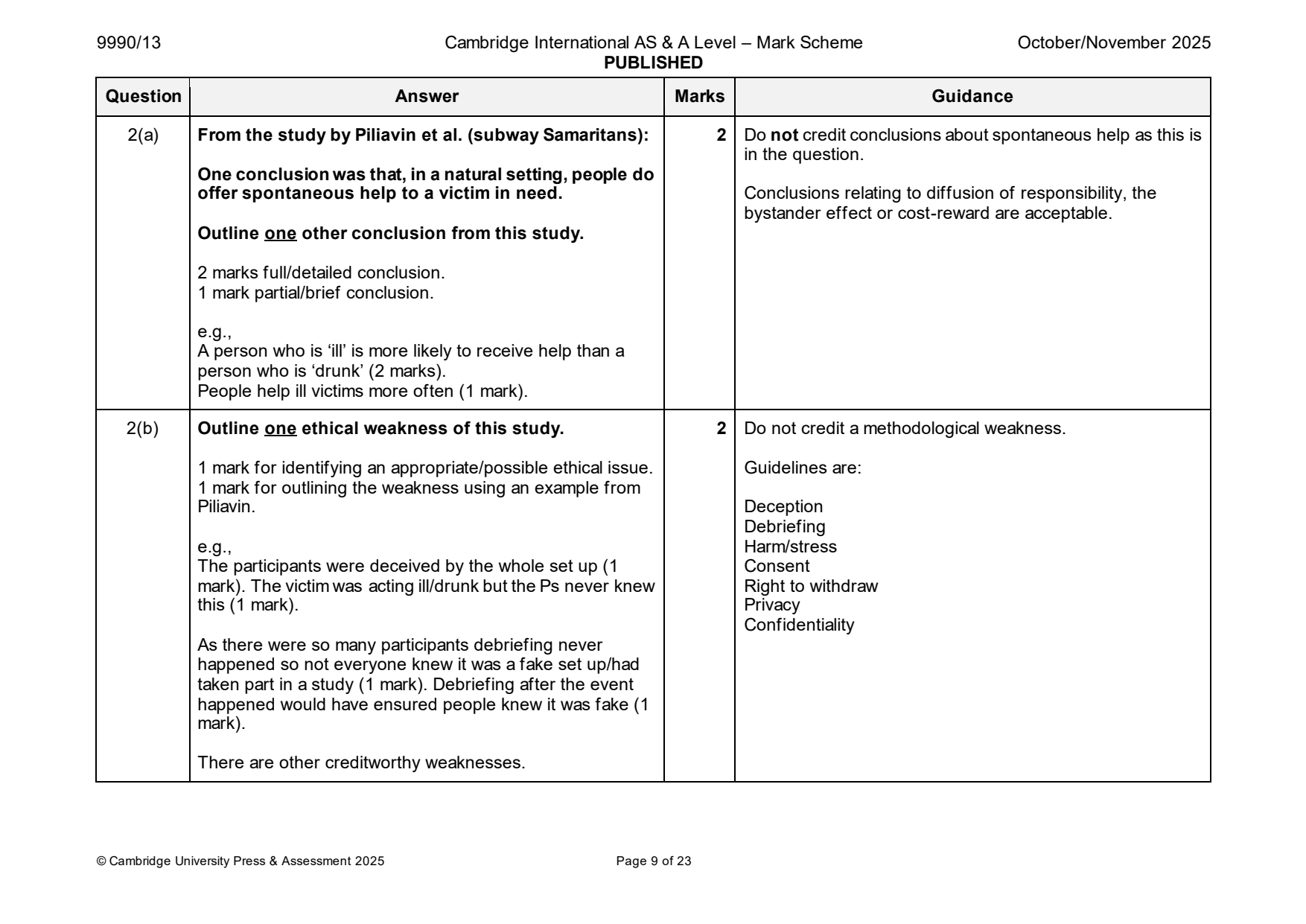
2(a) From the study by Piliavin et al. (subway Samaritans): 2 Do not credit conclusions about spontaneous help as this is
in the question.
One conclusion was that, in a natural setting, people do
offer spontaneous help to a victim in need. Conclusions relating to diffusion of responsibility, the
bystander effect or cost-reward are acceptable.
Outline one other conclusion from this study.
2 marks full/detailed conclusion.
1 mark partial/brief conclusion.
e.g.,
A person who is ‘ill’ is more likely to receive help than a
person who is ‘drunk’ (2 marks).
People help ill victims more often (1 mark).
2(b) Outline one ethical weakness of this study. 2 Do not credit a methodological weakness.
1 mark for identifying an appropriate/possible ethical issue. Guidelines are:
1 mark for outlining the weakness using an example from
Piliavin. Deception
Debriefing
e.g., Harm/stress
The participants were deceived by the whole set up (1 Consent
mark). The victim was acting ill/drunk but the Ps never knew Right to withdraw
this (1 mark). Privacy
Confidentiality
As there were so many participants debriefing never
happened so not everyone knew it was a fake set up/had
taken part in a study (1 mark). Debriefing after the event
happened would have ensured people knew it was fake (1
mark).
There are other creditworthy weaknesses.
© Cambridge University Press & Assessment 2025 Page 9 of 23
Official mark scheme pages: 9 · source PDF URL
9990-2025-on-13-q05
Oct/Nov 2025 · Paper 13 · Question 5 · 4 marks
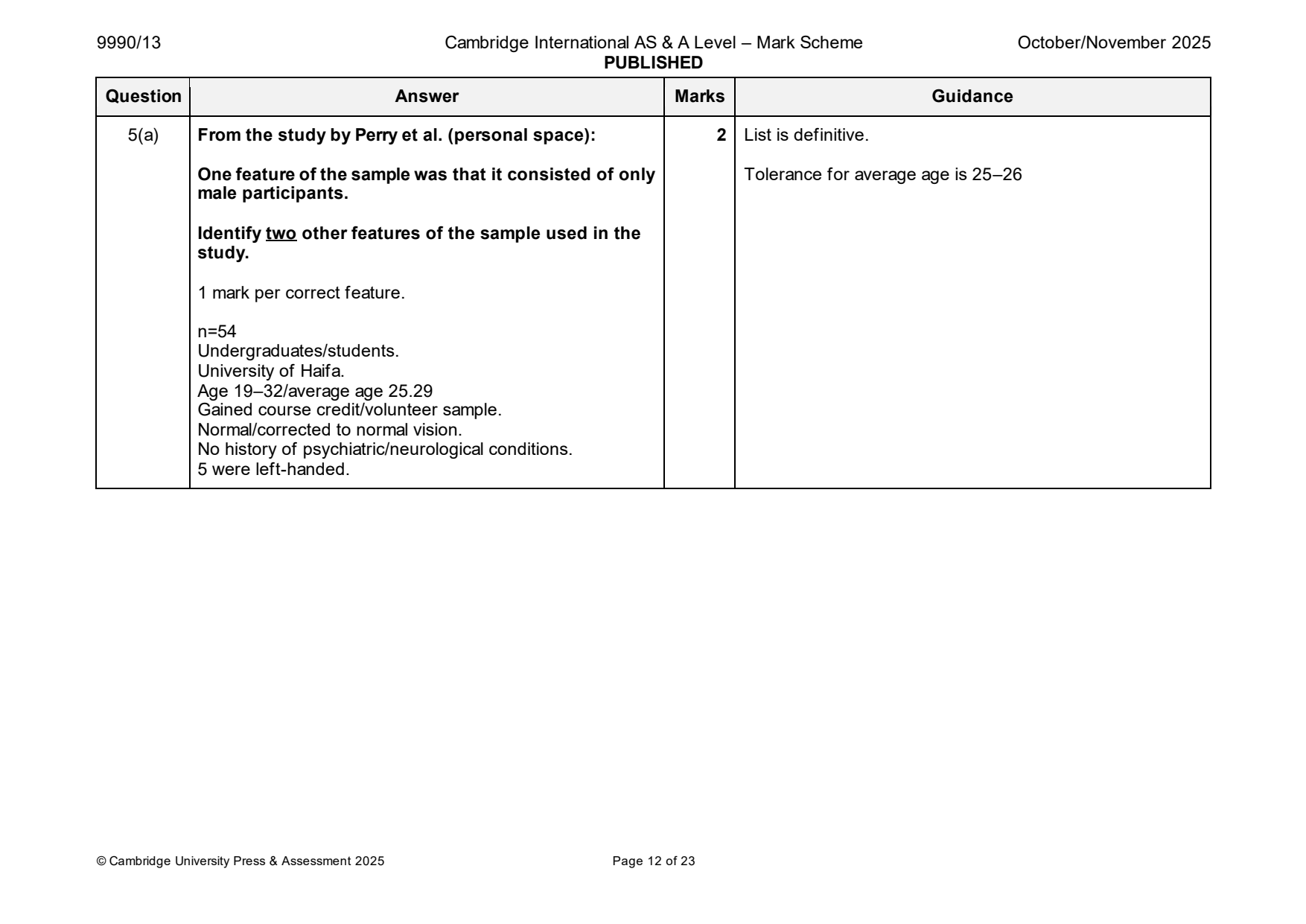
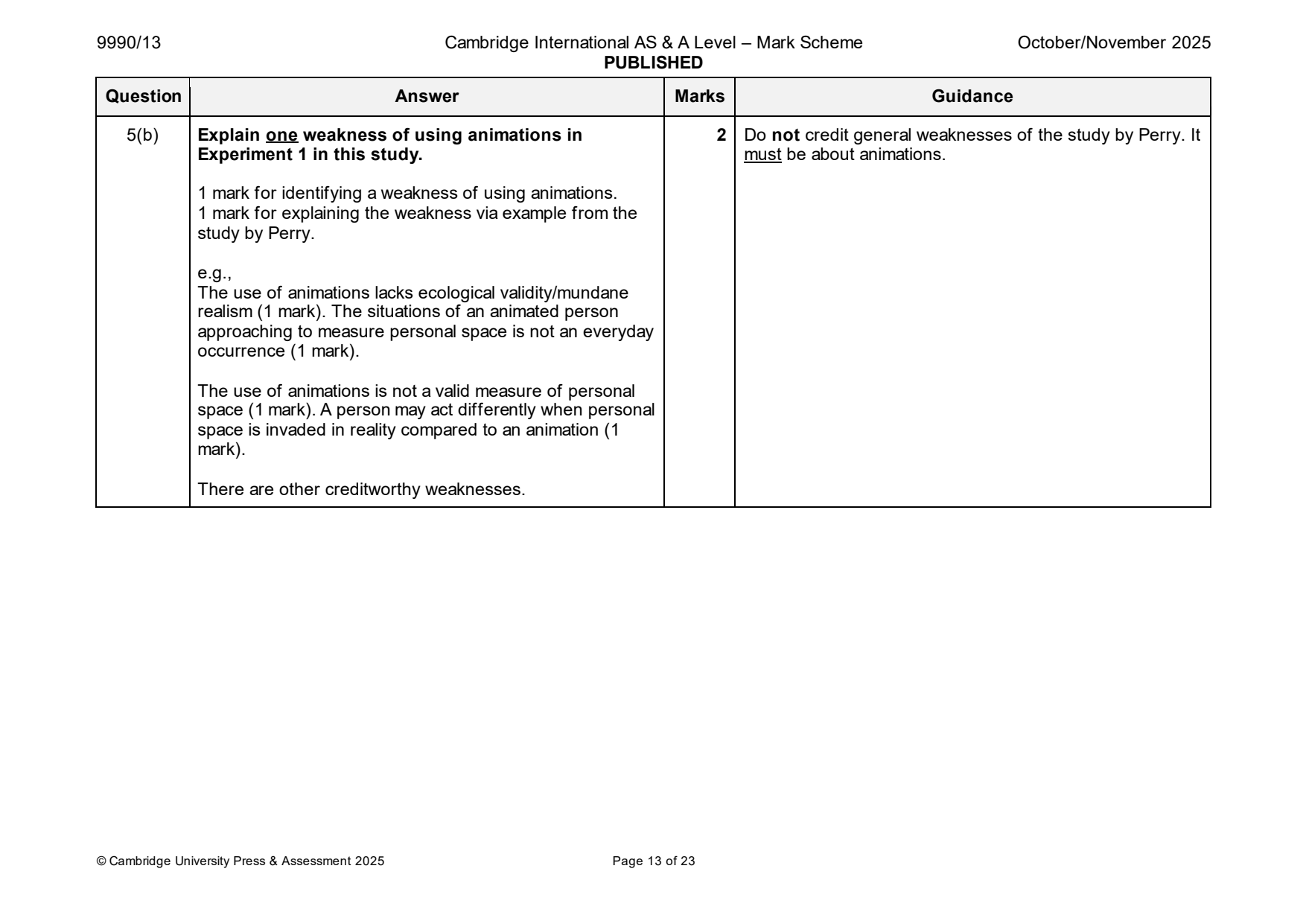
5(a) From the study by Perry et al. (personal space): 2 List is definitive.
One feature of the sample was that it consisted of only Tolerance for average age is 25–26
male participants.
Identify two other features of the sample used in the
study.
1 mark per correct feature.
n=54
Undergraduates/students.
University of Haifa.
Age 19–32/average age 25.29
Gained course credit/volunteer sample.
Normal/corrected to normal vision.
No history of psychiatric/neurological conditions.
5 were left-handed.
© Cambridge University Press & Assessment 2025 Page 12 of 23
5(b) Explain one weakness of using animations in 2 Do not credit general weaknesses of the study by Perry. It
Experiment 1 in this study. must be about animations.
1 mark for identifying a weakness of using animations.
1 mark for explaining the weakness via example from the
study by Perry.
e.g.,
The use of animations lacks ecological validity/mundane
realism (1 mark). The situations of an animated person
approaching to measure personal space is not an everyday
occurrence (1 mark).
The use of animations is not a valid measure of personal
space (1 mark). A person may act differently when personal
space is invaded in reality compared to an animation (1
mark).
There are other creditworthy weaknesses.
© Cambridge University Press & Assessment 2025 Page 13 of 23
Official mark scheme pages: 12, 13 · source PDF URL