Try the new view →
9990-2021-mj-11-q04
May/June 2021 · Paper 11 · Question 4 · 6 marks
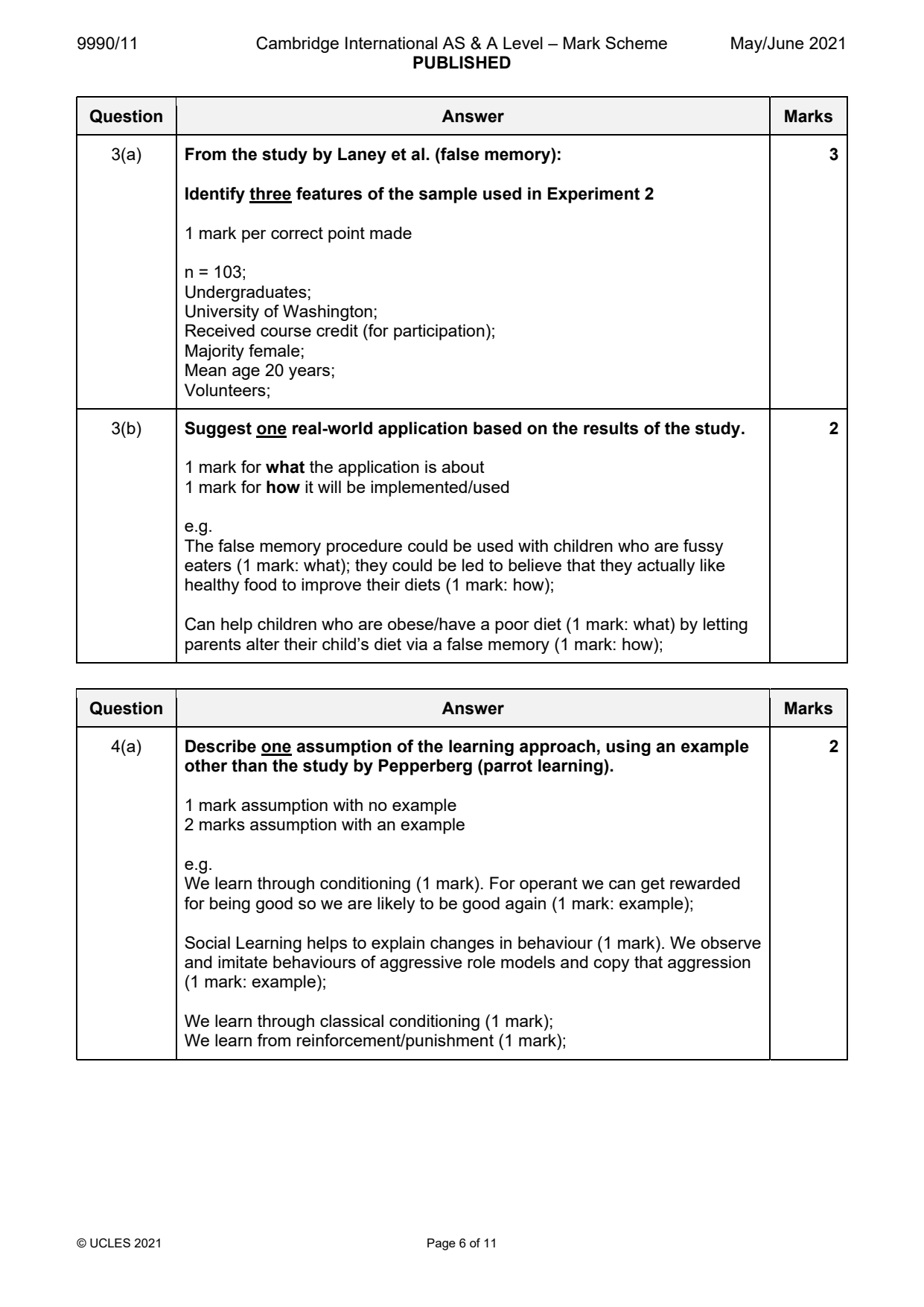
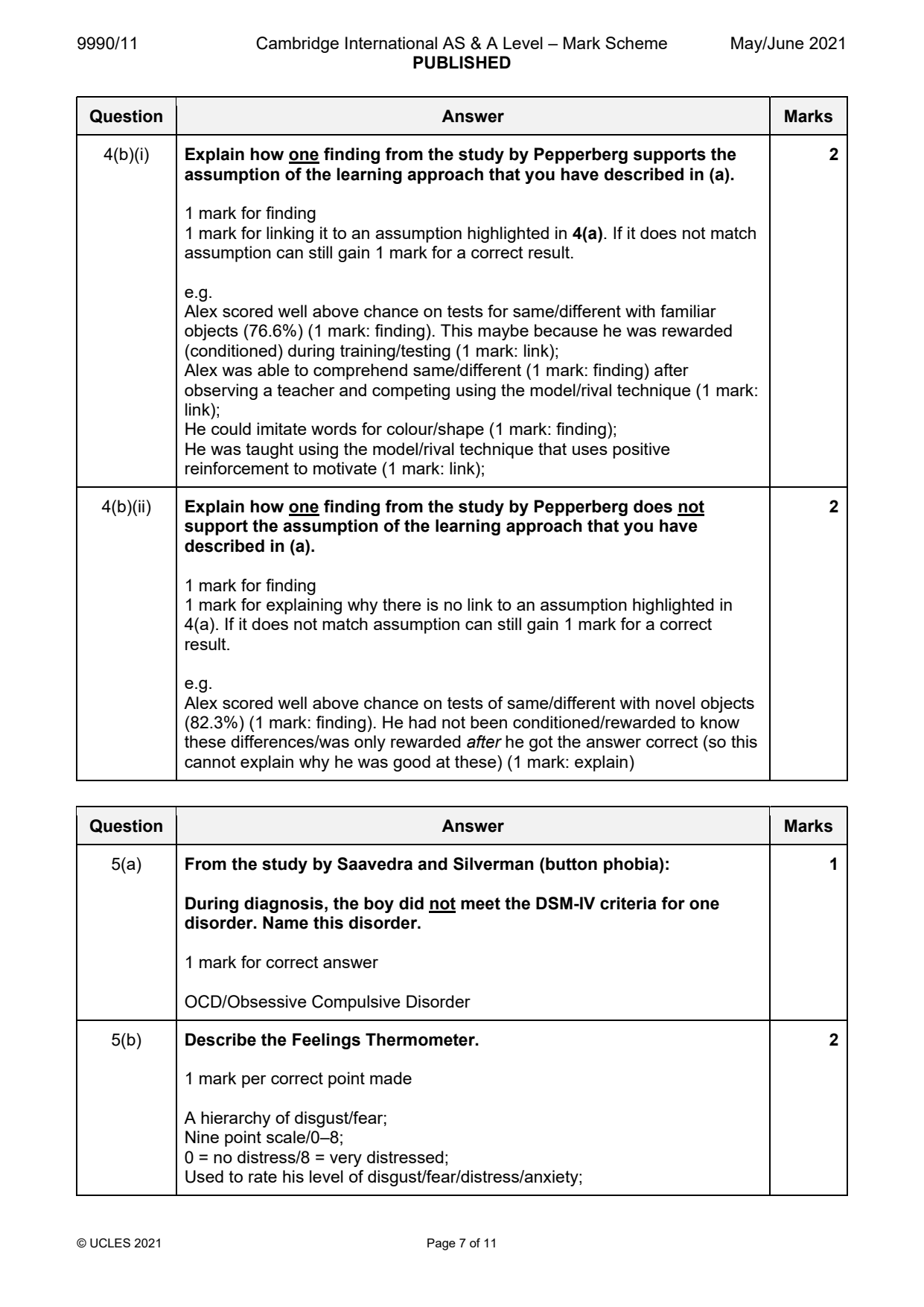
4(a) Describe one assumption of the learning approach, using an example 2
other than the study by Pepperberg (parrot learning).
1 mark assumption with no example
2 marks assumption with an example
e.g.
We learn through conditioning (1 mark). For operant we can get rewarded
for being good so we are likely to be good again (1 mark: example);
Social Learning helps to explain changes in behaviour (1 mark). We observe
and imitate behaviours of aggressive role models and copy that aggression
(1 mark: example);
We learn through classical conditioning (1 mark);
We learn from reinforcement/punishment (1 mark);
© UCLES 2021 Page 6 of 11
4(b)(i) Explain how one finding from the study by Pepperberg supports the 2
assumption of the learning approach that you have described in (a).
1 mark for finding
1 mark for linking it to an assumption highlighted in 4(a). If it does not match
assumption can still gain 1 mark for a correct result.
e.g.
Alex scored well above chance on tests for same/different with familiar
objects (76.6%) (1 mark: finding). This maybe because he was rewarded
(conditioned) during training/testing (1 mark: link);
Alex was able to comprehend same/different (1 mark: finding) after
observing a teacher and competing using the model/rival technique (1 mark:
link);
He could imitate words for colour/shape (1 mark: finding);
He was taught using the model/rival technique that uses positive
reinforcement to motivate (1 mark: link);
4(b)(ii) Explain how one finding from the study by Pepperberg does not 2
support the assumption of the learning approach that you have
described in (a).
1 mark for finding
1 mark for explaining why there is no link to an assumption highlighted in
4(a). If it does not match assumption can still gain 1 mark for a correct
result.
e.g.
Alex scored well above chance on tests of same/different with novel objects
(82.3%) (1 mark: finding). He had not been conditioned/rewarded to know
these differences/was only rewarded after he got the answer correct (so this
cannot explain why he was good at these) (1 mark: explain)
Question Answer Marks
Official mark scheme pages: 6, 7 · source PDF URL
9990-2021-mj-11-q05
May/June 2021 · Paper 11 · Question 5 · 5 marks
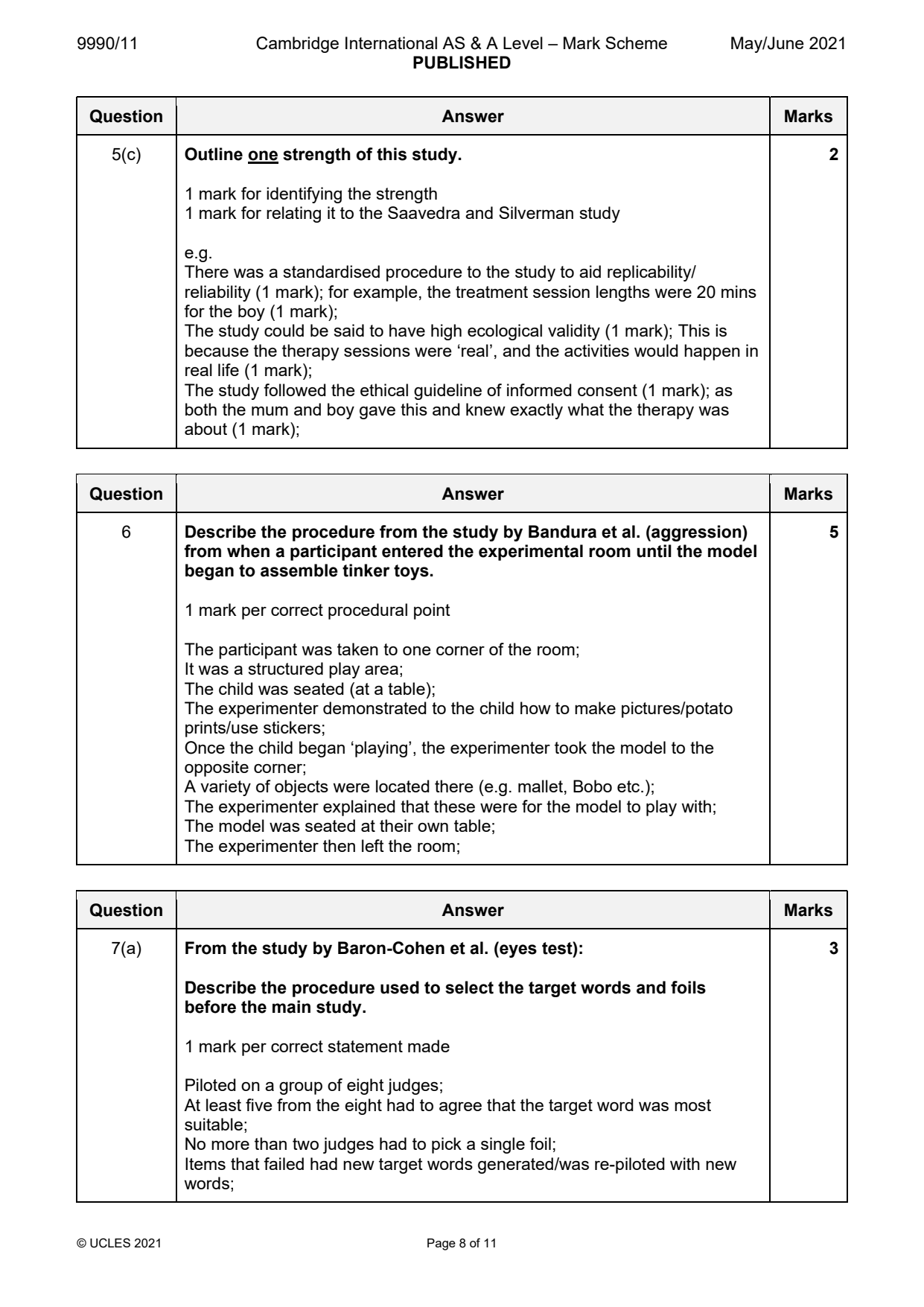
5(a) From the study by Saavedra and Silverman (button phobia): 1
During diagnosis, the boy did not meet the DSM-IV criteria for one
disorder. Name this disorder.
1 mark for correct answer
OCD/Obsessive Compulsive Disorder
5(b) Describe the Feelings Thermometer. 2
1 mark per correct point made
A hierarchy of disgust/fear;
Nine point scale/0–8;
0 = no distress/8 = very distressed;
Used to rate his level of disgust/fear/distress/anxiety;
© UCLES 2021 Page 7 of 11
5(c) Outline one strength of this study. 2
1 mark for identifying the strength
1 mark for relating it to the Saavedra and Silverman study
e.g.
There was a standardised procedure to the study to aid replicability/
reliability (1 mark); for example, the treatment session lengths were 20 mins
for the boy (1 mark);
The study could be said to have high ecological validity (1 mark); This is
because the therapy sessions were ‘real’, and the activities would happen in
real life (1 mark);
The study followed the ethical guideline of informed consent (1 mark); as
both the mum and boy gave this and knew exactly what the therapy was
about (1 mark);
Question Answer Marks
Official mark scheme pages: 7, 8 · source PDF URL
9990-2021-mj-11-q06
May/June 2021 · Paper 11 · Question 6 · 5 marks
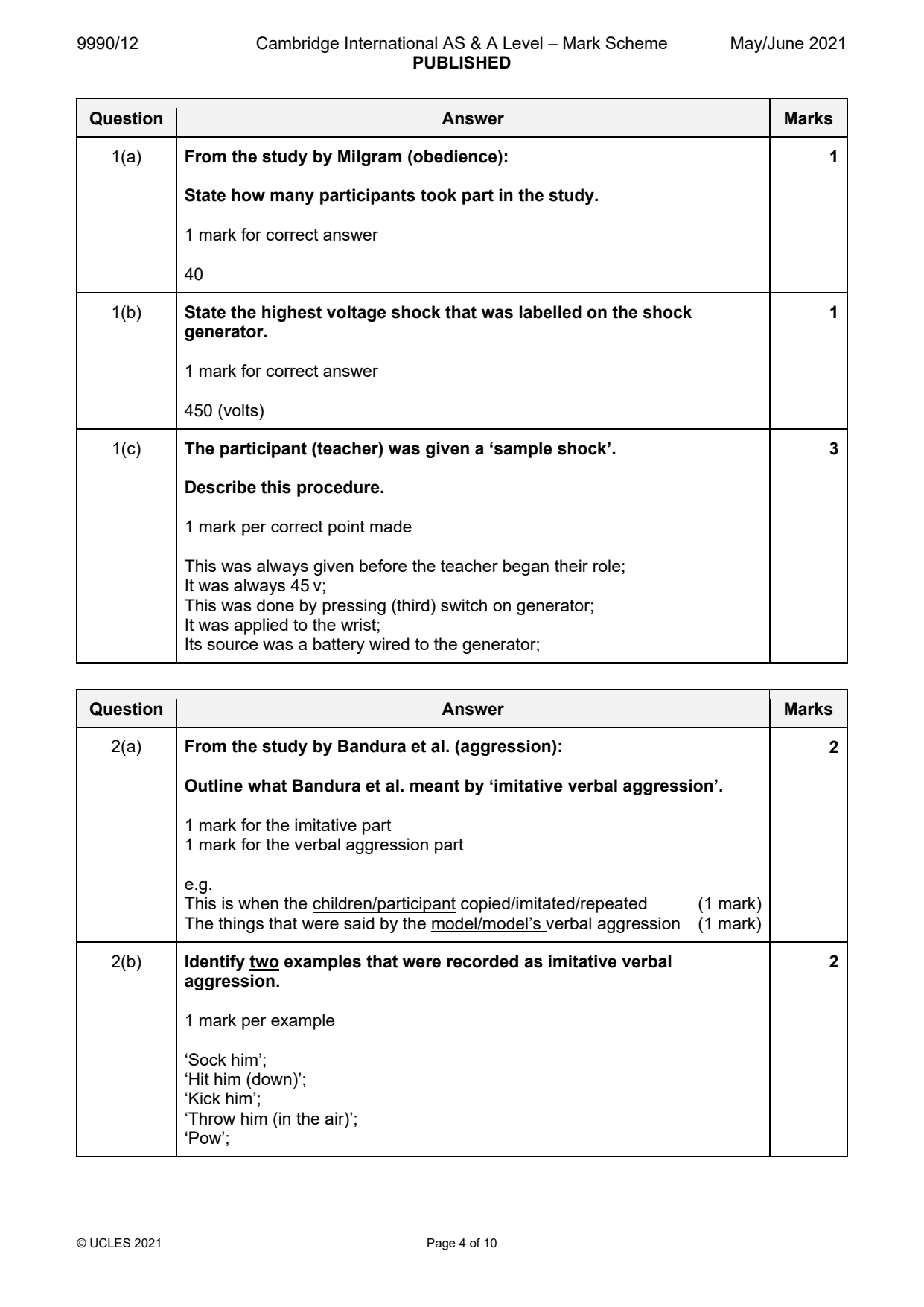
6 Describe the procedure from the study by Bandura et al. (aggression) 5
from when a participant entered the experimental room until the model
began to assemble tinker toys.
1 mark per correct procedural point
The participant was taken to one corner of the room;
It was a structured play area;
The child was seated (at a table);
The experimenter demonstrated to the child how to make pictures/potato
prints/use stickers;
Once the child began ‘playing’, the experimenter took the model to the
opposite corner;
A variety of objects were located there (e.g. mallet, Bobo etc.);
The experimenter explained that these were for the model to play with;
The model was seated at their own table;
The experimenter then left the room;
Question Answer Marks
Official mark scheme pages: 8 · source PDF URL
9990-2021-mj-12-q02
May/June 2021 · Paper 12 · Question 2 · 6 marks
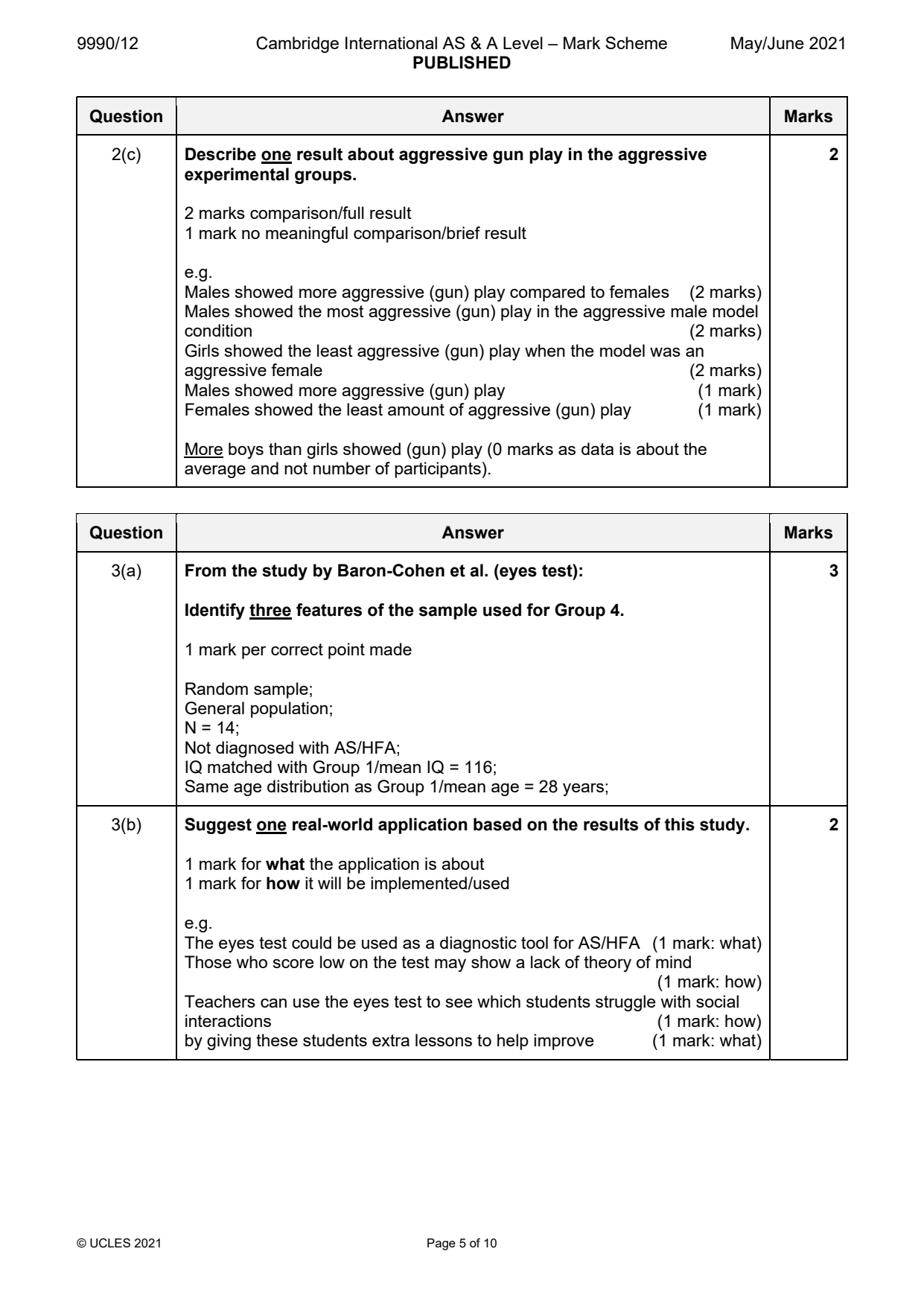
2(a) From the study by Bandura et al. (aggression): 2
Outline what Bandura et al. meant by ‘imitative verbal aggression’.
1 mark for the imitative part
1 mark for the verbal aggression part
e.g.
This is when the children/participant copied/imitated/repeated (1 mark)
The things that were said by the model/model’s verbal aggression (1 mark)
2(b) Identify two examples that were recorded as imitative verbal 2
aggression.
1 mark per example
‘Sock him’;
‘Hit him (down)’;
‘Kick him’;
‘Throw him (in the air)’;
‘Pow’;
© UCLES 2021 Page 4 of 10
2(c) Describe one result about aggressive gun play in the aggressive 2
experimental groups.
2 marks comparison/full result
1 mark no meaningful comparison/brief result
e.g.
Males showed more aggressive (gun) play compared to females (2 marks)
Males showed the most aggressive (gun) play in the aggressive male model
condition (2 marks)
Girls showed the least aggressive (gun) play when the model was an
aggressive female (2 marks)
Males showed more aggressive (gun) play (1 mark)
Females showed the least amount of aggressive (gun) play (1 mark)
More boys than girls showed (gun) play (0 marks as data is about the
average and not number of participants).
Question Answer Marks
Official mark scheme pages: 4, 5 · source PDF URL
9990-2021-mj-12-q04
May/June 2021 · Paper 12 · Question 4 · 6 marks
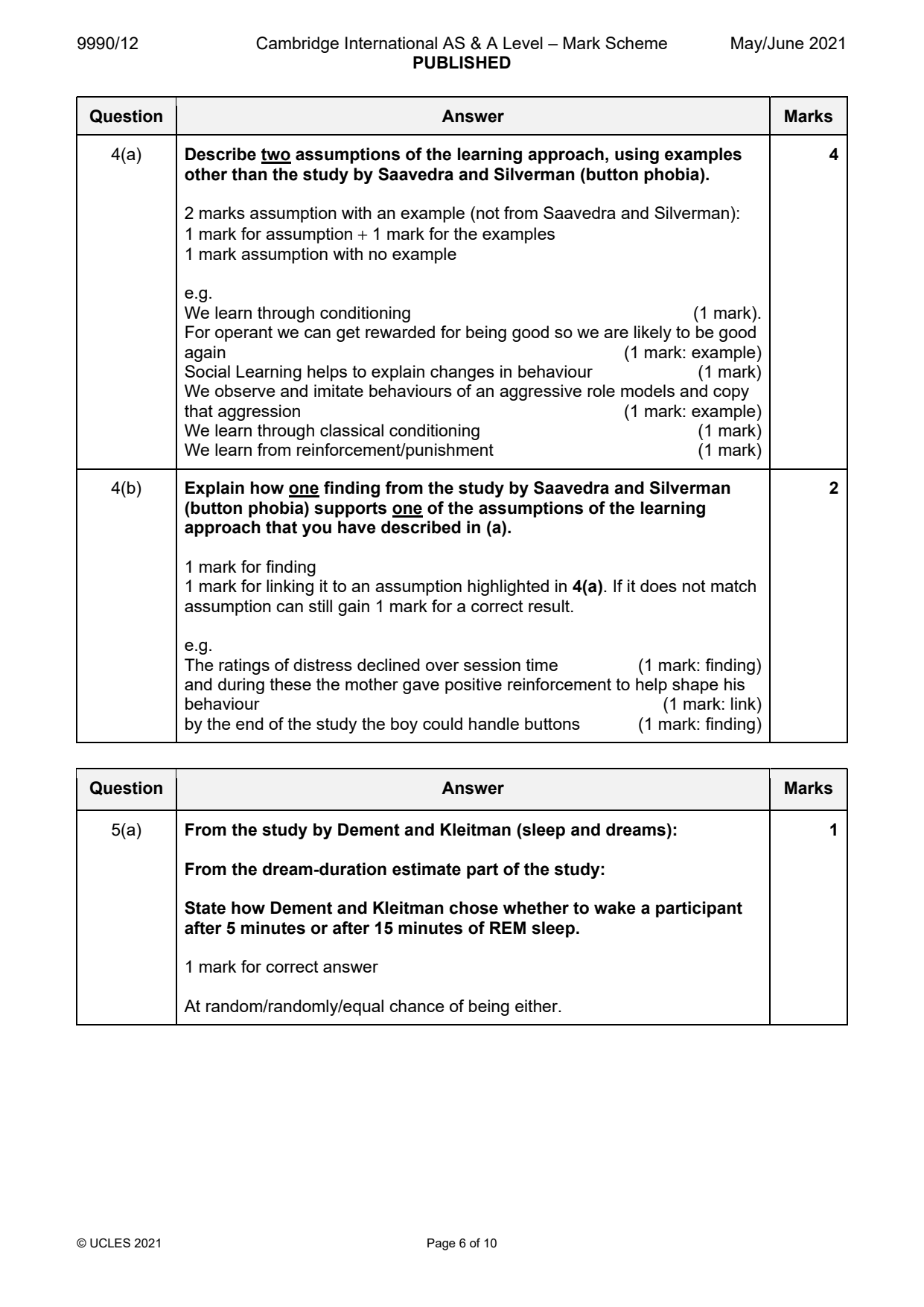
4(a) Describe two assumptions of the learning approach, using examples 4
other than the study by Saavedra and Silverman (button phobia).
2 marks assumption with an example (not from Saavedra and Silverman):
1 mark for assumption + 1 mark for the examples
1 mark assumption with no example
e.g.
We learn through conditioning (1 mark).
For operant we can get rewarded for being good so we are likely to be good
again (1 mark: example)
Social Learning helps to explain changes in behaviour (1 mark)
We observe and imitate behaviours of an aggressive role models and copy
that aggression (1 mark: example)
We learn through classical conditioning (1 mark)
We learn from reinforcement/punishment (1 mark)
4(b) Explain how one finding from the study by Saavedra and Silverman 2
(button phobia) supports one of the assumptions of the learning
approach that you have described in (a).
1 mark for finding
1 mark for linking it to an assumption highlighted in 4(a). If it does not match
assumption can still gain 1 mark for a correct result.
e.g.
The ratings of distress declined over session time (1 mark: finding)
and during these the mother gave positive reinforcement to help shape his
behaviour (1 mark: link)
by the end of the study the boy could handle buttons (1 mark: finding)
Question Answer Marks
Official mark scheme pages: 6 · source PDF URL
9990-2021-mj-12-q07
May/June 2021 · Paper 12 · Question 7 · 6 marks
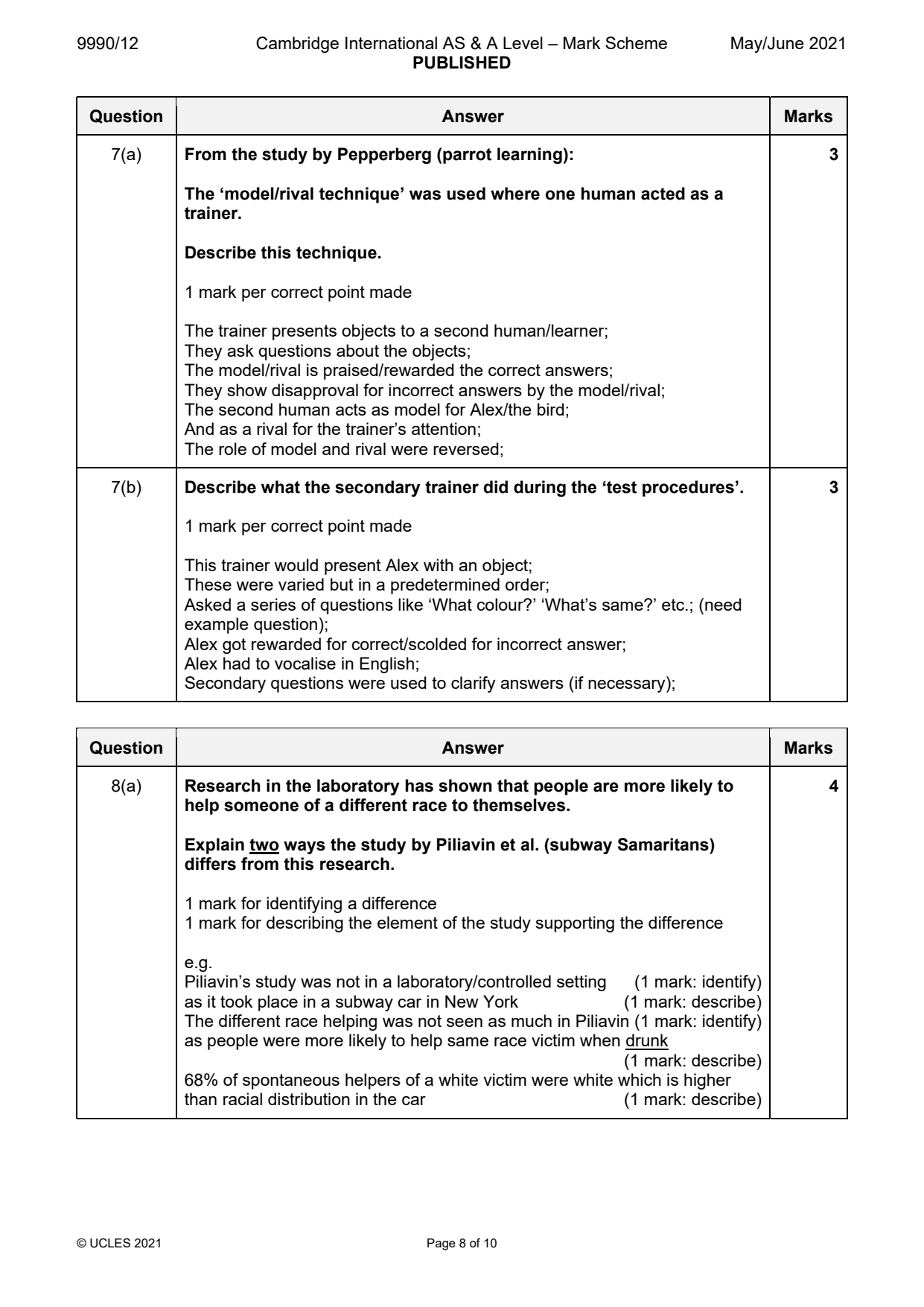
7(a) From the study by Pepperberg (parrot learning): 3
The ‘model/rival technique’ was used where one human acted as a
trainer.
Describe this technique.
1 mark per correct point made
The trainer presents objects to a second human/learner;
They ask questions about the objects;
The model/rival is praised/rewarded the correct answers;
They show disapproval for incorrect answers by the model/rival;
The second human acts as model for Alex/the bird;
And as a rival for the trainer’s attention;
The role of model and rival were reversed;
7(b) Describe what the secondary trainer did during the ‘test procedures’. 3
1 mark per correct point made
This trainer would present Alex with an object;
These were varied but in a predetermined order;
Asked a series of questions like ‘What colour?’ ‘What’s same?’ etc.; (need
example question);
Alex got rewarded for correct/scolded for incorrect answer;
Alex had to vocalise in English;
Secondary questions were used to clarify answers (if necessary);
Question Answer Marks
Official mark scheme pages: 8 · source PDF URL
9990-2021-mj-13-q01
May/June 2021 · Paper 13 · Question 1 · 5 marks
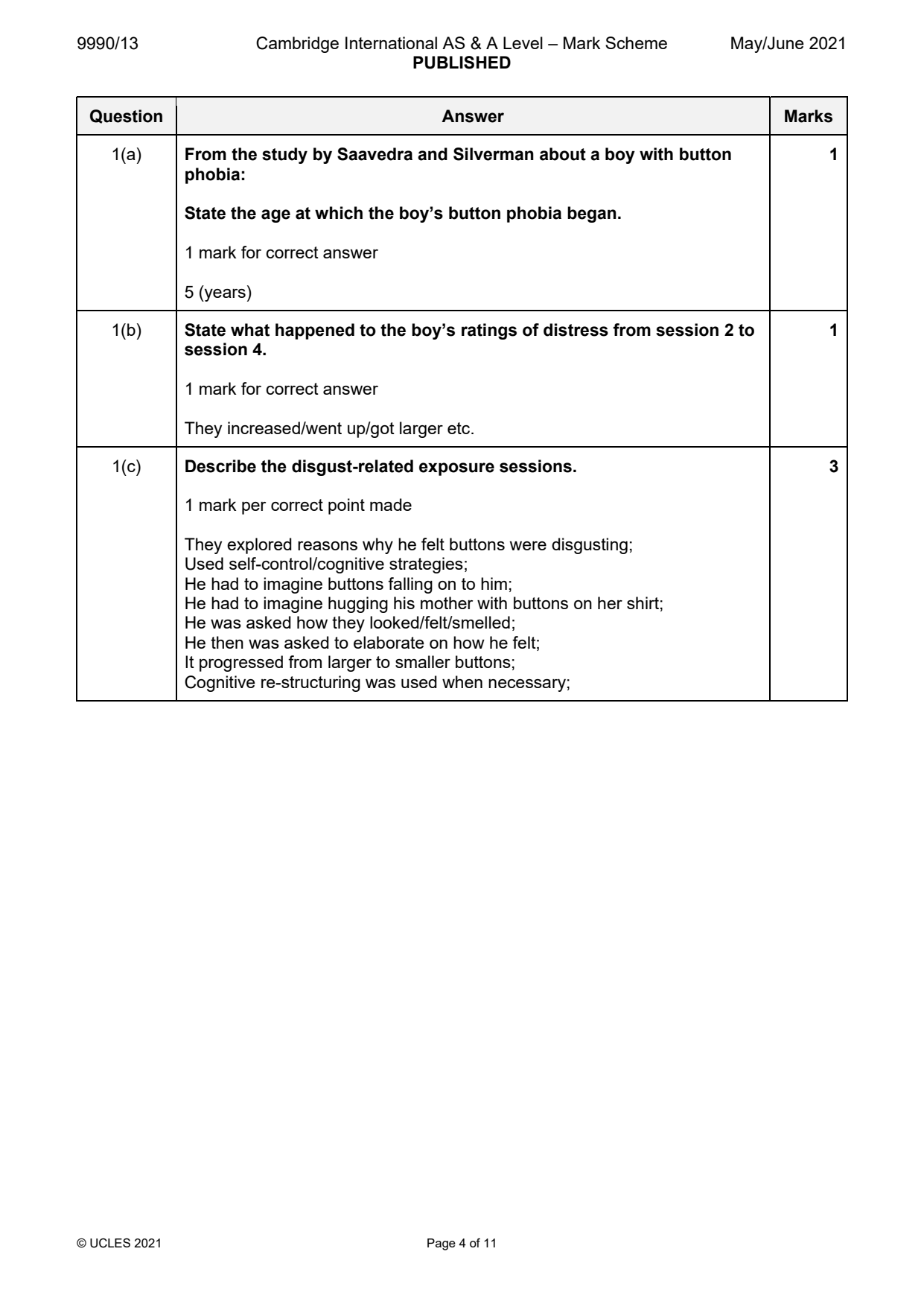
1(a) From the study by Saavedra and Silverman about a boy with button 1
phobia:
State the age at which the boy’s button phobia began.
1 mark for correct answer
5 (years)
1(b) State what happened to the boy’s ratings of distress from session 2 to 1
session 4.
1 mark for correct answer
They increased/went up/got larger etc.
1(c) Describe the disgust-related exposure sessions. 3
1 mark per correct point made
They explored reasons why he felt buttons were disgusting;
Used self-control/cognitive strategies;
He had to imagine buttons falling on to him;
He had to imagine hugging his mother with buttons on her shirt;
He was asked how they looked/felt/smelled;
He then was asked to elaborate on how he felt;
It progressed from larger to smaller buttons;
Cognitive re-structuring was used when necessary;
© UCLES 2021 Page 4 of 11
Official mark scheme pages: 4 · source PDF URL
9990-2021-mj-13-q02
May/June 2021 · Paper 13 · Question 2 · 6 marks
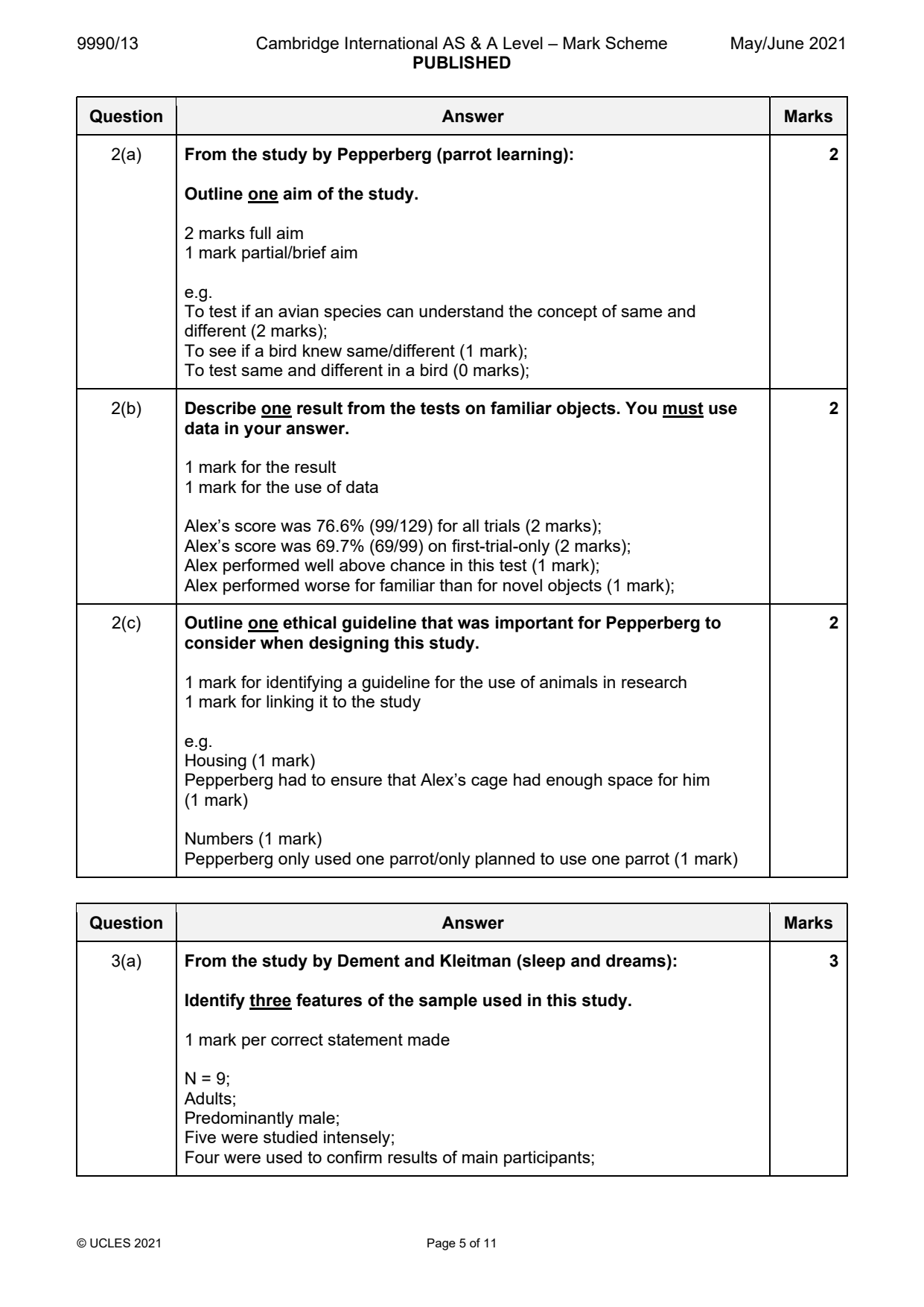
2(a) From the study by Pepperberg (parrot learning): 2
Outline one aim of the study.
2 marks full aim
1 mark partial/brief aim
e.g.
To test if an avian species can understand the concept of same and
different (2 marks);
To see if a bird knew same/different (1 mark);
To test same and different in a bird (0 marks);
2(b) Describe one result from the tests on familiar objects. You must use 2
data in your answer.
1 mark for the result
1 mark for the use of data
Alex’s score was 76.6% (99/129) for all trials (2 marks);
Alex’s score was 69.7% (69/99) on first-trial-only (2 marks);
Alex performed well above chance in this test (1 mark);
Alex performed worse for familiar than for novel objects (1 mark);
2(c) Outline one ethical guideline that was important for Pepperberg to 2
consider when designing this study.
1 mark for identifying a guideline for the use of animals in research
1 mark for linking it to the study
e.g.
Housing (1 mark)
Pepperberg had to ensure that Alex’s cage had enough space for him
(1 mark)
Numbers (1 mark)
Pepperberg only used one parrot/only planned to use one parrot (1 mark)
Question Answer Marks
Official mark scheme pages: 5 · source PDF URL
9990-2021-mj-13-q08
May/June 2021 · Paper 13 · Question 8 · 12 marks
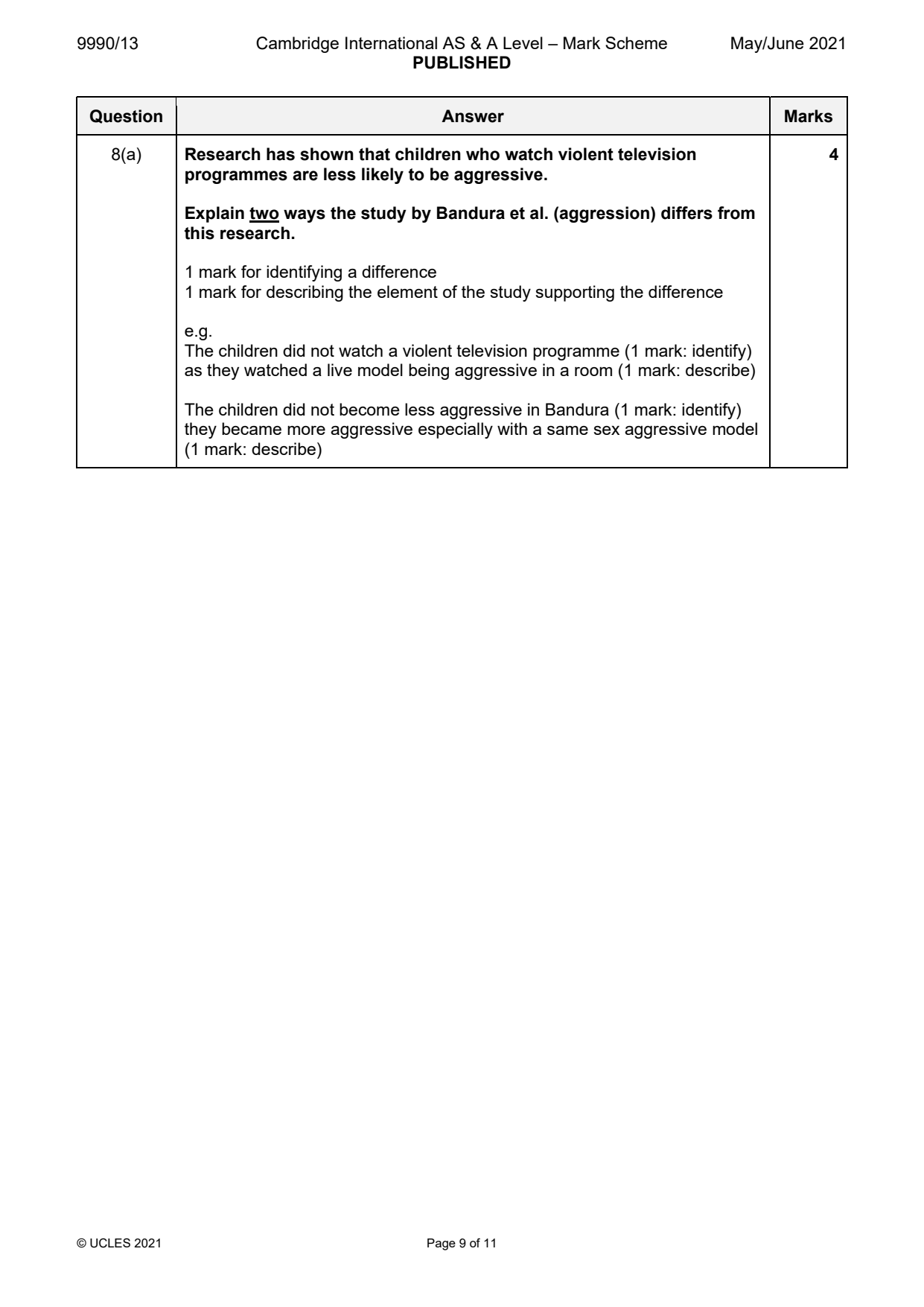
8(a) Research has shown that children who watch violent television 4
programmes are less likely to be aggressive.
Explain two ways the study by Bandura et al. (aggression) differs from
this research.
1 mark for identifying a difference
1 mark for describing the element of the study supporting the difference
e.g.
The children did not watch a violent television programme (1 mark: identify)
as they watched a live model being aggressive in a room (1 mark: describe)
The children did not become less aggressive in Bandura (1 mark: identify)
they became more aggressive especially with a same sex aggressive model
(1 mark: describe)
© UCLES 2021 Page 9 of 11
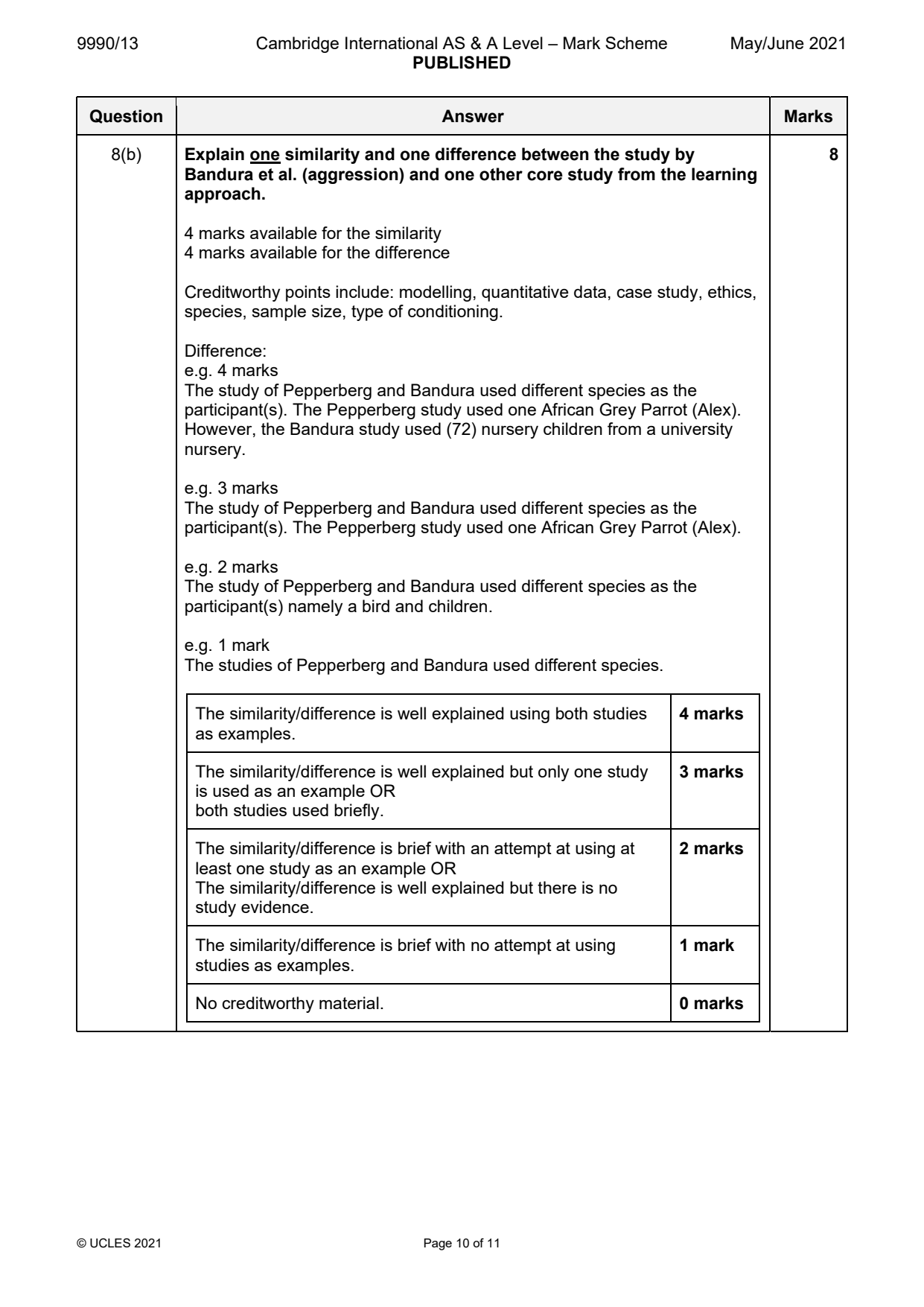
8(b) Explain one similarity and one difference between the study by 8
Bandura et al. (aggression) and one other core study from the learning
approach.
4 marks available for the similarity
4 marks available for the difference
Creditworthy points include: modelling, quantitative data, case study, ethics,
species, sample size, type of conditioning.
Difference:
e.g. 4 marks
The study of Pepperberg and Bandura used different species as the
participant(s). The Pepperberg study used one African Grey Parrot (Alex).
However, the Bandura study used (72) nursery children from a university
nursery.
e.g. 3 marks
The study of Pepperberg and Bandura used different species as the
participant(s). The Pepperberg study used one African Grey Parrot (Alex).
e.g. 2 marks
The study of Pepperberg and Bandura used different species as the
participant(s) namely a bird and children.
e.g. 1 mark
The studies of Pepperberg and Bandura used different species.
The similarity/difference is well explained using both studies 4 marks
as examples.
The similarity/difference is well explained but only one study 3 marks
is used as an example OR
both studies used briefly.
The similarity/difference is brief with an attempt at using at 2 marks
least one study as an example OR
The similarity/difference is well explained but there is no
study evidence.
The similarity/difference is brief with no attempt at using 1 mark
studies as examples.
No creditworthy material. 0 marks
© UCLES 2021 Page 10 of 11
Official mark scheme pages: 9, 10 · source PDF URL
9990-2021-on-11-q01
Oct/Nov 2021 · Paper 11 · Question 1 · 5 marks
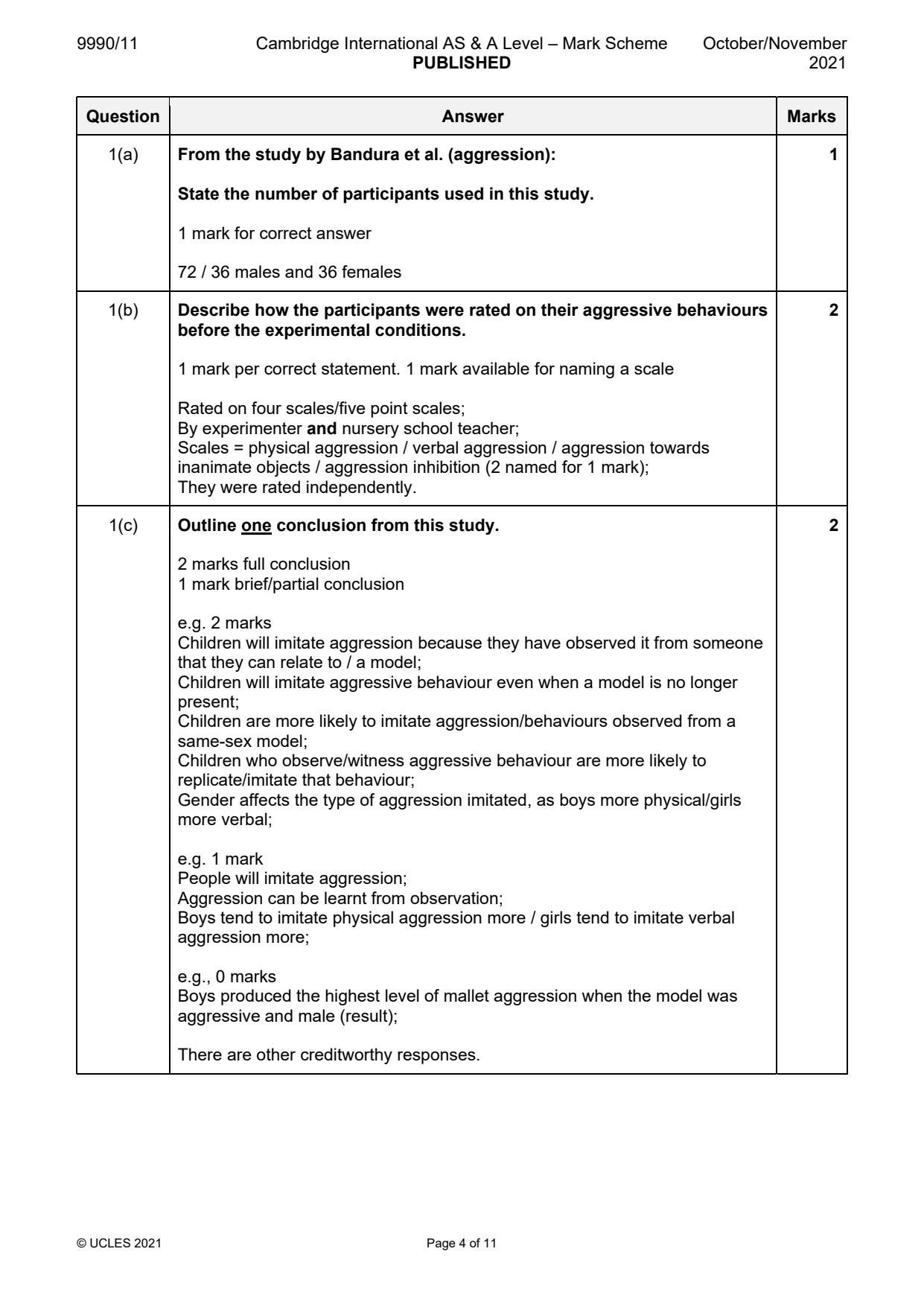
1(a) From the study by Bandura et al. (aggression): 1
State the number of participants used in this study.
1 mark for correct answer
72 / 36 males and 36 females
1(b) Describe how the participants were rated on their aggressive behaviours 2
before the experimental conditions.
1 mark per correct statement. 1 mark available for naming a scale
Rated on four scales/five point scales;
By experimenter and nursery school teacher;
Scales = physical aggression / verbal aggression / aggression towards
inanimate objects / aggression inhibition (2 named for 1 mark);
They were rated independently.
1(c) Outline one conclusion from this study. 2
2 marks full conclusion
1 mark brief/partial conclusion
e.g. 2 marks
Children will imitate aggression because they have observed it from someone
that they can relate to / a model;
Children will imitate aggressive behaviour even when a model is no longer
present;
Children are more likely to imitate aggression/behaviours observed from a
same-sex model;
Children who observe/witness aggressive behaviour are more likely to
replicate/imitate that behaviour;
Gender affects the type of aggression imitated, as boys more physical/girls
more verbal;
e.g. 1 mark
People will imitate aggression;
Aggression can be learnt from observation;
Boys tend to imitate physical aggression more / girls tend to imitate verbal
aggression more;
e.g., 0 marks
Boys produced the highest level of mallet aggression when the model was
aggressive and male (result);
There are other creditworthy responses.
© UCLES 2021 Page 4 of 11
Official mark scheme pages: 4 · source PDF URL
9990-2021-on-11-q06
Oct/Nov 2021 · Paper 11 · Question 6 · 6 marks
6(a) The study by Pepperberg (parrot learning) is based on social learning 4
theory.
Describe social learning theory.
1 mark per correct point made
Social Learning is when someone observes the behaviour of someone else /
pay attention to behaviour;
They retain this information for use at a later date;
The organism/person/animal must feel capable of replicating that behaviour;
The person/animal will imitate the behaviour they have observed;
They need to be motivated via vicarious reinforcement;
© UCLES 2021 Page 7 of 11
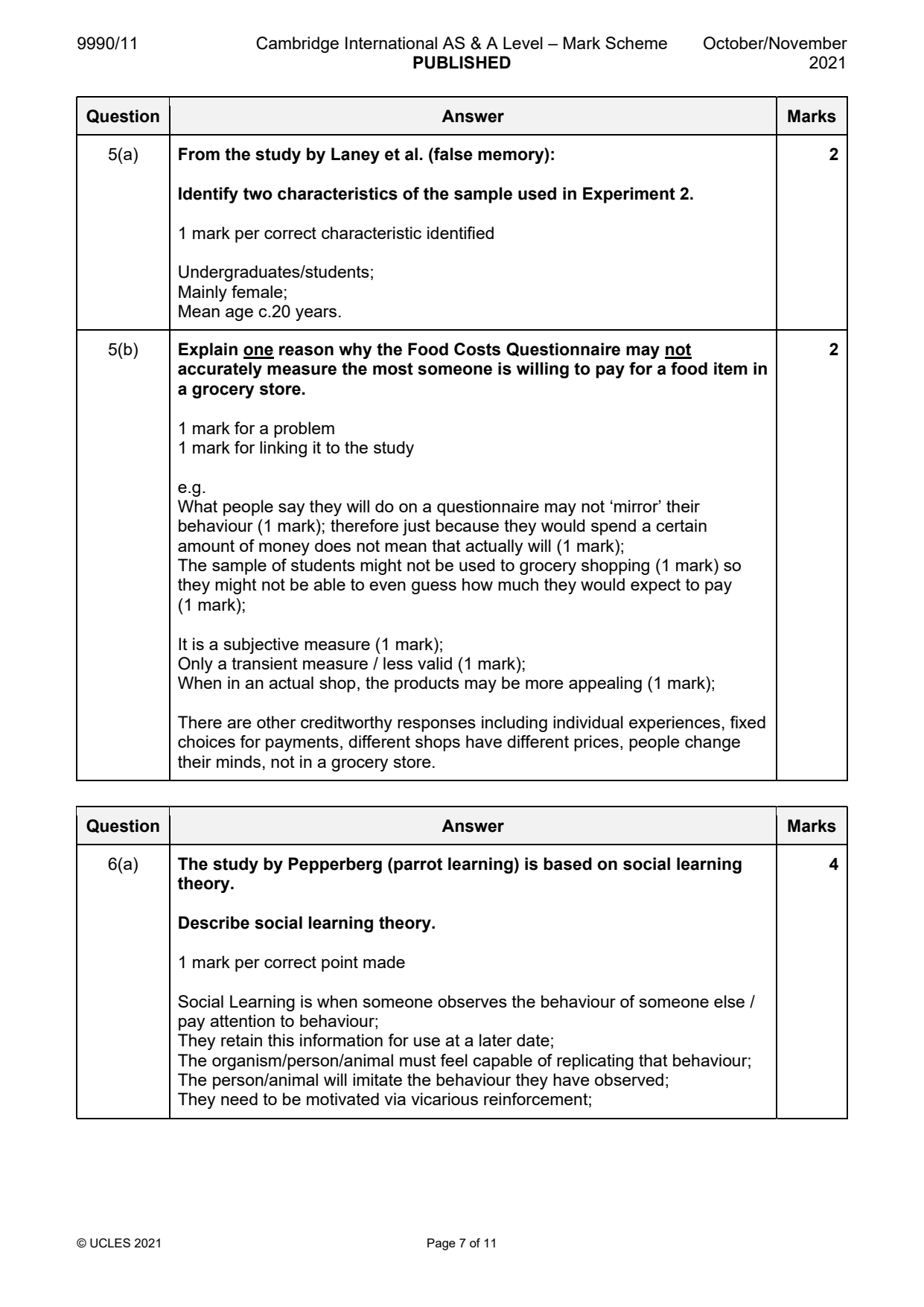
6(b) Outline how one result from this study supports social learning theory. 2
1 mark for appropriate result, then
1 mark for explaining how it links to Social Learning Theory
e.g.
Alex scored well above chance on tests for same/different with familiar objects
(76.6%) (1 mark). This may be because he had witnessed the model/rival
learning about same/different (1 mark).
Question Answer Marks
Official mark scheme pages: 7, 8 · source PDF URL
9990-2021-on-12-q01
Oct/Nov 2021 · Paper 12 · Question 1 · 5 marks
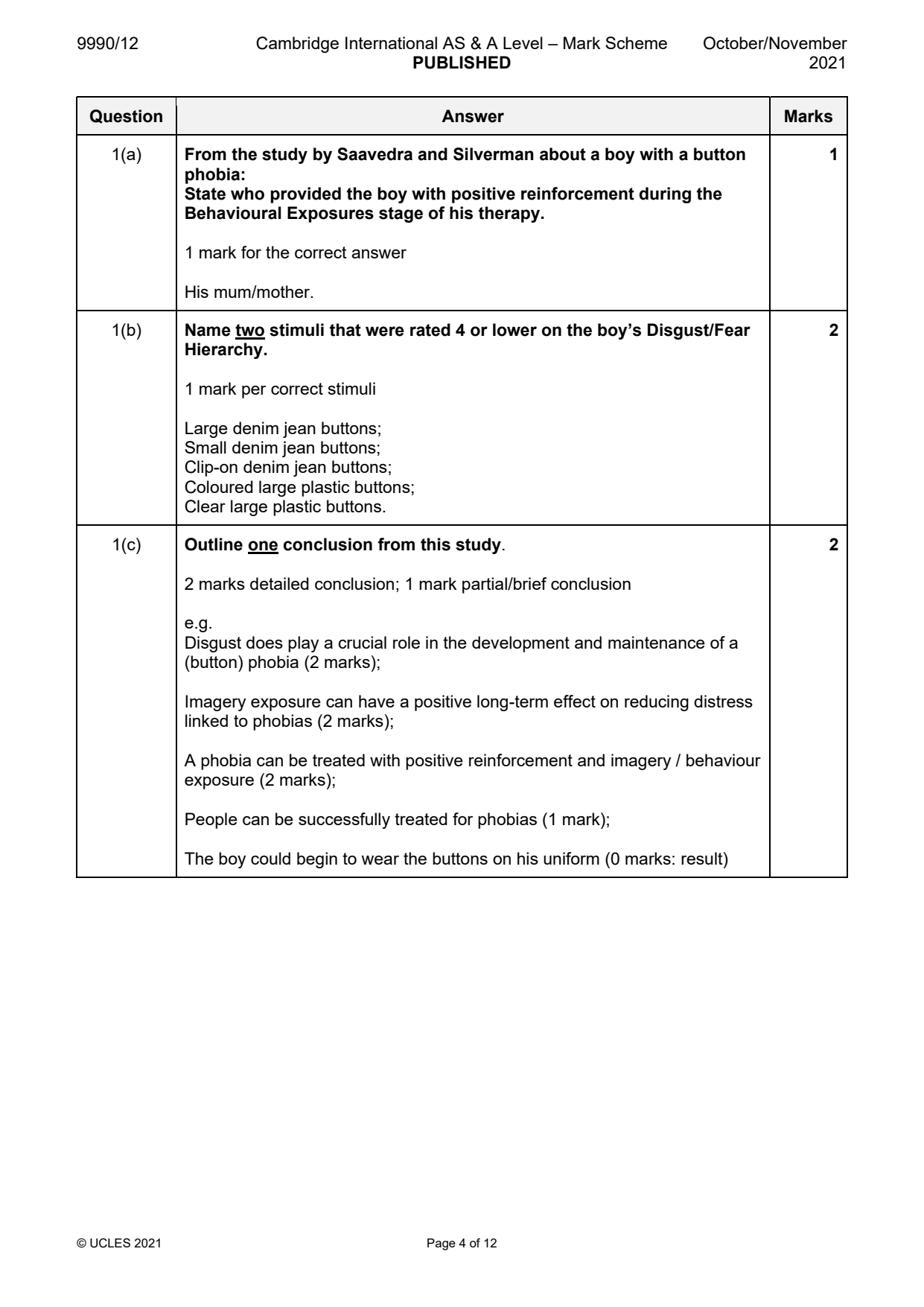
1(a) From the study by Saavedra and Silverman about a boy with a button 1
phobia:
State who provided the boy with positive reinforcement during the
Behavioural Exposures stage of his therapy.
1 mark for the correct answer
His mum/mother.
1(b) Name two stimuli that were rated 4 or lower on the boy’s Disgust/Fear 2
Hierarchy.
1 mark per correct stimuli
Large denim jean buttons;
Small denim jean buttons;
Clip-on denim jean buttons;
Coloured large plastic buttons;
Clear large plastic buttons.
1(c) Outline one conclusion from this study. 2
2 marks detailed conclusion; 1 mark partial/brief conclusion
e.g.
Disgust does play a crucial role in the development and maintenance of a
(button) phobia (2 marks);
Imagery exposure can have a positive long-term effect on reducing distress
linked to phobias (2 marks);
A phobia can be treated with positive reinforcement and imagery / behaviour
exposure (2 marks);
People can be successfully treated for phobias (1 mark);
The boy could begin to wear the buttons on his uniform (0 marks: result)
© UCLES 2021 Page 4 of 12
Official mark scheme pages: 4 · source PDF URL
9990-2021-on-12-q02
Oct/Nov 2021 · Paper 12 · Question 2 · 5 marks
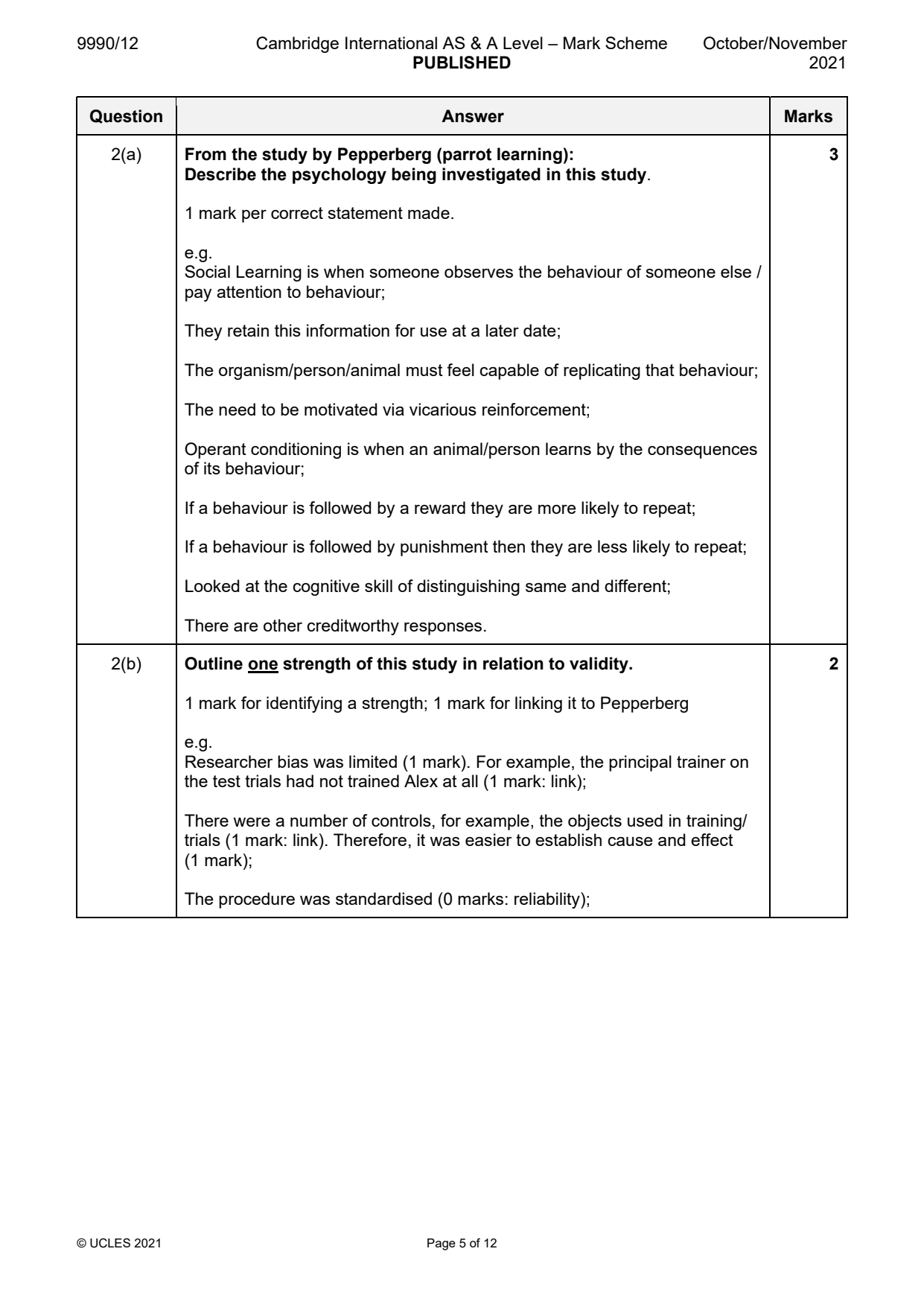
2(a) From the study by Pepperberg (parrot learning): 3
Describe the psychology being investigated in this study.
1 mark per correct statement made.
e.g.
Social Learning is when someone observes the behaviour of someone else /
pay attention to behaviour;
They retain this information for use at a later date;
The organism/person/animal must feel capable of replicating that behaviour;
The need to be motivated via vicarious reinforcement;
Operant conditioning is when an animal/person learns by the consequences
of its behaviour;
If a behaviour is followed by a reward they are more likely to repeat;
If a behaviour is followed by punishment then they are less likely to repeat;
Looked at the cognitive skill of distinguishing same and different;
There are other creditworthy responses.
2(b) Outline one strength of this study in relation to validity. 2
1 mark for identifying a strength; 1 mark for linking it to Pepperberg
e.g.
Researcher bias was limited (1 mark). For example, the principal trainer on
the test trials had not trained Alex at all (1 mark: link);
There were a number of controls, for example, the objects used in training/
trials (1 mark: link). Therefore, it was easier to establish cause and effect
(1 mark);
The procedure was standardised (0 marks: reliability);
© UCLES 2021 Page 5 of 12
Official mark scheme pages: 5 · source PDF URL
9990-2021-on-12-q09
Oct/Nov 2021 · Paper 12 · Question 9 · 10 marks
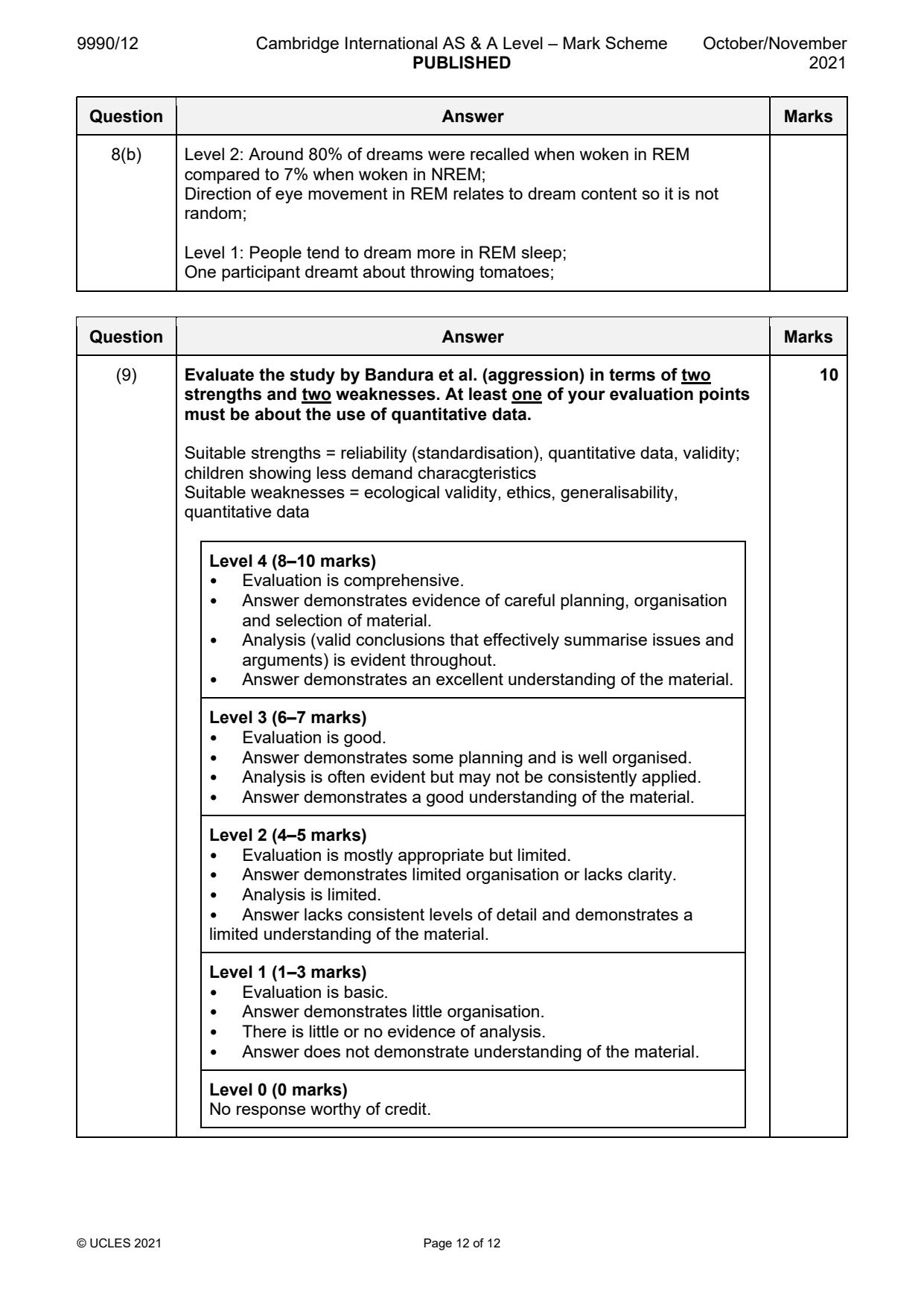
(9) Evaluate the study by Bandura et al. (aggression) in terms of two 10
strengths and two weaknesses. At least one of your evaluation points
must be about the use of quantitative data.
Suitable strengths = reliability (standardisation), quantitative data, validity;
children showing less demand characgteristics
Suitable weaknesses = ecological validity, ethics, generalisability,
quantitative data
Level 4 (8–10 marks)
• Evaluation is comprehensive.
• Answer demonstrates evidence of careful planning, organisation
and selection of material.
• Analysis (valid conclusions that effectively summarise issues and
arguments) is evident throughout.
• Answer demonstrates an excellent understanding of the material.
Level 3 (6–7 marks)
• Evaluation is good.
• Answer demonstrates some planning and is well organised.
• Analysis is often evident but may not be consistently applied.
• Answer demonstrates a good understanding of the material.
Level 2 (4–5 marks)
• Evaluation is mostly appropriate but limited.
• Answer demonstrates limited organisation or lacks clarity.
• Analysis is limited.
• Answer lacks consistent levels of detail and demonstrates a
limited understanding of the material.
Level 1 (1–3 marks)
• Evaluation is basic.
• Answer demonstrates little organisation.
• There is little or no evidence of analysis.
• Answer does not demonstrate understanding of the material.
Level 0 (0 marks)
No response worthy of credit.
© UCLES 2021 Page 12 of 12
Official mark scheme pages: 12 · source PDF URL
9990-2021-on-13-q08
Oct/Nov 2021 · Paper 13 · Question 8 · 12 marks
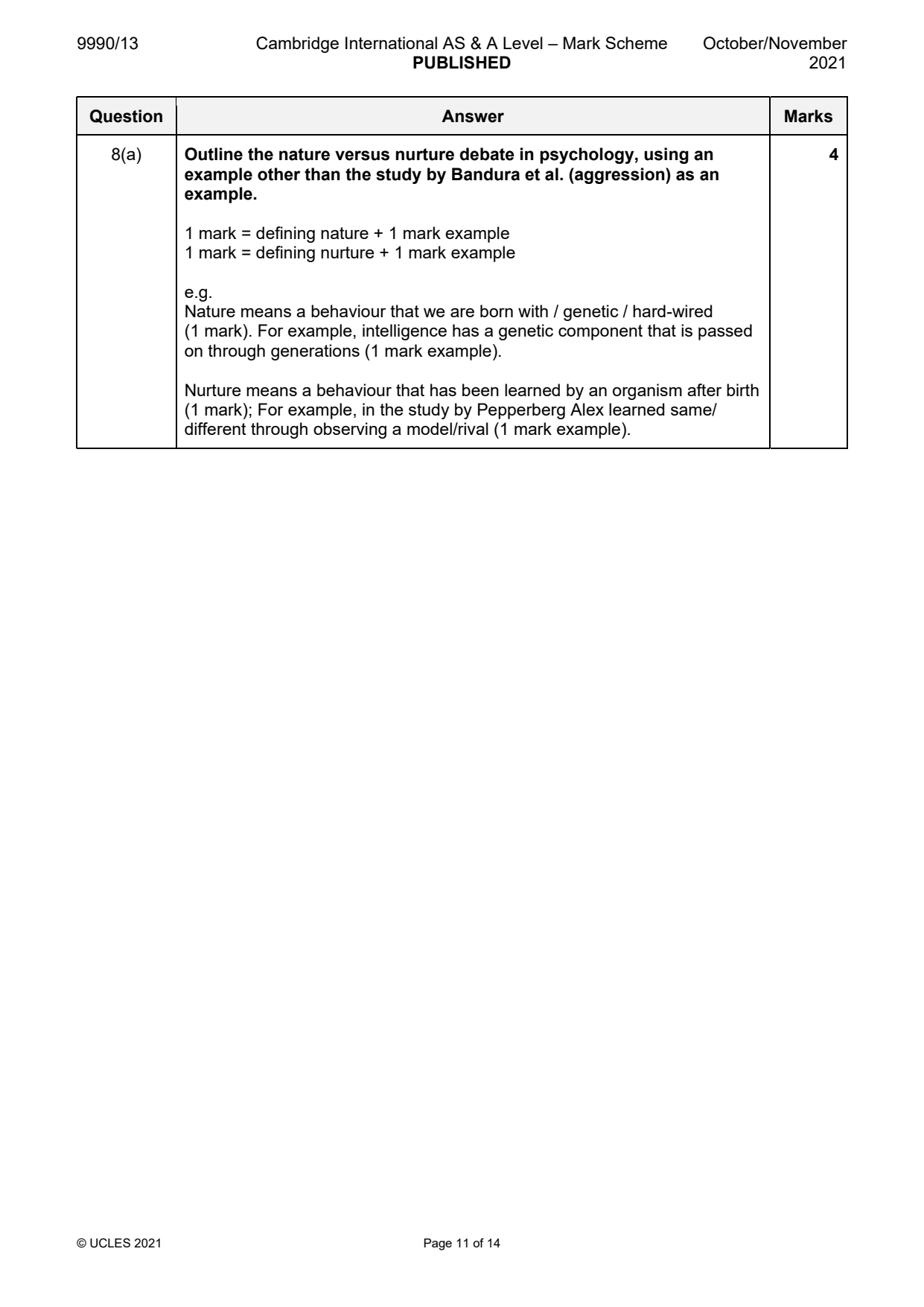
8(a) Outline the nature versus nurture debate in psychology, using an 4
example other than the study by Bandura et al. (aggression) as an
example.
1 mark = defining nature + 1 mark example
1 mark = defining nurture + 1 mark example
e.g.
Nature means a behaviour that we are born with / genetic / hard-wired
(1 mark). For example, intelligence has a genetic component that is passed
on through generations (1 mark example).
Nurture means a behaviour that has been learned by an organism after birth
(1 mark); For example, in the study by Pepperberg Alex learned same/
different through observing a model/rival (1 mark example).
© UCLES 2021 Page 11 of 14
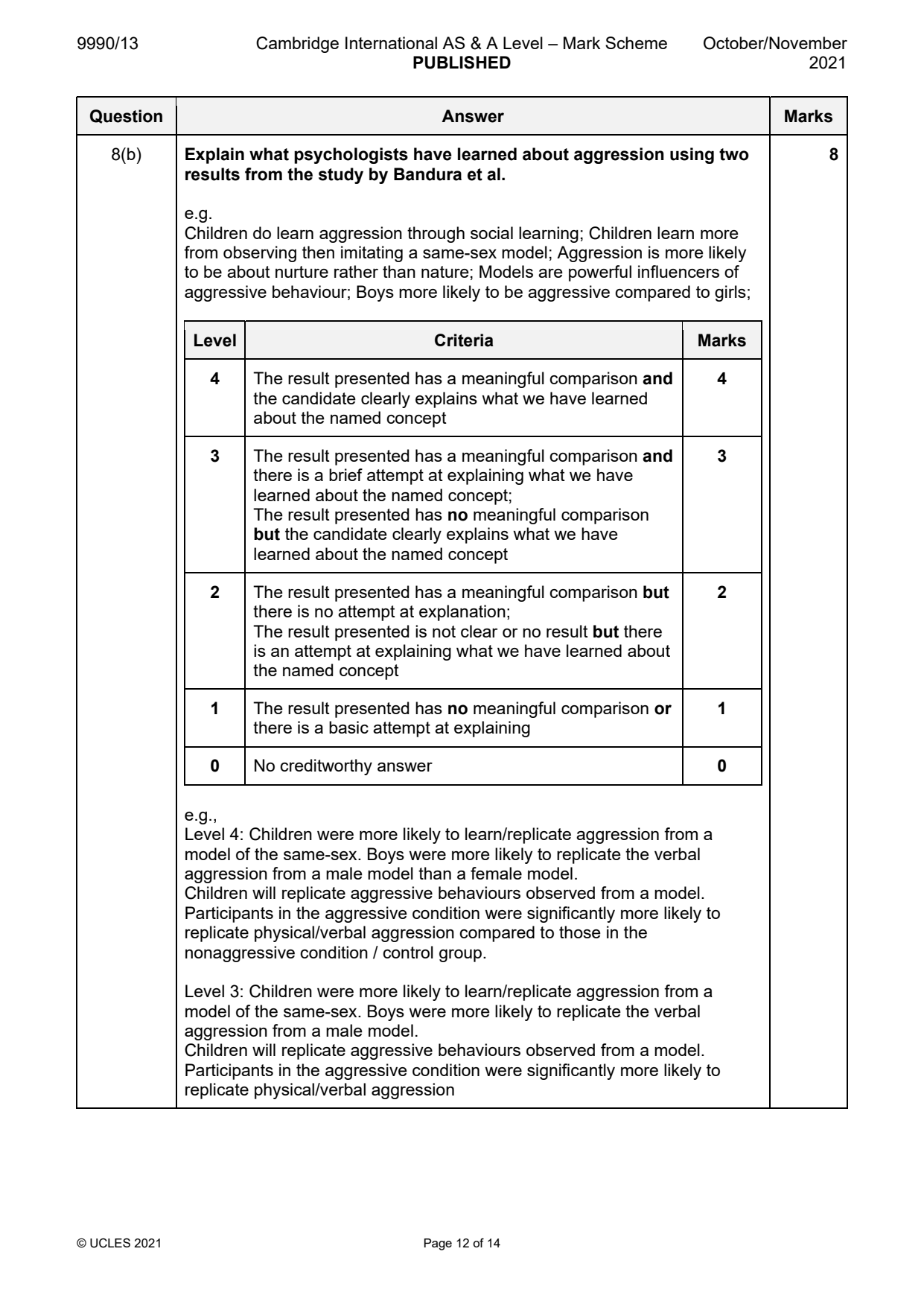
8(b) Explain what psychologists have learned about aggression using two 8
results from the study by Bandura et al.
e.g.
Children do learn aggression through social learning; Children learn more
from observing then imitating a same-sex model; Aggression is more likely
to be about nurture rather than nature; Models are powerful influencers of
aggressive behaviour; Boys more likely to be aggressive compared to girls;
Level Criteria Marks
4 The result presented has a meaningful comparison and 4
the candidate clearly explains what we have learned
about the named concept
3 The result presented has a meaningful comparison and 3
there is a brief attempt at explaining what we have
learned about the named concept;
The result presented has no meaningful comparison
but the candidate clearly explains what we have
learned about the named concept
2 The result presented has a meaningful comparison but 2
there is no attempt at explanation;
The result presented is not clear or no result but there
is an attempt at explaining what we have learned about
the named concept
1 The result presented has no meaningful comparison or 1
there is a basic attempt at explaining
0 No creditworthy answer 0
e.g.,
Level 4: Children were more likely to learn/replicate aggression from a
model of the same-sex. Boys were more likely to replicate the verbal
aggression from a male model than a female model.
Children will replicate aggressive behaviours observed from a model.
Participants in the aggressive condition were significantly more likely to
replicate physical/verbal aggression compared to those in the
nonaggressive condition / control group.
Level 3: Children were more likely to learn/replicate aggression from a
model of the same-sex. Boys were more likely to replicate the verbal
aggression from a male model.
Children will replicate aggressive behaviours observed from a model.
Participants in the aggressive condition were significantly more likely to
replicate physical/verbal aggression
© UCLES 2021 Page 12 of 14
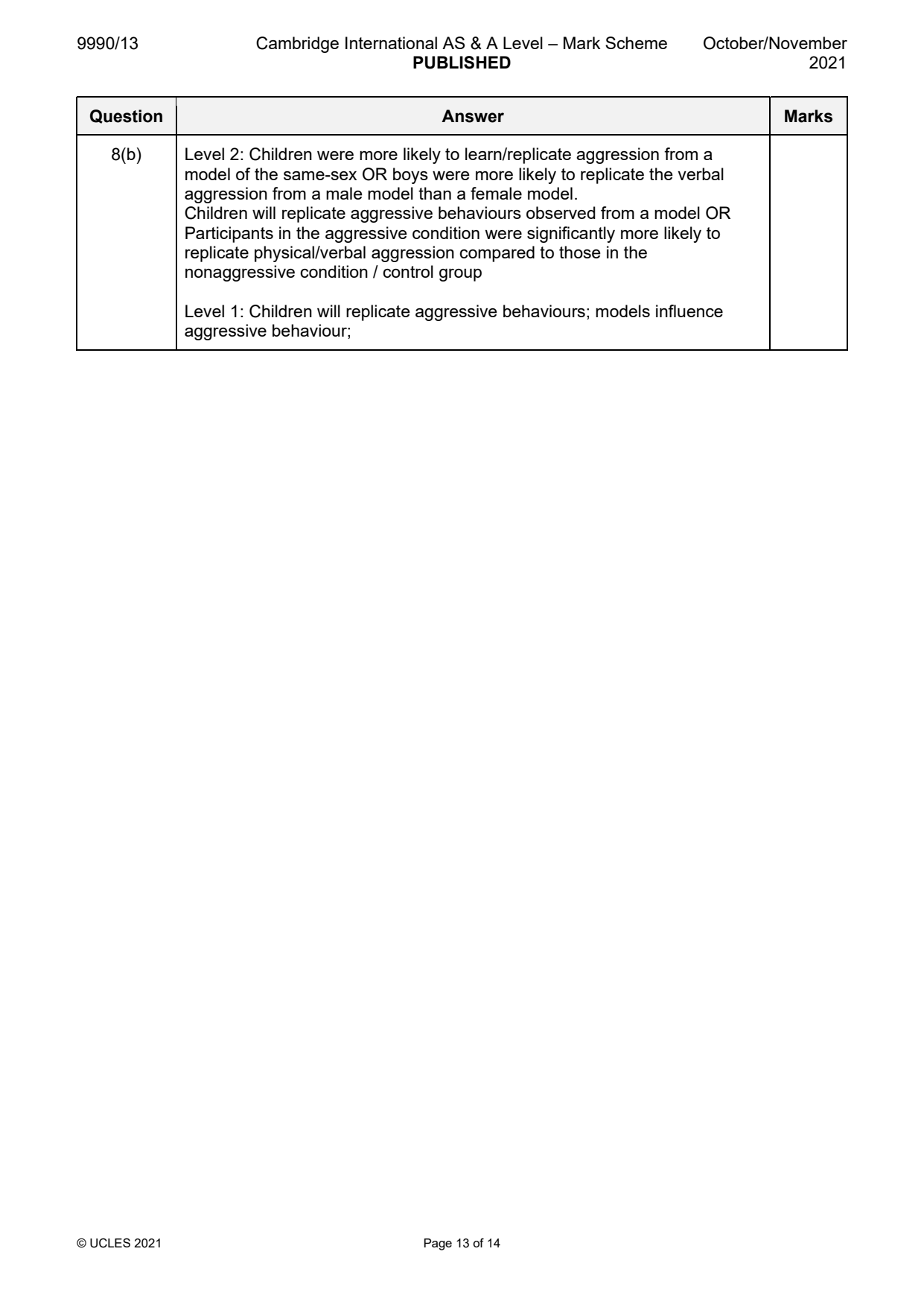
8(b) Level 2: Children were more likely to learn/replicate aggression from a
model of the same-sex OR boys were more likely to replicate the verbal
aggression from a male model than a female model.
Children will replicate aggressive behaviours observed from a model OR
Participants in the aggressive condition were significantly more likely to
replicate physical/verbal aggression compared to those in the
nonaggressive condition / control group
Level 1: Children will replicate aggressive behaviours; models influence
aggressive behaviour;
© UCLES 2021 Page 13 of 14
Official mark scheme pages: 11, 12, 13 · source PDF URL
9990-2022-mj-11-q01
May/June 2022 · Paper 11 · Question 1 · 4 marks
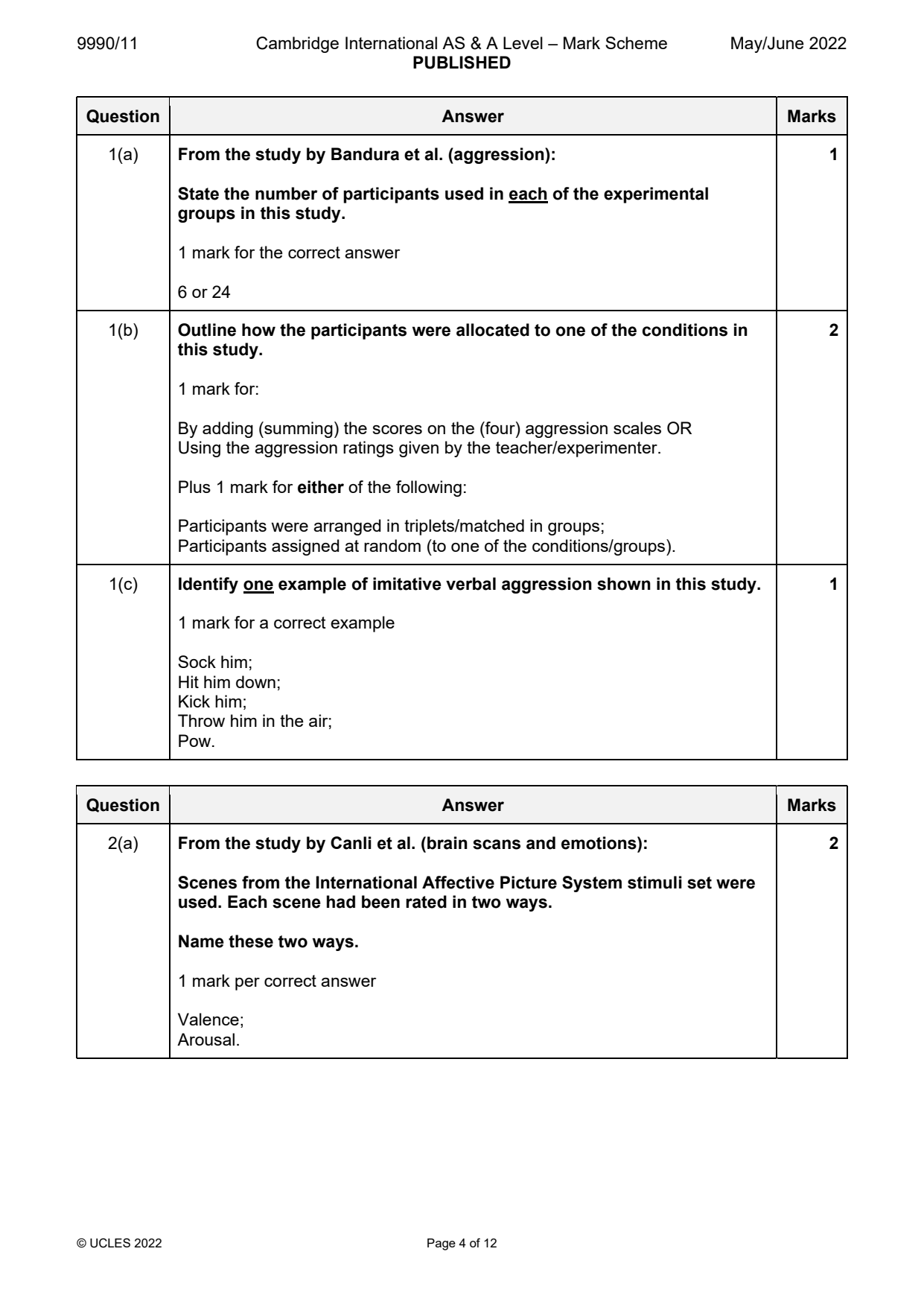
1(a) From the study by Bandura et al. (aggression): 1
State the number of participants used in each of the experimental
groups in this study.
1 mark for the correct answer
6 or 24
1(b) Outline how the participants were allocated to one of the conditions in 2
this study.
1 mark for:
By adding (summing) the scores on the (four) aggression scales OR
Using the aggression ratings given by the teacher/experimenter.
Plus 1 mark for either of the following:
Participants were arranged in triplets/matched in groups;
Participants assigned at random (to one of the conditions/groups).
1(c) Identify one example of imitative verbal aggression shown in this study. 1
1 mark for a correct example
Sock him;
Hit him down;
Kick him;
Throw him in the air;
Pow.
Question Answer Marks
Official mark scheme pages: 4 · source PDF URL
9990-2022-mj-11-q06
May/June 2022 · Paper 11 · Question 6 · 4 marks
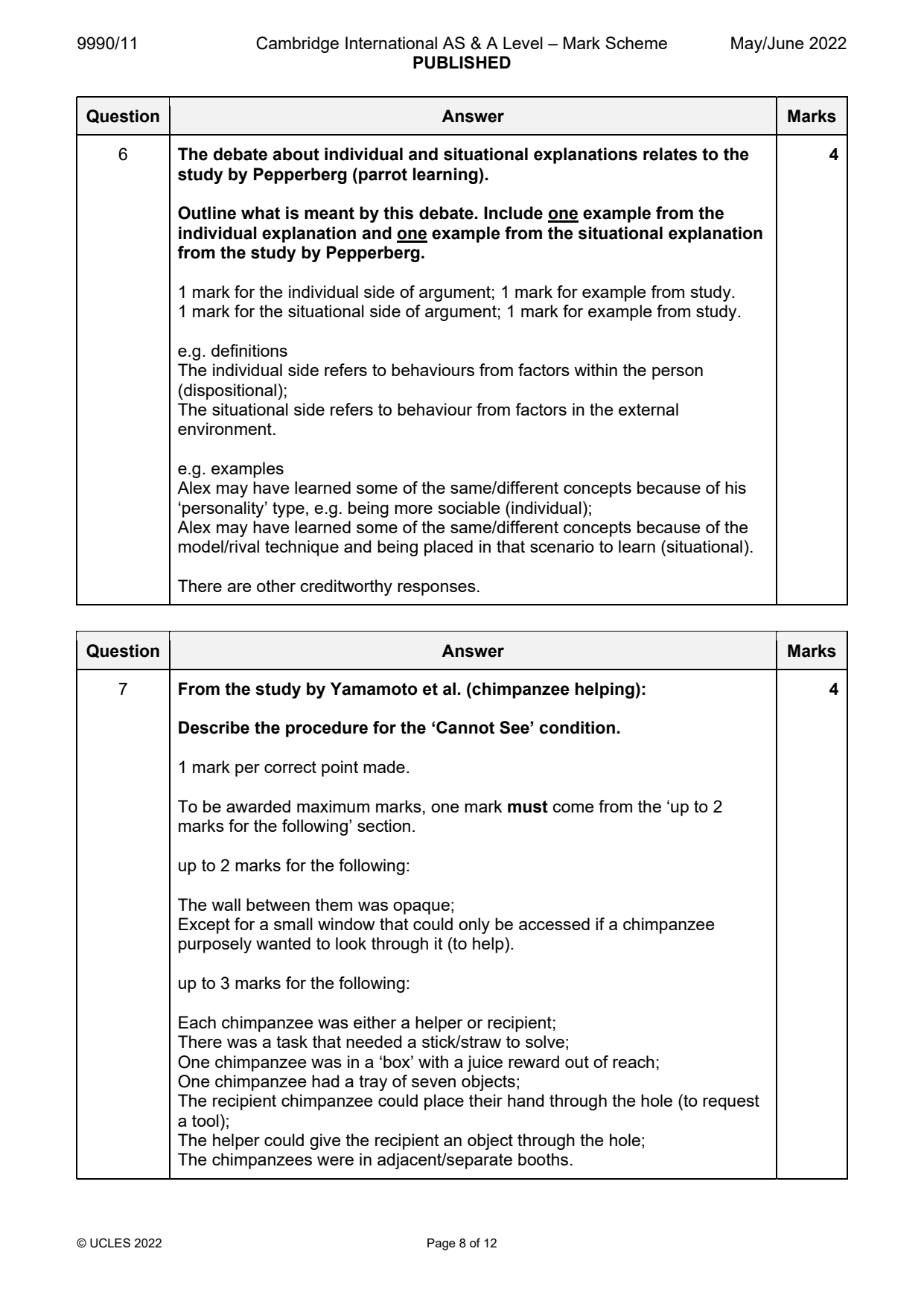
6 The debate about individual and situational explanations relates to the 4
study by Pepperberg (parrot learning).
Outline what is meant by this debate. Include one example from the
individual explanation and one example from the situational explanation
from the study by Pepperberg.
1 mark for the individual side of argument; 1 mark for example from study.
1 mark for the situational side of argument; 1 mark for example from study.
e.g. definitions
The individual side refers to behaviours from factors within the person
(dispositional);
The situational side refers to behaviour from factors in the external
environment.
e.g. examples
Alex may have learned some of the same/different concepts because of his
‘personality’ type, e.g. being more sociable (individual);
Alex may have learned some of the same/different concepts because of the
model/rival technique and being placed in that scenario to learn (situational).
There are other creditworthy responses.
Question Answer Marks
Official mark scheme pages: 8 · source PDF URL
9990-2022-mj-11-q09
May/June 2022 · Paper 11 · Question 9 · 12 marks
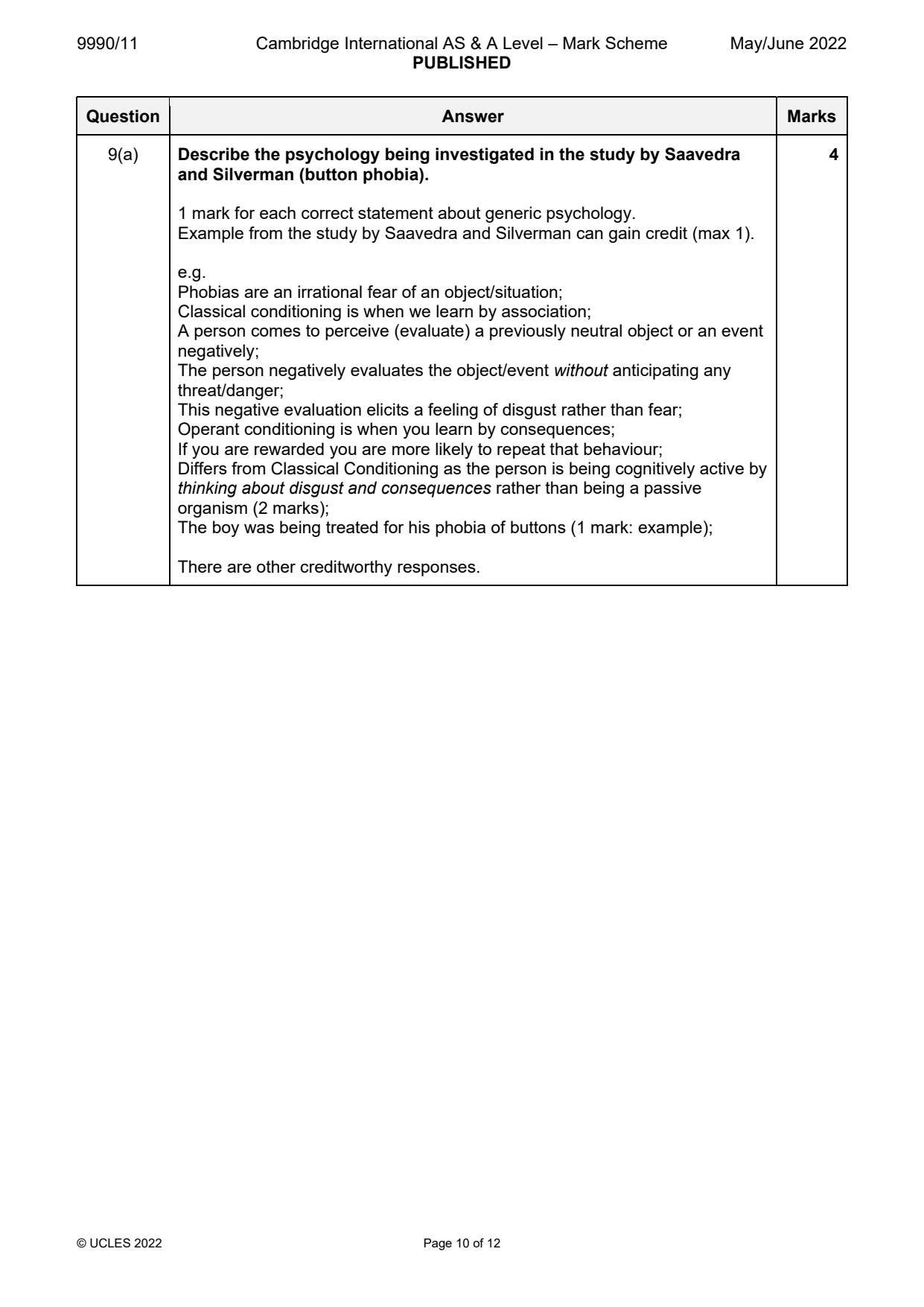
9(a) Describe the psychology being investigated in the study by Saavedra 4
and Silverman (button phobia).
1 mark for each correct statement about generic psychology.
Example from the study by Saavedra and Silverman can gain credit (max 1).
e.g.
Phobias are an irrational fear of an object/situation;
Classical conditioning is when we learn by association;
A person comes to perceive (evaluate) a previously neutral object or an event
negatively;
The person negatively evaluates the object/event without anticipating any
threat/danger;
This negative evaluation elicits a feeling of disgust rather than fear;
Operant conditioning is when you learn by consequences;
If you are rewarded you are more likely to repeat that behaviour;
Differs from Classical Conditioning as the person is being cognitively active by
thinking about disgust and consequences rather than being a passive
organism (2 marks);
The boy was being treated for his phobia of buttons (1 mark: example);
There are other creditworthy responses.
© UCLES 2022 Page 10 of 12
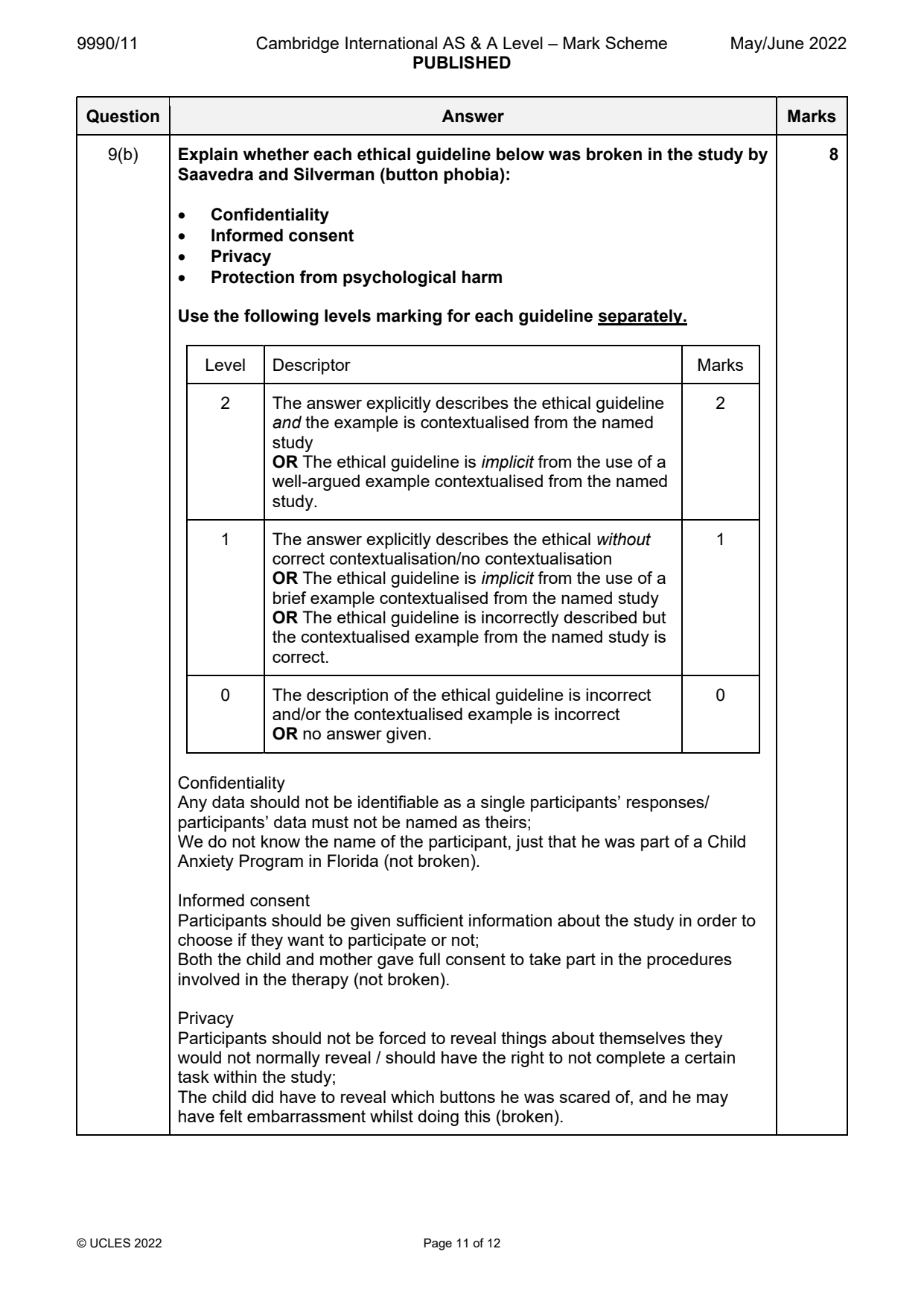
9(b) Explain whether each ethical guideline below was broken in the study by 8
Saavedra and Silverman (button phobia):
Confidentiality
Informed consent
Privacy
Protection from psychological harm
Use the following levels marking for each guideline separately.
Level Descriptor Marks
2 The answer explicitly describes the ethical guideline 2
and the example is contextualised from the named
study
OR The ethical guideline is implicit from the use of a
well-argued example contextualised from the named
study.
1 The answer explicitly describes the ethical without 1
correct contextualisation/no contextualisation
OR The ethical guideline is implicit from the use of a
brief example contextualised from the named study
OR The ethical guideline is incorrectly described but
the contextualised example from the named study is
correct.
0 The description of the ethical guideline is incorrect 0
and/or the contextualised example is incorrect
OR no answer given.
Confidentiality
Any data should not be identifiable as a single participants’ responses/
participants’ data must not be named as theirs;
We do not know the name of the participant, just that he was part of a Child
Anxiety Program in Florida (not broken).
Informed consent
Participants should be given sufficient information about the study in order to
choose if they want to participate or not;
Both the child and mother gave full consent to take part in the procedures
involved in the therapy (not broken).
Privacy
Participants should not be forced to reveal things about themselves they
would not normally reveal / should have the right to not complete a certain
task within the study;
The child did have to reveal which buttons he was scared of, and he may
have felt embarrassment whilst doing this (broken).
© UCLES 2022 Page 11 of 12
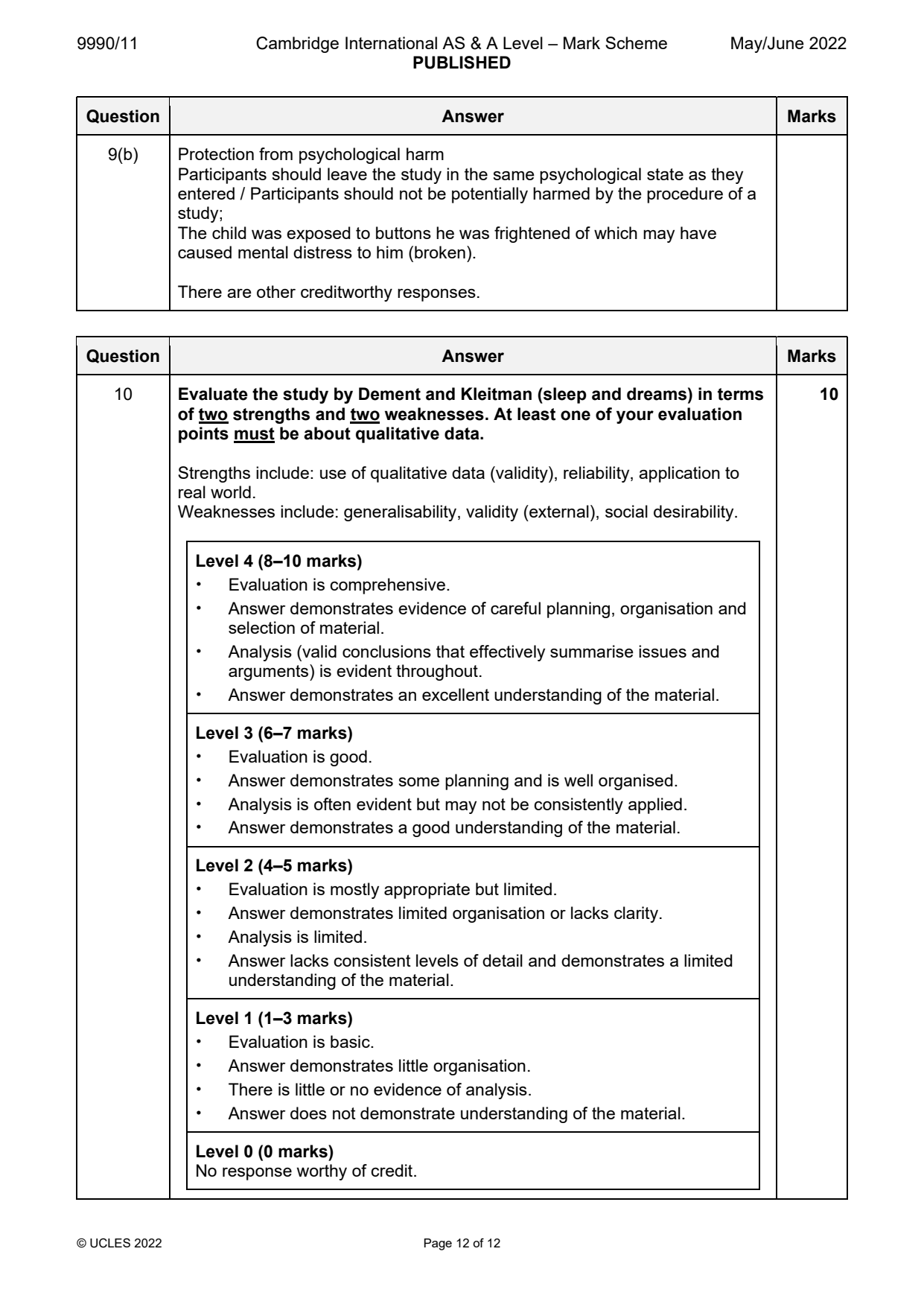
9(b) Protection from psychological harm
Participants should leave the study in the same psychological state as they
entered / Participants should not be potentially harmed by the procedure of a
study;
The child was exposed to buttons he was frightened of which may have
caused mental distress to him (broken).
There are other creditworthy responses.
Question Answer Marks
Official mark scheme pages: 10, 11, 12 · source PDF URL
9990-2022-mj-12-q02
May/June 2022 · Paper 12 · Question 2 · 4 marks
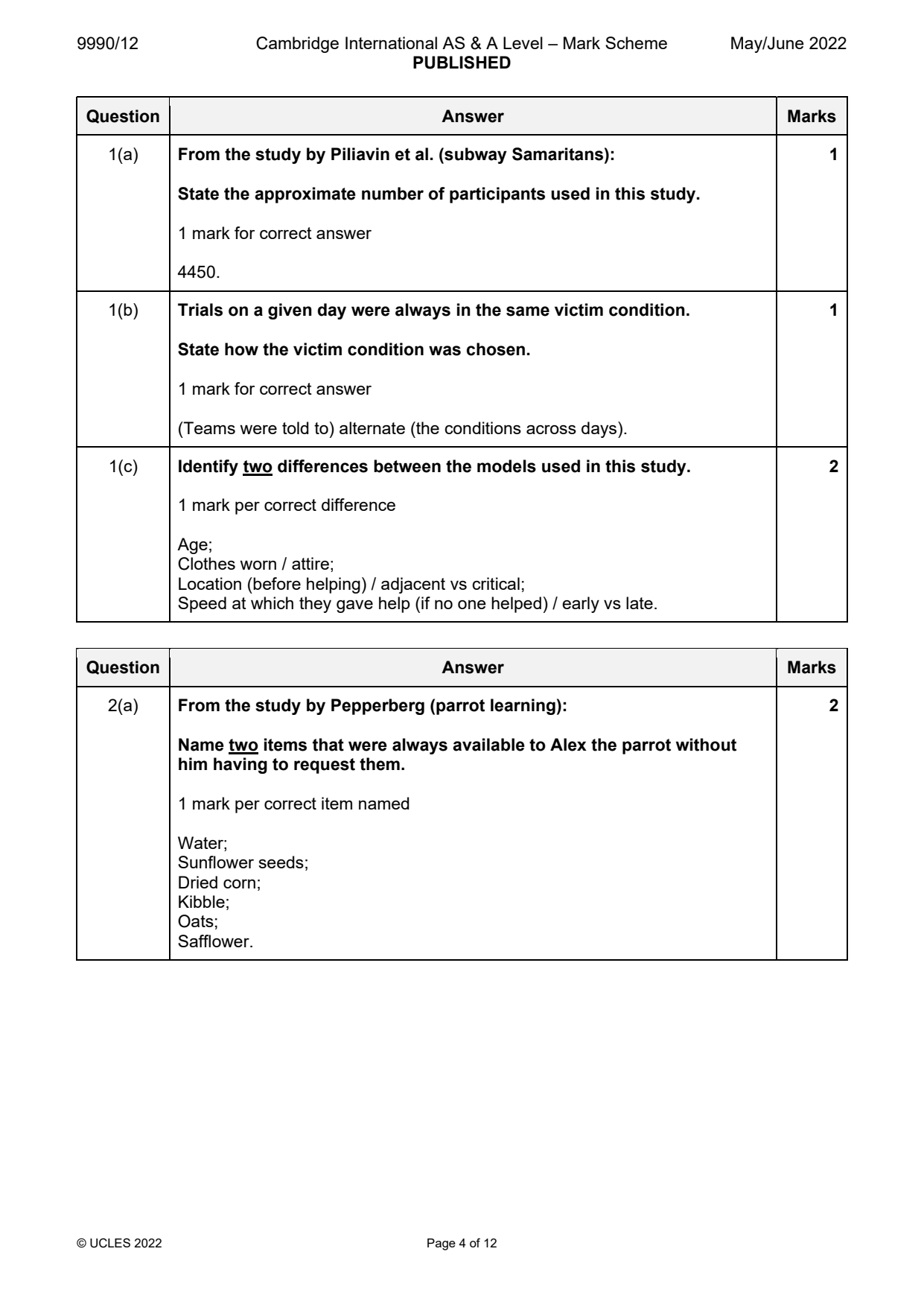
2(a) From the study by Pepperberg (parrot learning): 2
Name two items that were always available to Alex the parrot without
him having to request them.
1 mark per correct item named
Water;
Sunflower seeds;
Dried corn;
Kibble;
Oats;
Safflower.
© UCLES 2022 Page 4 of 12
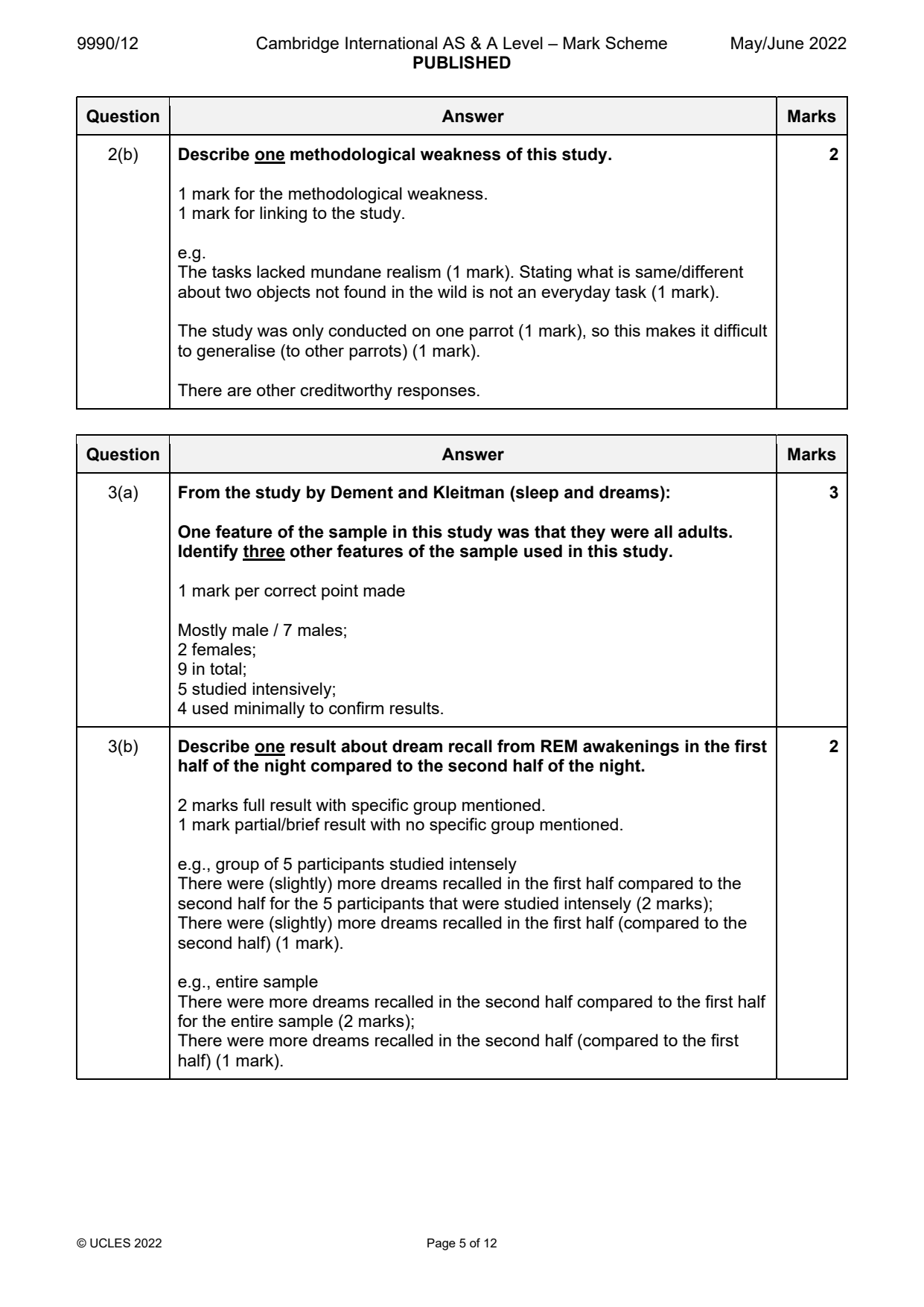
2(b) Describe one methodological weakness of this study. 2
1 mark for the methodological weakness.
1 mark for linking to the study.
e.g.
The tasks lacked mundane realism (1 mark). Stating what is same/different
about two objects not found in the wild is not an everyday task (1 mark).
The study was only conducted on one parrot (1 mark), so this makes it difficult
to generalise (to other parrots) (1 mark).
There are other creditworthy responses.
Question Answer Marks
Official mark scheme pages: 4, 5 · source PDF URL
9990-2022-mj-12-q06
May/June 2022 · Paper 12 · Question 6 · 4 marks
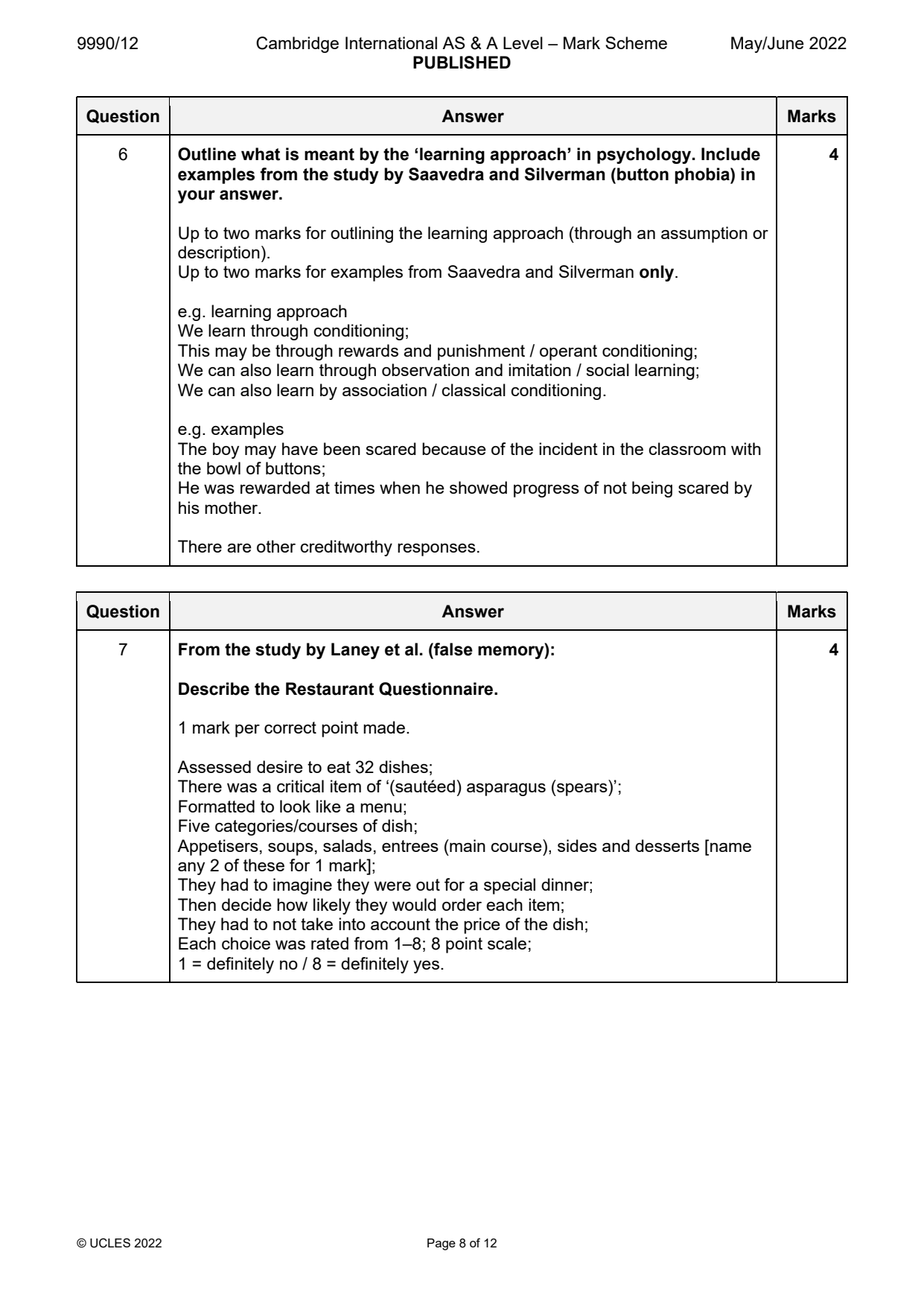
6 Outline what is meant by the ‘learning approach’ in psychology. Include 4
examples from the study by Saavedra and Silverman (button phobia) in
your answer.
Up to two marks for outlining the learning approach (through an assumption or
description).
Up to two marks for examples from Saavedra and Silverman only.
e.g. learning approach
We learn through conditioning;
This may be through rewards and punishment / operant conditioning;
We can also learn through observation and imitation / social learning;
We can also learn by association / classical conditioning.
e.g. examples
The boy may have been scared because of the incident in the classroom with
the bowl of buttons;
He was rewarded at times when he showed progress of not being scared by
his mother.
There are other creditworthy responses.
Question Answer Marks
Official mark scheme pages: 8 · source PDF URL
9990-2022-mj-12-q09
May/June 2022 · Paper 12 · Question 9 · 12 marks
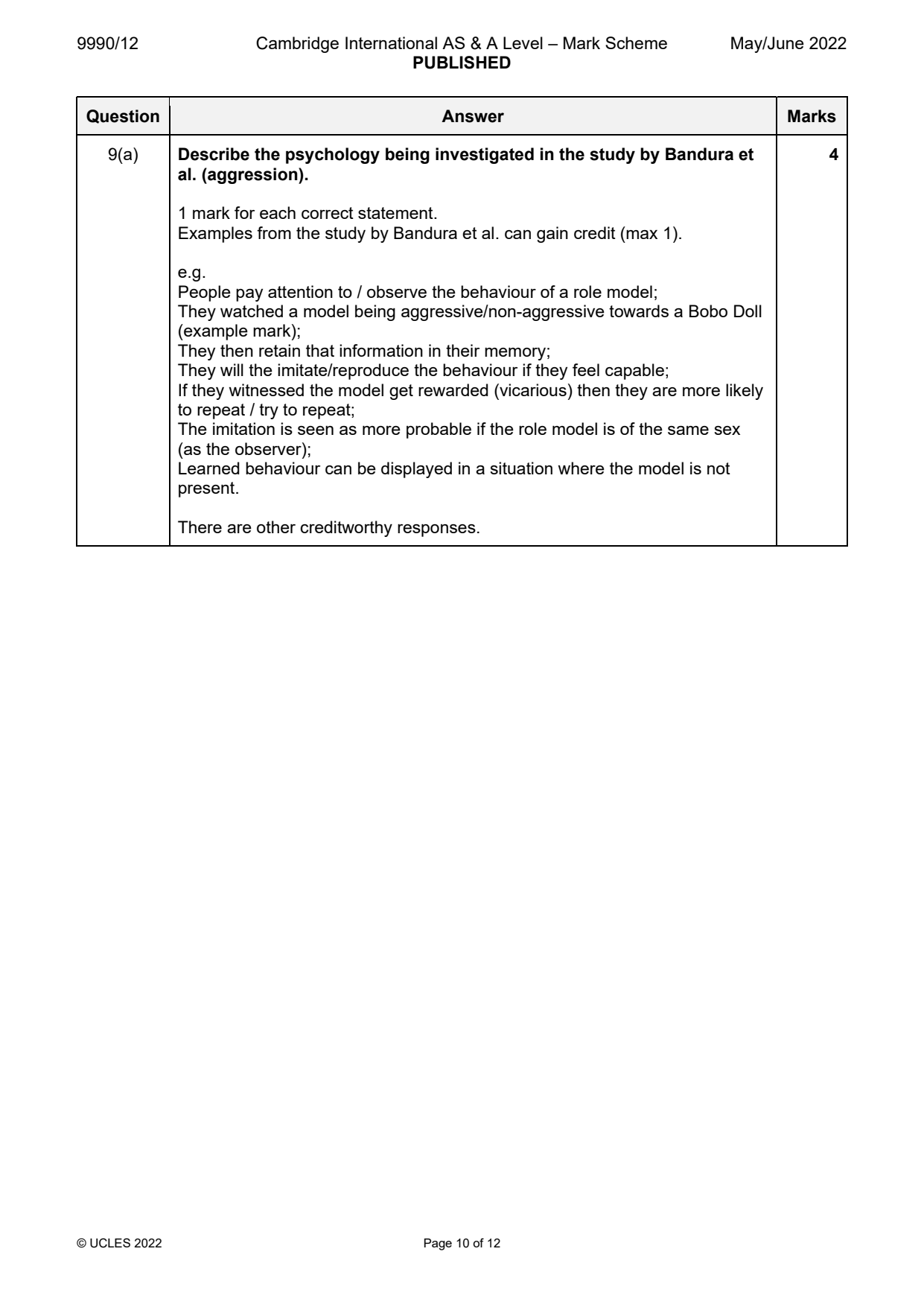
9(a) Describe the psychology being investigated in the study by Bandura et 4
al. (aggression).
1 mark for each correct statement.
Examples from the study by Bandura et al. can gain credit (max 1).
e.g.
People pay attention to / observe the behaviour of a role model;
They watched a model being aggressive/non-aggressive towards a Bobo Doll
(example mark);
They then retain that information in their memory;
They will the imitate/reproduce the behaviour if they feel capable;
If they witnessed the model get rewarded (vicarious) then they are more likely
to repeat / try to repeat;
The imitation is seen as more probable if the role model is of the same sex
(as the observer);
Learned behaviour can be displayed in a situation where the model is not
present.
There are other creditworthy responses.
© UCLES 2022 Page 10 of 12
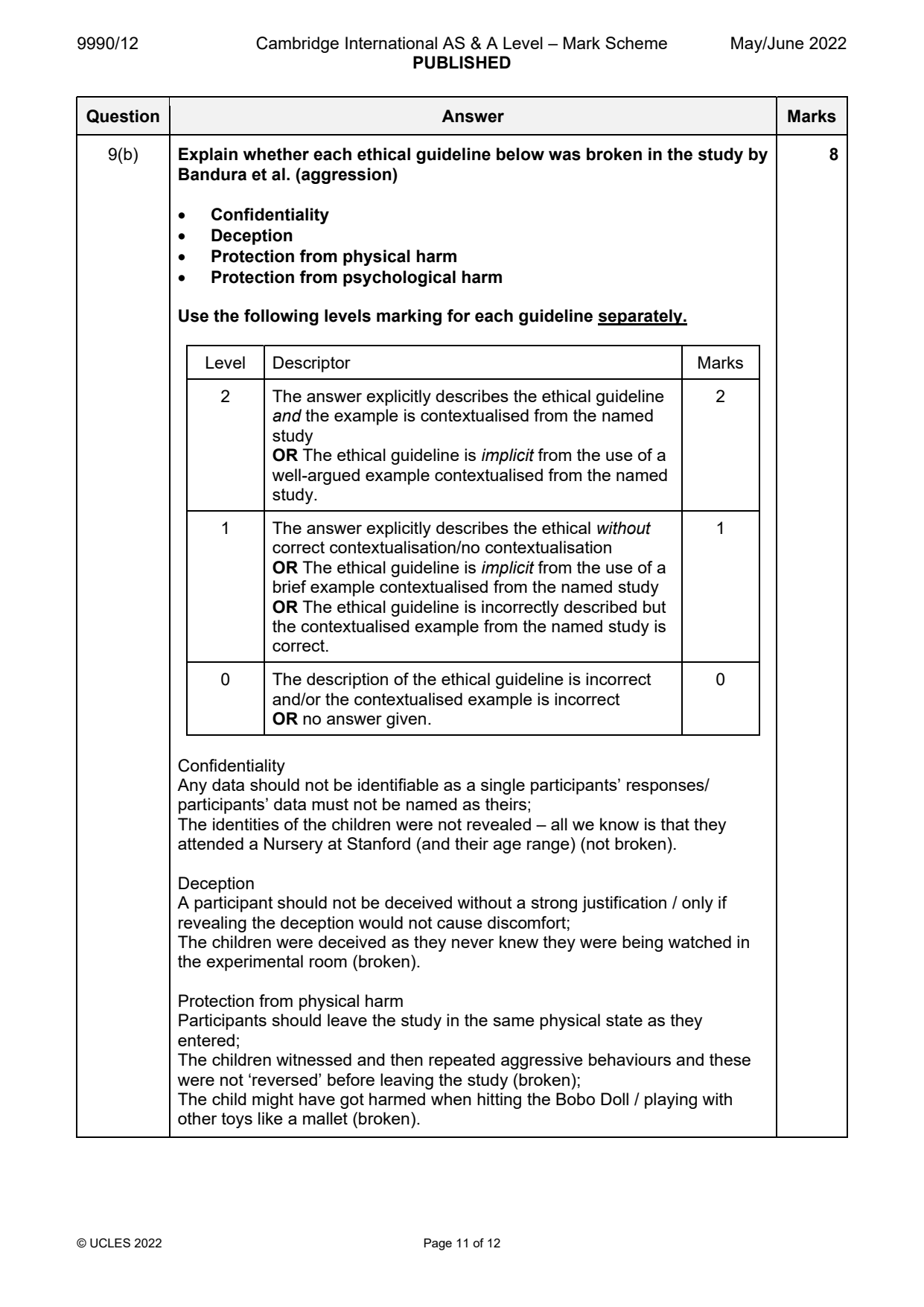
9(b) Explain whether each ethical guideline below was broken in the study by 8
Bandura et al. (aggression)
Confidentiality
Deception
Protection from physical harm
Protection from psychological harm
Use the following levels marking for each guideline separately.
Level Descriptor Marks
2 The answer explicitly describes the ethical guideline 2
and the example is contextualised from the named
study
OR The ethical guideline is implicit from the use of a
well-argued example contextualised from the named
study.
1 The answer explicitly describes the ethical without 1
correct contextualisation/no contextualisation
OR The ethical guideline is implicit from the use of a
brief example contextualised from the named study
OR The ethical guideline is incorrectly described but
the contextualised example from the named study is
correct.
0 The description of the ethical guideline is incorrect 0
and/or the contextualised example is incorrect
OR no answer given.
Confidentiality
Any data should not be identifiable as a single participants’ responses/
participants’ data must not be named as theirs;
The identities of the children were not revealed – all we know is that they
attended a Nursery at Stanford (and their age range) (not broken).
Deception
A participant should not be deceived without a strong justification / only if
revealing the deception would not cause discomfort;
The children were deceived as they never knew they were being watched in
the experimental room (broken).
Protection from physical harm
Participants should leave the study in the same physical state as they
entered;
The children witnessed and then repeated aggressive behaviours and these
were not ‘reversed’ before leaving the study (broken);
The child might have got harmed when hitting the Bobo Doll / playing with
other toys like a mallet (broken).
© UCLES 2022 Page 11 of 12
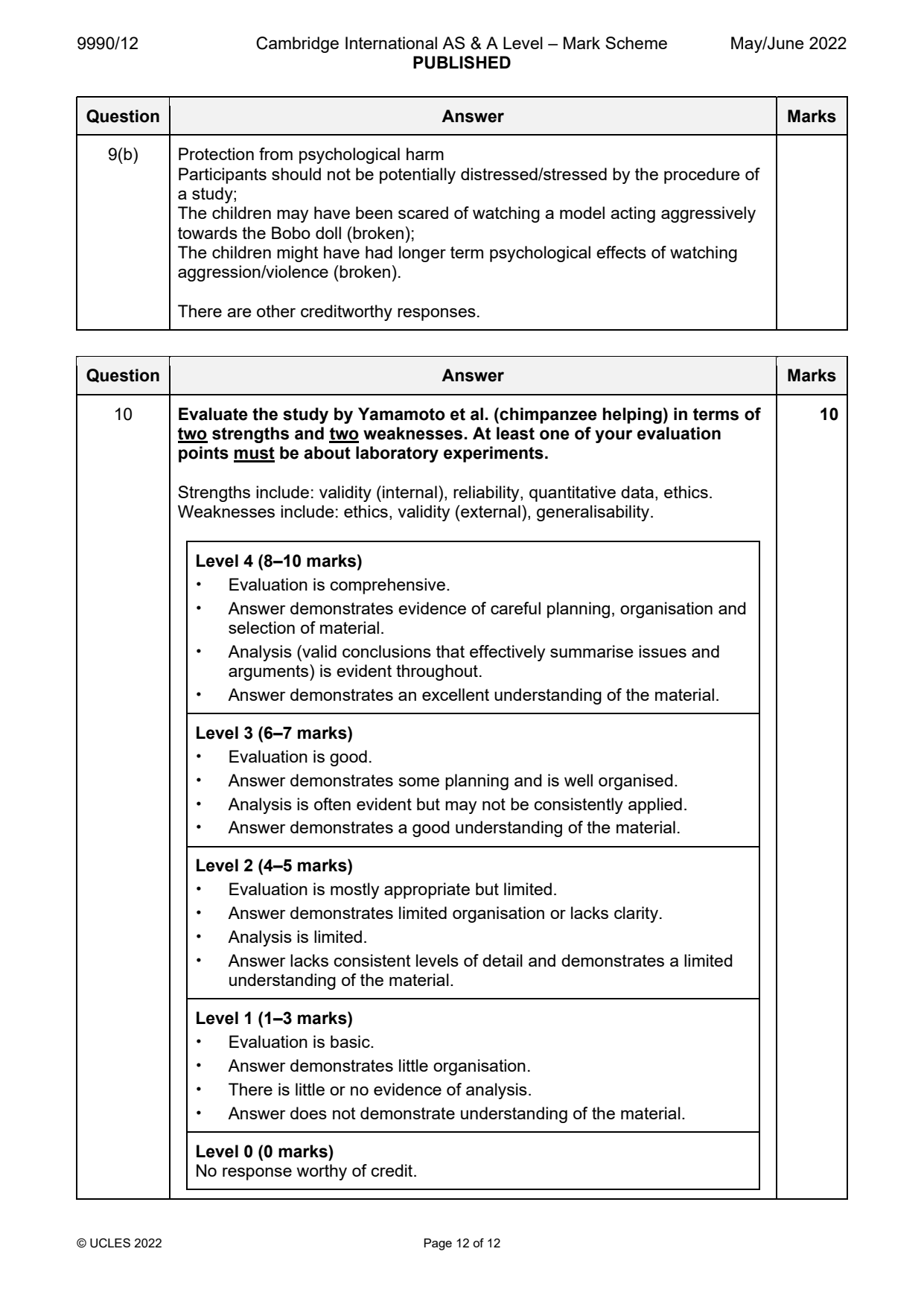
9(b) Protection from psychological harm
Participants should not be potentially distressed/stressed by the procedure of
a study;
The children may have been scared of watching a model acting aggressively
towards the Bobo doll (broken);
The children might have had longer term psychological effects of watching
aggression/violence (broken).
There are other creditworthy responses.
Question Answer Marks
Official mark scheme pages: 10, 11, 12 · source PDF URL
9990-2022-mj-13-q05
May/June 2022 · Paper 13 · Question 5 · 5 marks
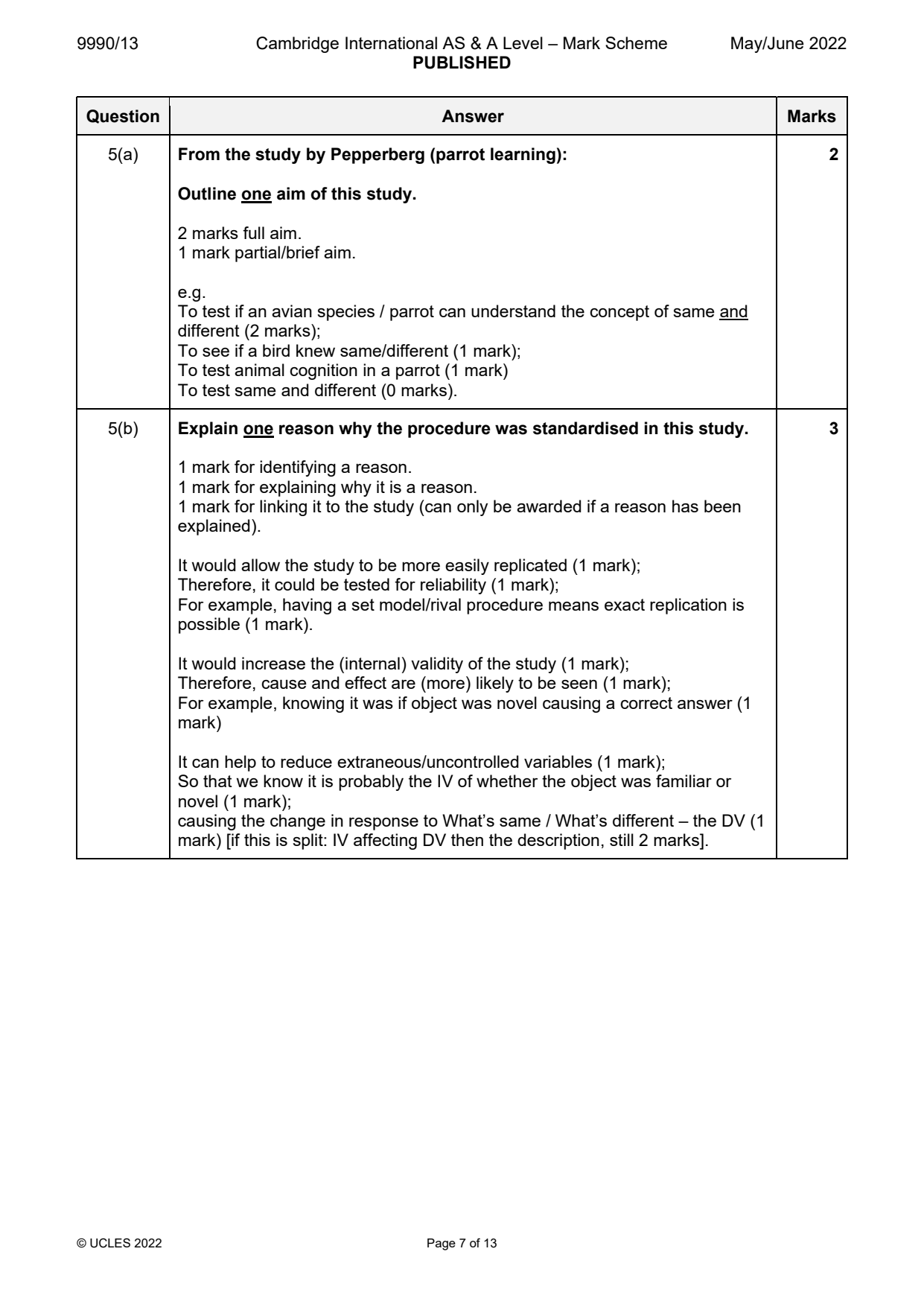
5(a) From the study by Pepperberg (parrot learning): 2
Outline one aim of this study.
2 marks full aim.
1 mark partial/brief aim.
e.g.
To test if an avian species / parrot can understand the concept of same and
different (2 marks);
To see if a bird knew same/different (1 mark);
To test animal cognition in a parrot (1 mark)
To test same and different (0 marks).
5(b) Explain one reason why the procedure was standardised in this study. 3
1 mark for identifying a reason.
1 mark for explaining why it is a reason.
1 mark for linking it to the study (can only be awarded if a reason has been
explained).
It would allow the study to be more easily replicated (1 mark);
Therefore, it could be tested for reliability (1 mark);
For example, having a set model/rival procedure means exact replication is
possible (1 mark).
It would increase the (internal) validity of the study (1 mark);
Therefore, cause and effect are (more) likely to be seen (1 mark);
For example, knowing it was if object was novel causing a correct answer (1
mark)
It can help to reduce extraneous/uncontrolled variables (1 mark);
So that we know it is probably the IV of whether the object was familiar or
novel (1 mark);
causing the change in response to What’s same / What’s different – the DV (1
mark) [if this is split: IV affecting DV then the description, still 2 marks].
© UCLES 2022 Page 7 of 13
Official mark scheme pages: 7 · source PDF URL
9990-2022-mj-13-q08
May/June 2022 · Paper 13 · Question 8 · 6 marks
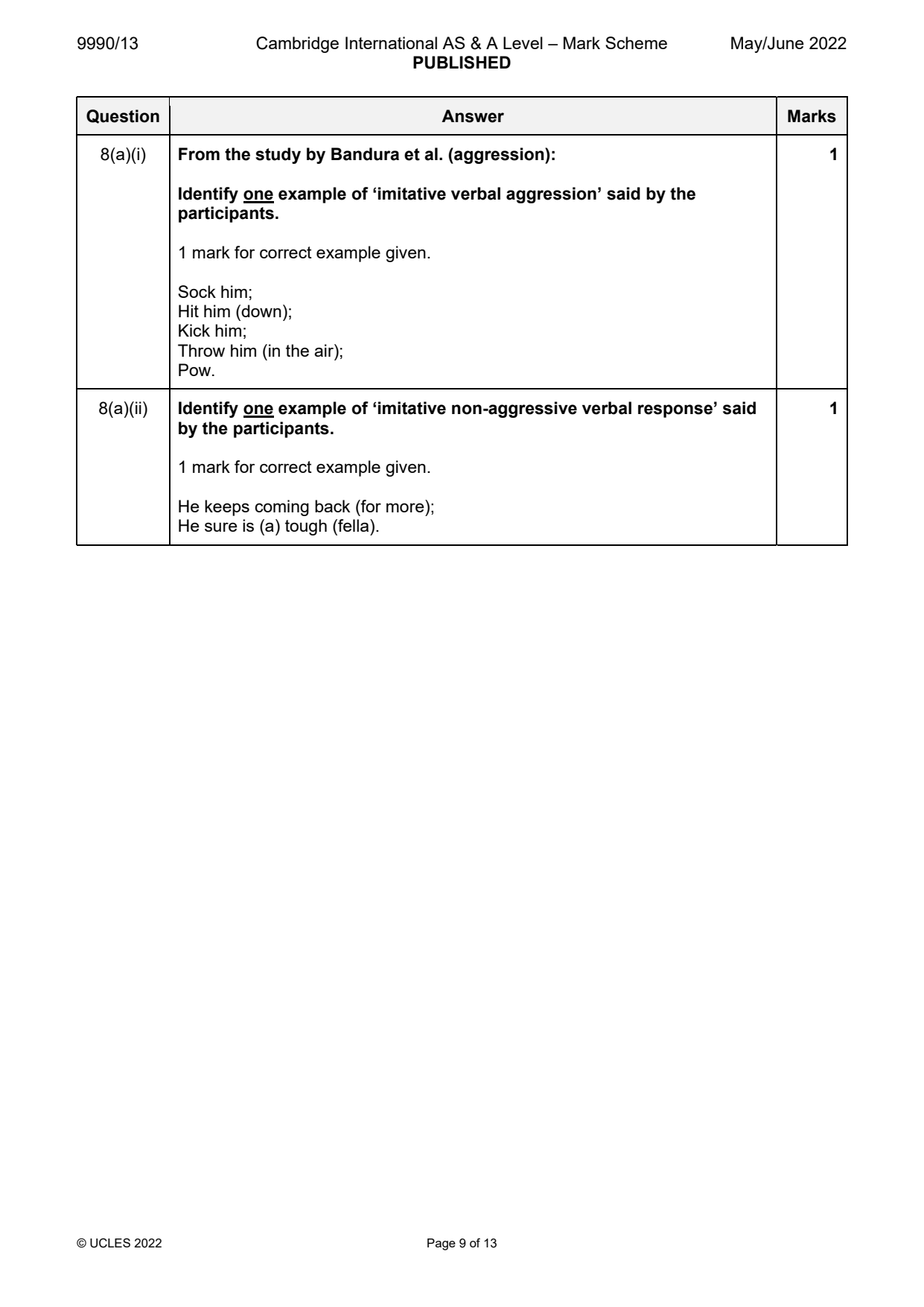
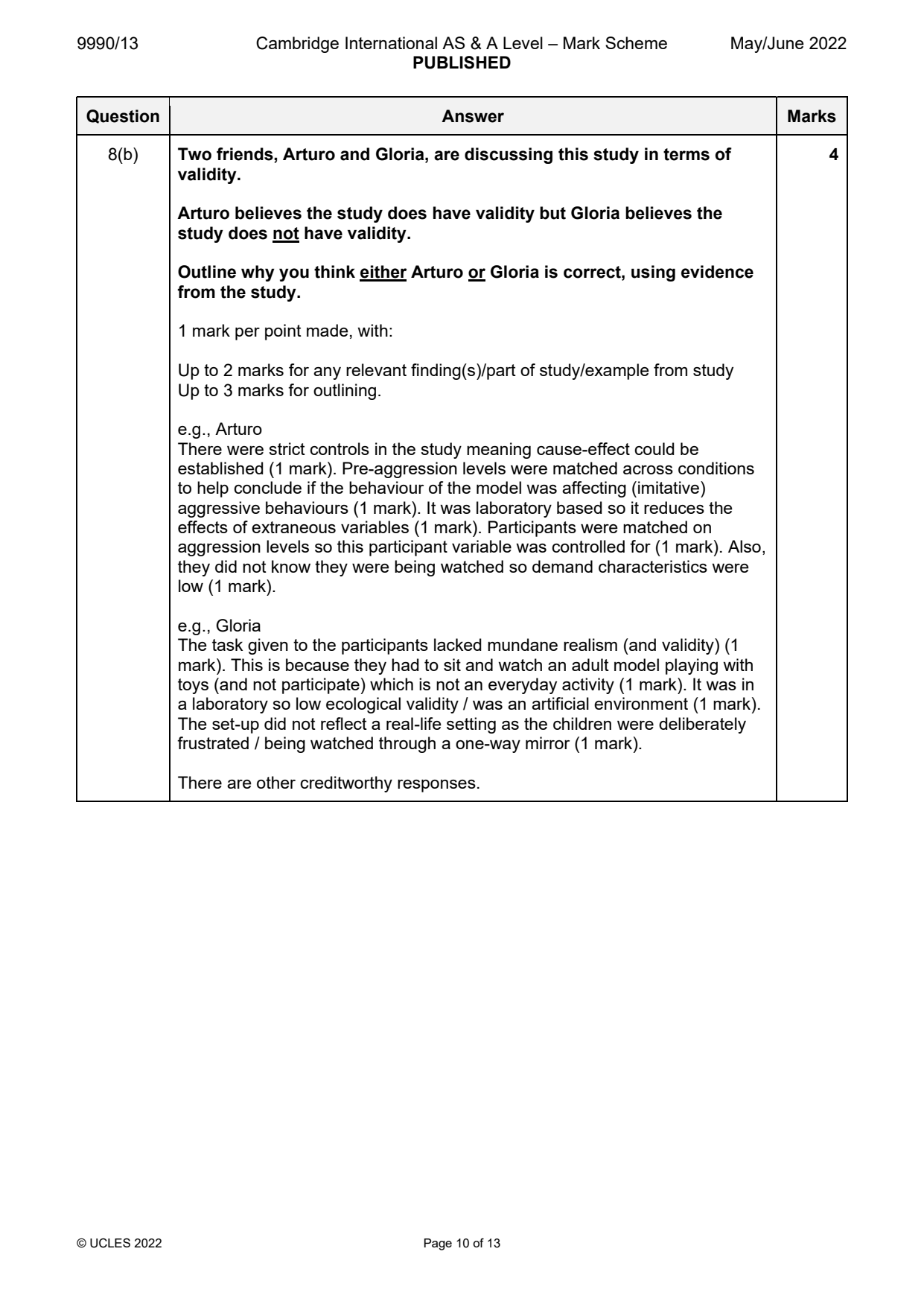
8(a)(i) From the study by Bandura et al. (aggression): 1
Identify one example of ‘imitative verbal aggression’ said by the
participants.
1 mark for correct example given.
Sock him;
Hit him (down);
Kick him;
Throw him (in the air);
Pow.
8(a)(ii) Identify one example of ‘imitative non-aggressive verbal response’ said 1
by the participants.
1 mark for correct example given.
He keeps coming back (for more);
He sure is (a) tough (fella).
© UCLES 2022 Page 9 of 13
8(b) Two friends, Arturo and Gloria, are discussing this study in terms of 4
validity.
Arturo believes the study does have validity but Gloria believes the
study does not have validity.
Outline why you think either Arturo or Gloria is correct, using evidence
from the study.
1 mark per point made, with:
Up to 2 marks for any relevant finding(s)/part of study/example from study
Up to 3 marks for outlining.
e.g., Arturo
There were strict controls in the study meaning cause-effect could be
established (1 mark). Pre-aggression levels were matched across conditions
to help conclude if the behaviour of the model was affecting (imitative)
aggressive behaviours (1 mark). It was laboratory based so it reduces the
effects of extraneous variables (1 mark). Participants were matched on
aggression levels so this participant variable was controlled for (1 mark). Also,
they did not know they were being watched so demand characteristics were
low (1 mark).
e.g., Gloria
The task given to the participants lacked mundane realism (and validity) (1
mark). This is because they had to sit and watch an adult model playing with
toys (and not participate) which is not an everyday activity (1 mark). It was in
a laboratory so low ecological validity / was an artificial environment (1 mark).
The set-up did not reflect a real-life setting as the children were deliberately
frustrated / being watched through a one-way mirror (1 mark).
There are other creditworthy responses.
© UCLES 2022 Page 10 of 13
Official mark scheme pages: 9, 10 · source PDF URL
9990-2022-on-11-q02
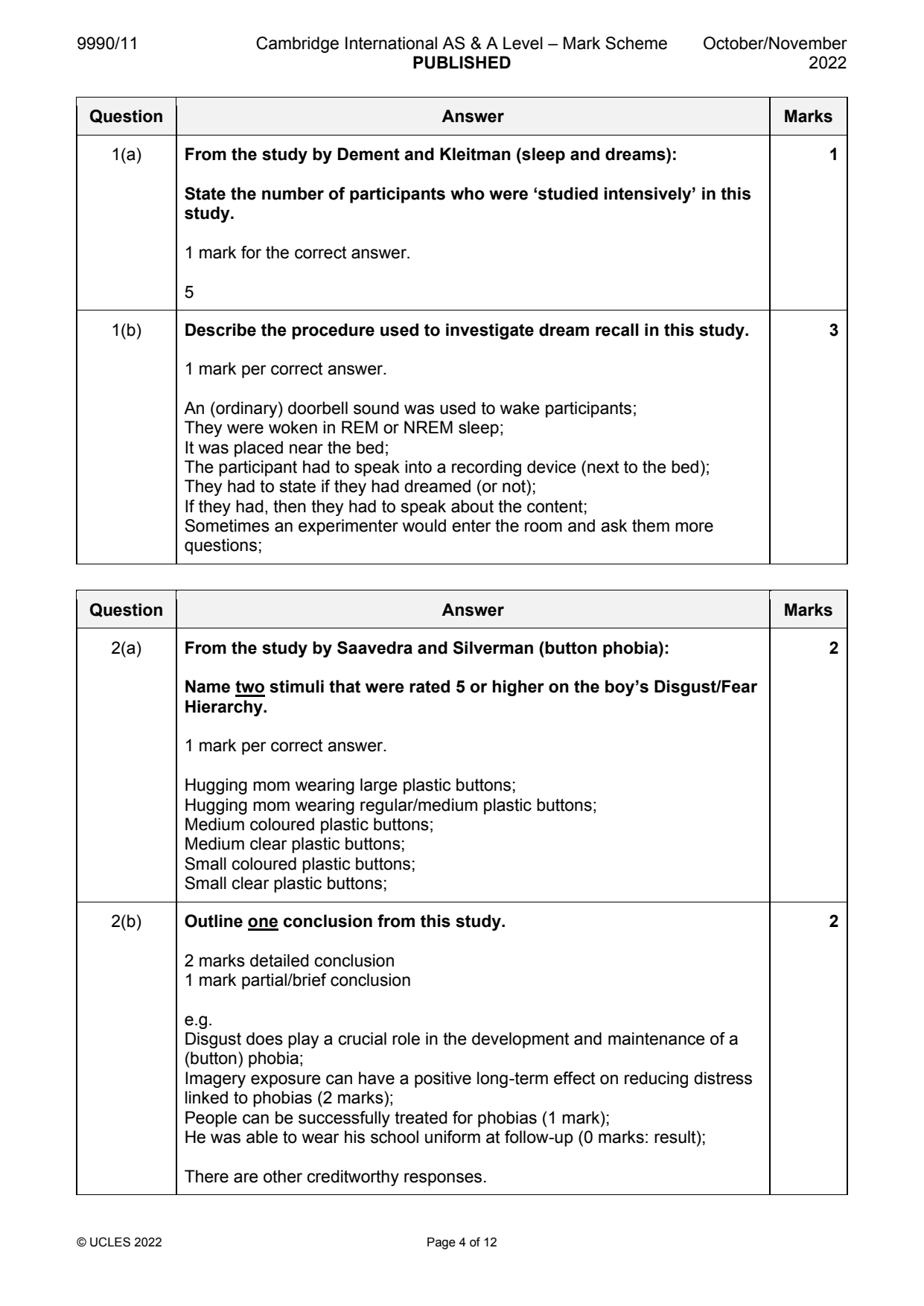
Oct/Nov 2022 · Paper 11 · Question 2 · 4 marks
2(a) From the study by Saavedra and Silverman (button phobia): 2
Name two stimuli that were rated 5 or higher on the boy’s Disgust/Fear
Hierarchy.
1 mark per correct answer.
Hugging mom wearing large plastic buttons;
Hugging mom wearing regular/medium plastic buttons;
Medium coloured plastic buttons;
Medium clear plastic buttons;
Small coloured plastic buttons;
Small clear plastic buttons;
2(b) Outline one conclusion from this study. 2
2 marks detailed conclusion
1 mark partial/brief conclusion
e.g.
Disgust does play a crucial role in the development and maintenance of a
(button) phobia;
Imagery exposure can have a positive long-term effect on reducing distress
linked to phobias (2 marks);
People can be successfully treated for phobias (1 mark);
He was able to wear his school uniform at follow-up (0 marks: result);
There are other creditworthy responses.
© UCLES 2022 Page 4 of 12
Official mark scheme pages: 4 · source PDF URL
9990-2022-on-11-q08
Oct/Nov 2022 · Paper 11 · Question 8 · 6 marks
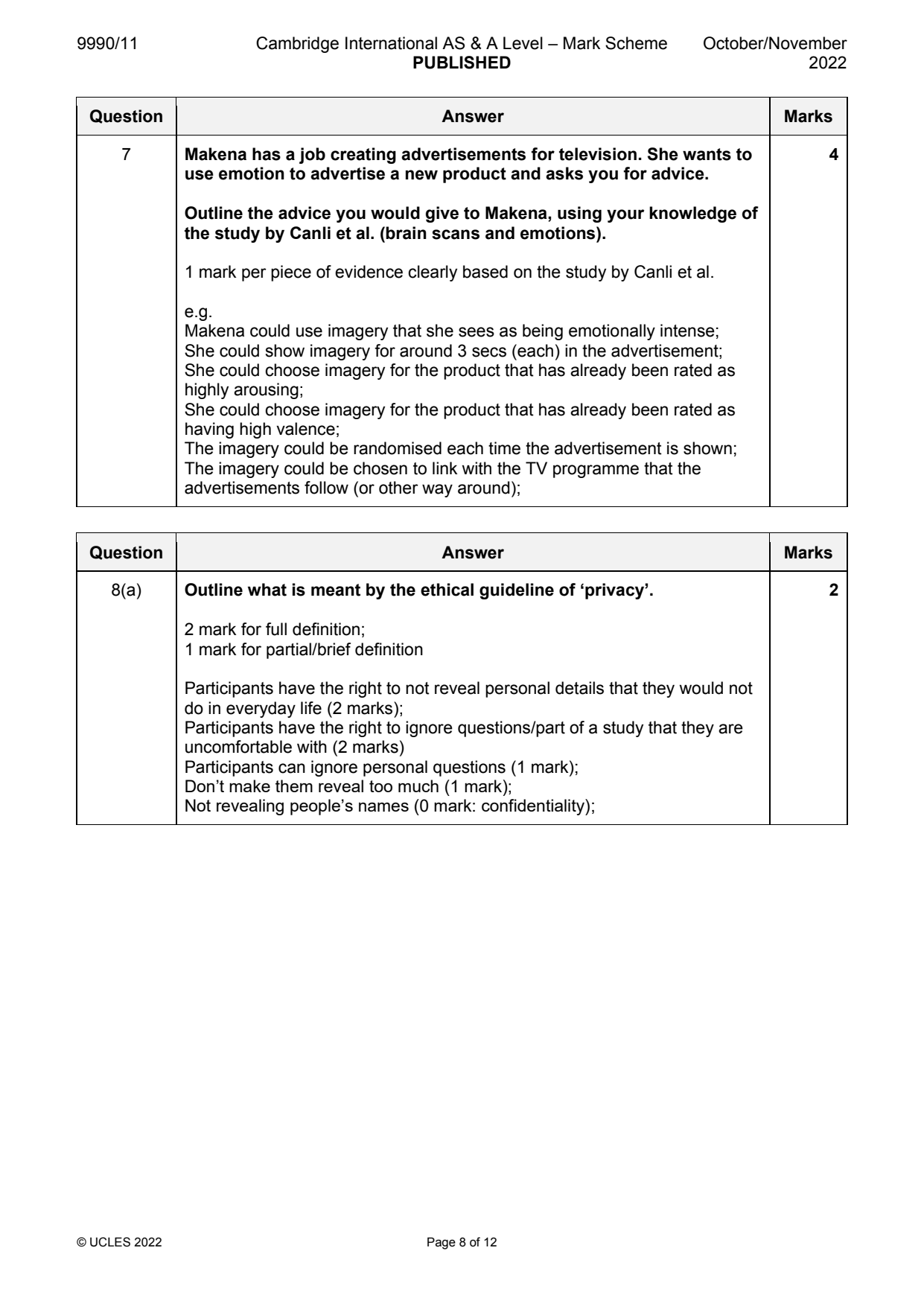
8(a) Outline what is meant by the ethical guideline of ‘privacy’. 2
2 mark for full definition;
1 mark for partial/brief definition
Participants have the right to not reveal personal details that they would not
do in everyday life (2 marks);
Participants have the right to ignore questions/part of a study that they are
uncomfortable with (2 marks)
Participants can ignore personal questions (1 mark);
Don’t make them reveal too much (1 mark);
Not revealing people’s names (0 mark: confidentiality);
© UCLES 2022 Page 8 of 12
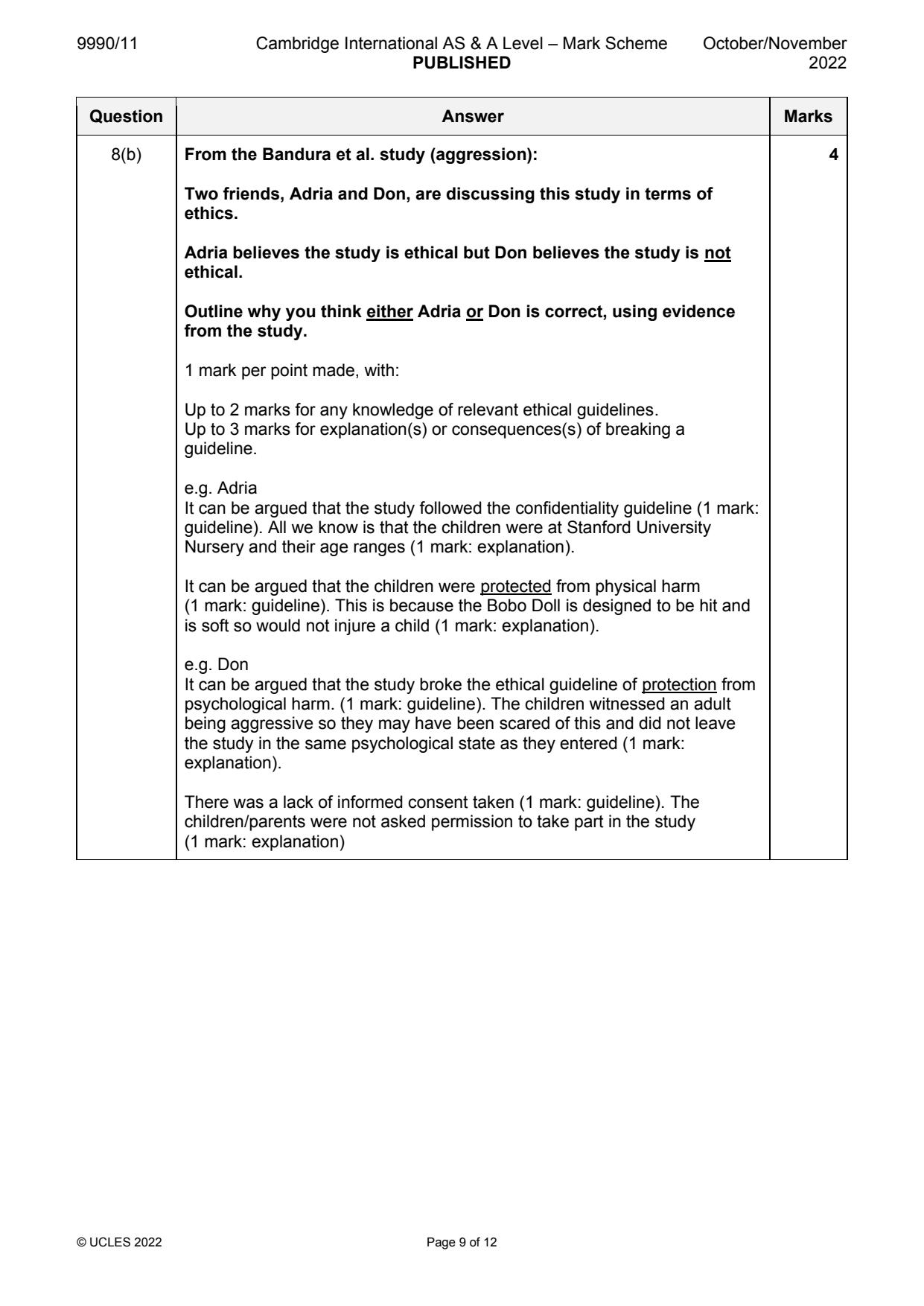
8(b) From the Bandura et al. study (aggression): 4
Two friends, Adria and Don, are discussing this study in terms of
ethics.
Adria believes the study is ethical but Don believes the study is not
ethical.
Outline why you think either Adria or Don is correct, using evidence
from the study.
1 mark per point made, with:
Up to 2 marks for any knowledge of relevant ethical guidelines.
Up to 3 marks for explanation(s) or consequences(s) of breaking a
guideline.
e.g. Adria
It can be argued that the study followed the confidentiality guideline (1 mark:
guideline). All we know is that the children were at Stanford University
Nursery and their age ranges (1 mark: explanation).
It can be argued that the children were protected from physical harm
(1 mark: guideline). This is because the Bobo Doll is designed to be hit and
is soft so would not injure a child (1 mark: explanation).
e.g. Don
It can be argued that the study broke the ethical guideline of protection from
psychological harm. (1 mark: guideline). The children witnessed an adult
being aggressive so they may have been scared of this and did not leave
the study in the same psychological state as they entered (1 mark:
explanation).
There was a lack of informed consent taken (1 mark: guideline). The
children/parents were not asked permission to take part in the study
(1 mark: explanation)
© UCLES 2022 Page 9 of 12
Official mark scheme pages: 8, 9 · source PDF URL
9990-2022-on-12-q01
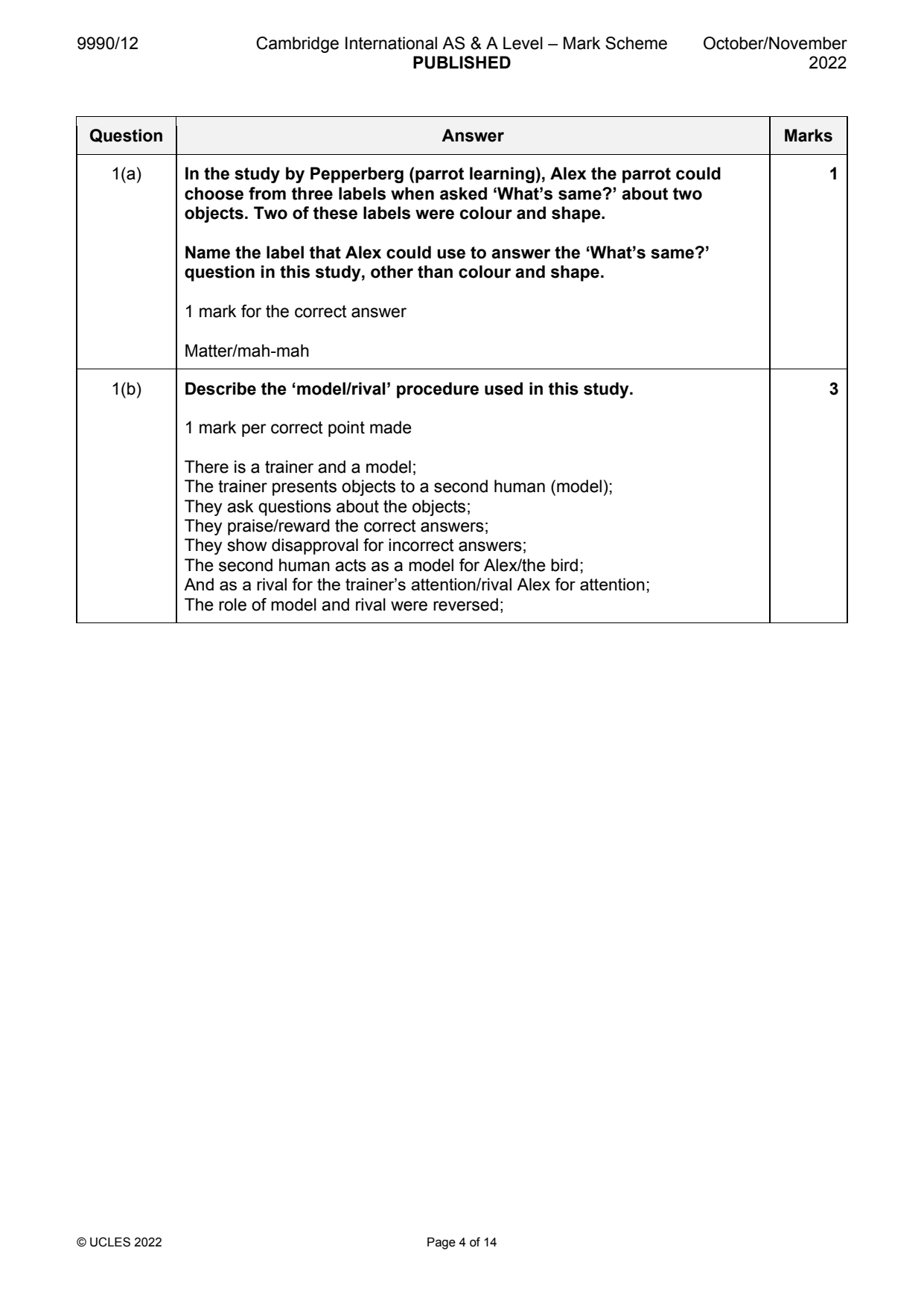
Oct/Nov 2022 · Paper 12 · Question 1 · 4 marks
1(a) In the study by Pepperberg (parrot learning), Alex the parrot could 1
choose from three labels when asked ‘What’s same?’ about two
objects. Two of these labels were colour and shape.
Name the label that Alex could use to answer the ‘What’s same?’
question in this study, other than colour and shape.
1 mark for the correct answer
Matter/mah-mah
1(b) Describe the ‘model/rival’ procedure used in this study. 3
1 mark per correct point made
There is a trainer and a model;
The trainer presents objects to a second human (model);
They ask questions about the objects;
They praise/reward the correct answers;
They show disapproval for incorrect answers;
The second human acts as a model for Alex/the bird;
And as a rival for the trainer’s attention/rival Alex for attention;
The role of model and rival were reversed;
© UCLES 2022 Page 4 of 14
Official mark scheme pages: 4 · source PDF URL
9990-2022-on-12-q07
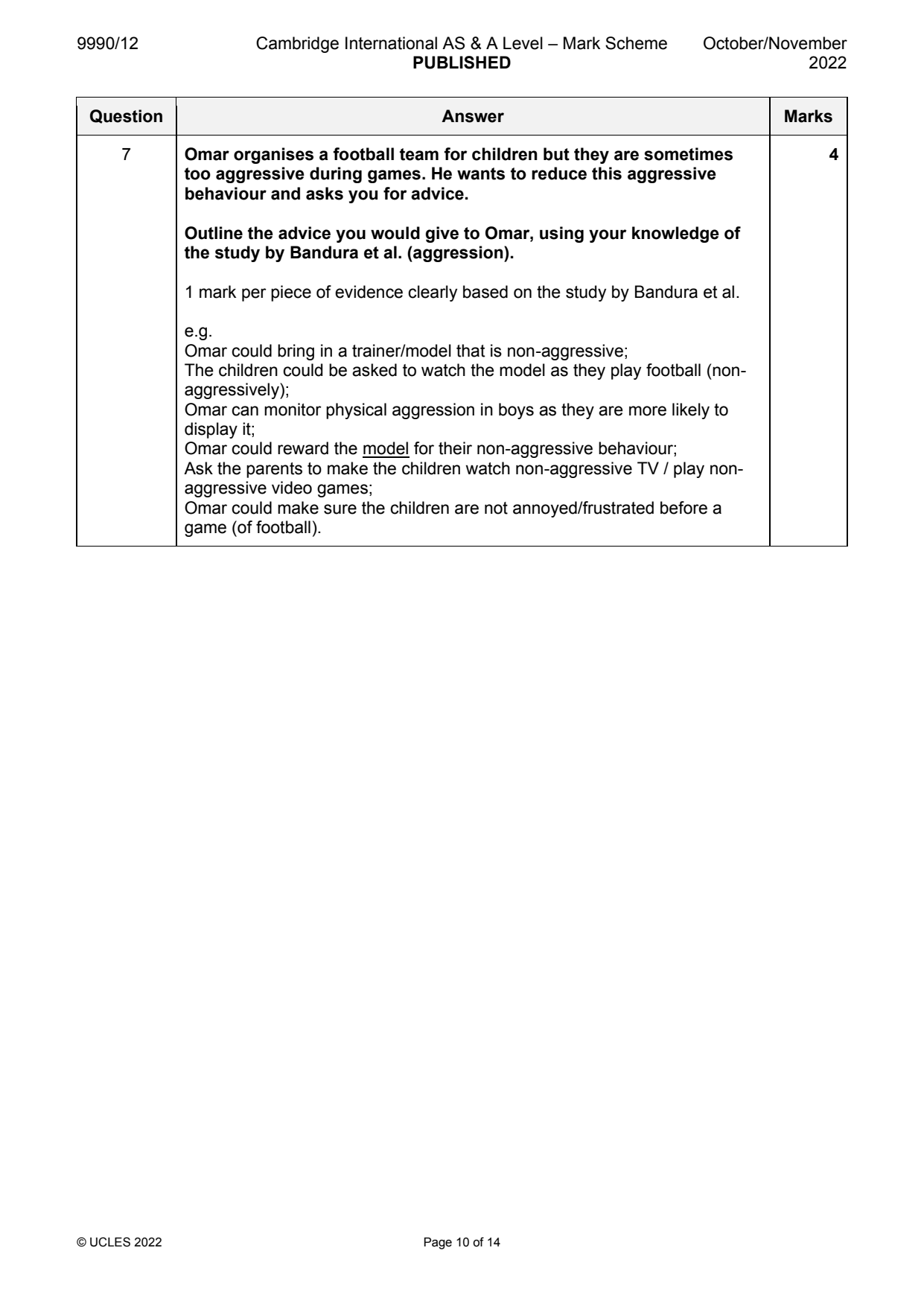
Oct/Nov 2022 · Paper 12 · Question 7 · 4 marks
7 Omar organises a football team for children but they are sometimes 4
too aggressive during games. He wants to reduce this aggressive
behaviour and asks you for advice.
Outline the advice you would give to Omar, using your knowledge of
the study by Bandura et al. (aggression).
1 mark per piece of evidence clearly based on the study by Bandura et al.
e.g.
Omar could bring in a trainer/model that is non-aggressive;
The children could be asked to watch the model as they play football (non-
aggressively);
Omar can monitor physical aggression in boys as they are more likely to
display it;
Omar could reward the model for their non-aggressive behaviour;
Ask the parents to make the children watch non-aggressive TV / play non-
aggressive video games;
Omar could make sure the children are not annoyed/frustrated before a
game (of football).
© UCLES 2022 Page 10 of 14
Official mark scheme pages: 10 · source PDF URL
9990-2022-on-13-q04
Oct/Nov 2022 · Paper 13 · Question 4 · 6 marks
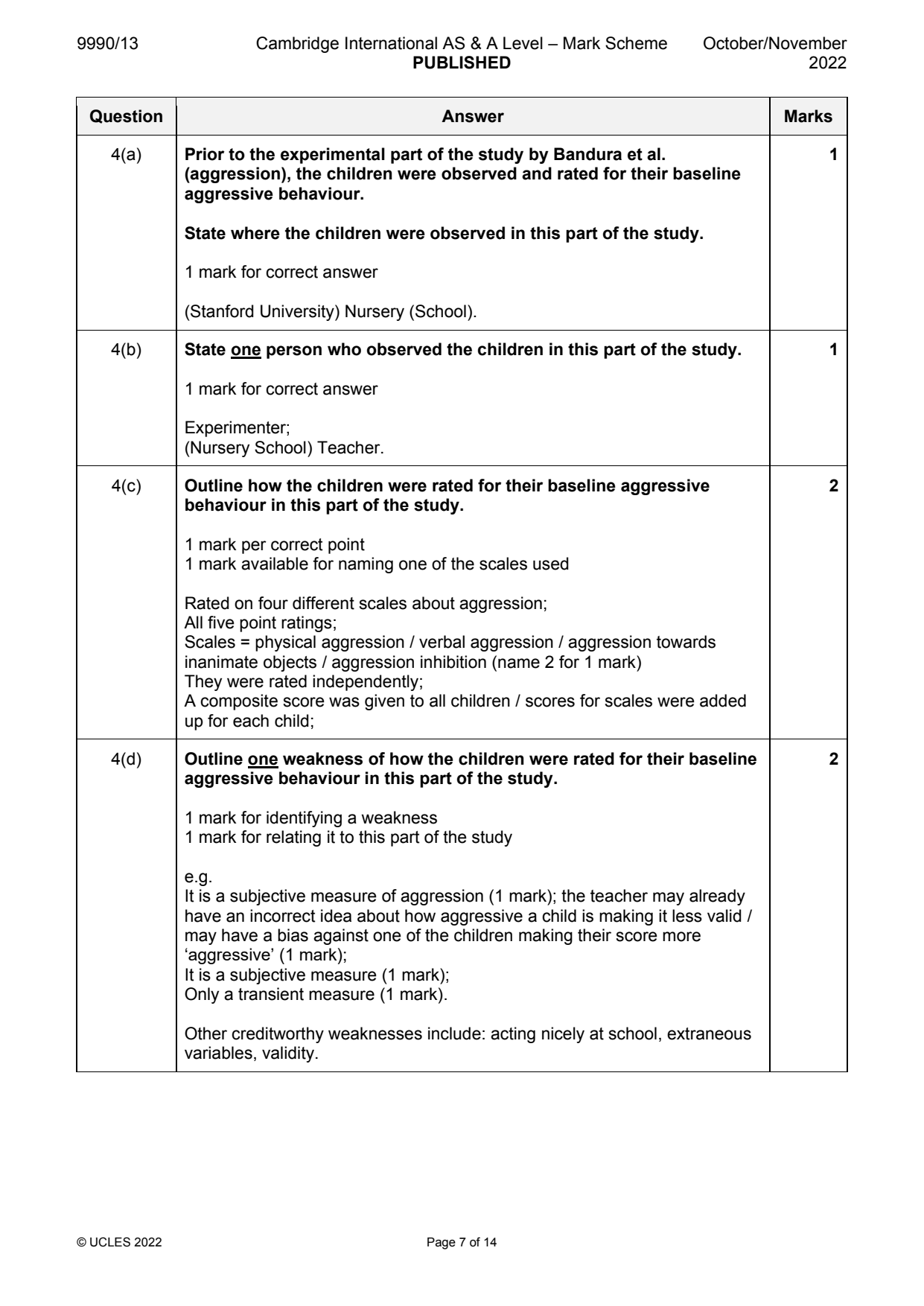
4(a) Prior to the experimental part of the study by Bandura et al. 1
(aggression), the children were observed and rated for their baseline
aggressive behaviour.
State where the children were observed in this part of the study.
1 mark for correct answer
(Stanford University) Nursery (School).
4(b) State one person who observed the children in this part of the study. 1
1 mark for correct answer
Experimenter;
(Nursery School) Teacher.
4(c) Outline how the children were rated for their baseline aggressive 2
behaviour in this part of the study.
1 mark per correct point
1 mark available for naming one of the scales used
Rated on four different scales about aggression;
All five point ratings;
Scales = physical aggression / verbal aggression / aggression towards
inanimate objects / aggression inhibition (name 2 for 1 mark)
They were rated independently;
A composite score was given to all children / scores for scales were added
up for each child;
4(d) Outline one weakness of how the children were rated for their baseline 2
aggressive behaviour in this part of the study.
1 mark for identifying a weakness
1 mark for relating it to this part of the study
e.g.
It is a subjective measure of aggression (1 mark); the teacher may already
have an incorrect idea about how aggressive a child is making it less valid /
may have a bias against one of the children making their score more
‘aggressive’ (1 mark);
It is a subjective measure (1 mark);
Only a transient measure (1 mark).
Other creditworthy weaknesses include: acting nicely at school, extraneous
variables, validity.
© UCLES 2022 Page 7 of 14
Official mark scheme pages: 7 · source PDF URL
9990-2022-on-13-q07
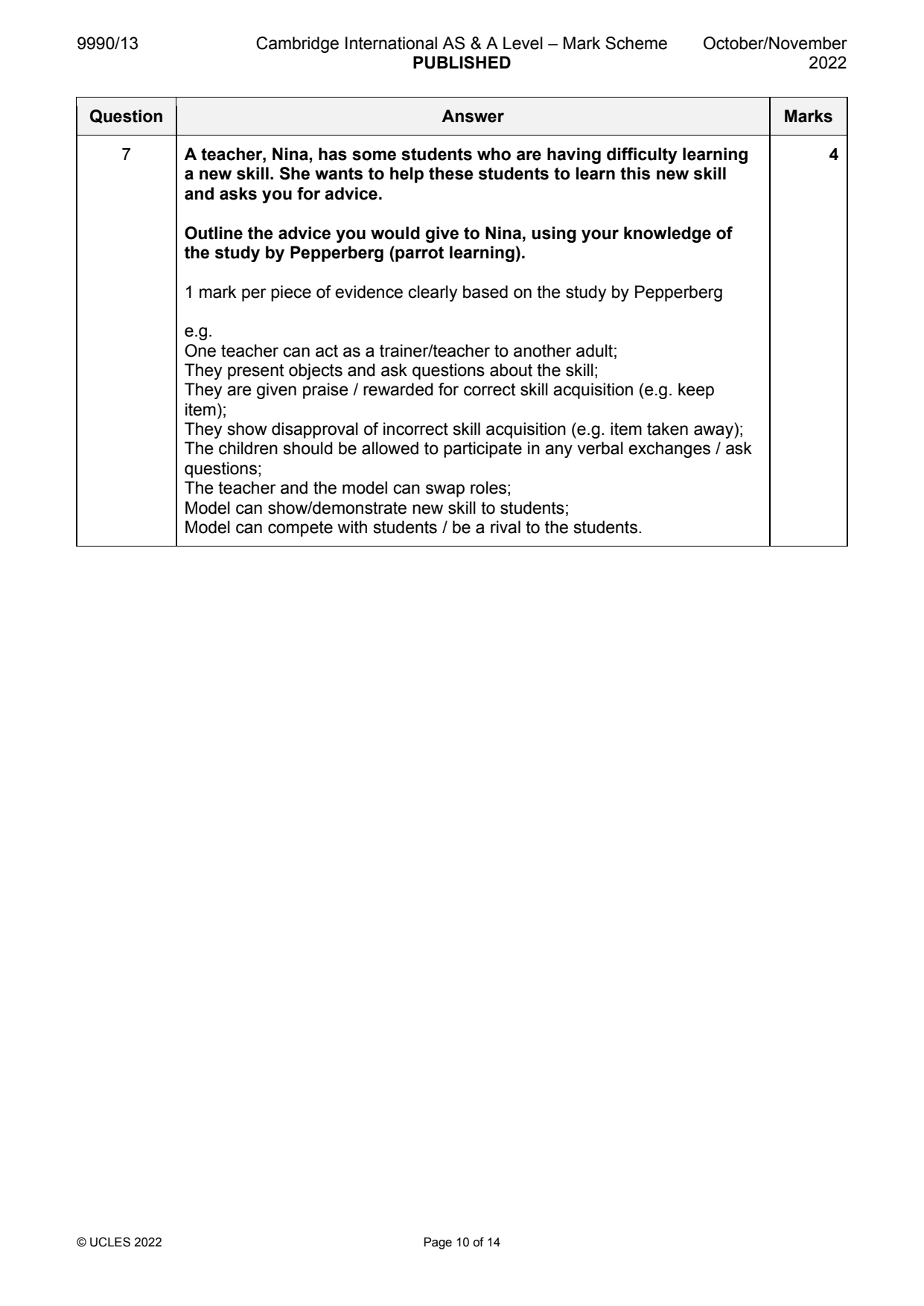
Oct/Nov 2022 · Paper 13 · Question 7 · 4 marks
7 A teacher, Nina, has some students who are having difficulty learning 4
a new skill. She wants to help these students to learn this new skill
and asks you for advice.
Outline the advice you would give to Nina, using your knowledge of
the study by Pepperberg (parrot learning).
1 mark per piece of evidence clearly based on the study by Pepperberg
e.g.
One teacher can act as a trainer/teacher to another adult;
They present objects and ask questions about the skill;
They are given praise / rewarded for correct skill acquisition (e.g. keep
item);
They show disapproval of incorrect skill acquisition (e.g. item taken away);
The children should be allowed to participate in any verbal exchanges / ask
questions;
The teacher and the model can swap roles;
Model can show/demonstrate new skill to students;
Model can compete with students / be a rival to the students.
© UCLES 2022 Page 10 of 14
Official mark scheme pages: 10 · source PDF URL
9990-2023-mj-11-q03
May/June 2023 · Paper 11 · Question 3 · 5 marks
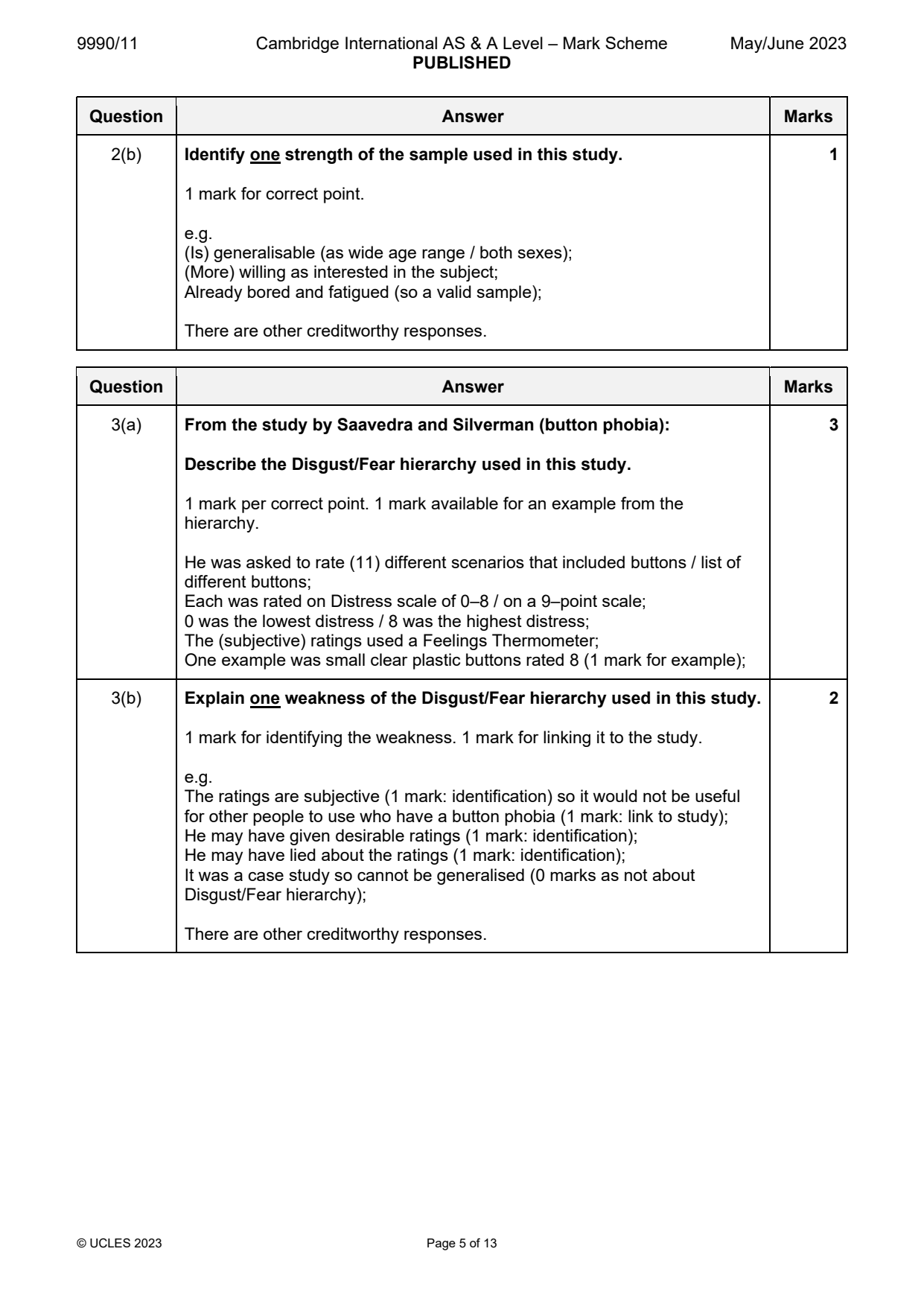
3(a) From the study by Saavedra and Silverman (button phobia): 3
Describe the Disgust/Fear hierarchy used in this study.
1 mark per correct point. 1 mark available for an example from the
hierarchy.
He was asked to rate (11) different scenarios that included buttons / list of
different buttons;
Each was rated on Distress scale of 0–8 / on a 9–point scale;
0 was the lowest distress / 8 was the highest distress;
The (subjective) ratings used a Feelings Thermometer;
One example was small clear plastic buttons rated 8 (1 mark for example);
3(b) Explain one weakness of the Disgust/Fear hierarchy used in this study. 2
1 mark for identifying the weakness. 1 mark for linking it to the study.
e.g.
The ratings are subjective (1 mark: identification) so it would not be useful
for other people to use who have a button phobia (1 mark: link to study);
He may have given desirable ratings (1 mark: identification);
He may have lied about the ratings (1 mark: identification);
It was a case study so cannot be generalised (0 marks as not about
Disgust/Fear hierarchy);
There are other creditworthy responses.
© UCLES 2023 Page 5 of 13
Official mark scheme pages: 5 · source PDF URL
9990-2023-mj-11-q10
May/June 2023 · Paper 11 · Question 10 · 10 marks
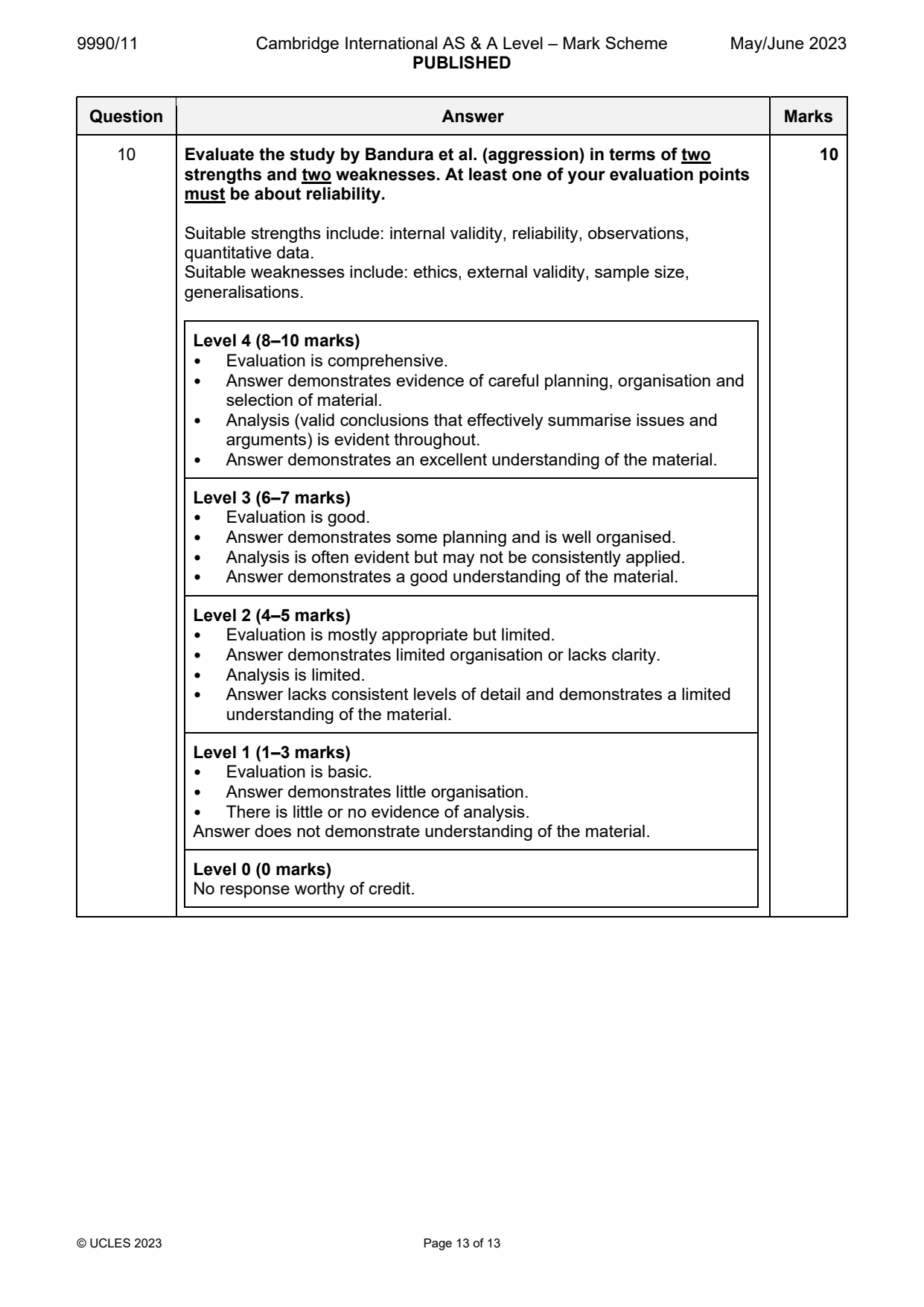
10 Evaluate the study by Bandura et al. (aggression) in terms of two 10
strengths and two weaknesses. At least one of your evaluation points
must be about reliability.
Suitable strengths include: internal validity, reliability, observations,
quantitative data.
Suitable weaknesses include: ethics, external validity, sample size,
generalisations.
Level 4 (8–10 marks)
• Evaluation is comprehensive.
• Answer demonstrates evidence of careful planning, organisation and
selection of material.
• Analysis (valid conclusions that effectively summarise issues and
arguments) is evident throughout.
• Answer demonstrates an excellent understanding of the material.
Level 3 (6–7 marks)
• Evaluation is good.
• Answer demonstrates some planning and is well organised.
• Analysis is often evident but may not be consistently applied.
• Answer demonstrates a good understanding of the material.
Level 2 (4–5 marks)
• Evaluation is mostly appropriate but limited.
• Answer demonstrates limited organisation or lacks clarity.
• Analysis is limited.
• Answer lacks consistent levels of detail and demonstrates a limited
understanding of the material.
Level 1 (1–3 marks)
• Evaluation is basic.
• Answer demonstrates little organisation.
• There is little or no evidence of analysis.
Answer does not demonstrate understanding of the material.
Level 0 (0 marks)
No response worthy of credit.
© UCLES 2023 Page 13 of 13
Official mark scheme pages: 13 · source PDF URL
9990-2023-mj-12-q04
May/June 2023 · Paper 12 · Question 4 · 6 marks
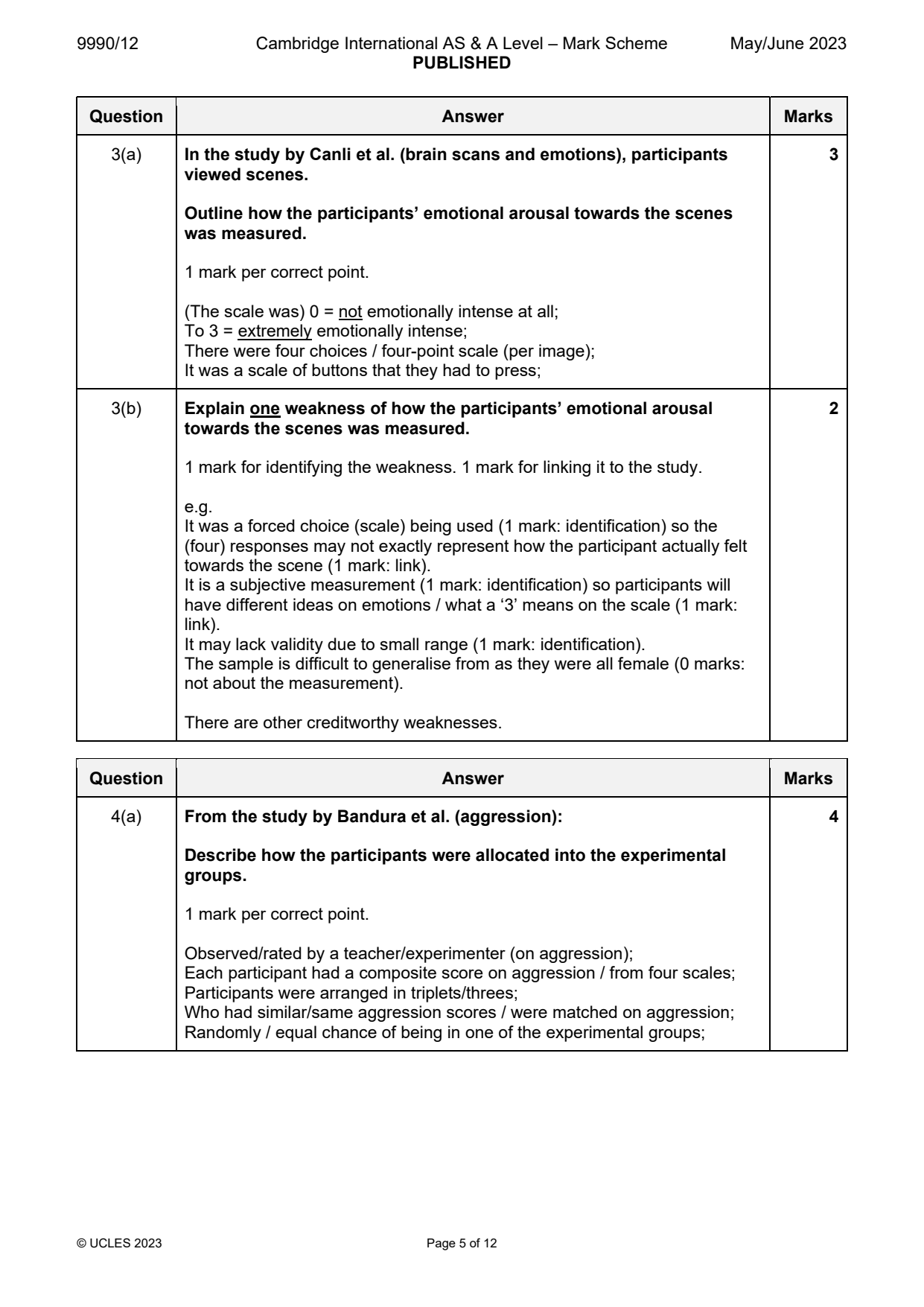
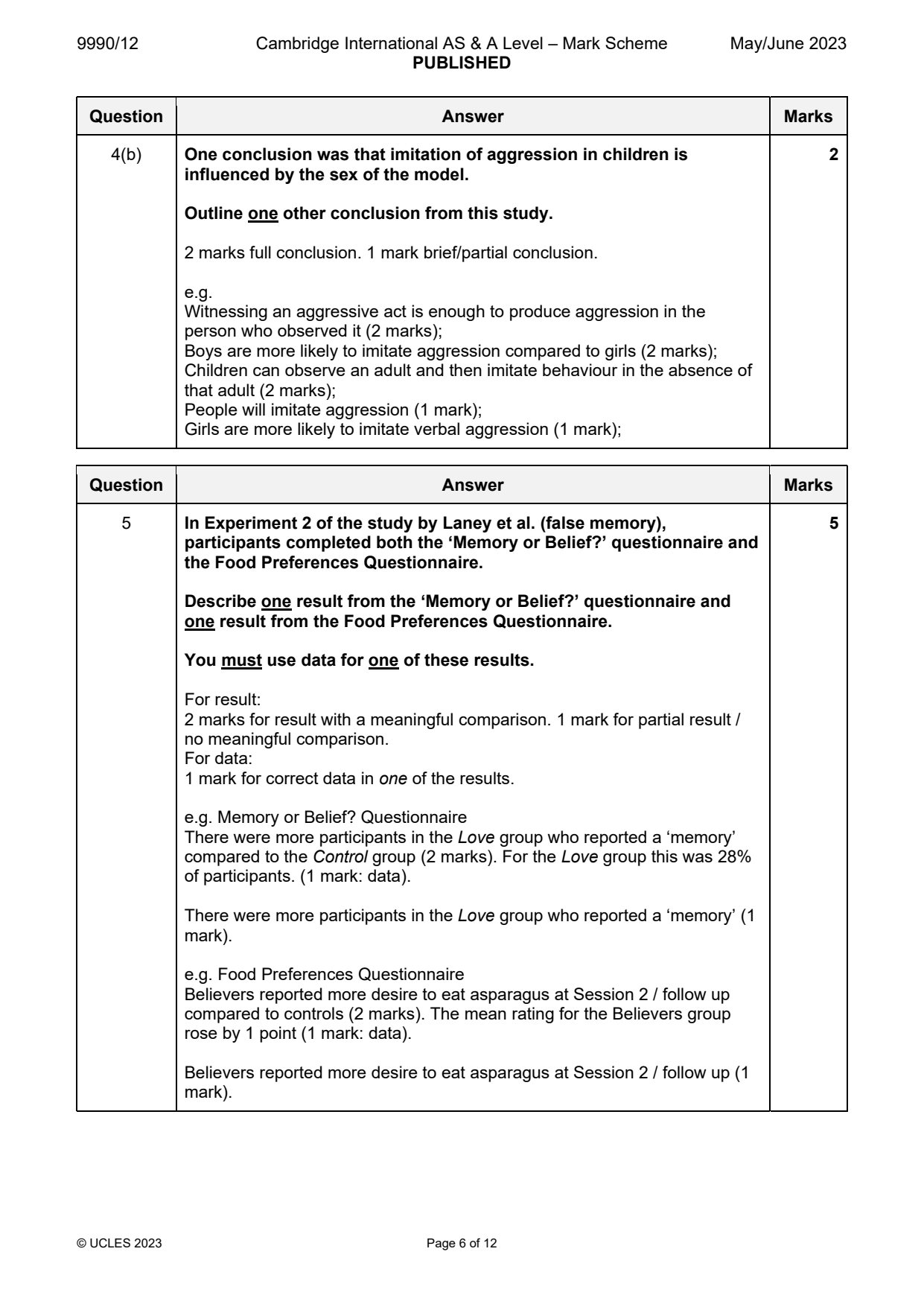
4(a) From the study by Bandura et al. (aggression): 4
Describe how the participants were allocated into the experimental
groups.
1 mark per correct point.
Observed/rated by a teacher/experimenter (on aggression);
Each participant had a composite score on aggression / from four scales;
Participants were arranged in triplets/threes;
Who had similar/same aggression scores / were matched on aggression;
Randomly / equal chance of being in one of the experimental groups;
© UCLES 2023 Page 5 of 12
4(b) One conclusion was that imitation of aggression in children is 2
influenced by the sex of the model.
Outline one other conclusion from this study.
2 marks full conclusion. 1 mark brief/partial conclusion.
e.g.
Witnessing an aggressive act is enough to produce aggression in the
person who observed it (2 marks);
Boys are more likely to imitate aggression compared to girls (2 marks);
Children can observe an adult and then imitate behaviour in the absence of
that adult (2 marks);
People will imitate aggression (1 mark);
Girls are more likely to imitate verbal aggression (1 mark);
Question Answer Marks
Official mark scheme pages: 5, 6 · source PDF URL
9990-2023-mj-12-q09
May/June 2023 · Paper 12 · Question 9 · 12 marks
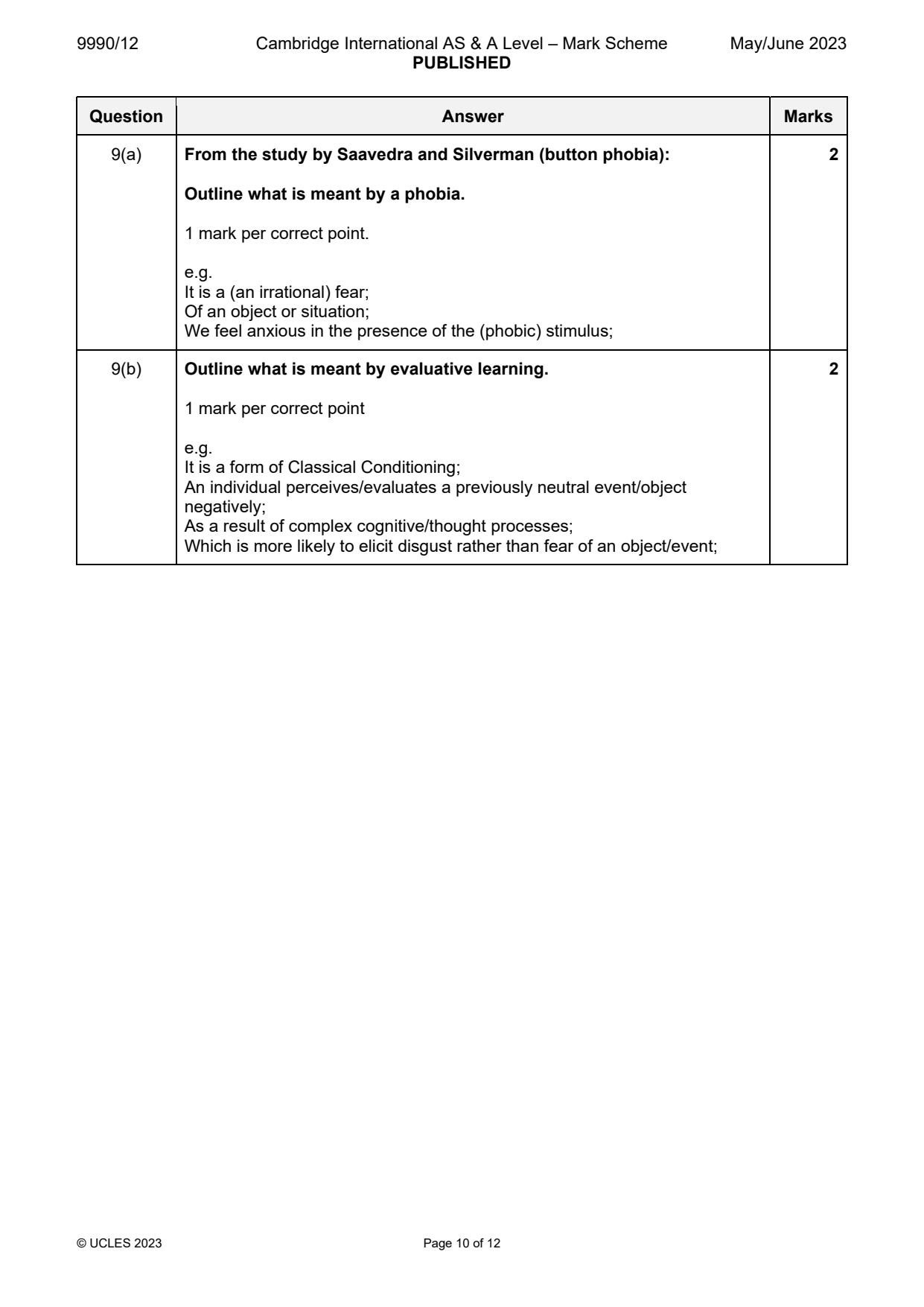
9(a) From the study by Saavedra and Silverman (button phobia): 2
Outline what is meant by a phobia.
1 mark per correct point.
e.g.
It is a (an irrational) fear;
Of an object or situation;
We feel anxious in the presence of the (phobic) stimulus;
9(b) Outline what is meant by evaluative learning. 2
1 mark per correct point
e.g.
It is a form of Classical Conditioning;
An individual perceives/evaluates a previously neutral event/object
negatively;
As a result of complex cognitive/thought processes;
Which is more likely to elicit disgust rather than fear of an object/event;
© UCLES 2023 Page 10 of 12
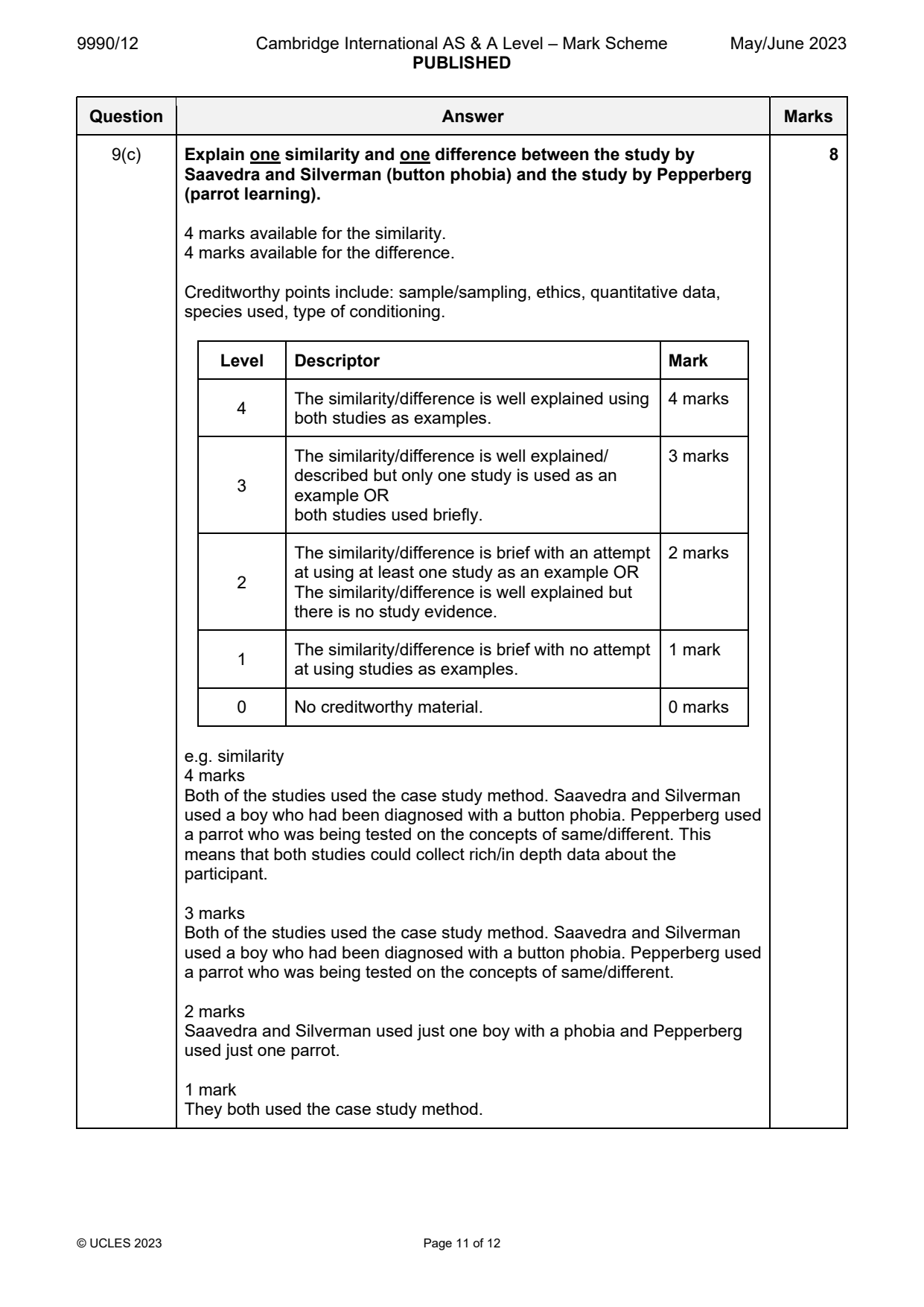
9(c) Explain one similarity and one difference between the study by 8
Saavedra and Silverman (button phobia) and the study by Pepperberg
(parrot learning).
4 marks available for the similarity.
4 marks available for the difference.
Creditworthy points include: sample/sampling, ethics, quantitative data,
species used, type of conditioning.
Level Descriptor Mark
The similarity/difference is well explained using 4 marks
4
both studies as examples.
The similarity/difference is well explained/ 3 marks
described but only one study is used as an
3
example OR
both studies used briefly.
The similarity/difference is brief with an attempt 2 marks
at using at least one study as an example OR
2
The similarity/difference is well explained but
there is no study evidence.
The similarity/difference is brief with no attempt 1 mark
1
at using studies as examples.
0 No creditworthy material. 0 marks
e.g. similarity
4 marks
Both of the studies used the case study method. Saavedra and Silverman
used a boy who had been diagnosed with a button phobia. Pepperberg used
a parrot who was being tested on the concepts of same/different. This
means that both studies could collect rich/in depth data about the
participant.
3 marks
Both of the studies used the case study method. Saavedra and Silverman
used a boy who had been diagnosed with a button phobia. Pepperberg used
a parrot who was being tested on the concepts of same/different.
2 marks
Saavedra and Silverman used just one boy with a phobia and Pepperberg
used just one parrot.
1 mark
They both used the case study method.
© UCLES 2023 Page 11 of 12
Official mark scheme pages: 10, 11 · source PDF URL
9990-2023-mj-13-q03
May/June 2023 · Paper 13 · Question 3 · 5 marks
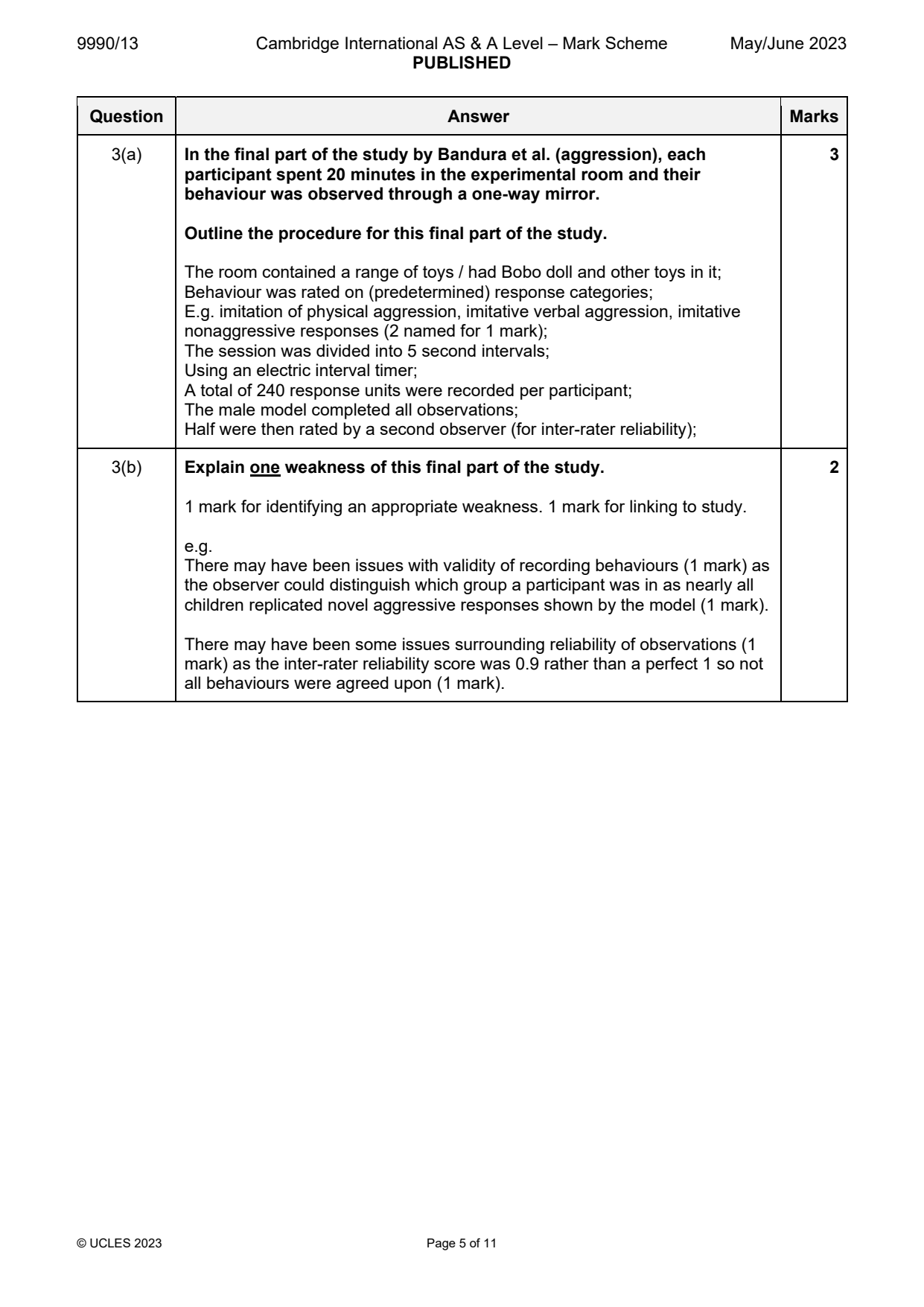
3(a) In the final part of the study by Bandura et al. (aggression), each 3
participant spent 20 minutes in the experimental room and their
behaviour was observed through a one-way mirror.
Outline the procedure for this final part of the study.
The room contained a range of toys / had Bobo doll and other toys in it;
Behaviour was rated on (predetermined) response categories;
E.g. imitation of physical aggression, imitative verbal aggression, imitative
nonaggressive responses (2 named for 1 mark);
The session was divided into 5 second intervals;
Using an electric interval timer;
A total of 240 response units were recorded per participant;
The male model completed all observations;
Half were then rated by a second observer (for inter-rater reliability);
3(b) Explain one weakness of this final part of the study. 2
1 mark for identifying an appropriate weakness. 1 mark for linking to study.
e.g.
There may have been issues with validity of recording behaviours (1 mark) as
the observer could distinguish which group a participant was in as nearly all
children replicated novel aggressive responses shown by the model (1 mark).
There may have been some issues surrounding reliability of observations (1
mark) as the inter-rater reliability score was 0.9 rather than a perfect 1 so not
all behaviours were agreed upon (1 mark).
© UCLES 2023 Page 5 of 11
Official mark scheme pages: 5 · source PDF URL
9990-2023-mj-13-q06
May/June 2023 · Paper 13 · Question 6 · 6 marks
6 Outline two assumptions of the learning approach. 6
You must use an example from a core study for each assumption.
For assumptions:
2 mark for full assumption
1 mark for partial assumption.
For example: 1 mark per correct example per assumption. Examples have to
come from a core study.
E.g., assumptions
Operant Conditioning can explain changes in behaviour (2 marks);
Classical Conditioning can explain changes in behaviour (2 marks);
Social Learning can explain changes in behaviour (2 marks);
Conditioning can explain behaviour (1 mark);
E.g., examples
In the Bandura study, children observed and imitated (modelled) aggressive
behaviours;
In the Pepperberg study, Alex the parrot got rewarded for a correct response
to a question;
In the Saavedra and Silverman study, classical conditioning (evaluative
learning) was used to help understand the causes of his button phobia;
© UCLES 2023 Page 7 of 11
Official mark scheme pages: 7 · source PDF URL
9990-2023-mj-13-q08
May/June 2023 · Paper 13 · Question 8 · 6 marks
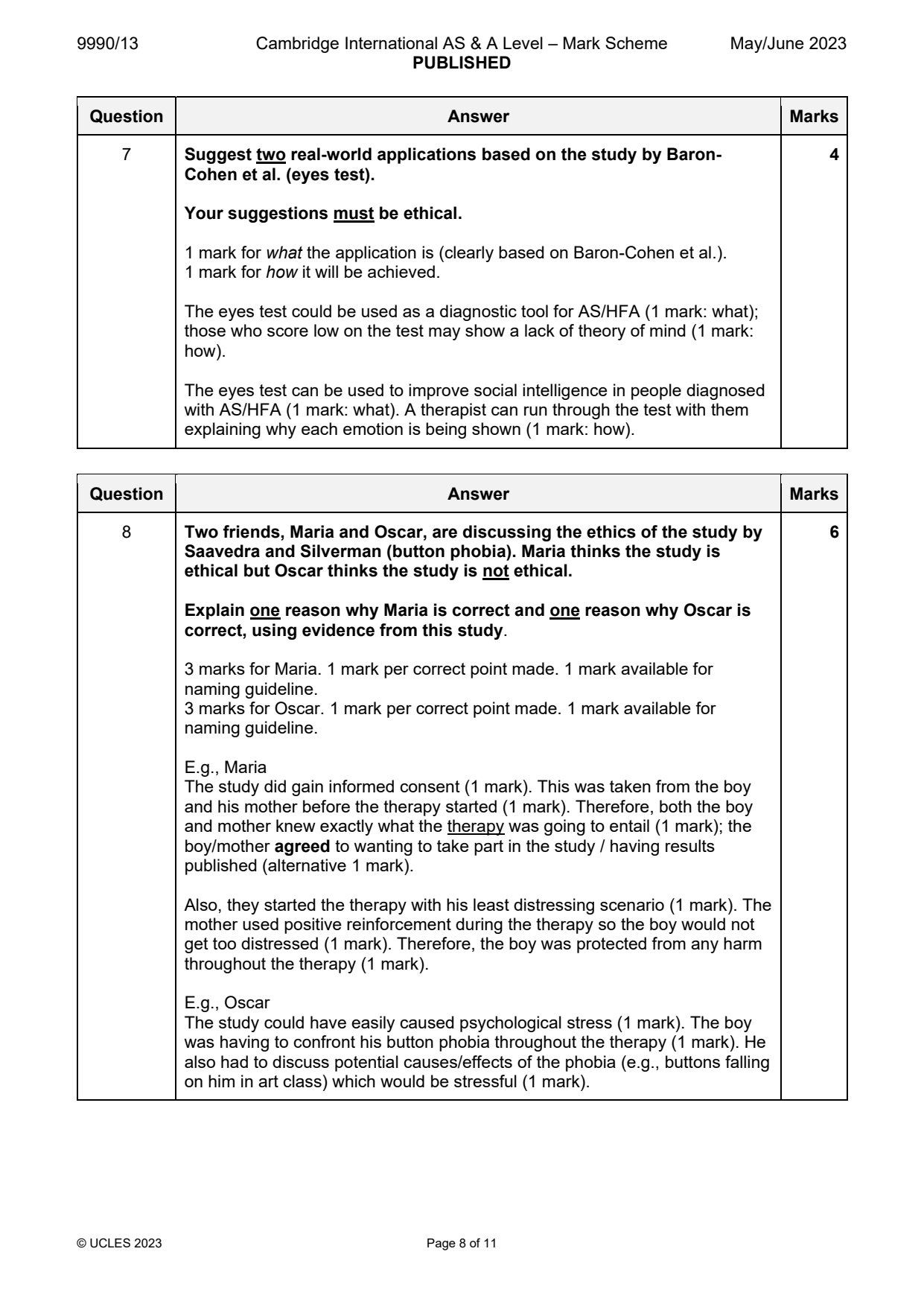
8 Two friends, Maria and Oscar, are discussing the ethics of the study by 6
Saavedra and Silverman (button phobia). Maria thinks the study is
ethical but Oscar thinks the study is not ethical.
Explain one reason why Maria is correct and one reason why Oscar is
correct, using evidence from this study.
3 marks for Maria. 1 mark per correct point made. 1 mark available for
naming guideline.
3 marks for Oscar. 1 mark per correct point made. 1 mark available for
naming guideline.
E.g., Maria
The study did gain informed consent (1 mark). This was taken from the boy
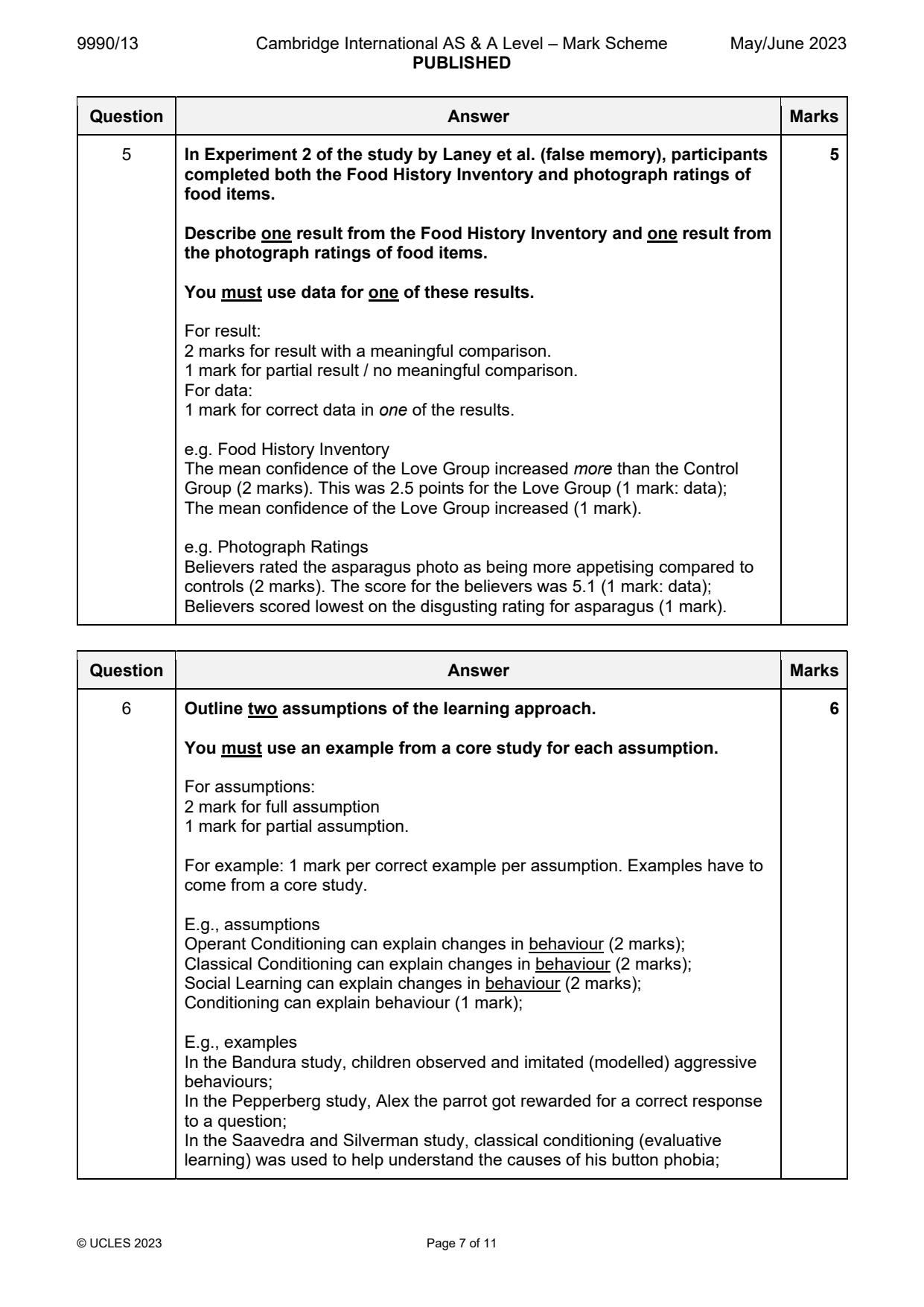
and his mother before the therapy started (1 mark). Therefore, both the boy
and mother knew exactly what the therapy was going to entail (1 mark); the
boy/mother agreed to wanting to take part in the study / having results
published (alternative 1 mark).
Also, they started the therapy with his least distressing scenario (1 mark). The
mother used positive reinforcement during the therapy so the boy would not
get too distressed (1 mark). Therefore, the boy was protected from any harm
throughout the therapy (1 mark).
E.g., Oscar
The study could have easily caused psychological stress (1 mark). The boy
was having to confront his button phobia throughout the therapy (1 mark). He
also had to discuss potential causes/effects of the phobia (e.g., buttons falling
on him in art class) which would be stressful (1 mark).
© UCLES 2023 Page 8 of 11
Official mark scheme pages: 8 · source PDF URL
9990-2023-on-11-q04
Oct/Nov 2023 · Paper 11 · Question 4 · 6 marks
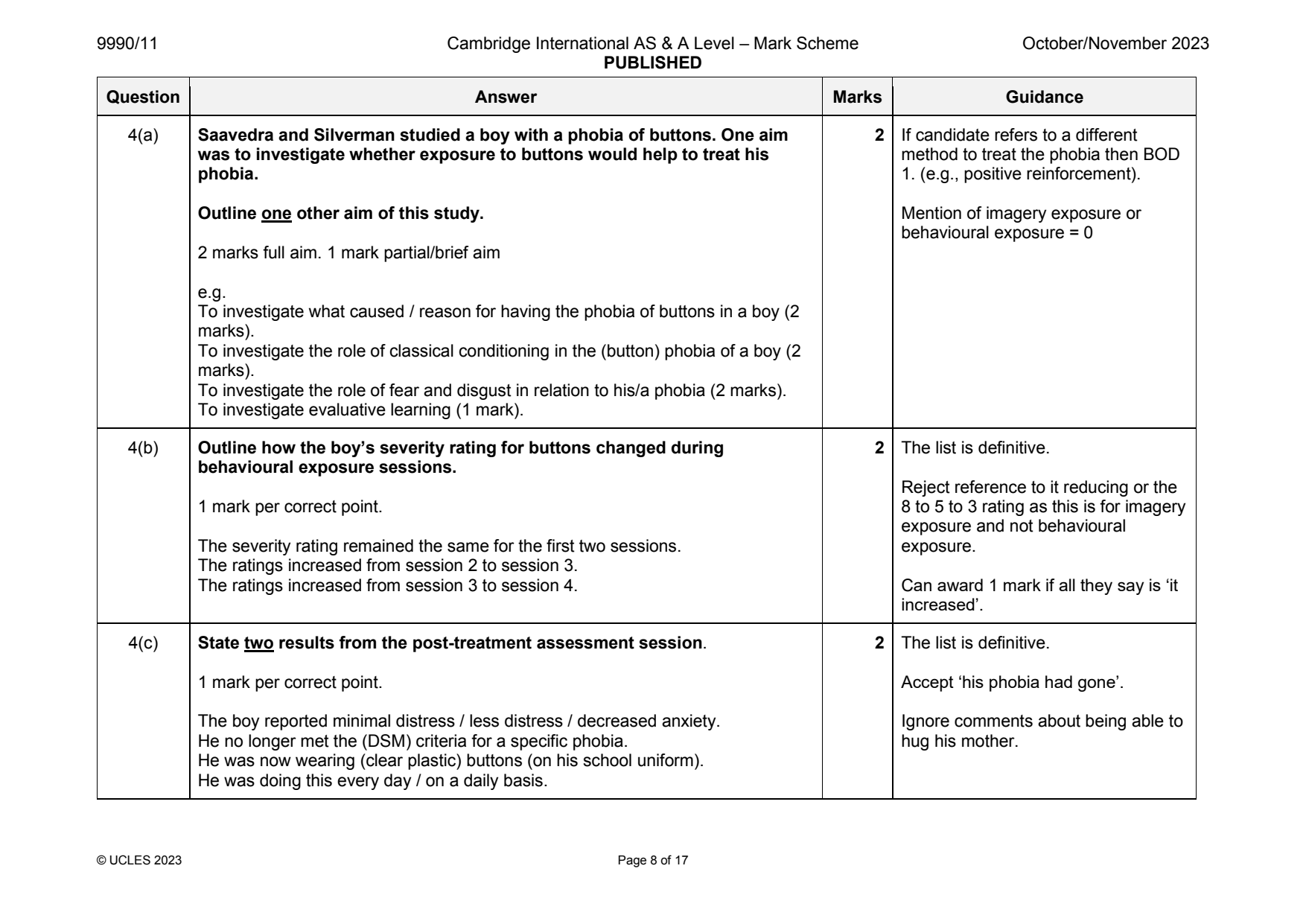
4(a) Saavedra and Silverman studied a boy with a phobia of buttons. One aim 2 If candidate refers to a different
was to investigate whether exposure to buttons would help to treat his method to treat the phobia then BOD
phobia. 1. (e.g., positive reinforcement).
Outline one other aim of this study. Mention of imagery exposure or
behavioural exposure = 0
2 marks full aim. 1 mark partial/brief aim
e.g.
To investigate what caused / reason for having the phobia of buttons in a boy (2
marks).
To investigate the role of classical conditioning in the (button) phobia of a boy (2
marks).
To investigate the role of fear and disgust in relation to his/a phobia (2 marks).
To investigate evaluative learning (1 mark).
4(b) Outline how the boy’s severity rating for buttons changed during 2 The list is definitive.
behavioural exposure sessions.
Reject reference to it reducing or the
1 mark per correct point. 8 to 5 to 3 rating as this is for imagery
exposure and not behavioural
The severity rating remained the same for the first two sessions. exposure.
The ratings increased from session 2 to session 3.
The ratings increased from session 3 to session 4. Can award 1 mark if all they say is ‘it
increased’.
4(c) State two results from the post-treatment assessment session. 2 The list is definitive.
1 mark per correct point. Accept ‘his phobia had gone’.
The boy reported minimal distress / less distress / decreased anxiety. Ignore comments about being able to
He no longer met the (DSM) criteria for a specific phobia. hug his mother.
He was now wearing (clear plastic) buttons (on his school uniform).
He was doing this every day / on a daily basis.
© UCLES 2023 Page 8 of 17
Official mark scheme pages: 8 · source PDF URL
9990-2023-on-11-q05
Oct/Nov 2023 · Paper 11 · Question 5 · 6 marks
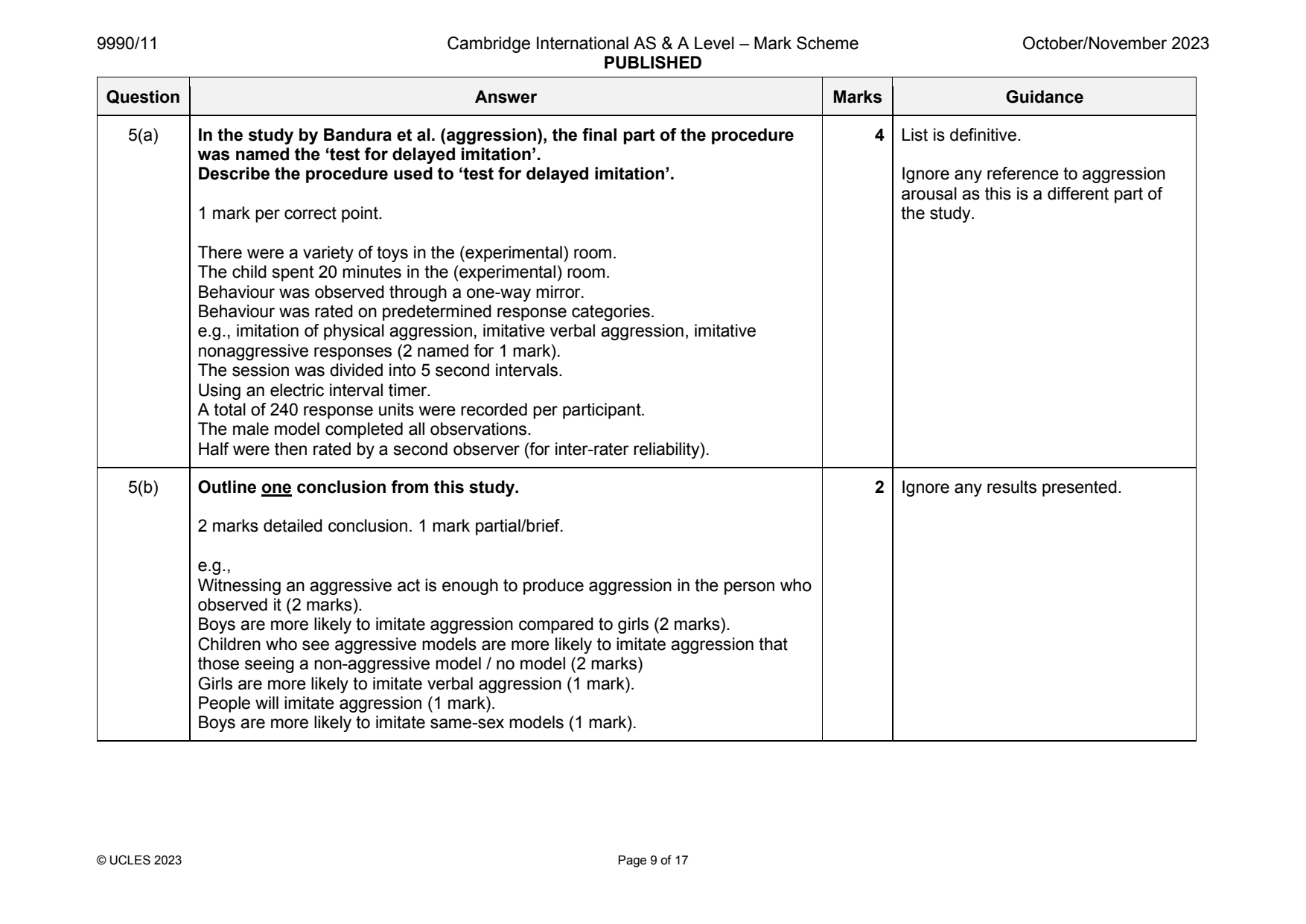
5(a) In the study by Bandura et al. (aggression), the final part of the procedure 4 List is definitive.
was named the ‘test for delayed imitation’.
Describe the procedure used to ‘test for delayed imitation’. Ignore any reference to aggression
arousal as this is a different part of
1 mark per correct point. the study.
There were a variety of toys in the (experimental) room.
The child spent 20 minutes in the (experimental) room.
Behaviour was observed through a one-way mirror.
Behaviour was rated on predetermined response categories.
e.g., imitation of physical aggression, imitative verbal aggression, imitative
nonaggressive responses (2 named for 1 mark).
The session was divided into 5 second intervals.
Using an electric interval timer.
A total of 240 response units were recorded per participant.
The male model completed all observations.
Half were then rated by a second observer (for inter-rater reliability).
5(b) Outline one conclusion from this study. 2 Ignore any results presented.
2 marks detailed conclusion. 1 mark partial/brief.
e.g.,
Witnessing an aggressive act is enough to produce aggression in the person who
observed it (2 marks).
Boys are more likely to imitate aggression compared to girls (2 marks).
Children who see aggressive models are more likely to imitate aggression that
those seeing a non-aggressive model / no model (2 marks)
Girls are more likely to imitate verbal aggression (1 mark).
People will imitate aggression (1 mark).
Boys are more likely to imitate same-sex models (1 mark).
© UCLES 2023 Page 9 of 17
Official mark scheme pages: 9 · source PDF URL
9990-2023-on-11-q09
Oct/Nov 2023 · Paper 11 · Question 9 · 12 marks
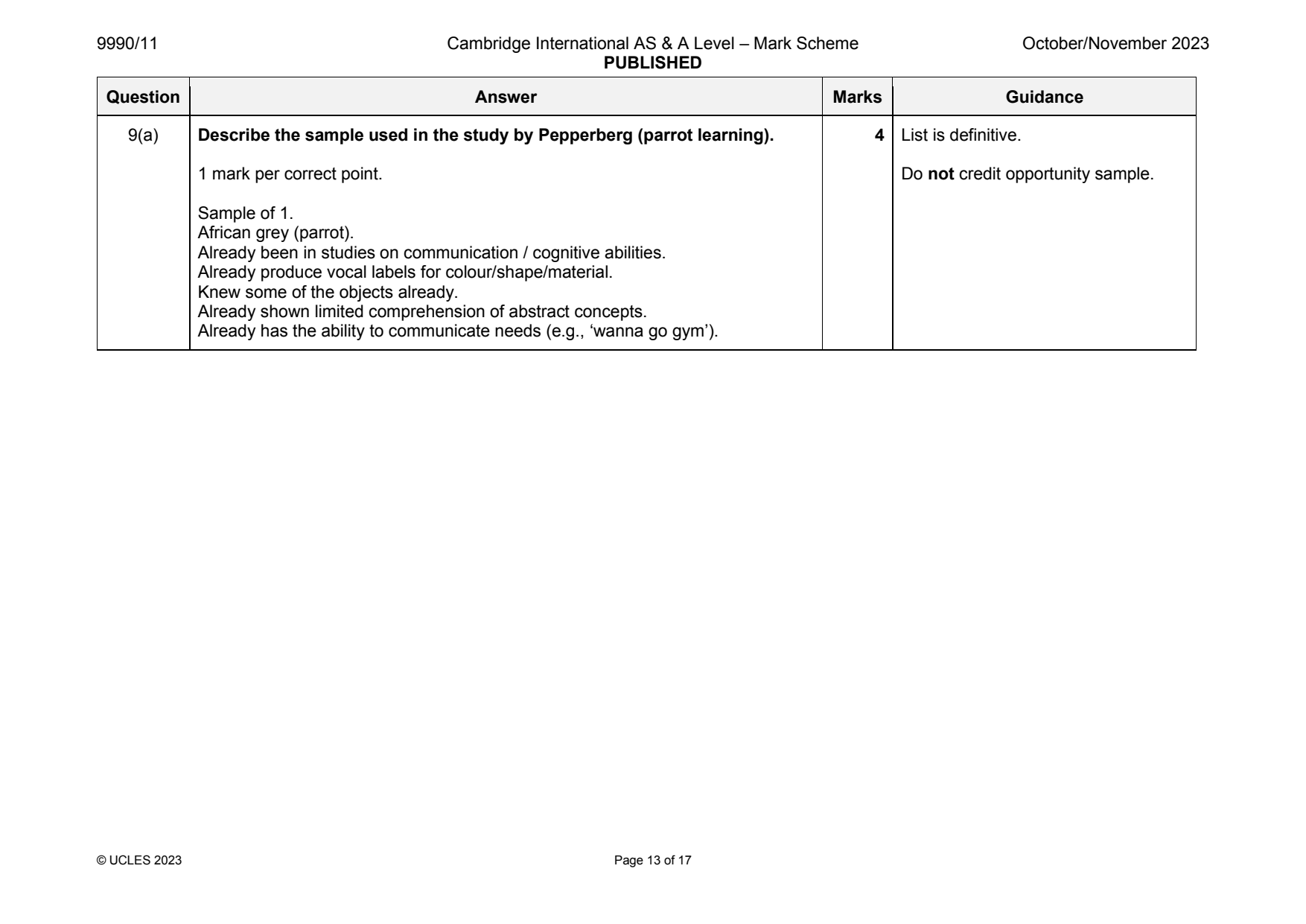
9(a) Describe the sample used in the study by Pepperberg (parrot learning). 4 List is definitive.
1 mark per correct point. Do not credit opportunity sample.
Sample of 1.
African grey (parrot).
Already been in studies on communication / cognitive abilities.
Already produce vocal labels for colour/shape/material.
Knew some of the objects already.
Already shown limited comprehension of abstract concepts.
Already has the ability to communicate needs (e.g., ‘wanna go gym’).
© UCLES 2023 Page 13 of 17
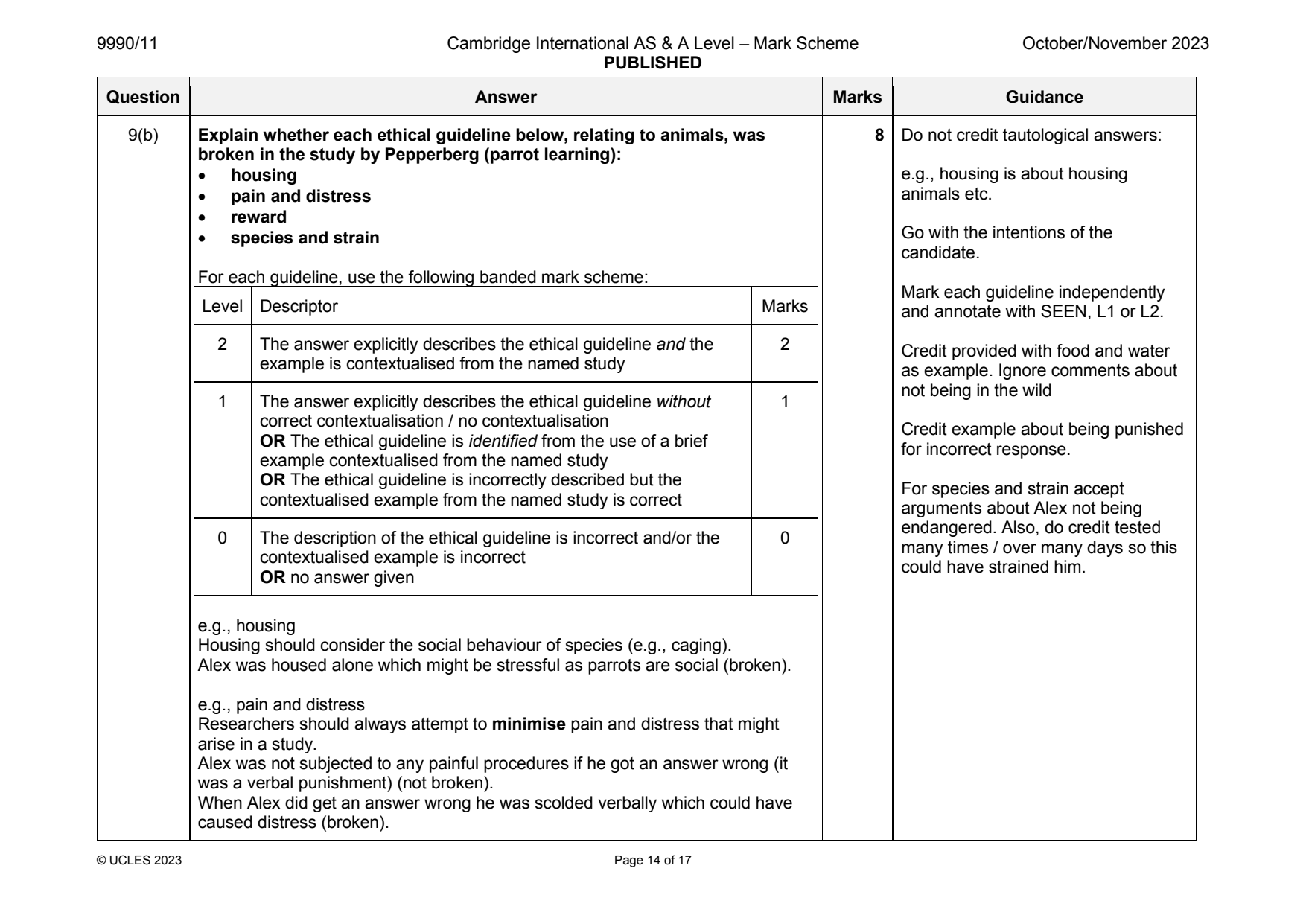
9(b) Explain whether each ethical guideline below, relating to animals, was 8 Do not credit tautological answers:
broken in the study by Pepperberg (parrot learning):
• housing e.g., housing is about housing
• pain and distress animals etc.
• reward
• species and strain Go with the intentions of the
candidate.
For each guideline, use the following banded mark scheme:
Mark each guideline independently
Level Descriptor Marks
and annotate with SEEN, L1 or L2.
2 The answer explicitly describes the ethical guideline and the 2
Credit provided with food and water
example is contextualised from the named study
as example. Ignore comments about
not being in the wild
1 The answer explicitly describes the ethical guideline without 1
correct contextualisation / no contextualisation
Credit example about being punished
OR The ethical guideline is identified from the use of a brief
for incorrect response.
example contextualised from the named study
OR The ethical guideline is incorrectly described but the
For species and strain accept
contextualised example from the named study is correct
arguments about Alex not being
endangered. Also, do credit tested
0 The description of the ethical guideline is incorrect and/or the 0
many times / over many days so this
contextualised example is incorrect
could have strained him.
OR no answer given
e.g., housing
Housing should consider the social behaviour of species (e.g., caging).
Alex was housed alone which might be stressful as parrots are social (broken).
e.g., pain and distress
Researchers should always attempt to minimise pain and distress that might
arise in a study.
Alex was not subjected to any painful procedures if he got an answer wrong (it
was a verbal punishment) (not broken).
When Alex did get an answer wrong he was scolded verbally which could have
caused distress (broken).
© UCLES 2023 Page 14 of 17
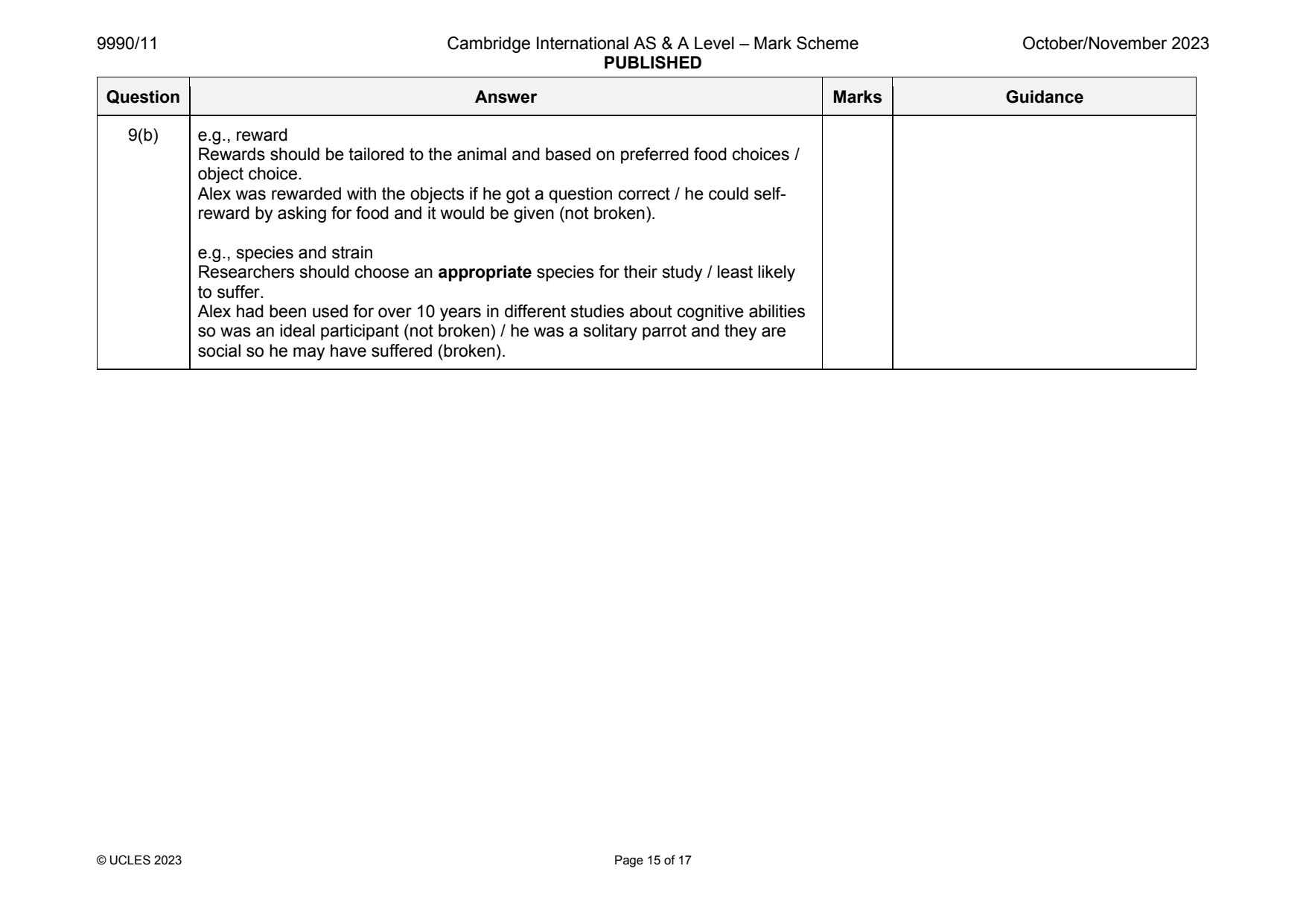
9(b) e.g., reward
Rewards should be tailored to the animal and based on preferred food choices /
object choice.
Alex was rewarded with the objects if he got a question correct / he could self-
reward by asking for food and it would be given (not broken).
e.g., species and strain
Researchers should choose an appropriate species for their study / least likely
to suffer.
Alex had been used for over 10 years in different studies about cognitive abilities
so was an ideal participant (not broken) / he was a solitary parrot and they are
social so he may have suffered (broken).
© UCLES 2023 Page 15 of 17
Official mark scheme pages: 13, 14, 15 · source PDF URL
9990-2023-on-12-q02
Oct/Nov 2023 · Paper 12 · Question 2 · 4 marks
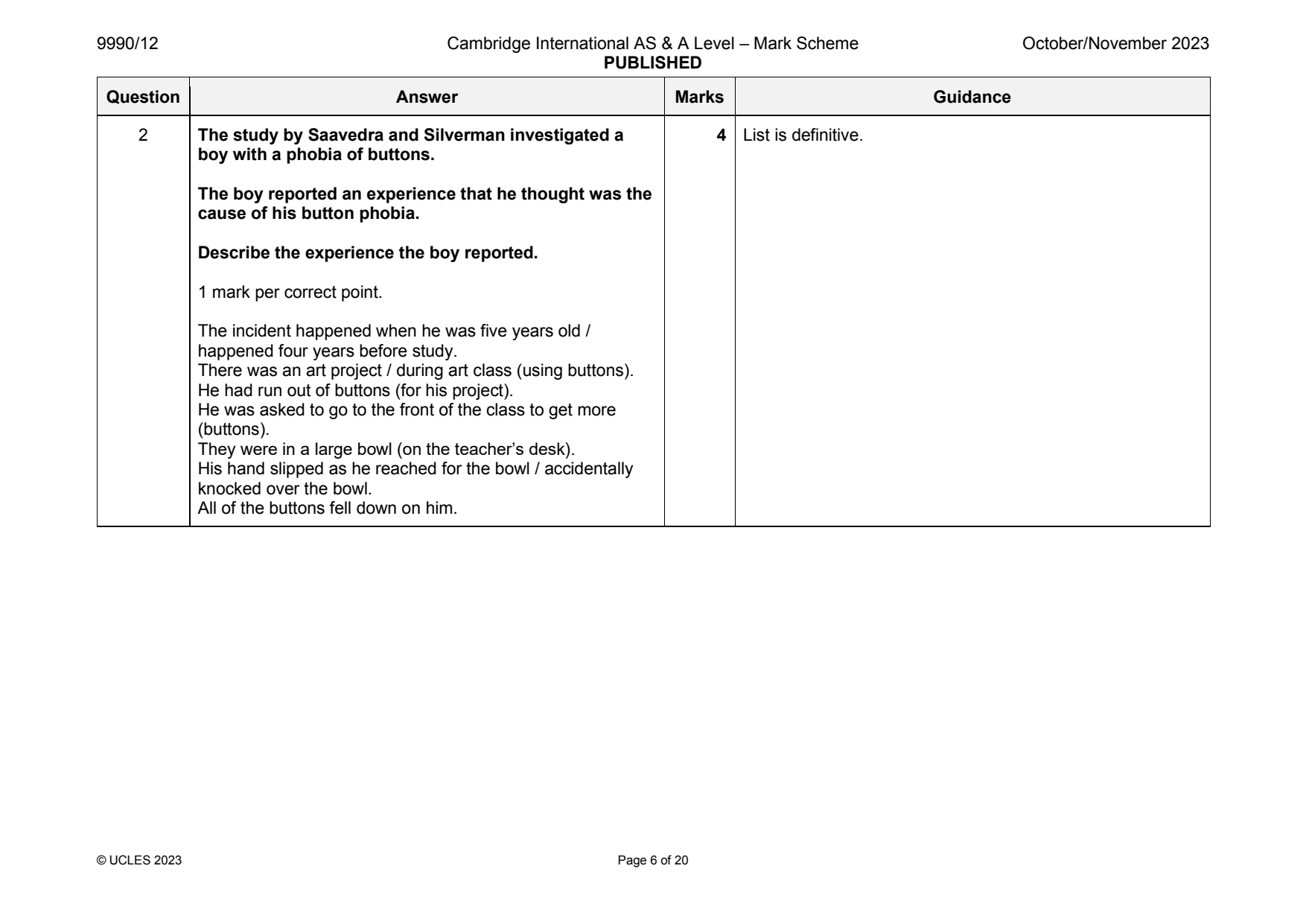
2 The study by Saavedra and Silverman investigated a 4 List is definitive.
boy with a phobia of buttons.
The boy reported an experience that he thought was the
cause of his button phobia.
Describe the experience the boy reported.
1 mark per correct point.
The incident happened when he was five years old /
happened four years before study.
There was an art project / during art class (using buttons).
He had run out of buttons (for his project).
He was asked to go to the front of the class to get more
(buttons).
They were in a large bowl (on the teacher’s desk).
His hand slipped as he reached for the bowl / accidentally
knocked over the bowl.
All of the buttons fell down on him.
© UCLES 2023 Page 6 of 20
Official mark scheme pages: 6 · source PDF URL
9990-2023-on-12-q04
Oct/Nov 2023 · Paper 12 · Question 4 · 6 marks
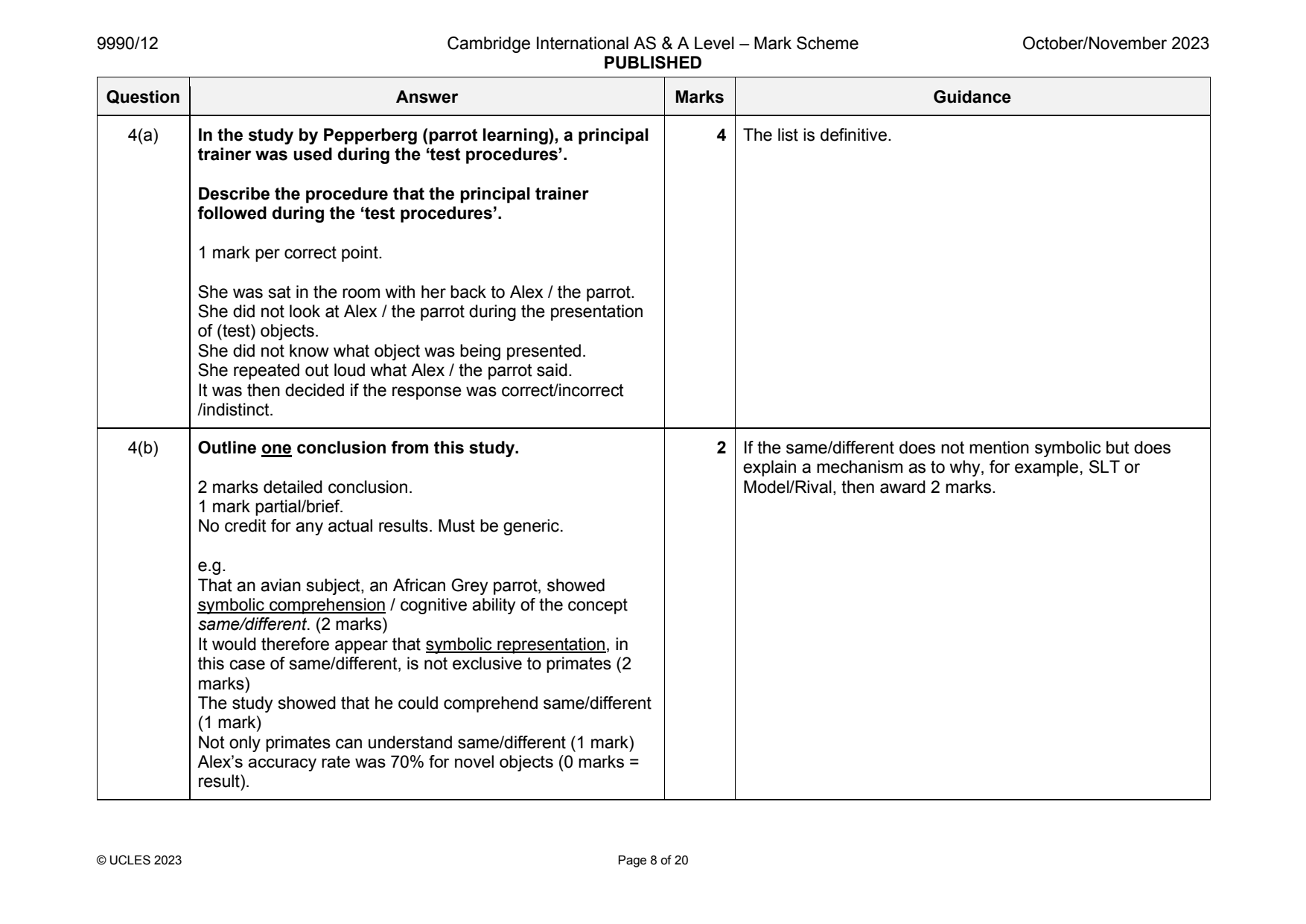
4(a) In the study by Pepperberg (parrot learning), a principal 4 The list is definitive.
trainer was used during the ‘test procedures’.
Describe the procedure that the principal trainer
followed during the ‘test procedures’.
1 mark per correct point.
She was sat in the room with her back to Alex / the parrot.
She did not look at Alex / the parrot during the presentation
of (test) objects.
She did not know what object was being presented.
She repeated out loud what Alex / the parrot said.
It was then decided if the response was correct/incorrect
/indistinct.
4(b) Outline one conclusion from this study. 2 If the same/different does not mention symbolic but does
explain a mechanism as to why, for example, SLT or
2 marks detailed conclusion. Model/Rival, then award 2 marks.
1 mark partial/brief.
No credit for any actual results. Must be generic.
e.g.
That an avian subject, an African Grey parrot, showed
symbolic comprehension / cognitive ability of the concept
same/different. (2 marks)
It would therefore appear that symbolic representation, in
this case of same/different, is not exclusive to primates (2
marks)
The study showed that he could comprehend same/different
(1 mark)
Not only primates can understand same/different (1 mark)
Alex’s accuracy rate was 70% for novel objects (0 marks =
result).
© UCLES 2023 Page 8 of 20
Official mark scheme pages: 8 · source PDF URL
9990-2023-on-12-q08
Oct/Nov 2023 · Paper 12 · Question 8 · 6 marks
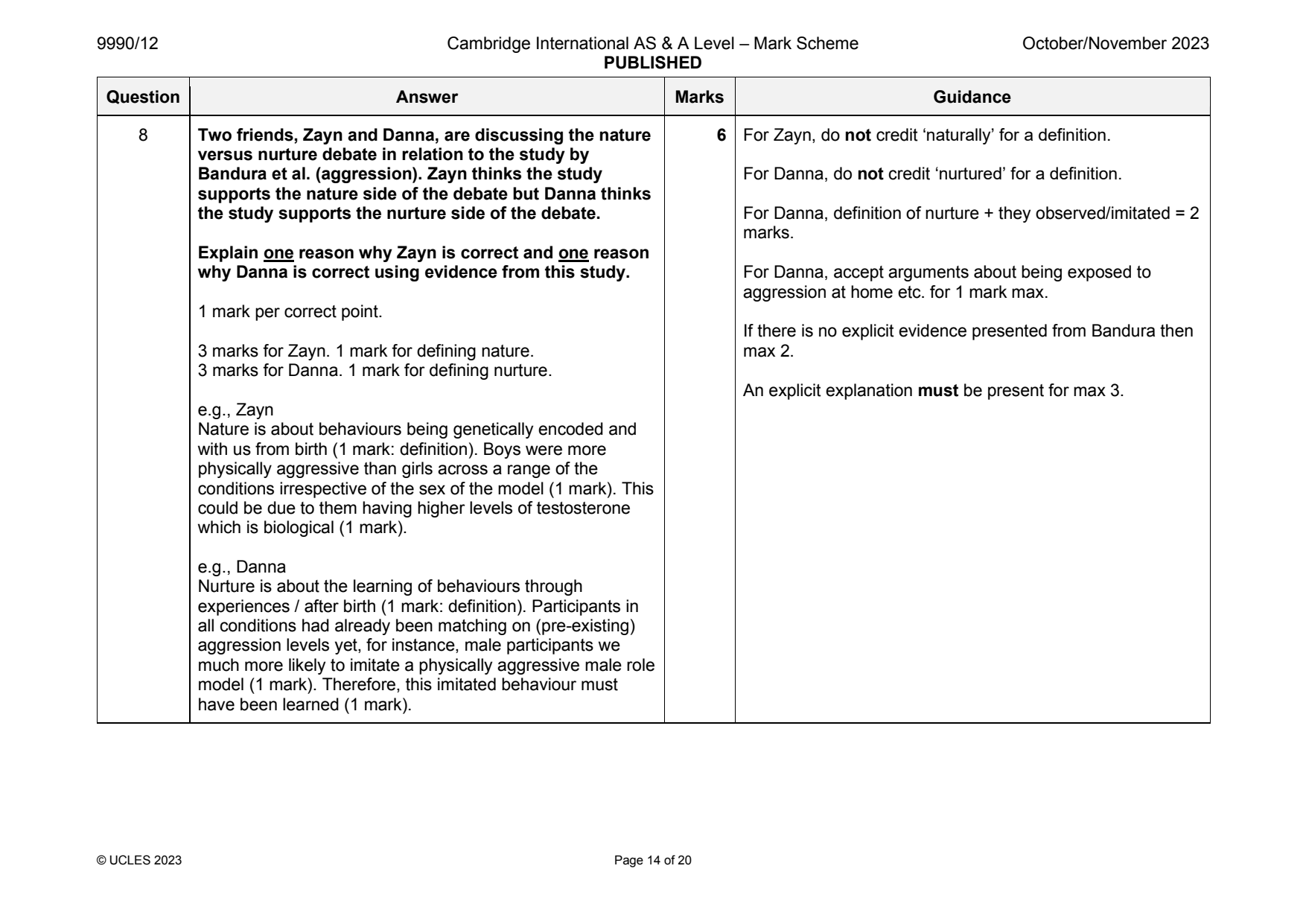
8 Two friends, Zayn and Danna, are discussing the nature 6 For Zayn, do not credit ‘naturally’ for a definition.
versus nurture debate in relation to the study by
Bandura et al. (aggression). Zayn thinks the study For Danna, do not credit ‘nurtured’ for a definition.
supports the nature side of the debate but Danna thinks
the study supports the nurture side of the debate. For Danna, definition of nurture + they observed/imitated = 2
marks.
Explain one reason why Zayn is correct and one reason
why Danna is correct using evidence from this study. For Danna, accept arguments about being exposed to
aggression at home etc. for 1 mark max.
1 mark per correct point.
If there is no explicit evidence presented from Bandura then
3 marks for Zayn. 1 mark for defining nature. max 2.
3 marks for Danna. 1 mark for defining nurture.
An explicit explanation must be present for max 3.
e.g., Zayn
Nature is about behaviours being genetically encoded and
with us from birth (1 mark: definition). Boys were more
physically aggressive than girls across a range of the
conditions irrespective of the sex of the model (1 mark). This
could be due to them having higher levels of testosterone
which is biological (1 mark).
e.g., Danna
Nurture is about the learning of behaviours through
experiences / after birth (1 mark: definition). Participants in
all conditions had already been matching on (pre-existing)
aggression levels yet, for instance, male participants we
much more likely to imitate a physically aggressive male role
model (1 mark). Therefore, this imitated behaviour must
have been learned (1 mark).
© UCLES 2023 Page 14 of 20
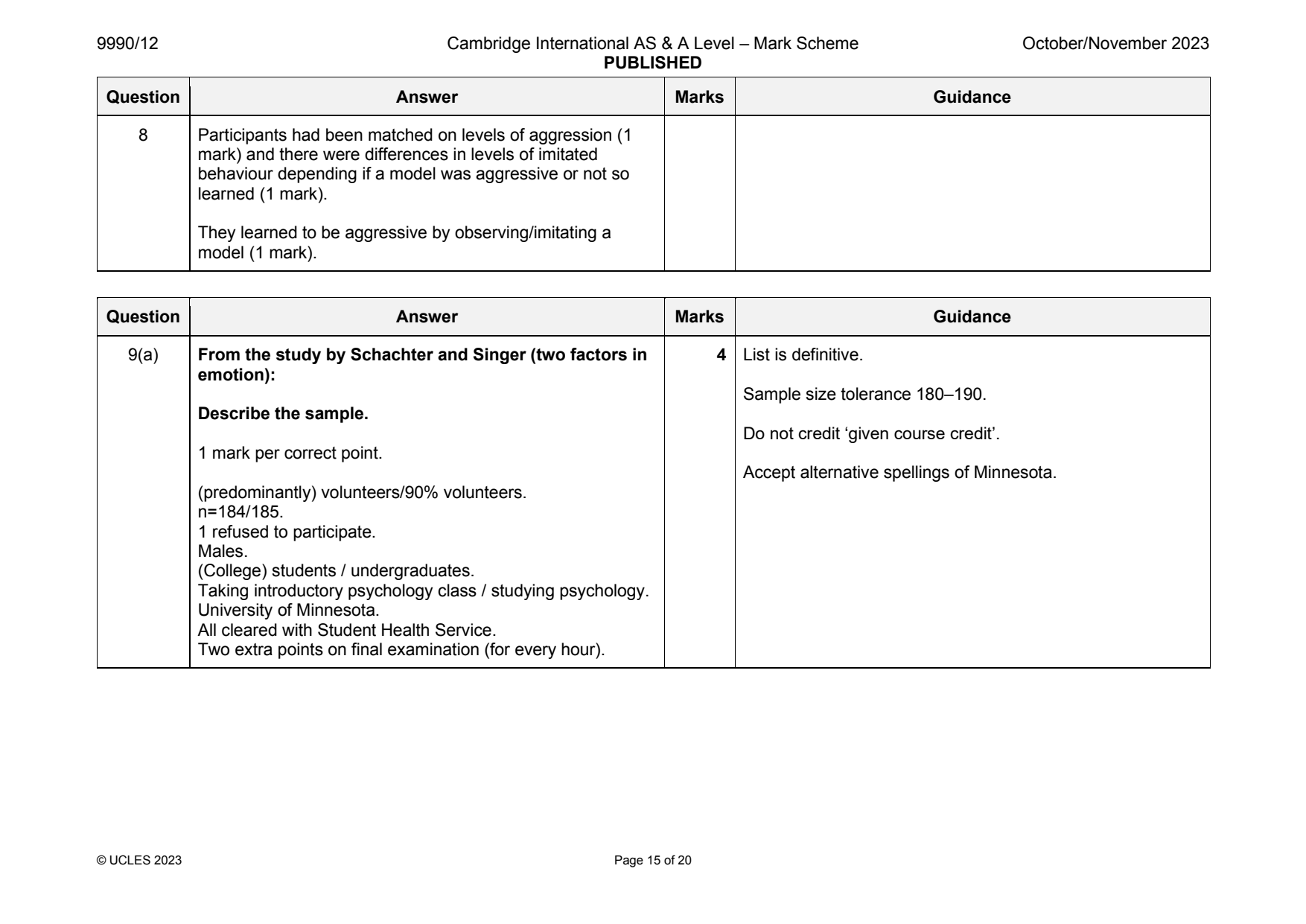
8 Participants had been matched on levels of aggression (1
mark) and there were differences in levels of imitated
behaviour depending if a model was aggressive or not so
learned (1 mark).
They learned to be aggressive by observing/imitating a
model (1 mark).
Question Answer Marks Guidance
Official mark scheme pages: 14, 15 · source PDF URL
9990-2023-on-13-q02
Oct/Nov 2023 · Paper 13 · Question 2 · 4 marks
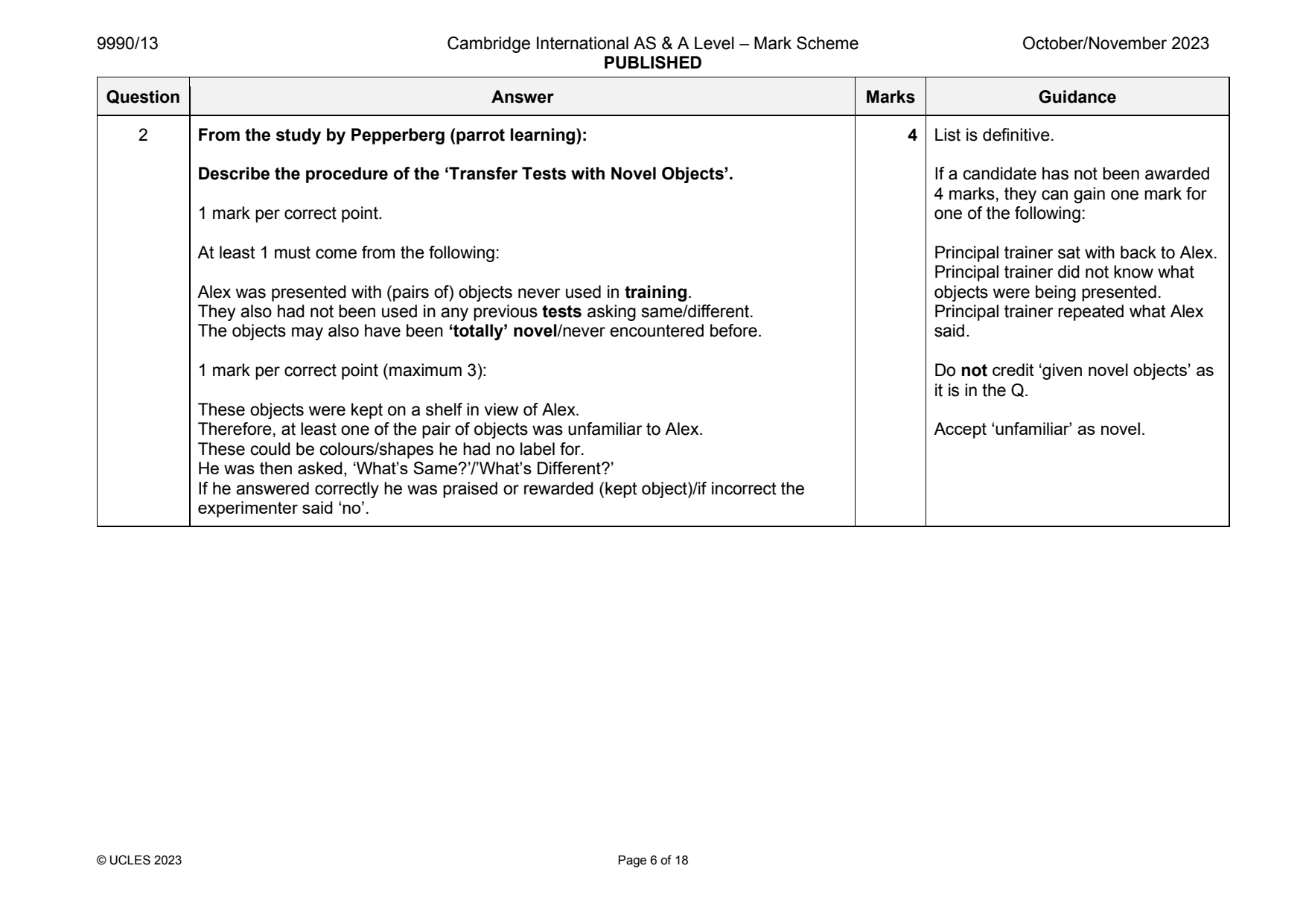
2 From the study by Pepperberg (parrot learning): 4 List is definitive.
Describe the procedure of the ‘Transfer Tests with Novel Objects’. If a candidate has not been awarded
4 marks, they can gain one mark for
1 mark per correct point. one of the following:
At least 1 must come from the following: Principal trainer sat with back to Alex.
Principal trainer did not know what
Alex was presented with (pairs of) objects never used in training. objects were being presented.
They also had not been used in any previous tests asking same/different. Principal trainer repeated what Alex
The objects may also have been ‘totally’ novel/never encountered before. said.
1 mark per correct point (maximum 3): Do not credit ‘given novel objects’ as
it is in the Q.
These objects were kept on a shelf in view of Alex.
Therefore, at least one of the pair of objects was unfamiliar to Alex. Accept ‘unfamiliar’ as novel.
These could be colours/shapes he had no label for.
He was then asked, ‘What’s Same?’/’What’s Different?’
If he answered correctly he was praised or rewarded (kept object)/if incorrect the
experimenter said ‘no’.
© UCLES 2023 Page 6 of 18
Official mark scheme pages: 6 · source PDF URL
9990-2023-on-13-q06
Oct/Nov 2023 · Paper 13 · Question 6 · 6 marks
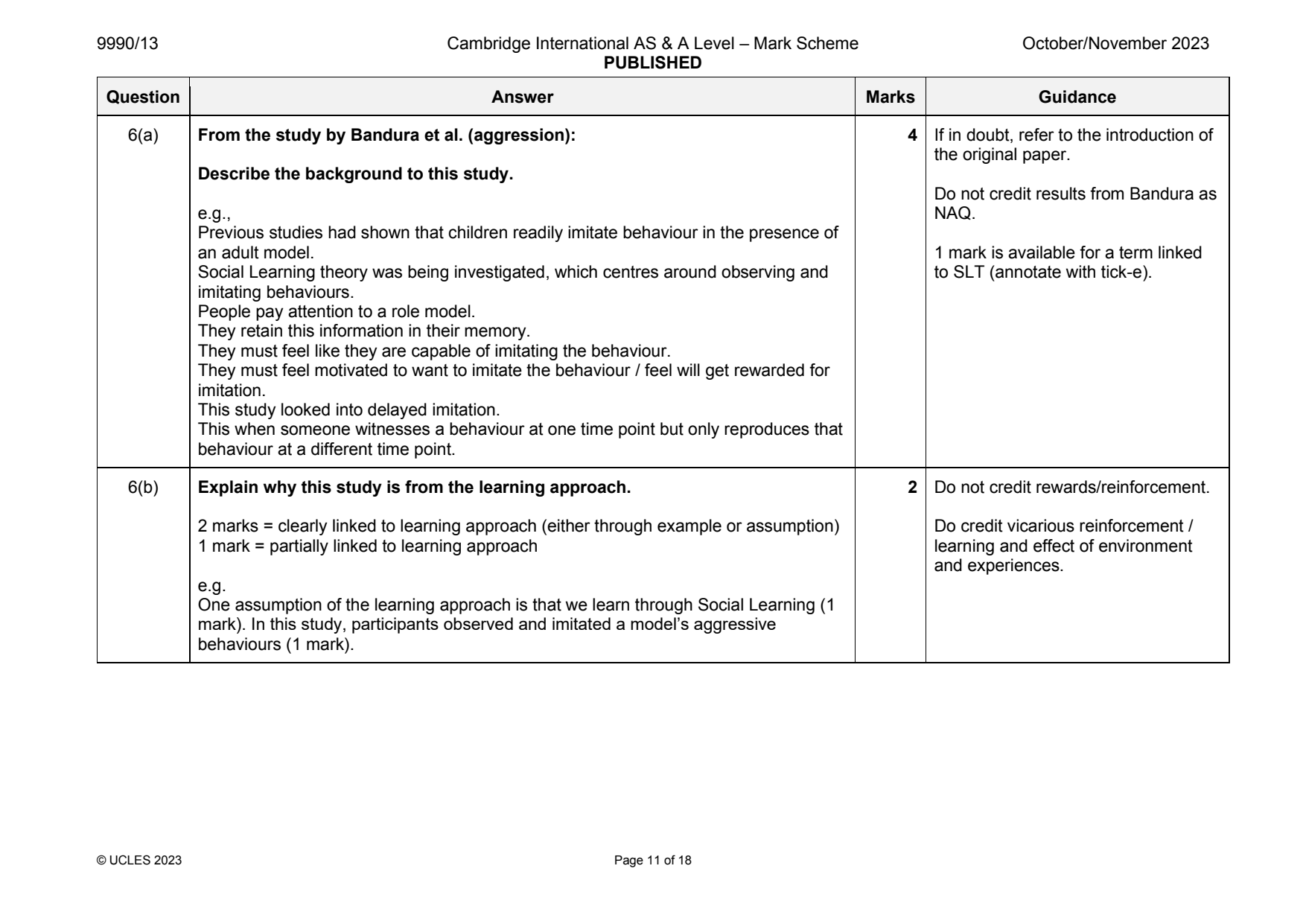
6(a) From the study by Bandura et al. (aggression): 4 If in doubt, refer to the introduction of
the original paper.
Describe the background to this study.
Do not credit results from Bandura as
e.g., NAQ.
Previous studies had shown that children readily imitate behaviour in the presence of
an adult model. 1 mark is available for a term linked
Social Learning theory was being investigated, which centres around observing and to SLT (annotate with tick-e).
imitating behaviours.
People pay attention to a role model.
They retain this information in their memory.
They must feel like they are capable of imitating the behaviour.
They must feel motivated to want to imitate the behaviour / feel will get rewarded for
imitation.
This study looked into delayed imitation.
This when someone witnesses a behaviour at one time point but only reproduces that
behaviour at a different time point.
6(b) Explain why this study is from the learning approach. 2 Do not credit rewards/reinforcement.
2 marks = clearly linked to learning approach (either through example or assumption) Do credit vicarious reinforcement /
1 mark = partially linked to learning approach learning and effect of environment
and experiences.
e.g.
One assumption of the learning approach is that we learn through Social Learning (1
mark). In this study, participants observed and imitated a model’s aggressive
behaviours (1 mark).
© UCLES 2023 Page 11 of 18
Official mark scheme pages: 11 · source PDF URL
9990-2023-on-13-q07
Oct/Nov 2023 · Paper 13 · Question 7 · 4 marks
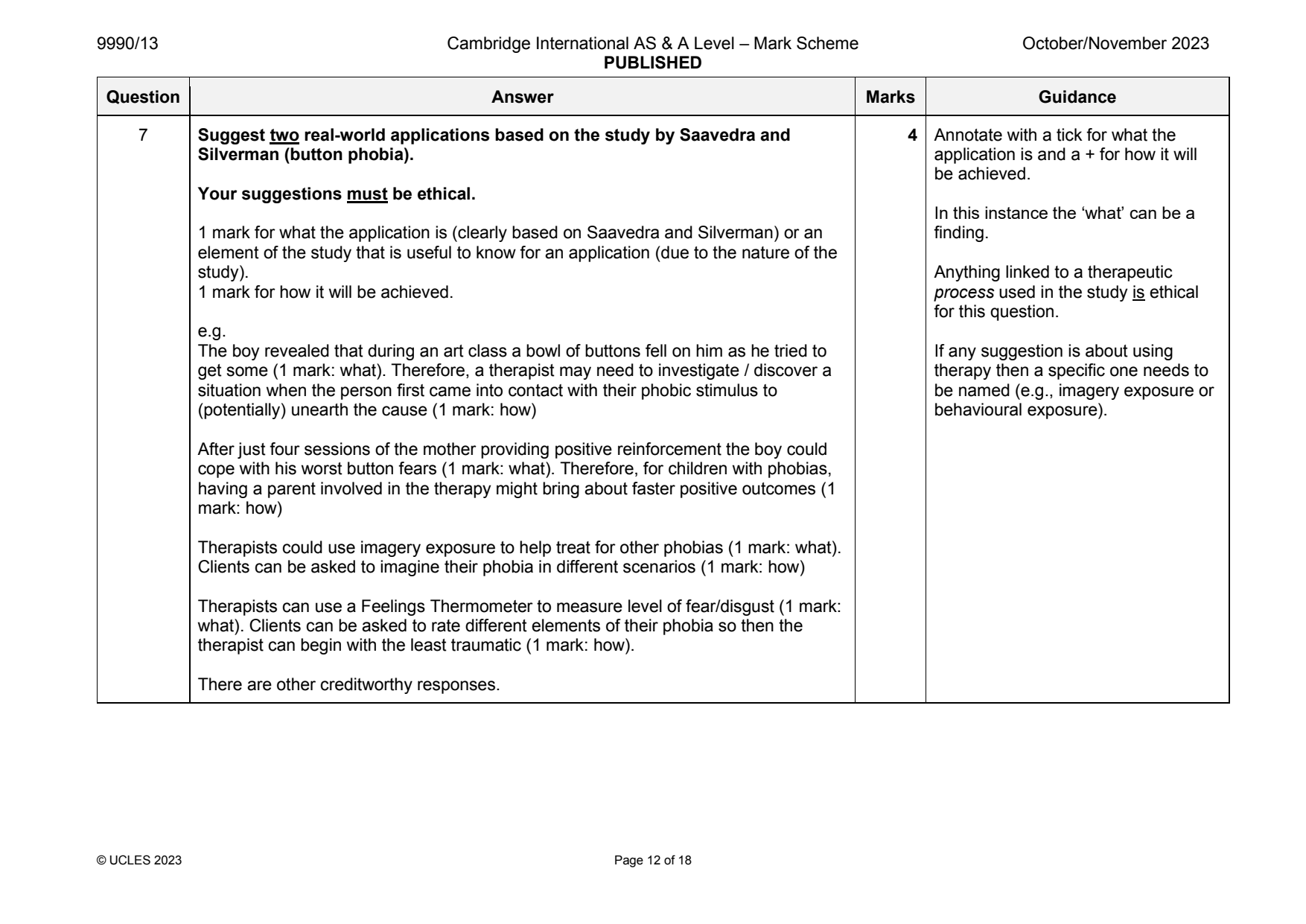
7 Suggest two real-world applications based on the study by Saavedra and 4 Annotate with a tick for what the
Silverman (button phobia). application is and a + for how it will
be achieved.
Your suggestions must be ethical.
In this instance the ‘what’ can be a
1 mark for what the application is (clearly based on Saavedra and Silverman) or an finding.
element of the study that is useful to know for an application (due to the nature of the
study). Anything linked to a therapeutic
1 mark for how it will be achieved. process used in the study is ethical
for this question.
e.g.
The boy revealed that during an art class a bowl of buttons fell on him as he tried to If any suggestion is about using
get some (1 mark: what). Therefore, a therapist may need to investigate / discover a therapy then a specific one needs to
situation when the person first came into contact with their phobic stimulus to be named (e.g., imagery exposure or
(potentially) unearth the cause (1 mark: how) behavioural exposure).
After just four sessions of the mother providing positive reinforcement the boy could
cope with his worst button fears (1 mark: what). Therefore, for children with phobias,
having a parent involved in the therapy might bring about faster positive outcomes (1
mark: how)
Therapists could use imagery exposure to help treat for other phobias (1 mark: what).
Clients can be asked to imagine their phobia in different scenarios (1 mark: how)
Therapists can use a Feelings Thermometer to measure level of fear/disgust (1 mark:
what). Clients can be asked to rate different elements of their phobia so then the
therapist can begin with the least traumatic (1 mark: how).
There are other creditworthy responses.
© UCLES 2023 Page 12 of 18
Official mark scheme pages: 12 · source PDF URL
9990-2024-m-12-q02
March 2024 · Paper 12 · Question 2 · 5 marks
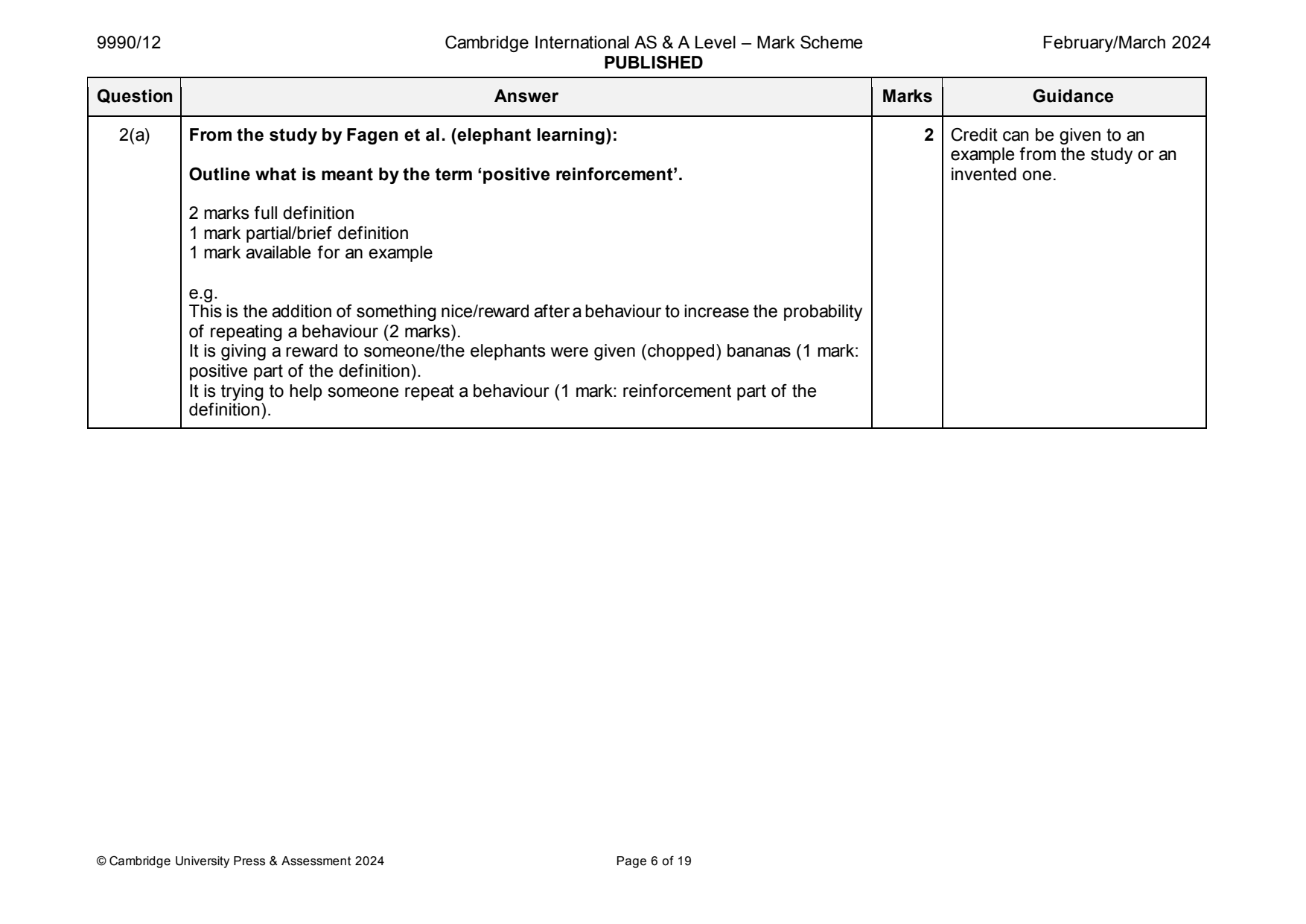
2(a) From the study by Fagen et al. (elephant learning): 2 Credit can be given to an
example from the study or an
Outline what is meant by the term ‘positive reinforcement’. invented one.
2 marks full definition
1 mark partial/brief definition
1 mark available for an example
e.g.
This is the addition of something nice/reward after a behaviour to increase the probability
of repeating a behaviour (2 marks).
It is giving a reward to someone/the elephants were given (chopped) bananas (1 mark:
positive part of the definition).
It is trying to help someone repeat a behaviour (1 mark: reinforcement part of the
definition).
© Cambridge University Press & Assessment 2024 Page 6 of 19
2(b) Outline one result in relation to the number of sessions it took for the elephants to 3 No tolerance on data.
pass the full trunk wash test. You must use data in your answer.
Use tick-d annotation when
2 marks for the result with a meaningful comparison awarding the data mark.
1 mark for result with no meaningful comparison
1 mark for correct data The answer must refer to the
number of sessions rather than
e.g., 3 marks (meaningful comparison plus data): whether they passed it or not
Elephant 2 took fewer sessions to pass the trunk compared to Elephant 4. It took (however, can credit elephant 5
elephant 2, 25 sessions. not passing).
The juvenile elephants passed within 25–35 sessions/all within 35 sessions whereas as
the older elephant never passed. If comparison is based on
correct data then award
e.g., 2 marks (meaningful comparison but no data or data but no group comparison): maximum marks.
Elephant 2 took fewer sessions to pass the trunk compared to Elephant 4.
The juvenile elephants passed within 25–35 sessions.
e.g., 1 mark (no meaningful comparison and no data):
Elephant 2 required the least number of sessions (to pass).
© Cambridge University Press & Assessment 2024 Page 7 of 19
Official mark scheme pages: 6, 7 · source PDF URL
9990-2024-m-12-q08
March 2024 · Paper 12 · Question 8 · 4 marks
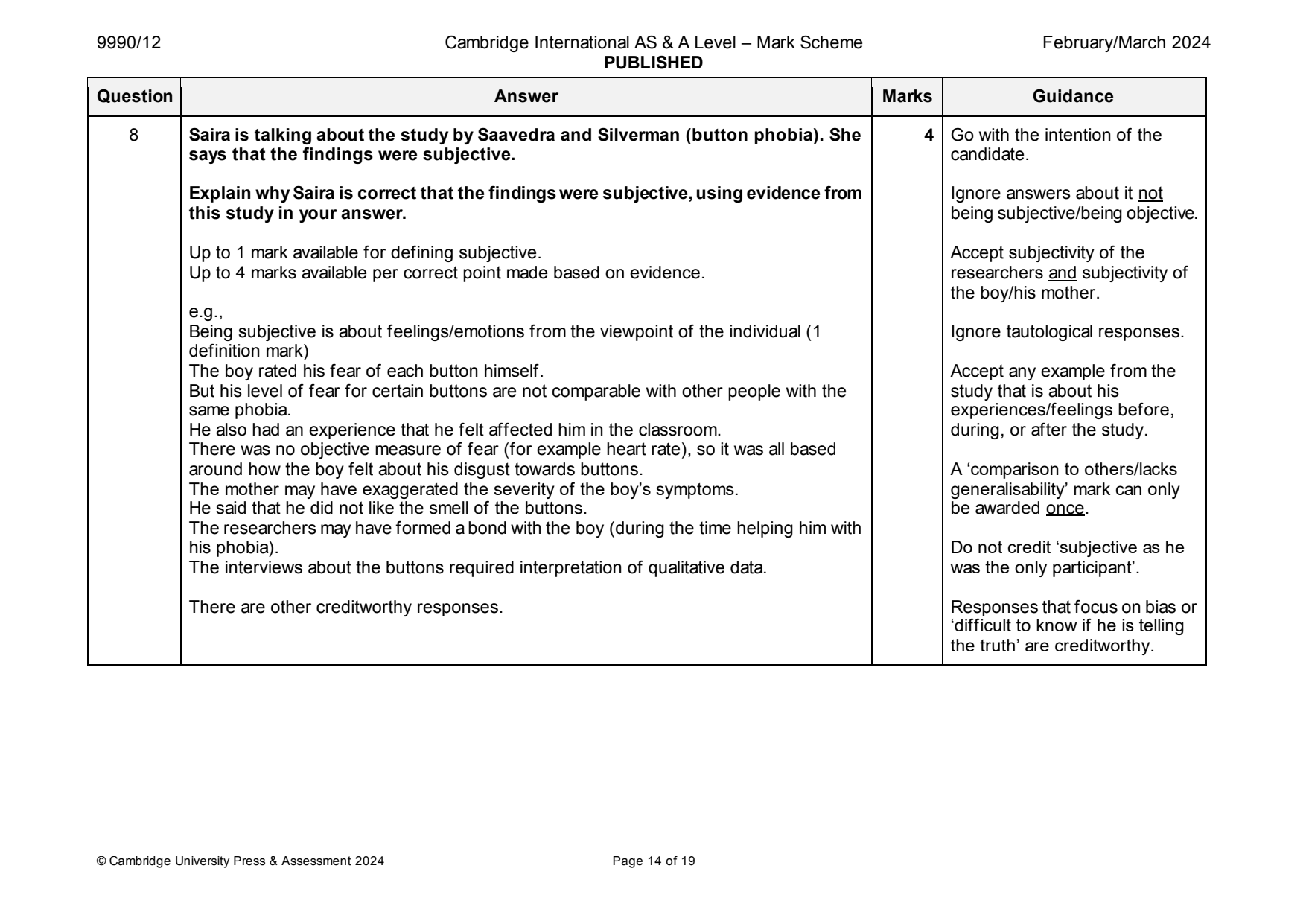
8 Saira is talking about the study by Saavedra and Silverman (button phobia). She 4 Go with the intention of the
says that the findings were subjective. candidate.
Explain why Saira is correct that the findings were subjective, using evidence from Ignore answers about it not
this study in your answer. being subjective/being objective.
Up to 1 mark available for defining subjective. Accept subjectivity of the
Up to 4 marks available per correct point made based on evidence. researchers and subjectivity of
the boy/his mother.
e.g.,
Being subjective is about feelings/emotions from the viewpoint of the individual (1 Ignore tautological responses.
definition mark)
The boy rated his fear of each button himself. Accept any example from the
But his level of fear for certain buttons are not comparable with other people with the study that is about his
same phobia. experiences/feelings before,
He also had an experience that he felt affected him in the classroom. during, or after the study.
There was no objective measure of fear (for example heart rate), so it was all based
around how the boy felt about his disgust towards buttons. A ‘comparison to others/lacks
The mother may have exaggerated the severity of the boy’s symptoms. generalisability’ mark can only
He said that he did not like the smell of the buttons. be awarded once.
The researchers may have formed a bond with the boy (during the time helping him with
his phobia). Do not credit ‘subjective as he
The interviews about the buttons required interpretation of qualitative data. was the only participant’.
There are other creditworthy responses. Responses that focus on bias or
‘difficult to know if he is telling
the truth’ are creditworthy.
© Cambridge University Press & Assessment 2024 Page 14 of 19
Official mark scheme pages: 14 · source PDF URL
9990-2024-mj-11-q04
May/June 2024 · Paper 11 · Question 4 · 5 marks
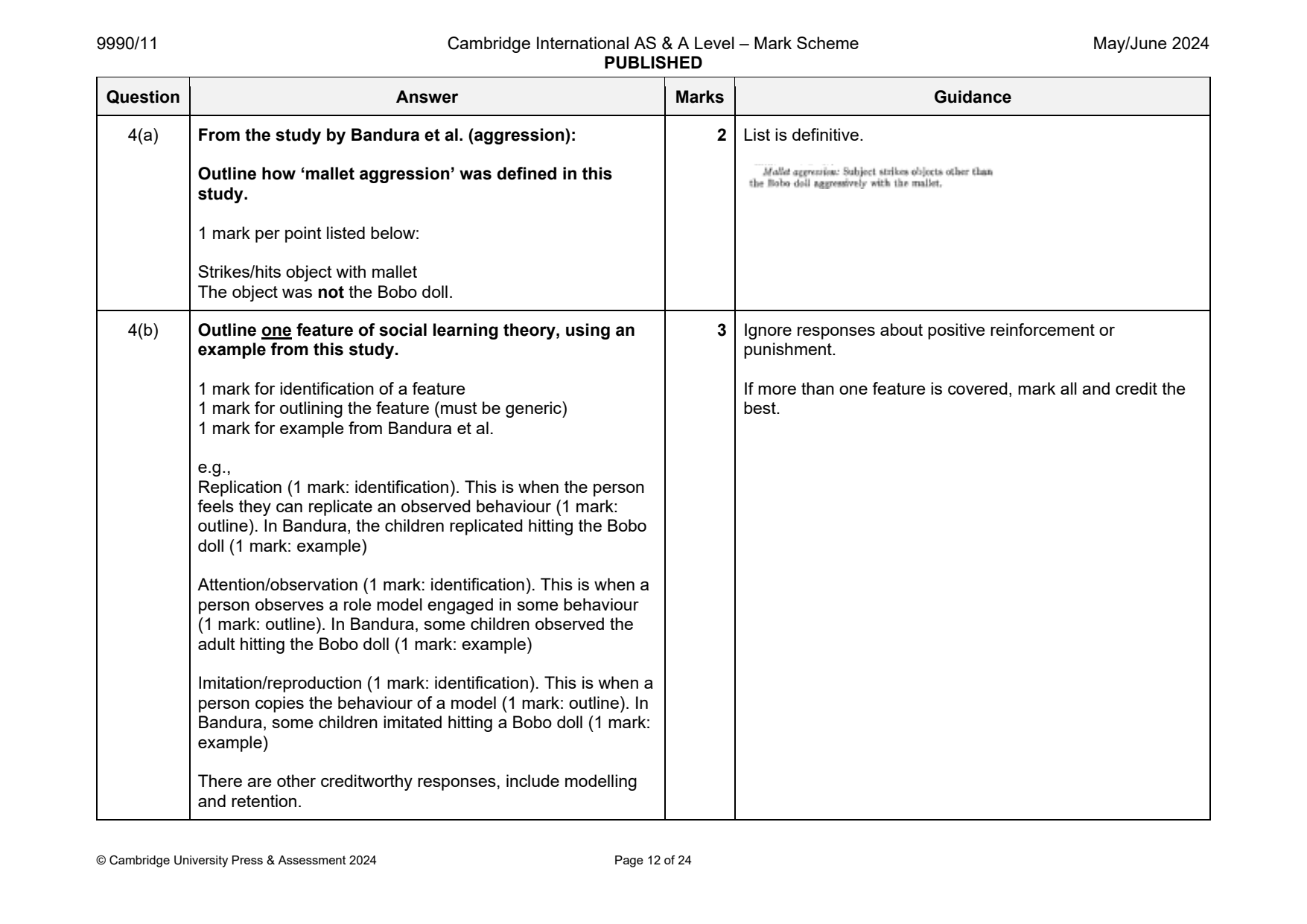
4(a) From the study by Bandura et al. (aggression): 2 List is definitive.
Outline how ‘mallet aggression’ was defined in this
study.
1 mark per point listed below:
Strikes/hits object with mallet
The object was not the Bobo doll.
4(b) Outline one feature of social learning theory, using an 3 Ignore responses about positive reinforcement or
example from this study. punishment.
1 mark for identification of a feature If more than one feature is covered, mark all and credit the
1 mark for outlining the feature (must be generic) best.
1 mark for example from Bandura et al.
e.g.,
Replication (1 mark: identification). This is when the person
feels they can replicate an observed behaviour (1 mark:
outline). In Bandura, the children replicated hitting the Bobo
doll (1 mark: example)
Attention/observation (1 mark: identification). This is when a
person observes a role model engaged in some behaviour
(1 mark: outline). In Bandura, some children observed the
adult hitting the Bobo doll (1 mark: example)
Imitation/reproduction (1 mark: identification). This is when a
person copies the behaviour of a model (1 mark: outline). In
Bandura, some children imitated hitting a Bobo doll (1 mark:
example)
There are other creditworthy responses, include modelling
and retention.
© Cambridge University Press & Assessment 2024 Page 12 of 24
Official mark scheme pages: 12 · source PDF URL
9990-2024-mj-11-q10
May/June 2024 · Paper 11 · Question 10 · 10 marks
10 Evaluate the study by Fagen et al. (elephant learning) in 10 Do not credit demand characteristics low as used elephants.
terms of two strengths and two weaknesses. At least
one of your evaluation points must be about Do accept arguments about using elephants for this type of
quantitative data. research is more practical than using humans.
Strengths include: reliability, standardisation, validity
(internal), quantitative data, ethics
Weaknesses include: sample, ethics.
Example: in detail
The study collected quantitative data which makes it easier
to make meaningful comparisons between
groups/conditions. They counted the number of trials it took
to pass the trunk wash and the degree of difficulty for each
task. As a result, they could compare performance across
the five elephant participants to see any trends/differences
etc.
Example: brief but in context
The sample only had 5 elephants as part of it. This could
make generalisations difficult as they might not represent
other elephants including adult ones.
Example: no context
The study followed a standardised procedure making it
easier to replicate.
© Cambridge University Press & Assessment 2024 Page 22 of 24
9990/11 Cambridge International AS & A Level – Mark Scheme May/June 2024
PUBLISHED
Question Answer Marks Guidance
10
Level Description Mark
5 Very good evaluation including the 9–10
named issue.
Thoroughly addresses both
strengths and both weaknesses in
detail.
Selection of evidence is very
thorough and effective.
4 Good evaluation including the 7–8
named issue.
Addresses strengths and
weaknesses but may include three
or four points. The majority of the
points are in depth.
Selection of evidence is thorough
and effective.
3 Mostly appropriate evaluation but 5–6
may not include the named issue.
Addresses either two strengths or
two weaknesses in detail or one of
each in detail or all four briefly.
Selection of evidence is mostly
effective.
© Cambridge University Press & Assessment 2024 Page 23 of 24
9990/11 Cambridge International AS & A Level – Mark Scheme May/June 2024
PUBLISHED
Question Answer Marks Guidance
10
Level Description Mark
2 Weak evaluation and may not 3–4
include the named issue.
Addresses either a strength or a
weakness. Evaluation points are
brief.
Some points may have no context.
Selection of evidence is sometimes
appropriate.
1 Little or no evaluation. 1–2
Discussion of strengths and
weaknesses is absent or
superficial.
Selection of evidence is limited.
0 No creditable response.
© Cambridge University Press & Assessment 2024 Page 24 of 24
Official mark scheme pages: 22, 23, 24 · source PDF URL
9990-2024-mj-12-q01
May/June 2024 · Paper 12 · Question 1 · 5 marks
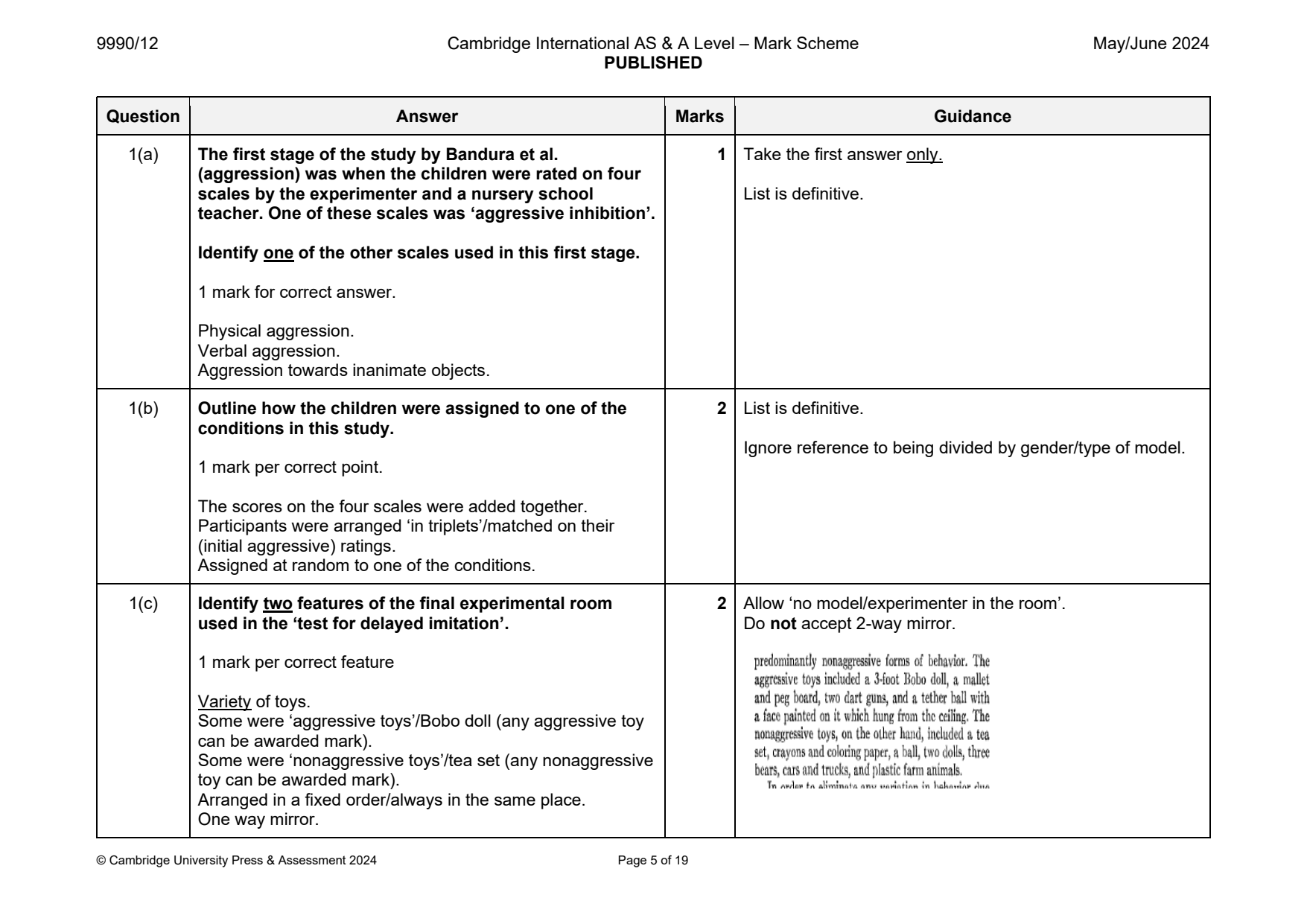
1(a) The first stage of the study by Bandura et al. 1 Take the first answer only.
(aggression) was when the children were rated on four
scales by the experimenter and a nursery school List is definitive.
teacher. One of these scales was ‘aggressive inhibition’.
Identify one of the other scales used in this first stage.
1 mark for correct answer.
Physical aggression.
Verbal aggression.
Aggression towards inanimate objects.
1(b) Outline how the children were assigned to one of the 2 List is definitive.
conditions in this study.
Ignore reference to being divided by gender/type of model.
1 mark per correct point.
The scores on the four scales were added together.
Participants were arranged ‘in triplets’/matched on their
(initial aggressive) ratings.
Assigned at random to one of the conditions.
1(c) Identify two features of the final experimental room 2 Allow ‘no model/experimenter in the room’.
used in the ‘test for delayed imitation’. Do not accept 2-way mirror.
1 mark per correct feature
Variety of toys.
Some were ‘aggressive toys’/Bobo doll (any aggressive toy
can be awarded mark).
Some were ‘nonaggressive toys’/tea set (any nonaggressive
toy can be awarded mark).
Arranged in a fixed order/always in the same place.
One way mirror.
© Cambridge University Press & Assessment 2024 Page 5 of 19
Official mark scheme pages: 5 · source PDF URL
9990-2024-mj-12-q09
May/June 2024 · Paper 12 · Question 9 · 12 marks
9(a) Describe the psychology being investigated in the study 4 No identification mark.
by Fagen et al. (elephant learning).
Ignore reference to classical conditioning.
1 mark per correct point.
1 mark available for example from the study by Fagen et al.
e.g.,
Operant conditioning is learning by consequence.
If you are rewarded you are more likely to repeat a
behaviour
The elephants got chopped banana if they were successful
at any task (example)
If you are punished you are less likely to repeat a behaviour
A primary reinforcer is one that fulfils a biological need.
A secondary reinforcer can be used as an exchange for a
primary reinforcer.
Secondary positive reinforcement can use a sound as a
secondary reinforcer that is consistently followed by a
primary reinforcer/food.
There are other creditworthy responses, including shaping
and behavioural chaining.
© Cambridge University Press & Assessment 2024 Page 14 of 19
9(b) Explain one similarity and one difference between the 8 Award L1–L4 for similarity.
study by Fagen et al. (elephant learning) and one other Award L1–L4 for difference.
study from the learning approach.
For Level 4 there must be some attempt at explaining the
Use the marking grid below. similarity or difference.
4 marks for the similarity, e.g., observational, lack mundane
The other studies from the learning approach are:
realism, quantitative data collection, use of rewards/operant
conditioning, standardisation, lacking generalisability.
Bandura
4 marks for the difference, e.g., qualitative data collection,
Saavedra and Silverman
sample, level of controls.
Different species = L1.
e.g., similarity
Different aims = L1.
e.g. 4 marks
Different ethical guidelines = L1
Both the Fagen study and the Bandura study used
observation as part of their data collection techniques. This
Both opportunity sampling (for Bandura and S&S
means that specific behaviours could be operationalised to
comparison) = L2
improve validity (explanation). For example, in Fagen there
was trunk down which meant the trunk was hanging loose
For description of the sample (e.g., n=….) from the two
and in Bandura gun play was pretending to shoot at an
studies with no explicit note about size differences or effect
object in the room.
on generalisability = L2
e.g. 3 marks
Both the Fagen study and the Bandura study used
observation as part of their data collection techniques. For
example, in Fagen there was trunk down which meant the
trunk was hanging loose/Bandura gun play was pretending
to shoot at an object in the room.
e.g. 2 marks
Both the Fagen study and the Bandura study used
observation as part of their data collection techniques. For
example, in Fagen there was trunk down.
e.g. 1 mark
Both the Fagen study and the Bandura study used
observation as part of their data collection techniques.
© Cambridge University Press & Assessment 2024 Page 15 of 19
9(b)
Mark/ Description
Level
4 The similarity/difference is well explained
using both studies as examples.
3 The similarity/difference is well explained
but only one study is used as an example
OR
both studies are used briefly.
2 The similarity/difference is brief with an
attempt at using at least one study as an
example OR
The similarity/difference is well explained
but there is no study evidence.
1 The similarity/difference is brief with no
attempt at using the studies as examples.
0 No creditable response.
© Cambridge University Press & Assessment 2024 Page 16 of 19
Official mark scheme pages: 14, 15, 16 · source PDF URL
9990-2024-mj-13-q02
May/June 2024 · Paper 13 · Question 2 · 4 marks
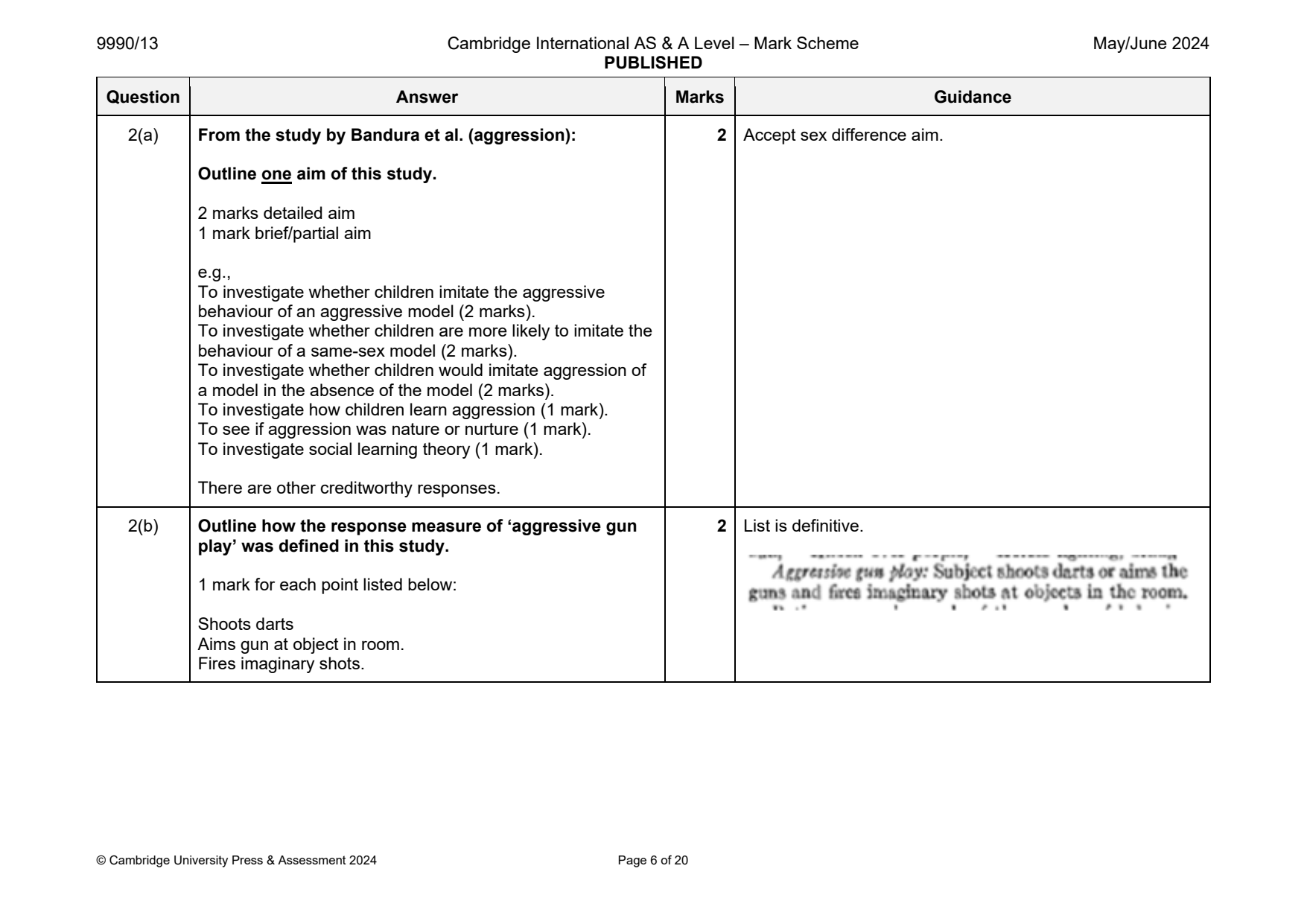
2(a) From the study by Bandura et al. (aggression): 2 Accept sex difference aim.
Outline one aim of this study.
2 marks detailed aim
1 mark brief/partial aim
e.g.,
To investigate whether children imitate the aggressive
behaviour of an aggressive model (2 marks).
To investigate whether children are more likely to imitate the
behaviour of a same-sex model (2 marks).
To investigate whether children would imitate aggression of
a model in the absence of the model (2 marks).
To investigate how children learn aggression (1 mark).
To see if aggression was nature or nurture (1 mark).
To investigate social learning theory (1 mark).
There are other creditworthy responses.
2(b) Outline how the response measure of ‘aggressive gun 2 List is definitive.
play’ was defined in this study.
1 mark for each point listed below:
Shoots darts
Aims gun at object in room.
Fires imaginary shots.
© Cambridge University Press & Assessment 2024 Page 6 of 20
Official mark scheme pages: 6 · source PDF URL
9990-2024-mj-13-q06
May/June 2024 · Paper 13 · Question 6 · 5 marks
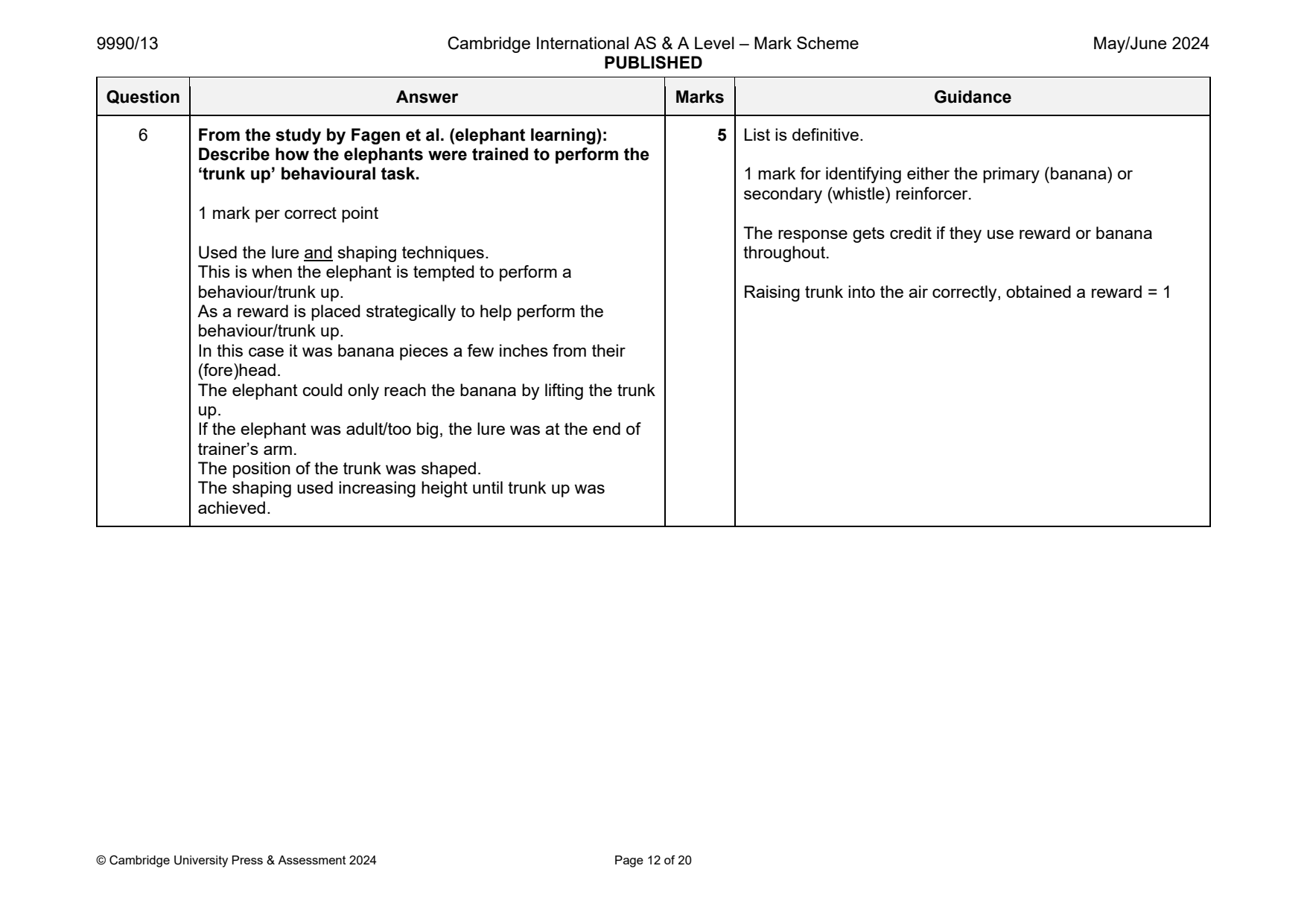
6 From the study by Fagen et al. (elephant learning): 5 List is definitive.
Describe how the elephants were trained to perform the
‘trunk up’ behavioural task. 1 mark for identifying either the primary (banana) or
secondary (whistle) reinforcer.
1 mark per correct point
The response gets credit if they use reward or banana
Used the lure and shaping techniques. throughout.
This is when the elephant is tempted to perform a
behaviour/trunk up. Raising trunk into the air correctly, obtained a reward = 1
As a reward is placed strategically to help perform the
behaviour/trunk up.
In this case it was banana pieces a few inches from their
(fore)head.
The elephant could only reach the banana by lifting the trunk
up.
If the elephant was adult/too big, the lure was at the end of
trainer’s arm.
The position of the trunk was shaped.
The shaping used increasing height until trunk up was
achieved.
© Cambridge University Press & Assessment 2024 Page 12 of 20
Official mark scheme pages: 12 · source PDF URL
9990-2024-mj-13-q10
May/June 2024 · Paper 13 · Question 10 · 10 marks
10 Evaluate the study by Saavedra and Silverman (button 10
phobia) in terms of two strengths and two weaknesses.
At least one of your evaluation points must be about
quantitative data.
Strengths include: reliability, standardisation, quantitative
data, follow-up
Weaknesses include: validity (external), sample, ethics
Example: in detail (named)
The study collected quantitative data which makes it easier
to make meaningful comparisons over time. They looked at
the change in distress ratings across different scenarios and
different time points in the therapeutic process. As a result,
they could compare the changes in distress ratings to make
more valid conclusions about the progression of his phobia.
Example: brief but in context
The sample was only one boy with a button phobia which
may make generalisation difficult. A person with a different
childhood experience or a female phobic may not respond to
therapy in the same way.
Example: no context
The sample was only one person making generalisations
difficult.
© Cambridge University Press & Assessment 2024 Page 18 of 20
10 Level guidance for Question 10
Level Description Mark
5 Very good evaluation including 910
the named issue.
Thoroughly addresses both
strengths and both weaknesses in
detail.
Selection of evidence is very
thorough and effective.
4 Good evaluation including the 78
named issue.
Addresses strengths and
weaknesses but may include
three or four points. The majority
of the points are in depth.
Selection of evidence is thorough
and effective.
3 Mostly appropriate evaluation but 56
may not include the named issue.
Addresses either two strengths or
two weaknesses in detail or one
of each in detail or all four briefly.
Selection of evidence is mostly
effective.
© Cambridge University Press & Assessment 2024 Page 19 of 20
9990/13 Cambridge International AS & A Level – Mark Scheme May/June 2024
PUBLISHED
Question Answer Marks Guidance
10
Level Description Mark
2 Weak evaluation and may not 34
include the named issue.
Addresses either a strength or a
weakness. Evaluation points are
brief.
Some points may have no
context.
Selection of evidence is
sometimes appropriate.
1 Little or no evaluation. 12
Discussion of strengths and
weaknesses is absent or
superficial.
Selection of evidence is limited.
0 No creditable response.
© Cambridge University Press & Assessment 2024 Page 20 of 20
Official mark scheme pages: 18, 19, 20 · source PDF URL
9990-2024-on-11-q02
Oct/Nov 2024 · Paper 11 · Question 2 · 4 marks
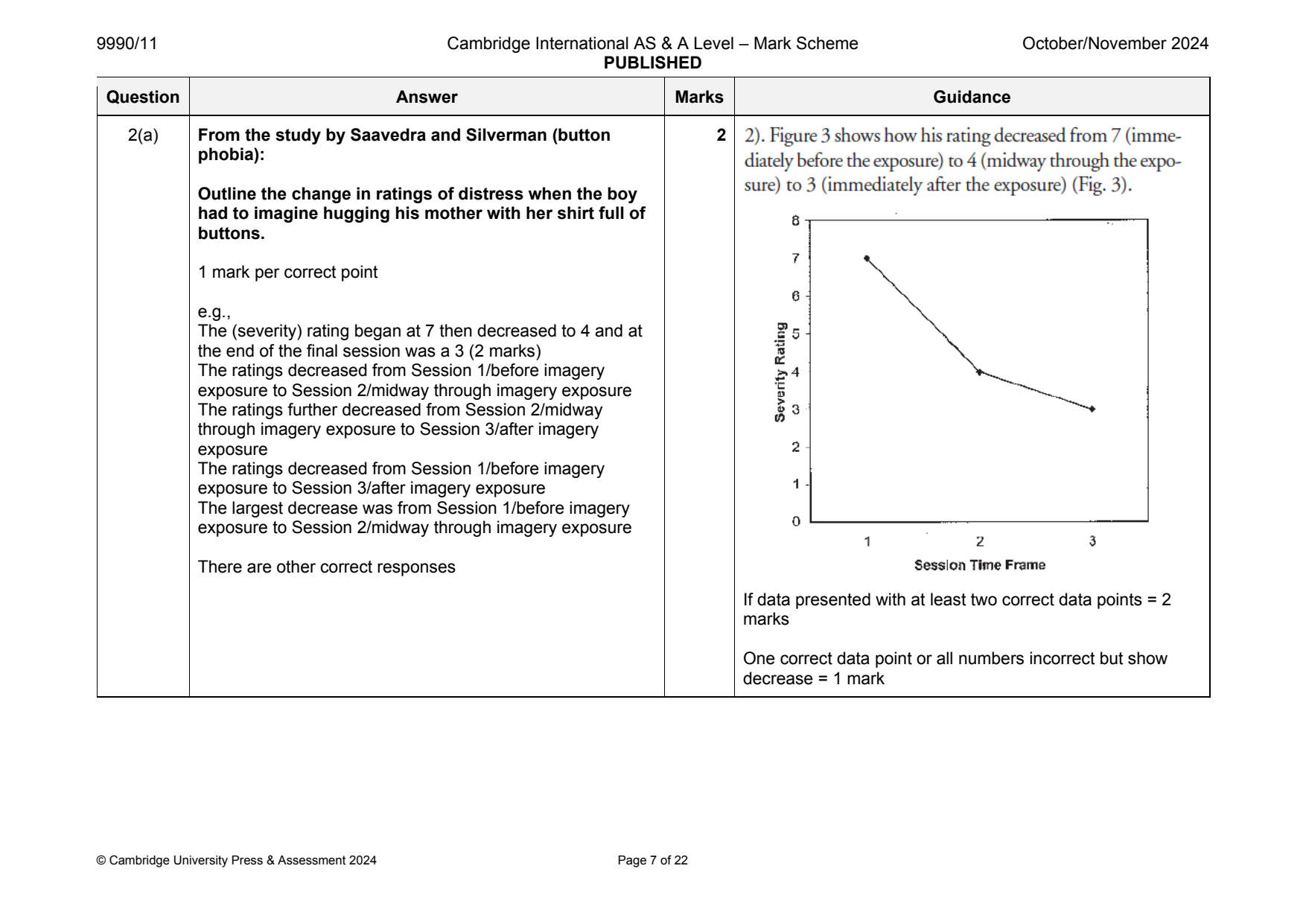
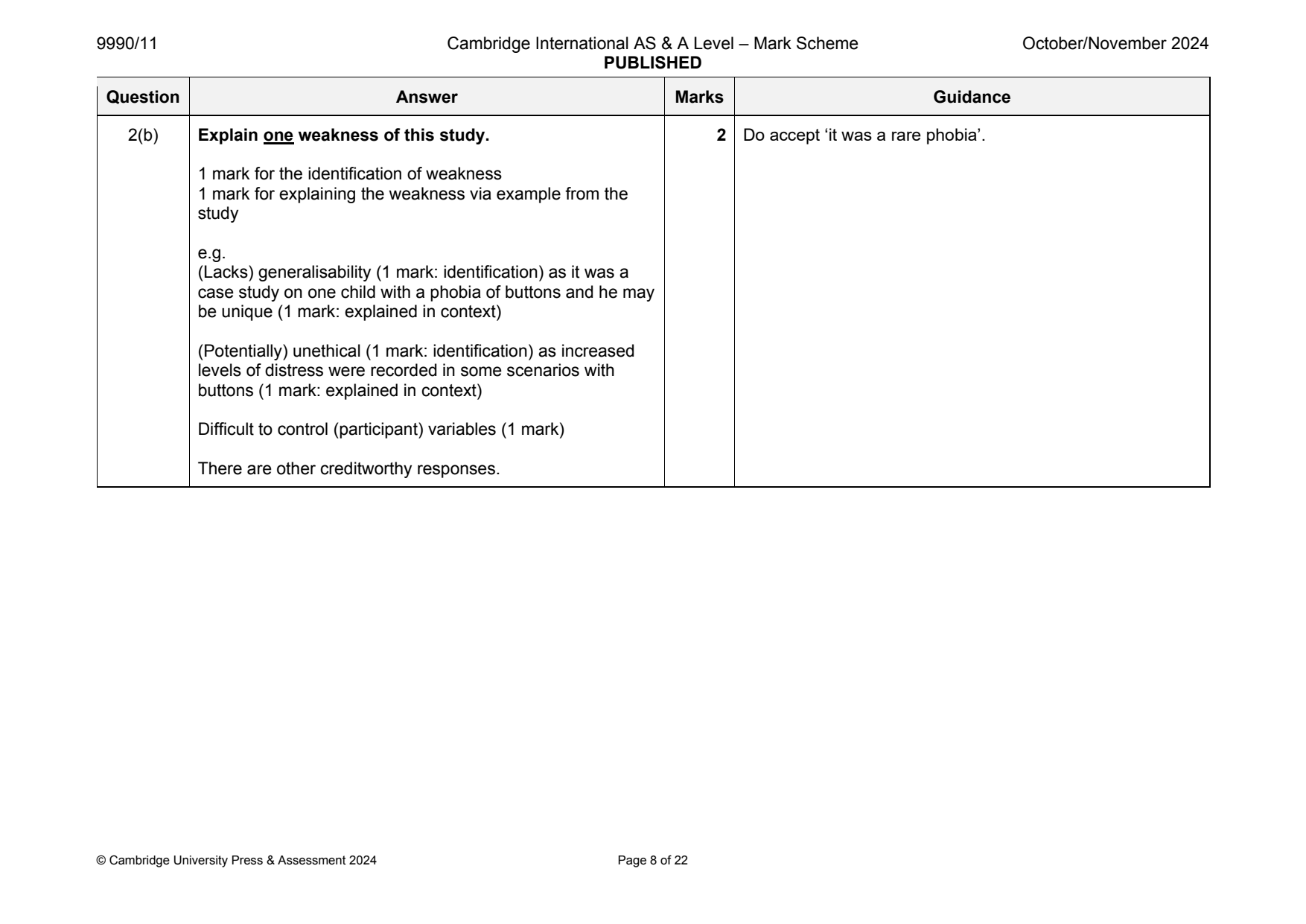
2(a) From the study by Saavedra and Silverman (button 2
phobia):
Outline the change in ratings of distress when the boy
had to imagine hugging his mother with her shirt full of
buttons.
1 mark per correct point
e.g.,
The (severity) rating began at 7 then decreased to 4 and at
the end of the final session was a 3 (2 marks)
The ratings decreased from Session 1/before imagery
exposure to Session 2/midway through imagery exposure
The ratings further decreased from Session 2/midway
through imagery exposure to Session 3/after imagery
exposure
The ratings decreased from Session 1/before imagery
exposure to Session 3/after imagery exposure
The largest decrease was from Session 1/before imagery
exposure to Session 2/midway through imagery exposure
There are other correct responses
If data presented with at least two correct data points = 2
marks
One correct data point or all numbers incorrect but show
decrease = 1 mark
© Cambridge University Press & Assessment 2024 Page 7 of 22
2(b) Explain one weakness of this study. 2 Do accept ‘it was a rare phobia’.
1 mark for the identification of weakness
1 mark for explaining the weakness via example from the
study
e.g.
(Lacks) generalisability (1 mark: identification) as it was a
case study on one child with a phobia of buttons and he may
be unique (1 mark: explained in context)
(Potentially) unethical (1 mark: identification) as increased
levels of distress were recorded in some scenarios with
buttons (1 mark: explained in context)
Difficult to control (participant) variables (1 mark)
There are other creditworthy responses.
© Cambridge University Press & Assessment 2024 Page 8 of 22
Official mark scheme pages: 7, 8 · source PDF URL
9990-2024-on-11-q10
Oct/Nov 2024 · Paper 11 · Question 10 · 10 marks
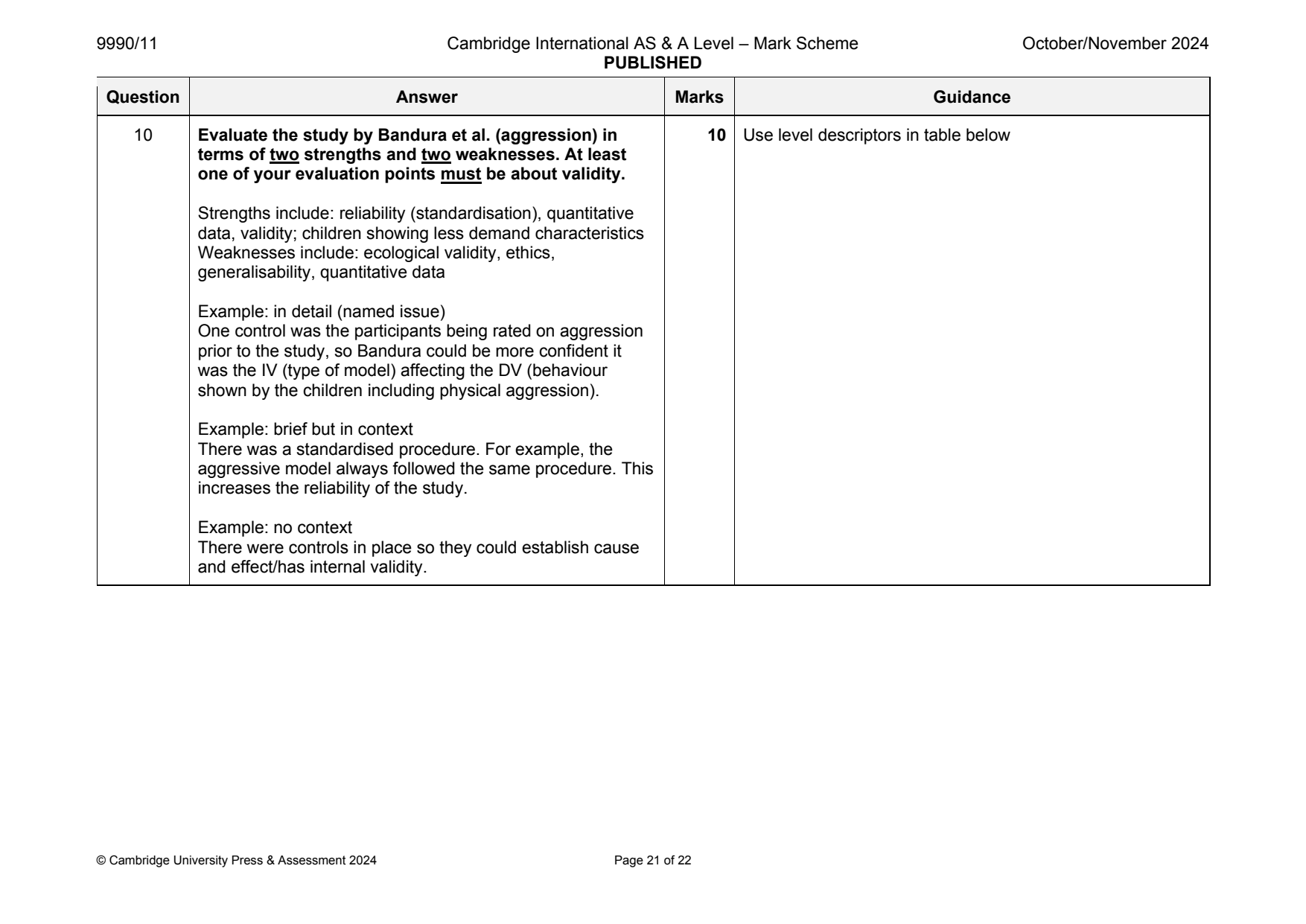
10 Evaluate the study by Bandura et al. (aggression) in 10 Use level descriptors in table below
terms of two strengths and two weaknesses. At least
one of your evaluation points must be about validity.
Strengths include: reliability (standardisation), quantitative
data, validity; children showing less demand characteristics
Weaknesses include: ecological validity, ethics,
generalisability, quantitative data
Example: in detail (named issue)
One control was the participants being rated on aggression
prior to the study, so Bandura could be more confident it
was the IV (type of model) affecting the DV (behaviour
shown by the children including physical aggression).
Example: brief but in context
There was a standardised procedure. For example, the
aggressive model always followed the same procedure. This
increases the reliability of the study.
Example: no context
There were controls in place so they could establish cause
and effect/has internal validity.
© Cambridge University Press & Assessment 2024 Page 21 of 22
Official mark scheme pages: 21 · source PDF URL
9990-2024-on-12-q01
Oct/Nov 2024 · Paper 12 · Question 1 · 5 marks
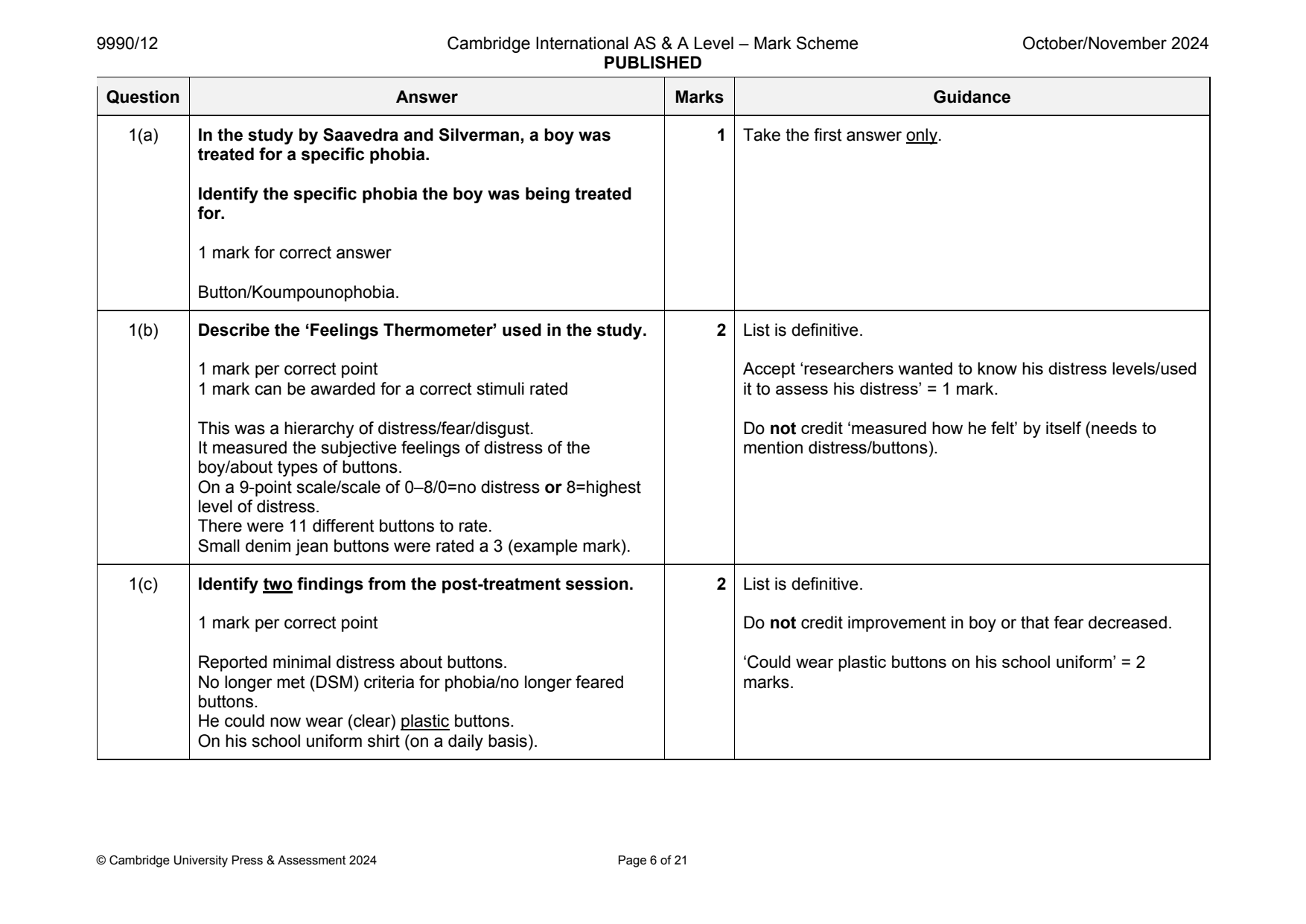
1(a) In the study by Saavedra and Silverman, a boy was 1 Take the first answer only.
treated for a specific phobia.
Identify the specific phobia the boy was being treated
for.
1 mark for correct answer
Button/Koumpounophobia.
1(b) Describe the ‘Feelings Thermometer’ used in the study. 2 List is definitive.
1 mark per correct point Accept ‘researchers wanted to know his distress levels/used
1 mark can be awarded for a correct stimuli rated it to assess his distress’ = 1 mark.
This was a hierarchy of distress/fear/disgust. Do not credit ‘measured how he felt’ by itself (needs to
It measured the subjective feelings of distress of the mention distress/buttons).
boy/about types of buttons.
On a 9-point scale/scale of 0–8/0=no distress or 8=highest
level of distress.
There were 11 different buttons to rate.
Small denim jean buttons were rated a 3 (example mark).
1(c) Identify two findings from the post-treatment session. 2 List is definitive.
1 mark per correct point Do not credit improvement in boy or that fear decreased.
Reported minimal distress about buttons. ‘Could wear plastic buttons on his school uniform’ = 2
No longer met (DSM) criteria for phobia/no longer feared marks.
buttons.
He could now wear (clear) plastic buttons.
On his school uniform shirt (on a daily basis).
© Cambridge University Press & Assessment 2024 Page 6 of 21
Official mark scheme pages: 6 · source PDF URL
9990-2024-on-12-q08
Oct/Nov 2024 · Paper 12 · Question 8 · 4 marks
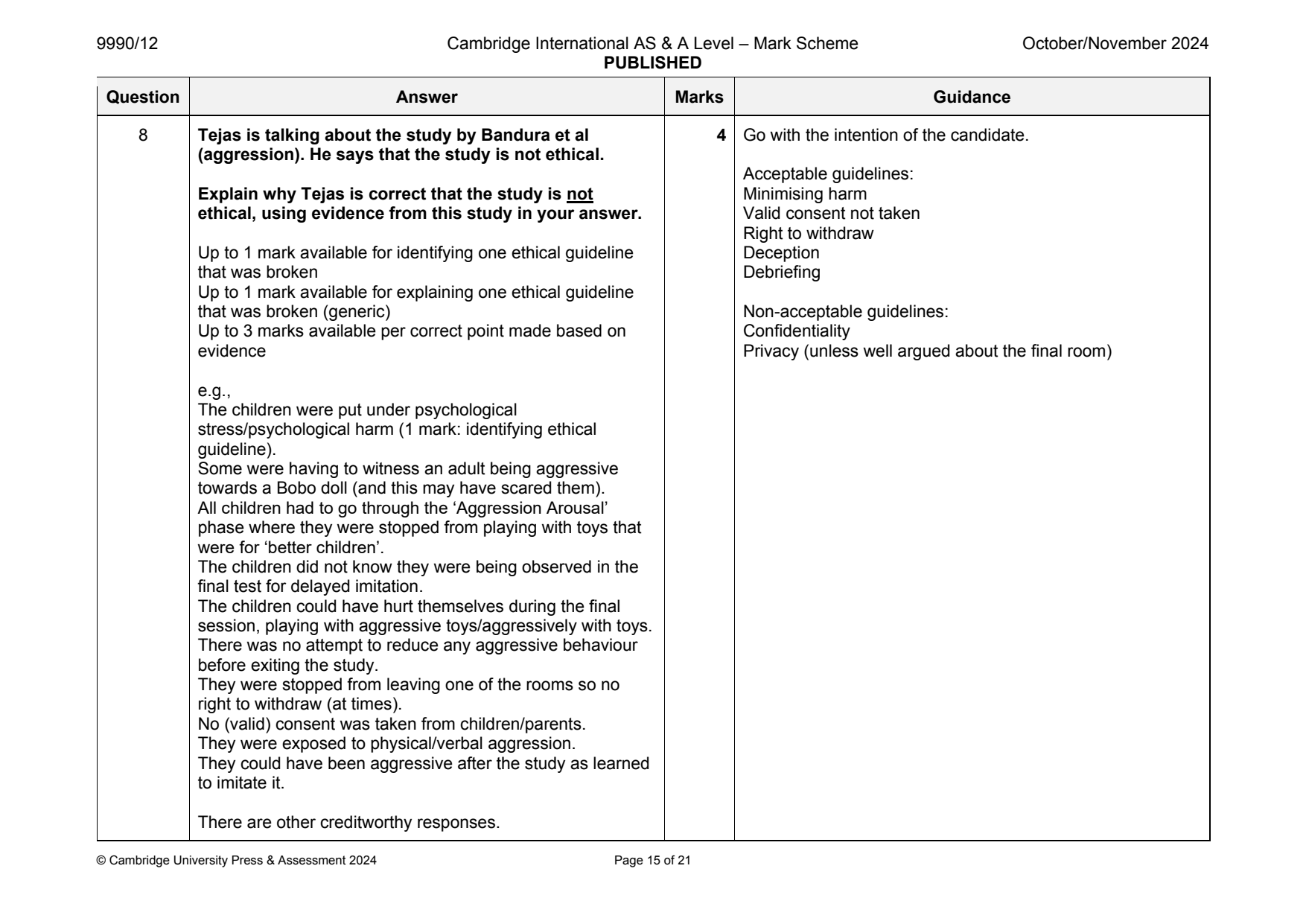
8 Tejas is talking about the study by Bandura et al 4 Go with the intention of the candidate.
(aggression). He says that the study is not ethical.
Acceptable guidelines:
Explain why Tejas is correct that the study is not Minimising harm
ethical, using evidence from this study in your answer. Valid consent not taken
Right to withdraw
Up to 1 mark available for identifying one ethical guideline Deception
that was broken Debriefing
Up to 1 mark available for explaining one ethical guideline
that was broken (generic) Non-acceptable guidelines:
Up to 3 marks available per correct point made based on Confidentiality
evidence Privacy (unless well argued about the final room)
e.g.,
The children were put under psychological
stress/psychological harm (1 mark: identifying ethical
guideline).
Some were having to witness an adult being aggressive
towards a Bobo doll (and this may have scared them).
All children had to go through the ‘Aggression Arousal’
phase where they were stopped from playing with toys that
were for ‘better children’.
The children did not know they were being observed in the
final test for delayed imitation.
The children could have hurt themselves during the final
session, playing with aggressive toys/aggressively with toys.
There was no attempt to reduce any aggressive behaviour
before exiting the study.
They were stopped from leaving one of the rooms so no
right to withdraw (at times).
No (valid) consent was taken from children/parents.
They were exposed to physical/verbal aggression.
They could have been aggressive after the study as learned
to imitate it.
There are other creditworthy responses.
© Cambridge University Press & Assessment 2024 Page 15 of 21
Official mark scheme pages: 15 · source PDF URL
9990-2024-on-13-q03
Oct/Nov 2024 · Paper 13 · Question 3 · 4 marks
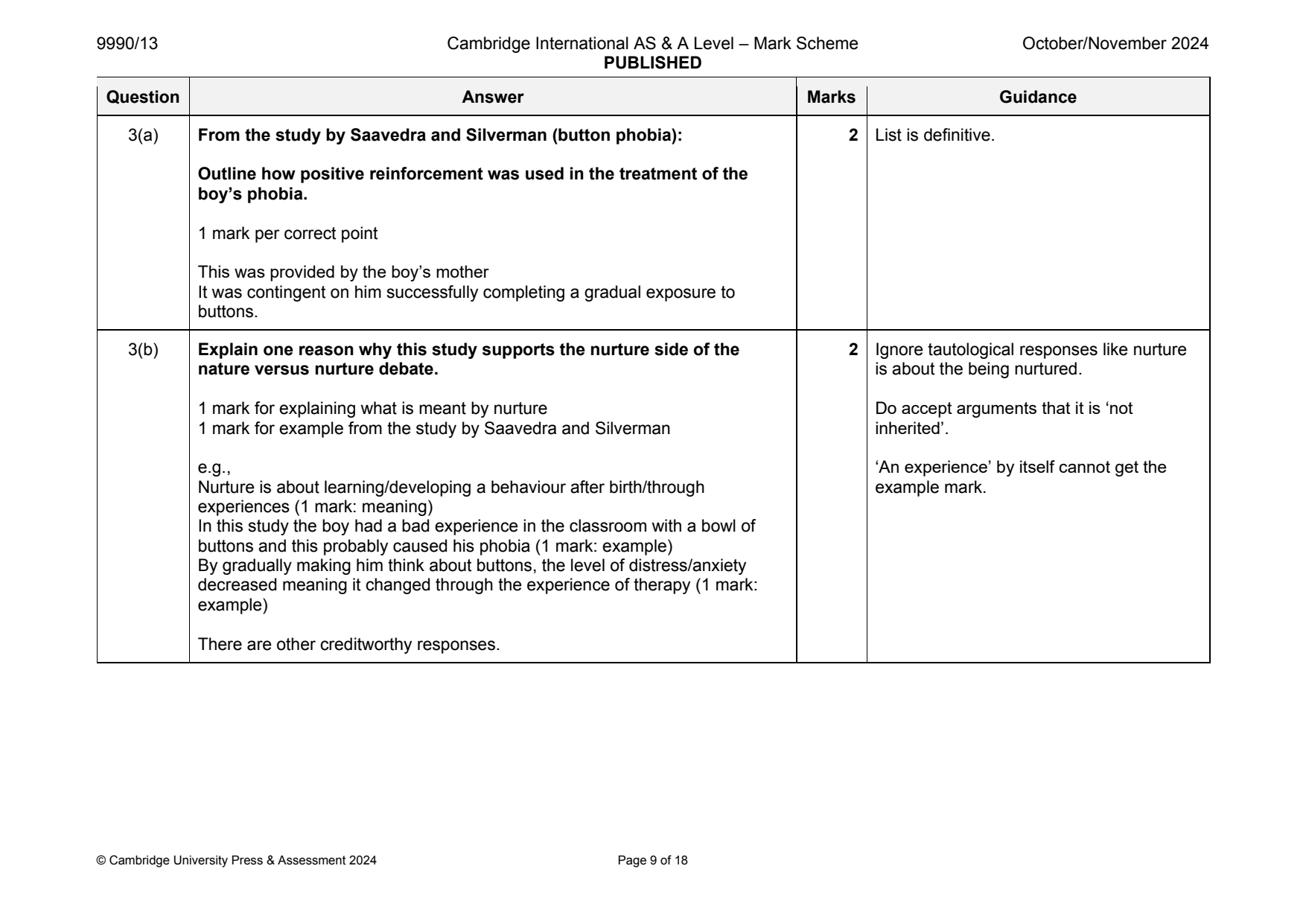
3(a) From the study by Saavedra and Silverman (button phobia): 2 List is definitive.
Outline how positive reinforcement was used in the treatment of the
boy’s phobia.
1 mark per correct point
This was provided by the boy’s mother
It was contingent on him successfully completing a gradual exposure to
buttons.
3(b) Explain one reason why this study supports the nurture side of the 2 Ignore tautological responses like nurture
nature versus nurture debate. is about the being nurtured.
1 mark for explaining what is meant by nurture Do accept arguments that it is ‘not
1 mark for example from the study by Saavedra and Silverman inherited’.
e.g., ‘An experience’ by itself cannot get the
Nurture is about learning/developing a behaviour after birth/through example mark.
experiences (1 mark: meaning)
In this study the boy had a bad experience in the classroom with a bowl of
buttons and this probably caused his phobia (1 mark: example)
By gradually making him think about buttons, the level of distress/anxiety
decreased meaning it changed through the experience of therapy (1 mark:
example)
There are other creditworthy responses.
© Cambridge University Press & Assessment 2024 Page 9 of 18
Official mark scheme pages: 9 · source PDF URL
9990-2024-on-13-q05
Oct/Nov 2024 · Paper 13 · Question 5 · 6 marks
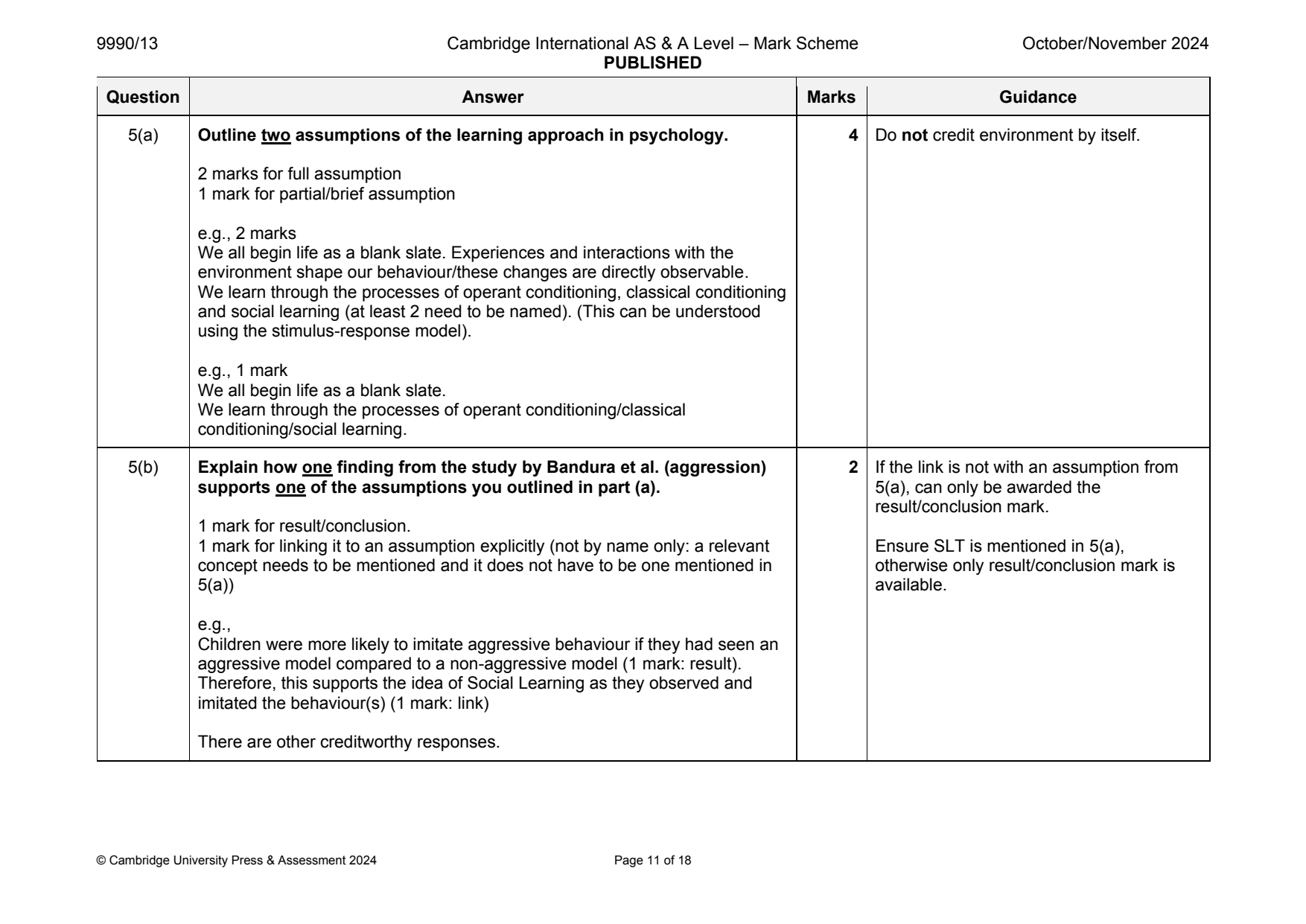
5(a) Outline two assumptions of the learning approach in psychology. 4 Do not credit environment by itself.
2 marks for full assumption
1 mark for partial/brief assumption
e.g., 2 marks
We all begin life as a blank slate. Experiences and interactions with the
environment shape our behaviour/these changes are directly observable.
We learn through the processes of operant conditioning, classical conditioning
and social learning (at least 2 need to be named). (This can be understood
using the stimulus-response model).
e.g., 1 mark
We all begin life as a blank slate.
We learn through the processes of operant conditioning/classical
conditioning/social learning.
5(b) Explain how one finding from the study by Bandura et al. (aggression) 2 If the link is not with an assumption from
supports one of the assumptions you outlined in part (a). 5(a), can only be awarded the
result/conclusion mark.
1 mark for result/conclusion.
1 mark for linking it to an assumption explicitly (not by name only: a relevant Ensure SLT is mentioned in 5(a),
concept needs to be mentioned and it does not have to be one mentioned in otherwise only result/conclusion mark is
5(a)) available.
e.g.,
Children were more likely to imitate aggressive behaviour if they had seen an
aggressive model compared to a non-aggressive model (1 mark: result).
Therefore, this supports the idea of Social Learning as they observed and
imitated the behaviour(s) (1 mark: link)
There are other creditworthy responses.
© Cambridge University Press & Assessment 2024 Page 11 of 18
Official mark scheme pages: 11 · source PDF URL
9990-2024-on-13-q09
Oct/Nov 2024 · Paper 13 · Question 9 · 12 marks
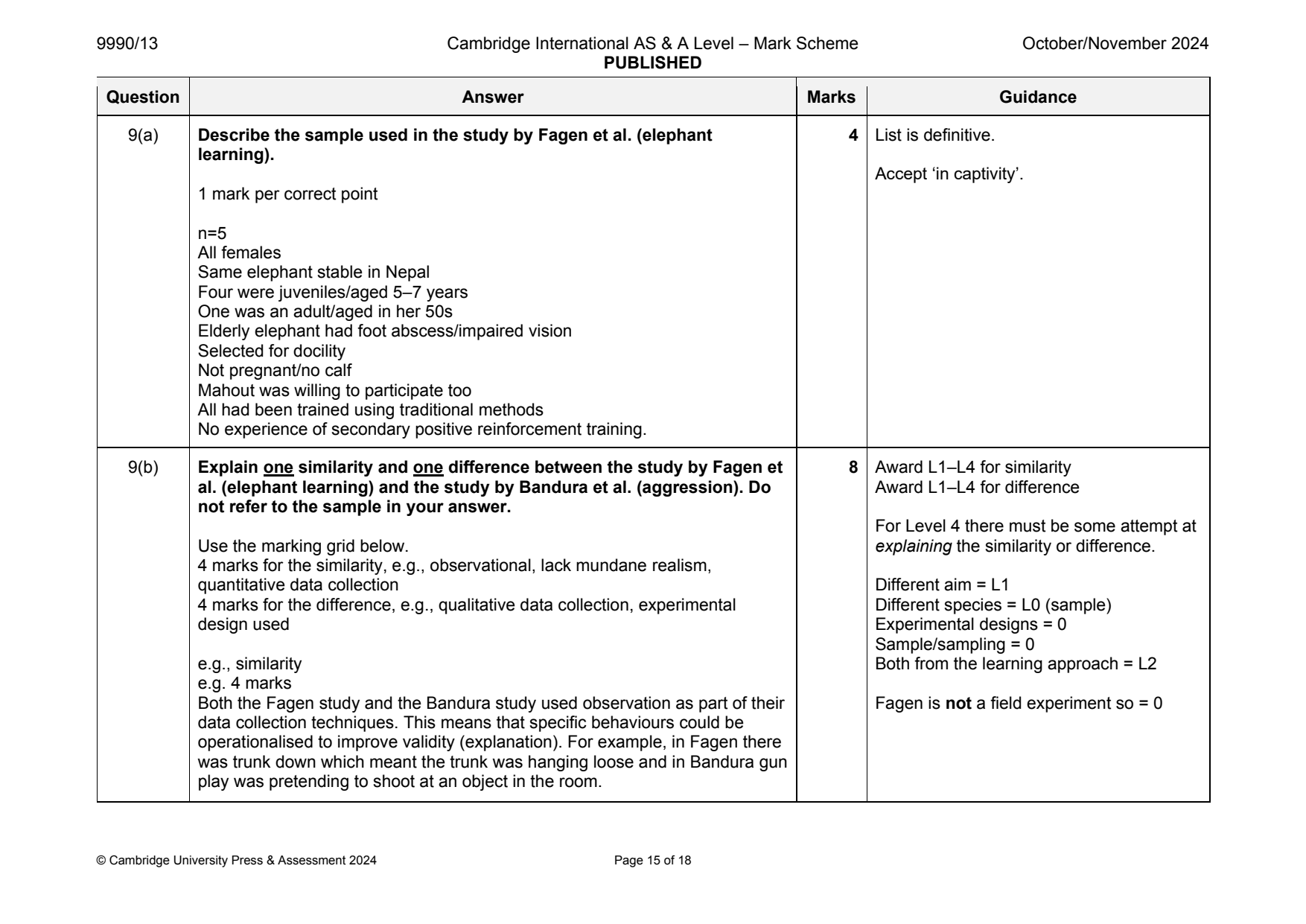
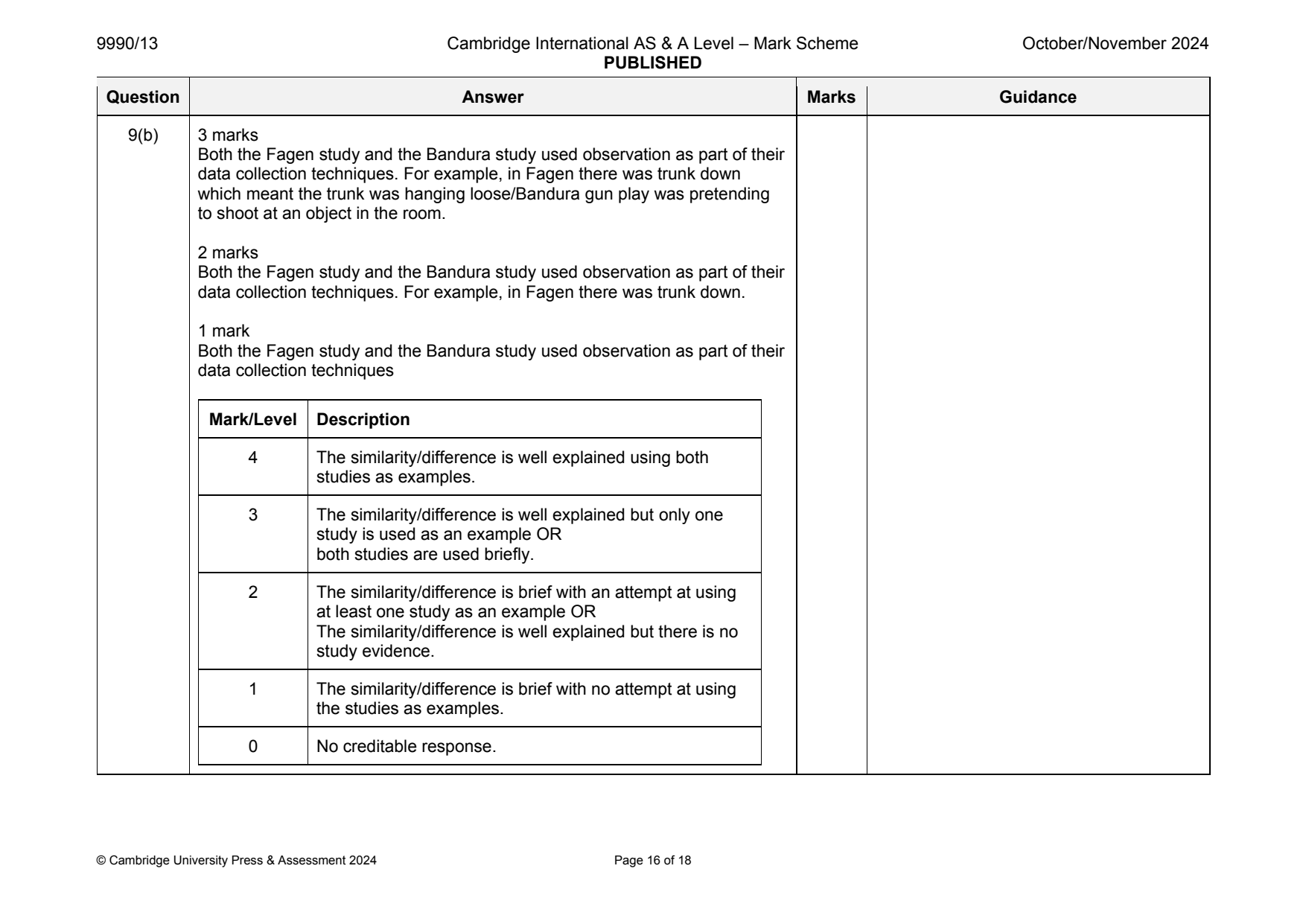
9(a) Describe the sample used in the study by Fagen et al. (elephant 4 List is definitive.
learning).
Accept ‘in captivity’.
1 mark per correct point
n=5
All females
Same elephant stable in Nepal
Four were juveniles/aged 5–7 years
One was an adult/aged in her 50s
Elderly elephant had foot abscess/impaired vision
Selected for docility
Not pregnant/no calf
Mahout was willing to participate too
All had been trained using traditional methods
No experience of secondary positive reinforcement training.
9(b) Explain one similarity and one difference between the study by Fagen et 8 Award L1–L4 for similarity
al. (elephant learning) and the study by Bandura et al. (aggression). Do Award L1–L4 for difference
not refer to the sample in your answer.
For Level 4 there must be some attempt at
Use the marking grid below. explaining the similarity or difference.
4 marks for the similarity, e.g., observational, lack mundane realism,
quantitative data collection Different aim = L1
4 marks for the difference, e.g., qualitative data collection, experimental Different species = L0 (sample)
design used Experimental designs = 0
Sample/sampling = 0
e.g., similarity Both from the learning approach = L2
e.g. 4 marks
Both the Fagen study and the Bandura study used observation as part of their Fagen is not a field experiment so = 0
data collection techniques. This means that specific behaviours could be
operationalised to improve validity (explanation). For example, in Fagen there
was trunk down which meant the trunk was hanging loose and in Bandura gun
play was pretending to shoot at an object in the room.
© Cambridge University Press & Assessment 2024 Page 15 of 18
9(b) 3 marks
Both the Fagen study and the Bandura study used observation as part of their
data collection techniques. For example, in Fagen there was trunk down
which meant the trunk was hanging loose/Bandura gun play was pretending
to shoot at an object in the room.
2 marks
Both the Fagen study and the Bandura study used observation as part of their
data collection techniques. For example, in Fagen there was trunk down.
1 mark
Both the Fagen study and the Bandura study used observation as part of their
data collection techniques
Mark/Level Description
4 The similarity/difference is well explained using both
studies as examples.
3 The similarity/difference is well explained but only one
study is used as an example OR
both studies are used briefly.
2 The similarity/difference is brief with an attempt at using
at least one study as an example OR
The similarity/difference is well explained but there is no
study evidence.
1 The similarity/difference is brief with no attempt at using
the studies as examples.
0 No creditable response.
© Cambridge University Press & Assessment 2024 Page 16 of 18
Official mark scheme pages: 15, 16 · source PDF URL
9990-2025-m-12-q06
March 2025 · Paper 12 · Question 6 · 7 marks
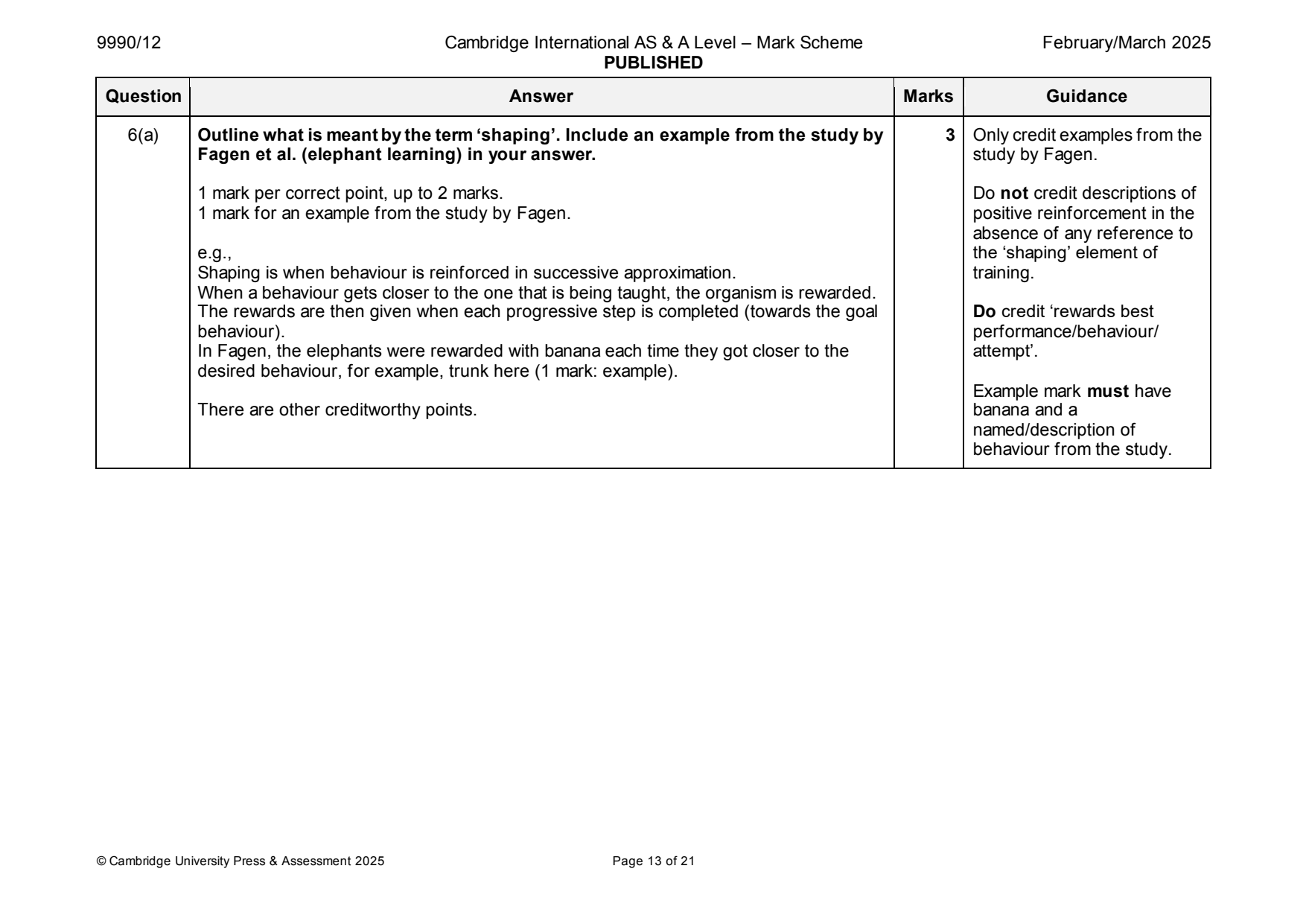
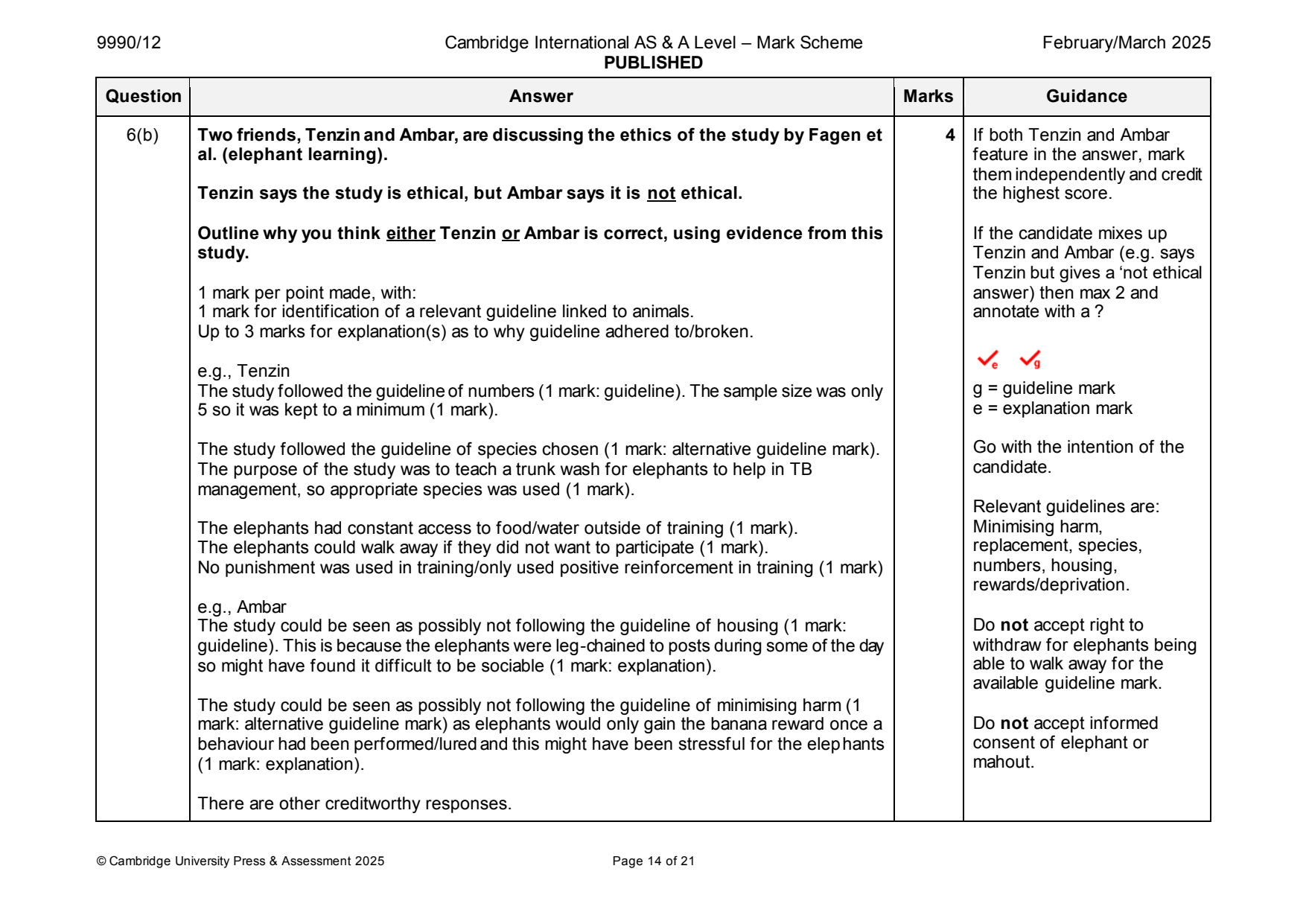
6(a) Outline what is meant by the term ‘shaping’. Include an example from the study by 3 Only credit examples from the
Fagen et al. (elephant learning) in your answer. study by Fagen.
1 mark per correct point, up to 2 marks. Do not credit descriptions of
1 mark for an example from the study by Fagen. positive reinforcement in the
absence of any reference to
e.g., the ‘shaping’ element of
Shaping is when behaviour is reinforced in successive approximation. training.
When a behaviour gets closer to the one that is being taught, the organism is rewarded.
The rewards are then given when each progressive step is completed (towards the goal Do credit ‘rewards best
behaviour). performance/behaviour/
In Fagen, the elephants were rewarded with banana each time they got closer to the attempt’.
desired behaviour, for example, trunk here (1 mark: example).
Example mark must have
There are other creditworthy points. banana and a
named/description of
behaviour from the study.
© Cambridge University Press & Assessment 2025 Page 13 of 21
6(b) Two friends, Tenzin and Ambar, are discussing the ethics of the study by Fagen et 4 If both Tenzin and Ambar
al. (elephant learning). feature in the answer, mark
them independently and credit
Tenzin says the study is ethical, but Ambar says it is not ethical. the highest score.
Outline why you think either Tenzin or Ambar is correct, using evidence from this If the candidate mixes up
study. Tenzin and Ambar (e.g. says
Tenzin but gives a ‘not ethical
1 mark per point made, with: answer) then max 2 and
1 mark for identification of a relevant guideline linked to animals. annotate with a ?
Up to 3 marks for explanation(s) as to why guideline adhered to/broken.
e.g., Tenzin
The study followed the guideline of numbers (1 mark: guideline). The sample size was only g = guideline mark
5 so it was kept to a minimum (1 mark). e = explanation mark
The study followed the guideline of species chosen (1 mark: alternative guideline mark). Go with the intention of the
The purpose of the study was to teach a trunk wash for elephants to help in TB candidate.
management, so appropriate species was used (1 mark).
Relevant guidelines are:
The elephants had constant access to food/water outside of training (1 mark). Minimising harm,
The elephants could walk away if they did not want to participate (1 mark). replacement, species,
No punishment was used in training/only used positive reinforcement in training (1 mark) numbers, housing,
rewards/deprivation.
e.g., Ambar
The study could be seen as possibly not following the guideline of housing (1 mark: Do not accept right to
guideline). This is because the elephants were leg-chained to posts during some of the day withdraw for elephants being
so might have found it difficult to be sociable (1 mark: explanation). able to walk away for the
available guideline mark.
The study could be seen as possibly not following the guideline of minimising harm (1
mark: alternative guideline mark) as elephants would only gain the banana reward once a Do not accept informed
behaviour had been performed/lured and this might have been stressful for the elephants consent of elephant or
(1 mark: explanation). mahout.
There are other creditworthy responses.
© Cambridge University Press & Assessment 2025 Page 14 of 21
Official mark scheme pages: 13, 14 · source PDF URL
9990-2025-m-12-q10
March 2025 · Paper 12 · Question 10 · 10 marks
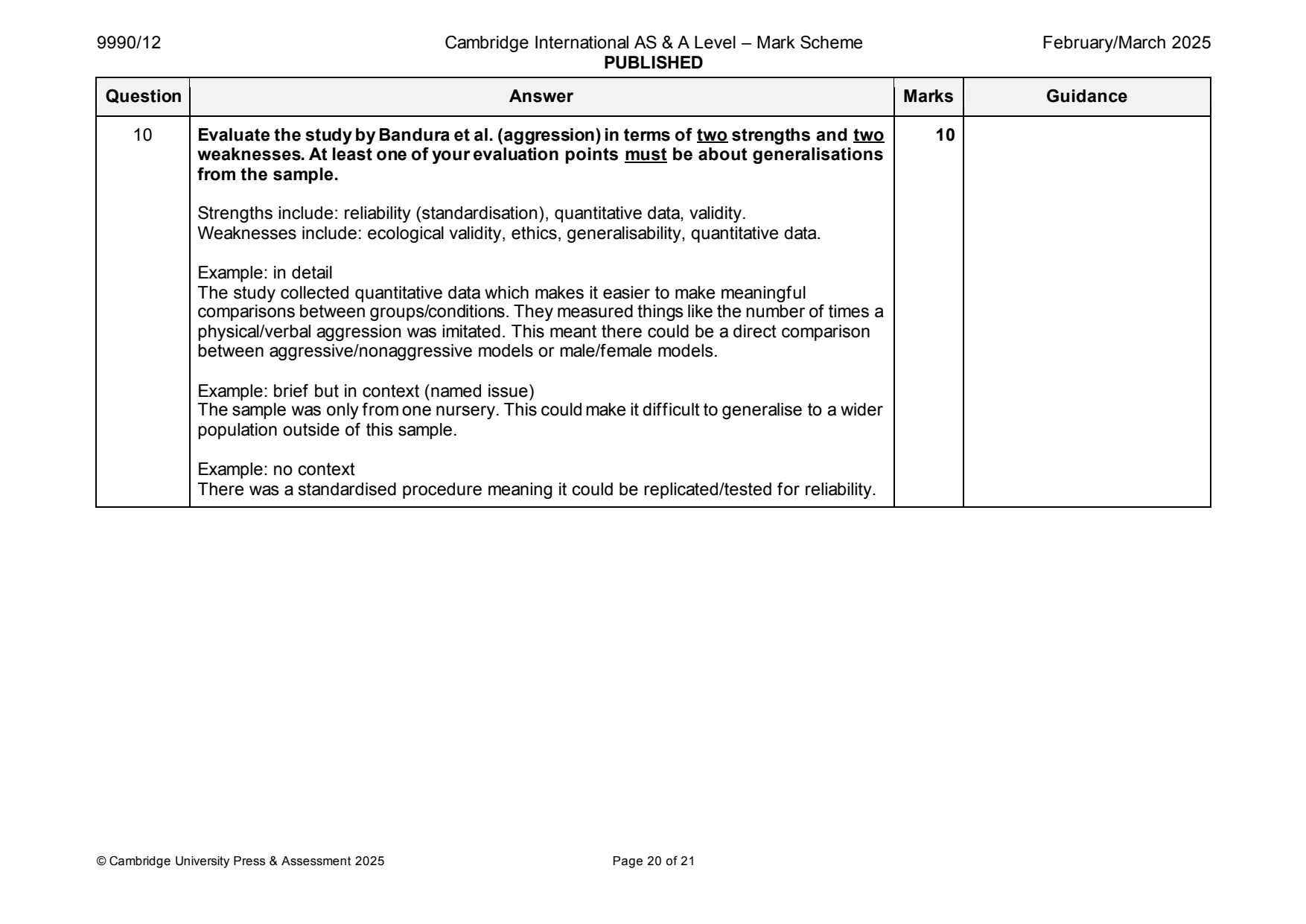
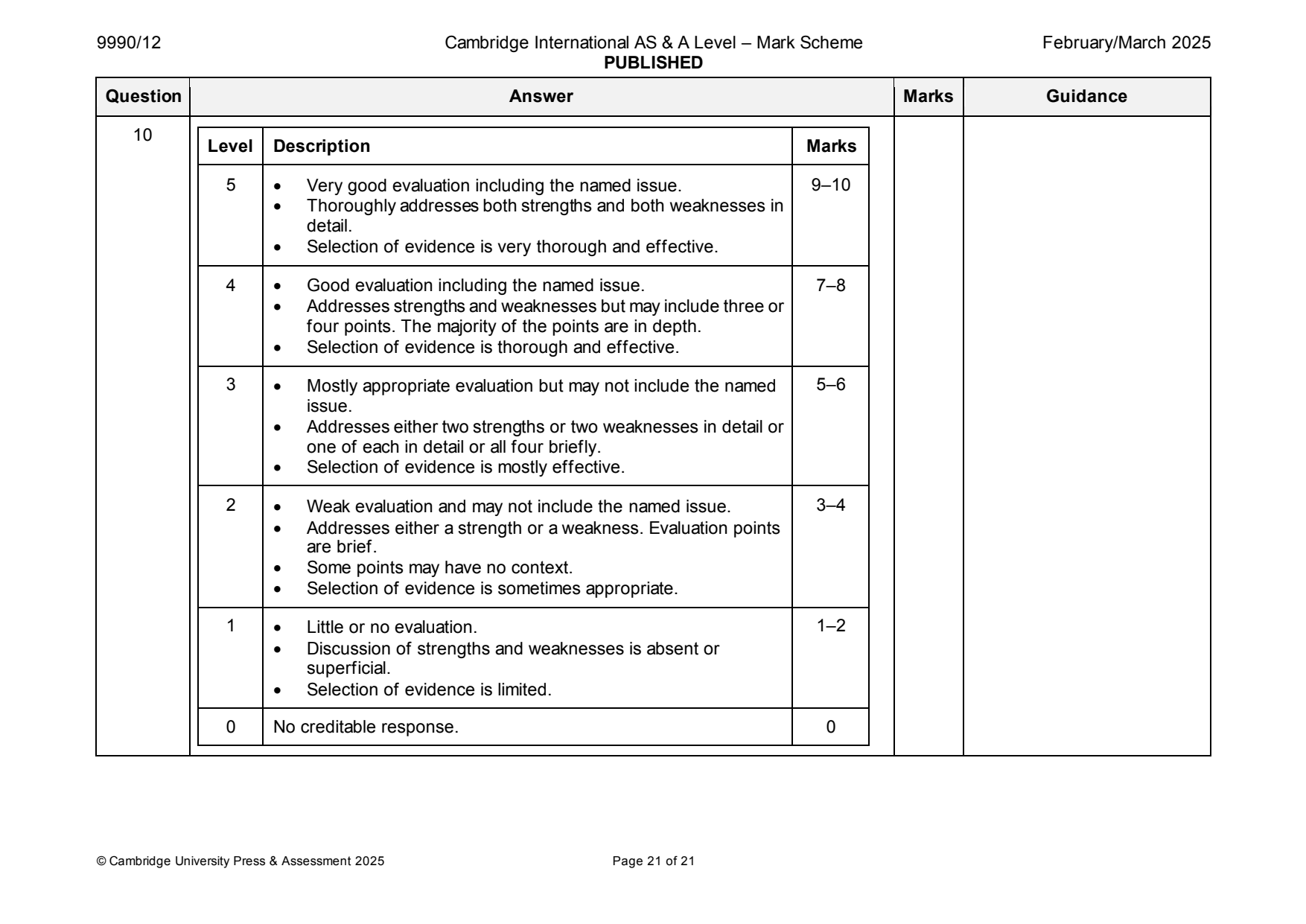
10 Evaluate the study by Bandura et al. (aggression) in terms of two strengths and two 10
weaknesses. At least one of your evaluation points must be about generalisations
from the sample.
Strengths include: reliability (standardisation), quantitative data, validity.
Weaknesses include: ecological validity, ethics, generalisability, quantitative data.
Example: in detail
The study collected quantitative data which makes it easier to make meaningful
comparisons between groups/conditions. They measured things like the number of times a
physical/verbal aggression was imitated. This meant there could be a direct comparison
between aggressive/nonaggressive models or male/female models.
Example: brief but in context (named issue)
The sample was only from one nursery. This could make it difficult to generalise to a wider
population outside of this sample.
Example: no context
There was a standardised procedure meaning it could be replicated/tested for reliability.
© Cambridge University Press & Assessment 2025 Page 20 of 21
9990/12 Cambridge International AS & A Level – Mark Scheme February/March 2025
PUBLISHED
Question Answer Marks Guidance
10
Level Description Marks
5 • Very good evaluation including the named issue. 9–10
• Thoroughly addresses both strengths and both weaknesses in
detail.
• Selection of evidence is very thorough and effective.
4 • Good evaluation including the named issue. 7–8
• Addresses strengths and weaknesses but may include three or
four points. The majority of the points are in depth.
• Selection of evidence is thorough and effective.
3 • Mostly appropriate evaluation but may not include the named 5–6
issue.
• Addresses either two strengths or two weaknesses in detail or
one of each in detail or all four briefly.
• Selection of evidence is mostly effective.
2 • Weak evaluation and may not include the named issue. 3–4
• Addresses either a strength or a weakness. Evaluation points
are brief.
• Some points may have no context.
• Selection of evidence is sometimes appropriate.
1 • Little or no evaluation. 1–2
• Discussion of strengths and weaknesses is absent or
superficial.
• Selection of evidence is limited.
0 No creditable response. 0
© Cambridge University Press & Assessment 2025 Page 21 of 21
Official mark scheme pages: 20, 21 · source PDF URL
9990-2025-mj-11-q01
May/June 2025 · Paper 11 · Question 1 · 5 marks
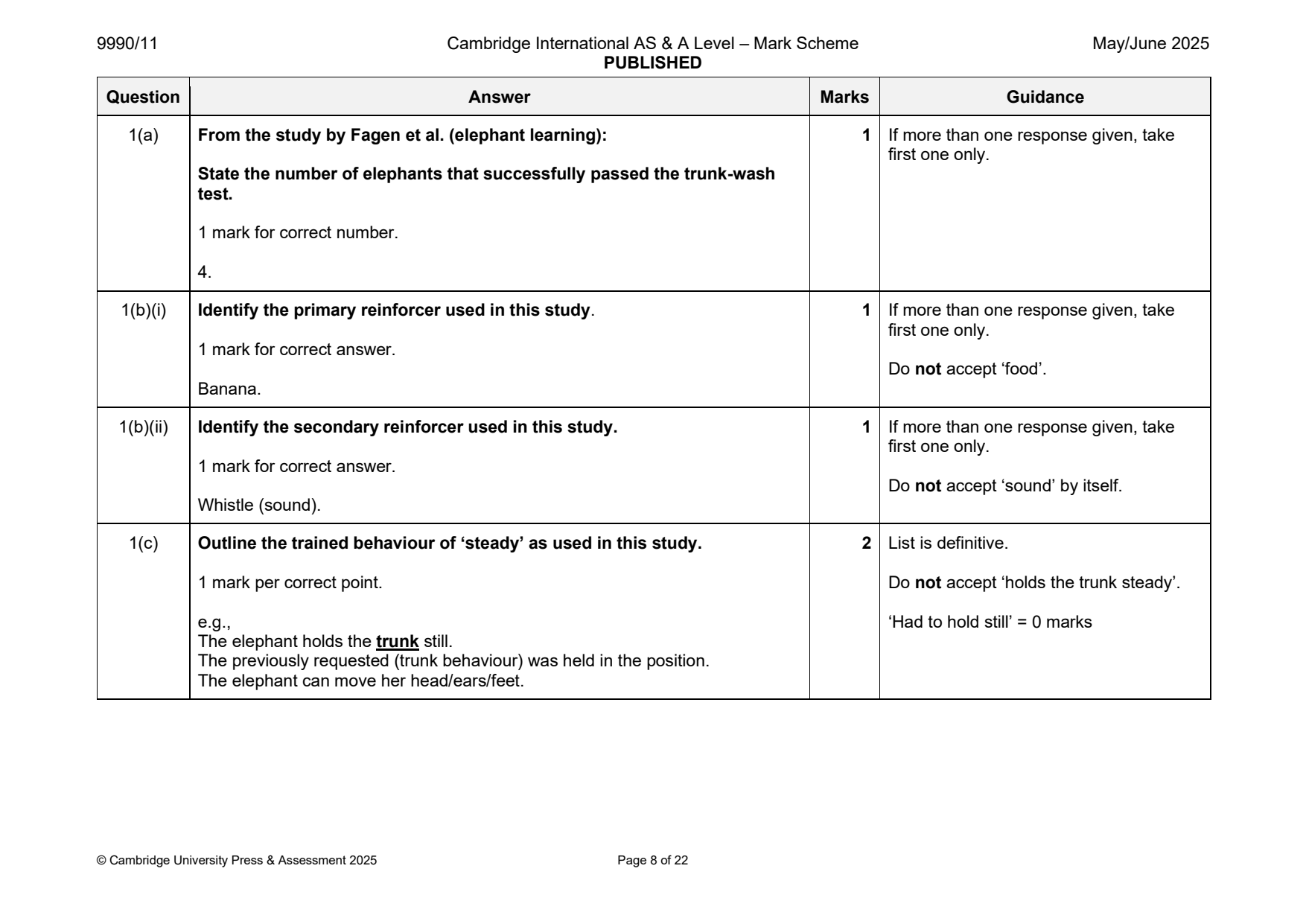
1(a) From the study by Fagen et al. (elephant learning): 1 If more than one response given, take
first one only.
State the number of elephants that successfully passed the trunk-wash
test.
1 mark for correct number.
4.
1(b)(i) Identify the primary reinforcer used in this study. 1 If more than one response given, take
first one only.
1 mark for correct answer.
Do not accept ‘food’.
Banana.
1(b)(ii) Identify the secondary reinforcer used in this study. 1 If more than one response given, take
first one only.
1 mark for correct answer.
Do not accept ‘sound’ by itself.
Whistle (sound).
1(c) Outline the trained behaviour of ‘steady’ as used in this study. 2 List is definitive.
1 mark per correct point. Do not accept ‘holds the trunk steady’.
e.g., ‘Had to hold still’ = 0 marks
The elephant holds the trunk still.
The previously requested (trunk behaviour) was held in the position.
The elephant can move her head/ears/feet.
© Cambridge University Press & Assessment 2025 Page 8 of 22
Official mark scheme pages: 8 · source PDF URL
9990-2025-mj-11-q03
May/June 2025 · Paper 11 · Question 3 · 6 marks
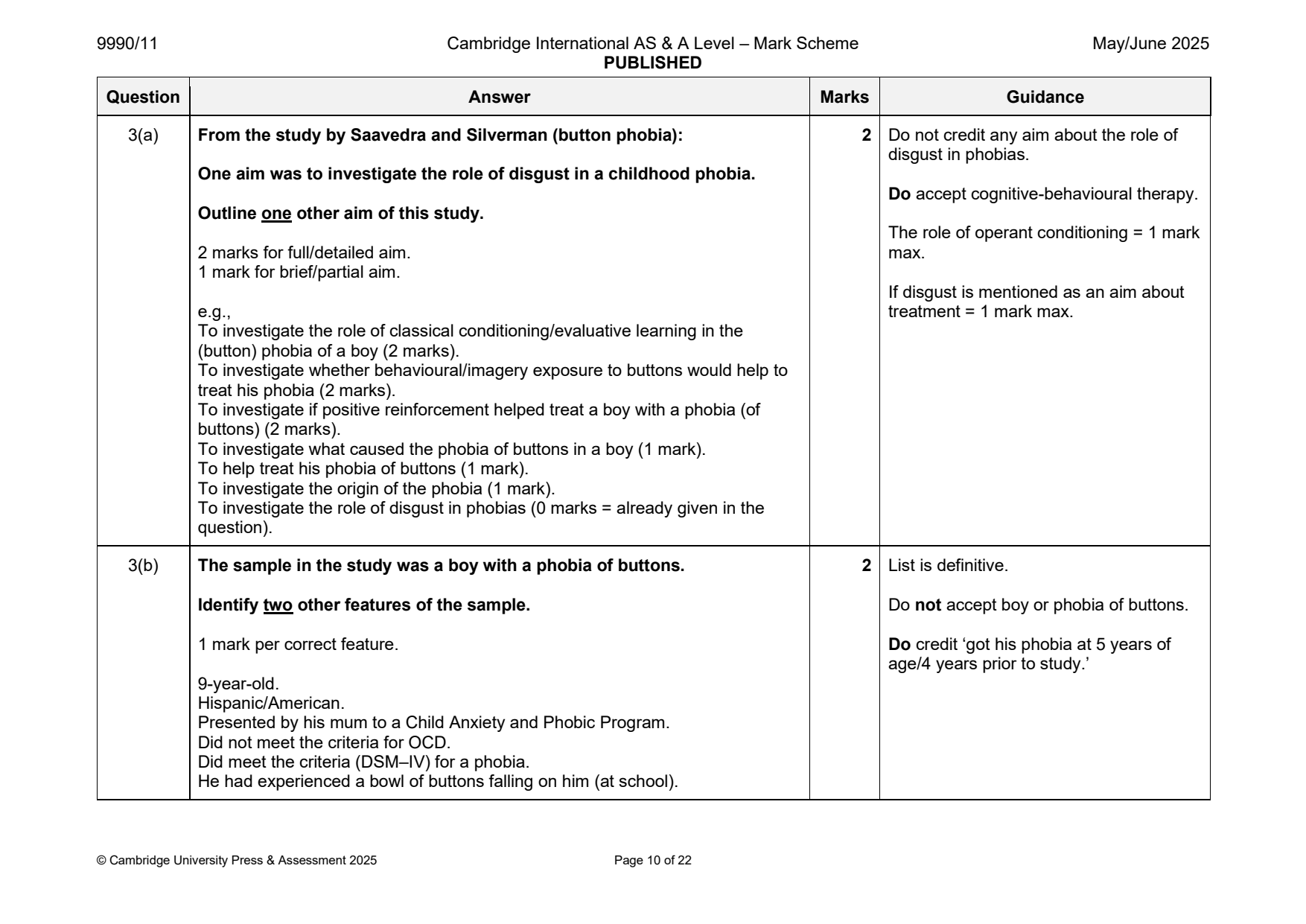
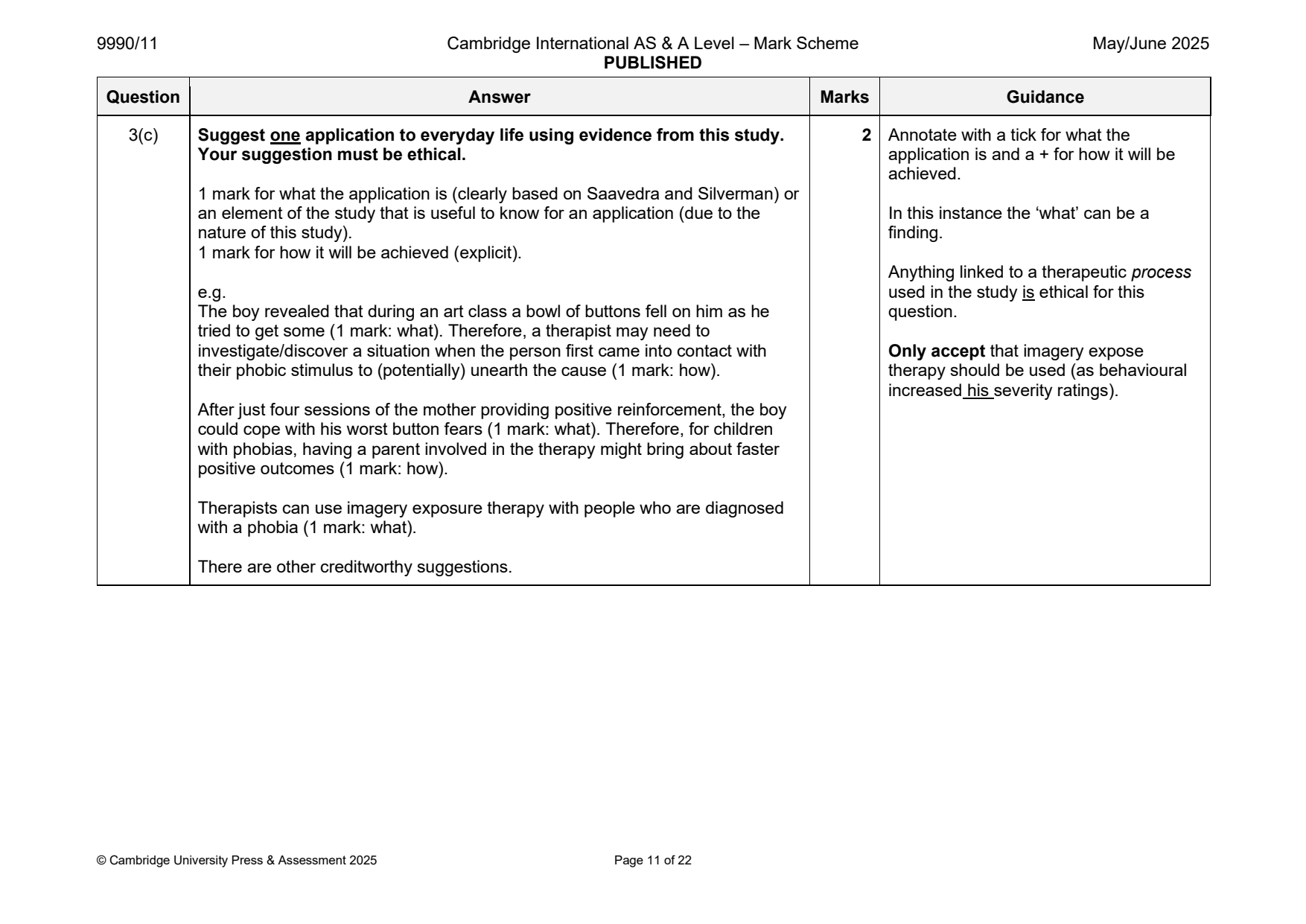
3(a) From the study by Saavedra and Silverman (button phobia): 2 Do not credit any aim about the role of
disgust in phobias.
One aim was to investigate the role of disgust in a childhood phobia.
Do accept cognitive-behavioural therapy.
Outline one other aim of this study.
The role of operant conditioning = 1 mark
2 marks for full/detailed aim. max.
1 mark for brief/partial aim.
If disgust is mentioned as an aim about
e.g., treatment = 1 mark max.
To investigate the role of classical conditioning/evaluative learning in the
(button) phobia of a boy (2 marks).
To investigate whether behavioural/imagery exposure to buttons would help to
treat his phobia (2 marks).
To investigate if positive reinforcement helped treat a boy with a phobia (of
buttons) (2 marks).
To investigate what caused the phobia of buttons in a boy (1 mark).
To help treat his phobia of buttons (1 mark).
To investigate the origin of the phobia (1 mark).
To investigate the role of disgust in phobias (0 marks = already given in the
question).
3(b) The sample in the study was a boy with a phobia of buttons. 2 List is definitive.
Identify two other features of the sample. Do not accept boy or phobia of buttons.
1 mark per correct feature. Do credit ‘got his phobia at 5 years of
age/4 years prior to study.’
9-year-old.
Hispanic/American.
Presented by his mum to a Child Anxiety and Phobic Program.
Did not meet the criteria for OCD.
Did meet the criteria (DSM–IV) for a phobia.
He had experienced a bowl of buttons falling on him (at school).
© Cambridge University Press & Assessment 2025 Page 10 of 22
3(c) Suggest one application to everyday life using evidence from this study. 2 Annotate with a tick for what the
Your suggestion must be ethical. application is and a + for how it will be
achieved.
1 mark for what the application is (clearly based on Saavedra and Silverman) or
an element of the study that is useful to know for an application (due to the In this instance the ‘what’ can be a
nature of this study). finding.
1 mark for how it will be achieved (explicit).
Anything linked to a therapeutic process
e.g. used in the study is ethical for this
The boy revealed that during an art class a bowl of buttons fell on him as he question.
tried to get some (1 mark: what). Therefore, a therapist may need to
investigate/discover a situation when the person first came into contact with Only accept that imagery expose
their phobic stimulus to (potentially) unearth the cause (1 mark: how). therapy should be used (as behavioural
increased his severity ratings).
After just four sessions of the mother providing positive reinforcement, the boy
could cope with his worst button fears (1 mark: what). Therefore, for children
with phobias, having a parent involved in the therapy might bring about faster
positive outcomes (1 mark: how).
Therapists can use imagery exposure therapy with people who are diagnosed
with a phobia (1 mark: what).
There are other creditworthy suggestions.
© Cambridge University Press & Assessment 2025 Page 11 of 22
Official mark scheme pages: 10, 11 · source PDF URL
9990-2025-mj-11-q08
May/June 2025 · Paper 11 · Question 8 · 4 marks
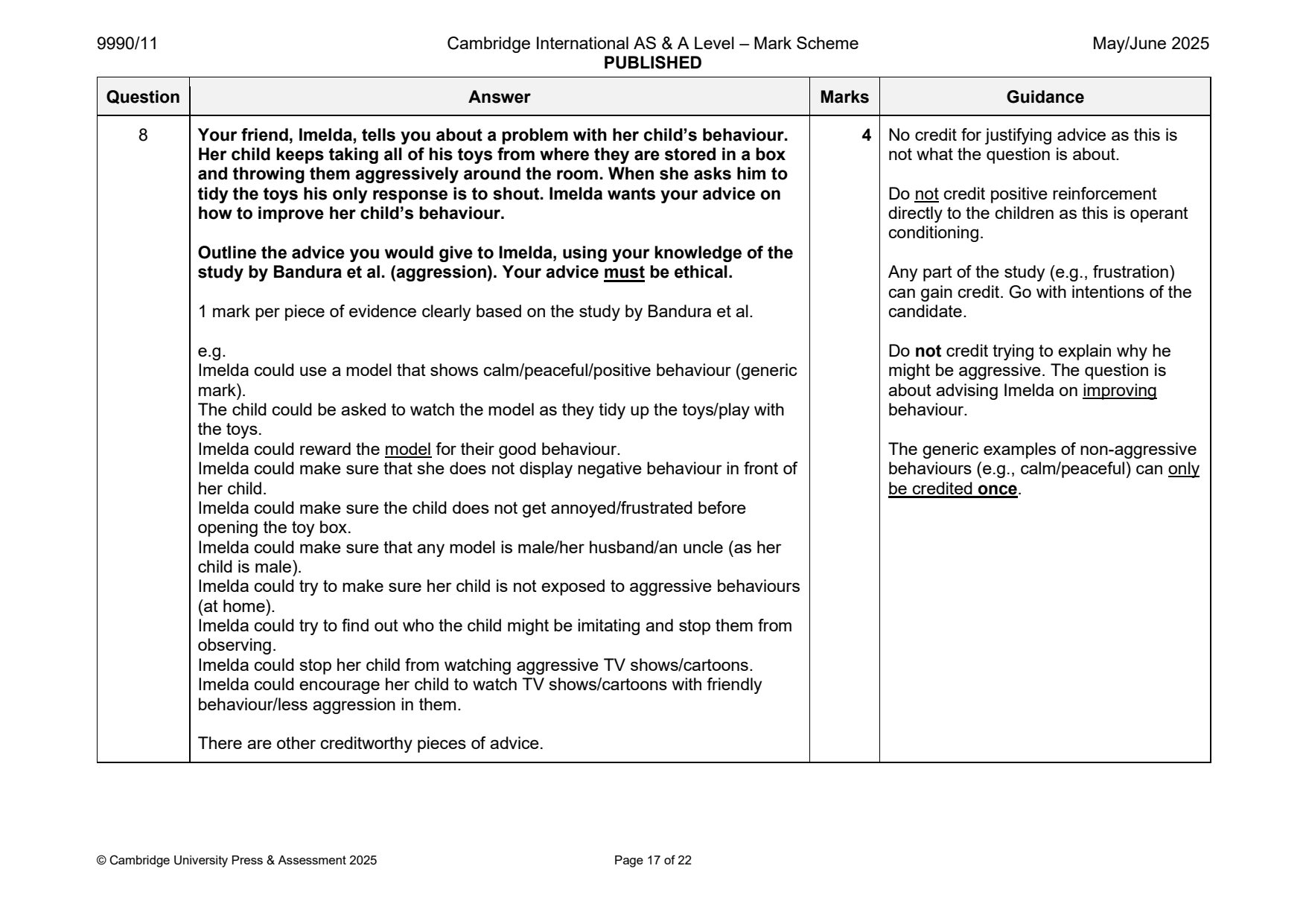
8 Your friend, Imelda, tells you about a problem with her child’s behaviour. 4 No credit for justifying advice as this is
Her child keeps taking all of his toys from where they are stored in a box not what the question is about.
and throwing them aggressively around the room. When she asks him to
tidy the toys his only response is to shout. Imelda wants your advice on Do not credit positive reinforcement
how to improve her child’s behaviour. directly to the children as this is operant
conditioning.
Outline the advice you would give to Imelda, using your knowledge of the
study by Bandura et al. (aggression). Your advice must be ethical. Any part of the study (e.g., frustration)
can gain credit. Go with intentions of the
1 mark per piece of evidence clearly based on the study by Bandura et al. candidate.
e.g. Do not credit trying to explain why he
Imelda could use a model that shows calm/peaceful/positive behaviour (generic might be aggressive. The question is
mark). about advising Imelda on improving
The child could be asked to watch the model as they tidy up the toys/play with behaviour.
the toys.
Imelda could reward the model for their good behaviour. The generic examples of non-aggressive
Imelda could make sure that she does not display negative behaviour in front of behaviours (e.g., calm/peaceful) can only
her child. be credited once.
Imelda could make sure the child does not get annoyed/frustrated before
opening the toy box.
Imelda could make sure that any model is male/her husband/an uncle (as her
child is male).
Imelda could try to make sure her child is not exposed to aggressive behaviours
(at home).
Imelda could try to find out who the child might be imitating and stop them from
observing.
Imelda could stop her child from watching aggressive TV shows/cartoons.
Imelda could encourage her child to watch TV shows/cartoons with friendly
behaviour/less aggression in them.
There are other creditworthy pieces of advice.
© Cambridge University Press & Assessment 2025 Page 17 of 22
Official mark scheme pages: 17 · source PDF URL
9990-2025-mj-12-q05
May/June 2025 · Paper 12 · Question 5 · 4 marks
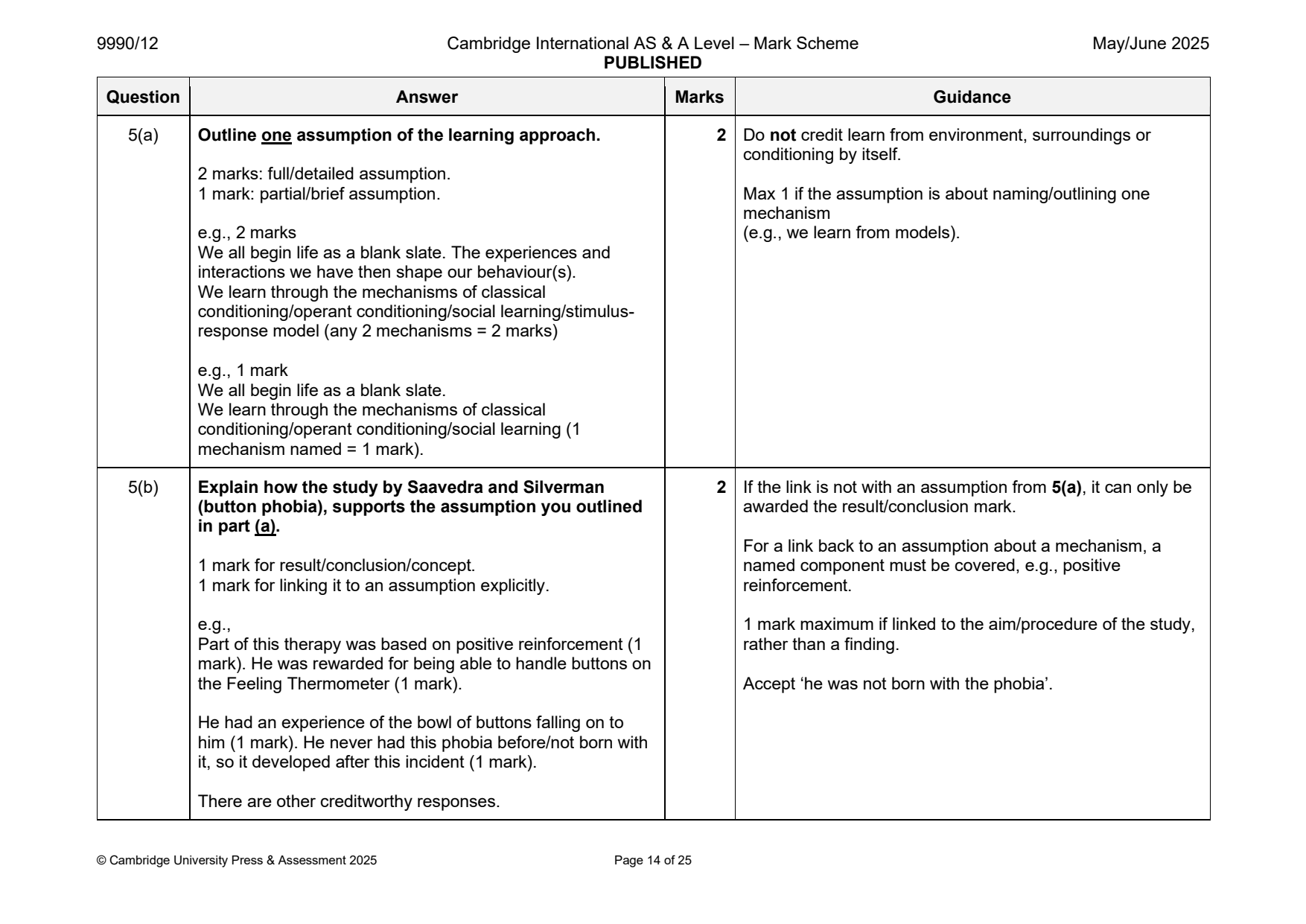
5(a) Outline one assumption of the learning approach. 2 Do not credit learn from environment, surroundings or
conditioning by itself.
2 marks: full/detailed assumption.
1 mark: partial/brief assumption. Max 1 if the assumption is about naming/outlining one
mechanism
e.g., 2 marks (e.g., we learn from models).
We all begin life as a blank slate. The experiences and
interactions we have then shape our behaviour(s).
We learn through the mechanisms of classical
conditioning/operant conditioning/social learning/stimulus-
response model (any 2 mechanisms = 2 marks)
e.g., 1 mark
We all begin life as a blank slate.
We learn through the mechanisms of classical
conditioning/operant conditioning/social learning (1
mechanism named = 1 mark).
5(b) Explain how the study by Saavedra and Silverman 2 If the link is not with an assumption from 5(a), it can only be
(button phobia), supports the assumption you outlined awarded the result/conclusion mark.
in part (a).
For a link back to an assumption about a mechanism, a
1 mark for result/conclusion/concept. named component must be covered, e.g., positive
1 mark for linking it to an assumption explicitly. reinforcement.
e.g., 1 mark maximum if linked to the aim/procedure of the study,
Part of this therapy was based on positive reinforcement (1 rather than a finding.
mark). He was rewarded for being able to handle buttons on
the Feeling Thermometer (1 mark). Accept ‘he was not born with the phobia’.
He had an experience of the bowl of buttons falling on to
him (1 mark). He never had this phobia before/not born with
it, so it developed after this incident (1 mark).
There are other creditworthy responses.
© Cambridge University Press & Assessment 2025 Page 14 of 25
Official mark scheme pages: 14 · source PDF URL
9990-2025-mj-12-q06
May/June 2025 · Paper 12 · Question 6 · 7 marks
6(a) Outline what is meant by the term ‘positive 3 Only credit examples from the study by Fagen.
reinforcement’. Include an example from the study by
Fagen et al. (elephant learning) in your answer. Do credit ‘encourage/strengthen/enhances behaviour’ as
meaning increasing probability.
1 mark per correct point.
1 mark for an example from the study by Fagen. Do not credit ‘rewarded with food’.
e.g., Do not credit ‘rewarded with banana’ by itself.
Positive reinforcement is when a reward is given after the
completion of a desired behaviour.
This increases the probability that the desired behaviour will
be repeated.
In the study by Fagen, the elephants were rewarded with
banana when a specific behaviour was shown (1 mark:
example).
There are other creditworthy responses
© Cambridge University Press & Assessment 2025 Page 15 of 25
6(b) Two friends, Roksana and Tien are discussing the study 4 If both Roksana and Tien feature in the answer, mark them
by Fagen et al. (elephant learning) in terms of the independently and credit the highest score.
individual and situational explanations for behaviour.
If the candidate mixes up Roksana and Tien (e.g. says Tien
Roksana says the study supports the individual but gives an individual explanation answer) then max 2 and
explanation, but Tien says it supports the situational annotate with a ?
explanation.
Do not credit definitions that are tautological, for example,
Outline why you think either Roksana or Tien is correct, the situational explanation is based on the situation.
using evidence from the study.
Do not credit why it is not individual or situational.
1 mark per point made, with
1 mark available for definition of individual/situational Do not credit individual differences as a definition mark.
explanation.
Up to 4 marks for examples/explanations that support Do credit statements like ‘elephant 2 as the fastest’ etc.
individual/situational.
For Roksana:
e.g., Roksana If the elephants are not correctly ‘numbered’ then generic
The individual side refers to behaviours from factors within statements like ‘one elephant was faster’ or ‘one failed to
the person (dispositional) (1 mark: definition). There were complete the trunk wash’ can only be credited once.
individual differences in the amount of time it took the
elephants to be trained on the trunk wash (1 mark:
example). Elephant 2 only needed 25 sessions/Elephant 1
needed 30 etc. (1 mark: example). Elephant 5 did not
successfully complete the training (1 mark: example). This
could have been because she was older than the rest of the
elephants/had vision problems/abscess on foot/trunk
weakness (1 mark: explanation).
© Cambridge University Press & Assessment 2025 Page 16 of 25
6(b) e.g., Tien
The situational side refers to behaviour from factors in the
external environment (1 mark). The reason the elephants
could complete the trunk wash was because of the
training/operant conditioning (1 mark: explanation). Their
behaviour was shaped by the researchers who rewarded a
series of different behaviours like trunk here (1 mark:
example). The elephants received banana pieces every time
they performed a certain behaviour correctly, so this
encouraged them to repeat the behaviours (1 mark:
example/explanation). There were distractions like tourists
which slowed training (1 mark: example).
There are other creditworthy examples/explanations.
© Cambridge University Press & Assessment 2025 Page 17 of 25
Official mark scheme pages: 15, 16, 17 · source PDF URL
9990-2025-mj-12-q07
May/June 2025 · Paper 12 · Question 7 · 5 marks
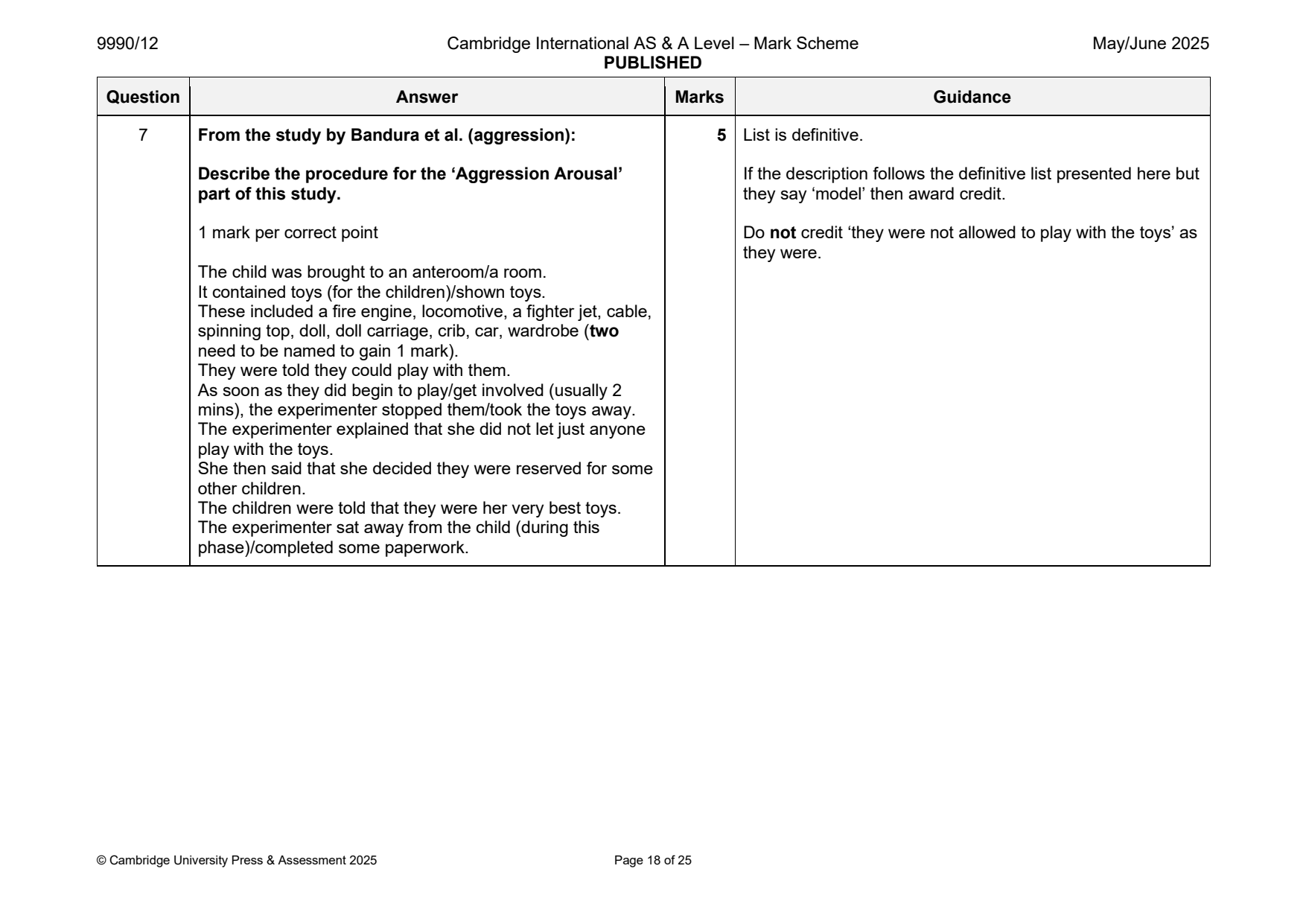
7 From the study by Bandura et al. (aggression): 5 List is definitive.
Describe the procedure for the ‘Aggression Arousal’ If the description follows the definitive list presented here but
part of this study. they say ‘model’ then award credit.
1 mark per correct point Do not credit ‘they were not allowed to play with the toys’ as
they were.
The child was brought to an anteroom/a room.
It contained toys (for the children)/shown toys.
These included a fire engine, locomotive, a fighter jet, cable,
spinning top, doll, doll carriage, crib, car, wardrobe (two
need to be named to gain 1 mark).
They were told they could play with them.
As soon as they did begin to play/get involved (usually 2
mins), the experimenter stopped them/took the toys away.
The experimenter explained that she did not let just anyone
play with the toys.
She then said that she decided they were reserved for some
other children.
The children were told that they were her very best toys.
The experimenter sat away from the child (during this
phase)/completed some paperwork.
© Cambridge University Press & Assessment 2025 Page 18 of 25
Official mark scheme pages: 18 · source PDF URL
9990-2025-mj-13-q01
May/June 2025 · Paper 13 · Question 1 · 5 marks
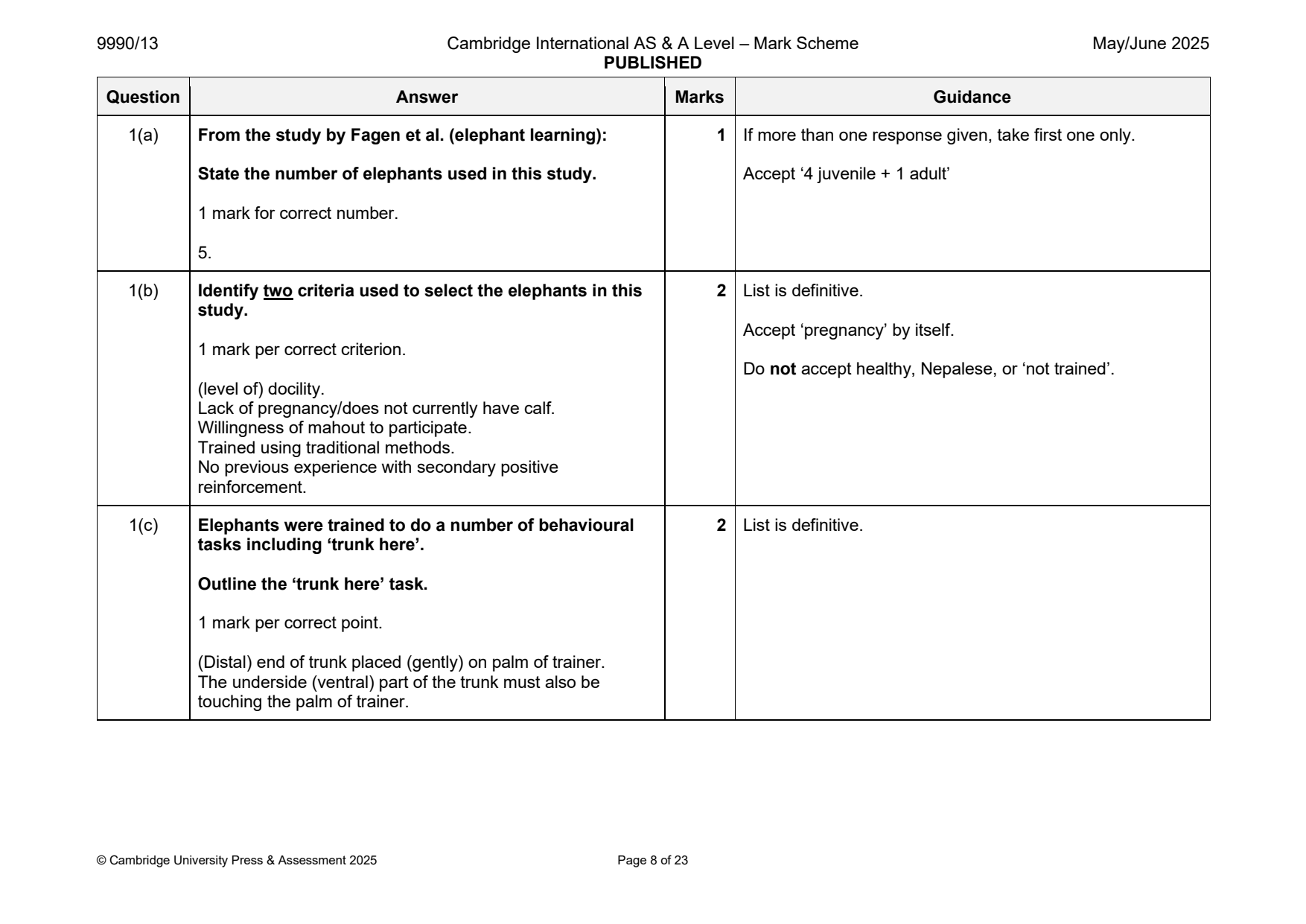
1(a) From the study by Fagen et al. (elephant learning): 1 If more than one response given, take first one only.
State the number of elephants used in this study. Accept ‘4 juvenile + 1 adult’
1 mark for correct number.
5.
1(b) Identify two criteria used to select the elephants in this 2 List is definitive.
study.
Accept ‘pregnancy’ by itself.
1 mark per correct criterion.
Do not accept healthy, Nepalese, or ‘not trained’.
(level of) docility.
Lack of pregnancy/does not currently have calf.
Willingness of mahout to participate.
Trained using traditional methods.
No previous experience with secondary positive
reinforcement.
1(c) Elephants were trained to do a number of behavioural 2 List is definitive.
tasks including ‘trunk here’.
Outline the ‘trunk here’ task.
1 mark per correct point.
(Distal) end of trunk placed (gently) on palm of trainer.
The underside (ventral) part of the trunk must also be
touching the palm of trainer.
© Cambridge University Press & Assessment 2025 Page 8 of 23
Official mark scheme pages: 8 · source PDF URL
9990-2025-mj-13-q03
May/June 2025 · Paper 13 · Question 3 · 6 marks
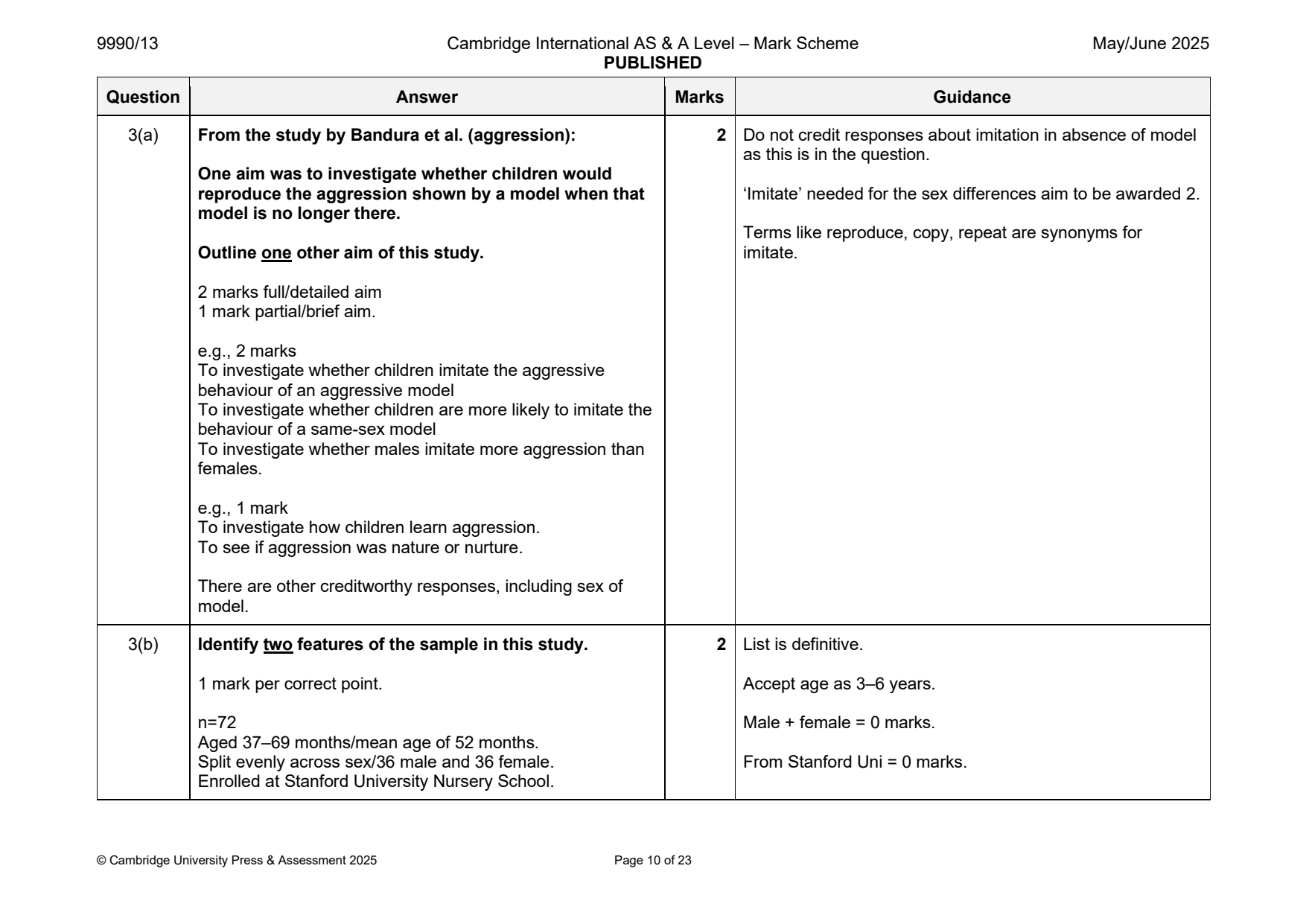
3(a) From the study by Bandura et al. (aggression): 2 Do not credit responses about imitation in absence of model
as this is in the question.
One aim was to investigate whether children would
reproduce the aggression shown by a model when that ‘Imitate’ needed for the sex differences aim to be awarded 2.
model is no longer there.
Terms like reproduce, copy, repeat are synonyms for
Outline one other aim of this study. imitate.
2 marks full/detailed aim
1 mark partial/brief aim.
e.g., 2 marks
To investigate whether children imitate the aggressive
behaviour of an aggressive model
To investigate whether children are more likely to imitate the
behaviour of a same-sex model
To investigate whether males imitate more aggression than
females.
e.g., 1 mark
To investigate how children learn aggression.
To see if aggression was nature or nurture.
There are other creditworthy responses, including sex of
model.
3(b) Identify two features of the sample in this study. 2 List is definitive.
1 mark per correct point. Accept age as 3–6 years.
n=72 Male + female = 0 marks.
Aged 37–69 months/mean age of 52 months.
Split evenly across sex/36 male and 36 female. From Stanford Uni = 0 marks.
Enrolled at Stanford University Nursery School.
© Cambridge University Press & Assessment 2025 Page 10 of 23
3(c) Suggest one application to everyday life using evidence 2 Annotate with a tick for what the application is and a + for
from this study. Your suggestion must be ethical. how it will be achieved.
1 mark for what the application is (clearly based on Do not credit explaining everyday behaviours, for example,
Bandura). we must be careful what we do around others, or it explains
1 mark for how it will be achieved. why some people get aggressive.
e.g. A finding can be used as a ‘what’ if it leads logically into the
Children can be taught prosocial behaviour (1 mark: what). ‘how’.
A child can observe a model engaging in prosocial
behaviour/speech and they are likely to imitate this (1 mark:
how).
Children can be taught a new skill at school (1 mark: what).
A child can observe a teacher showing them how to
complete a new skill and then are given the opportunity to
replicate it (1 mark: how).
Can be used by TV companies/video games creators/toy
companies (1 mark: what) by reducing the amount of
aggression in programmes/presenting more prosocial
behaviour (1 mark: how).
Parents can use it to sensor TV/videogame content/time for
their children (1 mark: what) by restricting the time
played/presenting more prosocial behaviour/not allowing
them to play aggressive games (1 mark: how).
There are other creditworthy suggestions.
© Cambridge University Press & Assessment 2025 Page 11 of 23
Official mark scheme pages: 10, 11 · source PDF URL
9990-2025-mj-13-q10
May/June 2025 · Paper 13 · Question 10 · 10 marks
10 Evaluate the study by Saavedra and Silverman (button 10
phobia) in terms of two strengths and two weaknesses.
At least one of your evaluation points must be about
subjective data.
Strengths include reliability (standardisation), quantitative
data, validity, self-reports.
Weaknesses include subjective data, ethics, generalisability,
quantitative data, self-reports.
Example: in detail
The sample was one boy with a button phobia so it may be
difficult to generalise/he had a ‘unique’ phobia of buttons.
Females may react differently to the type of therapy as they
tend to be more emotional, plus people with other types of
phobia may not find a Feelings Thermometer useful if the
phobia is not a concrete object.
Example: brief but in context
The participant could have lied/given false responses/shown
social desirability. He could have rated some of the buttons
differently to how he felt as he did not want to look as
scared.
Example: no context
There was a standardised procedure meaning it could be
replicated/tested for reliability.
© Cambridge University Press & Assessment 2025 Page 21 of 23
9990/13 Cambridge International AS & A Level – Mark Scheme May/June 2025
PUBLISHED
Question Answer Marks Guidance
10
Level Description Mark
5 • Very good evaluation including 9–10
the named issue.
• Thoroughly addresses both
strengths and both weaknesses in
detail.
• Selection of evidence is very
thorough and effective.
4 • Good evaluation including the 7–8
named issue.
• Addresses strengths and
weaknesses but may include
three or four points. The majority
of the points are in depth.
• Selection of evidence is thorough
and effective.
3 • Mostly appropriate evaluation but 5–6
may not include the named issue.
• Addresses either two strengths or
two weaknesses in detail or one
of each in detail or all four briefly.
• Selection of evidence is mostly
effective.
© Cambridge University Press & Assessment 2025 Page 22 of 23
9990/13 Cambridge International AS & A Level – Mark Scheme May/June 2025
PUBLISHED
Question Answer Marks Guidance
10
Level Description Mark
2 • Weak evaluation and may not 3–4
include the named issue.
• Addresses either a strength or a
weakness. Evaluation points are
brief.
• Some points may have no
context.
• Selection of evidence is
sometimes appropriate.
1 • Little or no evaluation. 1–2
• Discussion of strengths and
weaknesses is absent or
superficial.
• Selection of evidence is limited.
0 No creditable response.
© Cambridge University Press & Assessment 2025 Page 23 of 23
Official mark scheme pages: 21, 22, 23 · source PDF URL
9990-2025-on-11-q03
Oct/Nov 2025 · Paper 11 · Question 3 · 4 marks
3(a) From the study by Fagen et al. (elephant learning): 2 List is definitive.
The ‘capture technique’ was used in the training of the
elephants. Spontaneous = 1 mark
Reward = 1 mark
Outline what is meant by the ‘capture technique’ as
used in this study. Accept ‘accidental’.
1 mark per correct point.
1 mark available for example from study.
The trainer waits for an animal to perform a specified
behaviour.
This has to be spontaneous/natural.
This behaviour is then marked/rewarded repeatedly.
The behaviour of blow was captured from a natural exhale
(from the elephant).
3(b) Outline one result about the mean success rate for the 2 Do not credit that 4 juveniles passed/adult failed.
‘trunk wash’ task over time.
Do not credit the number of trials it took to pass the trunk
2 marks for the result with a meaningful comparison. wash.
1 mark for result with no meaningful comparison.
If two numbers are approximately correct (e.g., 36% up to
e.g., 2 marks 86%) = 2 marks.
There was a general trend of the higher the number of
sessions, the higher the mean percentage pass trunk
washes.
There was a dip in mean percentage success rates between
sessions 25 and 30.
e.g., 1 mark
The elephants got better over time/had more
success/increased over time.
© Cambridge University Press & Assessment 2025 Page 11 of 24
Official mark scheme pages: 11 · source PDF URL
9990-2025-on-11-q10
Oct/Nov 2025 · Paper 11 · Question 10 · 10 marks
10 Evaluate the study by Bandura et al. (aggression) in 10
terms of two strengths and two weaknesses.
At least one of your evaluation points must be about
ethics.
Strengths include reliability (standardisation), quantitative
data, validity.
Weaknesses include ecological validity, ethics,
generalisability, quantitative data.
Example: in detail
The study collected quantitative data which makes it easier
to make meaningful comparisons between
groups/conditions. They measured things like number of
times a physical/verbal aggression was imitated. This meant
there could be a direct comparison between
aggressive/nonaggressive models or male/female models.
Example: brief but in context (named issue)
The children may have been psychologically
harmed/stressed by watching an adult beat up a Bobo doll in
front of them.
Example: no context
There was a standardised procedure meaning it could be
replicated/tested for reliability.
© Cambridge University Press & Assessment 2025 Page 23 of 24
Official mark scheme pages: 23 · source PDF URL
9990-2025-on-12-q02
Oct/Nov 2025 · Paper 12 · Question 2 · 4 marks
2(a) From the study by Bandura et al. (aggression): 2 Do not credit the conclusion already presented in the
question.
One conclusion was that boys are more likely to imitate
aggressive behaviour than girls. No mention of aggression = 1 mark max.
Outline one other conclusion from this study. For sex differences conclusions based on type of
aggression, the only creditworthy response is about girls and
2 marks full/detailed conclusion. verbal aggression for 1 mark max.
1 mark partial/brief conclusion
Comparisons to no-model or non-aggressive model = 1
Witnessing an aggressive act is enough to produce mark max as part result.
aggression in the person who observed it (2 marks).
Children will reproduce aggressive behaviours in the Mention of ‘group’ or ‘condition’ = 0 marks (result).
absence of an observed model/adult (2 marks)
Children are more likely to imitate the aggression of a same
sex model (2 marks)
Girls are more likely to imitate verbal aggression (1 mark)
Children will imitate aggression (1 mark)
Boys showed more gun aggression (0 marks: result).
There are other creditworthy conclusions.
2(b) Outline one weakness of this study in relation to the 2 Accept arguments linked to the ethics of using children for 1
sample of participants. mark max.
1 mark for identifying the weakness related to the sample. Do not credit ‘cannot generalise to adults’.
1 mark for outlining the weakness with an example from the
study. Do award the identification of ‘low generalisability’ even if
the example is incorrect.
e.g.,
Difficult to generalise from the sample (1 mark: Accept ‘cannot be applied’ and ‘not representative’ as ID
identification). The sample was only from one nursery so this marks.
could make it difficult to generalise as the sample may not
fully represent children in other parts of the world/different
nurseries as it was a university nursery (1 mark: outlining).
There are other creditworthy sample-related weaknesses.
© Cambridge University Press & Assessment 2025 Page 10 of 23
Official mark scheme pages: 10 · source PDF URL
9990-2025-on-12-q09
Oct/Nov 2025 · Paper 12 · Question 9 · 12 marks
9(a) From the study by Saavedra and Silverman (button 4 List is definitive.
phobia):
Do not credit he had a phobia of buttons as this is in the
Describe the participant used in this study. question.
1 mark per correct point made.
(one) boy/male.
9-year-old.
Hispanic/American.
He was presented (by his mum) to a Child Anxiety and
Phobic Program.
He did not meet the criteria for OCD.
He did meet the criteria (DSM-IV) for a phobia.
He had experienced a bowl of buttons falling on him (at
school).
Had his phobia at 5 years of age/4 years prior to study.
9(b) Explain one similarity and one difference between the 8 Award L1-L4 for the similarity
study by Saavedra and Silverman (button phobia) and Award L1-L4 for the difference
the study by Bandura et al. (aggression). Do not refer to
sampling in your answer. For Level 4 there must be some attempt at explaining the
similarity/difference.
Use the marking grid below.
4 marks for the similarity, e.g., quantitative data collection, For similarity:
both about learnt behaviours.
4 marks for the difference, e.g., experimental vs. non- Both used children = L1
experimental, sample, learning theory focused on. Both from the learning approach/follow learning assumptions
= L1
© Cambridge University Press & Assessment 2025 Page 19 of 23
9(b) e.g., difference For difference:
e.g., 4 marks
The two studies focus on a different theory from the learning Different aims = L1
approach. Bandura focused on social learning involving Quantitative vs qualitative = L2 max
imitation and observation. Saavedra focused on operant
conditioning/classical conditioning whereby the boy got If the candidate does not identify the similarity or difference
rewarded by his mum during the treatment of his button explicitly so it reads like a description of both studies = L1
phobia. So, Bandura is about vicarious learning, but
Saavedra is about direct ‘hands-on’ experiences
(explanation).
e.g., 3 marks
The two studies focus on a different theory from the learning
approach. Bandura focused on social learning involving
imitation and observation. Saavedra focused on operant
conditioning/classical conditioning.
e.g., 2 marks
The two studies focus on a different theory from the learning
approach. Bandura focused on social learning involving
imitation and observation.
e.g., 1 mark
The two studies focus on a different theory from the learning
approach.
© Cambridge University Press & Assessment 2025 Page 20 of 23
9(b)
Mark/ Description
Level
4 The similarity/difference is well explained using
both studies as examples.
3 The similarity/difference is well explained but only
one study is used as an example OR
both studies are used briefly.
2 The similarity/difference is brief with an attempt at
using at least one study as an example OR
The similarity/difference is well explained but
there is no study evidence.
1 The similarity/difference is brief with no attempt at
using the studies as examples.
0 No creditable response.
Question Answer Marks Guidance
Official mark scheme pages: 19, 20, 21 · source PDF URL
9990-2025-on-13-q06
Oct/Nov 2025 · Paper 13 · Question 6 · 7 marks
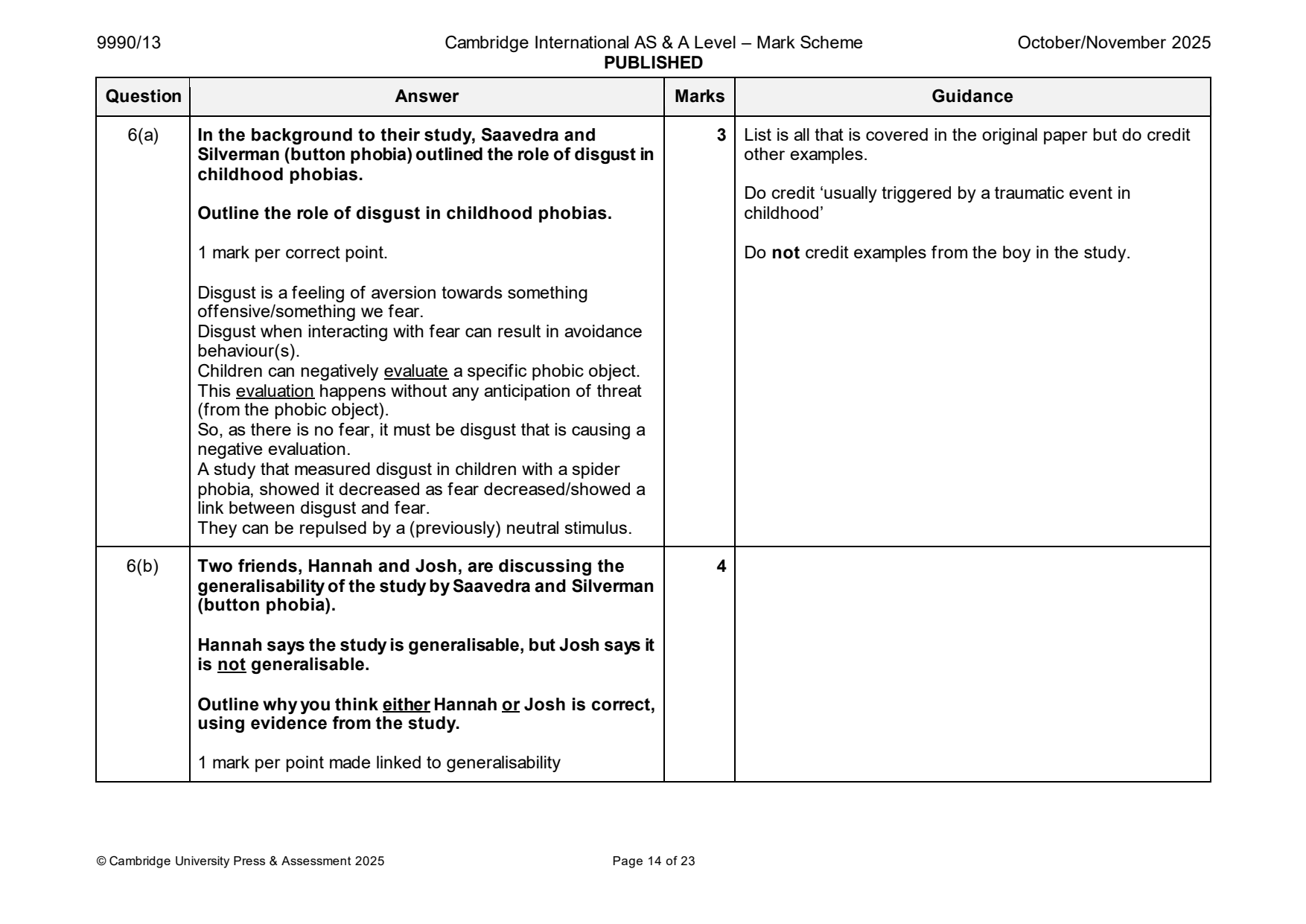
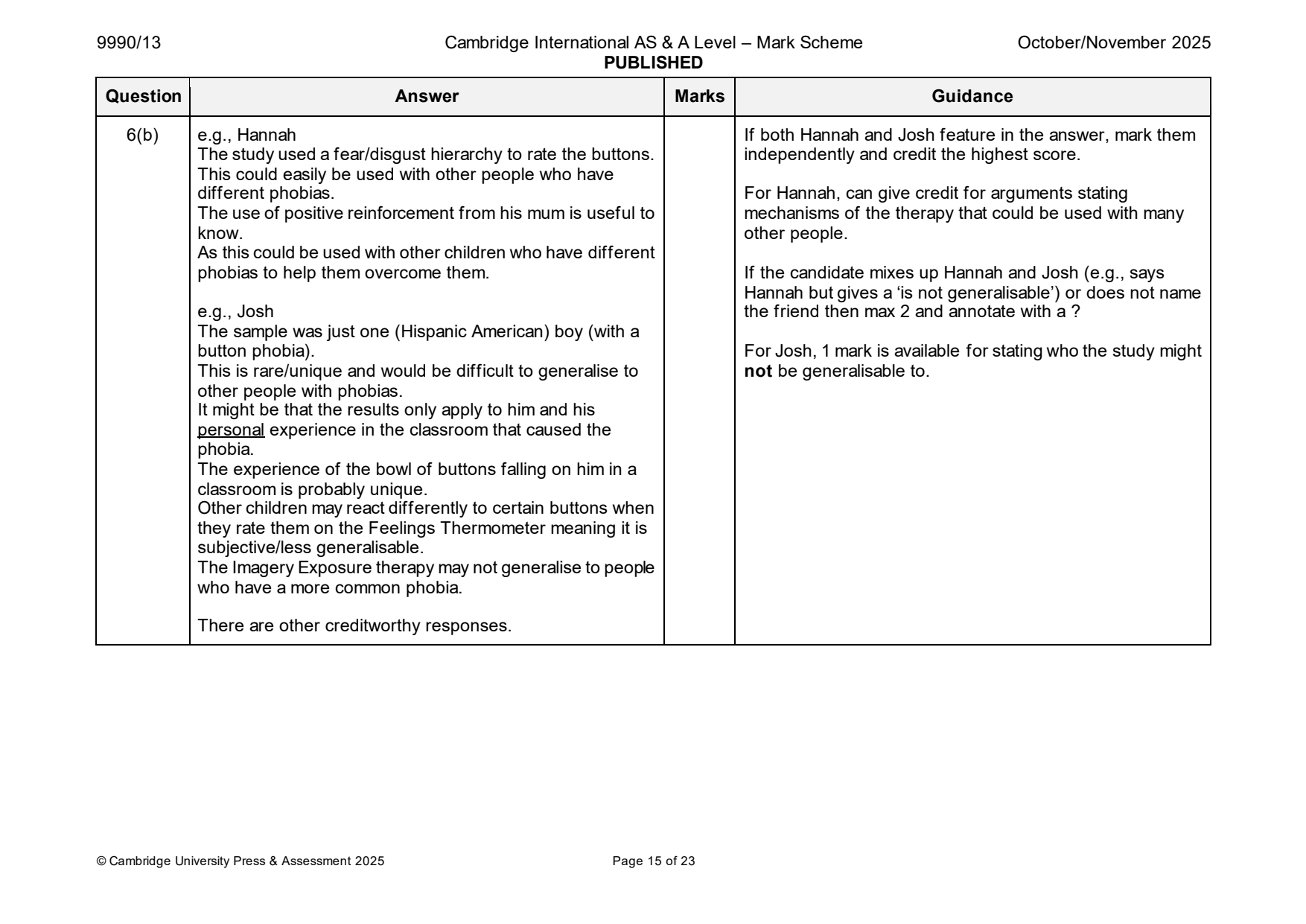
6(a) In the background to their study, Saavedra and 3 List is all that is covered in the original paper but do credit
Silverman (button phobia) outlined the role of disgust in other examples.
childhood phobias.
Do credit ‘usually triggered by a traumatic event in
Outline the role of disgust in childhood phobias. childhood’
1 mark per correct point. Do not credit examples from the boy in the study.
Disgust is a feeling of aversion towards something
offensive/something we fear.
Disgust when interacting with fear can result in avoidance
behaviour(s).
Children can negatively evaluate a specific phobic object.
This evaluation happens without any anticipation of threat
(from the phobic object).
So, as there is no fear, it must be disgust that is causing a
negative evaluation.
A study that measured disgust in children with a spider
phobia, showed it decreased as fear decreased/showed a
link between disgust and fear.
They can be repulsed by a (previously) neutral stimulus.
6(b) Two friends, Hannah and Josh, are discussing the 4
generalisability of the study by Saavedra and Silverman
(button phobia).
Hannah says the study is generalisable, but Josh says it
is not generalisable.
Outline why you think either Hannah or Josh is correct,
using evidence from the study.
1 mark per point made linked to generalisability
© Cambridge University Press & Assessment 2025 Page 14 of 23
6(b) e.g., Hannah If both Hannah and Josh feature in the answer, mark them
The study used a fear/disgust hierarchy to rate the buttons. independently and credit the highest score.
This could easily be used with other people who have
different phobias. For Hannah, can give credit for arguments stating
The use of positive reinforcement from his mum is useful to mechanisms of the therapy that could be used with many
know. other people.
As this could be used with other children who have different
phobias to help them overcome them. If the candidate mixes up Hannah and Josh (e.g., says
Hannah but gives a ‘is not generalisable’) or does not name
e.g., Josh the friend then max 2 and annotate with a ?
The sample was just one (Hispanic American) boy (with a
button phobia). For Josh, 1 mark is available for stating who the study might
This is rare/unique and would be difficult to generalise to not be generalisable to.
other people with phobias.
It might be that the results only apply to him and his
personal experience in the classroom that caused the
phobia.
The experience of the bowl of buttons falling on him in a
classroom is probably unique.
Other children may react differently to certain buttons when
they rate them on the Feelings Thermometer meaning it is
subjective/less generalisable.
The Imagery Exposure therapy may not generalise to people
who have a more common phobia.
There are other creditworthy responses.
© Cambridge University Press & Assessment 2025 Page 15 of 23
Official mark scheme pages: 14, 15 · source PDF URL
9990-2025-on-13-q07
Oct/Nov 2025 · Paper 13 · Question 7 · 4 marks
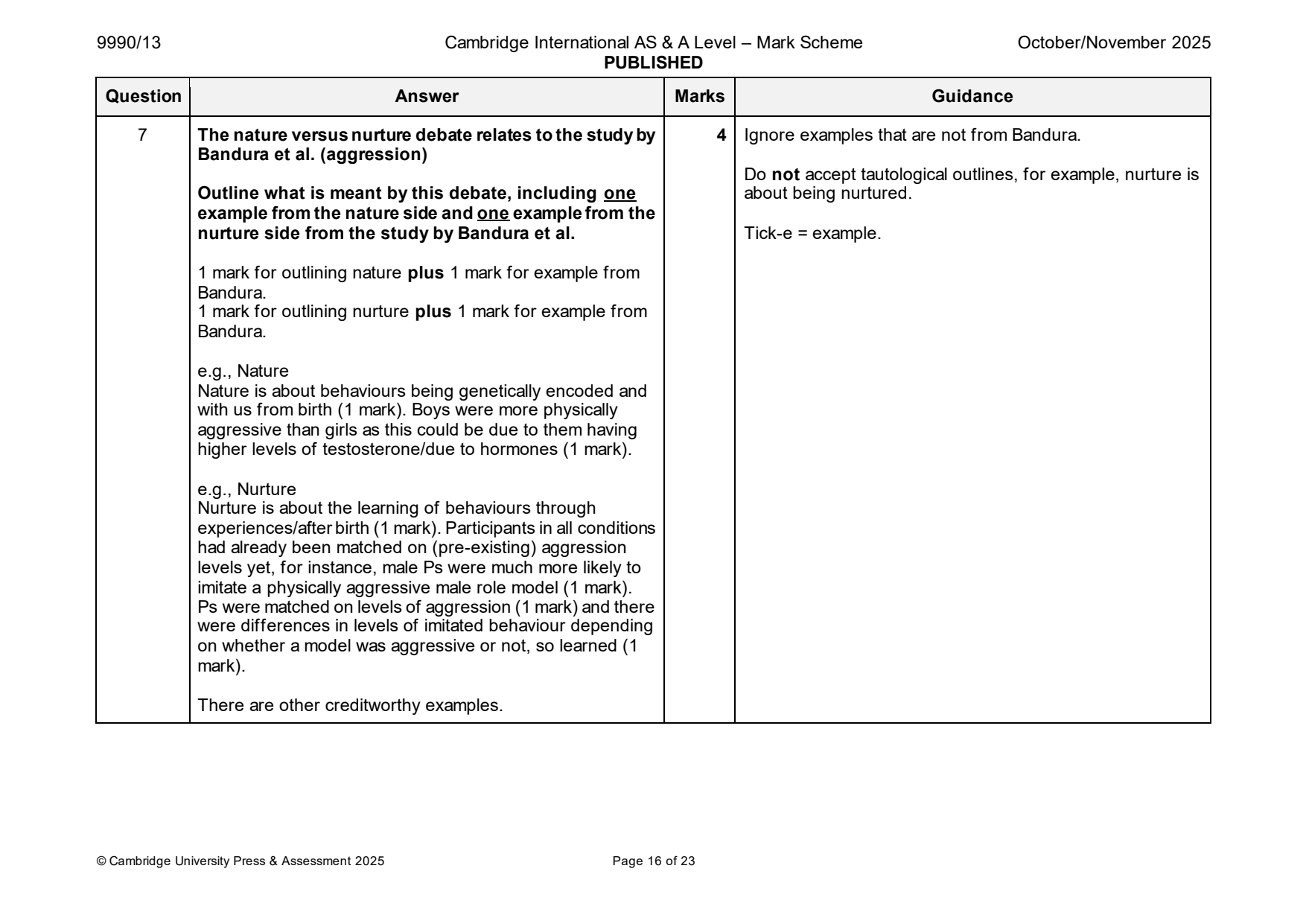
7 The nature versus nurture debate relates to the study by 4 Ignore examples that are not from Bandura.
Bandura et al. (aggression)
Do not accept tautological outlines, for example, nurture is
Outline what is meant by this debate, including one about being nurtured.
example from the nature side and one example from the
nurture side from the study by Bandura et al. Tick-e = example.
1 mark for outlining nature plus 1 mark for example from
Bandura.
1 mark for outlining nurture plus 1 mark for example from
Bandura.
e.g., Nature
Nature is about behaviours being genetically encoded and
with us from birth (1 mark). Boys were more physically
aggressive than girls as this could be due to them having
higher levels of testosterone/due to hormones (1 mark).
e.g., Nurture
Nurture is about the learning of behaviours through
experiences/after birth (1 mark). Participants in all conditions
had already been matched on (pre-existing) aggression
levels yet, for instance, male Ps were much more likely to
imitate a physically aggressive male role model (1 mark).
Ps were matched on levels of aggression (1 mark) and there
were differences in levels of imitated behaviour depending
on whether a model was aggressive or not, so learned (1
mark).
There are other creditworthy examples.
© Cambridge University Press & Assessment 2025 Page 16 of 23
Official mark scheme pages: 16 · source PDF URL
9990-2025-on-13-q08
Oct/Nov 2025 · Paper 13 · Question 8 · 6 marks
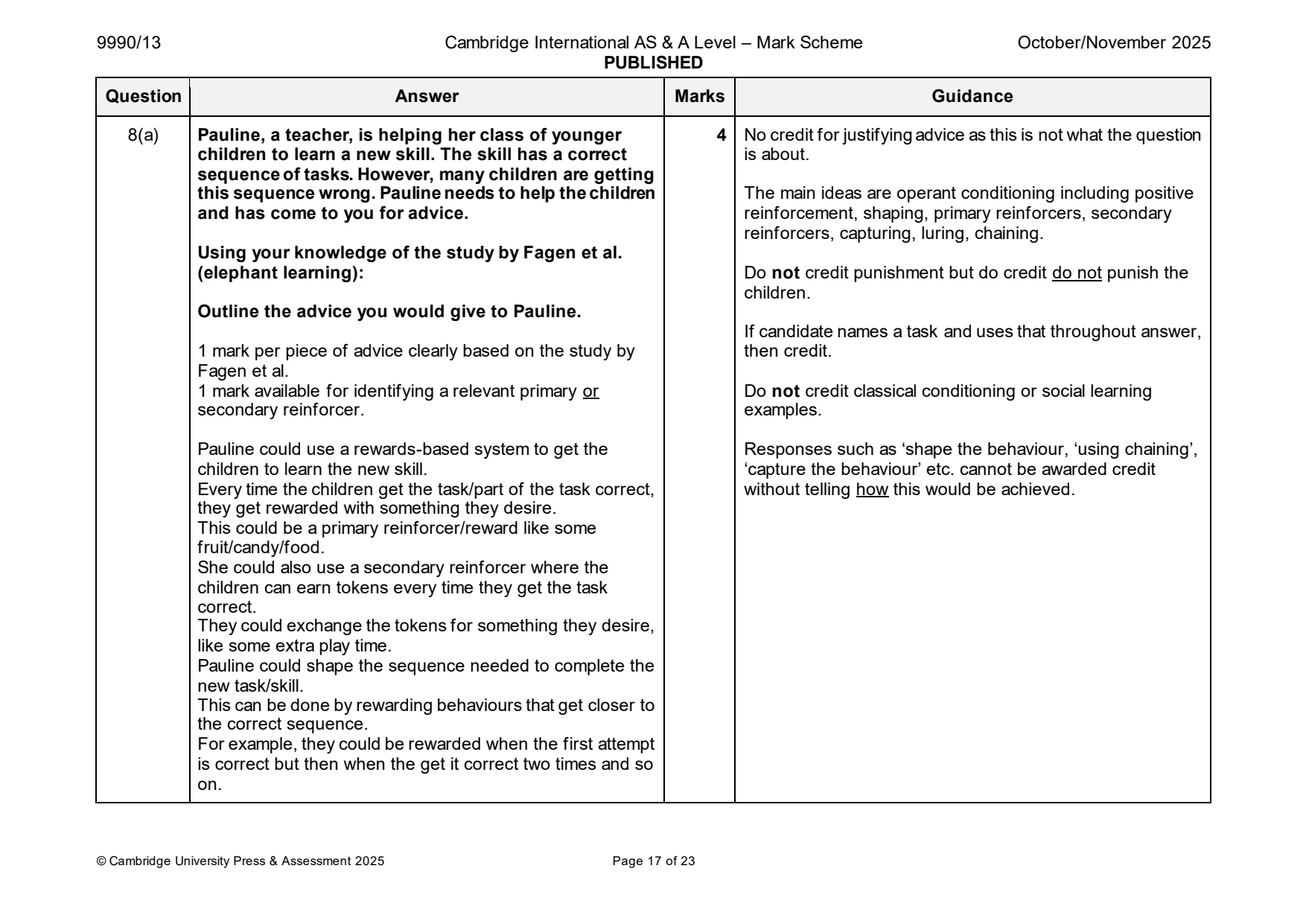
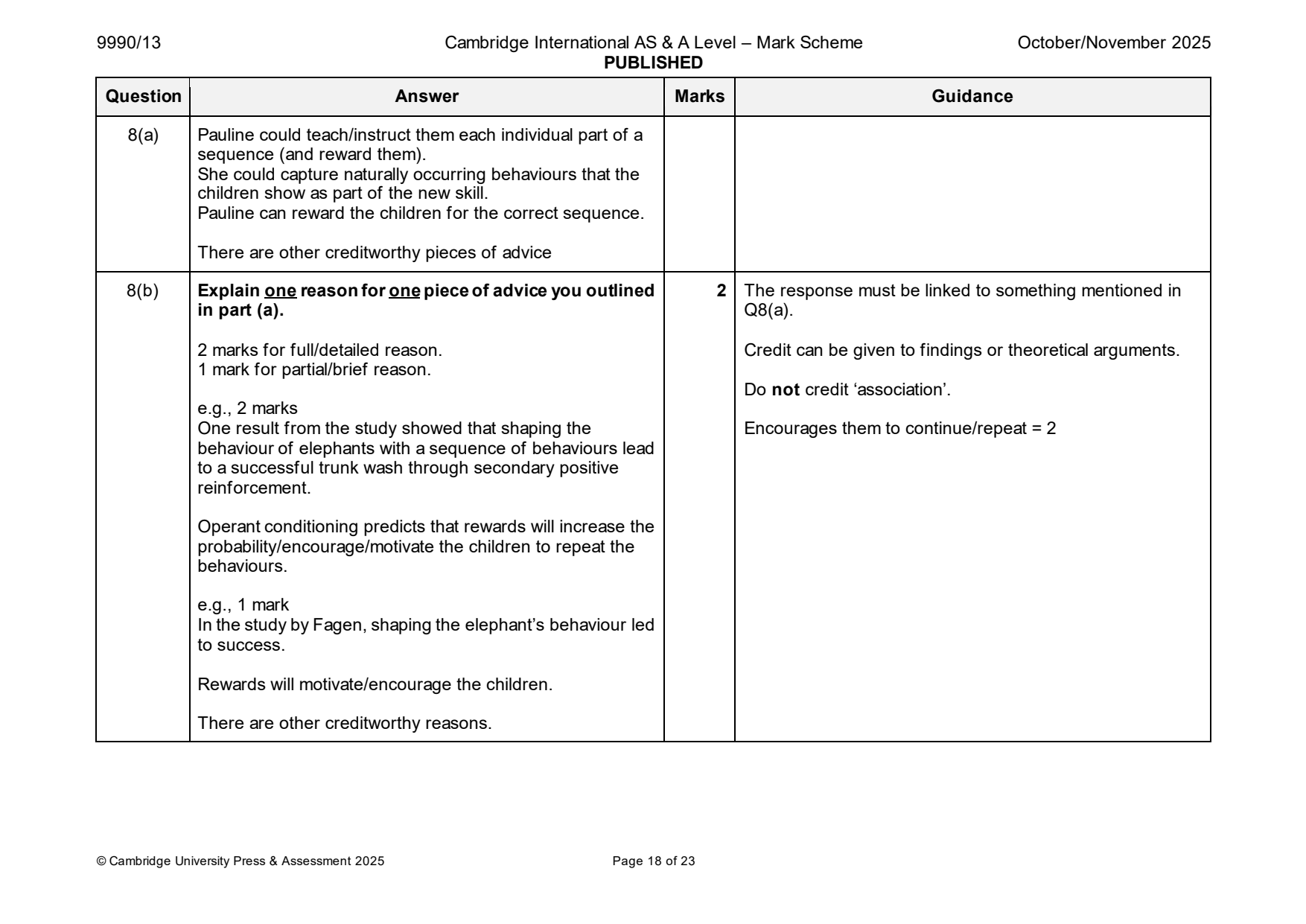
8(a) Pauline, a teacher, is helping her class of younger 4 No credit for justifying advice as this is not what the question
children to learn a new skill. The skill has a correct is about.
sequence of tasks. However, many children are getting
this sequence wrong. Pauline needs to help the children The main ideas are operant conditioning including positive
and has come to you for advice. reinforcement, shaping, primary reinforcers, secondary
reinforcers, capturing, luring, chaining.
Using your knowledge of the study by Fagen et al.
(elephant learning): Do not credit punishment but do credit do not punish the
children.
Outline the advice you would give to Pauline.
If candidate names a task and uses that throughout answer,
1 mark per piece of advice clearly based on the study by then credit.
Fagen et al.
1 mark available for identifying a relevant primary or Do not credit classical conditioning or social learning
secondary reinforcer. examples.
Pauline could use a rewards-based system to get the Responses such as ‘shape the behaviour, ‘using chaining’,
children to learn the new skill. ‘capture the behaviour’ etc. cannot be awarded credit
Every time the children get the task/part of the task correct, without telling how this would be achieved.
they get rewarded with something they desire.
This could be a primary reinforcer/reward like some
fruit/candy/food.
She could also use a secondary reinforcer where the
children can earn tokens every time they get the task
correct.
They could exchange the tokens for something they desire,
like some extra play time.
Pauline could shape the sequence needed to complete the
new task/skill.
This can be done by rewarding behaviours that get closer to
the correct sequence.
For example, they could be rewarded when the first attempt
is correct but then when the get it correct two times and so
on.
© Cambridge University Press & Assessment 2025 Page 17 of 23
8(a) Pauline could teach/instruct them each individual part of a
sequence (and reward them).
She could capture naturally occurring behaviours that the
children show as part of the new skill.
Pauline can reward the children for the correct sequence.
There are other creditworthy pieces of advice
8(b) Explain one reason for one piece of advice you outlined 2 The response must be linked to something mentioned in
in part (a). Q8(a).
2 marks for full/detailed reason. Credit can be given to findings or theoretical arguments.
1 mark for partial/brief reason.
Do not credit ‘association’.
e.g., 2 marks
One result from the study showed that shaping the Encourages them to continue/repeat = 2
behaviour of elephants with a sequence of behaviours lead
to a successful trunk wash through secondary positive
reinforcement.
Operant conditioning predicts that rewards will increase the
probability/encourage/motivate the children to repeat the
behaviours.
e.g., 1 mark
In the study by Fagen, shaping the elephant’s behaviour led
to success.
Rewards will motivate/encourage the children.
There are other creditworthy reasons.
© Cambridge University Press & Assessment 2025 Page 18 of 23
Official mark scheme pages: 17, 18 · source PDF URL