Try the new view →
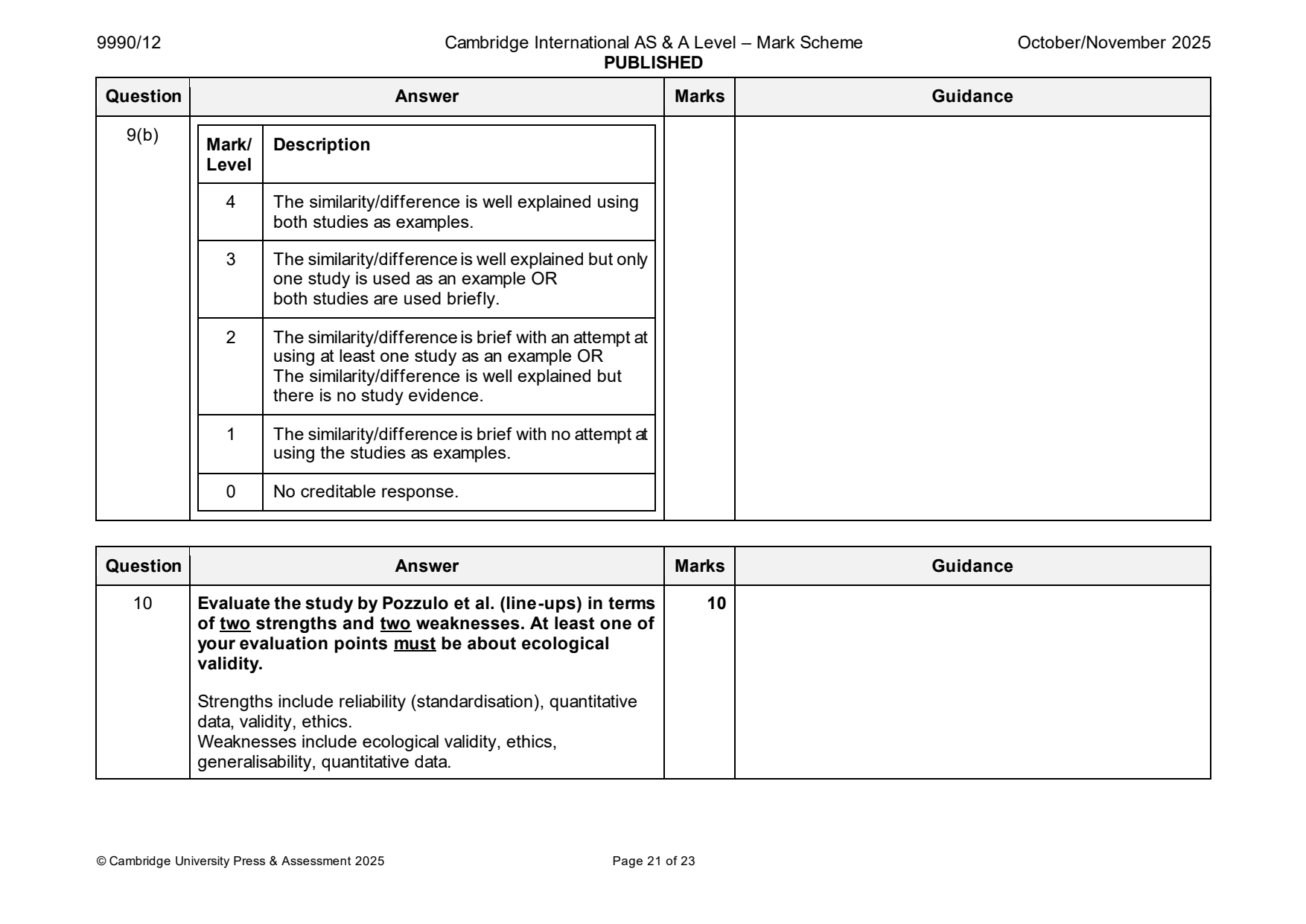
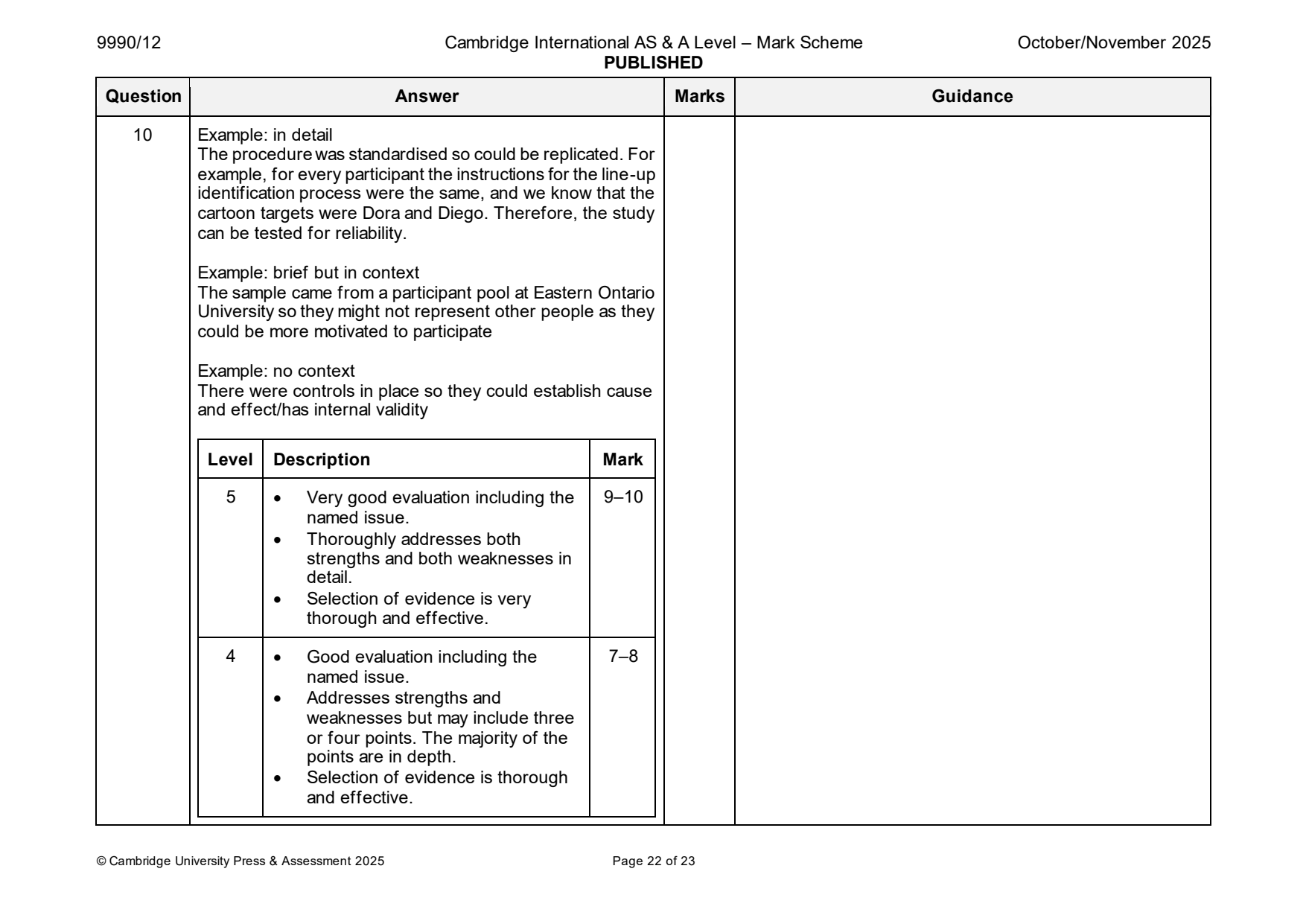
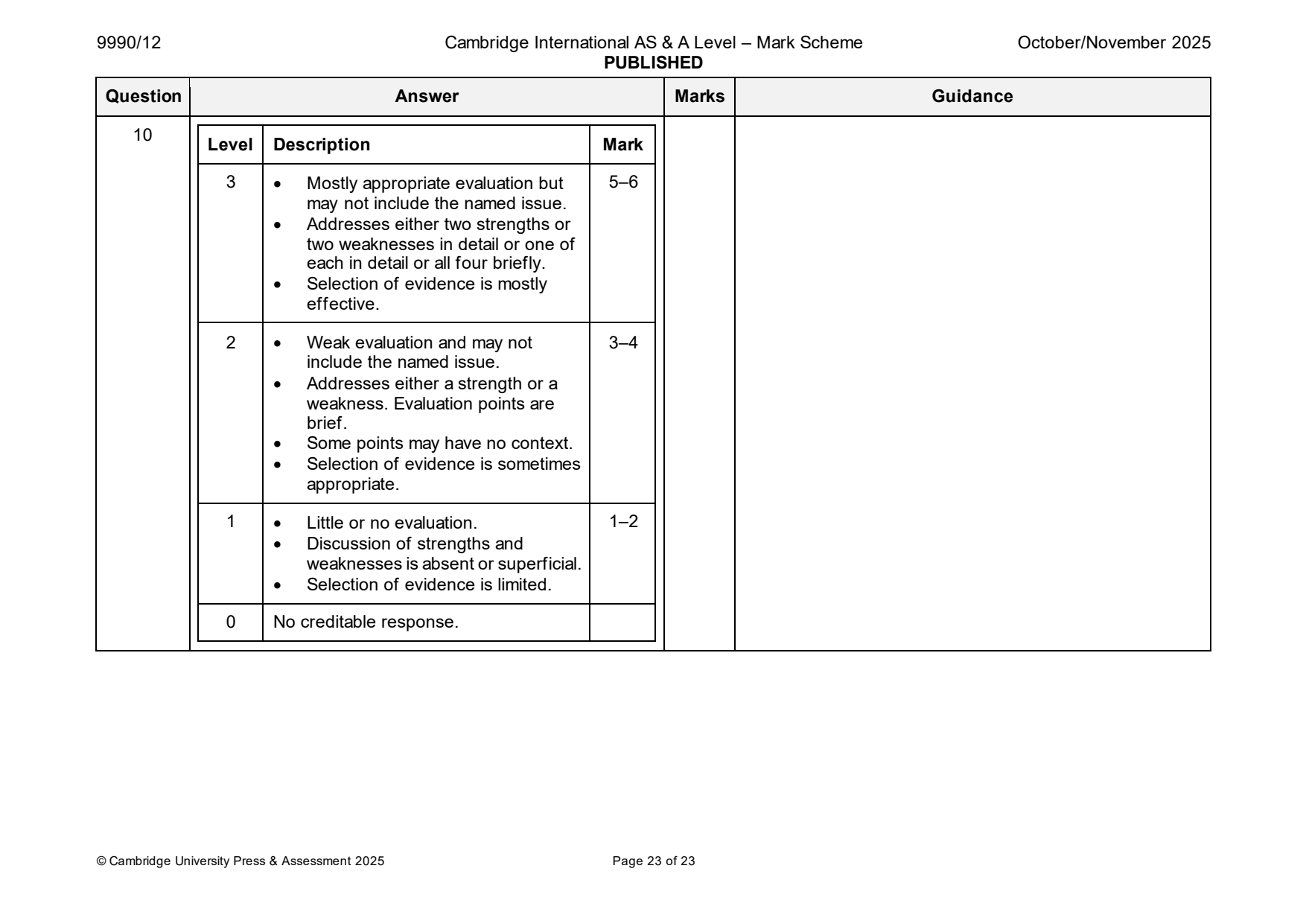
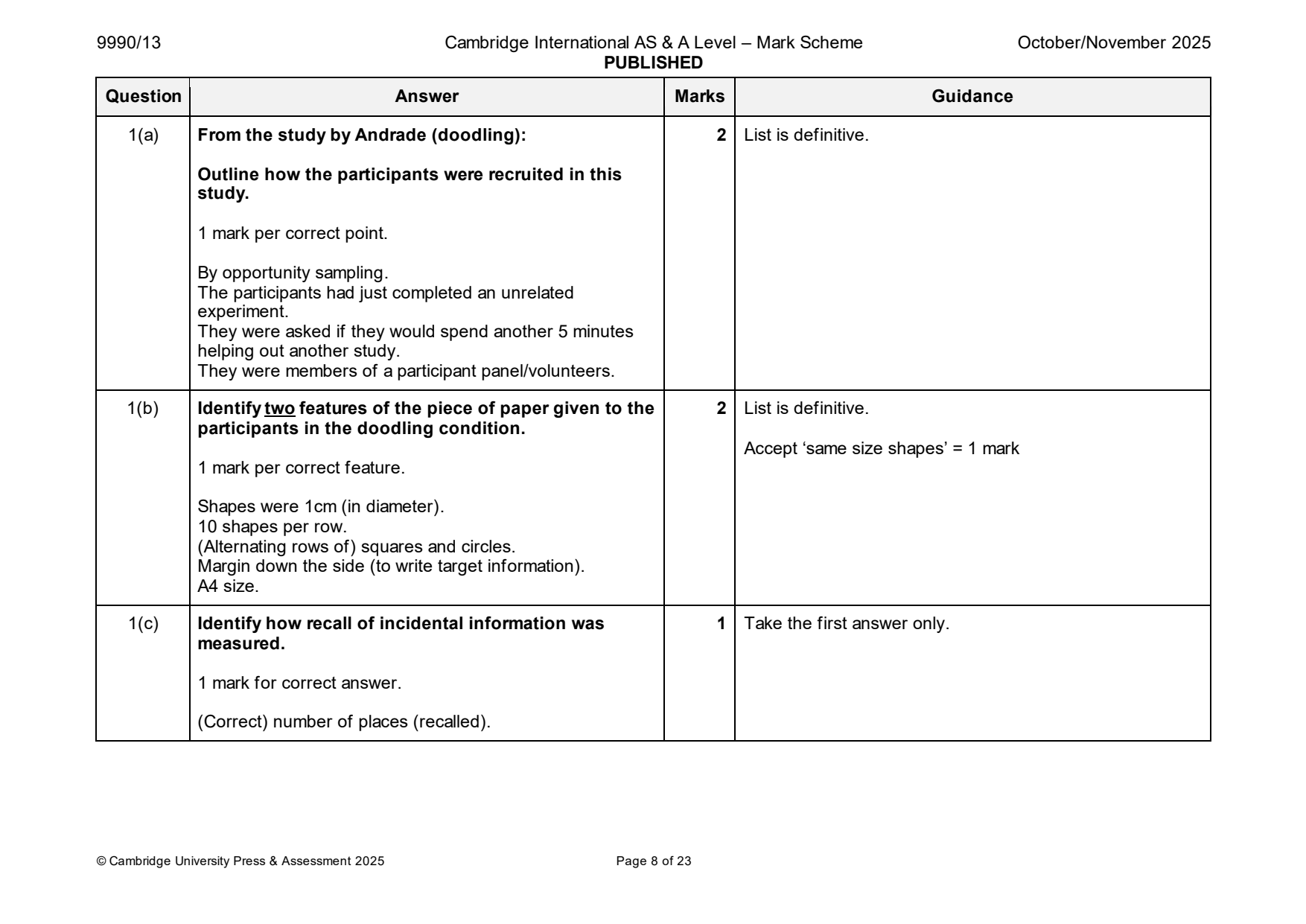
9990-2021-mj-11-q03
May/June 2021 · Paper 11 · Question 3 · 5 marks
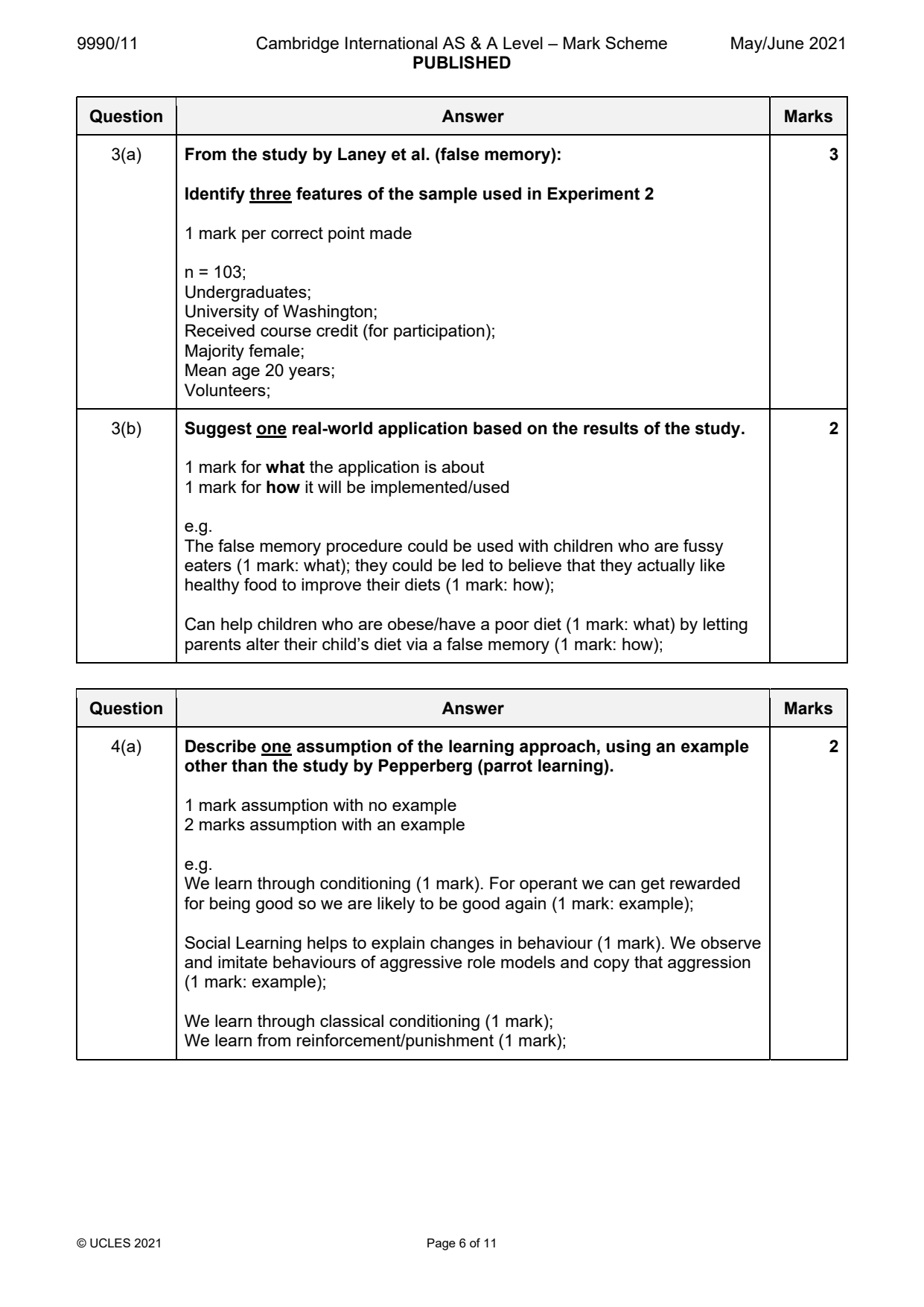
3(a) From the study by Laney et al. (false memory): 3
Identify three features of the sample used in Experiment 2
1 mark per correct point made
n = 103;
Undergraduates;
University of Washington;
Received course credit (for participation);
Majority female;
Mean age 20 years;
Volunteers;
3(b) Suggest one real-world application based on the results of the study. 2
1 mark for what the application is about
1 mark for how it will be implemented/used
e.g.
The false memory procedure could be used with children who are fussy
eaters (1 mark: what); they could be led to believe that they actually like
healthy food to improve their diets (1 mark: how);
Can help children who are obese/have a poor diet (1 mark: what) by letting
parents alter their child’s diet via a false memory (1 mark: how);
Question Answer Marks
Official mark scheme pages: 6 · source PDF URL
9990-2021-mj-11-q07
May/June 2021 · Paper 11 · Question 7 · 6 marks
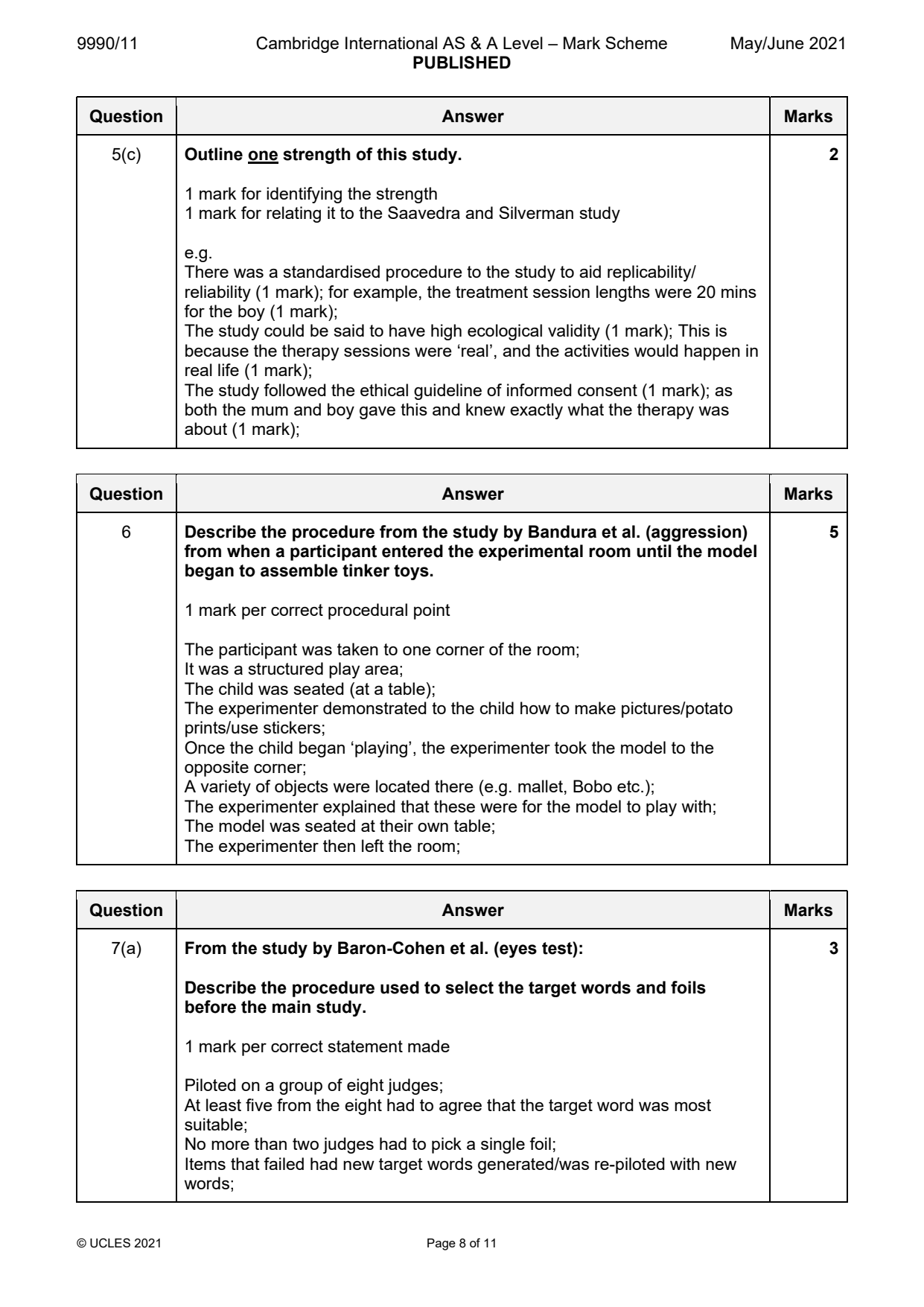
7(a) From the study by Baron-Cohen et al. (eyes test): 3
Describe the procedure used to select the target words and foils
before the main study.
1 mark per correct statement made
Piloted on a group of eight judges;
At least five from the eight had to agree that the target word was most
suitable;
No more than two judges had to pick a single foil;
Items that failed had new target words generated/was re-piloted with new
words;
© UCLES 2021 Page 8 of 11
7(b) Group 1 consisted of 15 adults recruited using adverts in a specialist 3
magazine.
Identify three other characteristics of Group 1.
1 mark per characteristic
(all) male;
(diagnosed) with AS/HFA;
Mean age of 29.7 (years);
Normal range IQ/mean IQ = 115;
Same socioeconomic classes as Group 2;
Same educational levels as Group 2;
Question Answer Marks
Official mark scheme pages: 8, 9 · source PDF URL
9990-2021-mj-12-q03
May/June 2021 · Paper 12 · Question 3 · 5 marks
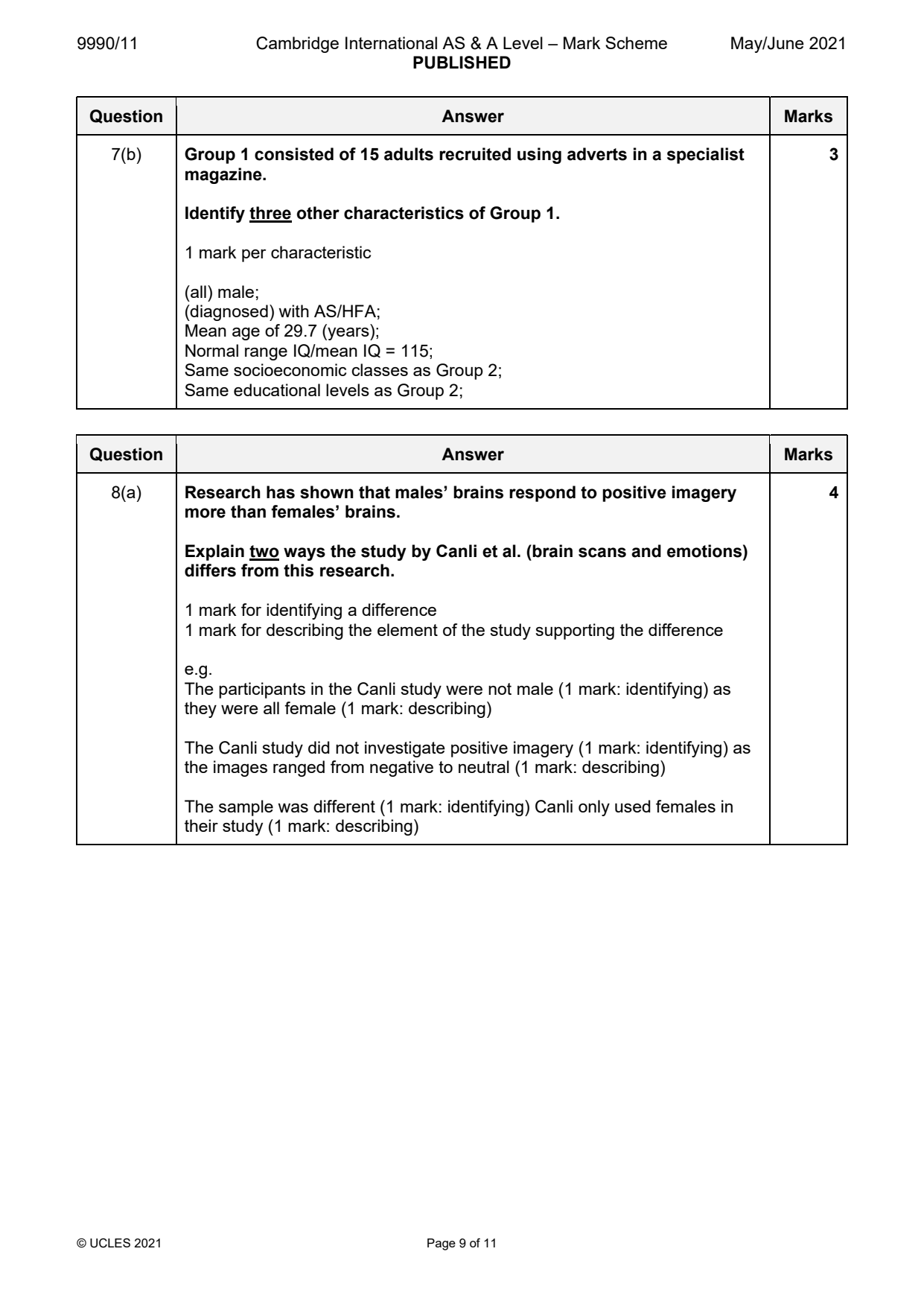
3(a) From the study by Baron-Cohen et al. (eyes test): 3
Identify three features of the sample used for Group 4.
1 mark per correct point made
Random sample;
General population;
N = 14;
Not diagnosed with AS/HFA;
IQ matched with Group 1/mean IQ = 116;
Same age distribution as Group 1/mean age = 28 years;
3(b) Suggest one real-world application based on the results of this study. 2
1 mark for what the application is about
1 mark for how it will be implemented/used
e.g.
The eyes test could be used as a diagnostic tool for AS/HFA (1 mark: what)
Those who score low on the test may show a lack of theory of mind
(1 mark: how)
Teachers can use the eyes test to see which students struggle with social
interactions (1 mark: how)
by giving these students extra lessons to help improve (1 mark: what)
© UCLES 2021 Page 5 of 10
Official mark scheme pages: 5 · source PDF URL
9990-2021-mj-12-q06
May/June 2021 · Paper 12 · Question 6 · 5 marks
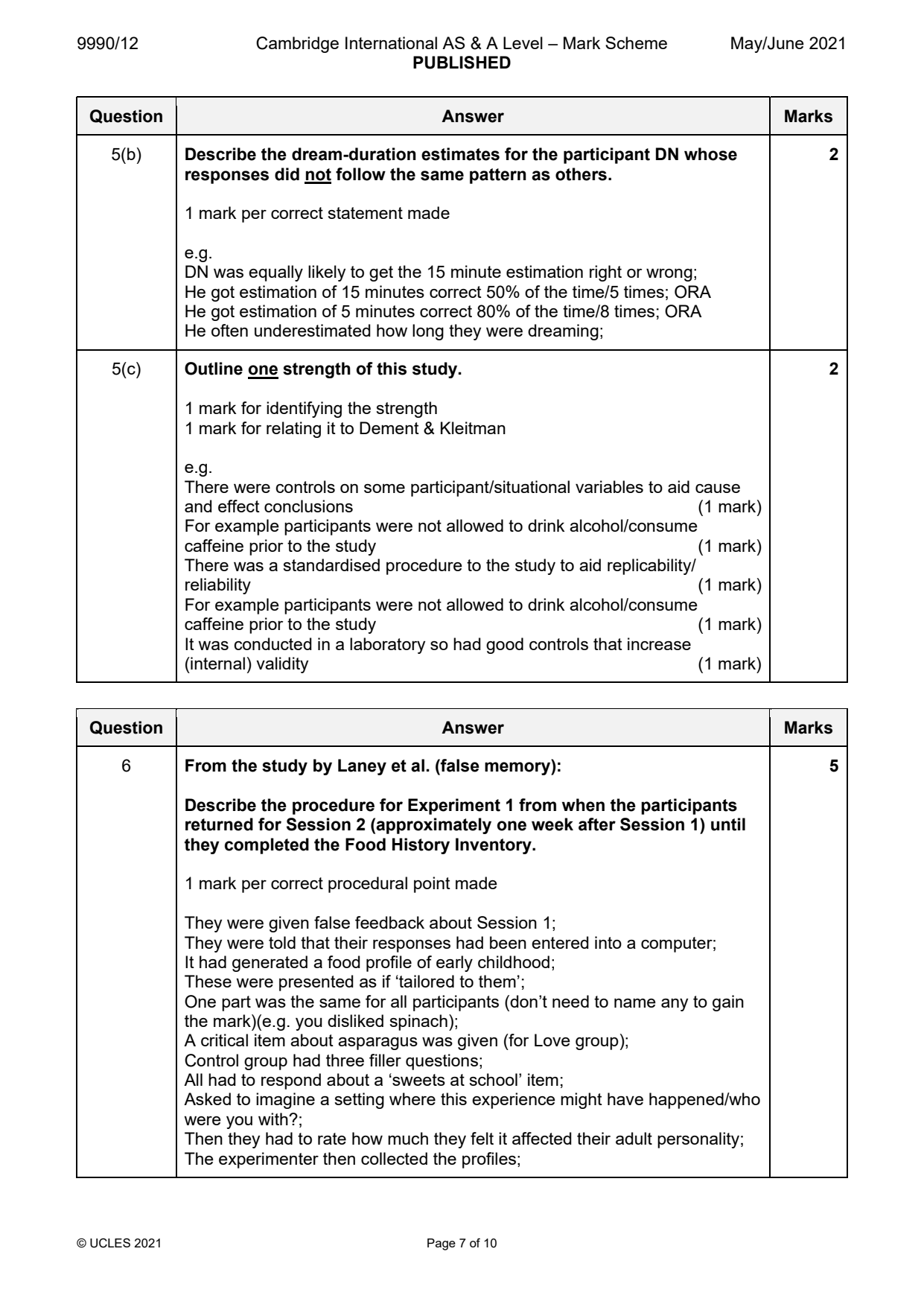
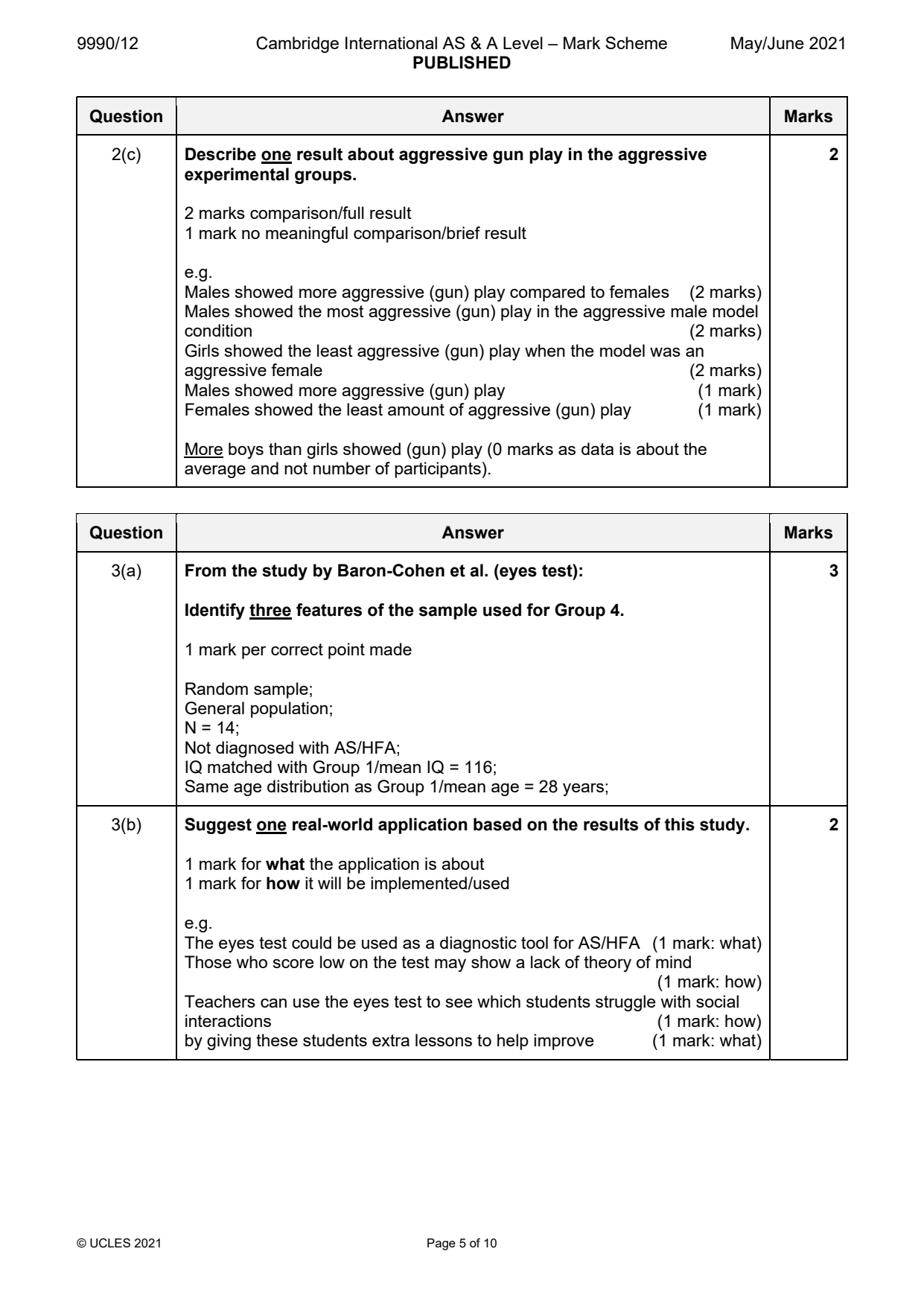
6 From the study by Laney et al. (false memory): 5
Describe the procedure for Experiment 1 from when the participants
returned for Session 2 (approximately one week after Session 1) until
they completed the Food History Inventory.
1 mark per correct procedural point made
They were given false feedback about Session 1;
They were told that their responses had been entered into a computer;
It had generated a food profile of early childhood;
These were presented as if ‘tailored to them’;
One part was the same for all participants (don’t need to name any to gain
the mark)(e.g. you disliked spinach);
A critical item about asparagus was given (for Love group);
Control group had three filler questions;
All had to respond about a ‘sweets at school’ item;
Asked to imagine a setting where this experience might have happened/who
were you with?;
Then they had to rate how much they felt it affected their adult personality;
The experimenter then collected the profiles;
© UCLES 2021 Page 7 of 10
Official mark scheme pages: 7 · source PDF URL
9990-2021-mj-13-q04
May/June 2021 · Paper 13 · Question 4 · 6 marks
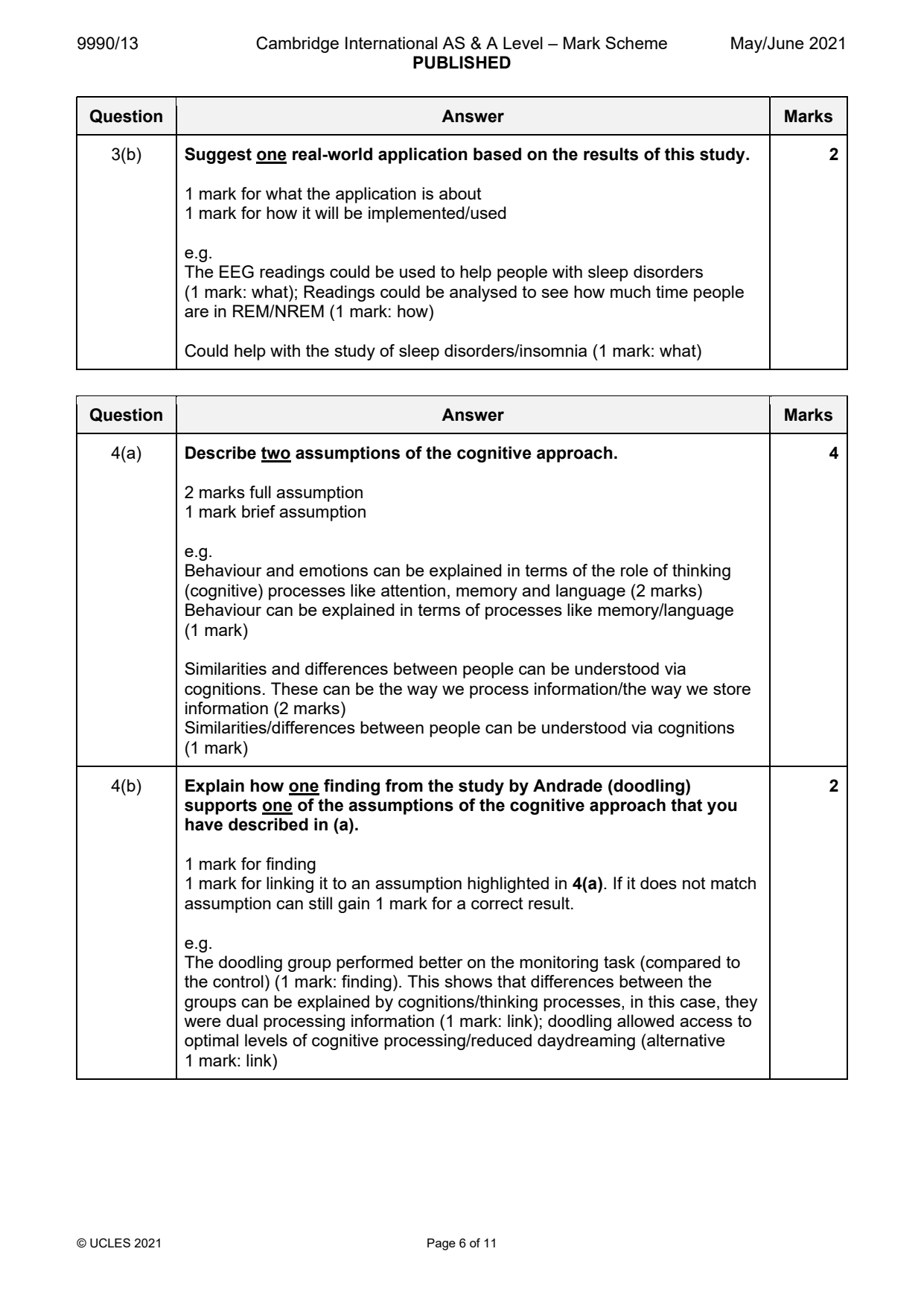
4(a) Describe two assumptions of the cognitive approach. 4
2 marks full assumption
1 mark brief assumption
e.g.
Behaviour and emotions can be explained in terms of the role of thinking
(cognitive) processes like attention, memory and language (2 marks)
Behaviour can be explained in terms of processes like memory/language
(1 mark)
Similarities and differences between people can be understood via
cognitions. These can be the way we process information/the way we store
information (2 marks)
Similarities/differences between people can be understood via cognitions
(1 mark)
4(b) Explain how one finding from the study by Andrade (doodling) 2
supports one of the assumptions of the cognitive approach that you
have described in (a).
1 mark for finding
1 mark for linking it to an assumption highlighted in 4(a). If it does not match
assumption can still gain 1 mark for a correct result.
e.g.
The doodling group performed better on the monitoring task (compared to
the control) (1 mark: finding). This shows that differences between the
groups can be explained by cognitions/thinking processes, in this case, they
were dual processing information (1 mark: link); doodling allowed access to
optimal levels of cognitive processing/reduced daydreaming (alternative
1 mark: link)
© UCLES 2021 Page 6 of 11
Official mark scheme pages: 6 · source PDF URL
9990-2021-mj-13-q06
May/June 2021 · Paper 13 · Question 6 · 5 marks
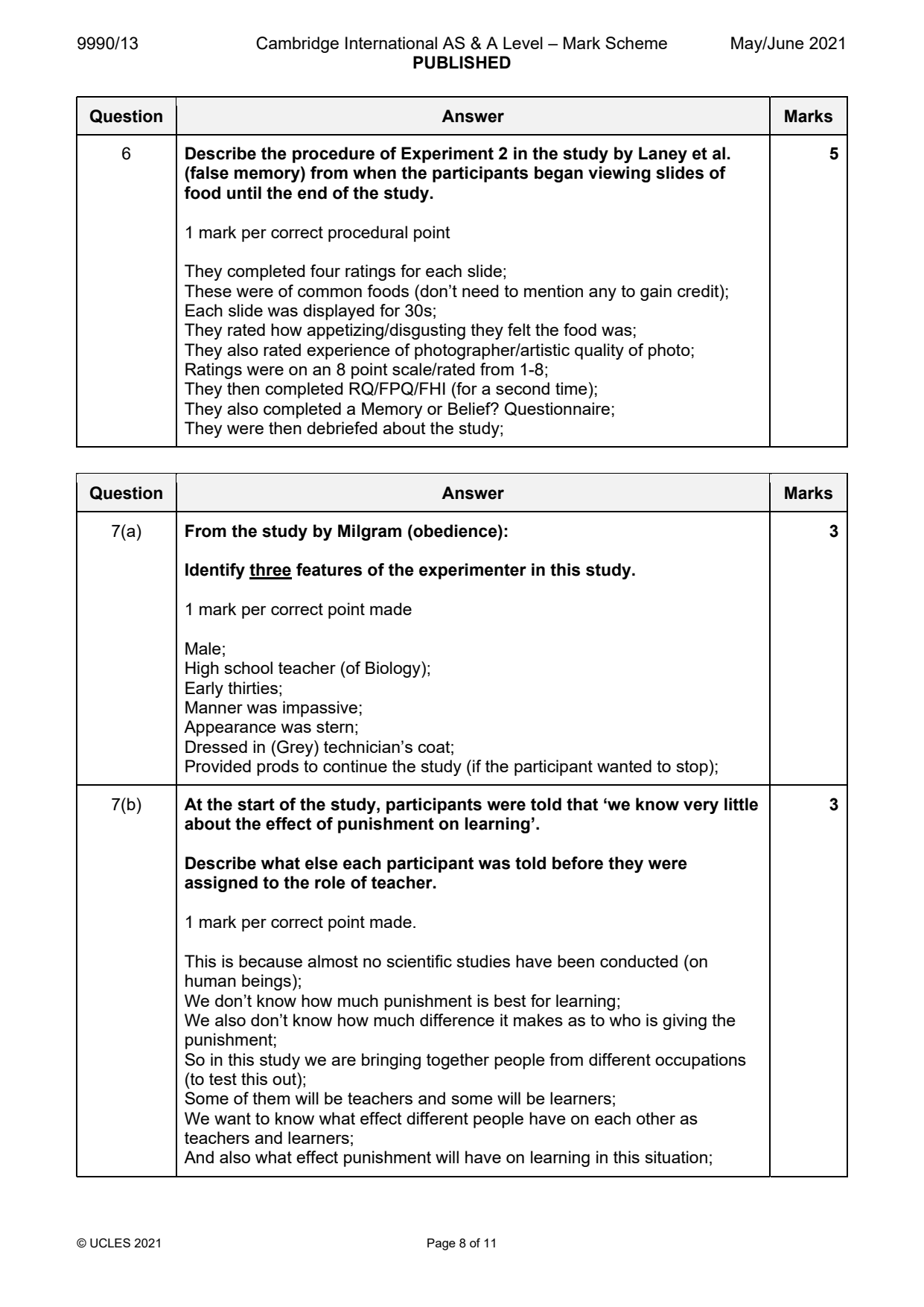
6 Describe the procedure of Experiment 2 in the study by Laney et al. 5
(false memory) from when the participants began viewing slides of
food until the end of the study.
1 mark per correct procedural point
They completed four ratings for each slide;
These were of common foods (don’t need to mention any to gain credit);
Each slide was displayed for 30s;
They rated how appetizing/disgusting they felt the food was;
They also rated experience of photographer/artistic quality of photo;
Ratings were on an 8 point scale/rated from 1-8;
They then completed RQ/FPQ/FHI (for a second time);
They also completed a Memory or Belief? Questionnaire;
They were then debriefed about the study;
Question Answer Marks
Official mark scheme pages: 8 · source PDF URL
9990-2021-on-11-q02
Oct/Nov 2021 · Paper 11 · Question 2 · 5 marks
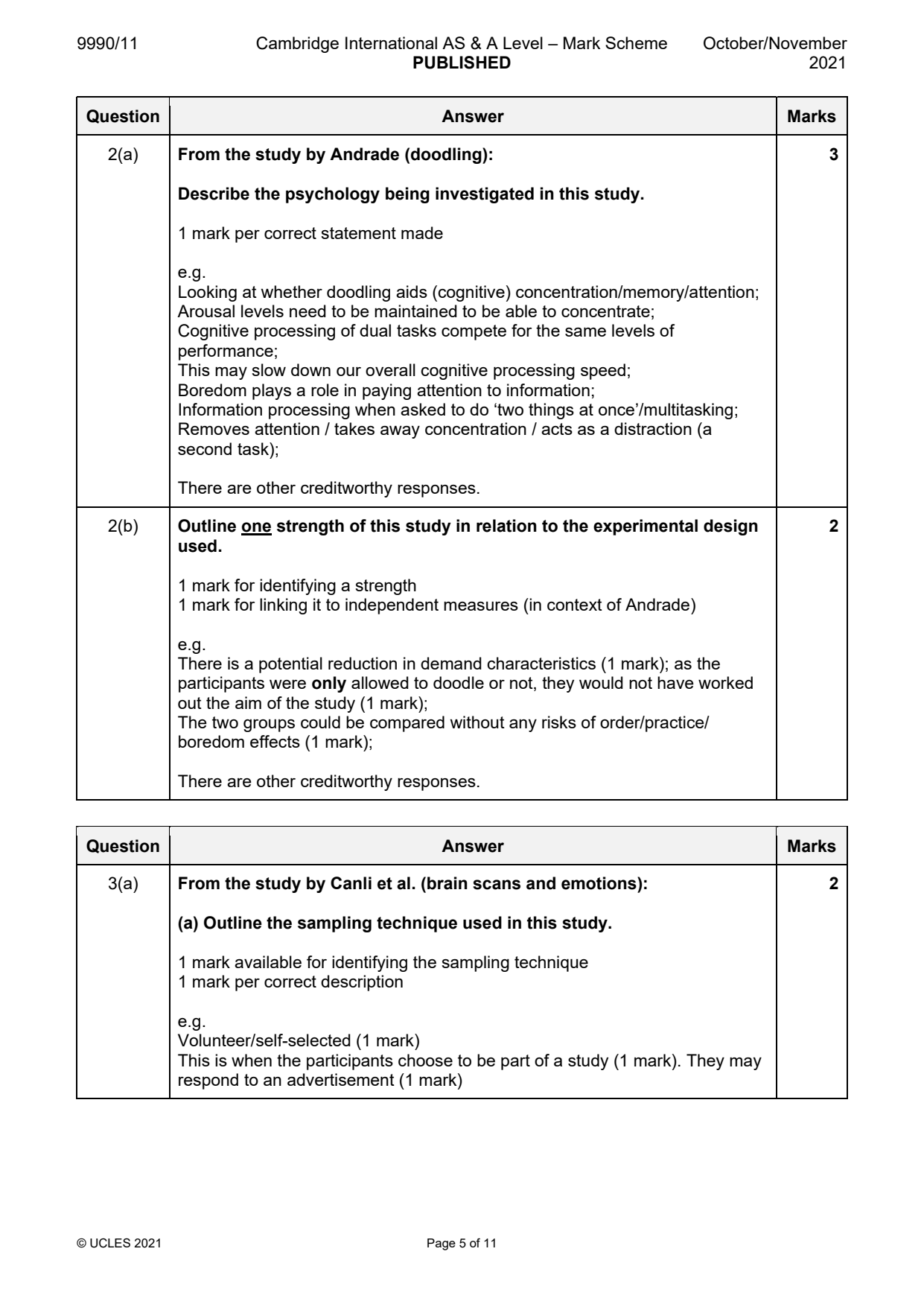
2(a) From the study by Andrade (doodling): 3
Describe the psychology being investigated in this study.
1 mark per correct statement made
e.g.
Looking at whether doodling aids (cognitive) concentration/memory/attention;
Arousal levels need to be maintained to be able to concentrate;
Cognitive processing of dual tasks compete for the same levels of
performance;
This may slow down our overall cognitive processing speed;
Boredom plays a role in paying attention to information;
Information processing when asked to do ‘two things at once’/multitasking;
Removes attention / takes away concentration / acts as a distraction (a
second task);
There are other creditworthy responses.
2(b) Outline one strength of this study in relation to the experimental design 2
used.
1 mark for identifying a strength
1 mark for linking it to independent measures (in context of Andrade)
e.g.
There is a potential reduction in demand characteristics (1 mark); as the
participants were only allowed to doodle or not, they would not have worked
out the aim of the study (1 mark);
The two groups could be compared without any risks of order/practice/
boredom effects (1 mark);
There are other creditworthy responses.
Question Answer Marks
Official mark scheme pages: 5 · source PDF URL
9990-2021-on-11-q05
Oct/Nov 2021 · Paper 11 · Question 5 · 4 marks
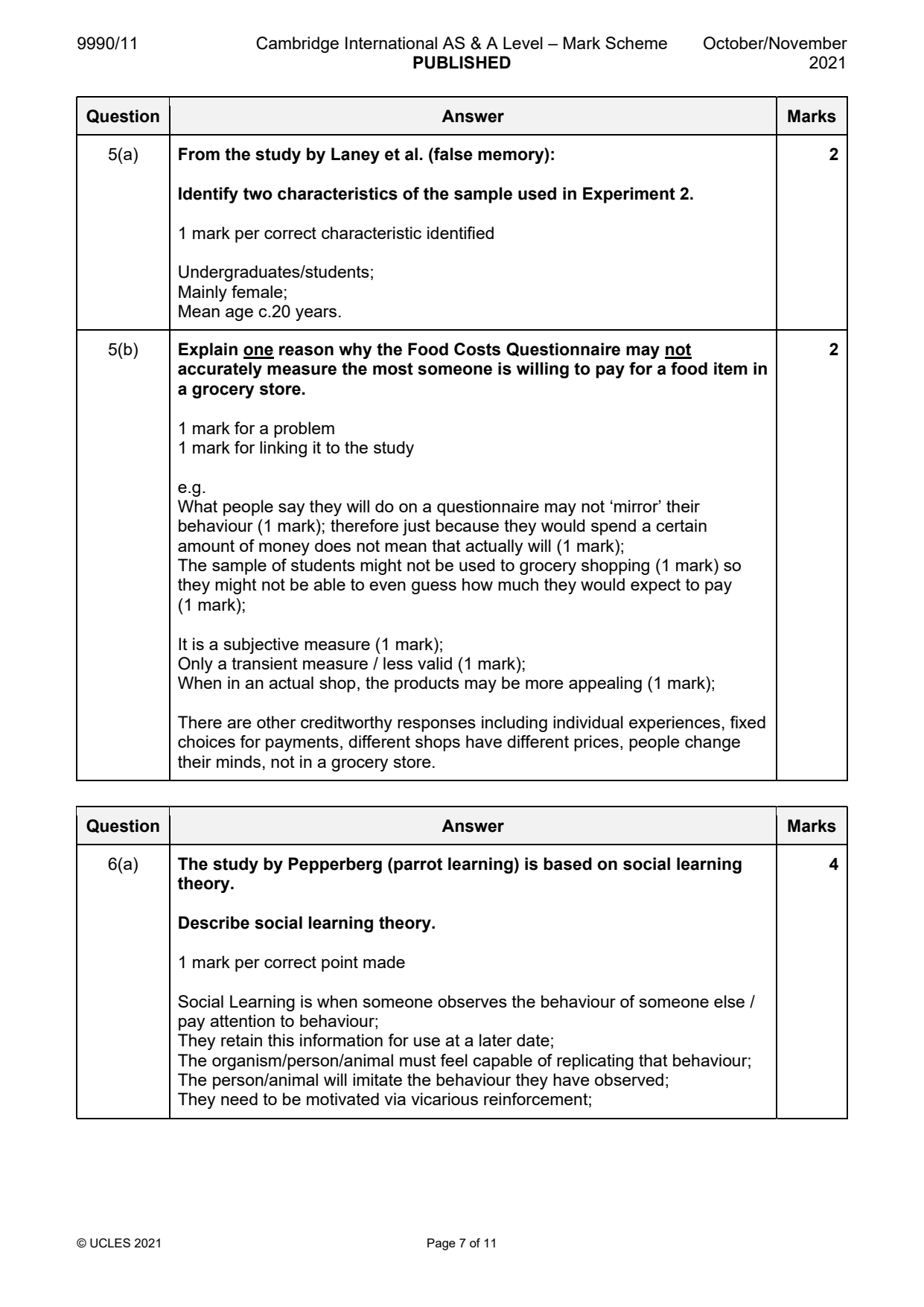
5(a) From the study by Laney et al. (false memory): 2
Identify two characteristics of the sample used in Experiment 2.
1 mark per correct characteristic identified
Undergraduates/students;
Mainly female;
Mean age c.20 years.
5(b) Explain one reason why the Food Costs Questionnaire may not 2
accurately measure the most someone is willing to pay for a food item in
a grocery store.
1 mark for a problem
1 mark for linking it to the study
e.g.
What people say they will do on a questionnaire may not ‘mirror’ their
behaviour (1 mark); therefore just because they would spend a certain
amount of money does not mean that actually will (1 mark);
The sample of students might not be used to grocery shopping (1 mark) so
they might not be able to even guess how much they would expect to pay
(1 mark);
It is a subjective measure (1 mark);
Only a transient measure / less valid (1 mark);
When in an actual shop, the products may be more appealing (1 mark);
There are other creditworthy responses including individual experiences, fixed
choices for payments, different shops have different prices, people change
their minds, not in a grocery store.
Question Answer Marks
Official mark scheme pages: 7 · source PDF URL
9990-2021-on-11-q09
Oct/Nov 2021 · Paper 11 · Question 9 · 10 marks
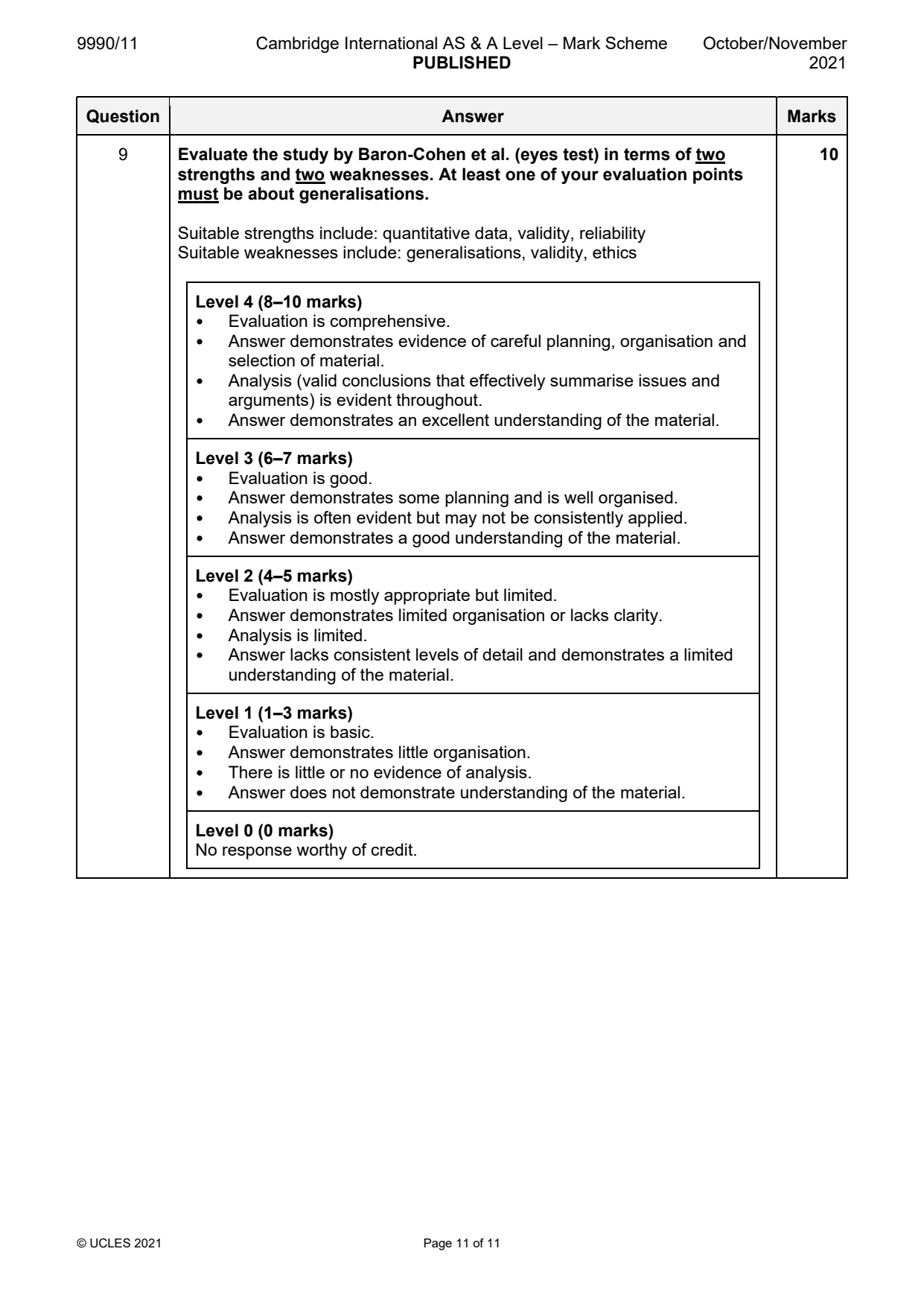
9 Evaluate the study by Baron-Cohen et al. (eyes test) in terms of two 10
strengths and two weaknesses. At least one of your evaluation points
must be about generalisations.
Suitable strengths include: quantitative data, validity, reliability
Suitable weaknesses include: generalisations, validity, ethics
Level 4 (8–10 marks)
• Evaluation is comprehensive.
• Answer demonstrates evidence of careful planning, organisation and
selection of material.
• Analysis (valid conclusions that effectively summarise issues and
arguments) is evident throughout.
• Answer demonstrates an excellent understanding of the material.
Level 3 (6–7 marks)
• Evaluation is good.
• Answer demonstrates some planning and is well organised.
• Analysis is often evident but may not be consistently applied.
• Answer demonstrates a good understanding of the material.
Level 2 (4–5 marks)
• Evaluation is mostly appropriate but limited.
• Answer demonstrates limited organisation or lacks clarity.
• Analysis is limited.
• Answer lacks consistent levels of detail and demonstrates a limited
understanding of the material.
Level 1 (1–3 marks)
• Evaluation is basic.
• Answer demonstrates little organisation.
• There is little or no evidence of analysis.
• Answer does not demonstrate understanding of the material.
Level 0 (0 marks)
No response worthy of credit.
© UCLES 2021 Page 11 of 11
Official mark scheme pages: 11 · source PDF URL
9990-2021-on-12-q06
Oct/Nov 2021 · Paper 12 · Question 6 · 6 marks
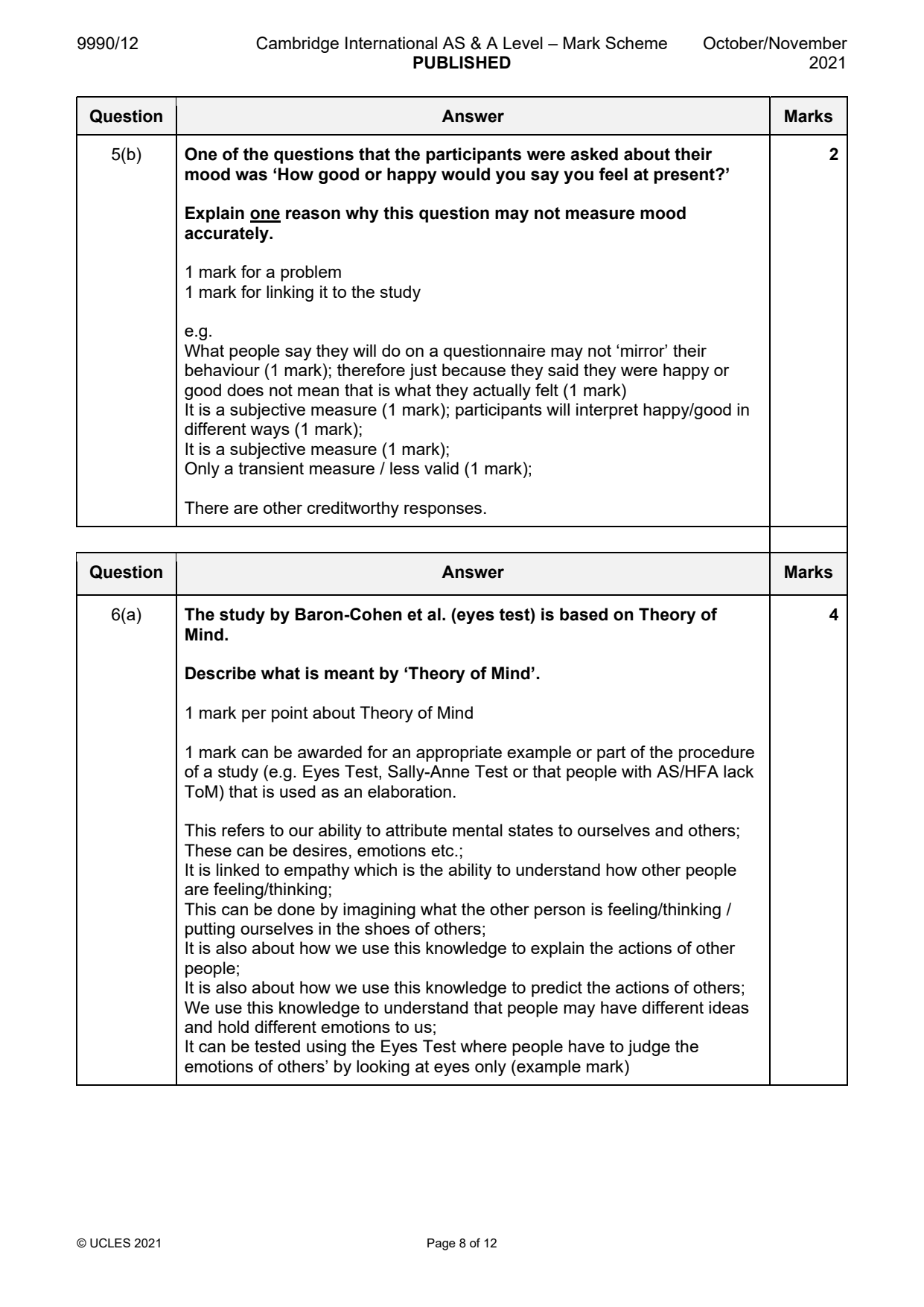
6(a) The study by Baron-Cohen et al. (eyes test) is based on Theory of 4
Mind.
Describe what is meant by ‘Theory of Mind’.
1 mark per point about Theory of Mind
1 mark can be awarded for an appropriate example or part of the procedure
of a study (e.g. Eyes Test, Sally-Anne Test or that people with AS/HFA lack
ToM) that is used as an elaboration.
This refers to our ability to attribute mental states to ourselves and others;
These can be desires, emotions etc.;
It is linked to empathy which is the ability to understand how other people
are feeling/thinking;
This can be done by imagining what the other person is feeling/thinking /
putting ourselves in the shoes of others;
It is also about how we use this knowledge to explain the actions of other
people;
It is also about how we use this knowledge to predict the actions of others;
We use this knowledge to understand that people may have different ideas
and hold different emotions to us;
It can be tested using the Eyes Test where people have to judge the
emotions of others’ by looking at eyes only (example mark)
© UCLES 2021 Page 8 of 12
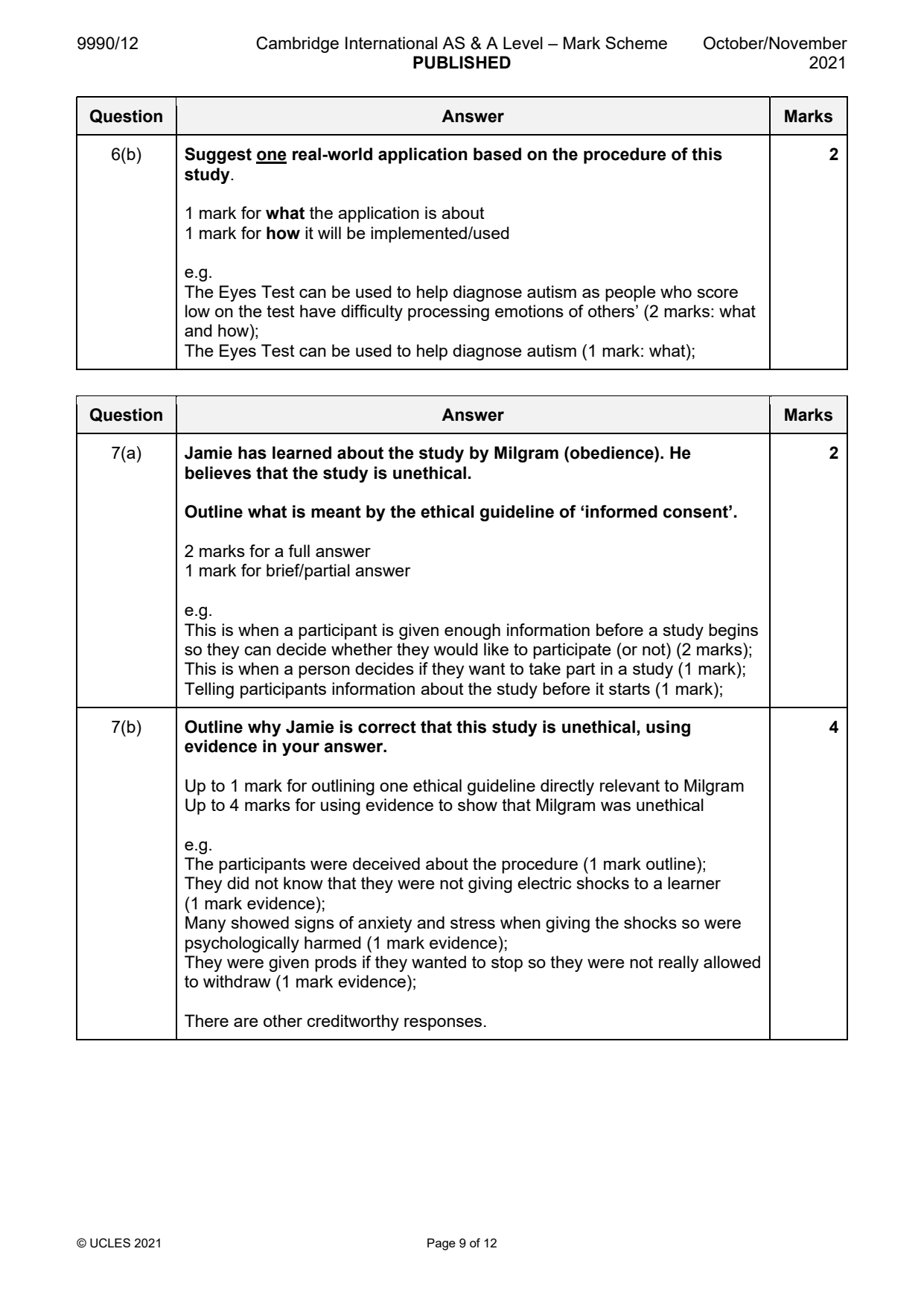
6(b) Suggest one real-world application based on the procedure of this 2
study.
1 mark for what the application is about
1 mark for how it will be implemented/used
e.g.
The Eyes Test can be used to help diagnose autism as people who score
low on the test have difficulty processing emotions of others’ (2 marks: what
and how);
The Eyes Test can be used to help diagnose autism (1 mark: what);
Question Answer Marks
Official mark scheme pages: 8, 9 · source PDF URL
9990-2021-on-13-q01
Oct/Nov 2021 · Paper 13 · Question 1 · 5 marks
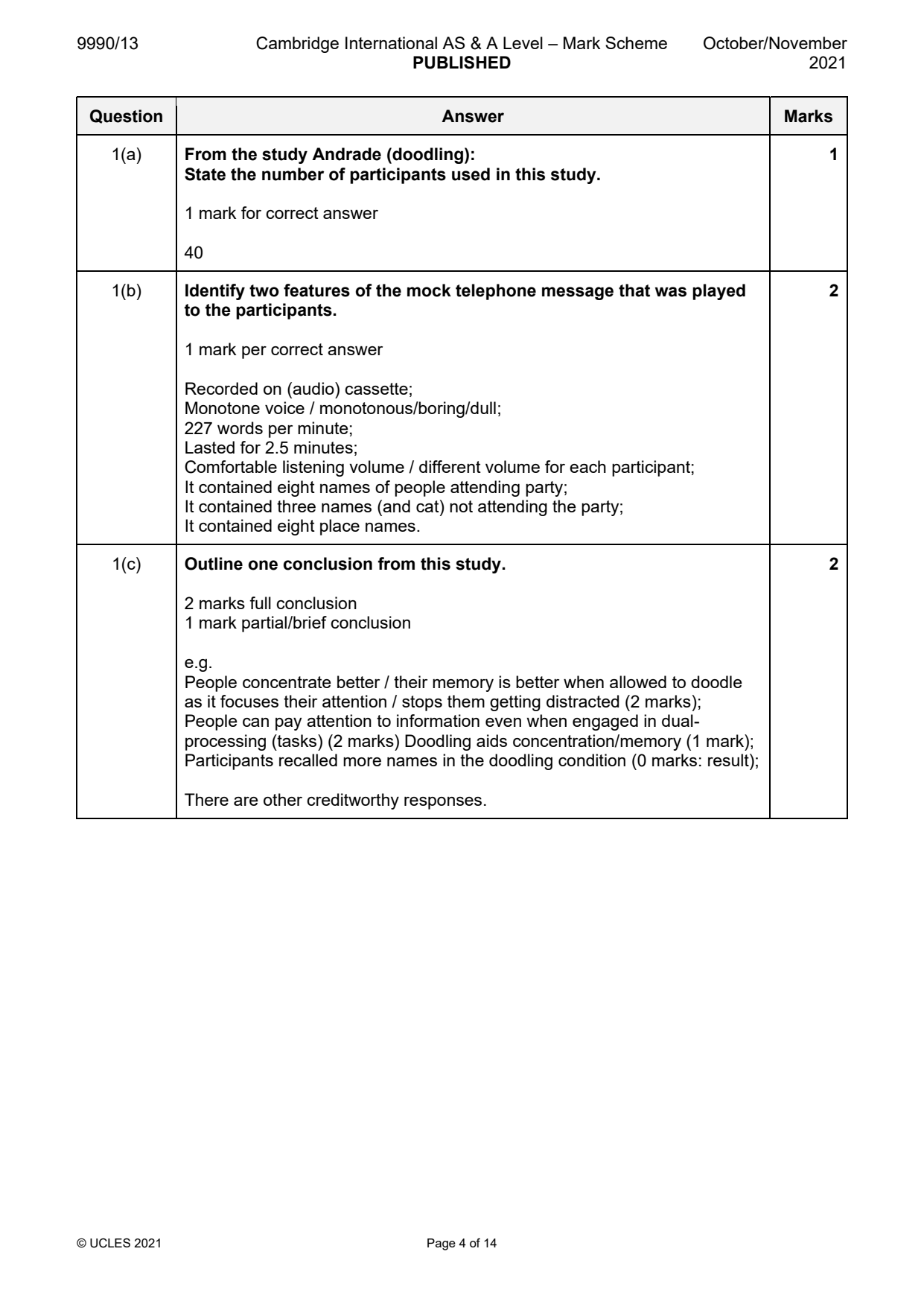
1(a) From the study Andrade (doodling): 1
State the number of participants used in this study.
1 mark for correct answer
40
1(b) Identify two features of the mock telephone message that was played 2
to the participants.
1 mark per correct answer
Recorded on (audio) cassette;
Monotone voice / monotonous/boring/dull;
227 words per minute;
Lasted for 2.5 minutes;
Comfortable listening volume / different volume for each participant;
It contained eight names of people attending party;
It contained three names (and cat) not attending the party;
It contained eight place names.
1(c) Outline one conclusion from this study. 2
2 marks full conclusion
1 mark partial/brief conclusion
e.g.
People concentrate better / their memory is better when allowed to doodle
as it focuses their attention / stops them getting distracted (2 marks);
People can pay attention to information even when engaged in dual-
processing (tasks) (2 marks) Doodling aids concentration/memory (1 mark);
Participants recalled more names in the doodling condition (0 marks: result);
There are other creditworthy responses.
© UCLES 2021 Page 4 of 14
Official mark scheme pages: 4 · source PDF URL
9990-2021-on-13-q05
Oct/Nov 2021 · Paper 13 · Question 5 · 4 marks
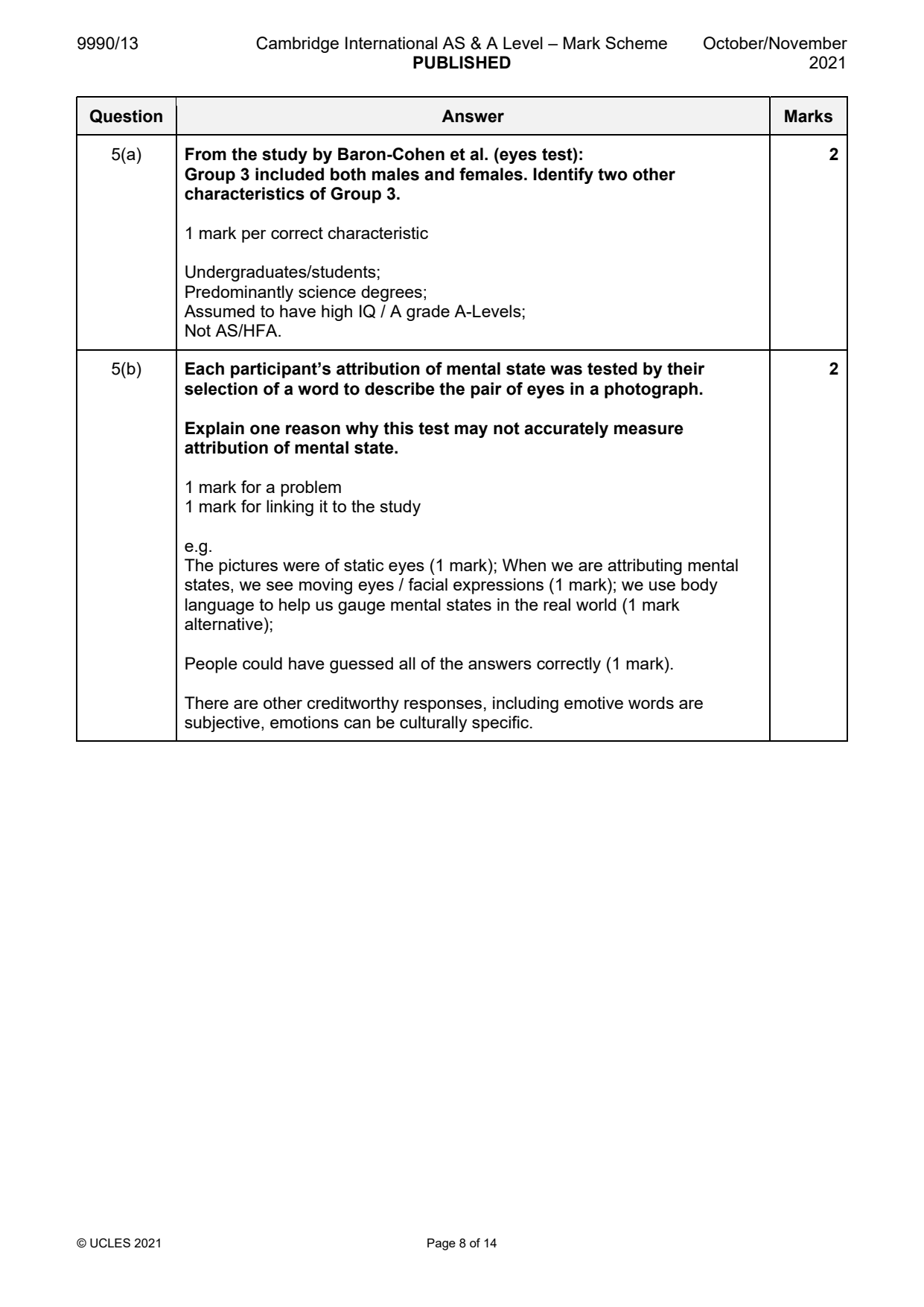
5(a) From the study by Baron-Cohen et al. (eyes test): 2
Group 3 included both males and females. Identify two other
characteristics of Group 3.
1 mark per correct characteristic
Undergraduates/students;
Predominantly science degrees;
Assumed to have high IQ / A grade A-Levels;
Not AS/HFA.
5(b) Each participant’s attribution of mental state was tested by their 2
selection of a word to describe the pair of eyes in a photograph.
Explain one reason why this test may not accurately measure
attribution of mental state.
1 mark for a problem
1 mark for linking it to the study
e.g.
The pictures were of static eyes (1 mark); When we are attributing mental
states, we see moving eyes / facial expressions (1 mark); we use body
language to help us gauge mental states in the real world (1 mark
alternative);
People could have guessed all of the answers correctly (1 mark).
There are other creditworthy responses, including emotive words are
subjective, emotions can be culturally specific.
© UCLES 2021 Page 8 of 14
Official mark scheme pages: 8 · source PDF URL
9990-2021-on-13-q07
Oct/Nov 2021 · Paper 13 · Question 7 · 6 marks
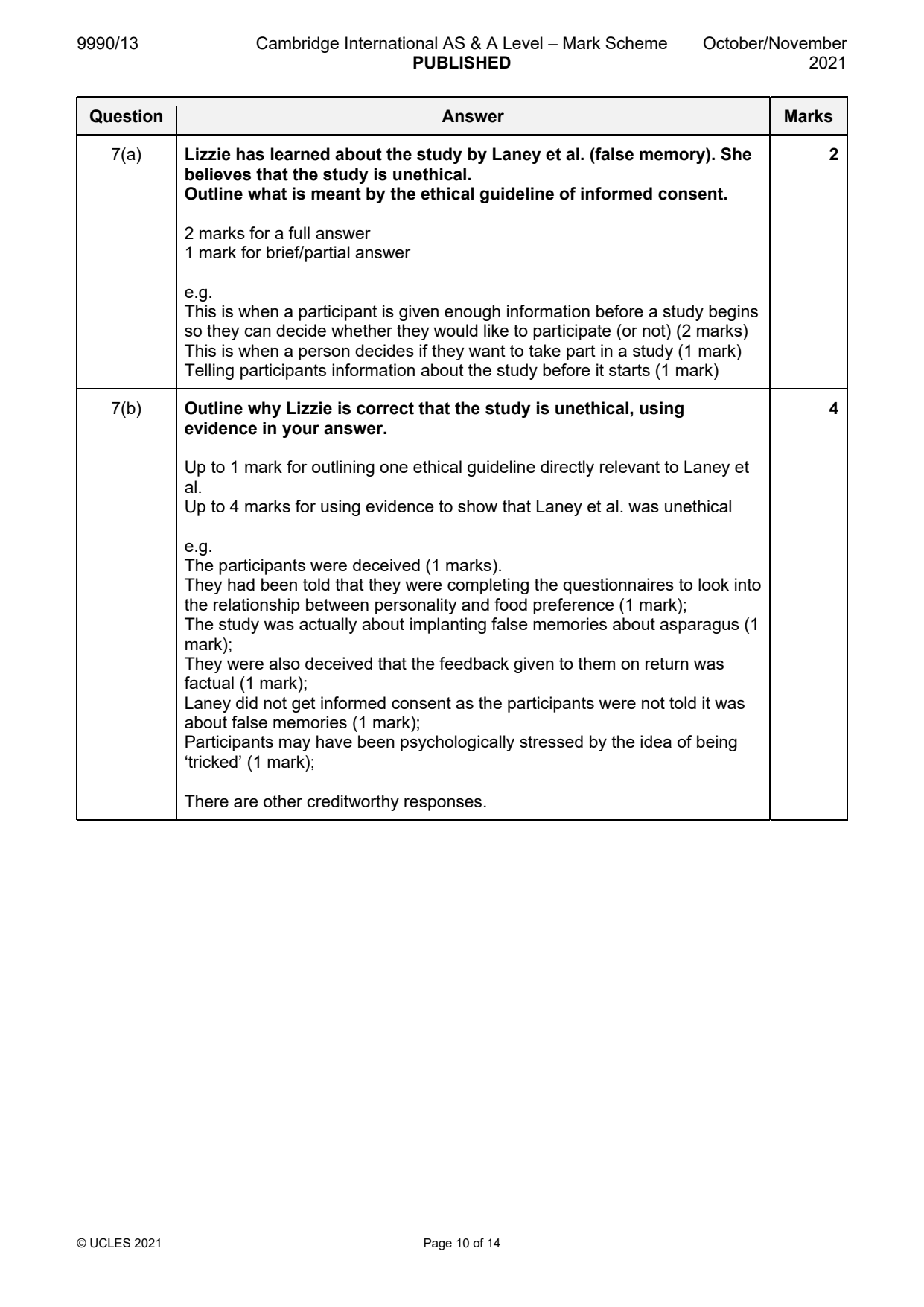
7(a) Lizzie has learned about the study by Laney et al. (false memory). She 2
believes that the study is unethical.
Outline what is meant by the ethical guideline of informed consent.
2 marks for a full answer
1 mark for brief/partial answer
e.g.
This is when a participant is given enough information before a study begins
so they can decide whether they would like to participate (or not) (2 marks)
This is when a person decides if they want to take part in a study (1 mark)
Telling participants information about the study before it starts (1 mark)
7(b) Outline why Lizzie is correct that the study is unethical, using 4
evidence in your answer.
Up to 1 mark for outlining one ethical guideline directly relevant to Laney et
al.
Up to 4 marks for using evidence to show that Laney et al. was unethical
e.g.
The participants were deceived (1 marks).
They had been told that they were completing the questionnaires to look into
the relationship between personality and food preference (1 mark);
The study was actually about implanting false memories about asparagus (1
mark);
They were also deceived that the feedback given to them on return was
factual (1 mark);
Laney did not get informed consent as the participants were not told it was
about false memories (1 mark);
Participants may have been psychologically stressed by the idea of being
‘tricked’ (1 mark);
There are other creditworthy responses.
© UCLES 2021 Page 10 of 14
Official mark scheme pages: 10 · source PDF URL
9990-2022-mj-11-q03
May/June 2022 · Paper 11 · Question 3 · 5 marks
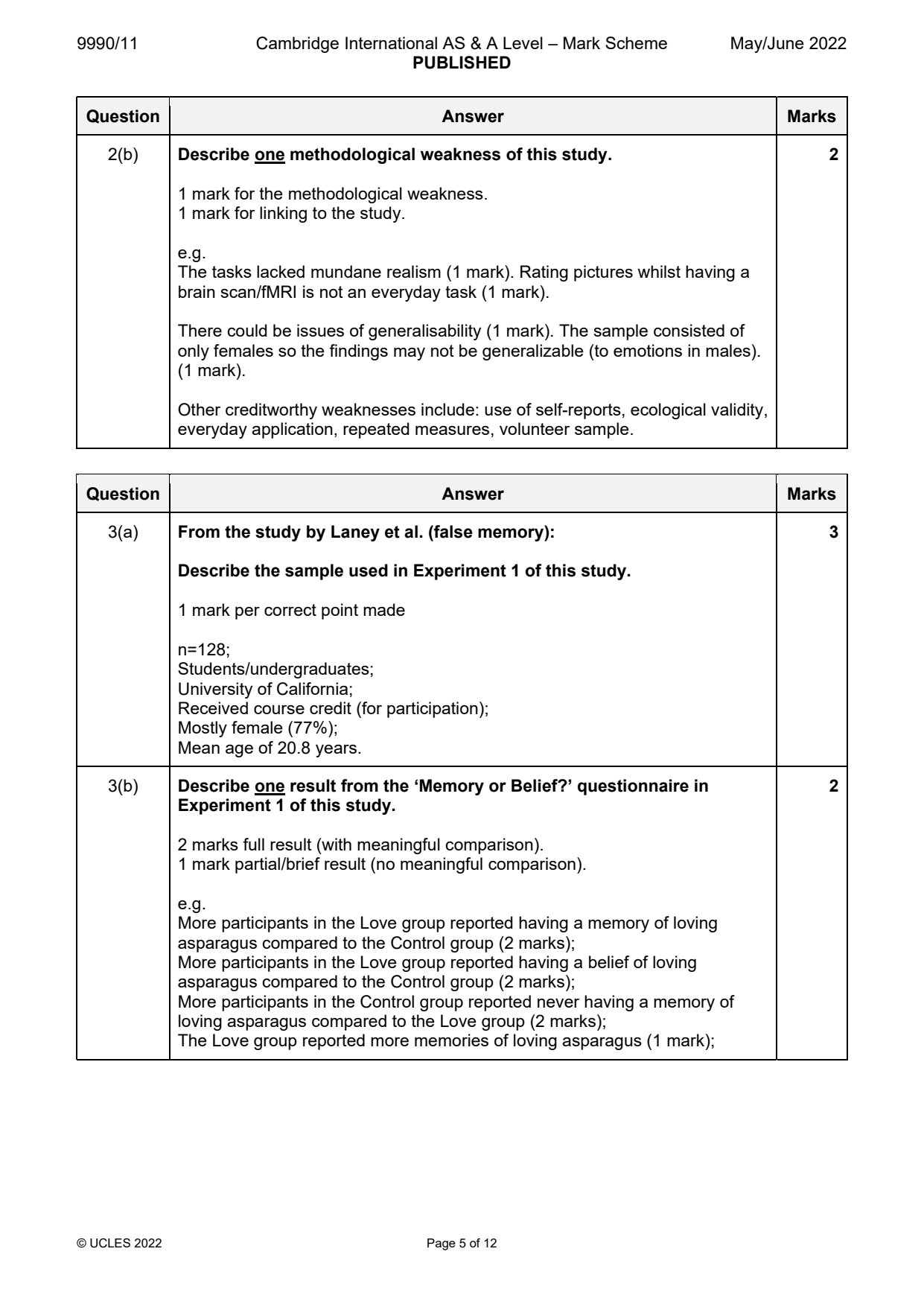
3(a) From the study by Laney et al. (false memory): 3
Describe the sample used in Experiment 1 of this study.
1 mark per correct point made
n=128;
Students/undergraduates;
University of California;
Received course credit (for participation);
Mostly female (77%);
Mean age of 20.8 years.
3(b) Describe one result from the ‘Memory or Belief?’ questionnaire in 2
Experiment 1 of this study.
2 marks full result (with meaningful comparison).
1 mark partial/brief result (no meaningful comparison).
e.g.
More participants in the Love group reported having a memory of loving
asparagus compared to the Control group (2 marks);
More participants in the Love group reported having a belief of loving
asparagus compared to the Control group (2 marks);
More participants in the Control group reported never having a memory of
loving asparagus compared to the Love group (2 marks);
The Love group reported more memories of loving asparagus (1 mark);
© UCLES 2022 Page 5 of 12
Official mark scheme pages: 5 · source PDF URL
9990-2022-mj-11-q05
May/June 2022 · Paper 11 · Question 5 · 5 marks
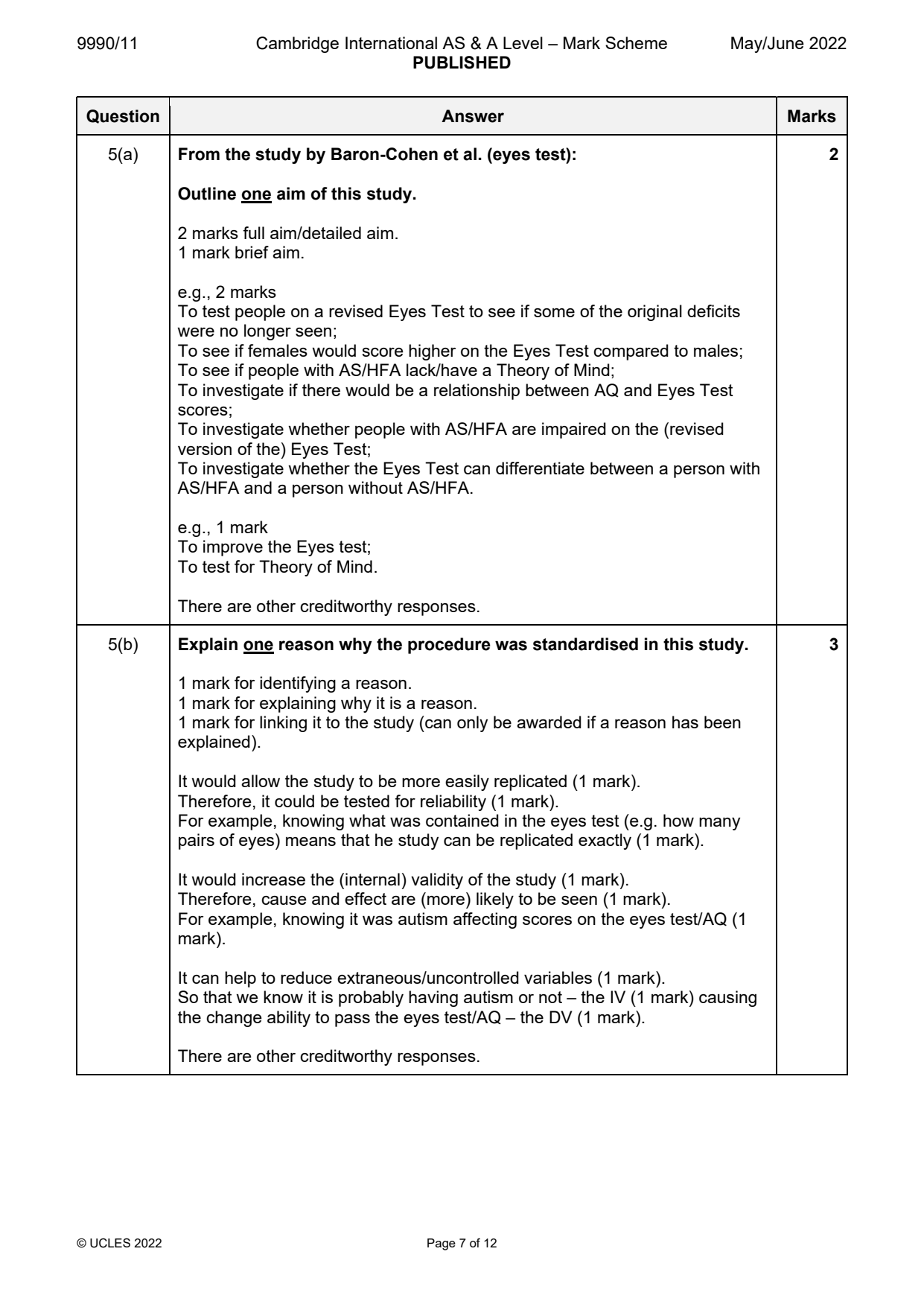
5(a) From the study by Baron-Cohen et al. (eyes test): 2
Outline one aim of this study.
2 marks full aim/detailed aim.
1 mark brief aim.
e.g., 2 marks
To test people on a revised Eyes Test to see if some of the original deficits
were no longer seen;
To see if females would score higher on the Eyes Test compared to males;
To see if people with AS/HFA lack/have a Theory of Mind;
To investigate if there would be a relationship between AQ and Eyes Test
scores;
To investigate whether people with AS/HFA are impaired on the (revised
version of the) Eyes Test;
To investigate whether the Eyes Test can differentiate between a person with
AS/HFA and a person without AS/HFA.
e.g., 1 mark
To improve the Eyes test;
To test for Theory of Mind.
There are other creditworthy responses.
5(b) Explain one reason why the procedure was standardised in this study. 3
1 mark for identifying a reason.
1 mark for explaining why it is a reason.
1 mark for linking it to the study (can only be awarded if a reason has been
explained).
It would allow the study to be more easily replicated (1 mark).
Therefore, it could be tested for reliability (1 mark).
For example, knowing what was contained in the eyes test (e.g. how many
pairs of eyes) means that he study can be replicated exactly (1 mark).
It would increase the (internal) validity of the study (1 mark).
Therefore, cause and effect are (more) likely to be seen (1 mark).
For example, knowing it was autism affecting scores on the eyes test/AQ (1
mark).
It can help to reduce extraneous/uncontrolled variables (1 mark).
So that we know it is probably having autism or not – the IV (1 mark) causing
the change ability to pass the eyes test/AQ – the DV (1 mark).
There are other creditworthy responses.
© UCLES 2022 Page 7 of 12
Official mark scheme pages: 7 · source PDF URL
9990-2022-mj-11-q08
May/June 2022 · Paper 11 · Question 8 · 6 marks
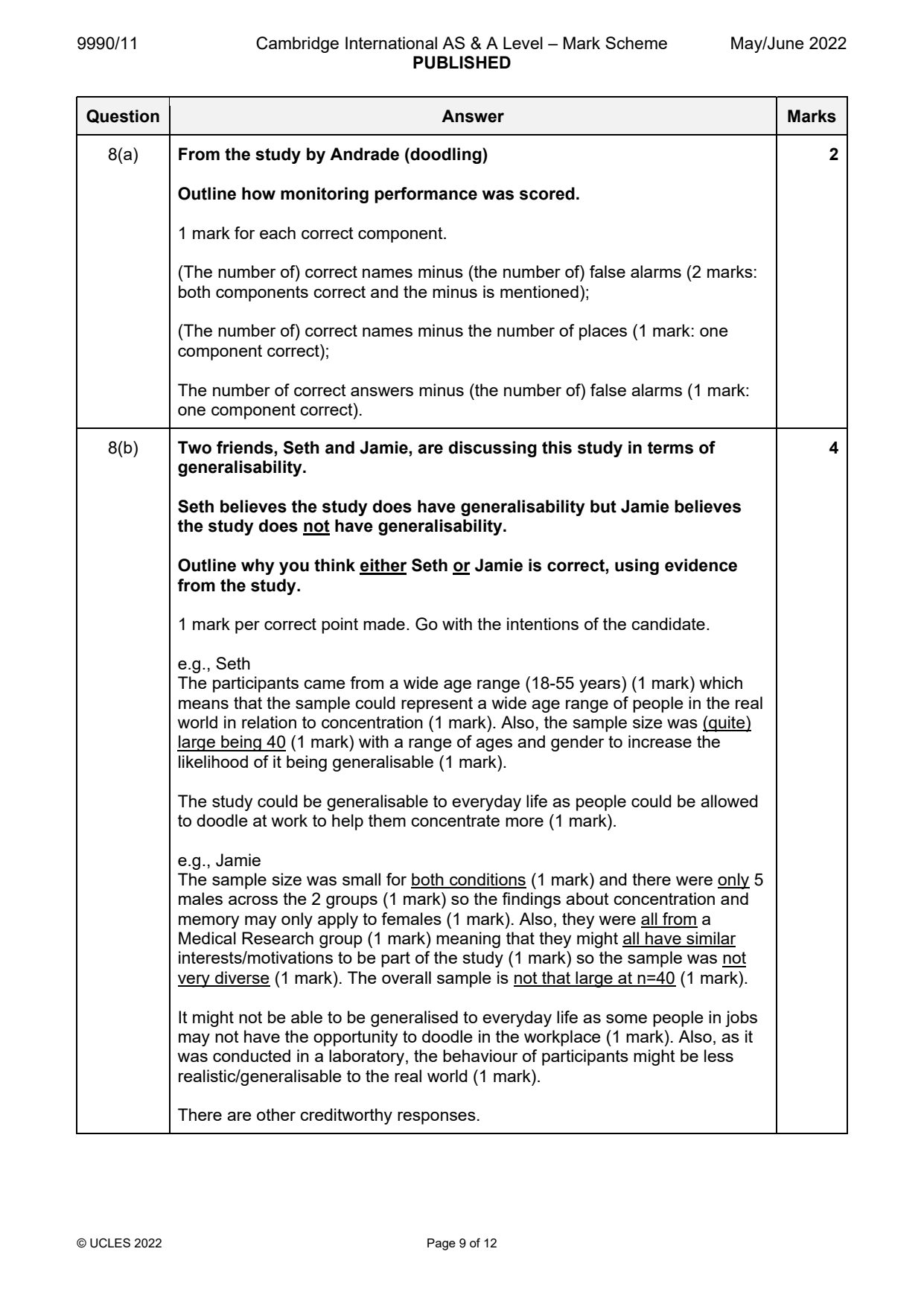
8(a) From the study by Andrade (doodling) 2
Outline how monitoring performance was scored.
1 mark for each correct component.
(The number of) correct names minus (the number of) false alarms (2 marks:
both components correct and the minus is mentioned);
(The number of) correct names minus the number of places (1 mark: one
component correct);
The number of correct answers minus (the number of) false alarms (1 mark:
one component correct).
8(b) Two friends, Seth and Jamie, are discussing this study in terms of 4
generalisability.
Seth believes the study does have generalisability but Jamie believes
the study does not have generalisability.
Outline why you think either Seth or Jamie is correct, using evidence
from the study.
1 mark per correct point made. Go with the intentions of the candidate.
e.g., Seth
The participants came from a wide age range (18-55 years) (1 mark) which
means that the sample could represent a wide age range of people in the real
world in relation to concentration (1 mark). Also, the sample size was (quite)
large being 40 (1 mark) with a range of ages and gender to increase the
likelihood of it being generalisable (1 mark).
The study could be generalisable to everyday life as people could be allowed
to doodle at work to help them concentrate more (1 mark).
e.g., Jamie
The sample size was small for both conditions (1 mark) and there were only 5
males across the 2 groups (1 mark) so the findings about concentration and
memory may only apply to females (1 mark). Also, they were all from a
Medical Research group (1 mark) meaning that they might all have similar
interests/motivations to be part of the study (1 mark) so the sample was not
very diverse (1 mark). The overall sample is not that large at n=40 (1 mark).
It might not be able to be generalised to everyday life as some people in jobs
may not have the opportunity to doodle in the workplace (1 mark). Also, as it
was conducted in a laboratory, the behaviour of participants might be less
realistic/generalisable to the real world (1 mark).
There are other creditworthy responses.
© UCLES 2022 Page 9 of 12
Official mark scheme pages: 9 · source PDF URL
9990-2022-mj-12-q07
May/June 2022 · Paper 12 · Question 7 · 4 marks
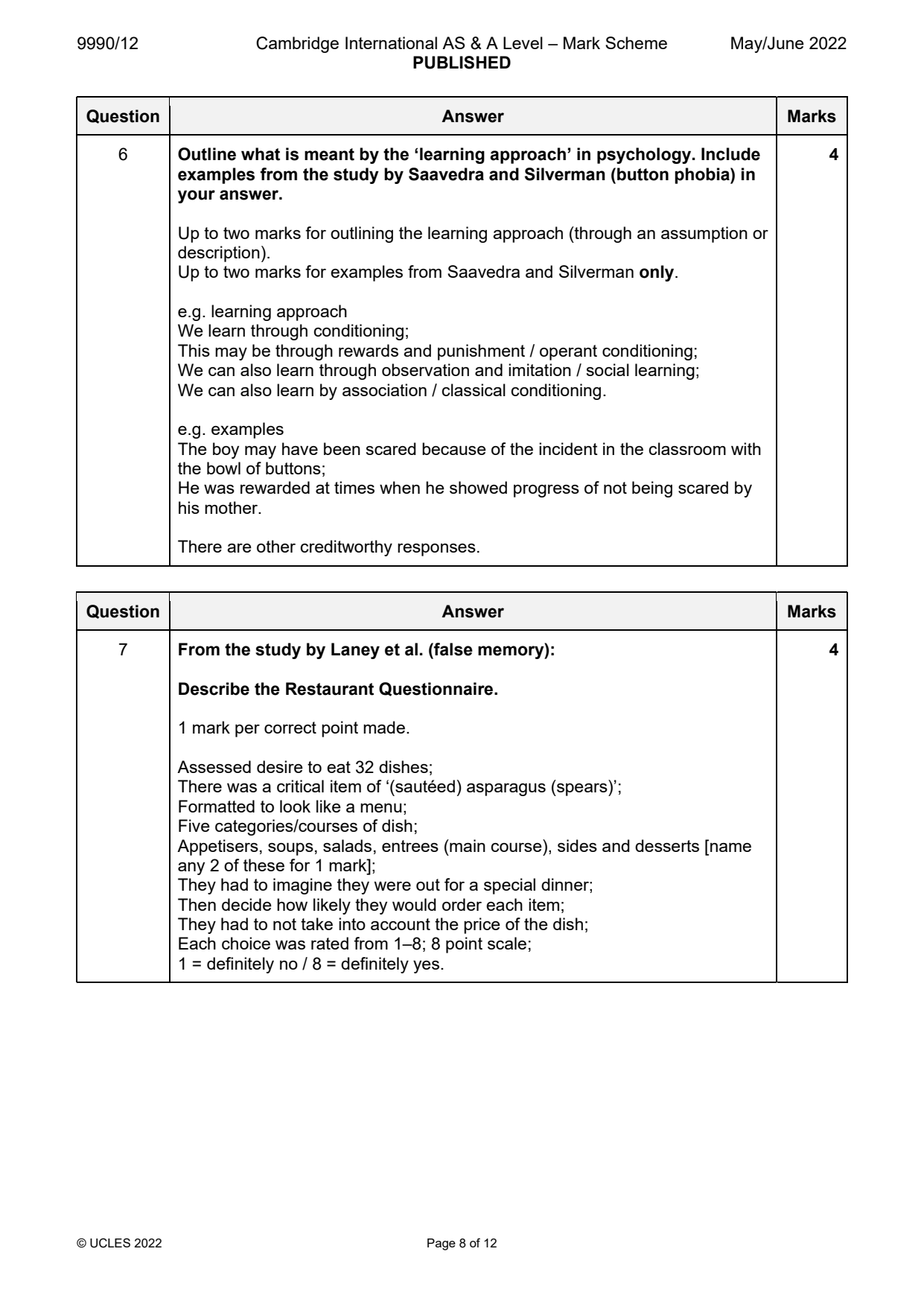
7 From the study by Laney et al. (false memory): 4
Describe the Restaurant Questionnaire.
1 mark per correct point made.
Assessed desire to eat 32 dishes;
There was a critical item of ‘(sautéed) asparagus (spears)’;
Formatted to look like a menu;
Five categories/courses of dish;
Appetisers, soups, salads, entrees (main course), sides and desserts [name
any 2 of these for 1 mark];
They had to imagine they were out for a special dinner;
Then decide how likely they would order each item;
They had to not take into account the price of the dish;
Each choice was rated from 1–8; 8 point scale;
1 = definitely no / 8 = definitely yes.
© UCLES 2022 Page 8 of 12
Official mark scheme pages: 8 · source PDF URL
9990-2022-mj-13-q01
May/June 2022 · Paper 13 · Question 1 · 4 marks
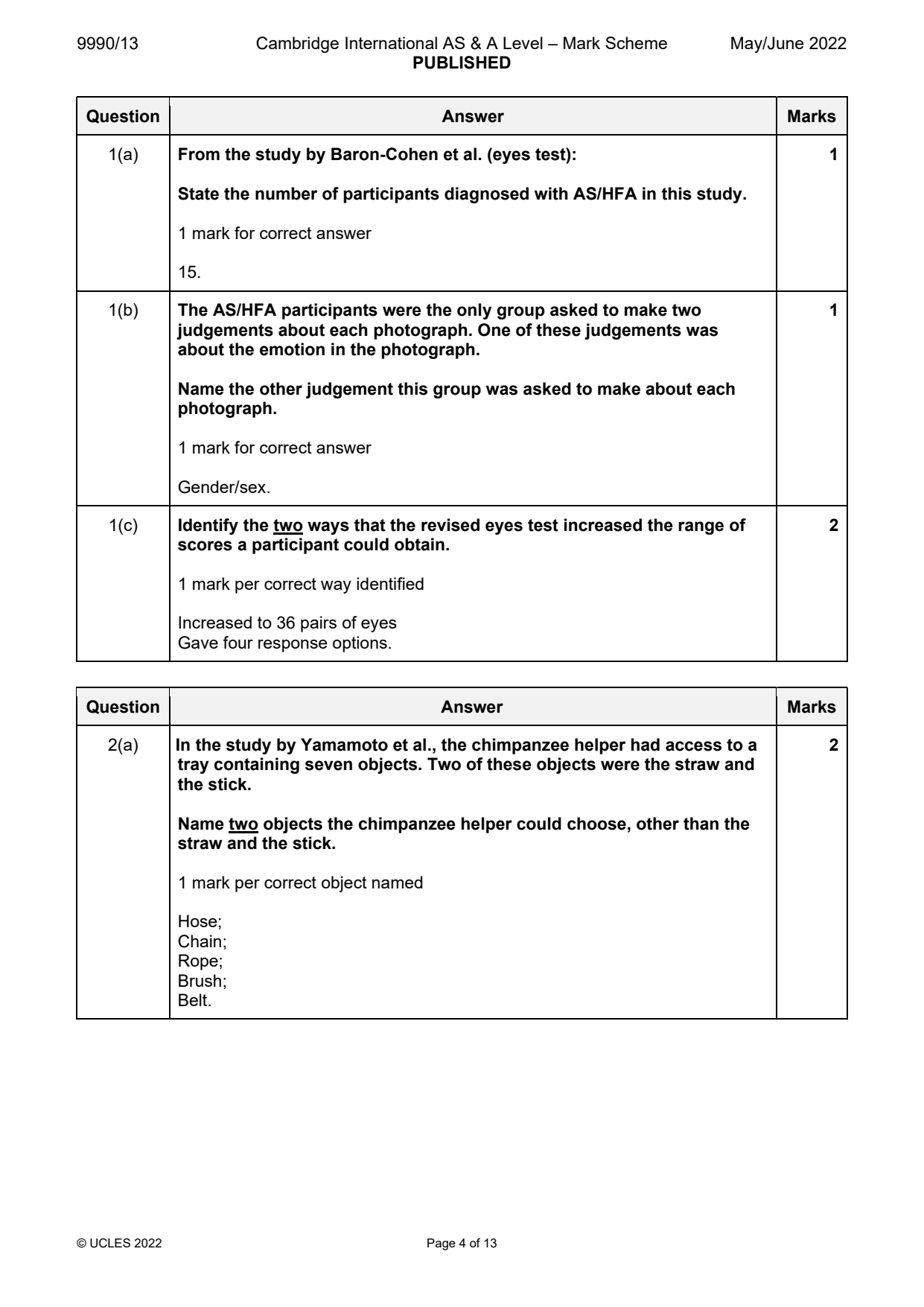
1(a) From the study by Baron-Cohen et al. (eyes test): 1
State the number of participants diagnosed with AS/HFA in this study.
1 mark for correct answer
15.
1(b) The AS/HFA participants were the only group asked to make two 1
judgements about each photograph. One of these judgements was
about the emotion in the photograph.
Name the other judgement this group was asked to make about each
photograph.
1 mark for correct answer
Gender/sex.
1(c) Identify the two ways that the revised eyes test increased the range of 2
scores a participant could obtain.
1 mark per correct way identified
Increased to 36 pairs of eyes
Gave four response options.
Question Answer Marks
Official mark scheme pages: 4 · source PDF URL
9990-2022-mj-13-q06
May/June 2022 · Paper 13 · Question 6 · 4 marks
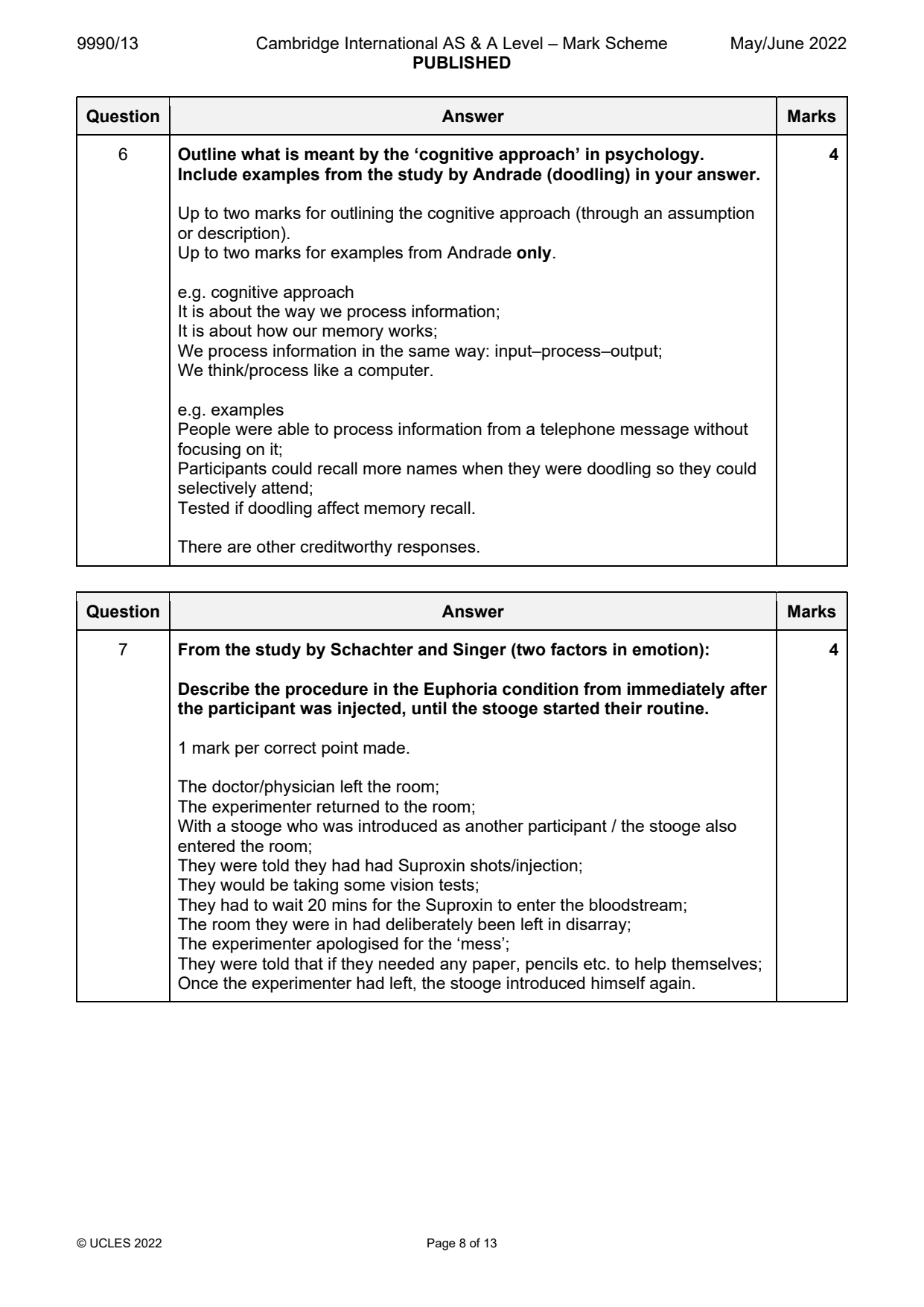
6 Outline what is meant by the ‘cognitive approach’ in psychology. 4
Include examples from the study by Andrade (doodling) in your answer.
Up to two marks for outlining the cognitive approach (through an assumption
or description).
Up to two marks for examples from Andrade only.
e.g. cognitive approach
It is about the way we process information;
It is about how our memory works;
We process information in the same way: input–process–output;
We think/process like a computer.
e.g. examples
People were able to process information from a telephone message without
focusing on it;
Participants could recall more names when they were doodling so they could
selectively attend;
Tested if doodling affect memory recall.
There are other creditworthy responses.
Question Answer Marks
Official mark scheme pages: 8 · source PDF URL
9990-2022-mj-13-q09
May/June 2022 · Paper 13 · Question 9 · 12 marks
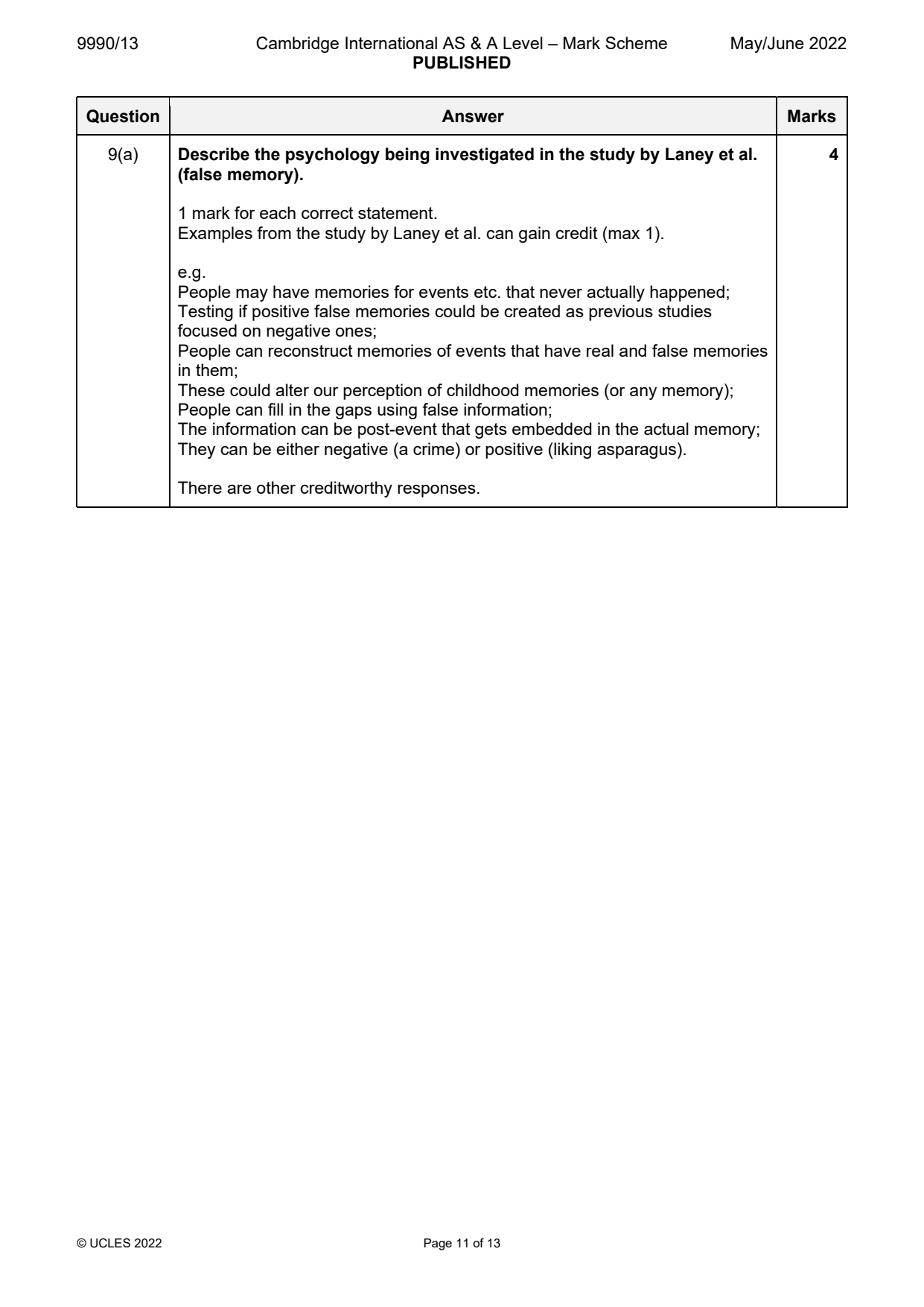
9(a) Describe the psychology being investigated in the study by Laney et al. 4
(false memory).
1 mark for each correct statement.
Examples from the study by Laney et al. can gain credit (max 1).
e.g.
People may have memories for events etc. that never actually happened;
Testing if positive false memories could be created as previous studies
focused on negative ones;
People can reconstruct memories of events that have real and false memories
in them;
These could alter our perception of childhood memories (or any memory);
People can fill in the gaps using false information;
The information can be post-event that gets embedded in the actual memory;
They can be either negative (a crime) or positive (liking asparagus).
There are other creditworthy responses.
© UCLES 2022 Page 11 of 13
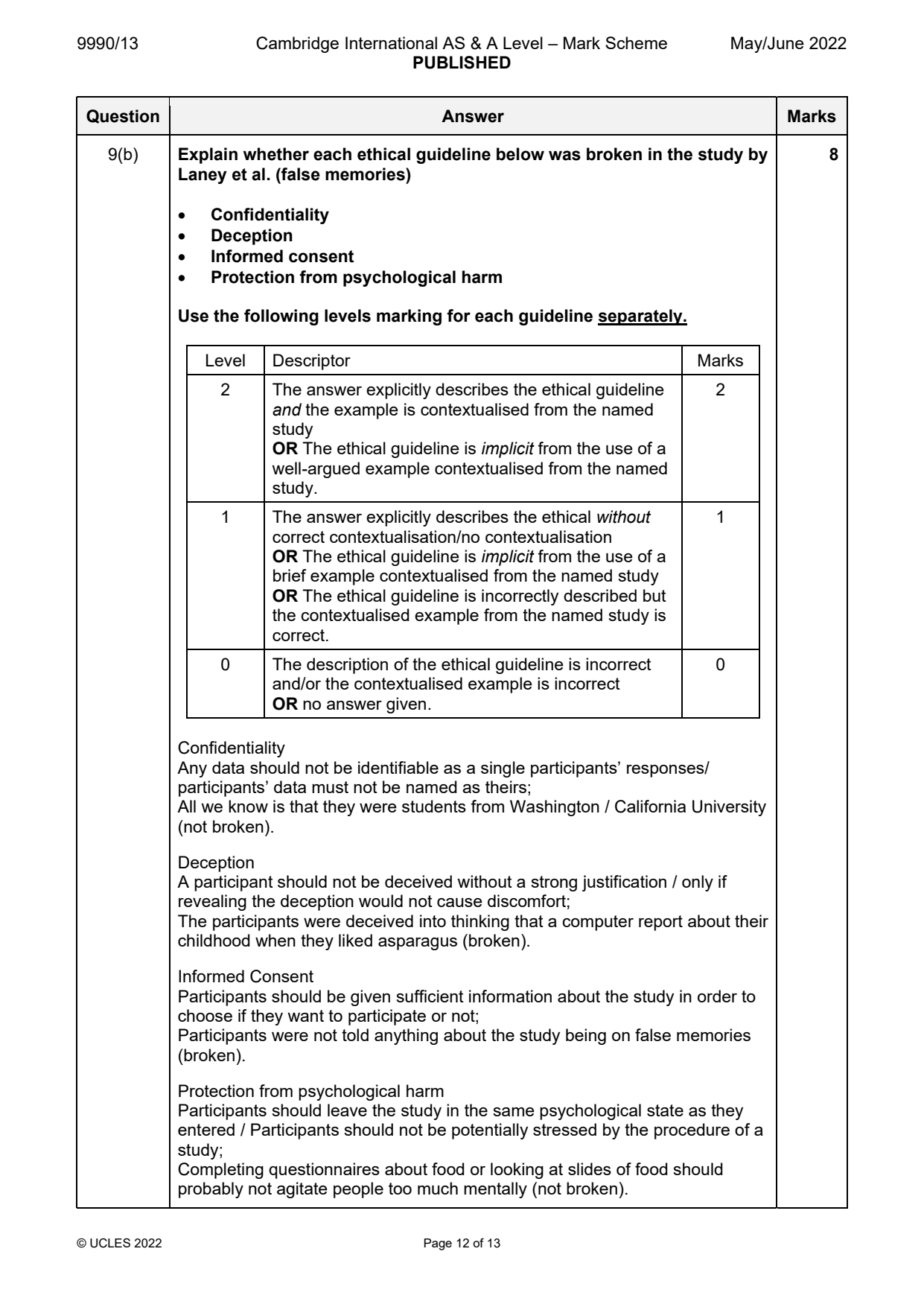
9(b) Explain whether each ethical guideline below was broken in the study by 8
Laney et al. (false memories)
Confidentiality
Deception
Informed consent
Protection from psychological harm
Use the following levels marking for each guideline separately.
Level Descriptor Marks
2 The answer explicitly describes the ethical guideline 2
and the example is contextualised from the named
study
OR The ethical guideline is implicit from the use of a
well-argued example contextualised from the named
study.
1 The answer explicitly describes the ethical without 1
correct contextualisation/no contextualisation
OR The ethical guideline is implicit from the use of a
brief example contextualised from the named study
OR The ethical guideline is incorrectly described but
the contextualised example from the named study is
correct.
0 The description of the ethical guideline is incorrect 0
and/or the contextualised example is incorrect
OR no answer given.
Confidentiality
Any data should not be identifiable as a single participants’ responses/
participants’ data must not be named as theirs;
All we know is that they were students from Washington / California University
(not broken).
Deception
A participant should not be deceived without a strong justification / only if
revealing the deception would not cause discomfort;
The participants were deceived into thinking that a computer report about their
childhood when they liked asparagus (broken).
Informed Consent
Participants should be given sufficient information about the study in order to
choose if they want to participate or not;
Participants were not told anything about the study being on false memories
(broken).
Protection from psychological harm
Participants should leave the study in the same psychological state as they
entered / Participants should not be potentially stressed by the procedure of a
study;
Completing questionnaires about food or looking at slides of food should
probably not agitate people too much mentally (not broken).
© UCLES 2022 Page 12 of 13
Official mark scheme pages: 11, 12 · source PDF URL
9990-2022-on-11-q03
Oct/Nov 2022 · Paper 11 · Question 3 · 5 marks
3(a) From the study by Baron-Cohen et al. (eyes test): 3
Describe the sample for Group 1 in this study.
Adults;
Male;
Diagnosed with AS/HFA;
N = 15;
Recruited via advertisements in magazine/volunteer sample;
Similar socioeconomic class to Group 2;
Similar education background to Group 2;
IQ 115/similar IQ for Group 4;
Mean age = 29.7 years;
3(b) The original ‘Reading the Mind in the Eyes’ test had several problems. 2
Two of these problems were:
• the test only used 25 pairs of eyes
• some words in the test were difficult to understand.
State how this study solved each of these problems with the revised
‘Reading the Mind in the Eyes’ test.
1 mark per correct ‘resolution’
Problem 1: 25 pairs of eyes
= there were 36 pairs of eyes used
Problem 2: some words were difficult to comprehend
= a glossary (of definitions) was available
Question Answer Marks
Official mark scheme pages: 5 · source PDF URL
9990-2022-on-11-q04
Oct/Nov 2022 · Paper 11 · Question 4 · 6 marks
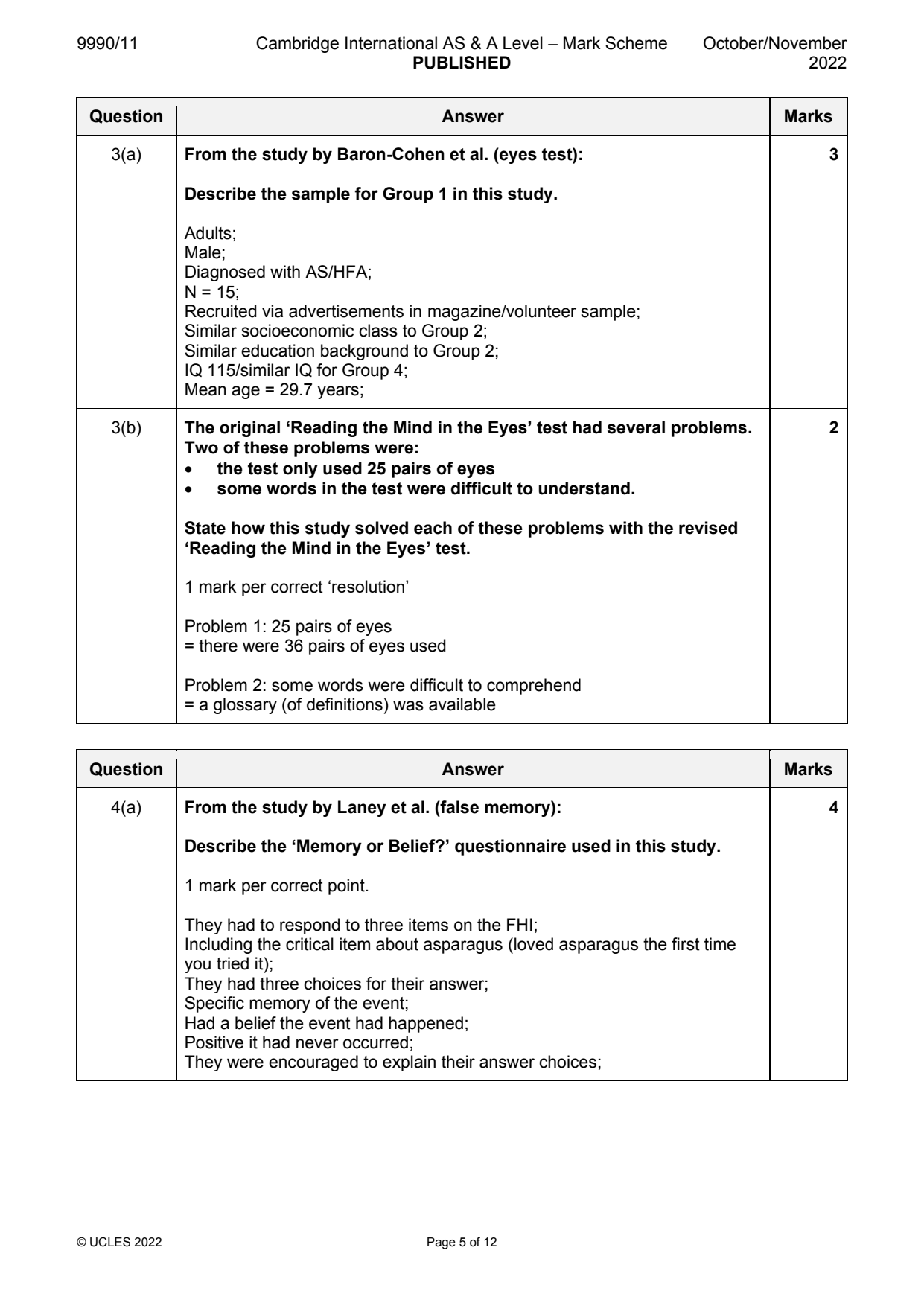
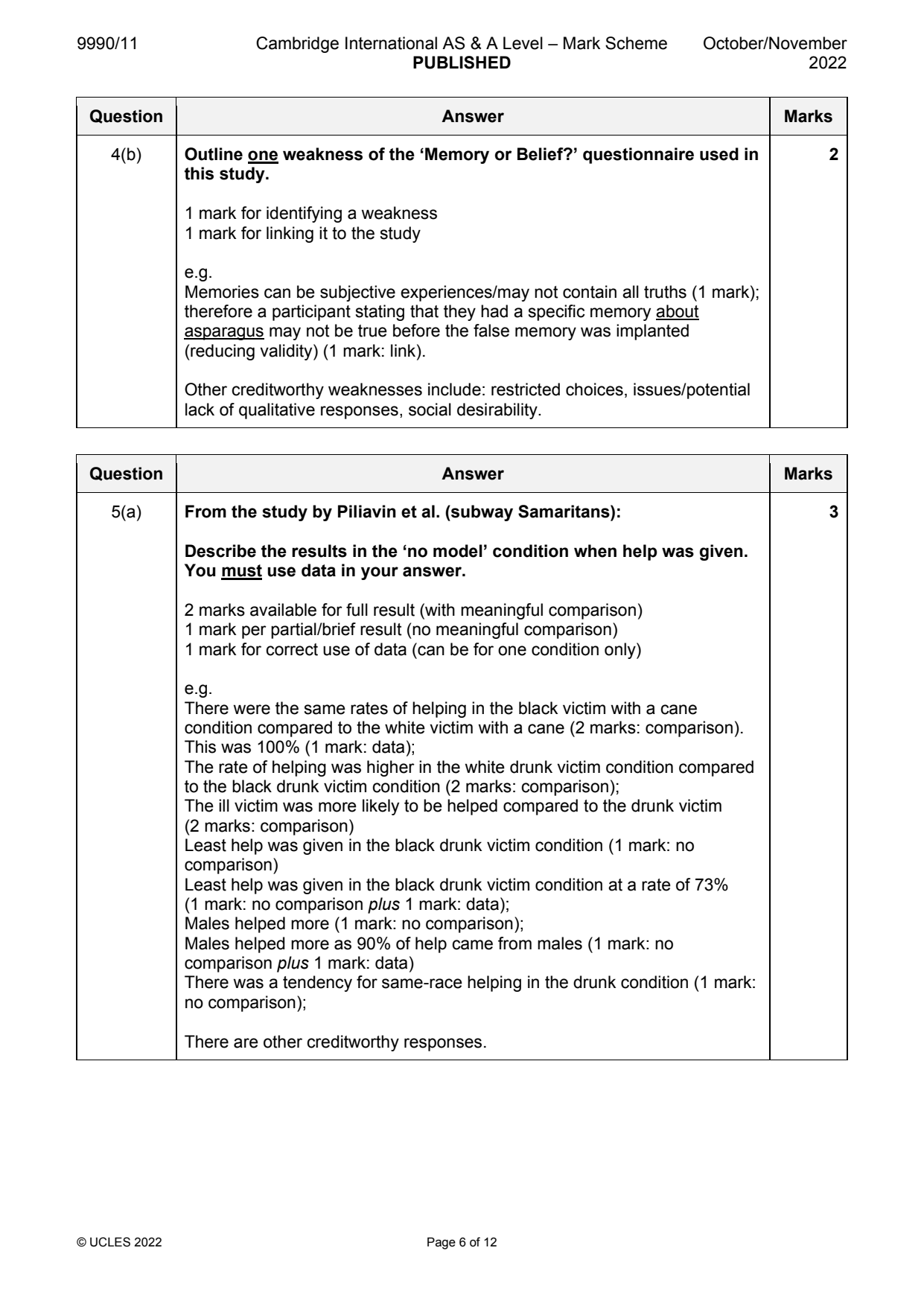
4(a) From the study by Laney et al. (false memory): 4
Describe the ‘Memory or Belief?’ questionnaire used in this study.
1 mark per correct point.
They had to respond to three items on the FHI;
Including the critical item about asparagus (loved asparagus the first time
you tried it);
They had three choices for their answer;
Specific memory of the event;
Had a belief the event had happened;
Positive it had never occurred;
They were encouraged to explain their answer choices;
© UCLES 2022 Page 5 of 12
4(b) Outline one weakness of the ‘Memory or Belief?’ questionnaire used in 2
this study.
1 mark for identifying a weakness
1 mark for linking it to the study
e.g.
Memories can be subjective experiences/may not contain all truths (1 mark);
therefore a participant stating that they had a specific memory about
asparagus may not be true before the false memory was implanted
(reducing validity) (1 mark: link).
Other creditworthy weaknesses include: restricted choices, issues/potential
lack of qualitative responses, social desirability.
Question Answer Marks
Official mark scheme pages: 5, 6 · source PDF URL
9990-2022-on-11-q10
Oct/Nov 2022 · Paper 11 · Question 10 · 10 marks
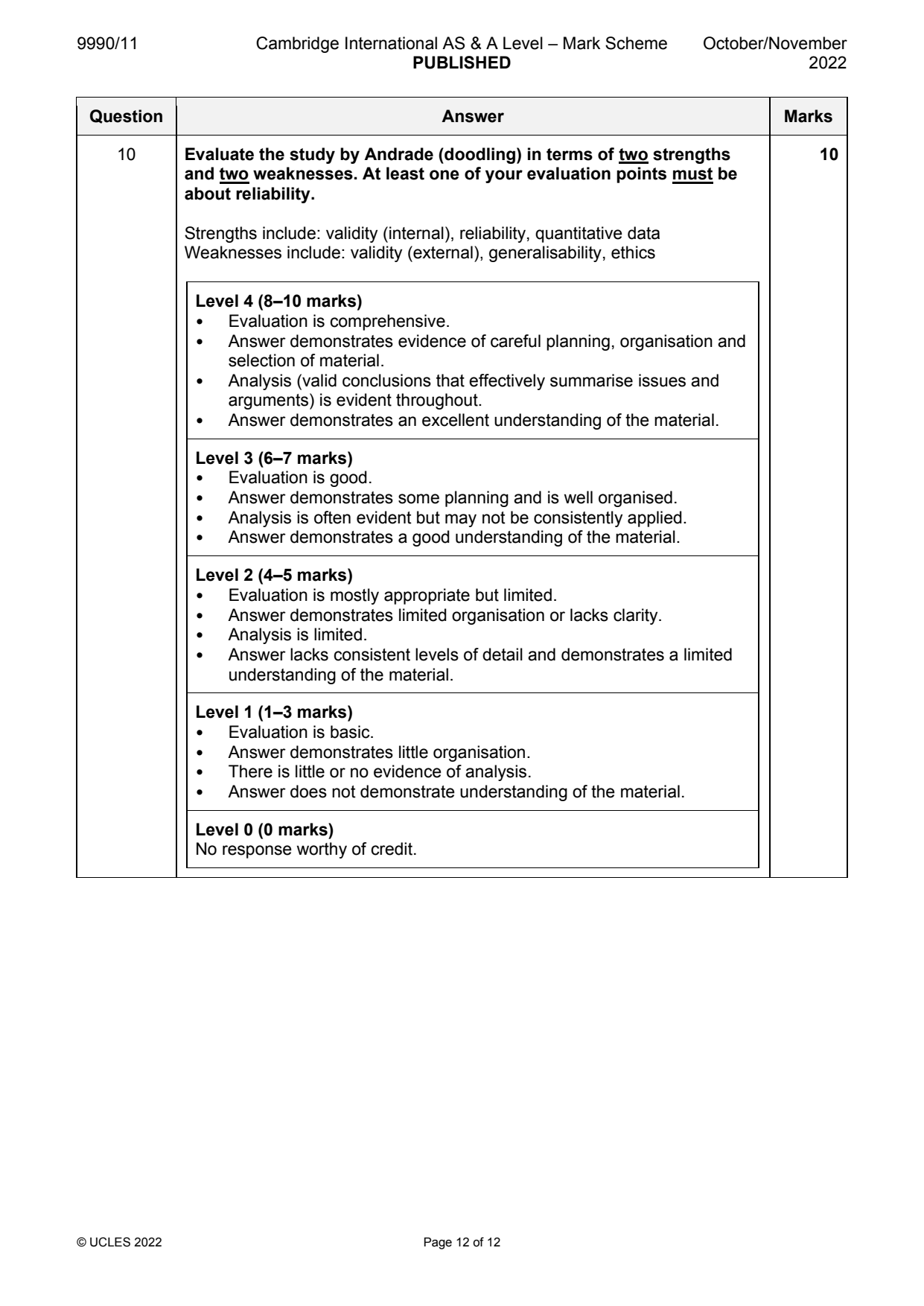
10 Evaluate the study by Andrade (doodling) in terms of two strengths 10
and two weaknesses. At least one of your evaluation points must be
about reliability.
Strengths include: validity (internal), reliability, quantitative data
Weaknesses include: validity (external), generalisability, ethics
Level 4 (8–10 marks)
• Evaluation is comprehensive.
• Answer demonstrates evidence of careful planning, organisation and
selection of material.
• Analysis (valid conclusions that effectively summarise issues and
arguments) is evident throughout.
• Answer demonstrates an excellent understanding of the material.
Level 3 (6–7 marks)
• Evaluation is good.
• Answer demonstrates some planning and is well organised.
• Analysis is often evident but may not be consistently applied.
• Answer demonstrates a good understanding of the material.
Level 2 (4–5 marks)
• Evaluation is mostly appropriate but limited.
• Answer demonstrates limited organisation or lacks clarity.
• Analysis is limited.
• Answer lacks consistent levels of detail and demonstrates a limited
understanding of the material.
Level 1 (1–3 marks)
• Evaluation is basic.
• Answer demonstrates little organisation.
• There is little or no evidence of analysis.
• Answer does not demonstrate understanding of the material.
Level 0 (0 marks)
No response worthy of credit.
© UCLES 2022 Page 12 of 12
Official mark scheme pages: 12 · source PDF URL
9990-2022-on-12-q03
Oct/Nov 2022 · Paper 12 · Question 3 · 5 marks
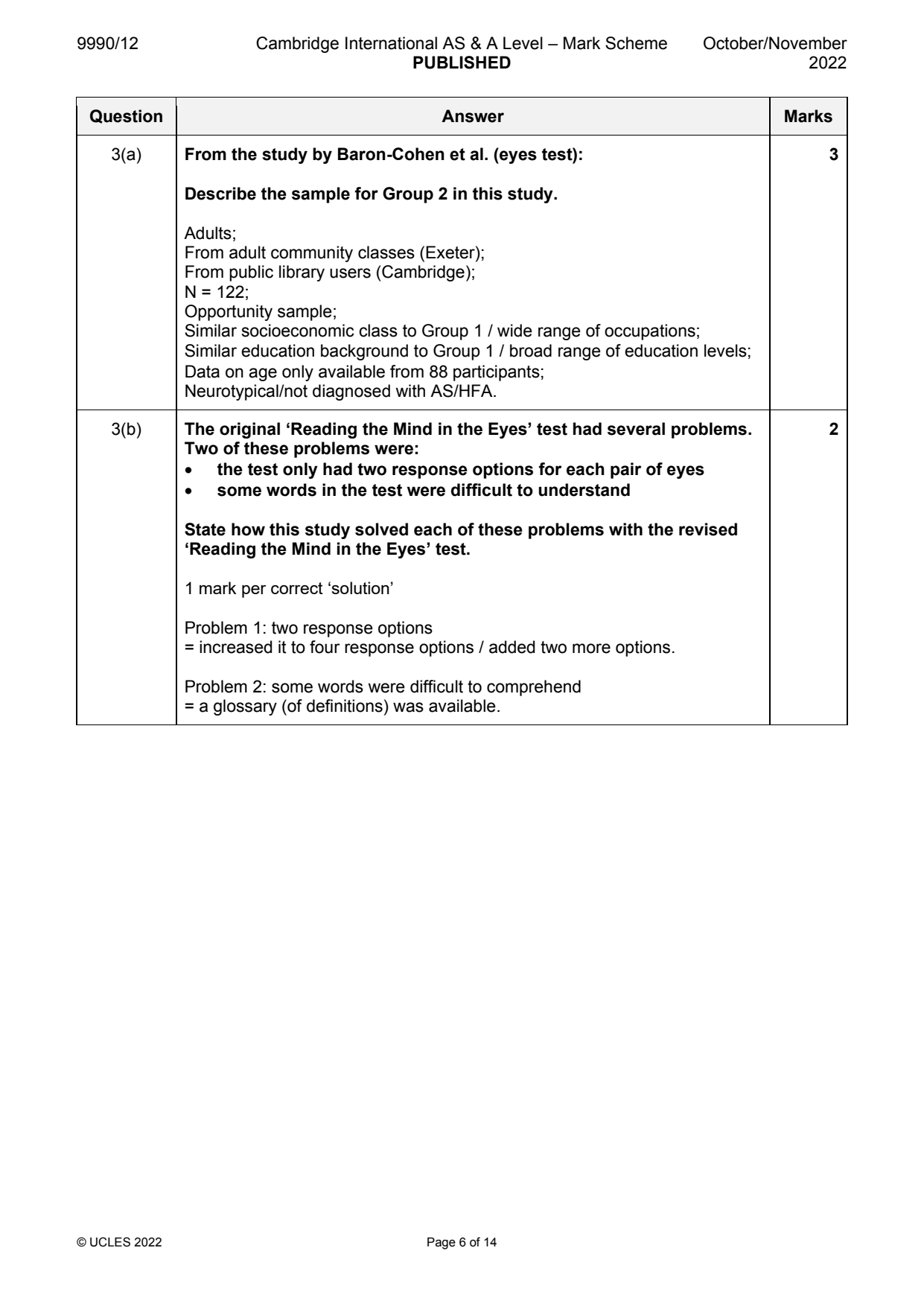
3(a) From the study by Baron-Cohen et al. (eyes test): 3
Describe the sample for Group 2 in this study.
Adults;
From adult community classes (Exeter);
From public library users (Cambridge);
N = 122;
Opportunity sample;
Similar socioeconomic class to Group 1 / wide range of occupations;
Similar education background to Group 1 / broad range of education levels;
Data on age only available from 88 participants;
Neurotypical/not diagnosed with AS/HFA.
3(b) The original ‘Reading the Mind in the Eyes’ test had several problems. 2
Two of these problems were:
• the test only had two response options for each pair of eyes
• some words in the test were difficult to understand
State how this study solved each of these problems with the revised
‘Reading the Mind in the Eyes’ test.
1 mark per correct ‘solution’
Problem 1: two response options
= increased it to four response options / added two more options.
Problem 2: some words were difficult to comprehend
= a glossary (of definitions) was available.
© UCLES 2022 Page 6 of 14
Official mark scheme pages: 6 · source PDF URL
9990-2022-on-12-q04
Oct/Nov 2022 · Paper 12 · Question 4 · 6 marks
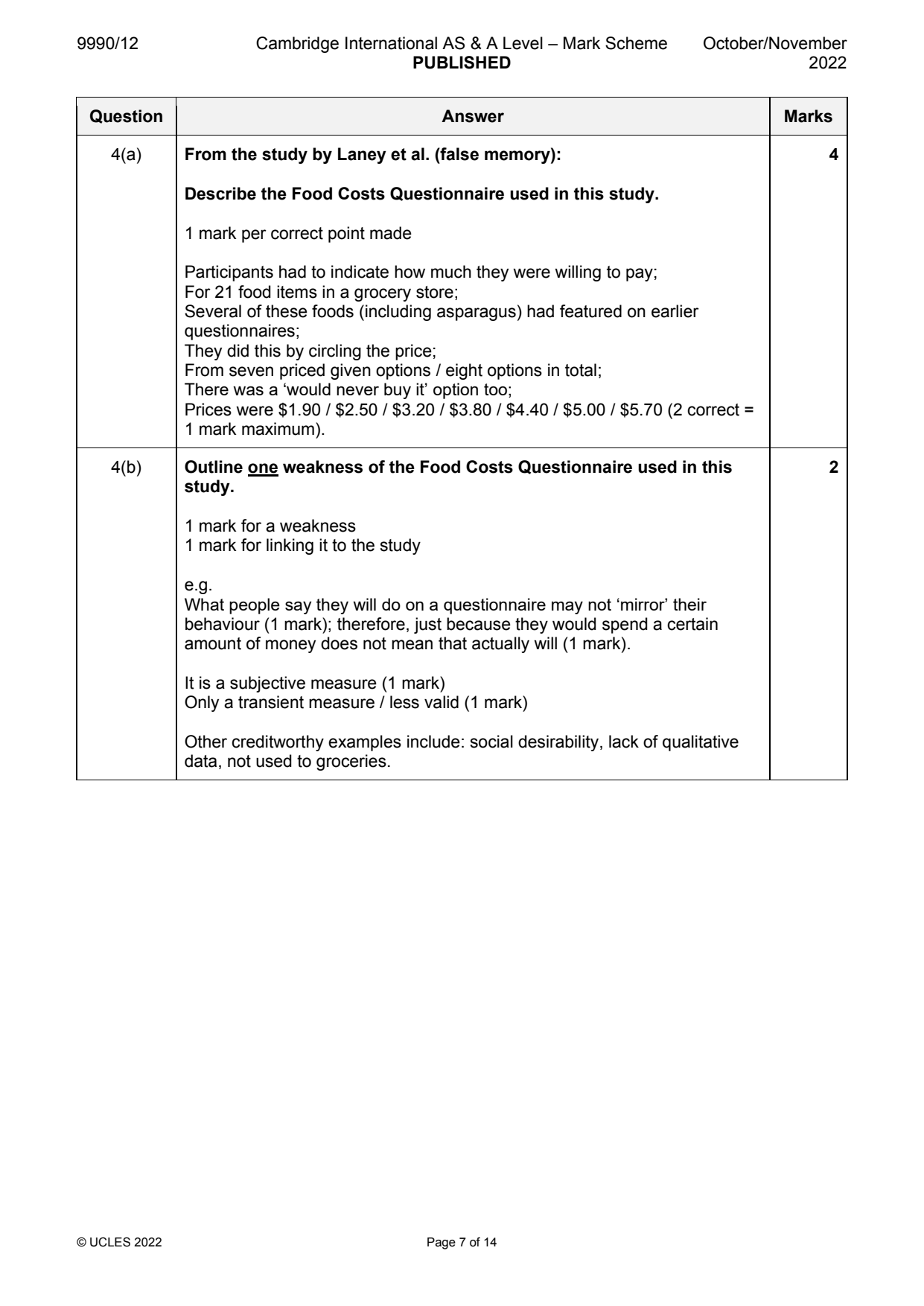
4(a) From the study by Laney et al. (false memory): 4
Describe the Food Costs Questionnaire used in this study.
1 mark per correct point made
Participants had to indicate how much they were willing to pay;
For 21 food items in a grocery store;
Several of these foods (including asparagus) had featured on earlier
questionnaires;
They did this by circling the price;
From seven priced given options / eight options in total;
There was a ‘would never buy it’ option too;
Prices were $1.90 / $2.50 / $3.20 / $3.80 / $4.40 / $5.00 / $5.70 (2 correct =
1 mark maximum).
4(b) Outline one weakness of the Food Costs Questionnaire used in this 2
study.
1 mark for a weakness
1 mark for linking it to the study
e.g.
What people say they will do on a questionnaire may not ‘mirror’ their
behaviour (1 mark); therefore, just because they would spend a certain
amount of money does not mean that actually will (1 mark).
It is a subjective measure (1 mark)
Only a transient measure / less valid (1 mark)
Other creditworthy examples include: social desirability, lack of qualitative
data, not used to groceries.
© UCLES 2022 Page 7 of 14
Official mark scheme pages: 7 · source PDF URL
9990-2022-on-12-q09
Oct/Nov 2022 · Paper 12 · Question 9 · 12 marks
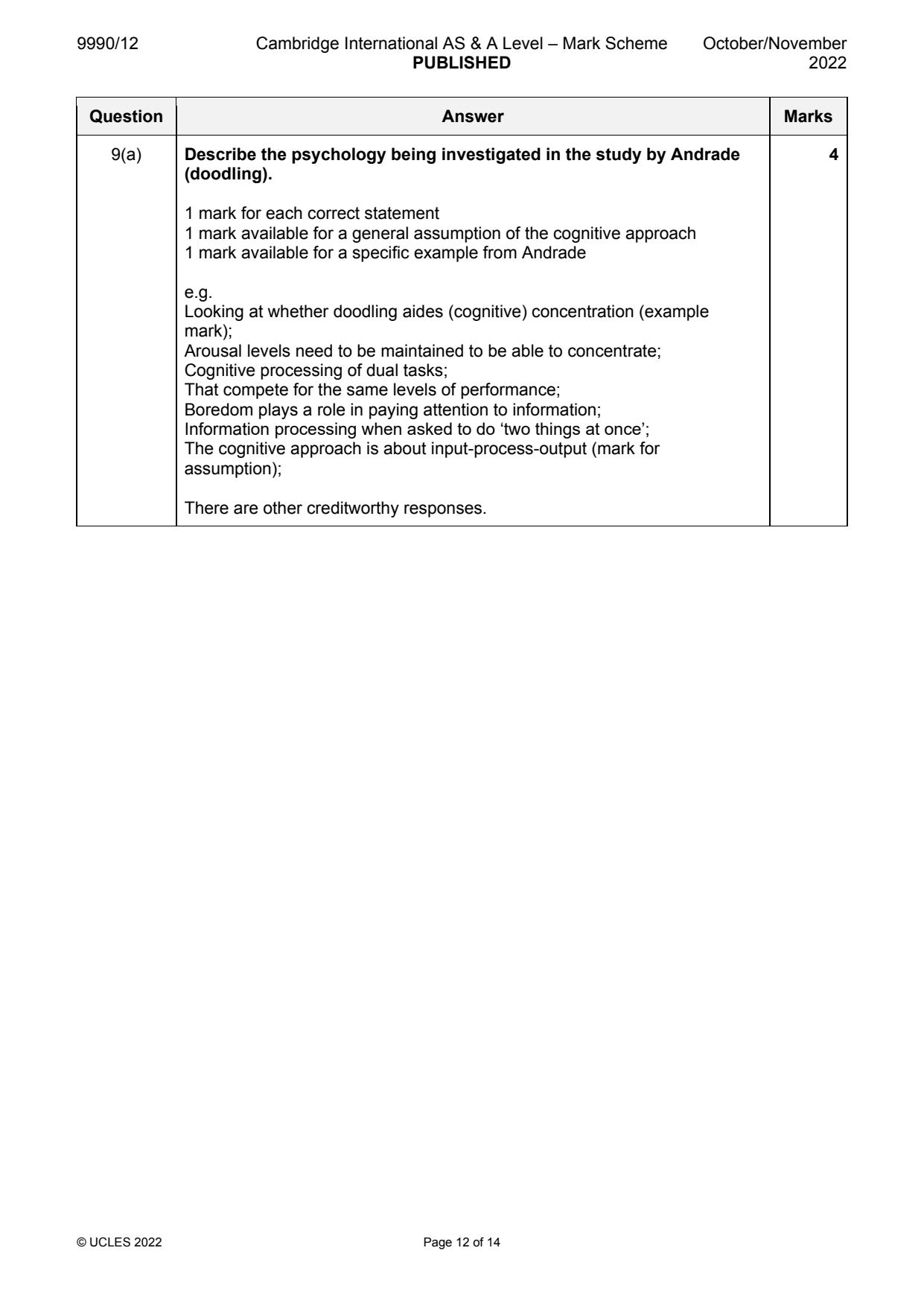
9(a) Describe the psychology being investigated in the study by Andrade 4
(doodling).
1 mark for each correct statement
1 mark available for a general assumption of the cognitive approach
1 mark available for a specific example from Andrade
e.g.
Looking at whether doodling aides (cognitive) concentration (example
mark);
Arousal levels need to be maintained to be able to concentrate;
Cognitive processing of dual tasks;
That compete for the same levels of performance;
Boredom plays a role in paying attention to information;
Information processing when asked to do ‘two things at once’;
The cognitive approach is about input-process-output (mark for
assumption);
There are other creditworthy responses.
© UCLES 2022 Page 12 of 14
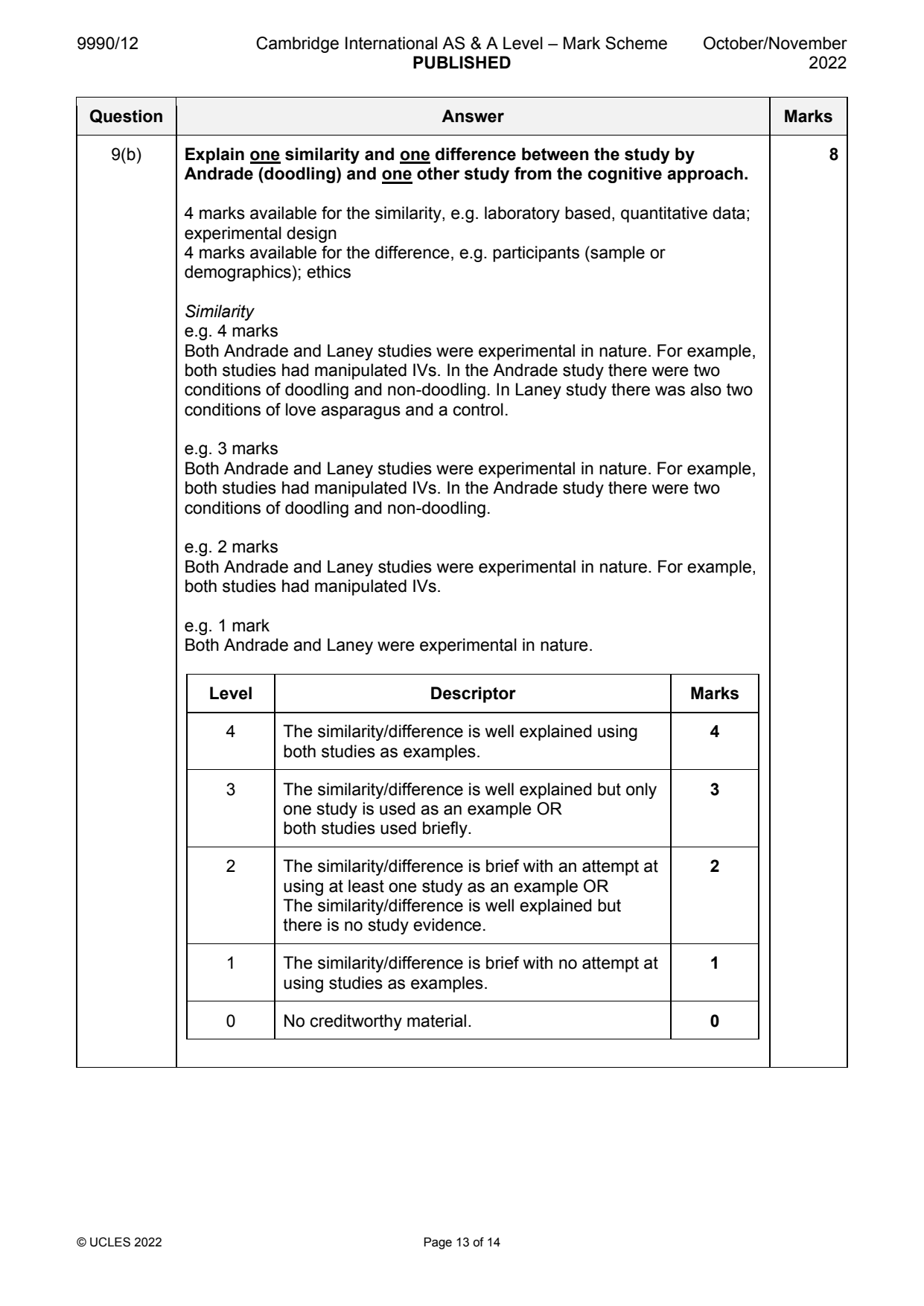
9(b) Explain one similarity and one difference between the study by 8
Andrade (doodling) and one other study from the cognitive approach.
4 marks available for the similarity, e.g. laboratory based, quantitative data;
experimental design
4 marks available for the difference, e.g. participants (sample or
demographics); ethics
Similarity
e.g. 4 marks
Both Andrade and Laney studies were experimental in nature. For example,
both studies had manipulated IVs. In the Andrade study there were two
conditions of doodling and non-doodling. In Laney study there was also two
conditions of love asparagus and a control.
e.g. 3 marks
Both Andrade and Laney studies were experimental in nature. For example,
both studies had manipulated IVs. In the Andrade study there were two
conditions of doodling and non-doodling.
e.g. 2 marks
Both Andrade and Laney studies were experimental in nature. For example,
both studies had manipulated IVs.
e.g. 1 mark
Both Andrade and Laney were experimental in nature.
Level Descriptor Marks
4 The similarity/difference is well explained using 4
both studies as examples.
3 The similarity/difference is well explained but only 3
one study is used as an example OR
both studies used briefly.
2 The similarity/difference is brief with an attempt at 2
using at least one study as an example OR
The similarity/difference is well explained but
there is no study evidence.
1 The similarity/difference is brief with no attempt at 1
using studies as examples.
0 No creditworthy material. 0
© UCLES 2022 Page 13 of 14
Official mark scheme pages: 12, 13 · source PDF URL
9990-2022-on-13-q01
Oct/Nov 2022 · Paper 13 · Question 1 · 4 marks
1(a) From the study by Andrade (doodling): 1
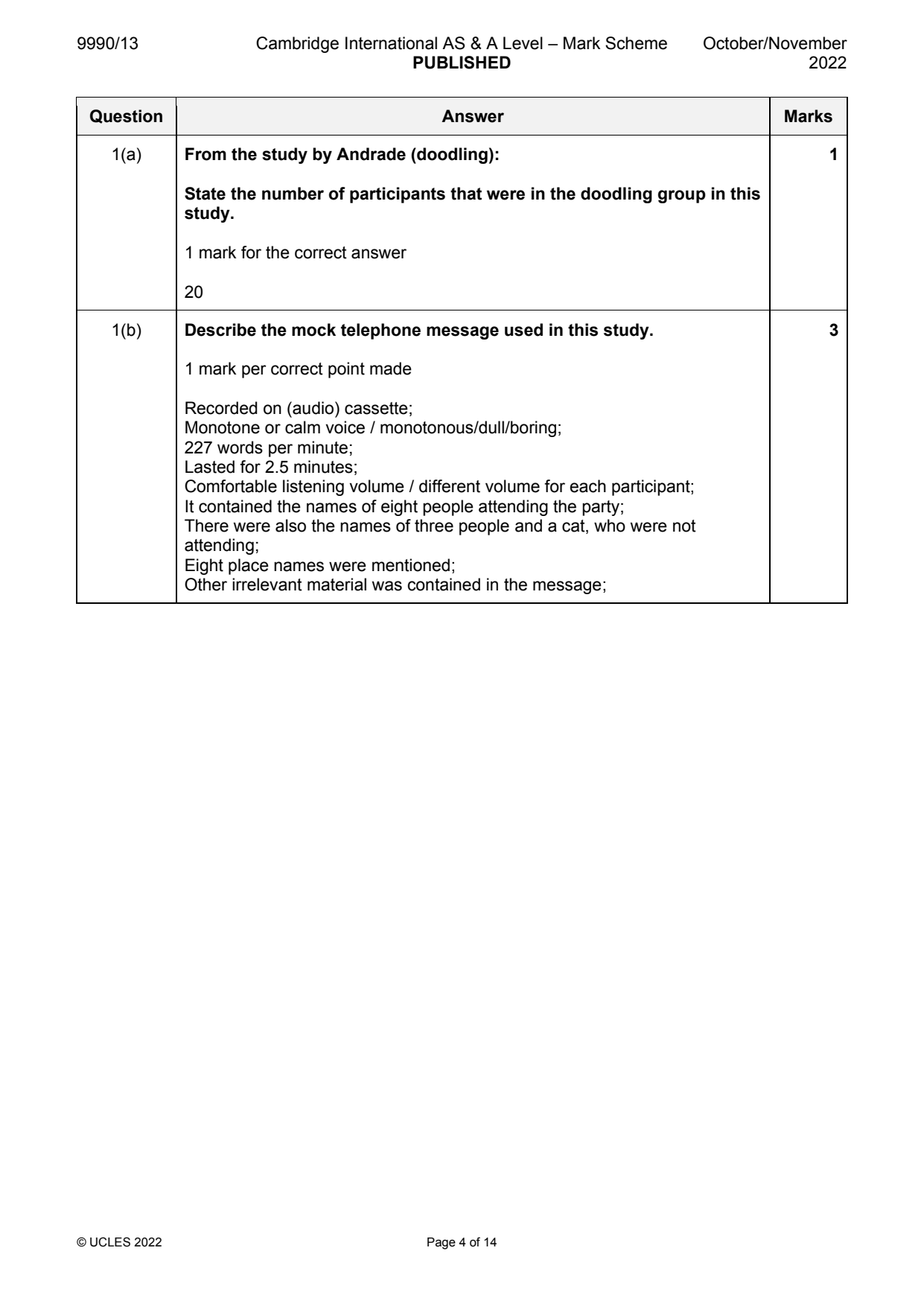
State the number of participants that were in the doodling group in this
study.
1 mark for the correct answer
20
1(b) Describe the mock telephone message used in this study. 3
1 mark per correct point made
Recorded on (audio) cassette;
Monotone or calm voice / monotonous/dull/boring;
227 words per minute;
Lasted for 2.5 minutes;
Comfortable listening volume / different volume for each participant;
It contained the names of eight people attending the party;
There were also the names of three people and a cat, who were not
attending;
Eight place names were mentioned;
Other irrelevant material was contained in the message;
© UCLES 2022 Page 4 of 14
Official mark scheme pages: 4 · source PDF URL
9990-2022-on-13-q03
Oct/Nov 2022 · Paper 13 · Question 3 · 5 marks
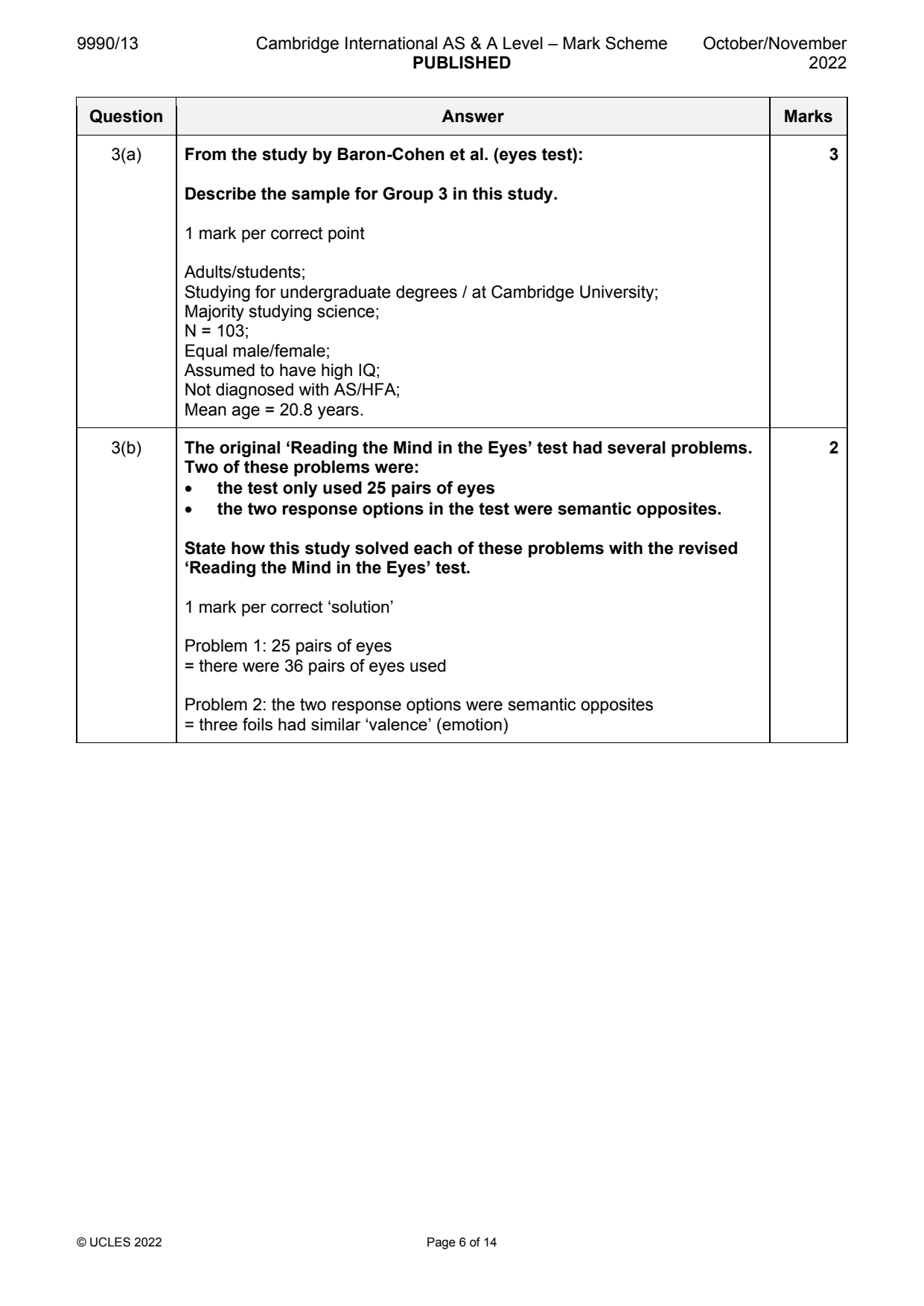
3(a) From the study by Baron-Cohen et al. (eyes test): 3
Describe the sample for Group 3 in this study.
1 mark per correct point
Adults/students;
Studying for undergraduate degrees / at Cambridge University;
Majority studying science;
N = 103;
Equal male/female;
Assumed to have high IQ;
Not diagnosed with AS/HFA;
Mean age = 20.8 years.
3(b) The original ‘Reading the Mind in the Eyes’ test had several problems. 2
Two of these problems were:
• the test only used 25 pairs of eyes
• the two response options in the test were semantic opposites.
State how this study solved each of these problems with the revised
‘Reading the Mind in the Eyes’ test.
1 mark per correct ‘solution’
Problem 1: 25 pairs of eyes
= there were 36 pairs of eyes used
Problem 2: the two response options were semantic opposites
= three foils had similar ‘valence’ (emotion)
© UCLES 2022 Page 6 of 14
Official mark scheme pages: 6 · source PDF URL
9990-2022-on-13-q09
Oct/Nov 2022 · Paper 13 · Question 9 · 12 marks
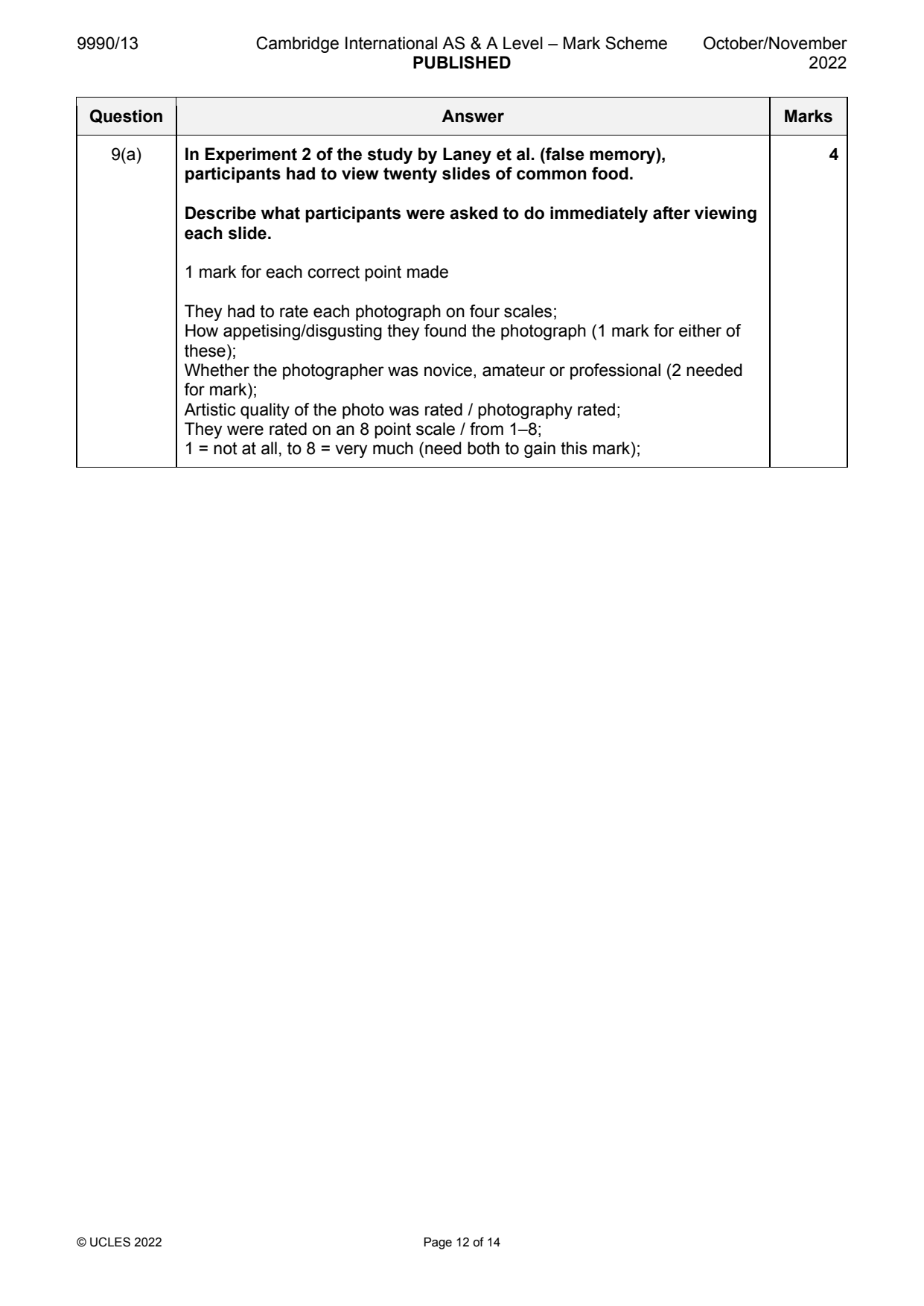
9(a) In Experiment 2 of the study by Laney et al. (false memory), 4
participants had to view twenty slides of common food.
Describe what participants were asked to do immediately after viewing
each slide.
1 mark for each correct point made
They had to rate each photograph on four scales;
How appetising/disgusting they found the photograph (1 mark for either of
these);
Whether the photographer was novice, amateur or professional (2 needed
for mark);
Artistic quality of the photo was rated / photography rated;
They were rated on an 8 point scale / from 1–8;
1 = not at all, to 8 = very much (need both to gain this mark);
© UCLES 2022 Page 12 of 14
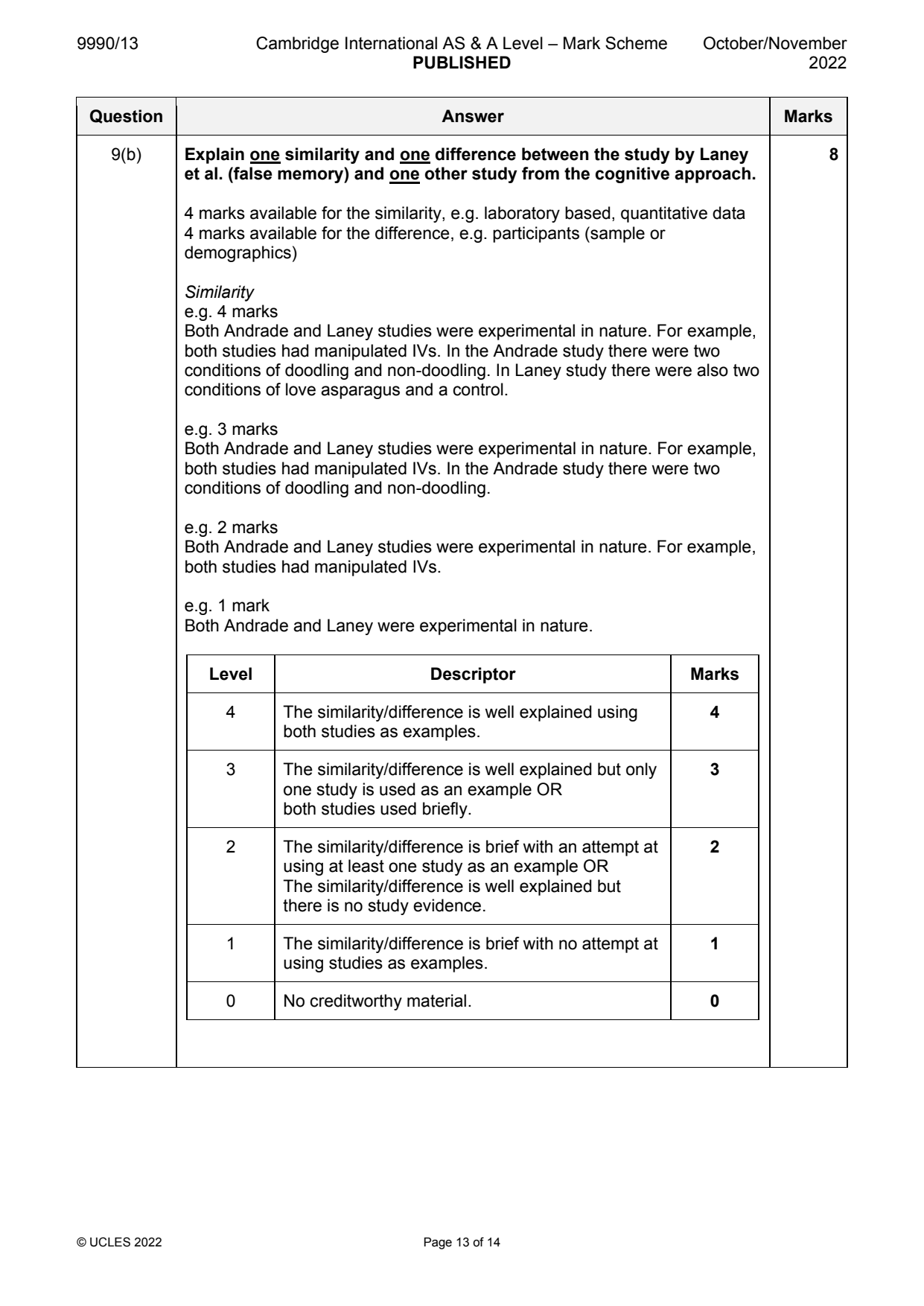
9(b) Explain one similarity and one difference between the study by Laney 8
et al. (false memory) and one other study from the cognitive approach.
4 marks available for the similarity, e.g. laboratory based, quantitative data
4 marks available for the difference, e.g. participants (sample or
demographics)
Similarity
e.g. 4 marks
Both Andrade and Laney studies were experimental in nature. For example,
both studies had manipulated IVs. In the Andrade study there were two
conditions of doodling and non-doodling. In Laney study there were also two
conditions of love asparagus and a control.
e.g. 3 marks
Both Andrade and Laney studies were experimental in nature. For example,
both studies had manipulated IVs. In the Andrade study there were two
conditions of doodling and non-doodling.
e.g. 2 marks
Both Andrade and Laney studies were experimental in nature. For example,
both studies had manipulated IVs.
e.g. 1 mark
Both Andrade and Laney were experimental in nature.
Level Descriptor Marks
4 The similarity/difference is well explained using 4
both studies as examples.
3 The similarity/difference is well explained but only 3
one study is used as an example OR
both studies used briefly.
2 The similarity/difference is brief with an attempt at 2
using at least one study as an example OR
The similarity/difference is well explained but
there is no study evidence.
1 The similarity/difference is brief with no attempt at 1
using studies as examples.
0 No creditworthy material. 0
© UCLES 2022 Page 13 of 14
Official mark scheme pages: 12, 13 · source PDF URL
9990-2023-mj-11-q02
May/June 2023 · Paper 11 · Question 2 · 3 marks
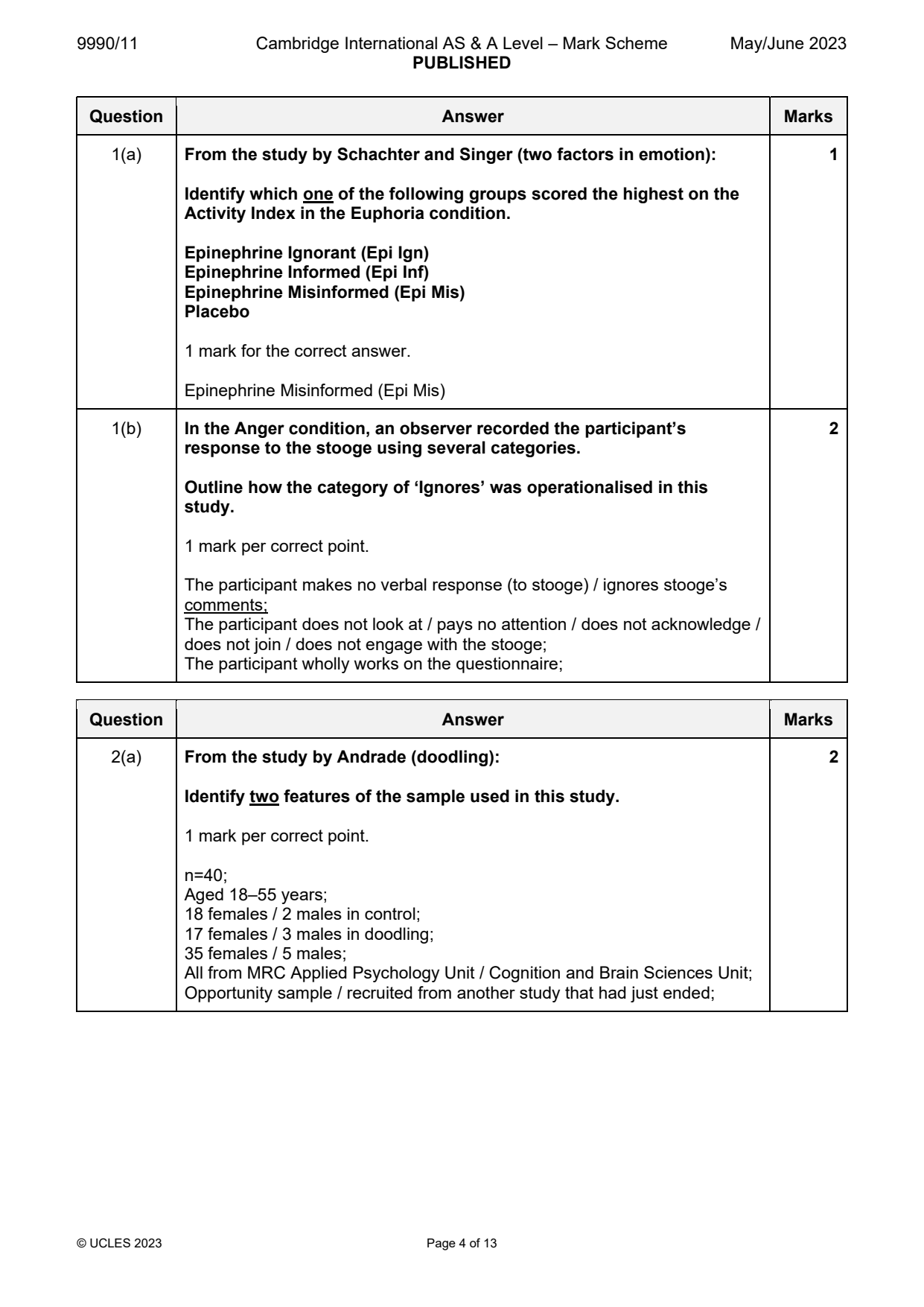
2(a) From the study by Andrade (doodling): 2
Identify two features of the sample used in this study.
1 mark per correct point.
n=40;
Aged 18–55 years;
18 females / 2 males in control;
17 females / 3 males in doodling;
35 females / 5 males;
All from MRC Applied Psychology Unit / Cognition and Brain Sciences Unit;
Opportunity sample / recruited from another study that had just ended;
© UCLES 2023 Page 4 of 13
2(b) Identify one strength of the sample used in this study. 1
1 mark for correct point.
e.g.
(Is) generalisable (as wide age range / both sexes);
(More) willing as interested in the subject;
Already bored and fatigued (so a valid sample);
There are other creditworthy responses.
Question Answer Marks
Official mark scheme pages: 4, 5 · source PDF URL
9990-2023-mj-11-q05
May/June 2023 · Paper 11 · Question 5 · 5 marks
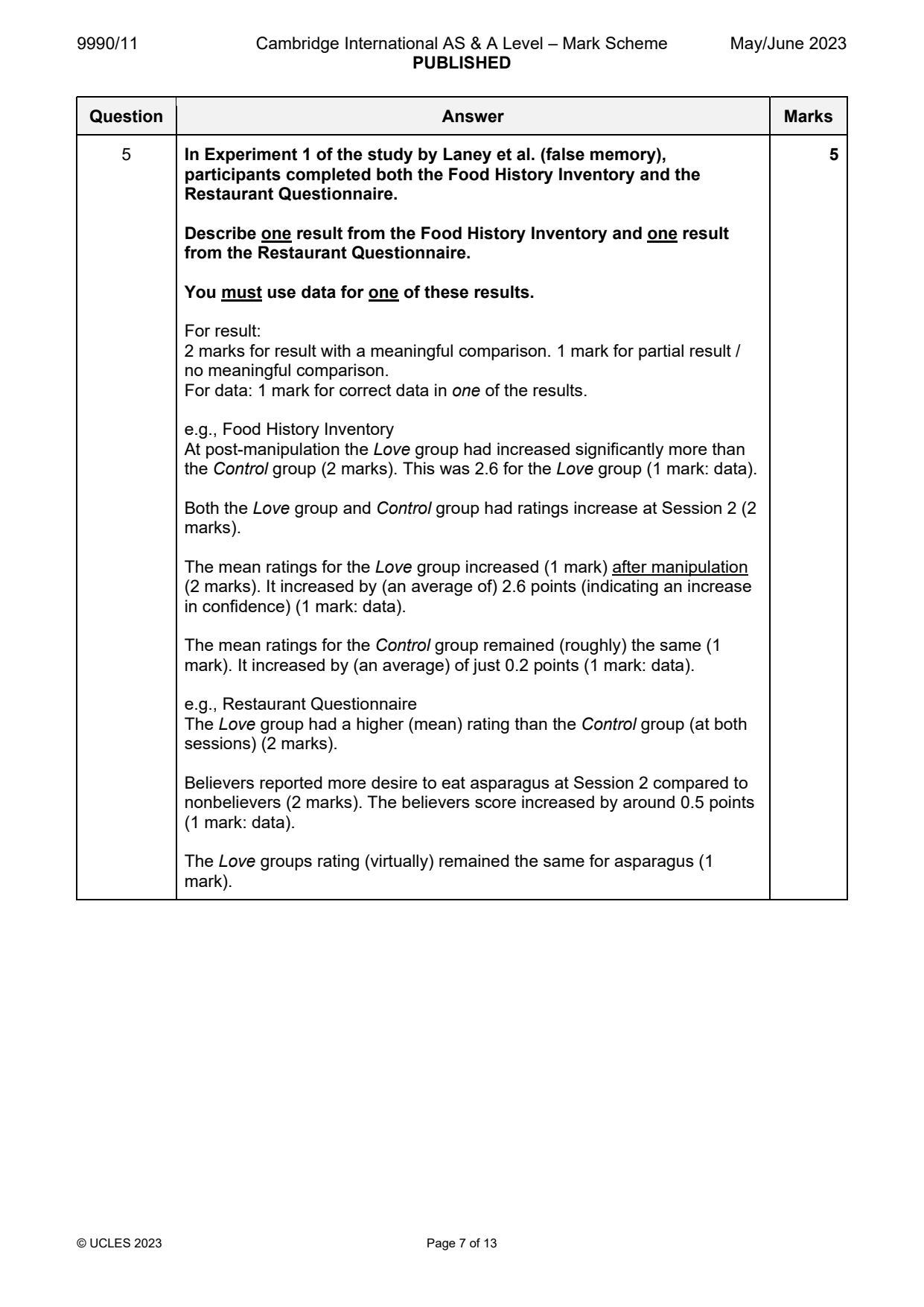
5 In Experiment 1 of the study by Laney et al. (false memory), 5
participants completed both the Food History Inventory and the
Restaurant Questionnaire.
Describe one result from the Food History Inventory and one result
from the Restaurant Questionnaire.
You must use data for one of these results.
For result:
2 marks for result with a meaningful comparison. 1 mark for partial result /
no meaningful comparison.
For data: 1 mark for correct data in one of the results.
e.g., Food History Inventory
At post-manipulation the Love group had increased significantly more than
the Control group (2 marks). This was 2.6 for the Love group (1 mark: data).
Both the Love group and Control group had ratings increase at Session 2 (2
marks).
The mean ratings for the Love group increased (1 mark) after manipulation
(2 marks). It increased by (an average of) 2.6 points (indicating an increase
in confidence) (1 mark: data).
The mean ratings for the Control group remained (roughly) the same (1
mark). It increased by (an average) of just 0.2 points (1 mark: data).
e.g., Restaurant Questionnaire
The Love group had a higher (mean) rating than the Control group (at both
sessions) (2 marks).
Believers reported more desire to eat asparagus at Session 2 compared to
nonbelievers (2 marks). The believers score increased by around 0.5 points
(1 mark: data).
The Love groups rating (virtually) remained the same for asparagus (1
mark).
© UCLES 2023 Page 7 of 13
Official mark scheme pages: 7 · source PDF URL
9990-2023-mj-11-q06
May/June 2023 · Paper 11 · Question 6 · 6 marks
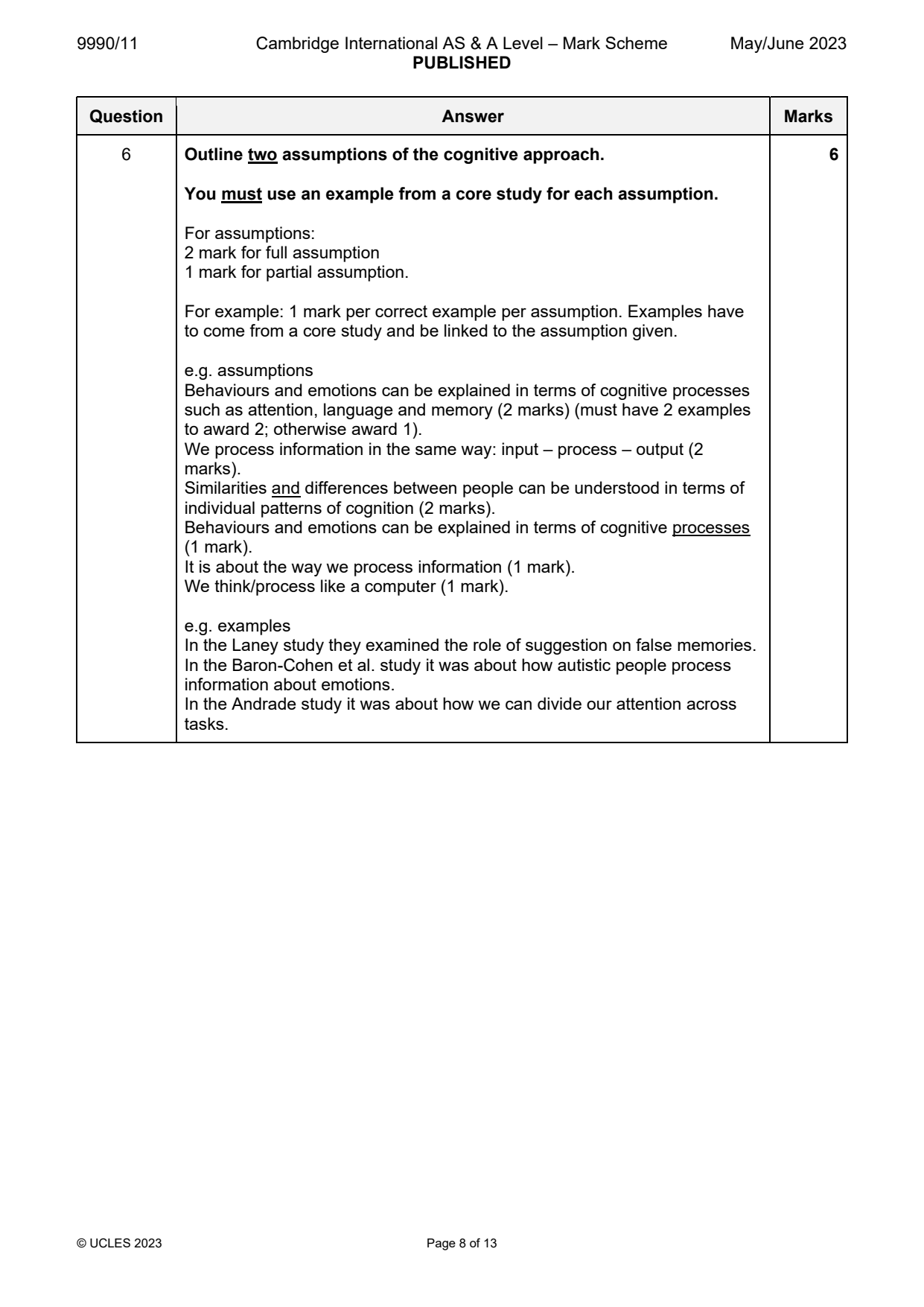
6 Outline two assumptions of the cognitive approach. 6
You must use an example from a core study for each assumption.
For assumptions:
2 mark for full assumption
1 mark for partial assumption.
For example: 1 mark per correct example per assumption. Examples have
to come from a core study and be linked to the assumption given.
e.g. assumptions
Behaviours and emotions can be explained in terms of cognitive processes
such as attention, language and memory (2 marks) (must have 2 examples
to award 2; otherwise award 1).
We process information in the same way: input – process – output (2
marks).
Similarities and differences between people can be understood in terms of
individual patterns of cognition (2 marks).
Behaviours and emotions can be explained in terms of cognitive processes
(1 mark).
It is about the way we process information (1 mark).
We think/process like a computer (1 mark).
e.g. examples
In the Laney study they examined the role of suggestion on false memories.
In the Baron-Cohen et al. study it was about how autistic people process
information about emotions.
In the Andrade study it was about how we can divide our attention across
tasks.
© UCLES 2023 Page 8 of 13
Official mark scheme pages: 8 · source PDF URL
9990-2023-mj-11-q08
May/June 2023 · Paper 11 · Question 8 · 6 marks
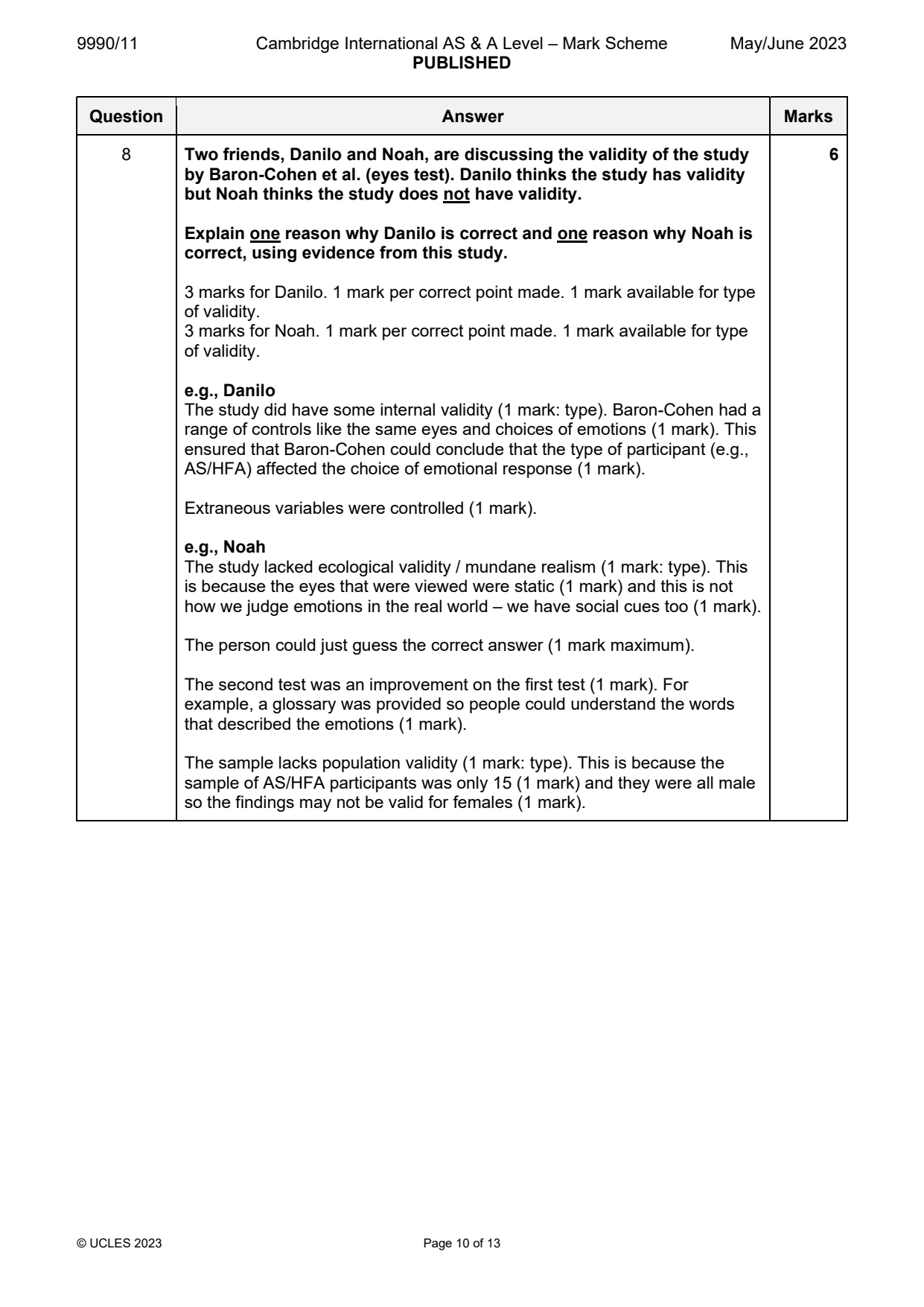
8 Two friends, Danilo and Noah, are discussing the validity of the study 6
by Baron-Cohen et al. (eyes test). Danilo thinks the study has validity
but Noah thinks the study does not have validity.
Explain one reason why Danilo is correct and one reason why Noah is
correct, using evidence from this study.
3 marks for Danilo. 1 mark per correct point made. 1 mark available for type
of validity.
3 marks for Noah. 1 mark per correct point made. 1 mark available for type
of validity.
e.g., Danilo
The study did have some internal validity (1 mark: type). Baron-Cohen had a
range of controls like the same eyes and choices of emotions (1 mark). This
ensured that Baron-Cohen could conclude that the type of participant (e.g.,
AS/HFA) affected the choice of emotional response (1 mark).
Extraneous variables were controlled (1 mark).
e.g., Noah
The study lacked ecological validity / mundane realism (1 mark: type). This
is because the eyes that were viewed were static (1 mark) and this is not
how we judge emotions in the real world – we have social cues too (1 mark).
The person could just guess the correct answer (1 mark maximum).
The second test was an improvement on the first test (1 mark). For
example, a glossary was provided so people could understand the words
that described the emotions (1 mark).
The sample lacks population validity (1 mark: type). This is because the
sample of AS/HFA participants was only 15 (1 mark) and they were all male
so the findings may not be valid for females (1 mark).
© UCLES 2023 Page 10 of 13
Official mark scheme pages: 10 · source PDF URL
9990-2023-mj-12-q02
May/June 2023 · Paper 12 · Question 2 · 3 marks
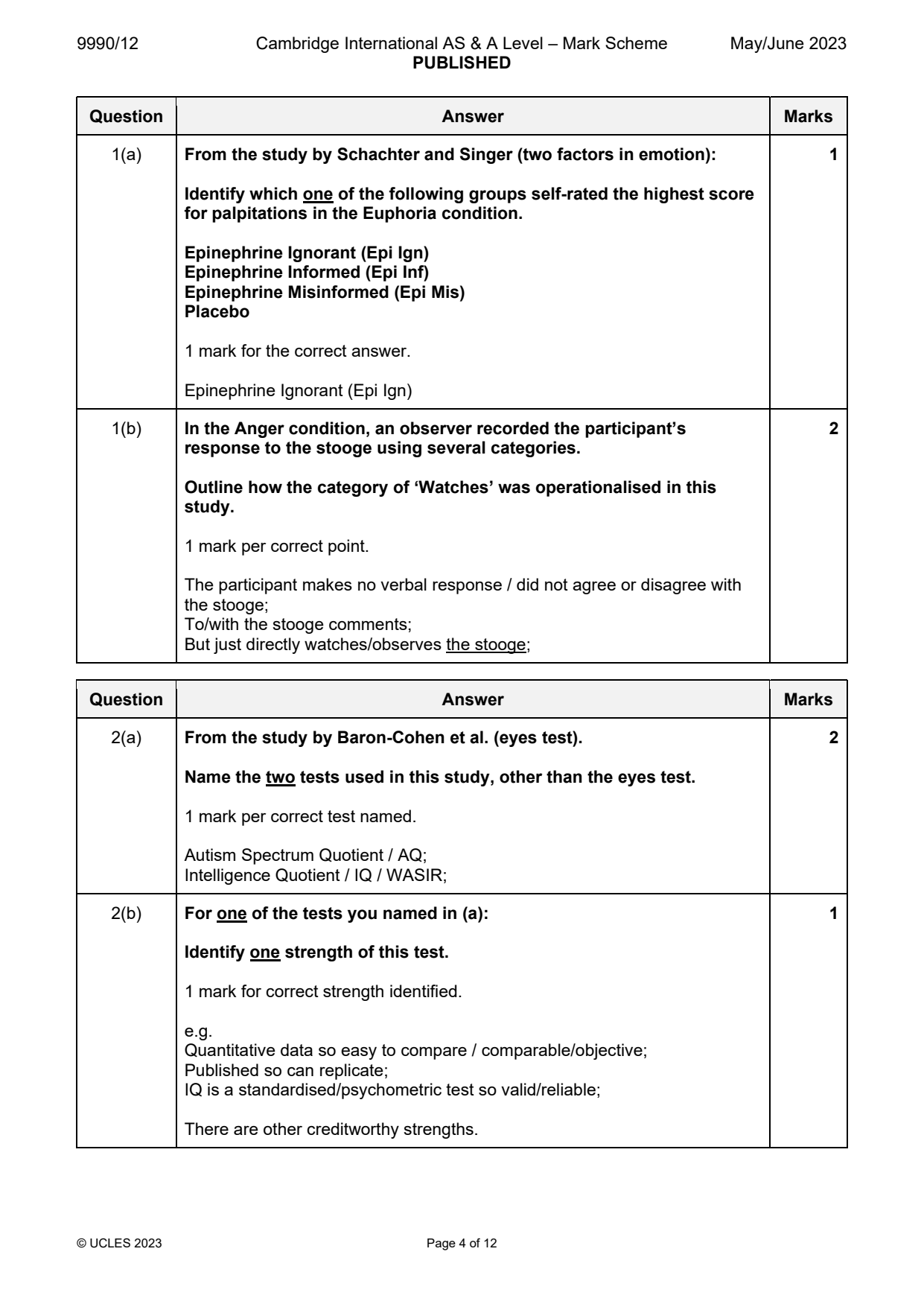
2(a) From the study by Baron-Cohen et al. (eyes test). 2
Name the two tests used in this study, other than the eyes test.
1 mark per correct test named.
Autism Spectrum Quotient / AQ;
Intelligence Quotient / IQ / WASIR;
2(b) For one of the tests you named in (a): 1
Identify one strength of this test.
1 mark for correct strength identified.
e.g.
Quantitative data so easy to compare / comparable/objective;
Published so can replicate;
IQ is a standardised/psychometric test so valid/reliable;
There are other creditworthy strengths.
© UCLES 2023 Page 4 of 12
Official mark scheme pages: 4 · source PDF URL
9990-2023-mj-12-q05
May/June 2023 · Paper 12 · Question 5 · 5 marks
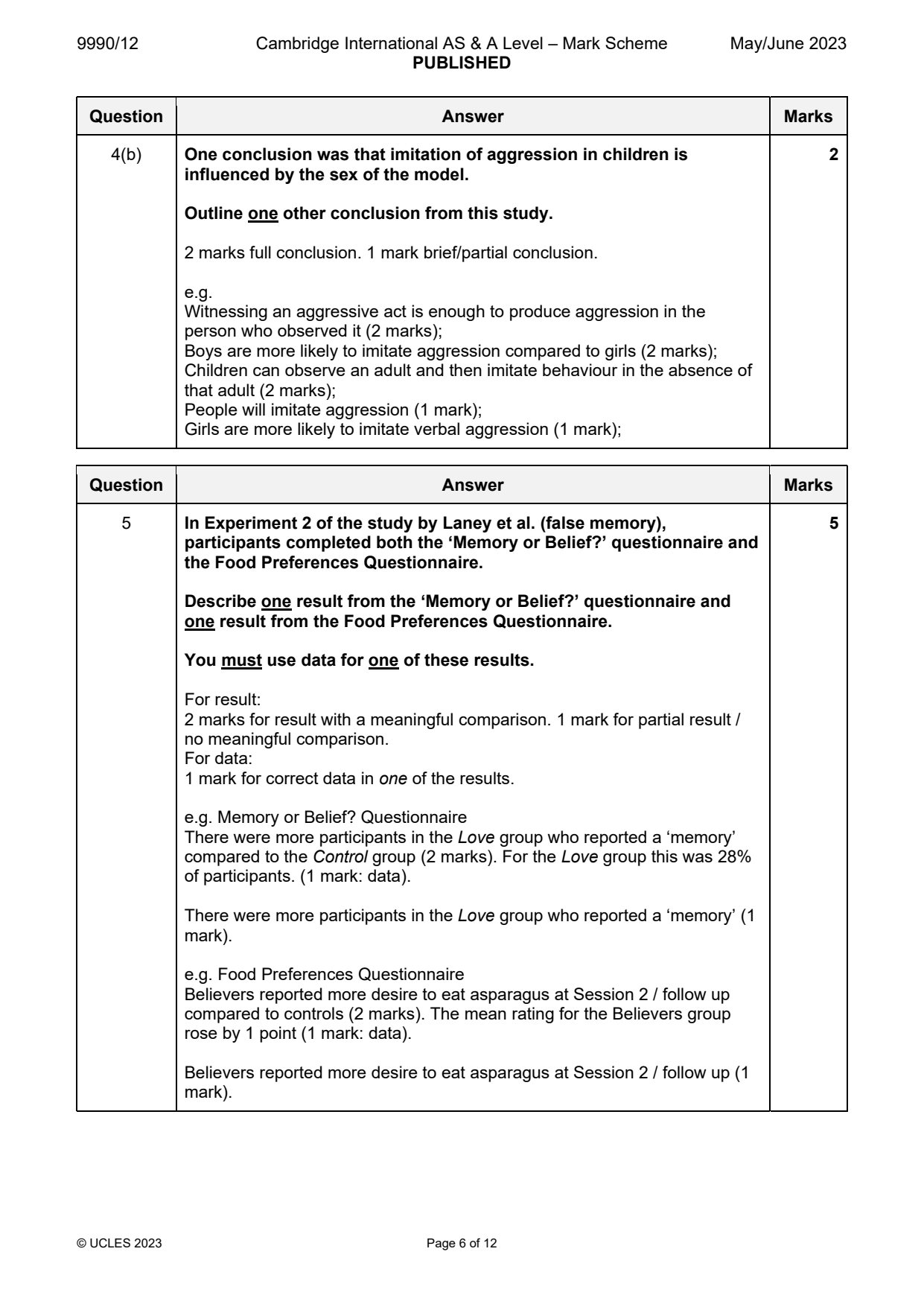
5 In Experiment 2 of the study by Laney et al. (false memory), 5
participants completed both the ‘Memory or Belief?’ questionnaire and
the Food Preferences Questionnaire.
Describe one result from the ‘Memory or Belief?’ questionnaire and
one result from the Food Preferences Questionnaire.
You must use data for one of these results.
For result:
2 marks for result with a meaningful comparison. 1 mark for partial result /
no meaningful comparison.
For data:
1 mark for correct data in one of the results.
e.g. Memory or Belief? Questionnaire
There were more participants in the Love group who reported a ‘memory’
compared to the Control group (2 marks). For the Love group this was 28%
of participants. (1 mark: data).
There were more participants in the Love group who reported a ‘memory’ (1
mark).
e.g. Food Preferences Questionnaire
Believers reported more desire to eat asparagus at Session 2 / follow up
compared to controls (2 marks). The mean rating for the Believers group
rose by 1 point (1 mark: data).
Believers reported more desire to eat asparagus at Session 2 / follow up (1
mark).
© UCLES 2023 Page 6 of 12
Official mark scheme pages: 6 · source PDF URL
9990-2023-mj-12-q10
May/June 2023 · Paper 12 · Question 10 · 10 marks
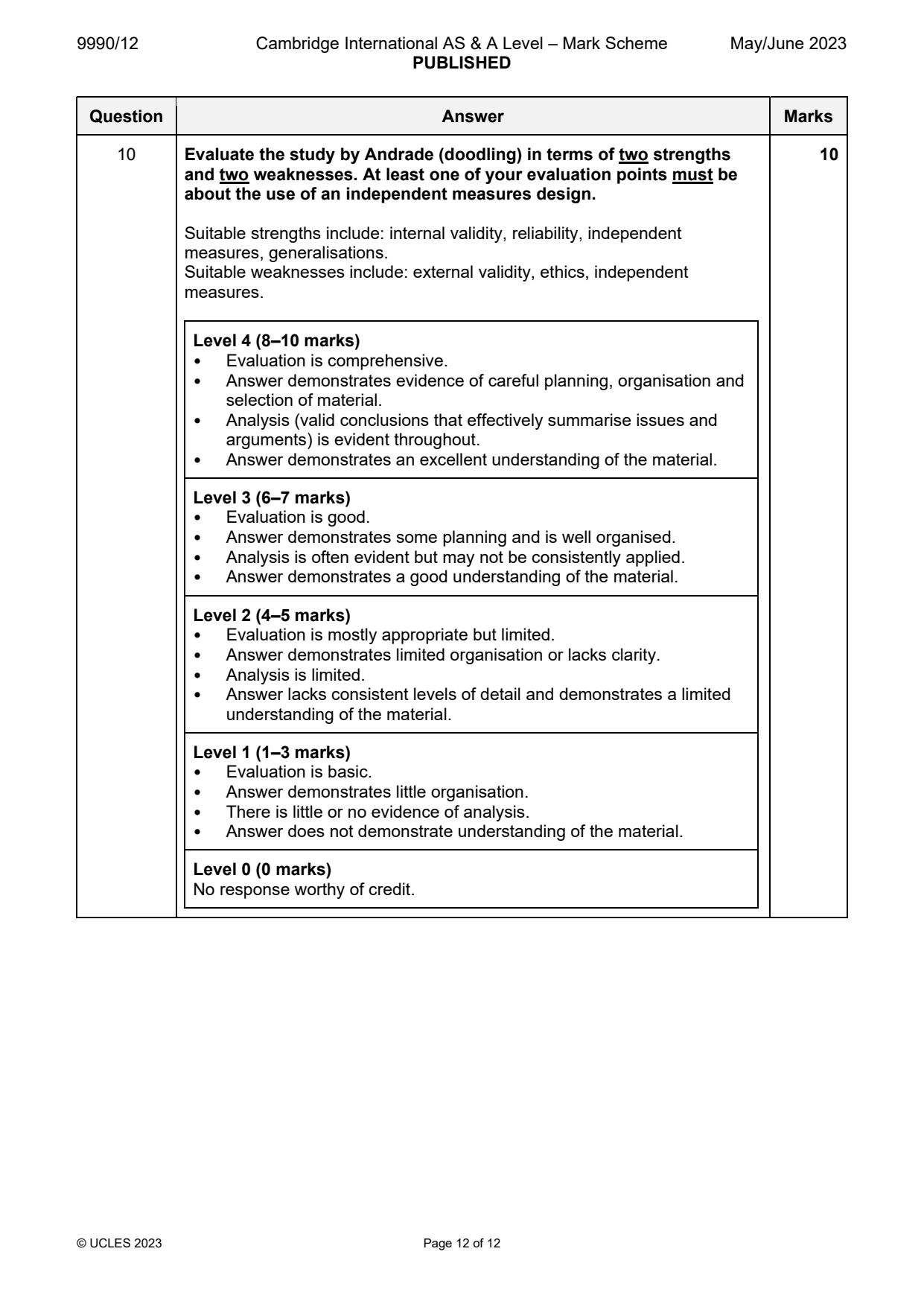
10 Evaluate the study by Andrade (doodling) in terms of two strengths 10
and two weaknesses. At least one of your evaluation points must be
about the use of an independent measures design.
Suitable strengths include: internal validity, reliability, independent
measures, generalisations.
Suitable weaknesses include: external validity, ethics, independent
measures.
Level 4 (8–10 marks)
• Evaluation is comprehensive.
• Answer demonstrates evidence of careful planning, organisation and
selection of material.
• Analysis (valid conclusions that effectively summarise issues and
arguments) is evident throughout.
• Answer demonstrates an excellent understanding of the material.
Level 3 (6–7 marks)
• Evaluation is good.
• Answer demonstrates some planning and is well organised.
• Analysis is often evident but may not be consistently applied.
• Answer demonstrates a good understanding of the material.
Level 2 (4–5 marks)
• Evaluation is mostly appropriate but limited.
• Answer demonstrates limited organisation or lacks clarity.
• Analysis is limited.
• Answer lacks consistent levels of detail and demonstrates a limited
understanding of the material.
Level 1 (1–3 marks)
• Evaluation is basic.
• Answer demonstrates little organisation.
• There is little or no evidence of analysis.
• Answer does not demonstrate understanding of the material.
Level 0 (0 marks)
No response worthy of credit.
© UCLES 2023 Page 12 of 12
Official mark scheme pages: 12 · source PDF URL
9990-2023-mj-13-q05
May/June 2023 · Paper 13 · Question 5 · 5 marks
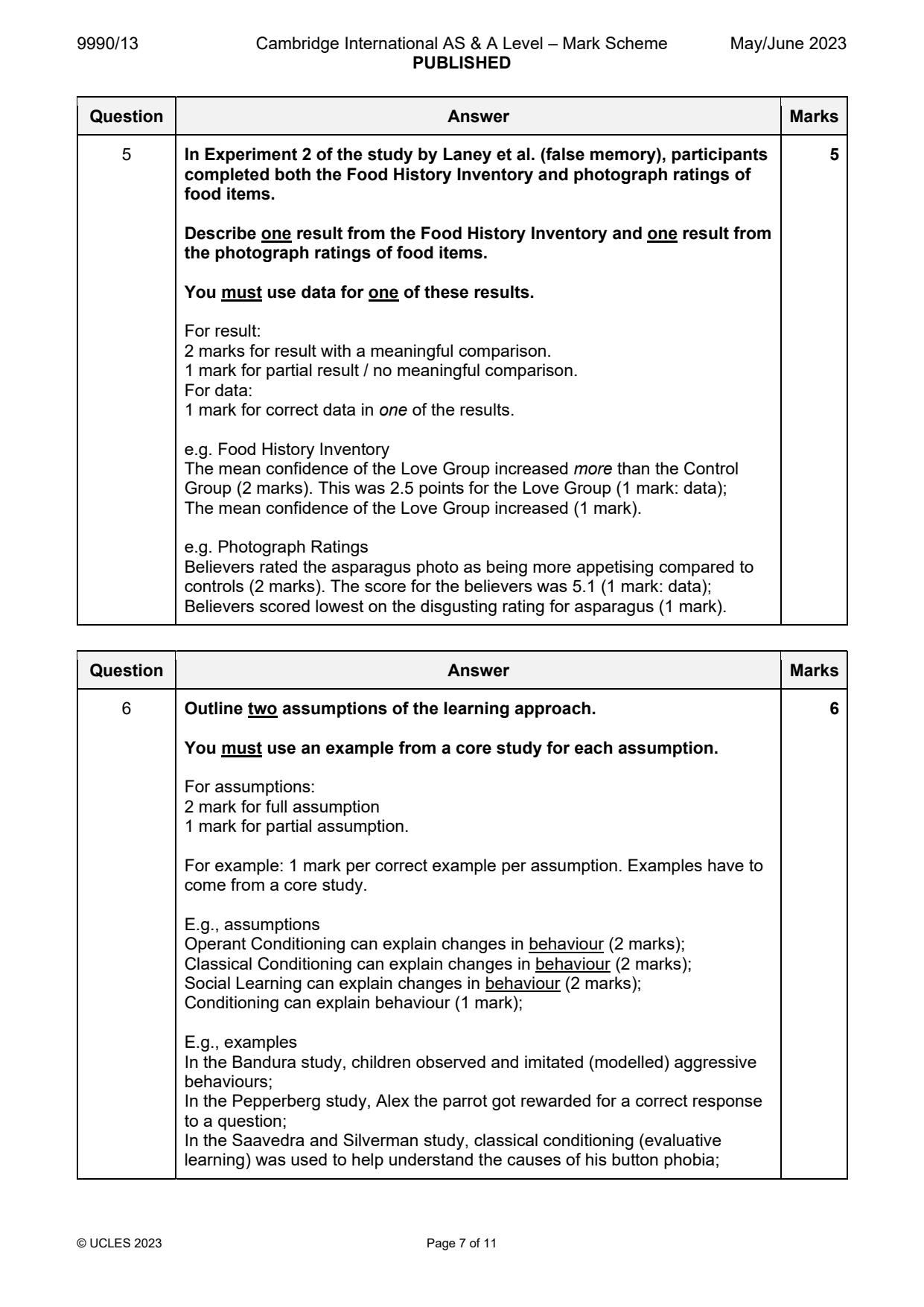
5 In Experiment 2 of the study by Laney et al. (false memory), participants 5
completed both the Food History Inventory and photograph ratings of
food items.
Describe one result from the Food History Inventory and one result from
the photograph ratings of food items.
You must use data for one of these results.
For result:
2 marks for result with a meaningful comparison.
1 mark for partial result / no meaningful comparison.
For data:
1 mark for correct data in one of the results.
e.g. Food History Inventory
The mean confidence of the Love Group increased more than the Control
Group (2 marks). This was 2.5 points for the Love Group (1 mark: data);
The mean confidence of the Love Group increased (1 mark).
e.g. Photograph Ratings
Believers rated the asparagus photo as being more appetising compared to
controls (2 marks). The score for the believers was 5.1 (1 mark: data);
Believers scored lowest on the disgusting rating for asparagus (1 mark).
Question Answer Marks
Official mark scheme pages: 7 · source PDF URL
9990-2023-mj-13-q07
May/June 2023 · Paper 13 · Question 7 · 4 marks
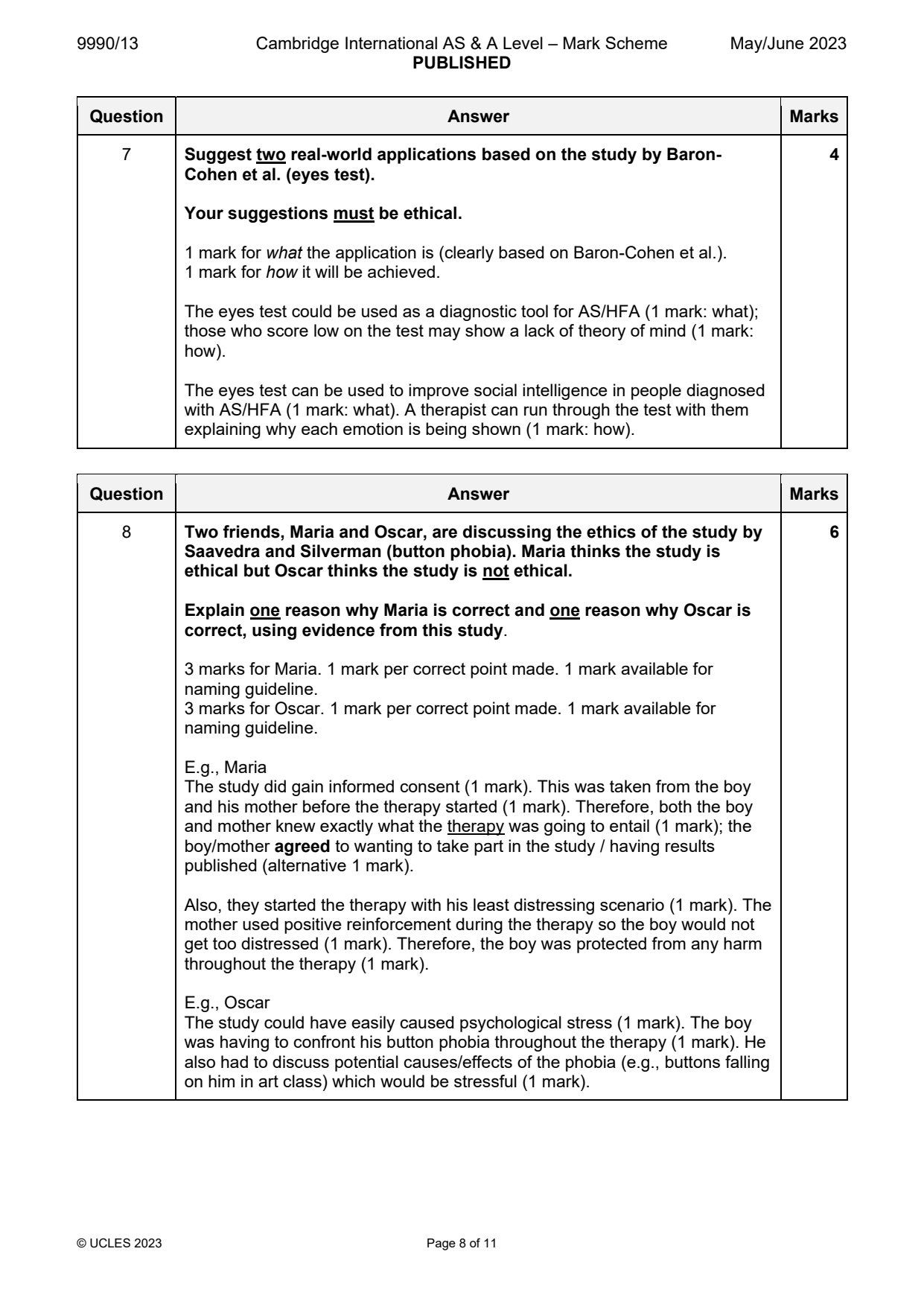
7 Suggest two real-world applications based on the study by Baron- 4
Cohen et al. (eyes test).
Your suggestions must be ethical.
1 mark for what the application is (clearly based on Baron-Cohen et al.).
1 mark for how it will be achieved.
The eyes test could be used as a diagnostic tool for AS/HFA (1 mark: what);
those who score low on the test may show a lack of theory of mind (1 mark:
how).
The eyes test can be used to improve social intelligence in people diagnosed
with AS/HFA (1 mark: what). A therapist can run through the test with them
explaining why each emotion is being shown (1 mark: how).
Question Answer Marks
Official mark scheme pages: 8 · source PDF URL
9990-2023-on-11-q01
Oct/Nov 2023 · Paper 11 · Question 1 · 3 marks
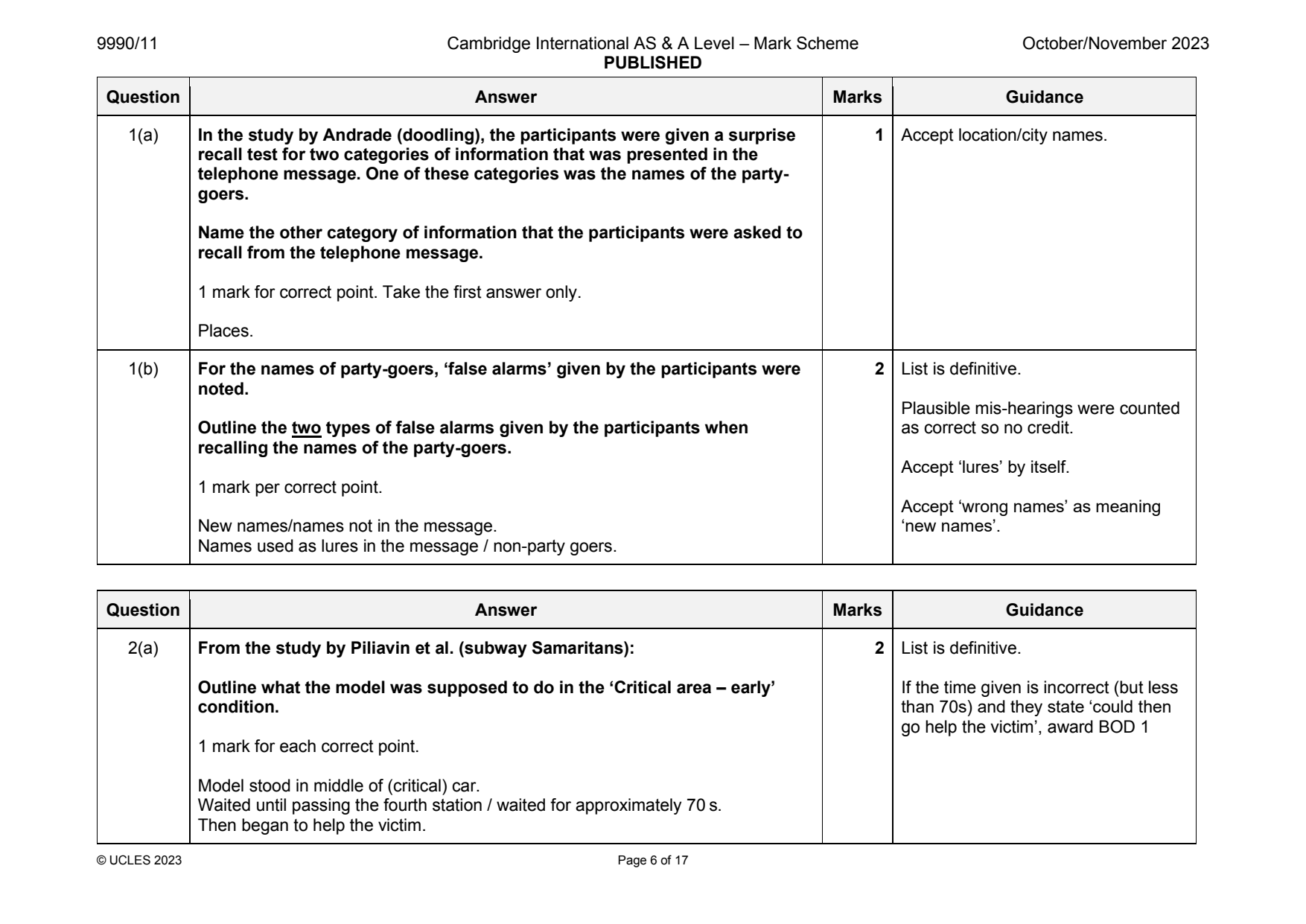
1(a) In the study by Andrade (doodling), the participants were given a surprise 1 Accept location/city names.
recall test for two categories of information that was presented in the
telephone message. One of these categories was the names of the party-
goers.
Name the other category of information that the participants were asked to
recall from the telephone message.
1 mark for correct point. Take the first answer only.
Places.
1(b) For the names of party-goers, ‘false alarms’ given by the participants were 2 List is definitive.
noted.
Plausible mis-hearings were counted
Outline the two types of false alarms given by the participants when as correct so no credit.
recalling the names of the party-goers.
Accept ‘lures’ by itself.
1 mark per correct point.
Accept ‘wrong names’ as meaning
New names/names not in the message. ‘new names’.
Names used as lures in the message / non-party goers.
Question Answer Marks Guidance
Official mark scheme pages: 6 · source PDF URL
9990-2023-on-11-q03
Oct/Nov 2023 · Paper 11 · Question 3 · 3 marks
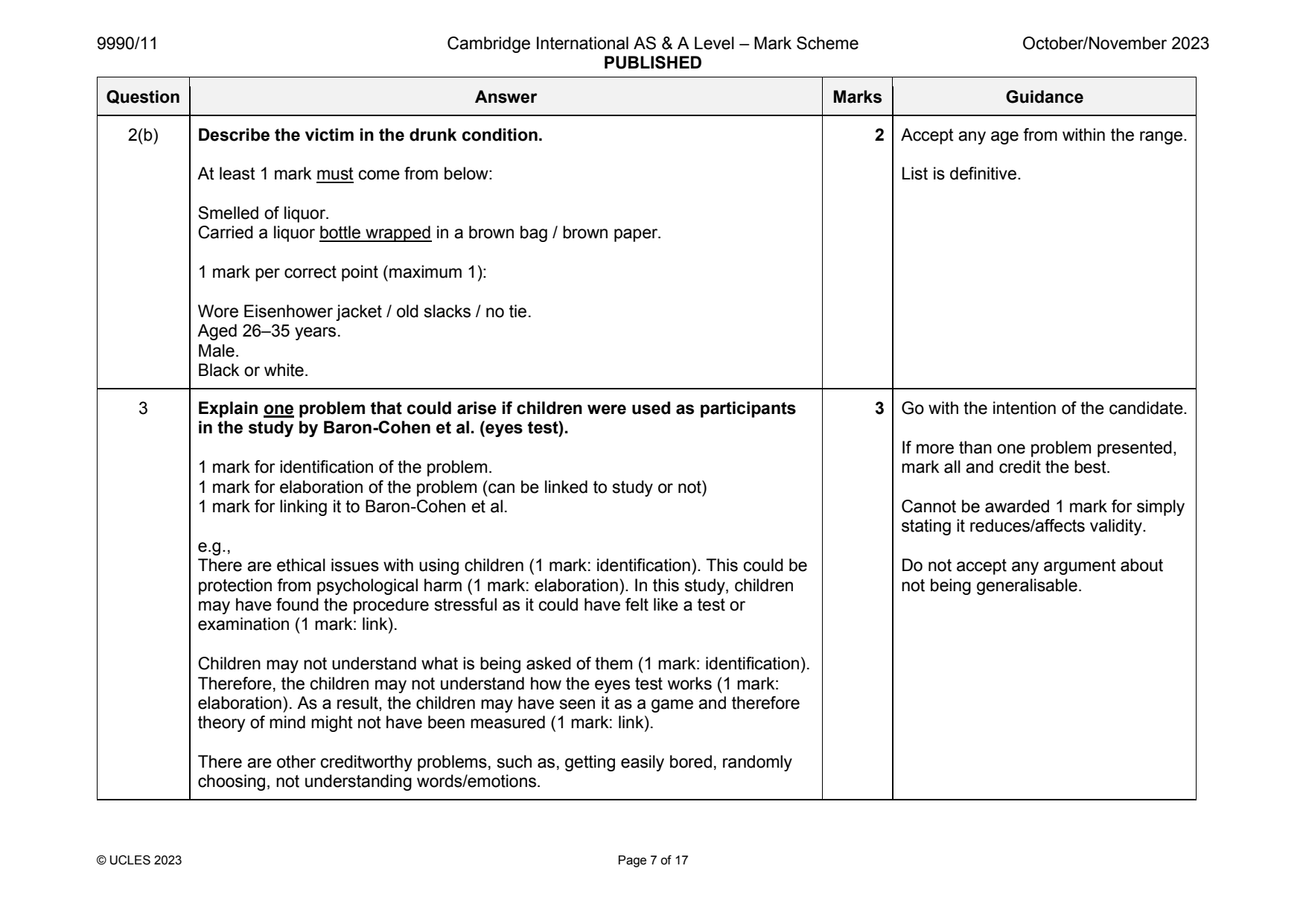
3 Explain one problem that could arise if children were used as participants 3 Go with the intention of the candidate.
in the study by Baron-Cohen et al. (eyes test).
If more than one problem presented,
1 mark for identification of the problem. mark all and credit the best.
1 mark for elaboration of the problem (can be linked to study or not)
1 mark for linking it to Baron-Cohen et al. Cannot be awarded 1 mark for simply
stating it reduces/affects validity.
e.g.,
There are ethical issues with using children (1 mark: identification). This could be Do not accept any argument about
protection from psychological harm (1 mark: elaboration). In this study, children not being generalisable.
may have found the procedure stressful as it could have felt like a test or
examination (1 mark: link).
Children may not understand what is being asked of them (1 mark: identification).
Therefore, the children may not understand how the eyes test works (1 mark:
elaboration). As a result, the children may have seen it as a game and therefore
theory of mind might not have been measured (1 mark: link).
There are other creditworthy problems, such as, getting easily bored, randomly
choosing, not understanding words/emotions.
© UCLES 2023 Page 7 of 17
Official mark scheme pages: 7 · source PDF URL
9990-2023-on-11-q10
Oct/Nov 2023 · Paper 11 · Question 10 · 10 marks
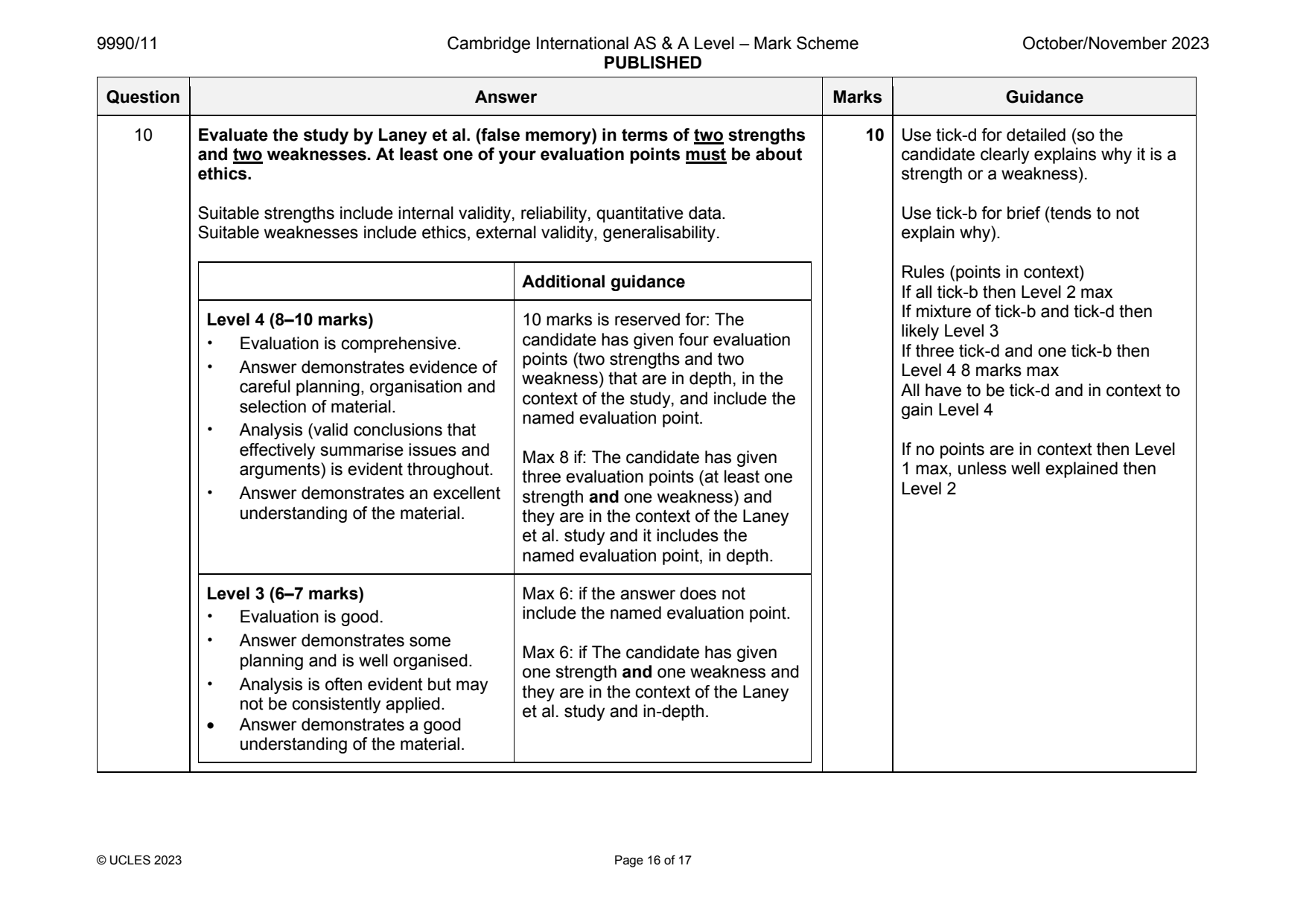
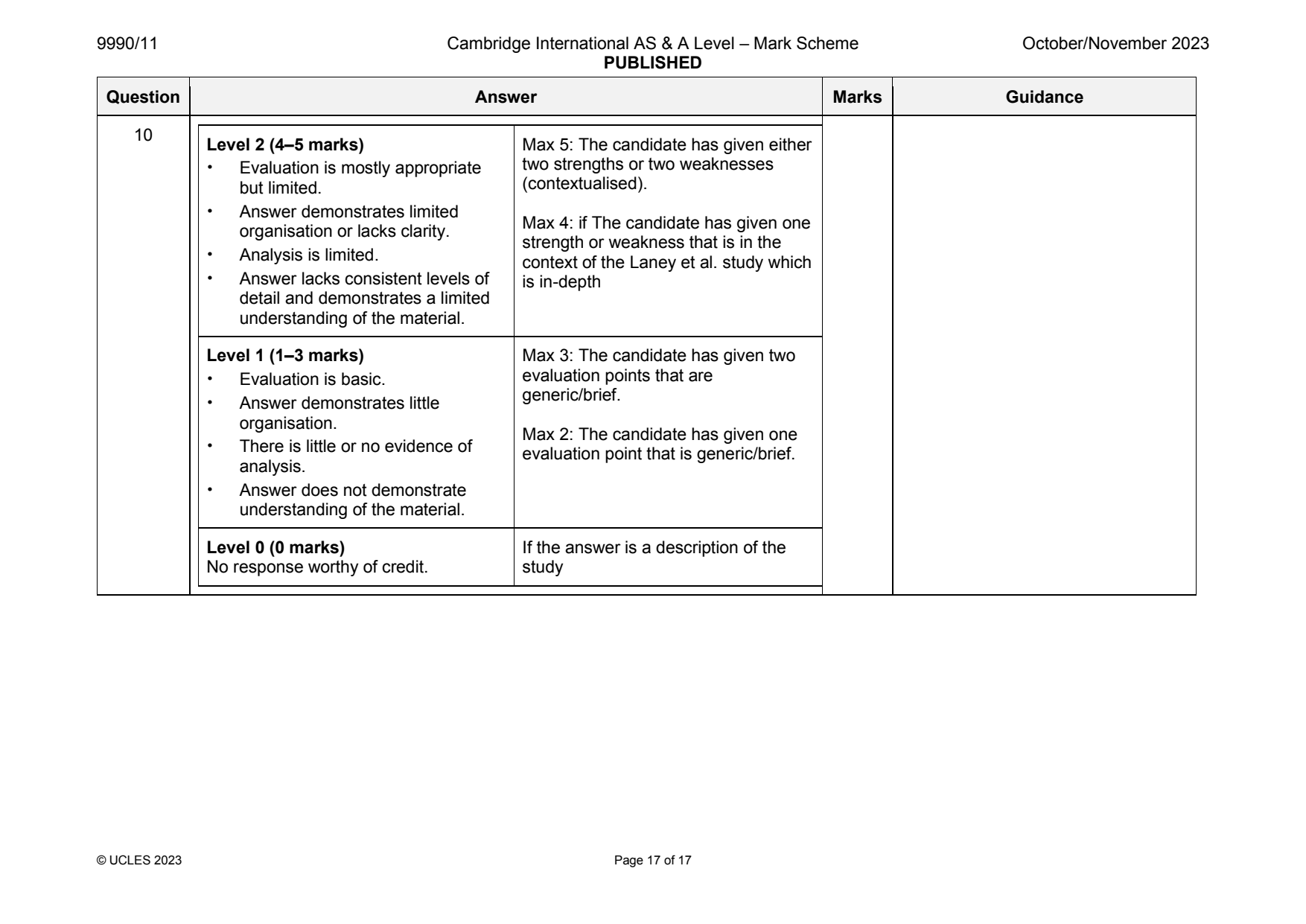
10 Evaluate the study by Laney et al. (false memory) in terms of two strengths 10 Use tick-d for detailed (so the
and two weaknesses. At least one of your evaluation points must be about candidate clearly explains why it is a
ethics. strength or a weakness).
Suitable strengths include internal validity, reliability, quantitative data. Use tick-b for brief (tends to not
Suitable weaknesses include ethics, external validity, generalisability. explain why).
Rules (points in context)
Additional guidance
If all tick-b then Level 2 max
If mixture of tick-b and tick-d then
Level 4 (8–10 marks) 10 marks is reserved for: The
likely Level 3
• Evaluation is comprehensive. candidate has given four evaluation
If three tick-d and one tick-b then
points (two strengths and two
• Answer demonstrates evidence of Level 4 8 marks max
weakness) that are in depth, in the
careful planning, organisation and All have to be tick-d and in context to
context of the study, and include the
selection of material. gain Level 4
named evaluation point.
• Analysis (valid conclusions that
effectively summarise issues and If no points are in context then Level
Max 8 if: The candidate has given
arguments) is evident throughout. 1 max, unless well explained then
three evaluation points (at least one
• Answer demonstrates an excellent strength and one weakness) and Level 2
understanding of the material. they are in the context of the Laney
et al. study and it includes the
named evaluation point, in depth.
Level 3 (6–7 marks) Max 6: if the answer does not
• Evaluation is good. include the named evaluation point.
• Answer demonstrates some
Max 6: if The candidate has given
planning and is well organised.
one strength and one weakness and
• Analysis is often evident but may
they are in the context of the Laney
not be consistently applied.
et al. study and in-depth.
• Answer demonstrates a good
understanding of the material.
© UCLES 2023 Page 16 of 17
9990/11 Cambridge International AS & A Level – Mark Scheme October/November 2023
PUBLISHED
Question Answer Marks Guidance
10
Level 2 (4–5 marks) Max 5: The candidate has given either
• Evaluation is mostly appropriate two strengths or two weaknesses
but limited. (contextualised).
• Answer demonstrates limited
Max 4: if The candidate has given one
organisation or lacks clarity.
strength or weakness that is in the
• Analysis is limited.
context of the Laney et al. study which
• Answer lacks consistent levels of is in-depth
detail and demonstrates a limited
understanding of the material.
Level 1 (1–3 marks) Max 3: The candidate has given two
• Evaluation is basic. evaluation points that are
generic/brief.
• Answer demonstrates little
organisation.
Max 2: The candidate has given one
• There is little or no evidence of
evaluation point that is generic/brief.
analysis.
• Answer does not demonstrate
understanding of the material.
Level 0 (0 marks) If the answer is a description of the
No response worthy of credit. study
© UCLES 2023 Page 17 of 17
Official mark scheme pages: 16, 17 · source PDF URL
9990-2023-on-12-q01
Oct/Nov 2023 · Paper 12 · Question 1 · 3 marks
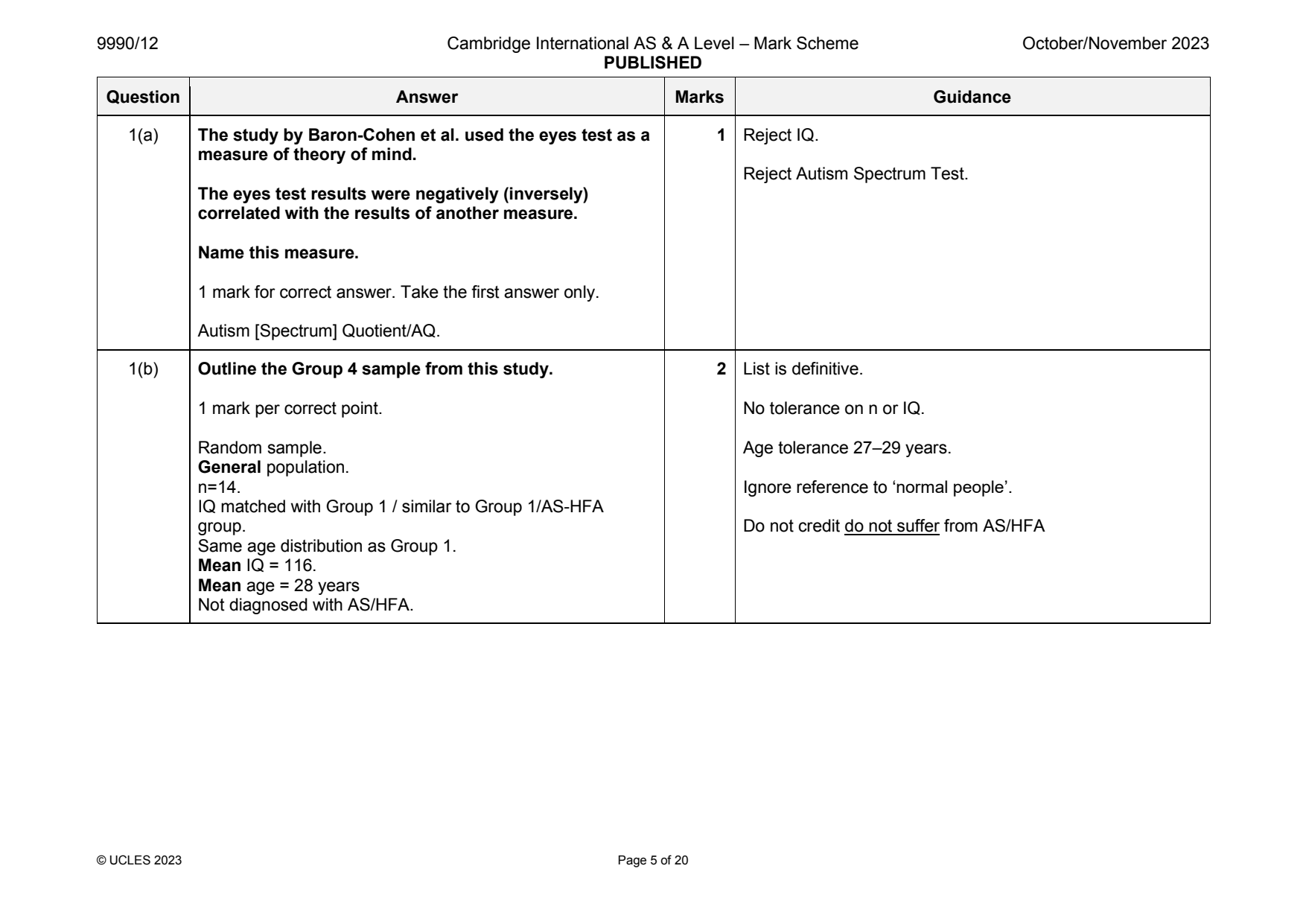
1(a) The study by Baron-Cohen et al. used the eyes test as a 1 Reject IQ.
measure of theory of mind.
Reject Autism Spectrum Test.
The eyes test results were negatively (inversely)
correlated with the results of another measure.
Name this measure.
1 mark for correct answer. Take the first answer only.
Autism [Spectrum] Quotient/AQ.
1(b) Outline the Group 4 sample from this study. 2 List is definitive.
1 mark per correct point. No tolerance on n or IQ.
Random sample. Age tolerance 27–29 years.
General population.
n=14. Ignore reference to ‘normal people’.
IQ matched with Group 1 / similar to Group 1/AS-HFA
group. Do not credit do not suffer from AS/HFA
Same age distribution as Group 1.
Mean IQ = 116.
Mean age = 28 years
Not diagnosed with AS/HFA.
© UCLES 2023 Page 5 of 20
Official mark scheme pages: 5 · source PDF URL
9990-2023-on-12-q06
Oct/Nov 2023 · Paper 12 · Question 6 · 6 marks
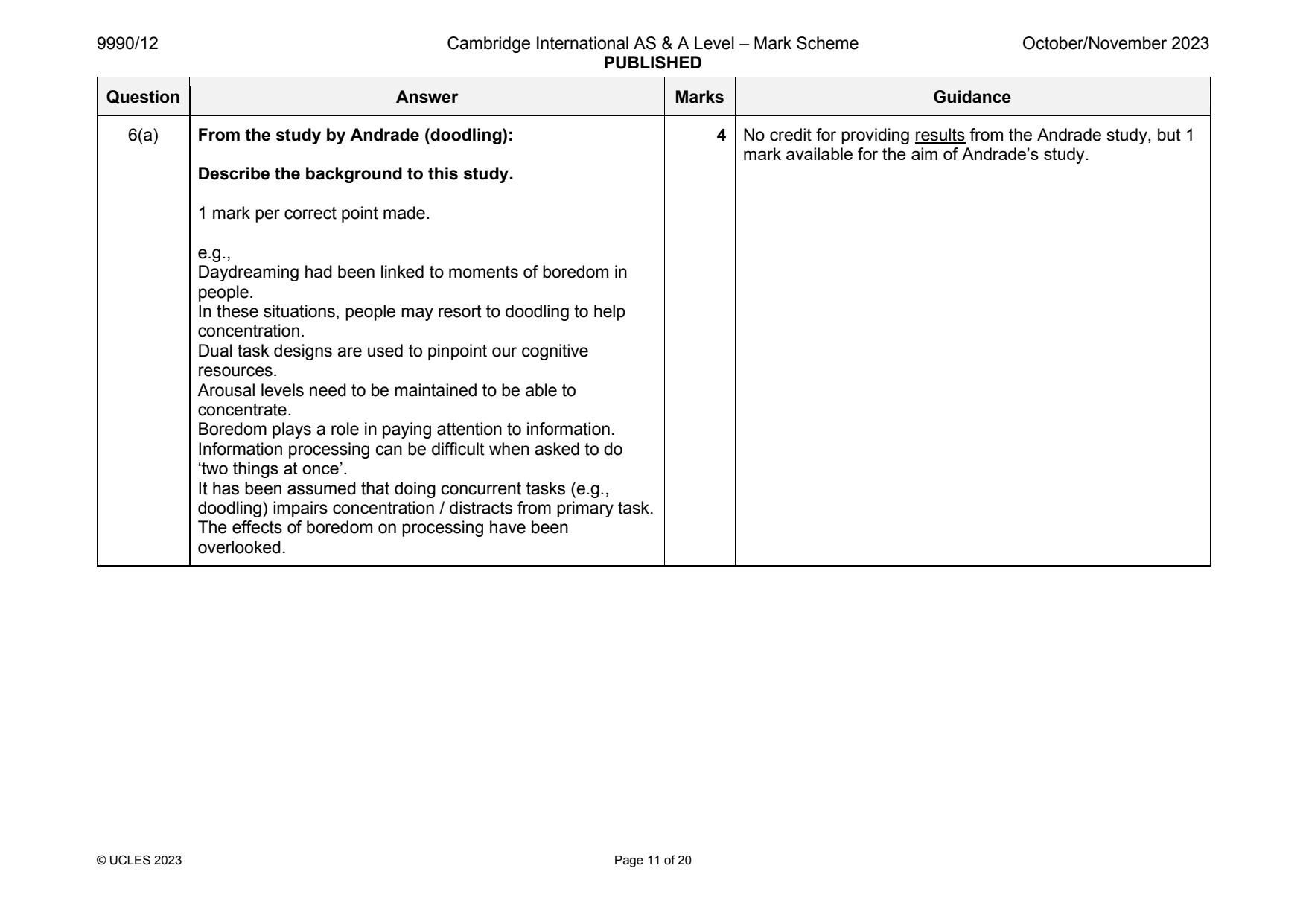
6(a) From the study by Andrade (doodling): 4 No credit for providing results from the Andrade study, but 1
mark available for the aim of Andrade’s study.
Describe the background to this study.
1 mark per correct point made.
e.g.,
Daydreaming had been linked to moments of boredom in
people.
In these situations, people may resort to doodling to help
concentration.
Dual task designs are used to pinpoint our cognitive
resources.
Arousal levels need to be maintained to be able to
concentrate.
Boredom plays a role in paying attention to information.
Information processing can be difficult when asked to do
‘two things at once’.
It has been assumed that doing concurrent tasks (e.g.,
doodling) impairs concentration / distracts from primary task.
The effects of boredom on processing have been
overlooked.
© UCLES 2023 Page 11 of 20
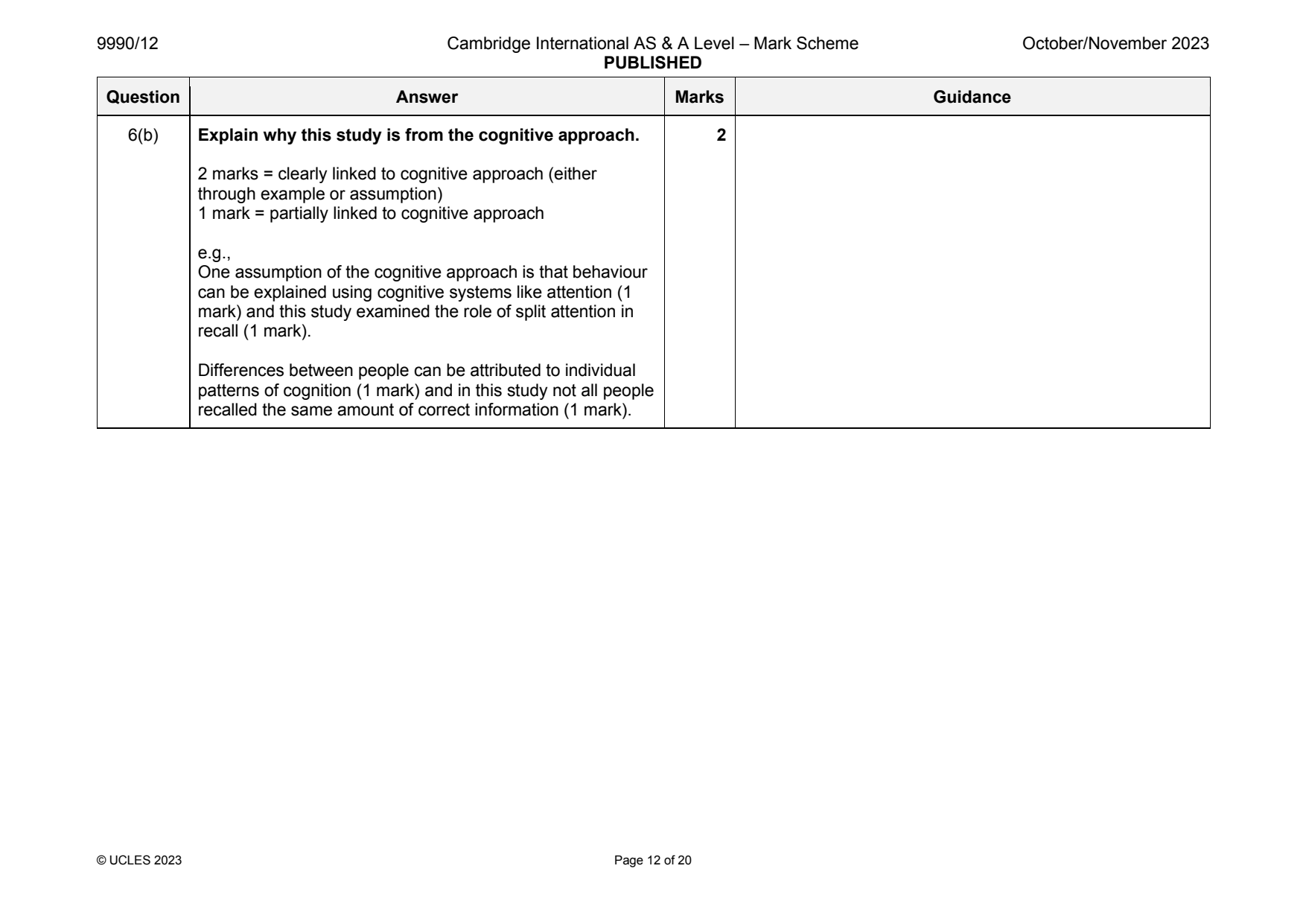
6(b) Explain why this study is from the cognitive approach. 2
2 marks = clearly linked to cognitive approach (either
through example or assumption)
1 mark = partially linked to cognitive approach
e.g.,
One assumption of the cognitive approach is that behaviour
can be explained using cognitive systems like attention (1
mark) and this study examined the role of split attention in
recall (1 mark).
Differences between people can be attributed to individual
patterns of cognition (1 mark) and in this study not all people
recalled the same amount of correct information (1 mark).
© UCLES 2023 Page 12 of 20
Official mark scheme pages: 11, 12 · source PDF URL
9990-2023-on-13-q03
Oct/Nov 2023 · Paper 13 · Question 3 · 3 marks
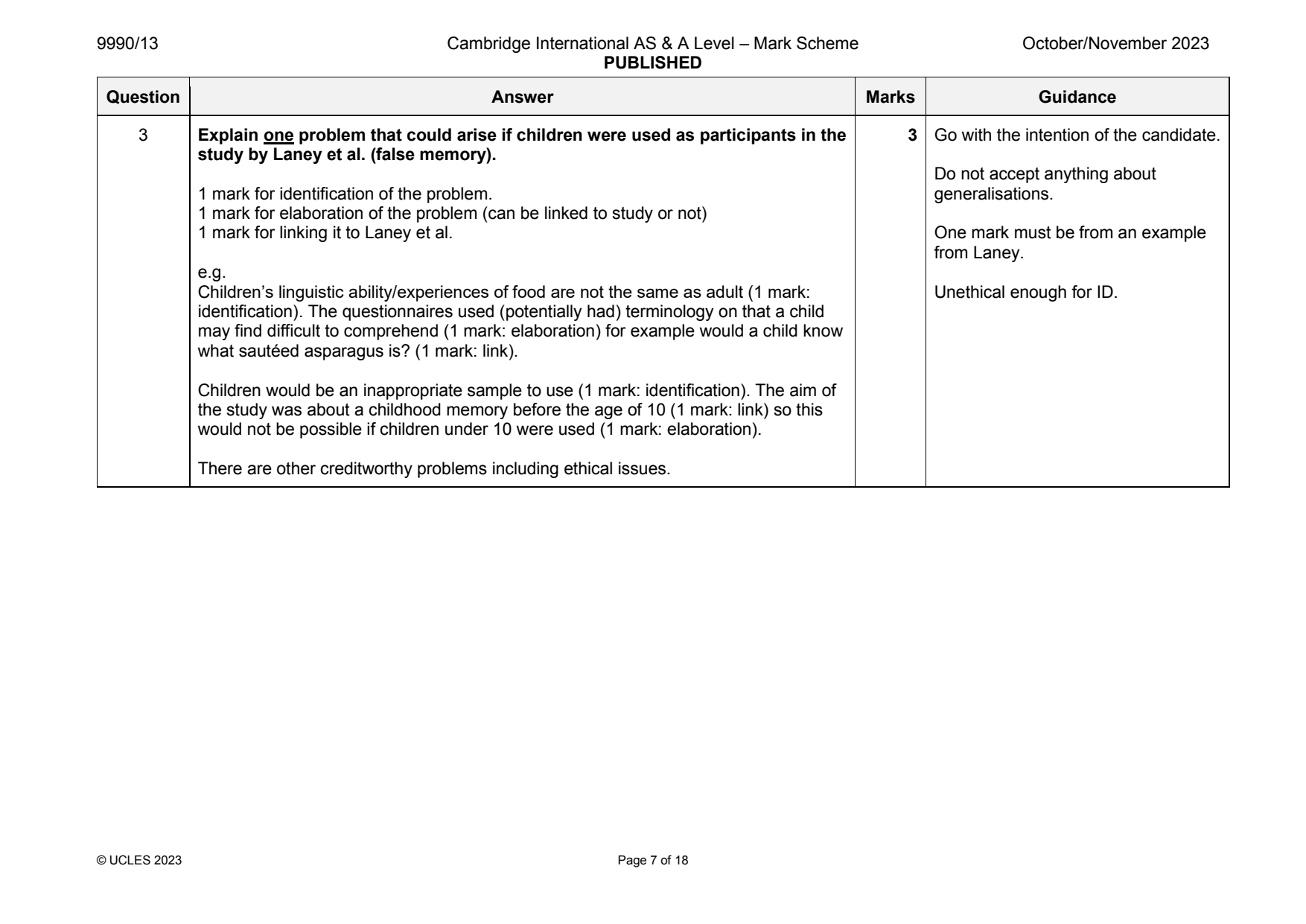
3 Explain one problem that could arise if children were used as participants in the 3 Go with the intention of the candidate.
study by Laney et al. (false memory).
Do not accept anything about
1 mark for identification of the problem. generalisations.
1 mark for elaboration of the problem (can be linked to study or not)
1 mark for linking it to Laney et al. One mark must be from an example
from Laney.
e.g.
Children’s linguistic ability/experiences of food are not the same as adult (1 mark: Unethical enough for ID.
identification). The questionnaires used (potentially had) terminology on that a child
may find difficult to comprehend (1 mark: elaboration) for example would a child know
what sautéed asparagus is? (1 mark: link).
Children would be an inappropriate sample to use (1 mark: identification). The aim of
the study was about a childhood memory before the age of 10 (1 mark: link) so this
would not be possible if children under 10 were used (1 mark: elaboration).
There are other creditworthy problems including ethical issues.
© UCLES 2023 Page 7 of 18
Official mark scheme pages: 7 · source PDF URL
9990-2023-on-13-q05
Oct/Nov 2023 · Paper 13 · Question 5 · 6 marks
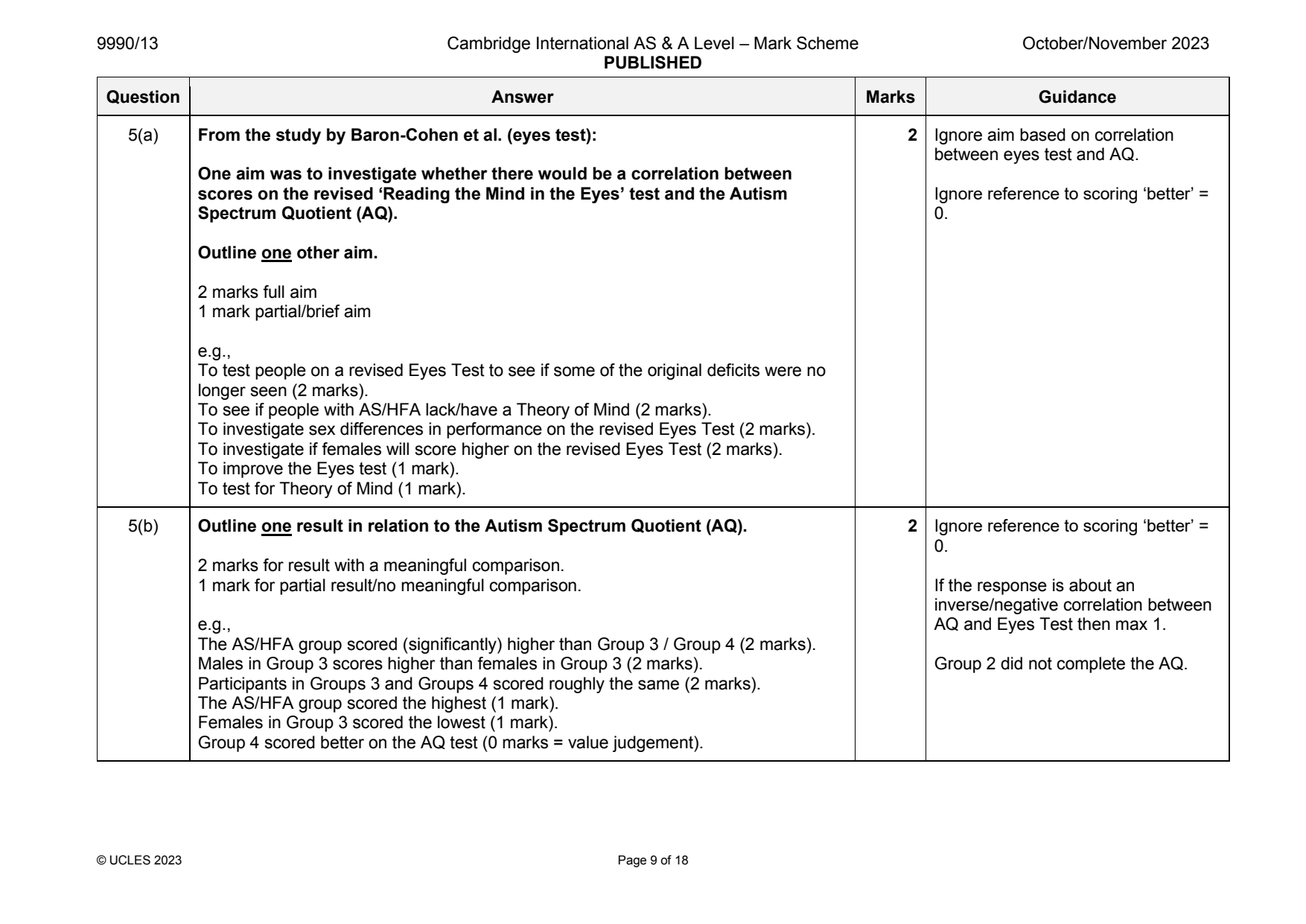
5(a) From the study by Baron-Cohen et al. (eyes test): 2 Ignore aim based on correlation
between eyes test and AQ.
One aim was to investigate whether there would be a correlation between
scores on the revised ‘Reading the Mind in the Eyes’ test and the Autism Ignore reference to scoring ‘better’ =
Spectrum Quotient (AQ). 0.
Outline one other aim.
2 marks full aim
1 mark partial/brief aim
e.g.,
To test people on a revised Eyes Test to see if some of the original deficits were no
longer seen (2 marks).
To see if people with AS/HFA lack/have a Theory of Mind (2 marks).
To investigate sex differences in performance on the revised Eyes Test (2 marks).
To investigate if females will score higher on the revised Eyes Test (2 marks).
To improve the Eyes test (1 mark).
To test for Theory of Mind (1 mark).
5(b) Outline one result in relation to the Autism Spectrum Quotient (AQ). 2 Ignore reference to scoring ‘better’ =
0.
2 marks for result with a meaningful comparison.
1 mark for partial result/no meaningful comparison. If the response is about an
inverse/negative correlation between
e.g., AQ and Eyes Test then max 1.
The AS/HFA group scored (significantly) higher than Group 3 / Group 4 (2 marks).
Males in Group 3 scores higher than females in Group 3 (2 marks). Group 2 did not complete the AQ.
Participants in Groups 3 and Groups 4 scored roughly the same (2 marks).
The AS/HFA group scored the highest (1 mark).
Females in Group 3 scored the lowest (1 mark).
Group 4 scored better on the AQ test (0 marks = value judgement).
© UCLES 2023 Page 9 of 18
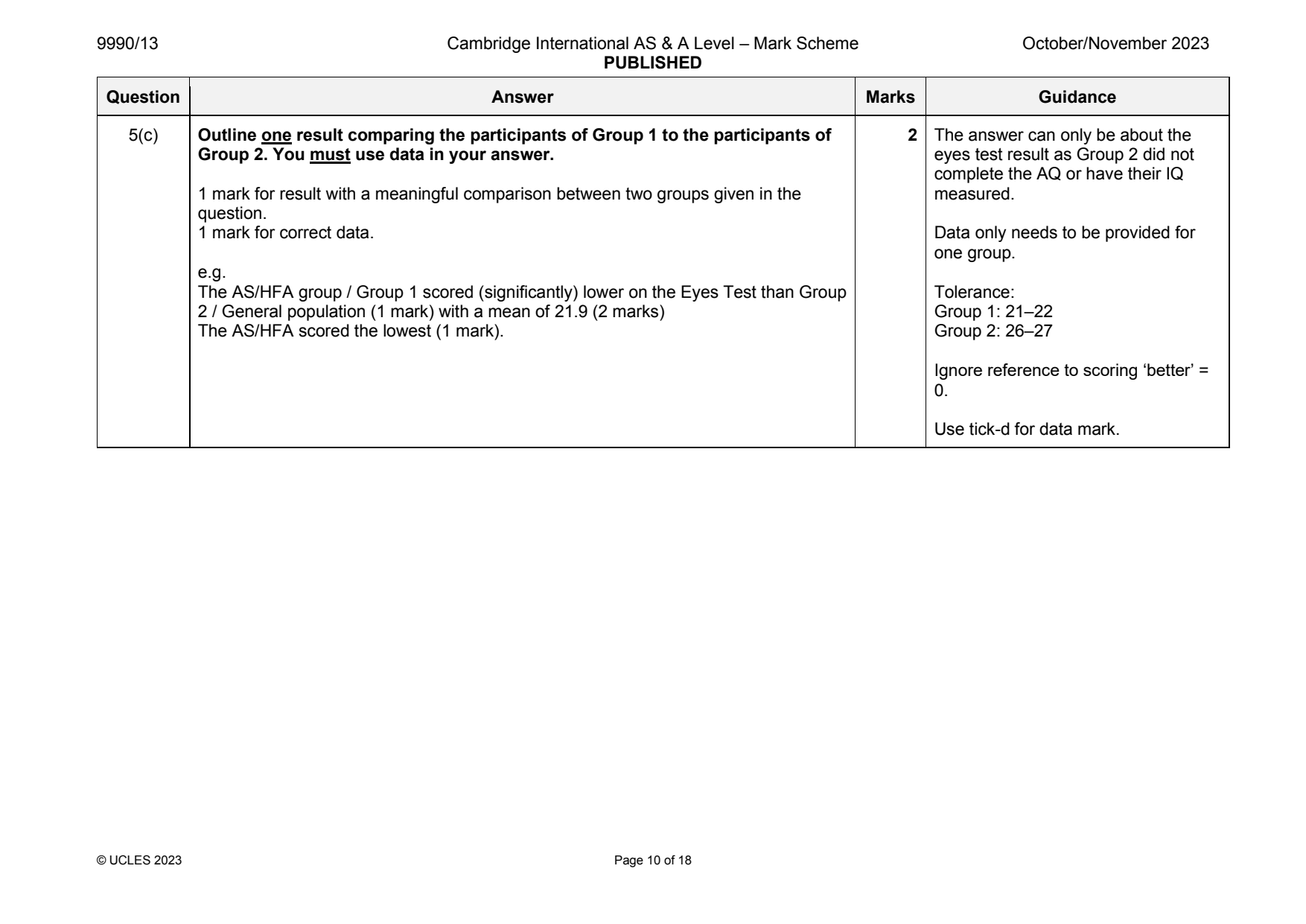
5(c) Outline one result comparing the participants of Group 1 to the participants of 2 The answer can only be about the
Group 2. You must use data in your answer. eyes test result as Group 2 did not
complete the AQ or have their IQ
1 mark for result with a meaningful comparison between two groups given in the measured.
question.
1 mark for correct data. Data only needs to be provided for
one group.
e.g.
The AS/HFA group / Group 1 scored (significantly) lower on the Eyes Test than Group Tolerance:
2 / General population (1 mark) with a mean of 21.9 (2 marks) Group 1: 21–22
The AS/HFA scored the lowest (1 mark). Group 2: 26–27
Ignore reference to scoring ‘better’ =
0.
Use tick-d for data mark.
© UCLES 2023 Page 10 of 18
Official mark scheme pages: 9, 10 · source PDF URL
9990-2023-on-13-q08
Oct/Nov 2023 · Paper 13 · Question 8 · 6 marks
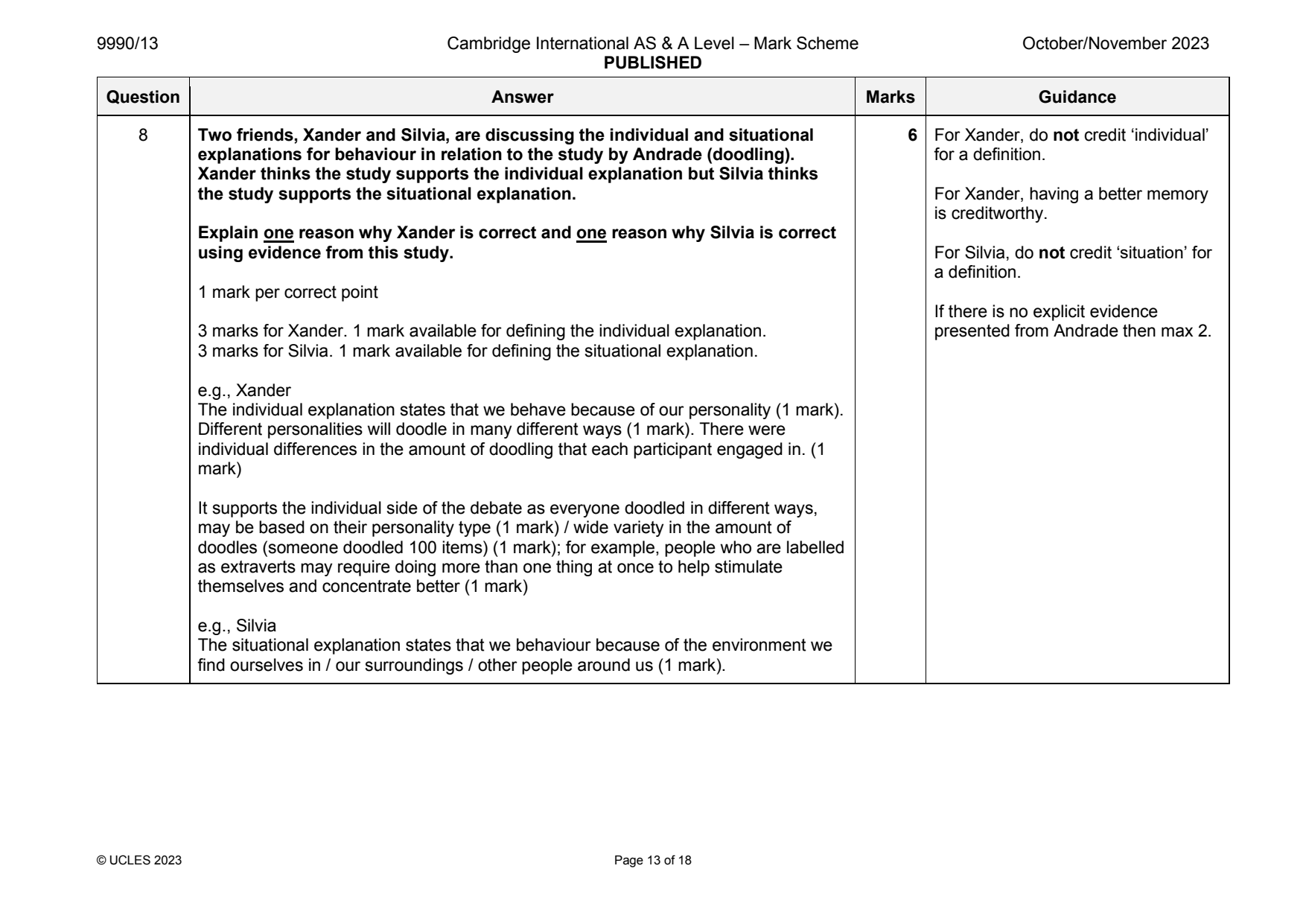
8 Two friends, Xander and Silvia, are discussing the individual and situational 6 For Xander, do not credit ‘individual’
explanations for behaviour in relation to the study by Andrade (doodling). for a definition.
Xander thinks the study supports the individual explanation but Silvia thinks
the study supports the situational explanation. For Xander, having a better memory
is creditworthy.
Explain one reason why Xander is correct and one reason why Silvia is correct
using evidence from this study. For Silvia, do not credit ‘situation’ for
a definition.
1 mark per correct point
If there is no explicit evidence
3 marks for Xander. 1 mark available for defining the individual explanation. presented from Andrade then max 2.
3 marks for Silvia. 1 mark available for defining the situational explanation.
e.g., Xander
The individual explanation states that we behave because of our personality (1 mark).
Different personalities will doodle in many different ways (1 mark). There were
individual differences in the amount of doodling that each participant engaged in. (1
mark)
It supports the individual side of the debate as everyone doodled in different ways,
may be based on their personality type (1 mark) / wide variety in the amount of
doodles (someone doodled 100 items) (1 mark); for example, people who are labelled
as extraverts may require doing more than one thing at once to help stimulate
themselves and concentrate better (1 mark)
e.g., Silvia
The situational explanation states that we behaviour because of the environment we
find ourselves in / our surroundings / other people around us (1 mark).
© UCLES 2023 Page 13 of 18
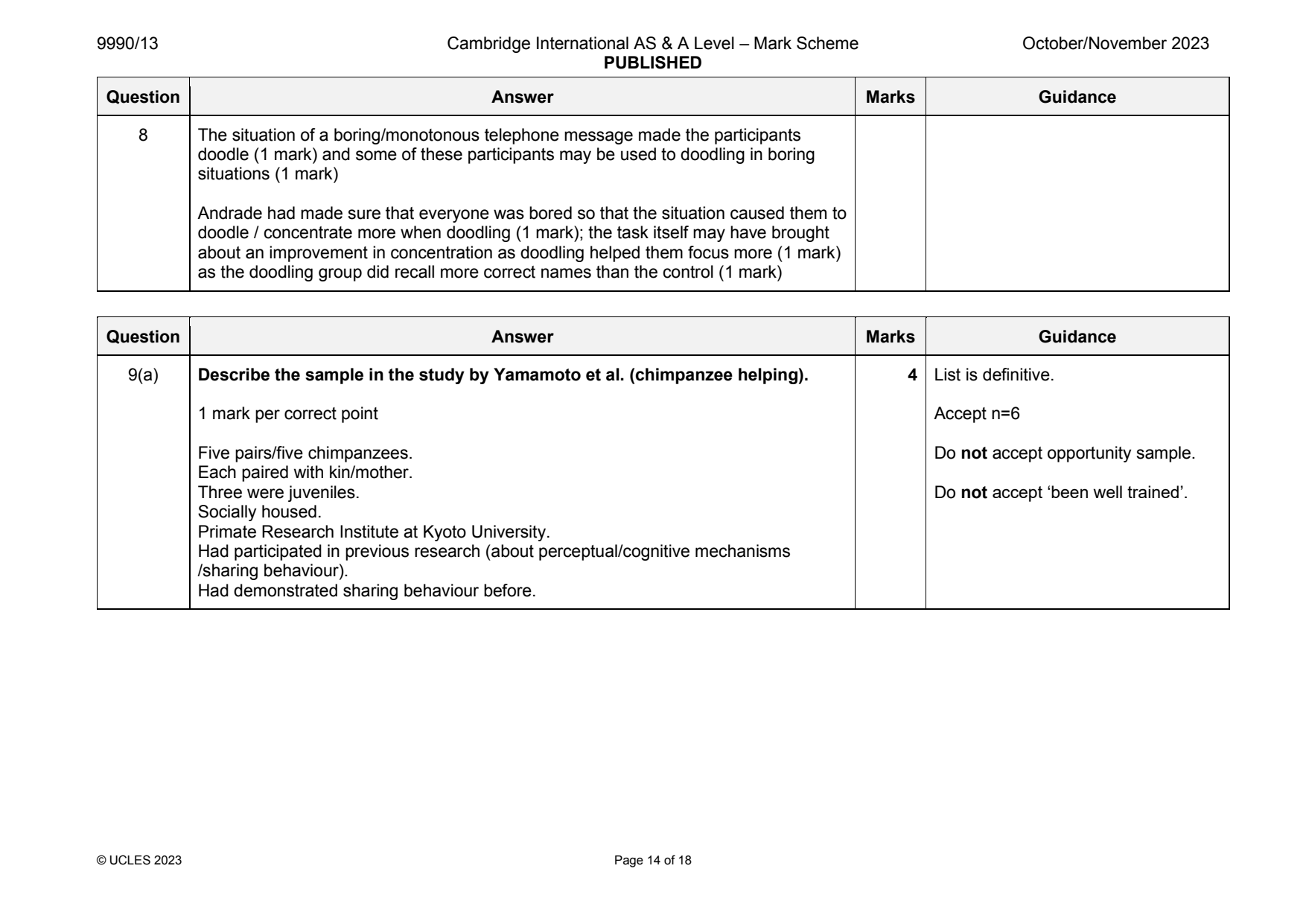
8 The situation of a boring/monotonous telephone message made the participants
doodle (1 mark) and some of these participants may be used to doodling in boring
situations (1 mark)
Andrade had made sure that everyone was bored so that the situation caused them to
doodle / concentrate more when doodling (1 mark); the task itself may have brought
about an improvement in concentration as doodling helped them focus more (1 mark)
as the doodling group did recall more correct names than the control (1 mark)
Question Answer Marks Guidance
Official mark scheme pages: 13, 14 · source PDF URL
9990-2024-m-12-q01
March 2024 · Paper 12 · Question 1 · 5 marks
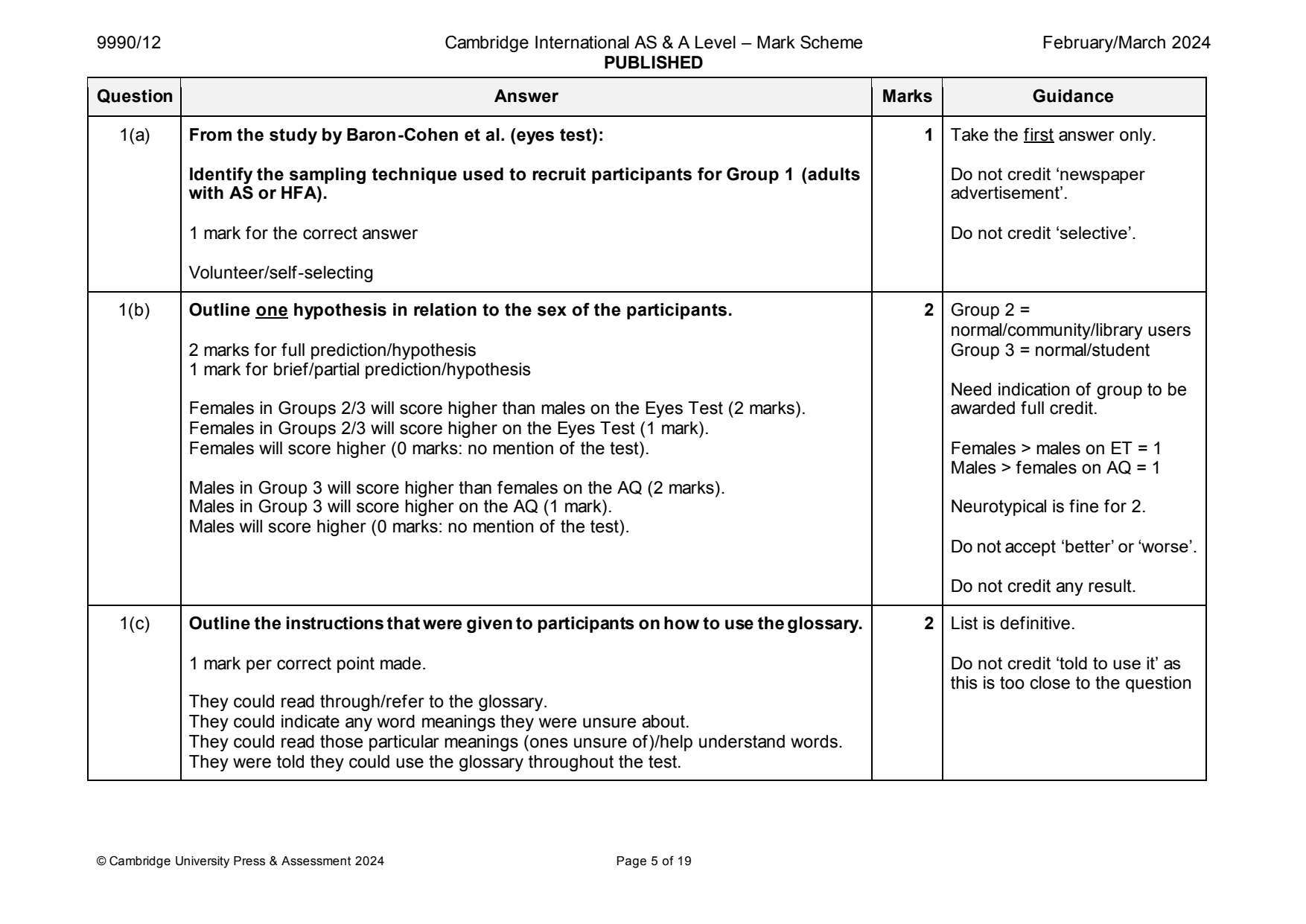
1(a) From the study by Baron-Cohen et al. (eyes test): 1 Take the first answer only.
Identify the sampling technique used to recruit participants for Group 1 (adults Do not credit ‘newspaper
with AS or HFA). advertisement’.
1 mark for the correct answer Do not credit ‘selective’.
Volunteer/self-selecting
1(b) Outline one hypothesis in relation to the sex of the participants. 2 Group 2 =
normal/community/library users
2 marks for full prediction/hypothesis Group 3 = normal/student
1 mark for brief/partial prediction/hypothesis
Need indication of group to be
Females in Groups 2/3 will score higher than males on the Eyes Test (2 marks). awarded full credit.
Females in Groups 2/3 will score higher on the Eyes Test (1 mark).
Females will score higher (0 marks: no mention of the test). Females > males on ET = 1
Males > females on AQ = 1
Males in Group 3 will score higher than females on the AQ (2 marks).
Males in Group 3 will score higher on the AQ (1 mark). Neurotypical is fine for 2.
Males will score higher (0 marks: no mention of the test).
Do not accept ‘better’ or ‘worse’.
Do not credit any result.
1(c) Outline the instructions that were given to participants on how to use the glossary. 2 List is definitive.
1 mark per correct point made. Do not credit ‘told to use it’ as
this is too close to the question
They could read through/refer to the glossary.
They could indicate any word meanings they were unsure about.
They could read those particular meanings (ones unsure of)/help understand words.
They were told they could use the glossary throughout the test.
© Cambridge University Press & Assessment 2024 Page 5 of 19
Official mark scheme pages: 5 · source PDF URL
9990-2024-m-12-q05
March 2024 · Paper 12 · Question 5 · 6 marks
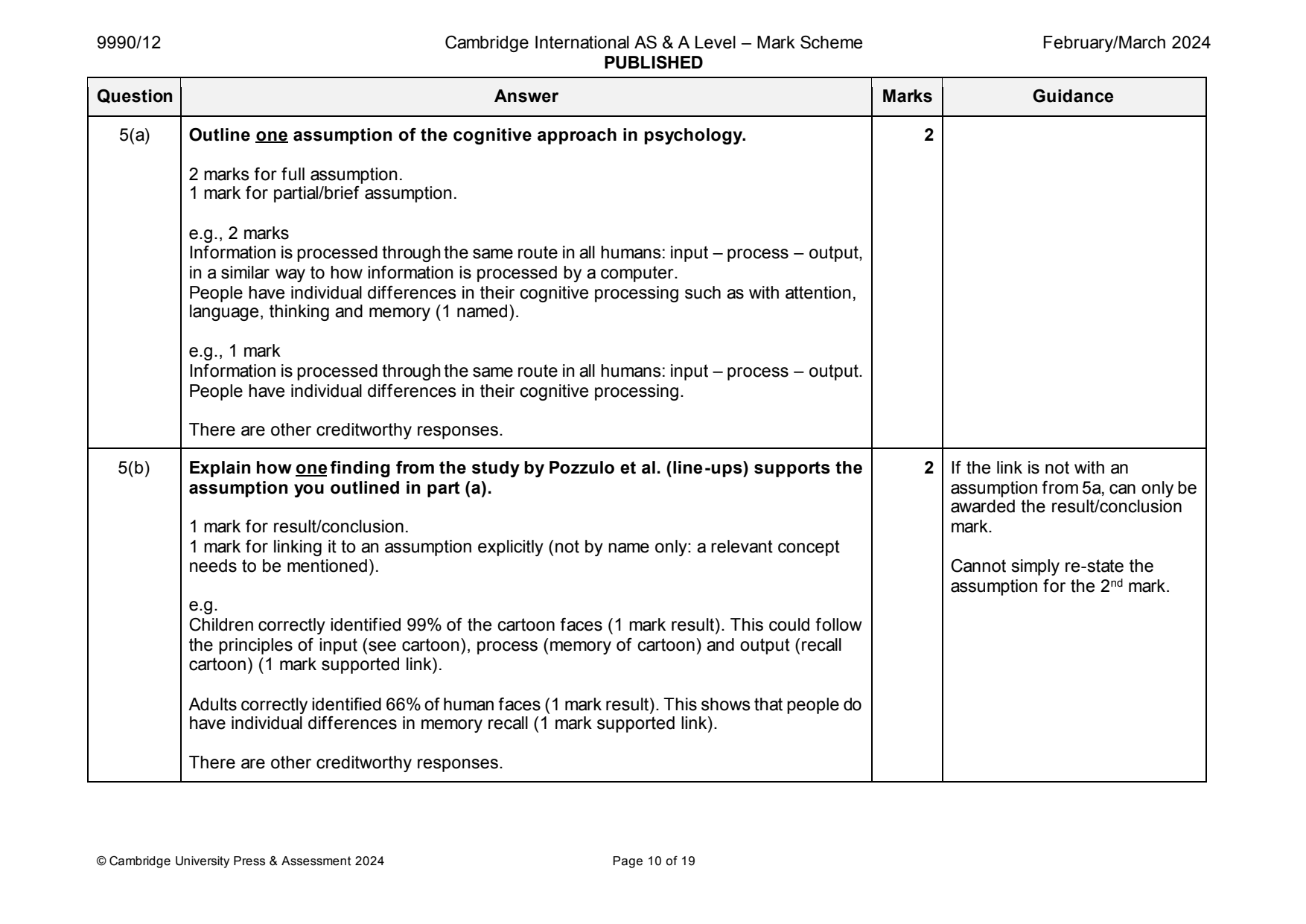
5(a) Outline one assumption of the cognitive approach in psychology. 2
2 marks for full assumption.
1 mark for partial/brief assumption.
e.g., 2 marks
Information is processed through the same route in all humans: input – process – output,
in a similar way to how information is processed by a computer.
People have individual differences in their cognitive processing such as with attention,
language, thinking and memory (1 named).
e.g., 1 mark
Information is processed through the same route in all humans: input – process – output.
People have individual differences in their cognitive processing.
There are other creditworthy responses.
5(b) Explain how one finding from the study by Pozzulo et al. (line-ups) supports the 2 If the link is not with an
assumption you outlined in part (a). assumption from 5a, can only be
awarded the result/conclusion
1 mark for result/conclusion. mark.
1 mark for linking it to an assumption explicitly (not by name only: a relevant concept
needs to be mentioned). Cannot simply re-state the
assumption for the 2nd mark.
e.g.
Children correctly identified 99% of the cartoon faces (1 mark result). This could follow
the principles of input (see cartoon), process (memory of cartoon) and output (recall
cartoon) (1 mark supported link).
Adults correctly identified 66% of human faces (1 mark result). This shows that people do
have individual differences in memory recall (1 mark supported link).
There are other creditworthy responses.
© Cambridge University Press & Assessment 2024 Page 10 of 19
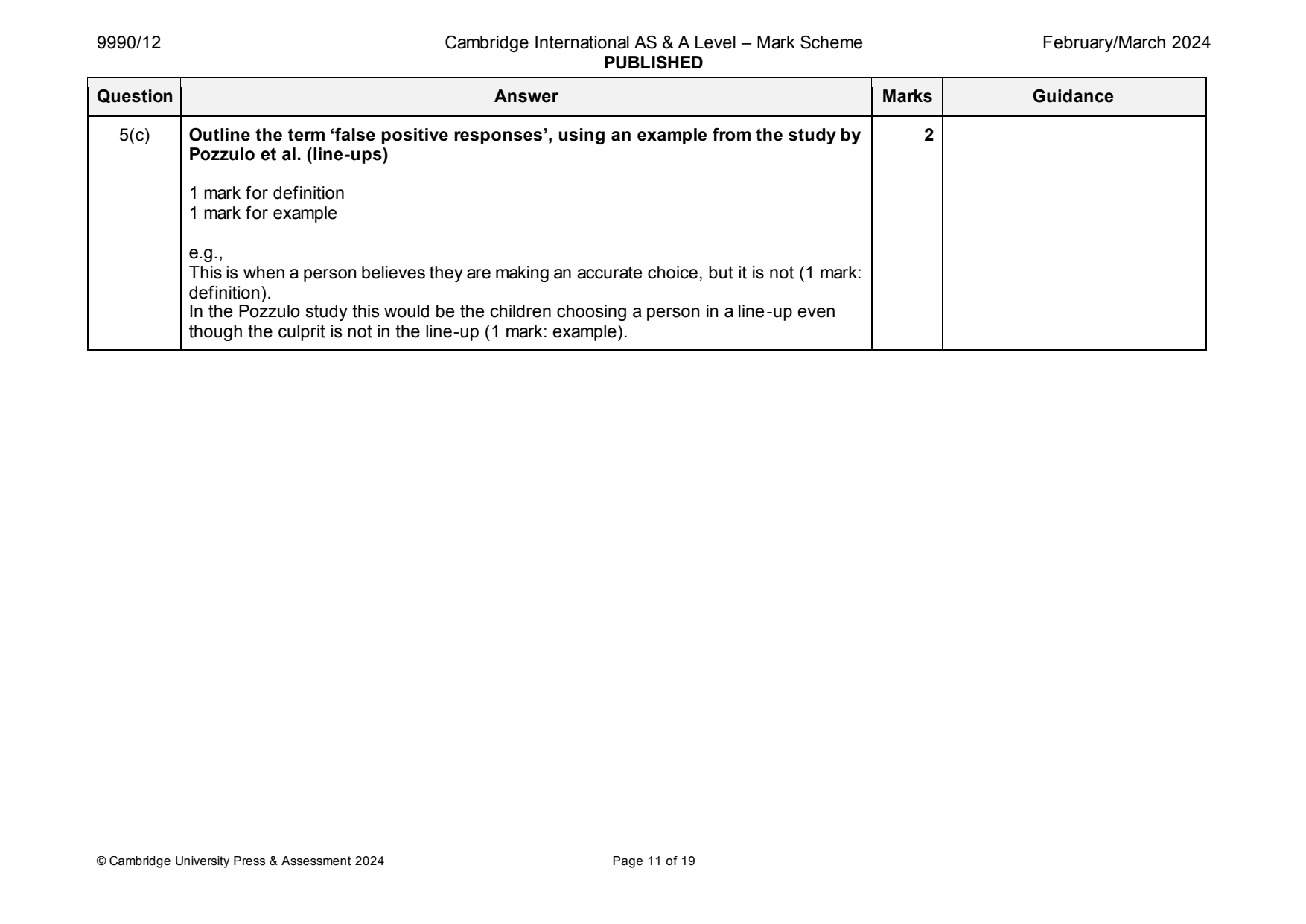
5(c) Outline the term ‘false positive responses’, using an example from the study by 2
Pozzulo et al. (line-ups)
1 mark for definition
1 mark for example
e.g.,
This is when a person believes they are making an accurate choice, but it is not (1 mark:
definition).
In the Pozzulo study this would be the children choosing a person in a line-up even
though the culprit is not in the line-up (1 mark: example).
© Cambridge University Press & Assessment 2024 Page 11 of 19
Official mark scheme pages: 10, 11 · source PDF URL
9990-2024-m-12-q09
March 2024 · Paper 12 · Question 9 · 12 marks
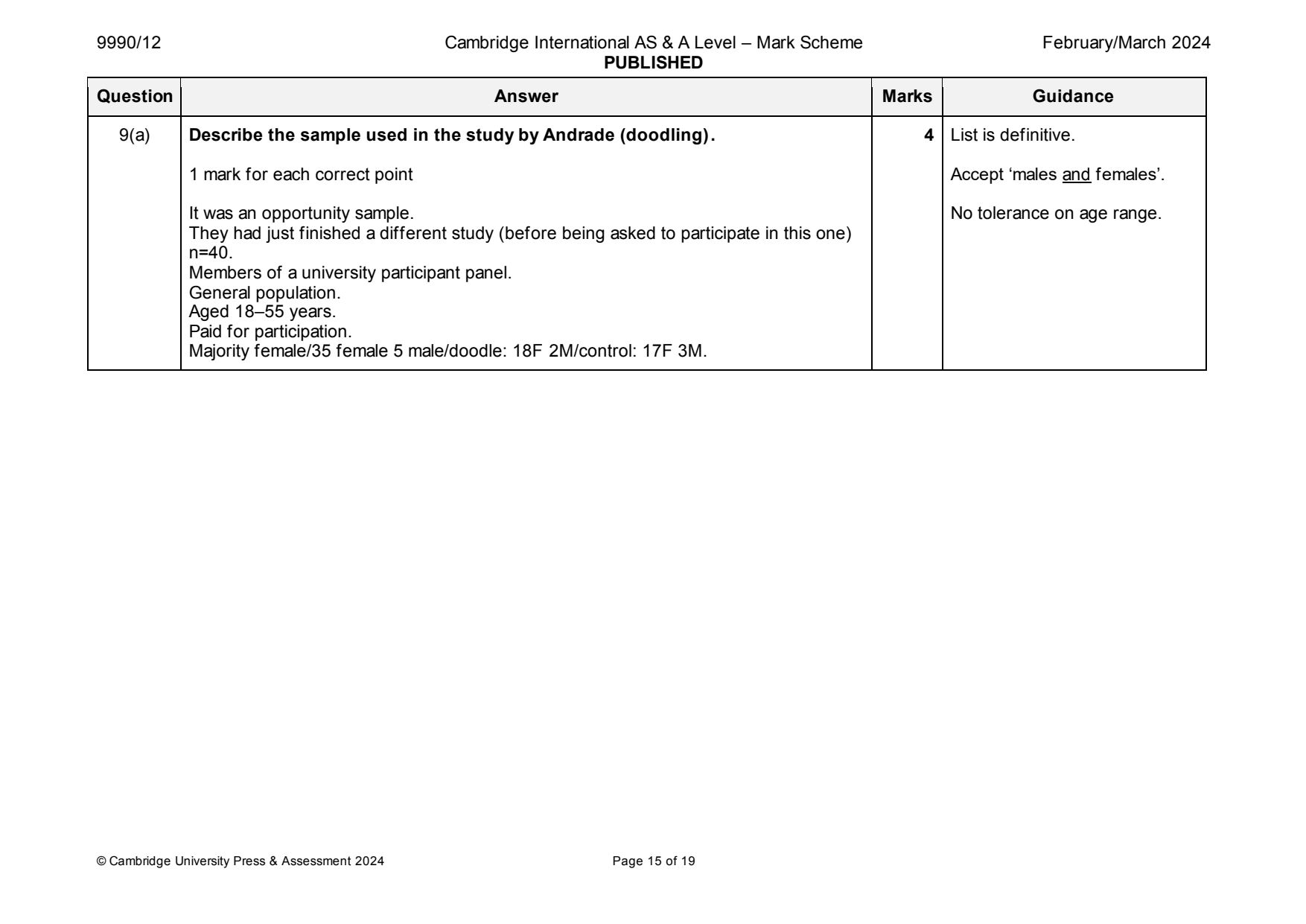
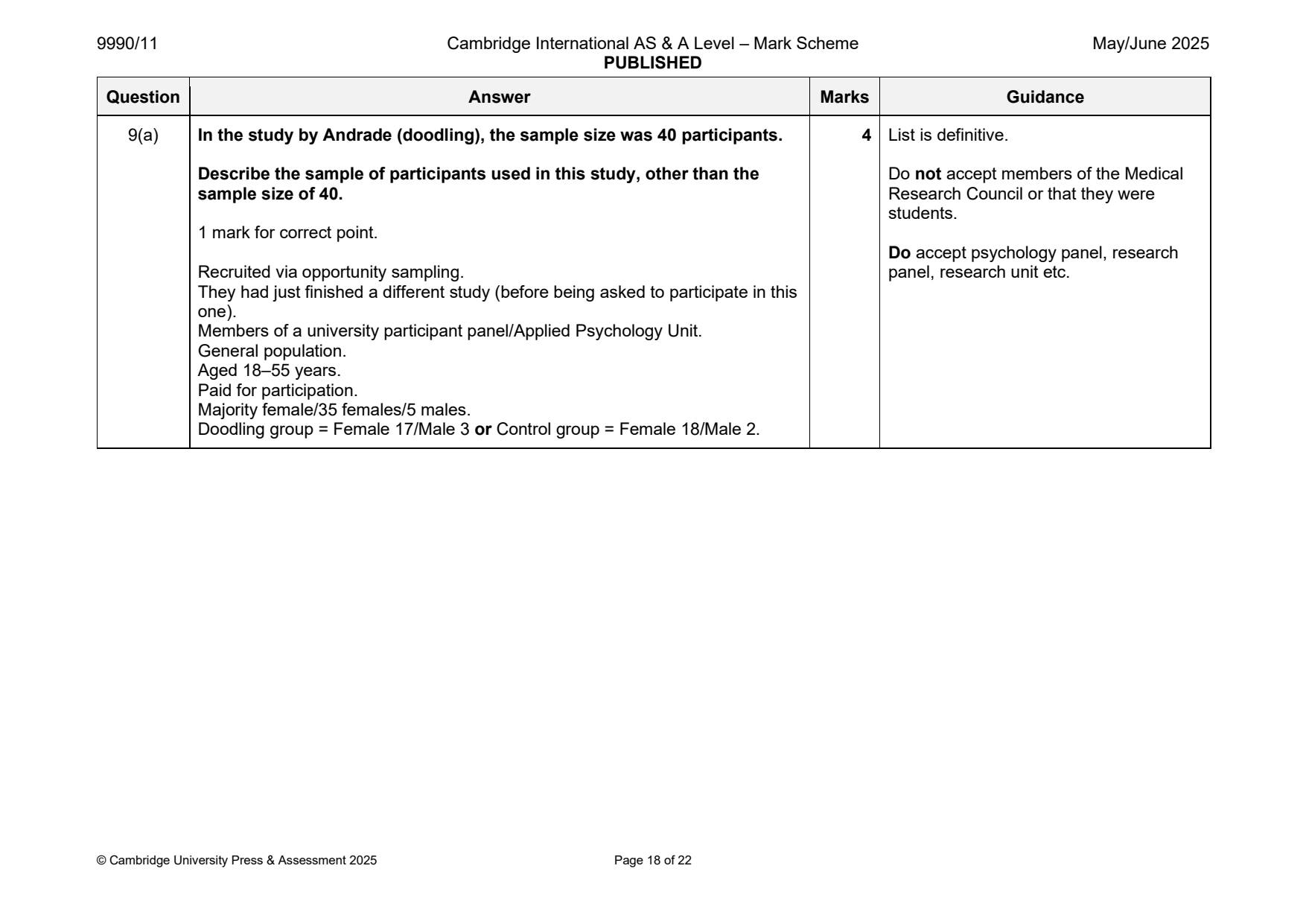
9(a) Describe the sample used in the study by Andrade (doodling). 4 List is definitive.
1 mark for each correct point Accept ‘males and females’.
It was an opportunity sample. No tolerance on age range.
They had just finished a different study (before being asked to participate in this one)
n=40.
Members of a university participant panel.
General population.
Aged 18–55 years.
Paid for participation.
Majority female/35 female 5 male/doodle: 18F 2M/control: 17F 3M.
© Cambridge University Press & Assessment 2024 Page 15 of 19
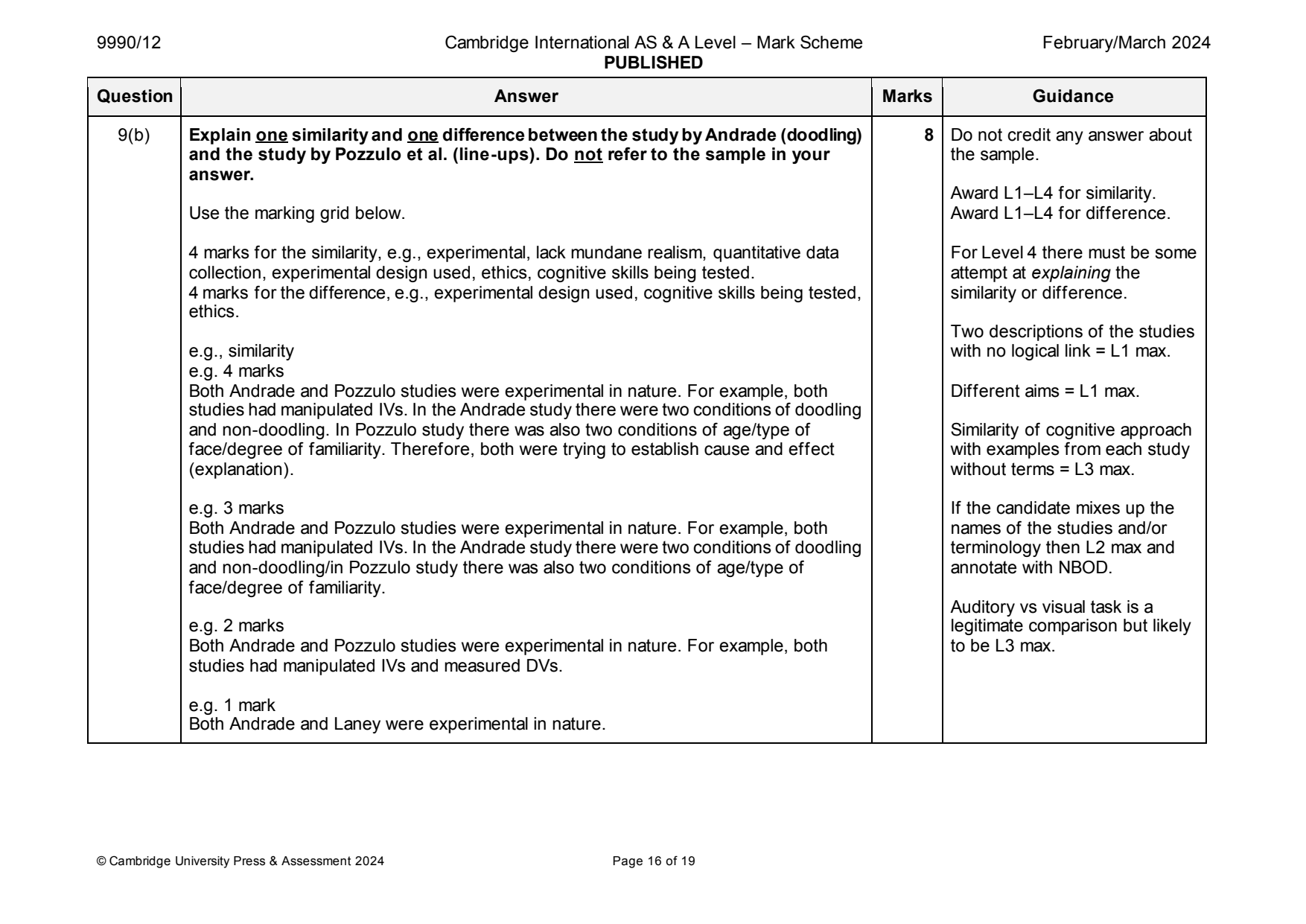
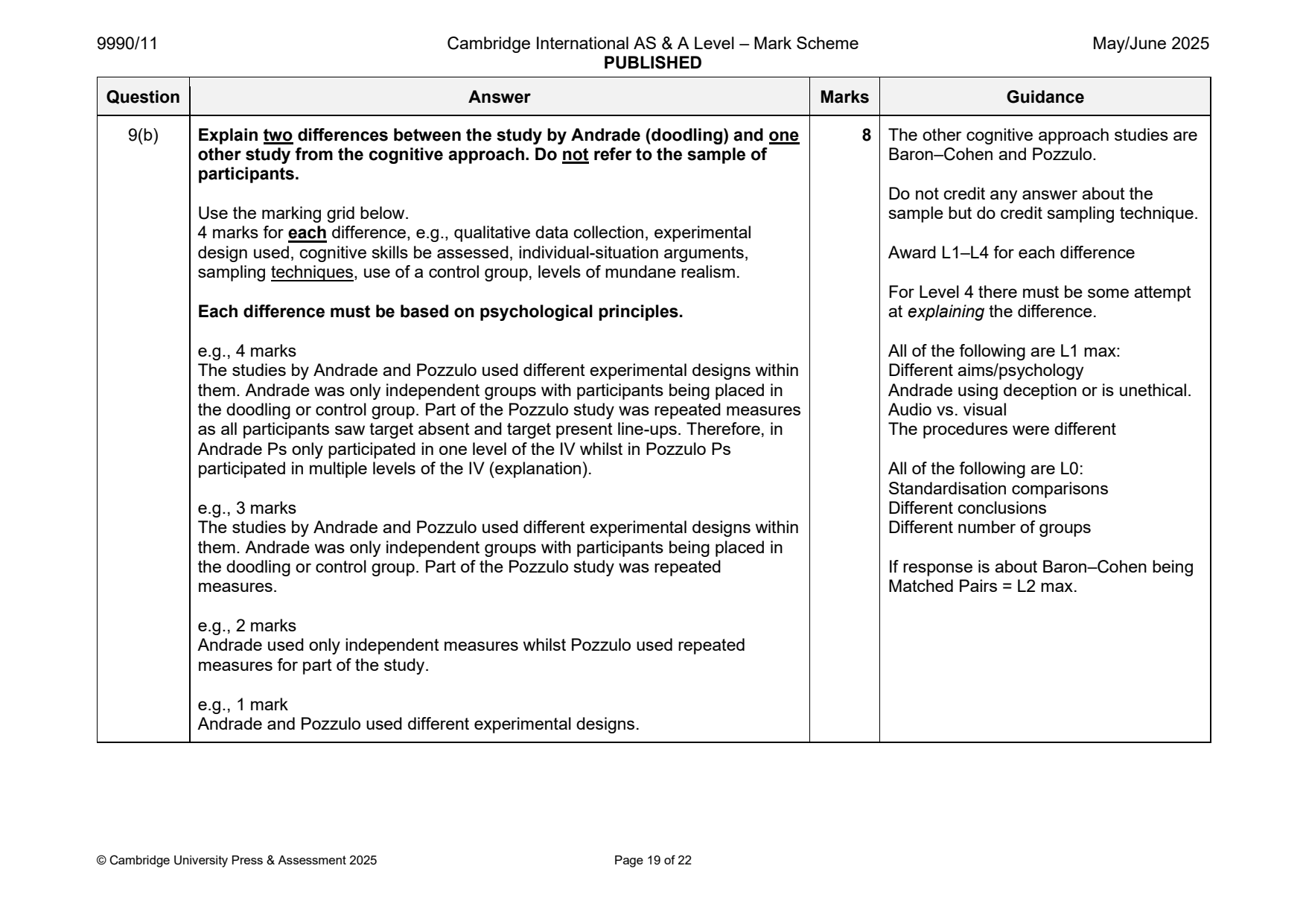
9(b) Explain one similarity and one difference between the study by Andrade (doodling) 8 Do not credit any answer about
and the study by Pozzulo et al. (line-ups). Do not refer to the sample in your the sample.
answer.
Award L1–L4 for similarity.
Use the marking grid below. Award L1–L4 for difference.
4 marks for the similarity, e.g., experimental, lack mundane realism, quantitative data For Level 4 there must be some
collection, experimental design used, ethics, cognitive skills being tested. attempt at explaining the
4 marks for the difference, e.g., experimental design used, cognitive skills being tested, similarity or difference.
ethics.
Two descriptions of the studies
e.g., similarity with no logical link = L1 max.
e.g. 4 marks
Both Andrade and Pozzulo studies were experimental in nature. For example, both Different aims = L1 max.
studies had manipulated IVs. In the Andrade study there were two conditions of doodling
and non-doodling. In Pozzulo study there was also two conditions of age/type of Similarity of cognitive approach
face/degree of familiarity. Therefore, both were trying to establish cause and effect with examples from each study
(explanation). without terms = L3 max.
e.g. 3 marks If the candidate mixes up the
Both Andrade and Pozzulo studies were experimental in nature. For example, both names of the studies and/or
studies had manipulated IVs. In the Andrade study there were two conditions of doodling terminology then L2 max and
and non-doodling/in Pozzulo study there was also two conditions of age/type of annotate with NBOD.
face/degree of familiarity.
Auditory vs visual task is a
e.g. 2 marks legitimate comparison but likely
Both Andrade and Pozzulo studies were experimental in nature. For example, both to be L3 max.
studies had manipulated IVs and measured DVs.
e.g. 1 mark
Both Andrade and Laney were experimental in nature.
© Cambridge University Press & Assessment 2024 Page 16 of 19
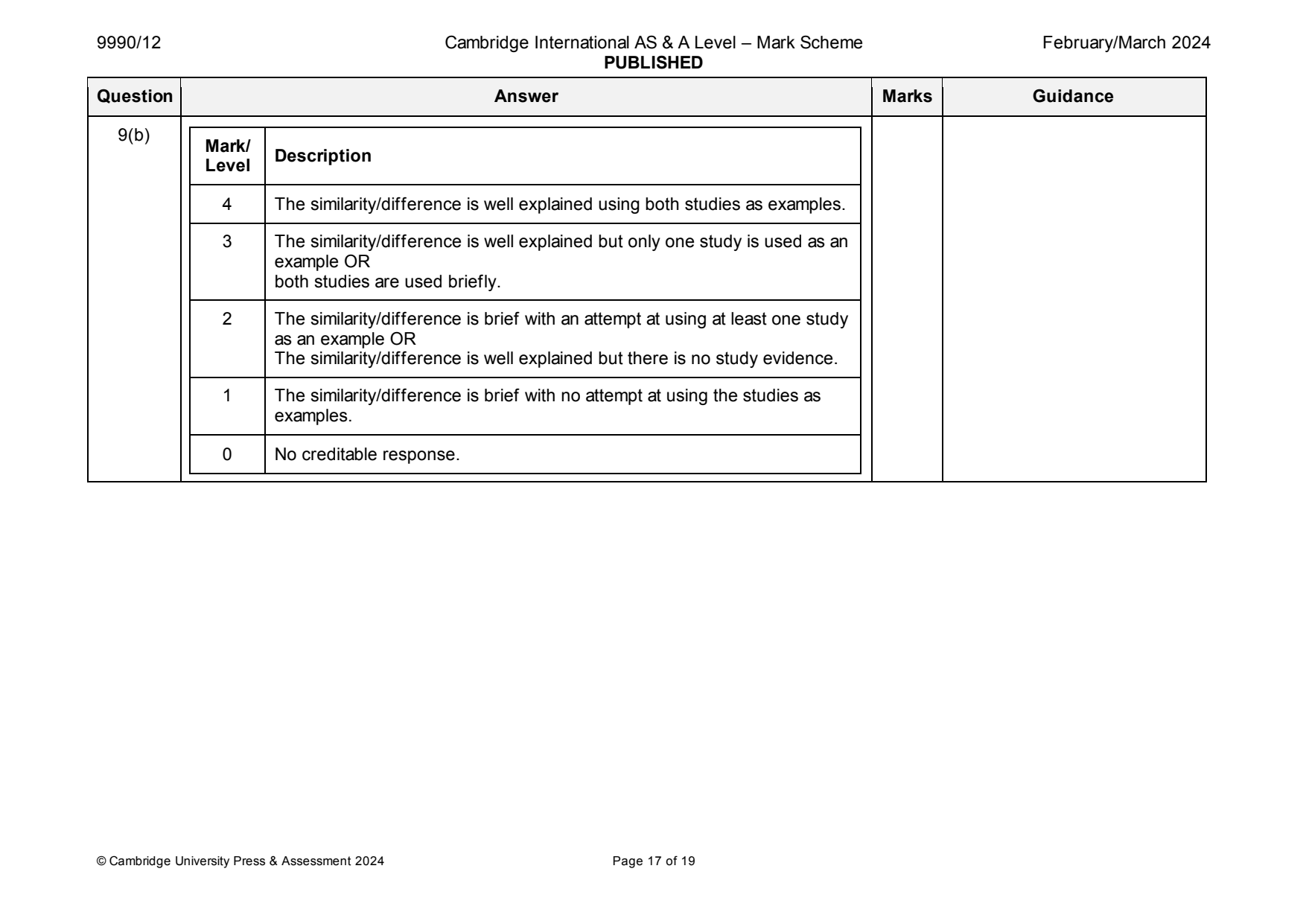
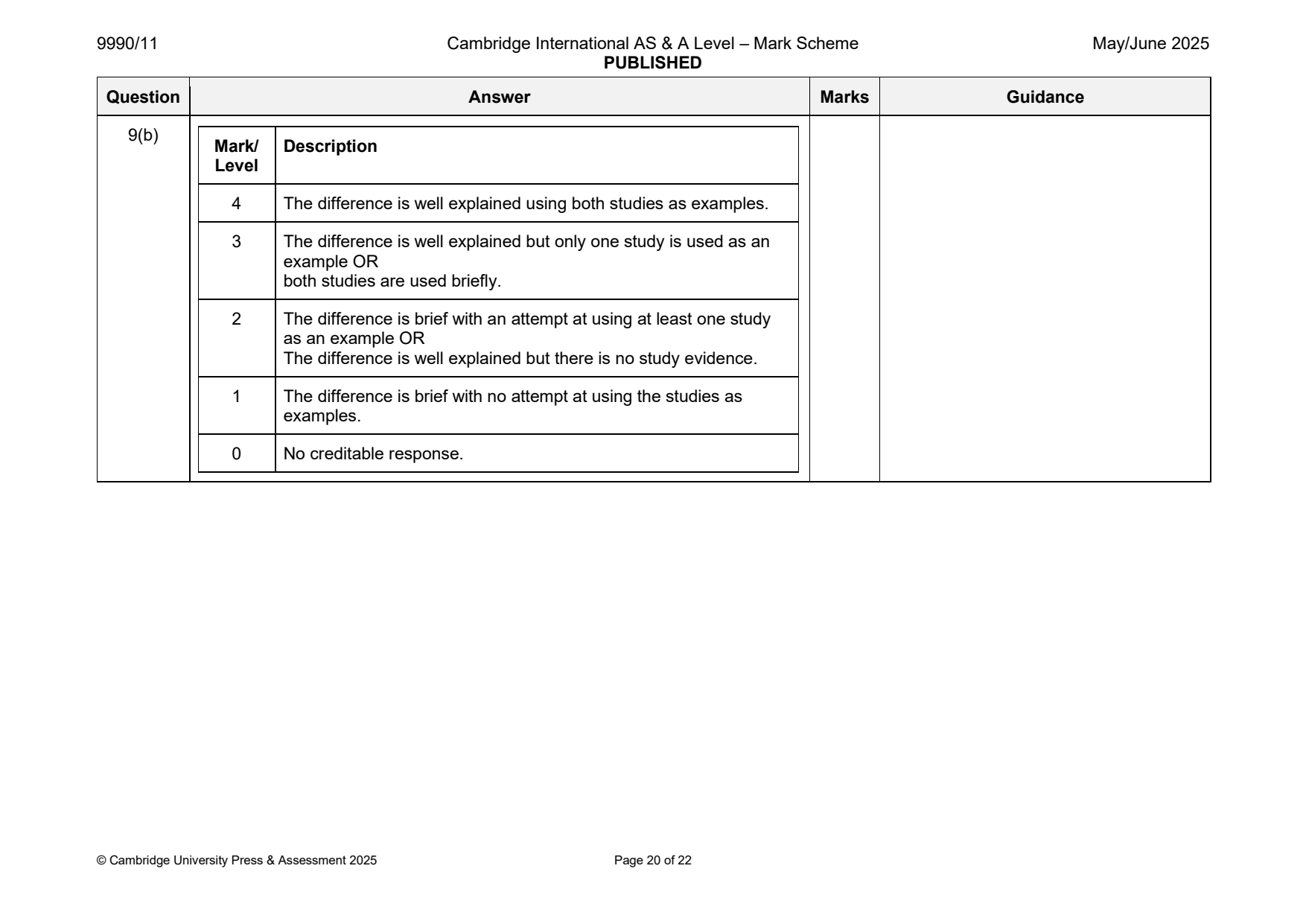
9(b)
Mark/
Description
Level
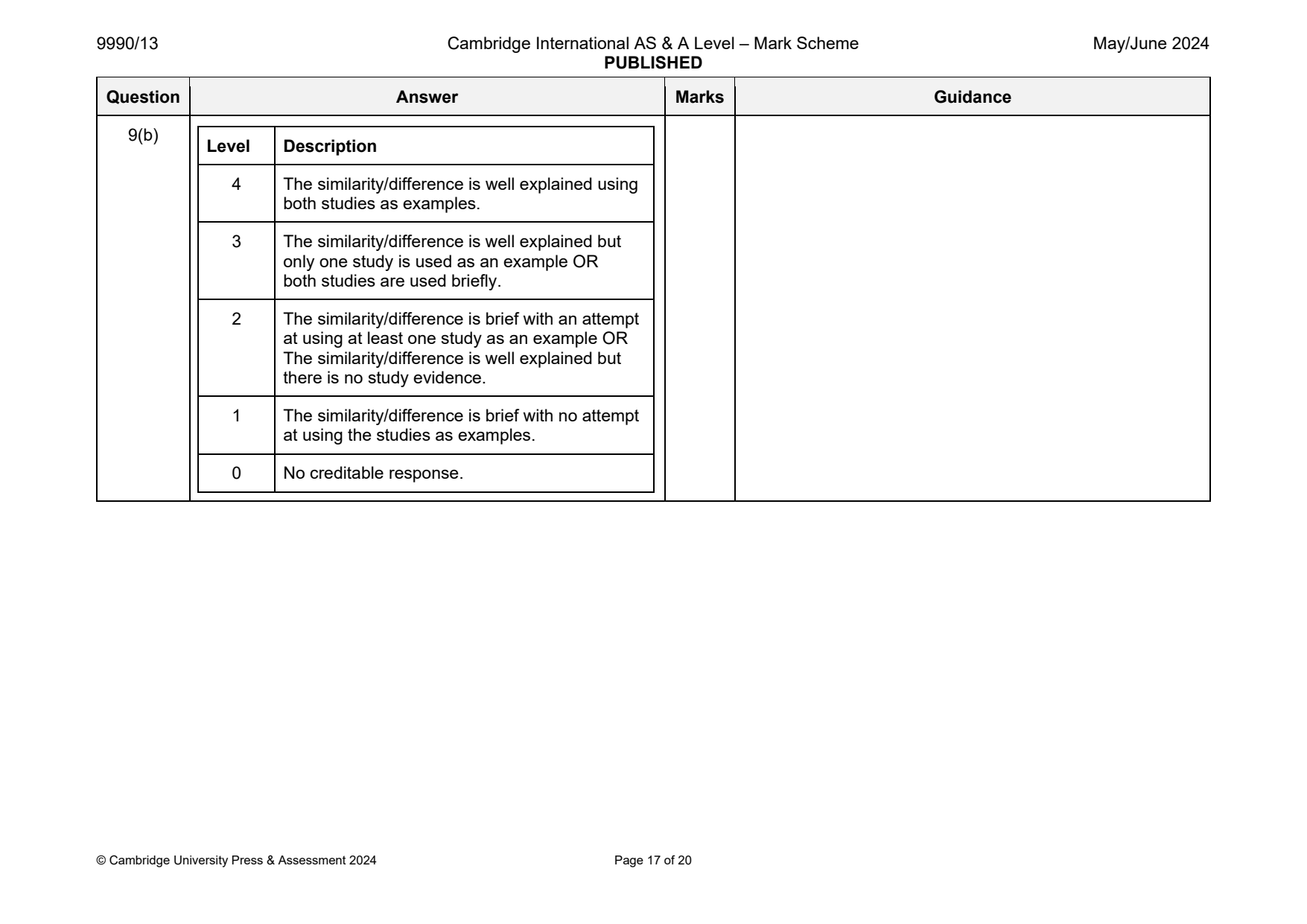
4 The similarity/difference is well explained using both studies as examples.
3 The similarity/difference is well explained but only one study is used as an
example OR
both studies are used briefly.
2 The similarity/difference is brief with an attempt at using at least one study
as an example OR
The similarity/difference is well explained but there is no study evidence.
1 The similarity/difference is brief with no attempt at using the studies as
examples.
0 No creditable response.
© Cambridge University Press & Assessment 2024 Page 17 of 19
Official mark scheme pages: 15, 16, 17 · source PDF URL
9990-2024-mj-11-q01
May/June 2024 · Paper 11 · Question 1 · 5 marks
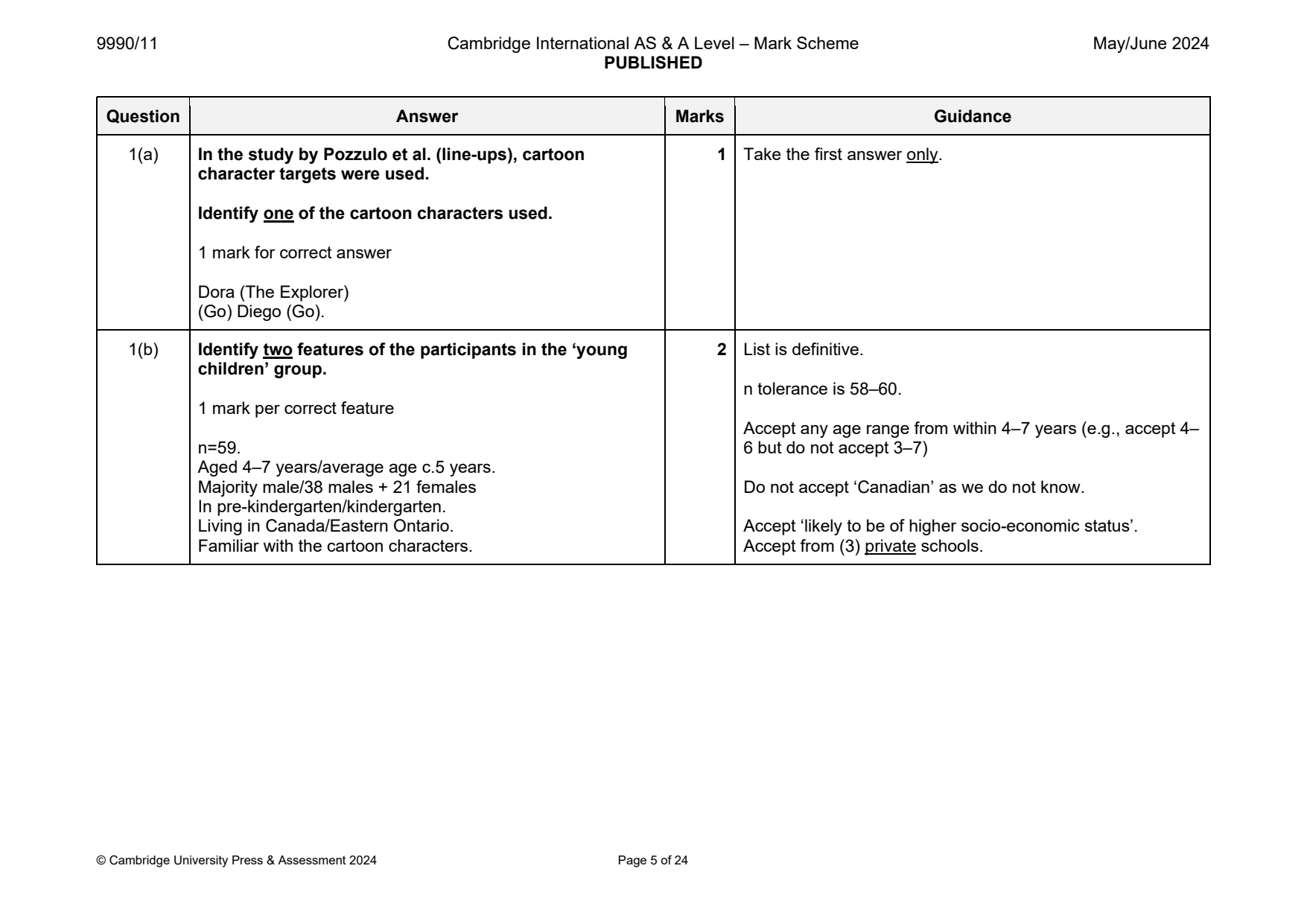
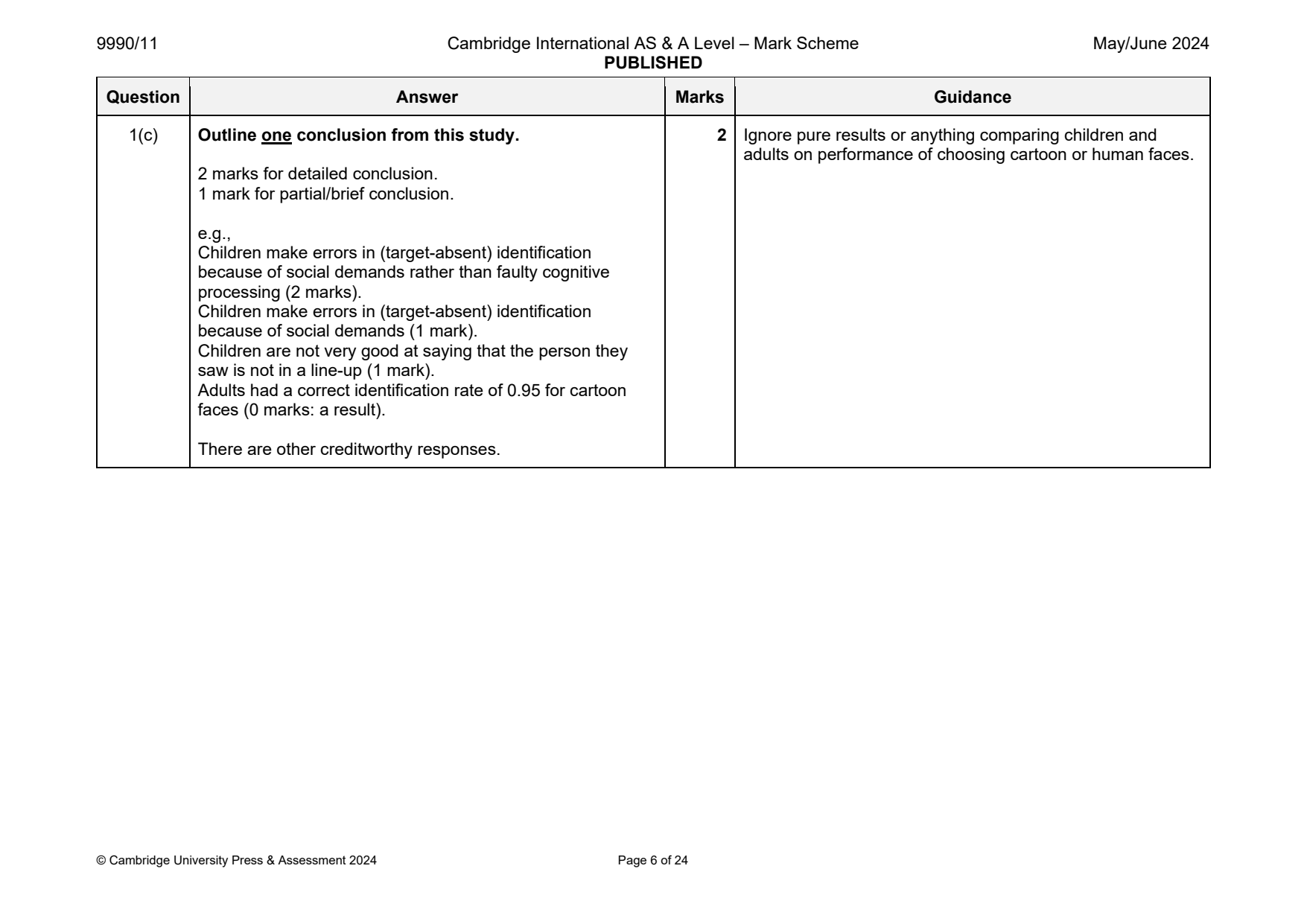
1(a) In the study by Pozzulo et al. (line-ups), cartoon 1 Take the first answer only.
character targets were used.
Identify one of the cartoon characters used.
1 mark for correct answer
Dora (The Explorer)
(Go) Diego (Go).
1(b) Identify two features of the participants in the ‘young 2 List is definitive.
children’ group.
n tolerance is 58–60.
1 mark per correct feature
Accept any age range from within 4–7 years (e.g., accept 4–
n=59. 6 but do not accept 3–7)
Aged 4–7 years/average age c.5 years.
Majority male/38 males + 21 females Do not accept ‘Canadian’ as we do not know.
In pre-kindergarten/kindergarten.
Living in Canada/Eastern Ontario. Accept ‘likely to be of higher socio-economic status’.
Familiar with the cartoon characters. Accept from (3) private schools.
© Cambridge University Press & Assessment 2024 Page 5 of 24
1(c) Outline one conclusion from this study. 2 Ignore pure results or anything comparing children and
adults on performance of choosing cartoon or human faces.
2 marks for detailed conclusion.
1 mark for partial/brief conclusion.
e.g.,
Children make errors in (target-absent) identification
because of social demands rather than faulty cognitive
processing (2 marks).
Children make errors in (target-absent) identification
because of social demands (1 mark).
Children are not very good at saying that the person they
saw is not in a line-up (1 mark).
Adults had a correct identification rate of 0.95 for cartoon
faces (0 marks: a result).
There are other creditworthy responses.
© Cambridge University Press & Assessment 2024 Page 6 of 24
Official mark scheme pages: 5, 6 · source PDF URL
9990-2024-mj-11-q05
May/June 2024 · Paper 11 · Question 5 · 5 marks
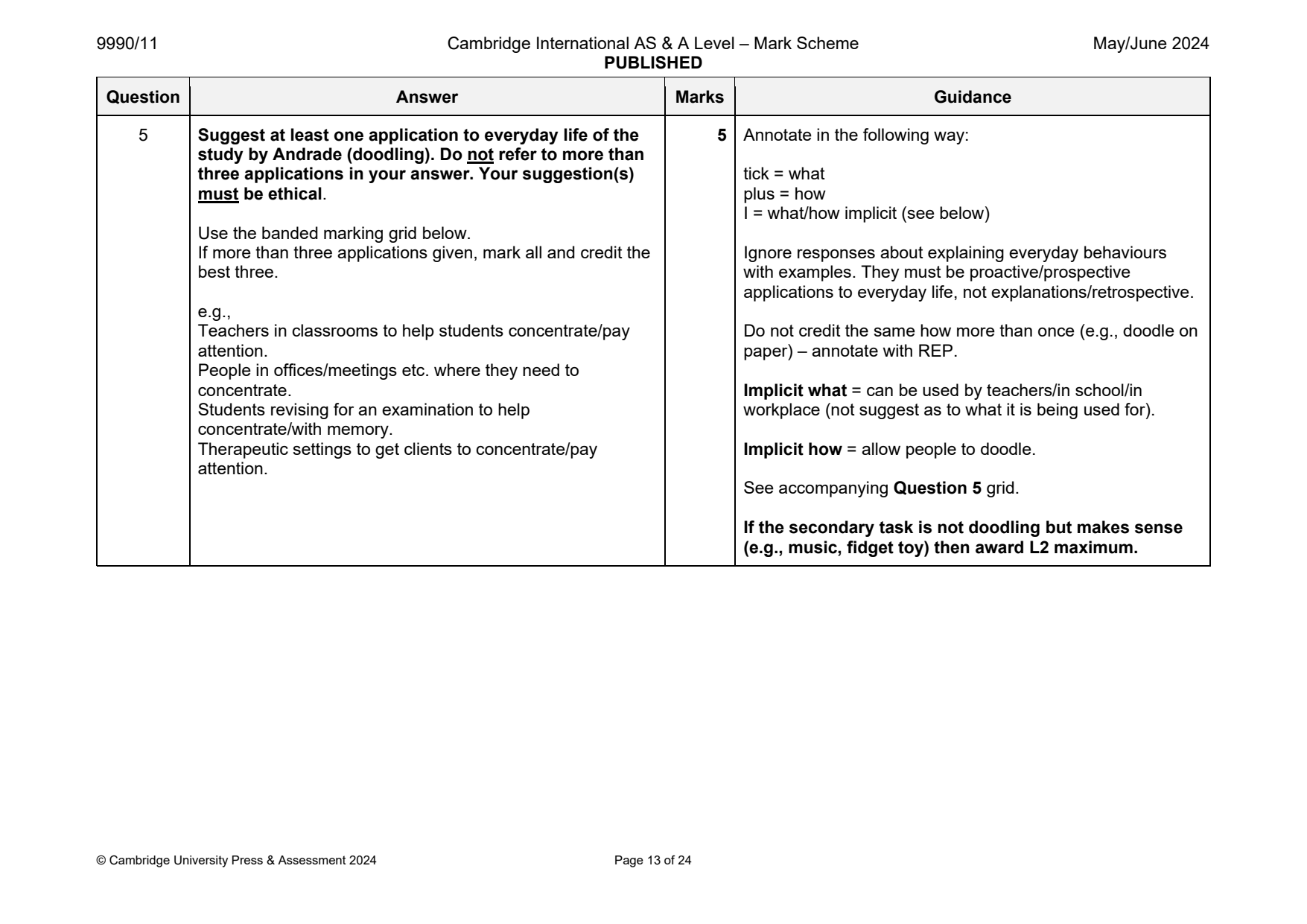
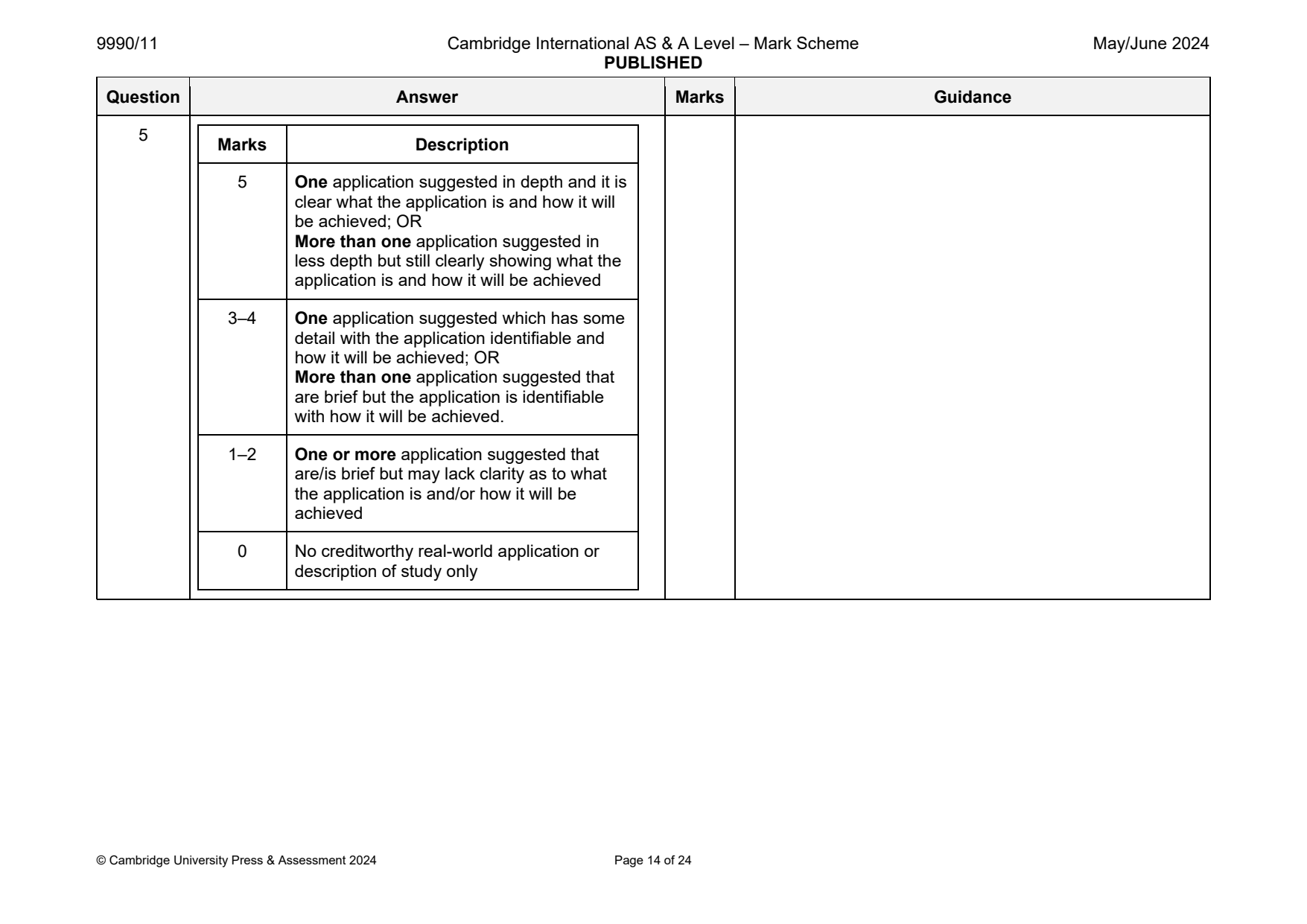
5 Suggest at least one application to everyday life of the 5 Annotate in the following way:
study by Andrade (doodling). Do not refer to more than
three applications in your answer. Your suggestion(s) tick = what
must be ethical. plus = how
I = what/how implicit (see below)
Use the banded marking grid below.
If more than three applications given, mark all and credit the Ignore responses about explaining everyday behaviours
best three. with examples. They must be proactive/prospective
applications to everyday life, not explanations/retrospective.
e.g.,
Teachers in classrooms to help students concentrate/pay Do not credit the same how more than once (e.g., doodle on
attention. paper) – annotate with REP.
People in offices/meetings etc. where they need to
concentrate. Implicit what = can be used by teachers/in school/in
Students revising for an examination to help workplace (not suggest as to what it is being used for).
concentrate/with memory.
Therapeutic settings to get clients to concentrate/pay Implicit how = allow people to doodle.
attention.
See accompanying Question 5 grid.
If the secondary task is not doodling but makes sense
(e.g., music, fidget toy) then award L2 maximum.
© Cambridge University Press & Assessment 2024 Page 13 of 24
5 One application suggested in depth and it is
clear what the application is and how it will
be achieved; OR
More than one application suggested in
less depth but still clearly showing what the
application is and how it will be achieved
3–4 One application suggested which has some
detail with the application identifiable and
how it will be achieved; OR
More than one application suggested that
are brief but the application is identifiable
with how it will be achieved.
1–2 One or more application suggested that
are/is brief but may lack clarity as to what
the application is and/or how it will be
achieved
0 No creditworthy real-world application or
description of study only
© Cambridge University Press & Assessment 2024 Page 14 of 24
Official mark scheme pages: 13, 14 · source PDF URL
9990-2024-mj-11-q07
May/June 2024 · Paper 11 · Question 7 · 4 marks
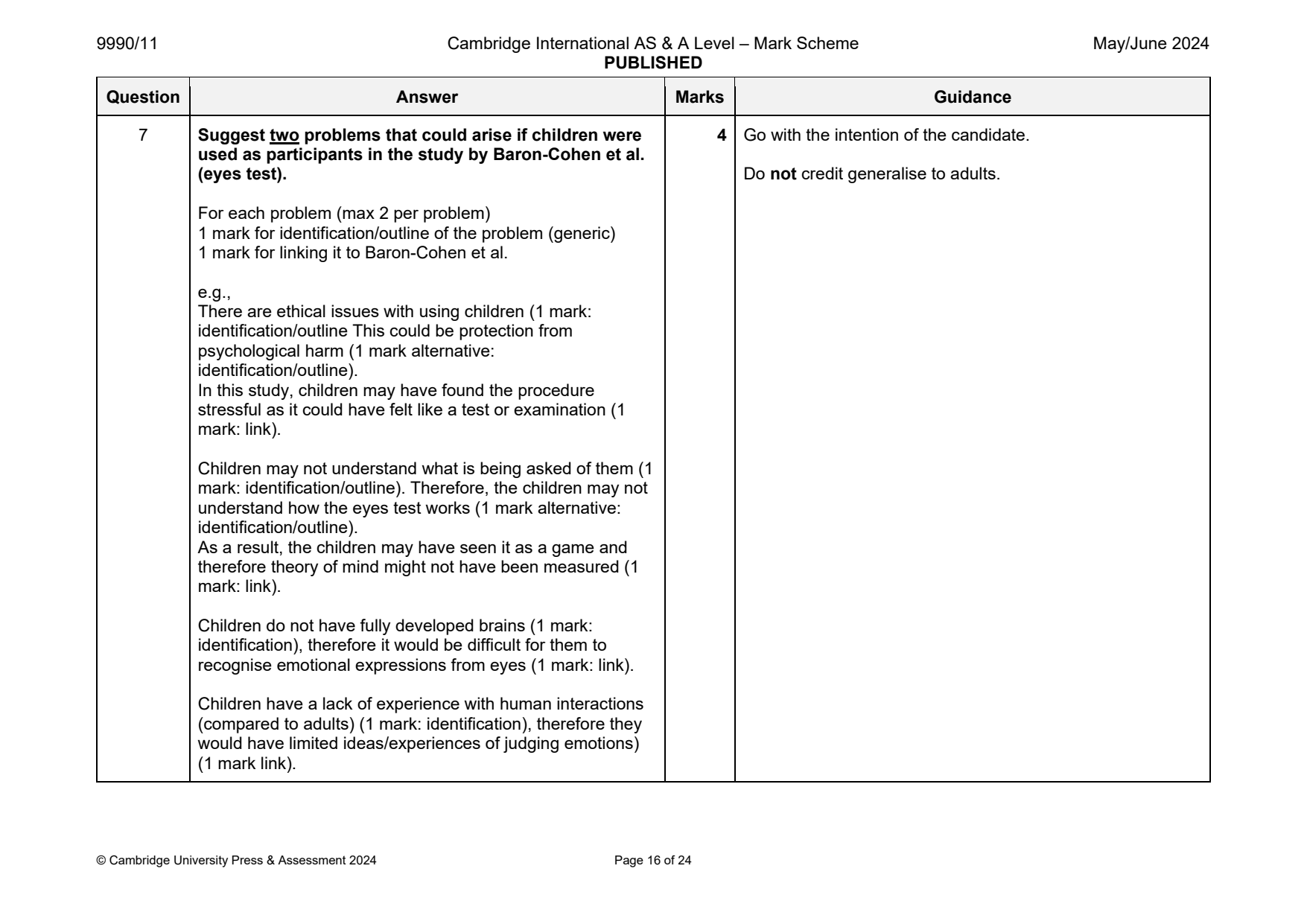
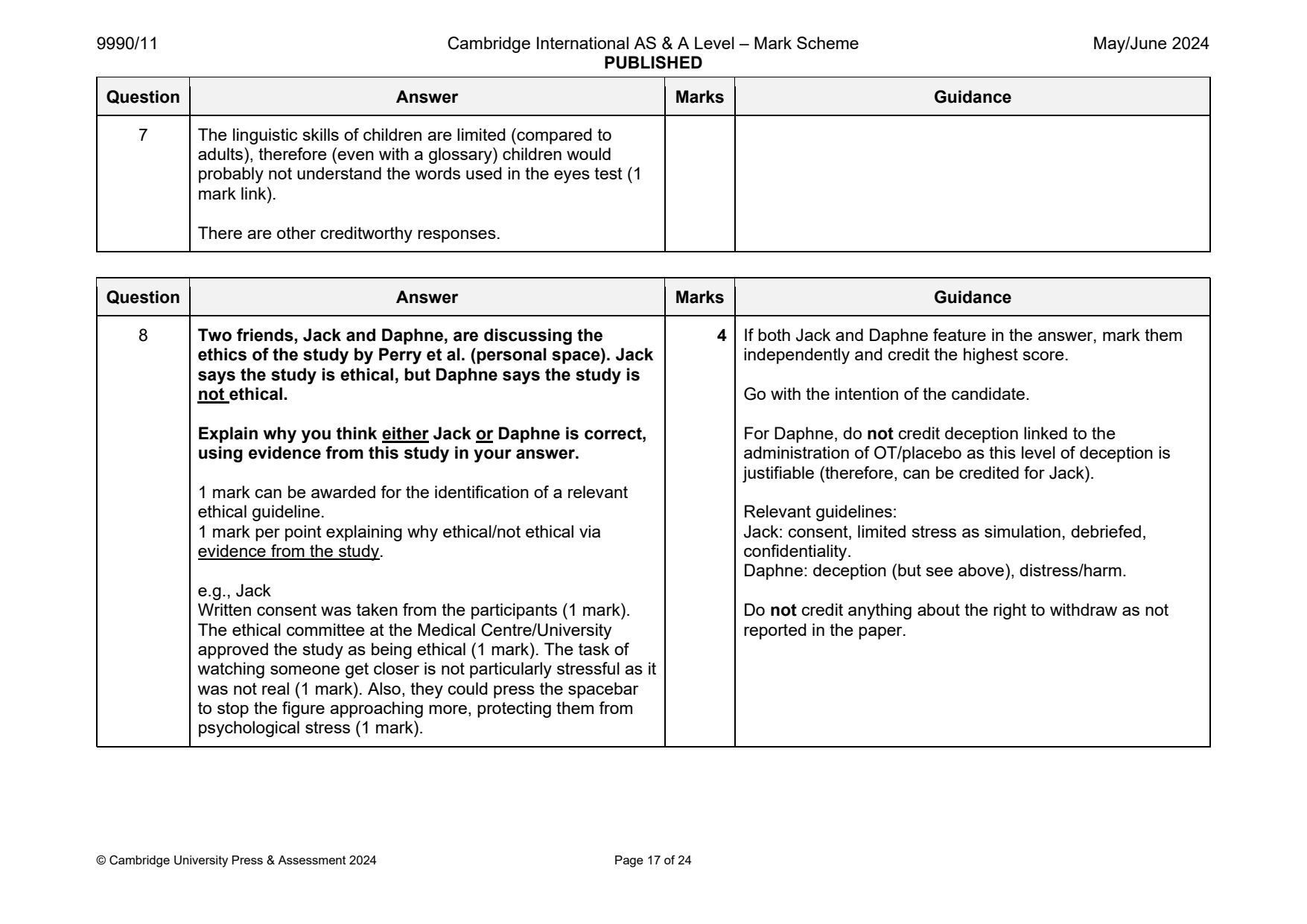
7 Suggest two problems that could arise if children were 4 Go with the intention of the candidate.
used as participants in the study by Baron-Cohen et al.
(eyes test). Do not credit generalise to adults.
For each problem (max 2 per problem)
1 mark for identification/outline of the problem (generic)
1 mark for linking it to Baron-Cohen et al.
e.g.,
There are ethical issues with using children (1 mark:
identification/outline This could be protection from
psychological harm (1 mark alternative:
identification/outline).
In this study, children may have found the procedure
stressful as it could have felt like a test or examination (1
mark: link).
Children may not understand what is being asked of them (1
mark: identification/outline). Therefore, the children may not
understand how the eyes test works (1 mark alternative:
identification/outline).
As a result, the children may have seen it as a game and
therefore theory of mind might not have been measured (1
mark: link).
Children do not have fully developed brains (1 mark:
identification), therefore it would be difficult for them to
recognise emotional expressions from eyes (1 mark: link).
Children have a lack of experience with human interactions
(compared to adults) (1 mark: identification), therefore they
would have limited ideas/experiences of judging emotions)
(1 mark link).
© Cambridge University Press & Assessment 2024 Page 16 of 24
7 The linguistic skills of children are limited (compared to
adults), therefore (even with a glossary) children would
probably not understand the words used in the eyes test (1
mark link).
There are other creditworthy responses.
Question Answer Marks Guidance
Official mark scheme pages: 16, 17 · source PDF URL
9990-2024-mj-12-q02
May/June 2024 · Paper 12 · Question 2 · 4 marks
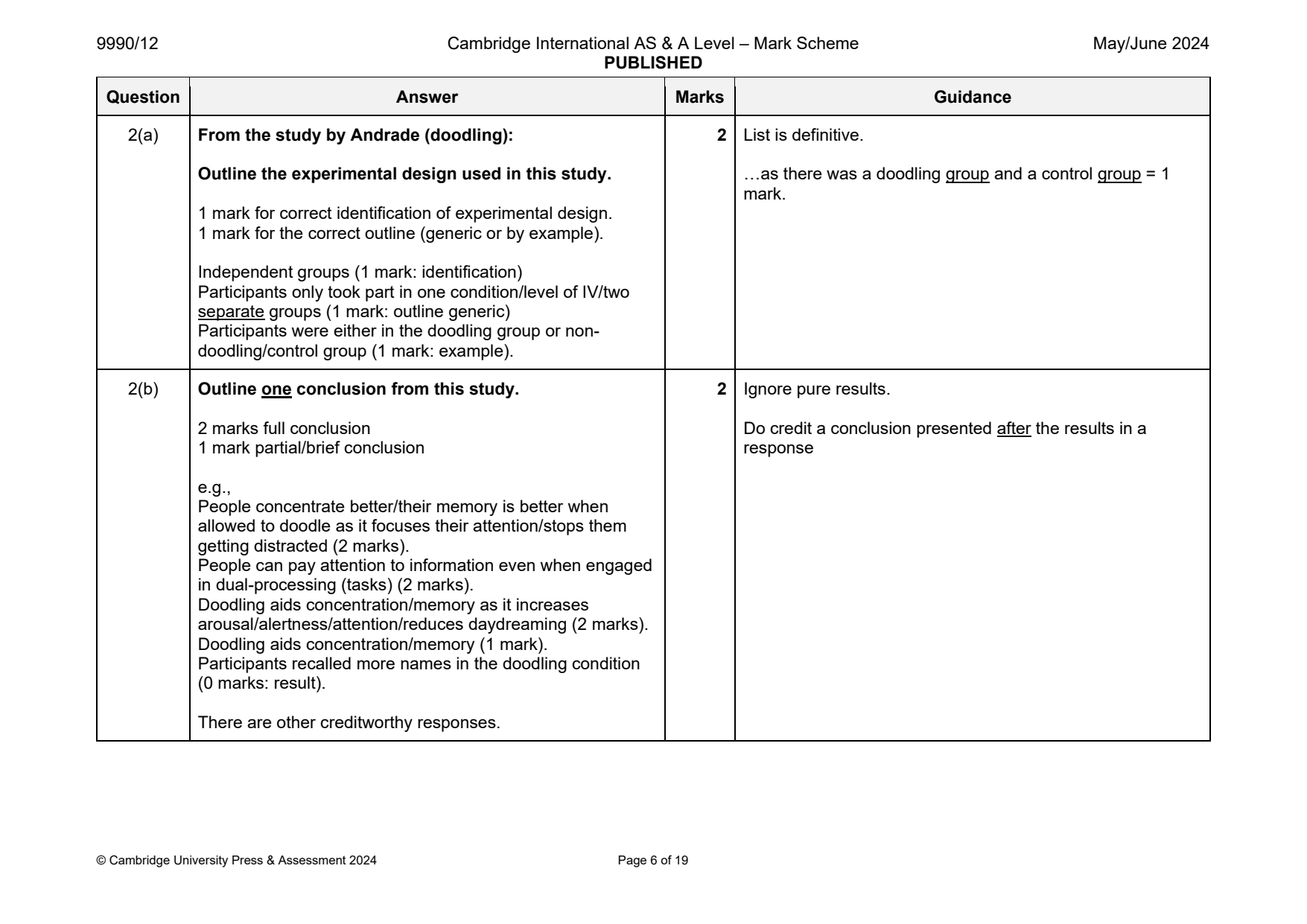
2(a) From the study by Andrade (doodling): 2 List is definitive.
Outline the experimental design used in this study. …as there was a doodling group and a control group = 1
mark.
1 mark for correct identification of experimental design.
1 mark for the correct outline (generic or by example).
Independent groups (1 mark: identification)
Participants only took part in one condition/level of IV/two
separate groups (1 mark: outline generic)
Participants were either in the doodling group or non-
doodling/control group (1 mark: example).
2(b) Outline one conclusion from this study. 2 Ignore pure results.
2 marks full conclusion Do credit a conclusion presented after the results in a
1 mark partial/brief conclusion response
e.g.,
People concentrate better/their memory is better when
allowed to doodle as it focuses their attention/stops them
getting distracted (2 marks).
People can pay attention to information even when engaged
in dual-processing (tasks) (2 marks).
Doodling aids concentration/memory as it increases
arousal/alertness/attention/reduces daydreaming (2 marks).
Doodling aids concentration/memory (1 mark).
Participants recalled more names in the doodling condition
(0 marks: result).
There are other creditworthy responses.
© Cambridge University Press & Assessment 2024 Page 6 of 19
Official mark scheme pages: 6 · source PDF URL
9990-2024-mj-12-q06
May/June 2024 · Paper 12 · Question 6 · 5 marks
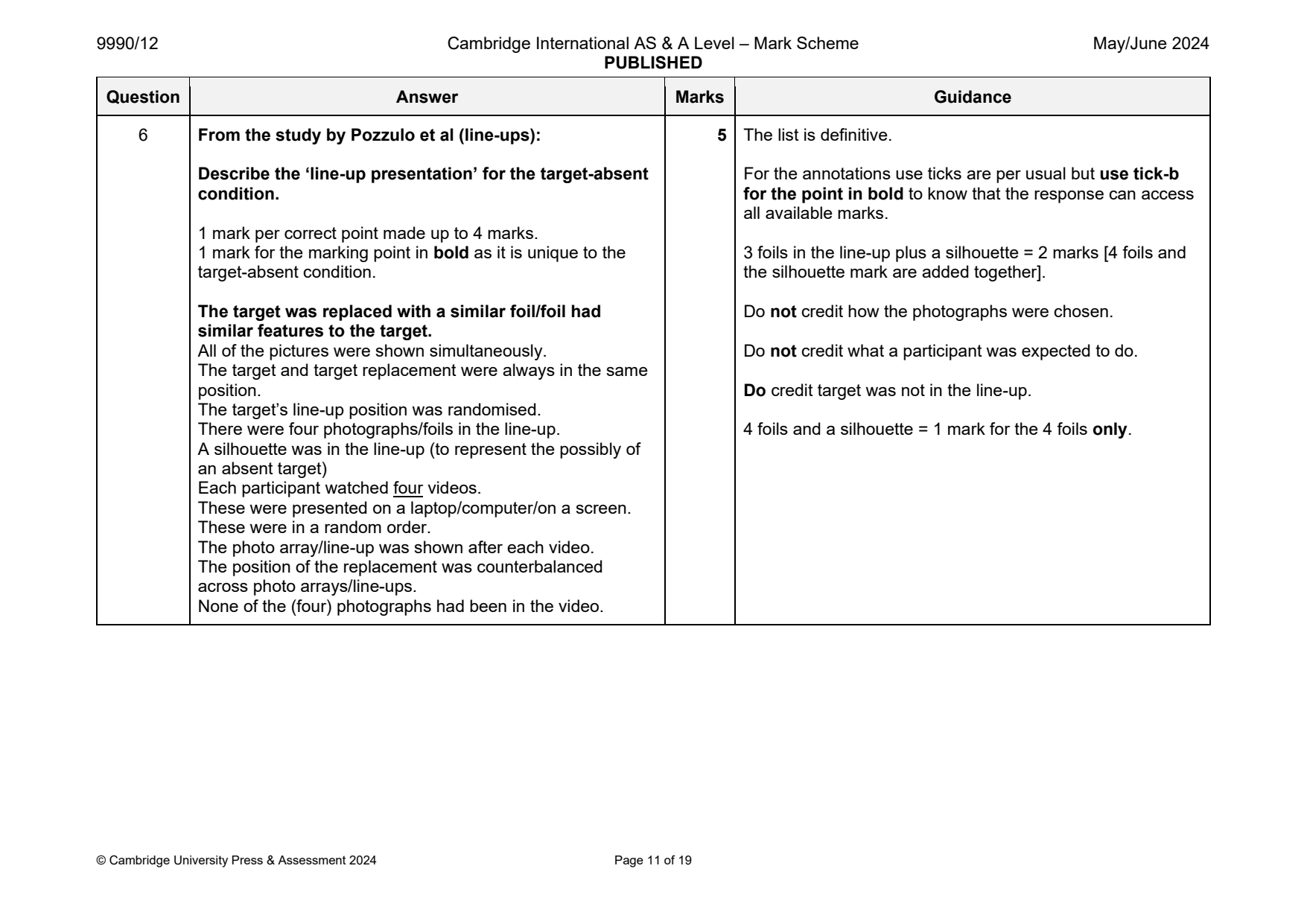
6 From the study by Pozzulo et al (line-ups): 5 The list is definitive.
Describe the ‘line-up presentation’ for the target-absent For the annotations use ticks are per usual but use tick-b
condition. for the point in bold to know that the response can access
all available marks.
1 mark per correct point made up to 4 marks.
1 mark for the marking point in bold as it is unique to the 3 foils in the line-up plus a silhouette = 2 marks [4 foils and
target-absent condition. the silhouette mark are added together].
The target was replaced with a similar foil/foil had Do not credit how the photographs were chosen.
similar features to the target.
All of the pictures were shown simultaneously. Do not credit what a participant was expected to do.
The target and target replacement were always in the same
position. Do credit target was not in the line-up.
The target’s line-up position was randomised.
There were four photographs/foils in the line-up. 4 foils and a silhouette = 1 mark for the 4 foils only.
A silhouette was in the line-up (to represent the possibly of
an absent target)
Each participant watched four videos.
These were presented on a laptop/computer/on a screen.
These were in a random order.
The photo array/line-up was shown after each video.
The position of the replacement was counterbalanced
across photo arrays/line-ups.
None of the (four) photographs had been in the video.
© Cambridge University Press & Assessment 2024 Page 11 of 19
Official mark scheme pages: 11 · source PDF URL
9990-2024-mj-12-q10
May/June 2024 · Paper 12 · Question 10 · 10 marks
10 Evaluate the study by Baron-Cohen et al. (eyes test) in 10 Ignore if candidate calls it a laboratory experiment but do
terms of two strengths and two weaknesses. At least credit controls and standardisation if argued correctly.
one of your evaluation points must be about ethics.
Please note that the only ethical guidelines that are covered
Strengths include: reliability, standardisation, validity in the journal paper are:
(internal), quantitative data, ethics.
Weaknesses include, validity (external), sample, lack of Adhere: minimising harm (weak), informed consent,
random allocation confidentiality.
Example: in detail (named) Break: minimising harm only.
The study was unethical as the process of attempting to
identify emotions from eyes for the AS/HFA was going to be The remainder: right to withdraw, deception, privacy and
stressful as it predicted that they would find it difficult debriefing are not mentioned in the journal paper.
therefore it could have been psychologically stressful for
those participants. Also, not understanding the words to
choose from even with the glossary may have caused
unnecessary stress.
Example: brief but in context
The sample only had 15 AS/HFA participants and they were
all male. This could make generalisations difficult as they
might not represent females with AS/HFA.
Example: no context
The study followed a standardised procedure making it
easier to replicate.
© Cambridge University Press & Assessment 2024 Page 17 of 19
9990/12 Cambridge International AS & A Level – Mark Scheme May/June 2024
PUBLISHED
Question Answer Marks Guidance
10
Level Description Mark
5 Very good evaluation including the 9–10
named issue.
Thoroughly addresses both
strengths and both weaknesses in
detail.
Selection of evidence is very
thorough and effective.
4 Good evaluation including the 7–8
named issue.
Addresses strengths and
weaknesses but may include three
or four points. The majority of the
points are in depth.
Selection of evidence is thorough
and effective.
3 Mostly appropriate evaluation but 5–6
may not include the named issue.
Addresses either two strengths or
two weaknesses in detail or one of
each in detail or all four briefly.
Selection of evidence is mostly
effective.
© Cambridge University Press & Assessment 2024 Page 18 of 19
9990/12 Cambridge International AS & A Level – Mark Scheme May/June 2024
PUBLISHED
Question Answer Marks Guidance
10
Level Description Mark
2 Weak evaluation and may not 3–4
include the named issue.
Addresses either a strength or a
weakness. Evaluation points are
brief.
Some points may have no context.
Selection of evidence is sometimes
appropriate.
1 Little or no evaluation. 1–2
Discussion of strengths and
weaknesses is absent or
superficial.
Selection of evidence is limited.
0 No creditable response.
© Cambridge University Press & Assessment 2024 Page 19 of 19
Official mark scheme pages: 17, 18, 19 · source PDF URL
9990-2024-mj-13-q04
May/June 2024 · Paper 13 · Question 4 · 5 marks
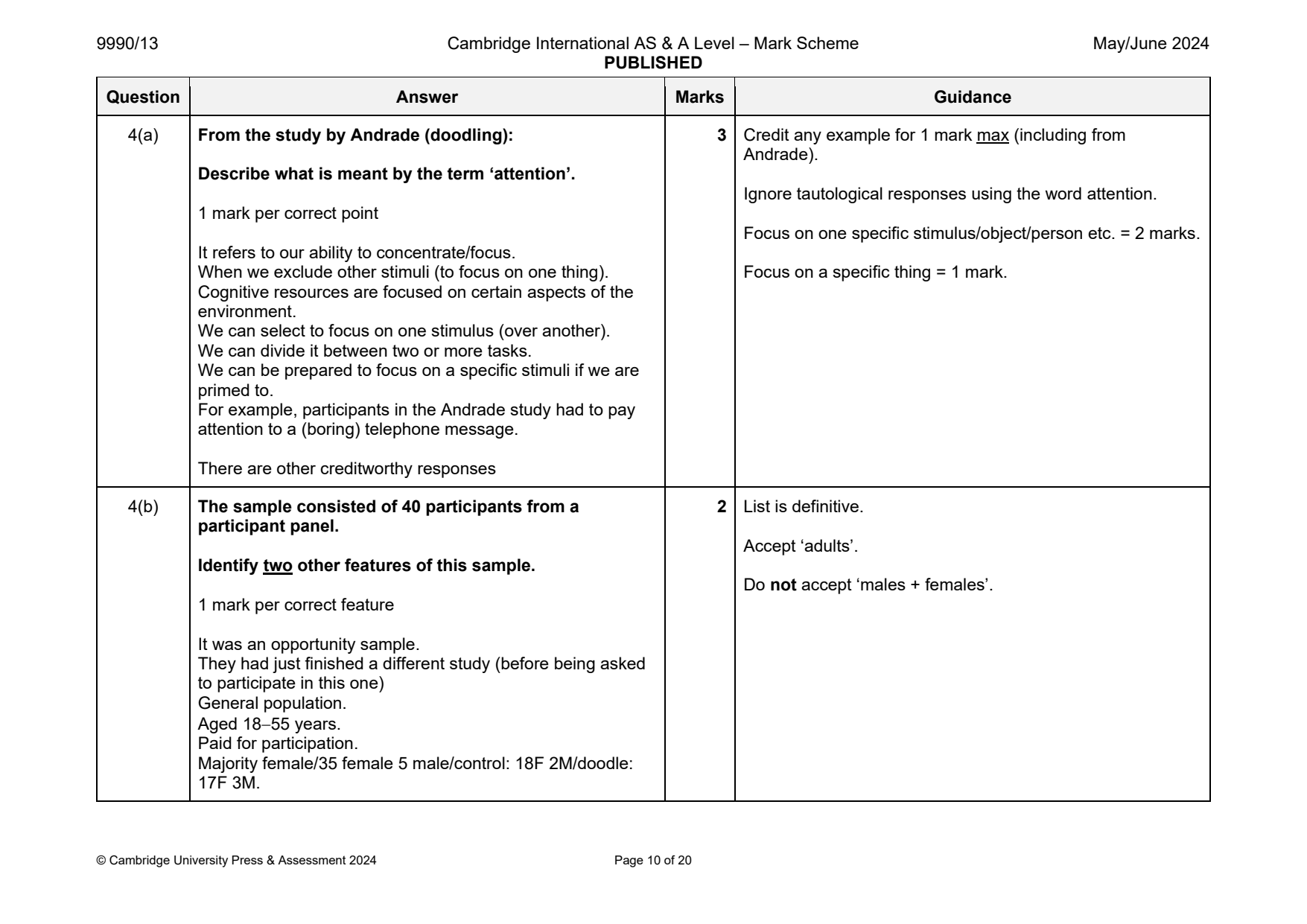
4(a) From the study by Andrade (doodling): 3 Credit any example for 1 mark max (including from
Andrade).
Describe what is meant by the term ‘attention’.
Ignore tautological responses using the word attention.
1 mark per correct point
Focus on one specific stimulus/object/person etc. = 2 marks.
It refers to our ability to concentrate/focus.
When we exclude other stimuli (to focus on one thing). Focus on a specific thing = 1 mark.
Cognitive resources are focused on certain aspects of the
environment.
We can select to focus on one stimulus (over another).
We can divide it between two or more tasks.
We can be prepared to focus on a specific stimuli if we are
primed to.
For example, participants in the Andrade study had to pay
attention to a (boring) telephone message.
There are other creditworthy responses
4(b) The sample consisted of 40 participants from a 2 List is definitive.
participant panel.
Accept ‘adults’.
Identify two other features of this sample.
Do not accept ‘males + females’.
1 mark per correct feature
It was an opportunity sample.
They had just finished a different study (before being asked
to participate in this one)
General population.
Aged 1855 years.
Paid for participation.
Majority female/35 female 5 male/control: 18F 2M/doodle:
17F 3M.
© Cambridge University Press & Assessment 2024 Page 10 of 20
Official mark scheme pages: 10 · source PDF URL
9990-2024-mj-13-q09
May/June 2024 · Paper 13 · Question 9 · 12 marks
9(a) From the study by Baron-Cohen et al. (eyes test): 4 Lists are definitive.
Describe the sample used in either Group 1 or Group 2. Accept opportunity sample for Group 2
1 mark per correct point Group 1 mean age tolerance is 2930y
Group 1 If both groups covered, mark independently and credit the
best, placing the annotation REP at the end of the response.
Adults/mean age c.30y.
Males.
n=15.
Diagnosed with AS/HFA.
Volunteer sample/Responded to an advert in a National
Autism Society magazine.
Same socioeconomic class as Group 2.
Same educational levels as Group 2.
Typical range IQ/average IQ = 115/matched IQ with Group
4.
Group 2
Adults/mean age 28y.
n=122.
From adult community/education classes (in Exeter).
Public library users (in Cambridge).
Broad range of occupations.
Same socioeconomic class as Group 1.
Same educational levels as Group 1/broad range of
educational levels.
© Cambridge University Press & Assessment 2024 Page 15 of 20
9(b) Explain two similarities between the study by Baron- 8 Do not credit any answer about the sample.
Cohen et al. (eyes test) and one other study from the
cognitive approach. Do not refer to the sample in your Award L1L4 for similarity
answer.
For Level 4 there must be some attempt at explaining the
Use the marking grid below. similarity.
4 marks for the similarity, e.g., experimental, lack mundane The other studies from the cognitive approach are:
realism, quantitative data collection
Andrade
e.g., similarity Pozzulo et al
e.g. 4 marks
Both Andrade and Baron-Cohen studies were experimental Both had hypotheses that were supported = L2 max.
in nature. For example, both studies had IVs. In the Andrade
study there were two conditions of doodling and non- If they state that Baron-Cohen was a laboratory
doodling. In the Baron-Cohen study the IV was natural and experiment then no credit for it but you can credit features
based around if a person had been diagnosed with AS/HFA of the experimental method.
or not. Therefore, both were trying to establish cause and
effect (explanation) Anything linked to the sample or sampling technique = L0,
placing a X next to the response.
e.g. 3 marks
Both Andrade and Baron-Cohen studies were experimental
in nature. For example, both studies had IVs. In the Andrade
study there were two conditions of doodling and non-
doodling/in the Baron-Cohen study the IV was natural and
based around if a person had been diagnosed with AS/HFA
or not.
e.g. 2 marks
Both Andrade and Baron-Cohen studies were experimental
in nature. For example, both studies had IVs and measured
DVs.
e.g. 1 mark
Both Andrade and Baron-Cohen were experimental in
nature.
© Cambridge University Press & Assessment 2024 Page 16 of 20
9(b)
Level Description
4 The similarity/difference is well explained using
both studies as examples.
3 The similarity/difference is well explained but
only one study is used as an example OR
both studies are used briefly.
2 The similarity/difference is brief with an attempt
at using at least one study as an example OR
The similarity/difference is well explained but
there is no study evidence.
1 The similarity/difference is brief with no attempt
at using the studies as examples.
0 No creditable response.
© Cambridge University Press & Assessment 2024 Page 17 of 20
Official mark scheme pages: 15, 16, 17 · source PDF URL
9990-2024-on-11-q03
Oct/Nov 2024 · Paper 11 · Question 3 · 4 marks
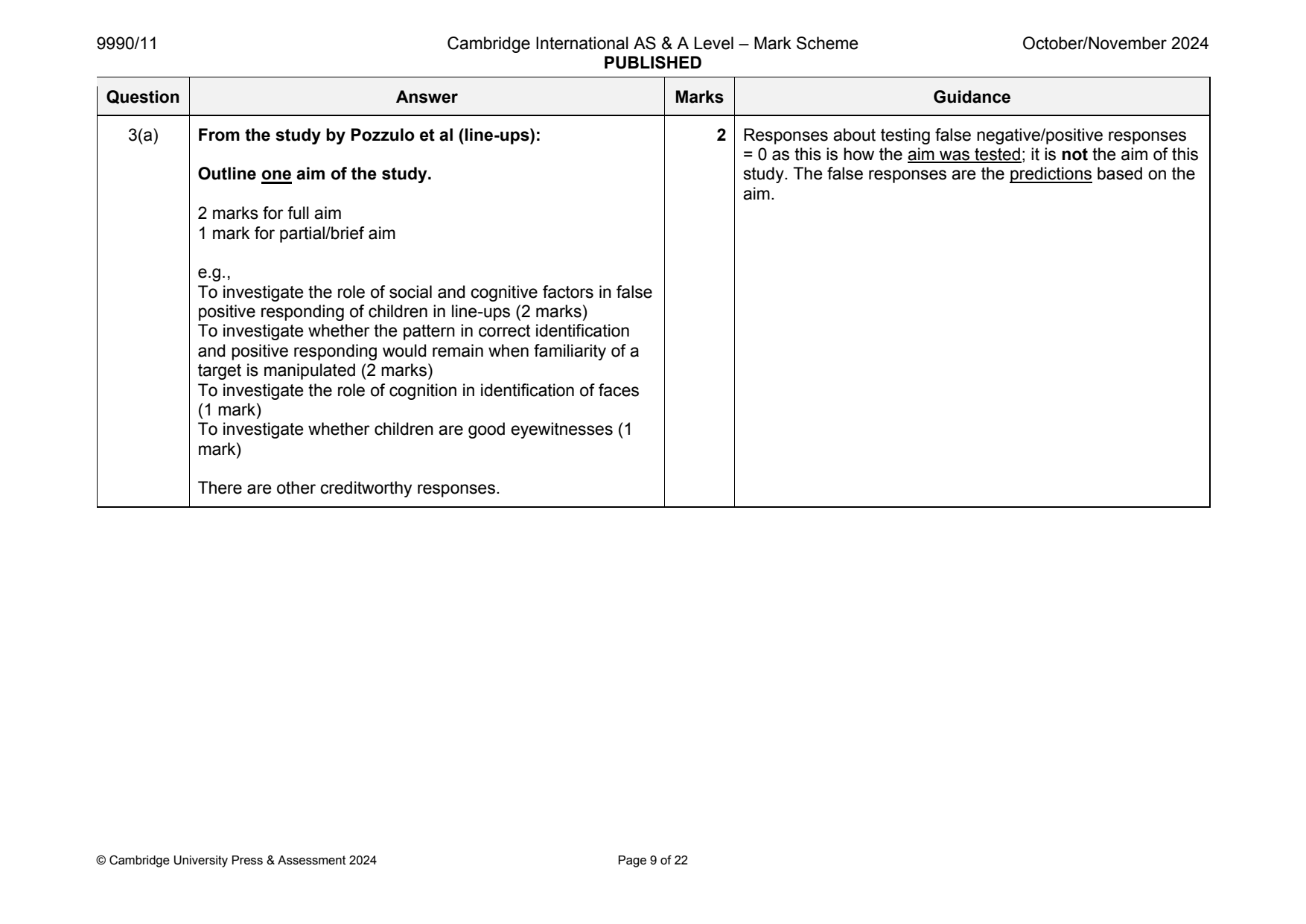
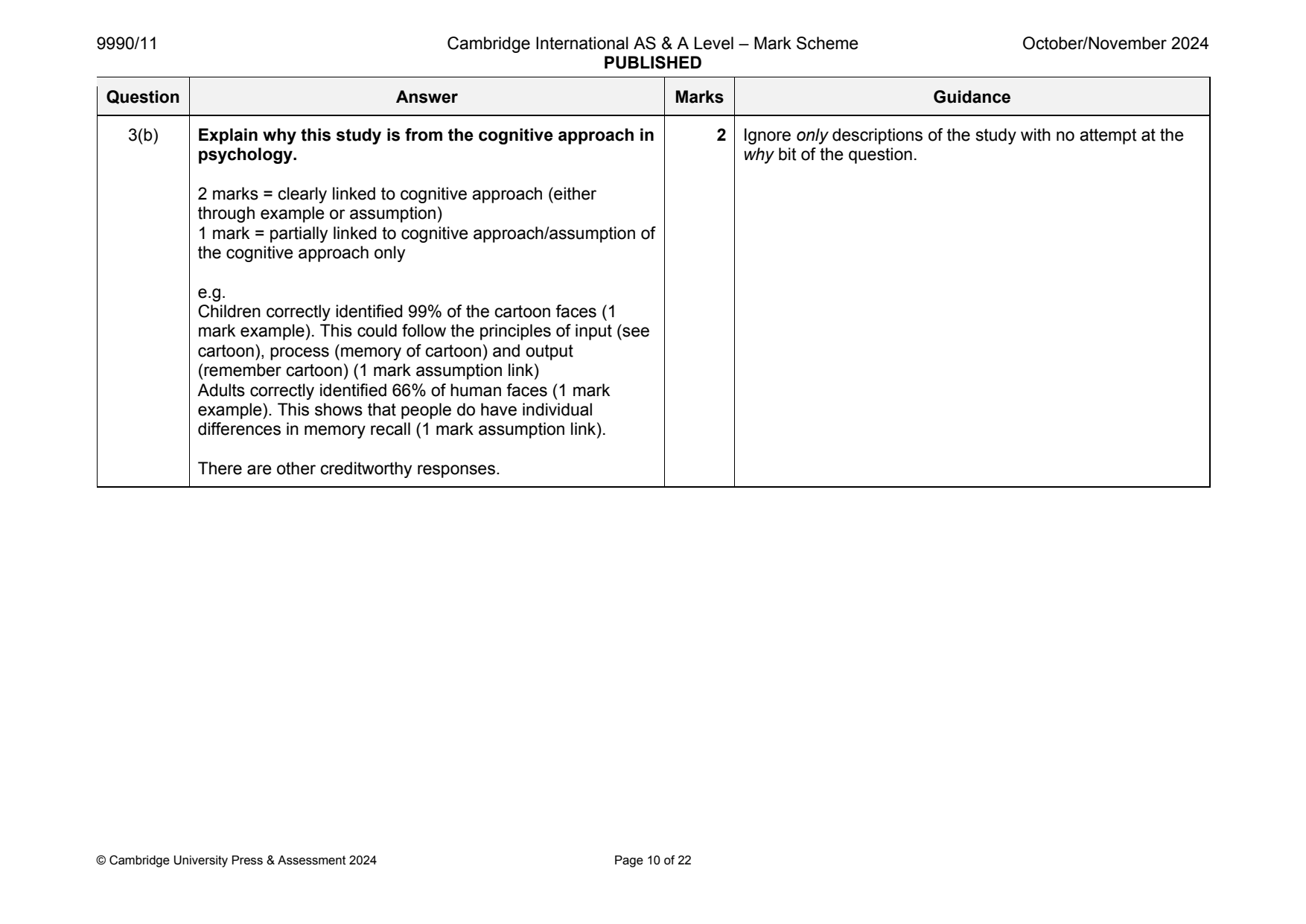
3(a) From the study by Pozzulo et al (line-ups): 2 Responses about testing false negative/positive responses
= 0 as this is how the aim was tested; it is not the aim of this
Outline one aim of the study. study. The false responses are the predictions based on the
aim.
2 marks for full aim
1 mark for partial/brief aim
e.g.,
To investigate the role of social and cognitive factors in false
positive responding of children in line-ups (2 marks)
To investigate whether the pattern in correct identification
and positive responding would remain when familiarity of a
target is manipulated (2 marks)
To investigate the role of cognition in identification of faces
(1 mark)
To investigate whether children are good eyewitnesses (1
mark)
There are other creditworthy responses.
© Cambridge University Press & Assessment 2024 Page 9 of 22
3(b) Explain why this study is from the cognitive approach in 2 Ignore only descriptions of the study with no attempt at the
psychology. why bit of the question.
2 marks = clearly linked to cognitive approach (either
through example or assumption)
1 mark = partially linked to cognitive approach/assumption of
the cognitive approach only
e.g.
Children correctly identified 99% of the cartoon faces (1
mark example). This could follow the principles of input (see
cartoon), process (memory of cartoon) and output
(remember cartoon) (1 mark assumption link)
Adults correctly identified 66% of human faces (1 mark
example). This shows that people do have individual
differences in memory recall (1 mark assumption link).
There are other creditworthy responses.
© Cambridge University Press & Assessment 2024 Page 10 of 22
Official mark scheme pages: 9, 10 · source PDF URL
9990-2024-on-11-q07
Oct/Nov 2024 · Paper 11 · Question 7 · 4 marks
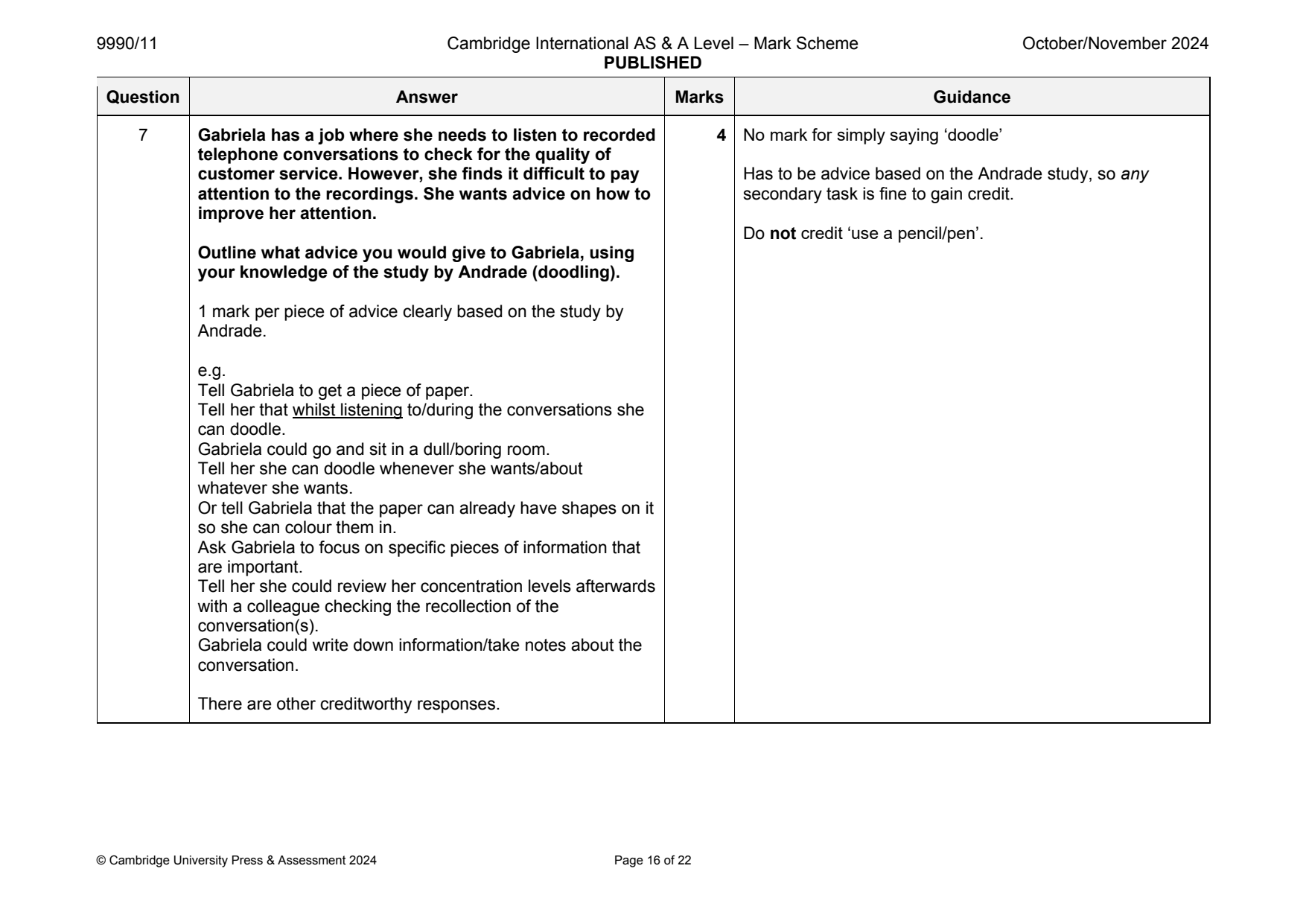
7 Gabriela has a job where she needs to listen to recorded 4 No mark for simply saying ‘doodle’
telephone conversations to check for the quality of
customer service. However, she finds it difficult to pay Has to be advice based on the Andrade study, so any
attention to the recordings. She wants advice on how to secondary task is fine to gain credit.
improve her attention.
Do not credit ‘use a pencil/pen’.
Outline what advice you would give to Gabriela, using
your knowledge of the study by Andrade (doodling).
1 mark per piece of advice clearly based on the study by
Andrade.
e.g.
Tell Gabriela to get a piece of paper.
Tell her that whilst listening to/during the conversations she
can doodle.
Gabriela could go and sit in a dull/boring room.
Tell her she can doodle whenever she wants/about
whatever she wants.
Or tell Gabriela that the paper can already have shapes on it
so she can colour them in.
Ask Gabriela to focus on specific pieces of information that
are important.
Tell her she could review her concentration levels afterwards
with a colleague checking the recollection of the
conversation(s).
Gabriela could write down information/take notes about the
conversation.
There are other creditworthy responses.
© Cambridge University Press & Assessment 2024 Page 16 of 22
Official mark scheme pages: 16 · source PDF URL
9990-2024-on-11-q08
Oct/Nov 2024 · Paper 11 · Question 8 · 4 marks
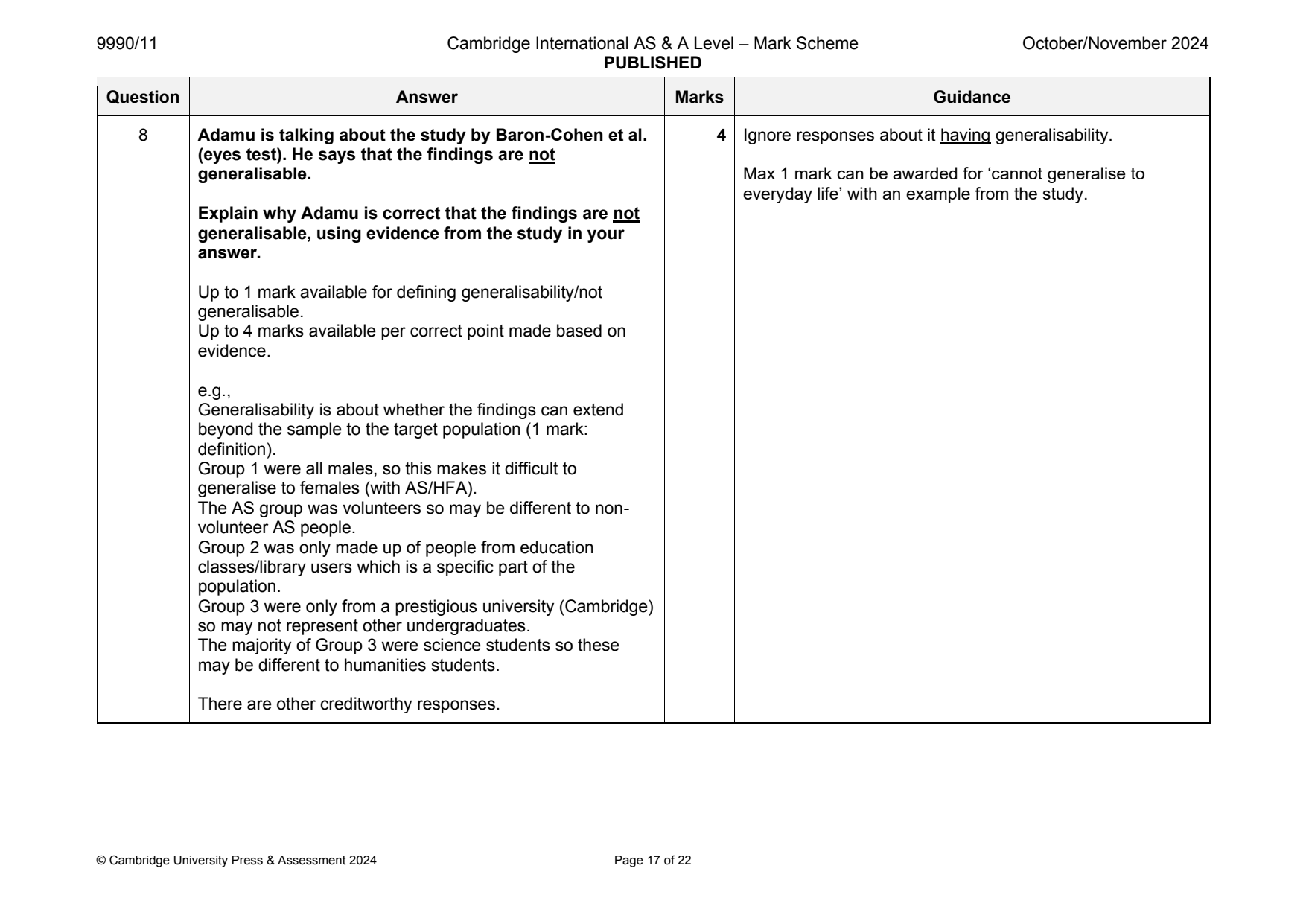
8 Adamu is talking about the study by Baron-Cohen et al. 4 Ignore responses about it having generalisability.
(eyes test). He says that the findings are not
generalisable. Max 1 mark can be awarded for ‘cannot generalise to
everyday life’ with an example from the study.
Explain why Adamu is correct that the findings are not
generalisable, using evidence from the study in your
answer.
Up to 1 mark available for defining generalisability/not
generalisable.
Up to 4 marks available per correct point made based on
evidence.
e.g.,
Generalisability is about whether the findings can extend
beyond the sample to the target population (1 mark:
definition).
Group 1 were all males, so this makes it difficult to
generalise to females (with AS/HFA).
The AS group was volunteers so may be different to non-
volunteer AS people.
Group 2 was only made up of people from education
classes/library users which is a specific part of the
population.
Group 3 were only from a prestigious university (Cambridge)
so may not represent other undergraduates.
The majority of Group 3 were science students so these
may be different to humanities students.
There are other creditworthy responses.
© Cambridge University Press & Assessment 2024 Page 17 of 22
Official mark scheme pages: 17 · source PDF URL
9990-2024-on-12-q02
Oct/Nov 2024 · Paper 12 · Question 2 · 4 marks
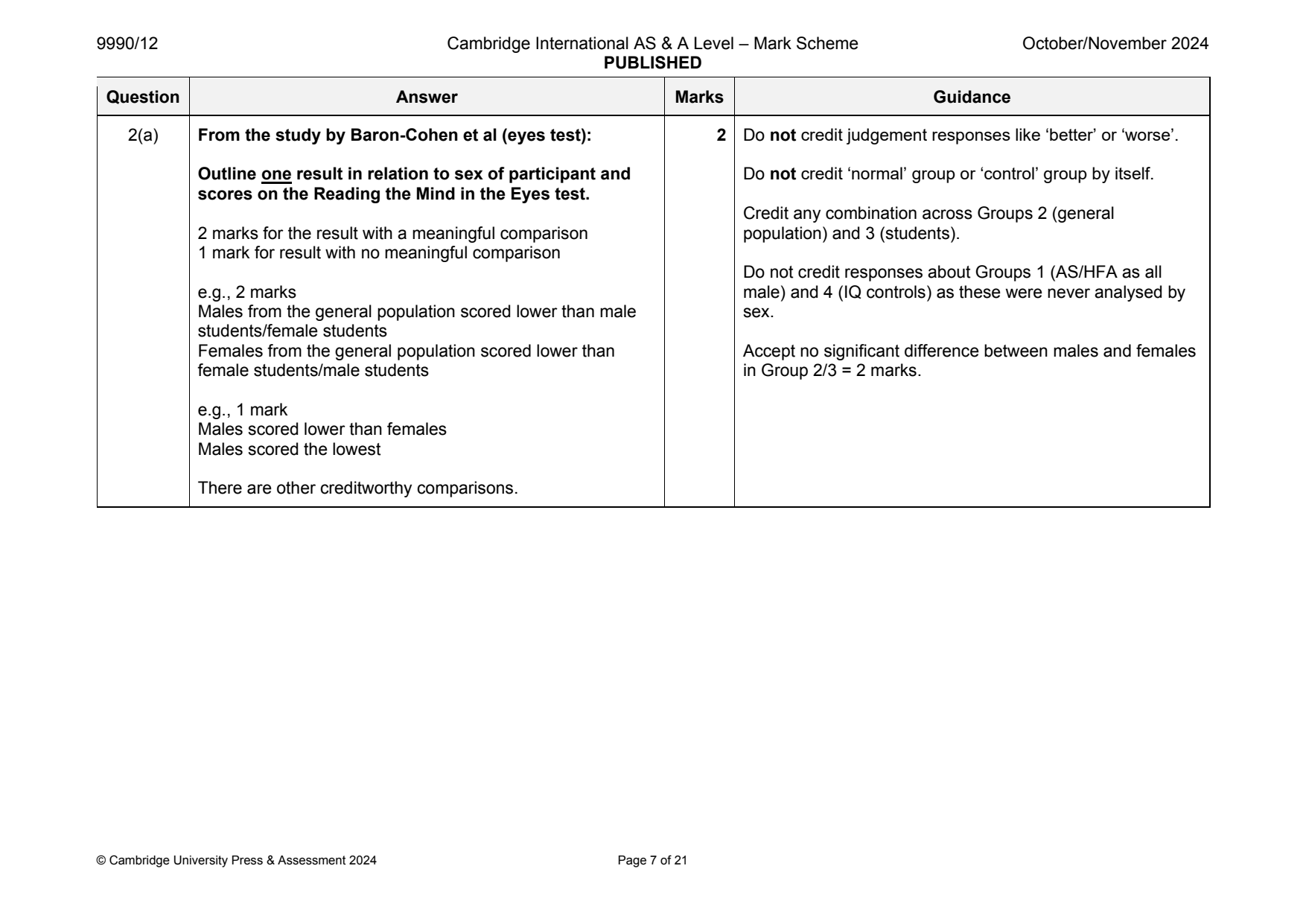
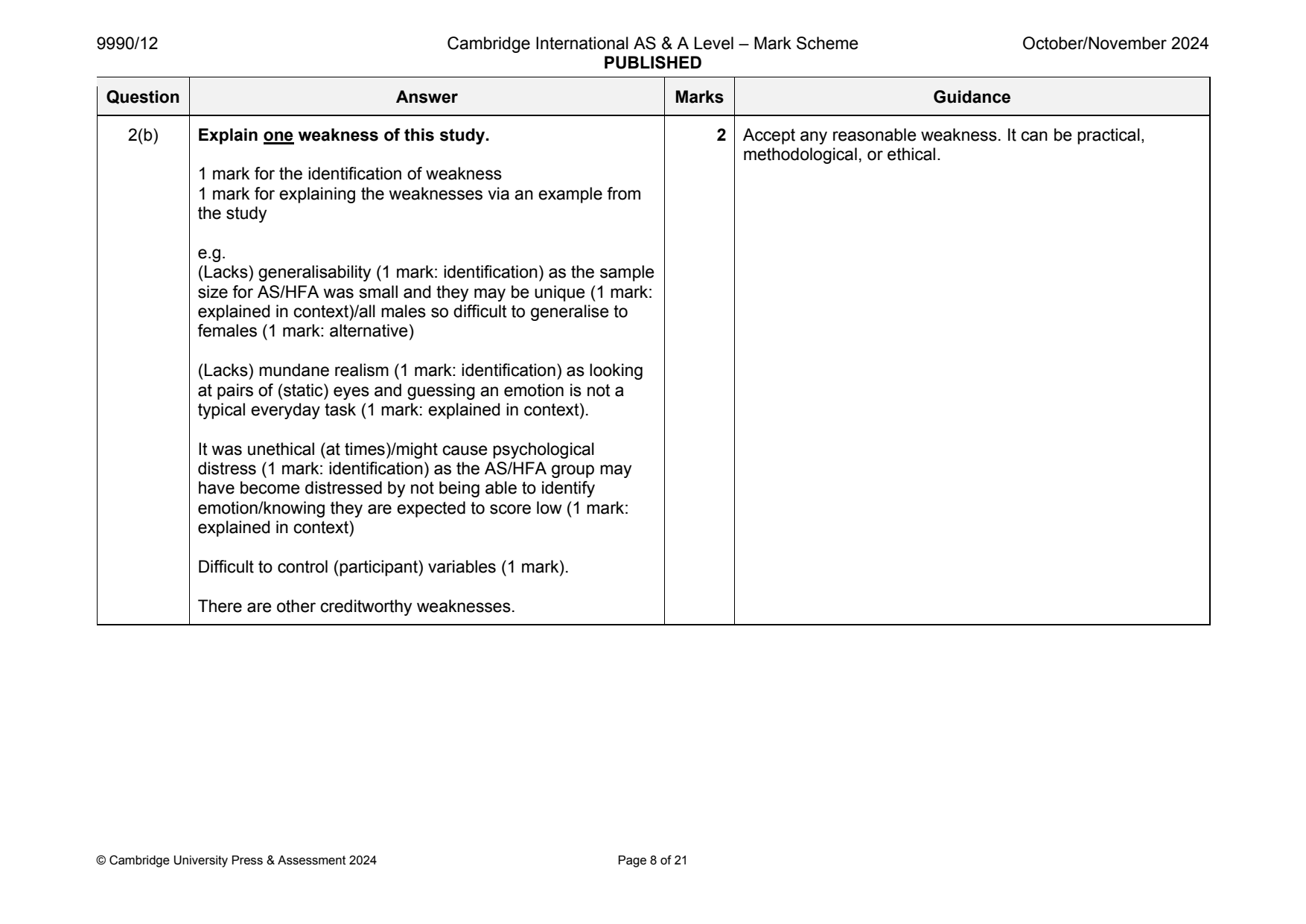
2(a) From the study by Baron-Cohen et al (eyes test): 2 Do not credit judgement responses like ‘better’ or ‘worse’.
Outline one result in relation to sex of participant and Do not credit ‘normal’ group or ‘control’ group by itself.
scores on the Reading the Mind in the Eyes test.
Credit any combination across Groups 2 (general
2 marks for the result with a meaningful comparison population) and 3 (students).
1 mark for result with no meaningful comparison
Do not credit responses about Groups 1 (AS/HFA as all
e.g., 2 marks male) and 4 (IQ controls) as these were never analysed by
Males from the general population scored lower than male sex.
students/female students
Females from the general population scored lower than Accept no significant difference between males and females
female students/male students in Group 2/3 = 2 marks.
e.g., 1 mark
Males scored lower than females
Males scored the lowest
There are other creditworthy comparisons.
© Cambridge University Press & Assessment 2024 Page 7 of 21
2(b) Explain one weakness of this study. 2 Accept any reasonable weakness. It can be practical,
methodological, or ethical.
1 mark for the identification of weakness
1 mark for explaining the weaknesses via an example from
the study
e.g.
(Lacks) generalisability (1 mark: identification) as the sample
size for AS/HFA was small and they may be unique (1 mark:
explained in context)/all males so difficult to generalise to
females (1 mark: alternative)
(Lacks) mundane realism (1 mark: identification) as looking
at pairs of (static) eyes and guessing an emotion is not a
typical everyday task (1 mark: explained in context).
It was unethical (at times)/might cause psychological
distress (1 mark: identification) as the AS/HFA group may
have become distressed by not being able to identify
emotion/knowing they are expected to score low (1 mark:
explained in context)
Difficult to control (participant) variables (1 mark).
There are other creditworthy weaknesses.
© Cambridge University Press & Assessment 2024 Page 8 of 21
Official mark scheme pages: 7, 8 · source PDF URL
9990-2024-on-12-q07
Oct/Nov 2024 · Paper 12 · Question 7 · 4 marks
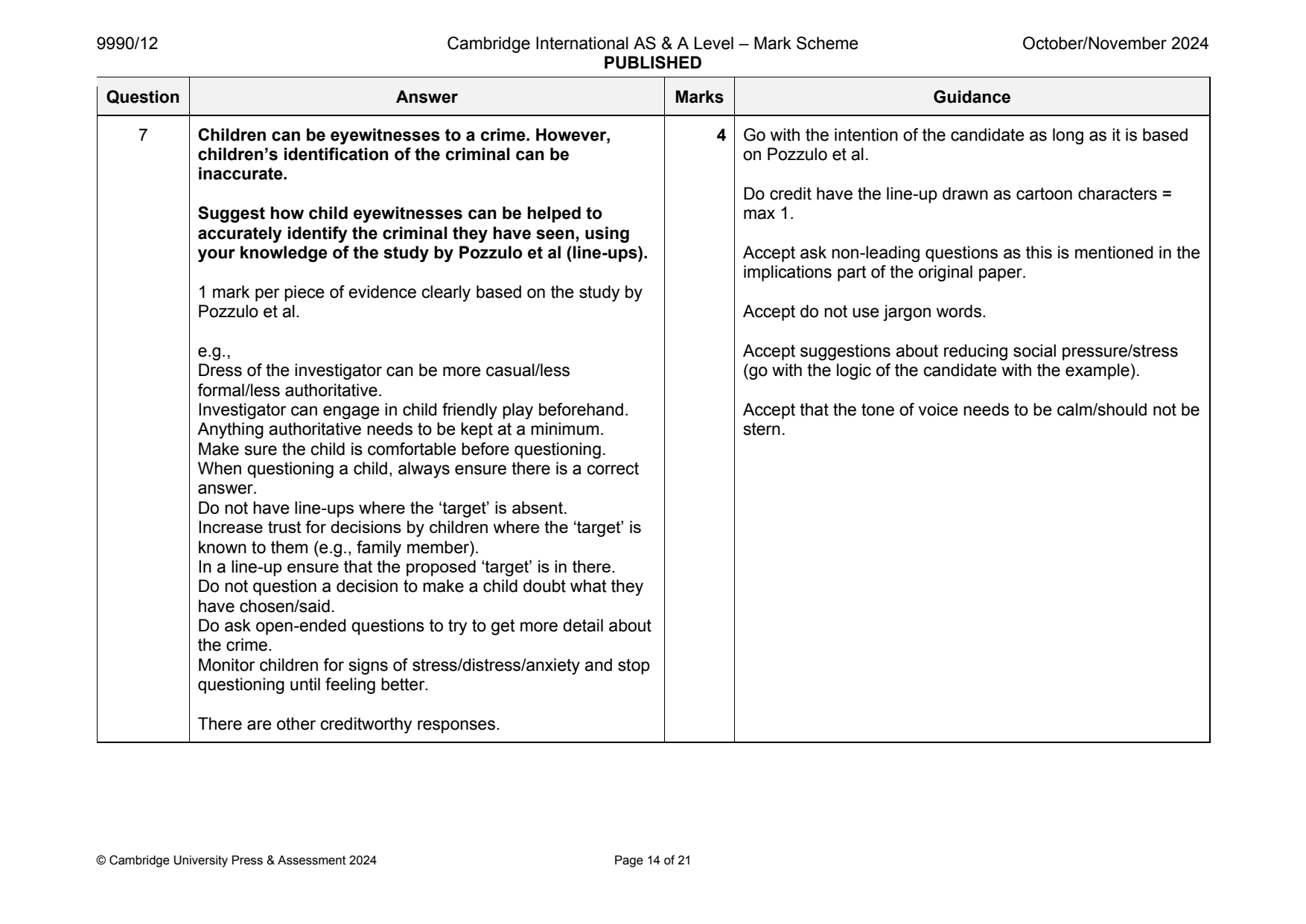
7 Children can be eyewitnesses to a crime. However, 4 Go with the intention of the candidate as long as it is based
children’s identification of the criminal can be on Pozzulo et al.
inaccurate.
Do credit have the line-up drawn as cartoon characters =
Suggest how child eyewitnesses can be helped to max 1.
accurately identify the criminal they have seen, using
your knowledge of the study by Pozzulo et al (line-ups). Accept ask non-leading questions as this is mentioned in the
implications part of the original paper.
1 mark per piece of evidence clearly based on the study by
Pozzulo et al. Accept do not use jargon words.
e.g., Accept suggestions about reducing social pressure/stress
Dress of the investigator can be more casual/less (go with the logic of the candidate with the example).
formal/less authoritative.
Investigator can engage in child friendly play beforehand. Accept that the tone of voice needs to be calm/should not be
Anything authoritative needs to be kept at a minimum. stern.
Make sure the child is comfortable before questioning.
When questioning a child, always ensure there is a correct
answer.
Do not have line-ups where the ‘target’ is absent.
Increase trust for decisions by children where the ‘target’ is
known to them (e.g., family member).
In a line-up ensure that the proposed ‘target’ is in there.
Do not question a decision to make a child doubt what they
have chosen/said.
Do ask open-ended questions to try to get more detail about
the crime.
Monitor children for signs of stress/distress/anxiety and stop
questioning until feeling better.
There are other creditworthy responses.
© Cambridge University Press & Assessment 2024 Page 14 of 21
Official mark scheme pages: 14 · source PDF URL
9990-2024-on-12-q10
Oct/Nov 2024 · Paper 12 · Question 10 · 10 marks
10 Evaluate the study by Andrade (doodling) in terms of 10
two strengths and two weaknesses. At least one of your
evaluation points must be about the sampling technique
used.
Strengths include: reliability, standardisation, validity
(internal), sampling technique
Weaknesses include: validity (external), sample, ethics,
sampling technique
Example: in detail
One control was the participants in the doodling group being
encouraged to doodle (in the hope of it affecting
concentration), so Andrade could be more confident it was
the IV (doodling or not) affecting the DV (memory
recall/concentration/level of attention).
Example: brief but in context
There was a standardised procedure. For example, the
telephone message was the same for all participants. This
increases the reliability of the study.
Example: no context
There were controls in place so they could establish cause
and effect/has internal validity.
© Cambridge University Press & Assessment 2024 Page 19 of 21
9990/12 Cambridge International AS & A Level – Mark Scheme October/November 2024
PUBLISHED
Question Answer Marks Guidance
10
Level Description Mark
5 • Very good evaluation including the 9–10
named issue.
• Thoroughly addresses both strengths
and both weaknesses in detail.
• Selection of evidence is very thorough
and effective.
4 • Good evaluation including the named 7–8
issue.
• Addresses strengths and weaknesses
but may include three or four points.
The majority of the points are in
depth.
• Selection of evidence is thorough and
effective.
3 • Mostly appropriate evaluation but may 5–6
not include the named issue.
• Addresses either two strengths or two
weaknesses in detail or one of each
in detail or all four briefly.
• Selection of evidence is mostly
effective.
2 • Weak evaluation and may not include 3–4
the named issue.
• Addresses either a strength or a
weakness. Evaluation points are brief.
• Some points may have no context.
• Selection of evidence is sometimes
appropriate.
© Cambridge University Press & Assessment 2024 Page 20 of 21
9990/12 Cambridge International AS & A Level – Mark Scheme October/November 2024
PUBLISHED
Question Answer Marks Guidance
10
1 • Little or no evaluation. 1–2
• Discussion of strengths and
weaknesses is absent or superficial.
• Selection of evidence is limited.
0 No creditable response.
© Cambridge University Press & Assessment 2024 Page 21 of 21
Official mark scheme pages: 19, 20, 21 · source PDF URL
9990-2024-on-13-q04
Oct/Nov 2024 · Paper 13 · Question 4 · 5 marks
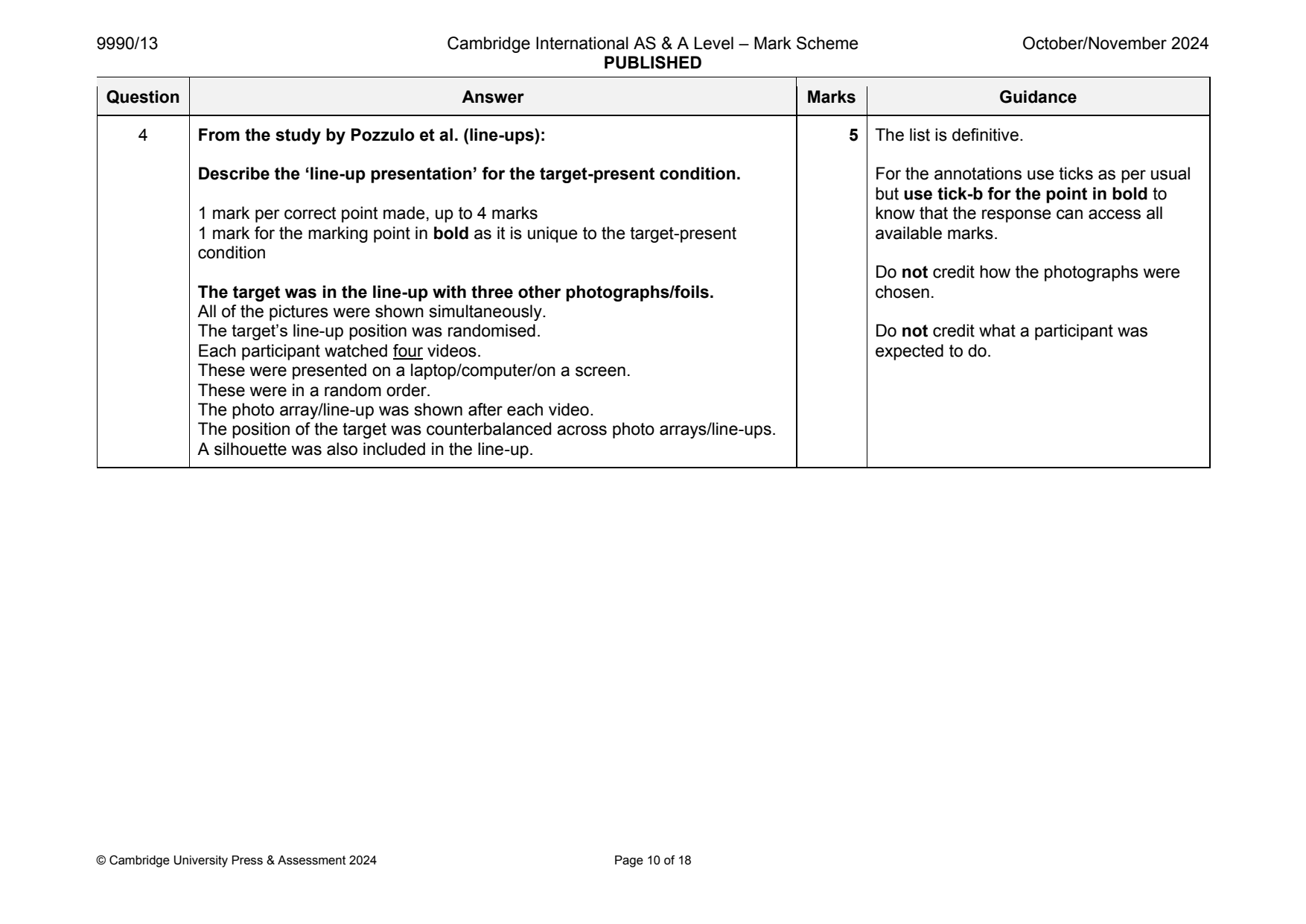
4 From the study by Pozzulo et al. (line-ups): 5 The list is definitive.
Describe the ‘line-up presentation’ for the target-present condition. For the annotations use ticks as per usual
but use tick-b for the point in bold to
1 mark per correct point made, up to 4 marks know that the response can access all
1 mark for the marking point in bold as it is unique to the target-present available marks.
condition
Do not credit how the photographs were
The target was in the line-up with three other photographs/foils. chosen.
All of the pictures were shown simultaneously.
The target’s line-up position was randomised. Do not credit what a participant was
Each participant watched four videos. expected to do.
These were presented on a laptop/computer/on a screen.
These were in a random order.
The photo array/line-up was shown after each video.
The position of the target was counterbalanced across photo arrays/line-ups.
A silhouette was also included in the line-up.
© Cambridge University Press & Assessment 2024 Page 10 of 18
Official mark scheme pages: 10 · source PDF URL
9990-2024-on-13-q06
Oct/Nov 2024 · Paper 13 · Question 6 · 6 marks
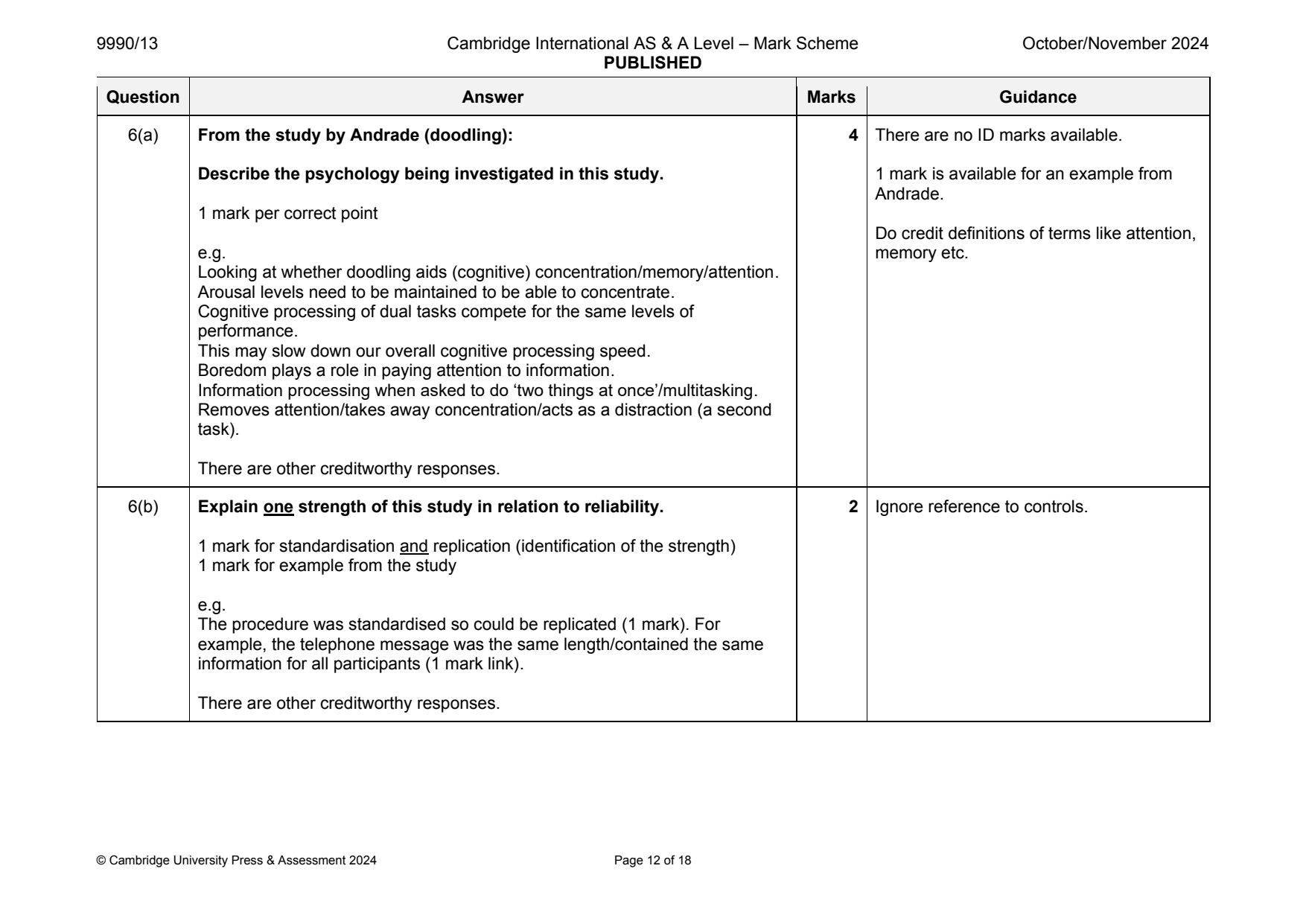
6(a) From the study by Andrade (doodling): 4 There are no ID marks available.
Describe the psychology being investigated in this study. 1 mark is available for an example from
Andrade.
1 mark per correct point
Do credit definitions of terms like attention,
e.g. memory etc.
Looking at whether doodling aids (cognitive) concentration/memory/attention.
Arousal levels need to be maintained to be able to concentrate.
Cognitive processing of dual tasks compete for the same levels of
performance.
This may slow down our overall cognitive processing speed.
Boredom plays a role in paying attention to information.
Information processing when asked to do ‘two things at once’/multitasking.
Removes attention/takes away concentration/acts as a distraction (a second
task).
There are other creditworthy responses.
6(b) Explain one strength of this study in relation to reliability. 2 Ignore reference to controls.
1 mark for standardisation and replication (identification of the strength)
1 mark for example from the study
e.g.
The procedure was standardised so could be replicated (1 mark). For
example, the telephone message was the same length/contained the same
information for all participants (1 mark link).
There are other creditworthy responses.
© Cambridge University Press & Assessment 2024 Page 12 of 18
Official mark scheme pages: 12 · source PDF URL
9990-2025-m-12-q04
March 2025 · Paper 12 · Question 4 · 3 marks
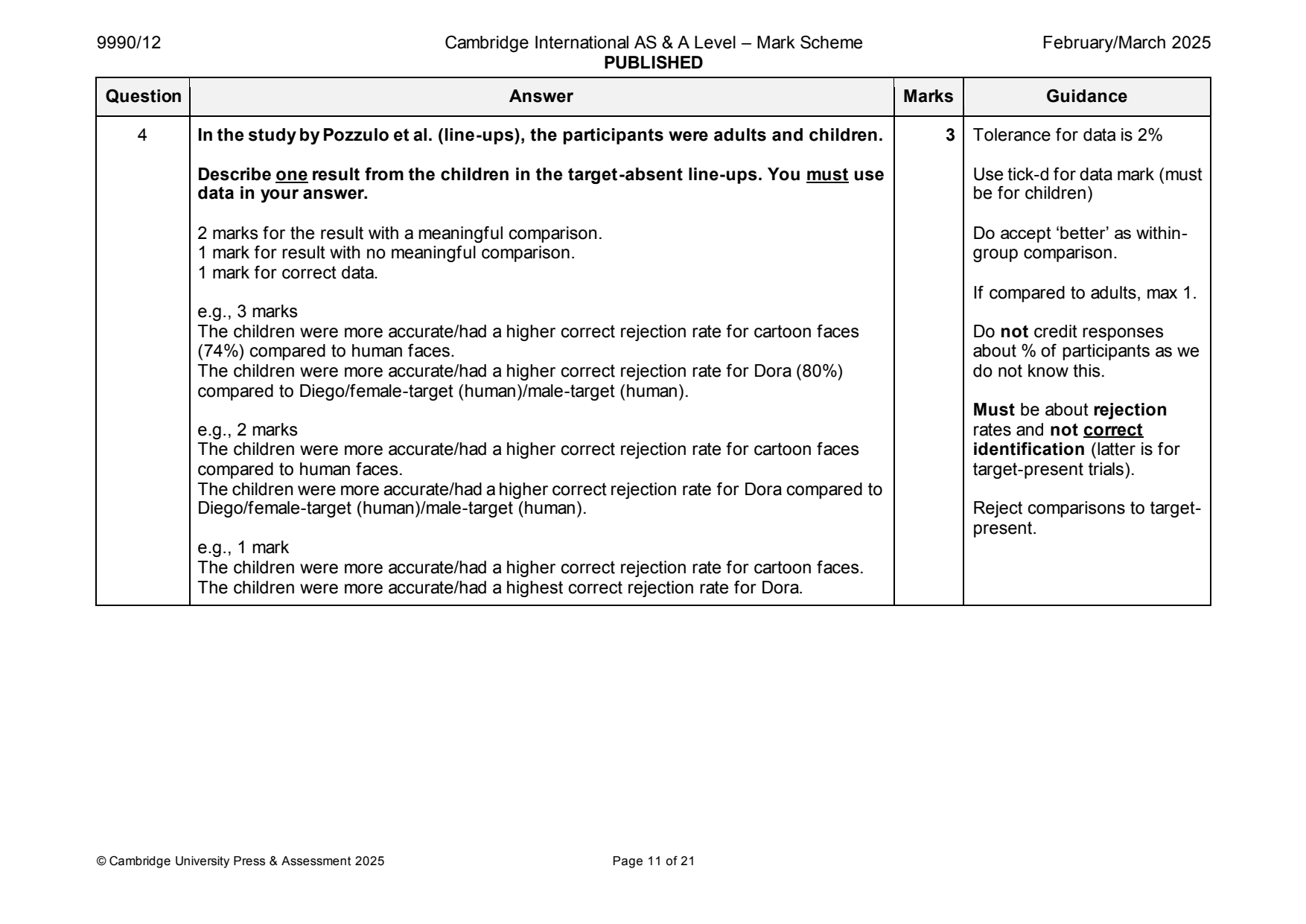
4 In the study by Pozzulo et al. (line-ups), the participants were adults and children. 3 Tolerance for data is 2%
Describe one result from the children in the target-absent line-ups. You must use Use tick-d for data mark (must
data in your answer. be for children)
2 marks for the result with a meaningful comparison. Do accept ‘better’ as within-
1 mark for result with no meaningful comparison. group comparison.
1 mark for correct data.
If compared to adults, max 1.
e.g., 3 marks
The children were more accurate/had a higher correct rejection rate for cartoon faces Do not credit responses
(74%) compared to human faces. about % of participants as we
The children were more accurate/had a higher correct rejection rate for Dora (80%) do not know this.
compared to Diego/female-target (human)/male-target (human).
Must be about rejection
e.g., 2 marks rates and not correct
The children were more accurate/had a higher correct rejection rate for cartoon faces identification (latter is for
compared to human faces. target-present trials).
The children were more accurate/had a higher correct rejection rate for Dora compared to
Diego/female-target (human)/male-target (human). Reject comparisons to target-
present.
e.g., 1 mark
The children were more accurate/had a higher correct rejection rate for cartoon faces.
The children were more accurate/had a highest correct rejection rate for Dora.
© Cambridge University Press & Assessment 2025 Page 11 of 21
Official mark scheme pages: 11 · source PDF URL
9990-2025-m-12-q05
March 2025 · Paper 12 · Question 5 · 4 marks
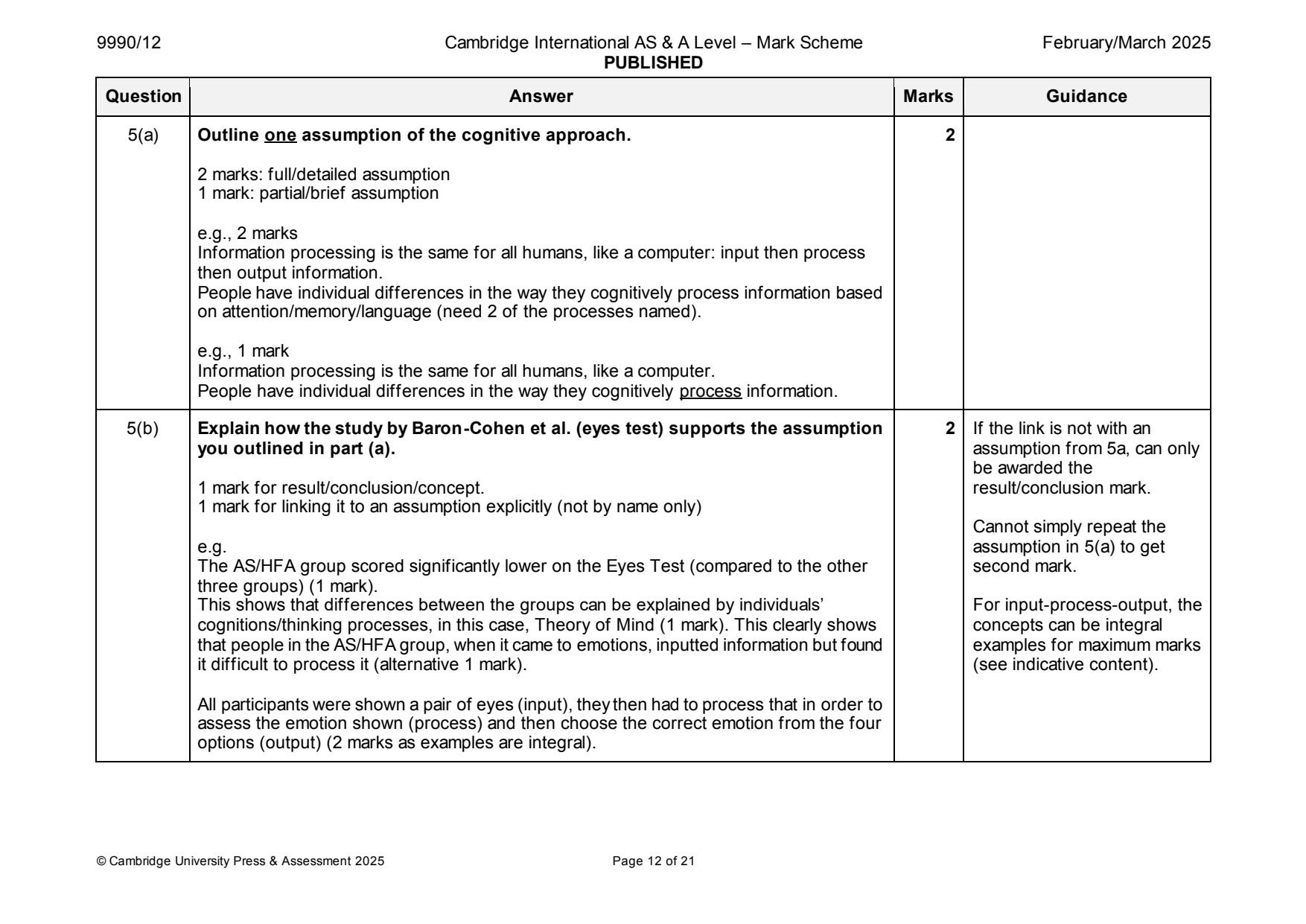
5(a) Outline one assumption of the cognitive approach. 2
2 marks: full/detailed assumption
1 mark: partial/brief assumption
e.g., 2 marks
Information processing is the same for all humans, like a computer: input then process
then output information.
People have individual differences in the way they cognitively process information based
on attention/memory/language (need 2 of the processes named).
e.g., 1 mark
Information processing is the same for all humans, like a computer.
People have individual differences in the way they cognitively process information.
5(b) Explain how the study by Baron-Cohen et al. (eyes test) supports the assumption 2 If the link is not with an
you outlined in part (a). assumption from 5a, can only
be awarded the
1 mark for result/conclusion/concept. result/conclusion mark.
1 mark for linking it to an assumption explicitly (not by name only)
Cannot simply repeat the
e.g. assumption in 5(a) to get
The AS/HFA group scored significantly lower on the Eyes Test (compared to the other second mark.
three groups) (1 mark).
This shows that differences between the groups can be explained by individuals’ For input-process-output, the
cognitions/thinking processes, in this case, Theory of Mind (1 mark). This clearly shows concepts can be integral
that people in the AS/HFA group, when it came to emotions, inputted information but found examples for maximum marks
it difficult to process it (alternative 1 mark). (see indicative content).
All participants were shown a pair of eyes (input), they then had to process that in order to
assess the emotion shown (process) and then choose the correct emotion from the four
options (output) (2 marks as examples are integral).
© Cambridge University Press & Assessment 2025 Page 12 of 21
Official mark scheme pages: 12 · source PDF URL
9990-2025-m-12-q07
March 2025 · Paper 12 · Question 7 · 5 marks
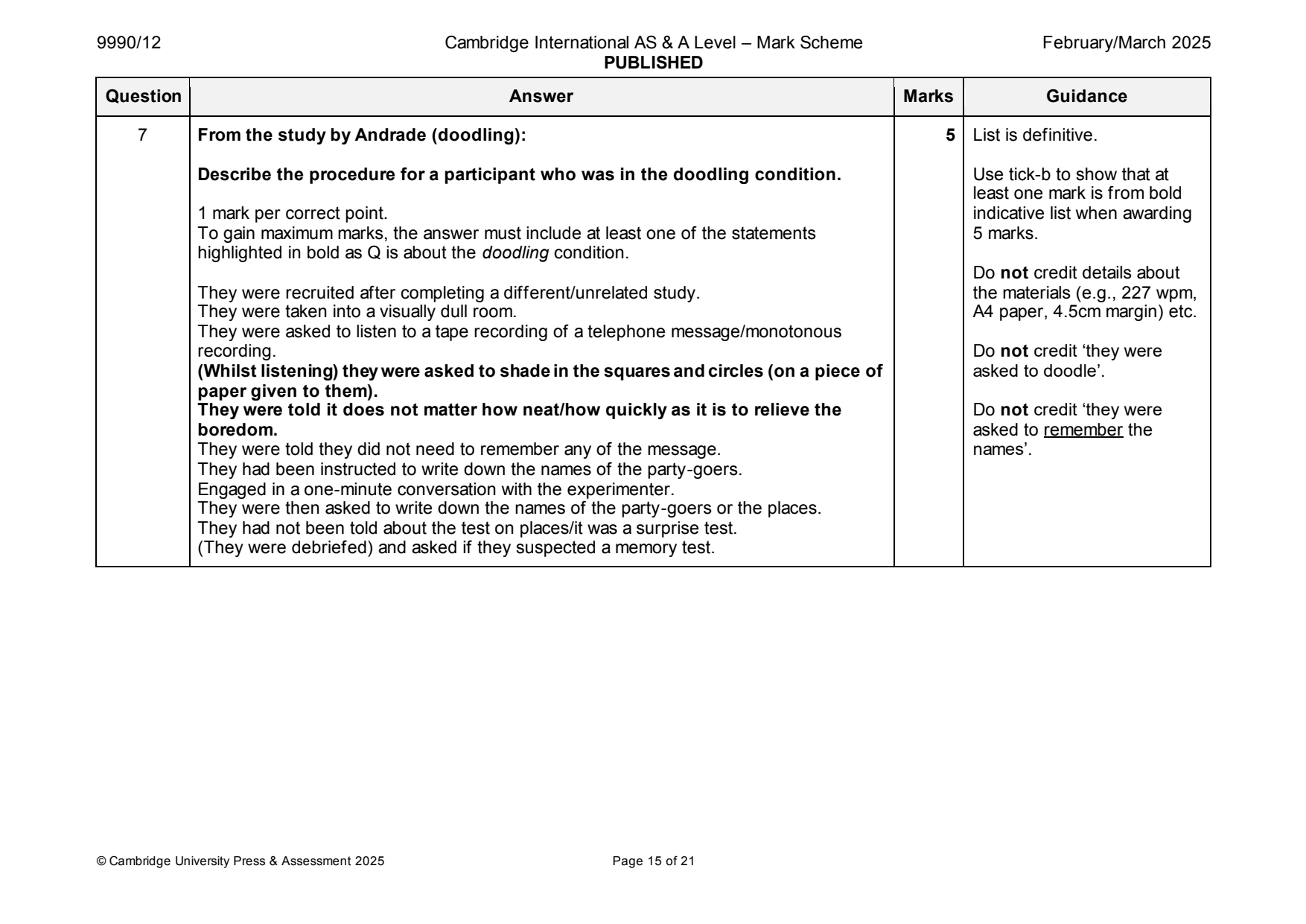
7 From the study by Andrade (doodling): 5 List is definitive.
Describe the procedure for a participant who was in the doodling condition. Use tick-b to show that at
least one mark is from bold
1 mark per correct point. indicative list when awarding
To gain maximum marks, the answer must include at least one of the statements 5 marks.
highlighted in bold as Q is about the doodling condition.
Do not credit details about
They were recruited after completing a different/unrelated study. the materials (e.g., 227 wpm,
They were taken into a visually dull room. A4 paper, 4.5cm margin) etc.
They were asked to listen to a tape recording of a telephone message/monotonous
recording. Do not credit ‘they were
(Whilst listening) they were asked to shade in the squares and circles (on a piece of asked to doodle’.
paper given to them).
They were told it does not matter how neat/how quickly as it is to relieve the Do not credit ‘they were
boredom. asked to remember the
They were told they did not need to remember any of the message. names’.
They had been instructed to write down the names of the party-goers.
Engaged in a one-minute conversation with the experimenter.
They were then asked to write down the names of the party-goers or the places.
They had not been told about the test on places/it was a surprise test.
(They were debriefed) and asked if they suspected a memory test.
© Cambridge University Press & Assessment 2025 Page 15 of 21
Official mark scheme pages: 15 · source PDF URL
9990-2025-mj-11-q06
May/June 2025 · Paper 11 · Question 6 · 7 marks
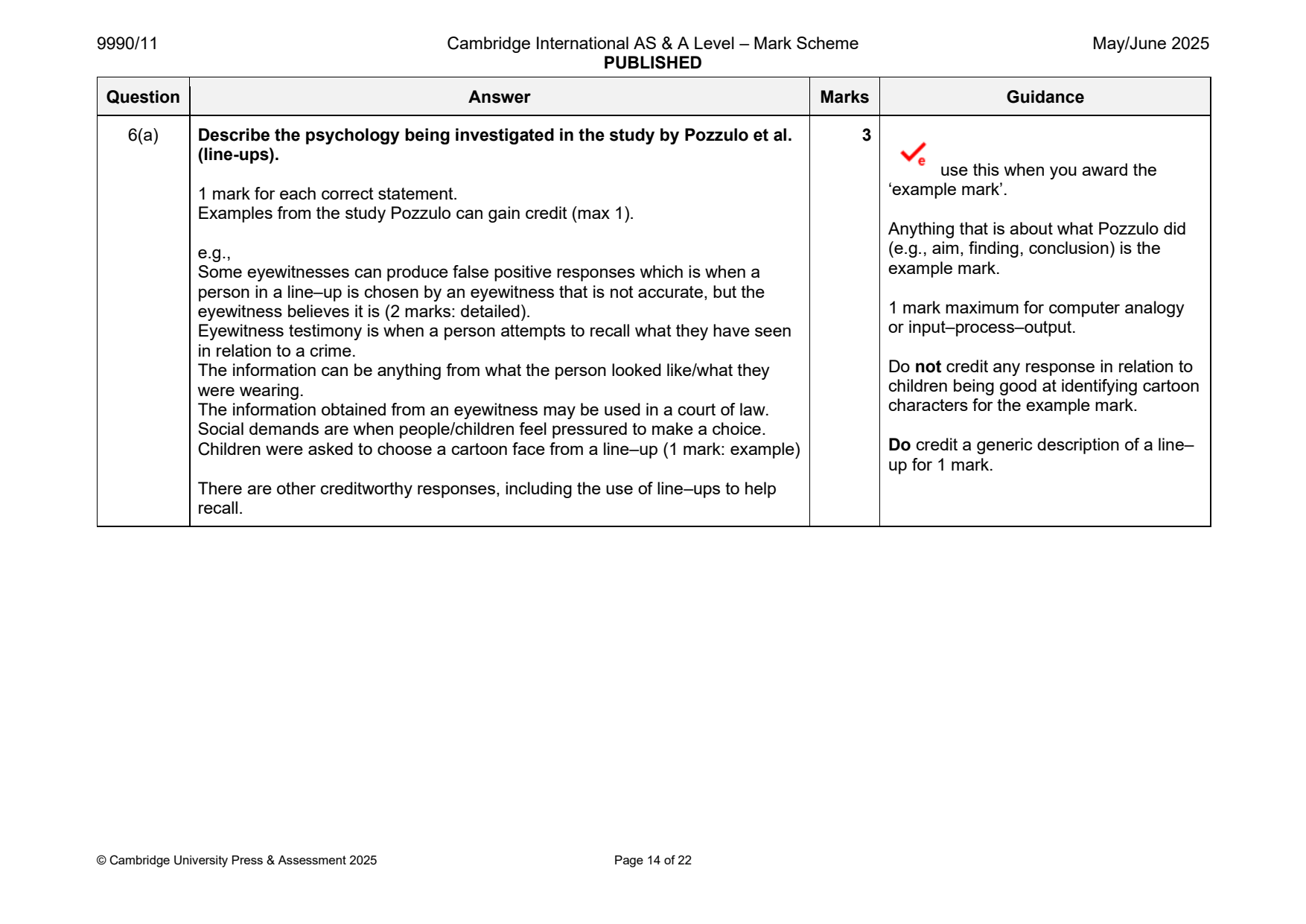
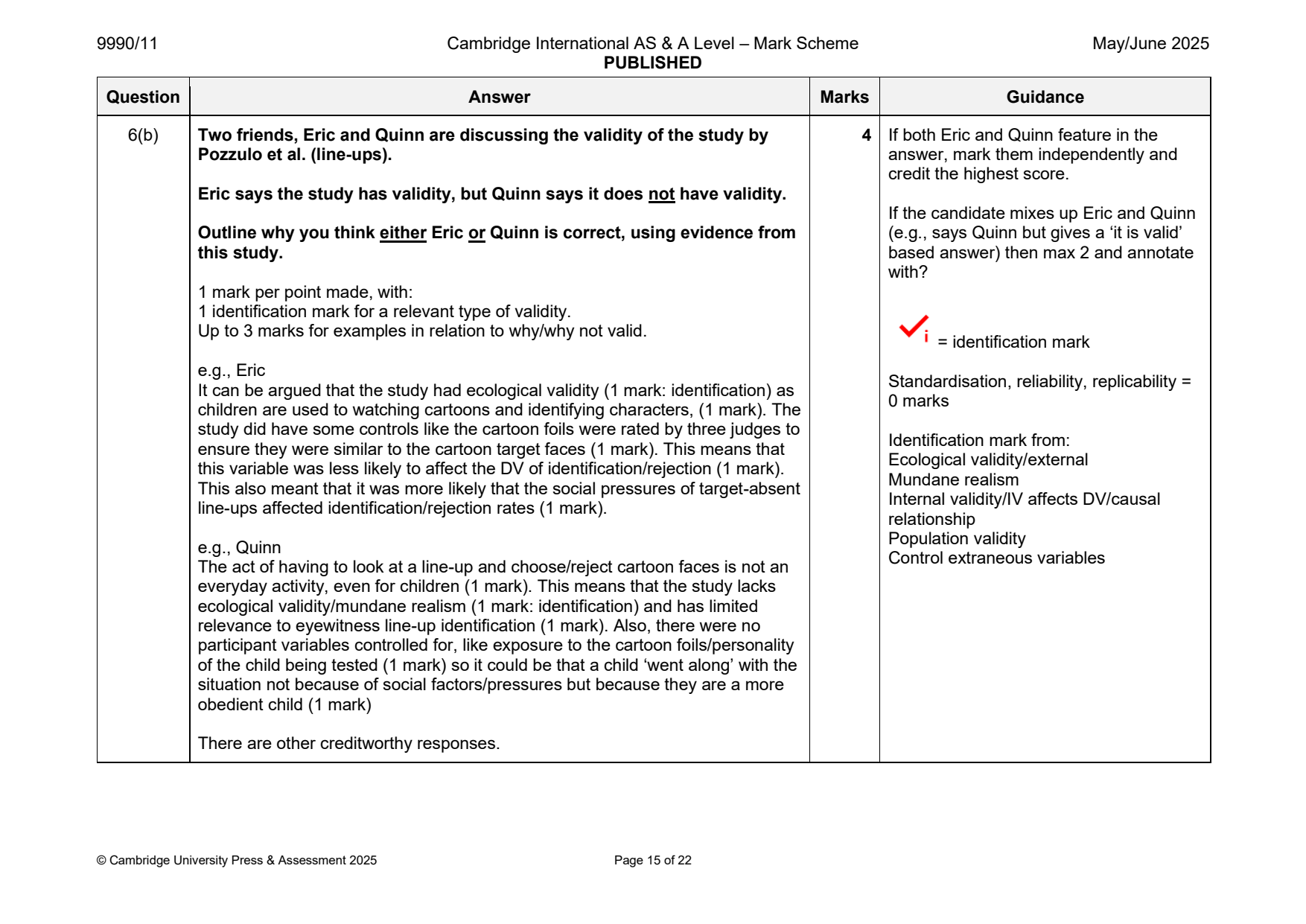
6(a) Describe the psychology being investigated in the study by Pozzulo et al. 3
(line-ups).
use this when you award the
1 mark for each correct statement. ‘example mark’.
Examples from the study Pozzulo can gain credit (max 1).
Anything that is about what Pozzulo did
e.g., (e.g., aim, finding, conclusion) is the
Some eyewitnesses can produce false positive responses which is when a example mark.
person in a line–up is chosen by an eyewitness that is not accurate, but the
eyewitness believes it is (2 marks: detailed). 1 mark maximum for computer analogy
Eyewitness testimony is when a person attempts to recall what they have seen or input–process–output.
in relation to a crime.
The information can be anything from what the person looked like/what they Do not credit any response in relation to
were wearing. children being good at identifying cartoon
The information obtained from an eyewitness may be used in a court of law. characters for the example mark.
Social demands are when people/children feel pressured to make a choice.
Children were asked to choose a cartoon face from a line–up (1 mark: example) Do credit a generic description of a line–
up for 1 mark.
There are other creditworthy responses, including the use of line–ups to help
recall.
© Cambridge University Press & Assessment 2025 Page 14 of 22
6(b) Two friends, Eric and Quinn are discussing the validity of the study by 4 If both Eric and Quinn feature in the
Pozzulo et al. (line-ups). answer, mark them independently and
credit the highest score.
Eric says the study has validity, but Quinn says it does not have validity.
If the candidate mixes up Eric and Quinn
Outline why you think either Eric or Quinn is correct, using evidence from (e.g., says Quinn but gives a ‘it is valid’
this study. based answer) then max 2 and annotate
with?
1 mark per point made, with:
1 identification mark for a relevant type of validity.
Up to 3 marks for examples in relation to why/why not valid.
= identification mark
e.g., Eric
Standardisation, reliability, replicability =
It can be argued that the study had ecological validity (1 mark: identification) as
0 marks
children are used to watching cartoons and identifying characters, (1 mark). The
study did have some controls like the cartoon foils were rated by three judges to
Identification mark from:
ensure they were similar to the cartoon target faces (1 mark). This means that
Ecological validity/external
this variable was less likely to affect the DV of identification/rejection (1 mark).
Mundane realism
This also meant that it was more likely that the social pressures of target-absent
Internal validity/IV affects DV/causal
line-ups affected identification/rejection rates (1 mark).
relationship
Population validity
e.g., Quinn
Control extraneous variables
The act of having to look at a line-up and choose/reject cartoon faces is not an
everyday activity, even for children (1 mark). This means that the study lacks
ecological validity/mundane realism (1 mark: identification) and has limited
relevance to eyewitness line-up identification (1 mark). Also, there were no
participant variables controlled for, like exposure to the cartoon foils/personality
of the child being tested (1 mark) so it could be that a child ‘went along’ with the
situation not because of social factors/pressures but because they are a more
obedient child (1 mark)
There are other creditworthy responses.
© Cambridge University Press & Assessment 2025 Page 15 of 22
Official mark scheme pages: 14, 15 · source PDF URL
9990-2025-mj-11-q09
May/June 2025 · Paper 11 · Question 9 · 12 marks
9(a) In the study by Andrade (doodling), the sample size was 40 participants. 4 List is definitive.
Describe the sample of participants used in this study, other than the Do not accept members of the Medical
sample size of 40. Research Council or that they were
students.
1 mark for correct point.
Do accept psychology panel, research
Recruited via opportunity sampling. panel, research unit etc.
They had just finished a different study (before being asked to participate in this
one).
Members of a university participant panel/Applied Psychology Unit.
General population.
Aged 18–55 years.
Paid for participation.
Majority female/35 females/5 males.
Doodling group = Female 17/Male 3 or Control group = Female 18/Male 2.
© Cambridge University Press & Assessment 2025 Page 18 of 22
9(b) Explain two differences between the study by Andrade (doodling) and one 8 The other cognitive approach studies are
other study from the cognitive approach. Do not refer to the sample of Baron–Cohen and Pozzulo.
participants.
Do not credit any answer about the
Use the marking grid below. sample but do credit sampling technique.
4 marks for each difference, e.g., qualitative data collection, experimental
design used, cognitive skills be assessed, individual-situation arguments, Award L1–L4 for each difference
sampling techniques, use of a control group, levels of mundane realism.
For Level 4 there must be some attempt
Each difference must be based on psychological principles. at explaining the difference.
e.g., 4 marks All of the following are L1 max:
The studies by Andrade and Pozzulo used different experimental designs within Different aims/psychology
them. Andrade was only independent groups with participants being placed in Andrade using deception or is unethical.
the doodling or control group. Part of the Pozzulo study was repeated measures Audio vs. visual
as all participants saw target absent and target present line-ups. Therefore, in The procedures were different
Andrade Ps only participated in one level of the IV whilst in Pozzulo Ps
participated in multiple levels of the IV (explanation). All of the following are L0:
Standardisation comparisons
e.g., 3 marks Different conclusions
The studies by Andrade and Pozzulo used different experimental designs within Different number of groups
them. Andrade was only independent groups with participants being placed in
the doodling or control group. Part of the Pozzulo study was repeated If response is about Baron–Cohen being
measures. Matched Pairs = L2 max.
e.g., 2 marks
Andrade used only independent measures whilst Pozzulo used repeated
measures for part of the study.
e.g., 1 mark
Andrade and Pozzulo used different experimental designs.
© Cambridge University Press & Assessment 2025 Page 19 of 22
9(b)
Mark/ Description
Level
4 The difference is well explained using both studies as examples.
3 The difference is well explained but only one study is used as an
example OR
both studies are used briefly.
2 The difference is brief with an attempt at using at least one study
as an example OR
The difference is well explained but there is no study evidence.
1 The difference is brief with no attempt at using the studies as
examples.
0 No creditable response.
© Cambridge University Press & Assessment 2025 Page 20 of 22
Official mark scheme pages: 18, 19, 20 · source PDF URL
9990-2025-mj-12-q02
May/June 2025 · Paper 12 · Question 2 · 4 marks
2(a) From the study by Pozzulo et al. (line-ups). 2 List is definitive.
Identify two features of the female used as a ‘human Accept ‘white’.
face target’. Accept ‘combing hair’.
1 mark per correct point.
Caucasian.
Student.
22 years old.
(she was) brushing her hair (in bathroom).
© Cambridge University Press & Assessment 2025 Page 9 of 25
2(b) Explain one strength of this study in relation to 2 Ignore reference to controls only.
reliability.
1 mark for standardisation and replication (identification of
the strength)
1 mark for example from the study
e.g.
The procedure was standardised so could be replicated (1
mark). For example, every participant saw all four videos in
a random order (1 mark link).
There are other creditworthy responses.
Question Answer Marks Guidance
Official mark scheme pages: 9, 10 · source PDF URL
9990-2025-mj-12-q10
May/June 2025 · Paper 12 · Question 10 · 10 marks
10 Evaluate the study by Baron-Cohen et al. (eyes test) in 10
terms of two strengths and two weaknesses. At least
one of your evaluation points must be about
quantitative data.
Strengths include: reliability (standardisation), quantitative
data, validity.
Weaknesses include: ecological validity, ethics,
generalisability, quantitative data.
Example: in detail (named issue)
The study collected quantitative data which makes it easier
to make meaningful comparisons between groups/conditions
(as you compare like with like). They counted the number of
correct emotions identified from looking at the eyes. As a
result, they could compare performance across the four
groups of participants to see any trends/differences between
the AS/HFA groups and the other three groups.
Example: brief but in context
The sample for the AS/HFA group was 15 males which may
make generalisation difficult and may not represent females
with AS/HFA.
Example: no context
There was a standardised procedure meaning it could be
replicated/tested for reliability.
© Cambridge University Press & Assessment 2025 Page 23 of 25
9990/12 Cambridge International AS & A Level – Mark Scheme May/June 2025
PUBLISHED
Question Answer Marks Guidance
10
Level Description Marks
5 • Very good evaluation including the 9–10
named issue.
• Thoroughly addresses both
strengths and both weaknesses in
detail.
• Selection of evidence is very
thorough and effective.
4 • Good evaluation including the 7–8
named issue.
• Addresses strengths and
weaknesses but may include three
or four points. The majority of the
points are in depth.
• Selection of evidence is thorough
and effective.
3 • Mostly appropriate evaluation but 5–6
may not include the named issue.
• Addresses either two strengths or
two weaknesses in detail or one of
each in detail or all four briefly.
• Selection of evidence is mostly
effective.
© Cambridge University Press & Assessment 2025 Page 24 of 25
9990/12 Cambridge International AS & A Level – Mark Scheme May/June 2025
PUBLISHED
Question Answer Marks Guidance
10
Level Description Marks
2 • Weak evaluation and may not 3–4
include the named issue.
• Addresses either a strength or a
weakness. Evaluation points are
brief.
• Some points may have no context.
• Selection of evidence is
sometimes appropriate.
1 • Little or no evaluation. 1–2
• Discussion of strengths and
weaknesses is absent or
superficial.
• Selection of evidence is limited.
0 • No creditable response. 0
© Cambridge University Press & Assessment 2025 Page 25 of 25
Official mark scheme pages: 23, 24, 25 · source PDF URL
9990-2025-mj-13-q08
May/June 2025 · Paper 13 · Question 8 · 4 marks
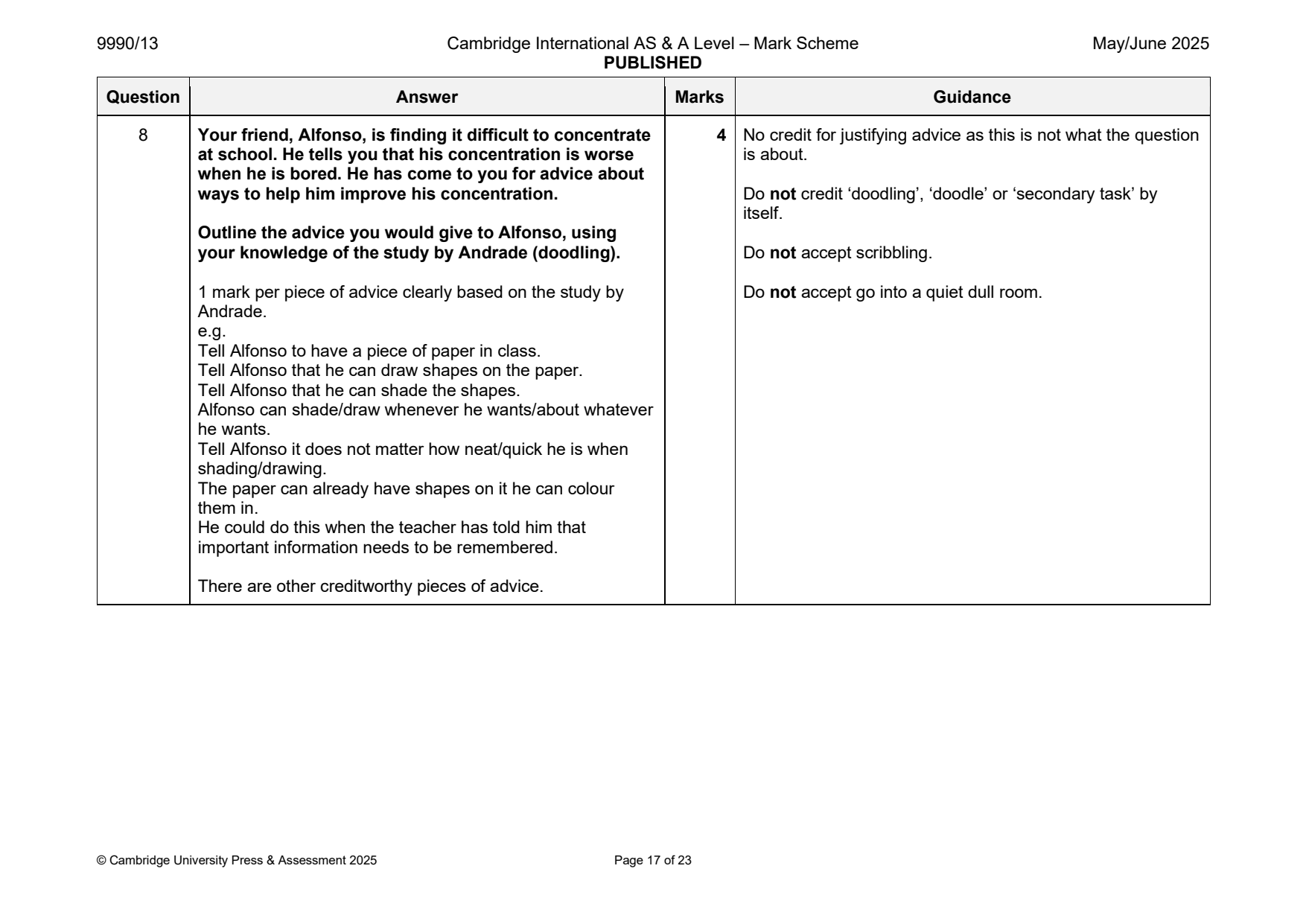
8 Your friend, Alfonso, is finding it difficult to concentrate 4 No credit for justifying advice as this is not what the question
at school. He tells you that his concentration is worse is about.
when he is bored. He has come to you for advice about
ways to help him improve his concentration. Do not credit ‘doodling’, ‘doodle’ or ‘secondary task’ by
itself.
Outline the advice you would give to Alfonso, using
your knowledge of the study by Andrade (doodling). Do not accept scribbling.
1 mark per piece of advice clearly based on the study by Do not accept go into a quiet dull room.
Andrade.
e.g.
Tell Alfonso to have a piece of paper in class.
Tell Alfonso that he can draw shapes on the paper.
Tell Alfonso that he can shade the shapes.
Alfonso can shade/draw whenever he wants/about whatever
he wants.
Tell Alfonso it does not matter how neat/quick he is when
shading/drawing.
The paper can already have shapes on it he can colour
them in.
He could do this when the teacher has told him that
important information needs to be remembered.
There are other creditworthy pieces of advice.
© Cambridge University Press & Assessment 2025 Page 17 of 23
Official mark scheme pages: 17 · source PDF URL
9990-2025-on-11-q05
Oct/Nov 2025 · Paper 11 · Question 5 · 4 marks
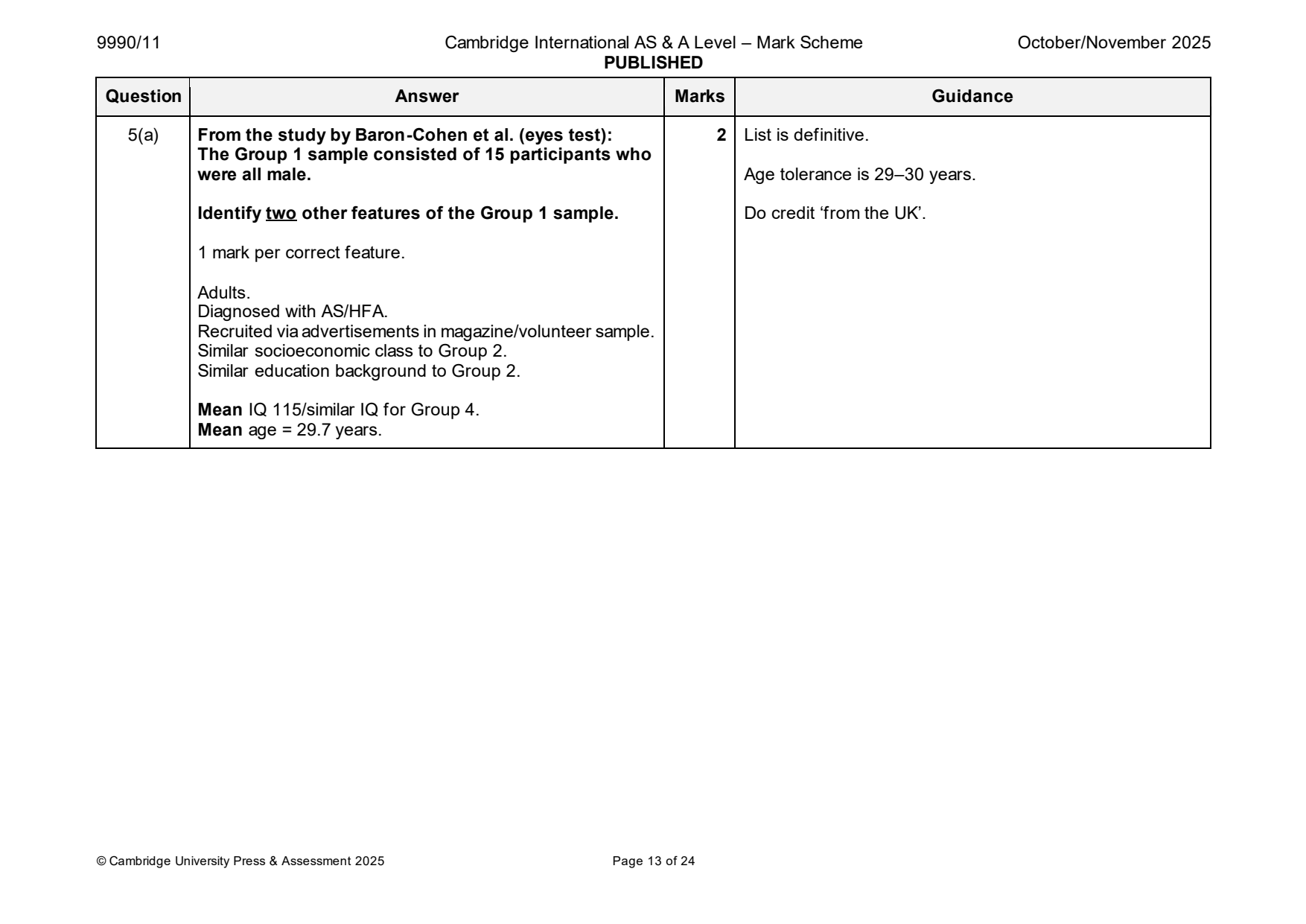
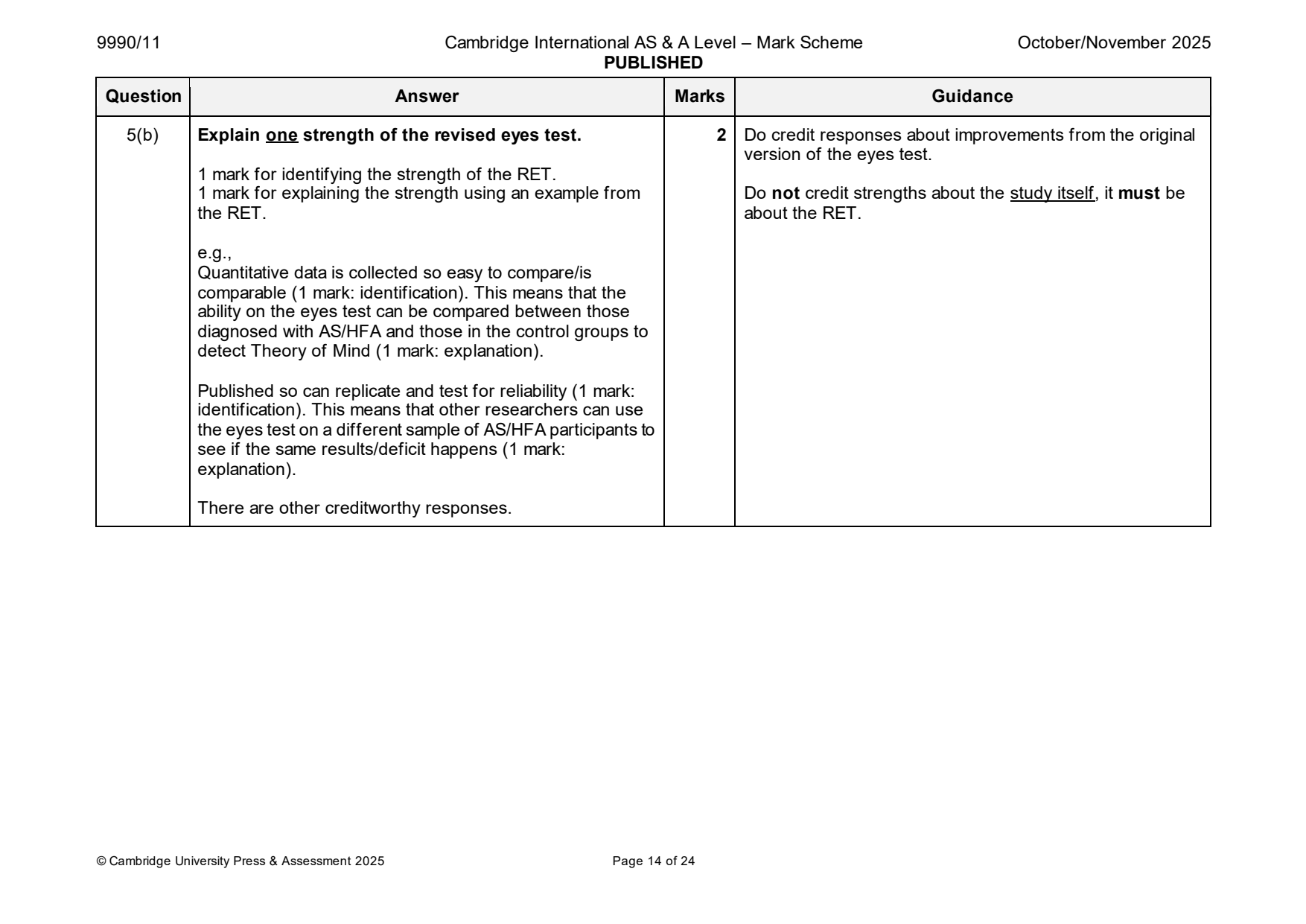
5(a) From the study by Baron-Cohen et al. (eyes test): 2 List is definitive.
The Group 1 sample consisted of 15 participants who
were all male. Age tolerance is 29–30 years.
Identify two other features of the Group 1 sample. Do credit ‘from the UK’.
1 mark per correct feature.
Adults.
Diagnosed with AS/HFA.
Recruited via advertisements in magazine/volunteer sample.
Similar socioeconomic class to Group 2.
Similar education background to Group 2.
Mean IQ 115/similar IQ for Group 4.
Mean age = 29.7 years.
© Cambridge University Press & Assessment 2025 Page 13 of 24
5(b) Explain one strength of the revised eyes test. 2 Do credit responses about improvements from the original
version of the eyes test.
1 mark for identifying the strength of the RET.
1 mark for explaining the strength using an example from Do not credit strengths about the study itself, it must be
the RET. about the RET.
e.g.,
Quantitative data is collected so easy to compare/is
comparable (1 mark: identification). This means that the
ability on the eyes test can be compared between those
diagnosed with AS/HFA and those in the control groups to
detect Theory of Mind (1 mark: explanation).
Published so can replicate and test for reliability (1 mark:
identification). This means that other researchers can use
the eyes test on a different sample of AS/HFA participants to
see if the same results/deficit happens (1 mark:
explanation).
There are other creditworthy responses.
© Cambridge University Press & Assessment 2025 Page 14 of 24
Official mark scheme pages: 13, 14 · source PDF URL
9990-2025-on-11-q06
Oct/Nov 2025 · Paper 11 · Question 6 · 7 marks
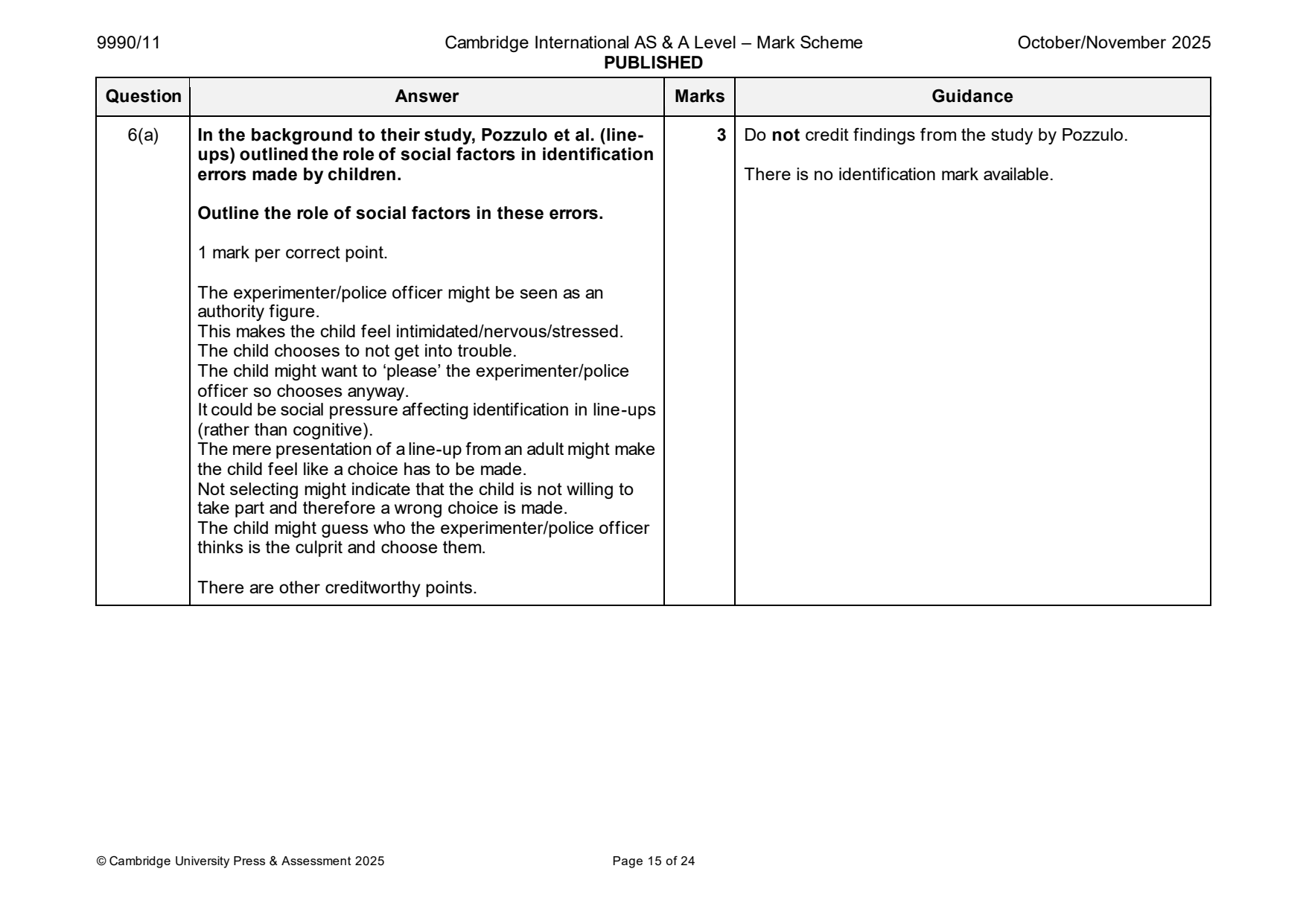
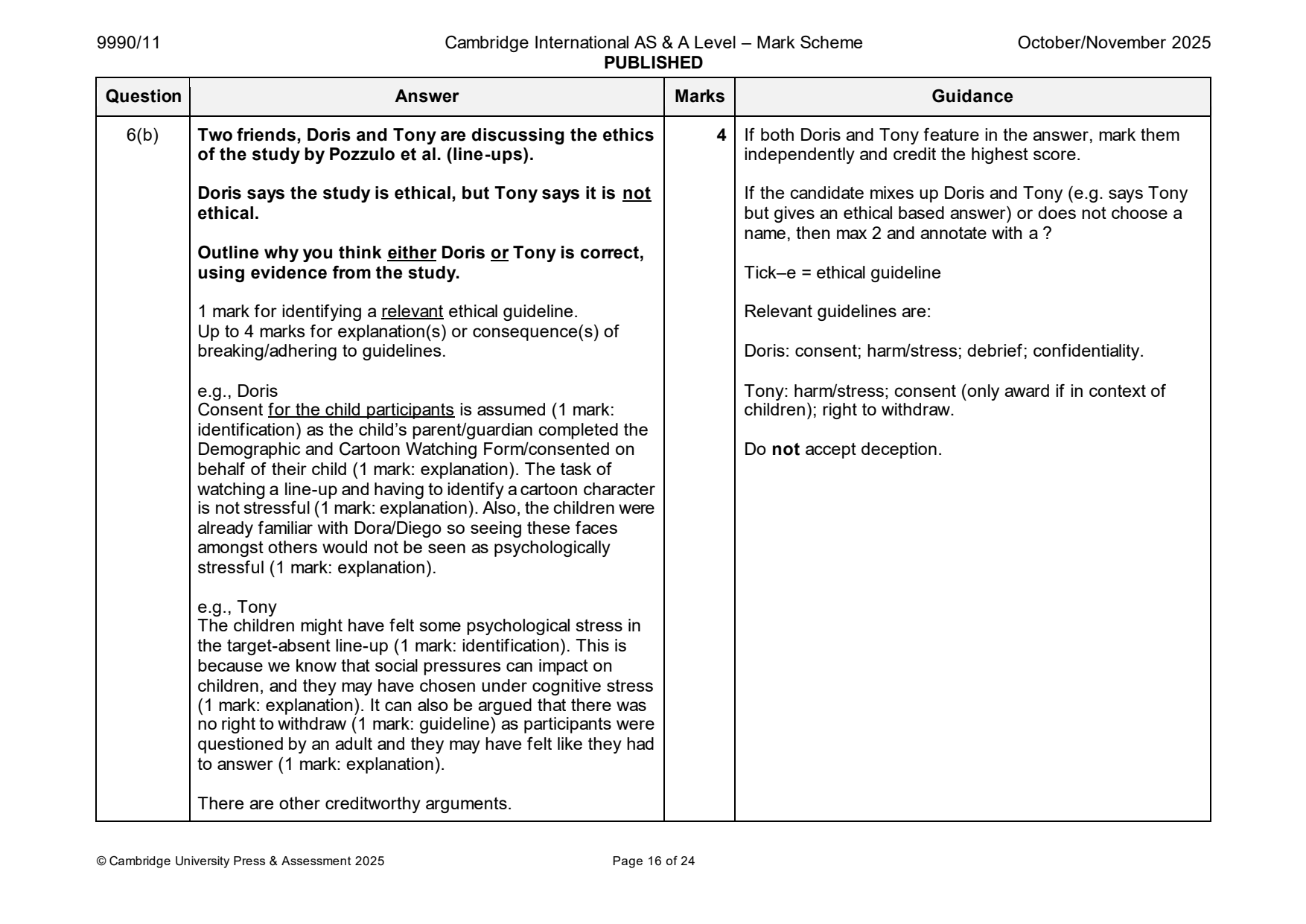
6(a) In the background to their study, Pozzulo et al. (line- 3 Do not credit findings from the study by Pozzulo.
ups) outlined the role of social factors in identification
errors made by children. There is no identification mark available.
Outline the role of social factors in these errors.
1 mark per correct point.
The experimenter/police officer might be seen as an
authority figure.
This makes the child feel intimidated/nervous/stressed.
The child chooses to not get into trouble.
The child might want to ‘please’ the experimenter/police
officer so chooses anyway.
It could be social pressure affecting identification in line-ups
(rather than cognitive).
The mere presentation of a line-up from an adult might make
the child feel like a choice has to be made.
Not selecting might indicate that the child is not willing to
take part and therefore a wrong choice is made.
The child might guess who the experimenter/police officer
thinks is the culprit and choose them.
There are other creditworthy points.
© Cambridge University Press & Assessment 2025 Page 15 of 24
6(b) Two friends, Doris and Tony are discussing the ethics 4 If both Doris and Tony feature in the answer, mark them
of the study by Pozzulo et al. (line-ups). independently and credit the highest score.
Doris says the study is ethical, but Tony says it is not If the candidate mixes up Doris and Tony (e.g. says Tony
ethical. but gives an ethical based answer) or does not choose a
name, then max 2 and annotate with a ?
Outline why you think either Doris or Tony is correct,
using evidence from the study. Tick–e = ethical guideline
1 mark for identifying a relevant ethical guideline. Relevant guidelines are:
Up to 4 marks for explanation(s) or consequence(s) of
breaking/adhering to guidelines. Doris: consent; harm/stress; debrief; confidentiality.
e.g., Doris Tony: harm/stress; consent (only award if in context of
Consent for the child participants is assumed (1 mark: children); right to withdraw.
identification) as the child’s parent/guardian completed the
Demographic and Cartoon Watching Form/consented on Do not accept deception.
behalf of their child (1 mark: explanation). The task of
watching a line-up and having to identify a cartoon character
is not stressful (1 mark: explanation). Also, the children were
already familiar with Dora/Diego so seeing these faces
amongst others would not be seen as psychologically
stressful (1 mark: explanation).
e.g., Tony
The children might have felt some psychological stress in
the target-absent line-up (1 mark: identification). This is
because we know that social pressures can impact on
children, and they may have chosen under cognitive stress
(1 mark: explanation). It can also be argued that there was
no right to withdraw (1 mark: guideline) as participants were
questioned by an adult and they may have felt like they had
to answer (1 mark: explanation).
There are other creditworthy arguments.
© Cambridge University Press & Assessment 2025 Page 16 of 24
Official mark scheme pages: 15, 16 · source PDF URL
9990-2025-on-12-q08
Oct/Nov 2025 · Paper 12 · Question 8 · 6 marks
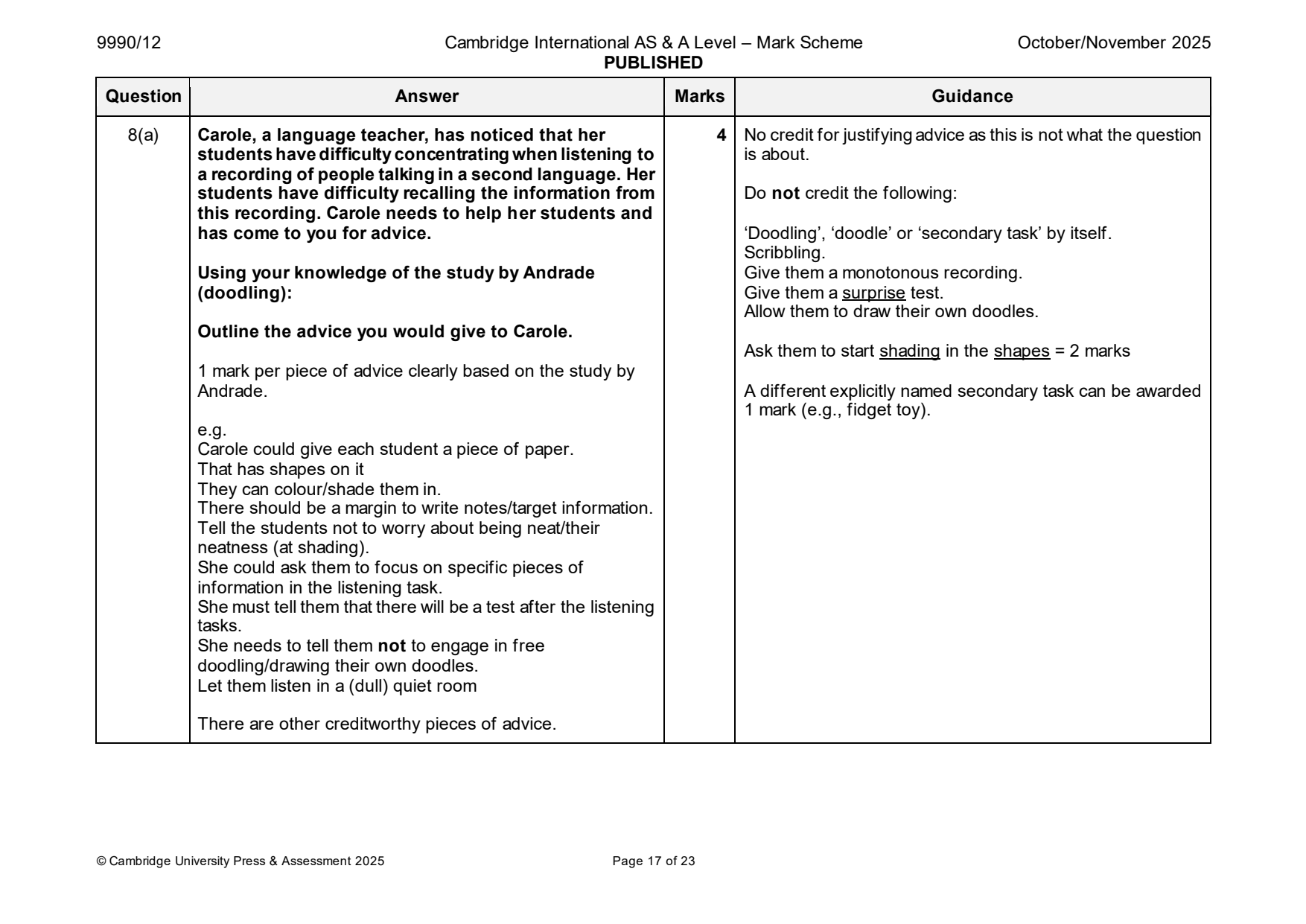
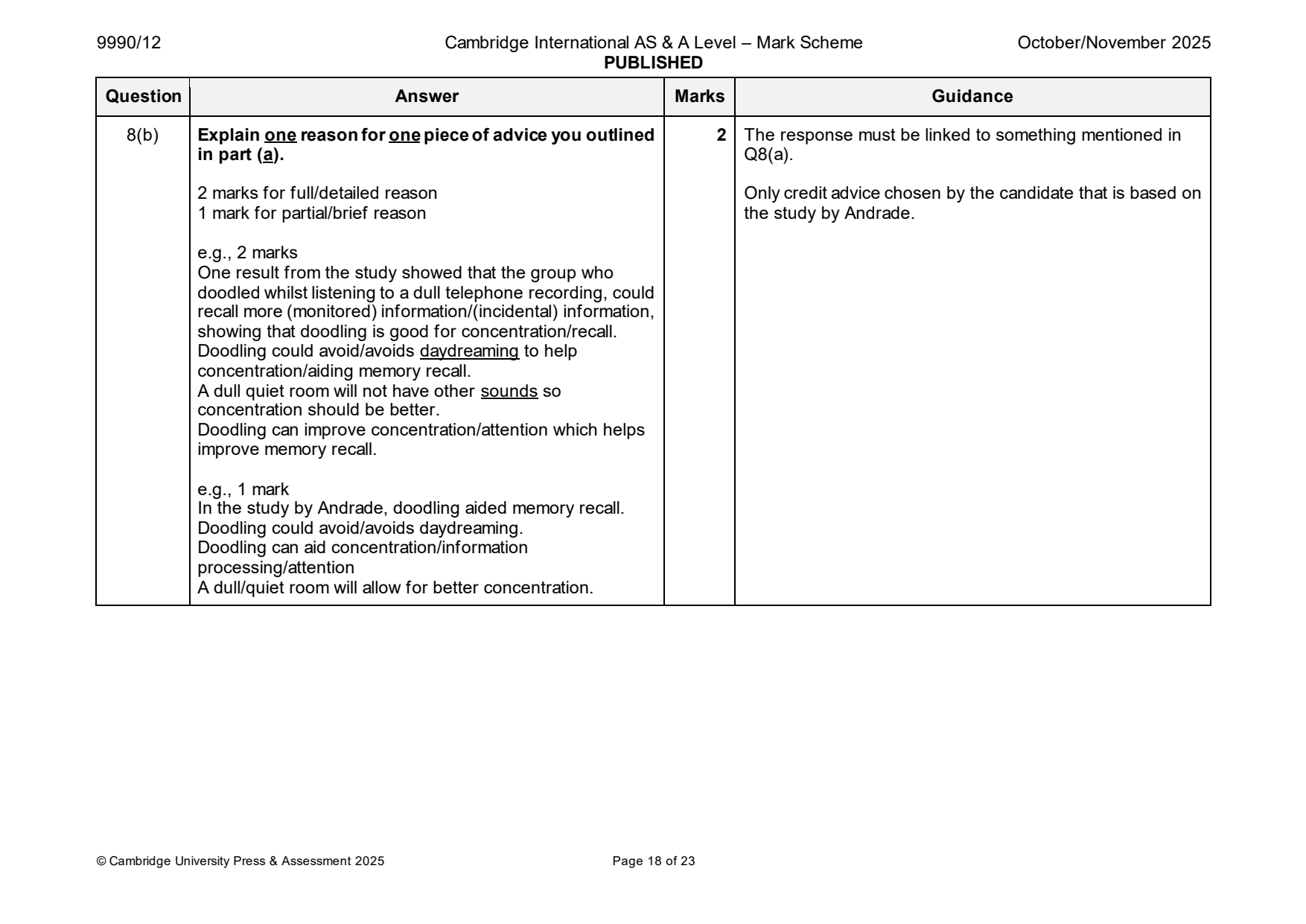
8(a) Carole, a language teacher, has noticed that her 4 No credit for justifying advice as this is not what the question
students have difficulty concentrating when listening to is about.
a recording of people talking in a second language. Her
students have difficulty recalling the information from Do not credit the following:
this recording. Carole needs to help her students and
has come to you for advice. ‘Doodling’, ‘doodle’ or ‘secondary task’ by itself.
Scribbling.
Using your knowledge of the study by Andrade Give them a monotonous recording.
(doodling): Give them a surprise test.
Allow them to draw their own doodles.
Outline the advice you would give to Carole.
Ask them to start shading in the shapes = 2 marks
1 mark per piece of advice clearly based on the study by
Andrade. A different explicitly named secondary task can be awarded
1 mark (e.g., fidget toy).
e.g.
Carole could give each student a piece of paper.
That has shapes on it
They can colour/shade them in.
There should be a margin to write notes/target information.
Tell the students not to worry about being neat/their
neatness (at shading).
She could ask them to focus on specific pieces of
information in the listening task.
She must tell them that there will be a test after the listening
tasks.
She needs to tell them not to engage in free
doodling/drawing their own doodles.
Let them listen in a (dull) quiet room
There are other creditworthy pieces of advice.
© Cambridge University Press & Assessment 2025 Page 17 of 23
8(b) Explain one reason for one piece of advice you outlined 2 The response must be linked to something mentioned in
in part (a). Q8(a).
2 marks for full/detailed reason Only credit advice chosen by the candidate that is based on
1 mark for partial/brief reason the study by Andrade.
e.g., 2 marks
One result from the study showed that the group who
doodled whilst listening to a dull telephone recording, could
recall more (monitored) information/(incidental) information,
showing that doodling is good for concentration/recall.
Doodling could avoid/avoids daydreaming to help
concentration/aiding memory recall.
A dull quiet room will not have other sounds so
concentration should be better.
Doodling can improve concentration/attention which helps
improve memory recall.
e.g., 1 mark
In the study by Andrade, doodling aided memory recall.
Doodling could avoid/avoids daydreaming.
Doodling can aid concentration/information
processing/attention
A dull/quiet room will allow for better concentration.
© Cambridge University Press & Assessment 2025 Page 18 of 23
Official mark scheme pages: 17, 18 · source PDF URL
9990-2025-on-12-q10
Oct/Nov 2025 · Paper 12 · Question 10 · 10 marks
10 Evaluate the study by Pozzulo et al. (line-ups) in terms 10
of two strengths and two weaknesses. At least one of
your evaluation points must be about ecological
validity.
Strengths include reliability (standardisation), quantitative
data, validity, ethics.
Weaknesses include ecological validity, ethics,
generalisability, quantitative data.
© Cambridge University Press & Assessment 2025 Page 21 of 23
10 Example: in detail
The procedure was standardised so could be replicated. For
example, for every participant the instructions for the line-up
identification process were the same, and we know that the
cartoon targets were Dora and Diego. Therefore, the study
can be tested for reliability.
Example: brief but in context
The sample came from a participant pool at Eastern Ontario
University so they might not represent other people as they
could be more motivated to participate
Example: no context
There were controls in place so they could establish cause
and effect/has internal validity
Level Description Mark
5 • Very good evaluation including the 9–10
named issue.
• Thoroughly addresses both
strengths and both weaknesses in
detail.
• Selection of evidence is very
thorough and effective.
4 • Good evaluation including the 7–8
named issue.
• Addresses strengths and
weaknesses but may include three
or four points. The majority of the
points are in depth.
• Selection of evidence is thorough
and effective.
© Cambridge University Press & Assessment 2025 Page 22 of 23
9990/12 Cambridge International AS & A Level – Mark Scheme October/November 2025
PUBLISHED
Question Answer Marks Guidance
10
Level Description Mark
3 • Mostly appropriate evaluation but 5–6
may not include the named issue.
• Addresses either two strengths or
two weaknesses in detail or one of
each in detail or all four briefly.
• Selection of evidence is mostly
effective.
2 • Weak evaluation and may not 3–4
include the named issue.
• Addresses either a strength or a
weakness. Evaluation points are
brief.
• Some points may have no context.
• Selection of evidence is sometimes
appropriate.
1 • Little or no evaluation. 1–2
• Discussion of strengths and
weaknesses is absent or superficial.
• Selection of evidence is limited.
0 No creditable response.
© Cambridge University Press & Assessment 2025 Page 23 of 23
Official mark scheme pages: 21, 22, 23 · source PDF URL
9990-2025-on-13-q01
Oct/Nov 2025 · Paper 13 · Question 1 · 5 marks
1(a) From the study by Andrade (doodling): 2 List is definitive.
Outline how the participants were recruited in this
study.
1 mark per correct point.
By opportunity sampling.
The participants had just completed an unrelated
experiment.
They were asked if they would spend another 5 minutes
helping out another study.
They were members of a participant panel/volunteers.
1(b) Identify two features of the piece of paper given to the 2 List is definitive.
participants in the doodling condition.
Accept ‘same size shapes’ = 1 mark
1 mark per correct feature.
Shapes were 1cm (in diameter).
10 shapes per row.
(Alternating rows of) squares and circles.
Margin down the side (to write target information).
A4 size.
1(c) Identify how recall of incidental information was 1 Take the first answer only.
measured.
1 mark for correct answer.
(Correct) number of places (recalled).
© Cambridge University Press & Assessment 2025 Page 8 of 23
Official mark scheme pages: 8 · source PDF URL
9990-2025-on-13-q04
Oct/Nov 2025 · Paper 13 · Question 4 · 4 marks
4 From the study by Pozzulo et al. (line-ups): 4 List is definitive.
Describe how the cartoon foils were selected. Do not credit what the pictures looked like (e.g., black and
white; cropped) as the question is about selection.
1 mark per correct point.
They were selected from readily available images on the
internet.
They were chosen as they had a similar appearance to
Dora/Diego.
Similarity was based on facial structure/hair length/hair
colour (only 1 mark for any of these).
Three judges conducted the ratings.
On 10 photographs for each target.
The four cartoon characters receiving the highest similarity
scores were used.
© Cambridge University Press & Assessment 2025 Page 11 of 23
Official mark scheme pages: 11 · source PDF URL
9990-2025-on-13-q09
Oct/Nov 2025 · Paper 13 · Question 9 · 12 marks
9(a) From the study by Baron-Cohen et al. (eyes test): 4 Do credit descriptions of AS/HFA for 1 mark max.
Describe the psychology being investigated.
1 mark per correct point.
Creditworthy points include theory of mind, social sensitivity,
reliability, validity.
1 mark available for an example from the study.
e.g., Theory of Mind
This refers to our ability to attribute mental states to
ourselves and others.
It is linked to empathy which is the ability to understand how
other people are feeling/thinking.
This can be done by imagining what the other person is
feeling/thinking/putting ourselves in the shoes of others.
It is also about how we use this knowledge to explain the
actions of other people.
It is also about how we use this knowledge to predict the
actions of others.
We use this knowledge to understand that people may have
different ideas and hold different emotions to us.
It can be tested using the Eyes Test where people have to
judge the emotions of others’ by looking at eyes only
(example mark).
There are other creditworthy responses.
© Cambridge University Press & Assessment 2025 Page 19 of 23
9(b) Explain two similarities between the study by Baron- 8 Award L1-L4 for each similarity
Cohen et al. (eyes test) and the study by Andrade
(doodling). For Level 4 there must be some attempt at explaining the
similarity.
Use the marking grid below.
4 marks for the similarity, e.g., experimental, lack mundane Both used humans = L1
realism, quantitative data collection, experimental design Both about cognitive psychology = L1
used. Both laboratory = L1
Both have good application = L3 max
e.g., similarity
e.g., 4 marks
Both Andrade and Baron-Cohen studies were experimental
in nature. For example, both studies had IVs. In the Andrade
study there were two conditions of doodling and non-
doodling. In the Baron-Cohen study the IV was natural and
based around if a person had been diagnosed with AS/HFA
or not. Therefore, both were trying to establish cause and
effect (explanation).
e.g. 3 marks
Both Andrade and Baron-Cohen studies were experimental
in nature. For example, both studies had IVs. In the Andrade
study there were two conditions of doodling and non-
doodling/in the Baron-Cohen study the IV was natural and
based around if a person had been diagnosed with AS/HFA
or not.
e.g. 2 marks
Both Andrade and Baron-Cohen studies were experimental
in nature. For example, both studies had IVs and measured
DVs.
e.g. 1 mark
Both Andrade and Baron-Cohen were experimental in
nature.
© Cambridge University Press & Assessment 2025 Page 20 of 23
9(b)
Mark/ Description
Level
4 The similarity/difference is well explained using
both studies as examples.
3 The similarity/difference is well explained but only
one study is used as an example OR
both studies are used briefly.
2 The similarity/difference is brief with an attempt at
using at least one study as an example OR
The similarity/difference is well explained but
there is no study evidence.
1 The similarity/difference is brief with no attempt at
using the studies as examples.
0 No creditable response.
Question Answer Marks Guidance
Official mark scheme pages: 19, 20, 21 · source PDF URL