Try the new view →
9990-2021-mj-11-q08
May/June 2021 · Paper 11 · Question 8 · 12 marks
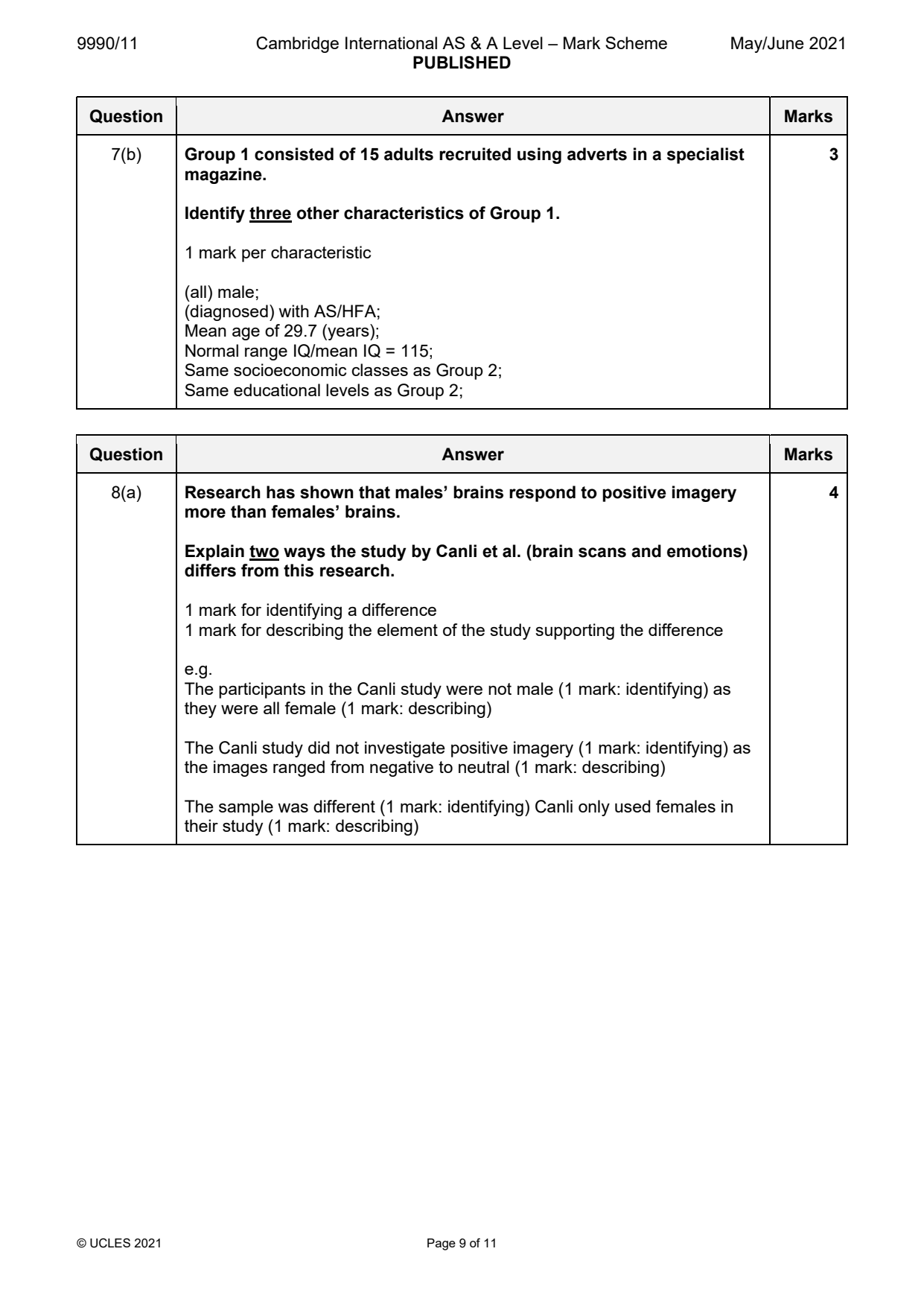
8(a) Research has shown that males’ brains respond to positive imagery 4
more than females’ brains.
Explain two ways the study by Canli et al. (brain scans and emotions)
differs from this research.
1 mark for identifying a difference
1 mark for describing the element of the study supporting the difference
e.g.
The participants in the Canli study were not male (1 mark: identifying) as
they were all female (1 mark: describing)
The Canli study did not investigate positive imagery (1 mark: identifying) as
the images ranged from negative to neutral (1 mark: describing)
The sample was different (1 mark: identifying) Canli only used females in
their study (1 mark: describing)
© UCLES 2021 Page 9 of 11
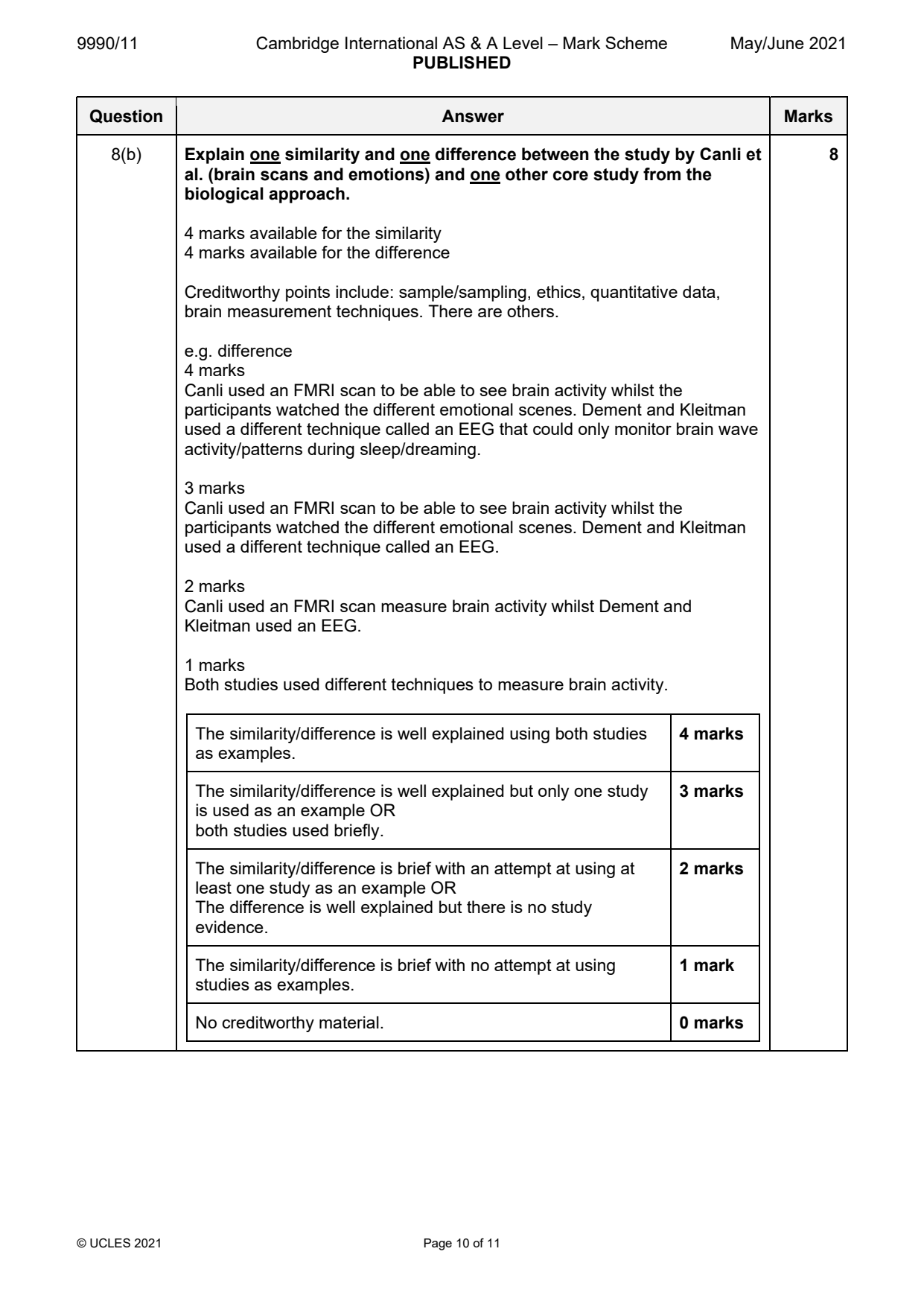
8(b) Explain one similarity and one difference between the study by Canli et 8
al. (brain scans and emotions) and one other core study from the
biological approach.
4 marks available for the similarity
4 marks available for the difference
Creditworthy points include: sample/sampling, ethics, quantitative data,
brain measurement techniques. There are others.
e.g. difference
4 marks
Canli used an FMRI scan to be able to see brain activity whilst the
participants watched the different emotional scenes. Dement and Kleitman
used a different technique called an EEG that could only monitor brain wave
activity/patterns during sleep/dreaming.
3 marks
Canli used an FMRI scan to be able to see brain activity whilst the
participants watched the different emotional scenes. Dement and Kleitman
used a different technique called an EEG.
2 marks
Canli used an FMRI scan measure brain activity whilst Dement and
Kleitman used an EEG.
1 marks
Both studies used different techniques to measure brain activity.
The similarity/difference is well explained using both studies 4 marks
as examples.
The similarity/difference is well explained but only one study 3 marks
is used as an example OR
both studies used briefly.
The similarity/difference is brief with an attempt at using at 2 marks
least one study as an example OR
The difference is well explained but there is no study
evidence.
The similarity/difference is brief with no attempt at using 1 mark
studies as examples.
No creditworthy material. 0 marks
© UCLES 2021 Page 10 of 11
Official mark scheme pages: 9, 10 · source PDF URL
9990-2021-mj-12-q05
May/June 2021 · Paper 12 · Question 5 · 5 marks
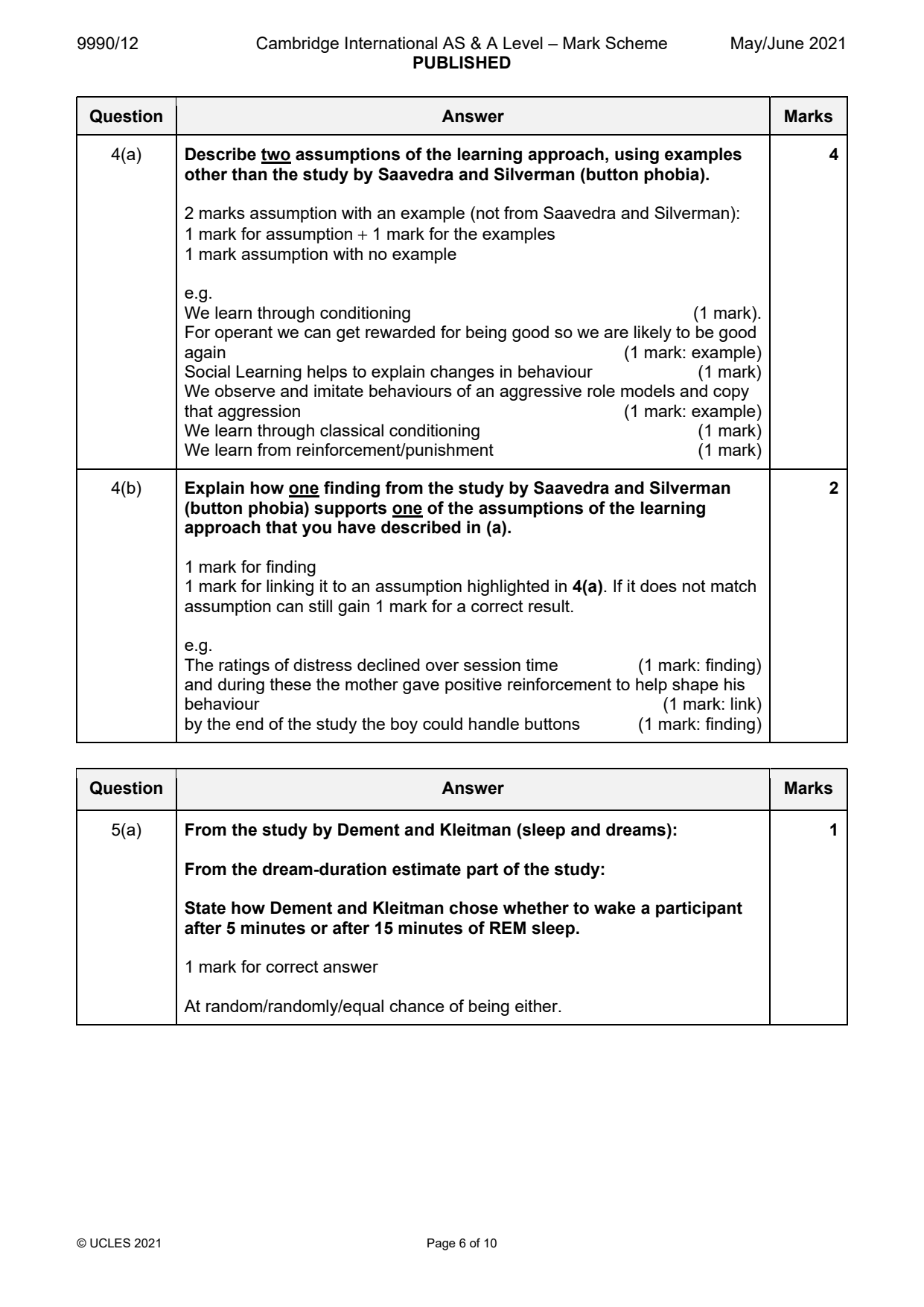
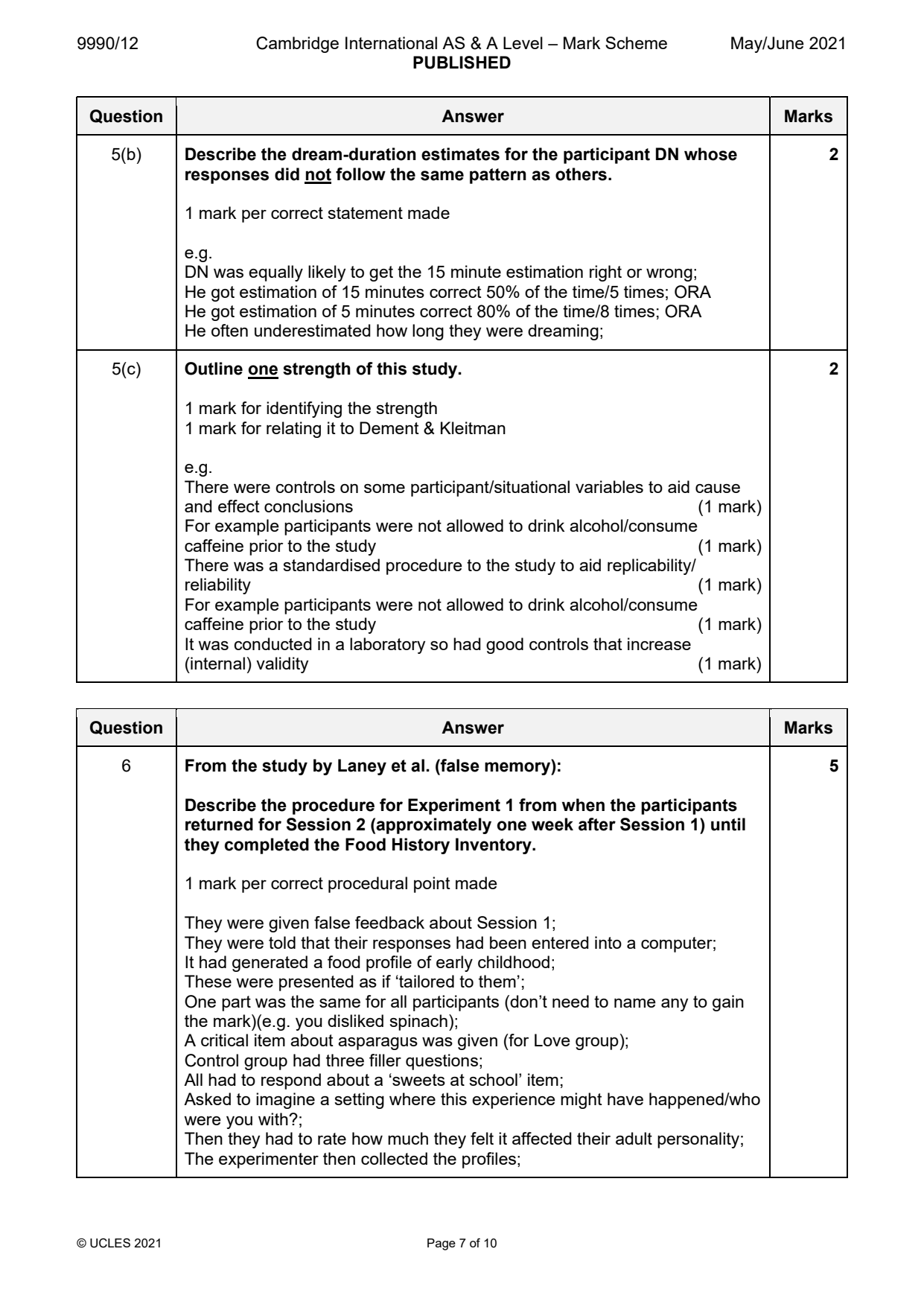
5(a) From the study by Dement and Kleitman (sleep and dreams): 1
From the dream-duration estimate part of the study:
State how Dement and Kleitman chose whether to wake a participant
after 5 minutes or after 15 minutes of REM sleep.
1 mark for correct answer
At random/randomly/equal chance of being either.
© UCLES 2021 Page 6 of 10
5(b) Describe the dream-duration estimates for the participant DN whose 2
responses did not follow the same pattern as others.
1 mark per correct statement made
e.g.
DN was equally likely to get the 15 minute estimation right or wrong;
He got estimation of 15 minutes correct 50% of the time/5 times; ORA
He got estimation of 5 minutes correct 80% of the time/8 times; ORA
He often underestimated how long they were dreaming;
5(c) Outline one strength of this study. 2
1 mark for identifying the strength
1 mark for relating it to Dement & Kleitman
e.g.
There were controls on some participant/situational variables to aid cause
and effect conclusions (1 mark)
For example participants were not allowed to drink alcohol/consume
caffeine prior to the study (1 mark)
There was a standardised procedure to the study to aid replicability/
reliability (1 mark)
For example participants were not allowed to drink alcohol/consume
caffeine prior to the study (1 mark)
It was conducted in a laboratory so had good controls that increase
(internal) validity (1 mark)
Question Answer Marks
Official mark scheme pages: 6, 7 · source PDF URL
9990-2021-mj-12-q09
May/June 2021 · Paper 12 · Question 9 · 10 marks
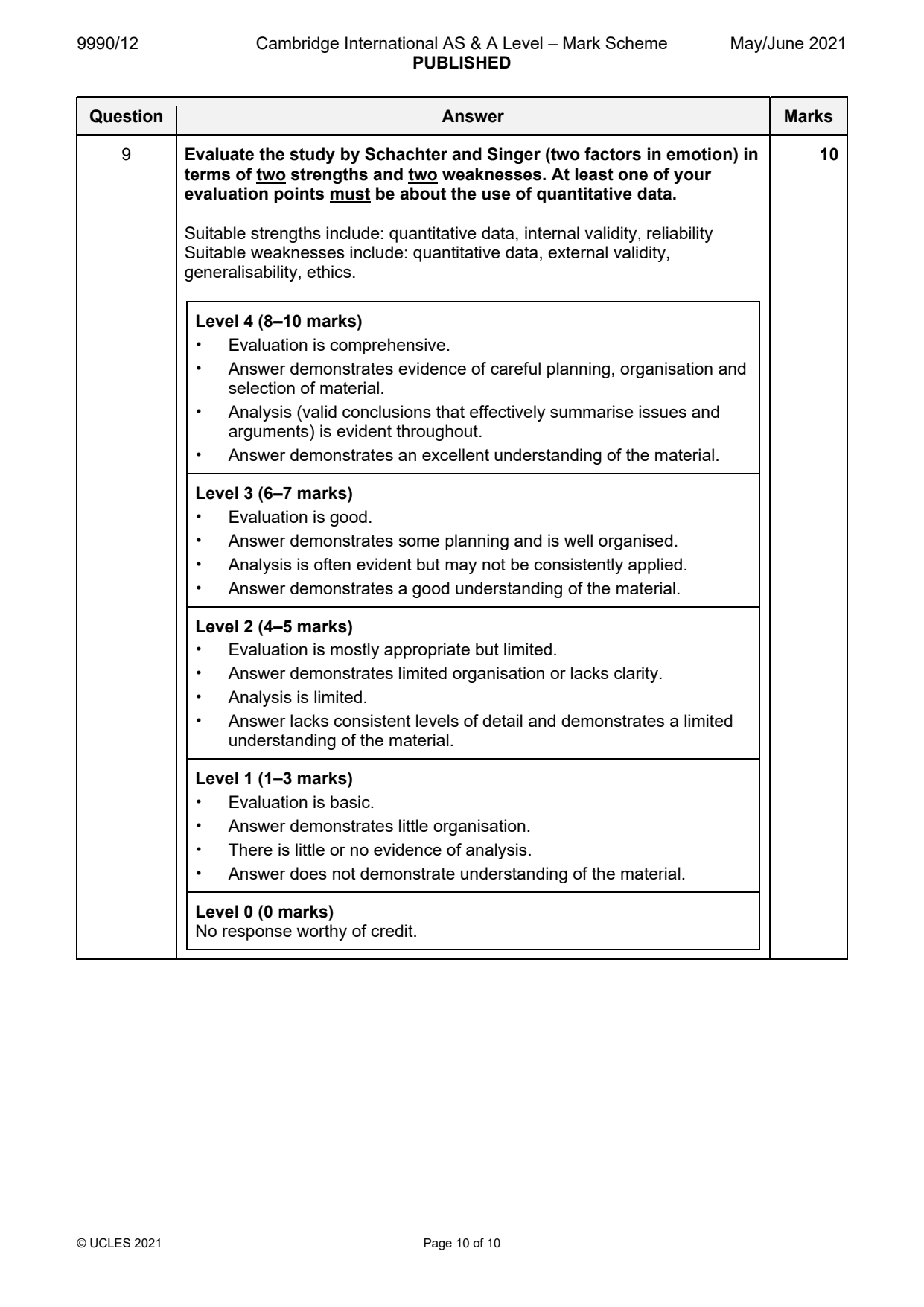
9 Evaluate the study by Schachter and Singer (two factors in emotion) in 10
terms of two strengths and two weaknesses. At least one of your
evaluation points must be about the use of quantitative data.
Suitable strengths include: quantitative data, internal validity, reliability
Suitable weaknesses include: quantitative data, external validity,
generalisability, ethics.
Level 4 (8–10 marks)
• Evaluation is comprehensive.
• Answer demonstrates evidence of careful planning, organisation and
selection of material.
• Analysis (valid conclusions that effectively summarise issues and
arguments) is evident throughout.
• Answer demonstrates an excellent understanding of the material.
Level 3 (6–7 marks)
• Evaluation is good.
• Answer demonstrates some planning and is well organised.
• Analysis is often evident but may not be consistently applied.
• Answer demonstrates a good understanding of the material.
Level 2 (4–5 marks)
• Evaluation is mostly appropriate but limited.
• Answer demonstrates limited organisation or lacks clarity.
• Analysis is limited.
• Answer lacks consistent levels of detail and demonstrates a limited
understanding of the material.
Level 1 (1–3 marks)
• Evaluation is basic.
• Answer demonstrates little organisation.
• There is little or no evidence of analysis.
• Answer does not demonstrate understanding of the material.
Level 0 (0 marks)
No response worthy of credit.
© UCLES 2021 Page 10 of 10
Official mark scheme pages: 10 · source PDF URL
9990-2021-mj-13-q03
May/June 2021 · Paper 13 · Question 3 · 5 marks
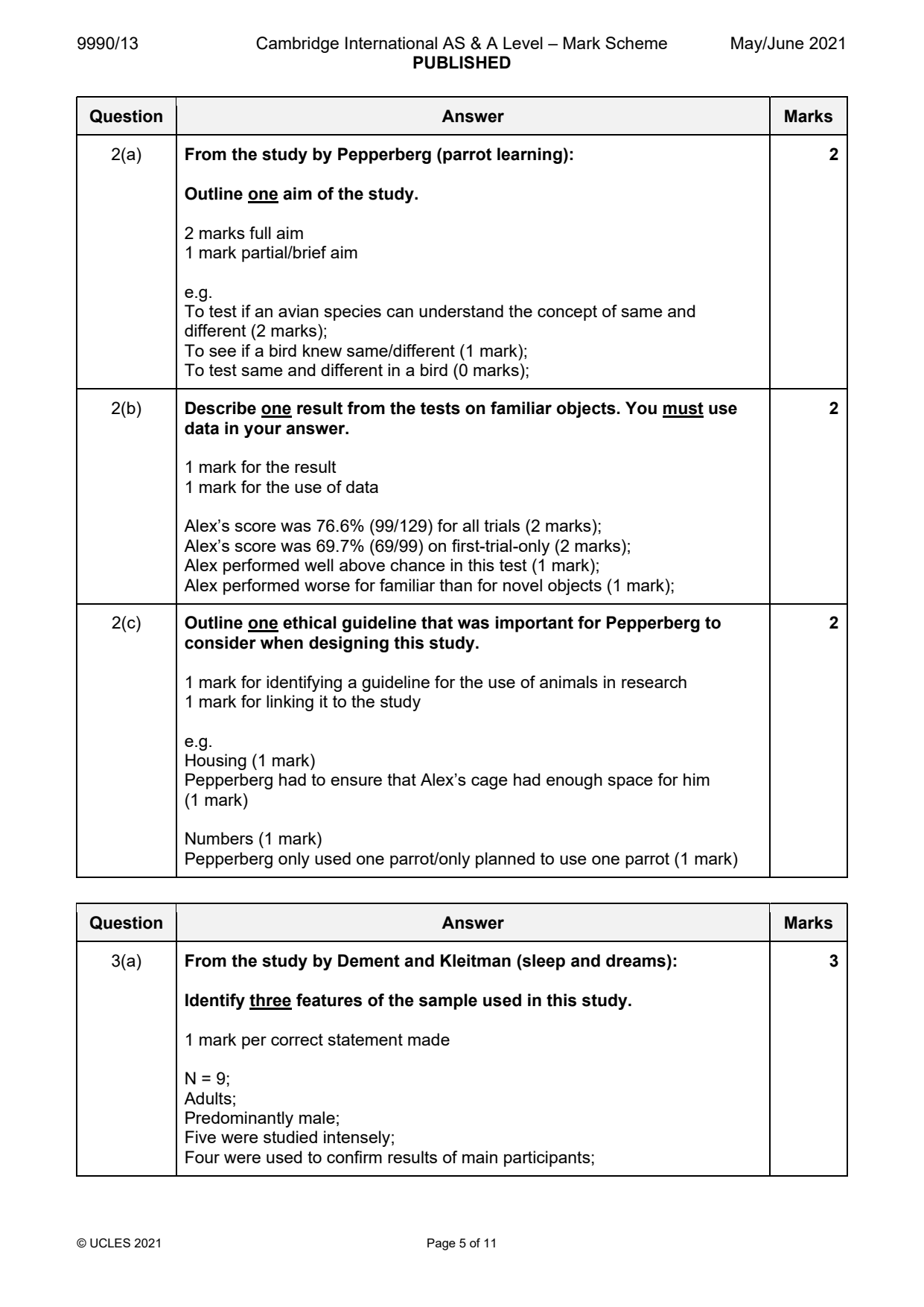
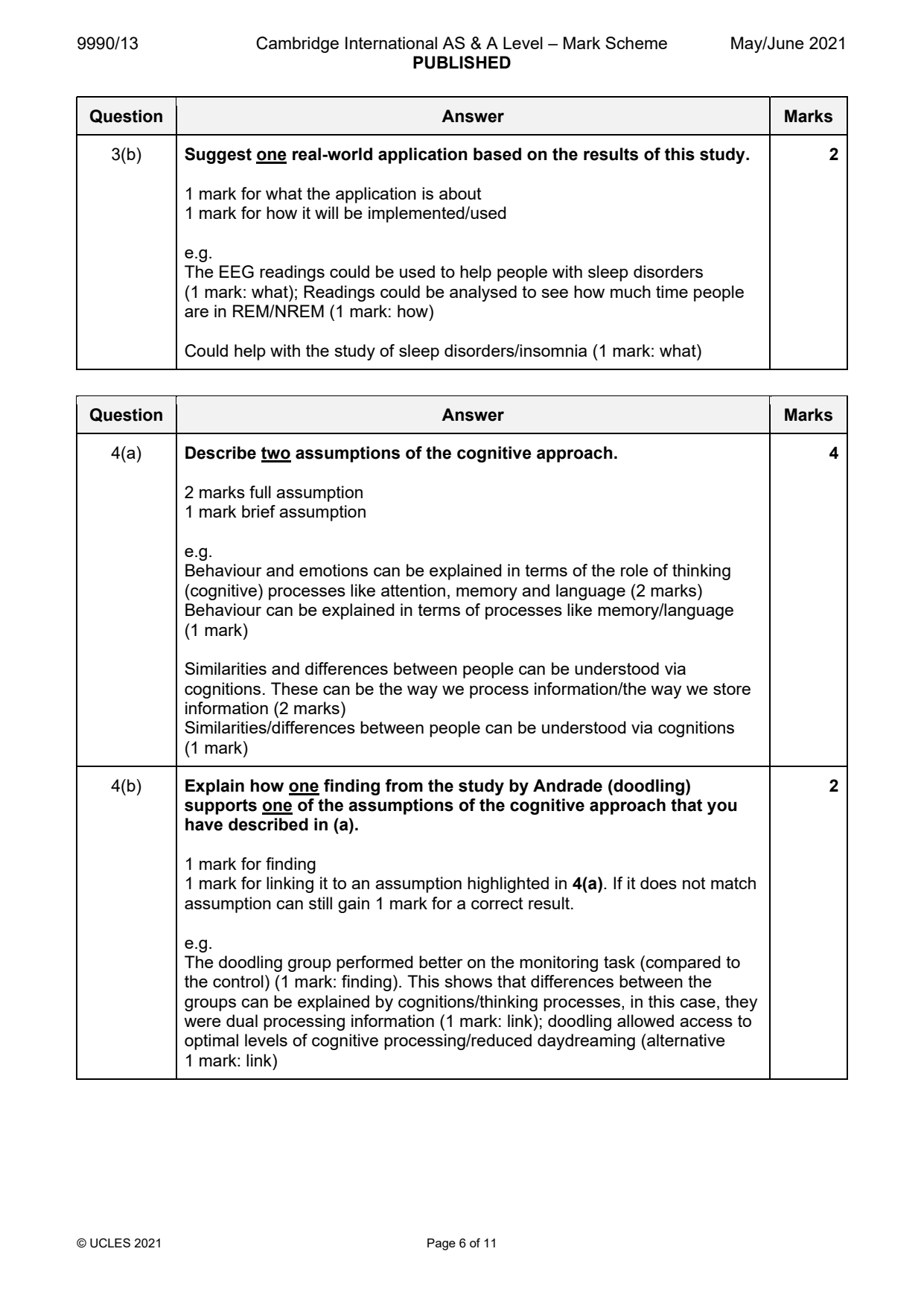
3(a) From the study by Dement and Kleitman (sleep and dreams): 3
Identify three features of the sample used in this study.
1 mark per correct statement made
N = 9;
Adults;
Predominantly male;
Five were studied intensely;
Four were used to confirm results of main participants;
© UCLES 2021 Page 5 of 11
3(b) Suggest one real-world application based on the results of this study. 2
1 mark for what the application is about
1 mark for how it will be implemented/used
e.g.
The EEG readings could be used to help people with sleep disorders
(1 mark: what); Readings could be analysed to see how much time people
are in REM/NREM (1 mark: how)
Could help with the study of sleep disorders/insomnia (1 mark: what)
Question Answer Marks
Official mark scheme pages: 5, 6 · source PDF URL
9990-2021-mj-13-q09
May/June 2021 · Paper 13 · Question 9 · 10 marks
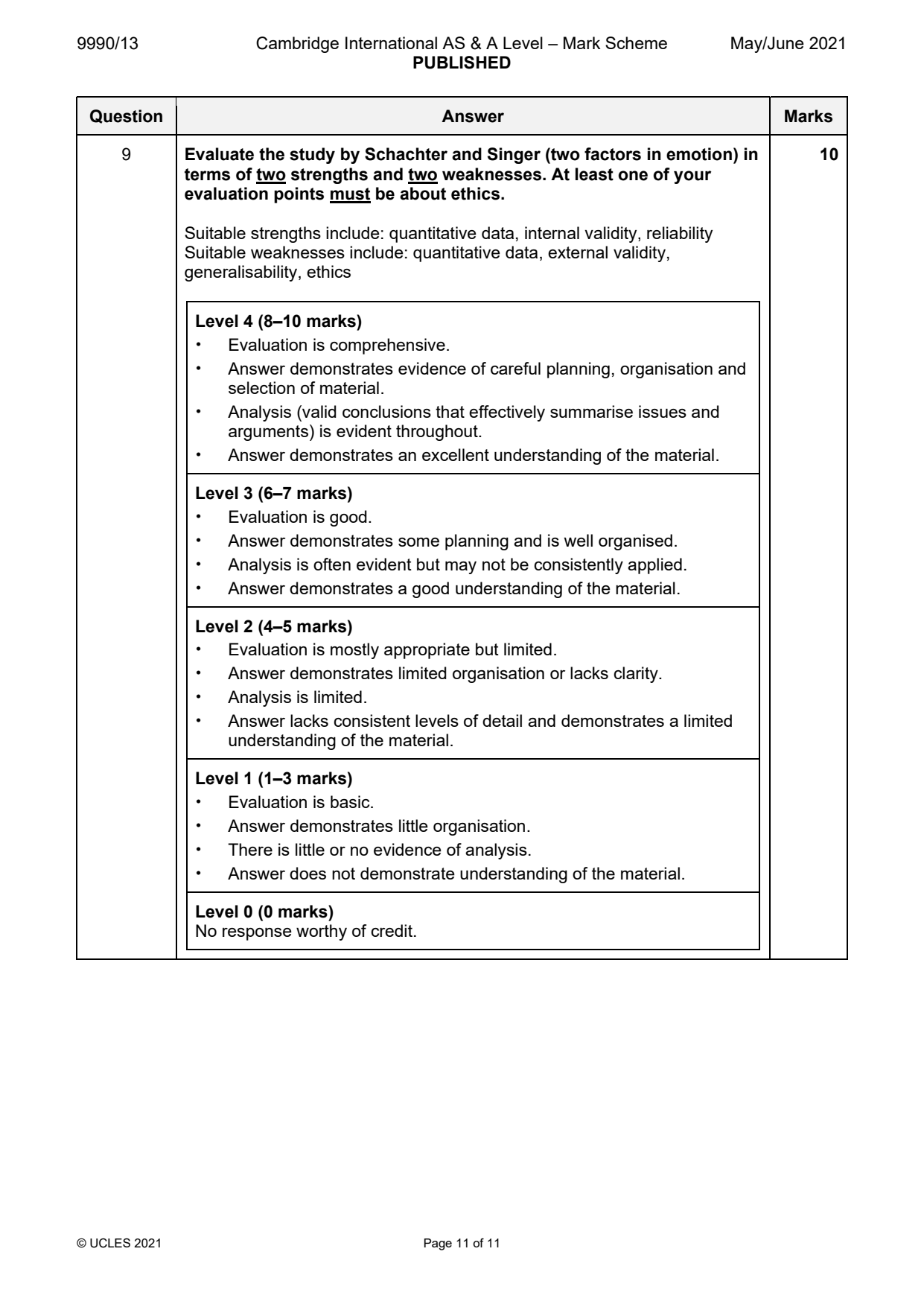
9 Evaluate the study by Schachter and Singer (two factors in emotion) in 10
terms of two strengths and two weaknesses. At least one of your
evaluation points must be about ethics.
Suitable strengths include: quantitative data, internal validity, reliability
Suitable weaknesses include: quantitative data, external validity,
generalisability, ethics
Level 4 (8–10 marks)
• Evaluation is comprehensive.
• Answer demonstrates evidence of careful planning, organisation and
selection of material.
• Analysis (valid conclusions that effectively summarise issues and
arguments) is evident throughout.
• Answer demonstrates an excellent understanding of the material.
Level 3 (6–7 marks)
• Evaluation is good.
• Answer demonstrates some planning and is well organised.
• Analysis is often evident but may not be consistently applied.
• Answer demonstrates a good understanding of the material.
Level 2 (4–5 marks)
• Evaluation is mostly appropriate but limited.
• Answer demonstrates limited organisation or lacks clarity.
• Analysis is limited.
• Answer lacks consistent levels of detail and demonstrates a limited
understanding of the material.
Level 1 (1–3 marks)
• Evaluation is basic.
• Answer demonstrates little organisation.
• There is little or no evidence of analysis.
• Answer does not demonstrate understanding of the material.
Level 0 (0 marks)
No response worthy of credit.
© UCLES 2021 Page 11 of 11
Official mark scheme pages: 11 · source PDF URL
9990-2021-on-11-q03
Oct/Nov 2021 · Paper 11 · Question 3 · 6 marks
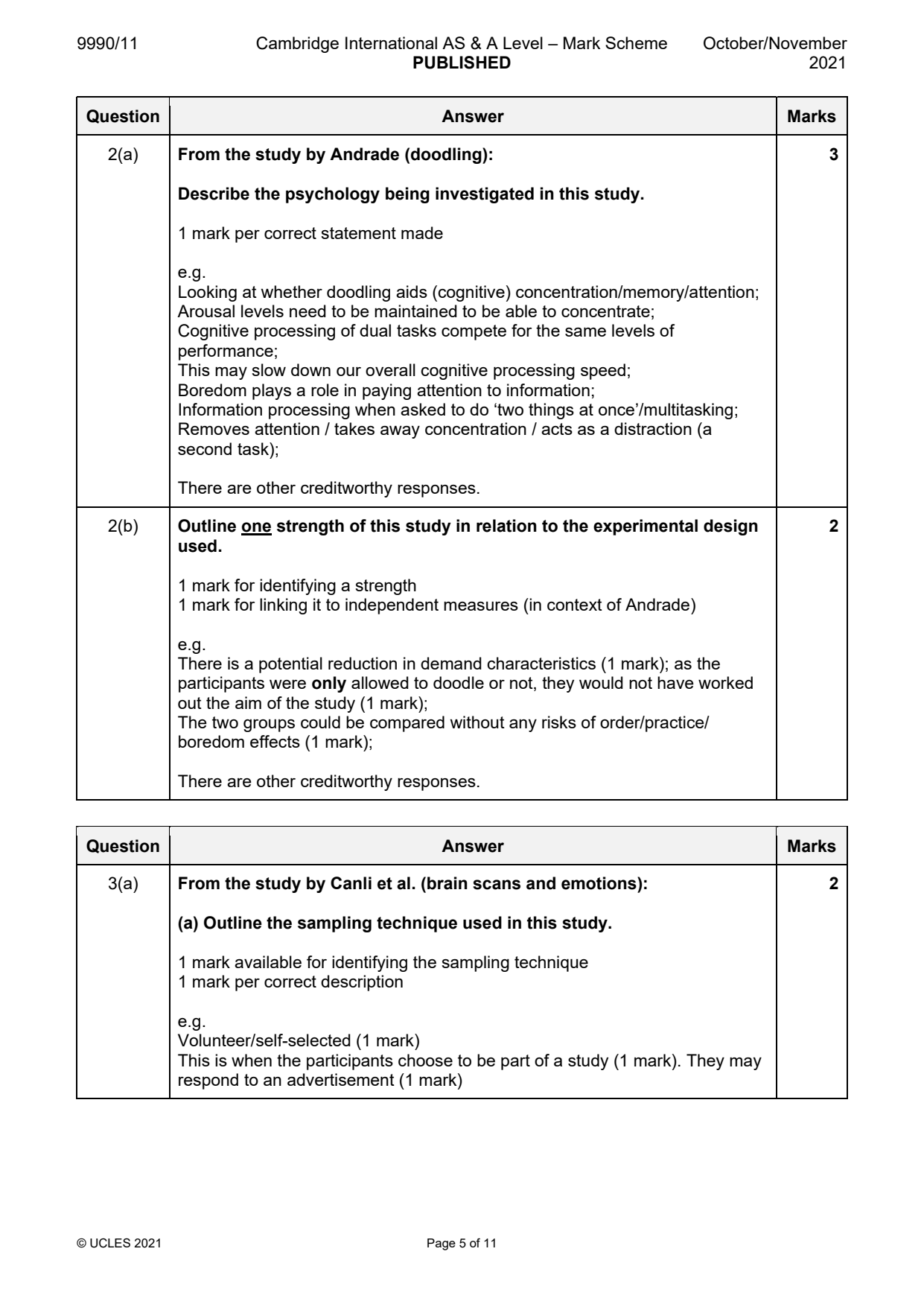
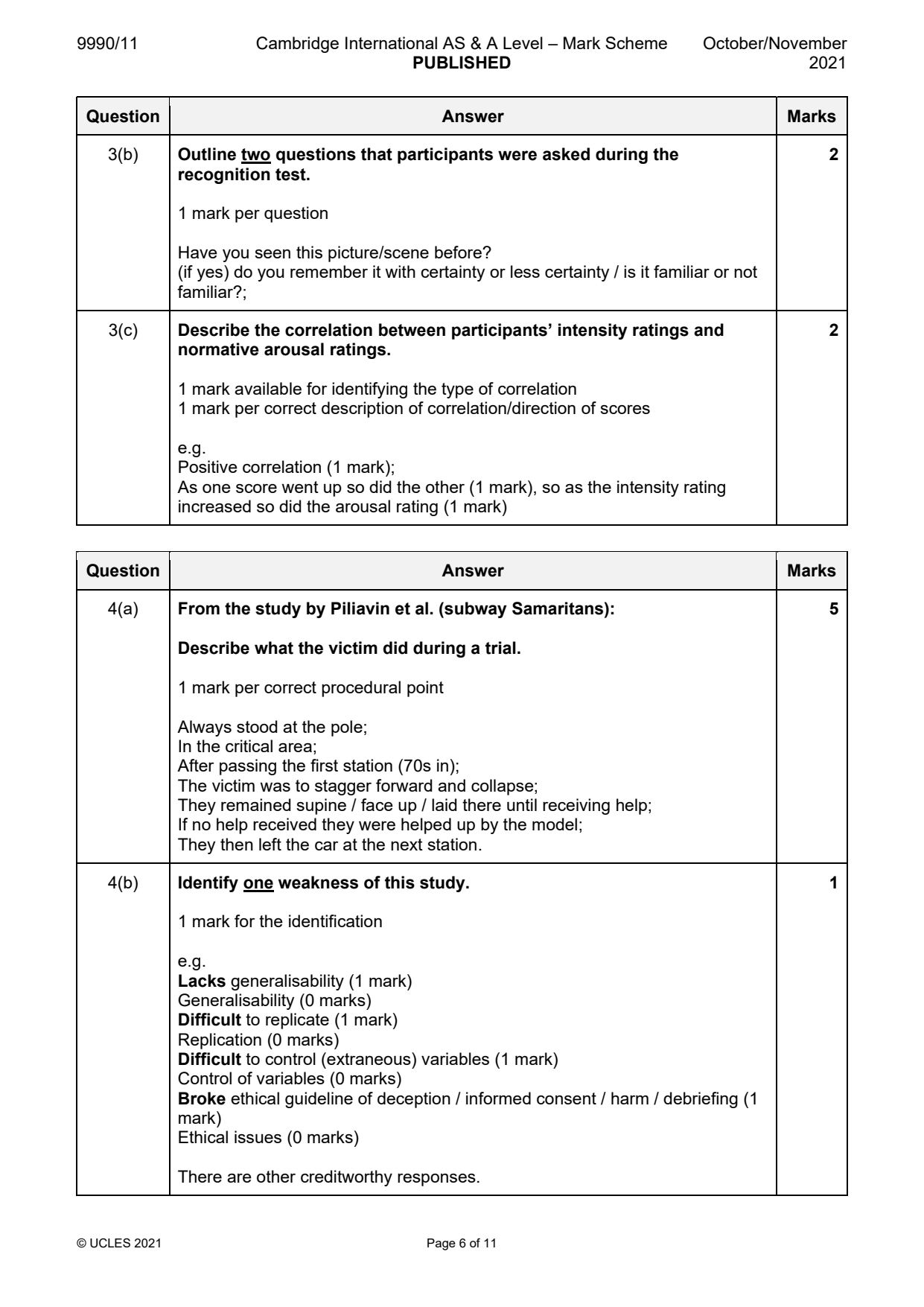
3(a) From the study by Canli et al. (brain scans and emotions): 2
(a) Outline the sampling technique used in this study.
1 mark available for identifying the sampling technique
1 mark per correct description
e.g.
Volunteer/self-selected (1 mark)
This is when the participants choose to be part of a study (1 mark). They may
respond to an advertisement (1 mark)
© UCLES 2021 Page 5 of 11
3(b) Outline two questions that participants were asked during the 2
recognition test.
1 mark per question
Have you seen this picture/scene before?
(if yes) do you remember it with certainty or less certainty / is it familiar or not
familiar?;
3(c) Describe the correlation between participants’ intensity ratings and 2
normative arousal ratings.
1 mark available for identifying the type of correlation
1 mark per correct description of correlation/direction of scores
e.g.
Positive correlation (1 mark);
As one score went up so did the other (1 mark), so as the intensity rating
increased so did the arousal rating (1 mark)
Question Answer Marks
Official mark scheme pages: 5, 6 · source PDF URL
9990-2021-on-11-q07
Oct/Nov 2021 · Paper 11 · Question 7 · 6 marks
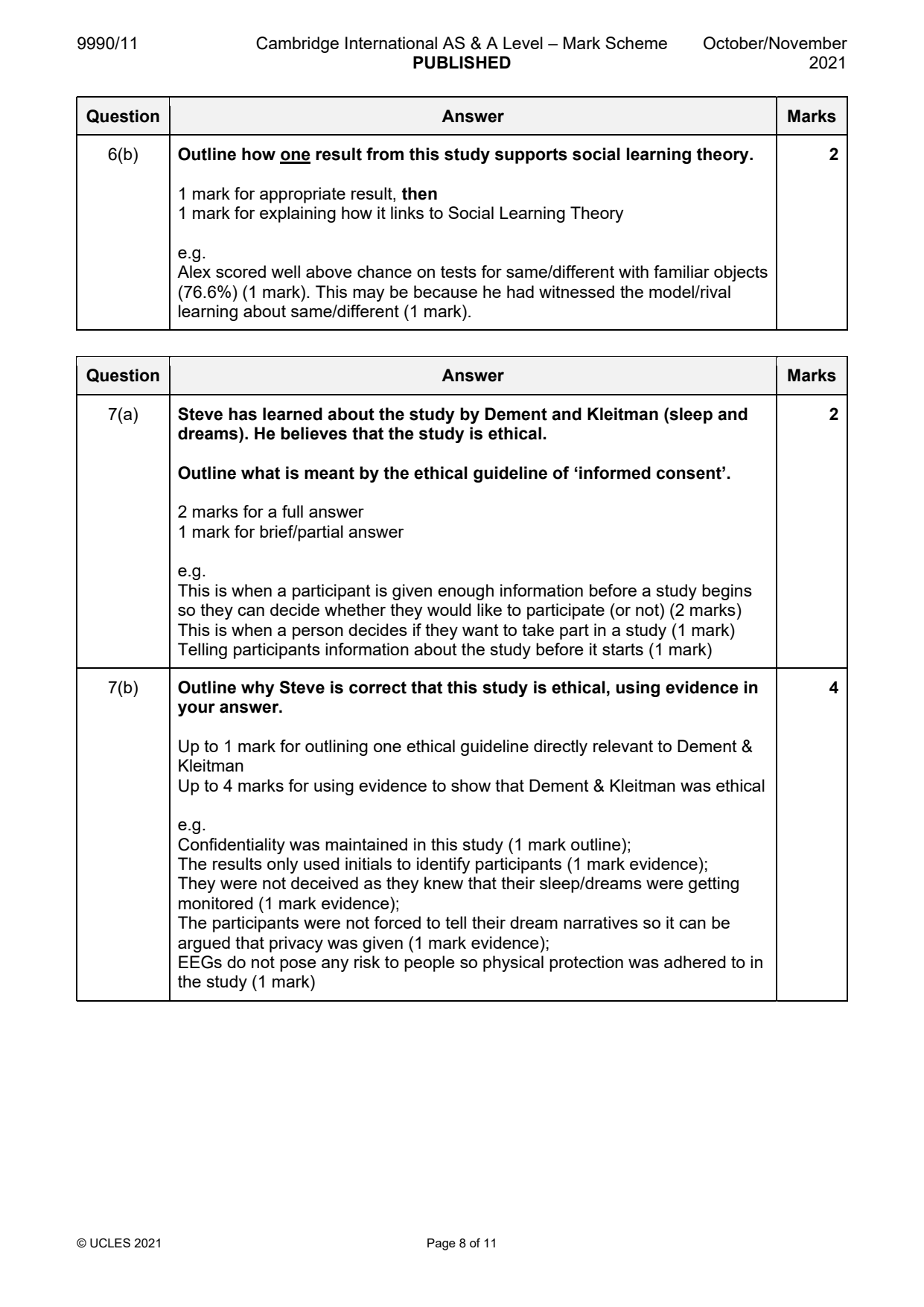
7(a) Steve has learned about the study by Dement and Kleitman (sleep and 2
dreams). He believes that the study is ethical.
Outline what is meant by the ethical guideline of ‘informed consent’.
2 marks for a full answer
1 mark for brief/partial answer
e.g.
This is when a participant is given enough information before a study begins
so they can decide whether they would like to participate (or not) (2 marks)
This is when a person decides if they want to take part in a study (1 mark)
Telling participants information about the study before it starts (1 mark)
7(b) Outline why Steve is correct that this study is ethical, using evidence in 4
your answer.
Up to 1 mark for outlining one ethical guideline directly relevant to Dement &
Kleitman
Up to 4 marks for using evidence to show that Dement & Kleitman was ethical
e.g.
Confidentiality was maintained in this study (1 mark outline);
The results only used initials to identify participants (1 mark evidence);
They were not deceived as they knew that their sleep/dreams were getting
monitored (1 mark evidence);
The participants were not forced to tell their dream narratives so it can be
argued that privacy was given (1 mark evidence);
EEGs do not pose any risk to people so physical protection was adhered to in
the study (1 mark)
© UCLES 2021 Page 8 of 11
Official mark scheme pages: 8 · source PDF URL
9990-2021-on-12-q03
Oct/Nov 2021 · Paper 12 · Question 3 · 6 marks
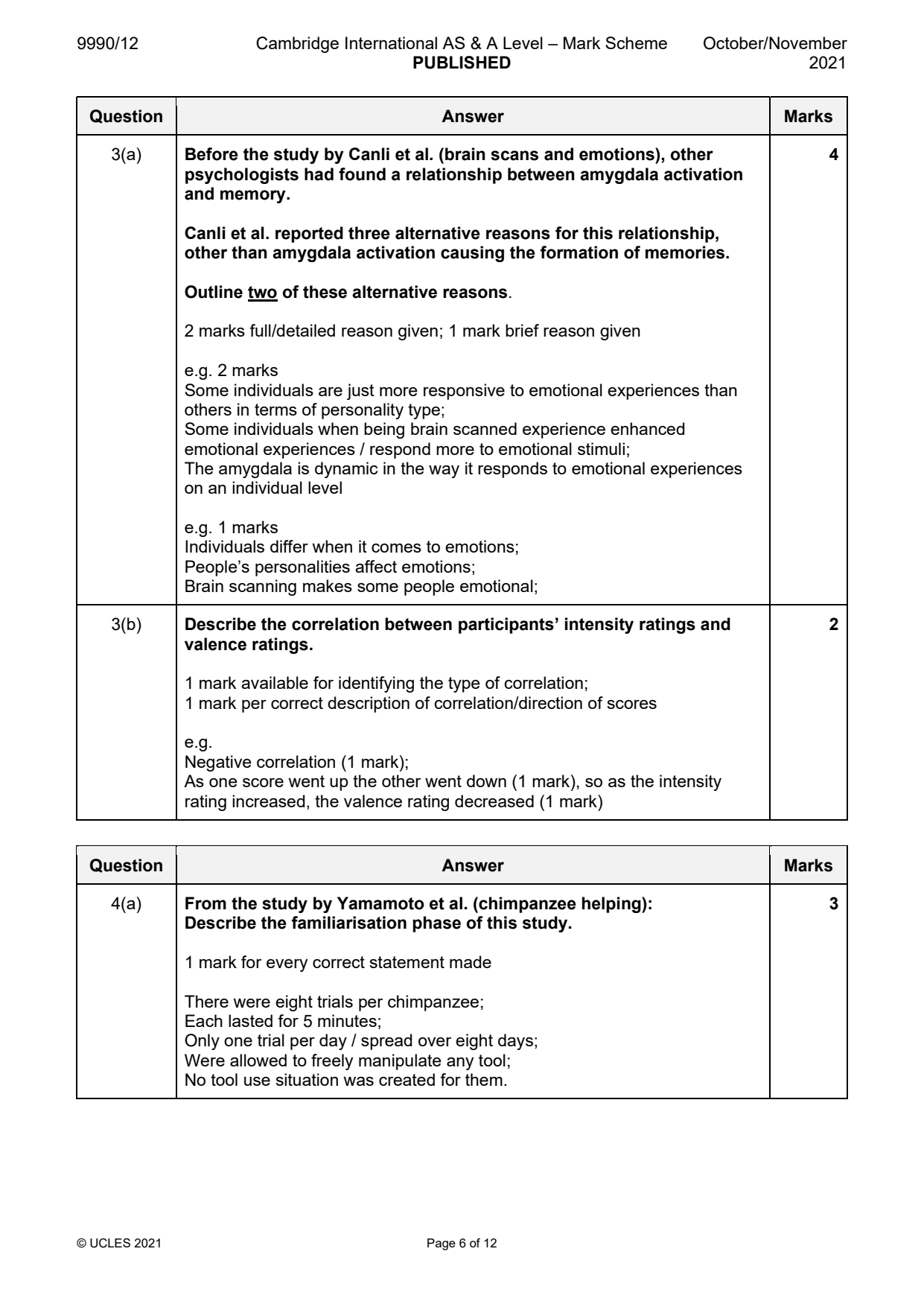
3(a) Before the study by Canli et al. (brain scans and emotions), other 4
psychologists had found a relationship between amygdala activation
and memory.
Canli et al. reported three alternative reasons for this relationship,
other than amygdala activation causing the formation of memories.
Outline two of these alternative reasons.
2 marks full/detailed reason given; 1 mark brief reason given
e.g. 2 marks
Some individuals are just more responsive to emotional experiences than
others in terms of personality type;
Some individuals when being brain scanned experience enhanced
emotional experiences / respond more to emotional stimuli;
The amygdala is dynamic in the way it responds to emotional experiences
on an individual level
e.g. 1 marks
Individuals differ when it comes to emotions;
People’s personalities affect emotions;
Brain scanning makes some people emotional;
3(b) Describe the correlation between participants’ intensity ratings and 2
valence ratings.
1 mark available for identifying the type of correlation;
1 mark per correct description of correlation/direction of scores
e.g.
Negative correlation (1 mark);
As one score went up the other went down (1 mark), so as the intensity
rating increased, the valence rating decreased (1 mark)
Question Answer Marks
Official mark scheme pages: 6 · source PDF URL
9990-2021-on-12-q05
Oct/Nov 2021 · Paper 12 · Question 5 · 4 marks
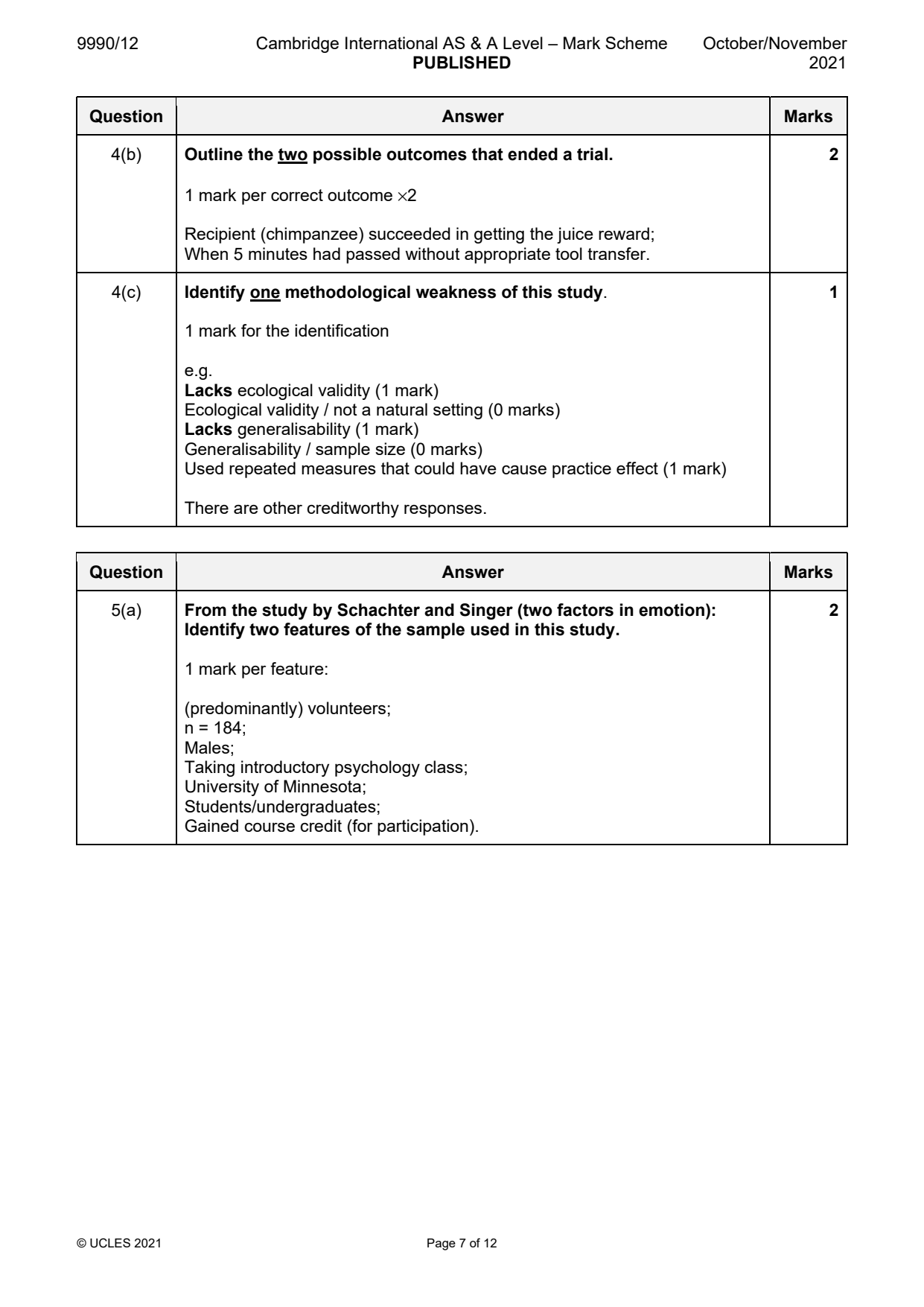
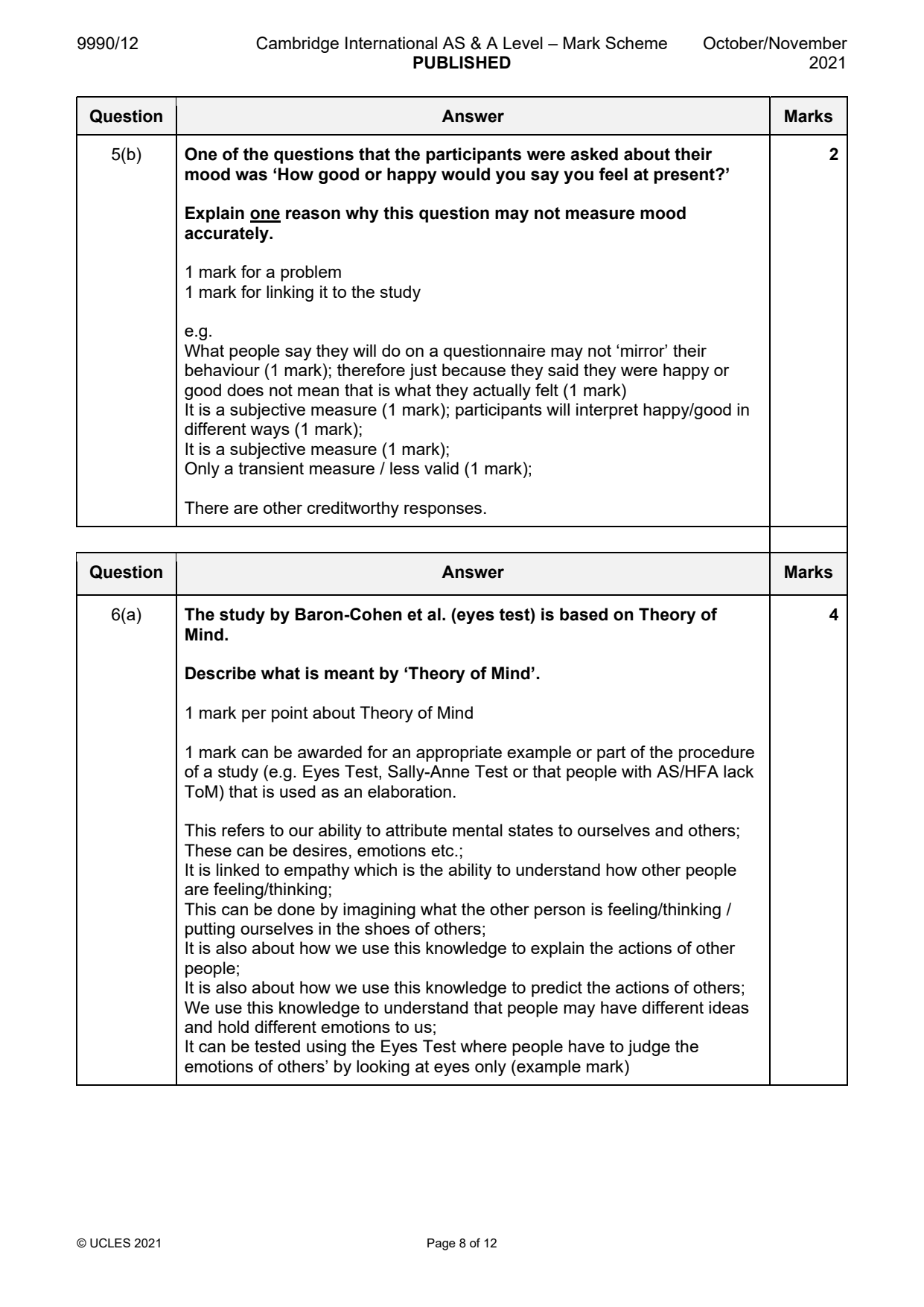
5(a) From the study by Schachter and Singer (two factors in emotion): 2
Identify two features of the sample used in this study.
1 mark per feature:
(predominantly) volunteers;
n = 184;
Males;
Taking introductory psychology class;
University of Minnesota;
Students/undergraduates;
Gained course credit (for participation).
© UCLES 2021 Page 7 of 12
5(b) One of the questions that the participants were asked about their 2
mood was ‘How good or happy would you say you feel at present?’
Explain one reason why this question may not measure mood
accurately.
1 mark for a problem
1 mark for linking it to the study
e.g.
What people say they will do on a questionnaire may not ‘mirror’ their
behaviour (1 mark); therefore just because they said they were happy or
good does not mean that is what they actually felt (1 mark)
It is a subjective measure (1 mark); participants will interpret happy/good in
different ways (1 mark);
It is a subjective measure (1 mark);
Only a transient measure / less valid (1 mark);
There are other creditworthy responses.
Question Answer Marks
Official mark scheme pages: 7, 8 · source PDF URL
9990-2021-on-12-q08
Oct/Nov 2021 · Paper 12 · Question 8 · 12 marks
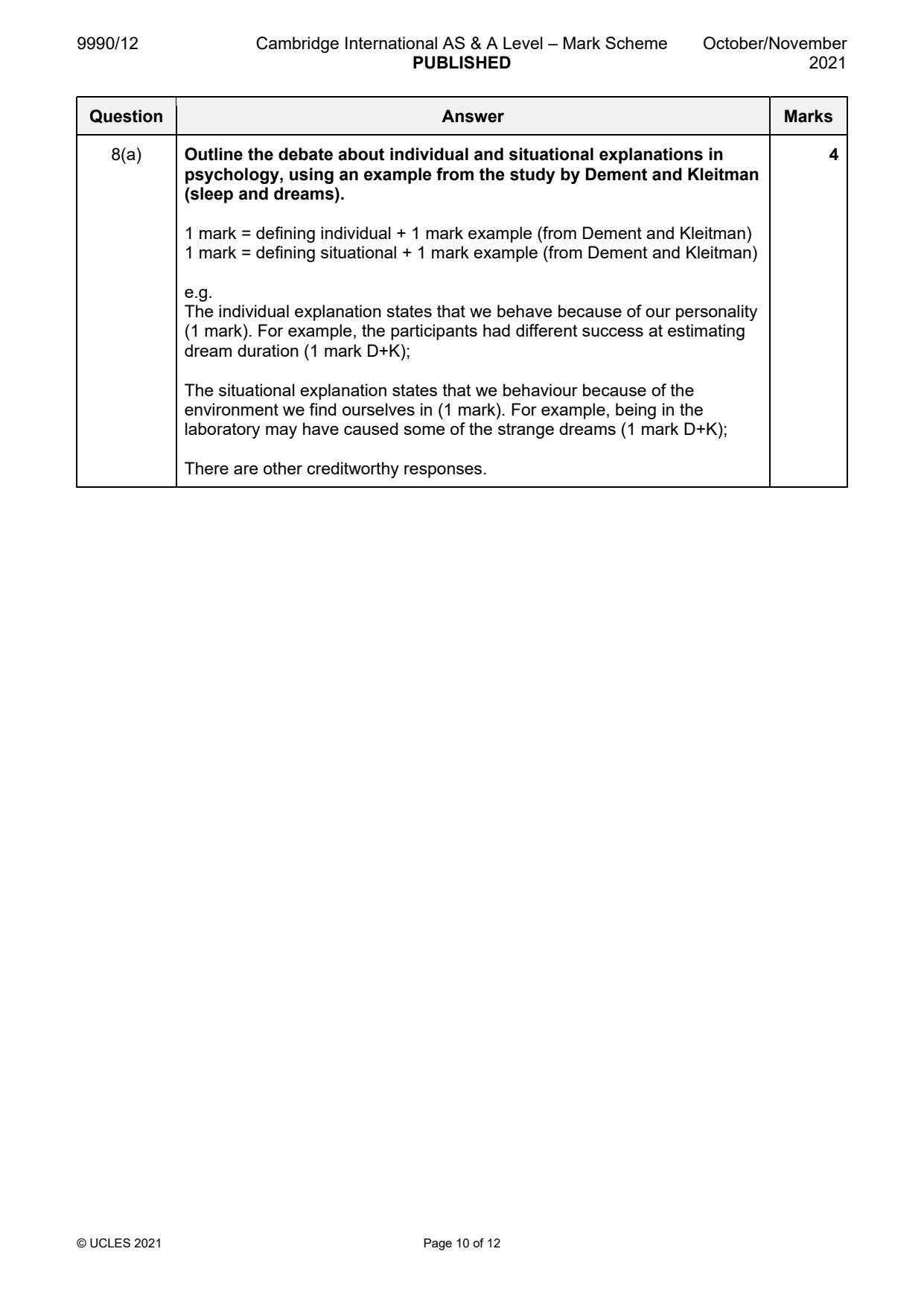
8(a) Outline the debate about individual and situational explanations in 4
psychology, using an example from the study by Dement and Kleitman
(sleep and dreams).
1 mark = defining individual + 1 mark example (from Dement and Kleitman)
1 mark = defining situational + 1 mark example (from Dement and Kleitman)
e.g.
The individual explanation states that we behave because of our personality
(1 mark). For example, the participants had different success at estimating
dream duration (1 mark D+K);
The situational explanation states that we behaviour because of the
environment we find ourselves in (1 mark). For example, being in the
laboratory may have caused some of the strange dreams (1 mark D+K);
There are other creditworthy responses.
© UCLES 2021 Page 10 of 12
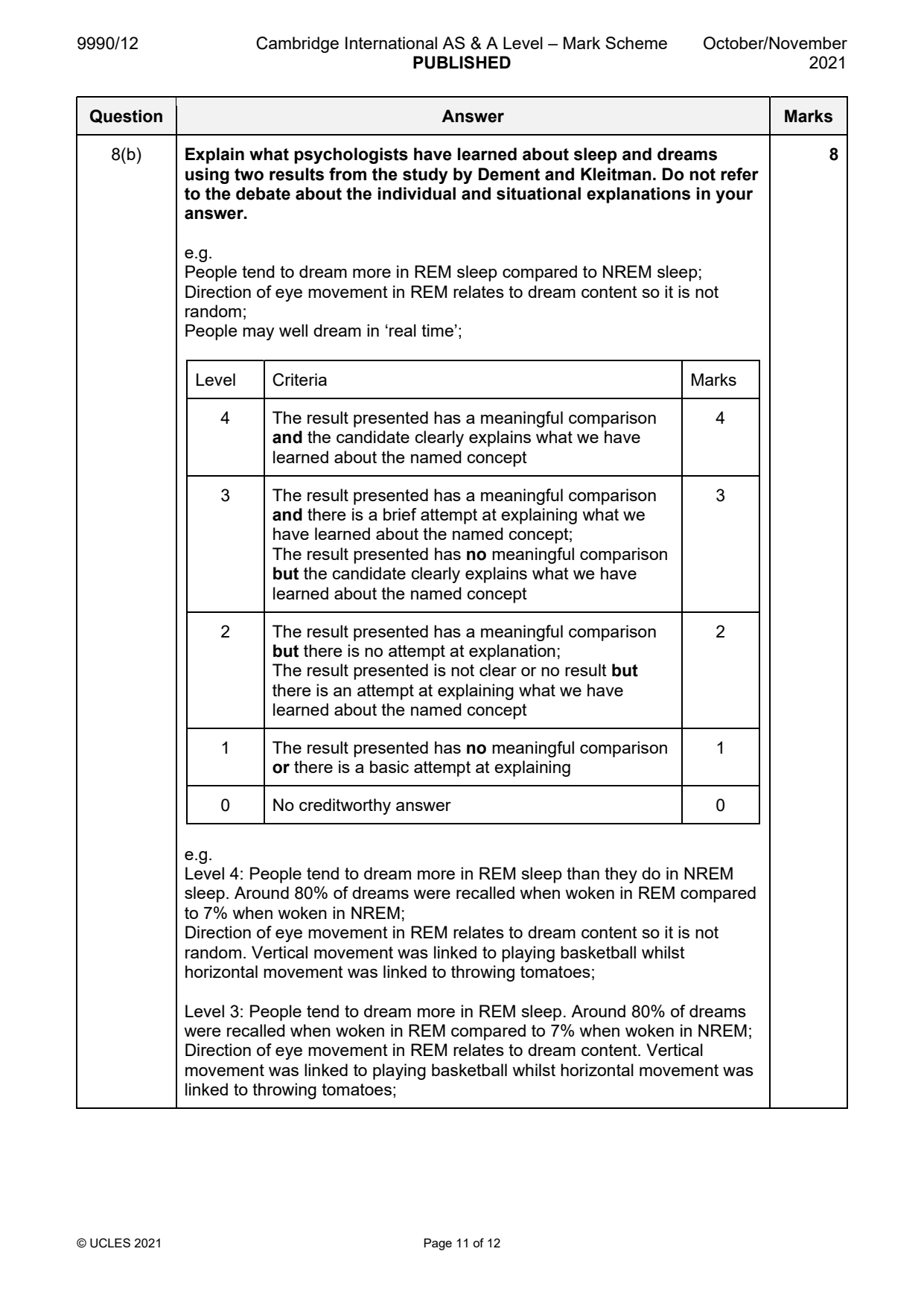
8(b) Explain what psychologists have learned about sleep and dreams 8
using two results from the study by Dement and Kleitman. Do not refer
to the debate about the individual and situational explanations in your
answer.
e.g.
People tend to dream more in REM sleep compared to NREM sleep;
Direction of eye movement in REM relates to dream content so it is not
random;
People may well dream in ‘real time’;
Level Criteria Marks
4 The result presented has a meaningful comparison 4
and the candidate clearly explains what we have
learned about the named concept
3 The result presented has a meaningful comparison 3
and there is a brief attempt at explaining what we
have learned about the named concept;
The result presented has no meaningful comparison
but the candidate clearly explains what we have
learned about the named concept
2 The result presented has a meaningful comparison 2
but there is no attempt at explanation;
The result presented is not clear or no result but
there is an attempt at explaining what we have
learned about the named concept
1 The result presented has no meaningful comparison 1
or there is a basic attempt at explaining
0 No creditworthy answer 0
e.g.
Level 4: People tend to dream more in REM sleep than they do in NREM
sleep. Around 80% of dreams were recalled when woken in REM compared
to 7% when woken in NREM;
Direction of eye movement in REM relates to dream content so it is not
random. Vertical movement was linked to playing basketball whilst
horizontal movement was linked to throwing tomatoes;
Level 3: People tend to dream more in REM sleep. Around 80% of dreams
were recalled when woken in REM compared to 7% when woken in NREM;
Direction of eye movement in REM relates to dream content. Vertical
movement was linked to playing basketball whilst horizontal movement was
linked to throwing tomatoes;
© UCLES 2021 Page 11 of 12
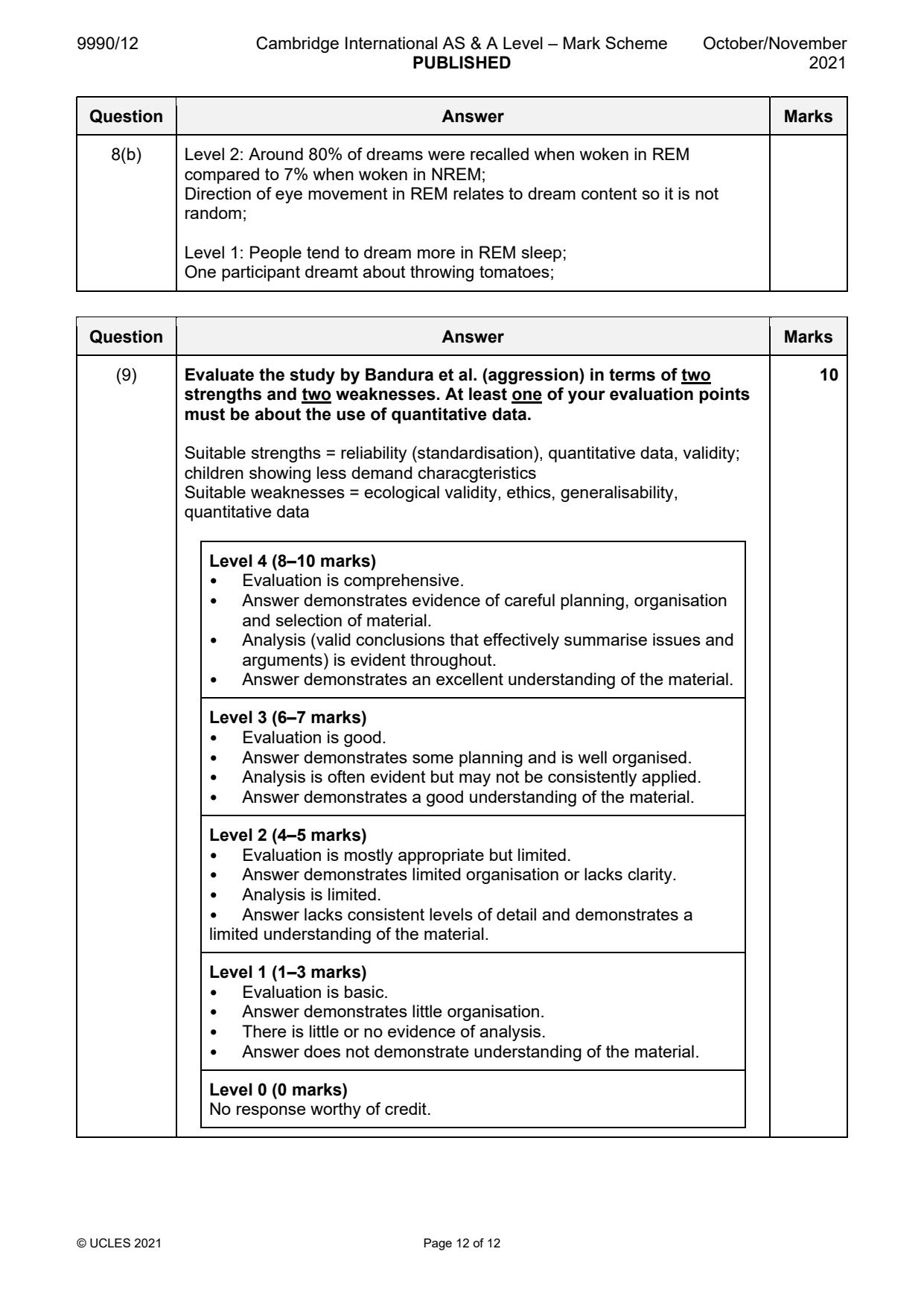
8(b) Level 2: Around 80% of dreams were recalled when woken in REM
compared to 7% when woken in NREM;
Direction of eye movement in REM relates to dream content so it is not
random;
Level 1: People tend to dream more in REM sleep;
One participant dreamt about throwing tomatoes;
Question Answer Marks
Official mark scheme pages: 10, 11, 12 · source PDF URL
9990-2021-on-13-q04
Oct/Nov 2021 · Paper 13 · Question 4 · 6 marks
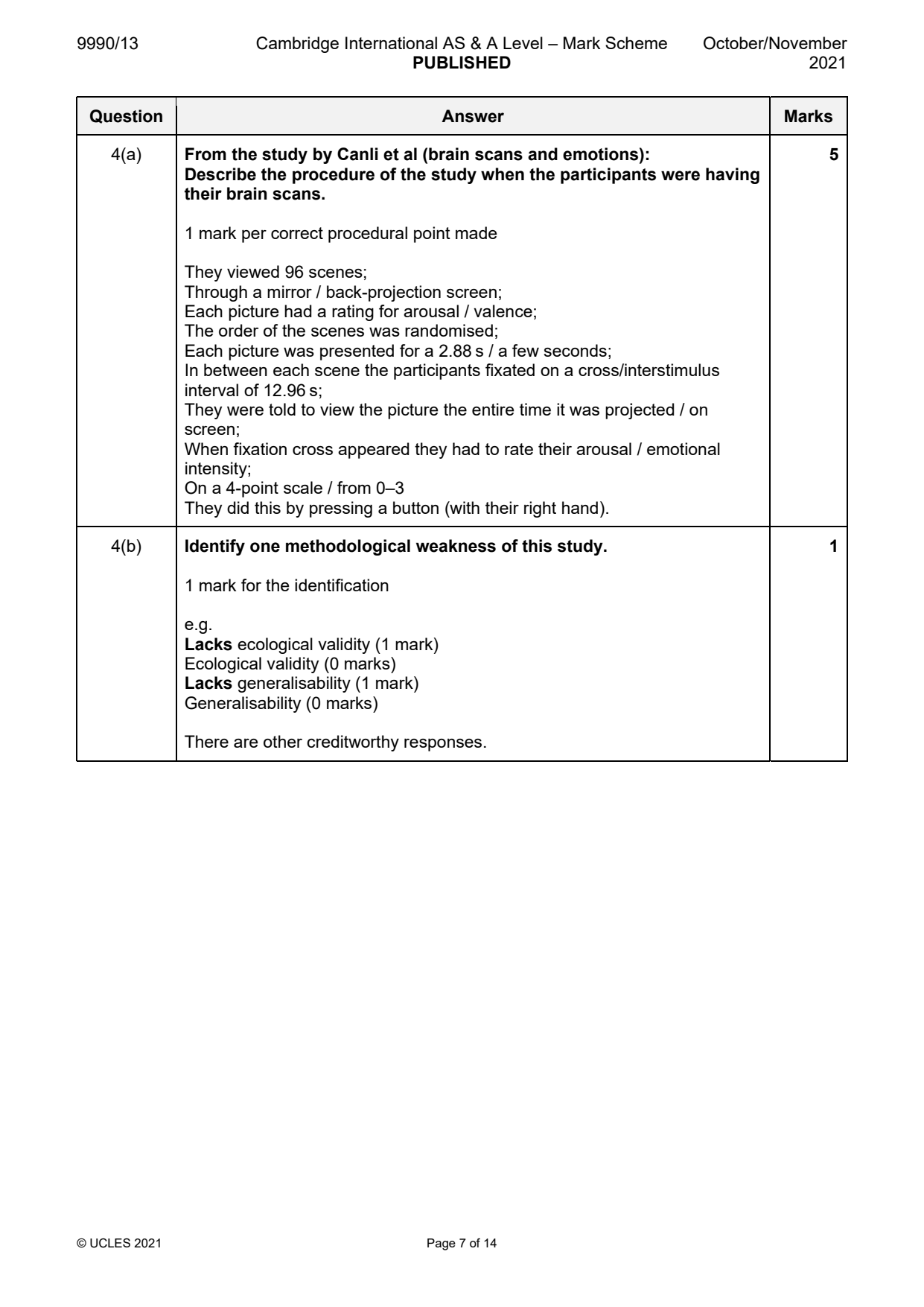
4(a) From the study by Canli et al (brain scans and emotions): 5
Describe the procedure of the study when the participants were having
their brain scans.
1 mark per correct procedural point made
They viewed 96 scenes;
Through a mirror / back-projection screen;
Each picture had a rating for arousal / valence;
The order of the scenes was randomised;
Each picture was presented for a 2.88 s / a few seconds;
In between each scene the participants fixated on a cross/interstimulus
interval of 12.96 s;
They were told to view the picture the entire time it was projected / on
screen;
When fixation cross appeared they had to rate their arousal / emotional
intensity;
On a 4-point scale / from 0–3
They did this by pressing a button (with their right hand).
4(b) Identify one methodological weakness of this study. 1
1 mark for the identification
e.g.
Lacks ecological validity (1 mark)
Ecological validity (0 marks)
Lacks generalisability (1 mark)
Generalisability (0 marks)
There are other creditworthy responses.
© UCLES 2021 Page 7 of 14
Official mark scheme pages: 7 · source PDF URL
9990-2021-on-13-q06
Oct/Nov 2021 · Paper 13 · Question 6 · 6 marks
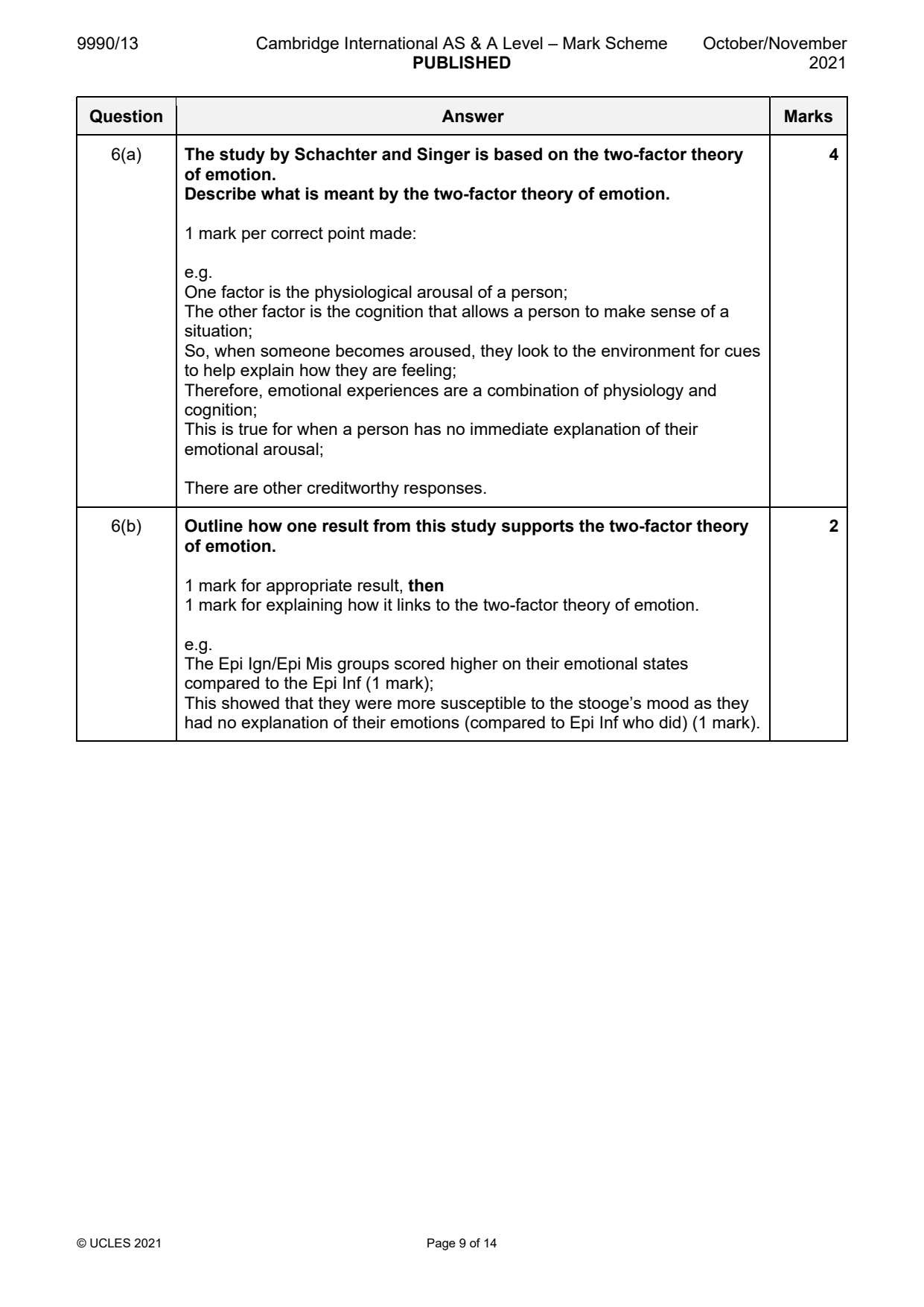
6(a) The study by Schachter and Singer is based on the two-factor theory 4
of emotion.
Describe what is meant by the two-factor theory of emotion.
1 mark per correct point made:
e.g.
One factor is the physiological arousal of a person;
The other factor is the cognition that allows a person to make sense of a
situation;
So, when someone becomes aroused, they look to the environment for cues
to help explain how they are feeling;
Therefore, emotional experiences are a combination of physiology and
cognition;
This is true for when a person has no immediate explanation of their
emotional arousal;
There are other creditworthy responses.
6(b) Outline how one result from this study supports the two-factor theory 2
of emotion.
1 mark for appropriate result, then
1 mark for explaining how it links to the two-factor theory of emotion.
e.g.
The Epi Ign/Epi Mis groups scored higher on their emotional states
compared to the Epi Inf (1 mark);
This showed that they were more susceptible to the stooge’s mood as they
had no explanation of their emotions (compared to Epi Inf who did) (1 mark).
© UCLES 2021 Page 9 of 14
Official mark scheme pages: 9 · source PDF URL
9990-2022-mj-11-q02
May/June 2022 · Paper 11 · Question 2 · 4 marks
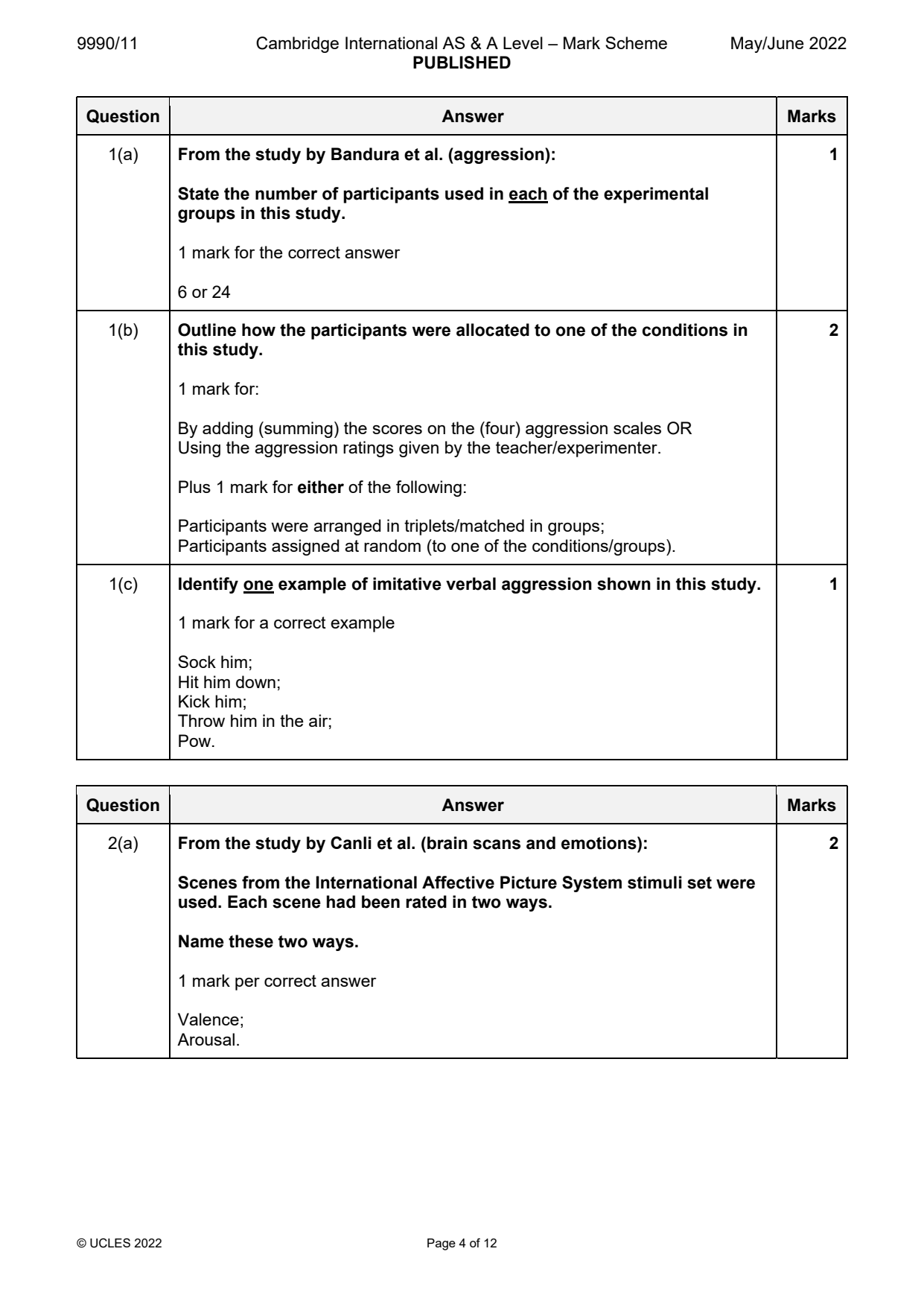
2(a) From the study by Canli et al. (brain scans and emotions): 2
Scenes from the International Affective Picture System stimuli set were
used. Each scene had been rated in two ways.
Name these two ways.
1 mark per correct answer
Valence;
Arousal.
© UCLES 2022 Page 4 of 12
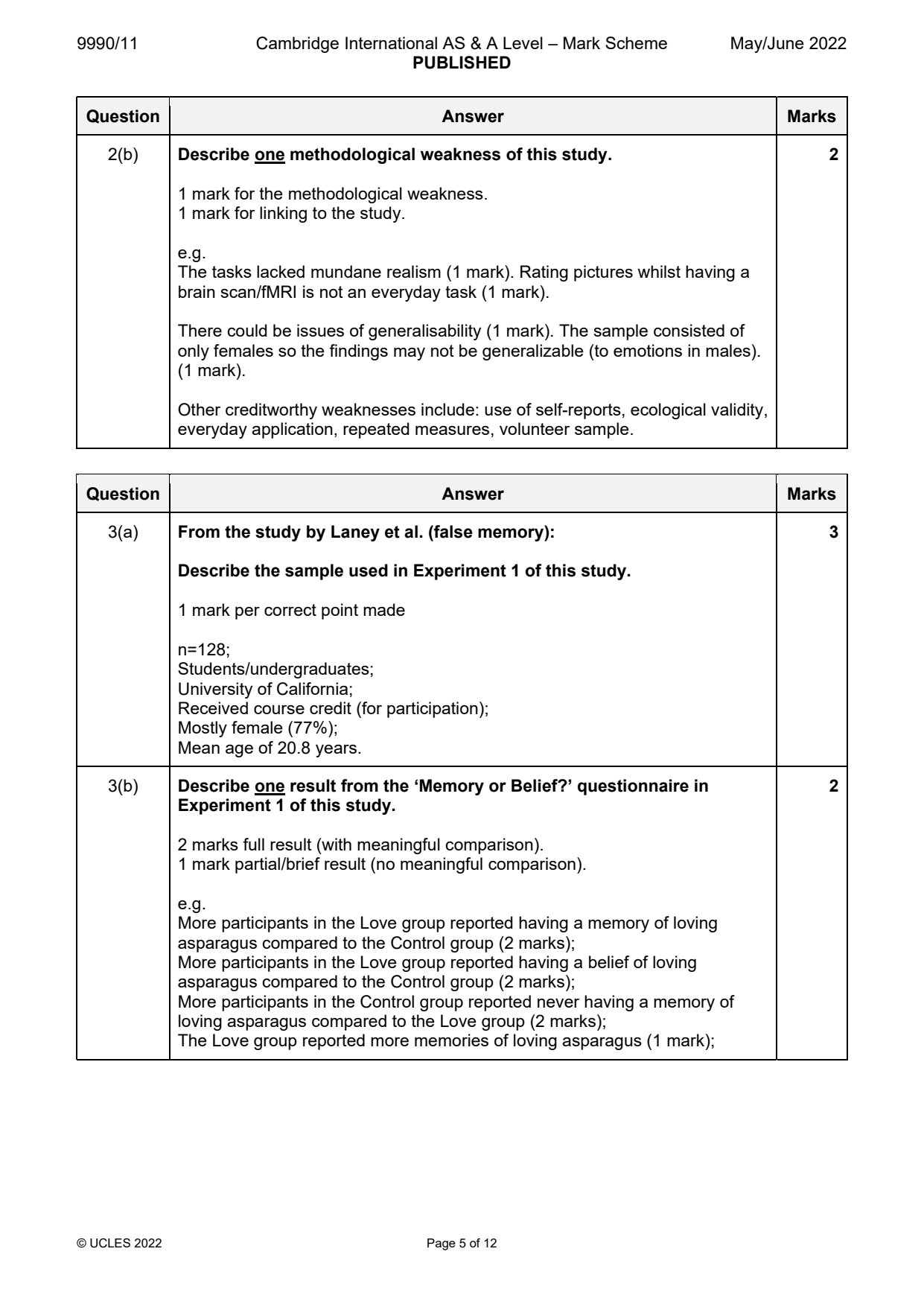
2(b) Describe one methodological weakness of this study. 2
1 mark for the methodological weakness.
1 mark for linking to the study.
e.g.
The tasks lacked mundane realism (1 mark). Rating pictures whilst having a
brain scan/fMRI is not an everyday task (1 mark).
There could be issues of generalisability (1 mark). The sample consisted of
only females so the findings may not be generalizable (to emotions in males).
(1 mark).
Other creditworthy weaknesses include: use of self-reports, ecological validity,
everyday application, repeated measures, volunteer sample.
Question Answer Marks
Official mark scheme pages: 4, 5 · source PDF URL
9990-2022-mj-11-q10
May/June 2022 · Paper 11 · Question 10 · 10 marks
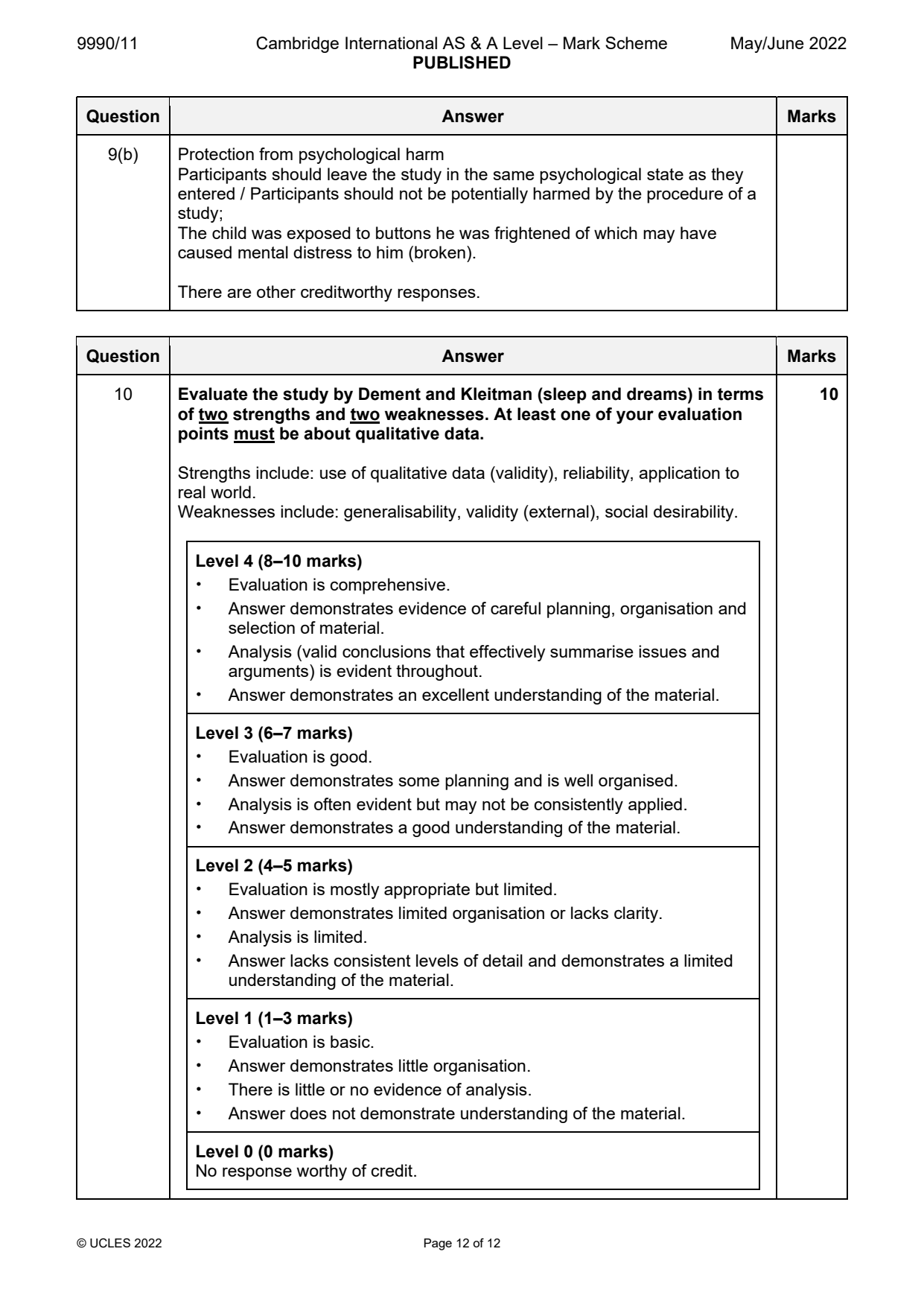
10 Evaluate the study by Dement and Kleitman (sleep and dreams) in terms 10
of two strengths and two weaknesses. At least one of your evaluation
points must be about qualitative data.
Strengths include: use of qualitative data (validity), reliability, application to
real world.
Weaknesses include: generalisability, validity (external), social desirability.
Level 4 (8–10 marks)
• Evaluation is comprehensive.
• Answer demonstrates evidence of careful planning, organisation and
selection of material.
• Analysis (valid conclusions that effectively summarise issues and
arguments) is evident throughout.
• Answer demonstrates an excellent understanding of the material.
Level 3 (6–7 marks)
• Evaluation is good.
• Answer demonstrates some planning and is well organised.
• Analysis is often evident but may not be consistently applied.
• Answer demonstrates a good understanding of the material.
Level 2 (4–5 marks)
• Evaluation is mostly appropriate but limited.
• Answer demonstrates limited organisation or lacks clarity.
• Analysis is limited.
• Answer lacks consistent levels of detail and demonstrates a limited
understanding of the material.
Level 1 (1–3 marks)
• Evaluation is basic.
• Answer demonstrates little organisation.
• There is little or no evidence of analysis.
• Answer does not demonstrate understanding of the material.
Level 0 (0 marks)
No response worthy of credit.
© UCLES 2022 Page 12 of 12
Official mark scheme pages: 12 · source PDF URL
9990-2022-mj-12-q03
May/June 2022 · Paper 12 · Question 3 · 5 marks
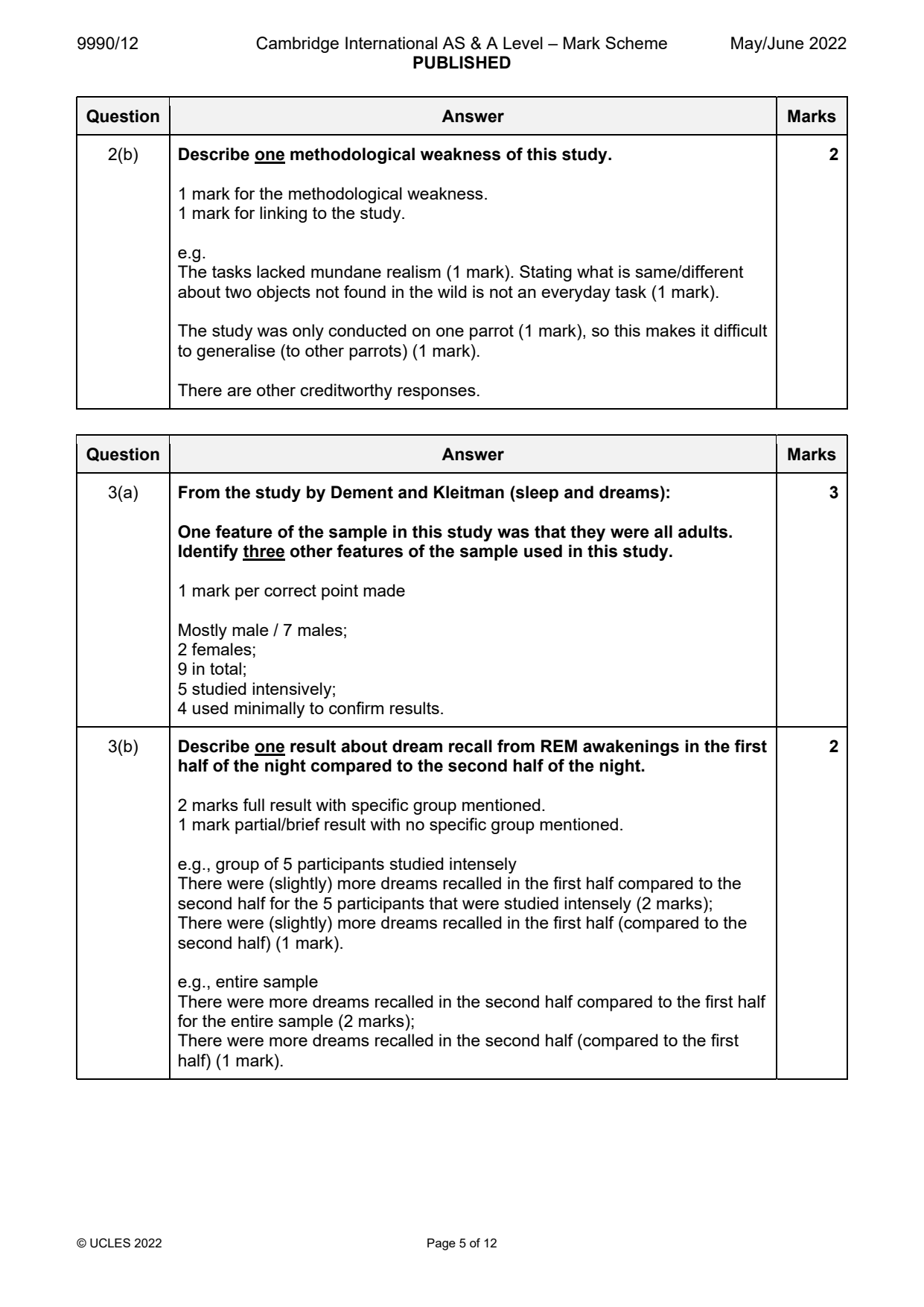
3(a) From the study by Dement and Kleitman (sleep and dreams): 3
One feature of the sample in this study was that they were all adults.
Identify three other features of the sample used in this study.
1 mark per correct point made
Mostly male / 7 males;
2 females;
9 in total;
5 studied intensively;
4 used minimally to confirm results.
3(b) Describe one result about dream recall from REM awakenings in the first 2
half of the night compared to the second half of the night.
2 marks full result with specific group mentioned.
1 mark partial/brief result with no specific group mentioned.
e.g., group of 5 participants studied intensely
There were (slightly) more dreams recalled in the first half compared to the
second half for the 5 participants that were studied intensely (2 marks);
There were (slightly) more dreams recalled in the first half (compared to the
second half) (1 mark).
e.g., entire sample
There were more dreams recalled in the second half compared to the first half
for the entire sample (2 marks);
There were more dreams recalled in the second half (compared to the first
half) (1 mark).
© UCLES 2022 Page 5 of 12
Official mark scheme pages: 5 · source PDF URL
9990-2022-mj-12-q05
May/June 2022 · Paper 12 · Question 5 · 5 marks
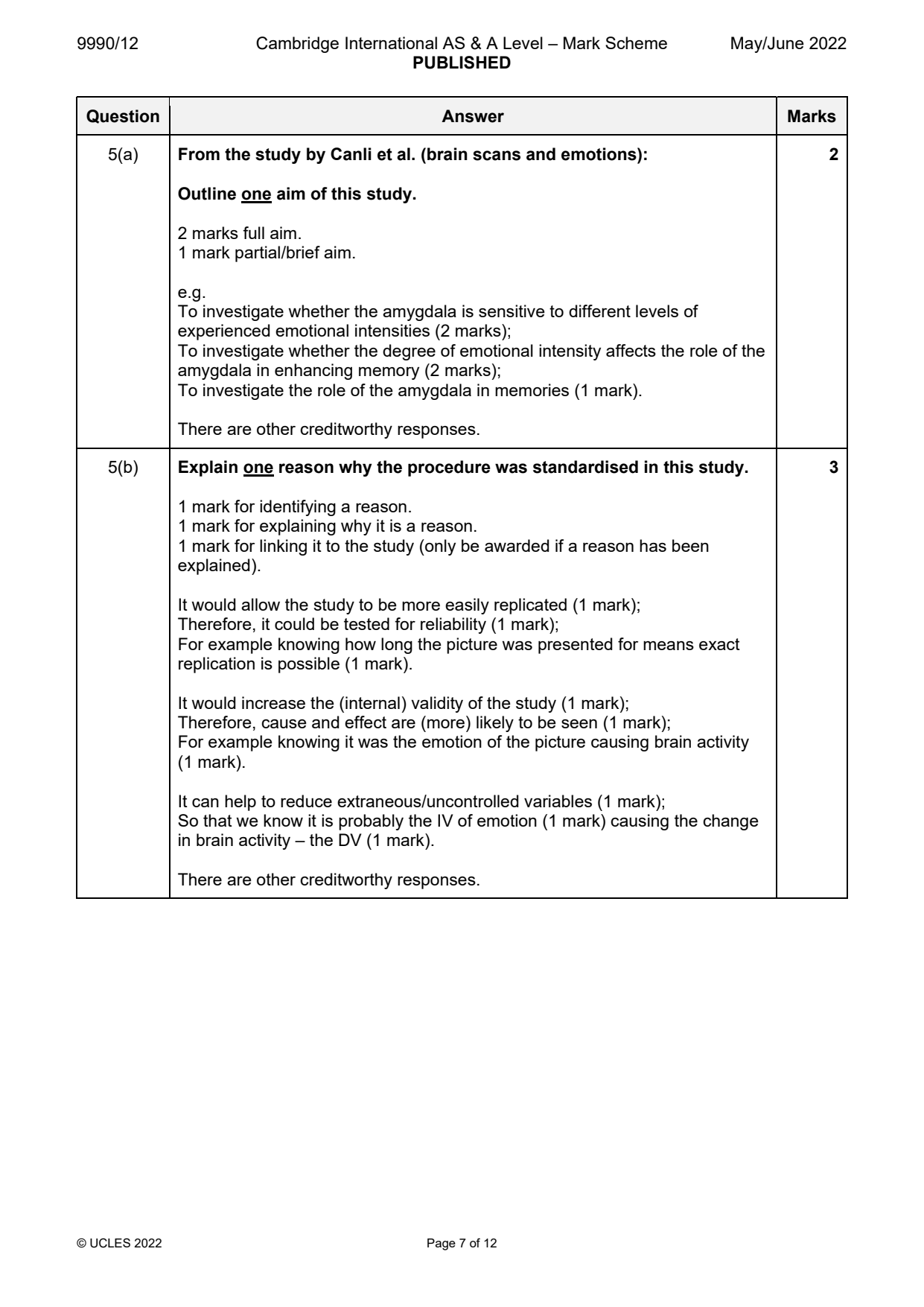
5(a) From the study by Canli et al. (brain scans and emotions): 2
Outline one aim of this study.
2 marks full aim.
1 mark partial/brief aim.
e.g.
To investigate whether the amygdala is sensitive to different levels of
experienced emotional intensities (2 marks);
To investigate whether the degree of emotional intensity affects the role of the
amygdala in enhancing memory (2 marks);
To investigate the role of the amygdala in memories (1 mark).
There are other creditworthy responses.
5(b) Explain one reason why the procedure was standardised in this study. 3
1 mark for identifying a reason.
1 mark for explaining why it is a reason.
1 mark for linking it to the study (only be awarded if a reason has been
explained).
It would allow the study to be more easily replicated (1 mark);
Therefore, it could be tested for reliability (1 mark);
For example knowing how long the picture was presented for means exact
replication is possible (1 mark).
It would increase the (internal) validity of the study (1 mark);
Therefore, cause and effect are (more) likely to be seen (1 mark);
For example knowing it was the emotion of the picture causing brain activity
(1 mark).
It can help to reduce extraneous/uncontrolled variables (1 mark);
So that we know it is probably the IV of emotion (1 mark) causing the change
in brain activity – the DV (1 mark).
There are other creditworthy responses.
© UCLES 2022 Page 7 of 12
Official mark scheme pages: 7 · source PDF URL
9990-2022-mj-12-q08
May/June 2022 · Paper 12 · Question 8 · 6 marks
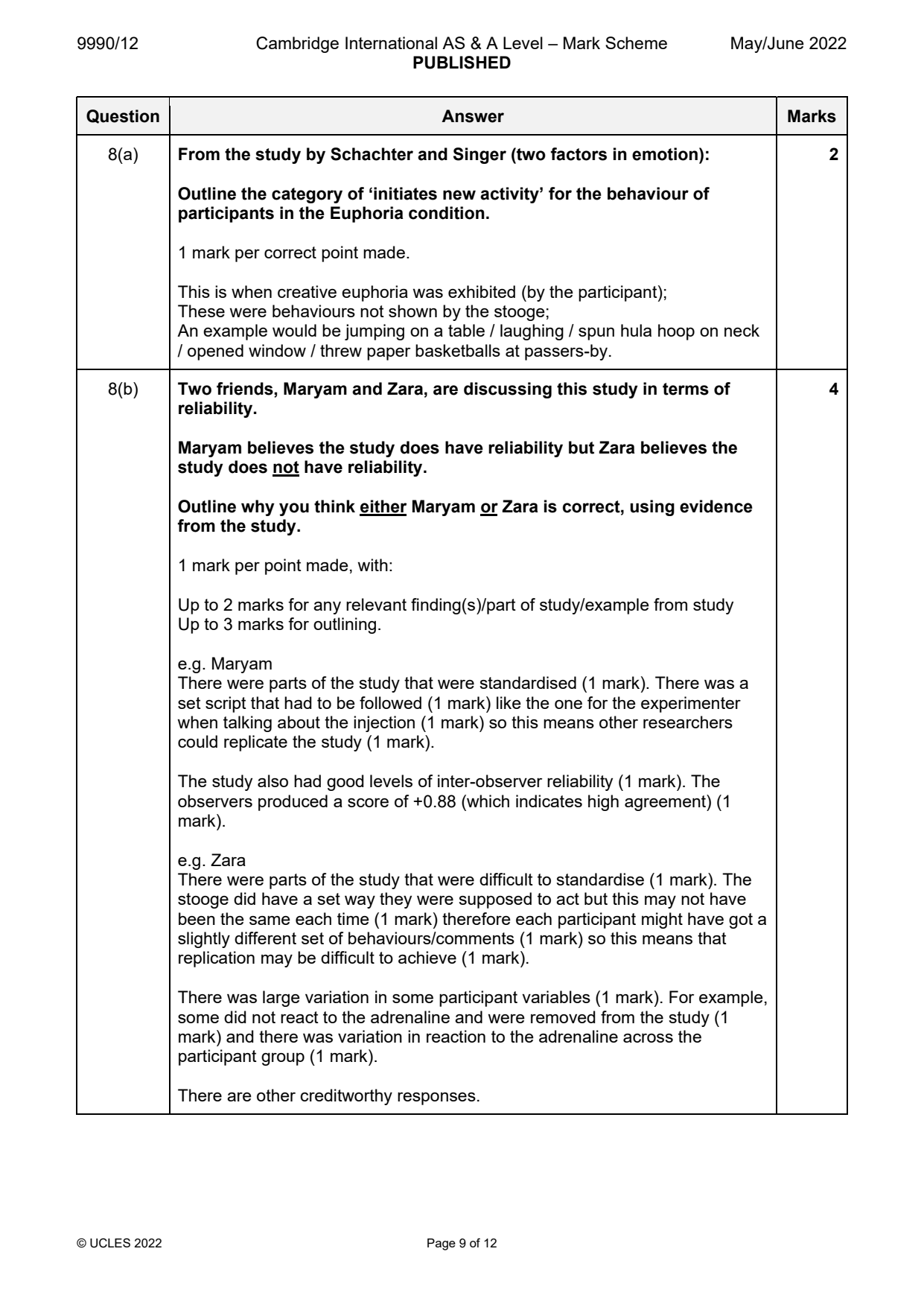
8(a) From the study by Schachter and Singer (two factors in emotion): 2
Outline the category of ‘initiates new activity’ for the behaviour of
participants in the Euphoria condition.
1 mark per correct point made.
This is when creative euphoria was exhibited (by the participant);
These were behaviours not shown by the stooge;
An example would be jumping on a table / laughing / spun hula hoop on neck
/ opened window / threw paper basketballs at passers-by.
8(b) Two friends, Maryam and Zara, are discussing this study in terms of 4
reliability.
Maryam believes the study does have reliability but Zara believes the
study does not have reliability.
Outline why you think either Maryam or Zara is correct, using evidence
from the study.
1 mark per point made, with:
Up to 2 marks for any relevant finding(s)/part of study/example from study
Up to 3 marks for outlining.
e.g. Maryam
There were parts of the study that were standardised (1 mark). There was a
set script that had to be followed (1 mark) like the one for the experimenter
when talking about the injection (1 mark) so this means other researchers
could replicate the study (1 mark).
The study also had good levels of inter-observer reliability (1 mark). The
observers produced a score of +0.88 (which indicates high agreement) (1
mark).
e.g. Zara
There were parts of the study that were difficult to standardise (1 mark). The
stooge did have a set way they were supposed to act but this may not have
been the same each time (1 mark) therefore each participant might have got a
slightly different set of behaviours/comments (1 mark) so this means that
replication may be difficult to achieve (1 mark).
There was large variation in some participant variables (1 mark). For example,
some did not react to the adrenaline and were removed from the study (1
mark) and there was variation in reaction to the adrenaline across the
participant group (1 mark).
There are other creditworthy responses.
© UCLES 2022 Page 9 of 12
Official mark scheme pages: 9 · source PDF URL
9990-2022-mj-13-q03
May/June 2022 · Paper 13 · Question 3 · 5 marks
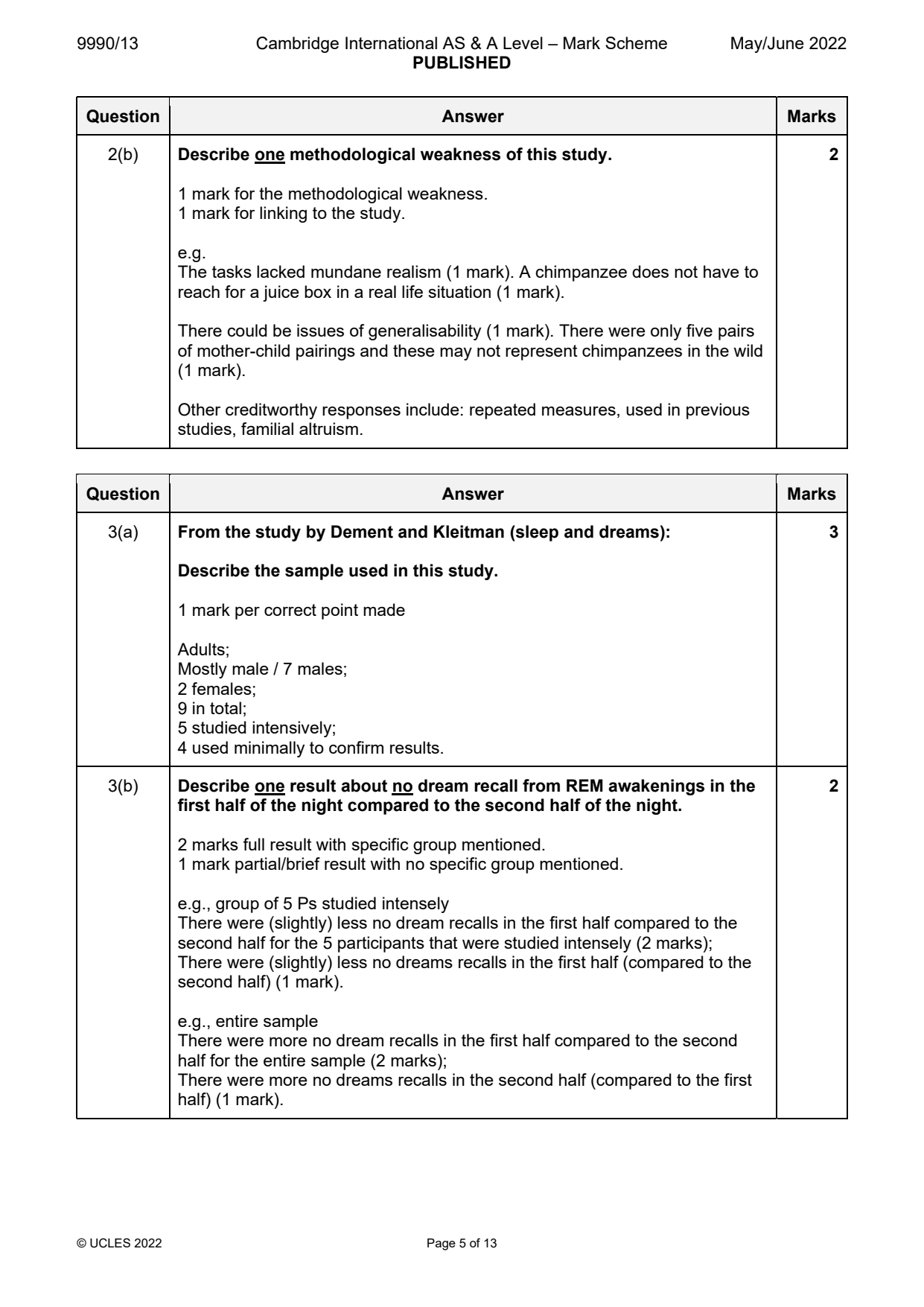
3(a) From the study by Dement and Kleitman (sleep and dreams): 3
Describe the sample used in this study.
1 mark per correct point made
Adults;
Mostly male / 7 males;
2 females;
9 in total;
5 studied intensively;
4 used minimally to confirm results.
3(b) Describe one result about no dream recall from REM awakenings in the 2
first half of the night compared to the second half of the night.
2 marks full result with specific group mentioned.
1 mark partial/brief result with no specific group mentioned.
e.g., group of 5 Ps studied intensely
There were (slightly) less no dream recalls in the first half compared to the
second half for the 5 participants that were studied intensely (2 marks);
There were (slightly) less no dreams recalls in the first half (compared to the
second half) (1 mark).
e.g., entire sample
There were more no dream recalls in the first half compared to the second
half for the entire sample (2 marks);
There were more no dreams recalls in the second half (compared to the first
half) (1 mark).
© UCLES 2022 Page 5 of 13
Official mark scheme pages: 5 · source PDF URL
9990-2022-mj-13-q07
May/June 2022 · Paper 13 · Question 7 · 4 marks
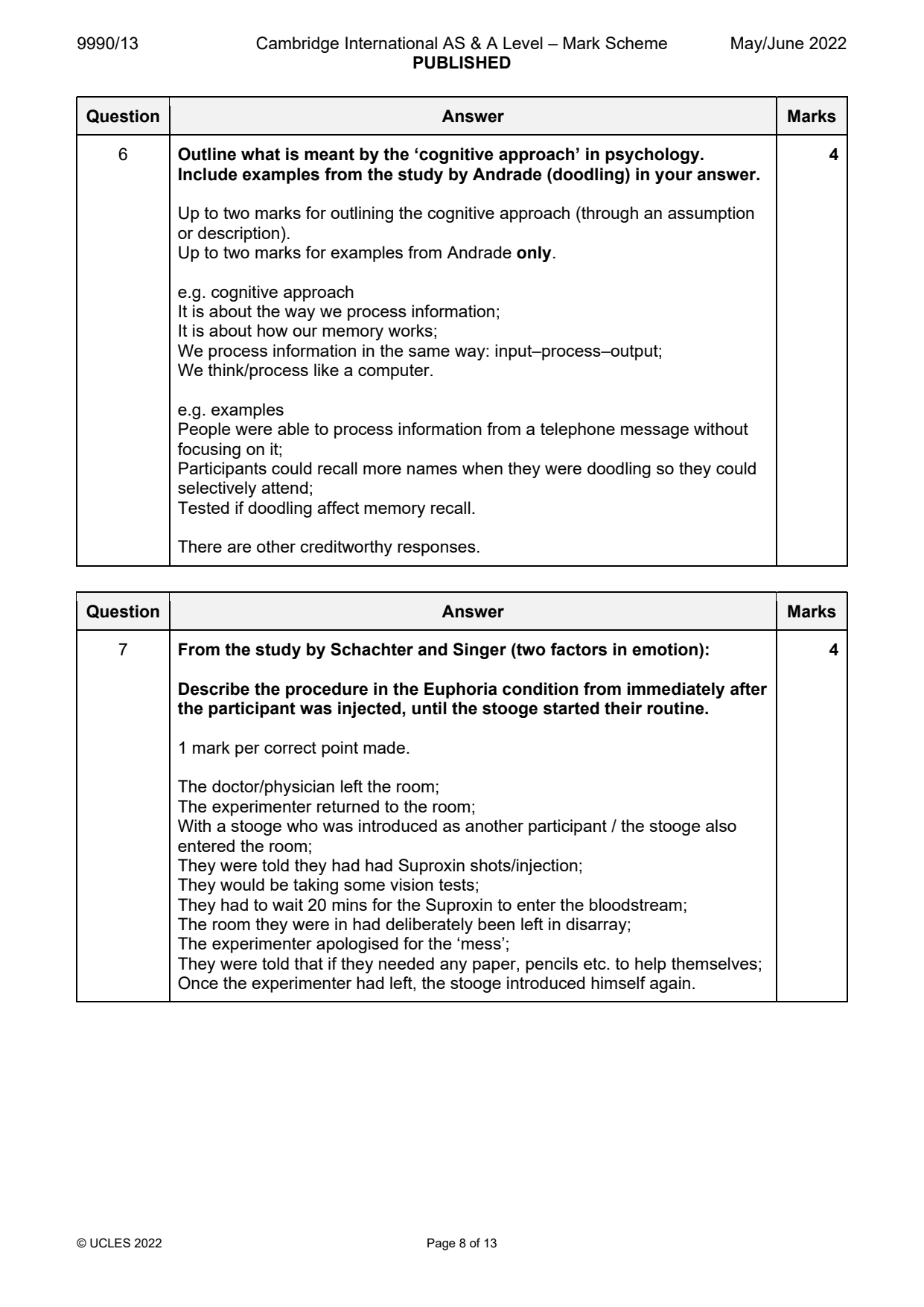
7 From the study by Schachter and Singer (two factors in emotion): 4
Describe the procedure in the Euphoria condition from immediately after
the participant was injected, until the stooge started their routine.
1 mark per correct point made.
The doctor/physician left the room;
The experimenter returned to the room;
With a stooge who was introduced as another participant / the stooge also
entered the room;
They were told they had had Suproxin shots/injection;
They would be taking some vision tests;
They had to wait 20 mins for the Suproxin to enter the bloodstream;
The room they were in had deliberately been left in disarray;
The experimenter apologised for the ‘mess’;
They were told that if they needed any paper, pencils etc. to help themselves;
Once the experimenter had left, the stooge introduced himself again.
© UCLES 2022 Page 8 of 13
Official mark scheme pages: 8 · source PDF URL
9990-2022-on-11-q01
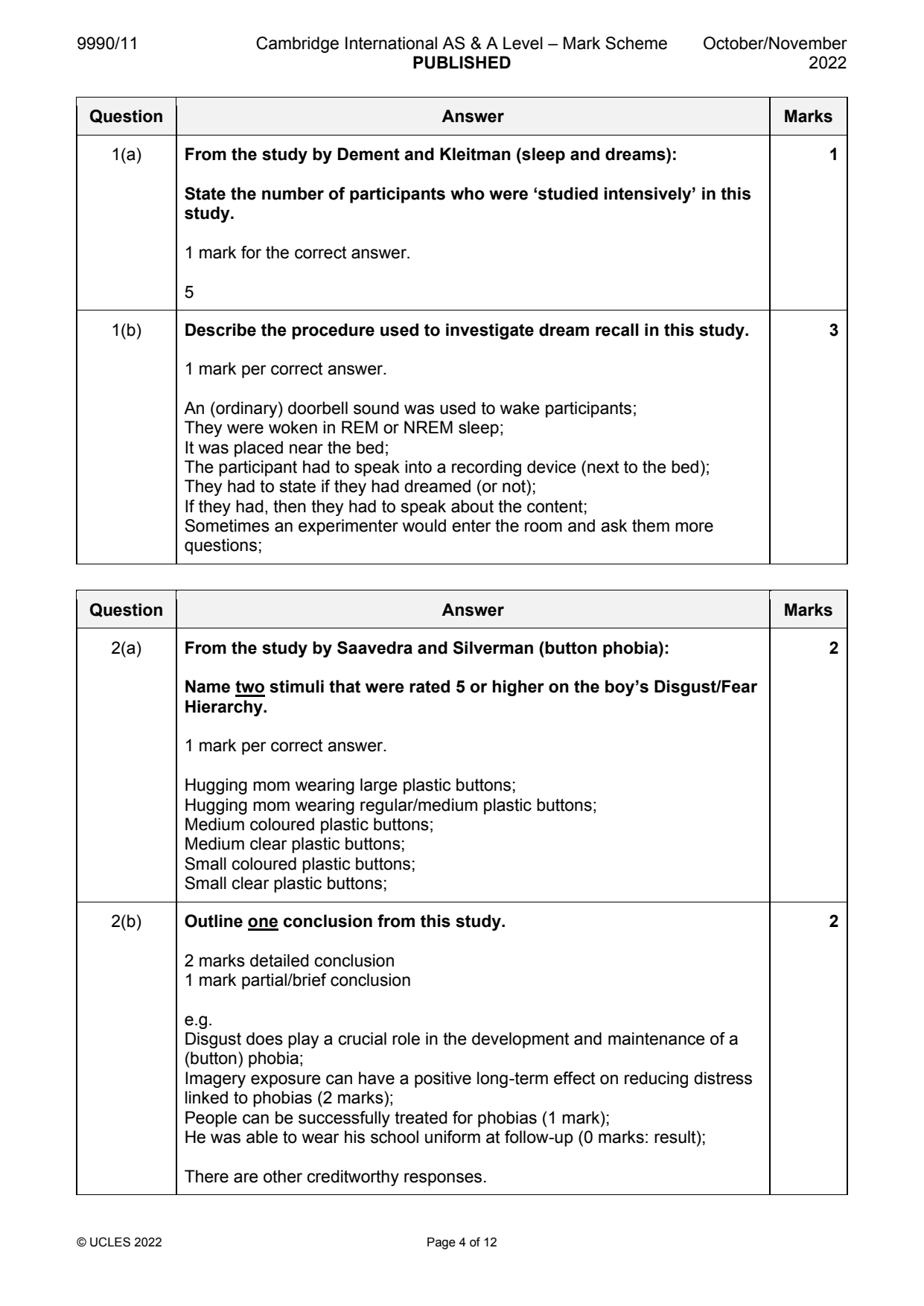
Oct/Nov 2022 · Paper 11 · Question 1 · 4 marks
1(a) From the study by Dement and Kleitman (sleep and dreams): 1
State the number of participants who were ‘studied intensively’ in this
study.
1 mark for the correct answer.
5
1(b) Describe the procedure used to investigate dream recall in this study. 3
1 mark per correct answer.
An (ordinary) doorbell sound was used to wake participants;
They were woken in REM or NREM sleep;
It was placed near the bed;
The participant had to speak into a recording device (next to the bed);
They had to state if they had dreamed (or not);
If they had, then they had to speak about the content;
Sometimes an experimenter would enter the room and ask them more
questions;
Question Answer Marks
Official mark scheme pages: 4 · source PDF URL
9990-2022-on-11-q06
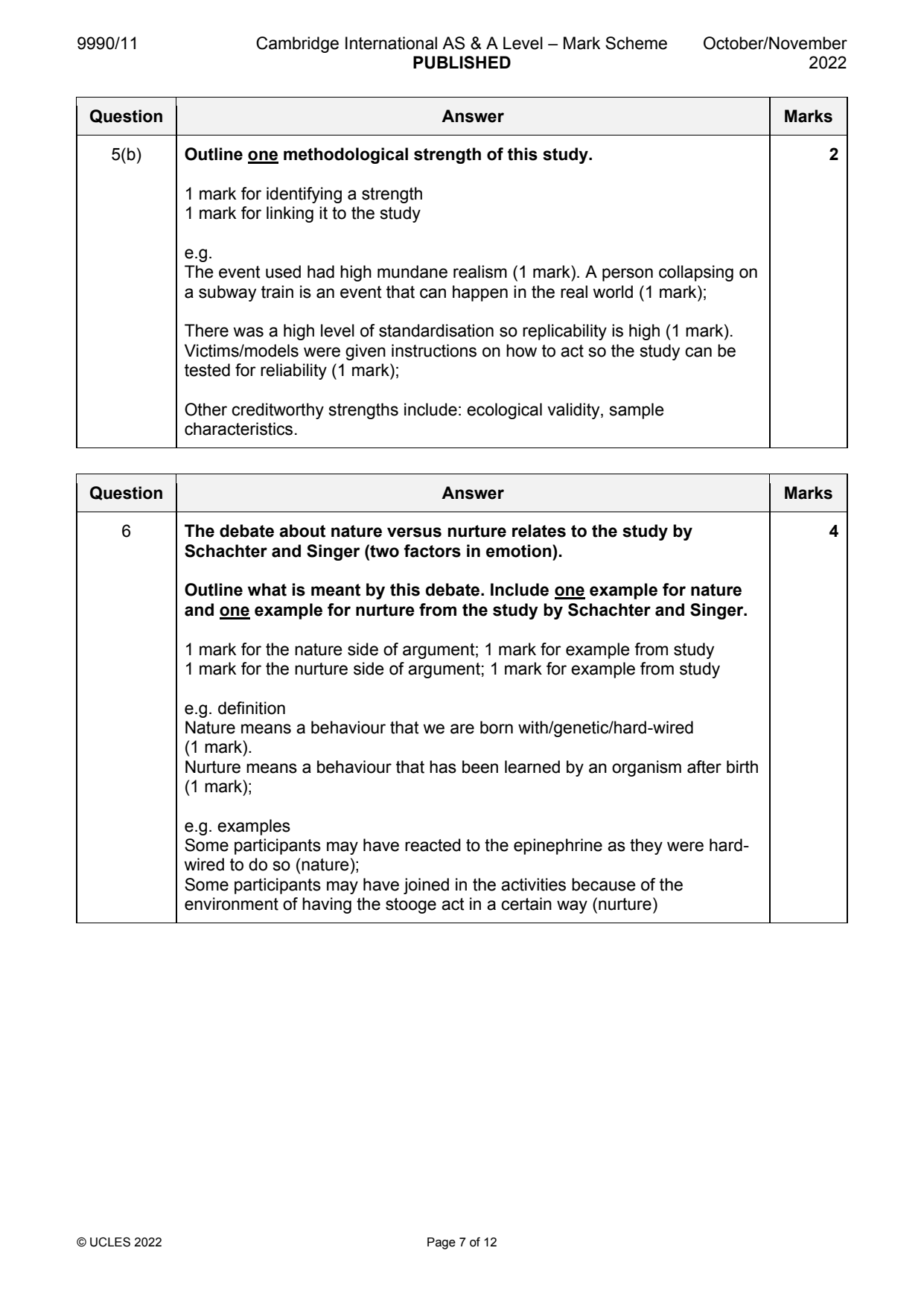
Oct/Nov 2022 · Paper 11 · Question 6 · 4 marks
6 The debate about nature versus nurture relates to the study by 4
Schachter and Singer (two factors in emotion).
Outline what is meant by this debate. Include one example for nature
and one example for nurture from the study by Schachter and Singer.
1 mark for the nature side of argument; 1 mark for example from study
1 mark for the nurture side of argument; 1 mark for example from study
e.g. definition
Nature means a behaviour that we are born with/genetic/hard-wired
(1 mark).
Nurture means a behaviour that has been learned by an organism after birth
(1 mark);
e.g. examples
Some participants may have reacted to the epinephrine as they were hard-
wired to do so (nature);
Some participants may have joined in the activities because of the
environment of having the stooge act in a certain way (nurture)
© UCLES 2022 Page 7 of 12
Official mark scheme pages: 7 · source PDF URL
9990-2022-on-11-q07
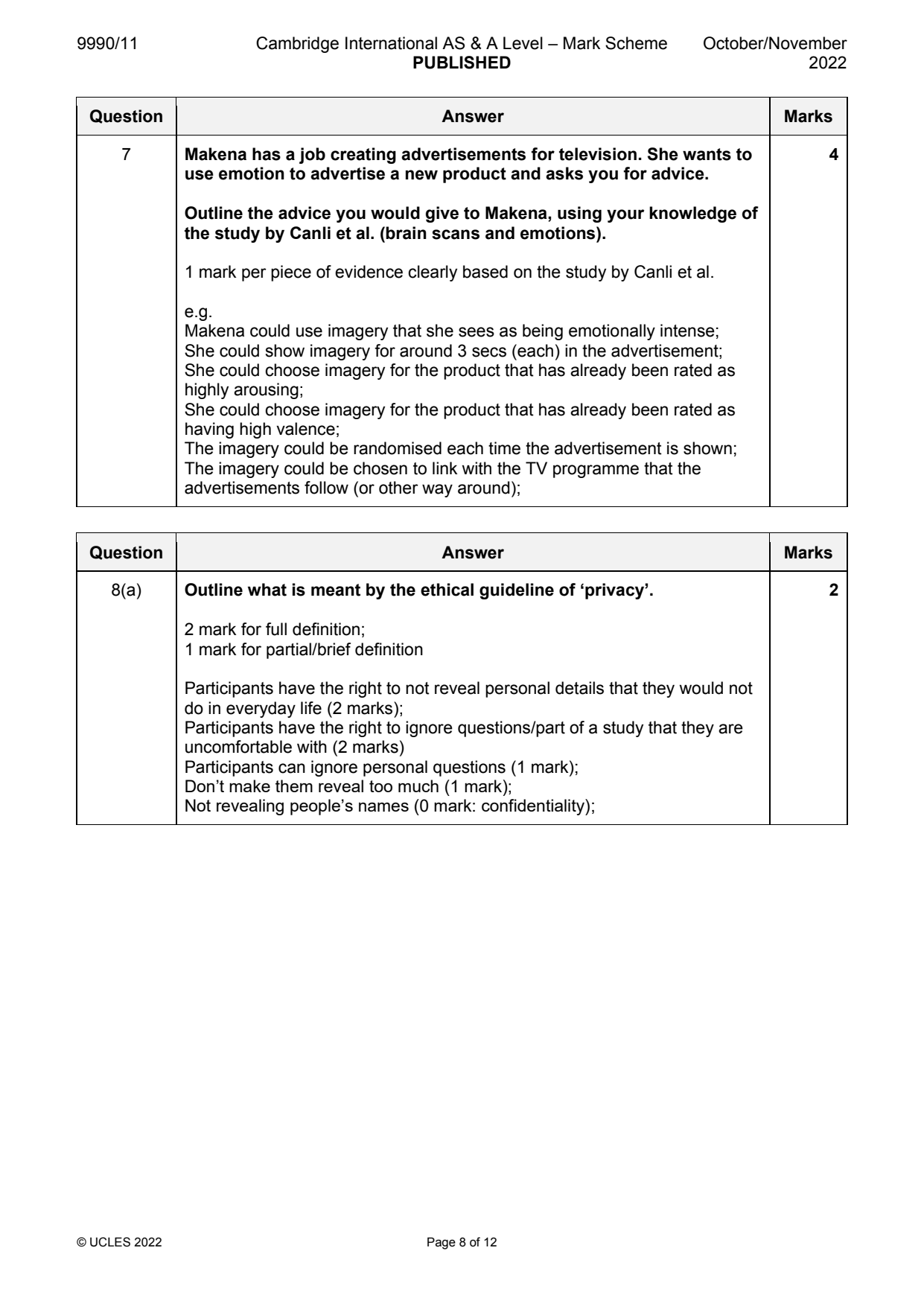
Oct/Nov 2022 · Paper 11 · Question 7 · 4 marks
7 Makena has a job creating advertisements for television. She wants to 4
use emotion to advertise a new product and asks you for advice.
Outline the advice you would give to Makena, using your knowledge of
the study by Canli et al. (brain scans and emotions).
1 mark per piece of evidence clearly based on the study by Canli et al.
e.g.
Makena could use imagery that she sees as being emotionally intense;
She could show imagery for around 3 secs (each) in the advertisement;
She could choose imagery for the product that has already been rated as
highly arousing;
She could choose imagery for the product that has already been rated as
having high valence;
The imagery could be randomised each time the advertisement is shown;
The imagery could be chosen to link with the TV programme that the
advertisements follow (or other way around);
Question Answer Marks
Official mark scheme pages: 8 · source PDF URL
9990-2022-on-12-q02
Oct/Nov 2022 · Paper 12 · Question 2 · 4 marks
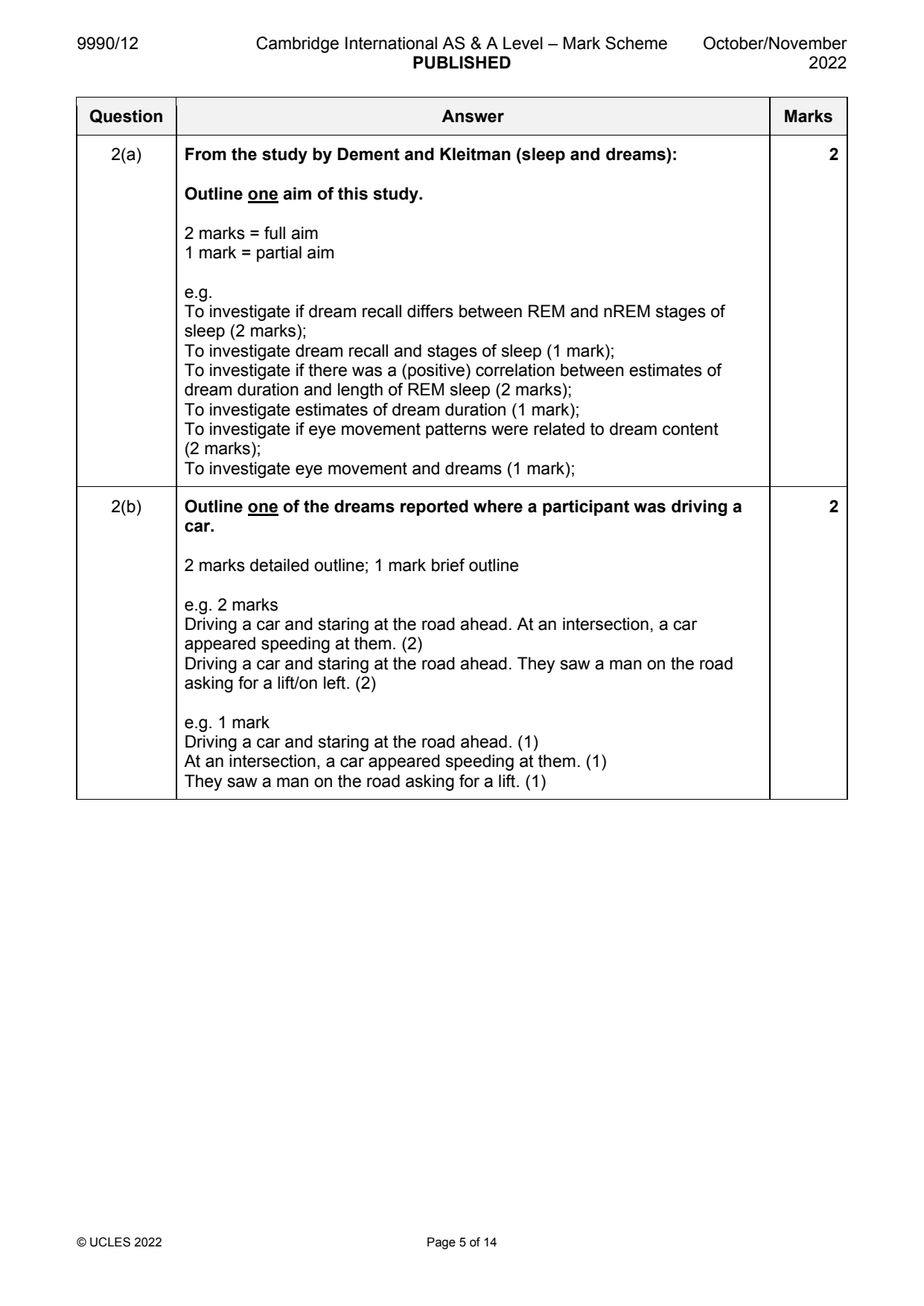
2(a) From the study by Dement and Kleitman (sleep and dreams): 2
Outline one aim of this study.
2 marks = full aim
1 mark = partial aim
e.g.
To investigate if dream recall differs between REM and nREM stages of
sleep (2 marks);
To investigate dream recall and stages of sleep (1 mark);
To investigate if there was a (positive) correlation between estimates of
dream duration and length of REM sleep (2 marks);
To investigate estimates of dream duration (1 mark);
To investigate if eye movement patterns were related to dream content
(2 marks);
To investigate eye movement and dreams (1 mark);
2(b) Outline one of the dreams reported where a participant was driving a 2
car.
2 marks detailed outline; 1 mark brief outline
e.g. 2 marks
Driving a car and staring at the road ahead. At an intersection, a car
appeared speeding at them. (2)
Driving a car and staring at the road ahead. They saw a man on the road
asking for a lift/on left. (2)
e.g. 1 mark
Driving a car and staring at the road ahead. (1)
At an intersection, a car appeared speeding at them. (1)
They saw a man on the road asking for a lift. (1)
© UCLES 2022 Page 5 of 14
Official mark scheme pages: 5 · source PDF URL
9990-2022-on-12-q05
Oct/Nov 2022 · Paper 12 · Question 5 · 5 marks
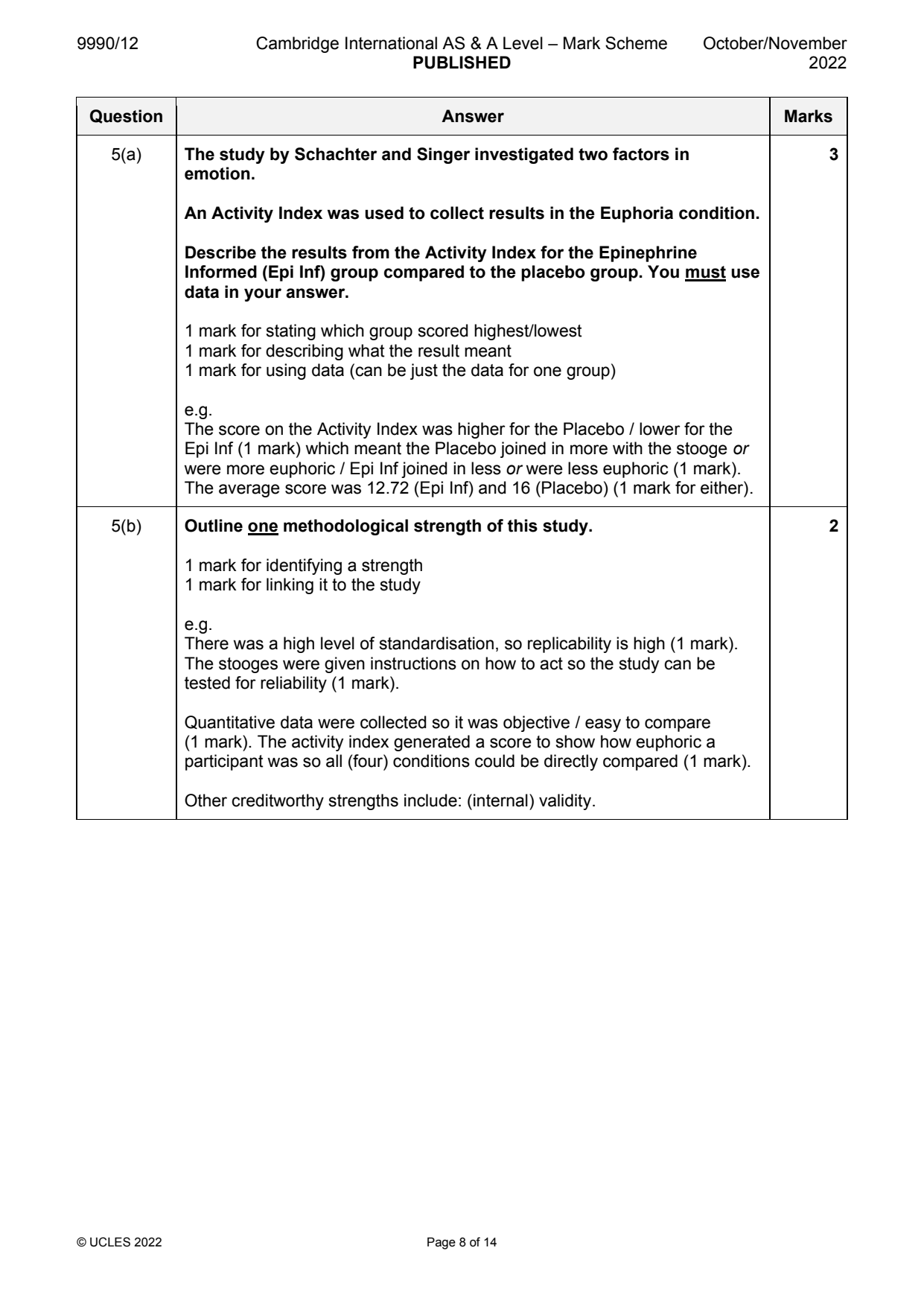
5(a) The study by Schachter and Singer investigated two factors in 3
emotion.
An Activity Index was used to collect results in the Euphoria condition.
Describe the results from the Activity Index for the Epinephrine
Informed (Epi Inf) group compared to the placebo group. You must use
data in your answer.
1 mark for stating which group scored highest/lowest
1 mark for describing what the result meant
1 mark for using data (can be just the data for one group)
e.g.
The score on the Activity Index was higher for the Placebo / lower for the
Epi Inf (1 mark) which meant the Placebo joined in more with the stooge or
were more euphoric / Epi Inf joined in less or were less euphoric (1 mark).
The average score was 12.72 (Epi Inf) and 16 (Placebo) (1 mark for either).
5(b) Outline one methodological strength of this study. 2
1 mark for identifying a strength
1 mark for linking it to the study
e.g.
There was a high level of standardisation, so replicability is high (1 mark).
The stooges were given instructions on how to act so the study can be
tested for reliability (1 mark).
Quantitative data were collected so it was objective / easy to compare
(1 mark). The activity index generated a score to show how euphoric a
participant was so all (four) conditions could be directly compared (1 mark).
Other creditworthy strengths include: (internal) validity.
© UCLES 2022 Page 8 of 14
Official mark scheme pages: 8 · source PDF URL
9990-2022-on-12-q10
Oct/Nov 2022 · Paper 12 · Question 10 · 10 marks
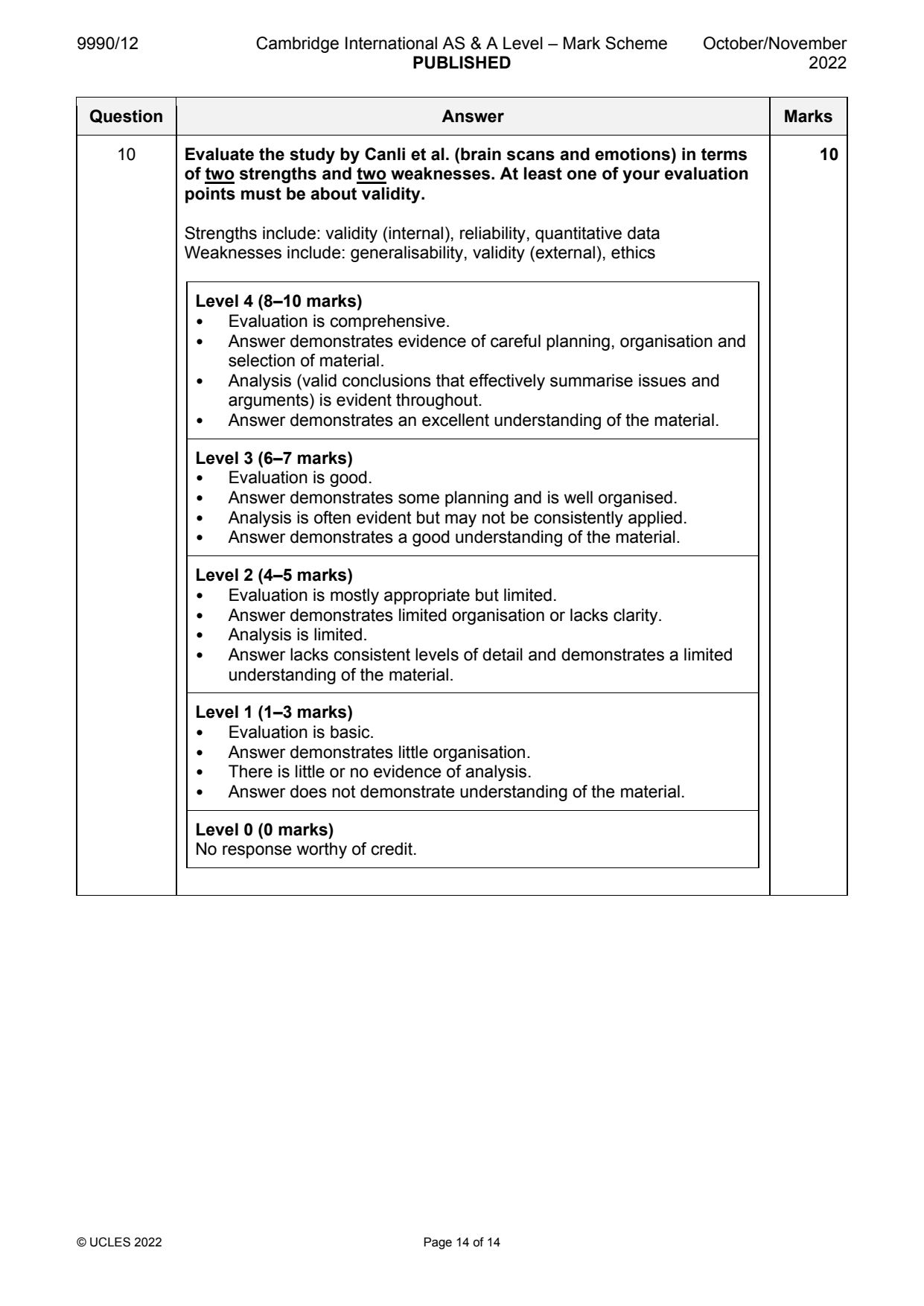
10 Evaluate the study by Canli et al. (brain scans and emotions) in terms 10
of two strengths and two weaknesses. At least one of your evaluation
points must be about validity.
Strengths include: validity (internal), reliability, quantitative data
Weaknesses include: generalisability, validity (external), ethics
Level 4 (8–10 marks)
• Evaluation is comprehensive.
• Answer demonstrates evidence of careful planning, organisation and
selection of material.
• Analysis (valid conclusions that effectively summarise issues and
arguments) is evident throughout.
• Answer demonstrates an excellent understanding of the material.
Level 3 (6–7 marks)
• Evaluation is good.
• Answer demonstrates some planning and is well organised.
• Analysis is often evident but may not be consistently applied.
• Answer demonstrates a good understanding of the material.
Level 2 (4–5 marks)
• Evaluation is mostly appropriate but limited.
• Answer demonstrates limited organisation or lacks clarity.
• Analysis is limited.
• Answer lacks consistent levels of detail and demonstrates a limited
understanding of the material.
Level 1 (1–3 marks)
• Evaluation is basic.
• Answer demonstrates little organisation.
• There is little or no evidence of analysis.
• Answer does not demonstrate understanding of the material.
Level 0 (0 marks)
No response worthy of credit.
© UCLES 2022 Page 14 of 14
Official mark scheme pages: 14 · source PDF URL
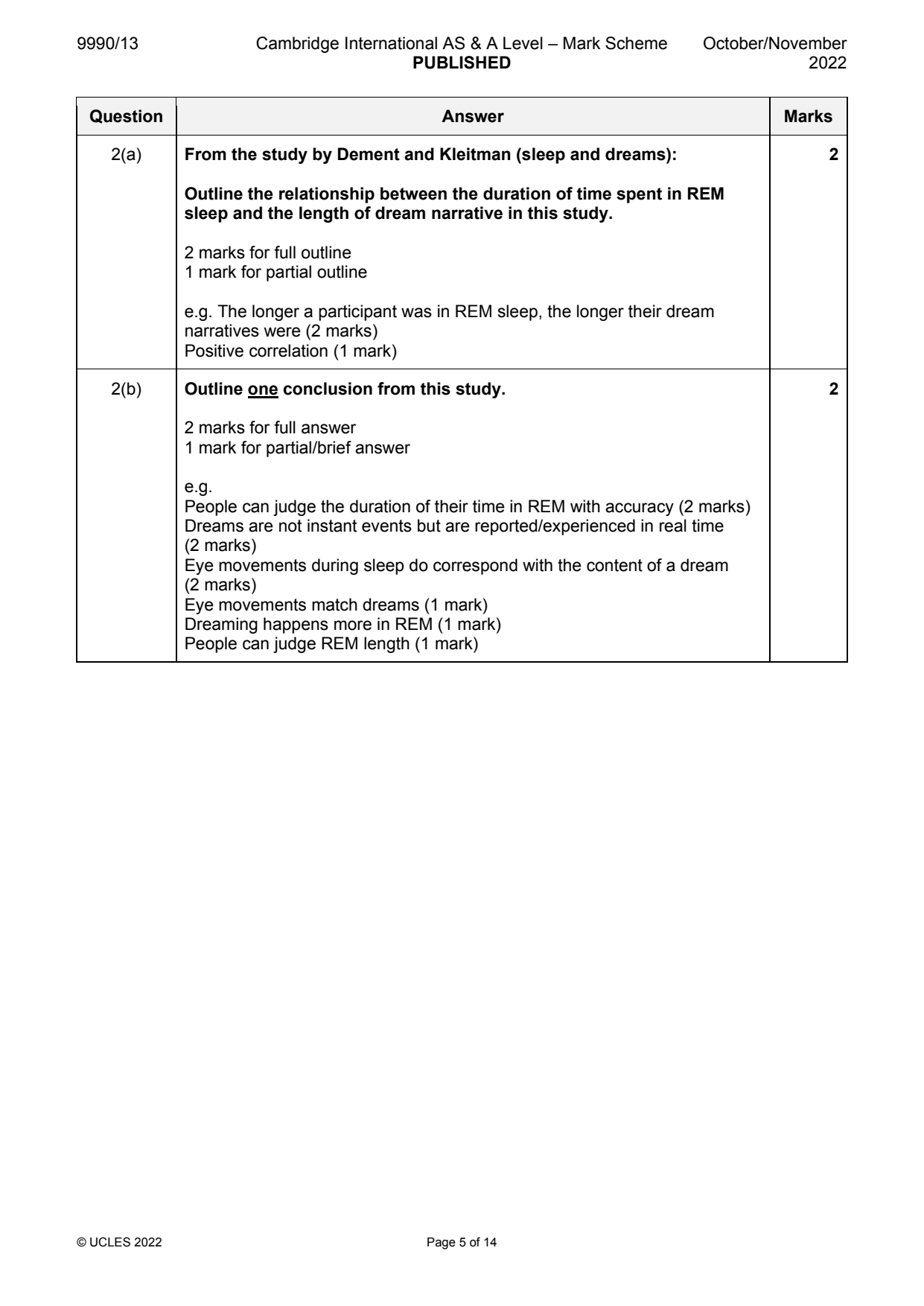
9990-2022-on-13-q02
Oct/Nov 2022 · Paper 13 · Question 2 · 4 marks
2(a) From the study by Dement and Kleitman (sleep and dreams): 2
Outline the relationship between the duration of time spent in REM
sleep and the length of dream narrative in this study.
2 marks for full outline
1 mark for partial outline
e.g. The longer a participant was in REM sleep, the longer their dream
narratives were (2 marks)
Positive correlation (1 mark)
2(b) Outline one conclusion from this study. 2
2 marks for full answer
1 mark for partial/brief answer
e.g.
People can judge the duration of their time in REM with accuracy (2 marks)
Dreams are not instant events but are reported/experienced in real time
(2 marks)
Eye movements during sleep do correspond with the content of a dream
(2 marks)
Eye movements match dreams (1 mark)
Dreaming happens more in REM (1 mark)
People can judge REM length (1 mark)
© UCLES 2022 Page 5 of 14
Official mark scheme pages: 5 · source PDF URL
9990-2022-on-13-q05
Oct/Nov 2022 · Paper 13 · Question 5 · 5 marks
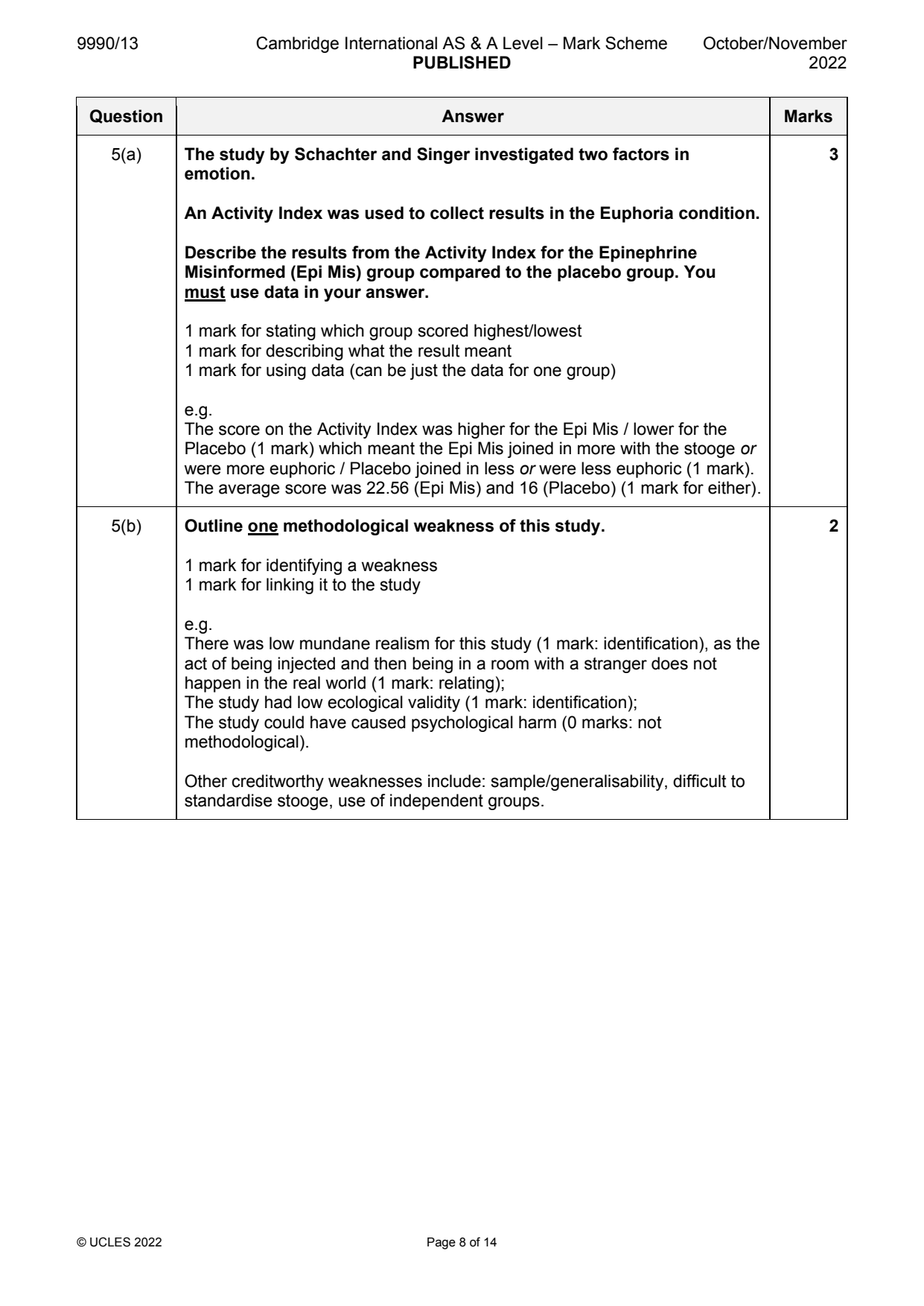
5(a) The study by Schachter and Singer investigated two factors in 3
emotion.
An Activity Index was used to collect results in the Euphoria condition.
Describe the results from the Activity Index for the Epinephrine
Misinformed (Epi Mis) group compared to the placebo group. You
must use data in your answer.
1 mark for stating which group scored highest/lowest
1 mark for describing what the result meant
1 mark for using data (can be just the data for one group)
e.g.
The score on the Activity Index was higher for the Epi Mis / lower for the
Placebo (1 mark) which meant the Epi Mis joined in more with the stooge or
were more euphoric / Placebo joined in less or were less euphoric (1 mark).
The average score was 22.56 (Epi Mis) and 16 (Placebo) (1 mark for either).
5(b) Outline one methodological weakness of this study. 2
1 mark for identifying a weakness
1 mark for linking it to the study
e.g.
There was low mundane realism for this study (1 mark: identification), as the
act of being injected and then being in a room with a stranger does not
happen in the real world (1 mark: relating);
The study had low ecological validity (1 mark: identification);
The study could have caused psychological harm (0 marks: not
methodological).
Other creditworthy weaknesses include: sample/generalisability, difficult to
standardise stooge, use of independent groups.
© UCLES 2022 Page 8 of 14
Official mark scheme pages: 8 · source PDF URL
9990-2022-on-13-q08
Oct/Nov 2022 · Paper 13 · Question 8 · 6 marks
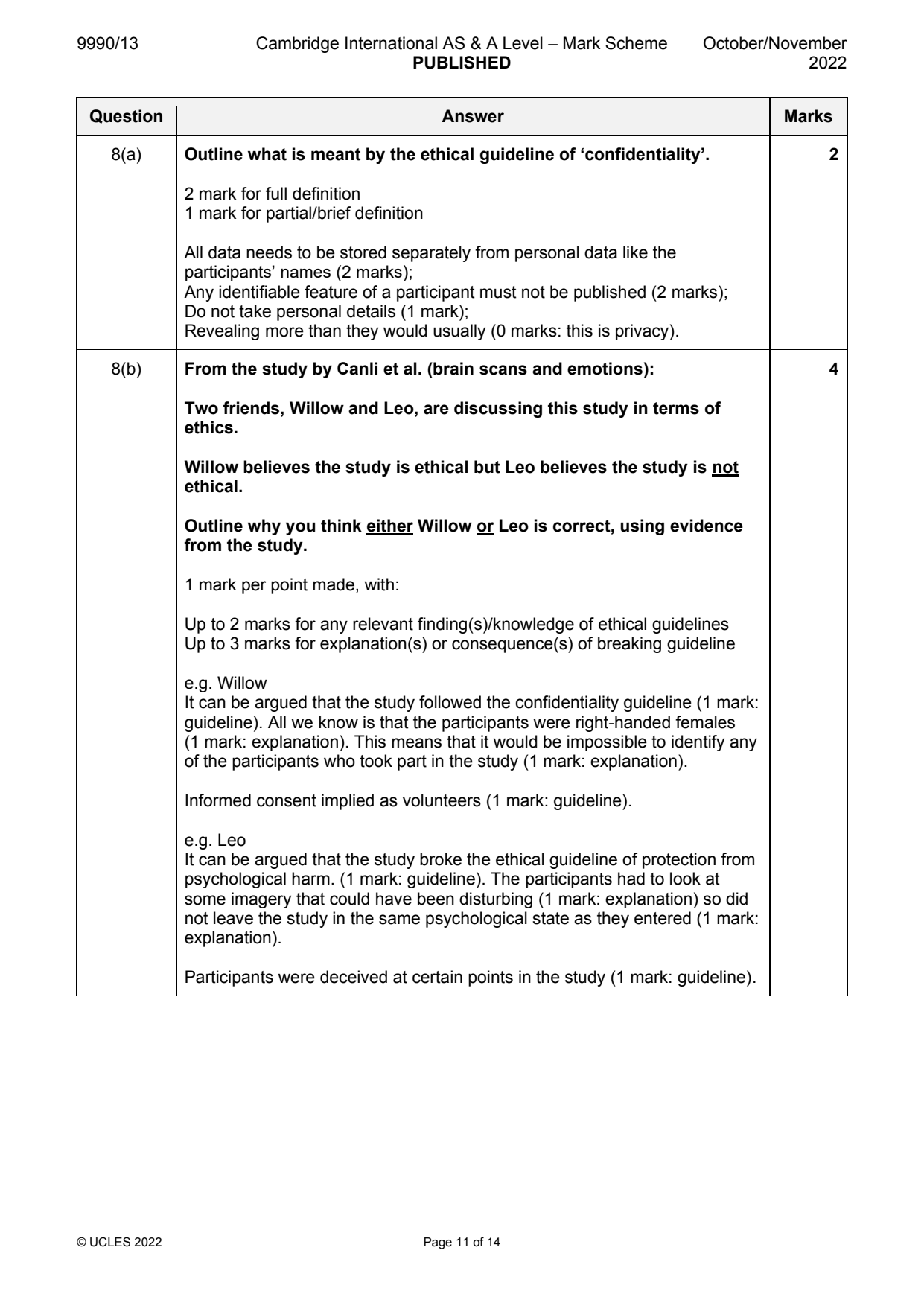
8(a) Outline what is meant by the ethical guideline of ‘confidentiality’. 2
2 mark for full definition
1 mark for partial/brief definition
All data needs to be stored separately from personal data like the
participants’ names (2 marks);
Any identifiable feature of a participant must not be published (2 marks);
Do not take personal details (1 mark);
Revealing more than they would usually (0 marks: this is privacy).
8(b) From the study by Canli et al. (brain scans and emotions): 4
Two friends, Willow and Leo, are discussing this study in terms of
ethics.
Willow believes the study is ethical but Leo believes the study is not
ethical.
Outline why you think either Willow or Leo is correct, using evidence
from the study.
1 mark per point made, with:
Up to 2 marks for any relevant finding(s)/knowledge of ethical guidelines
Up to 3 marks for explanation(s) or consequence(s) of breaking guideline
e.g. Willow
It can be argued that the study followed the confidentiality guideline (1 mark:
guideline). All we know is that the participants were right-handed females
(1 mark: explanation). This means that it would be impossible to identify any
of the participants who took part in the study (1 mark: explanation).
Informed consent implied as volunteers (1 mark: guideline).
e.g. Leo
It can be argued that the study broke the ethical guideline of protection from
psychological harm. (1 mark: guideline). The participants had to look at
some imagery that could have been disturbing (1 mark: explanation) so did
not leave the study in the same psychological state as they entered (1 mark:
explanation).
Participants were deceived at certain points in the study (1 mark: guideline).
© UCLES 2022 Page 11 of 14
Official mark scheme pages: 11 · source PDF URL
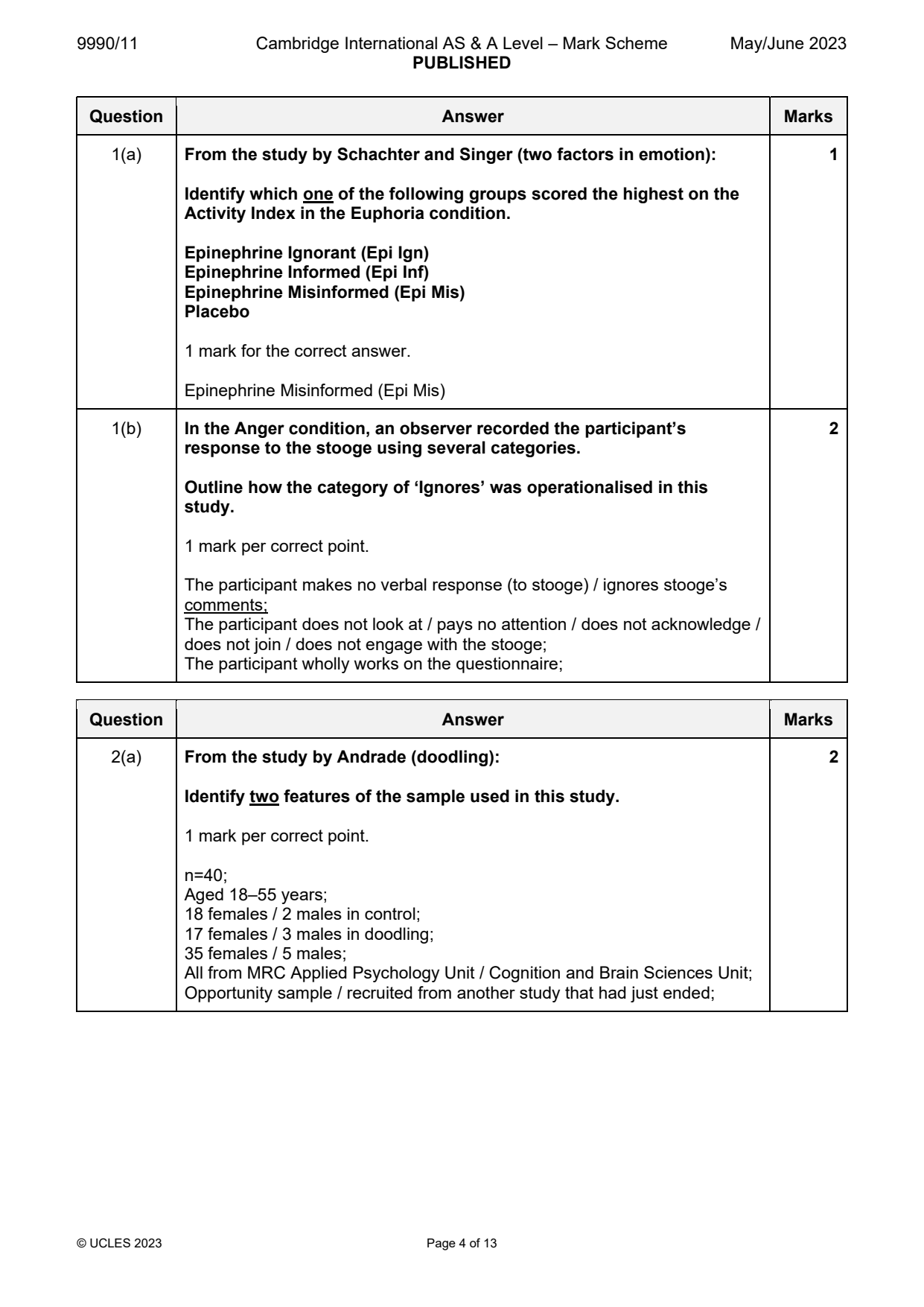
9990-2023-mj-11-q01
May/June 2023 · Paper 11 · Question 1 · 3 marks
1(a) From the study by Schachter and Singer (two factors in emotion): 1
Identify which one of the following groups scored the highest on the
Activity Index in the Euphoria condition.
Epinephrine Ignorant (Epi Ign)
Epinephrine Informed (Epi Inf)
Epinephrine Misinformed (Epi Mis)
Placebo
1 mark for the correct answer.
Epinephrine Misinformed (Epi Mis)
1(b) In the Anger condition, an observer recorded the participant’s 2
response to the stooge using several categories.
Outline how the category of ‘Ignores’ was operationalised in this
study.
1 mark per correct point.
The participant makes no verbal response (to stooge) / ignores stooge’s
comments;
The participant does not look at / pays no attention / does not acknowledge /
does not join / does not engage with the stooge;
The participant wholly works on the questionnaire;
Question Answer Marks
Official mark scheme pages: 4 · source PDF URL
9990-2023-mj-11-q09
May/June 2023 · Paper 11 · Question 9 · 12 marks
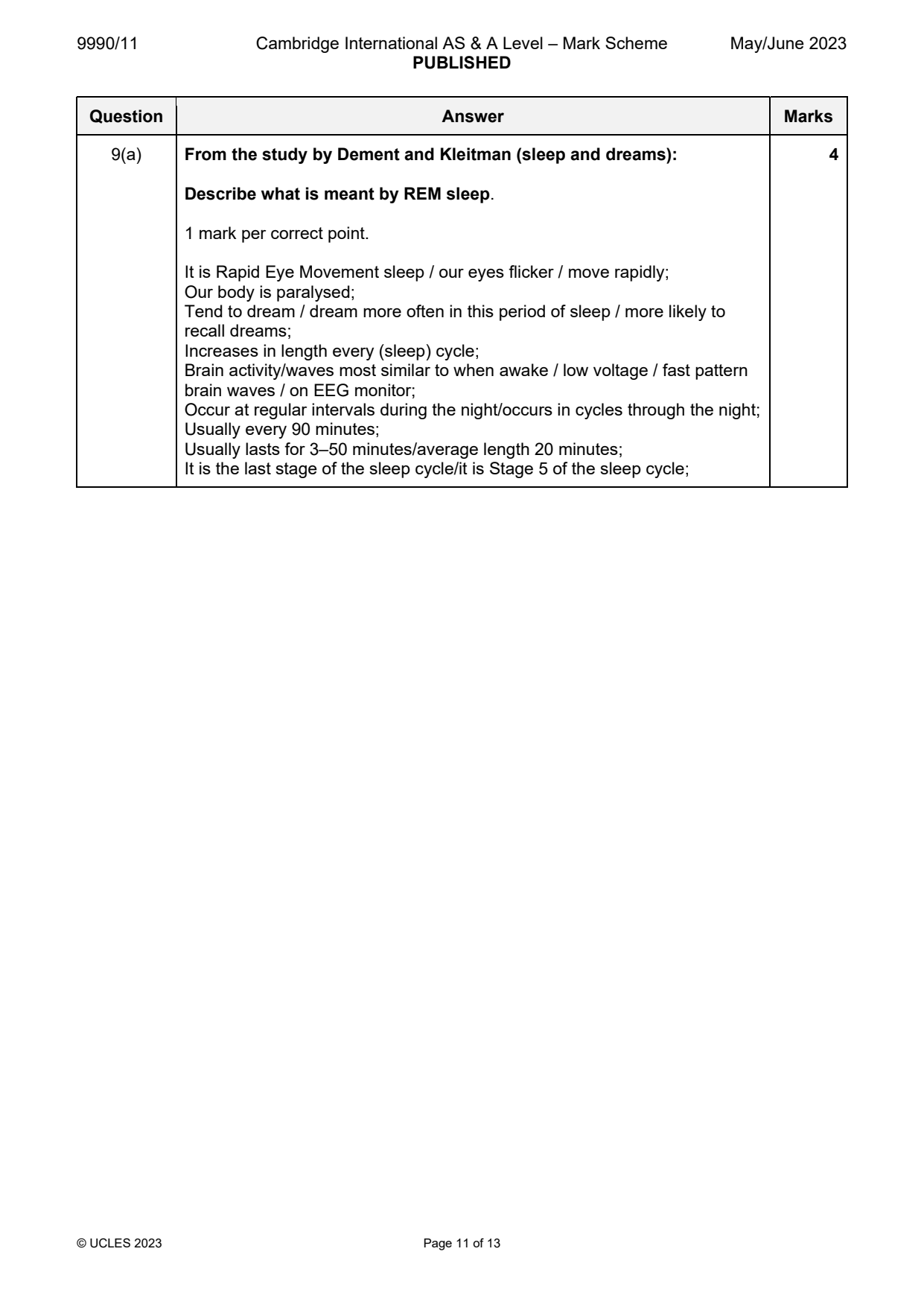
9(a) From the study by Dement and Kleitman (sleep and dreams): 4
Describe what is meant by REM sleep.
1 mark per correct point.
It is Rapid Eye Movement sleep / our eyes flicker / move rapidly;
Our body is paralysed;
Tend to dream / dream more often in this period of sleep / more likely to
recall dreams;
Increases in length every (sleep) cycle;
Brain activity/waves most similar to when awake / low voltage / fast pattern
brain waves / on EEG monitor;
Occur at regular intervals during the night/occurs in cycles through the night;
Usually every 90 minutes;
Usually lasts for 3–50 minutes/average length 20 minutes;
It is the last stage of the sleep cycle/it is Stage 5 of the sleep cycle;
© UCLES 2023 Page 11 of 13
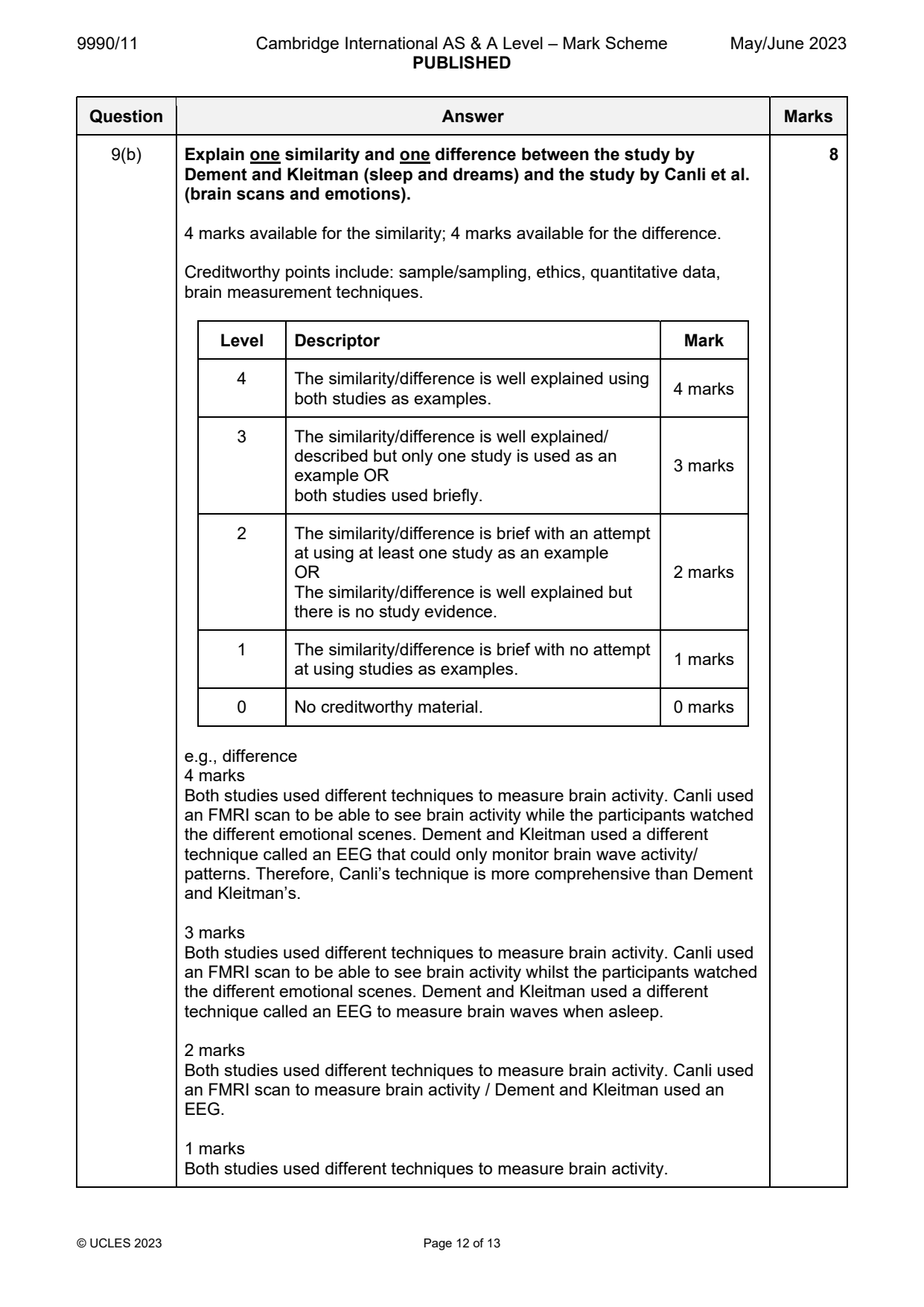
9(b) Explain one similarity and one difference between the study by 8
Dement and Kleitman (sleep and dreams) and the study by Canli et al.
(brain scans and emotions).
4 marks available for the similarity; 4 marks available for the difference.
Creditworthy points include: sample/sampling, ethics, quantitative data,
brain measurement techniques.
Level Descriptor Mark
4 The similarity/difference is well explained using
4 marks
both studies as examples.
3 The similarity/difference is well explained/
described but only one study is used as an
3 marks
example OR
both studies used briefly.
2 The similarity/difference is brief with an attempt
at using at least one study as an example
OR 2 marks
The similarity/difference is well explained but
there is no study evidence.
1 The similarity/difference is brief with no attempt
1 marks
at using studies as examples.
0 No creditworthy material. 0 marks
e.g., difference
4 marks
Both studies used different techniques to measure brain activity. Canli used
an FMRI scan to be able to see brain activity while the participants watched
the different emotional scenes. Dement and Kleitman used a different
technique called an EEG that could only monitor brain wave activity/
patterns. Therefore, Canli’s technique is more comprehensive than Dement
and Kleitman’s.
3 marks
Both studies used different techniques to measure brain activity. Canli used
an FMRI scan to be able to see brain activity whilst the participants watched
the different emotional scenes. Dement and Kleitman used a different
technique called an EEG to measure brain waves when asleep.
2 marks
Both studies used different techniques to measure brain activity. Canli used
an FMRI scan to measure brain activity / Dement and Kleitman used an
EEG.
1 marks
Both studies used different techniques to measure brain activity.
© UCLES 2023 Page 12 of 13
Official mark scheme pages: 11, 12 · source PDF URL
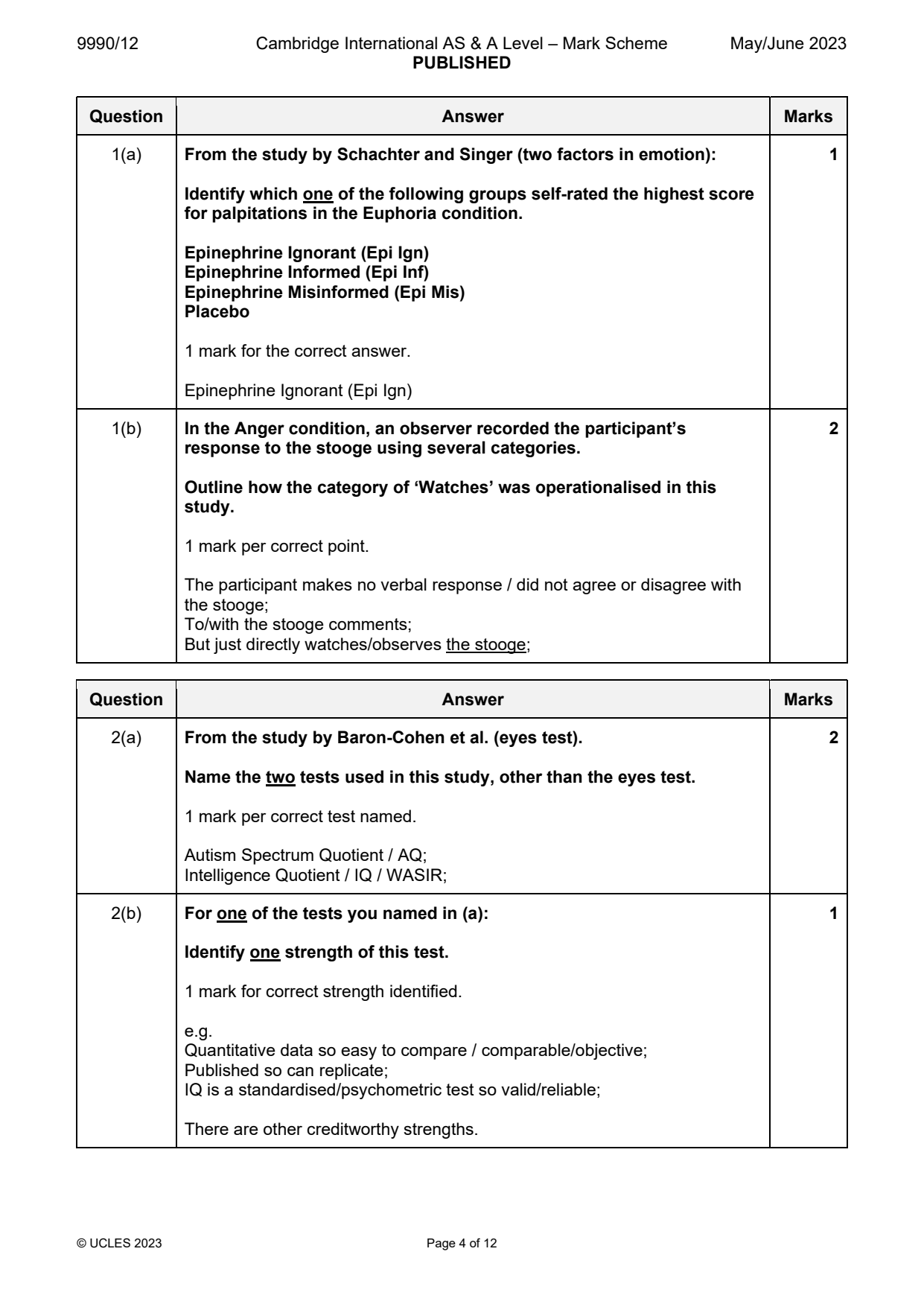
9990-2023-mj-12-q01
May/June 2023 · Paper 12 · Question 1 · 3 marks
1(a) From the study by Schachter and Singer (two factors in emotion): 1
Identify which one of the following groups self-rated the highest score
for palpitations in the Euphoria condition.
Epinephrine Ignorant (Epi Ign)
Epinephrine Informed (Epi Inf)
Epinephrine Misinformed (Epi Mis)
Placebo
1 mark for the correct answer.
Epinephrine Ignorant (Epi Ign)
1(b) In the Anger condition, an observer recorded the participant’s 2
response to the stooge using several categories.
Outline how the category of ‘Watches’ was operationalised in this
study.
1 mark per correct point.
The participant makes no verbal response / did not agree or disagree with
the stooge;
To/with the stooge comments;
But just directly watches/observes the stooge;
Question Answer Marks
Official mark scheme pages: 4 · source PDF URL
9990-2023-mj-12-q03
May/June 2023 · Paper 12 · Question 3 · 5 marks
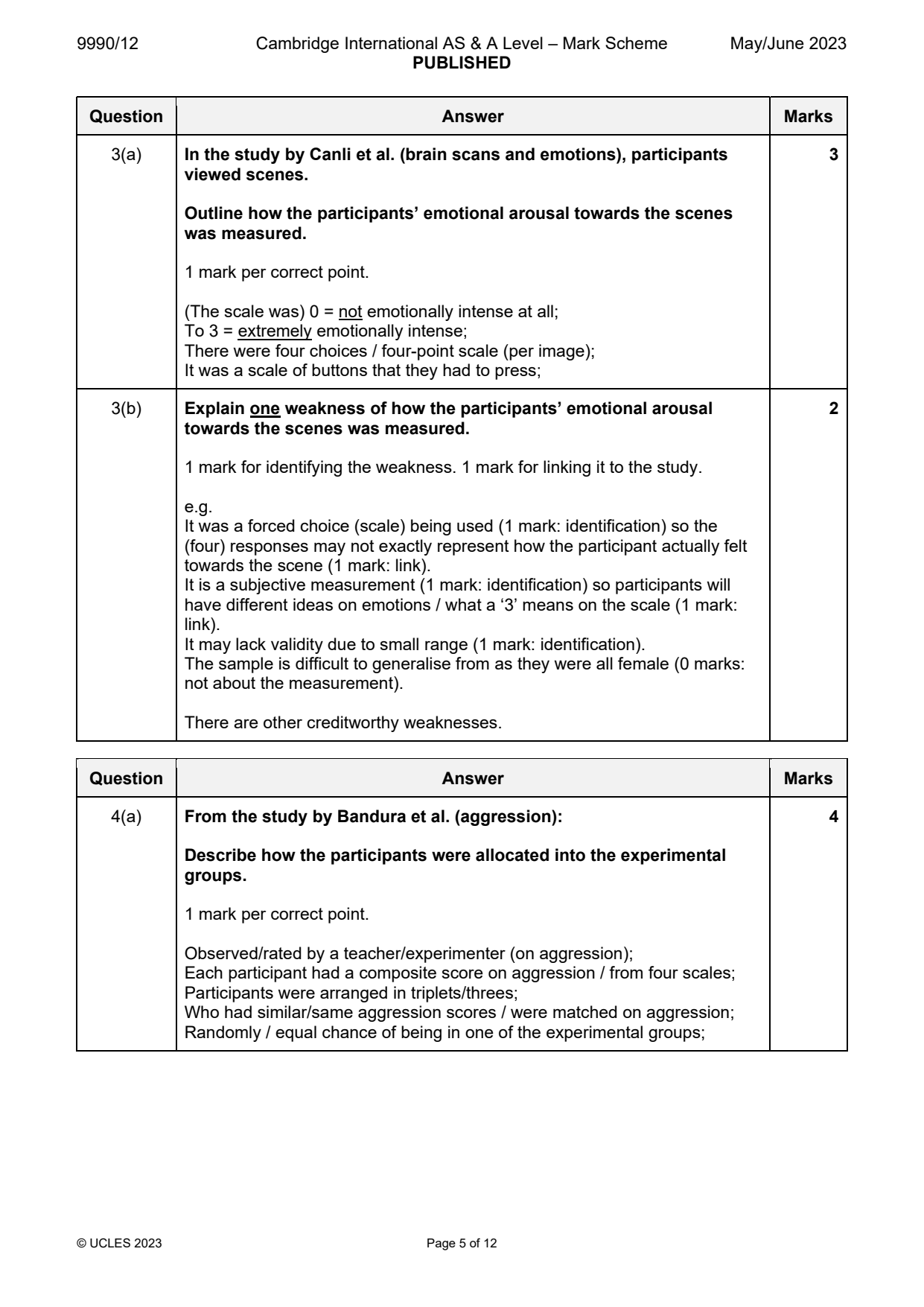
3(a) In the study by Canli et al. (brain scans and emotions), participants 3
viewed scenes.
Outline how the participants’ emotional arousal towards the scenes
was measured.
1 mark per correct point.
(The scale was) 0 = not emotionally intense at all;
To 3 = extremely emotionally intense;
There were four choices / four-point scale (per image);
It was a scale of buttons that they had to press;
3(b) Explain one weakness of how the participants’ emotional arousal 2
towards the scenes was measured.
1 mark for identifying the weakness. 1 mark for linking it to the study.
e.g.
It was a forced choice (scale) being used (1 mark: identification) so the
(four) responses may not exactly represent how the participant actually felt
towards the scene (1 mark: link).
It is a subjective measurement (1 mark: identification) so participants will
have different ideas on emotions / what a ‘3’ means on the scale (1 mark:
link).
It may lack validity due to small range (1 mark: identification).
The sample is difficult to generalise from as they were all female (0 marks:
not about the measurement).
There are other creditworthy weaknesses.
Question Answer Marks
Official mark scheme pages: 5 · source PDF URL
9990-2023-mj-12-q07
May/June 2023 · Paper 12 · Question 7 · 4 marks
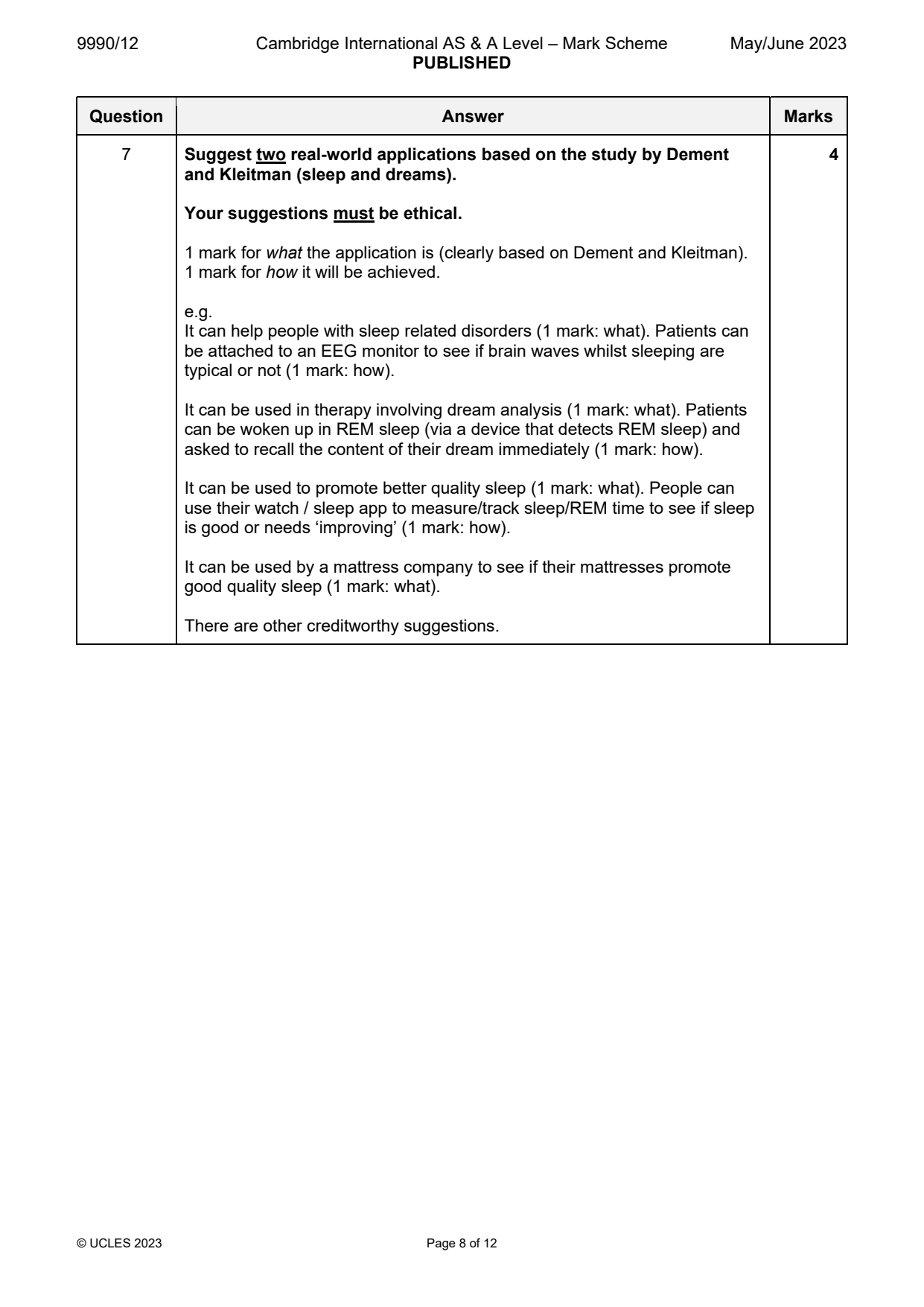
7 Suggest two real-world applications based on the study by Dement 4
and Kleitman (sleep and dreams).
Your suggestions must be ethical.
1 mark for what the application is (clearly based on Dement and Kleitman).
1 mark for how it will be achieved.
e.g.
It can help people with sleep related disorders (1 mark: what). Patients can
be attached to an EEG monitor to see if brain waves whilst sleeping are
typical or not (1 mark: how).
It can be used in therapy involving dream analysis (1 mark: what). Patients
can be woken up in REM sleep (via a device that detects REM sleep) and
asked to recall the content of their dream immediately (1 mark: how).
It can be used to promote better quality sleep (1 mark: what). People can
use their watch / sleep app to measure/track sleep/REM time to see if sleep
is good or needs ‘improving’ (1 mark: how).
It can be used by a mattress company to see if their mattresses promote
good quality sleep (1 mark: what).
There are other creditworthy suggestions.
© UCLES 2023 Page 8 of 12
Official mark scheme pages: 8 · source PDF URL
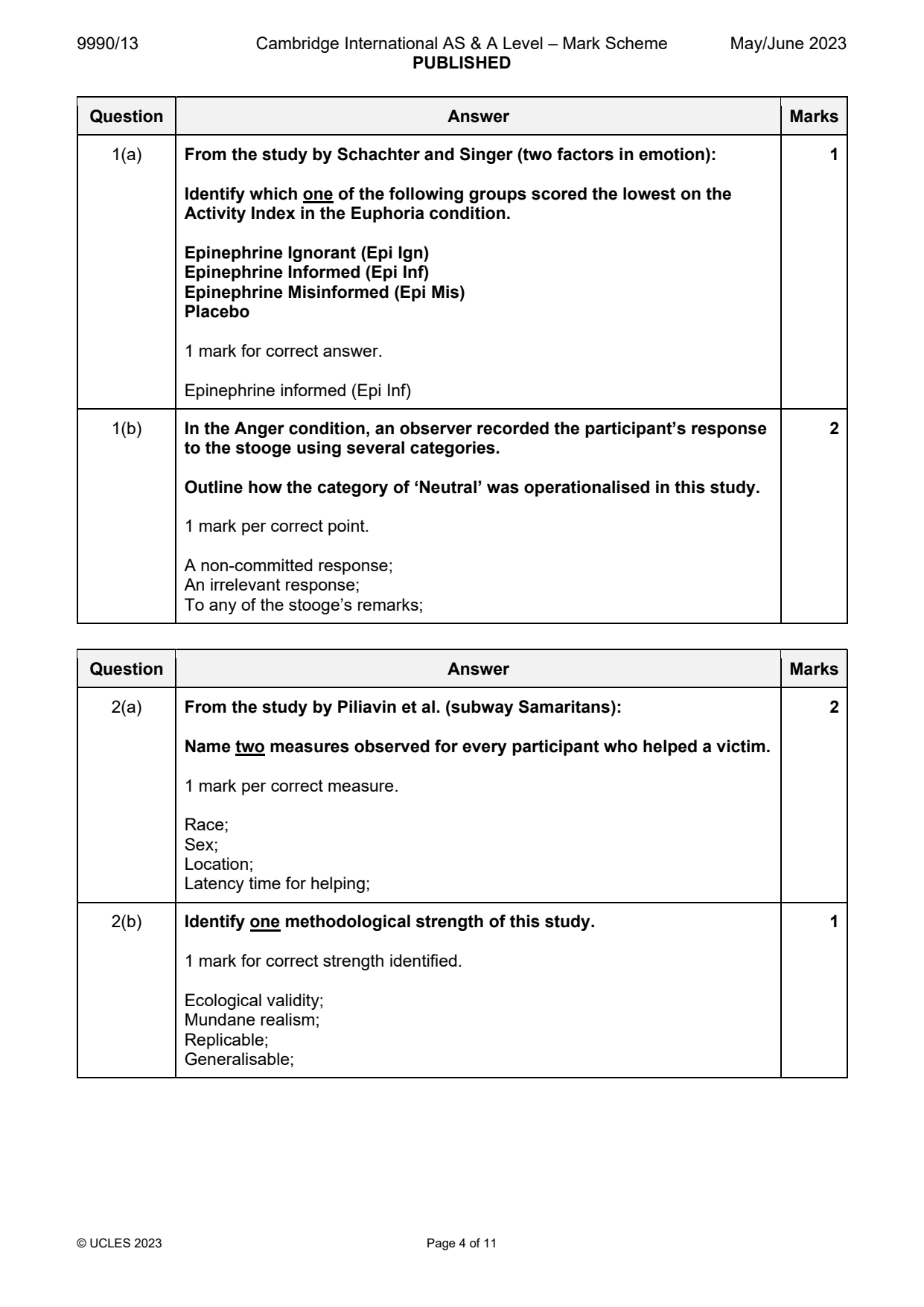
9990-2023-mj-13-q01
May/June 2023 · Paper 13 · Question 1 · 3 marks
1(a) From the study by Schachter and Singer (two factors in emotion): 1
Identify which one of the following groups scored the lowest on the
Activity Index in the Euphoria condition.
Epinephrine Ignorant (Epi Ign)
Epinephrine Informed (Epi Inf)
Epinephrine Misinformed (Epi Mis)
Placebo
1 mark for correct answer.
Epinephrine informed (Epi Inf)
1(b) In the Anger condition, an observer recorded the participant’s response 2
to the stooge using several categories.
Outline how the category of ‘Neutral’ was operationalised in this study.
1 mark per correct point.
A non-committed response;
An irrelevant response;
To any of the stooge’s remarks;
Question Answer Marks
Official mark scheme pages: 4 · source PDF URL
9990-2023-mj-13-q10
May/June 2023 · Paper 13 · Question 10 · 10 marks
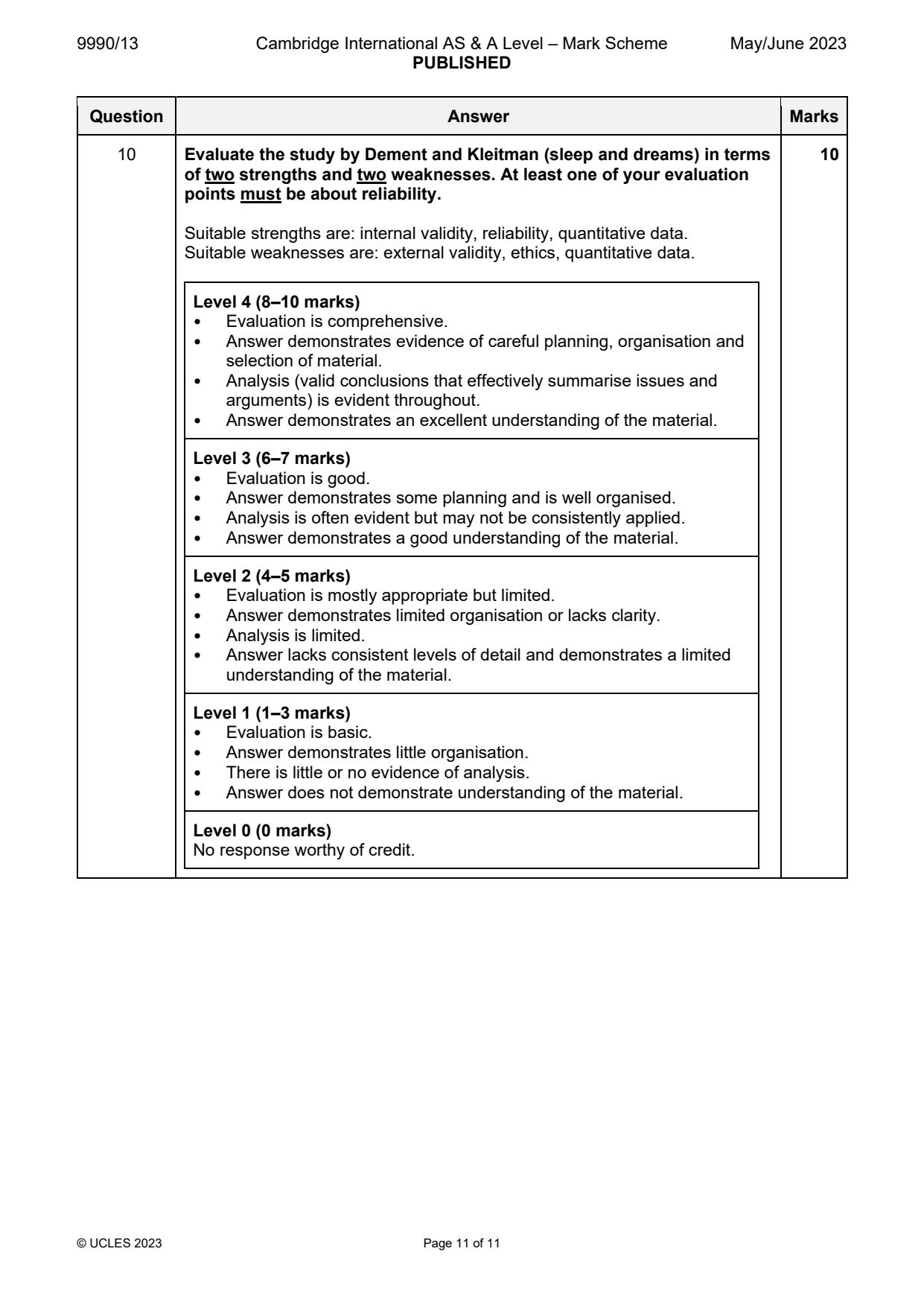
10 Evaluate the study by Dement and Kleitman (sleep and dreams) in terms 10
of two strengths and two weaknesses. At least one of your evaluation
points must be about reliability.
Suitable strengths are: internal validity, reliability, quantitative data.
Suitable weaknesses are: external validity, ethics, quantitative data.
Level 4 (8–10 marks)
• Evaluation is comprehensive.
• Answer demonstrates evidence of careful planning, organisation and
selection of material.
• Analysis (valid conclusions that effectively summarise issues and
arguments) is evident throughout.
• Answer demonstrates an excellent understanding of the material.
Level 3 (6–7 marks)
• Evaluation is good.
• Answer demonstrates some planning and is well organised.
• Analysis is often evident but may not be consistently applied.
• Answer demonstrates a good understanding of the material.
Level 2 (4–5 marks)
• Evaluation is mostly appropriate but limited.
• Answer demonstrates limited organisation or lacks clarity.
• Analysis is limited.
• Answer lacks consistent levels of detail and demonstrates a limited
understanding of the material.
Level 1 (1–3 marks)
• Evaluation is basic.
• Answer demonstrates little organisation.
• There is little or no evidence of analysis.
• Answer does not demonstrate understanding of the material.
Level 0 (0 marks)
No response worthy of credit.
© UCLES 2023 Page 11 of 11
Official mark scheme pages: 11 · source PDF URL
9990-2023-on-11-q06
Oct/Nov 2023 · Paper 11 · Question 6 · 6 marks
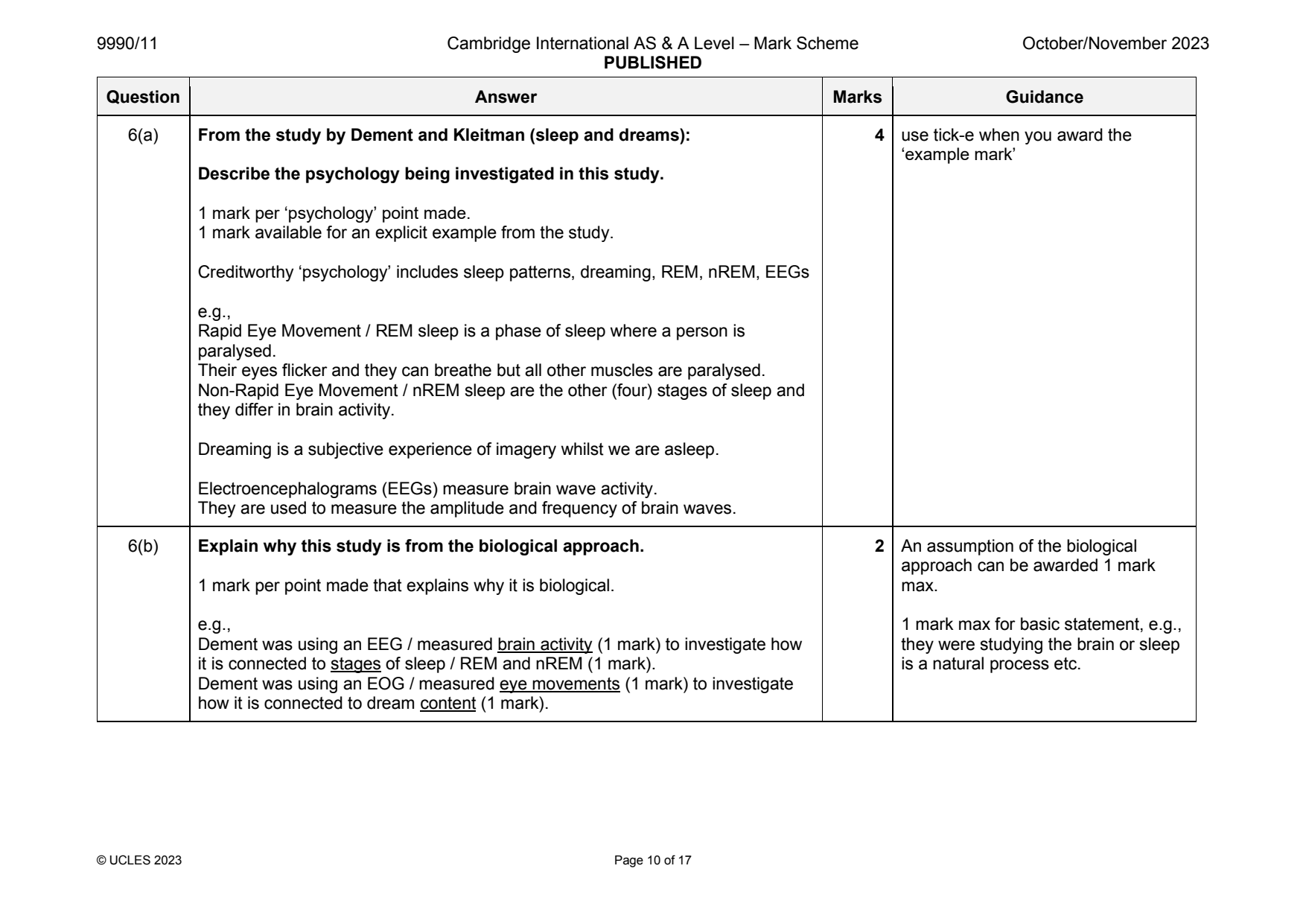
6(a) From the study by Dement and Kleitman (sleep and dreams): 4 use tick-e when you award the
‘example mark’
Describe the psychology being investigated in this study.
1 mark per ‘psychology’ point made.
1 mark available for an explicit example from the study.
Creditworthy ‘psychology’ includes sleep patterns, dreaming, REM, nREM, EEGs
e.g.,
Rapid Eye Movement / REM sleep is a phase of sleep where a person is
paralysed.
Their eyes flicker and they can breathe but all other muscles are paralysed.
Non-Rapid Eye Movement / nREM sleep are the other (four) stages of sleep and
they differ in brain activity.
Dreaming is a subjective experience of imagery whilst we are asleep.
Electroencephalograms (EEGs) measure brain wave activity.
They are used to measure the amplitude and frequency of brain waves.
6(b) Explain why this study is from the biological approach. 2 An assumption of the biological
approach can be awarded 1 mark
1 mark per point made that explains why it is biological. max.
e.g., 1 mark max for basic statement, e.g.,
Dement was using an EEG / measured brain activity (1 mark) to investigate how they were studying the brain or sleep
it is connected to stages of sleep / REM and nREM (1 mark). is a natural process etc.
Dement was using an EOG / measured eye movements (1 mark) to investigate
how it is connected to dream content (1 mark).
© UCLES 2023 Page 10 of 17
Official mark scheme pages: 10 · source PDF URL
9990-2023-on-11-q07
Oct/Nov 2023 · Paper 11 · Question 7 · 4 marks
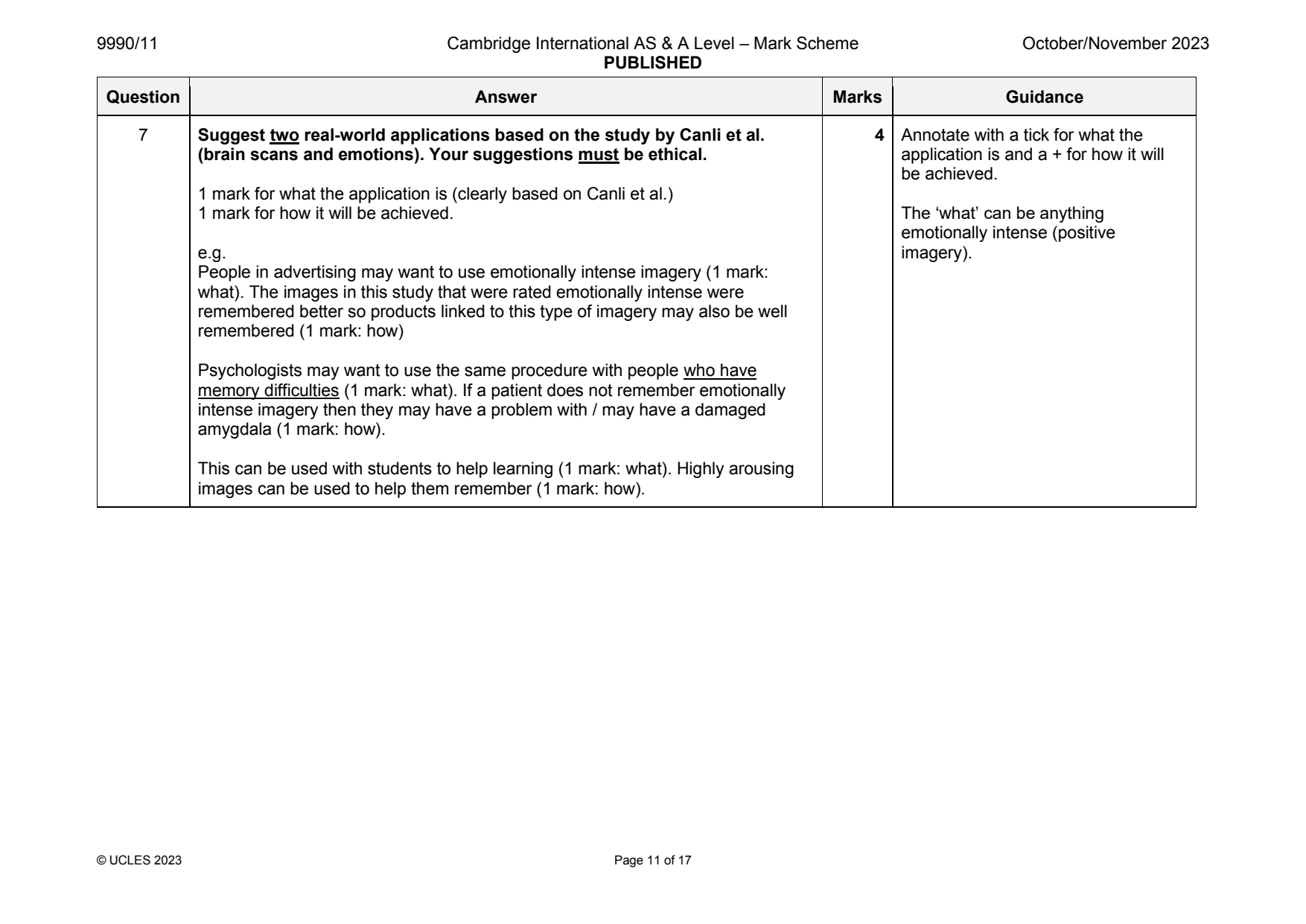
7 Suggest two real-world applications based on the study by Canli et al. 4 Annotate with a tick for what the
(brain scans and emotions). Your suggestions must be ethical. application is and a + for how it will
be achieved.
1 mark for what the application is (clearly based on Canli et al.)
1 mark for how it will be achieved. The ‘what’ can be anything
emotionally intense (positive
e.g. imagery).
People in advertising may want to use emotionally intense imagery (1 mark:
what). The images in this study that were rated emotionally intense were
remembered better so products linked to this type of imagery may also be well
remembered (1 mark: how)
Psychologists may want to use the same procedure with people who have
memory difficulties (1 mark: what). If a patient does not remember emotionally
intense imagery then they may have a problem with / may have a damaged
amygdala (1 mark: how).
This can be used with students to help learning (1 mark: what). Highly arousing
images can be used to help them remember (1 mark: how).
© UCLES 2023 Page 11 of 17
Official mark scheme pages: 11 · source PDF URL
9990-2023-on-12-q03
Oct/Nov 2023 · Paper 12 · Question 3 · 3 marks
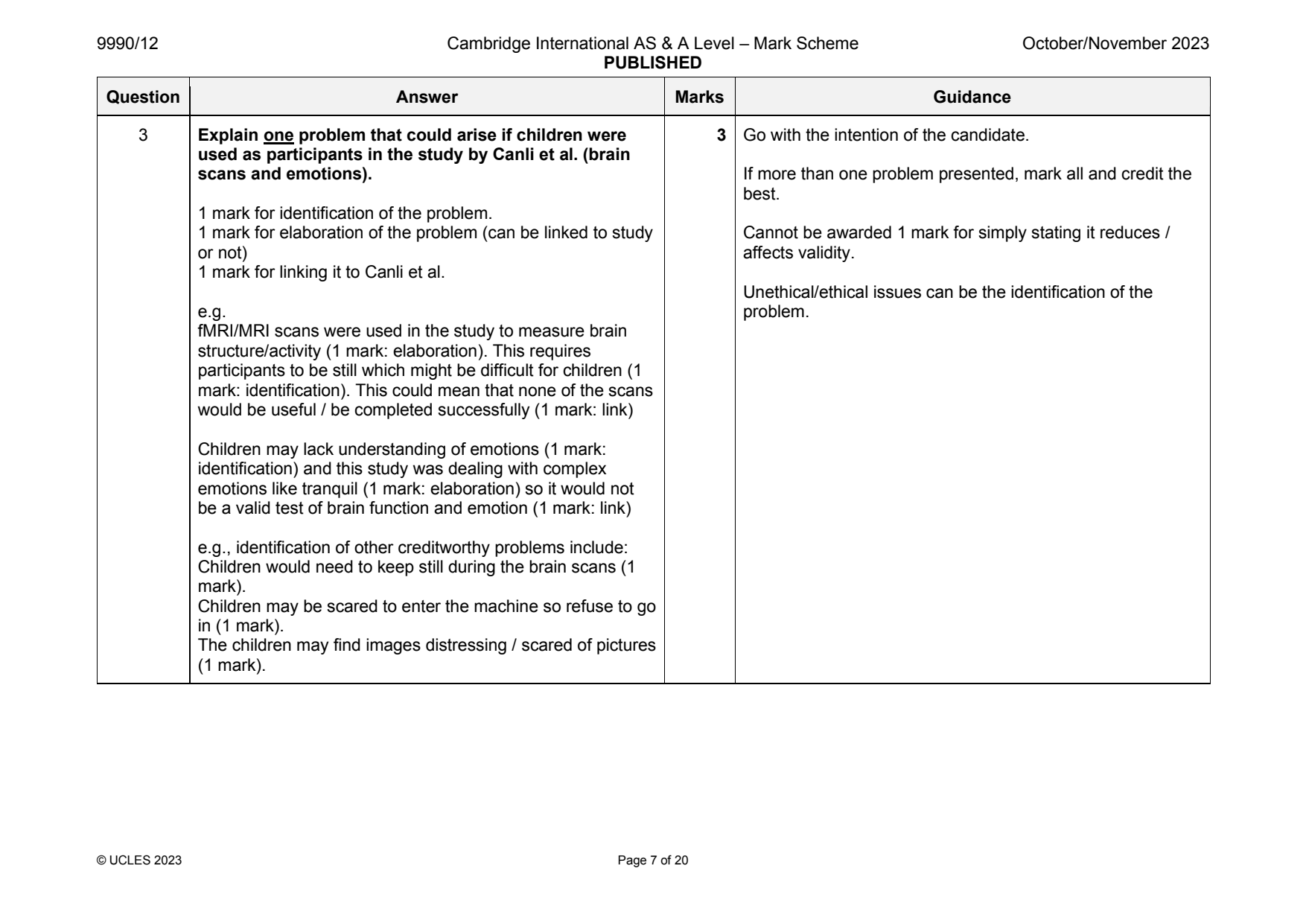
3 Explain one problem that could arise if children were 3 Go with the intention of the candidate.
used as participants in the study by Canli et al. (brain
scans and emotions). If more than one problem presented, mark all and credit the
best.
1 mark for identification of the problem.
1 mark for elaboration of the problem (can be linked to study Cannot be awarded 1 mark for simply stating it reduces /
or not) affects validity.
1 mark for linking it to Canli et al.
Unethical/ethical issues can be the identification of the
e.g. problem.
fMRI/MRI scans were used in the study to measure brain
structure/activity (1 mark: elaboration). This requires
participants to be still which might be difficult for children (1
mark: identification). This could mean that none of the scans
would be useful / be completed successfully (1 mark: link)
Children may lack understanding of emotions (1 mark:
identification) and this study was dealing with complex
emotions like tranquil (1 mark: elaboration) so it would not
be a valid test of brain function and emotion (1 mark: link)
e.g., identification of other creditworthy problems include:
Children would need to keep still during the brain scans (1
mark).
Children may be scared to enter the machine so refuse to go
in (1 mark).
The children may find images distressing / scared of pictures
(1 mark).
© UCLES 2023 Page 7 of 20
Official mark scheme pages: 7 · source PDF URL
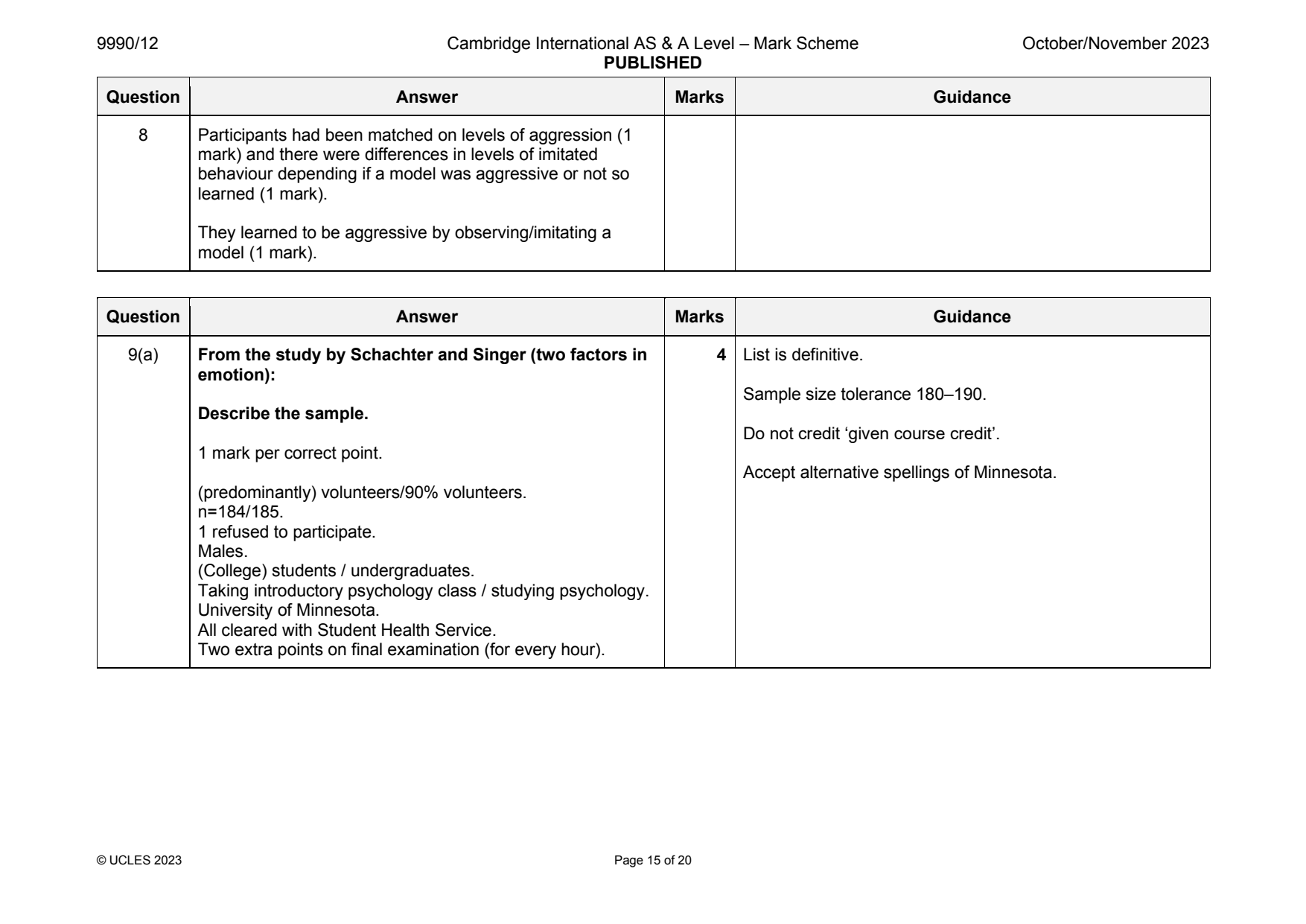
9990-2023-on-12-q09
Oct/Nov 2023 · Paper 12 · Question 9 · 12 marks
9(a) From the study by Schachter and Singer (two factors in 4 List is definitive.
emotion):
Sample size tolerance 180–190.
Describe the sample.
Do not credit ‘given course credit’.
1 mark per correct point.
Accept alternative spellings of Minnesota.
(predominantly) volunteers/90% volunteers.
n=184/185.
1 refused to participate.
Males.
(College) students / undergraduates.
Taking introductory psychology class / studying psychology.
University of Minnesota.
All cleared with Student Health Service.
Two extra points on final examination (for every hour).
© UCLES 2023 Page 15 of 20
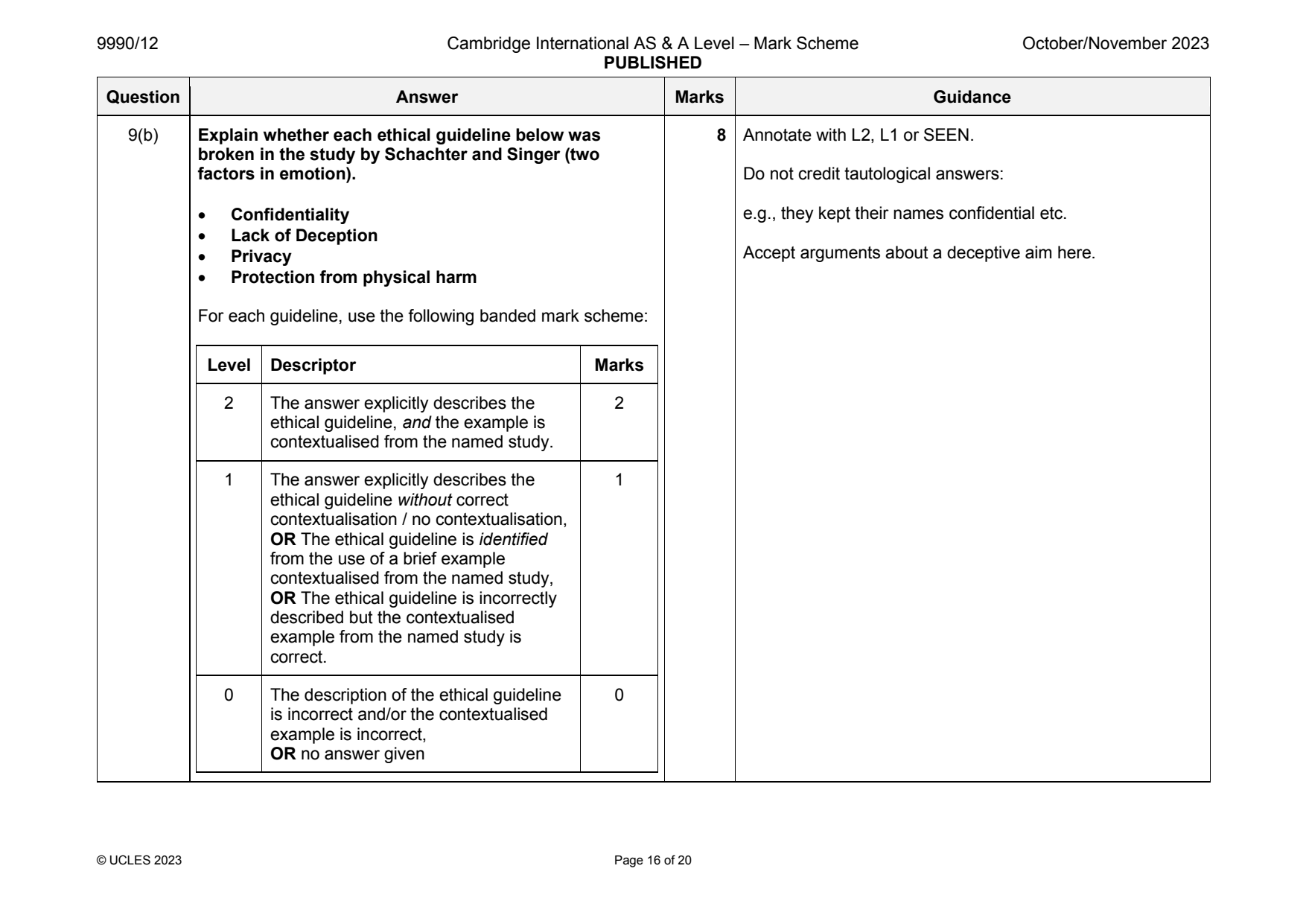
9(b) Explain whether each ethical guideline below was 8 Annotate with L2, L1 or SEEN.
broken in the study by Schachter and Singer (two
factors in emotion). Do not credit tautological answers:
• Confidentiality e.g., they kept their names confidential etc.
• Lack of Deception
• Privacy Accept arguments about a deceptive aim here.
• Protection from physical harm
For each guideline, use the following banded mark scheme:
Level Descriptor Marks
2 The answer explicitly describes the 2
ethical guideline, and the example is
contextualised from the named study.
1 The answer explicitly describes the 1
ethical guideline without correct
contextualisation / no contextualisation,
OR The ethical guideline is identified
from the use of a brief example
contextualised from the named study,
OR The ethical guideline is incorrectly
described but the contextualised
example from the named study is
correct.
0 The description of the ethical guideline 0
is incorrect and/or the contextualised
example is incorrect,
OR no answer given
© UCLES 2023 Page 16 of 20
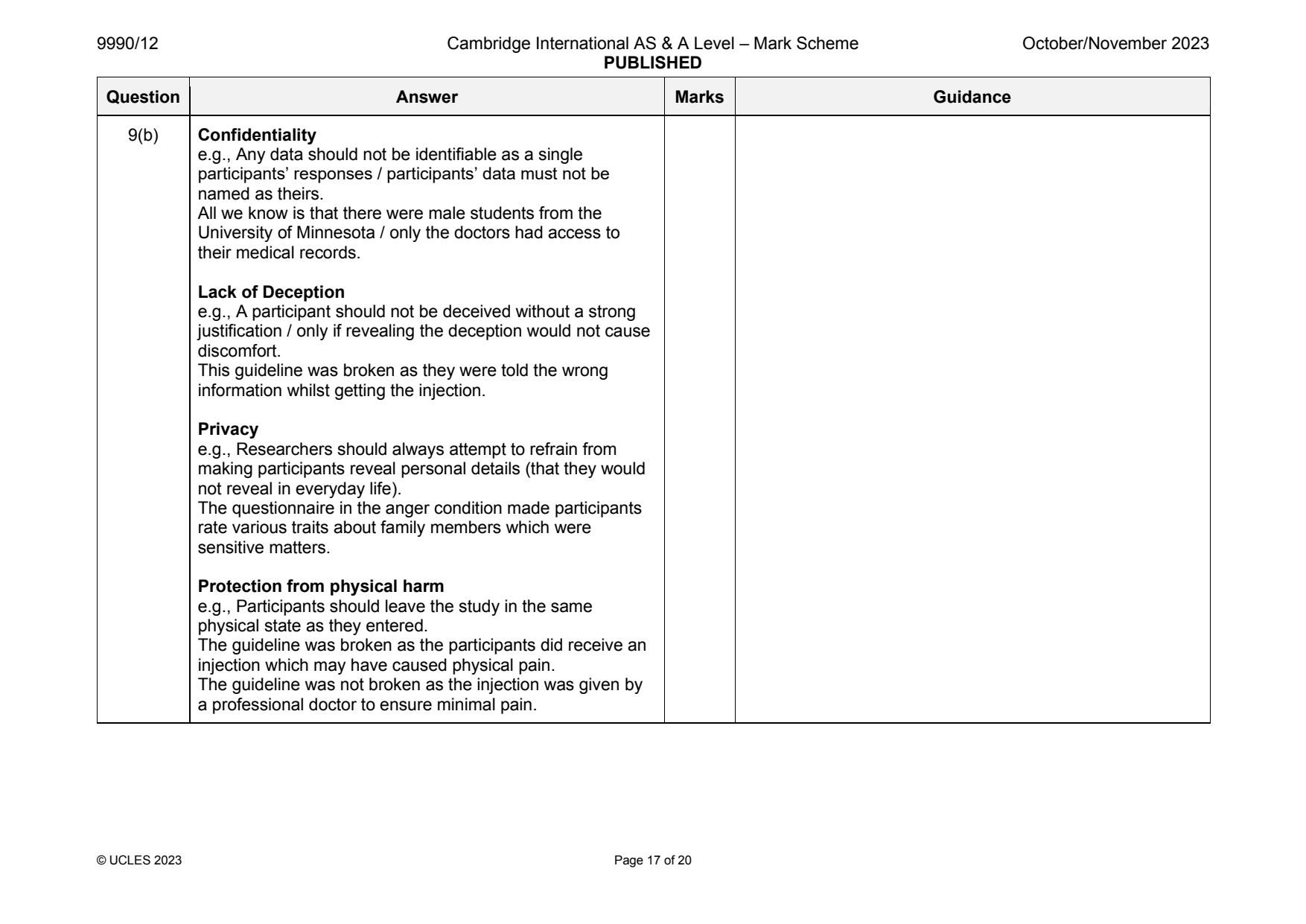
9(b) Confidentiality
e.g., Any data should not be identifiable as a single
participants’ responses / participants’ data must not be
named as theirs.
All we know is that there were male students from the
University of Minnesota / only the doctors had access to
their medical records.
Lack of Deception
e.g., A participant should not be deceived without a strong
justification / only if revealing the deception would not cause
discomfort.
This guideline was broken as they were told the wrong
information whilst getting the injection.
Privacy
e.g., Researchers should always attempt to refrain from
making participants reveal personal details (that they would
not reveal in everyday life).
The questionnaire in the anger condition made participants
rate various traits about family members which were
sensitive matters.
Protection from physical harm
e.g., Participants should leave the study in the same
physical state as they entered.
The guideline was broken as the participants did receive an
injection which may have caused physical pain.
The guideline was not broken as the injection was given by
a professional doctor to ensure minimal pain.
© UCLES 2023 Page 17 of 20
Official mark scheme pages: 15, 16, 17 · source PDF URL
9990-2023-on-13-q04
Oct/Nov 2023 · Paper 13 · Question 4 · 6 marks
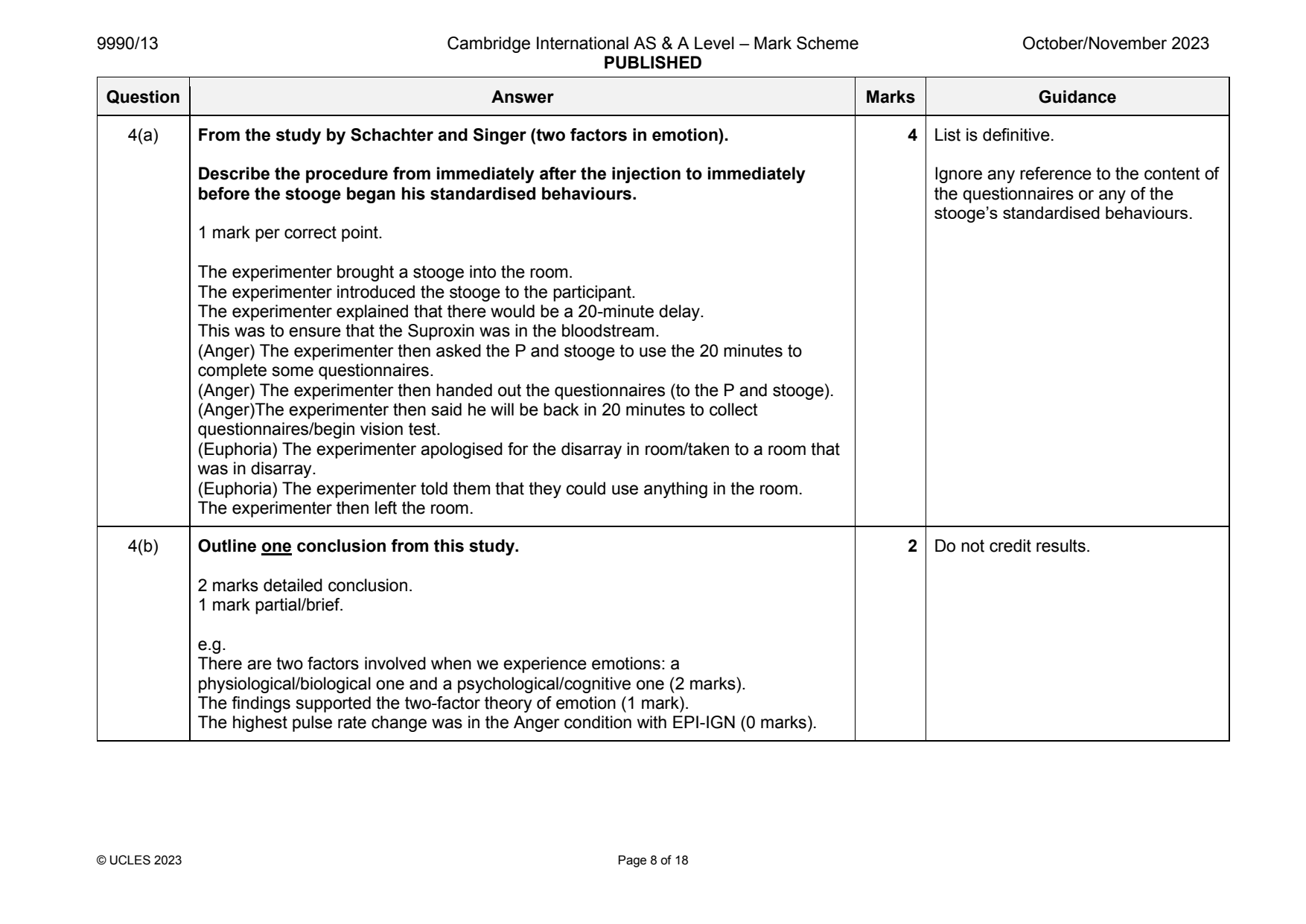
4(a) From the study by Schachter and Singer (two factors in emotion). 4 List is definitive.
Describe the procedure from immediately after the injection to immediately Ignore any reference to the content of
before the stooge began his standardised behaviours. the questionnaires or any of the
stooge’s standardised behaviours.
1 mark per correct point.
The experimenter brought a stooge into the room.
The experimenter introduced the stooge to the participant.
The experimenter explained that there would be a 20-minute delay.
This was to ensure that the Suproxin was in the bloodstream.
(Anger) The experimenter then asked the P and stooge to use the 20 minutes to
complete some questionnaires.
(Anger) The experimenter then handed out the questionnaires (to the P and stooge).
(Anger)The experimenter then said he will be back in 20 minutes to collect
questionnaires/begin vision test.
(Euphoria) The experimenter apologised for the disarray in room/taken to a room that
was in disarray.
(Euphoria) The experimenter told them that they could use anything in the room.
The experimenter then left the room.
4(b) Outline one conclusion from this study. 2 Do not credit results.
2 marks detailed conclusion.
1 mark partial/brief.
e.g.
There are two factors involved when we experience emotions: a
physiological/biological one and a psychological/cognitive one (2 marks).
The findings supported the two-factor theory of emotion (1 mark).
The highest pulse rate change was in the Anger condition with EPI-IGN (0 marks).
© UCLES 2023 Page 8 of 18
Official mark scheme pages: 8 · source PDF URL
9990-2023-on-13-q10
Oct/Nov 2023 · Paper 13 · Question 10 · 10 marks
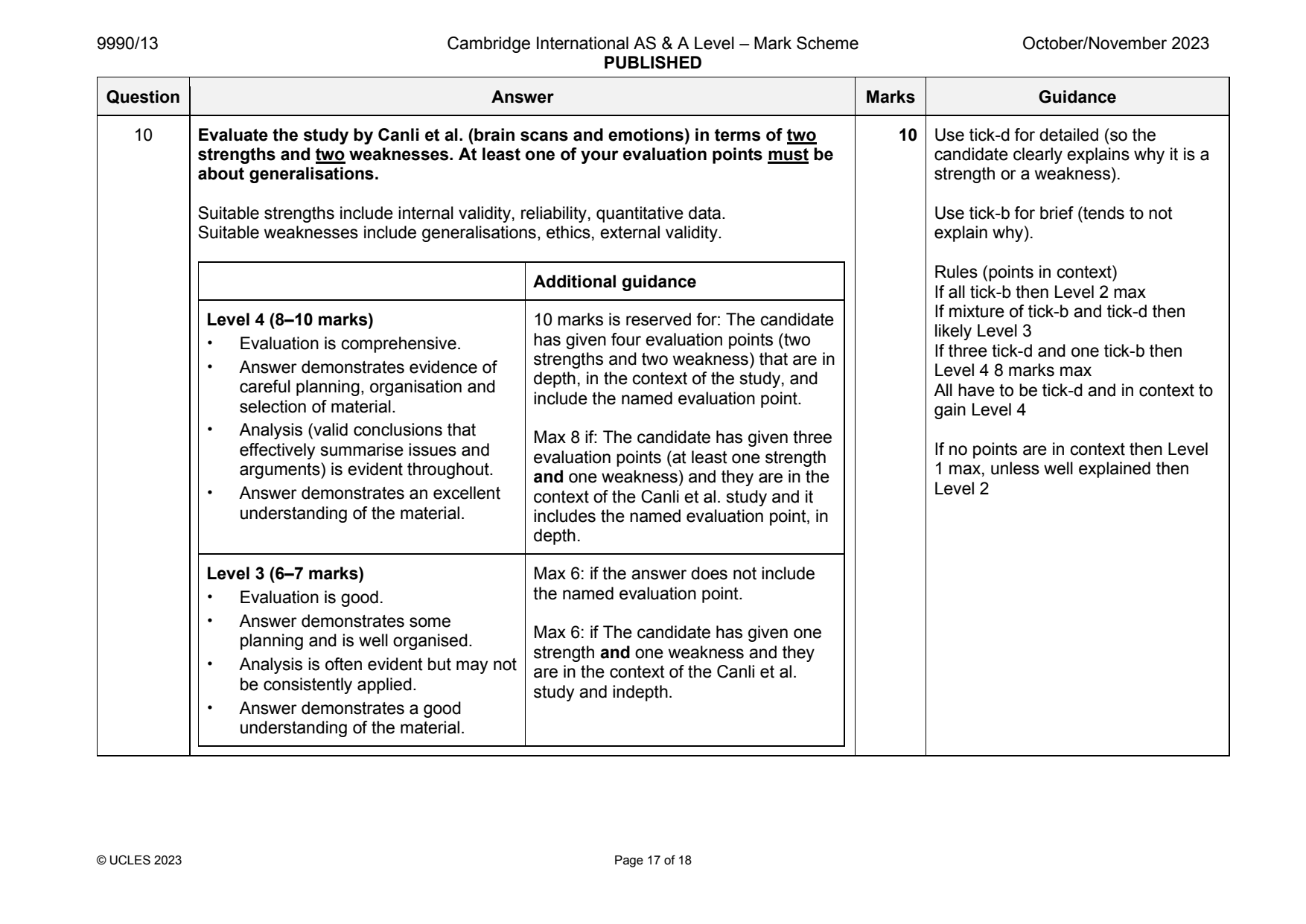
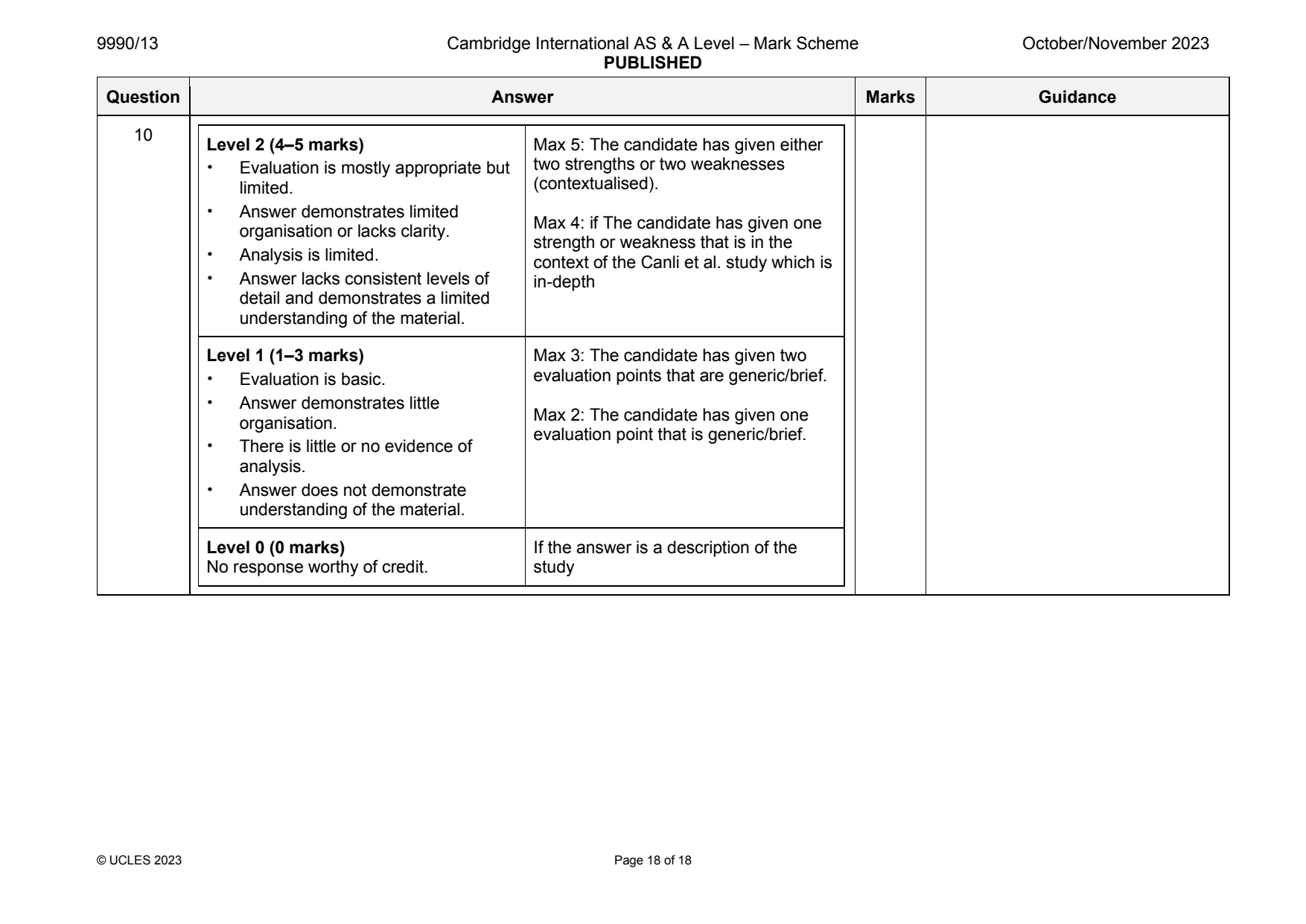
10 Evaluate the study by Canli et al. (brain scans and emotions) in terms of two 10 Use tick-d for detailed (so the
strengths and two weaknesses. At least one of your evaluation points must be candidate clearly explains why it is a
about generalisations. strength or a weakness).
Suitable strengths include internal validity, reliability, quantitative data. Use tick-b for brief (tends to not
Suitable weaknesses include generalisations, ethics, external validity. explain why).
Rules (points in context)
Additional guidance
If all tick-b then Level 2 max
If mixture of tick-b and tick-d then
Level 4 (8–10 marks) 10 marks is reserved for: The candidate
likely Level 3
• Evaluation is comprehensive. has given four evaluation points (two
If three tick-d and one tick-b then
strengths and two weakness) that are in
• Answer demonstrates evidence of Level 4 8 marks max
depth, in the context of the study, and
careful planning, organisation and All have to be tick-d and in context to
include the named evaluation point.
selection of material. gain Level 4
• Analysis (valid conclusions that
Max 8 if: The candidate has given three
effectively summarise issues and If no points are in context then Level
evaluation points (at least one strength
arguments) is evident throughout. 1 max, unless well explained then
and one weakness) and they are in the
• Answer demonstrates an excellent context of the Canli et al. study and it Level 2
understanding of the material. includes the named evaluation point, in
depth.
Level 3 (6–7 marks) Max 6: if the answer does not include
• Evaluation is good. the named evaluation point.
• Answer demonstrates some
Max 6: if The candidate has given one
planning and is well organised.
strength and one weakness and they
• Analysis is often evident but may not
are in the context of the Canli et al.
be consistently applied.
study and indepth.
• Answer demonstrates a good
understanding of the material.
© UCLES 2023 Page 17 of 18
9990/13 Cambridge International AS & A Level – Mark Scheme October/November 2023
PUBLISHED
Question Answer Marks Guidance
10
Level 2 (4–5 marks) Max 5: The candidate has given either
• Evaluation is mostly appropriate but two strengths or two weaknesses
limited. (contextualised).
• Answer demonstrates limited
Max 4: if The candidate has given one
organisation or lacks clarity.
strength or weakness that is in the
• Analysis is limited.
context of the Canli et al. study which is
• Answer lacks consistent levels of in-depth
detail and demonstrates a limited
understanding of the material.
Level 1 (1–3 marks) Max 3: The candidate has given two
• Evaluation is basic. evaluation points that are generic/brief.
• Answer demonstrates little
Max 2: The candidate has given one
organisation.
evaluation point that is generic/brief.
• There is little or no evidence of
analysis.
• Answer does not demonstrate
understanding of the material.
Level 0 (0 marks) If the answer is a description of the
No response worthy of credit. study
© UCLES 2023 Page 18 of 18
Official mark scheme pages: 17, 18 · source PDF URL
9990-2024-m-12-q04
March 2024 · Paper 12 · Question 4 · 4 marks
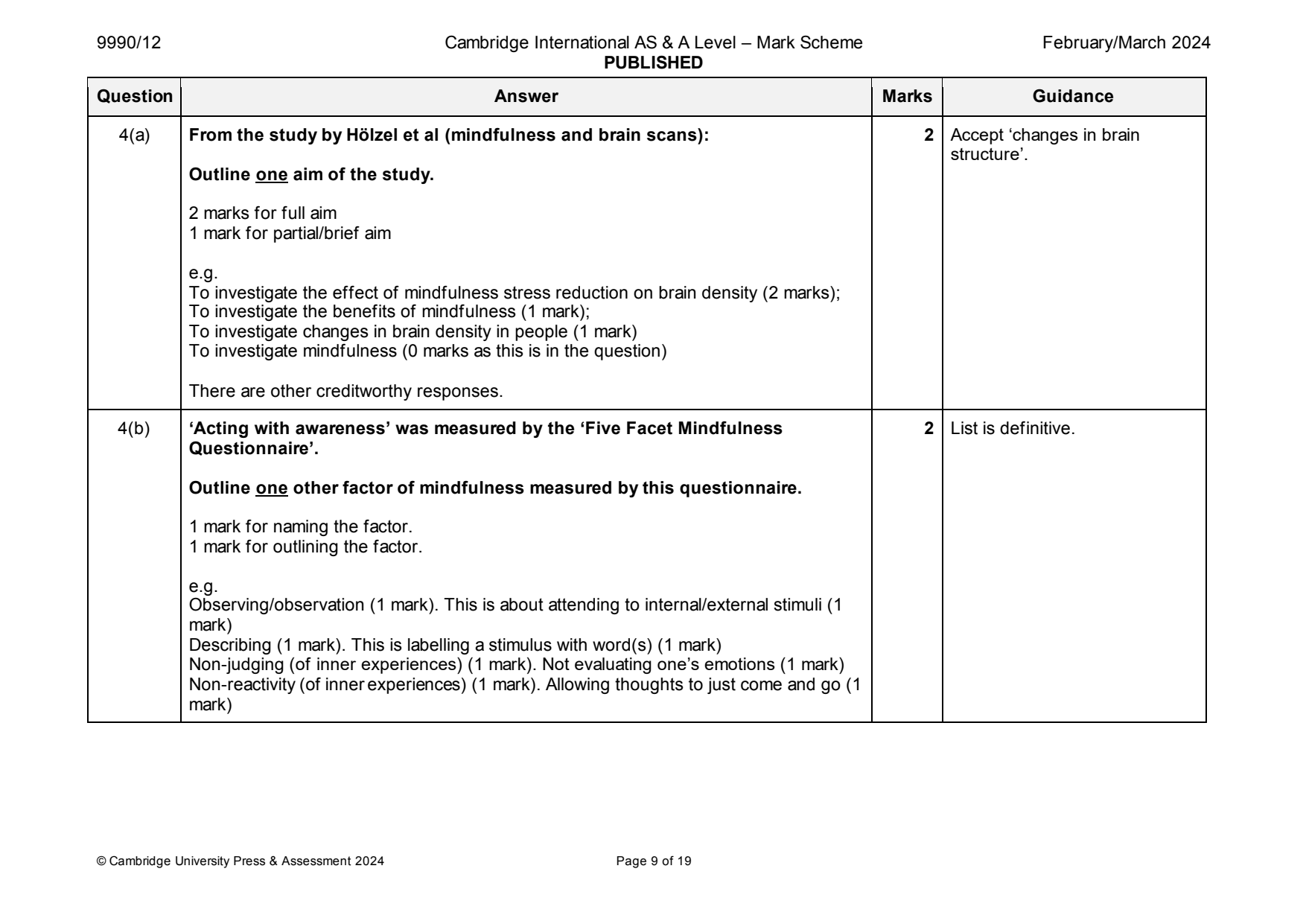
4(a) From the study by Hölzel et al (mindfulness and brain scans): 2 Accept ‘changes in brain
structure’.
Outline one aim of the study.
2 marks for full aim
1 mark for partial/brief aim
e.g.
To investigate the effect of mindfulness stress reduction on brain density (2 marks);
To investigate the benefits of mindfulness (1 mark);
To investigate changes in brain density in people (1 mark)
To investigate mindfulness (0 marks as this is in the question)
There are other creditworthy responses.
4(b) ‘Acting with awareness’ was measured by the ‘Five Facet Mindfulness 2 List is definitive.
Questionnaire’.
Outline one other factor of mindfulness measured by this questionnaire.
1 mark for naming the factor.
1 mark for outlining the factor.
e.g.
Observing/observation (1 mark). This is about attending to internal/external stimuli (1
mark)
Describing (1 mark). This is labelling a stimulus with word(s) (1 mark)
Non-judging (of inner experiences) (1 mark). Not evaluating one’s emotions (1 mark)
Non-reactivity (of inner experiences) (1 mark). Allowing thoughts to just come and go (1
mark)
© Cambridge University Press & Assessment 2024 Page 9 of 19
Official mark scheme pages: 9 · source PDF URL
9990-2024-m-12-q07
March 2024 · Paper 12 · Question 7 · 4 marks
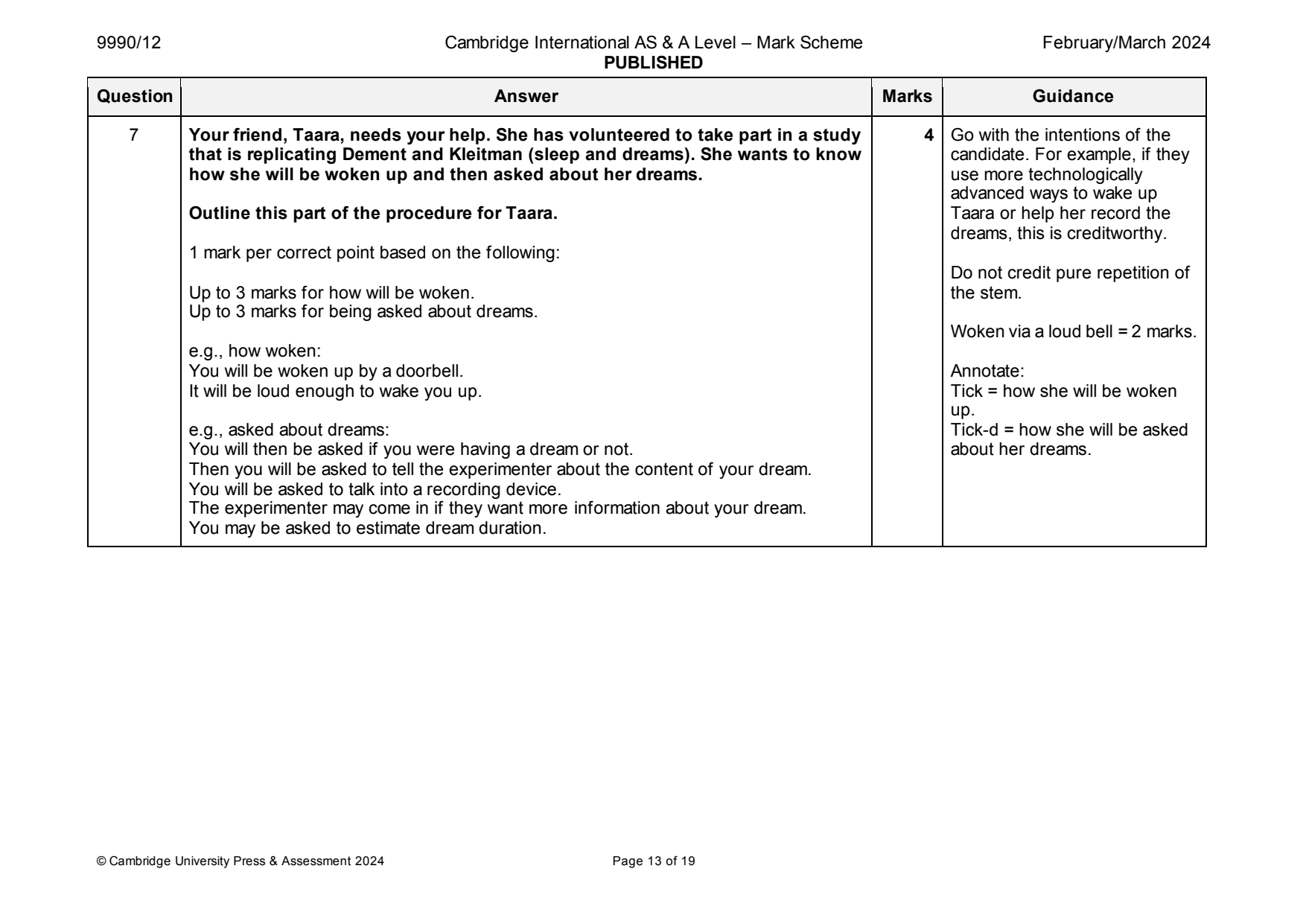
7 Your friend, Taara, needs your help. She has volunteered to take part in a study 4 Go with the intentions of the
that is replicating Dement and Kleitman (sleep and dreams). She wants to know candidate. For example, if they
how she will be woken up and then asked about her dreams. use more technologically
advanced ways to wake up
Outline this part of the procedure for Taara. Taara or help her record the
dreams, this is creditworthy.
1 mark per correct point based on the following:
Do not credit pure repetition of
Up to 3 marks for how will be woken. the stem.
Up to 3 marks for being asked about dreams.
Woken via a loud bell = 2 marks.
e.g., how woken:
You will be woken up by a doorbell. Annotate:
It will be loud enough to wake you up. Tick = how she will be woken
up.
e.g., asked about dreams: Tick-d = how she will be asked
You will then be asked if you were having a dream or not. about her dreams.
Then you will be asked to tell the experimenter about the content of your dream.
You will be asked to talk into a recording device.
The experimenter may come in if they want more information about your dream.
You may be asked to estimate dream duration.
© Cambridge University Press & Assessment 2024 Page 13 of 19
Official mark scheme pages: 13 · source PDF URL
9990-2024-m-12-q10
March 2024 · Paper 12 · Question 10 · 10 marks
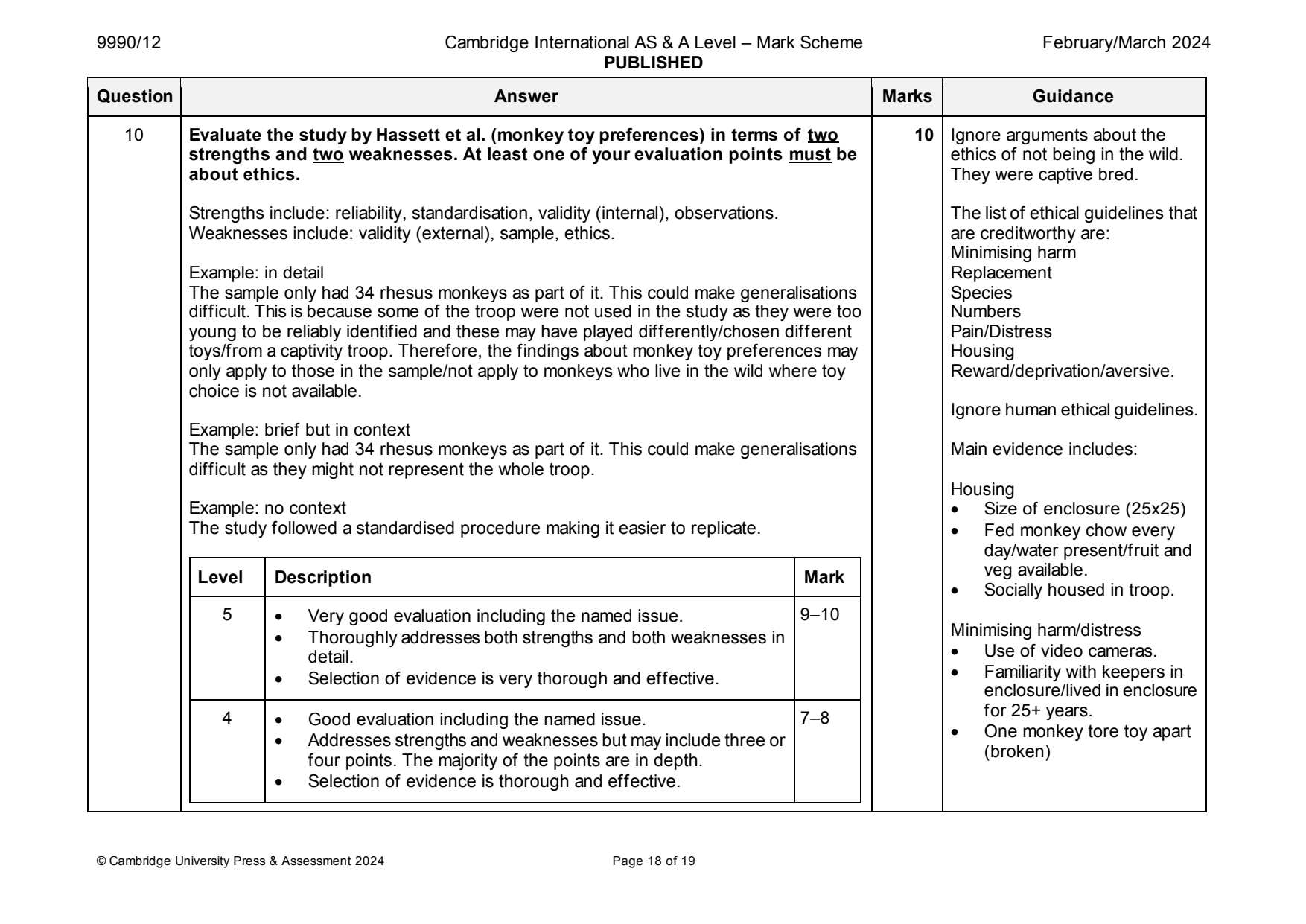
10 Evaluate the study by Hassett et al. (monkey toy preferences) in terms of two 10 Ignore arguments about the
strengths and two weaknesses. At least one of your evaluation points must be ethics of not being in the wild.
about ethics. They were captive bred.
Strengths include: reliability, standardisation, validity (internal), observations. The list of ethical guidelines that
Weaknesses include: validity (external), sample, ethics. are creditworthy are:
Minimising harm
Example: in detail Replacement
The sample only had 34 rhesus monkeys as part of it. This could make generalisations Species
difficult. This is because some of the troop were not used in the study as they were too Numbers
young to be reliably identified and these may have played differently/chosen different Pain/Distress
toys/from a captivity troop. Therefore, the findings about monkey toy preferences may Housing
only apply to those in the sample/not apply to monkeys who live in the wild where toy Reward/deprivation/aversive.
choice is not available.
Ignore human ethical guidelines.
Example: brief but in context
The sample only had 34 rhesus monkeys as part of it. This could make generalisations Main evidence includes:
difficult as they might not represent the whole troop.
Housing
Example: no context • Size of enclosure (25x25)
The study followed a standardised procedure making it easier to replicate. • Fed monkey chow every
day/water present/fruit and
veg available.
Level Description Mark
• Socially housed in troop.
5 • Very good evaluation including the named issue. 9–10
Minimising harm/distress
• Thoroughly addresses both strengths and both weaknesses in
• Use of video cameras.
detail.
• Familiarity with keepers in
• Selection of evidence is very thorough and effective.
enclosure/lived in enclosure
for 25+ years.
4 • Good evaluation including the named issue. 7–8
• One monkey tore toy apart
• Addresses strengths and weaknesses but may include three or
(broken)
four points. The majority of the points are in depth.
• Selection of evidence is thorough and effective.
© Cambridge University Press & Assessment 2024 Page 18 of 19
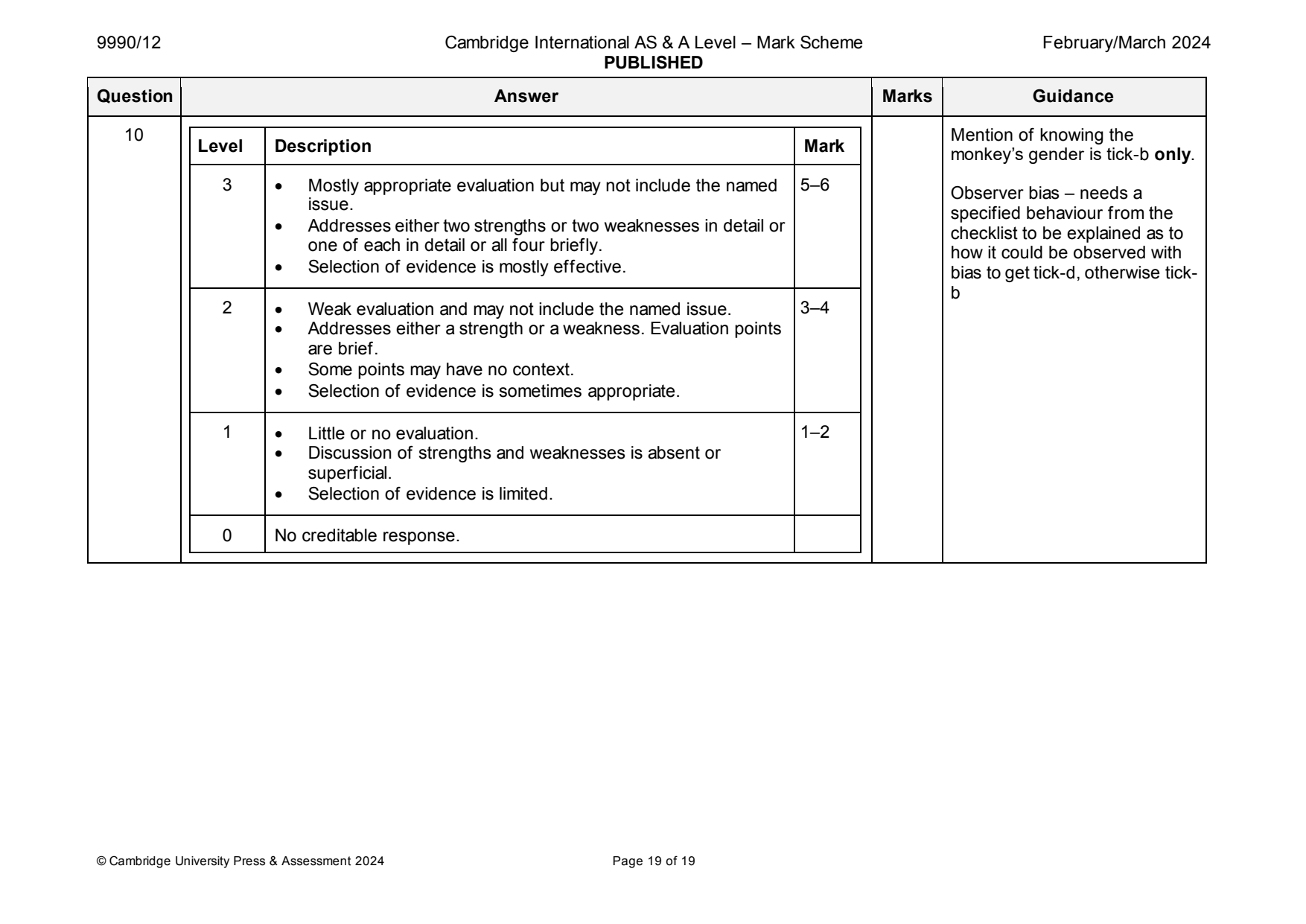
10 Mention of knowing the
Level Description Mark
monkey’s gender is tick-b only.
3 • Mostly appropriate evaluation but may not include the named 5–6
Observer bias – needs a
issue.
specified behaviour from the
• Addresses either two strengths or two weaknesses in detail or
checklist to be explained as to
one of each in detail or all four briefly.
how it could be observed with
• Selection of evidence is mostly effective.
bias to get tick-d, otherwise tick-
b
2 • Weak evaluation and may not include the named issue. 3–4
• Addresses either a strength or a weakness. Evaluation points
are brief.
• Some points may have no context.
• Selection of evidence is sometimes appropriate.
1 • Little or no evaluation. 1–2
• Discussion of strengths and weaknesses is absent or
superficial.
• Selection of evidence is limited.
0 No creditable response.
© Cambridge University Press & Assessment 2024 Page 19 of 19
Official mark scheme pages: 18, 19 · source PDF URL
9990-2024-mj-11-q03
May/June 2024 · Paper 11 · Question 3 · 6 marks
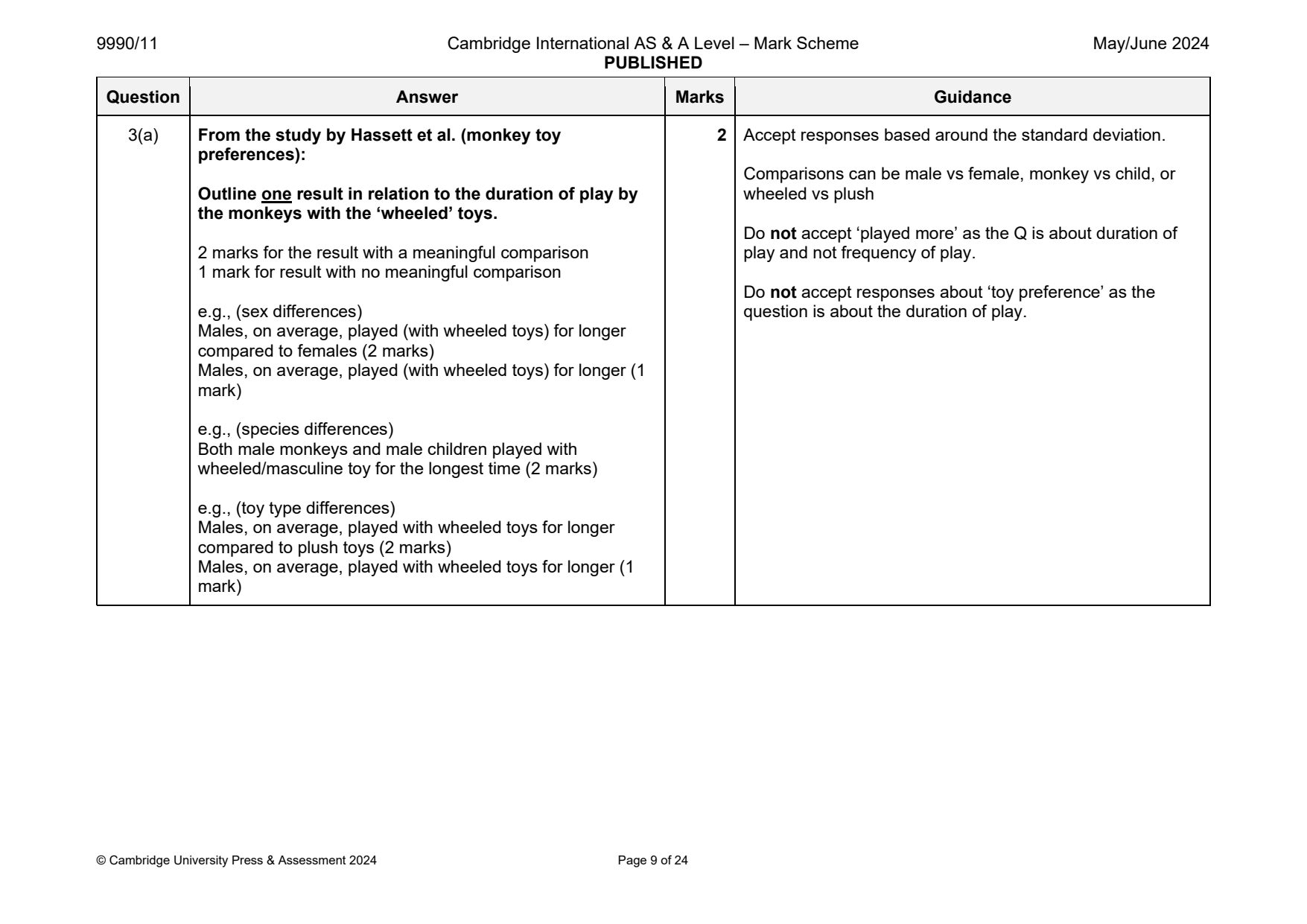
3(a) From the study by Hassett et al. (monkey toy 2 Accept responses based around the standard deviation.
preferences):
Comparisons can be male vs female, monkey vs child, or
Outline one result in relation to the duration of play by wheeled vs plush
the monkeys with the ‘wheeled’ toys.
Do not accept ‘played more’ as the Q is about duration of
2 marks for the result with a meaningful comparison play and not frequency of play.
1 mark for result with no meaningful comparison
Do not accept responses about ‘toy preference’ as the
e.g., (sex differences) question is about the duration of play.
Males, on average, played (with wheeled toys) for longer
compared to females (2 marks)
Males, on average, played (with wheeled toys) for longer (1
mark)
e.g., (species differences)
Both male monkeys and male children played with
wheeled/masculine toy for the longest time (2 marks)
e.g., (toy type differences)
Males, on average, played with wheeled toys for longer
compared to plush toys (2 marks)
Males, on average, played with wheeled toys for longer (1
mark)
© Cambridge University Press & Assessment 2024 Page 9 of 24
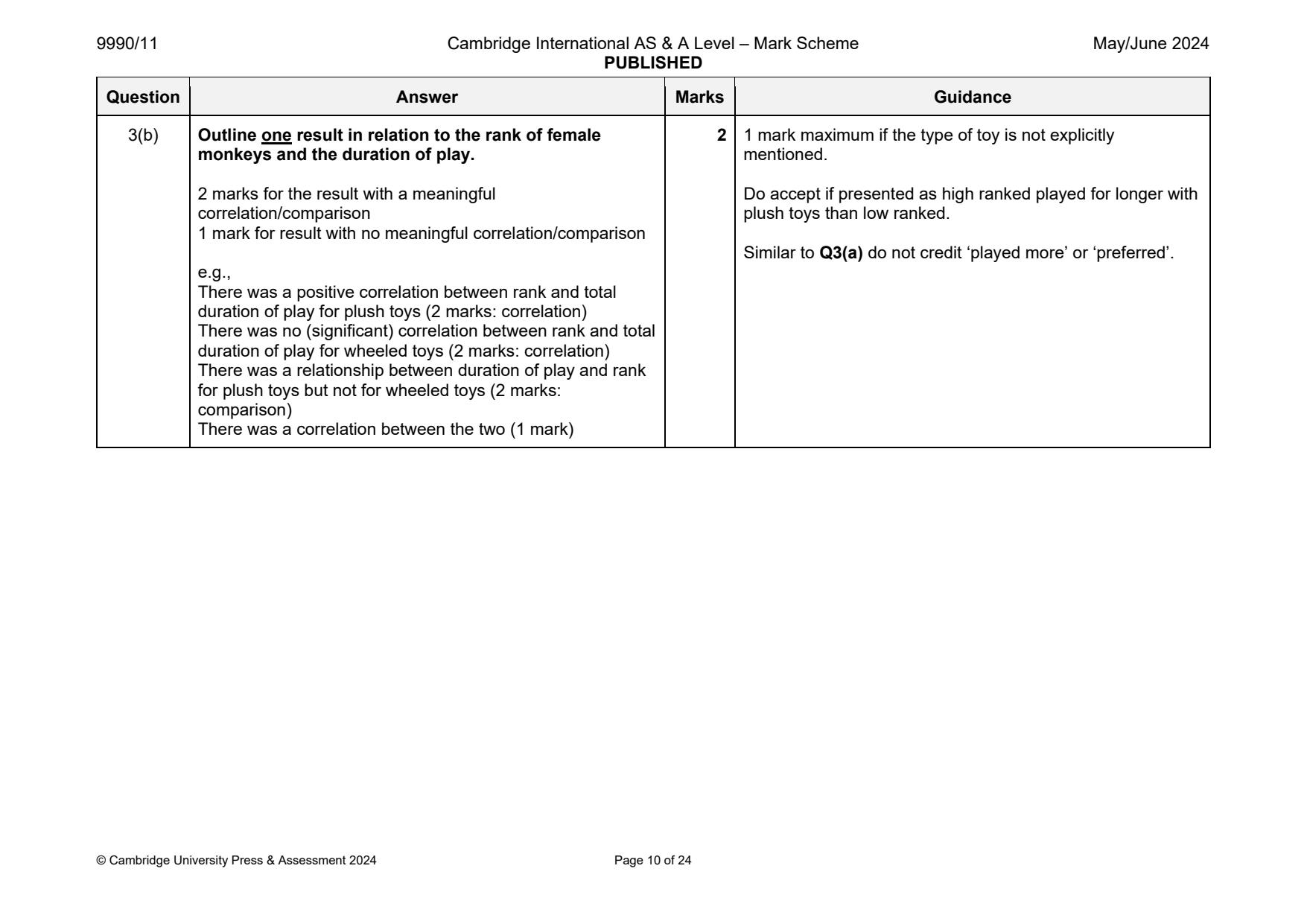
3(b) Outline one result in relation to the rank of female 2 1 mark maximum if the type of toy is not explicitly
monkeys and the duration of play. mentioned.
2 marks for the result with a meaningful Do accept if presented as high ranked played for longer with
correlation/comparison plush toys than low ranked.
1 mark for result with no meaningful correlation/comparison
Similar to Q3(a) do not credit ‘played more’ or ‘preferred’.
e.g.,
There was a positive correlation between rank and total
duration of play for plush toys (2 marks: correlation)
There was no (significant) correlation between rank and total
duration of play for wheeled toys (2 marks: correlation)
There was a relationship between duration of play and rank
for plush toys but not for wheeled toys (2 marks:
comparison)
There was a correlation between the two (1 mark)
© Cambridge University Press & Assessment 2024 Page 10 of 24
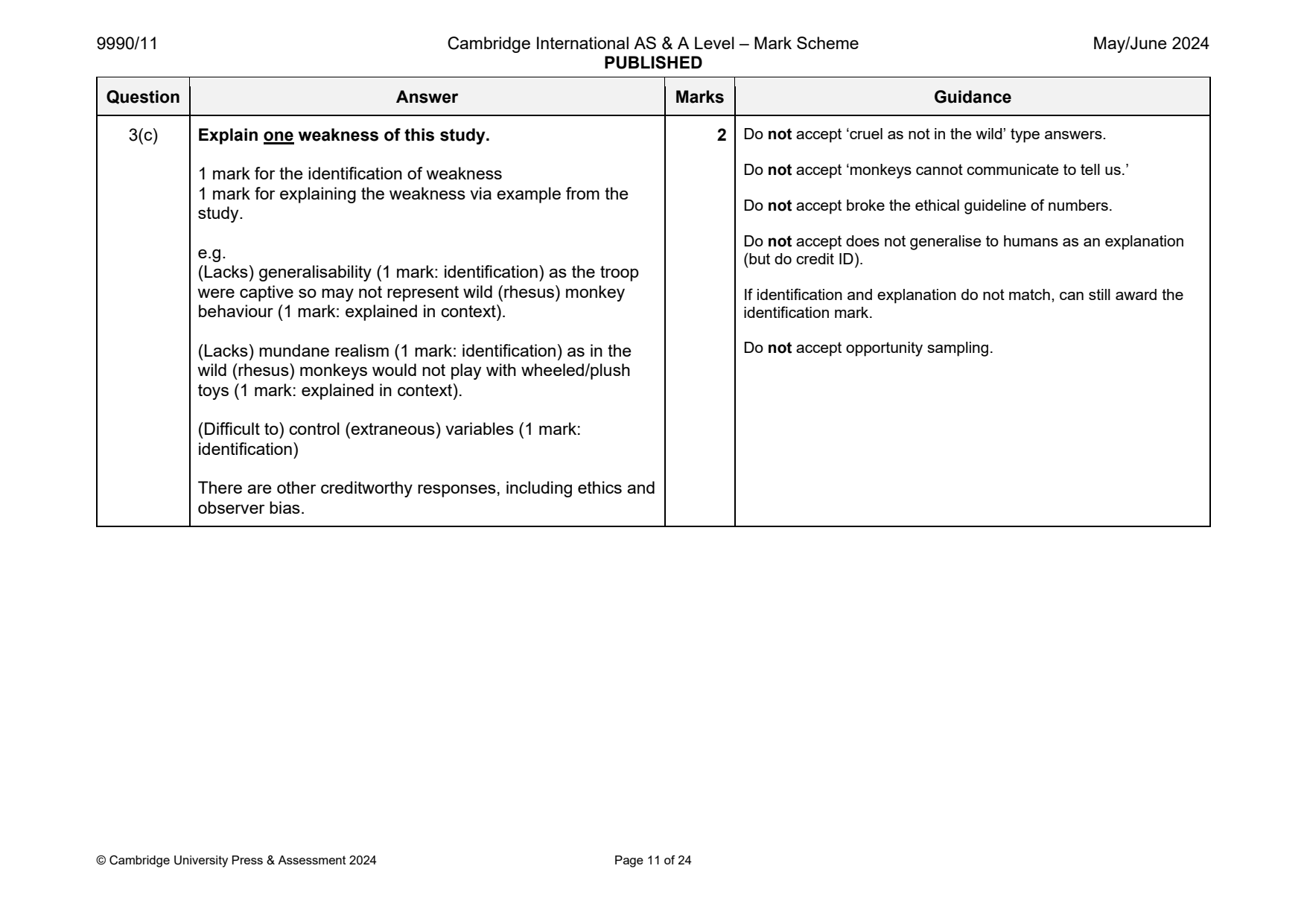
3(c) Explain one weakness of this study. 2 Do not accept ‘cruel as not in the wild’ type answers.
1 mark for the identification of weakness Do not accept ‘monkeys cannot communicate to tell us.’
1 mark for explaining the weakness via example from the
Do not accept broke the ethical guideline of numbers.
study.
Do not accept does not generalise to humans as an explanation
e.g.
(but do credit ID).
(Lacks) generalisability (1 mark: identification) as the troop
were captive so may not represent wild (rhesus) monkey If identification and explanation do not match, can still award the
behaviour (1 mark: explained in context). identification mark.
(Lacks) mundane realism (1 mark: identification) as in the Do not accept opportunity sampling.
wild (rhesus) monkeys would not play with wheeled/plush
toys (1 mark: explained in context).
(Difficult to) control (extraneous) variables (1 mark:
identification)
There are other creditworthy responses, including ethics and
observer bias.
© Cambridge University Press & Assessment 2024 Page 11 of 24
Official mark scheme pages: 9, 10, 11 · source PDF URL
9990-2024-mj-11-q09
May/June 2024 · Paper 11 · Question 9 · 12 marks
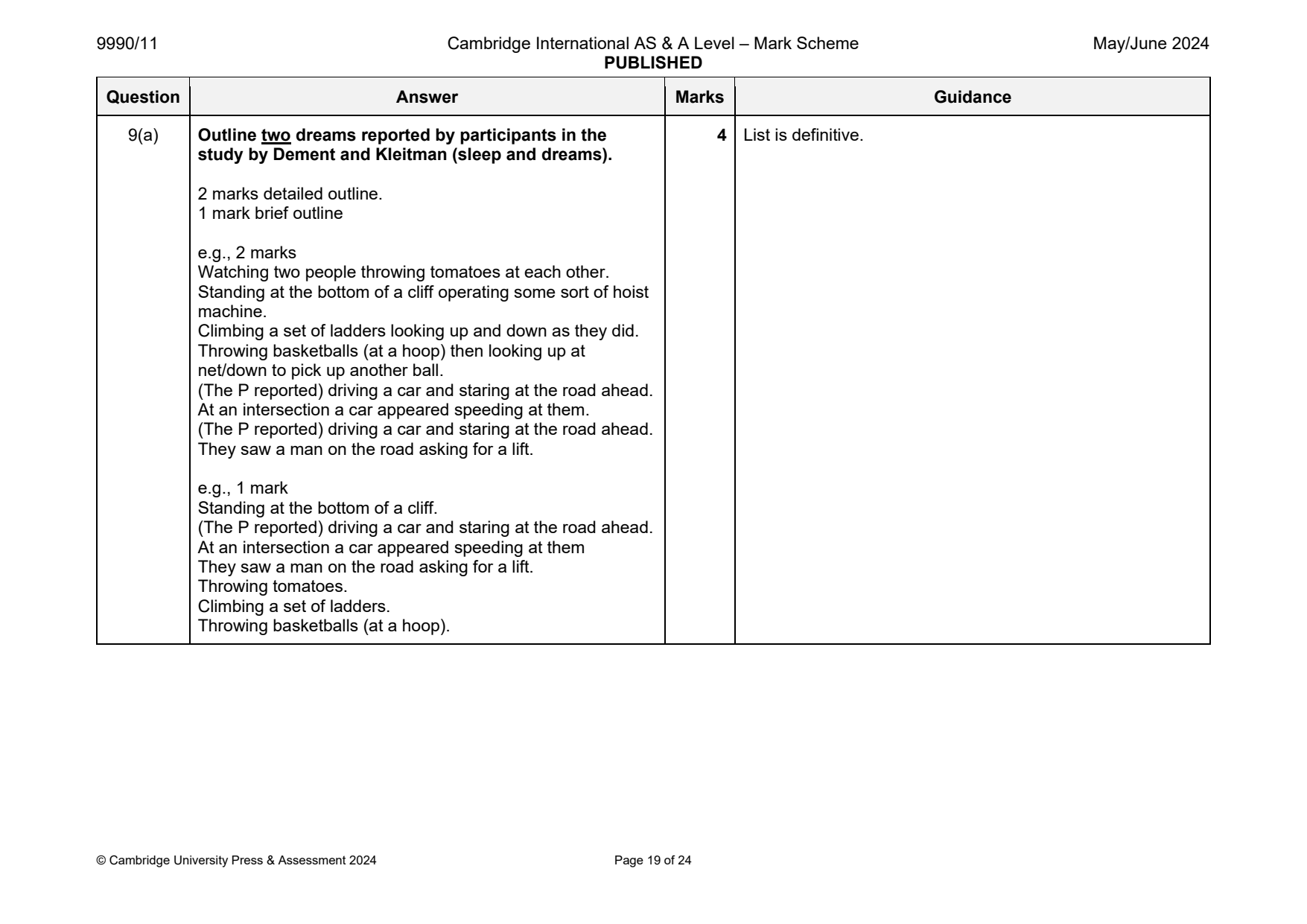
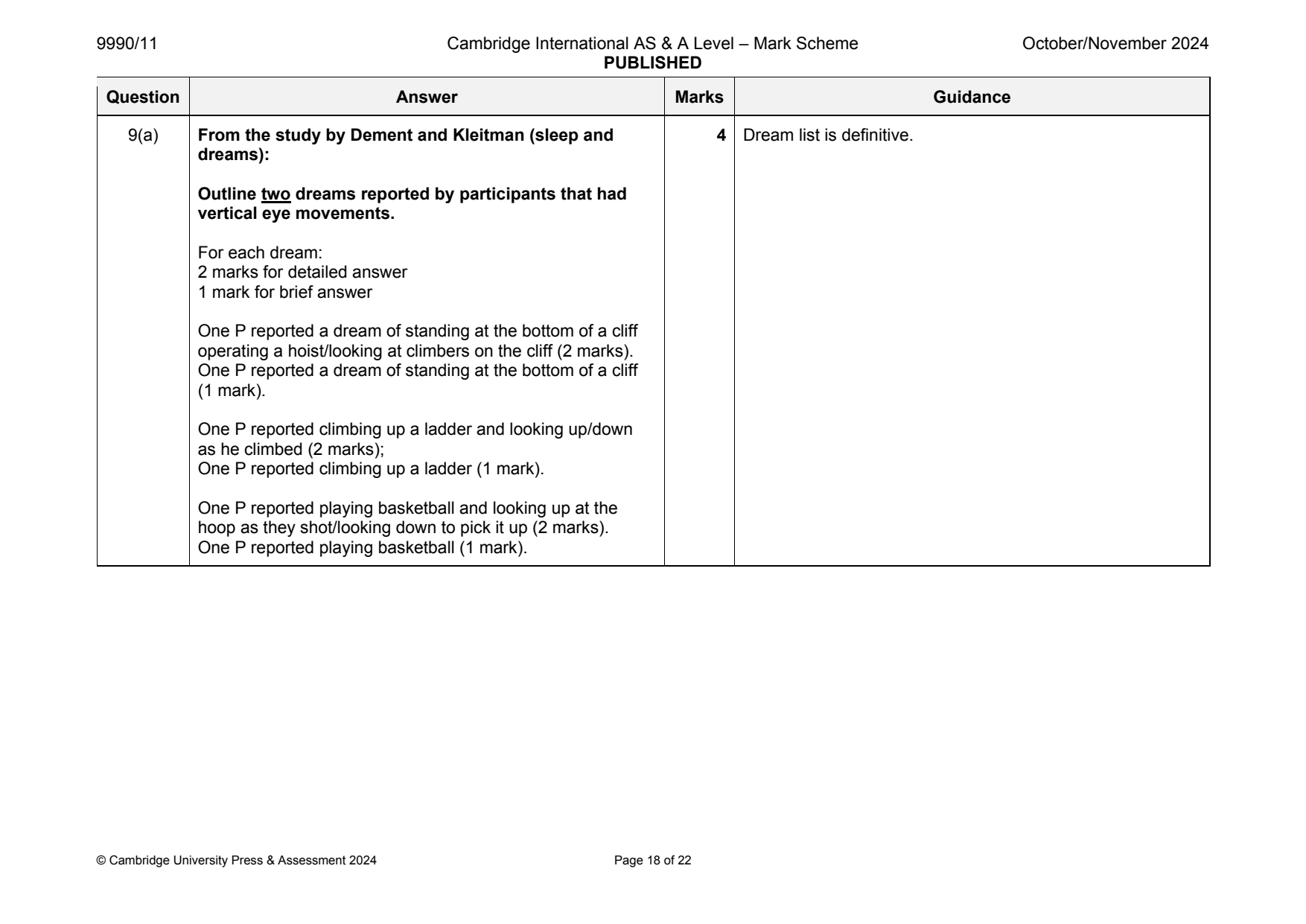
9(a) Outline two dreams reported by participants in the 4 List is definitive.
study by Dement and Kleitman (sleep and dreams).
2 marks detailed outline.
1 mark brief outline
e.g., 2 marks
Watching two people throwing tomatoes at each other.
Standing at the bottom of a cliff operating some sort of hoist
machine.
Climbing a set of ladders looking up and down as they did.
Throwing basketballs (at a hoop) then looking up at
net/down to pick up another ball.
(The P reported) driving a car and staring at the road ahead.
At an intersection a car appeared speeding at them.
(The P reported) driving a car and staring at the road ahead.
They saw a man on the road asking for a lift.
e.g., 1 mark
Standing at the bottom of a cliff.
(The P reported) driving a car and staring at the road ahead.
At an intersection a car appeared speeding at them
They saw a man on the road asking for a lift.
Throwing tomatoes.
Climbing a set of ladders.
Throwing basketballs (at a hoop).
© Cambridge University Press & Assessment 2024 Page 19 of 24
9(b) Explain two differences between the study by Dement 8 The other biological studies are:
and Kleitman (sleep and dreams) and one other study
from the biological approach. One of the differences Hassett
must be about the sample of participants. Hölzel
Use the marking grid below. One must be about the Award L1-L4 for each difference.
sample.
For Level 4 there must be some attempt at explaining the
4 marks for the difference (twice), e.g., brain measurement, difference.
research techniques used, type of data collected
(quantitative/qualitative), experimental design. Different species/assumptions/aims = L1
(if they simply write what both studies did, this is still
e.g. difference different aims).
e.g. 4 marks
Hölzel used an MRI scan to be able to see brain density For description of the sample (e.g., n=….) from the two
changes after a mindfulness stress reduction course. studies with no explicit note about size differences or effect
Dement and Kleitman used a different technique called an on generalisability = L2
EEG that could only monitor brain wave activity/patterns.
Therefore, Hölzel’s method looked at structure whereas Only accept opportunity sampling for Dement and Kleitman.
Dement and Kleitman looked at (real-time) function
(explanation). For D&K vs Hassett, different ethical guidelines = L1.
e.g. 3 marks Place a tick next to the difference that is about the sample. If
Different techniques were used to measure the brain. Hölzel no tick can be placed then mark both differences
used an MRI scan to be able to see brain density changes independently but only credit the best.
after a mindfulness stress reduction course/Dement and
Kleitman used a different technique called an EEG that
could only monitor brain wave activity/patterns.
e.g. 2 marks
Hölzel used an MRI scan measure brain density whilst
Dement and Kleitman used an EEG.
e.g. 1 mark
Both studies used different techniques to measure the brain.
© Cambridge University Press & Assessment 2024 Page 20 of 24
9(b)
Level Description
4 The difference is well explained using both
studies as examples.
3 The difference is well explained but only
one study is used as an example OR
both studies are used briefly.
2 The difference is brief with an attempt at
using at least one study as an example OR
The difference is well explained but there is
no study evidence.
1 The difference is brief with no attempt at
using the studies as examples.
0 No creditable response.
© Cambridge University Press & Assessment 2024 Page 21 of 24
Official mark scheme pages: 19, 20, 21 · source PDF URL
9990-2024-mj-12-q03
May/June 2024 · Paper 12 · Question 3 · 6 marks
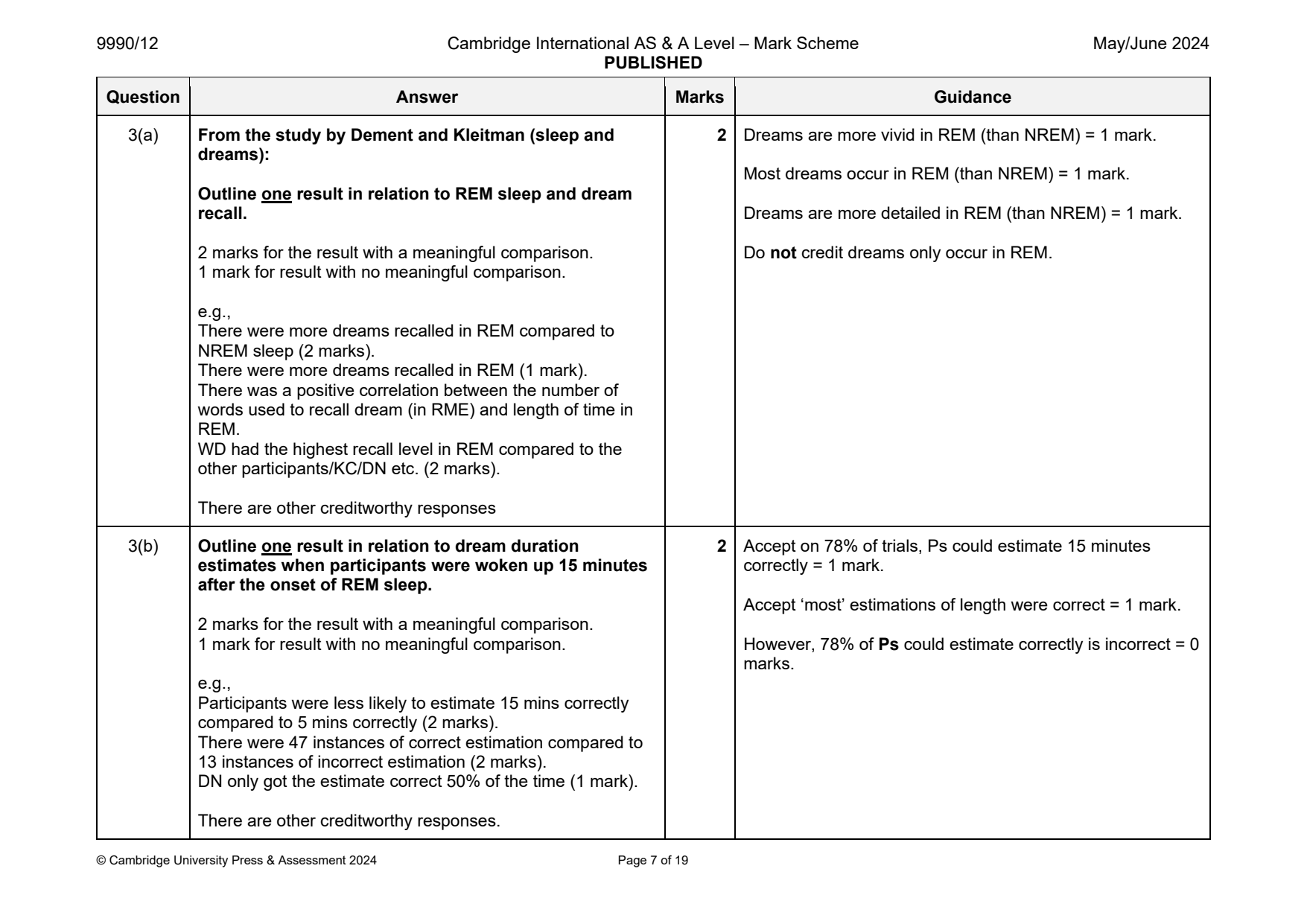
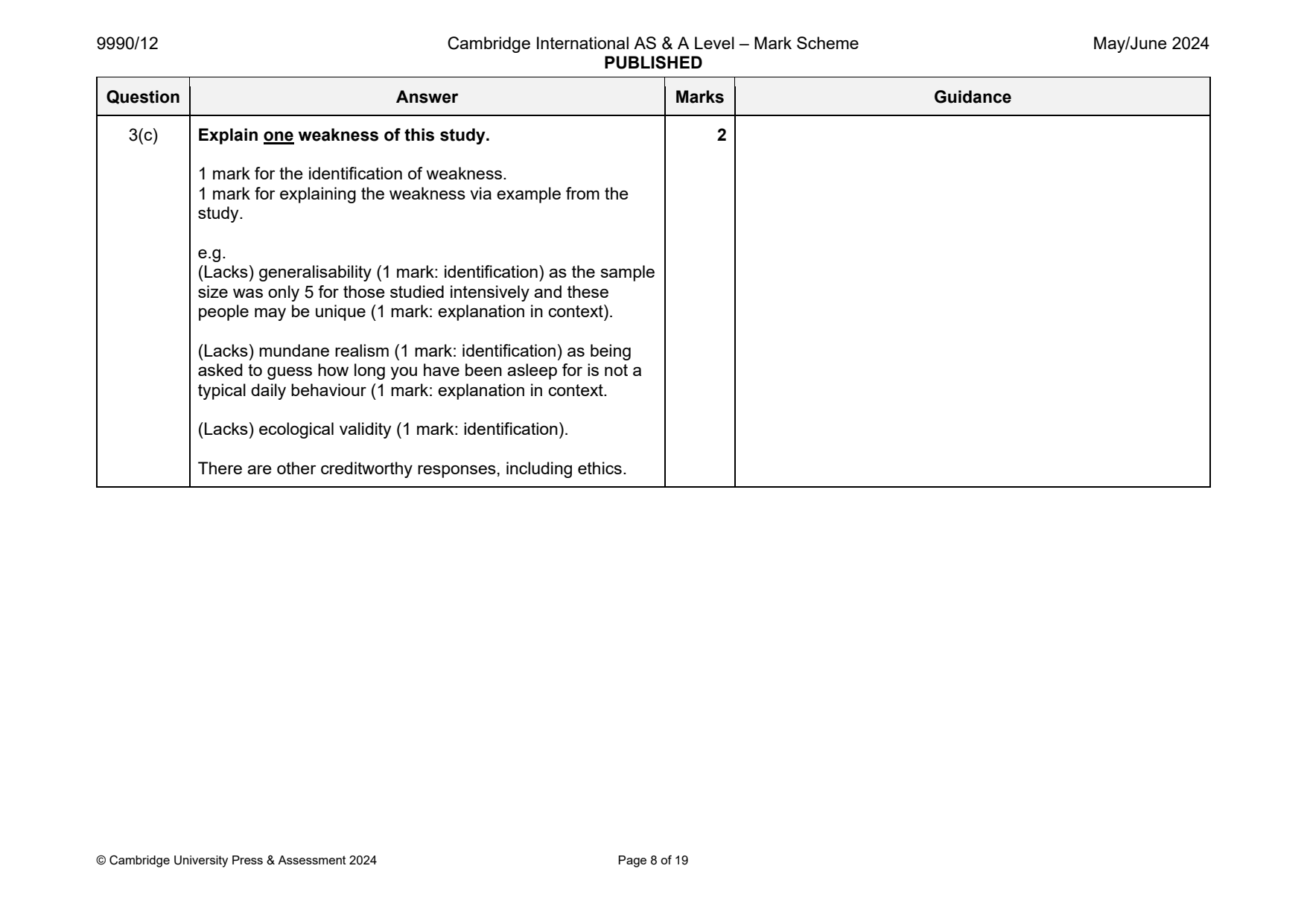
3(a) From the study by Dement and Kleitman (sleep and 2 Dreams are more vivid in REM (than NREM) = 1 mark.
dreams):
Most dreams occur in REM (than NREM) = 1 mark.
Outline one result in relation to REM sleep and dream
recall. Dreams are more detailed in REM (than NREM) = 1 mark.
2 marks for the result with a meaningful comparison. Do not credit dreams only occur in REM.
1 mark for result with no meaningful comparison.
e.g.,
There were more dreams recalled in REM compared to
NREM sleep (2 marks).
There were more dreams recalled in REM (1 mark).
There was a positive correlation between the number of
words used to recall dream (in RME) and length of time in
REM.
WD had the highest recall level in REM compared to the
other participants/KC/DN etc. (2 marks).
There are other creditworthy responses
3(b) Outline one result in relation to dream duration 2 Accept on 78% of trials, Ps could estimate 15 minutes
estimates when participants were woken up 15 minutes correctly = 1 mark.
after the onset of REM sleep.
Accept ‘most’ estimations of length were correct = 1 mark.
2 marks for the result with a meaningful comparison.
1 mark for result with no meaningful comparison. However, 78% of Ps could estimate correctly is incorrect = 0
marks.
e.g.,
Participants were less likely to estimate 15 mins correctly
compared to 5 mins correctly (2 marks).
There were 47 instances of correct estimation compared to
13 instances of incorrect estimation (2 marks).
DN only got the estimate correct 50% of the time (1 mark).
There are other creditworthy responses.
© Cambridge University Press & Assessment 2024 Page 7 of 19
3(c) Explain one weakness of this study. 2
1 mark for the identification of weakness.
1 mark for explaining the weakness via example from the
study.
e.g.
(Lacks) generalisability (1 mark: identification) as the sample
size was only 5 for those studied intensively and these
people may be unique (1 mark: explanation in context).
(Lacks) mundane realism (1 mark: identification) as being
asked to guess how long you have been asleep for is not a
typical daily behaviour (1 mark: explanation in context.
(Lacks) ecological validity (1 mark: identification).
There are other creditworthy responses, including ethics.
© Cambridge University Press & Assessment 2024 Page 8 of 19
Official mark scheme pages: 7, 8 · source PDF URL
9990-2024-mj-12-q05
May/June 2024 · Paper 12 · Question 5 · 5 marks
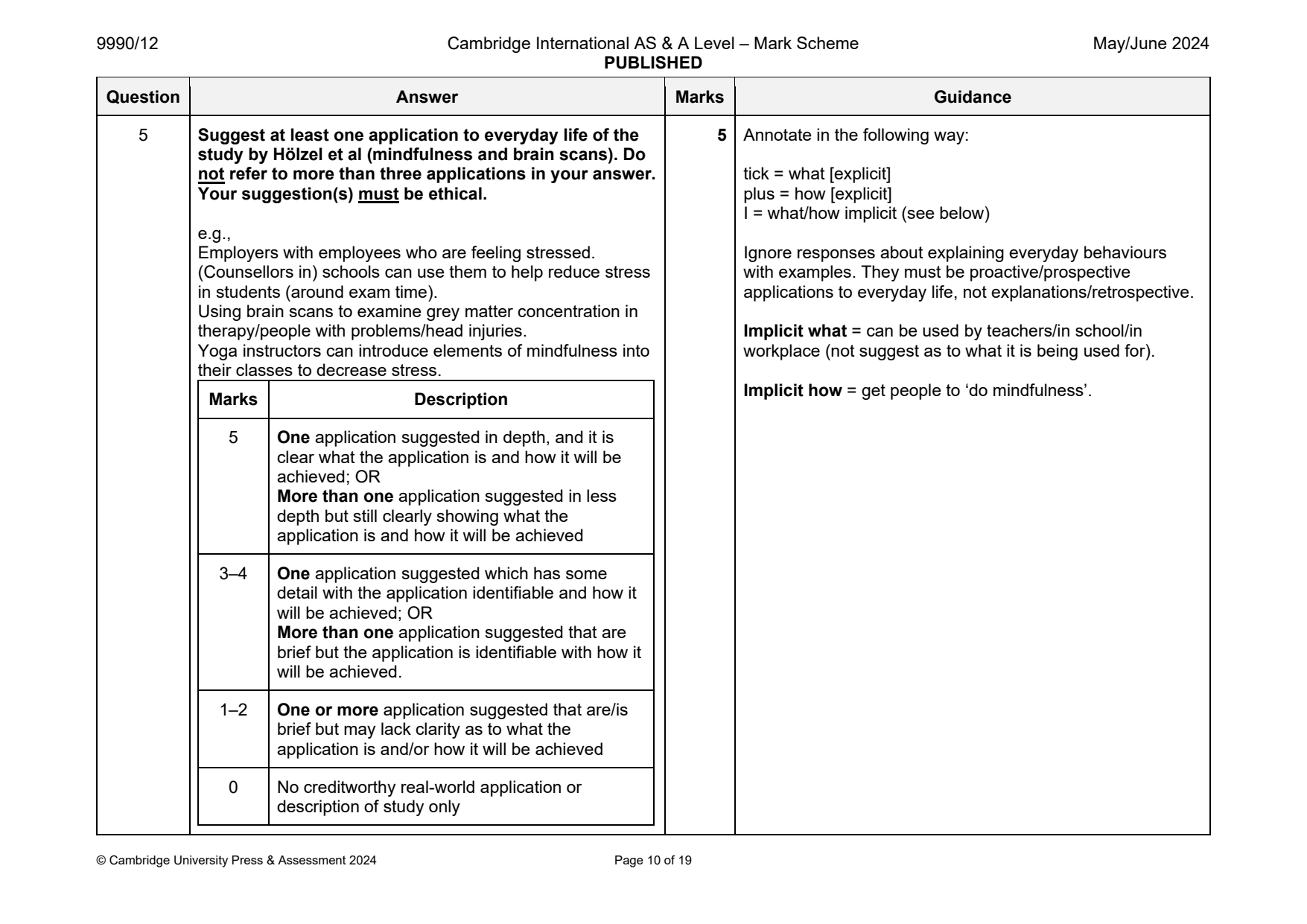
5 Suggest at least one application to everyday life of the 5 Annotate in the following way:
study by Hölzel et al (mindfulness and brain scans). Do
not refer to more than three applications in your answer. tick = what [explicit]
Your suggestion(s) must be ethical. plus = how [explicit]
I = what/how implicit (see below)
e.g.,
Employers with employees who are feeling stressed. Ignore responses about explaining everyday behaviours
(Counsellors in) schools can use them to help reduce stress with examples. They must be proactive/prospective
in students (around exam time). applications to everyday life, not explanations/retrospective.
Using brain scans to examine grey matter concentration in
therapy/people with problems/head injuries. Implicit what = can be used by teachers/in school/in
Yoga instructors can introduce elements of mindfulness into workplace (not suggest as to what it is being used for).
their classes to decrease stress.
Implicit how = get people to ‘do mindfulness’.
Marks Description
5 One application suggested in depth, and it is
clear what the application is and how it will be
achieved; OR
More than one application suggested in less
depth but still clearly showing what the
application is and how it will be achieved
3–4 One application suggested which has some
detail with the application identifiable and how it
will be achieved; OR
More than one application suggested that are
brief but the application is identifiable with how it
will be achieved.
1–2 One or more application suggested that are/is
brief but may lack clarity as to what the
application is and/or how it will be achieved
0 No creditworthy real-world application or
description of study only
© Cambridge University Press & Assessment 2024 Page 10 of 19
Official mark scheme pages: 10 · source PDF URL
9990-2024-mj-13-q05
May/June 2024 · Paper 13 · Question 5 · 5 marks
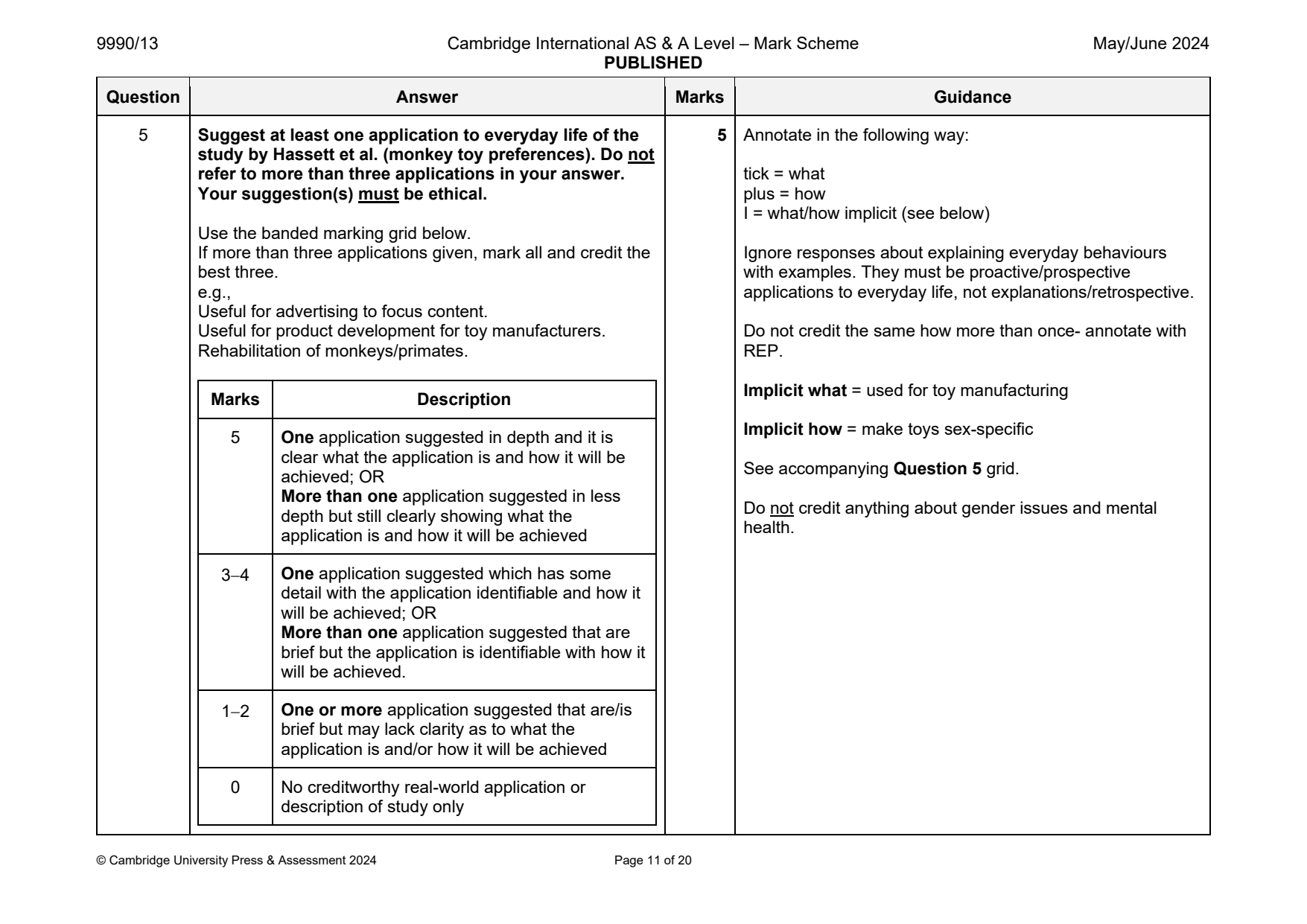
5 Suggest at least one application to everyday life of the 5 Annotate in the following way:
study by Hassett et al. (monkey toy preferences). Do not
refer to more than three applications in your answer. tick = what
Your suggestion(s) must be ethical. plus = how
I = what/how implicit (see below)
Use the banded marking grid below.
If more than three applications given, mark all and credit the Ignore responses about explaining everyday behaviours
best three. with examples. They must be proactive/prospective
e.g., applications to everyday life, not explanations/retrospective.
Useful for advertising to focus content.
Useful for product development for toy manufacturers. Do not credit the same how more than once- annotate with
Rehabilitation of monkeys/primates. REP.
Implicit what = used for toy manufacturing
Marks Description
Implicit how = make toys sex-specific
5 One application suggested in depth and it is
clear what the application is and how it will be
See accompanying Question 5 grid.
achieved; OR
More than one application suggested in less
Do not credit anything about gender issues and mental
depth but still clearly showing what the
health.
application is and how it will be achieved
34 One application suggested which has some
detail with the application identifiable and how it
will be achieved; OR
More than one application suggested that are
brief but the application is identifiable with how it
will be achieved.
12 One or more application suggested that are/is
brief but may lack clarity as to what the
application is and/or how it will be achieved
0 No creditworthy real-world application or
description of study only
© Cambridge University Press & Assessment 2024 Page 11 of 20
Official mark scheme pages: 11 · source PDF URL
9990-2024-mj-13-q07
May/June 2024 · Paper 13 · Question 7 · 4 marks
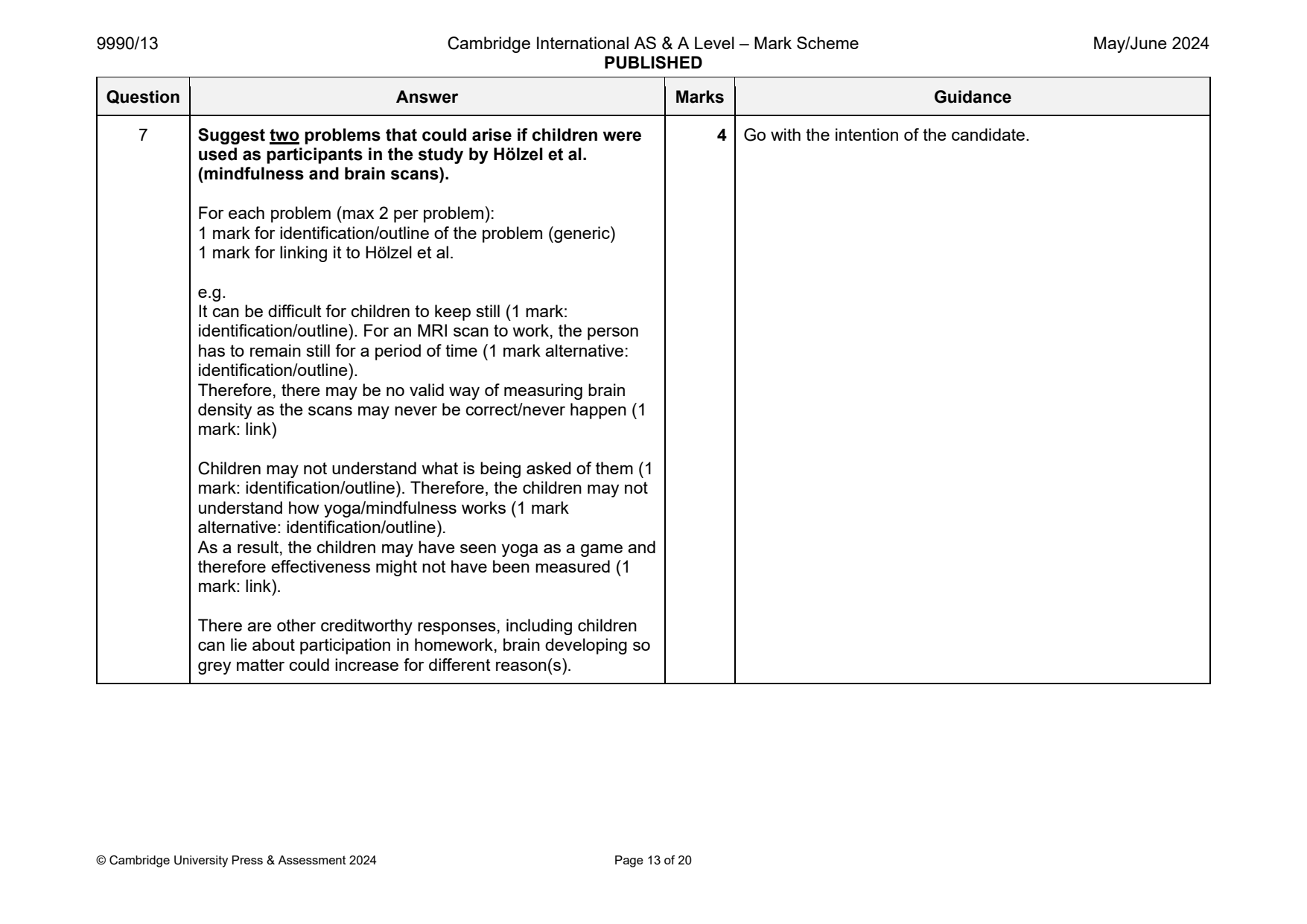
7 Suggest two problems that could arise if children were 4 Go with the intention of the candidate.
used as participants in the study by Hölzel et al.
(mindfulness and brain scans).
For each problem (max 2 per problem):
1 mark for identification/outline of the problem (generic)
1 mark for linking it to Hölzel et al.
e.g.
It can be difficult for children to keep still (1 mark:
identification/outline). For an MRI scan to work, the person
has to remain still for a period of time (1 mark alternative:
identification/outline).
Therefore, there may be no valid way of measuring brain
density as the scans may never be correct/never happen (1
mark: link)
Children may not understand what is being asked of them (1
mark: identification/outline). Therefore, the children may not
understand how yoga/mindfulness works (1 mark
alternative: identification/outline).
As a result, the children may have seen yoga as a game and
therefore effectiveness might not have been measured (1
mark: link).
There are other creditworthy responses, including children
can lie about participation in homework, brain developing so
grey matter could increase for different reason(s).
© Cambridge University Press & Assessment 2024 Page 13 of 20
Official mark scheme pages: 13 · source PDF URL
9990-2024-on-11-q01
Oct/Nov 2024 · Paper 11 · Question 1 · 5 marks
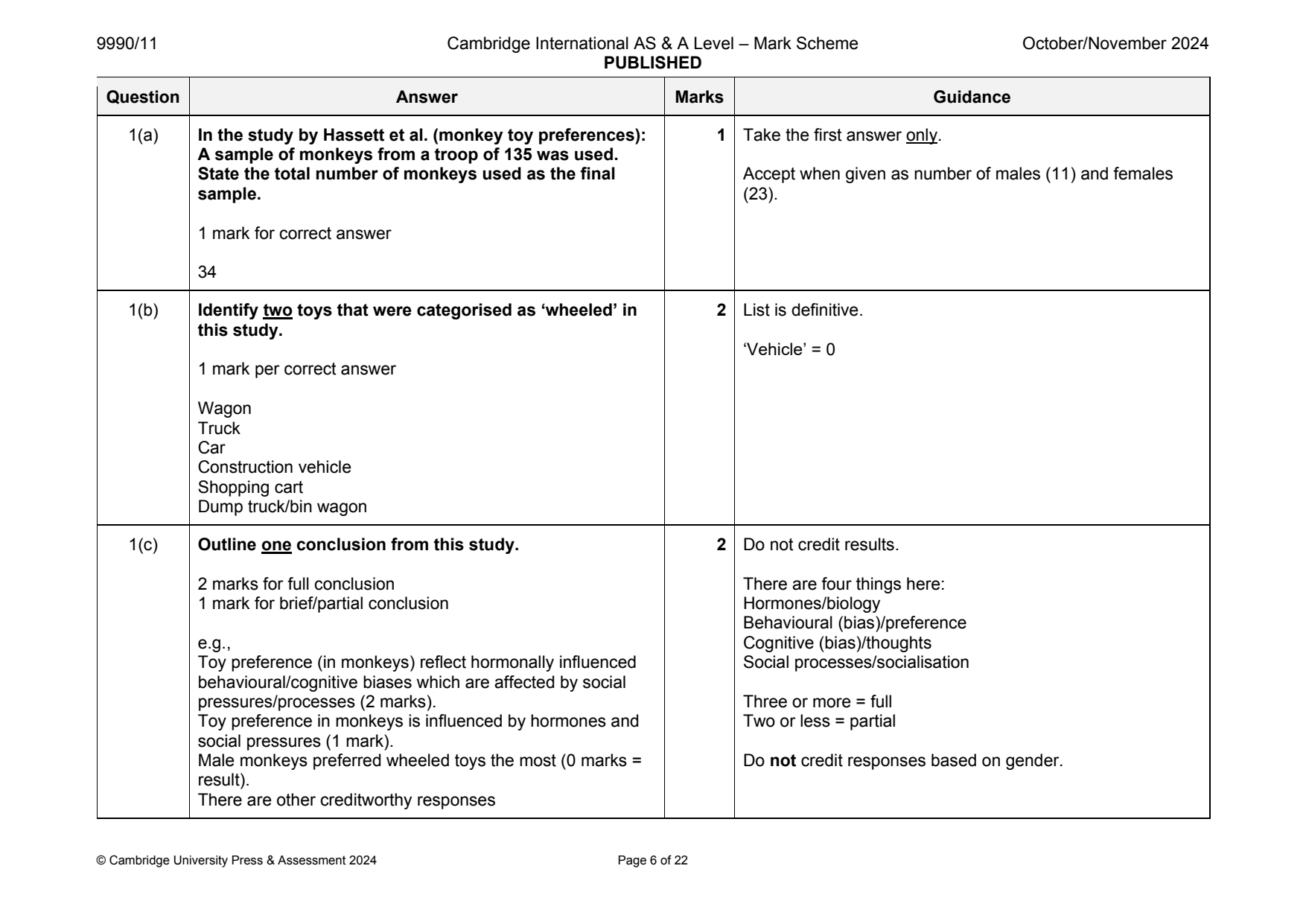
1(a) In the study by Hassett et al. (monkey toy preferences): 1 Take the first answer only.
A sample of monkeys from a troop of 135 was used.
State the total number of monkeys used as the final Accept when given as number of males (11) and females
sample. (23).
1 mark for correct answer
34
1(b) Identify two toys that were categorised as ‘wheeled’ in 2 List is definitive.
this study.
‘Vehicle’ = 0
1 mark per correct answer
Wagon
Truck
Car
Construction vehicle
Shopping cart
Dump truck/bin wagon
1(c) Outline one conclusion from this study. 2 Do not credit results.
2 marks for full conclusion There are four things here:
1 mark for brief/partial conclusion Hormones/biology
Behavioural (bias)/preference
e.g., Cognitive (bias)/thoughts
Toy preference (in monkeys) reflect hormonally influenced Social processes/socialisation
behavioural/cognitive biases which are affected by social
pressures/processes (2 marks). Three or more = full
Toy preference in monkeys is influenced by hormones and Two or less = partial
social pressures (1 mark).
Male monkeys preferred wheeled toys the most (0 marks = Do not credit responses based on gender.
result).
There are other creditworthy responses
© Cambridge University Press & Assessment 2024 Page 6 of 22
Official mark scheme pages: 6 · source PDF URL
9990-2024-on-11-q05
Oct/Nov 2024 · Paper 11 · Question 5 · 6 marks
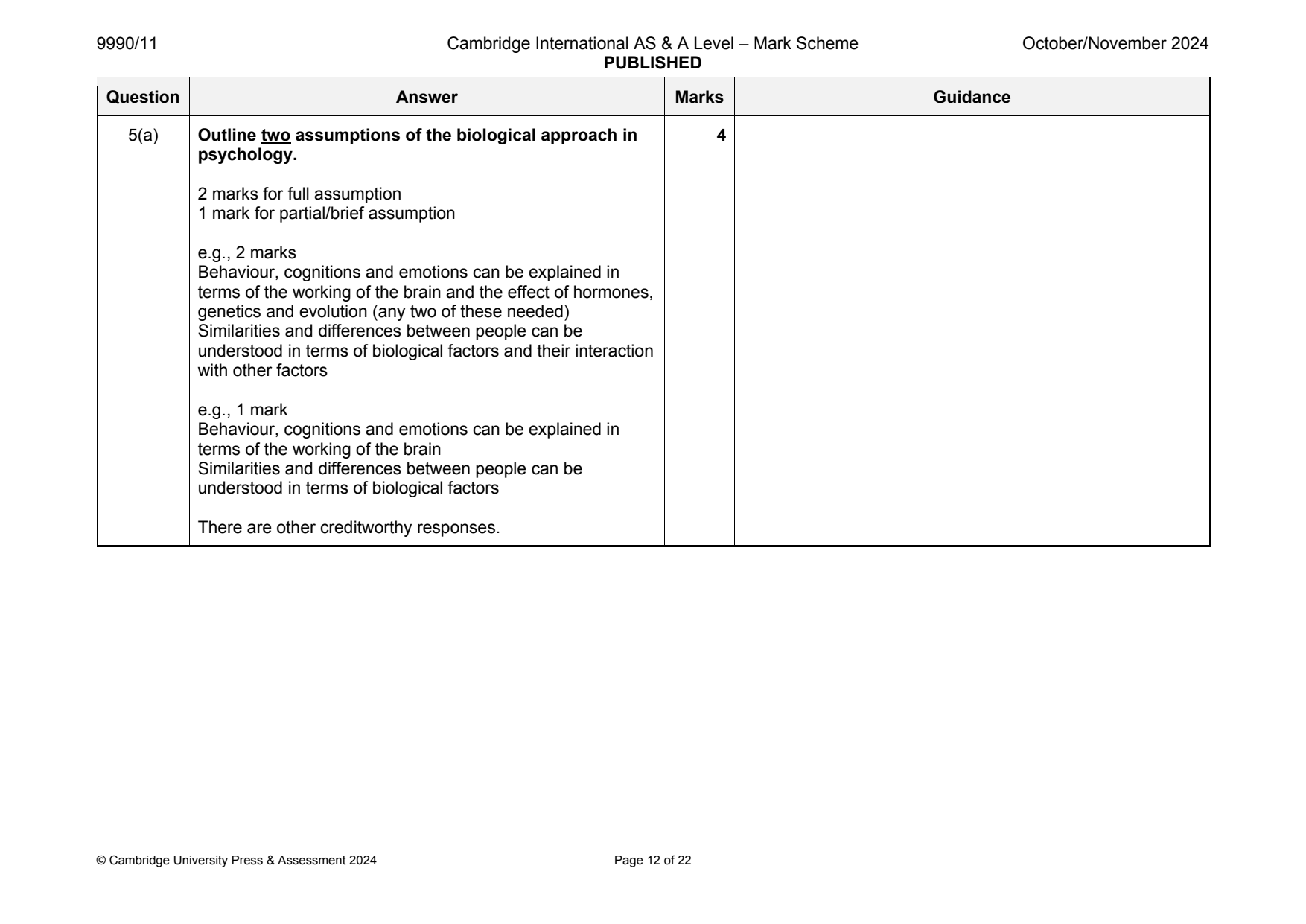
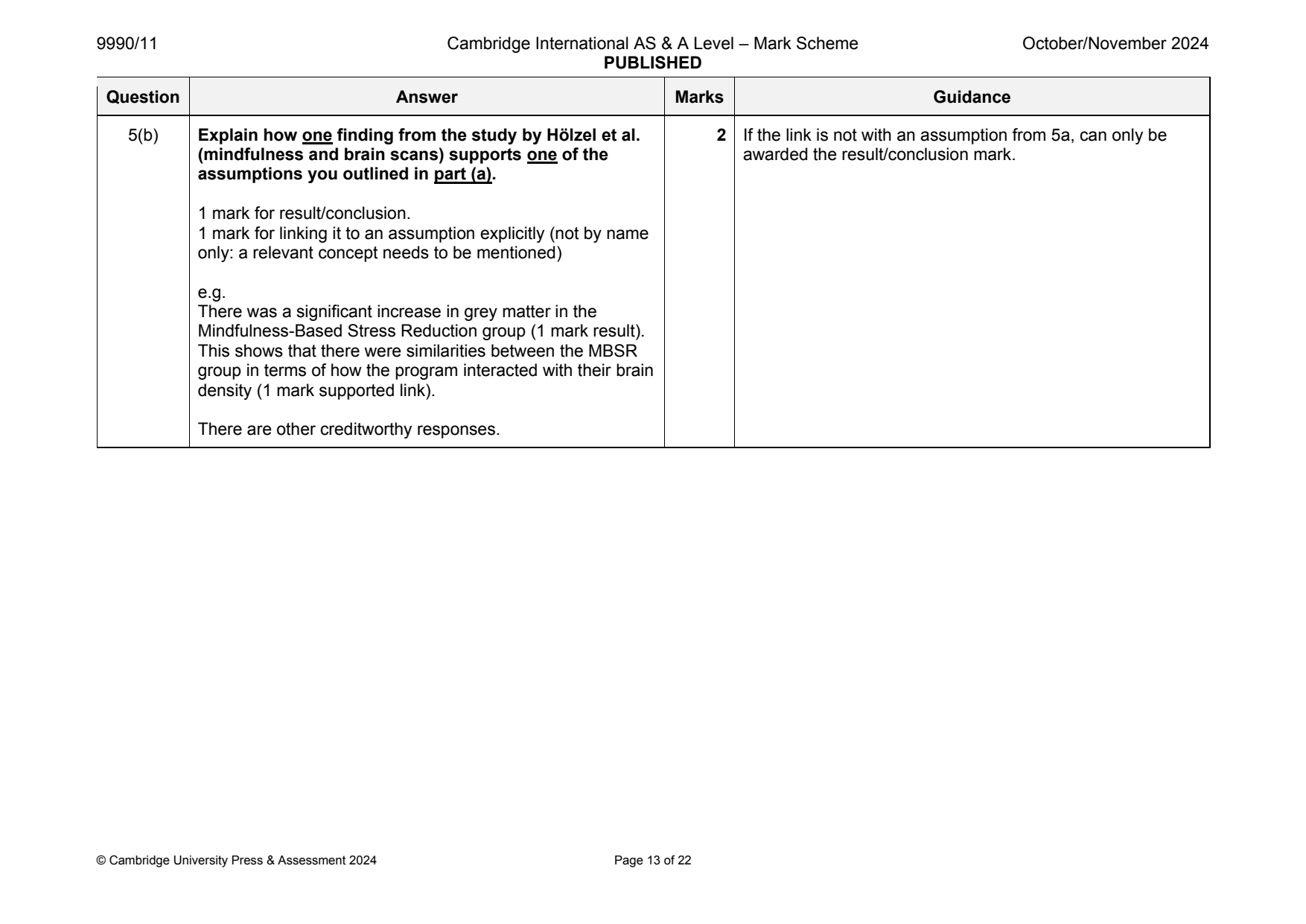
5(a) Outline two assumptions of the biological approach in 4
psychology.
2 marks for full assumption
1 mark for partial/brief assumption
e.g., 2 marks
Behaviour, cognitions and emotions can be explained in
terms of the working of the brain and the effect of hormones,
genetics and evolution (any two of these needed)
Similarities and differences between people can be
understood in terms of biological factors and their interaction
with other factors
e.g., 1 mark
Behaviour, cognitions and emotions can be explained in
terms of the working of the brain
Similarities and differences between people can be
understood in terms of biological factors
There are other creditworthy responses.
© Cambridge University Press & Assessment 2024 Page 12 of 22
5(b) Explain how one finding from the study by Hölzel et al. 2 If the link is not with an assumption from 5a, can only be
(mindfulness and brain scans) supports one of the awarded the result/conclusion mark.
assumptions you outlined in part (a).
1 mark for result/conclusion.
1 mark for linking it to an assumption explicitly (not by name
only: a relevant concept needs to be mentioned)
e.g.
There was a significant increase in grey matter in the
Mindfulness-Based Stress Reduction group (1 mark result).
This shows that there were similarities between the MBSR
group in terms of how the program interacted with their brain
density (1 mark supported link).
There are other creditworthy responses.
© Cambridge University Press & Assessment 2024 Page 13 of 22
Official mark scheme pages: 12, 13 · source PDF URL
9990-2024-on-11-q09
Oct/Nov 2024 · Paper 11 · Question 9 · 12 marks
9(a) From the study by Dement and Kleitman (sleep and 4 Dream list is definitive.
dreams):
Outline two dreams reported by participants that had
vertical eye movements.
For each dream:
2 marks for detailed answer
1 mark for brief answer
One P reported a dream of standing at the bottom of a cliff
operating a hoist/looking at climbers on the cliff (2 marks).
One P reported a dream of standing at the bottom of a cliff
(1 mark).
One P reported climbing up a ladder and looking up/down
as he climbed (2 marks);
One P reported climbing up a ladder (1 mark).
One P reported playing basketball and looking up at the
hoop as they shot/looking down to pick it up (2 marks).
One P reported playing basketball (1 mark).
© Cambridge University Press & Assessment 2024 Page 18 of 22
9(b) Explain two differences between the study by Dement 8 Award L1-L4 for each difference
and Kleitman and the study by Hölzel et al. (mindfulness
and brain scans). One of the differences must be about For Level 4 there must be some attempt at explaining the
the technique used to investigate the brain. difference.
Use the marking grid below. If both differences do not focus on technique used to
4 marks for the difference (twice), e.g., brain measurement, investigate the brain, then mark both but only credit the best.
research techniques used, type of data collected
(quantitative/qualitative), generalisability, sample size. Annotate with a tick to show they have a difference based
on the technique.
e.g. difference
4 marks To get L2 for technique, one of the techniques must be
Hölzel used an MRI scan to be able to see brain density mentioned in relation to what was being measured.
changes after a mindfulness stress reduction course.
Dement & Kleitman used a different technique called an Correct techniques must be mentioned to get L3 or L4.
EEG that could only monitor brain wave activity/patterns.
Therefore, Hölzel’s method looked at structure whereas Different aims = L1
Dement looked at (real-time) function (explanation). Quantitative/qualitative argument = L3 max
3 marks Do credit experimental designs as D&K utilised repeated
Hölzel used an MRI scan to be able to see brain measures and Hölzel used independent groups.
density/grey matter changes after a mindfulness stress
reduction course. Dement & Kleitman used a different Extra rules for techniques:
technique called an EEG that could only monitor brain wave
activity/patterns (during REM etc.) For L3 there needs to be specific examples of what was
measured from both studies
2 marks
Hölzel used an MRI scan measure brain density whilst If one of the techniques is incorrect, then L1 max.
Dement & Kleitman used an EEG.
1 mark
Hölzel used an MRI scan and/or Dement & Kleitman used
an EEG.
© Cambridge University Press & Assessment 2024 Page 19 of 22
9(b)
Mark/ Description
Level
4 The difference is well explained using both
studies as examples.
3 The difference is well explained but only one
study is used as an example OR
both studies are used briefly.
2 The difference is brief with an attempt at using
at least one study as an example OR
The difference is well explained but there is no
study evidence.
1 The difference is brief with no attempt at using
the studies as examples.
0 No creditable response.
© Cambridge University Press & Assessment 2024 Page 20 of 22
Official mark scheme pages: 18, 19, 20 · source PDF URL
9990-2024-on-12-q04
Oct/Nov 2024 · Paper 12 · Question 4 · 5 marks
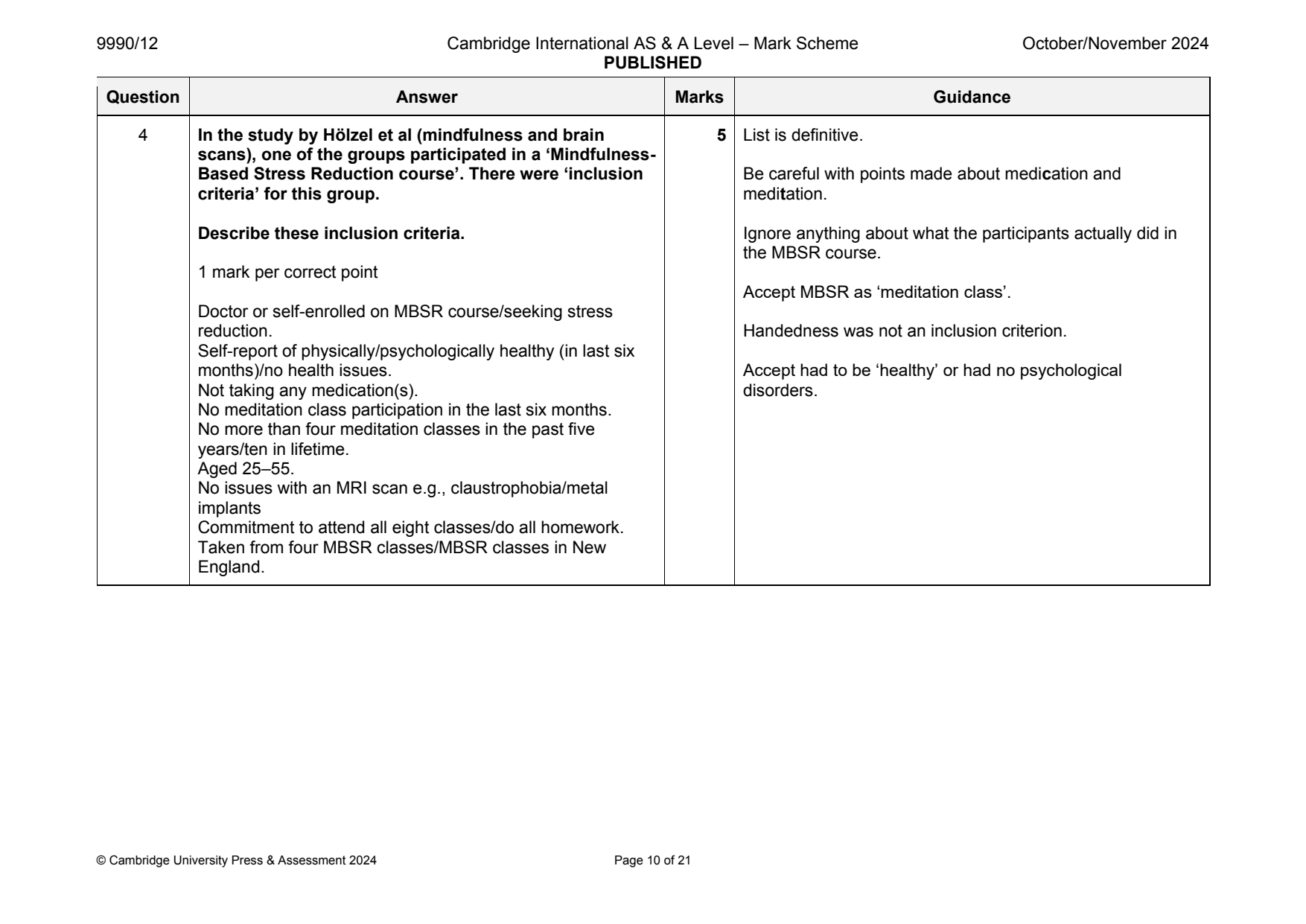
4 In the study by Hölzel et al (mindfulness and brain 5 List is definitive.
scans), one of the groups participated in a ‘Mindfulness-
Based Stress Reduction course’. There were ‘inclusion Be careful with points made about medication and
criteria’ for this group. meditation.
Describe these inclusion criteria. Ignore anything about what the participants actually did in
the MBSR course.
1 mark per correct point
Accept MBSR as ‘meditation class’.
Doctor or self-enrolled on MBSR course/seeking stress
reduction. Handedness was not an inclusion criterion.
Self-report of physically/psychologically healthy (in last six
months)/no health issues. Accept had to be ‘healthy’ or had no psychological
Not taking any medication(s). disorders.
No meditation class participation in the last six months.
No more than four meditation classes in the past five
years/ten in lifetime.
Aged 25–55.
No issues with an MRI scan e.g., claustrophobia/metal
implants
Commitment to attend all eight classes/do all homework.
Taken from four MBSR classes/MBSR classes in New
England.
© Cambridge University Press & Assessment 2024 Page 10 of 21
Official mark scheme pages: 10 · source PDF URL
9990-2024-on-12-q06
Oct/Nov 2024 · Paper 12 · Question 6 · 6 marks
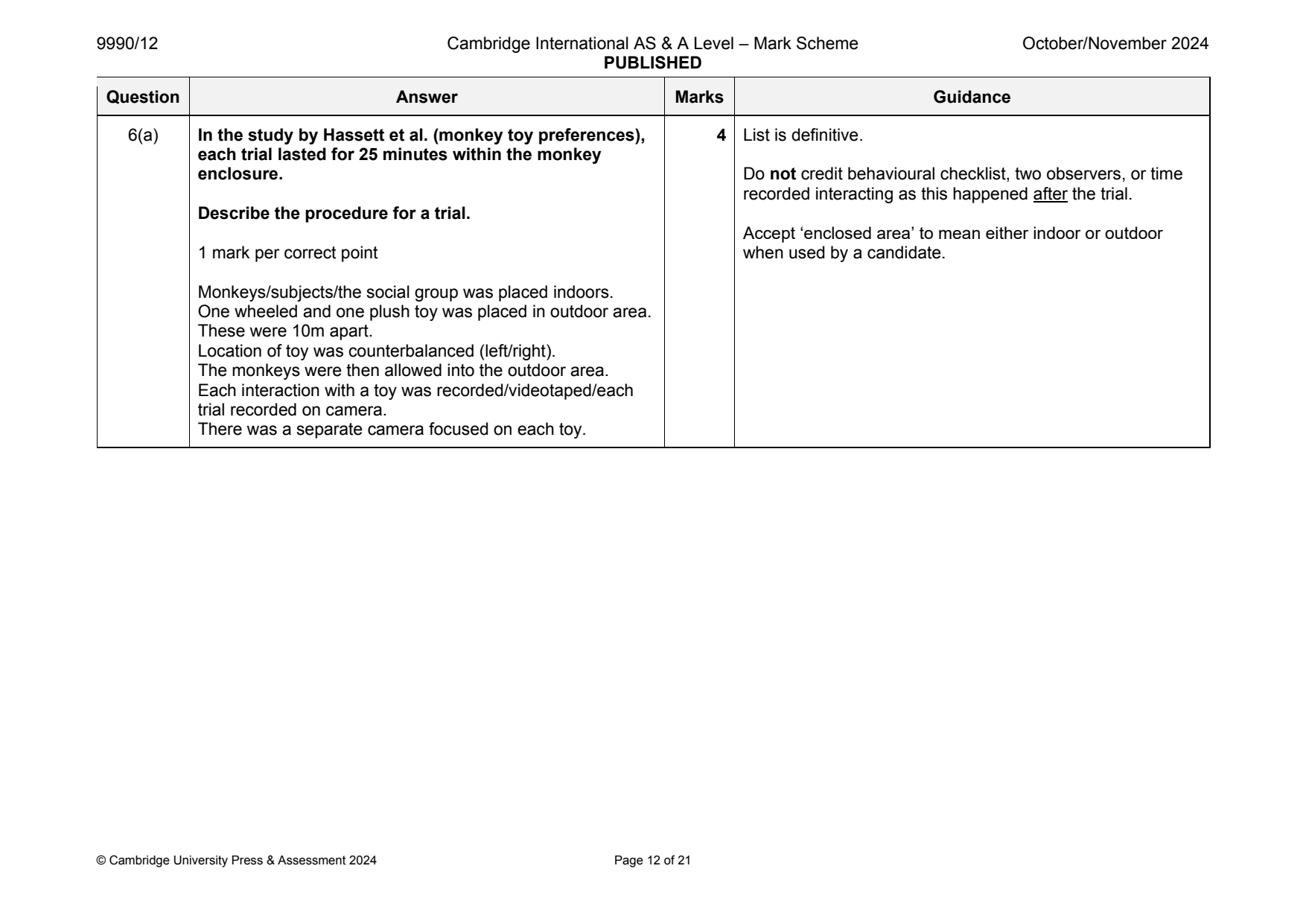
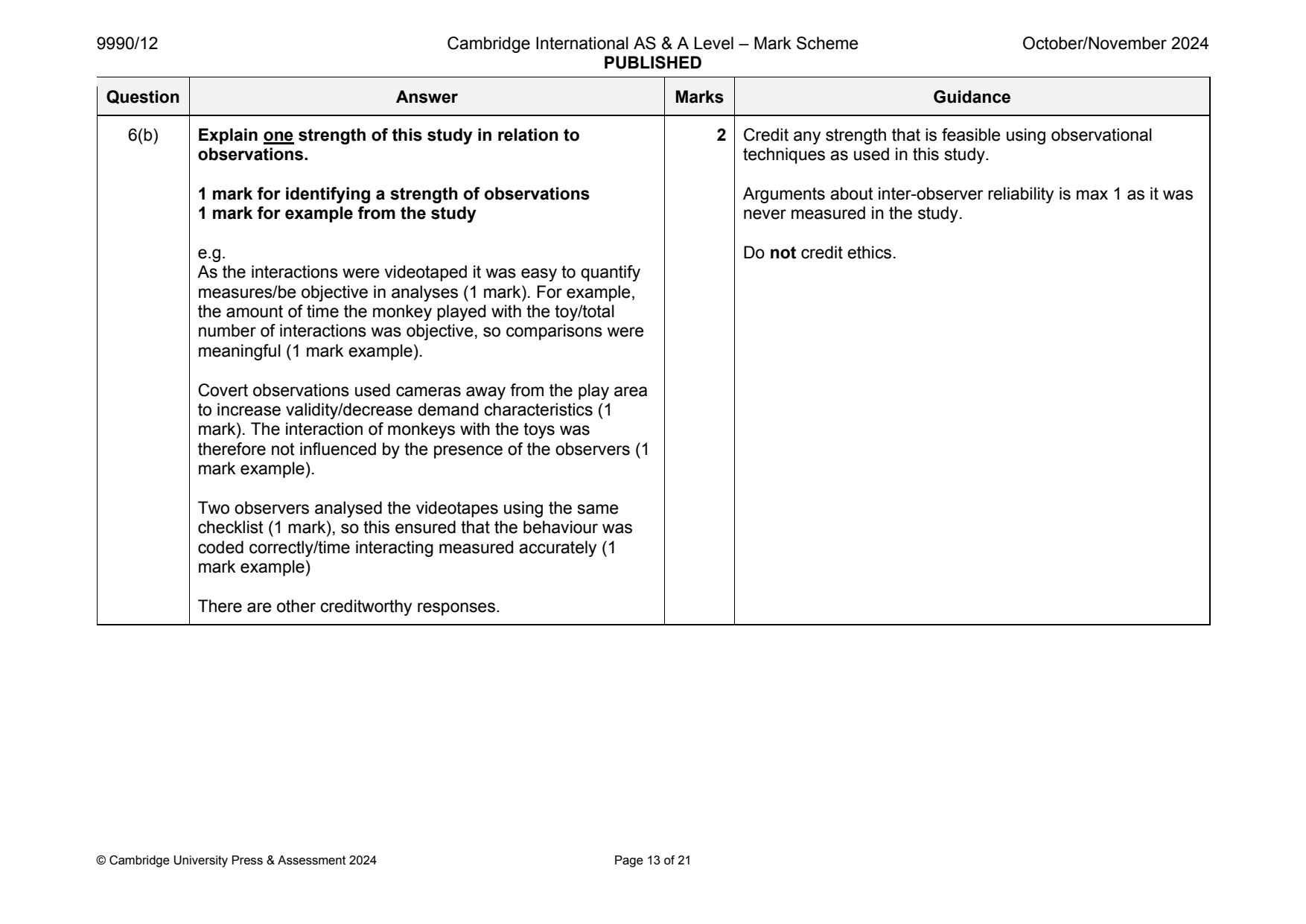
6(a) In the study by Hassett et al. (monkey toy preferences), 4 List is definitive.
each trial lasted for 25 minutes within the monkey
enclosure. Do not credit behavioural checklist, two observers, or time
recorded interacting as this happened after the trial.
Describe the procedure for a trial.
Accept ‘enclosed area’ to mean either indoor or outdoor
1 mark per correct point when used by a candidate.
Monkeys/subjects/the social group was placed indoors.
One wheeled and one plush toy was placed in outdoor area.
These were 10m apart.
Location of toy was counterbalanced (left/right).
The monkeys were then allowed into the outdoor area.
Each interaction with a toy was recorded/videotaped/each
trial recorded on camera.
There was a separate camera focused on each toy.
© Cambridge University Press & Assessment 2024 Page 12 of 21
6(b) Explain one strength of this study in relation to 2 Credit any strength that is feasible using observational
observations. techniques as used in this study.
1 mark for identifying a strength of observations Arguments about inter-observer reliability is max 1 as it was
1 mark for example from the study never measured in the study.
e.g. Do not credit ethics.
As the interactions were videotaped it was easy to quantify
measures/be objective in analyses (1 mark). For example,
the amount of time the monkey played with the toy/total
number of interactions was objective, so comparisons were
meaningful (1 mark example).
Covert observations used cameras away from the play area
to increase validity/decrease demand characteristics (1
mark). The interaction of monkeys with the toys was
therefore not influenced by the presence of the observers (1
mark example).
Two observers analysed the videotapes using the same
checklist (1 mark), so this ensured that the behaviour was
coded correctly/time interacting measured accurately (1
mark example)
There are other creditworthy responses.
© Cambridge University Press & Assessment 2024 Page 13 of 21
Official mark scheme pages: 12, 13 · source PDF URL
9990-2024-on-13-q01
Oct/Nov 2024 · Paper 13 · Question 1 · 5 marks
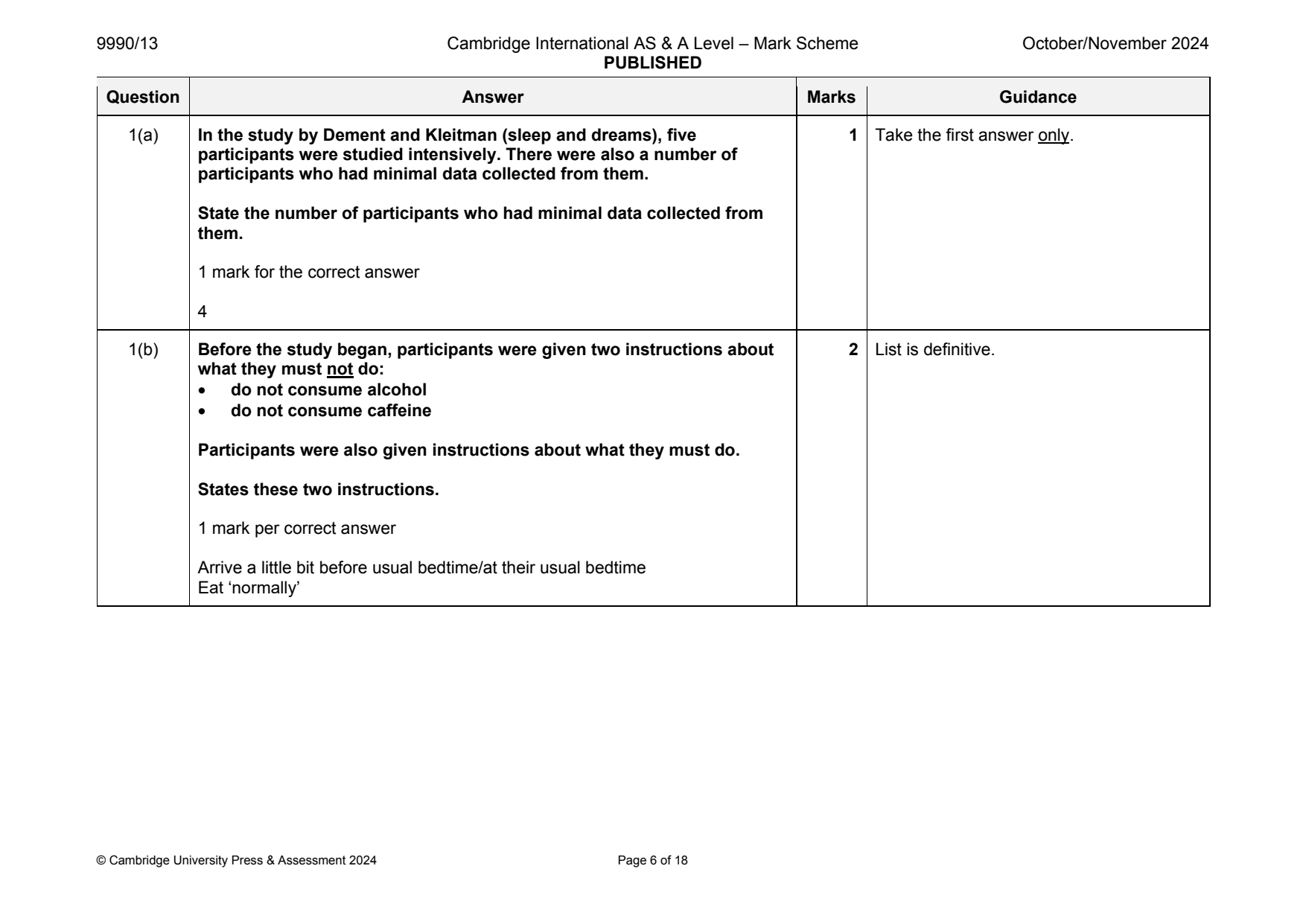
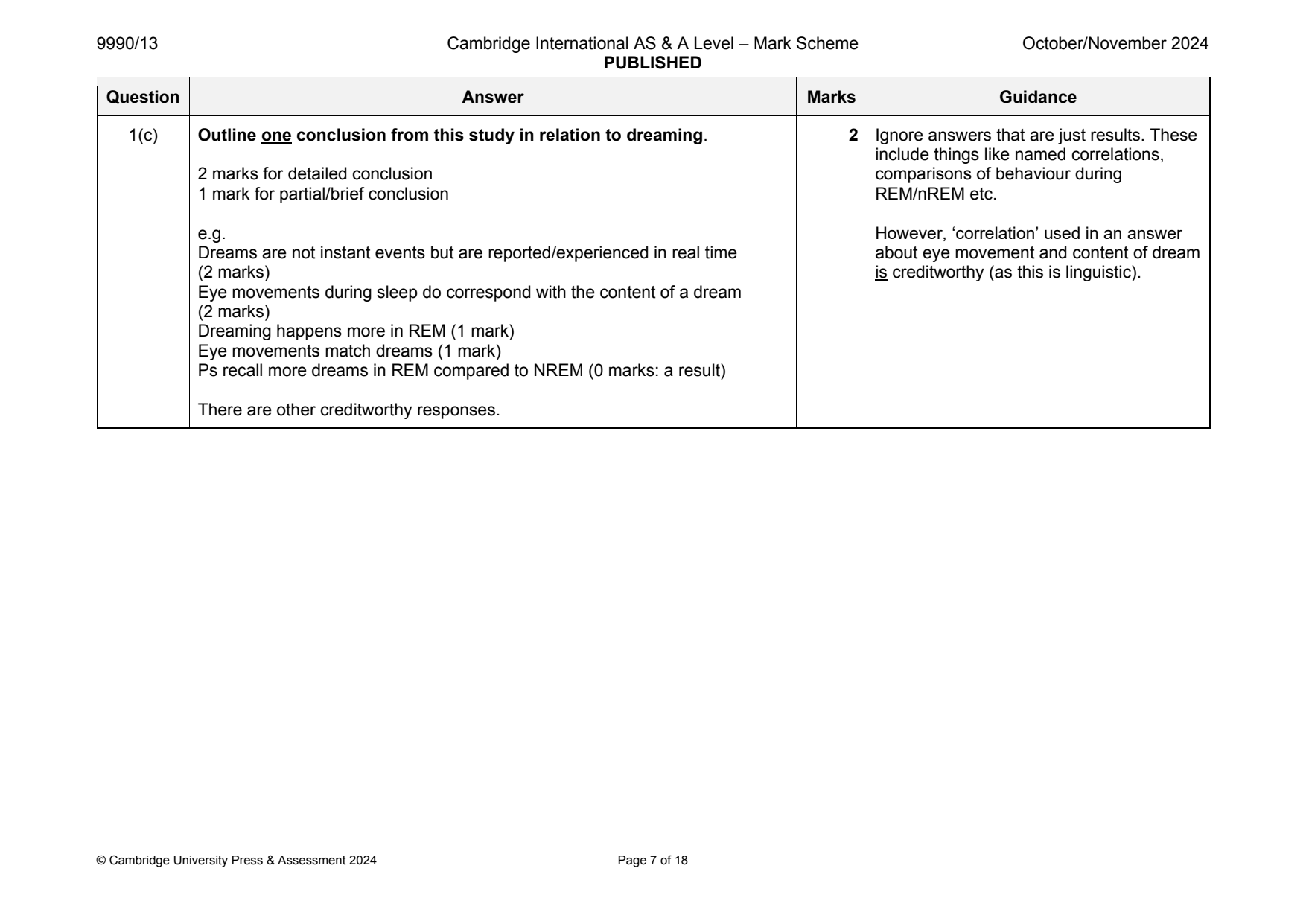
1(a) In the study by Dement and Kleitman (sleep and dreams), five 1 Take the first answer only.
participants were studied intensively. There were also a number of
participants who had minimal data collected from them.
State the number of participants who had minimal data collected from
them.
1 mark for the correct answer
4
1(b) Before the study began, participants were given two instructions about 2 List is definitive.
what they must not do:
• do not consume alcohol
• do not consume caffeine
Participants were also given instructions about what they must do.
States these two instructions.
1 mark per correct answer
Arrive a little bit before usual bedtime/at their usual bedtime
Eat ‘normally’
© Cambridge University Press & Assessment 2024 Page 6 of 18
1(c) Outline one conclusion from this study in relation to dreaming. 2 Ignore answers that are just results. These
include things like named correlations,
2 marks for detailed conclusion comparisons of behaviour during
1 mark for partial/brief conclusion REM/nREM etc.
e.g. However, ‘correlation’ used in an answer
Dreams are not instant events but are reported/experienced in real time about eye movement and content of dream
(2 marks) is creditworthy (as this is linguistic).
Eye movements during sleep do correspond with the content of a dream
(2 marks)
Dreaming happens more in REM (1 mark)
Eye movements match dreams (1 mark)
Ps recall more dreams in REM compared to NREM (0 marks: a result)
There are other creditworthy responses.
© Cambridge University Press & Assessment 2024 Page 7 of 18
Official mark scheme pages: 6, 7 · source PDF URL
9990-2024-on-13-q02
Oct/Nov 2024 · Paper 13 · Question 2 · 4 marks
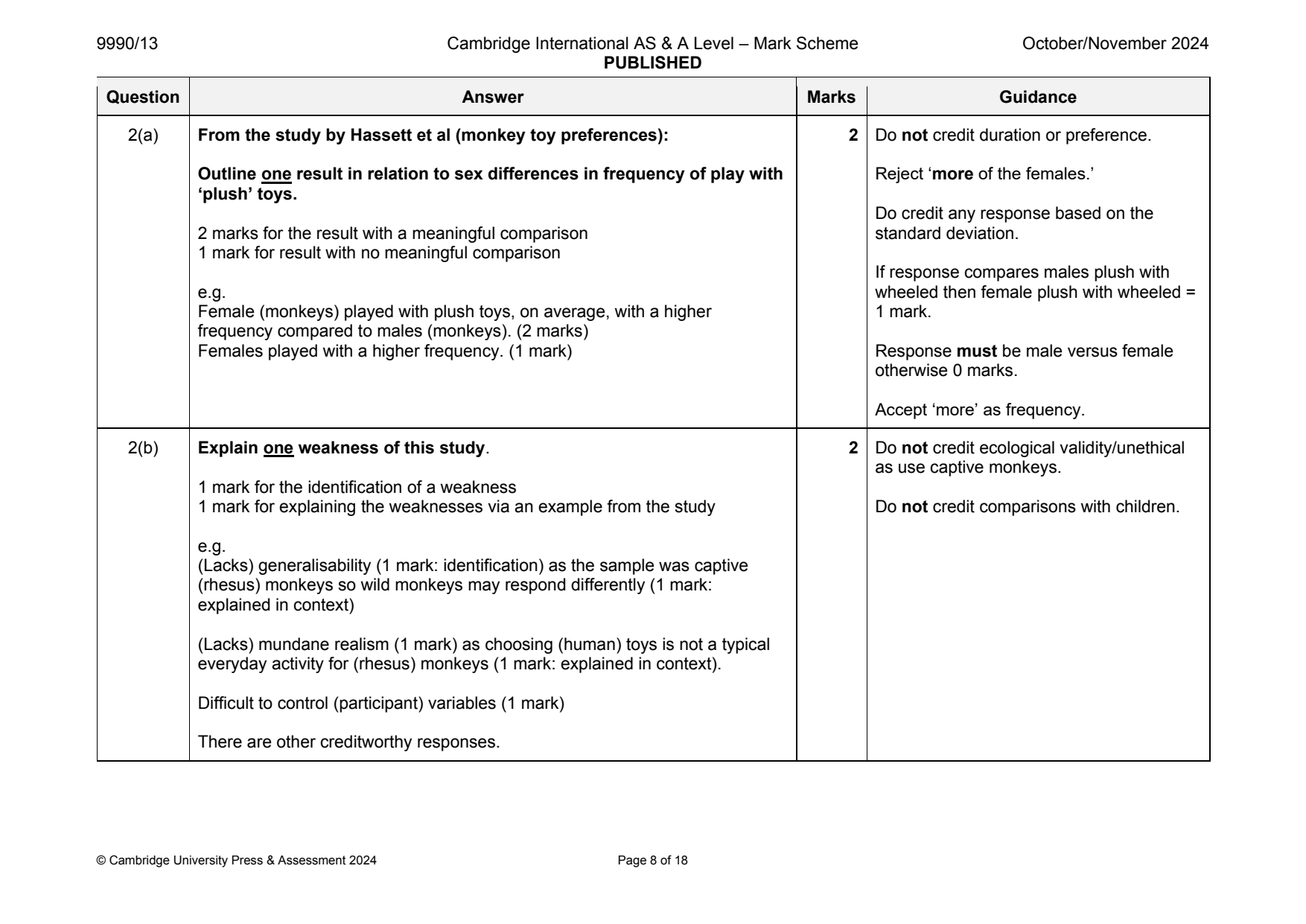
2(a) From the study by Hassett et al (monkey toy preferences): 2 Do not credit duration or preference.
Outline one result in relation to sex differences in frequency of play with Reject ‘more of the females.’
‘plush’ toys.
Do credit any response based on the
2 marks for the result with a meaningful comparison standard deviation.
1 mark for result with no meaningful comparison
If response compares males plush with
e.g. wheeled then female plush with wheeled =
Female (monkeys) played with plush toys, on average, with a higher 1 mark.
frequency compared to males (monkeys). (2 marks)
Females played with a higher frequency. (1 mark) Response must be male versus female
otherwise 0 marks.
Accept ‘more’ as frequency.
2(b) Explain one weakness of this study. 2 Do not credit ecological validity/unethical
as use captive monkeys.
1 mark for the identification of a weakness
1 mark for explaining the weaknesses via an example from the study Do not credit comparisons with children.
e.g.
(Lacks) generalisability (1 mark: identification) as the sample was captive
(rhesus) monkeys so wild monkeys may respond differently (1 mark:
explained in context)
(Lacks) mundane realism (1 mark) as choosing (human) toys is not a typical
everyday activity for (rhesus) monkeys (1 mark: explained in context).
Difficult to control (participant) variables (1 mark)
There are other creditworthy responses.
© Cambridge University Press & Assessment 2024 Page 8 of 18
Official mark scheme pages: 8 · source PDF URL
9990-2024-on-13-q08
Oct/Nov 2024 · Paper 13 · Question 8 · 4 marks
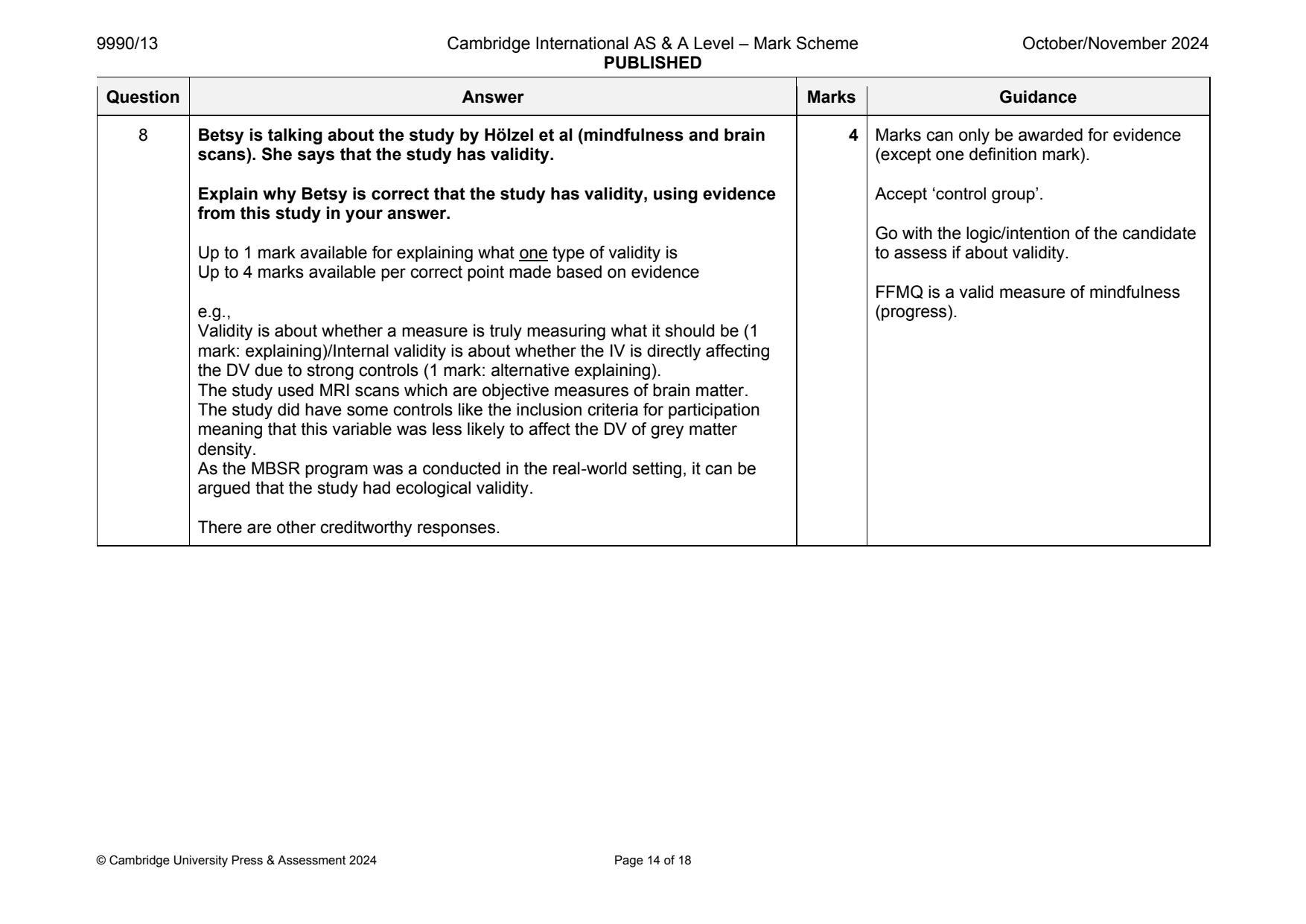
8 Betsy is talking about the study by Hölzel et al (mindfulness and brain 4 Marks can only be awarded for evidence
scans). She says that the study has validity. (except one definition mark).
Explain why Betsy is correct that the study has validity, using evidence Accept ‘control group’.
from this study in your answer.
Go with the logic/intention of the candidate
Up to 1 mark available for explaining what one type of validity is to assess if about validity.
Up to 4 marks available per correct point made based on evidence
FFMQ is a valid measure of mindfulness
e.g., (progress).
Validity is about whether a measure is truly measuring what it should be (1
mark: explaining)/Internal validity is about whether the IV is directly affecting
the DV due to strong controls (1 mark: alternative explaining).
The study used MRI scans which are objective measures of brain matter.
The study did have some controls like the inclusion criteria for participation
meaning that this variable was less likely to affect the DV of grey matter
density.
As the MBSR program was a conducted in the real-world setting, it can be
argued that the study had ecological validity.
There are other creditworthy responses.
© Cambridge University Press & Assessment 2024 Page 14 of 18
Official mark scheme pages: 14 · source PDF URL
9990-2025-m-12-q02
March 2025 · Paper 12 · Question 2 · 4 marks
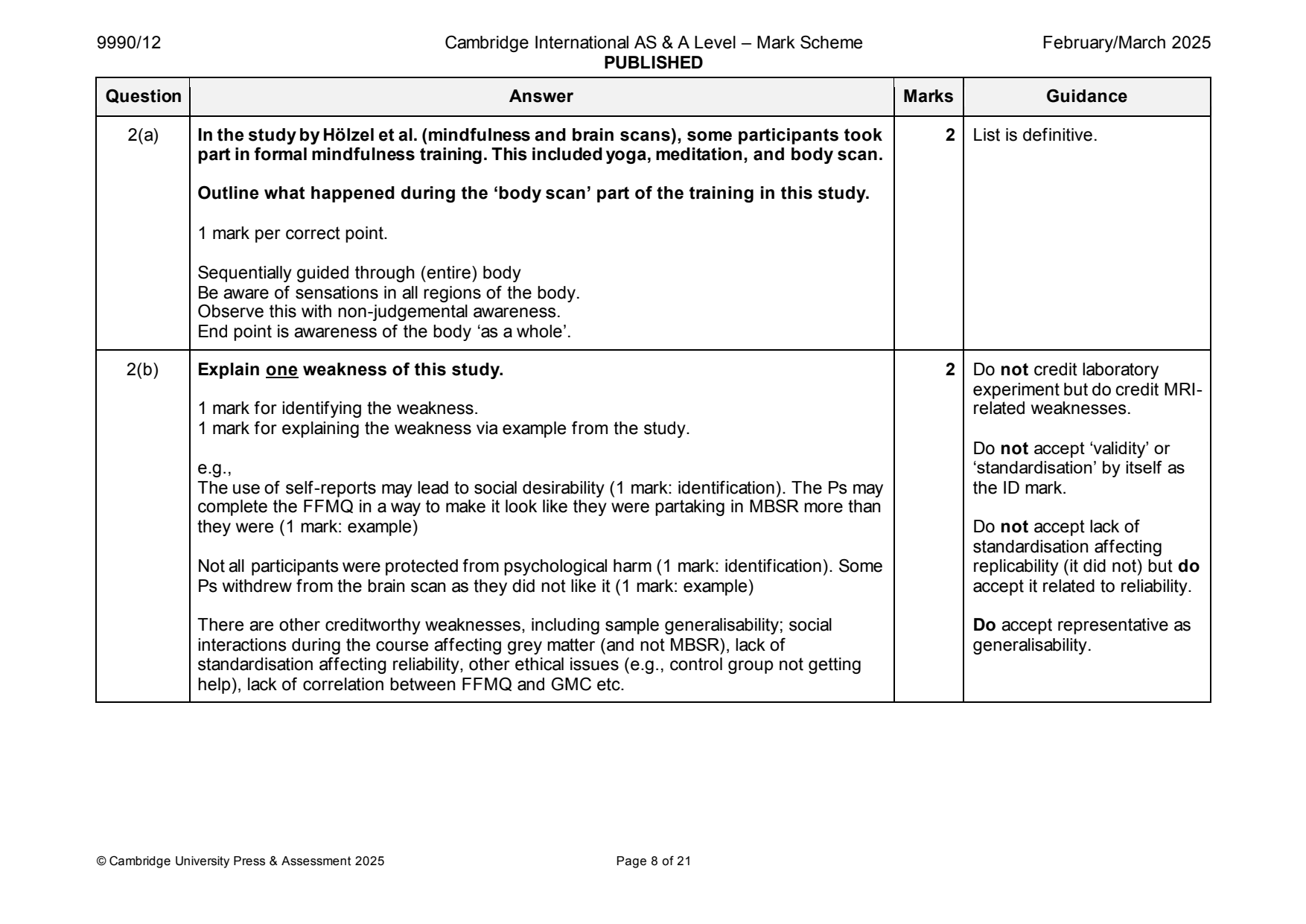
2(a) In the study by Hölzel et al. (mindfulness and brain scans), some participants took 2 List is definitive.
part in formal mindfulness training. This included yoga, meditation, and body scan.
Outline what happened during the ‘body scan’ part of the training in this study.
1 mark per correct point.
Sequentially guided through (entire) body
Be aware of sensations in all regions of the body.
Observe this with non-judgemental awareness.
End point is awareness of the body ‘as a whole’.
2(b) Explain one weakness of this study. 2 Do not credit laboratory
experiment but do credit MRI-
1 mark for identifying the weakness. related weaknesses.
1 mark for explaining the weakness via example from the study.
Do not accept ‘validity’ or
e.g., ‘standardisation’ by itself as
The use of self-reports may lead to social desirability (1 mark: identification). The Ps may the ID mark.
complete the FFMQ in a way to make it look like they were partaking in MBSR more than
they were (1 mark: example) Do not accept lack of
standardisation affecting
Not all participants were protected from psychological harm (1 mark: identification). Some replicability (it did not) but do
Ps withdrew from the brain scan as they did not like it (1 mark: example) accept it related to reliability.
There are other creditworthy weaknesses, including sample generalisability; social Do accept representative as
interactions during the course affecting grey matter (and not MBSR), lack of generalisability.
standardisation affecting reliability, other ethical issues (e.g., control group not getting
help), lack of correlation between FFMQ and GMC etc.
© Cambridge University Press & Assessment 2025 Page 8 of 21
Official mark scheme pages: 8 · source PDF URL
9990-2025-m-12-q03
March 2025 · Paper 12 · Question 3 · 6 marks
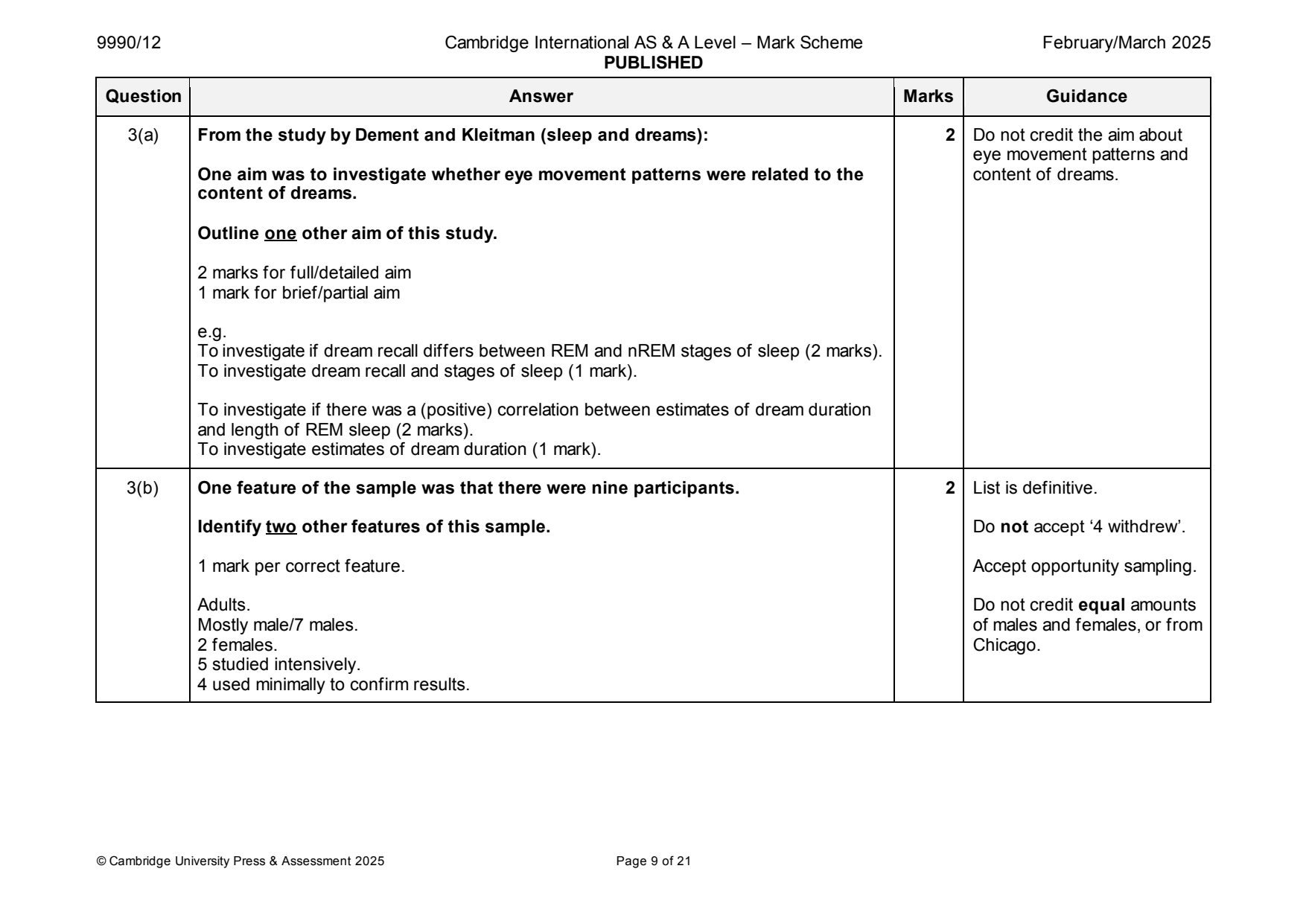
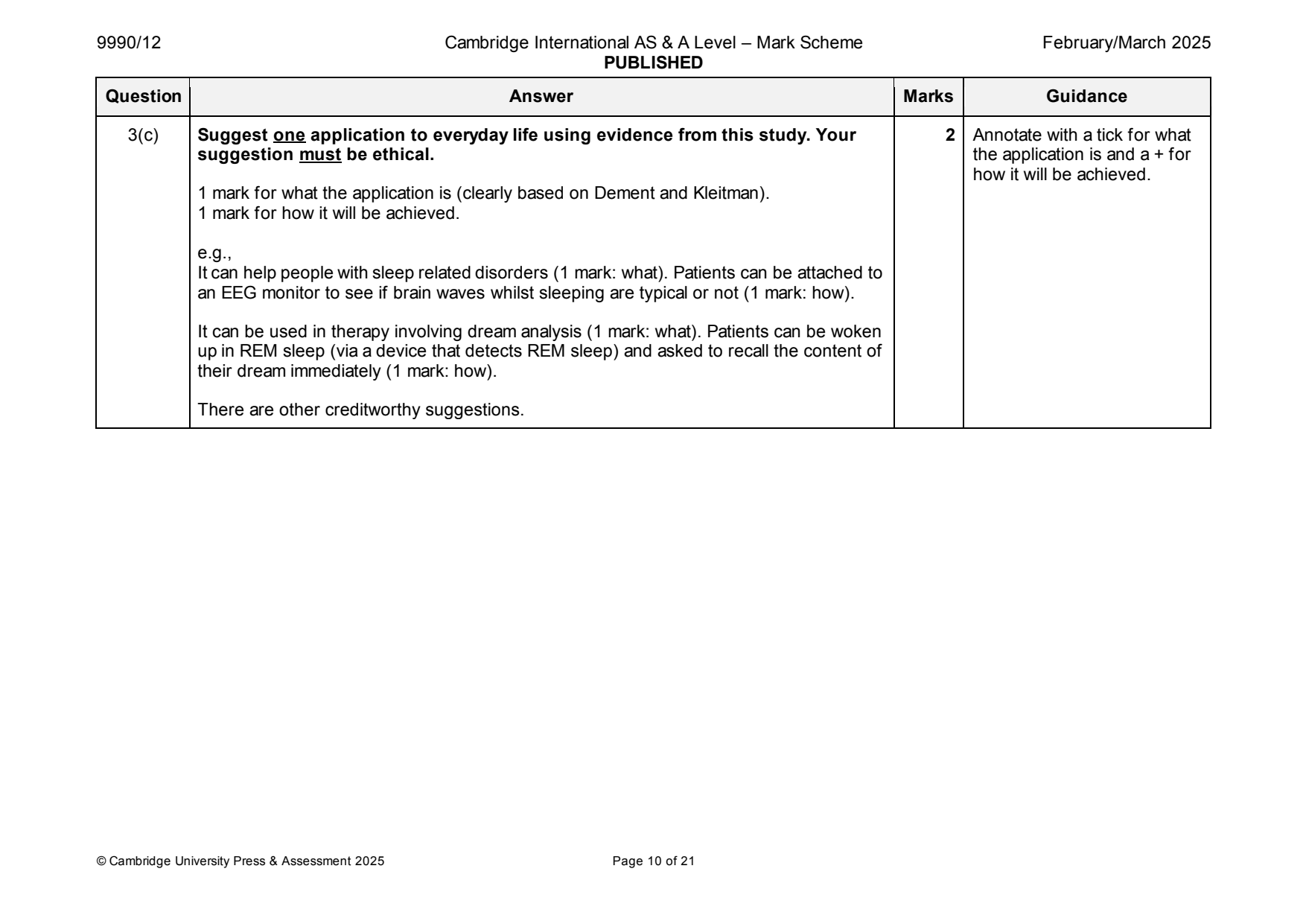
3(a) From the study by Dement and Kleitman (sleep and dreams): 2 Do not credit the aim about
eye movement patterns and
One aim was to investigate whether eye movement patterns were related to the content of dreams.
content of dreams.
Outline one other aim of this study.
2 marks for full/detailed aim
1 mark for brief/partial aim
e.g.
To investigate if dream recall differs between REM and nREM stages of sleep (2 marks).
To investigate dream recall and stages of sleep (1 mark).
To investigate if there was a (positive) correlation between estimates of dream duration
and length of REM sleep (2 marks).
To investigate estimates of dream duration (1 mark).
3(b) One feature of the sample was that there were nine participants. 2 List is definitive.
Identify two other features of this sample. Do not accept ‘4 withdrew’.
1 mark per correct feature. Accept opportunity sampling.
Adults. Do not credit equal amounts
Mostly male/7 males. of males and females, or from
2 females. Chicago.
5 studied intensively.
4 used minimally to confirm results.
© Cambridge University Press & Assessment 2025 Page 9 of 21
3(c) Suggest one application to everyday life using evidence from this study. Your 2 Annotate with a tick for what
suggestion must be ethical. the application is and a + for
how it will be achieved.
1 mark for what the application is (clearly based on Dement and Kleitman).
1 mark for how it will be achieved.
e.g.,
It can help people with sleep related disorders (1 mark: what). Patients can be attached to
an EEG monitor to see if brain waves whilst sleeping are typical or not (1 mark: how).
It can be used in therapy involving dream analysis (1 mark: what). Patients can be woken
up in REM sleep (via a device that detects REM sleep) and asked to recall the content of
their dream immediately (1 mark: how).
There are other creditworthy suggestions.
© Cambridge University Press & Assessment 2025 Page 10 of 21
Official mark scheme pages: 9, 10 · source PDF URL
9990-2025-m-12-q09
March 2025 · Paper 12 · Question 9 · 12 marks
9(a) Describe the sample used in the study by Hassett et al. (monkey toy preferences). 4 List is definitive.
1 mark per correct point. No tolerance on numbers.
Rhesus monkeys. Do credit information about
Troop of 135 individuals. rank if presented.
Lived together for more than 25 years.
Lived at Yerkes Center.
Matriline social structure/same natal group.
14 not used due to hormonal treatment.
Age range 3 months to over 13 years.
61 females/21 males/more females than males used as potential participants/82 potential
participants.
23 females/11 males/34 monkeys used in data analysis.
39 infants not used (as interactions not coded).
53 monkeys were excluded in total.
© Cambridge University Press & Assessment 2025 Page 17 of 21
9(b) Explain one similarity and one difference between the study by Hassett et al. 8 The other studies from the
(monkey toy preferences) and one other study from the biological approach. Do not biological approach are:
refer to the sample.
Hölzel et al
Use the marking grid below. Dement and Kleitman
4 marks for the similarity, e.g., assumptions they are based on, type of data collected,
ethics, experimental design, correlations. Do accept Perry if response
4 marks for the difference, e.g., brain measurement, type of data collected about biological aspects of
(quantitative/qualitative), type of experiment, experimental design. that study.
e.g., similarity Award L1–L4 for the similarity
4 marks Award L1–L4 for the
Both the studies by Hassett and Hölzel conformed to ethical bodies relevant to their difference
studies. In the study by Hassett this was in accordance with NIH Guidance to include
enrichment and appropriate environmental management. In the study by Hölzel this was For Level 4 there must be
via guidelines from a hospital and a medical school to include obtaining informed consent. some attempt at explaining
Therefore, both studies followed set ethical guidelines relevant to the setting the study took the similarity/difference.
place in (explanation).
If ethics used as a
e.g., difference, then max L2.
3 marks
Both the studies by Hassett and Hölzel conformed to ethical bodies relevant to their Different aims = L1.
studies. In the study by Hassett this was in accordance with NIH Guidance to include
enrichment and appropriate environmental management. Sample generalisability,
sampling technique or
e.g., different species = L0
2 marks
Both followed ethical guidelines relevant to their sample as Hölzel had to obtain informed
consent.
e.g.,
1 mark
Both conformed to ethical bodies relevant to their studies.
© Cambridge University Press & Assessment 2025 Page 18 of 21
9(b)
Mark/ Description
Level
4 The similarity/difference is well explained using both studies as examples.
3 The similarity/difference is well explained but only one study is used as an
example OR
both studies are used briefly.
2 The similarity/difference is brief with an attempt at using at least one study as
an example OR
The similarity/difference is well explained but there is no study evidence.
1 The similarity/difference is brief with no attempt at using the /studies as
examples.
0 No creditable response.
© Cambridge University Press & Assessment 2025 Page 19 of 21
Official mark scheme pages: 17, 18, 19 · source PDF URL
9990-2025-mj-11-q04
May/June 2025 · Paper 11 · Question 4 · 3 marks
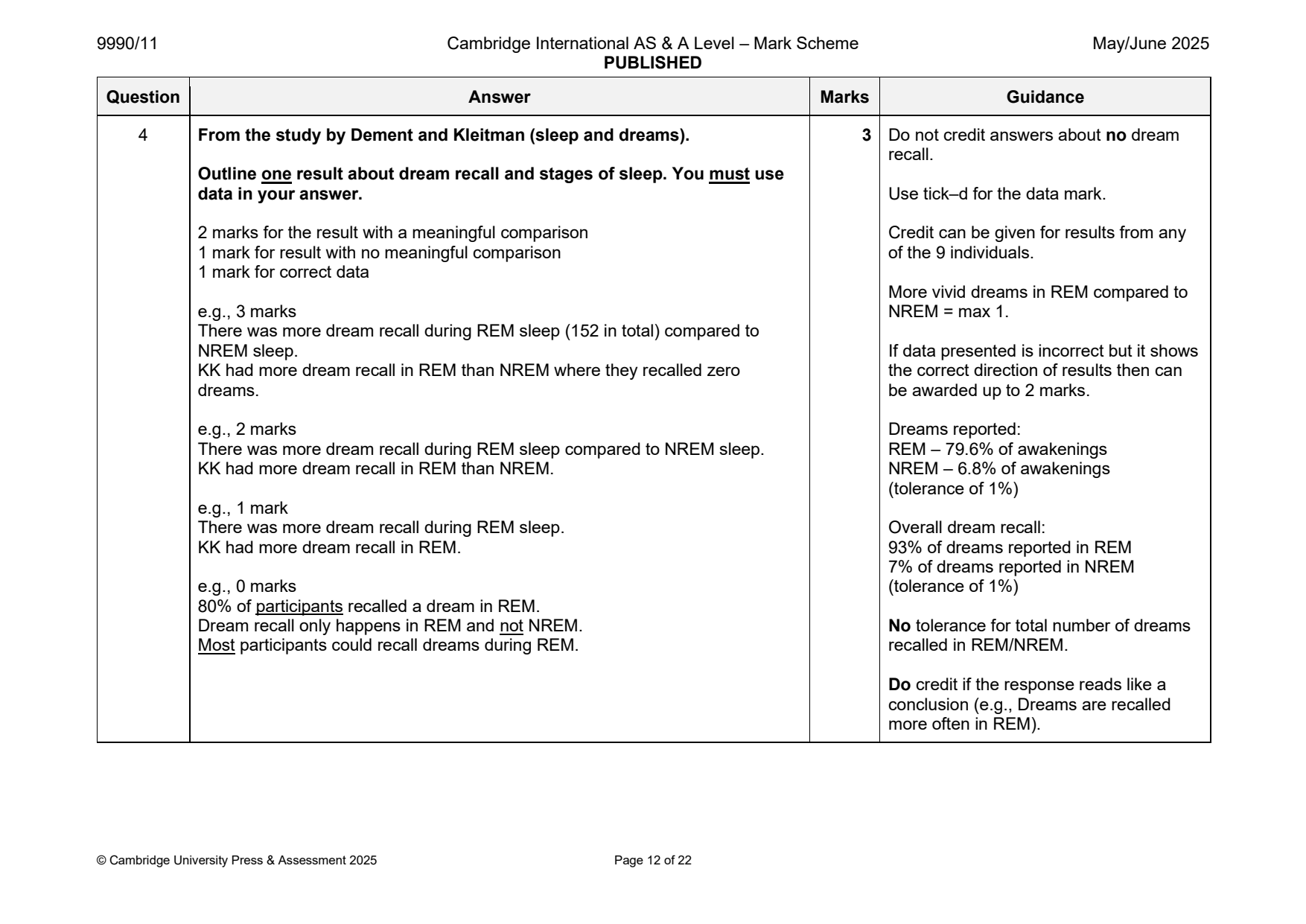
4 From the study by Dement and Kleitman (sleep and dreams). 3 Do not credit answers about no dream
recall.
Outline one result about dream recall and stages of sleep. You must use
data in your answer. Use tick–d for the data mark.
2 marks for the result with a meaningful comparison Credit can be given for results from any
1 mark for result with no meaningful comparison of the 9 individuals.
1 mark for correct data
More vivid dreams in REM compared to
e.g., 3 marks NREM = max 1.
There was more dream recall during REM sleep (152 in total) compared to
NREM sleep. If data presented is incorrect but it shows
KK had more dream recall in REM than NREM where they recalled zero the correct direction of results then can
dreams. be awarded up to 2 marks.
e.g., 2 marks Dreams reported:
There was more dream recall during REM sleep compared to NREM sleep. REM – 79.6% of awakenings
KK had more dream recall in REM than NREM. NREM – 6.8% of awakenings
(tolerance of 1%)
e.g., 1 mark
There was more dream recall during REM sleep. Overall dream recall:
KK had more dream recall in REM. 93% of dreams reported in REM
7% of dreams reported in NREM
e.g., 0 marks (tolerance of 1%)
80% of participants recalled a dream in REM.
Dream recall only happens in REM and not NREM. No tolerance for total number of dreams
Most participants could recall dreams during REM. recalled in REM/NREM.
Do credit if the response reads like a
conclusion (e.g., Dreams are recalled
more often in REM).
© Cambridge University Press & Assessment 2025 Page 12 of 22
Official mark scheme pages: 12 · source PDF URL
9990-2025-mj-11-q05
May/June 2025 · Paper 11 · Question 5 · 4 marks
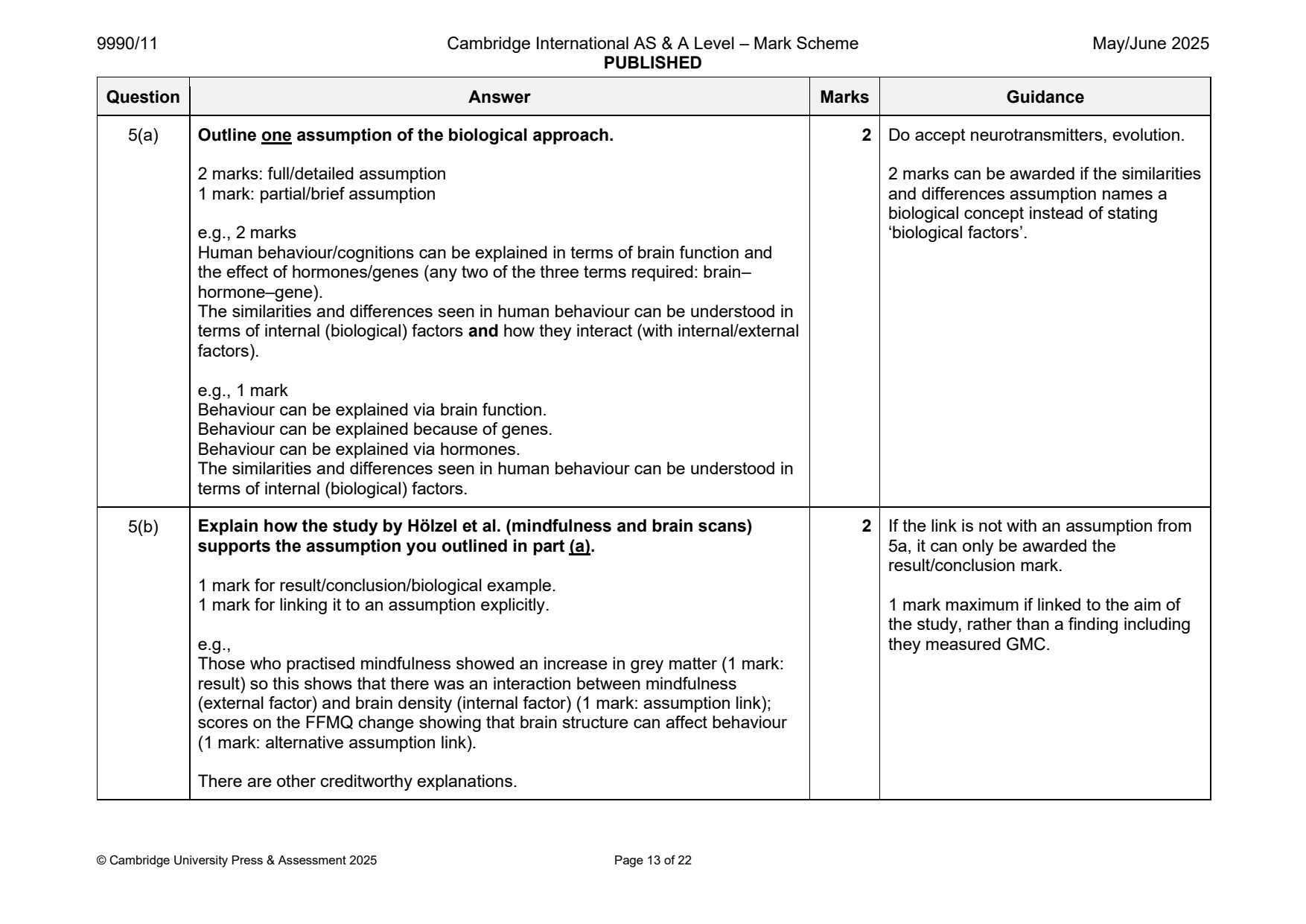
5(a) Outline one assumption of the biological approach. 2 Do accept neurotransmitters, evolution.
2 marks: full/detailed assumption 2 marks can be awarded if the similarities
1 mark: partial/brief assumption and differences assumption names a
biological concept instead of stating
e.g., 2 marks ‘biological factors’.
Human behaviour/cognitions can be explained in terms of brain function and
the effect of hormones/genes (any two of the three terms required: brain–
hormone–gene).
The similarities and differences seen in human behaviour can be understood in
terms of internal (biological) factors and how they interact (with internal/external
factors).
e.g., 1 mark
Behaviour can be explained via brain function.
Behaviour can be explained because of genes.
Behaviour can be explained via hormones.
The similarities and differences seen in human behaviour can be understood in
terms of internal (biological) factors.
5(b) Explain how the study by Hölzel et al. (mindfulness and brain scans) 2 If the link is not with an assumption from
supports the assumption you outlined in part (a). 5a, it can only be awarded the
result/conclusion mark.
1 mark for result/conclusion/biological example.
1 mark for linking it to an assumption explicitly. 1 mark maximum if linked to the aim of
the study, rather than a finding including
e.g., they measured GMC.
Those who practised mindfulness showed an increase in grey matter (1 mark:
result) so this shows that there was an interaction between mindfulness
(external factor) and brain density (internal factor) (1 mark: assumption link);
scores on the FFMQ change showing that brain structure can affect behaviour
(1 mark: alternative assumption link).
There are other creditworthy explanations.
© Cambridge University Press & Assessment 2025 Page 13 of 22
Official mark scheme pages: 13 · source PDF URL
9990-2025-mj-11-q07
May/June 2025 · Paper 11 · Question 7 · 5 marks
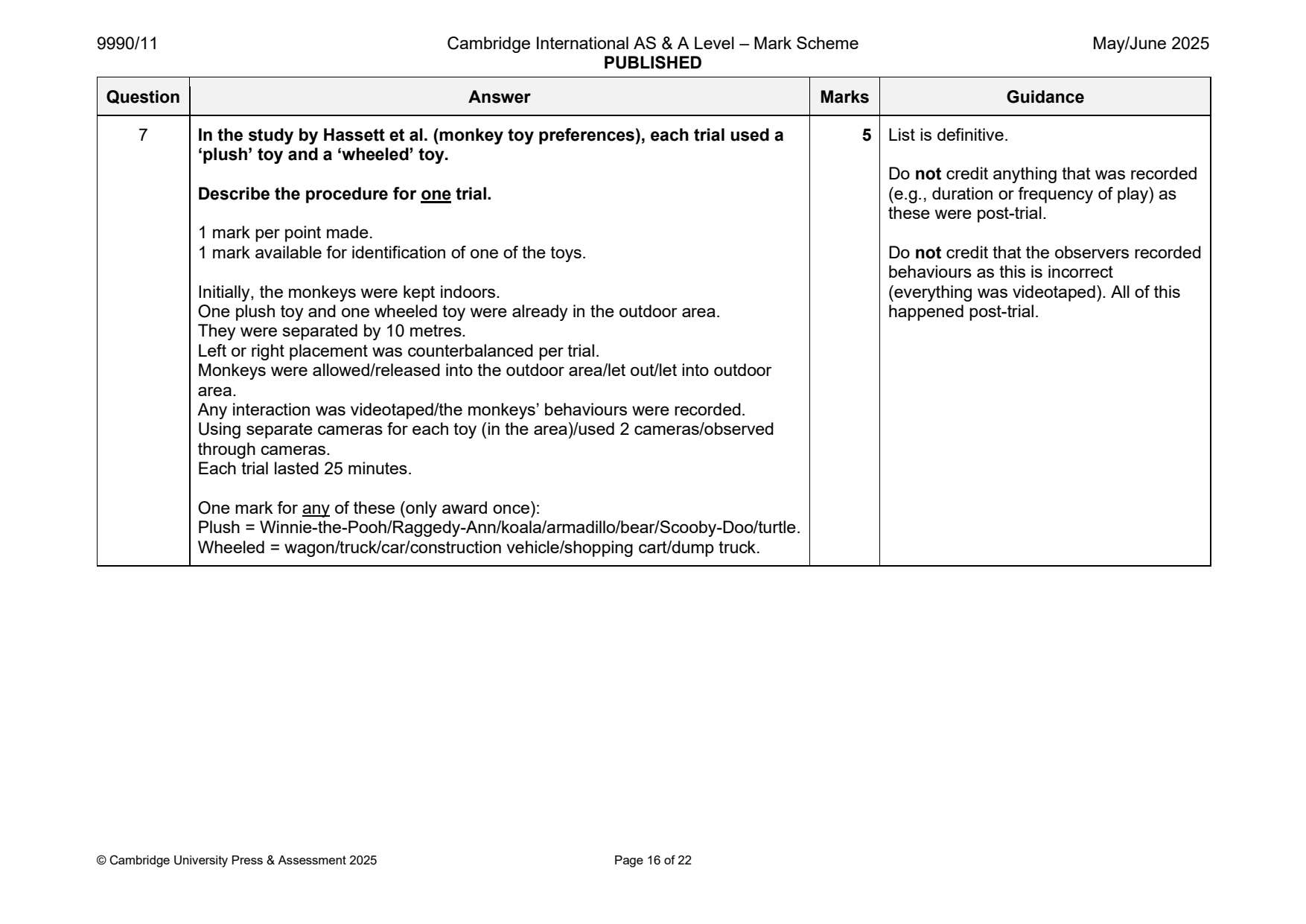
7 In the study by Hassett et al. (monkey toy preferences), each trial used a 5 List is definitive.
‘plush’ toy and a ‘wheeled’ toy.
Do not credit anything that was recorded
Describe the procedure for one trial. (e.g., duration or frequency of play) as
these were post-trial.
1 mark per point made.
1 mark available for identification of one of the toys. Do not credit that the observers recorded
behaviours as this is incorrect
Initially, the monkeys were kept indoors. (everything was videotaped). All of this
One plush toy and one wheeled toy were already in the outdoor area. happened post-trial.
They were separated by 10 metres.
Left or right placement was counterbalanced per trial.
Monkeys were allowed/released into the outdoor area/let out/let into outdoor
area.
Any interaction was videotaped/the monkeys’ behaviours were recorded.
Using separate cameras for each toy (in the area)/used 2 cameras/observed
through cameras.
Each trial lasted 25 minutes.
One mark for any of these (only award once):
Plush = Winnie-the-Pooh/Raggedy-Ann/koala/armadillo/bear/Scooby-Doo/turtle.
Wheeled = wagon/truck/car/construction vehicle/shopping cart/dump truck.
© Cambridge University Press & Assessment 2025 Page 16 of 22
Official mark scheme pages: 16 · source PDF URL
9990-2025-mj-12-q04
May/June 2025 · Paper 12 · Question 4 · 3 marks
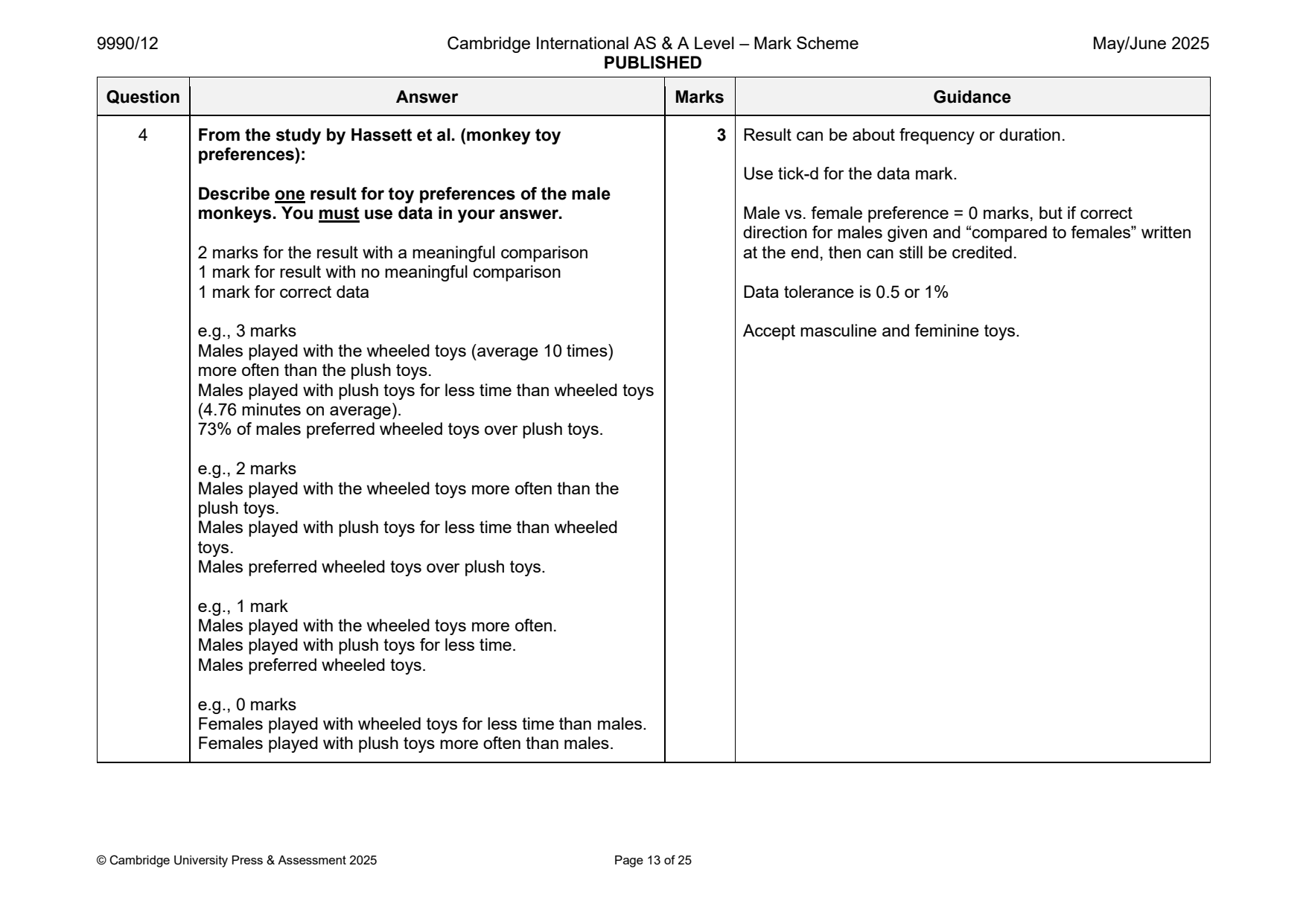
4 From the study by Hassett et al. (monkey toy 3 Result can be about frequency or duration.
preferences):
Use tick-d for the data mark.
Describe one result for toy preferences of the male
monkeys. You must use data in your answer. Male vs. female preference = 0 marks, but if correct
direction for males given and “compared to females” written
2 marks for the result with a meaningful comparison at the end, then can still be credited.
1 mark for result with no meaningful comparison
1 mark for correct data Data tolerance is 0.5 or 1%
e.g., 3 marks Accept masculine and feminine toys.
Males played with the wheeled toys (average 10 times)
more often than the plush toys.
Males played with plush toys for less time than wheeled toys
(4.76 minutes on average).
73% of males preferred wheeled toys over plush toys.
e.g., 2 marks
Males played with the wheeled toys more often than the
plush toys.
Males played with plush toys for less time than wheeled
toys.
Males preferred wheeled toys over plush toys.
e.g., 1 mark
Males played with the wheeled toys more often.
Males played with plush toys for less time.
Males preferred wheeled toys.
e.g., 0 marks
Females played with wheeled toys for less time than males.
Females played with plush toys more often than males.
© Cambridge University Press & Assessment 2025 Page 13 of 25
Official mark scheme pages: 13 · source PDF URL
9990-2025-mj-12-q08
May/June 2025 · Paper 12 · Question 8 · 4 marks
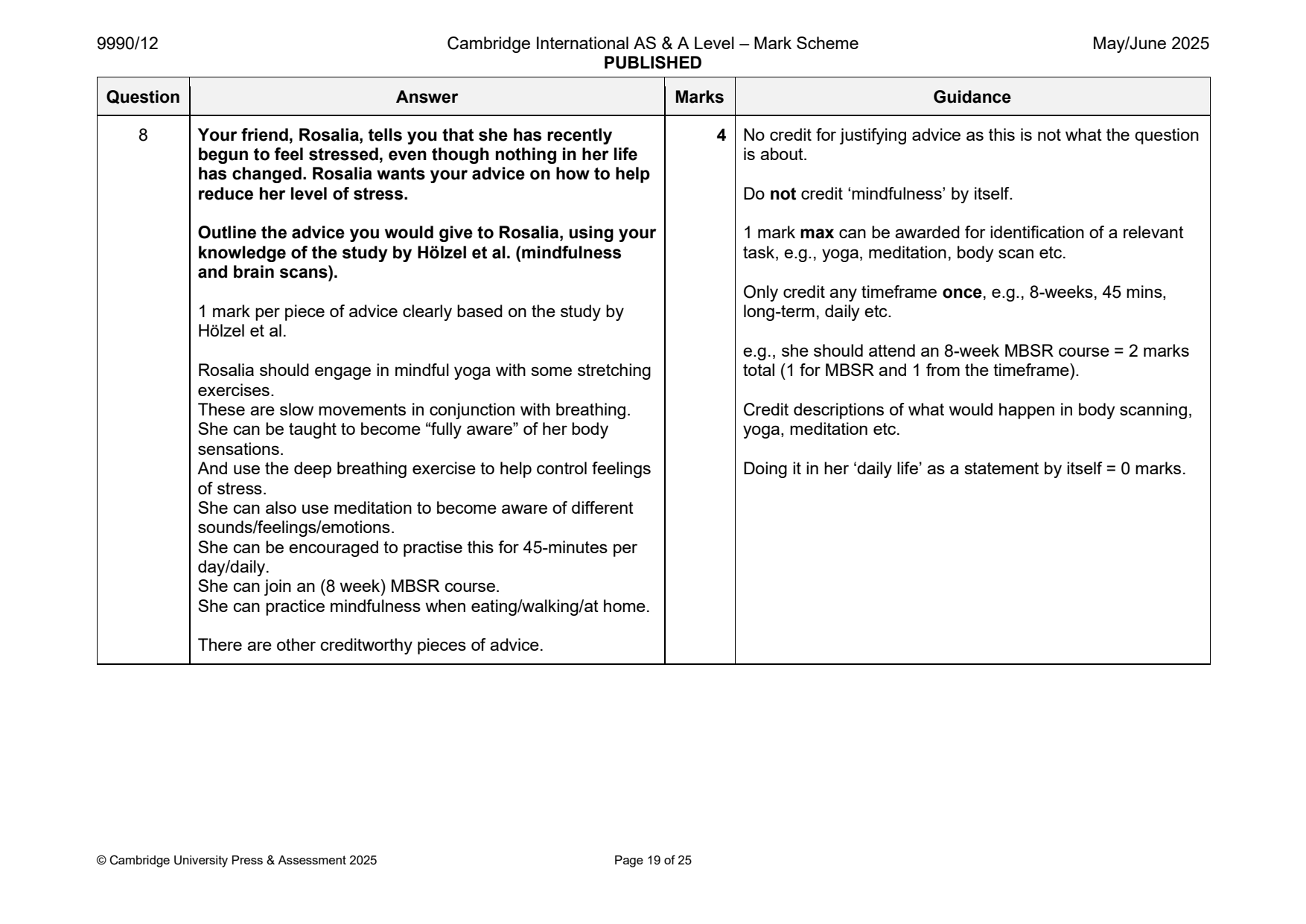
8 Your friend, Rosalia, tells you that she has recently 4 No credit for justifying advice as this is not what the question
begun to feel stressed, even though nothing in her life is about.
has changed. Rosalia wants your advice on how to help
reduce her level of stress. Do not credit ‘mindfulness’ by itself.
Outline the advice you would give to Rosalia, using your 1 mark max can be awarded for identification of a relevant
knowledge of the study by Hölzel et al. (mindfulness task, e.g., yoga, meditation, body scan etc.
and brain scans).
Only credit any timeframe once, e.g., 8-weeks, 45 mins,
1 mark per piece of advice clearly based on the study by long-term, daily etc.
Hölzel et al.
e.g., she should attend an 8-week MBSR course = 2 marks
Rosalia should engage in mindful yoga with some stretching total (1 for MBSR and 1 from the timeframe).
exercises.
These are slow movements in conjunction with breathing. Credit descriptions of what would happen in body scanning,
She can be taught to become “fully aware” of her body yoga, meditation etc.
sensations.
And use the deep breathing exercise to help control feelings Doing it in her ‘daily life’ as a statement by itself = 0 marks.
of stress.
She can also use meditation to become aware of different
sounds/feelings/emotions.
She can be encouraged to practise this for 45-minutes per
day/daily.
She can join an (8 week) MBSR course.
She can practice mindfulness when eating/walking/at home.
There are other creditworthy pieces of advice.
© Cambridge University Press & Assessment 2025 Page 19 of 25
Official mark scheme pages: 19 · source PDF URL
9990-2025-mj-13-q02
May/June 2025 · Paper 13 · Question 2 · 4 marks
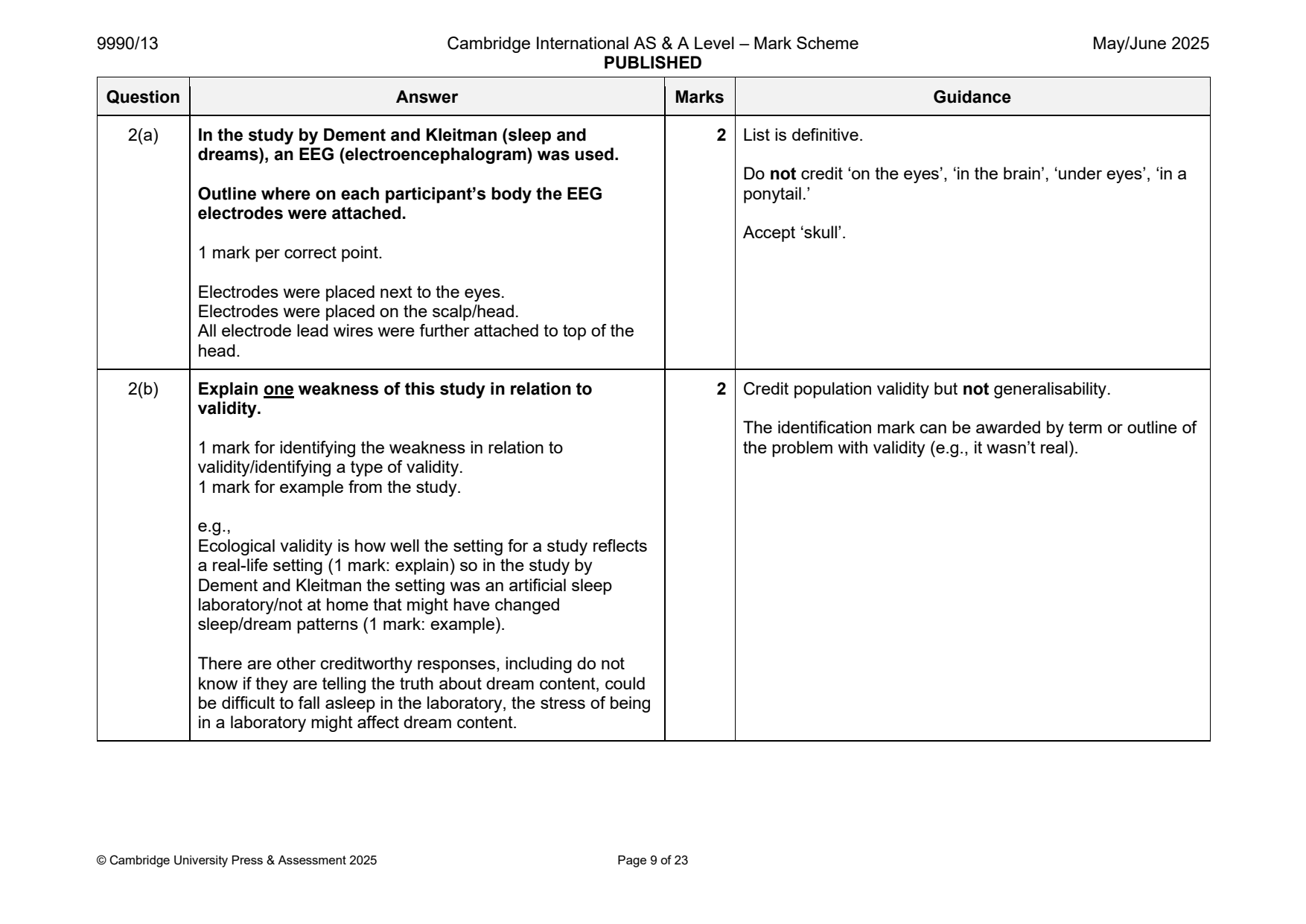
2(a) In the study by Dement and Kleitman (sleep and 2 List is definitive.
dreams), an EEG (electroencephalogram) was used.
Do not credit ‘on the eyes’, ‘in the brain’, ‘under eyes’, ‘in a
Outline where on each participant’s body the EEG ponytail.’
electrodes were attached.
Accept ‘skull’.
1 mark per correct point.
Electrodes were placed next to the eyes.
Electrodes were placed on the scalp/head.
All electrode lead wires were further attached to top of the
head.
2(b) Explain one weakness of this study in relation to 2 Credit population validity but not generalisability.
validity.
The identification mark can be awarded by term or outline of
1 mark for identifying the weakness in relation to the problem with validity (e.g., it wasn’t real).
validity/identifying a type of validity.
1 mark for example from the study.
e.g.,
Ecological validity is how well the setting for a study reflects
a real-life setting (1 mark: explain) so in the study by
Dement and Kleitman the setting was an artificial sleep
laboratory/not at home that might have changed
sleep/dream patterns (1 mark: example).
There are other creditworthy responses, including do not
know if they are telling the truth about dream content, could
be difficult to fall asleep in the laboratory, the stress of being
in a laboratory might affect dream content.
© Cambridge University Press & Assessment 2025 Page 9 of 23
Official mark scheme pages: 9 · source PDF URL
9990-2025-mj-13-q06
May/June 2025 · Paper 13 · Question 6 · 7 marks
6(a) Describe the psychology being investigated in the study 3
by Hassett et al. (monkey toy preferences).
use this when you award the ‘example mark’.
1 mark for each correct statement.
Examples from the study by Hassett can gain credit (max 1). Do not accept any answer about gender of monkeys.
e.g., Accept description of nature-nurture for 1 mark.
Sex differences refer to behavioural differences based on
biological differences between males and female.
These can be based on hormones/chromosomes.
The main male hormone is testosterone/the main female
hormone is oestrogen.
Play is any mental/physical activity performed in leisure time
for enjoyment/pleasure.
Socialisation is any mechanism that changes/adapts a
behaviour to societal/cultural expectations.
The study looked at whether male and female monkeys
preferred masculine or feminine toys (1 mark: example).
There are other creditworthy responses.
© Cambridge University Press & Assessment 2025 Page 14 of 23
6(b) Two friends, Madison and Zach, are discussing the 4 If both Madison and Zach feature in the answer, mark them
validity of the study by Hassett et al. (monkey toy independently and credit the highest score.
preferences).
If the candidate mixes up Madison and Zach (e.g., says
Madison says the study has validity, but Zach says it Zach but gives a ‘it is valid’ based answer) then max 2 and
does not have validity. annotate with ?
Outline why you think either Madison or Zach is correct,
using evidence from the study.
= identification mark
1 mark per point made, with:
Standardisation, reliability, replicability = 0 marks
1 identification mark for a relevant type of validity.
Up to 3 marks for examples in relation to why/why not valid.
Identification mark from:
Ecological validity/external
e.g., Madison
Mundane realism
it could be argued that the study has some ecological
Internal validity/IV affects DV/causal relationship
validity (1 mark: identification) as the enclosure was their
Population validity
everyday setting (1 mark). The study did have some controls
Control extraneous variables
like the types of toys chosen for wheeled/plush (1 mark).
This means that this variable was less likely to affect the DV
of toy choice/preference (1 mark). This also meant that it
more likely that the idea of masculine/feminine toys was
affecting the frequency/duration of play (1 mark).
e.g., Zach
The act of having to choose human toys to play with is not
an everyday activity for monkeys (1 mark). This means that
the study lacks ecological validity/mundane realism (1 mark:
identification). Also, there were no participant variables
controlled for like amount of previous experiences with novel
objects (1 mark), it could be that a monkey/monkeys were
drawn to the more exciting toys and not because of the sex-
typing (1 mark)
© Cambridge University Press & Assessment 2025 Page 15 of 23
6(b) There are other creditworthy responses, including monkeys
were not exposed to any societal pressures, videotaped so
no effect if having an experimenter nearby, toy
categorisation may have influenced toy choice, use of
counterbalancing, social rank controlled.
Question Answer Marks Guidance
Official mark scheme pages: 14, 15, 16 · source PDF URL
9990-2025-mj-13-q09
May/June 2025 · Paper 13 · Question 9 · 12 marks
9(a) Describe the Five Facet Mindfulness Questionnaire 4 List is definitive.
(FFMQ) used in the study by Hölzel et al. (mindfulness
and brain scans). No credit for describing any of the five facets.
1 mark per correct point. A response of:
1 mark available for naming one of the five facets. 1 = never; 5 = very often is 3 marks (1–5 and the two correct
examples)
It is a 39-item questionnaire.
Measures the five factors of mindfulness:
observing/describing/acting with awareness/non-judging of
inner experiences/ non-reactivity to inner experience (1 mark
maximum).
Rated on 5-point scale/scale of 1–5/Likert scale
1=never or rarely true.
5=very often or always true.
© Cambridge University Press & Assessment 2025 Page 18 of 23
9(b) Explain one similarity and one difference between the 8 The other biological approach studies are Hassett and
study by Hölzel et al. (mindfulness and brain scans) and Dement.
one other study from the biological approach. Do not Do accept Perry but only for oxytocin-related comparisons.
refer to questionnaires.
Award L1–L4 for the similarity
Use the marking grid below. Award L1–L4 for the difference
4 marks for the similarity, e.g., small samples, data
collection techniques, experimental design, brain scans. For Level 4 there must be some attempt at explaining the
similarity/difference.
4 marks for the difference, e.g., brain measurement
techniques, research techniques used, type of data Different aims = L1.
collected (quantitative/qualitative). Different species = L1.
Same species = L1.
e.g. difference Both have applications = L1.
4 marks Both study biology = L0.
Hölzel used an MRI scan to be able to see brain density
changes after a mindfulness stress reduction course. Any response where it is just describing what each study
Dement & Kleitman used a different technique called an did, take as different aim = L1
EEG that could only monitor brain wave activity/patterns.
Therefore, Hölzel’s method looked at structure whereas
Dement looked at (real-time) function (explanation).
3 marks
Different techniques were used to measure the brain. Hölzel
used an MRI scan to be able to see brain density changes
after a mindfulness stress reduction course/Dement &
Kleitman used a different technique called an EEG that
could only monitor brain wave activity/patterns.
2 marks
Hölzel used an MRI scan to measure brain density whilst
Dement & Kleitman used an EEG.
1 marks
Both studies used different techniques to measure the brain.
© Cambridge University Press & Assessment 2025 Page 19 of 23
9(b)
Mark/ Description
Level
4 The similarity/difference is well explained using
both studies as examples.
3 The similarity/difference is well explained but
only one study is used as an example
OR
both studies are used briefly.
2 The similarity/difference is brief with an attempt
at using at least one study as an example
OR
The similarity/difference is well explained but
there is no study evidence.
1 The similarity/difference is brief with no attempt
at using the studies as examples.
0 No creditable response.
© Cambridge University Press & Assessment 2025 Page 20 of 23
Official mark scheme pages: 18, 19, 20 · source PDF URL
9990-2025-on-11-q01
Oct/Nov 2025 · Paper 11 · Question 1 · 5 marks
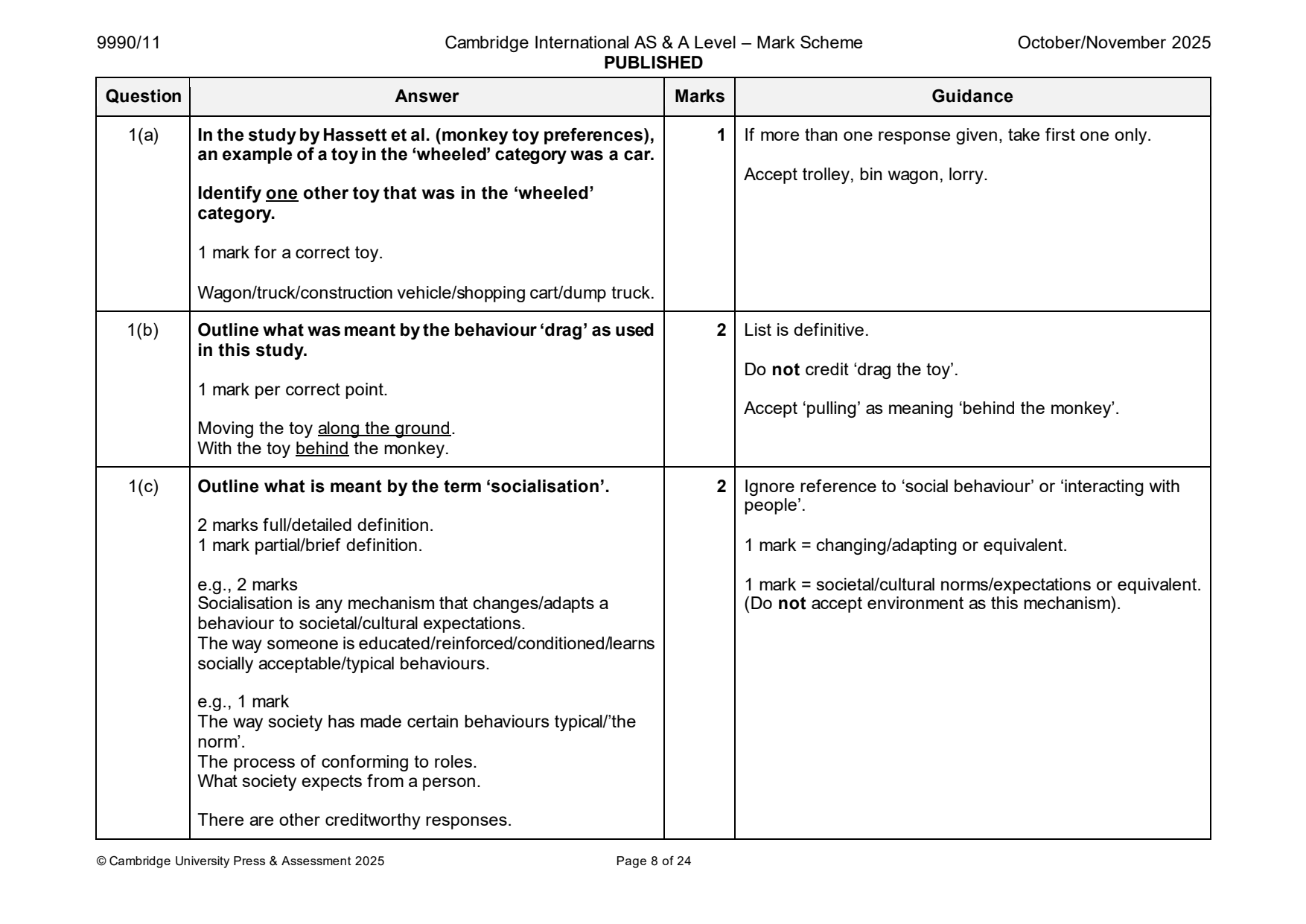
1(a) In the study by Hassett et al. (monkey toy preferences), 1 If more than one response given, take first one only.
an example of a toy in the ‘wheeled’ category was a car.
Accept trolley, bin wagon, lorry.
Identify one other toy that was in the ‘wheeled’
category.
1 mark for a correct toy.
Wagon/truck/construction vehicle/shopping cart/dump truck.
1(b) Outline what was meant by the behaviour ‘drag’ as used 2 List is definitive.
in this study.
Do not credit ‘drag the toy’.
1 mark per correct point.
Accept ‘pulling’ as meaning ‘behind the monkey’.
Moving the toy along the ground.
With the toy behind the monkey.
1(c) Outline what is meant by the term ‘socialisation’. 2 Ignore reference to ‘social behaviour’ or ‘interacting with
people’.
2 marks full/detailed definition.
1 mark partial/brief definition. 1 mark = changing/adapting or equivalent.
e.g., 2 marks 1 mark = societal/cultural norms/expectations or equivalent.
Socialisation is any mechanism that changes/adapts a (Do not accept environment as this mechanism).
behaviour to societal/cultural expectations.
The way someone is educated/reinforced/conditioned/learns
socially acceptable/typical behaviours.
e.g., 1 mark
The way society has made certain behaviours typical/’the
norm’.
The process of conforming to roles.
What society expects from a person.
There are other creditworthy responses.
© Cambridge University Press & Assessment 2025 Page 8 of 24
Official mark scheme pages: 8 · source PDF URL
9990-2025-on-11-q08
Oct/Nov 2025 · Paper 11 · Question 8 · 6 marks
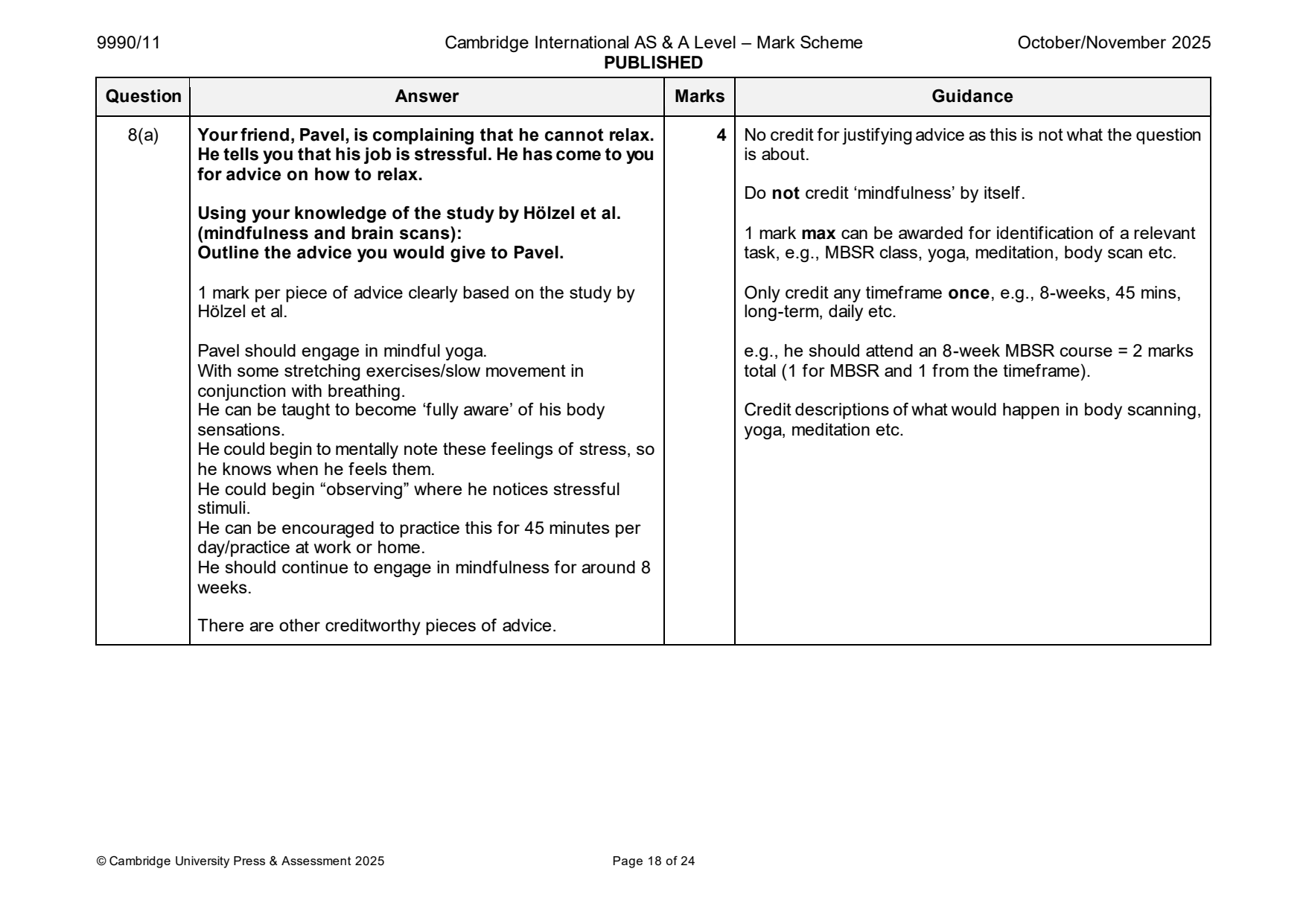
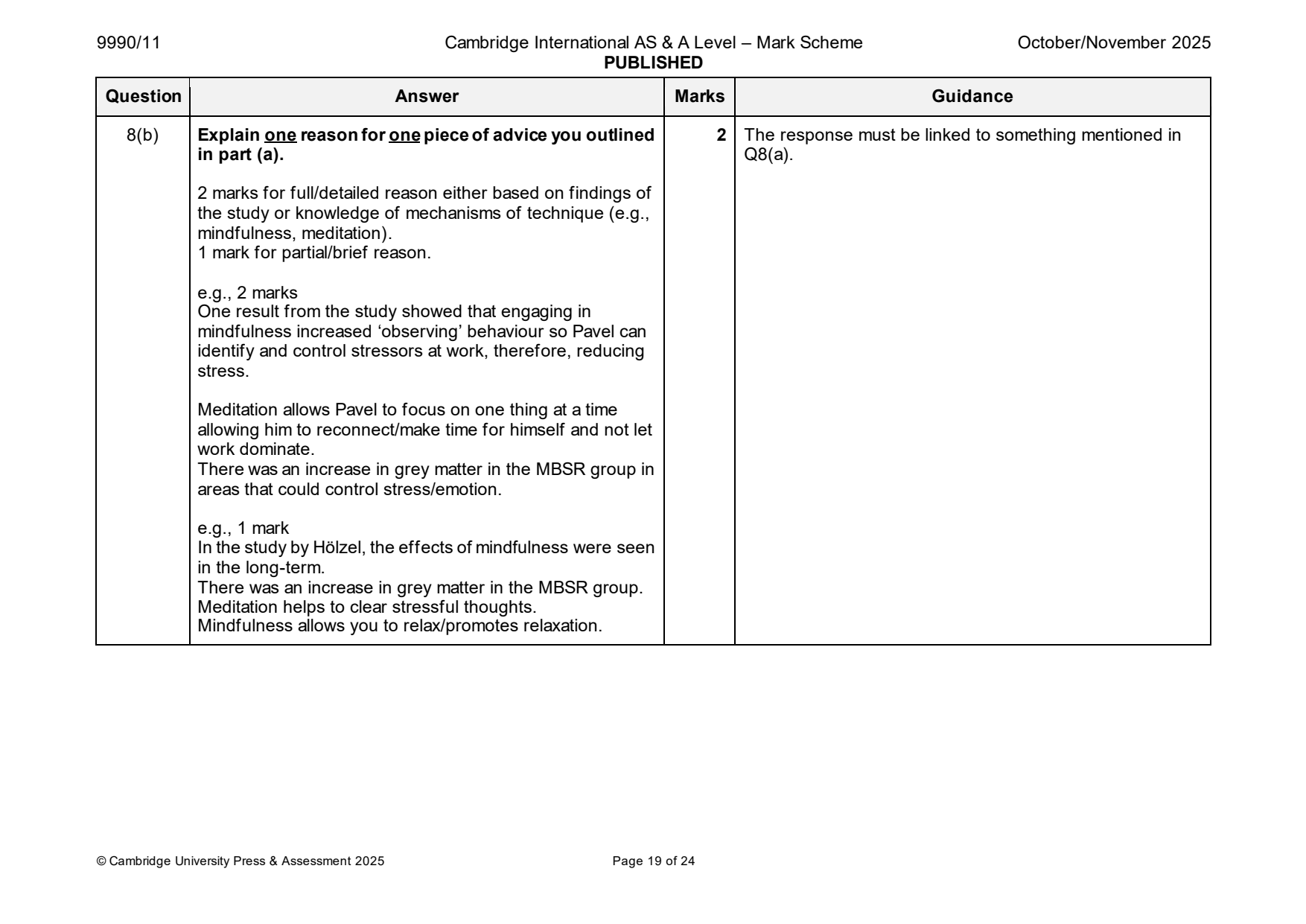
8(a) Your friend, Pavel, is complaining that he cannot relax. 4 No credit for justifying advice as this is not what the question
He tells you that his job is stressful. He has come to you is about.
for advice on how to relax.
Do not credit ‘mindfulness’ by itself.
Using your knowledge of the study by Hölzel et al.
(mindfulness and brain scans): 1 mark max can be awarded for identification of a relevant
Outline the advice you would give to Pavel. task, e.g., MBSR class, yoga, meditation, body scan etc.
1 mark per piece of advice clearly based on the study by Only credit any timeframe once, e.g., 8-weeks, 45 mins,
Hölzel et al. long-term, daily etc.
Pavel should engage in mindful yoga. e.g., he should attend an 8-week MBSR course = 2 marks
With some stretching exercises/slow movement in total (1 for MBSR and 1 from the timeframe).
conjunction with breathing.
He can be taught to become ‘fully aware’ of his body Credit descriptions of what would happen in body scanning,
sensations. yoga, meditation etc.
He could begin to mentally note these feelings of stress, so
he knows when he feels them.
He could begin “observing” where he notices stressful
stimuli.
He can be encouraged to practice this for 45 minutes per
day/practice at work or home.
He should continue to engage in mindfulness for around 8
weeks.
There are other creditworthy pieces of advice.
© Cambridge University Press & Assessment 2025 Page 18 of 24
8(b) Explain one reason for one piece of advice you outlined 2 The response must be linked to something mentioned in
in part (a). Q8(a).
2 marks for full/detailed reason either based on findings of
the study or knowledge of mechanisms of technique (e.g.,
mindfulness, meditation).
1 mark for partial/brief reason.
e.g., 2 marks
One result from the study showed that engaging in
mindfulness increased ‘observing’ behaviour so Pavel can
identify and control stressors at work, therefore, reducing
stress.
Meditation allows Pavel to focus on one thing at a time
allowing him to reconnect/make time for himself and not let
work dominate.
There was an increase in grey matter in the MBSR group in
areas that could control stress/emotion.
e.g., 1 mark
In the study by Hölzel, the effects of mindfulness were seen
in the long-term.
There was an increase in grey matter in the MBSR group.
Meditation helps to clear stressful thoughts.
Mindfulness allows you to relax/promotes relaxation.
© Cambridge University Press & Assessment 2025 Page 19 of 24
Official mark scheme pages: 18, 19 · source PDF URL
9990-2025-on-11-q09
Oct/Nov 2025 · Paper 11 · Question 9 · 12 marks
9(a) From the study by Dement and Kleitman (sleep and 4 List is definitive.
dreams):
Do not credit ‘on the eyes’, in the brain’ or ‘attached to head’
Describe how the EEG (electroencephalogram) was (too generic).
used in this study.
Used to detect brain waves/electrical (brain)
1 mark per correct point. activity/frequency and amplitude = 1 mark max.
Electrodes were placed next to the eyes.
Electrodes were placed on the scalp.
All electrode lead wires were further attached to top of the
head.
They were made into a single cord.
To prevent entanglement/give P free movement.
The EEG ran continuously (all night).
The speed of paper (3 or 6 mm per sec) allowed easy
recognition of eye-movements.
The eye movements picked up by the EEG allowed the
researcher to wake up the P at specific times (in REM or
NREM)/used to identify stage of sleep the participant was in.
It could measure the direction of eye movement (during
dreaming).
© Cambridge University Press & Assessment 2025 Page 20 of 24
9(b) Explain two similarities between the study by Dement 8 The other studies from the biological approach are Hölzel
and Kleitman (sleep and dreams) and one other study and Hassett.
from the biological approach.
Do accept Perry if about biological mechanisms.
Do not refer to brain measurement techniques.
Award L1–L4 for each similarity.
Use the marking grid below.
4 marks for the similarity (twice), e.g., research techniques For Level 4 there must be some attempt at explaining the
used, type of data collected (quantitative/qualitative), similarity.
sampling technique, ethics.
Ignore responses about brain measurement techniques like
e.g., similarity EEG/MRI etc.
4 marks
Both studies collected quantitative data which allowed for Both investigated biology = L1 max.
direct comparisons between groups/conditions
(explanation). In the Dement study, the number of times For Dement vs. Hölzel:
dreams were recalled in REM and NREM were recorded Both studied brain = L0
and compared for differences. Also, in the study by Hassett, Both used humans = L1
the duration of play with wheeled and plush toys was Repeated measures = L3 max.
recorded so sex differences between monkeys could be
seen.
3 marks
Both studies collected quantitative data. In the Dement
study, the number of times dreams were recalled in REM
and NREM were recorded and compared for differences.
Also, in the study by Hassett, the duration of play with
wheeled and plush toys was recorded.
2 marks
Both studies collected quantitative data. In the Dement
study, the number of times dreams were recalled in REM
and NREM were recorded.
1 mark
Both Dement and Hassett collected quantitative data.
© Cambridge University Press & Assessment 2025 Page 21 of 24
9(b)
Mark/ Description
Level
4 The similarity/difference is well explained using
both studies as examples.
3 The similarity/difference is well explained but
only one study is used as an example OR
both studies are used briefly.
2 The similarity/difference is brief with an attempt
at using at least one study as an example OR
The similarity/difference is well explained but
there is no study evidence.
1 The similarity/difference is brief with no attempt
at using the studies as examples.
0 No creditable response.
© Cambridge University Press & Assessment 2025 Page 22 of 24
Official mark scheme pages: 20, 21, 22 · source PDF URL
9990-2025-on-12-q04
Oct/Nov 2025 · Paper 12 · Question 4 · 4 marks
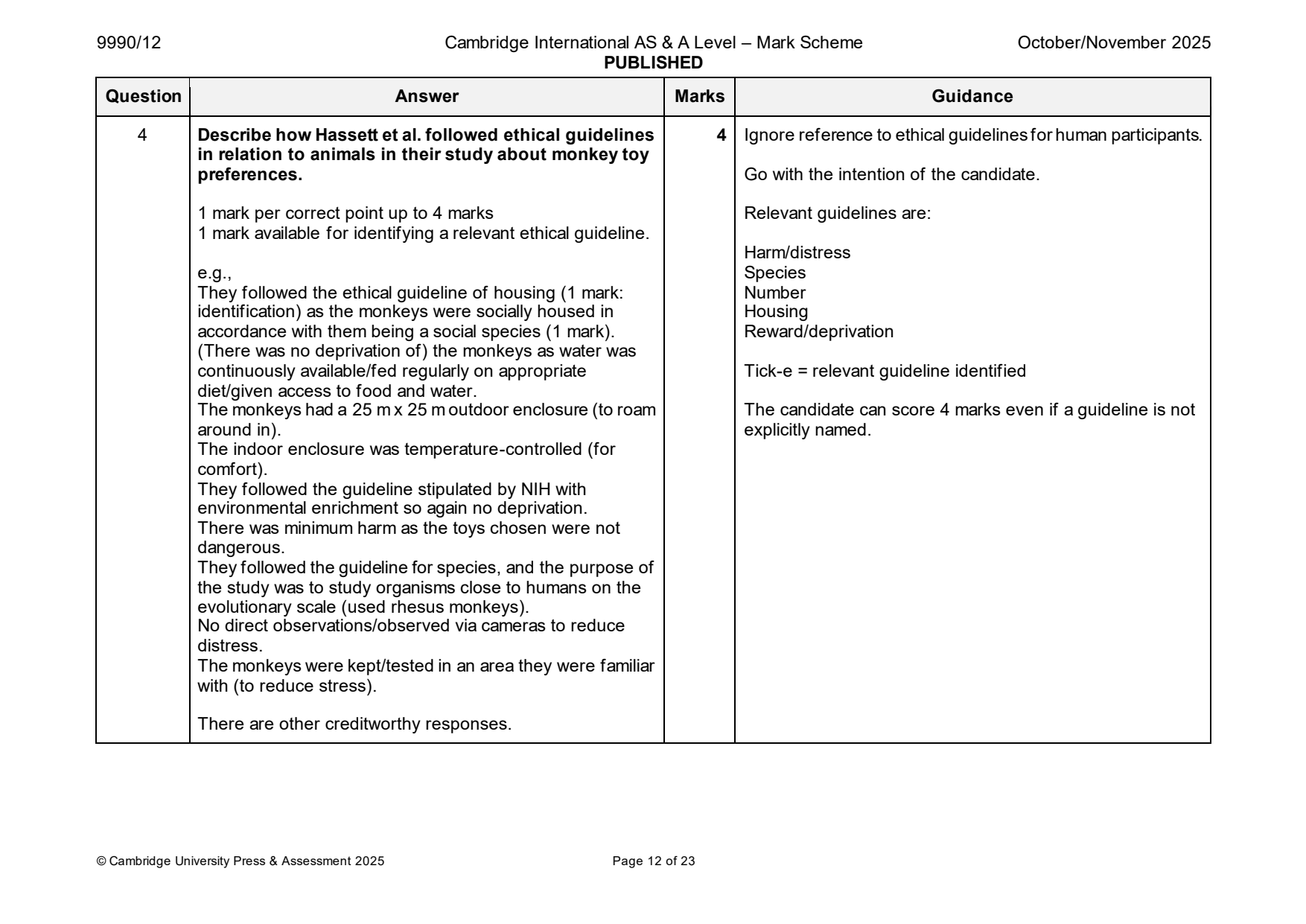
4 Describe how Hassett et al. followed ethical guidelines 4 Ignore reference to ethical guidelines for human participants.
in relation to animals in their study about monkey toy
preferences. Go with the intention of the candidate.
1 mark per correct point up to 4 marks Relevant guidelines are:
1 mark available for identifying a relevant ethical guideline.
Harm/distress
e.g., Species
They followed the ethical guideline of housing (1 mark: Number
identification) as the monkeys were socially housed in Housing
accordance with them being a social species (1 mark). Reward/deprivation
(There was no deprivation of) the monkeys as water was
continuously available/fed regularly on appropriate Tick-e = relevant guideline identified
diet/given access to food and water.
The monkeys had a 25 m x 25 m outdoor enclosure (to roam The candidate can score 4 marks even if a guideline is not
around in). explicitly named.
The indoor enclosure was temperature-controlled (for
comfort).
They followed the guideline stipulated by NIH with
environmental enrichment so again no deprivation.
There was minimum harm as the toys chosen were not
dangerous.
They followed the guideline for species, and the purpose of
the study was to study organisms close to humans on the
evolutionary scale (used rhesus monkeys).
No direct observations/observed via cameras to reduce
distress.
The monkeys were kept/tested in an area they were familiar
with (to reduce stress).
There are other creditworthy responses.
© Cambridge University Press & Assessment 2025 Page 12 of 23
Official mark scheme pages: 12 · source PDF URL
9990-2025-on-12-q05
Oct/Nov 2025 · Paper 12 · Question 5 · 4 marks
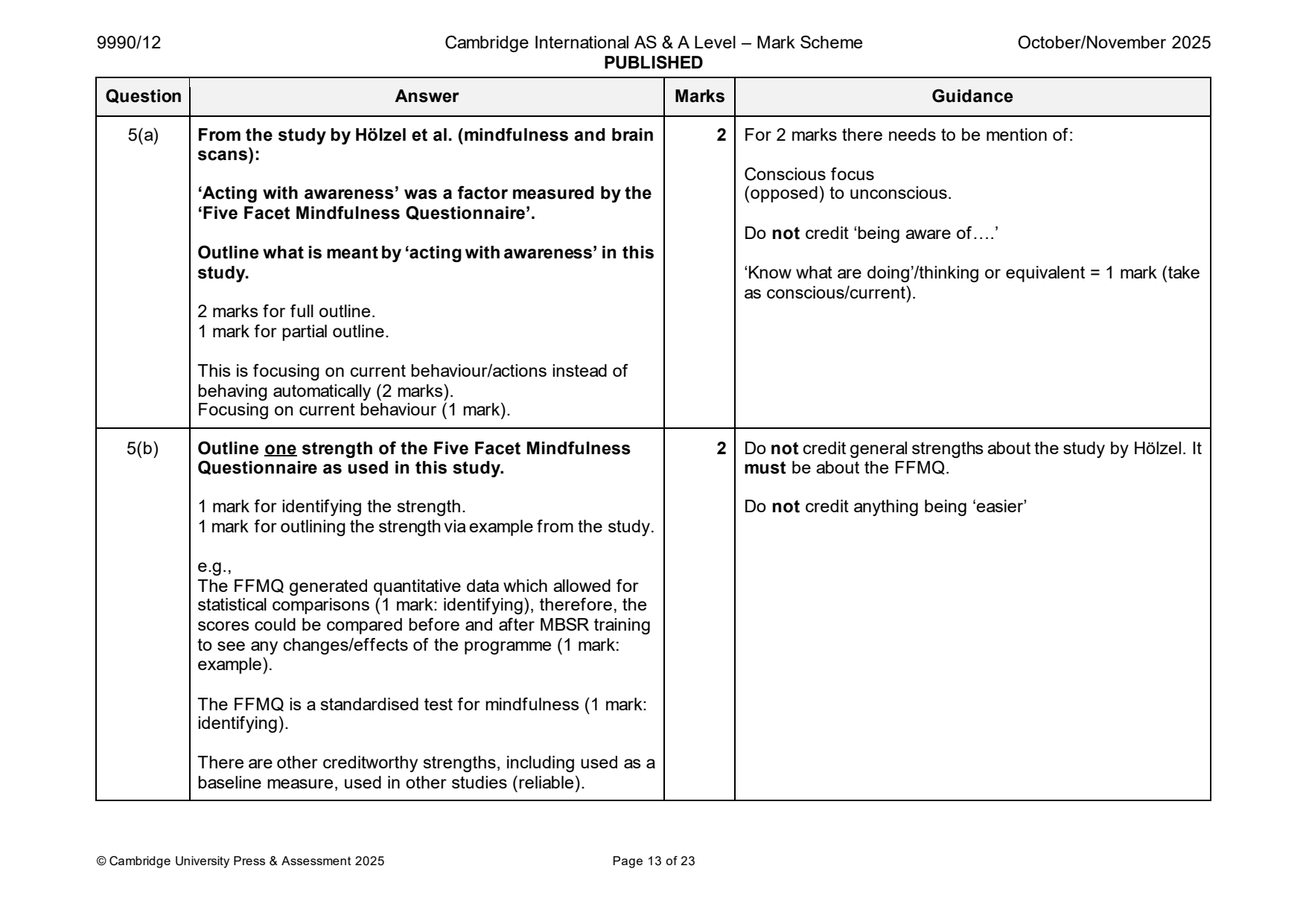
5(a) From the study by Hölzel et al. (mindfulness and brain 2 For 2 marks there needs to be mention of:
scans):
Conscious focus
‘Acting with awareness’ was a factor measured by the (opposed) to unconscious.
‘Five Facet Mindfulness Questionnaire’.
Do not credit ‘being aware of….’
Outline what is meant by ‘acting with awareness’ in this
study. ‘Know what are doing’/thinking or equivalent = 1 mark (take
as conscious/current).
2 marks for full outline.
1 mark for partial outline.
This is focusing on current behaviour/actions instead of
behaving automatically (2 marks).
Focusing on current behaviour (1 mark).
5(b) Outline one strength of the Five Facet Mindfulness 2 Do not credit general strengths about the study by Hölzel. It
Questionnaire as used in this study. must be about the FFMQ.
1 mark for identifying the strength. Do not credit anything being ‘easier’
1 mark for outlining the strength via example from the study.
e.g.,
The FFMQ generated quantitative data which allowed for
statistical comparisons (1 mark: identifying), therefore, the
scores could be compared before and after MBSR training
to see any changes/effects of the programme (1 mark:
example).
The FFMQ is a standardised test for mindfulness (1 mark:
identifying).
There are other creditworthy strengths, including used as a
baseline measure, used in other studies (reliable).
© Cambridge University Press & Assessment 2025 Page 13 of 23
Official mark scheme pages: 13 · source PDF URL
9990-2025-on-12-q07
Oct/Nov 2025 · Paper 12 · Question 7 · 4 marks
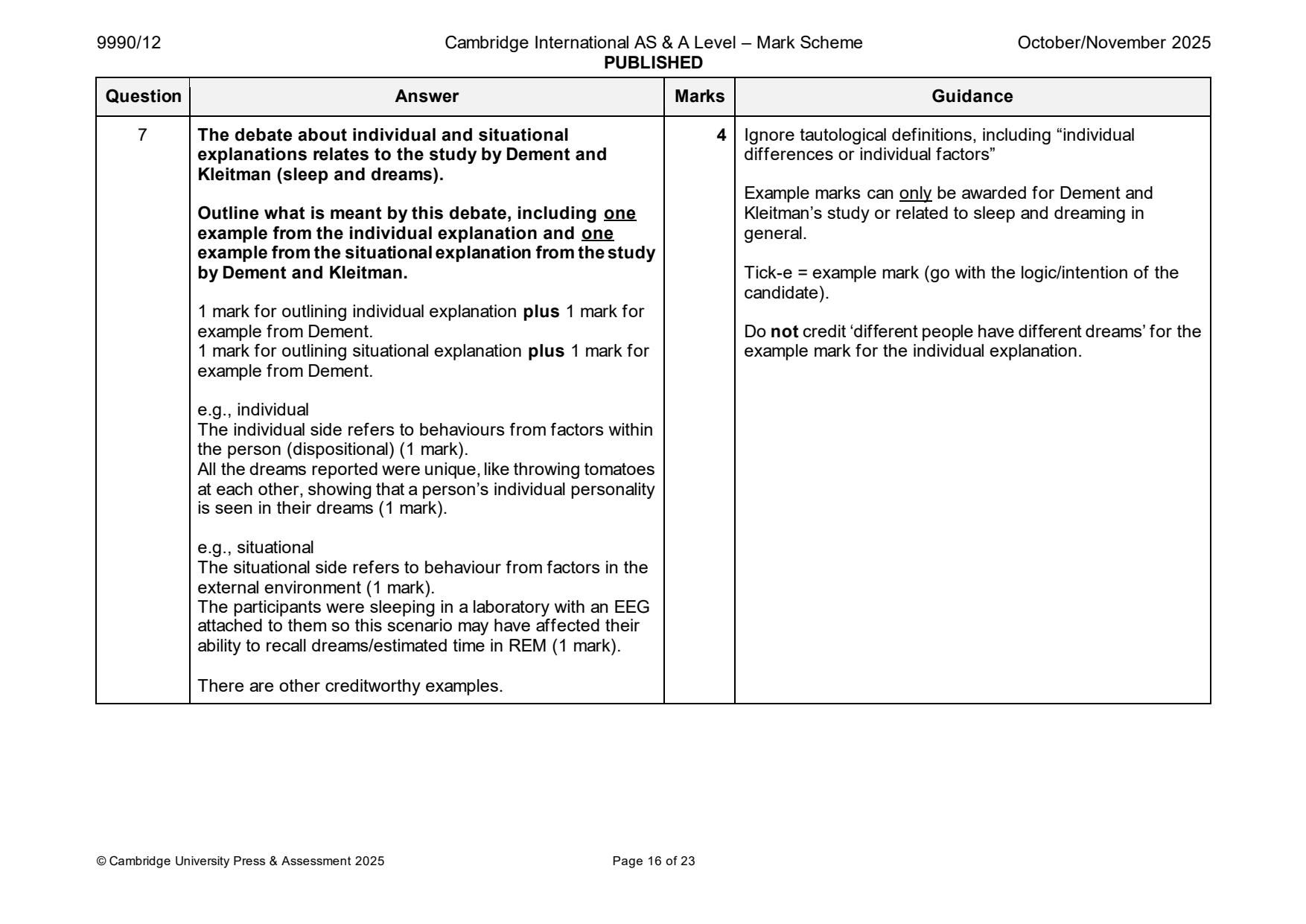
7 The debate about individual and situational 4 Ignore tautological definitions, including “individual
explanations relates to the study by Dement and differences or individual factors”
Kleitman (sleep and dreams).
Example marks can only be awarded for Dement and
Outline what is meant by this debate, including one Kleitman’s study or related to sleep and dreaming in
example from the individual explanation and one general.
example from the situational explanation from the study
by Dement and Kleitman. Tick-e = example mark (go with the logic/intention of the
candidate).
1 mark for outlining individual explanation plus 1 mark for
example from Dement. Do not credit ‘different people have different dreams’ for the
1 mark for outlining situational explanation plus 1 mark for example mark for the individual explanation.
example from Dement.
e.g., individual
The individual side refers to behaviours from factors within
the person (dispositional) (1 mark).
All the dreams reported were unique, like throwing tomatoes
at each other, showing that a person’s individual personality
is seen in their dreams (1 mark).
e.g., situational
The situational side refers to behaviour from factors in the
external environment (1 mark).
The participants were sleeping in a laboratory with an EEG
attached to them so this scenario may have affected their
ability to recall dreams/estimated time in REM (1 mark).
There are other creditworthy examples.
© Cambridge University Press & Assessment 2025 Page 16 of 23
Official mark scheme pages: 16 · source PDF URL
9990-2025-on-13-q03
Oct/Nov 2025 · Paper 13 · Question 3 · 4 marks
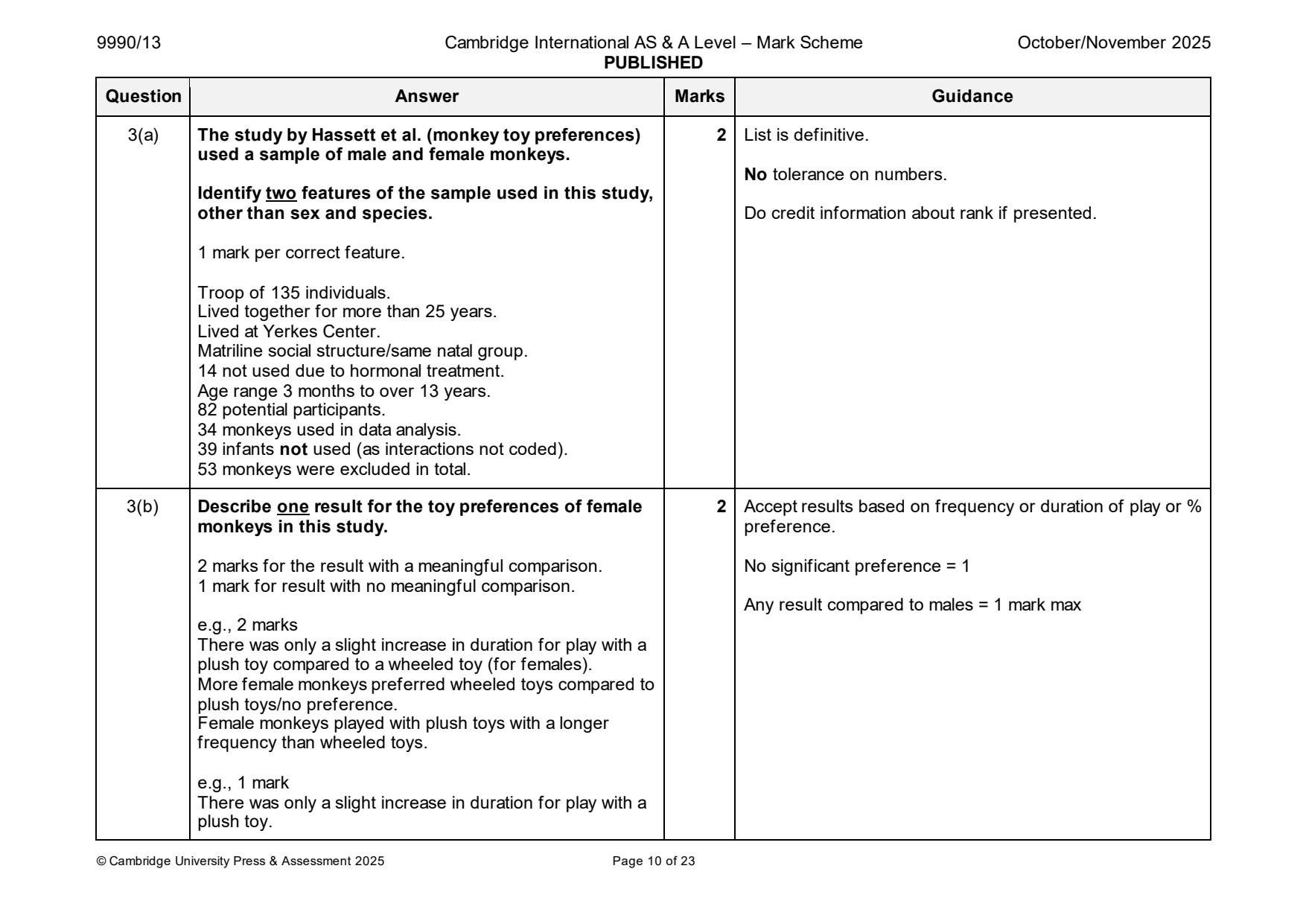
3(a) The study by Hassett et al. (monkey toy preferences) 2 List is definitive.
used a sample of male and female monkeys.
No tolerance on numbers.
Identify two features of the sample used in this study,
other than sex and species. Do credit information about rank if presented.
1 mark per correct feature.
Troop of 135 individuals.
Lived together for more than 25 years.
Lived at Yerkes Center.
Matriline social structure/same natal group.
14 not used due to hormonal treatment.
Age range 3 months to over 13 years.
82 potential participants.
34 monkeys used in data analysis.
39 infants not used (as interactions not coded).
53 monkeys were excluded in total.
3(b) Describe one result for the toy preferences of female 2 Accept results based on frequency or duration of play or %
monkeys in this study. preference.
2 marks for the result with a meaningful comparison. No significant preference = 1
1 mark for result with no meaningful comparison.
Any result compared to males = 1 mark max
e.g., 2 marks
There was only a slight increase in duration for play with a
plush toy compared to a wheeled toy (for females).
More female monkeys preferred wheeled toys compared to
plush toys/no preference.
Female monkeys played with plush toys with a longer
frequency than wheeled toys.
e.g., 1 mark
There was only a slight increase in duration for play with a
plush toy.
© Cambridge University Press & Assessment 2025 Page 10 of 23
Official mark scheme pages: 10 · source PDF URL
9990-2025-on-13-q10
Oct/Nov 2025 · Paper 13 · Question 10 · 10 marks
10 Evaluate the study by Hölzel et al. (mindfulness and 10
brain scans) in terms of two strengths and two
weaknesses. At least one of your evaluation points
must be about self-reports.
Strengths include: reliability (standardisation), quantitative
data, validity, self-reports.
Weaknesses include: ethics, generalisability, quantitative
data, self-reports.
© Cambridge University Press & Assessment 2025 Page 21 of 23
10 Example: in detail (named issue)
The self-report collected quantitative data which makes it
easier to have meaningful comparisons between
groups/conditions. They Ps completed the FFMQ at two-
time points (before and after MBSR or control). As a result,
they could compare changes in all five measures of
mindfulness for both groups of Ps to test longer-term
effectiveness.
Example: brief but in context
The sample size was only 16 participants making it difficult
to generalise beyond the sample.
Example: no context
There were controls in place so they could establish cause
and effect/has internal validity.
Level Description Mark
5 • Very good evaluation including the 9–10
named issue.
• Thoroughly addresses both
strengths and both weaknesses in
detail.
• Selection of evidence is very
thorough and effective.
4 • Good evaluation including the 7–8
named issue.
• Addresses strengths and
weaknesses but may include three
or four points. The majority of the
points are in depth.
• Selection of evidence is thorough
and effective.
© Cambridge University Press & Assessment 2025 Page 22 of 23
9990/13 Cambridge International AS & A Level – Mark Scheme October/November 2025
PUBLISHED
Question Answer Marks Guidance
10
3 • Mostly appropriate evaluation but 5–6
may not include the named issue.
• Addresses either two strengths or
two weaknesses in detail or one of
each in detail or all four briefly.
• Selection of evidence is mostly
effective.
2 • Weak evaluation and may not 3–4
include the named issue.
• Addresses either a strength or a
weakness. Evaluation points are
brief.
• Some points may have no context.
• Selection of evidence is sometimes
appropriate.
1 • Little or no evaluation. 1–2
• Discussion of strengths and
weaknesses is absent or superficial.
• Selection of evidence is limited.
0 No creditable response.
© Cambridge University Press & Assessment 2025 Page 23 of 23
Official mark scheme pages: 21, 22, 23 · source PDF URL