Try the new view →
9702-2022-m-42-q12
March 2022 · Paper 42 · Question 12 · 7 marks
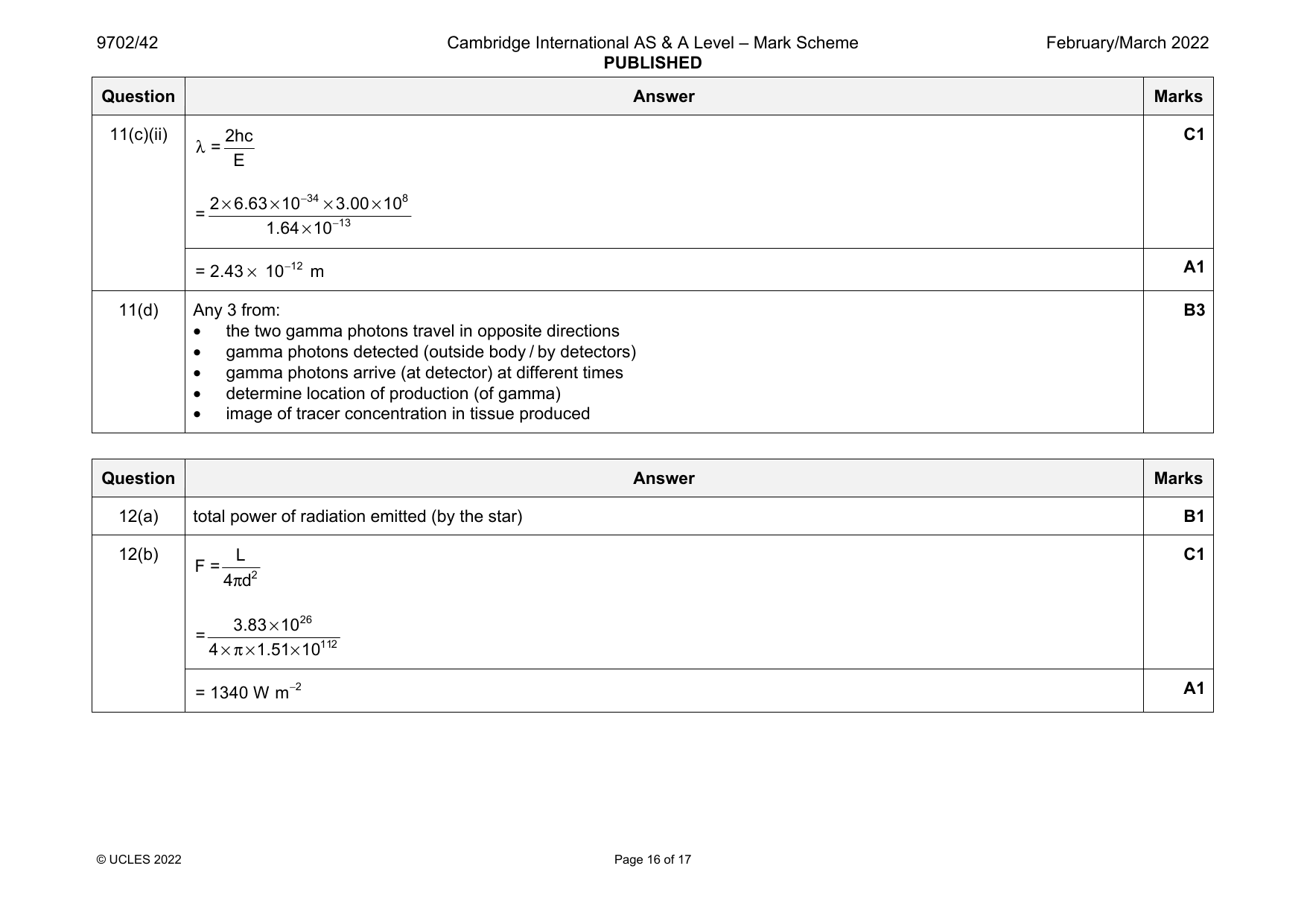
12(a) total power of radiation emitted (by the star) B1
12(b) L C1
F =
4πd2
3.83×1026
=
4×π×1.51×10112
= 1340 W m −2 A1
© UCLES 2022 Page 16 of 17
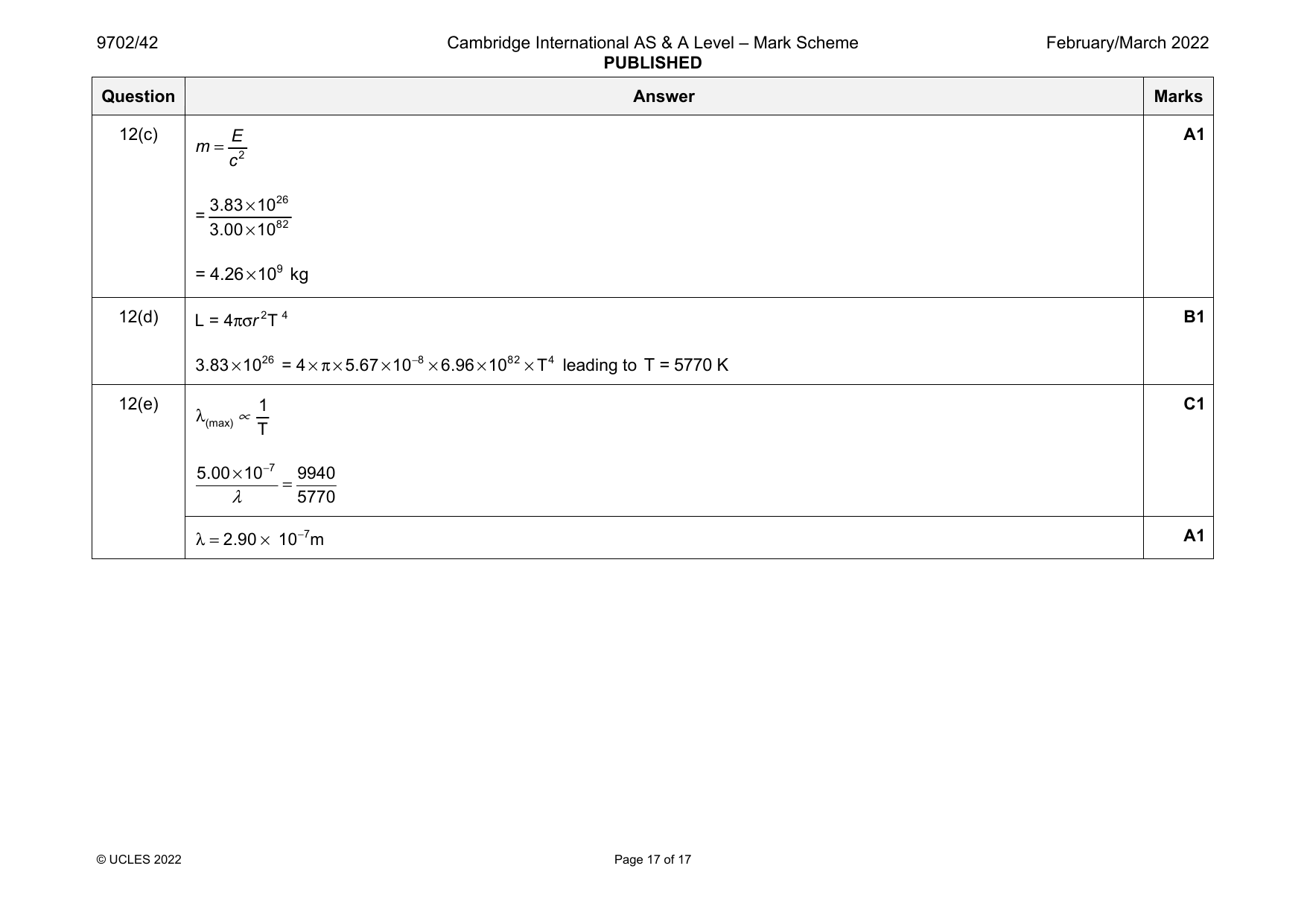
12(c) E A1
m=
c2
3.83×1026
=
3.00×1082
= 4.26×10⁹ kg
12(d) L = 4πσr2T 4 B1
3.83×1026 = 4×π×5.67×10 −8 ×6.96×1082×T4 leading to T = 5770 K
12(e) 1 C1
λ ∝
(max) T
5.00×10 −7 9940
=
λ 5770
λ =2.90 × 10 −7m A1
© UCLES 2022 Page 17 of 17
Official mark scheme pages: 16, 17 · source PDF URL
9702-2022-mj-41-q10
May/June 2022 · Paper 41 · Question 10 · 9 marks
10(a) wavelength of maximum intensity is inversely proportional to (thermodynamic) temperature B1
10(b)(i) = 0.50 m for A and 0.65 m for B C1
MAX
T = 5800 (0.50 / 0.65) A1
= 4500 K
10(b)(ii) (star B has) greater peak / average wavelength B1
(star B looks) redder B1
10(c)(i) apparent wavelength is greater B1
or
wavelength is greater than known value
(due to) movement of star away (from observer) B1
10(c)(ii) by examining the (lines in the) spectrum (of light from the star) B1
and comparing with known spectrum B1
© UCLES 2022 Page 16 of 16
Official mark scheme pages: 16 · source PDF URL
9702-2022-mj-42-q09
May/June 2022 · Paper 42 · Question 9 · 7 marks
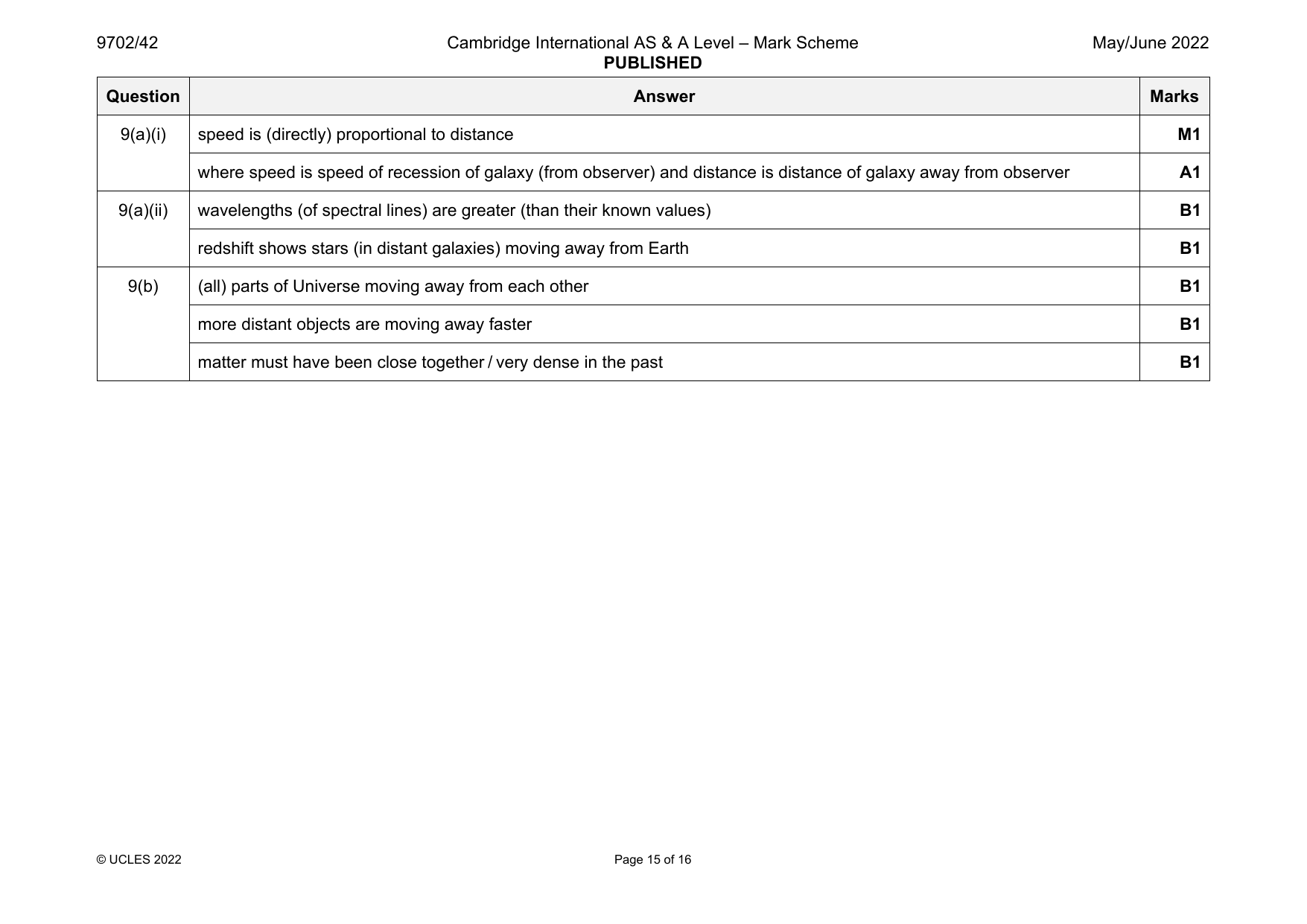
9(a)(i) speed is (directly) proportional to distance M1
where speed is speed of recession of galaxy (from observer) and distance is distance of galaxy away from observer A1
9(a)(ii) wavelengths (of spectral lines) are greater (than their known values) B1
redshift shows stars (in distant galaxies) moving away from Earth B1
9(b) (all) parts of Universe moving away from each other B1
more distant objects are moving away faster B1
matter must have been close together / very dense in the past B1
© UCLES 2022 Page 15 of 16
Official mark scheme pages: 15 · source PDF URL
9702-2022-mj-43-q10
May/June 2022 · Paper 43 · Question 10 · 9 marks
10(a) wavelength of maximum intensity is inversely proportional to (thermodynamic) temperature B1
10(b)(i) = 0.50 m for A and 0.65 m for B C1
MAX
T = 5800 (0.50 / 0.65) A1
= 4500 K
10(b)(ii) (star B has) greater peak / average wavelength B1
(star B looks) redder B1
10(c)(i) apparent wavelength is greater B1
or
wavelength is greater than known value
(due to) movement of star away (from observer) B1
10(c)(ii) by examining the (lines in the) spectrum (of light from the star) B1
and comparing with known spectrum B1
© UCLES 2022 Page 16 of 16
Official mark scheme pages: 16 · source PDF URL
9702-2022-on-41-q09
Oct/Nov 2022 · Paper 41 · Question 9 · 8 marks
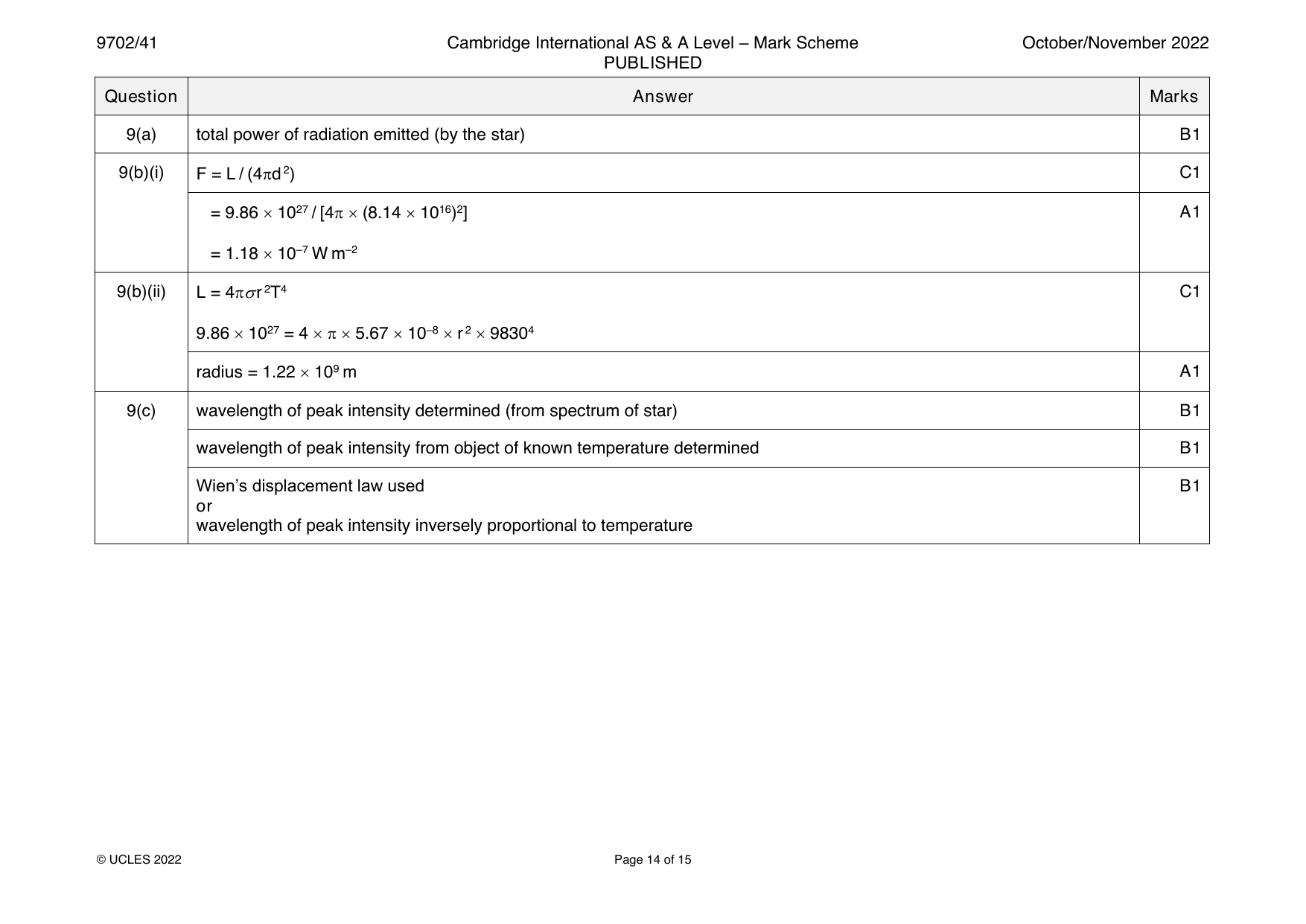
9(a) total power of radiation emitted (by the star) B1
9(b)(i) F = L / (4d 2) C1
= 9.86 1027 / [4 (8.14 1016)2] A1
= 1.18 10–7 W m–2
9(b)(ii) L = 4 r 2T4 C1
9.86 1027 = 4 5.67 10–8 r 2 98304
radius = 1.22 109 m A1
9(c) wavelength of peak intensity determined (from spectrum of star) B1
wavelength of peak intensity from object of known temperature determined B1
Wien’s displacement law used B1
or
wavelength of peak intensity inversely proportional to temperature
© UCLES 2022 Page 14 of 15
Official mark scheme pages: 14 · source PDF URL
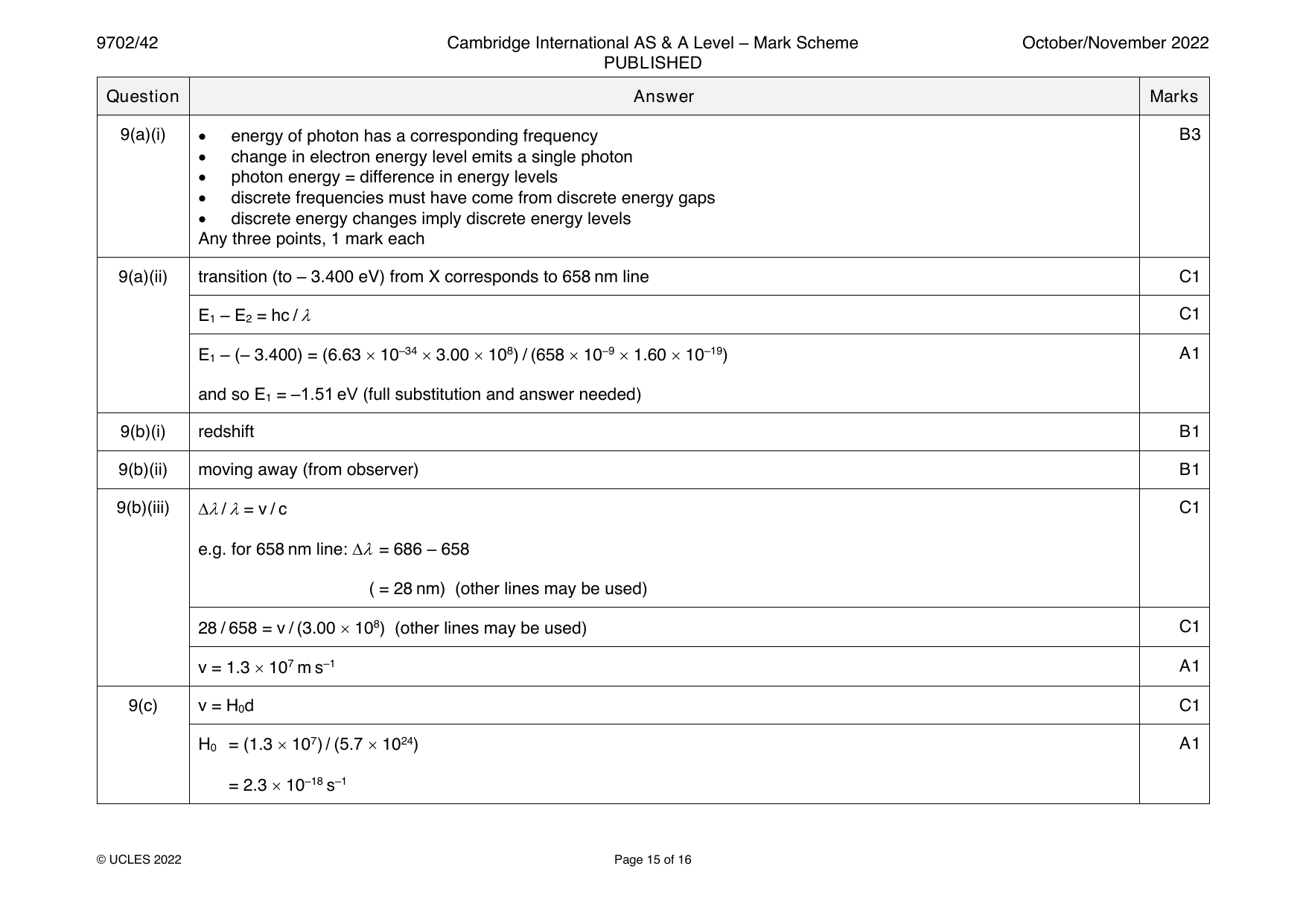
9702-2022-on-42-q09
Oct/Nov 2022 · Paper 42 · Question 9 · 13 marks
9(a)(i) • energy of photon has a corresponding frequency B3
• change in electron energy level emits a single photon
• photon energy = difference in energy levels
• discrete frequencies must have come from discrete energy gaps
• discrete energy changes imply discrete energy levels
Any three points, 1 mark each
9(a)(ii) transition (to – 3.400 eV) from X corresponds to 658 nm line C1
E – E = hc / C1
1 2
E – (– 3.400) = (6.63 10–34 3.00 108) / (658 10–9 1.60 10–19) A1
1
and so E = –1.51 eV (full substitution and answer needed)
1
9(b)(i) redshift B1
9(b)(ii) moving away (from observer) B1
9(b)(iii) / = v / c C1
e.g. for 658 nm line: = 686 – 658
( = 28 nm) (other lines may be used)
28 / 658 = v / (3.00 108) (other lines may be used) C1
v = 1.3 107 m s–1 A1
9(c) v = H d C1
0
H = (1.3 107) / (5.7 1024) A1
0
= 2.3 10–18 s–1
© UCLES 2022 Page 15 of 16
Official mark scheme pages: 15 · source PDF URL
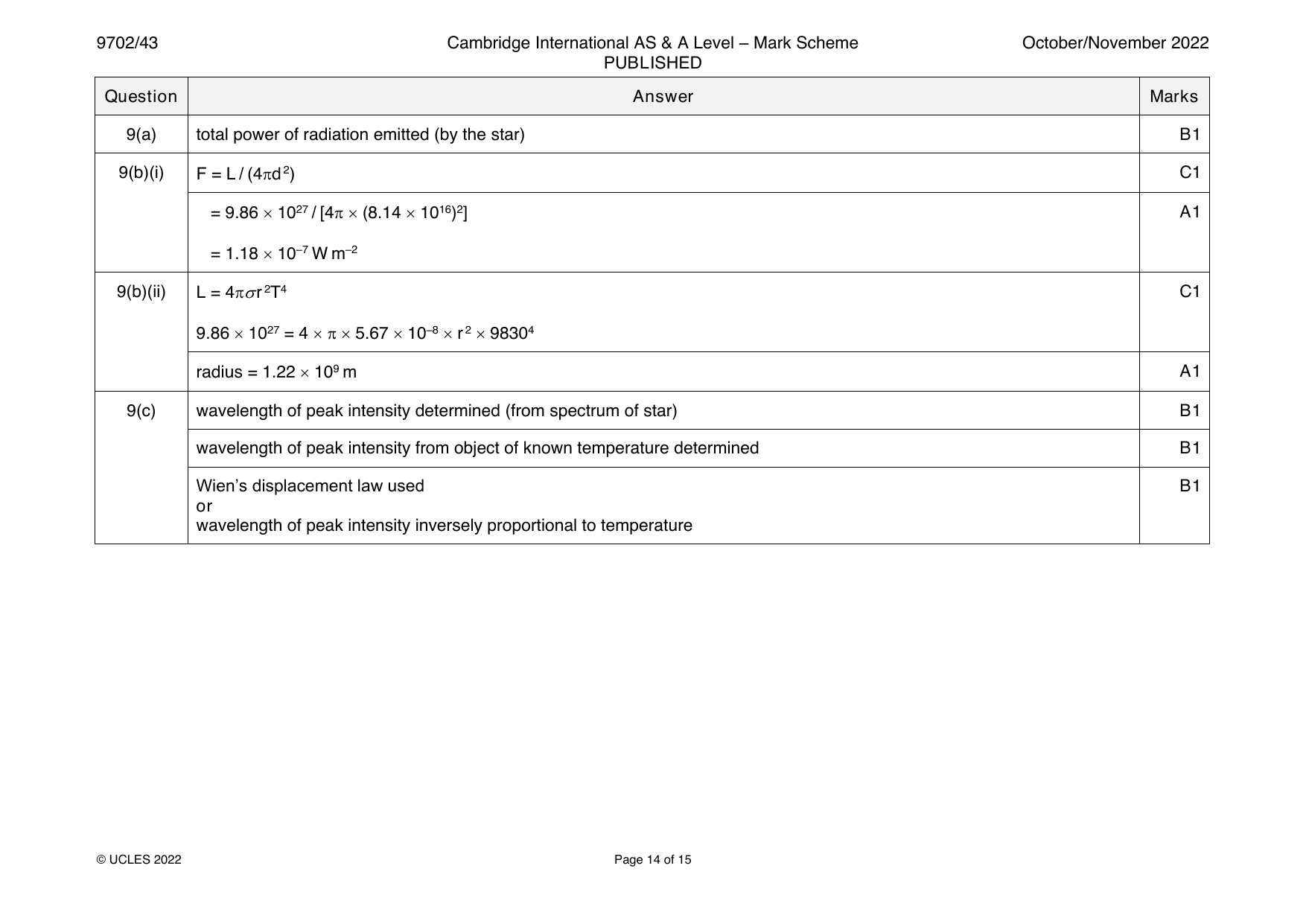
9702-2022-on-43-q09
Oct/Nov 2022 · Paper 43 · Question 9 · 8 marks
9(a) total power of radiation emitted (by the star) B1
9(b)(i) F = L / (4d 2) C1
= 9.86 1027 / [4 (8.14 1016)2] A1
= 1.18 10–7 W m–2
9(b)(ii) L = 4 r 2T4 C1
9.86 1027 = 4 5.67 10–8 r 2 98304
radius = 1.22 109 m A1
9(c) wavelength of peak intensity determined (from spectrum of star) B1
wavelength of peak intensity from object of known temperature determined B1
Wien’s displacement law used B1
or
wavelength of peak intensity inversely proportional to temperature
© UCLES 2022 Page 14 of 15
Official mark scheme pages: 14 · source PDF URL
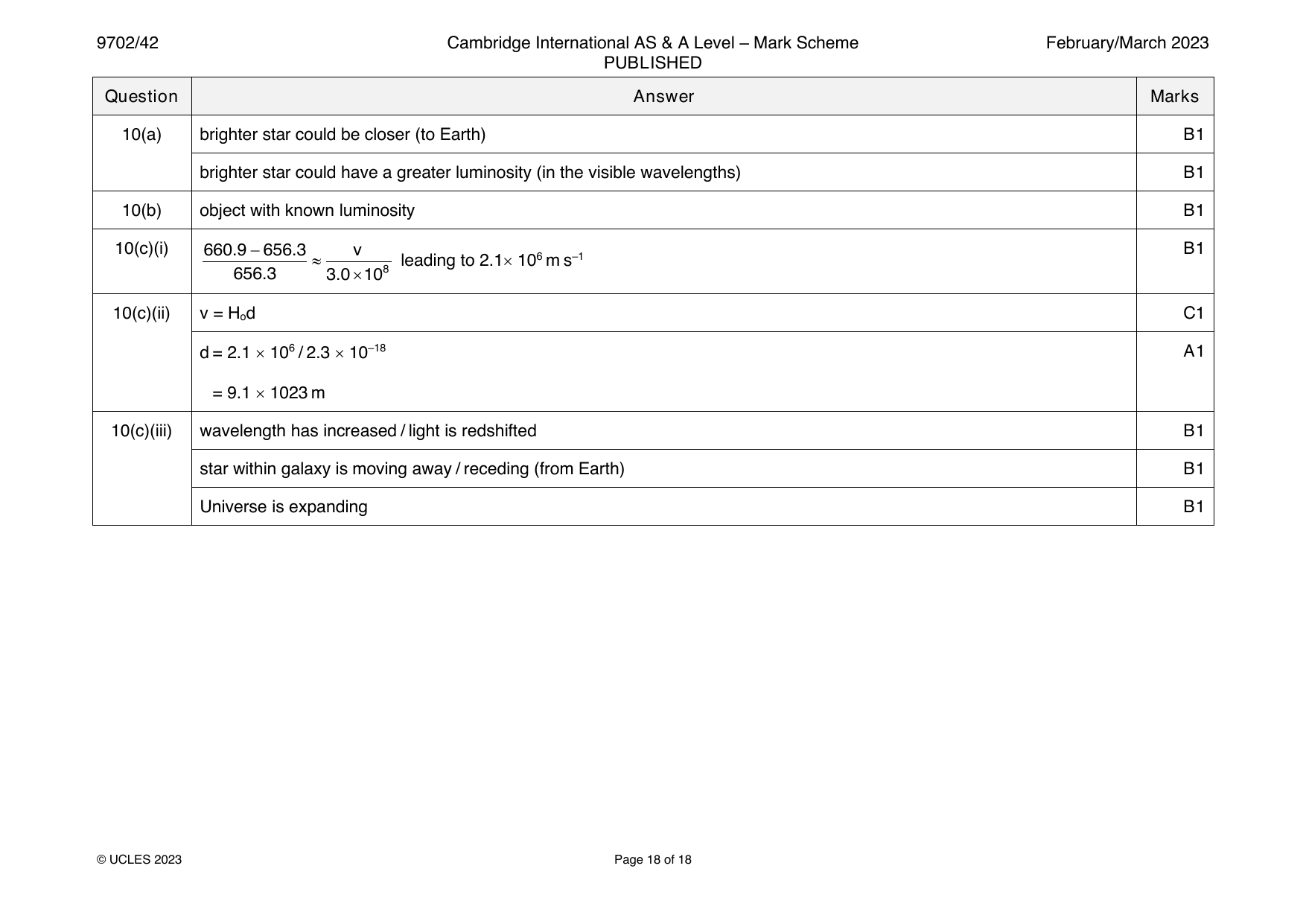
9702-2023-m-42-q10
March 2023 · Paper 42 · Question 10 · 9 marks
10(a) brighter star could be closer (to Earth) B1
brighter star could have a greater luminosity (in the visible wavelengths) B1
10(b) object with known luminosity B1
10(c)(i) 660.9−656.3 v B1
leading to 2.1 106 m s–1
656.3 3.0108
10(c)(ii) v = H d C1
o
d = 2.1 106 / 2.3 10–18 A1
= 9.1 1023 m
10(c)(iii) wavelength has increased / light is redshifted B1
star within galaxy is moving away / receding (from Earth) B1
Universe is expanding B1
© UCLES 2023 Page 18 of 18
Official mark scheme pages: 18 · source PDF URL
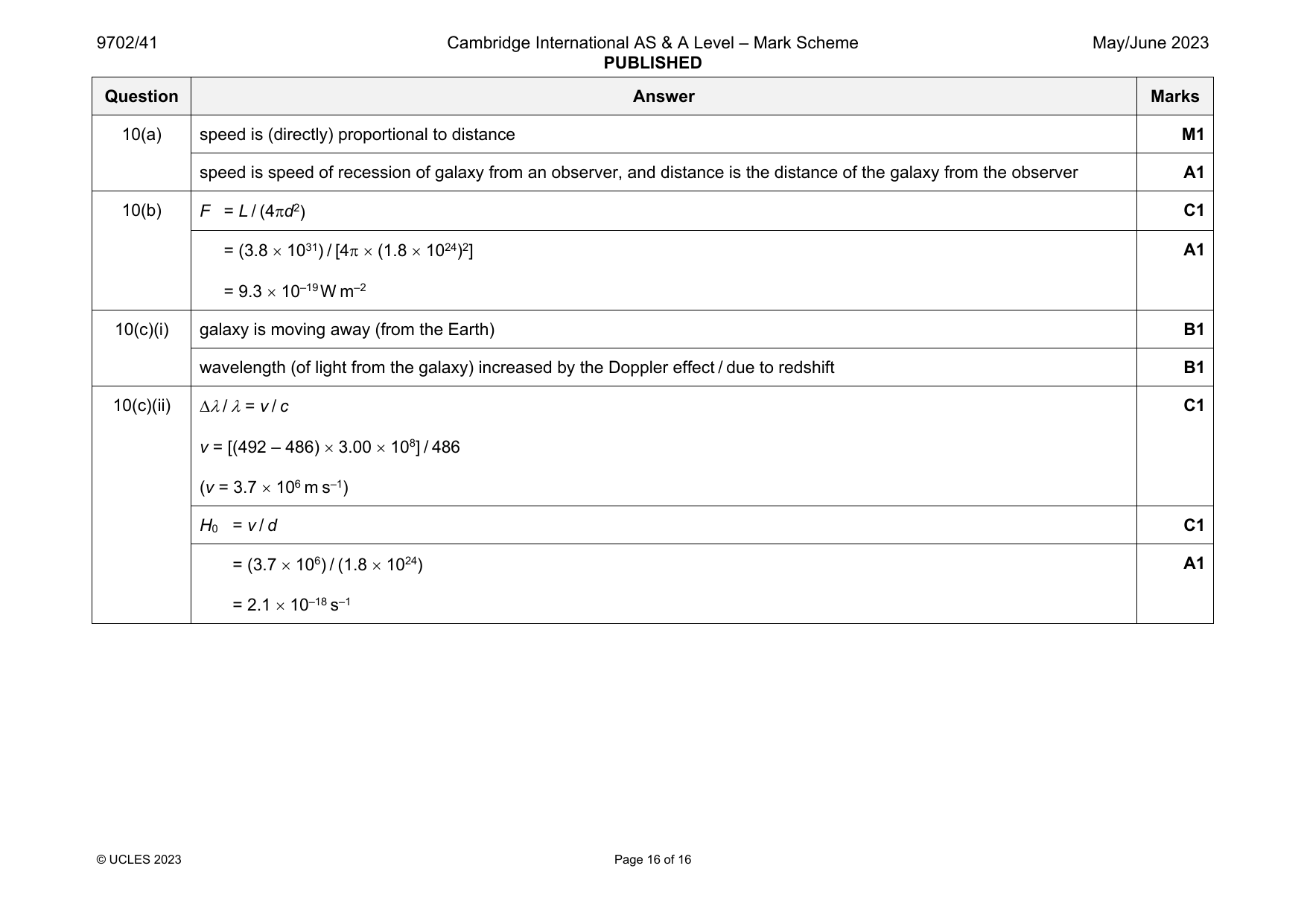
9702-2023-mj-41-q10
May/June 2023 · Paper 41 · Question 10 · 9 marks
10(a) speed is (directly) proportional to distance M1
speed is speed of recession of galaxy from an observer, and distance is the distance of the galaxy from the observer A1
10(b) F = L / (4d2) C1
= (3.8 1031) / [4 (1.8 1024)2] A1
= 9.3 10–19 W m–2
10(c)(i) galaxy is moving away (from the Earth) B1
wavelength (of light from the galaxy) increased by the Doppler effect / due to redshift B1
10(c)(ii) / = v / c C1
v = [(492 – 486) 3.00 108] / 486
(v = 3.7 106 m s–1)
H = v / d C1
0
= (3.7 106) / (1.8 1024) A1
= 2.1 10–18 s–1
© UCLES 2023 Page 16 of 16
Official mark scheme pages: 16 · source PDF URL
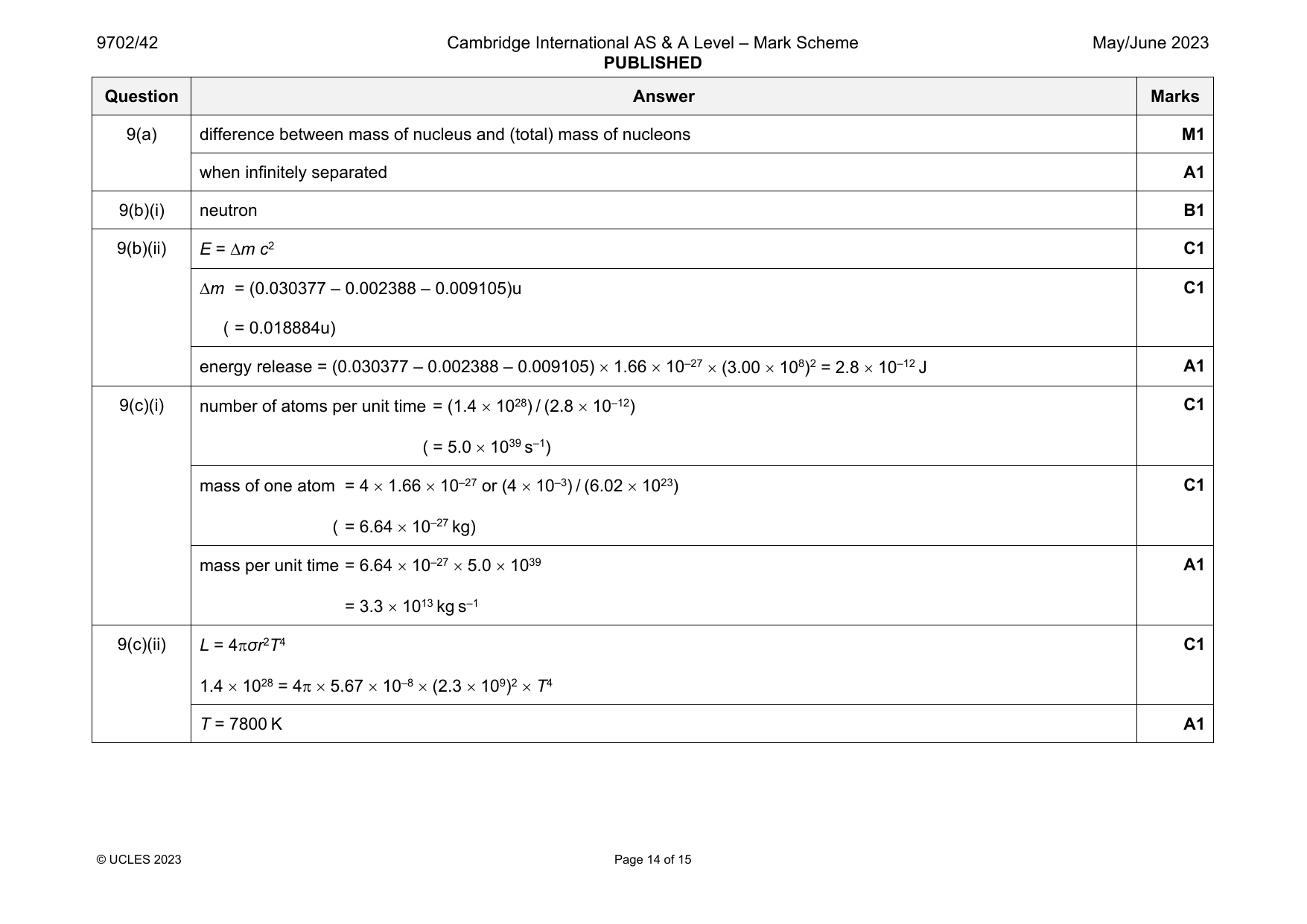
9702-2023-mj-42-q09
May/June 2023 · Paper 42 · Question 9 · 11 marks
9(a) difference between mass of nucleus and (total) mass of nucleons M1
when infinitely separated A1
9(b)(i) neutron B1
9(b)(ii) E = m c2 C1
m = (0.030377 – 0.002388 – 0.009105)u C1
( = 0.018884u)
energy release = (0.030377 – 0.002388 – 0.009105) 1.66 10–27 (3.00 108)2 = 2.8 10–12 J A1
9(c)(i) number of atoms per unit time = (1.4 1028) / (2.8 10–12) C1
( = 5.0 1039 s–1)
mass of one atom = 4 1.66 10–27 or (4 10–3) / (6.02 1023) C1
( = 6.64 10–27 kg)
mass per unit time = 6.64 10–27 5.0 1039 A1
= 3.3 1013 kg s–1
9(c)(ii) L = 4σr2T4 C1
1.4 1028 = 4 5.67 10–8 (2.3 109)2 T4
T = 7800 K A1
© UCLES 2023 Page 14 of 15
Official mark scheme pages: 14 · source PDF URL
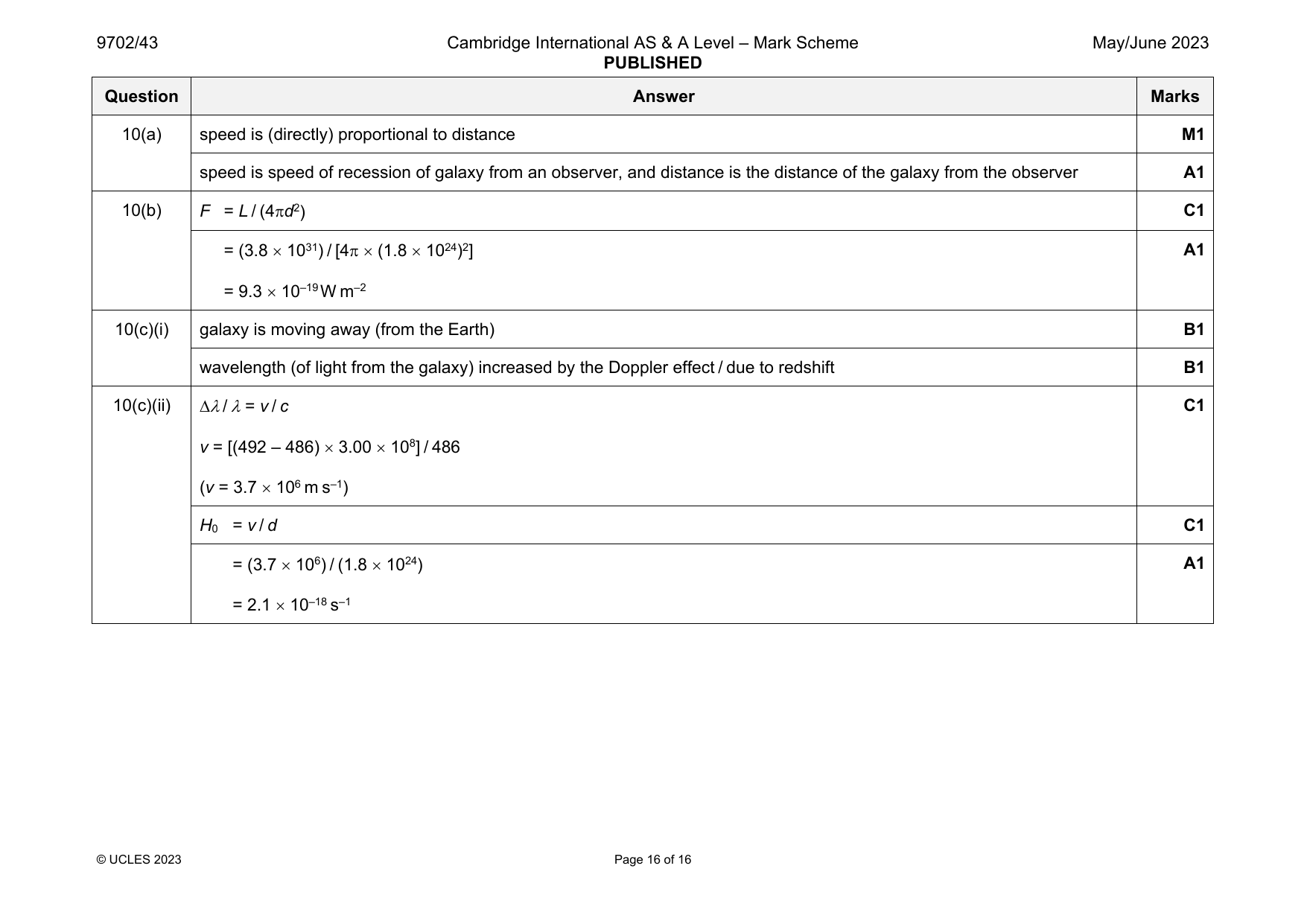
9702-2023-mj-43-q10
May/June 2023 · Paper 43 · Question 10 · 9 marks
10(a) speed is (directly) proportional to distance M1
speed is speed of recession of galaxy from an observer, and distance is the distance of the galaxy from the observer A1
10(b) F = L / (4d2) C1
= (3.8 1031) / [4 (1.8 1024)2] A1
= 9.3 10–19 W m–2
10(c)(i) galaxy is moving away (from the Earth) B1
wavelength (of light from the galaxy) increased by the Doppler effect / due to redshift B1
10(c)(ii) / = v / c C1
v = [(492 – 486) 3.00 108] / 486
(v = 3.7 106 m s–1)
H = v / d C1
0
= (3.7 106) / (1.8 1024) A1
= 2.1 10–18 s–1
© UCLES 2023 Page 16 of 16
Official mark scheme pages: 16 · source PDF URL
9702-2023-on-42-q10
Oct/Nov 2023 · Paper 42 · Question 10 · 8 marks
10(a) temperature inversely proportional to wavelength M1
temperature is thermodynamic temperature of surface, and wavelength is the wavelength at which maximum emission rate A1
occurs
10(b)(i) (astronomical) object of known luminosity B1
10(b)(ii) star / galaxy is moving away from the student B1
10(b)(iii) one tick placed in correct column in each row: B1
wavelength: too high
surface temperature: too low B1
distance: unchanged B1
radius: too high B1
© UCLES 2023 Page 15 of 15
Official mark scheme pages: 15 · source PDF URL
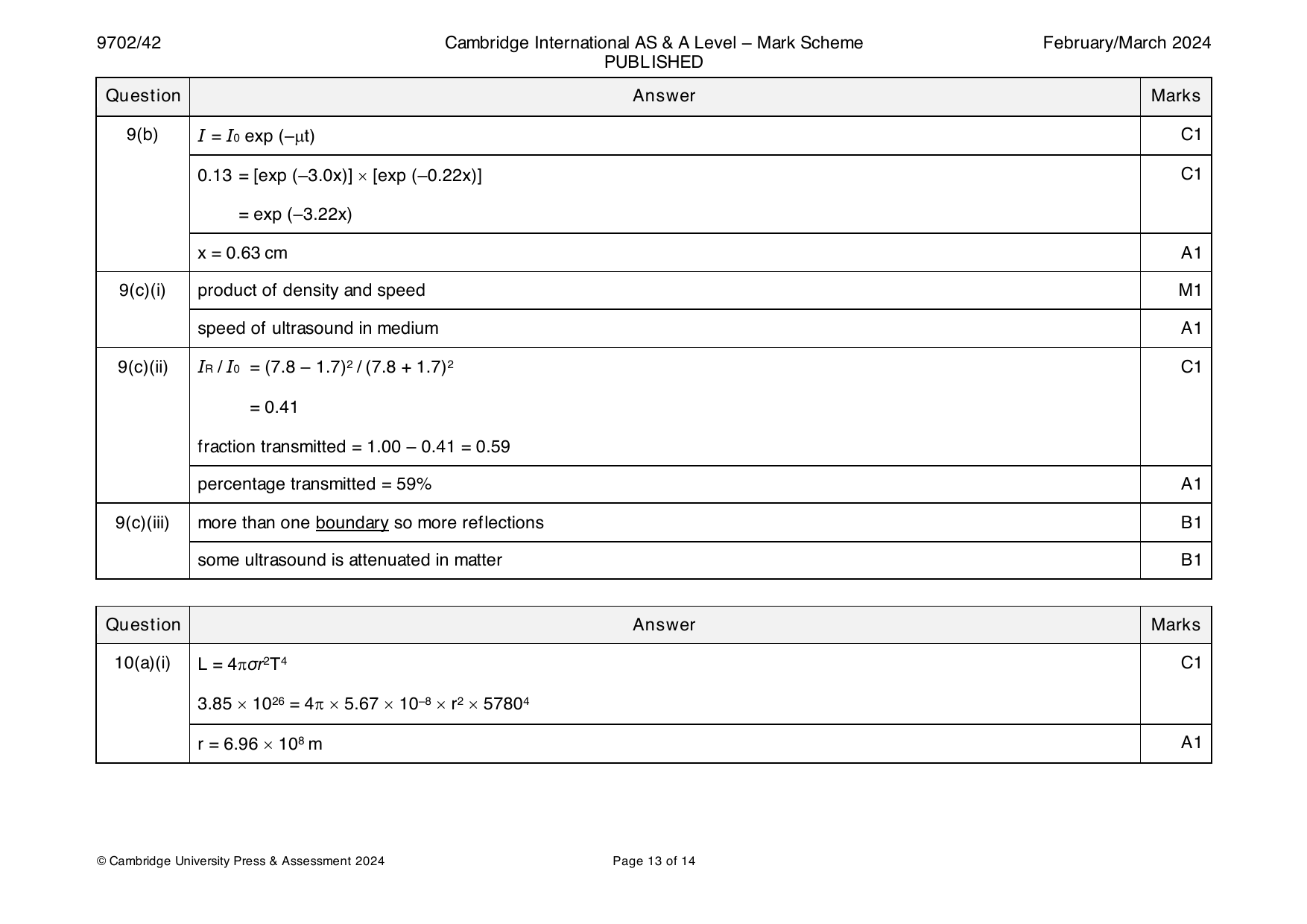
9702-2024-m-42-q10
March 2024 · Paper 42 · Question 10 · 10 marks
10(a)(i) L = 4σr2T4 C1
3.85 1026 = 4 5.67 10–8 r2 57804
r = 6.96 108 m A1
© Cambridge University Press & Assessment 2024 Page 13 of 14
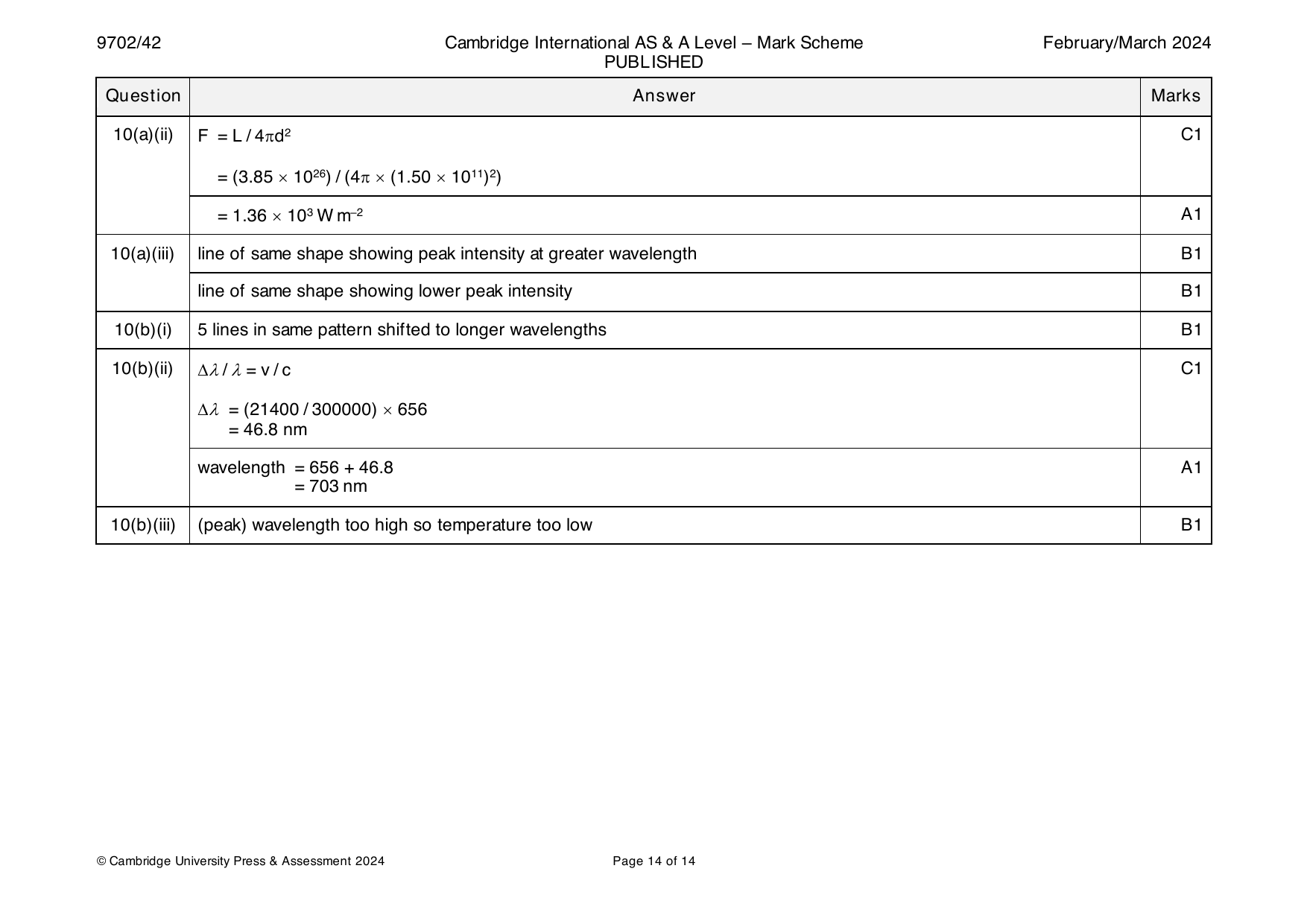
10(a)(ii) F = L / 4d2 C1
= (3.85 1026) / (4 (1.50 1011)2)
= 1.36 103 W m–2 A1
10(a)(iii) line of same shape showing peak intensity at greater wavelength B1
line of same shape showing lower peak intensity B1
10(b)(i) 5 lines in same pattern shifted to longer wavelengths B1
10(b)(ii) / = v / c C1
= (21400 / 300000) 656
= 46.8 nm
wavelength = 656 + 46.8 A1
= 703 nm
10(b)(iii) (peak) wavelength too high so temperature too low B1
© Cambridge University Press & Assessment 2024 Page 14 of 14
Official mark scheme pages: 13, 14 · source PDF URL
9702-2024-mj-41-q10
May/June 2024 · Paper 41 · Question 10 · 9 marks
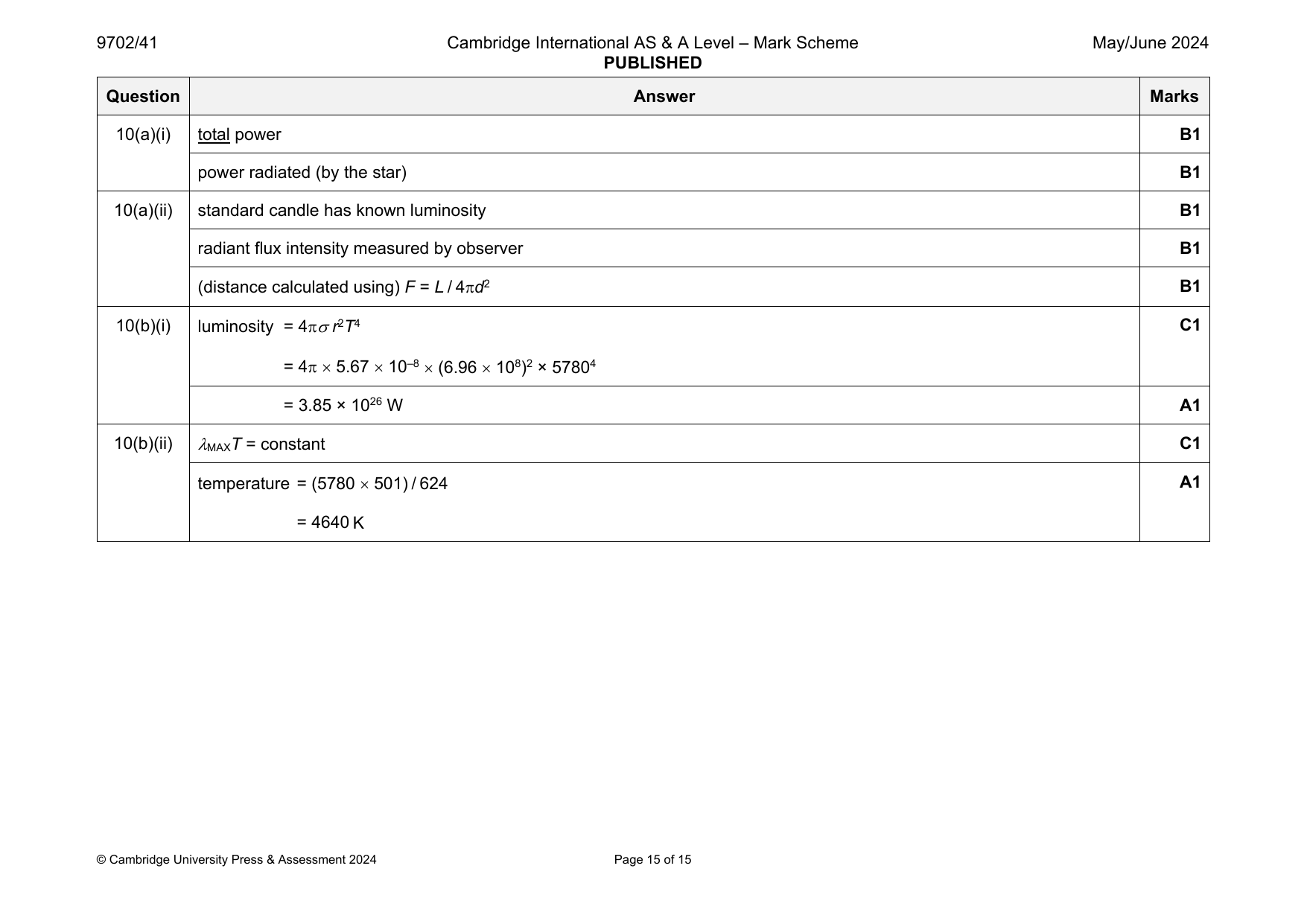
10(a)(i) total power B1
power radiated (by the star) B1
10(a)(ii) standard candle has known luminosity B1
radiant flux intensity measured by observer B1
(distance calculated using) F = L / 4d2 B1
10(b)(i) luminosity = 4 r2T4 C1
= 4 5.67 10–8 (6.96 108)2 × 57804
= 3.85 × 1026 W A1
10(b)(ii) T = constant C1
MAX
temperature = (5780 501) / 624 A1
= 4640 K
© Cambridge University Press & Assessment 2024 Page 15 of 15
Official mark scheme pages: 15 · source PDF URL
9702-2024-mj-42-q08
May/June 2024 · Paper 42 · Question 8 · 12 marks
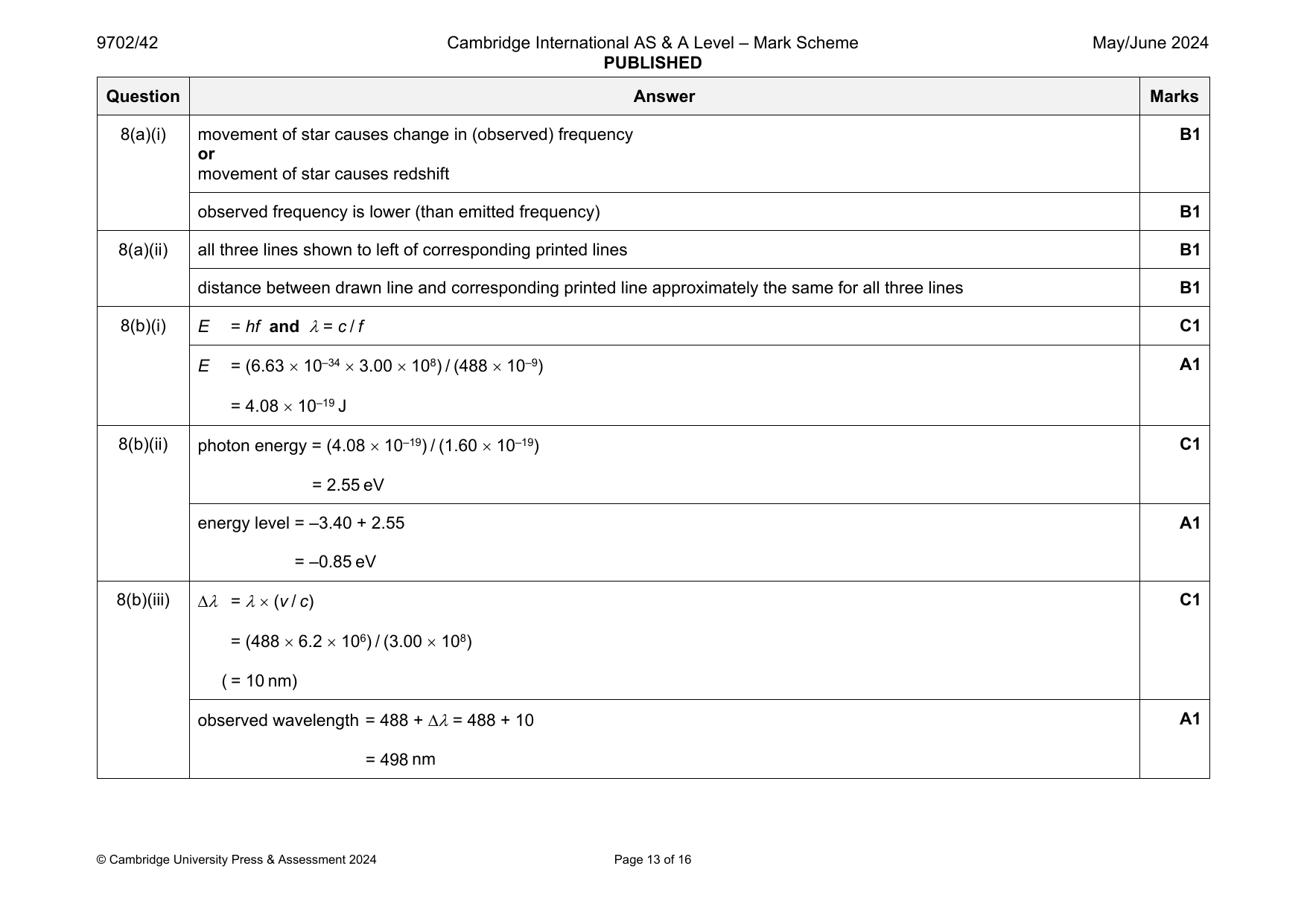
8(a)(i) movement of star causes change in (observed) frequency B1
or
movement of star causes redshift
observed frequency is lower (than emitted frequency) B1
8(a)(ii) all three lines shown to left of corresponding printed lines B1
distance between drawn line and corresponding printed line approximately the same for all three lines B1
8(b)(i) E = hf and = c / f C1
E = (6.63 10–34 3.00 108) / (488 10–9) A1
= 4.08 10–19 J
8(b)(ii) photon energy = (4.08 10–19) / (1.60 10–19) C1
= 2.55 eV
energy level = –3.40 + 2.55 A1
= –0.85 eV
8(b)(iii) = (v / c) C1
= (488 6.2 106) / (3.00 108)
( = 10 nm)
observed wavelength = 488 + = 488 + 10 A1
= 498 nm
© Cambridge University Press & Assessment 2024 Page 13 of 16
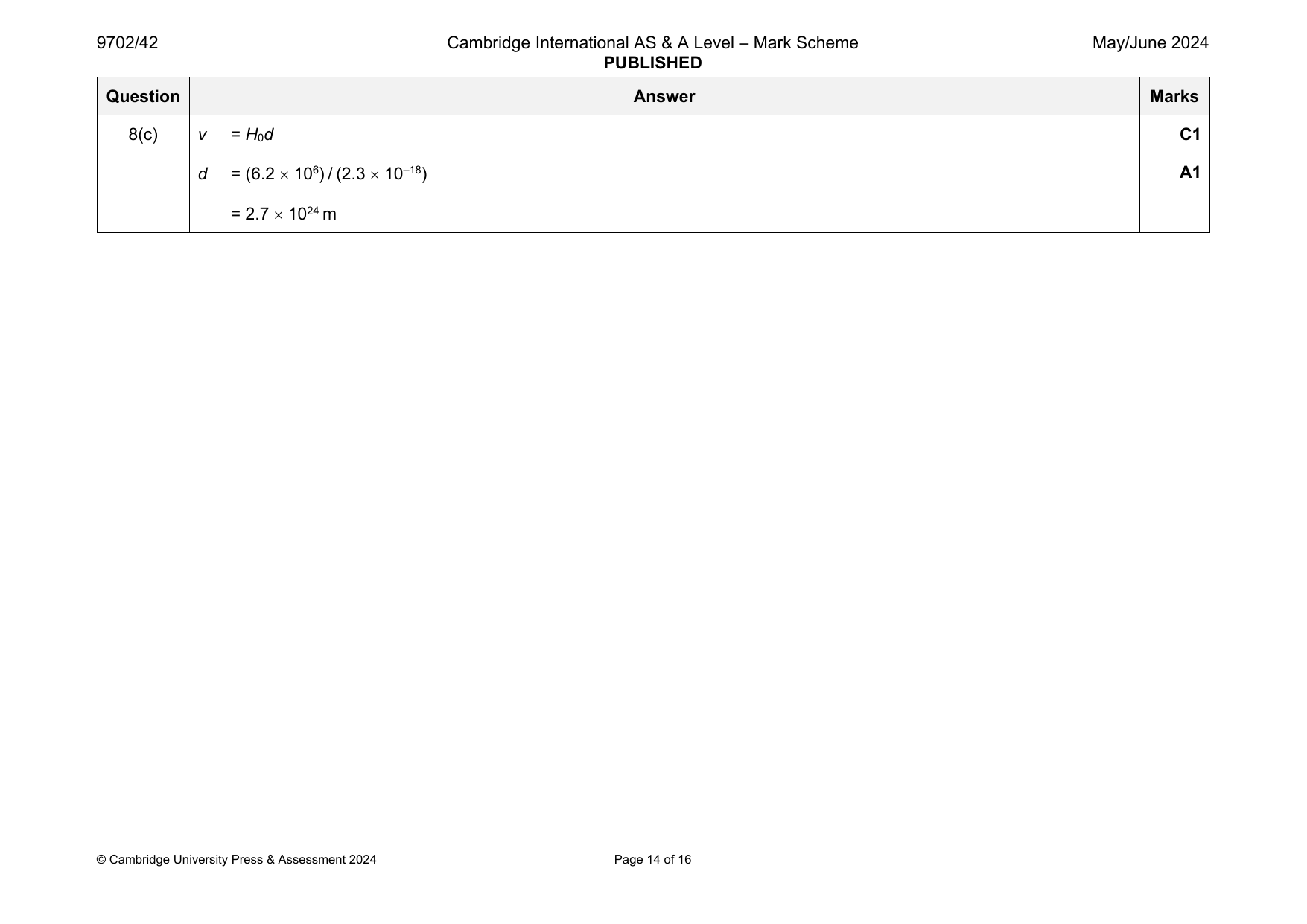
8(c) v = H d C1
0
d = (6.2 106) / (2.3 10–18) A1
= 2.7 1024 m
© Cambridge University Press & Assessment 2024 Page 14 of 16
Official mark scheme pages: 13, 14 · source PDF URL
9702-2024-mj-43-q10
May/June 2024 · Paper 43 · Question 10 · 9 marks
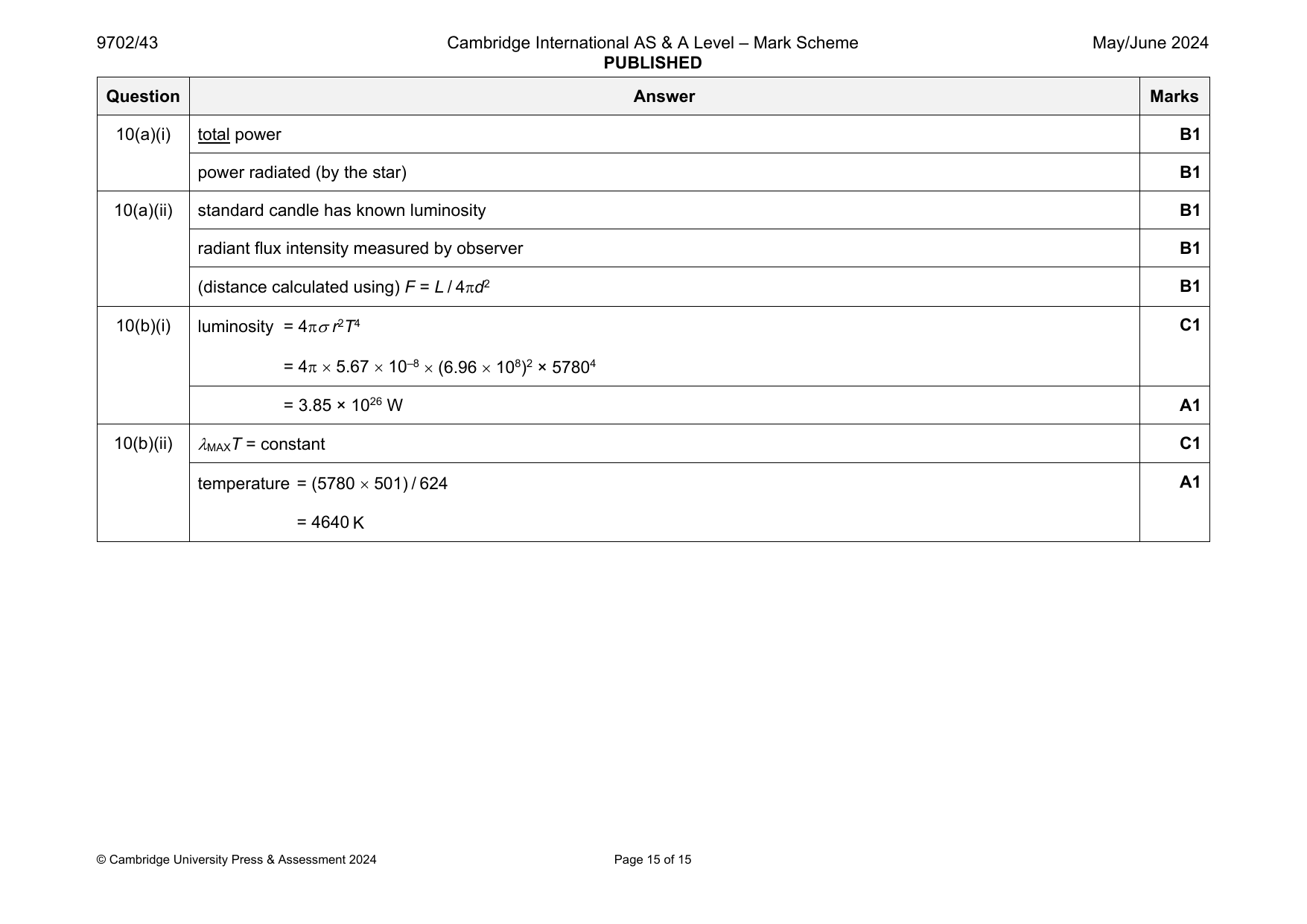
10(a)(i) total power B1
power radiated (by the star) B1
10(a)(ii) standard candle has known luminosity B1
radiant flux intensity measured by observer B1
(distance calculated using) F = L / 4d2 B1
10(b)(i) luminosity = 4 r2T4 C1
= 4 5.67 10–8 (6.96 108)2 × 57804
= 3.85 × 1026 W A1
10(b)(ii) T = constant C1
MAX
temperature = (5780 501) / 624 A1
= 4640 K
© Cambridge University Press & Assessment 2024 Page 15 of 15
Official mark scheme pages: 15 · source PDF URL
9702-2024-on-41-q10
Oct/Nov 2024 · Paper 41 · Question 10 · 10 marks
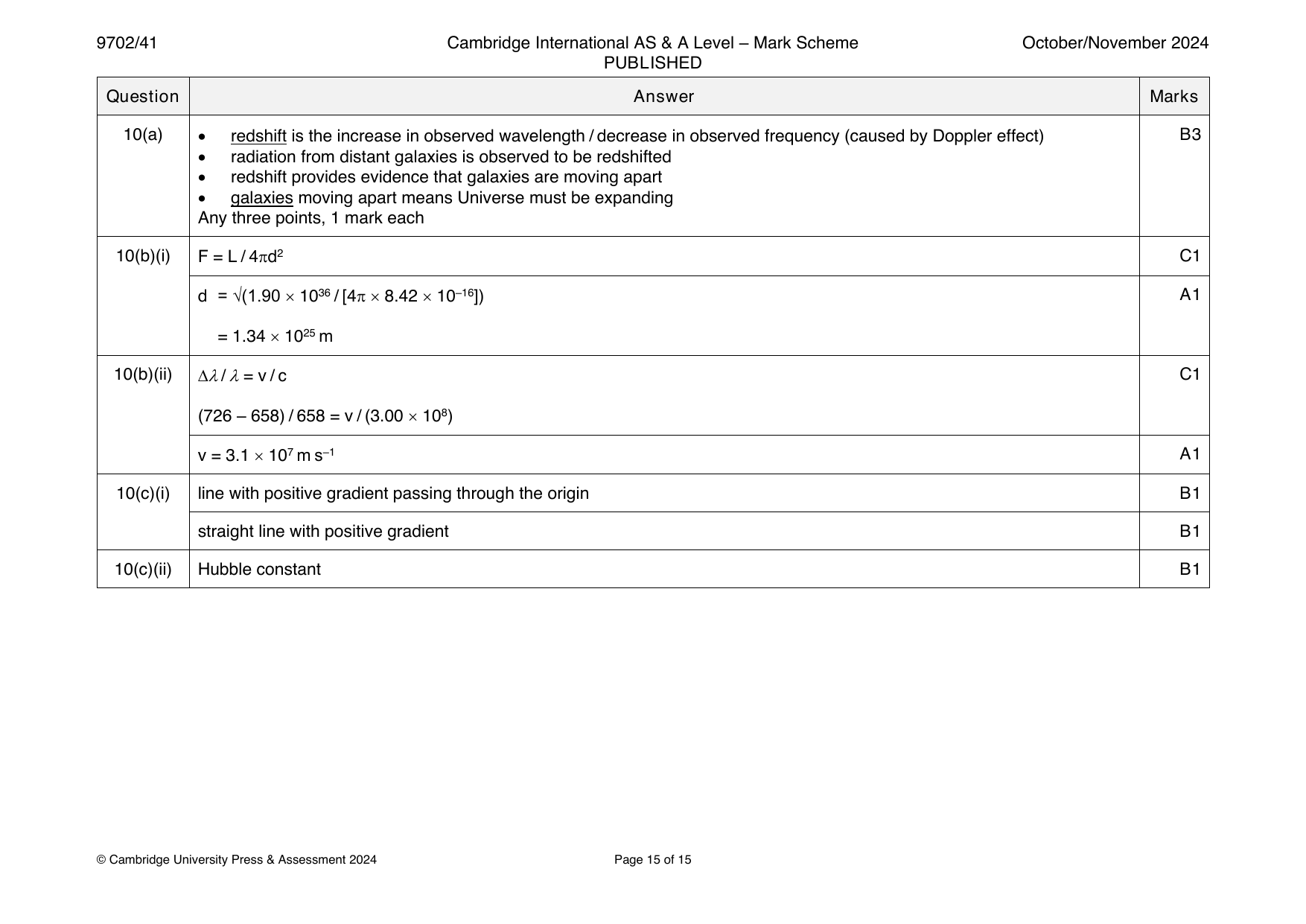
10(a) • redshift is the increase in observed wavelength / decrease in observed frequency (caused by Doppler effect) B3
• radiation from distant galaxies is observed to be redshifted
• redshift provides evidence that galaxies are moving apart
• galaxies moving apart means Universe must be expanding
Any three points, 1 mark each
10(b)(i) F = L / 4d2 C1
d = √(1.90 1036 / [4 8.42 10–16]) A1
= 1.34 1025 m
10(b)(ii) / = v / c C1
(726 – 658) / 658 = v / (3.00 108)
v = 3.1 107 m s–1 A1
10(c)(i) line with positive gradient passing through the origin B1
straight line with positive gradient B1
10(c)(ii) Hubble constant B1
© Cambridge University Press & Assessment 2024 Page 15 of 15
Official mark scheme pages: 15 · source PDF URL
9702-2024-on-42-q02
Oct/Nov 2024 · Paper 42 · Question 2 · 12 marks
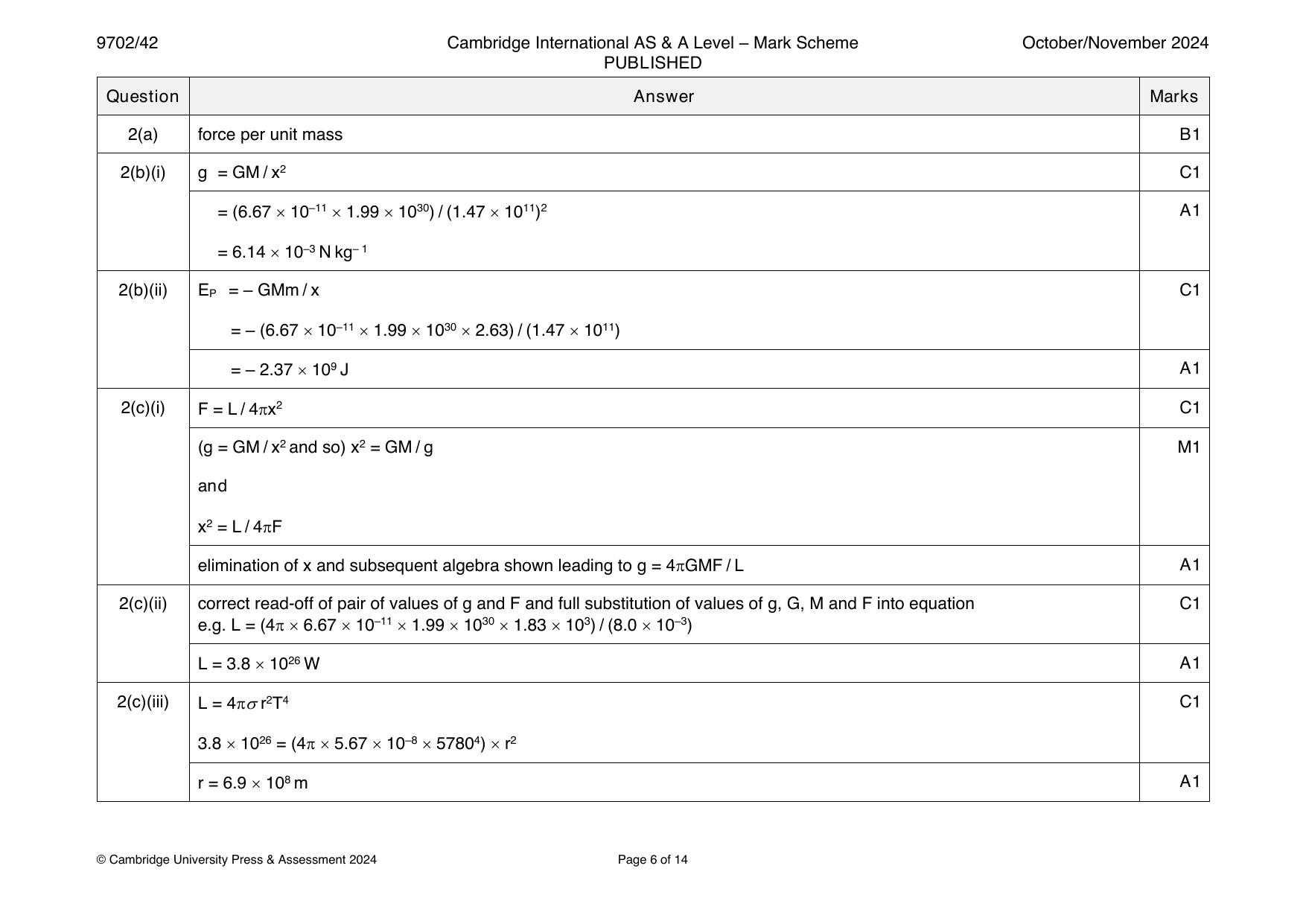
2(a) force per unit mass B1
2(b)(i) g = GM / x2 C1
= (6.67 10–11 1.99 1030) / (1.47 1011)2 A1
= 6.14 10–3 N kg– 1
2(b)(ii) E = – GMm / x C1
P
= – (6.67 10–11 1.99 1030 2.63) / (1.47 1011)
= – 2.37 109 J A1
2(c)(i) F = L / 4x2 C1
(g = GM / x2 and so) x2 = GM / g M1
and
x2 = L / 4F
elimination of x and subsequent algebra shown leading to g = 4GMF / L A1
2(c)(ii) correct read-off of pair of values of g and F and full substitution of values of g, G, M and F into equation C1
e.g. L = (4 6.67 10–11 1.99 1030 1.83 103) / (8.0 10–3)
L = 3.8 1026 W A1
2(c)(iii) L = 4 r2T4 C1
3.8 1026 = (4 5.67 10–8 57804) r2
r = 6.9 108 m A1
© Cambridge University Press & Assessment 2024 Page 6 of 14
Official mark scheme pages: 6 · source PDF URL
9702-2024-on-43-q10
Oct/Nov 2024 · Paper 43 · Question 10 · 10 marks
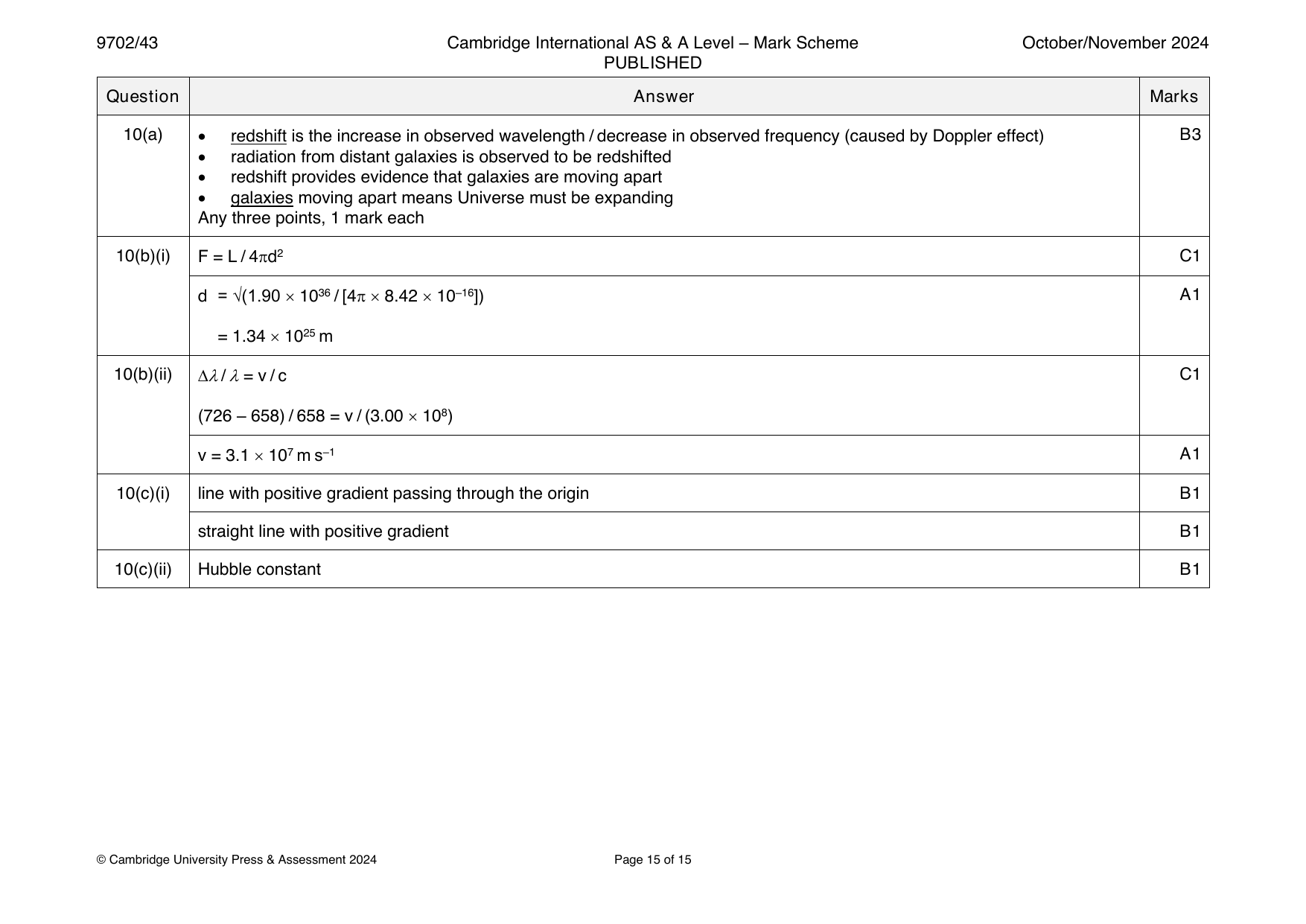
10(a) • redshift is the increase in observed wavelength / decrease in observed frequency (caused by Doppler effect) B3
• radiation from distant galaxies is observed to be redshifted
• redshift provides evidence that galaxies are moving apart
• galaxies moving apart means Universe must be expanding
Any three points, 1 mark each
10(b)(i) F = L / 4d2 C1
d = √(1.90 1036 / [4 8.42 10–16]) A1
= 1.34 1025 m
10(b)(ii) / = v / c C1
(726 – 658) / 658 = v / (3.00 108)
v = 3.1 107 m s–1 A1
10(c)(i) line with positive gradient passing through the origin B1
straight line with positive gradient B1
10(c)(ii) Hubble constant B1
© Cambridge University Press & Assessment 2024 Page 15 of 15
Official mark scheme pages: 15 · source PDF URL
9702-2025-m-42-q10
March 2025 · Paper 42 · Question 10 · 11 marks
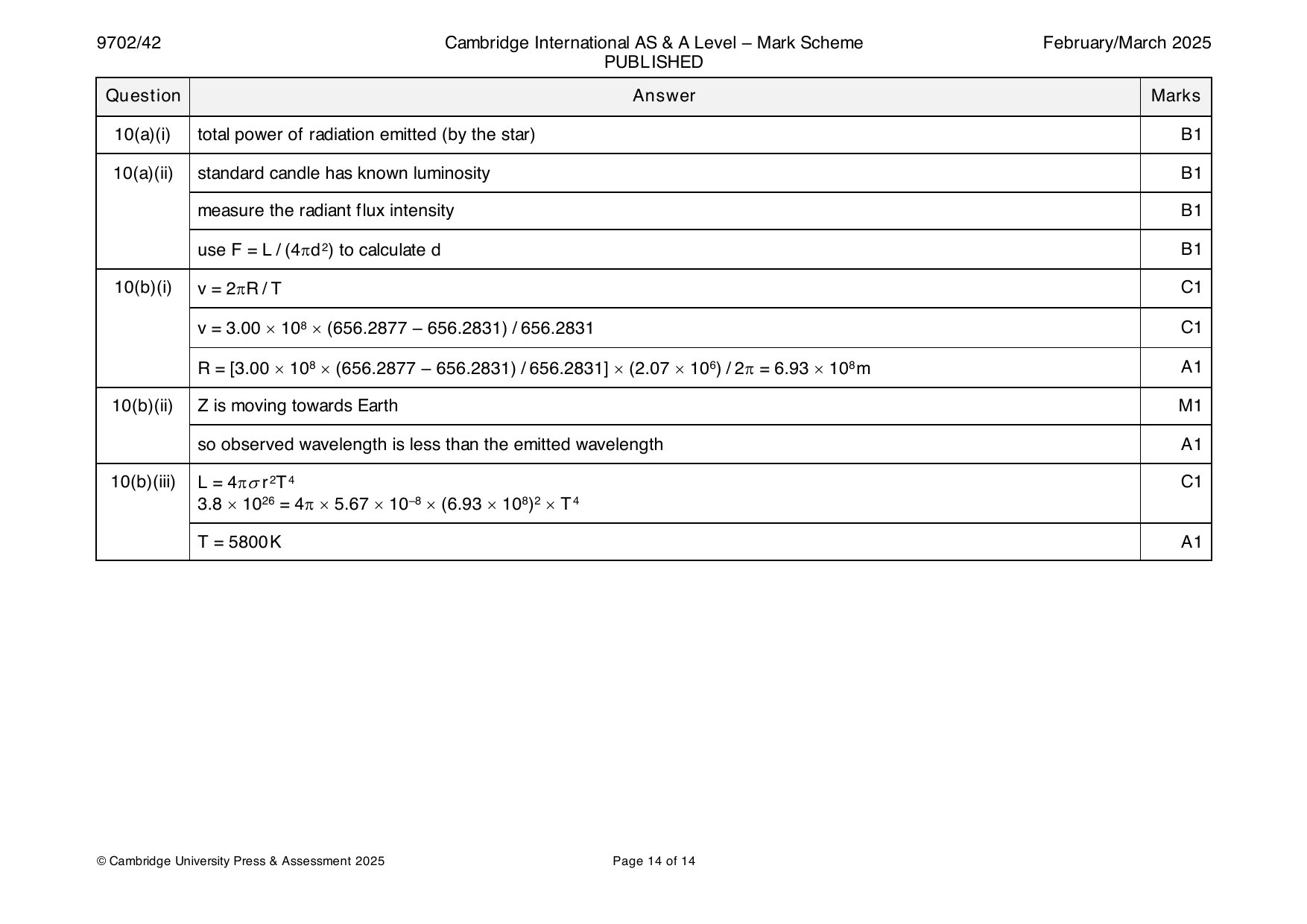
10(a)(i) total power of radiation emitted (by the star) B1
10(a)(ii) standard candle has known luminosity B1
measure the radiant flux intensity B1
use F = L / (4d2) to calculate d B1
10(b)(i) v = 2R / T C1
v = 3.00 108 (656.2877 – 656.2831) / 656.2831 C1
R = [3.00 108 (656.2877 – 656.2831) / 656.2831] (2.07 106) / 2 = 6.93 108m A1
10(b)(ii) Z is moving towards Earth M1
so observed wavelength is less than the emitted wavelength A1
10(b)(iii) L = 4 r2T4 C1
3.8 1026 = 4 5.67 10–8 (6.93 108)2 T4
T = 5800K A1
© Cambridge University Press & Assessment 2025 Page 14 of 14
Official mark scheme pages: 14 · source PDF URL
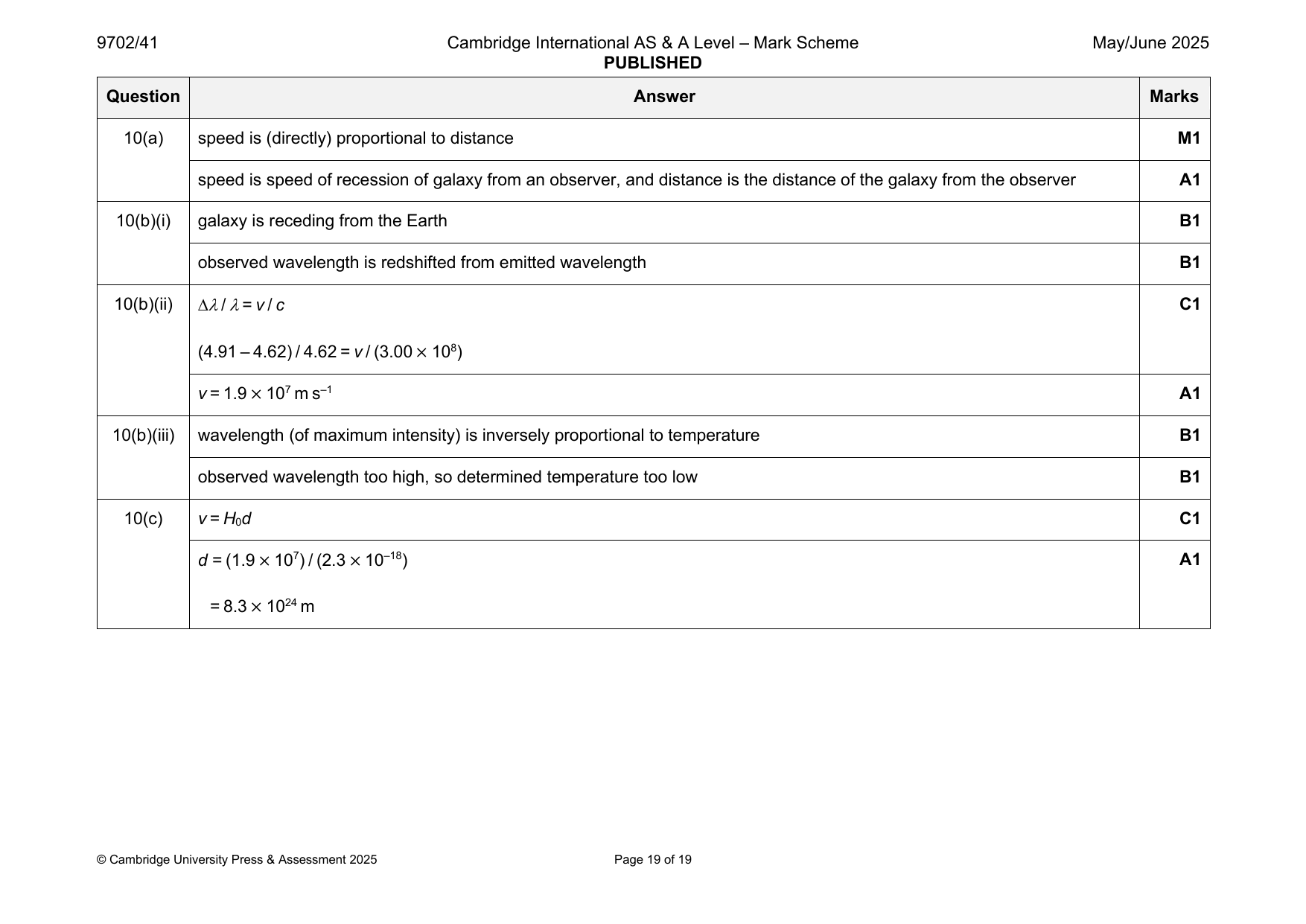
9702-2025-mj-41-q10
May/June 2025 · Paper 41 · Question 10 · 10 marks
10(a) speed is (directly) proportional to distance M1
speed is speed of recession of galaxy from an observer, and distance is the distance of the galaxy from the observer A1
10(b)(i) galaxy is receding from the Earth B1
observed wavelength is redshifted from emitted wavelength B1
10(b)(ii) / = v / c C1
(4.91 – 4.62) / 4.62 = v / (3.00 × 10⁸)
v = 1.9 × 10⁷ m s–1 A1
10(b)(iii) wavelength (of maximum intensity) is inversely proportional to temperature B1
observed wavelength too high, so determined temperature too low B1
10(c) v = H d C1
0
d = (1.9 × 10⁷) / (2.3 × 10⁻¹⁸) A1
= 8.3 × 1024 m
© Cambridge University Press & Assessment 2025 Page 19 of 19
Official mark scheme pages: 19 · source PDF URL
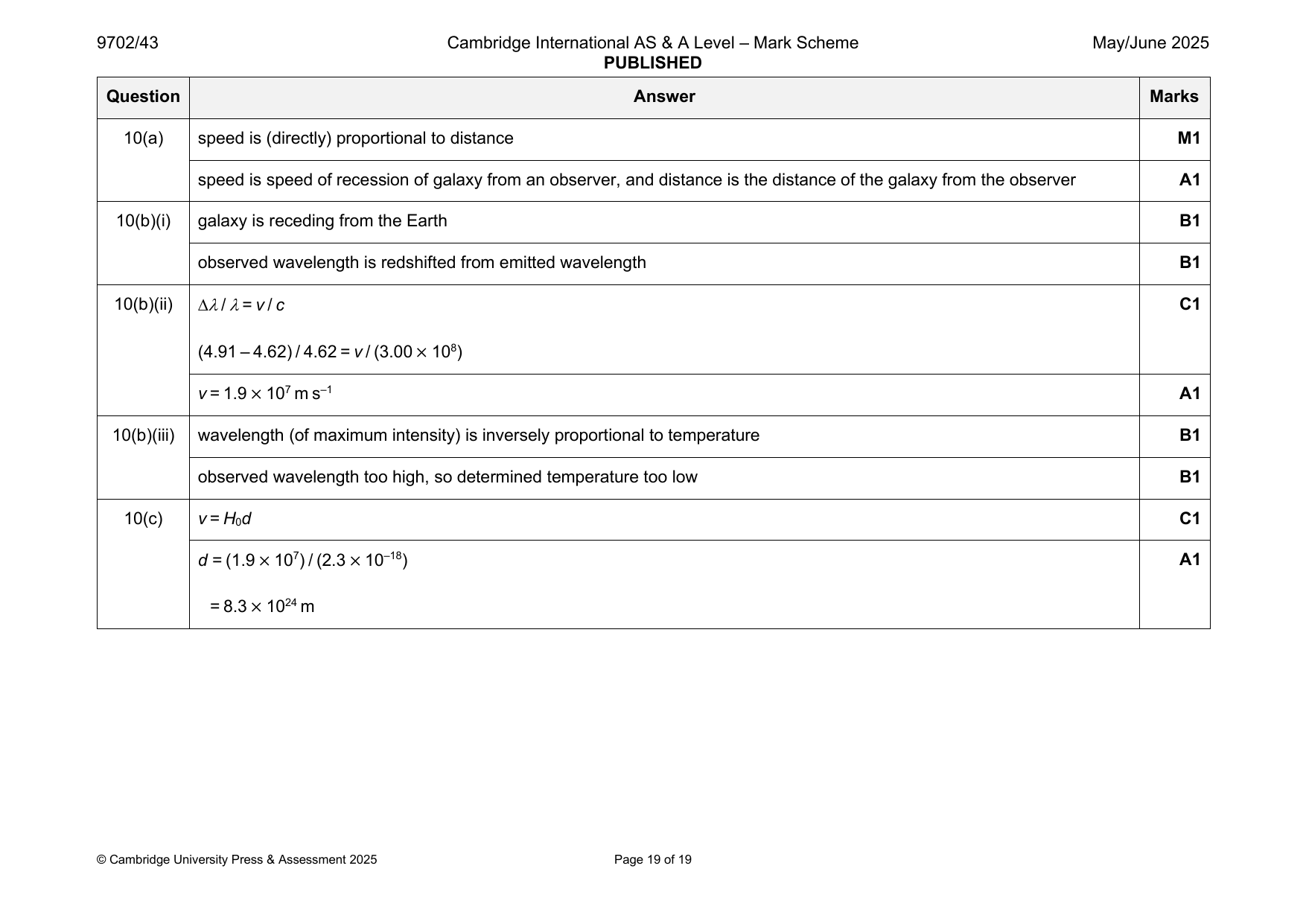
9702-2025-mj-43-q10
May/June 2025 · Paper 43 · Question 10 · 10 marks
10(a) speed is (directly) proportional to distance M1
speed is speed of recession of galaxy from an observer, and distance is the distance of the galaxy from the observer A1
10(b)(i) galaxy is receding from the Earth B1
observed wavelength is redshifted from emitted wavelength B1
10(b)(ii) / = v / c C1
(4.91 – 4.62) / 4.62 = v / (3.00 × 10⁸)
v = 1.9 × 10⁷ m s–1 A1
10(b)(iii) wavelength (of maximum intensity) is inversely proportional to temperature B1
observed wavelength too high, so determined temperature too low B1
10(c) v = H d C1
0
d = (1.9 × 10⁷) / (2.3 × 10⁻¹⁸) A1
= 8.3 × 1024 m
© Cambridge University Press & Assessment 2025 Page 19 of 19
Official mark scheme pages: 19 · source PDF URL
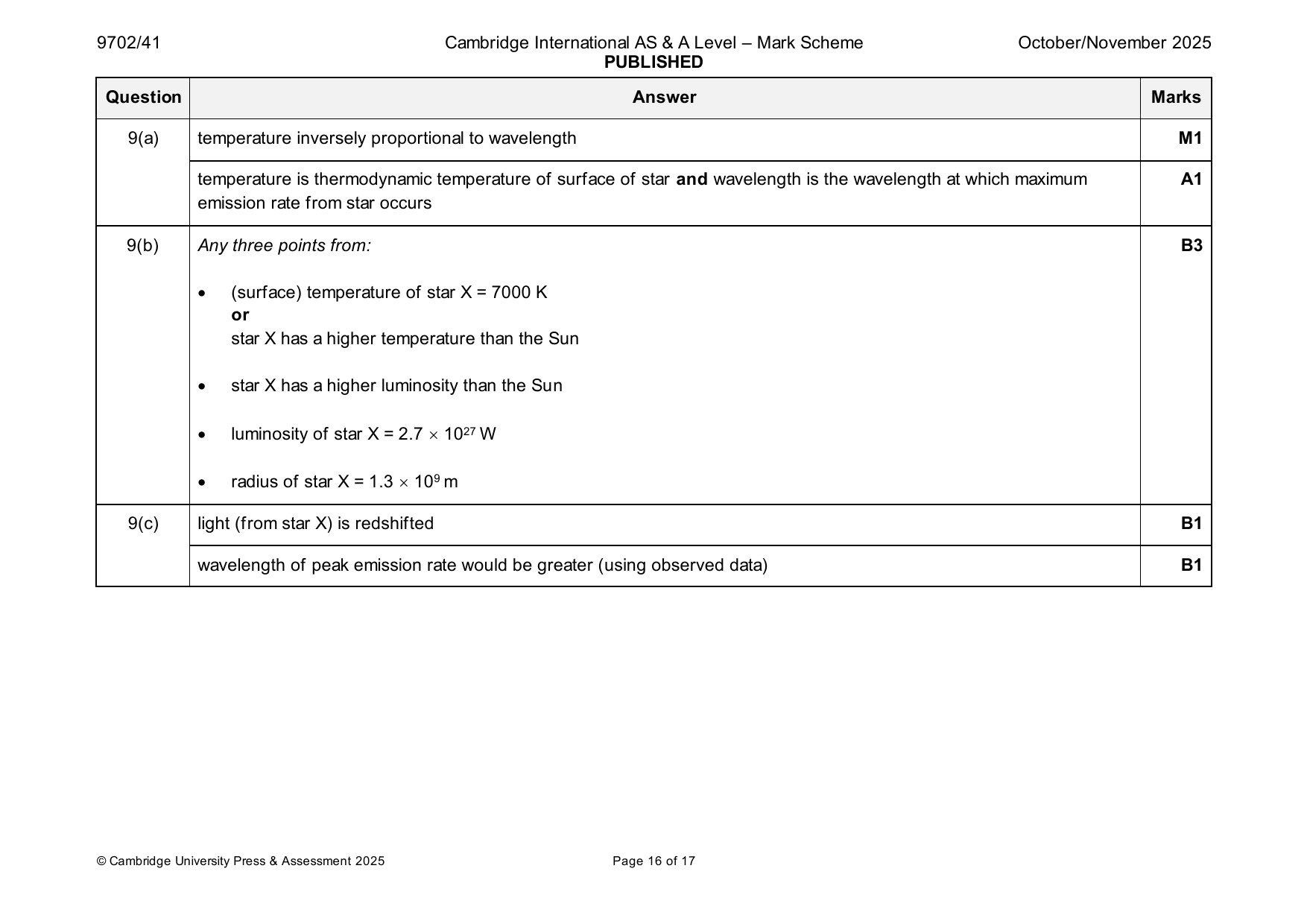
9702-2025-on-41-q09
Oct/Nov 2025 · Paper 41 · Question 9 · 7 marks
9(a) temperature inversely proportional to wavelength M1
temperature is thermodynamic temperature of surface of star and wavelength is the wavelength at which maximum A1
emission rate from star occurs
9(b) Any three points from: B3
• (surface) temperature of star X = 7000 K
or
star X has a higher temperature than the Sun
• star X has a higher luminosity than the Sun
• luminosity of star X = 2.7 1027 W
• radius of star X = 1.3 109 m
9(c) light (from star X) is redshifted B1
wavelength of peak emission rate would be greater (using observed data) B1
© Cambridge University Press & Assessment 2025 Page 16 of 17
Official mark scheme pages: 16 · source PDF URL
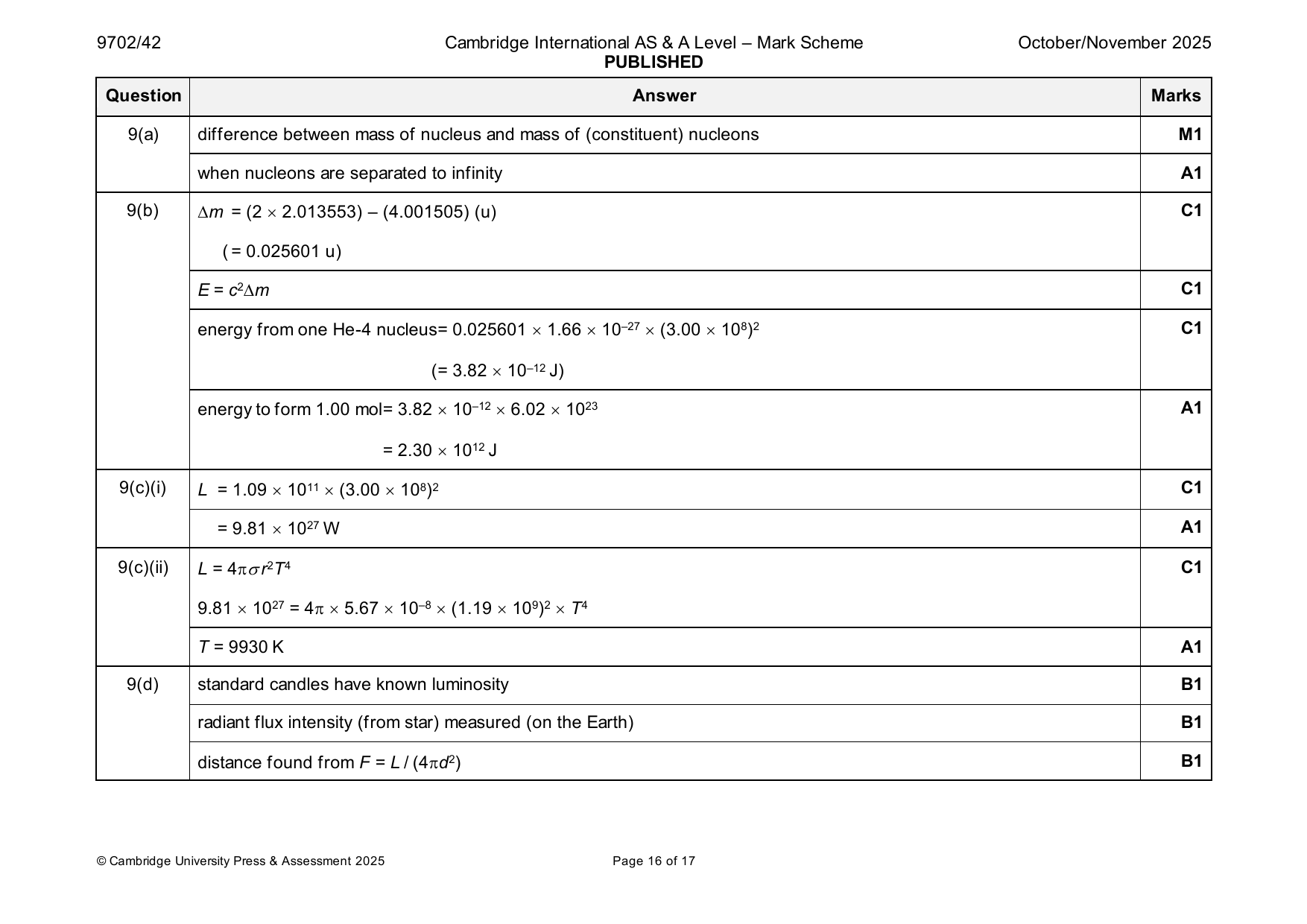
9702-2025-on-42-q09
Oct/Nov 2025 · Paper 42 · Question 9 · 13 marks
9(a) difference between mass of nucleus and mass of (constituent) nucleons M1
when nucleons are separated to infinity A1
9(b) m = (2 2.013553) – (4.001505) (u) C1
( = 0.025601 u)
E = c2m C1
energy from one He-4 nucleus= 0.025601 1.66 10–27 (3.00 108)2 C1
(= 3.82 10–12 J)
energy to form 1.00 mol= 3.82 10–12 6.02 1023 A1
= 2.30 1012 J
9(c)(i) L = 1.09 1011 (3.00 108)2 C1
= 9.81 1027 W A1
9(c)(ii) L = 4 r2T4 C1
9.81 1027 = 4 5.67 10–8 (1.19 109)2 T4
T = 9930 K A1
9(d) standard candles have known luminosity B1
radiant flux intensity (from star) measured (on the Earth) B1
distance found from F = L / (4d2) B1
© Cambridge University Press & Assessment 2025 Page 16 of 17
Official mark scheme pages: 16 · source PDF URL
9702-2025-on-43-q09
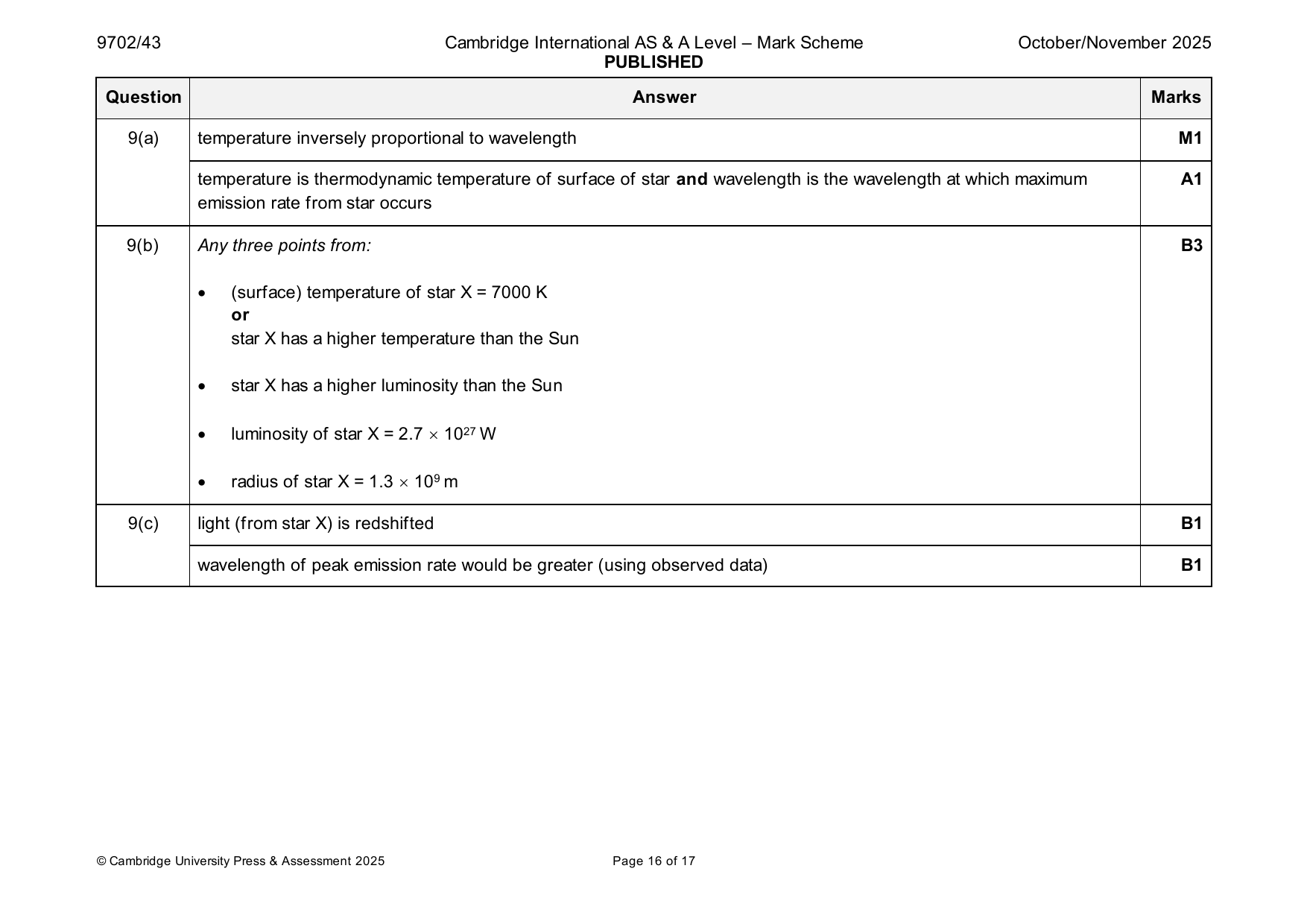
Oct/Nov 2025 · Paper 43 · Question 9 · 7 marks
9(a) temperature inversely proportional to wavelength M1
temperature is thermodynamic temperature of surface of star and wavelength is the wavelength at which maximum A1
emission rate from star occurs
9(b) Any three points from: B3
• (surface) temperature of star X = 7000 K
or
star X has a higher temperature than the Sun
• star X has a higher luminosity than the Sun
• luminosity of star X = 2.7 1027 W
• radius of star X = 1.3 109 m
9(c) light (from star X) is redshifted B1
wavelength of peak emission rate would be greater (using observed data) B1
© Cambridge University Press & Assessment 2025 Page 16 of 17
Official mark scheme pages: 16 · source PDF URL