Try the new view →
9702-2021-m-42-q12
March 2021 · Paper 42 · Question 12 · 6 marks
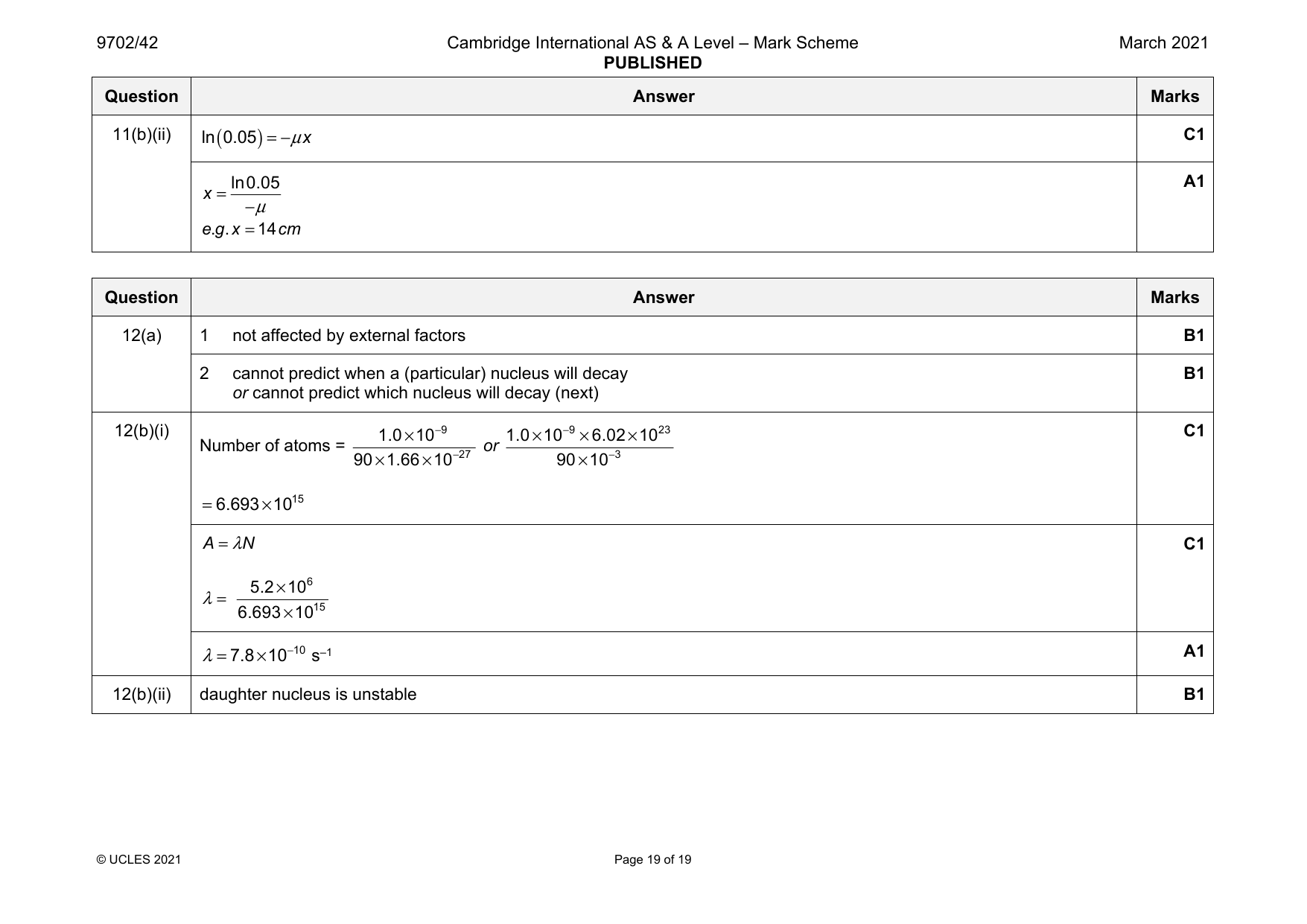
12(a) 1 not affected by external factors B1
2 cannot predict when a (particular) nucleus will decay B1
or cannot predict which nucleus will decay (next)
12(b)(i) 1.0×10 −9 1.0×10 −9×6.02×1023 C1
Number of atoms = or
90×1.66×10 −27 90×10 −3
=6.693×10¹⁵
A=λN C1
5.2×10⁶
λ=
6.693×10¹⁵
λ=7.8×10 −10 s–1 A1
12(b)(ii) daughter nucleus is unstable B1
© UCLES 2021 Page 19 of 19
Official mark scheme pages: 19 · source PDF URL
9702-2021-mj-41-q06
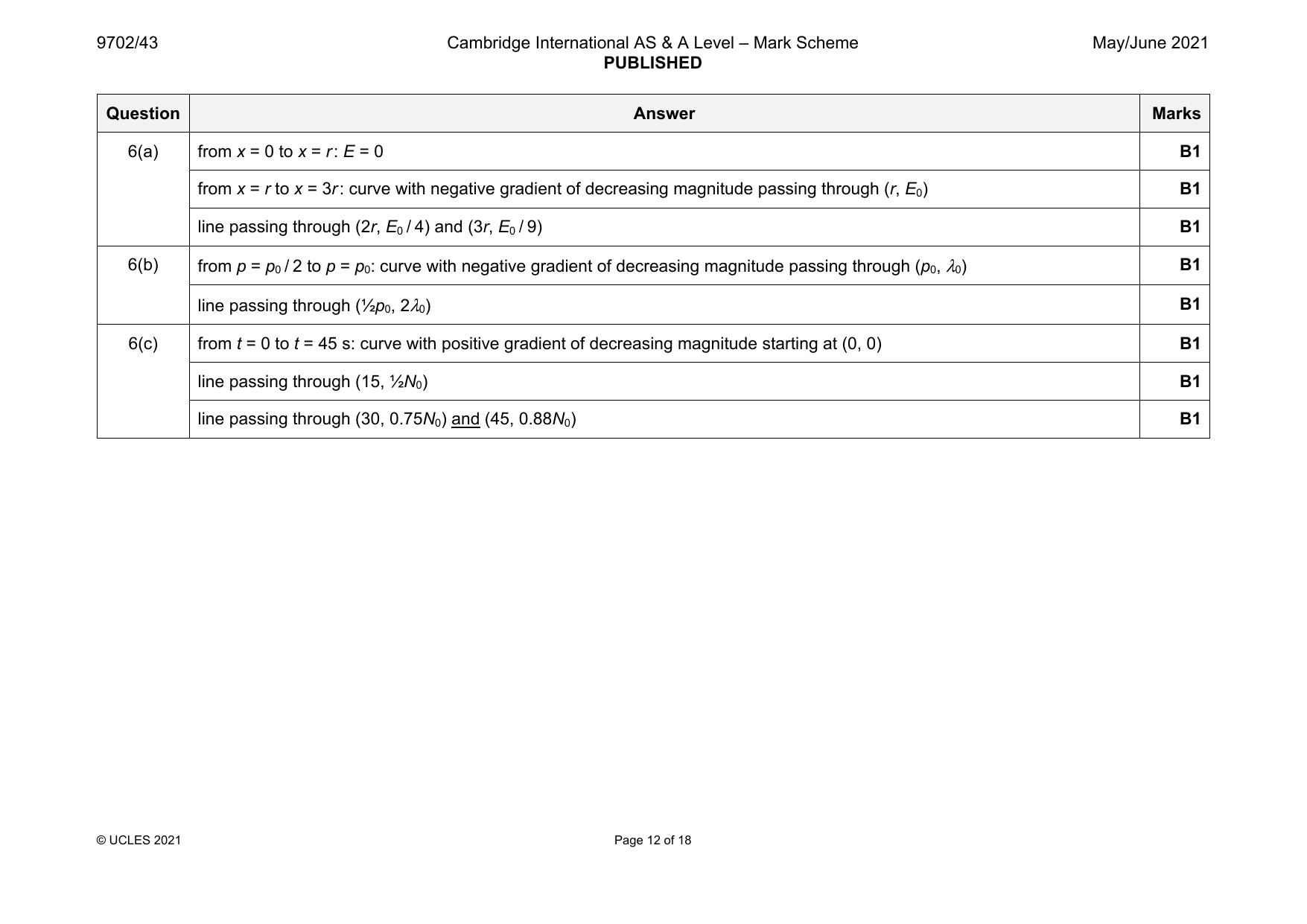
May/June 2021 · Paper 41 · Question 6 · 8 marks
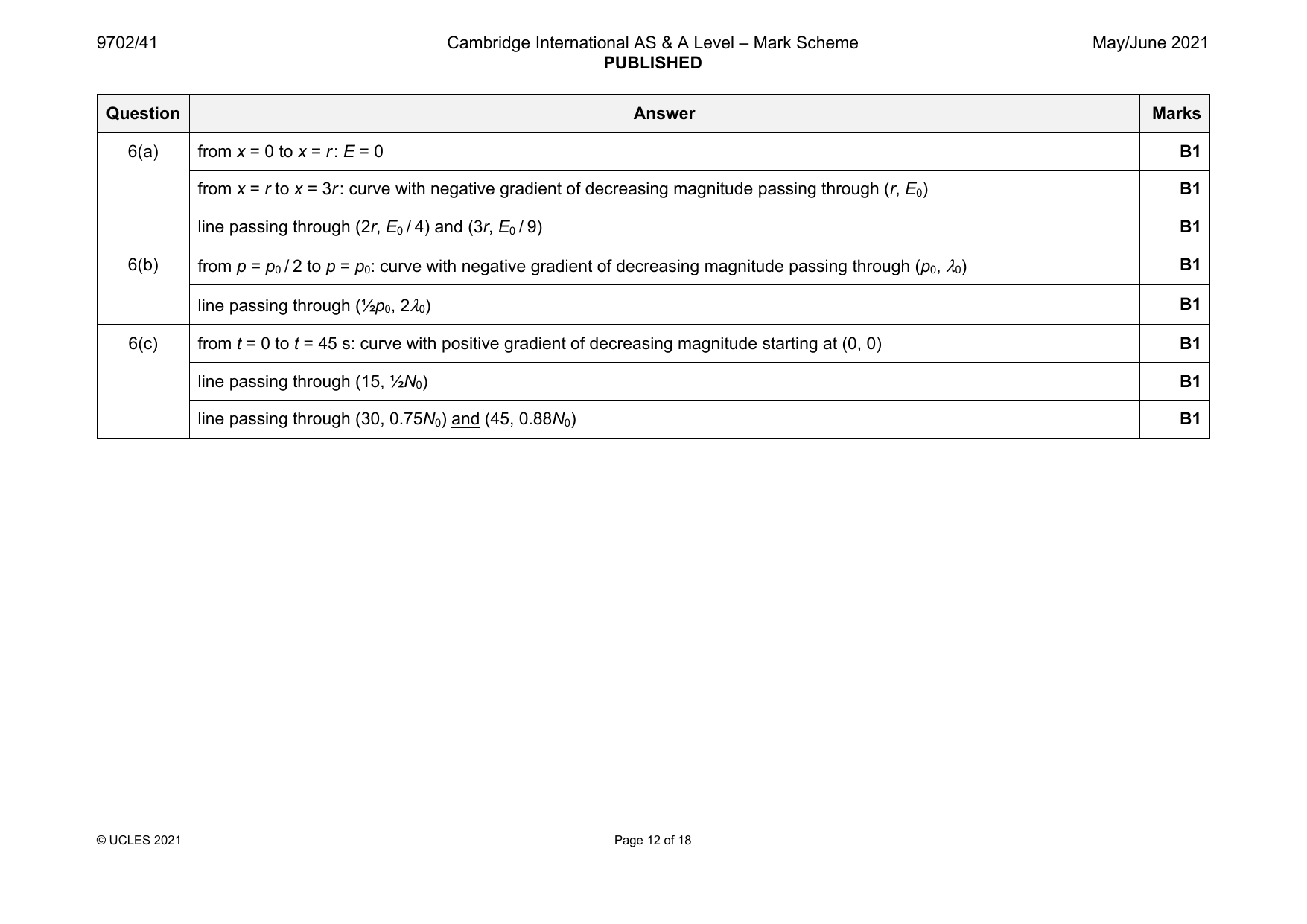
6(a) from x = 0 to x = r: E = 0 B1
from x = r to x = 3r: curve with negative gradient of decreasing magnitude passing through (r, E ) B1
0
line passing through (2r, E / 4) and (3r, E / 9) B1
0 0
6(b) from p = p / 2 to p = p : curve with negative gradient of decreasing magnitude passing through (p , λ) B1
0 0 0 0
line passing through (½p , 2λ) B1
0 0
6(c) from t = 0 to t = 45 s: curve with positive gradient of decreasing magnitude starting at (0, 0) B1
line passing through (15, ½N ) B1
0
line passing through (30, 0.75N ) and (45, 0.88N ) B1
0 0
© UCLES 2021 Page 12 of 18
Official mark scheme pages: 12 · source PDF URL
9702-2021-mj-42-q05
May/June 2021 · Paper 42 · Question 5 · 9 marks
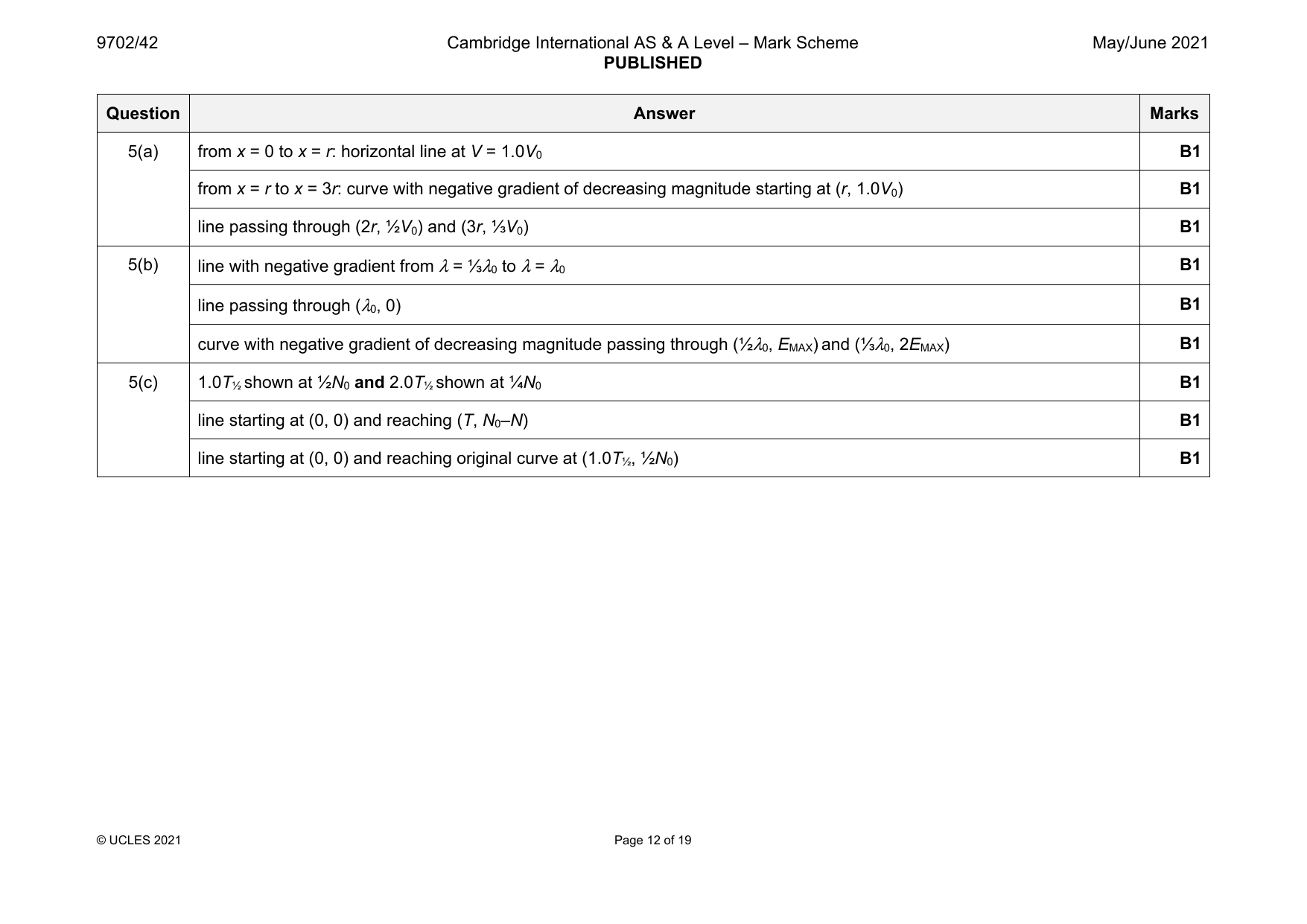
5(a) from x = 0 to x = r: horizontal line at V = 1.0V B1
0
from x = r to x = 3r: curve with negative gradient of decreasing magnitude starting at (r, 1.0V ) B1
0
line passing through (2r, ½V ) and (3r, ⅓V ) B1
0 0
5(b) line with negative gradient from λ = ⅓λ to λ = λ B1
0 0
line passing through (λ, 0) B1
0
curve with negative gradient of decreasing magnitude passing through (½λ, E )and (⅓λ, 2E ) B1
0 MAX 0 MAX
5(c) 1.0T shown at ½N and 2.0T shown at ¼N B1
½ 0 ½ 0
line starting at (0, 0) and reaching (T, N –N) B1
0
line starting at (0, 0) and reaching original curve at (1.0T , ½N ) B1
½ 0
© UCLES 2021 Page 12 of 19
Official mark scheme pages: 12 · source PDF URL
9702-2021-mj-42-q12
May/June 2021 · Paper 42 · Question 12 · 9 marks
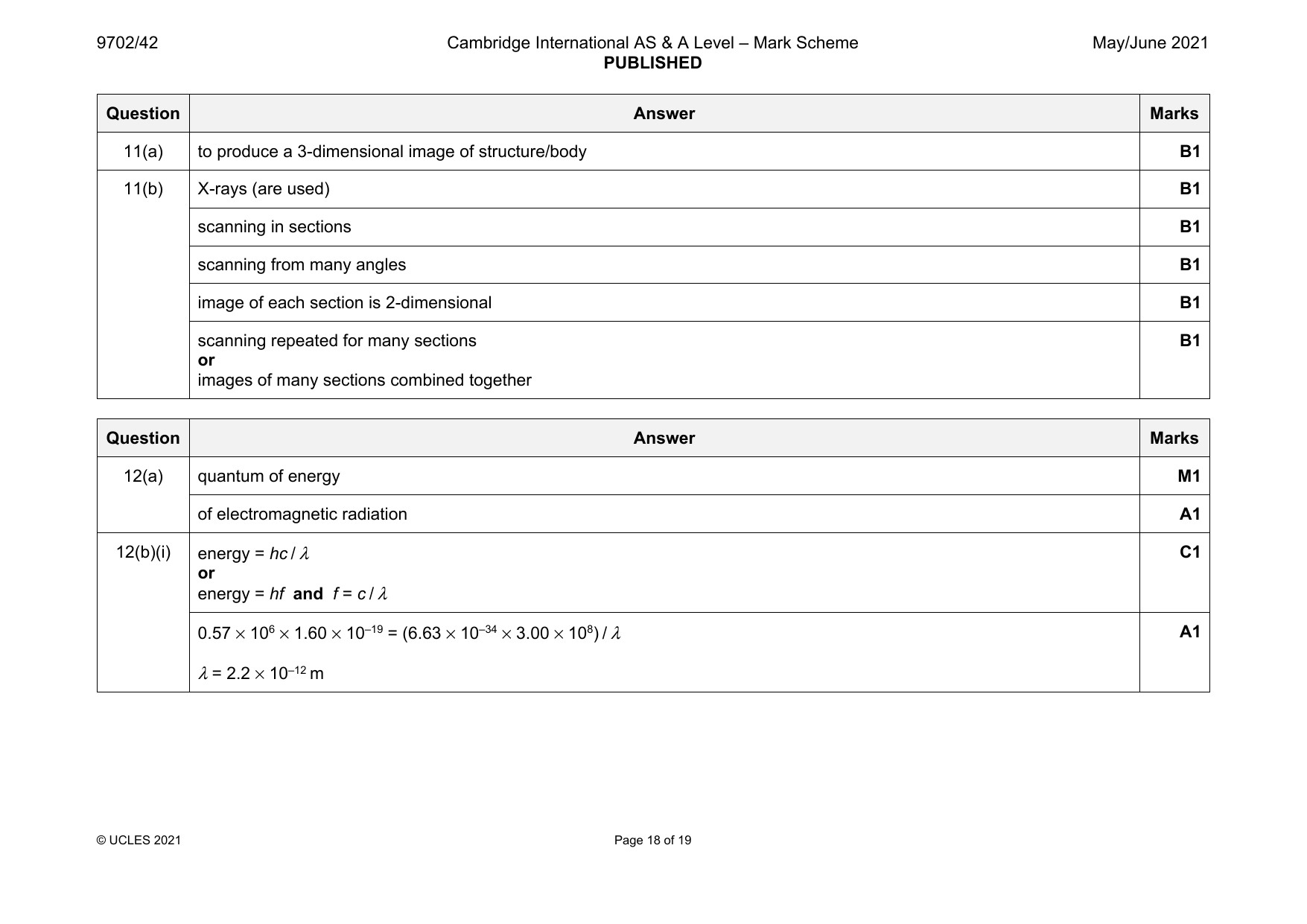
12(a) quantum of energy M1
of electromagnetic radiation A1
12(b)(i) energy = hc / λ C1
or
energy = hf and f = c / λ
0.57 × 106 × 1.60 × 10–19 = (6.63 × 10–34 × 3.00 × 108) / λ A1
λ = 2.2 × 10⁻¹² m
© UCLES 2021 Page 18 of 19
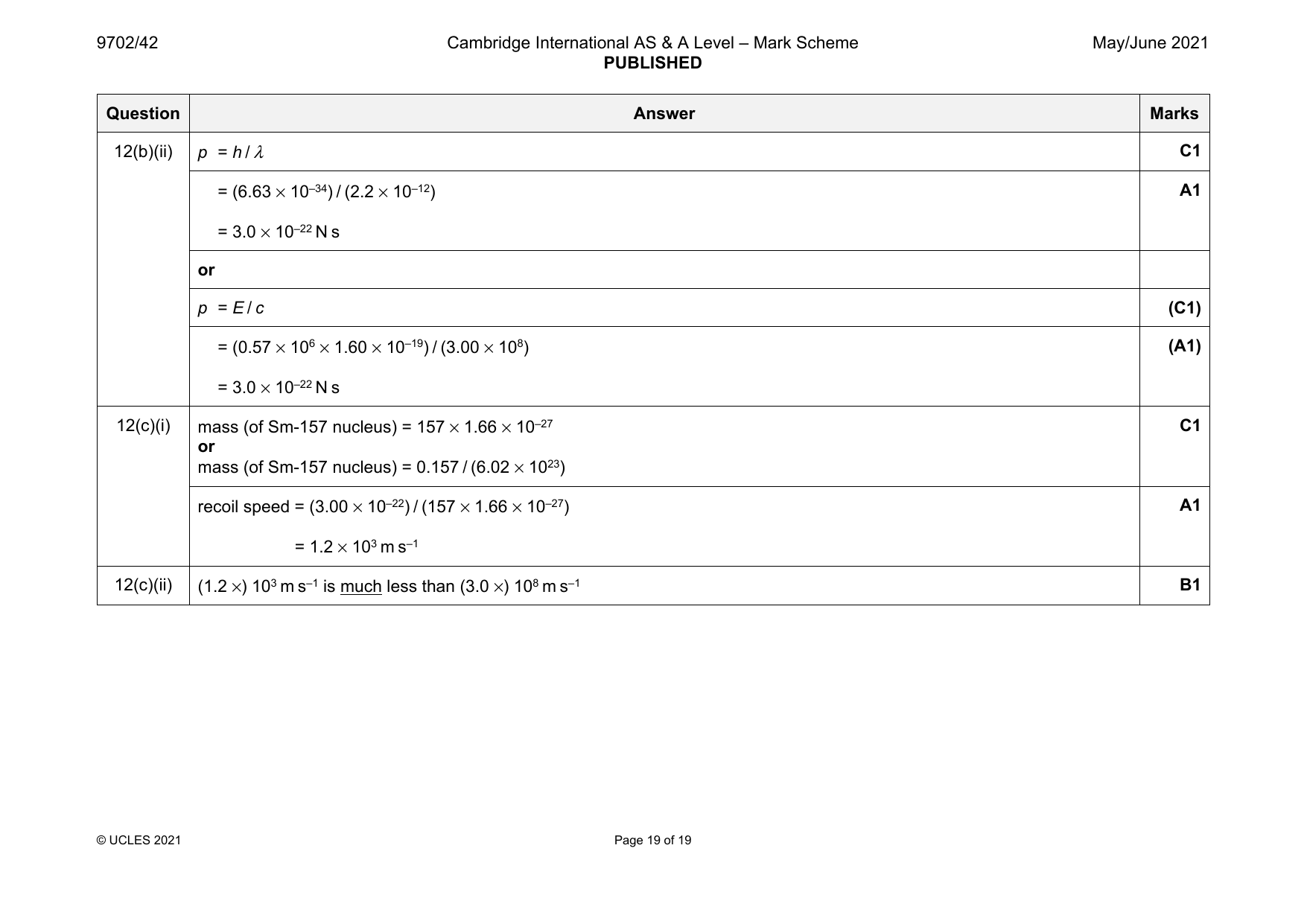
12(b)(ii) p = h / λ C1
= (6.63 × 10⁻³⁴) / (2.2 × 10⁻¹²) A1
= 3.0 × 10⁻²² N s
or
p = E / c (C1)
= (0.57 × 106 × 1.60 × 10–19) / (3.00 × 10⁸) (A1)
= 3.0 × 10⁻²² N s
12(c)(i) mass (of Sm-157 nucleus) = 157 × 1.66 × 10–27 C1
or
mass (of Sm-157 nucleus) = 0.157 / (6.02 × 10²³)
recoil speed = (3.00 × 10⁻²²) / (157 × 1.66 × 10–27) A1
= 1.2 × 10³ m s–1
12(c)(ii) (1.2 ×) 103 m s–1 is much less than (3.0 ×) 108 m s–1 B1
© UCLES 2021 Page 19 of 19
Official mark scheme pages: 18, 19 · source PDF URL
9702-2021-mj-43-q06
May/June 2021 · Paper 43 · Question 6 · 8 marks
6(a) from x = 0 to x = r: E = 0 B1
from x = r to x = 3r: curve with negative gradient of decreasing magnitude passing through (r, E ) B1
0
line passing through (2r, E / 4) and (3r, E / 9) B1
0 0
6(b) from p = p / 2 to p = p : curve with negative gradient of decreasing magnitude passing through (p , λ) B1
0 0 0 0
line passing through (½p , 2λ) B1
0 0
6(c) from t = 0 to t = 45 s: curve with positive gradient of decreasing magnitude starting at (0, 0) B1
line passing through (15, ½N ) B1
0
line passing through (30, 0.75N ) and (45, 0.88N ) B1
0 0
© UCLES 2021 Page 12 of 18
Official mark scheme pages: 12 · source PDF URL
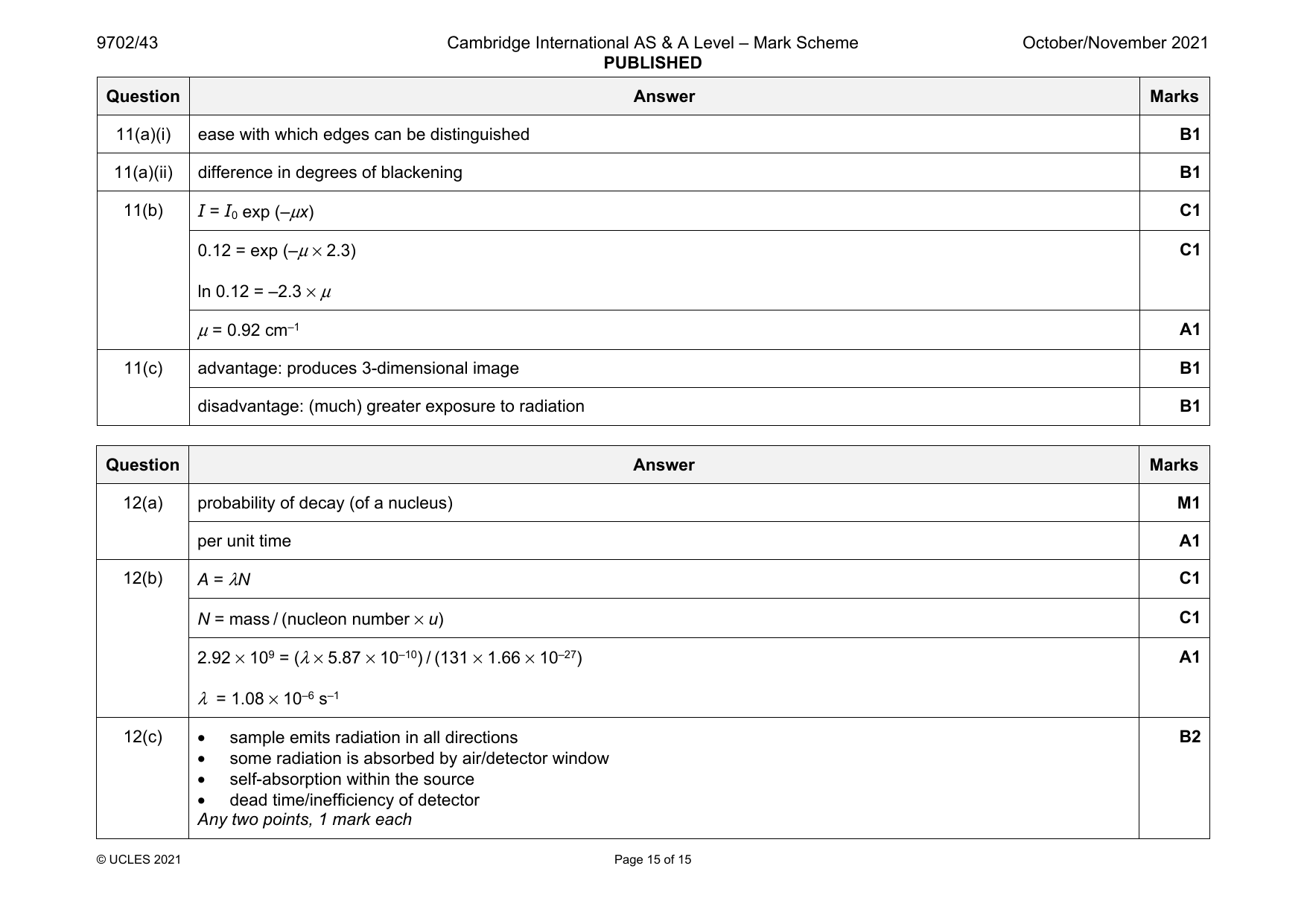
9702-2021-on-41-q12
Oct/Nov 2021 · Paper 41 · Question 12 · 7 marks
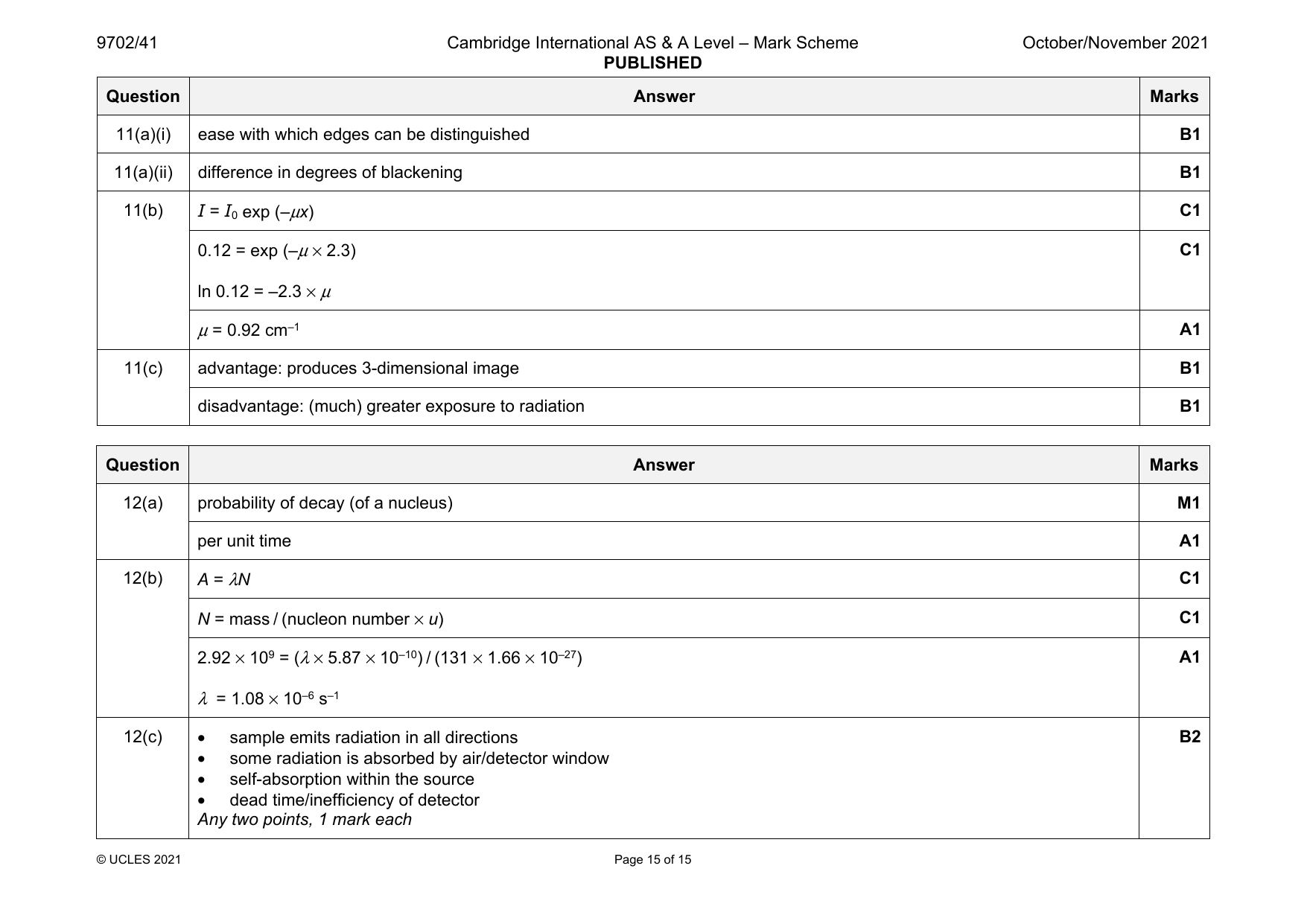
12(a) probability of decay (of a nucleus) M1
per unit time A1
12(b) A = λN C1
N = mass / (nucleon number × u) C1
2.92 × 109 = (λ × 5.87 × 10⁻¹⁰) / (131 × 1.66 × 10–27) A1
λ = 1.08 × 10⁻⁶ s–1
12(c) • sample emits radiation in all directions B2
• some radiation is absorbed by air/detector window
• self-absorption within the source
• dead time/inefficiency of detector
Any two points, 1 mark each
© UCLES 2021 Page 15 of 15
Official mark scheme pages: 15 · source PDF URL
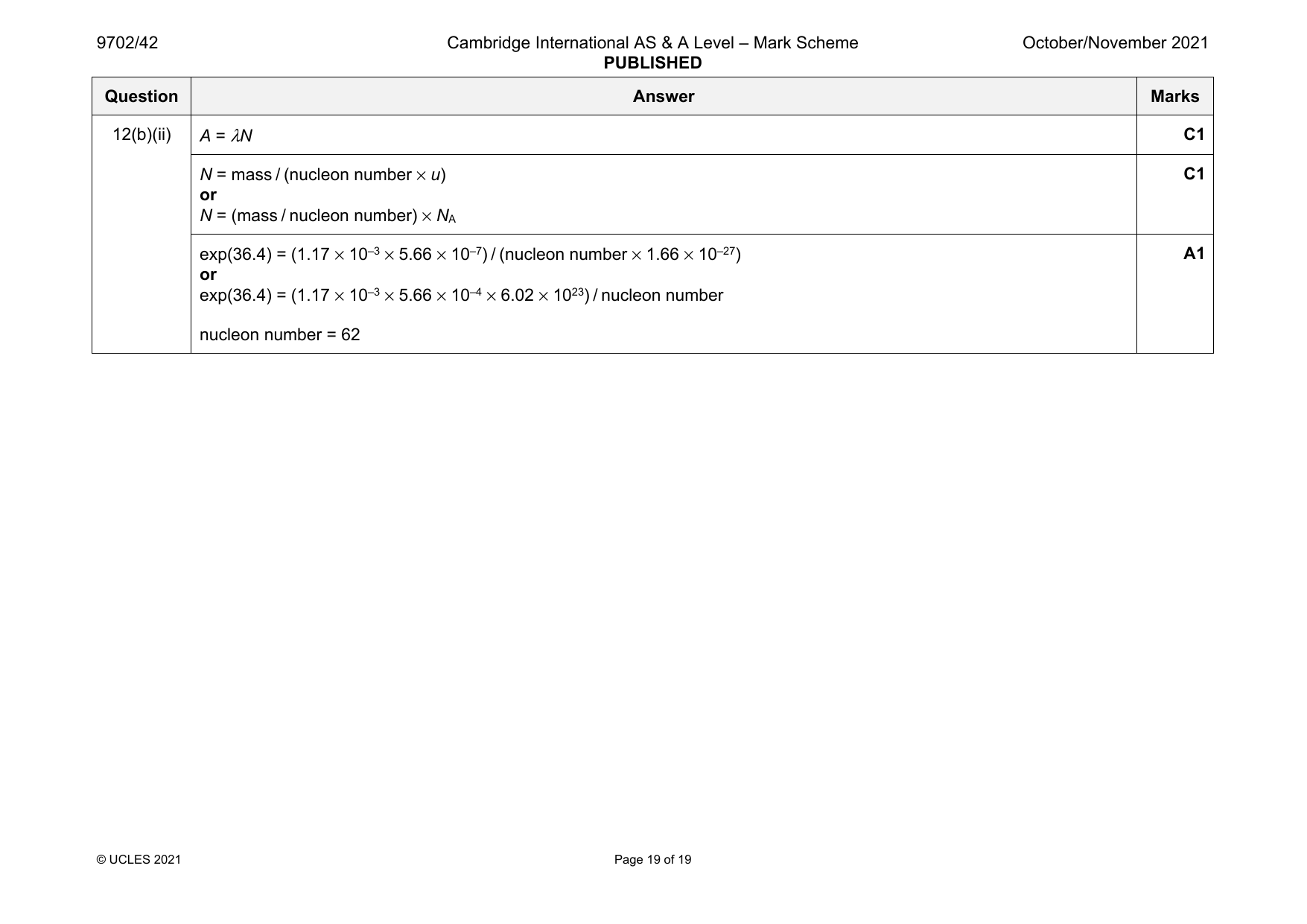
9702-2021-on-42-q12
Oct/Nov 2021 · Paper 42 · Question 12 · 8 marks
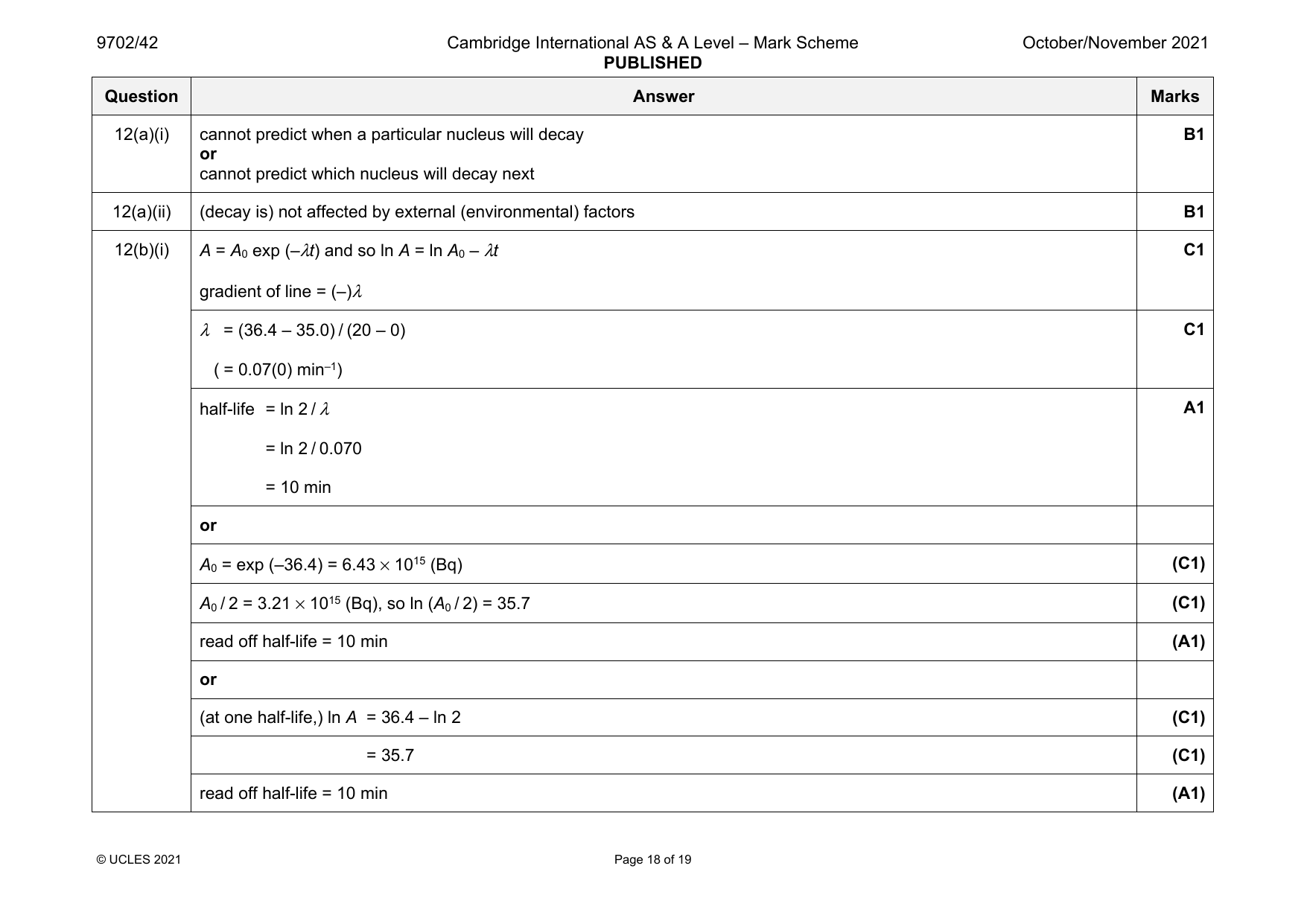
12(a)(i) cannot predict when a particular nucleus will decay B1
or
cannot predict which nucleus will decay next
12(a)(ii) (decay is) not affected by external (environmental) factors B1
12(b)(i) A = A exp (–λt) and so ln A = ln A – λt C1
0 0
gradient of line = (–)λ
λ = (36.4 – 35.0) / (20 – 0) C1
( = 0.07(0) min–1)
half-life = ln 2 / λ A1
= ln 2 / 0.070
= 10 min
or
A = exp (–36.4) = 6.43 × 10¹⁵ (Bq) (C1)
0
A / 2 = 3.21 × 10¹⁵ (Bq), so ln (A / 2) = 35.7 (C1)
0 0
read off half-life = 10 min (A1)
or
(at one half-life,) ln A = 36.4 – ln 2 (C1)
= 35.7 (C1)
read off half-life = 10 min (A1)
© UCLES 2021 Page 18 of 19
12(b)(ii) A = λN C1
N = mass / (nucleon number × u) C1
or
N = (mass / nucleon number) × N
A
exp(36.4) = (1.17 × 10–3 × 5.66 × 10–7) / (nucleon number × 1.66 × 10⁻²⁷) A1
or
exp(36.4) = (1.17 × 10–3 × 5.66 × 10–4 × 6.02 × 1023) / nucleon number
nucleon number = 62
© UCLES 2021 Page 19 of 19
Official mark scheme pages: 18, 19 · source PDF URL
9702-2021-on-43-q12
Oct/Nov 2021 · Paper 43 · Question 12 · 7 marks
12(a) probability of decay (of a nucleus) M1
per unit time A1
12(b) A = λN C1
N = mass / (nucleon number × u) C1
2.92 × 109 = (λ × 5.87 × 10⁻¹⁰) / (131 × 1.66 × 10–27) A1
λ = 1.08 × 10⁻⁶ s–1
12(c) • sample emits radiation in all directions B2
• some radiation is absorbed by air/detector window
• self-absorption within the source
• dead time/inefficiency of detector
Any two points, 1 mark each
© UCLES 2021 Page 15 of 15
Official mark scheme pages: 15 · source PDF URL
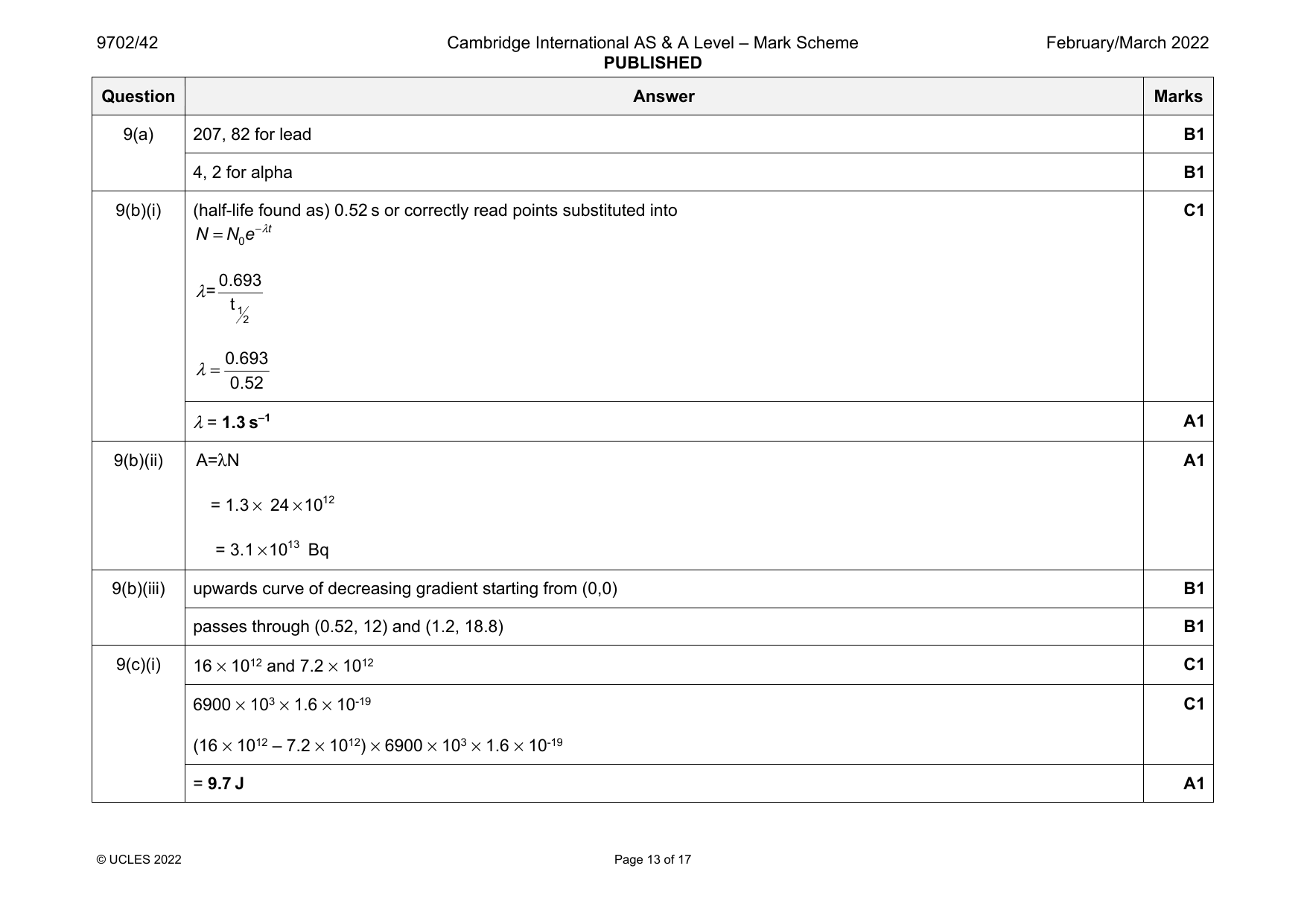
9702-2022-m-42-q09
March 2022 · Paper 42 · Question 9 · 11 marks
9(a) 207, 82 for lead B1
4, 2 for alpha B1
9(b)(i) (half-life found as) 0.52 s or correctly read points substituted into C1
N =N e −λt
0
0.693
λ=
t
1
2
0.693
λ=
0.52
λ = 1.3 s–1 A1
9(b)(ii) A=λN A1
= 1.3 × 24 ×1012
= 3.1 ×10¹³ Bq
9(b)(iii) upwards curve of decreasing gradient starting from (0,0) B1
passes through (0.52, 12) and (1.2, 18.8) B1
9(c)(i) 16 × 1012 and 7.2 × 10¹² C1
6900 × 103 × 1.6 × 10-19 C1
(16 × 1012 – 7.2 × 1012) × 6900 × 103 × 1.6 × 10-19
= 9.7 J A1
© UCLES 2022 Page 13 of 17
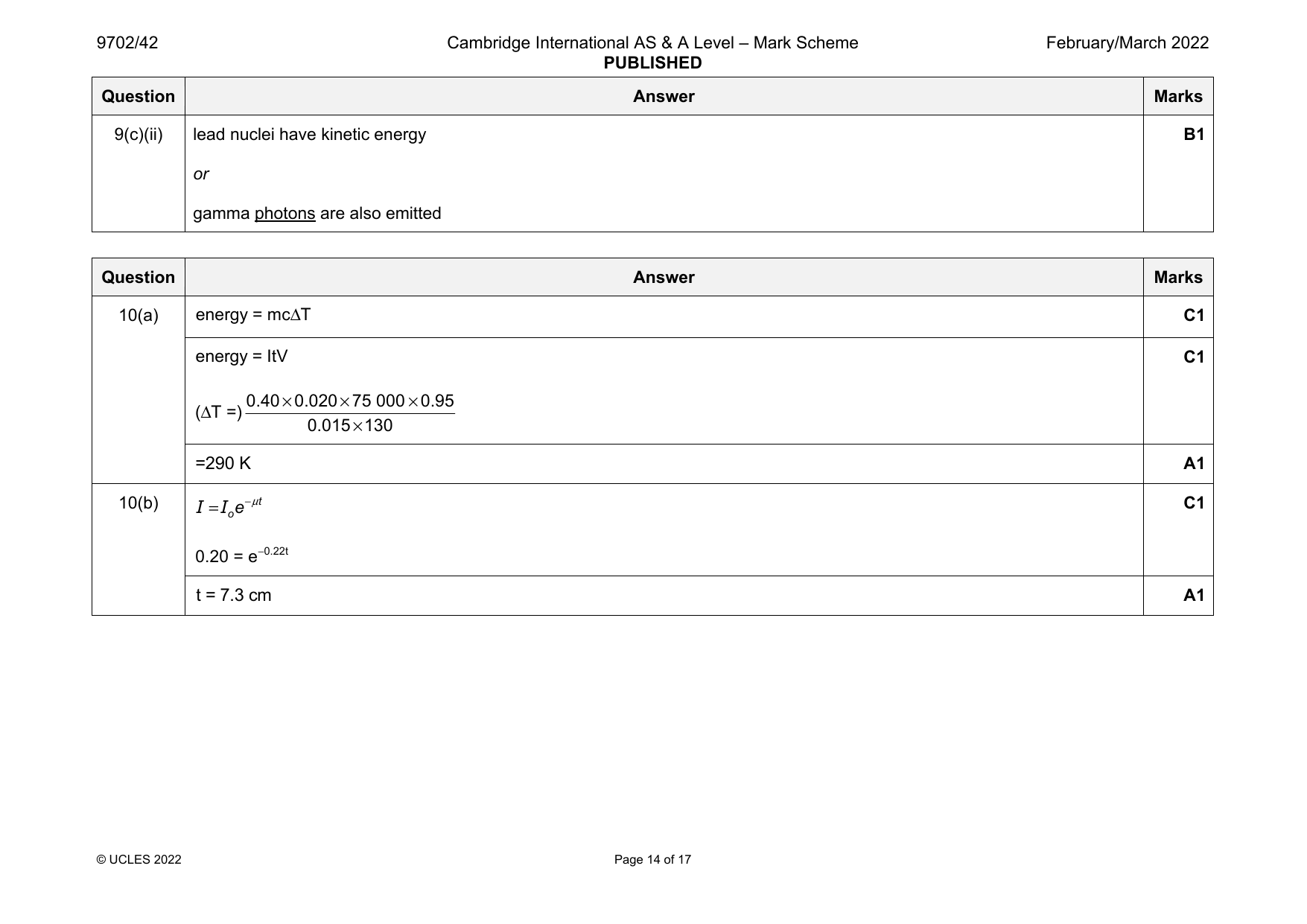
9(c)(ii) lead nuclei have kinetic energy B1
or
gamma photons are also emitted
Question Answer Marks
Official mark scheme pages: 13, 14 · source PDF URL
9702-2022-mj-41-q08
May/June 2022 · Paper 41 · Question 8 · 12 marks
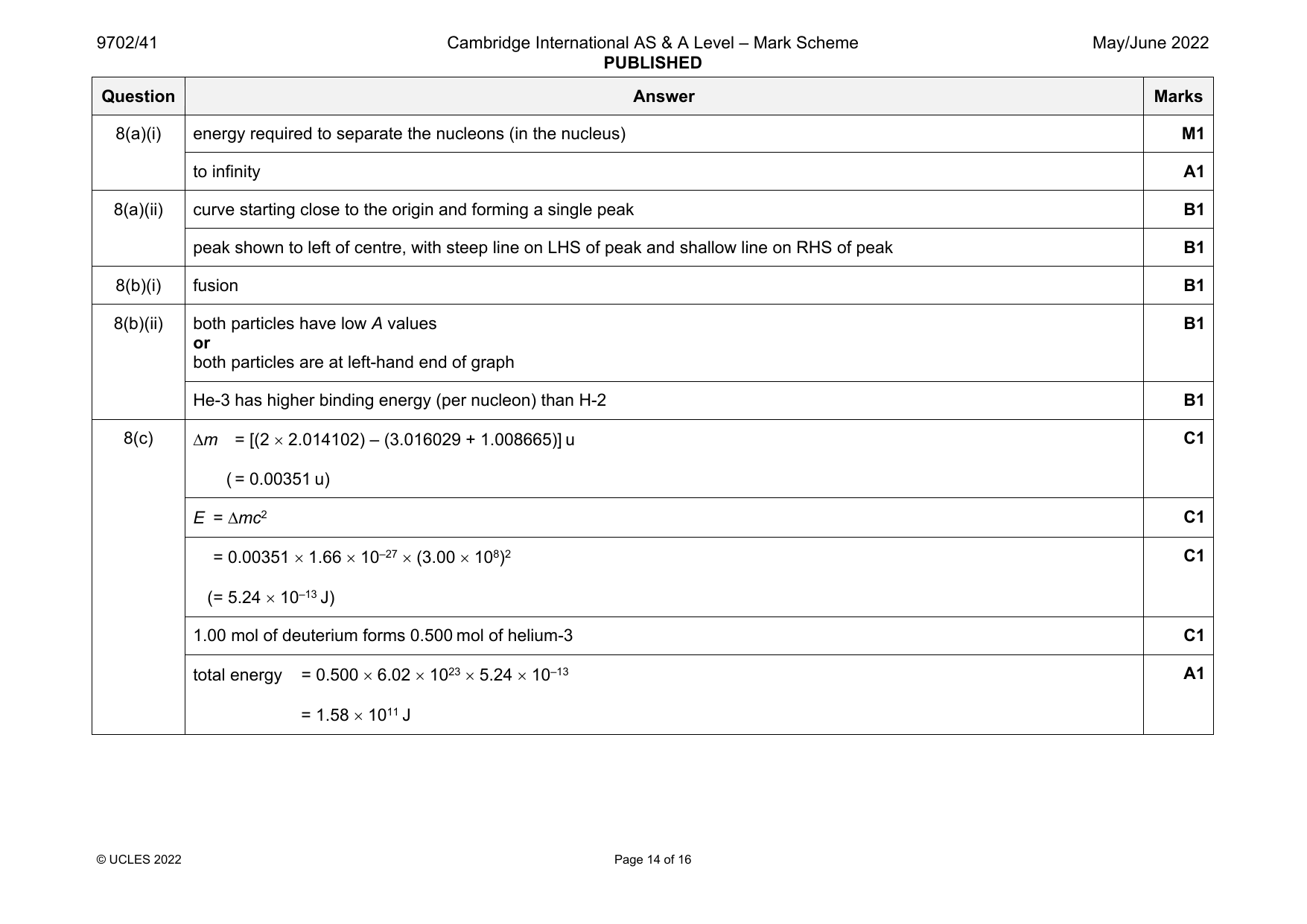
8(a)(i) energy required to separate the nucleons (in the nucleus) M1
to infinity A1
8(a)(ii) curve starting close to the origin and forming a single peak B1
peak shown to left of centre, with steep line on LHS of peak and shallow line on RHS of peak B1
8(b)(i) fusion B1
8(b)(ii) both particles have low A values B1
or
both particles are at left-hand end of graph
He-3 has higher binding energy (per nucleon) than H-2 B1
8(c) m = [(2 2.014102) – (3.016029 + 1.008665)] u C1
( = 0.00351 u)
E = mc2 C1
= 0.00351 1.66 10–27 (3.00 108)2 C1
( = 5.24 10–13 J)
1.00 mol of deuterium forms 0.500 mol of helium-3 C1
total energy = 0.500 6.02 1023 5.24 10–13 A1
= 1.58 1011 J
© UCLES 2022 Page 14 of 16
Official mark scheme pages: 14 · source PDF URL
9702-2022-mj-42-q10
May/June 2022 · Paper 42 · Question 10 · 11 marks
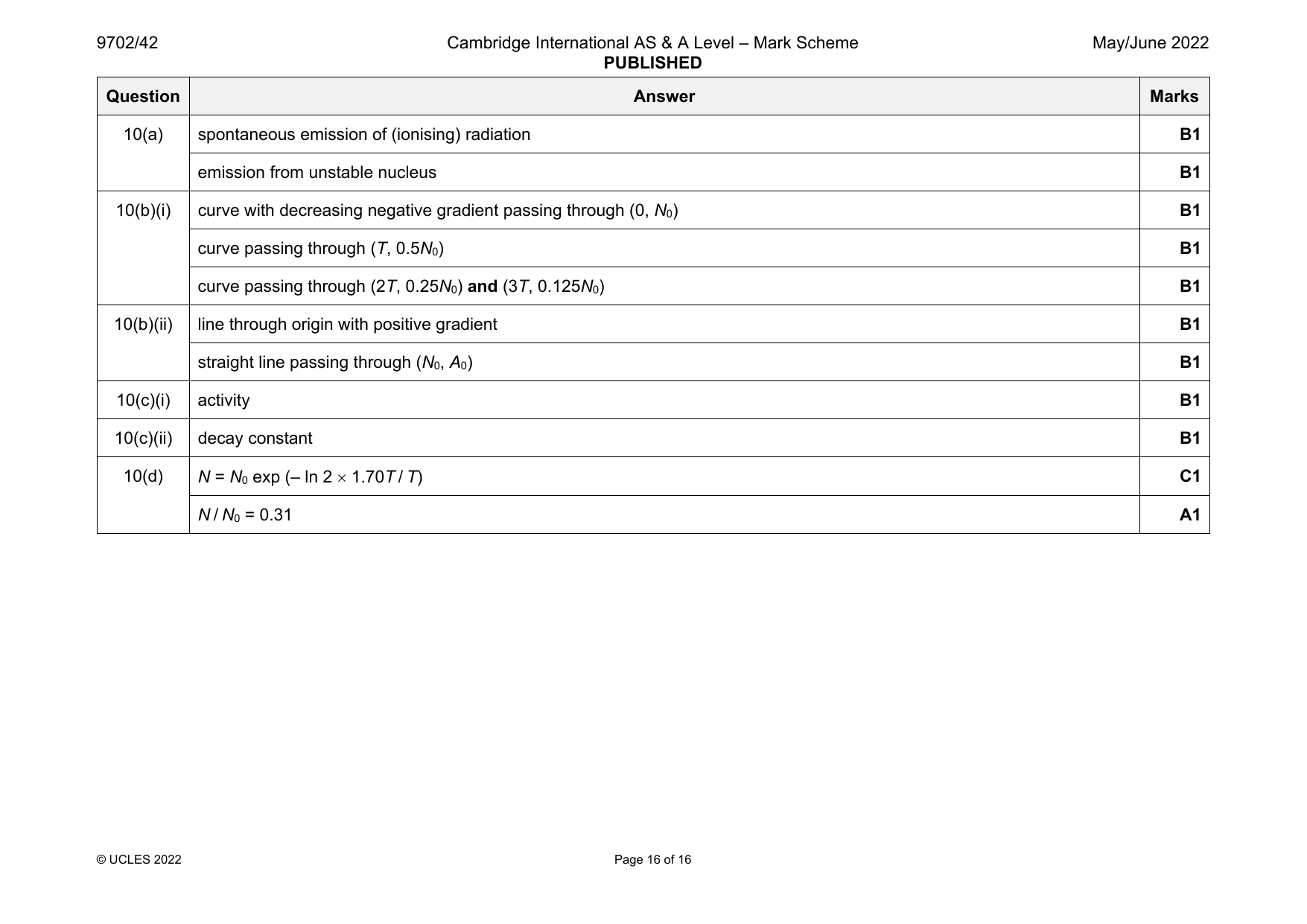
10(a) spontaneous emission of (ionising) radiation B1
emission from unstable nucleus B1
10(b)(i) curve with decreasing negative gradient passing through (0, N ) B1
0
curve passing through (T, 0.5N ) B1
0
curve passing through (2T, 0.25N ) and (3T, 0.125N ) B1
0 0
10(b)(ii) line through origin with positive gradient B1
straight line passing through (N , A ) B1
0 0
10(c)(i) activity B1
10(c)(ii) decay constant B1
10(d) N = N exp (– ln 2 1.70T / T) C1
0
N / N = 0.31 A1
0
© UCLES 2022 Page 16 of 16
Official mark scheme pages: 16 · source PDF URL
9702-2022-mj-43-q08
May/June 2022 · Paper 43 · Question 8 · 12 marks
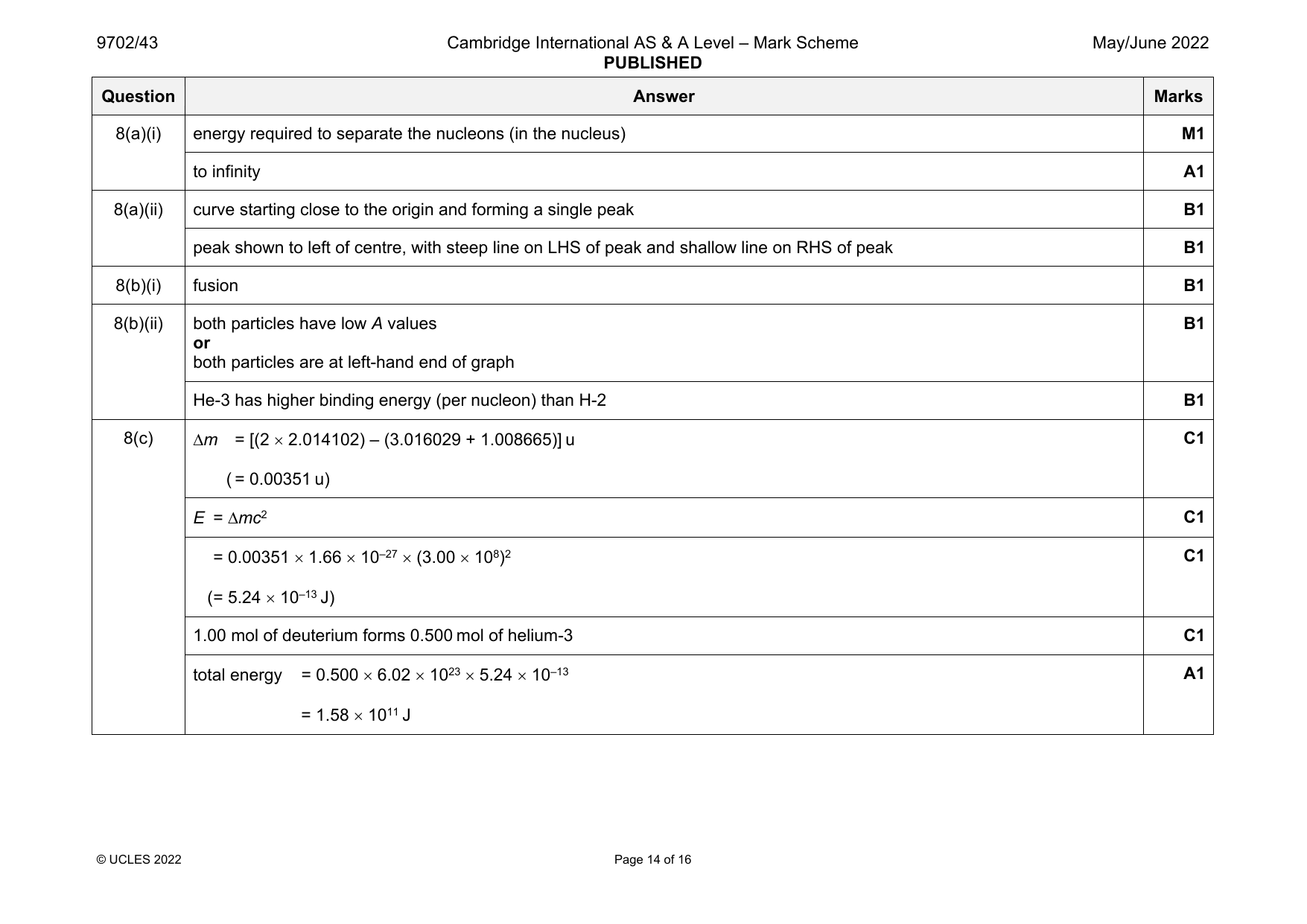
8(a)(i) energy required to separate the nucleons (in the nucleus) M1
to infinity A1
8(a)(ii) curve starting close to the origin and forming a single peak B1
peak shown to left of centre, with steep line on LHS of peak and shallow line on RHS of peak B1
8(b)(i) fusion B1
8(b)(ii) both particles have low A values B1
or
both particles are at left-hand end of graph
He-3 has higher binding energy (per nucleon) than H-2 B1
8(c) m = [(2 2.014102) – (3.016029 + 1.008665)] u C1
( = 0.00351 u)
E = mc2 C1
= 0.00351 1.66 10–27 (3.00 108)2 C1
( = 5.24 10–13 J)
1.00 mol of deuterium forms 0.500 mol of helium-3 C1
total energy = 0.500 6.02 1023 5.24 10–13 A1
= 1.58 1011 J
© UCLES 2022 Page 14 of 16
Official mark scheme pages: 14 · source PDF URL
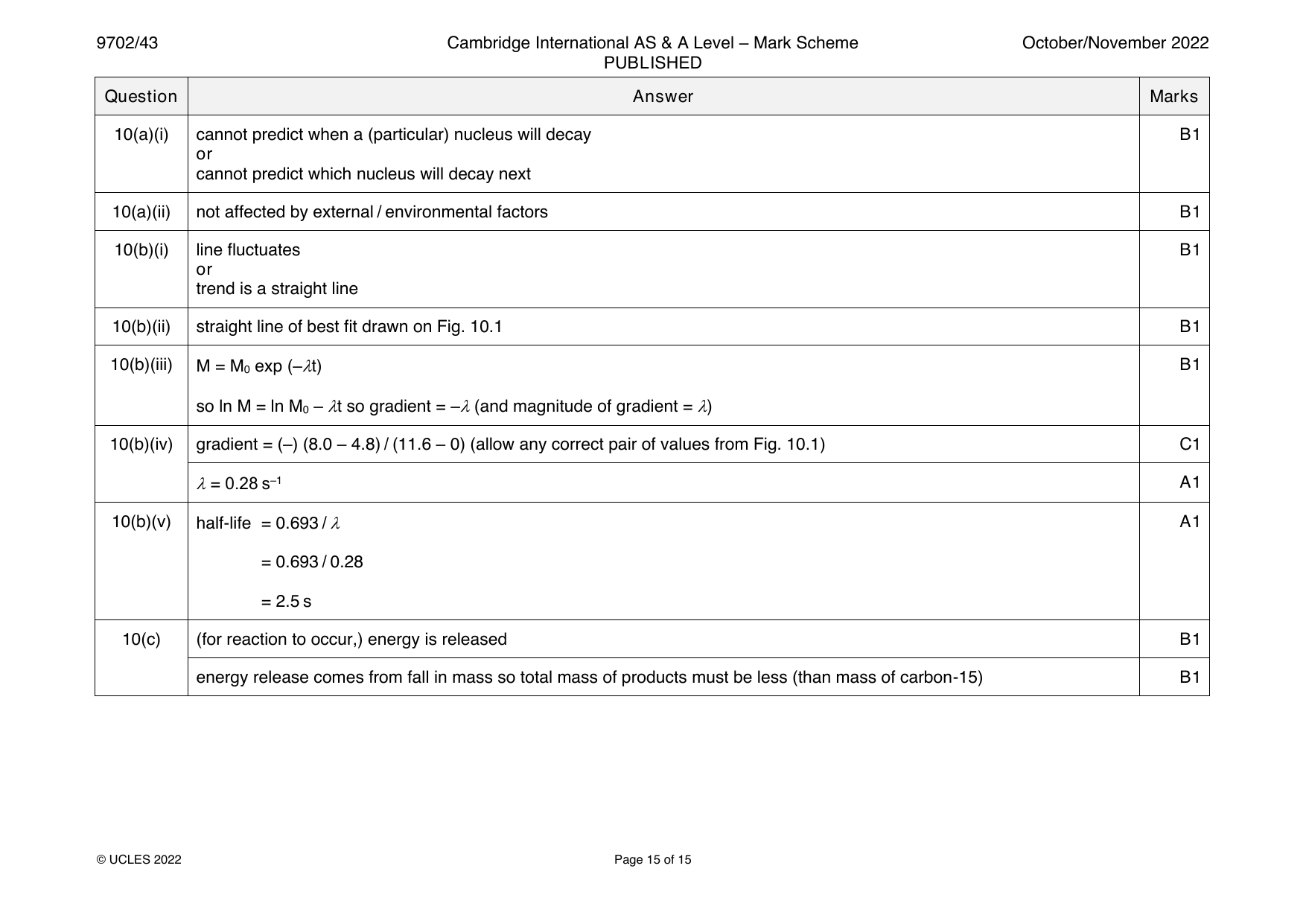
9702-2022-on-41-q10
Oct/Nov 2022 · Paper 41 · Question 10 · 10 marks
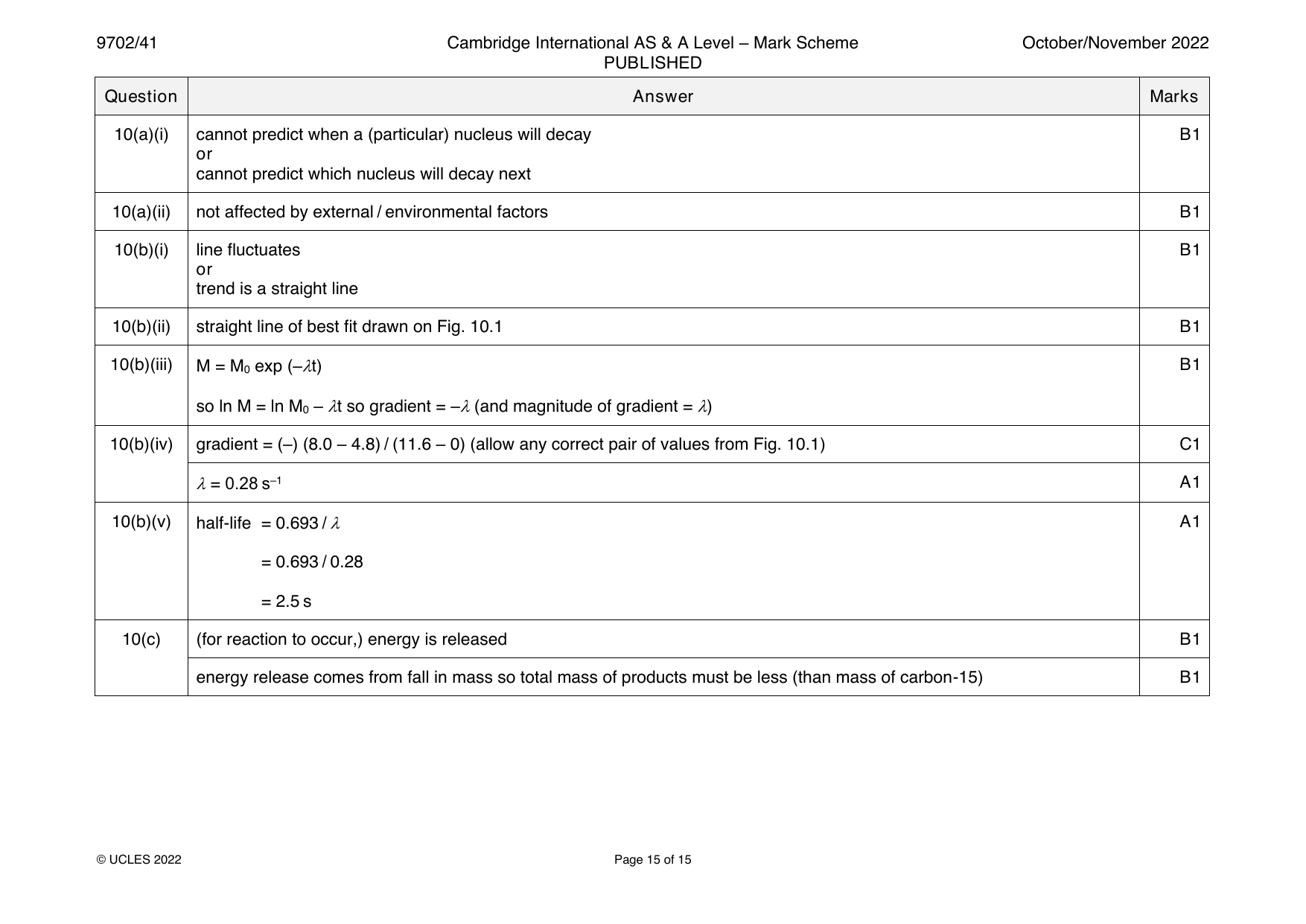
10(a)(i) cannot predict when a (particular) nucleus will decay B1
or
cannot predict which nucleus will decay next
10(a)(ii) not affected by external / environmental factors B1
10(b)(i) line fluctuates B1
or
trend is a straight line
10(b)(ii) straight line of best fit drawn on Fig. 10.1 B1
10(b)(iii) M = M exp (–t) B1
0
so ln M = ln M – t so gradient = – (and magnitude of gradient = )
0
10(b)(iv) gradient = (–) (8.0 – 4.8) / (11.6 – 0) (allow any correct pair of values from Fig. 10.1) C1
= 0.28 s–1 A1
10(b)(v) half-life = 0.693 / A1
= 0.693 / 0.28
= 2.5 s
10(c) (for reaction to occur,) energy is released B1
energy release comes from fall in mass so total mass of products must be less (than mass of carbon-15) B1
© UCLES 2022 Page 15 of 15
Official mark scheme pages: 15 · source PDF URL
9702-2022-on-43-q10
Oct/Nov 2022 · Paper 43 · Question 10 · 10 marks
10(a)(i) cannot predict when a (particular) nucleus will decay B1
or
cannot predict which nucleus will decay next
10(a)(ii) not affected by external / environmental factors B1
10(b)(i) line fluctuates B1
or
trend is a straight line
10(b)(ii) straight line of best fit drawn on Fig. 10.1 B1
10(b)(iii) M = M exp (–t) B1
0
so ln M = ln M – t so gradient = – (and magnitude of gradient = )
0
10(b)(iv) gradient = (–) (8.0 – 4.8) / (11.6 – 0) (allow any correct pair of values from Fig. 10.1) C1
= 0.28 s–1 A1
10(b)(v) half-life = 0.693 / A1
= 0.693 / 0.28
= 2.5 s
10(c) (for reaction to occur,) energy is released B1
energy release comes from fall in mass so total mass of products must be less (than mass of carbon-15) B1
© UCLES 2022 Page 15 of 15
Official mark scheme pages: 15 · source PDF URL
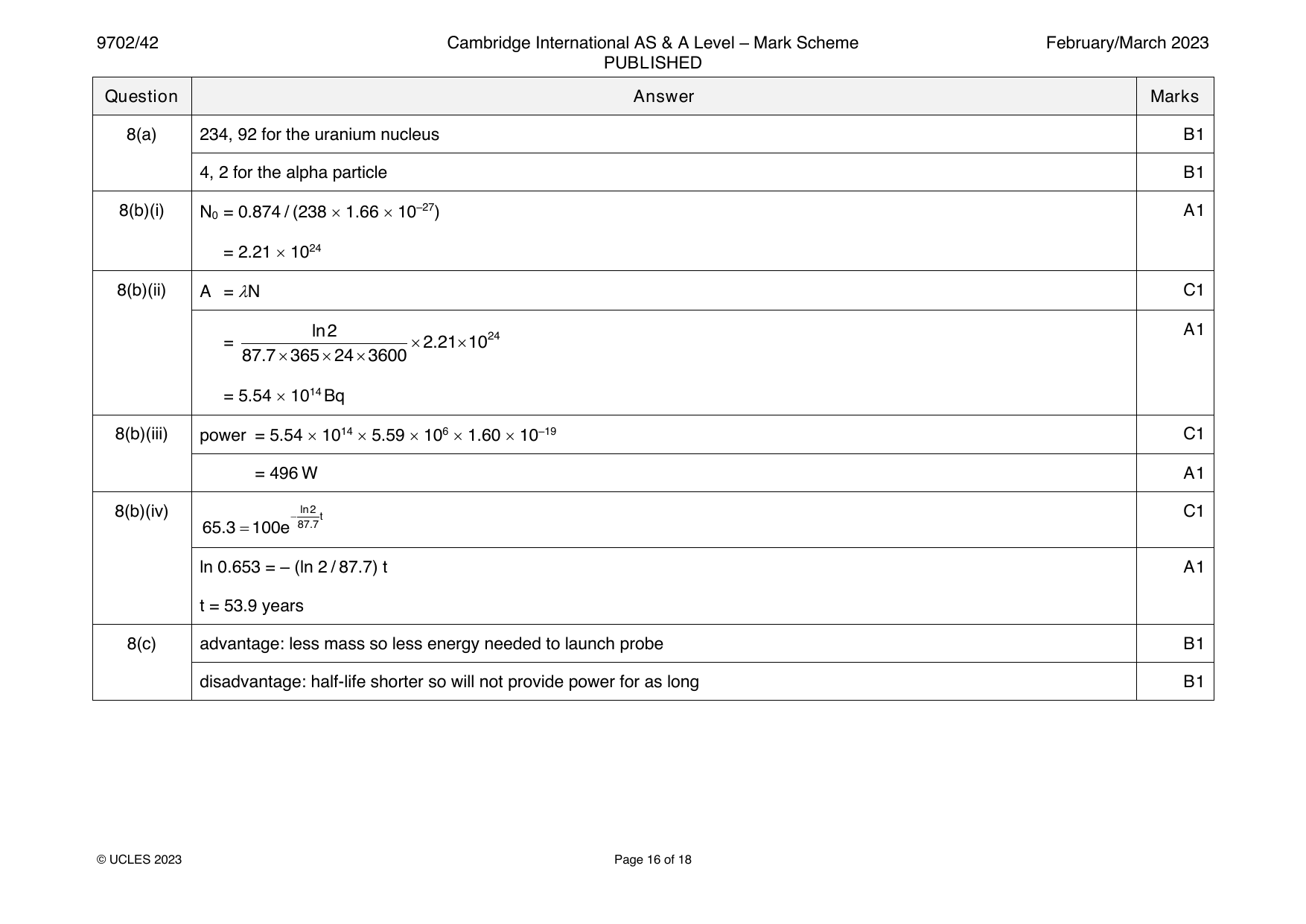
9702-2023-m-42-q08
March 2023 · Paper 42 · Question 8 · 11 marks
8(a) 234, 92 for the uranium nucleus B1
4, 2 for the alpha particle B1
8(b)(i) N = 0.874 / (238 1.66 10–27) A1
0
= 2.21 1024
8(b)(ii) A = N C1
ln2 A1
= 2.211024
87.7365243600
= 5.54 1014Bq
8(b)(iii) power = 5.54 1014 5.59 106 1.60 10–19 C1
= 496 W A1
8(b)(iv) ln2 C1
− t
65.3=100e 87.7
ln 0.653 = – (ln 2 / 87.7) t A1
t = 53.9 years
8(c) advantage: less mass so less energy needed to launch probe B1
disadvantage: half-life shorter so will not provide power for as long B1
© UCLES 2023 Page 16 of 18
Official mark scheme pages: 16 · source PDF URL
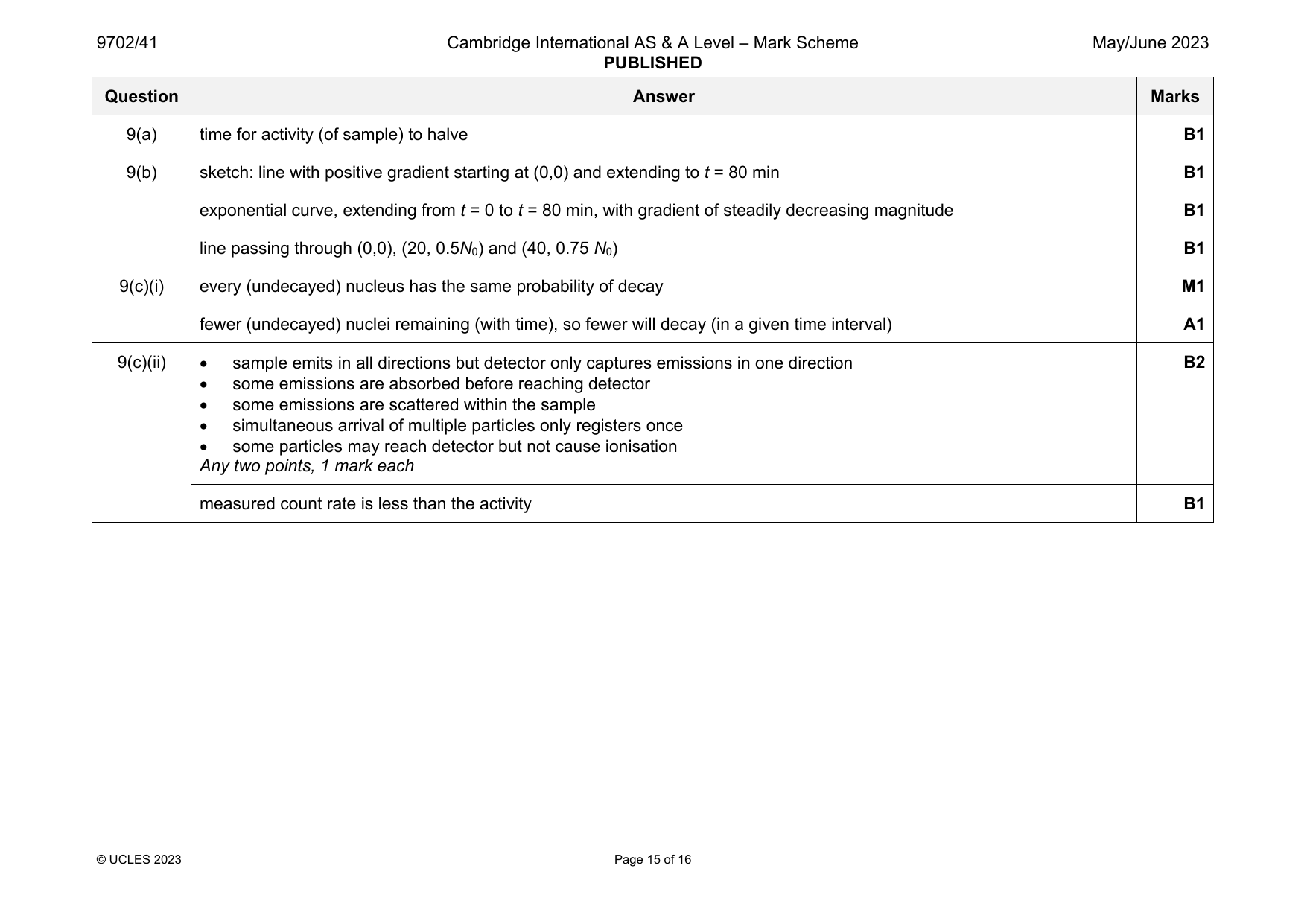
9702-2023-mj-41-q09
May/June 2023 · Paper 41 · Question 9 · 9 marks
9(a) time for activity (of sample) to halve B1
9(b) sketch: line with positive gradient starting at (0,0) and extending to t = 80 min B1
exponential curve, extending from t = 0 to t = 80 min, with gradient of steadily decreasing magnitude B1
line passing through (0,0), (20, 0.5N ) and (40, 0.75 N ) B1
0 0
9(c)(i) every (undecayed) nucleus has the same probability of decay M1
fewer (undecayed) nuclei remaining (with time), so fewer will decay (in a given time interval) A1
9(c)(ii) sample emits in all directions but detector only captures emissions in one direction B2
some emissions are absorbed before reaching detector
some emissions are scattered within the sample
simultaneous arrival of multiple particles only registers once
some particles may reach detector but not cause ionisation
Any two points, 1 mark each
measured count rate is less than the activity B1
© UCLES 2023 Page 15 of 16
Official mark scheme pages: 15 · source PDF URL
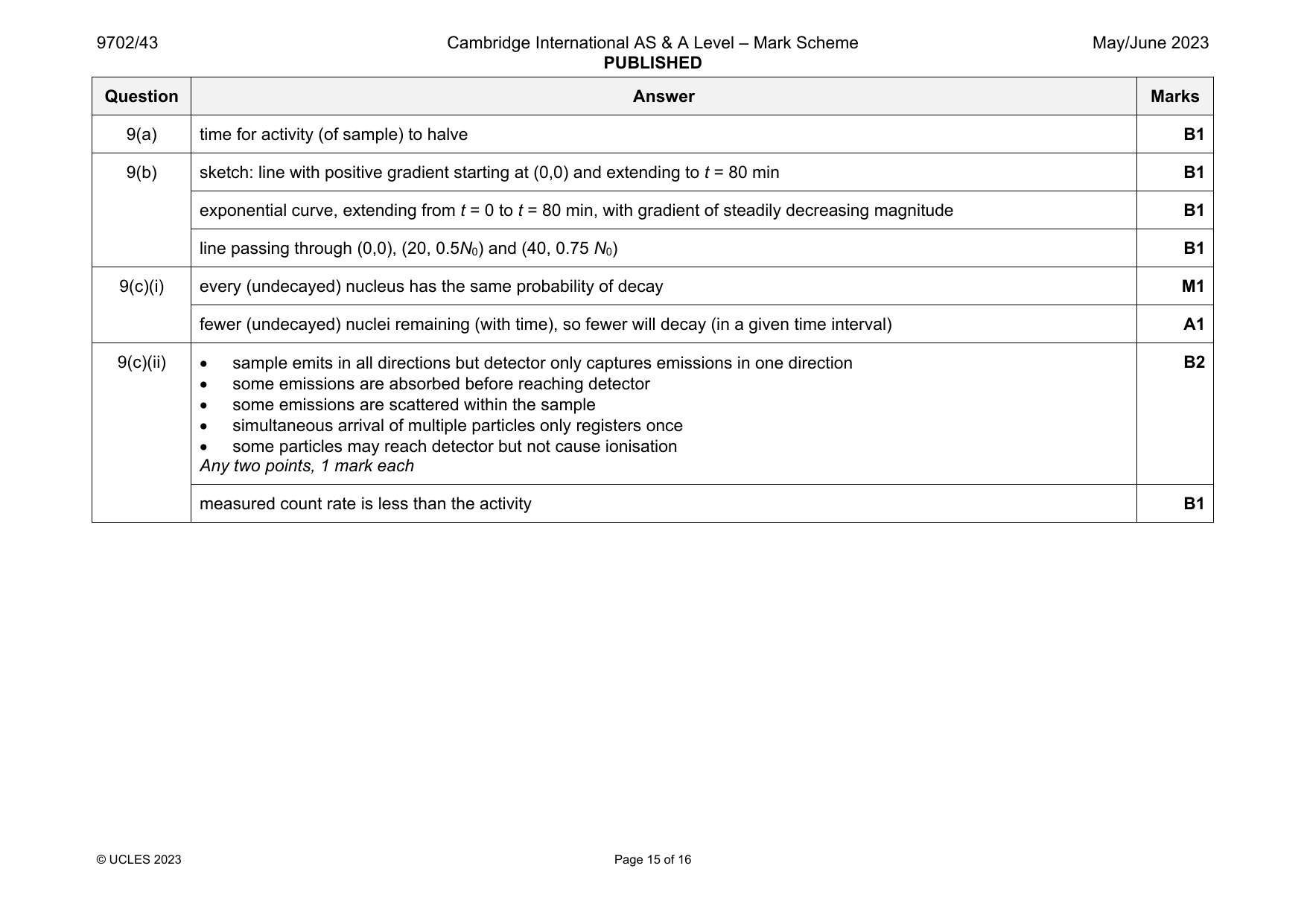
9702-2023-mj-43-q09
May/June 2023 · Paper 43 · Question 9 · 9 marks
9(a) time for activity (of sample) to halve B1
9(b) sketch: line with positive gradient starting at (0,0) and extending to t = 80 min B1
exponential curve, extending from t = 0 to t = 80 min, with gradient of steadily decreasing magnitude B1
line passing through (0,0), (20, 0.5N ) and (40, 0.75 N ) B1
0 0
9(c)(i) every (undecayed) nucleus has the same probability of decay M1
fewer (undecayed) nuclei remaining (with time), so fewer will decay (in a given time interval) A1
9(c)(ii) sample emits in all directions but detector only captures emissions in one direction B2
some emissions are absorbed before reaching detector
some emissions are scattered within the sample
simultaneous arrival of multiple particles only registers once
some particles may reach detector but not cause ionisation
Any two points, 1 mark each
measured count rate is less than the activity B1
© UCLES 2023 Page 15 of 16
Official mark scheme pages: 15 · source PDF URL
9702-2023-on-41-q09
Oct/Nov 2023 · Paper 41 · Question 9 · 10 marks
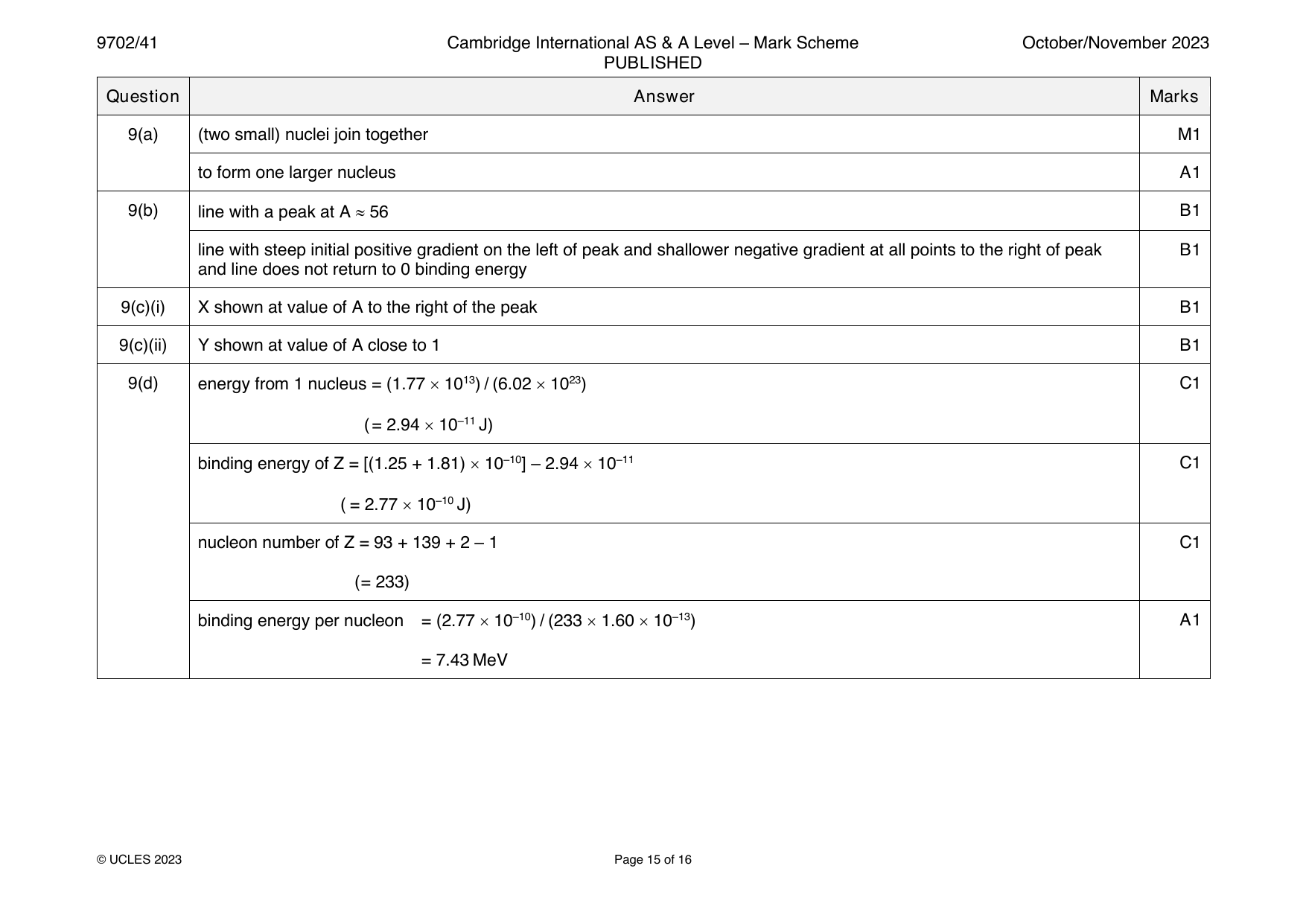
9(a) (two small) nuclei join together M1
to form one larger nucleus A1
9(b) line with a peak at A 56 B1
line with steep initial positive gradient on the left of peak and shallower negative gradient at all points to the right of peak B1
and line does not return to 0 binding energy
9(c)(i) X shown at value of A to the right of the peak B1
9(c)(ii) Y shown at value of A close to 1 B1
9(d) energy from 1 nucleus = (1.77 1013) / (6.02 1023) C1
( = 2.94 10–11 J)
binding energy of Z = [(1.25 + 1.81) 10–10] – 2.94 10–11 C1
( = 2.77 10–10 J)
nucleon number of Z = 93 + 139 + 2 – 1 C1
( = 233)
binding energy per nucleon = (2.77 10–10) / (233 1.60 10–13) A1
= 7.43 MeV
© UCLES 2023 Page 15 of 16
Official mark scheme pages: 15 · source PDF URL
9702-2023-on-43-q09
Oct/Nov 2023 · Paper 43 · Question 9 · 10 marks
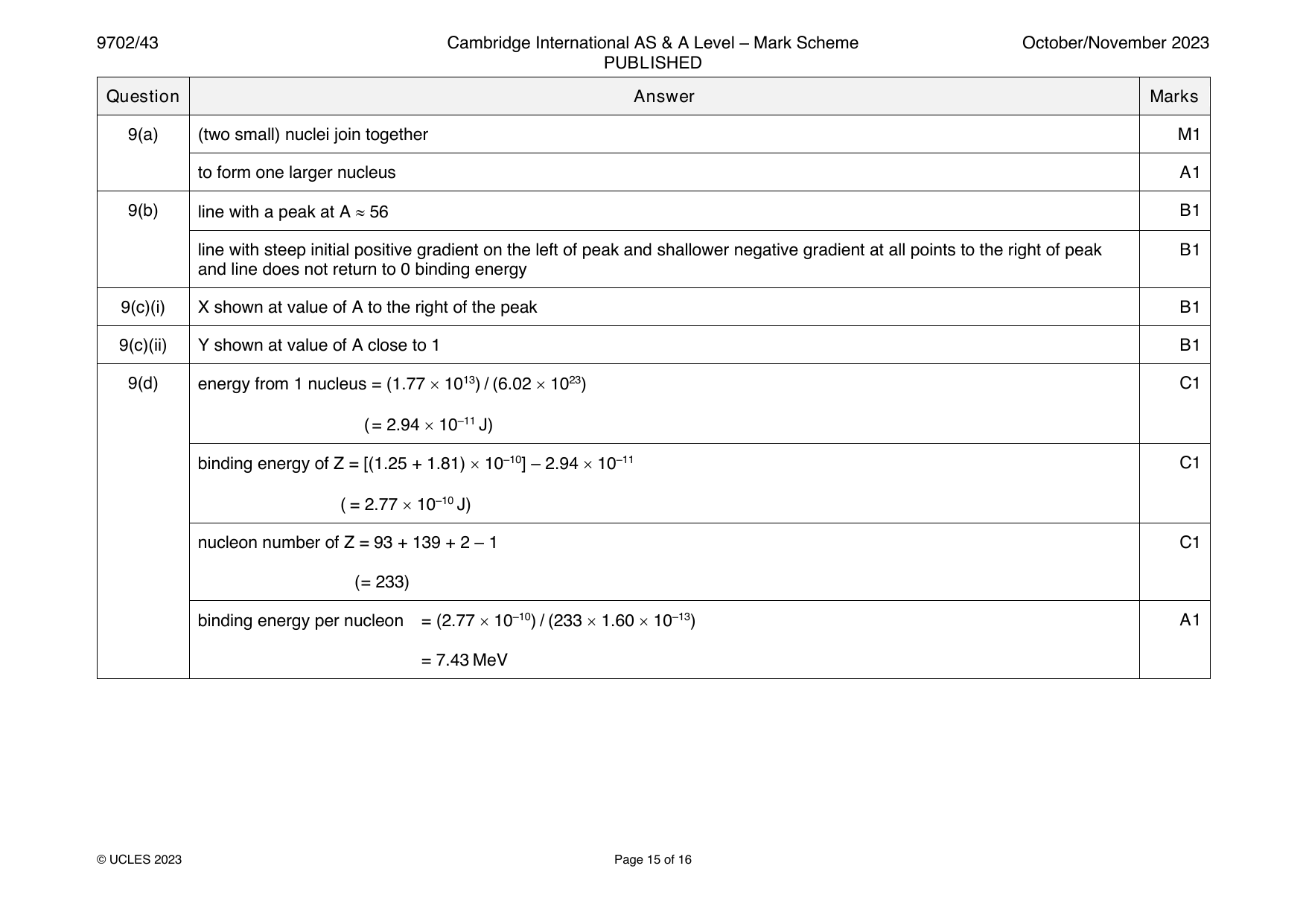
9(a) (two small) nuclei join together M1
to form one larger nucleus A1
9(b) line with a peak at A 56 B1
line with steep initial positive gradient on the left of peak and shallower negative gradient at all points to the right of peak B1
and line does not return to 0 binding energy
9(c)(i) X shown at value of A to the right of the peak B1
9(c)(ii) Y shown at value of A close to 1 B1
9(d) energy from 1 nucleus = (1.77 1013) / (6.02 1023) C1
( = 2.94 10–11 J)
binding energy of Z = [(1.25 + 1.81) 10–10] – 2.94 10–11 C1
( = 2.77 10–10 J)
nucleon number of Z = 93 + 139 + 2 – 1 C1
( = 233)
binding energy per nucleon = (2.77 10–10) / (233 1.60 10–13) A1
= 7.43 MeV
© UCLES 2023 Page 15 of 16
Official mark scheme pages: 15 · source PDF URL
9702-2024-m-42-q08
March 2024 · Paper 42 · Question 8 · 9 marks
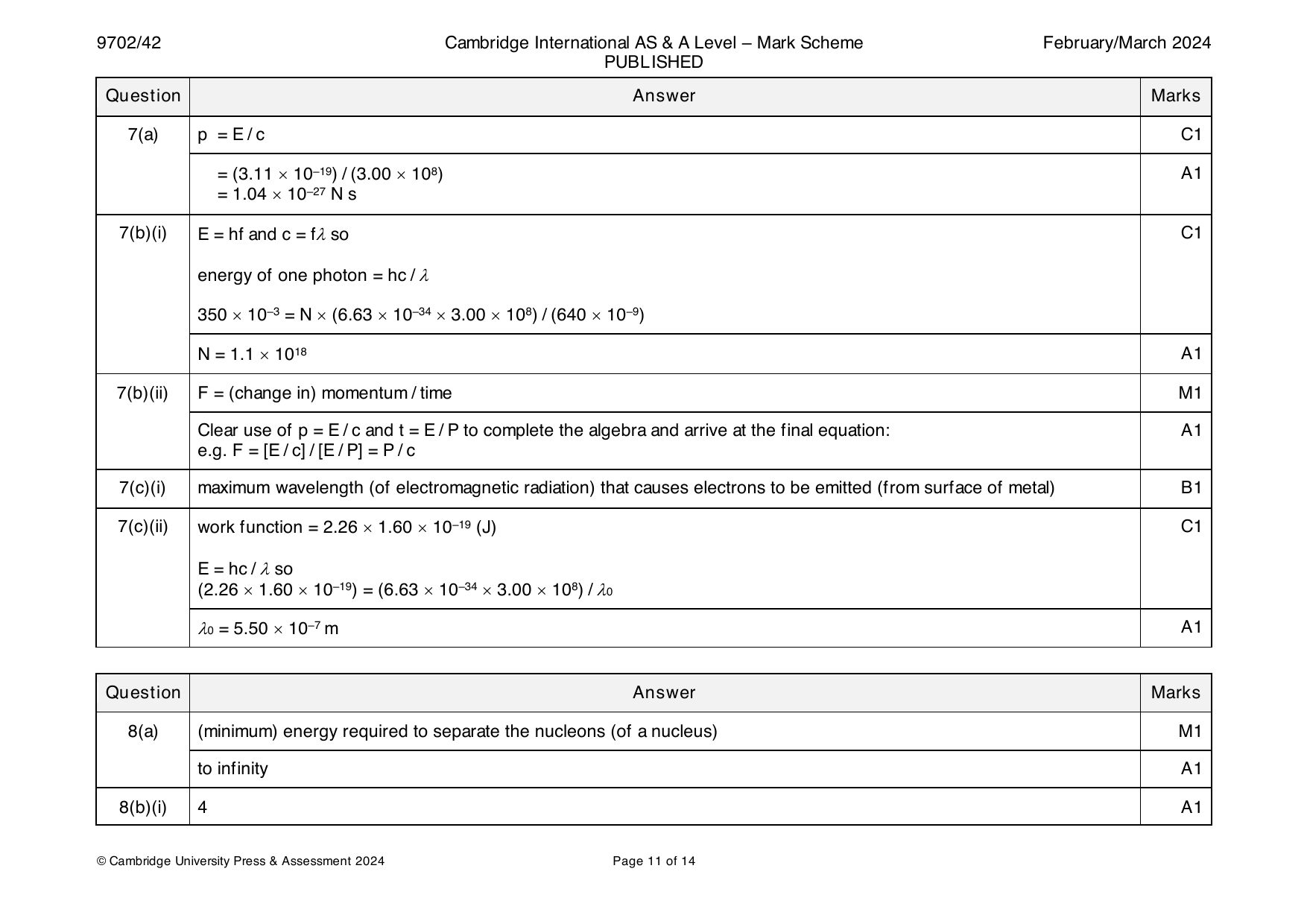
8(a) (minimum) energy required to separate the nucleons (of a nucleus) M1
to infinity A1
8(b)(i) 4 A1
© Cambridge University Press & Assessment 2024 Page 11 of 14
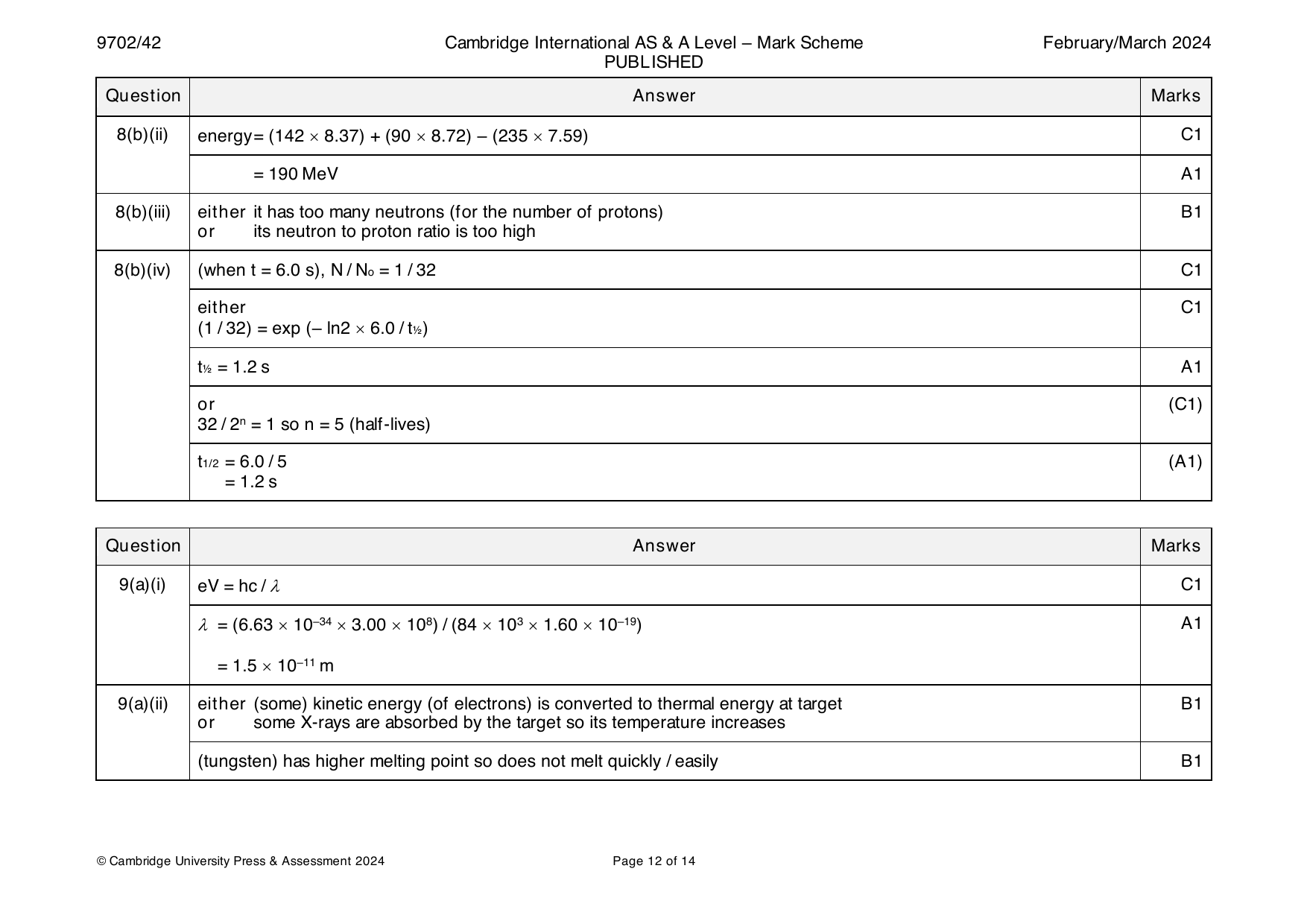
8(b)(ii) energy = (142 8.37) + (90 8.72) – (235 7.59) C1
= 190 MeV A1
8(b)(iii) either it has too many neutrons (for the number of protons) B1
or its neutron to proton ratio is too high
8(b)(iv) (when t = 6.0 s), N / N = 1 / 32 C1
o
either C1
(1 / 32) = exp (– ln2 6.0 / t )
½
t = 1.2 s A1
½
or (C1)
32 / 2n = 1 so n = 5 (half-lives)
t = 6.0 / 5 (A1)
1/2
= 1.2 s
Question Answer Marks
Official mark scheme pages: 11, 12 · source PDF URL
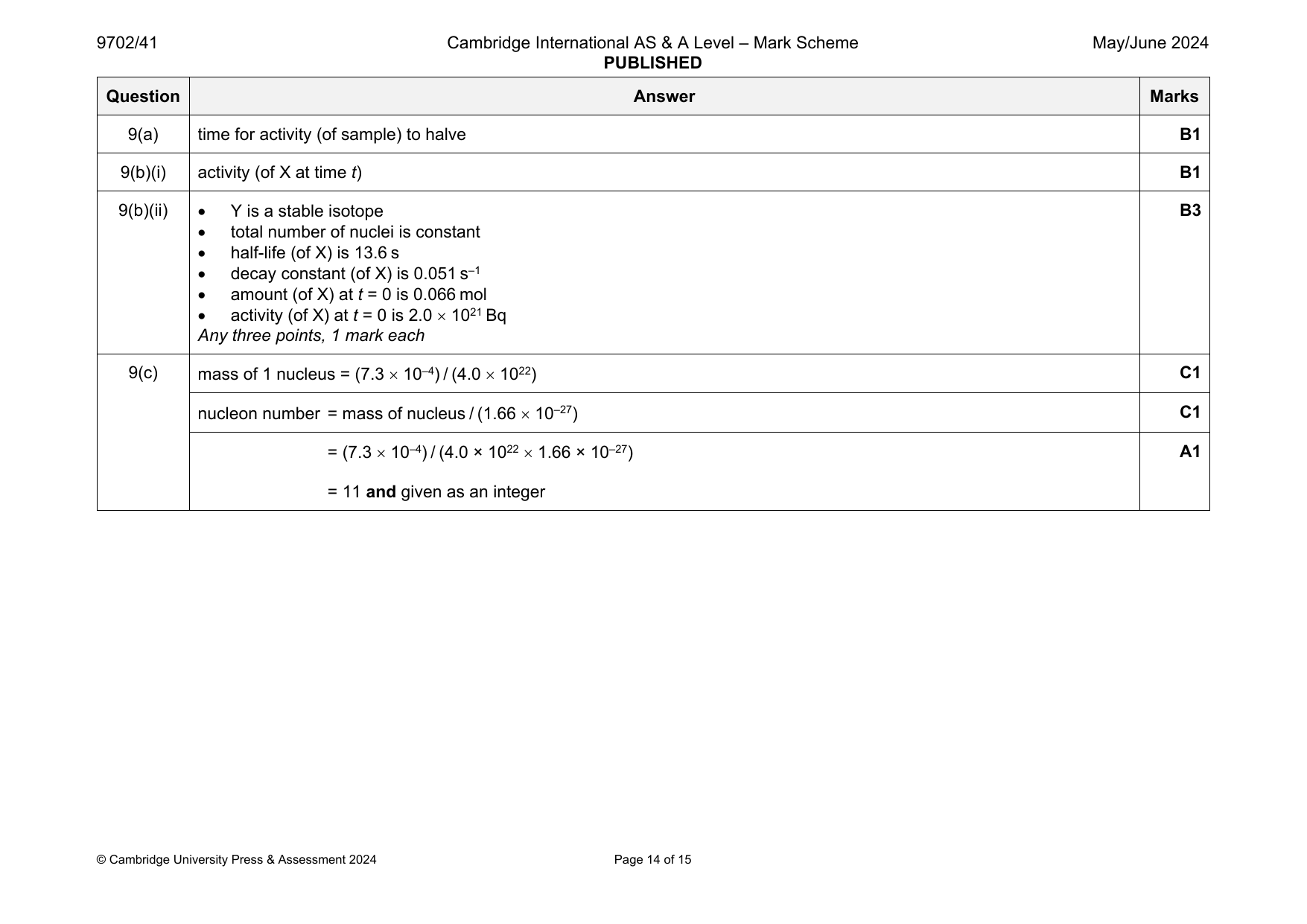
9702-2024-mj-41-q09
May/June 2024 · Paper 41 · Question 9 · 8 marks
9(a) time for activity (of sample) to halve B1
9(b)(i) activity (of X at time t) B1
9(b)(ii) Y is a stable isotope B3
total number of nuclei is constant
half-life (of X) is 13.6 s
decay constant (of X) is 0.051 s–1
amount (of X) at t = 0 is 0.066 mol
activity (of X) at t = 0 is 2.0 1021 Bq
Any three points, 1 mark each
9(c) mass of 1 nucleus = (7.3 10–4) / (4.0 1022) C1
nucleon number = mass of nucleus / (1.66 10–27) C1
= (7.3 10–4) / (4.0 × 10²² 1.66 × 10⁻²⁷) A1
= 11 and given as an integer
© Cambridge University Press & Assessment 2024 Page 14 of 15
Official mark scheme pages: 14 · source PDF URL
9702-2024-mj-42-q09
May/June 2024 · Paper 42 · Question 9 · 13 marks
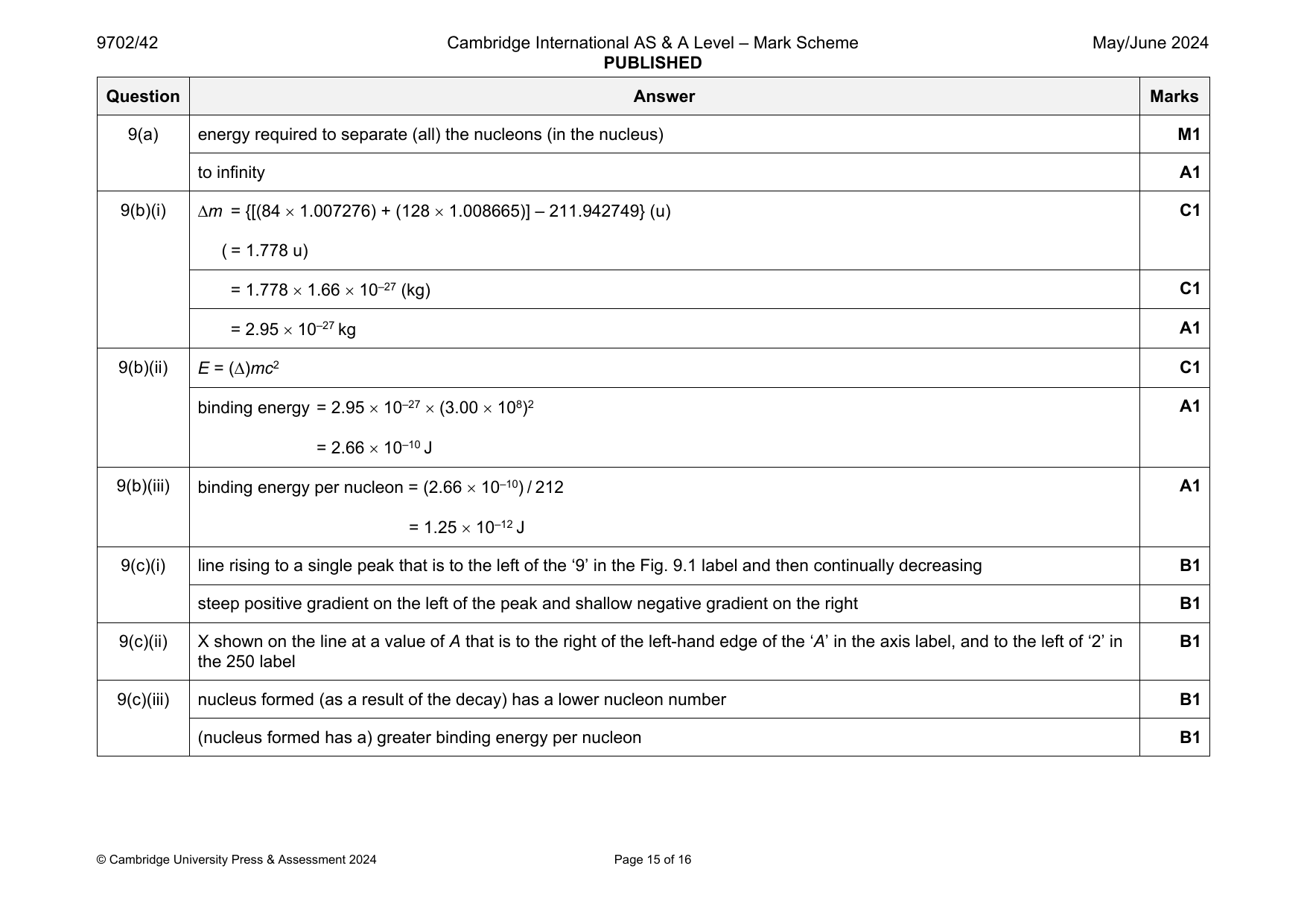
9(a) energy required to separate (all) the nucleons (in the nucleus) M1
to infinity A1
9(b)(i) m = {[(84 1.007276) + (128 1.008665)] – 211.942749} (u) C1
( = 1.778 u)
= 1.778 1.66 10–27 (kg) C1
= 2.95 10–27 kg A1
9(b)(ii) E = ()mc2 C1
binding energy = 2.95 10–27 (3.00 108)2 A1
= 2.66 10–10 J
9(b)(iii) binding energy per nucleon = (2.66 10–10) / 212 A1
= 1.25 10–12 J
9(c)(i) line rising to a single peak that is to the left of the ‘9’ in the Fig. 9.1 label and then continually decreasing B1
steep positive gradient on the left of the peak and shallow negative gradient on the right B1
9(c)(ii) X shown on the line at a value of A that is to the right of the left-hand edge of the ‘A’ in the axis label, and to the left of ‘2’ in B1
the 250 label
9(c)(iii) nucleus formed (as a result of the decay) has a lower nucleon number B1
(nucleus formed has a) greater binding energy per nucleon B1
© Cambridge University Press & Assessment 2024 Page 15 of 16
Official mark scheme pages: 15 · source PDF URL
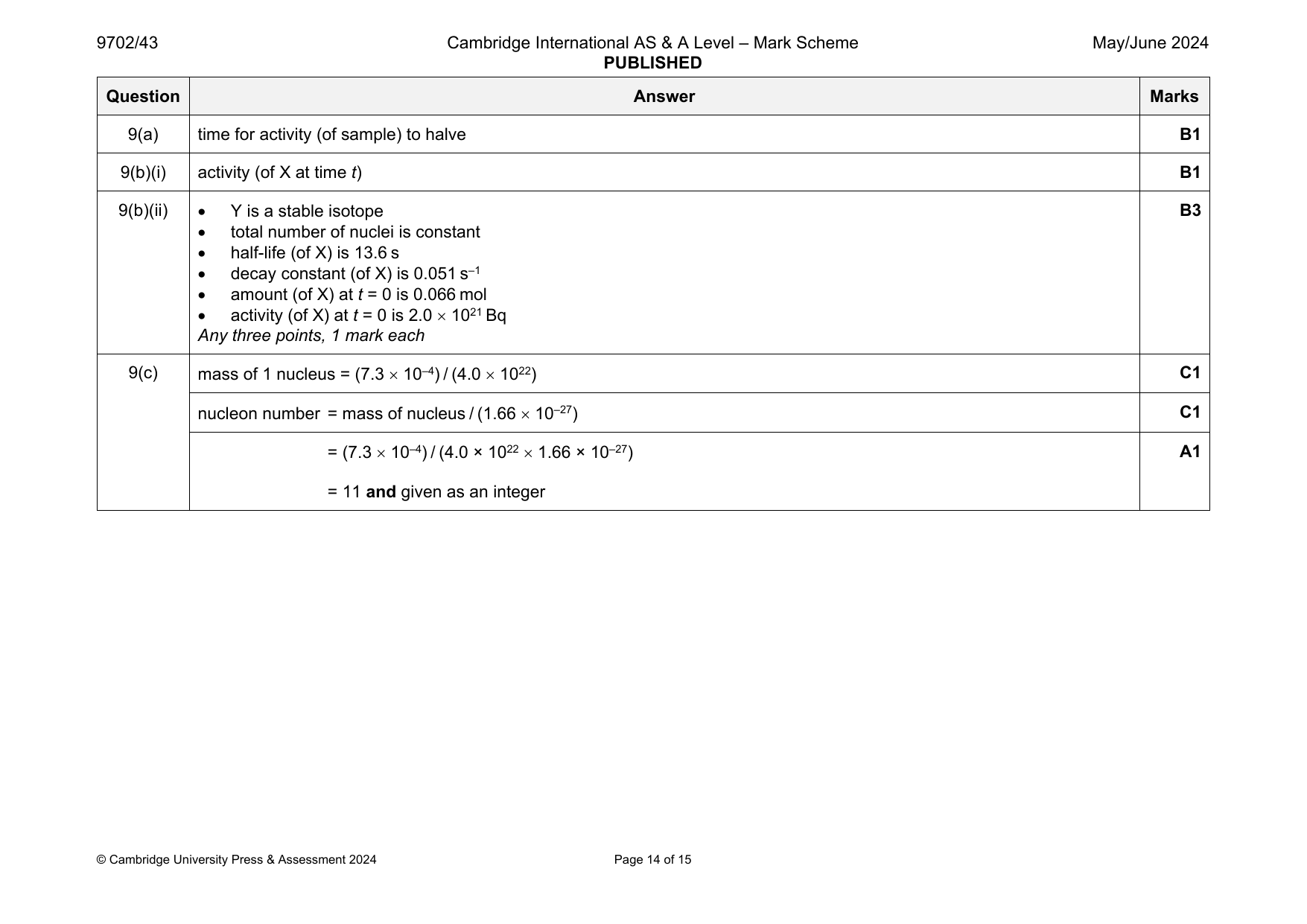
9702-2024-mj-43-q09
May/June 2024 · Paper 43 · Question 9 · 8 marks
9(a) time for activity (of sample) to halve B1
9(b)(i) activity (of X at time t) B1
9(b)(ii) Y is a stable isotope B3
total number of nuclei is constant
half-life (of X) is 13.6 s
decay constant (of X) is 0.051 s–1
amount (of X) at t = 0 is 0.066 mol
activity (of X) at t = 0 is 2.0 1021 Bq
Any three points, 1 mark each
9(c) mass of 1 nucleus = (7.3 10–4) / (4.0 1022) C1
nucleon number = mass of nucleus / (1.66 10–27) C1
= (7.3 10–4) / (4.0 × 10²² 1.66 × 10⁻²⁷) A1
= 11 and given as an integer
© Cambridge University Press & Assessment 2024 Page 14 of 15
Official mark scheme pages: 14 · source PDF URL
9702-2024-on-42-q10
Oct/Nov 2024 · Paper 42 · Question 10 · 8 marks

10(a)(i) cannot predict when a particular nucleus will decay B1
or
cannot predict which nucleus will decay next
10(a)(ii) (decay is) not affected by external (environmental) factors B1
10(a)(iii) fluctuations in (measured) count rate B1
10(b)(i) • large nuclei undergo fission whereas small nuclei undergo fusion B3
• fission involves one nucleus splitting into two (or more) (smaller) nuclei
• fusion involves two nuclei joining together to form one (larger) nucleus
• fission is (usually) initiated by neutron bombardment
• fusion is (usually) initiated by (very) high temperatures
Any three points, 1 mark each
10(b)(ii) binding energy per nucleon is greatest for intermediate nucleon numbers B1
(may be shown on sketch graph with axes labelled ‘binding energy per nucleon’ and ‘nucleon number’)
both fusion and fission involve an increase in binding energy (per nucleon) B1
© Cambridge University Press & Assessment 2024 Page 14 of 14
Official mark scheme pages: 14 · source PDF URL
9702-2025-m-42-q09
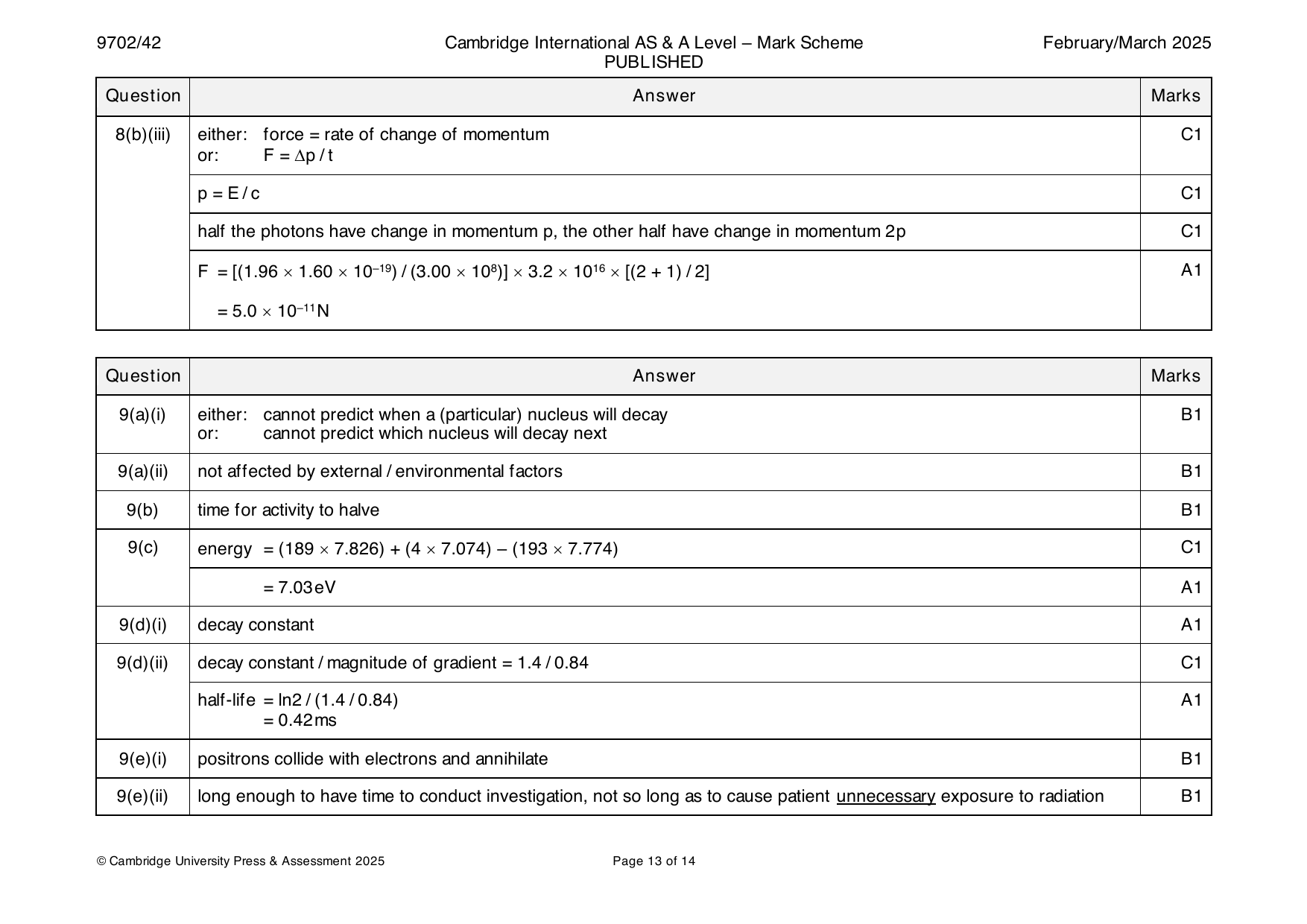
March 2025 · Paper 42 · Question 9 · 10 marks
9(a)(i) either: cannot predict when a (particular) nucleus will decay B1
or: cannot predict which nucleus will decay next
9(a)(ii) not affected by external / environmental factors B1
9(b) time for activity to halve B1
9(c) energy = (189 7.826) + (4 7.074) – (193 7.774) C1
= 7.03eV A1
9(d)(i) decay constant A1
9(d)(ii) decay constant / magnitude of gradient = 1.4 / 0.84 C1
half-life = ln2 / (1.4 / 0.84) A1
= 0.42ms
9(e)(i) positrons collide with electrons and annihilate B1
9(e)(ii) long enough to have time to conduct investigation, not so long as to cause patient unnecessary exposure to radiation B1
© Cambridge University Press & Assessment 2025 Page 13 of 14
Official mark scheme pages: 13 · source PDF URL
9702-2025-mj-41-q09
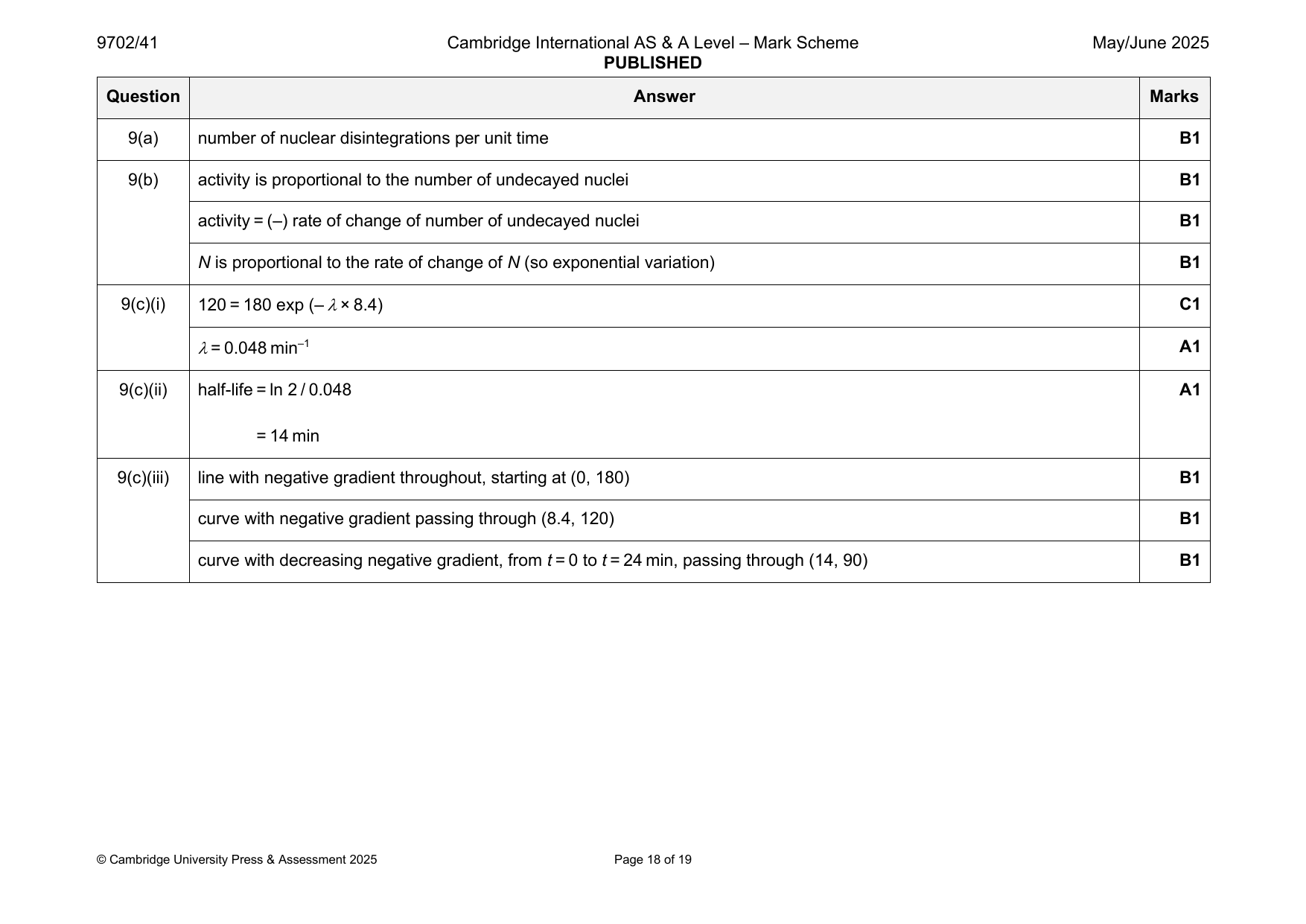
May/June 2025 · Paper 41 · Question 9 · 10 marks
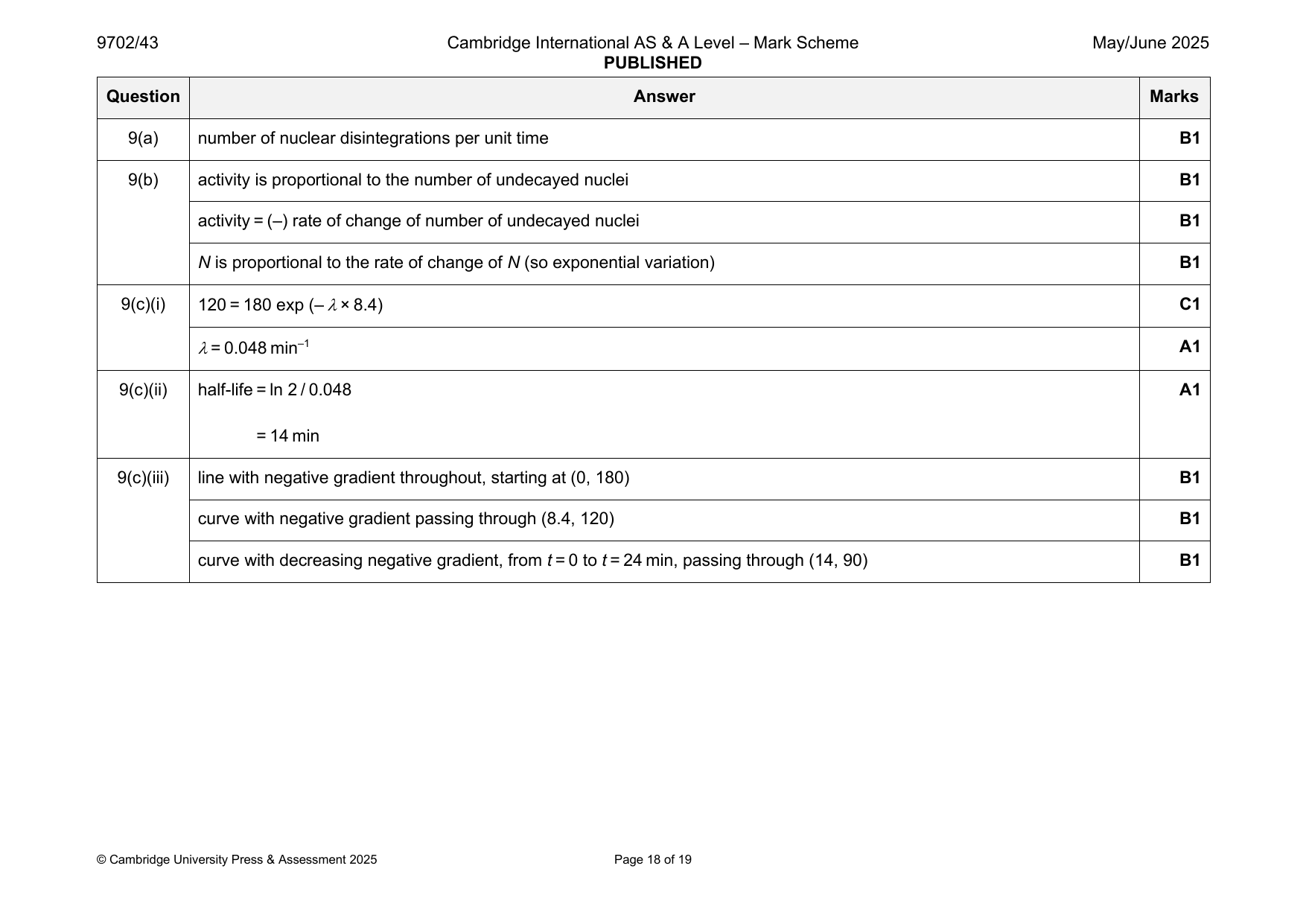
9(a) number of nuclear disintegrations per unit time B1
9(b) activity is proportional to the number of undecayed nuclei B1
activity = (–) rate of change of number of undecayed nuclei B1
N is proportional to the rate of change of N (so exponential variation) B1
9(c)(i) 120 = 180 exp (– × 8.4) C1
= 0.048 min–1 A1
9(c)(ii) half-life = ln 2 / 0.048 A1
= 14 min
9(c)(iii) line with negative gradient throughout, starting at (0, 180) B1
curve with negative gradient passing through (8.4, 120) B1
curve with decreasing negative gradient, from t = 0 to t = 24 min, passing through (14, 90) B1
© Cambridge University Press & Assessment 2025 Page 18 of 19
Official mark scheme pages: 18 · source PDF URL
9702-2025-mj-42-q10
May/June 2025 · Paper 42 · Question 10 · 9 marks
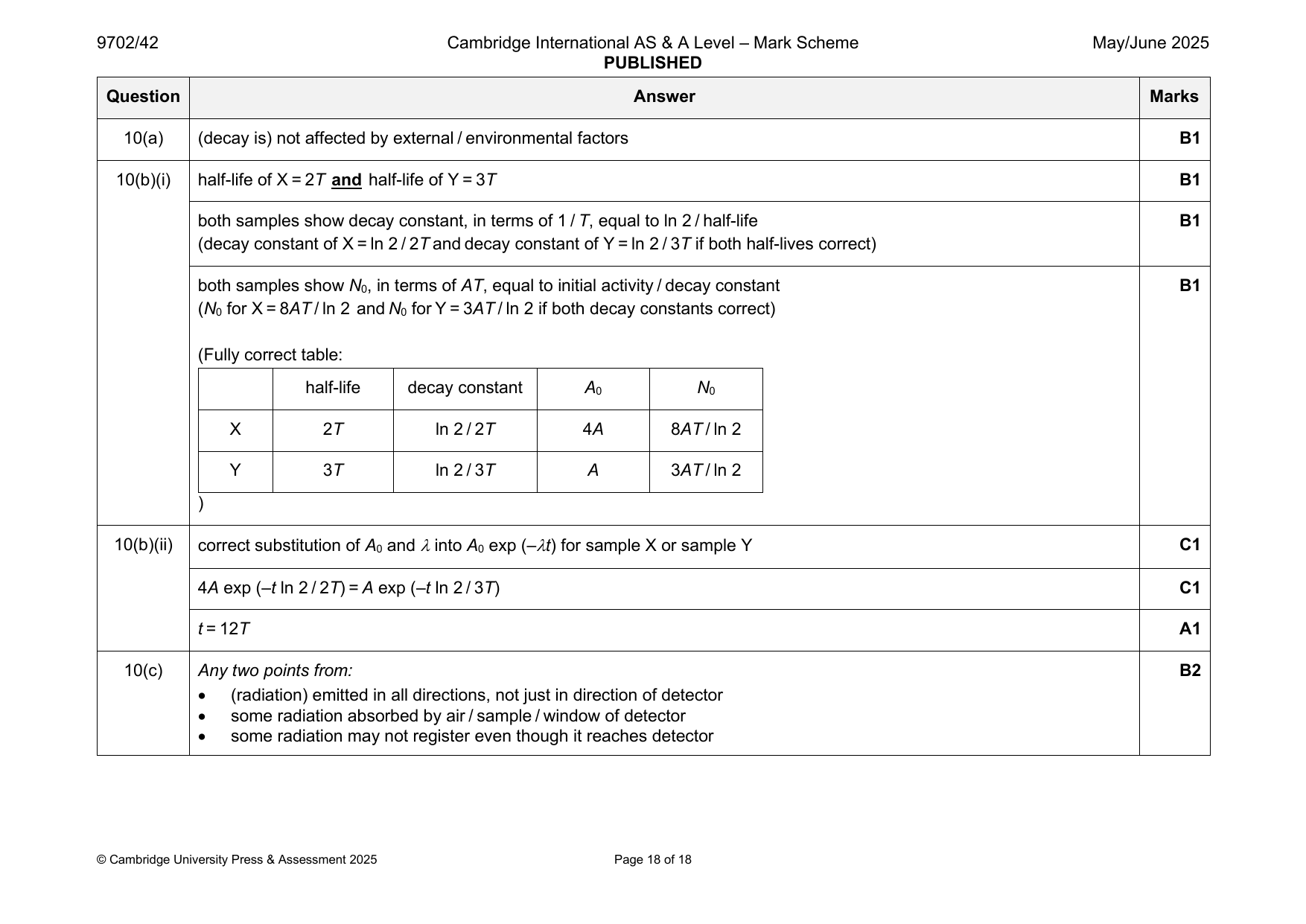
10(a) (decay is) not affected by external / environmental factors B1
10(b)(i) half-life of X = 2T and half-life of Y = 3T B1
both samples show decay constant, in terms of 1 / T, equal to ln 2 / half-life B1
(decay constant of X = ln 2 / 2T and decay constant of Y = ln 2 / 3T if both half-lives correct)
both samples show N , in terms of AT, equal to initial activity / decay constant B1
0
(N for X = 8AT / ln 2 and N for Y = 3AT / ln 2 if both decay constants correct)
0 0
(Fully correct table:
half-life decay constant A N
0 0
X 2T ln 2 / 2T 4A 8AT / ln 2
Y 3T ln 2 / 3T A 3AT / ln 2
)
10(b)(ii) correct substitution of A and into A exp (–t) for sample X or sample Y C1
0 0
4A exp (–t ln 2 / 2T) = A exp (–t ln 2 / 3T) C1
t = 12T A1
10(c) Any two points from: B2
• (radiation) emitted in all directions, not just in direction of detector
• some radiation absorbed by air / sample / window of detector
• some radiation may not register even though it reaches detector
© Cambridge University Press & Assessment 2025 Page 18 of 18
Official mark scheme pages: 18 · source PDF URL
9702-2025-mj-43-q09
May/June 2025 · Paper 43 · Question 9 · 10 marks
9(a) number of nuclear disintegrations per unit time B1
9(b) activity is proportional to the number of undecayed nuclei B1
activity = (–) rate of change of number of undecayed nuclei B1
N is proportional to the rate of change of N (so exponential variation) B1
9(c)(i) 120 = 180 exp (– × 8.4) C1
= 0.048 min–1 A1
9(c)(ii) half-life = ln 2 / 0.048 A1
= 14 min
9(c)(iii) line with negative gradient throughout, starting at (0, 180) B1
curve with negative gradient passing through (8.4, 120) B1
curve with decreasing negative gradient, from t = 0 to t = 24 min, passing through (14, 90) B1
© Cambridge University Press & Assessment 2025 Page 18 of 19
Official mark scheme pages: 18 · source PDF URL
9702-2025-on-41-q08
Oct/Nov 2025 · Paper 41 · Question 8 · 11 marks
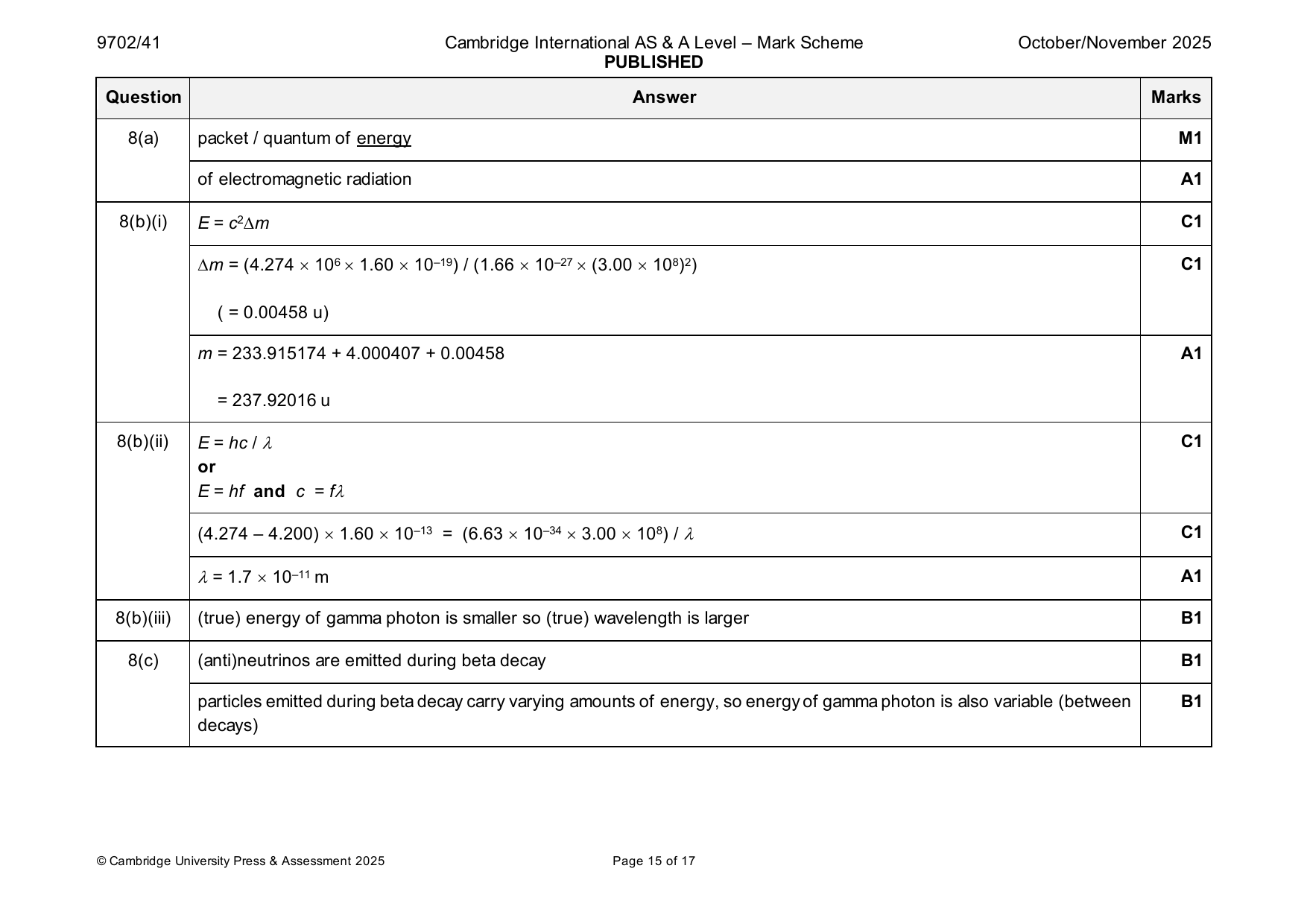
8(a) packet / quantum of energy M1
of electromagnetic radiation A1
8(b)(i) E = c2m C1
m = (4.274 106 1.60 10–19) / (1.66 10–27 (3.00 108)2) C1
( = 0.00458 u)
m = 233.915174 + 4.000407 + 0.00458 A1
= 237.92016 u
8(b)(ii) E = hc / C1
or
E = hf and c = f
(4.274 – 4.200) 1.60 10–13 = (6.63 10–34 3.00 108) / C1
= 1.7 10–11 m A1
8(b)(iii) (true) energy of gamma photon is smaller so (true) wavelength is larger B1
8(c) (anti)neutrinos are emitted during beta decay B1
particles emitted during beta decay carry varying amounts of energy, so energy of gamma photon is also variable (between B1
decays)
© Cambridge University Press & Assessment 2025 Page 15 of 17
Official mark scheme pages: 15 · source PDF URL
9702-2025-on-43-q08
Oct/Nov 2025 · Paper 43 · Question 8 · 11 marks
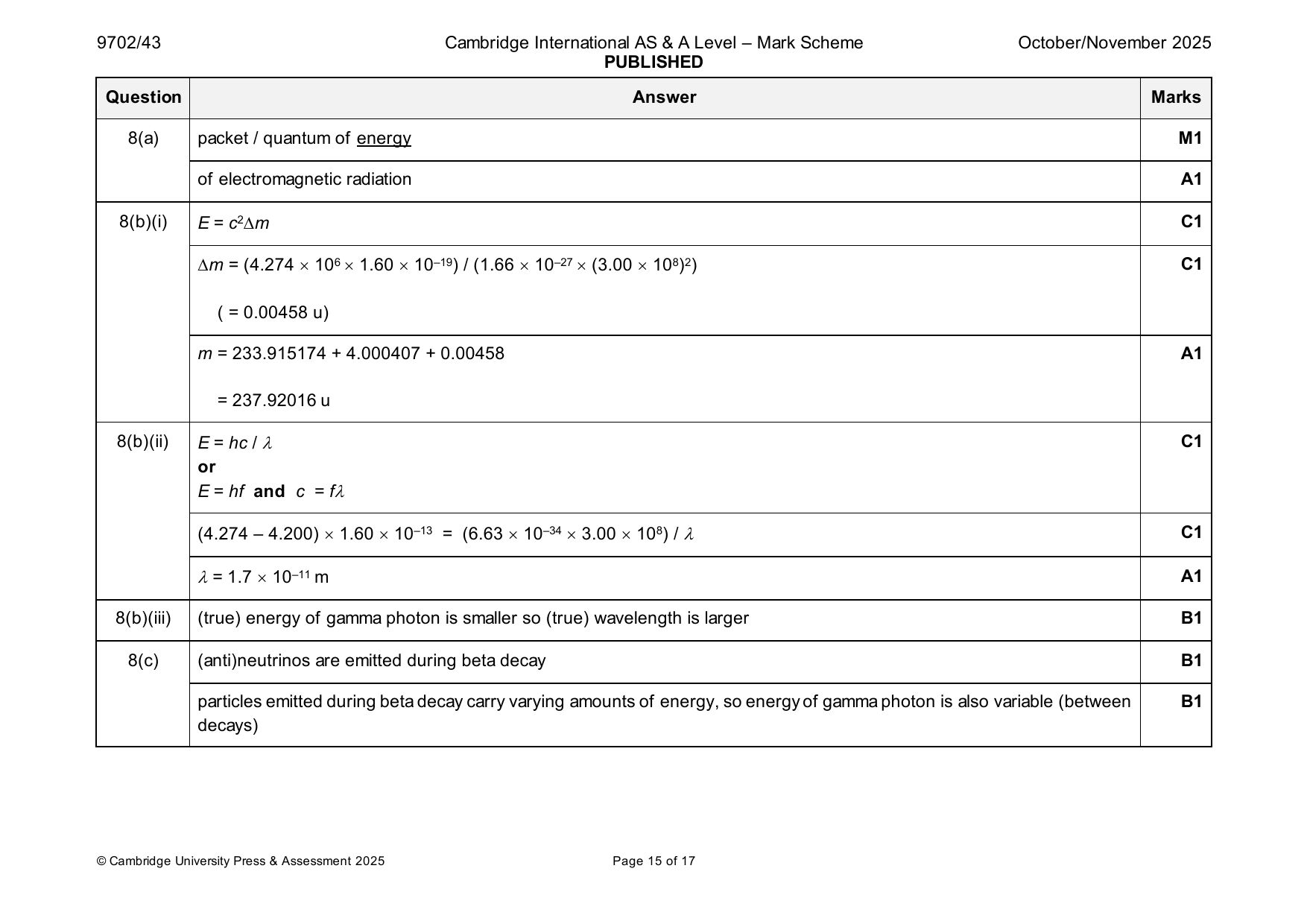
8(a) packet / quantum of energy M1
of electromagnetic radiation A1
8(b)(i) E = c2m C1
m = (4.274 106 1.60 10–19) / (1.66 10–27 (3.00 108)2) C1
( = 0.00458 u)
m = 233.915174 + 4.000407 + 0.00458 A1
= 237.92016 u
8(b)(ii) E = hc / C1
or
E = hf and c = f
(4.274 – 4.200) 1.60 10–13 = (6.63 10–34 3.00 108) / C1
= 1.7 10–11 m A1
8(b)(iii) (true) energy of gamma photon is smaller so (true) wavelength is larger B1
8(c) (anti)neutrinos are emitted during beta decay B1
particles emitted during beta decay carry varying amounts of energy, so energy of gamma photon is also variable (between B1
decays)
© Cambridge University Press & Assessment 2025 Page 15 of 17
Official mark scheme pages: 15 · source PDF URL