Try the new view →
9702-2021-m-42-q02
March 2021 · Paper 42 · Question 2 · 6 marks
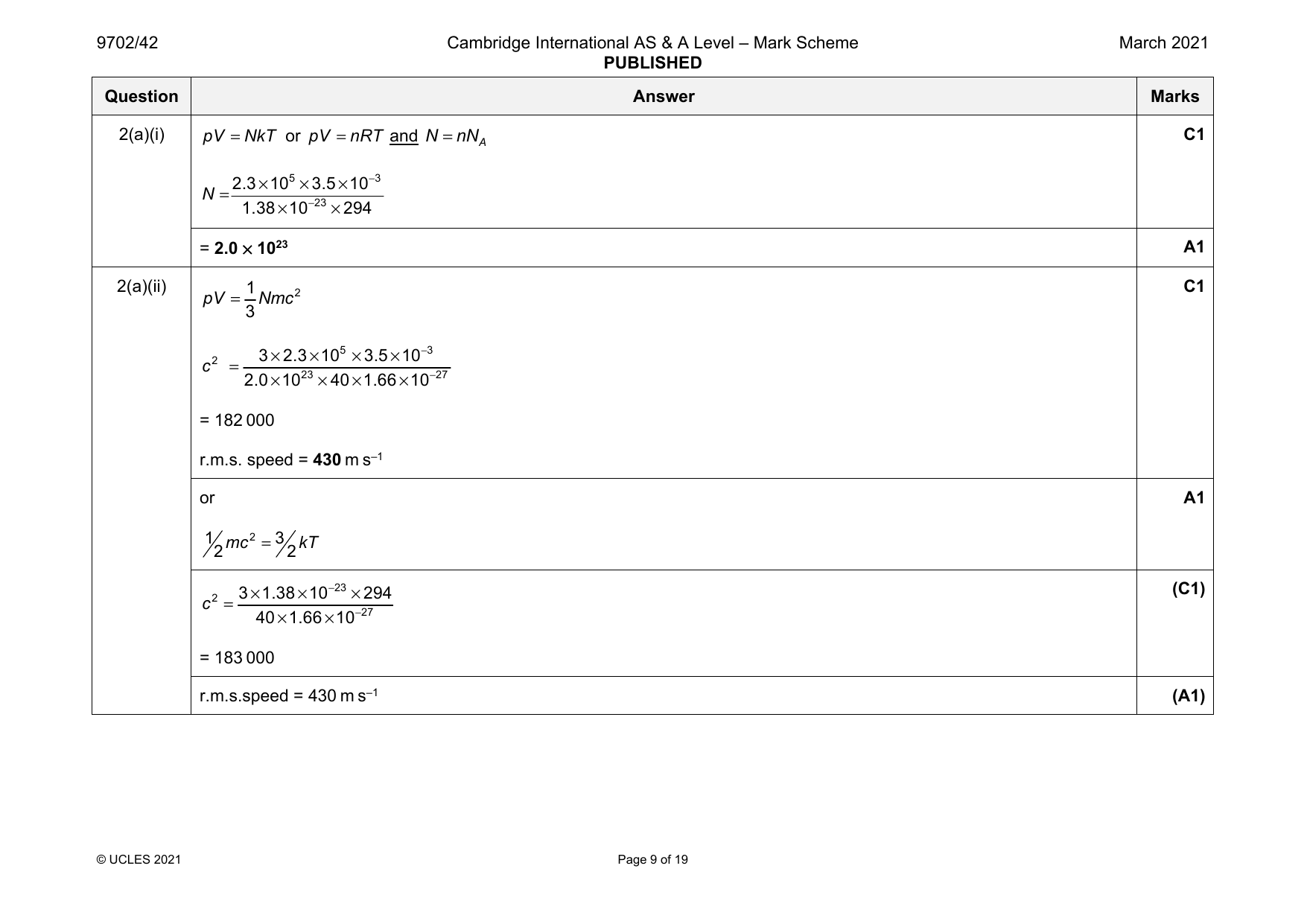
2(a)(i) pV =NkT or pV =nRT and N =nN C1
A
2.3×105×3.5×10 −3
N =
1.38×10 −23×294
= 2.0 × 10²³ A1
2(a)(ii) 1 C1
pV = Nmc2
Official mark scheme pages: 9 · source PDF URL
9702-2021-on-42-q03
Oct/Nov 2021 · Paper 42 · Question 3 · 11 marks
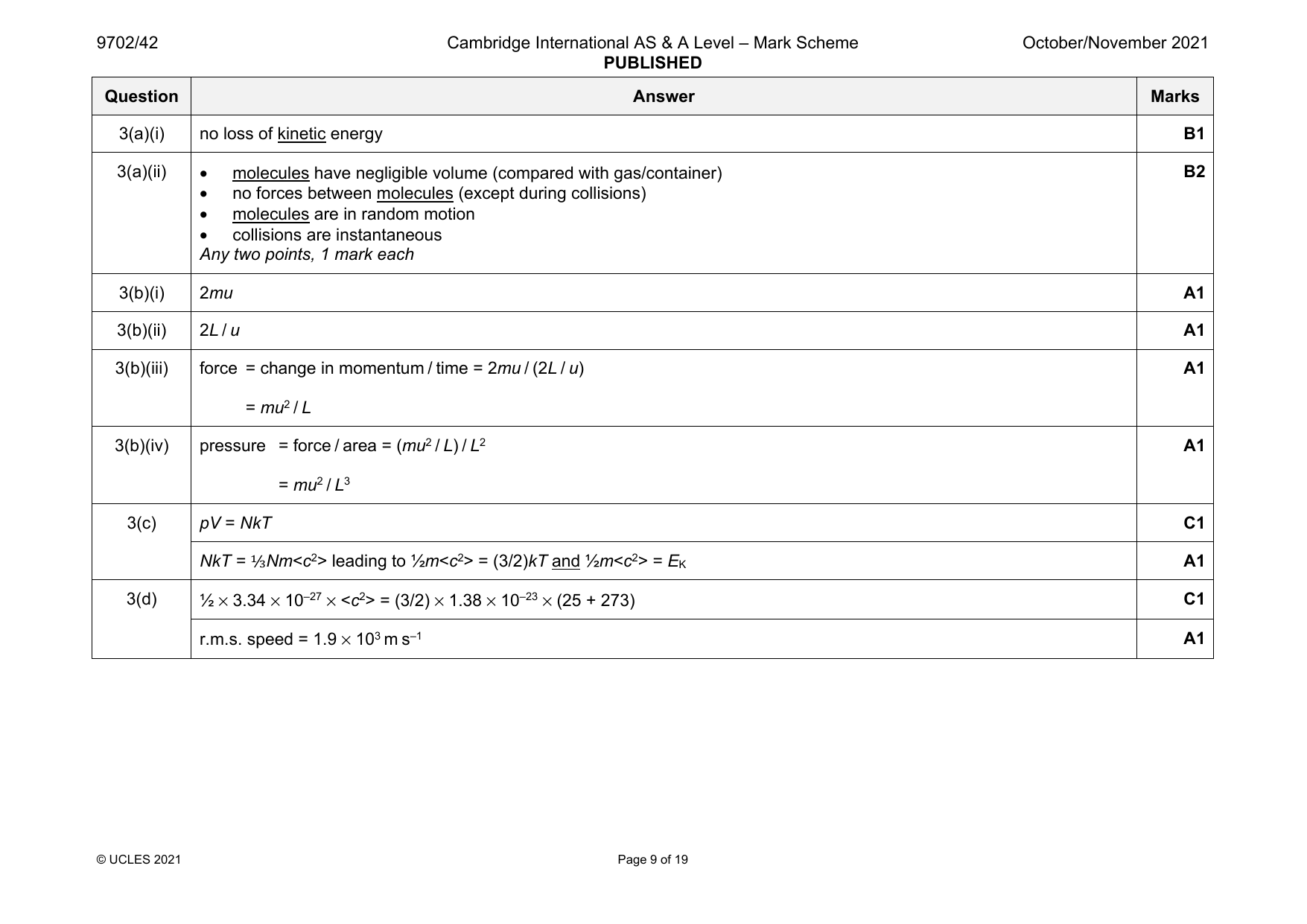
3(a)(i) no loss of kinetic energy B1
3(a)(ii) • molecules have negligible volume (compared with gas/container) B2
• no forces between molecules (except during collisions)
• molecules are in random motion
• collisions are instantaneous
Any two points, 1 mark each
3(b)(i) 2mu A1
3(b)(ii) 2L / u A1
3(b)(iii) force = change in momentum / time = 2mu / (2L / u) A1
= mu2 / L
3(b)(iv) pressure = force / area = (mu2 / L) / L2 A1
= mu2 / L3
3(c) pV = NkT C1
NkT = ⅓Nm<c2> leading to ½m<c2> = (3/2)kT and ½m<c2> = E A1
K
3(d) ½ × 3.34 × 10⁻²⁷ × <c2> = (3/2) × 1.38 × 10–23 × (25 + 273) C1
r.m.s. speed = 1.9 × 10³ m s–1 A1
© UCLES 2021 Page 9 of 19
Official mark scheme pages: 9 · source PDF URL
9702-2022-on-42-q03
Oct/Nov 2022 · Paper 42 · Question 3 · 10 marks
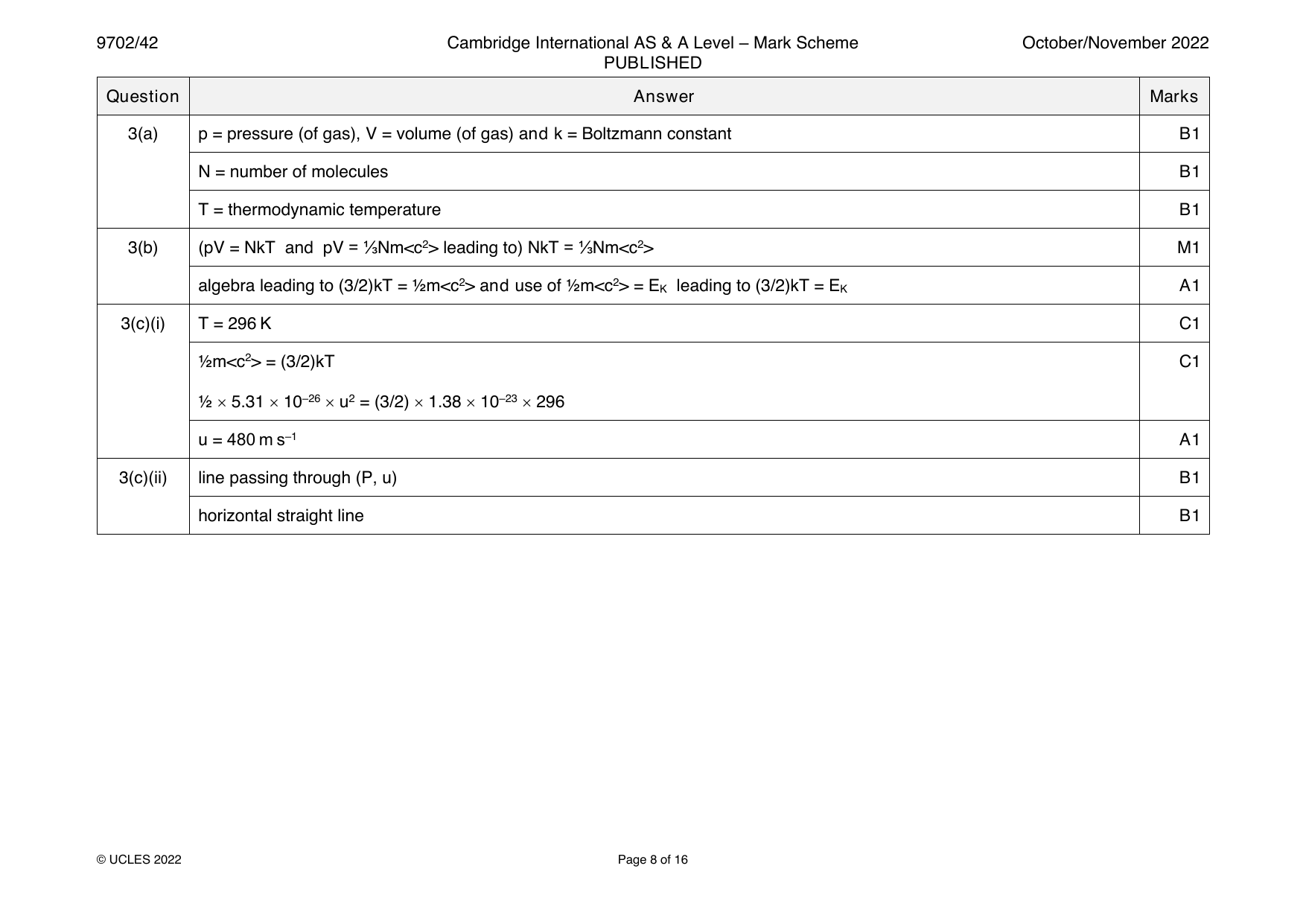
3(a) p = pressure (of gas), V = volume (of gas) and k = Boltzmann constant B1
N = number of molecules B1
T = thermodynamic temperature B1
3(b) (pV = NkT and pV = ⅓Nm<c2> leading to) NkT = ⅓Nm<c2> M1
algebra leading to (3/2)kT = ½m<c2> and use of ½m<c2> = E leading to (3/2)kT = E A1
K K
3(c)(i) T = 296 K C1
½m<c2> = (3/2)kT C1
½ 5.31 10–26 u2 = (3/2) 1.38 10–23 296
u = 480 m s–1 A1
3(c)(ii) line passing through (P, u) B1
horizontal straight line B1
© UCLES 2022 Page 8 of 16
Official mark scheme pages: 8 · source PDF URL
9702-2023-mj-42-q02
May/June 2023 · Paper 42 · Question 2 · 12 marks
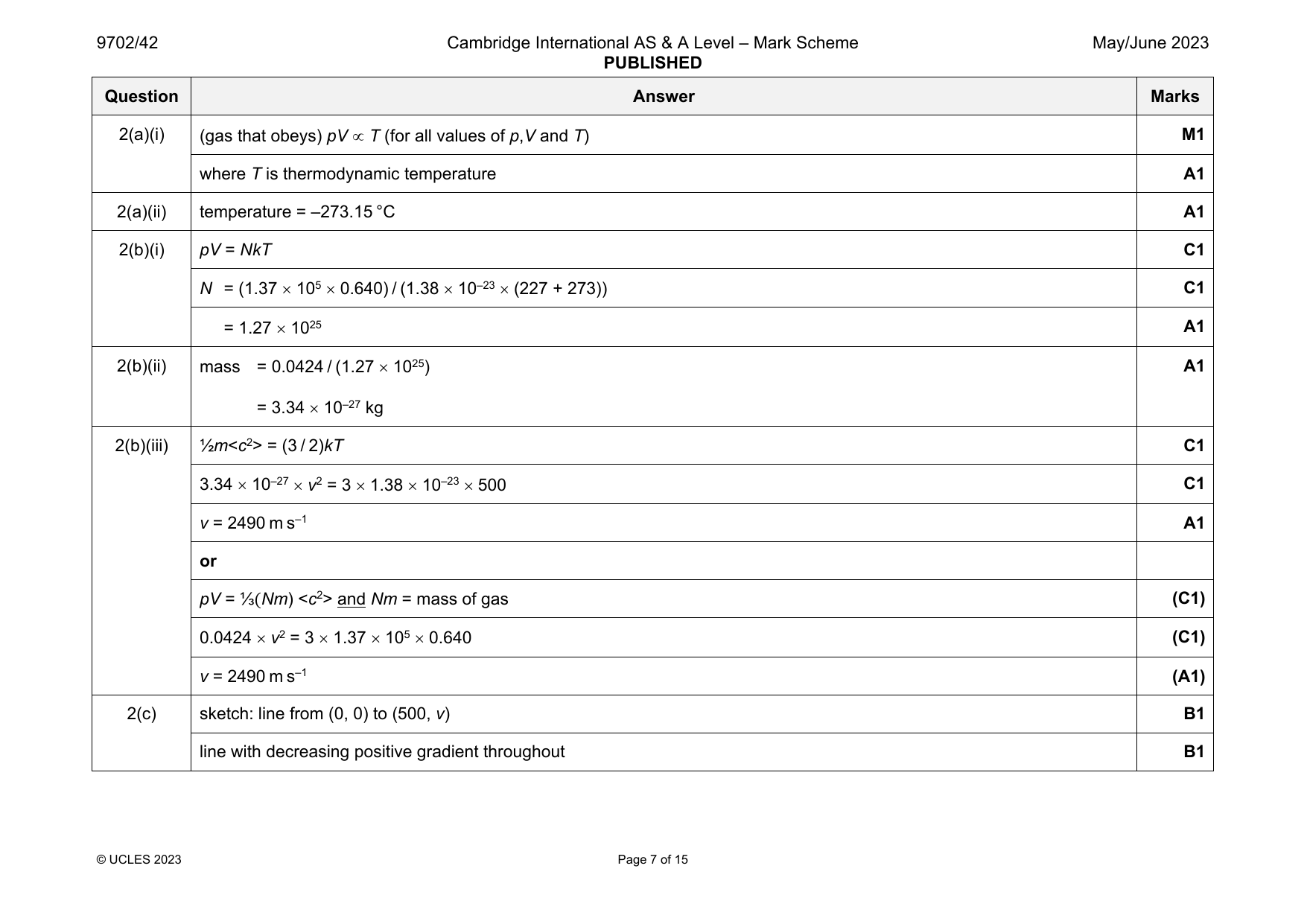
2(a)(i) (gas that obeys) pV T (for all values of p,V and T) M1
where T is thermodynamic temperature A1
2(a)(ii) temperature = –273.15 °C A1
2(b)(i) pV = NkT C1
N = (1.37 105 0.640) / (1.38 10–23 (227 + 273)) C1
= 1.27 1025 A1
2(b)(ii) mass = 0.0424 / (1.27 1025) A1
= 3.34 10–27 kg
2(b)(iii) ½m<c2> = (3 / 2)kT C1
3.34 10–27 v2 = 3 1.38 10–23 500 C1
v = 2490 m s–1 A1
or
pV = ⅓(Nm) <c2> and Nm = mass of gas (C1)
0.0424 v2 = 3 1.37 105 0.640 (C1)
v = 2490 m s–1 (A1)
2(c) sketch: line from (0, 0) to (500, v) B1
line with decreasing positive gradient throughout B1
© UCLES 2023 Page 7 of 15
Official mark scheme pages: 7 · source PDF URL
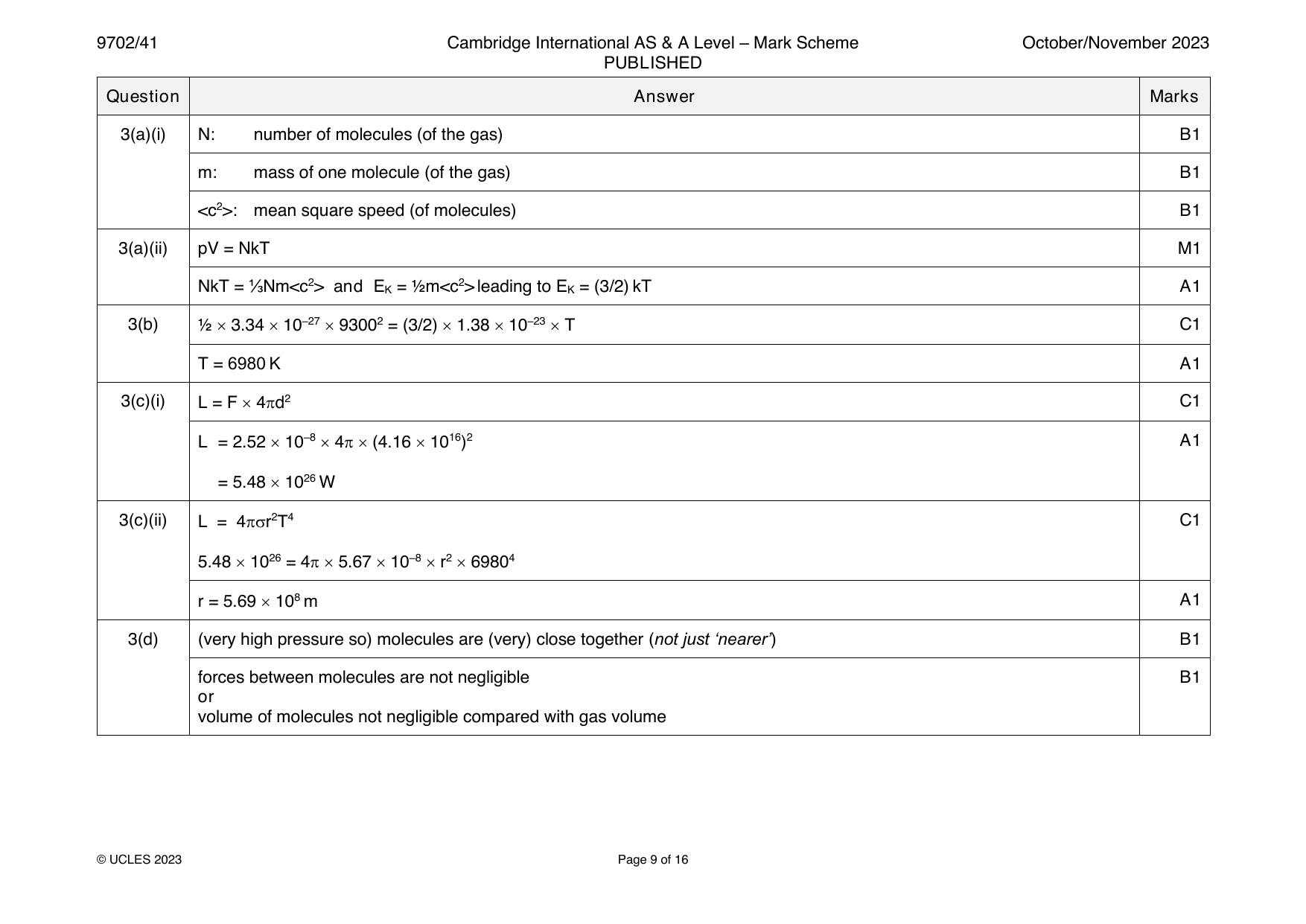
9702-2023-on-41-q03
Oct/Nov 2023 · Paper 41 · Question 3 · 13 marks
3(a)(i) N: number of molecules (of the gas) B1
m: mass of one molecule (of the gas) B1
<c2>: mean square speed (of molecules) B1
3(a)(ii) pV = NkT M1
NkT = ⅓Nm<c2> and E = ½m<c2> leading to E = (3/2) kT A1
K K
3(b) ½ 3.34 10–27 93002 = (3/2) 1.38 10–23 T C1
T = 6980 K A1
3(c)(i) L = F 4d2 C1
L = 2.52 10–8 4 (4.16 1016)2 A1
= 5.48 1026 W
3(c)(ii) L = 4r2T4 C1
5.48 1026 = 4 5.67 10–8 r2 69804
r = 5.69 108 m A1
3(d) (very high pressure so) molecules are (very) close together (not just ‘nearer’) B1
forces between molecules are not negligible B1
or
volume of molecules not negligible compared with gas volume
© UCLES 2023 Page 9 of 16
Official mark scheme pages: 9 · source PDF URL
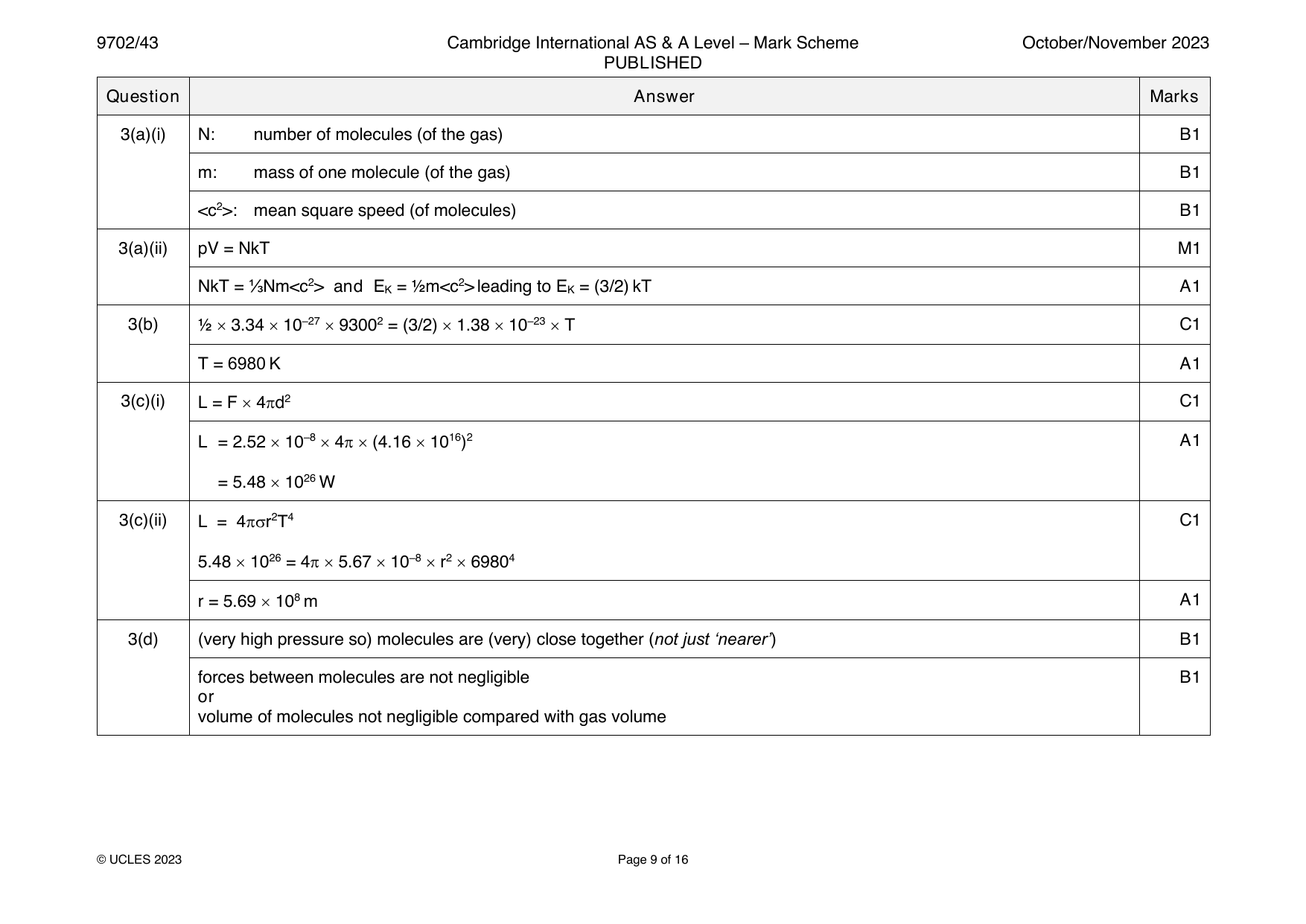
9702-2023-on-43-q03
Oct/Nov 2023 · Paper 43 · Question 3 · 13 marks
3(a)(i) N: number of molecules (of the gas) B1
m: mass of one molecule (of the gas) B1
<c2>: mean square speed (of molecules) B1
3(a)(ii) pV = NkT M1
NkT = ⅓Nm<c2> and E = ½m<c2> leading to E = (3/2) kT A1
K K
3(b) ½ 3.34 10–27 93002 = (3/2) 1.38 10–23 T C1
T = 6980 K A1
3(c)(i) L = F 4d2 C1
L = 2.52 10–8 4 (4.16 1016)2 A1
= 5.48 1026 W
3(c)(ii) L = 4r2T4 C1
5.48 1026 = 4 5.67 10–8 r2 69804
r = 5.69 108 m A1
3(d) (very high pressure so) molecules are (very) close together (not just ‘nearer’) B1
forces between molecules are not negligible B1
or
volume of molecules not negligible compared with gas volume
© UCLES 2023 Page 9 of 16
Official mark scheme pages: 9 · source PDF URL
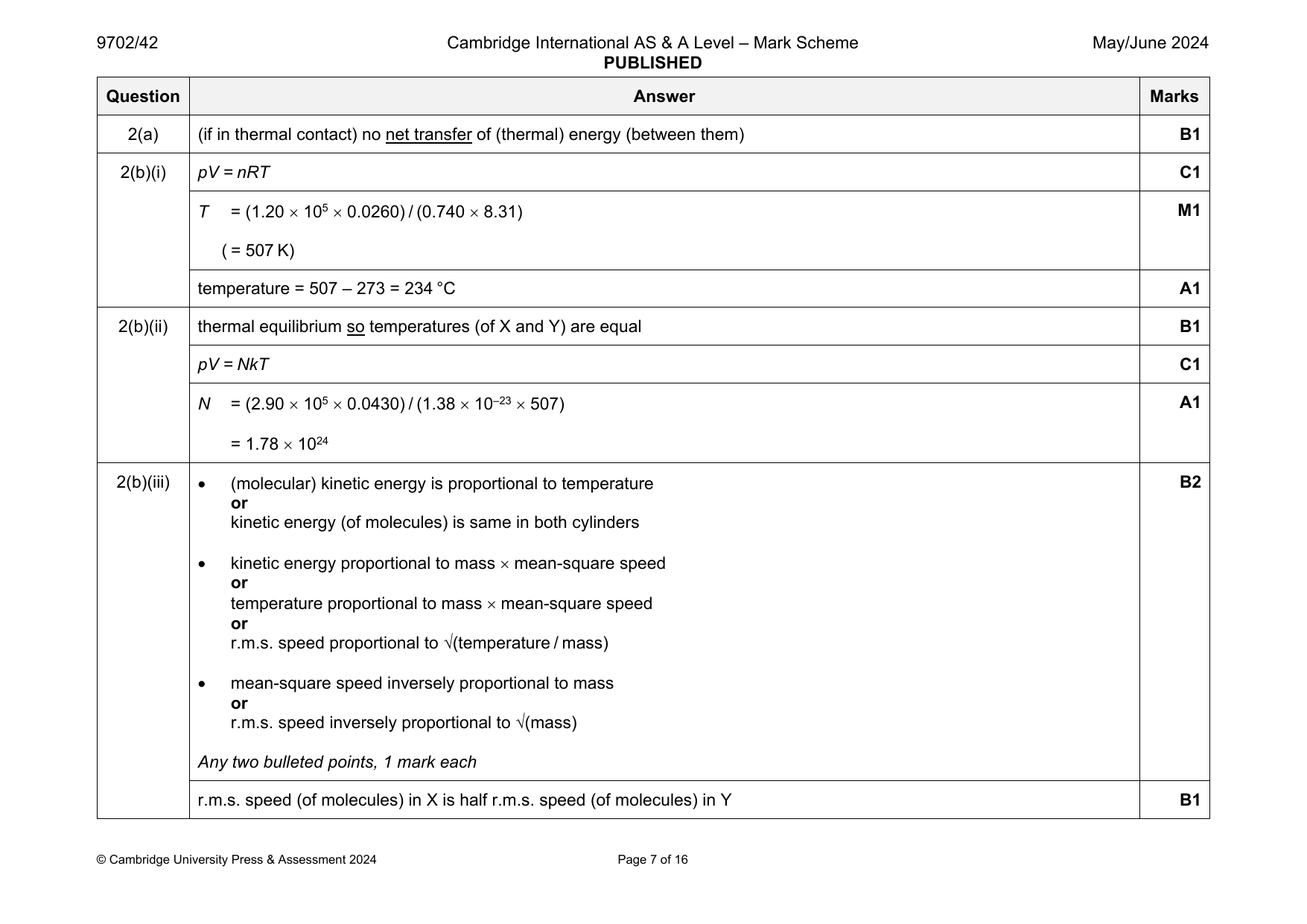
9702-2024-mj-42-q02
May/June 2024 · Paper 42 · Question 2 · 10 marks
2(a) (if in thermal contact) no net transfer of (thermal) energy (between them) B1
2(b)(i) pV = nRT C1
T = (1.20 105 0.0260) / (0.740 8.31) M1
( = 507 K)
temperature = 507 – 273 = 234 °C A1
2(b)(ii) thermal equilibrium so temperatures (of X and Y) are equal B1
pV = NkT C1
N = (2.90 105 0.0430) / (1.38 10–23 507) A1
= 1.78 1024
2(b)(iii) (molecular) kinetic energy is proportional to temperature B2
or
kinetic energy (of molecules) is same in both cylinders
kinetic energy proportional to mass mean-square speed
or
temperature proportional to mass mean-square speed
or
r.m.s. speed proportional to √(temperature / mass)
mean-square speed inversely proportional to mass
or
r.m.s. speed inversely proportional to √(mass)
Any two bulleted points, 1 mark each
r.m.s. speed (of molecules) in X is half r.m.s. speed (of molecules) in Y B1
© Cambridge University Press & Assessment 2024 Page 7 of 16
Official mark scheme pages: 7 · source PDF URL
9702-2024-on-42-q04
Oct/Nov 2024 · Paper 42 · Question 4 · 9 marks
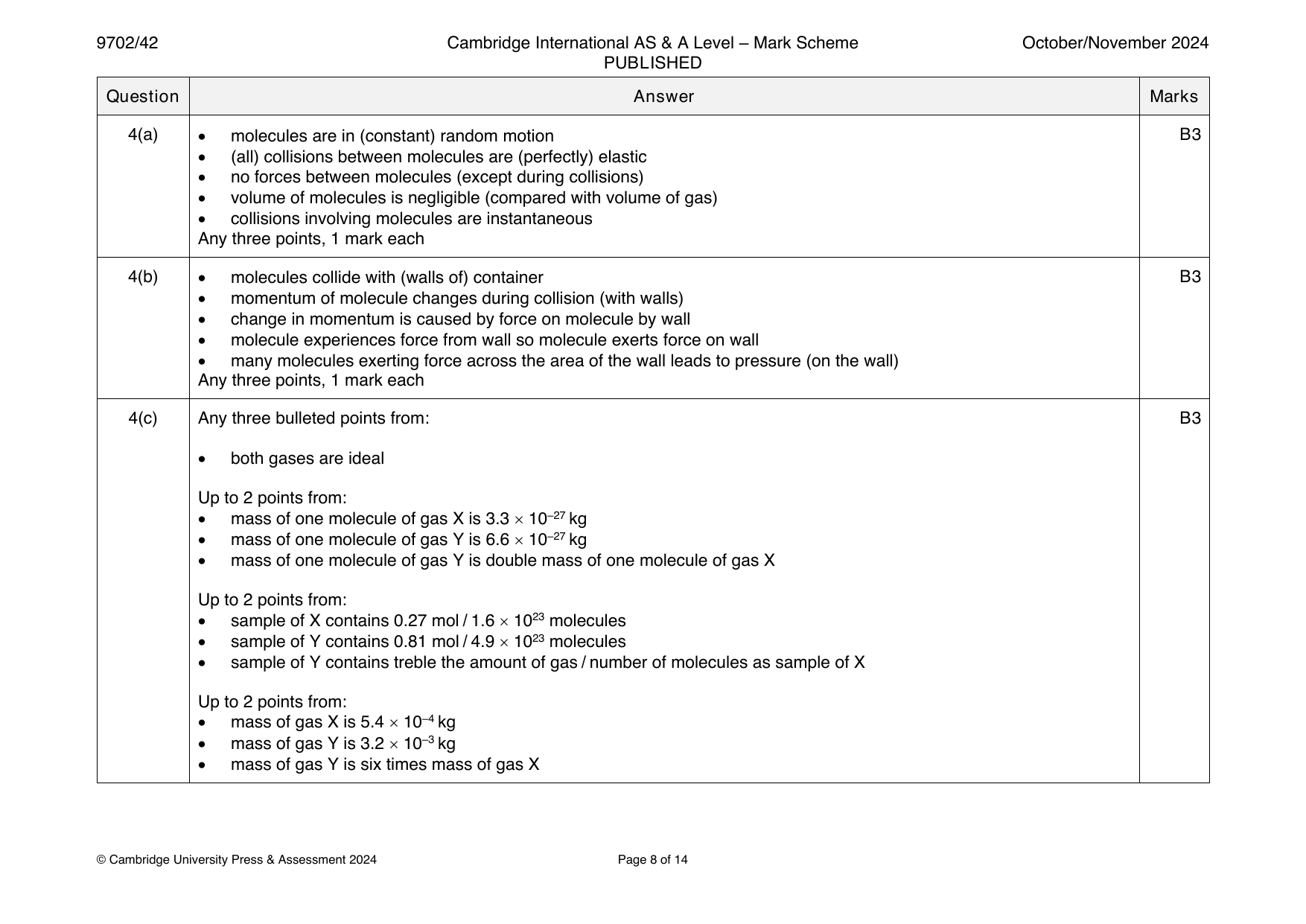
4(a) • molecules are in (constant) random motion B3
• (all) collisions between molecules are (perfectly) elastic
• no forces between molecules (except during collisions)
• volume of molecules is negligible (compared with volume of gas)
• collisions involving molecules are instantaneous
Any three points, 1 mark each
4(b) • molecules collide with (walls of) container B3
• momentum of molecule changes during collision (with walls)
• change in momentum is caused by force on molecule by wall
• molecule experiences force from wall so molecule exerts force on wall
• many molecules exerting force across the area of the wall leads to pressure (on the wall)
Any three points, 1 mark each
4(c) Any three bulleted points from: B3
• both gases are ideal
Up to 2 points from:
• mass of one molecule of gas X is 3.3 10–27 kg
• mass of one molecule of gas Y is 6.6 10–27 kg
• mass of one molecule of gas Y is double mass of one molecule of gas X
Up to 2 points from:
• sample of X contains 0.27 mol / 1.6 1023 molecules
• sample of Y contains 0.81 mol / 4.9 1023 molecules
• sample of Y contains treble the amount of gas / number of molecules as sample of X
Up to 2 points from:
• mass of gas X is 5.4 10–4 kg
• mass of gas Y is 3.2 10–3 kg
• mass of gas Y is six times mass of gas X
© Cambridge University Press & Assessment 2024 Page 8 of 14
Official mark scheme pages: 8 · source PDF URL
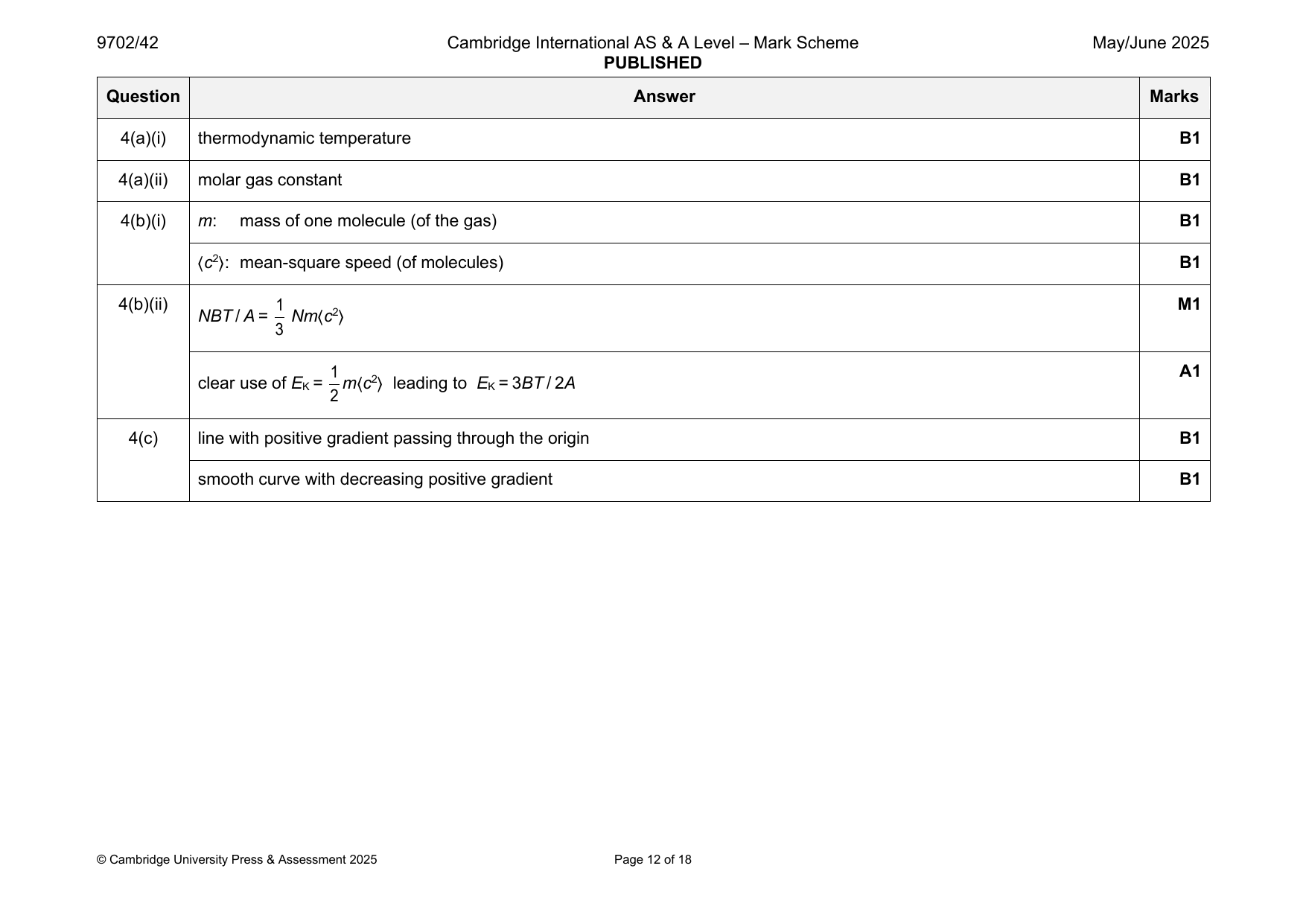
9702-2025-mj-42-q04
May/June 2025 · Paper 42 · Question 4 · 8 marks
4(a)(i) thermodynamic temperature B1
4(a)(ii) molar gas constant B1
4(b)(i) m: mass of one molecule (of the gas) B1
〈c2〉: mean-square speed (of molecules) B1
4(b)(ii) 1 M1
NBT / A = Nm〈c2〉
3
1 A1
clear use of E = m〈c2〉 leading to E = 3BT / 2A
K K
2
4(c) line with positive gradient passing through the origin B1
smooth curve with decreasing positive gradient B1
© Cambridge University Press & Assessment 2025 Page 12 of 18
Official mark scheme pages: 12 · source PDF URL
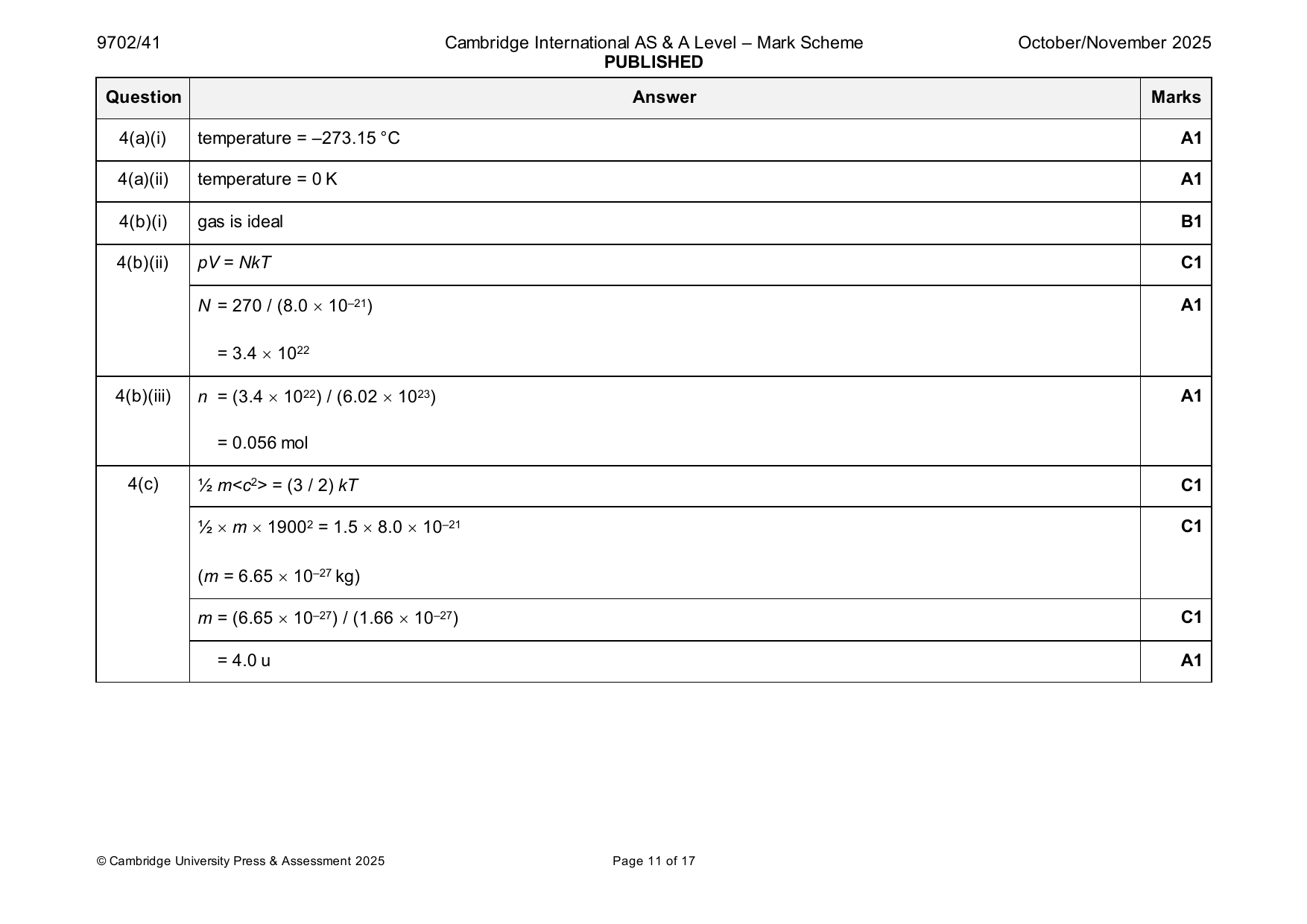
9702-2025-on-41-q04
Oct/Nov 2025 · Paper 41 · Question 4 · 10 marks
4(a)(i) temperature = –273.15 °C A1
4(a)(ii) temperature = 0 K A1
4(b)(i) gas is ideal B1
4(b)(ii) pV = NkT C1
N = 270 / (8.0 10–21) A1
= 3.4 1022
4(b)(iii) n = (3.4 1022) / (6.02 1023) A1
= 0.056 mol
4(c) ½ m<c2> = (3 / 2) kT C1
½ m 19002 = 1.5 8.0 10–21 C1
(m = 6.65 10–27 kg)
m = (6.65 10–27) / (1.66 10–27) C1
= 4.0 u A1
© Cambridge University Press & Assessment 2025 Page 11 of 17
Official mark scheme pages: 11 · source PDF URL
9702-2025-on-42-q02
Oct/Nov 2025 · Paper 42 · Question 2 · 11 marks
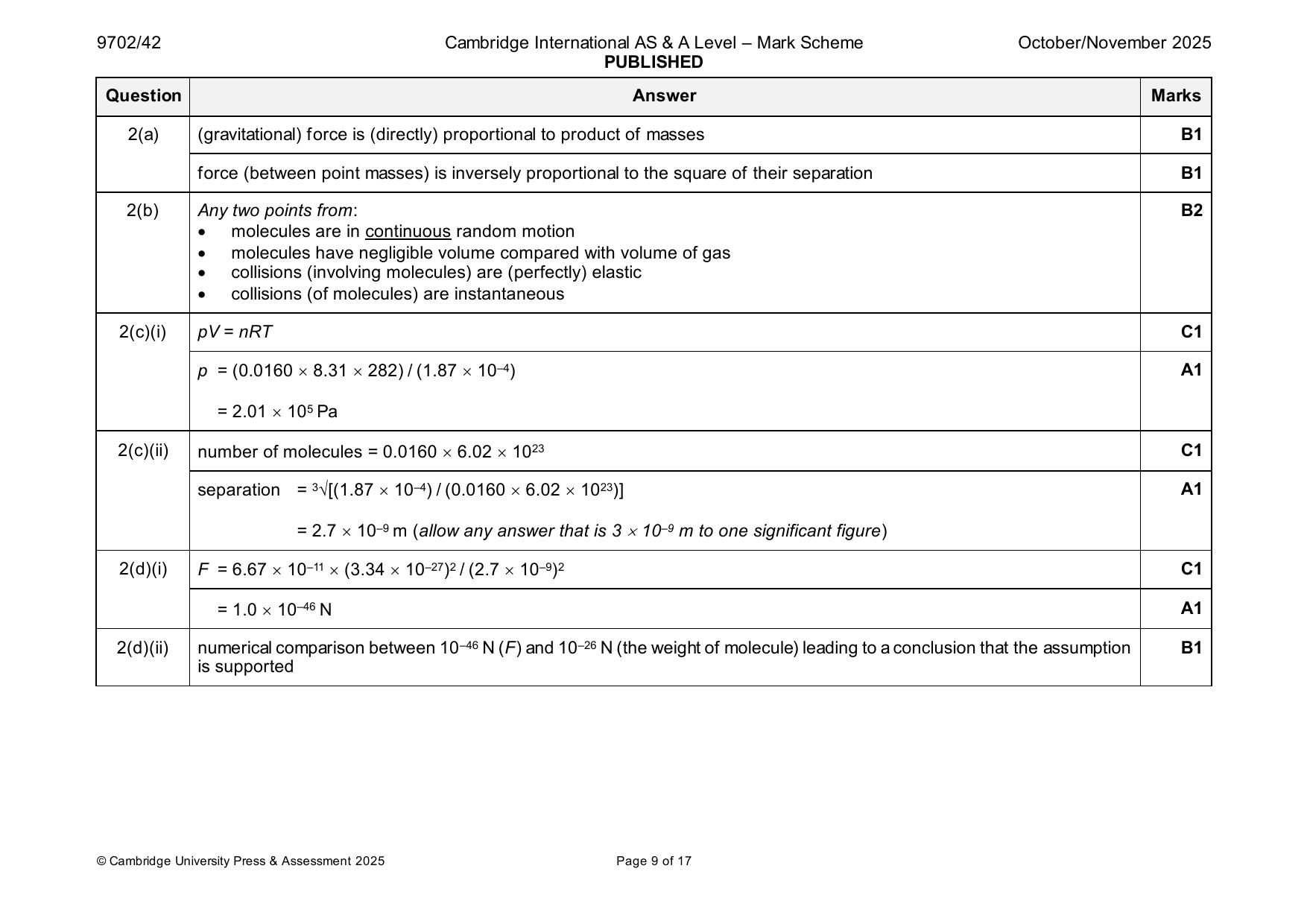
2(a) (gravitational) force is (directly) proportional to product of masses B1
force (between point masses) is inversely proportional to the square of their separation B1
2(b) Any two points from: B2
• molecules are in continuous random motion
• molecules have negligible volume compared with volume of gas
• collisions (involving molecules) are (perfectly) elastic
• collisions (of molecules) are instantaneous
2(c)(i) pV = nRT C1
p = (0.0160 8.31 282) / (1.87 10–4) A1
= 2.01 105 Pa
2(c)(ii) number of molecules = 0.0160 6.02 1023 C1
separation = 3√[(1.87 10–4) / (0.0160 6.02 1023)] A1
= 2.7 10–9 m (allow any answer that is 3 10–9 m to one significant figure)
2(d)(i) F = 6.67 10–11 (3.34 10–27)2 / (2.7 10–9)2 C1
= 1.0 10–46 N A1
2(d)(ii) numerical comparison between 10–46 N (F) and 10–26 N (the weight of molecule) leading to a conclusion that the assumption B1
is supported
© Cambridge University Press & Assessment 2025 Page 9 of 17
Official mark scheme pages: 9 · source PDF URL
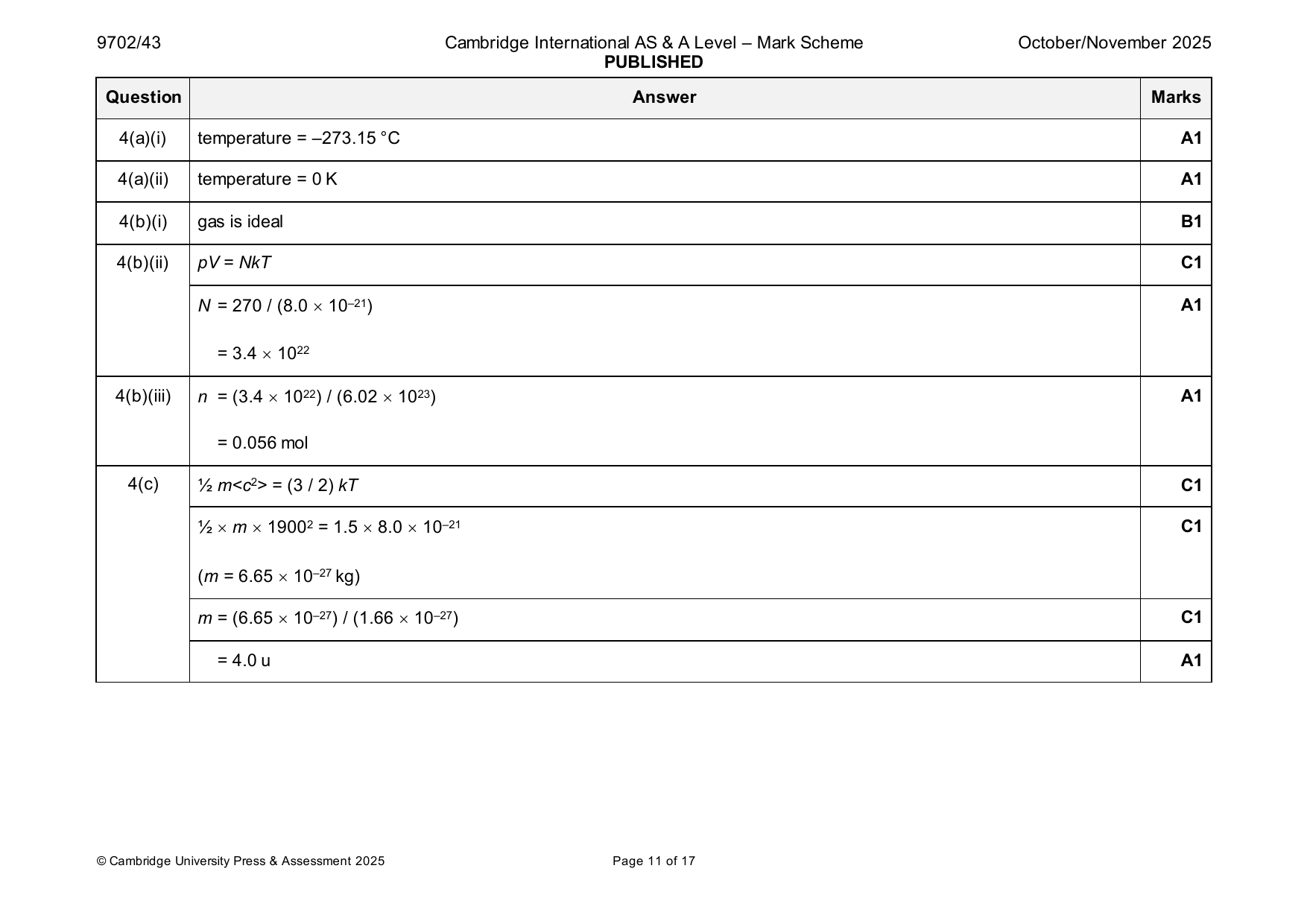
9702-2025-on-43-q04
Oct/Nov 2025 · Paper 43 · Question 4 · 10 marks
4(a)(i) temperature = –273.15 °C A1
4(a)(ii) temperature = 0 K A1
4(b)(i) gas is ideal B1
4(b)(ii) pV = NkT C1
N = 270 / (8.0 10–21) A1
= 3.4 1022
4(b)(iii) n = (3.4 1022) / (6.02 1023) A1
= 0.056 mol
4(c) ½ m<c2> = (3 / 2) kT C1
½ m 19002 = 1.5 8.0 10–21 C1
(m = 6.65 10–27 kg)
m = (6.65 10–27) / (1.66 10–27) C1
= 4.0 u A1
© Cambridge University Press & Assessment 2025 Page 11 of 17
Official mark scheme pages: 11 · source PDF URL