Try the new view →
9702-2021-on-41-q01
Oct/Nov 2021 · Paper 41 · Question 1 · 7 marks
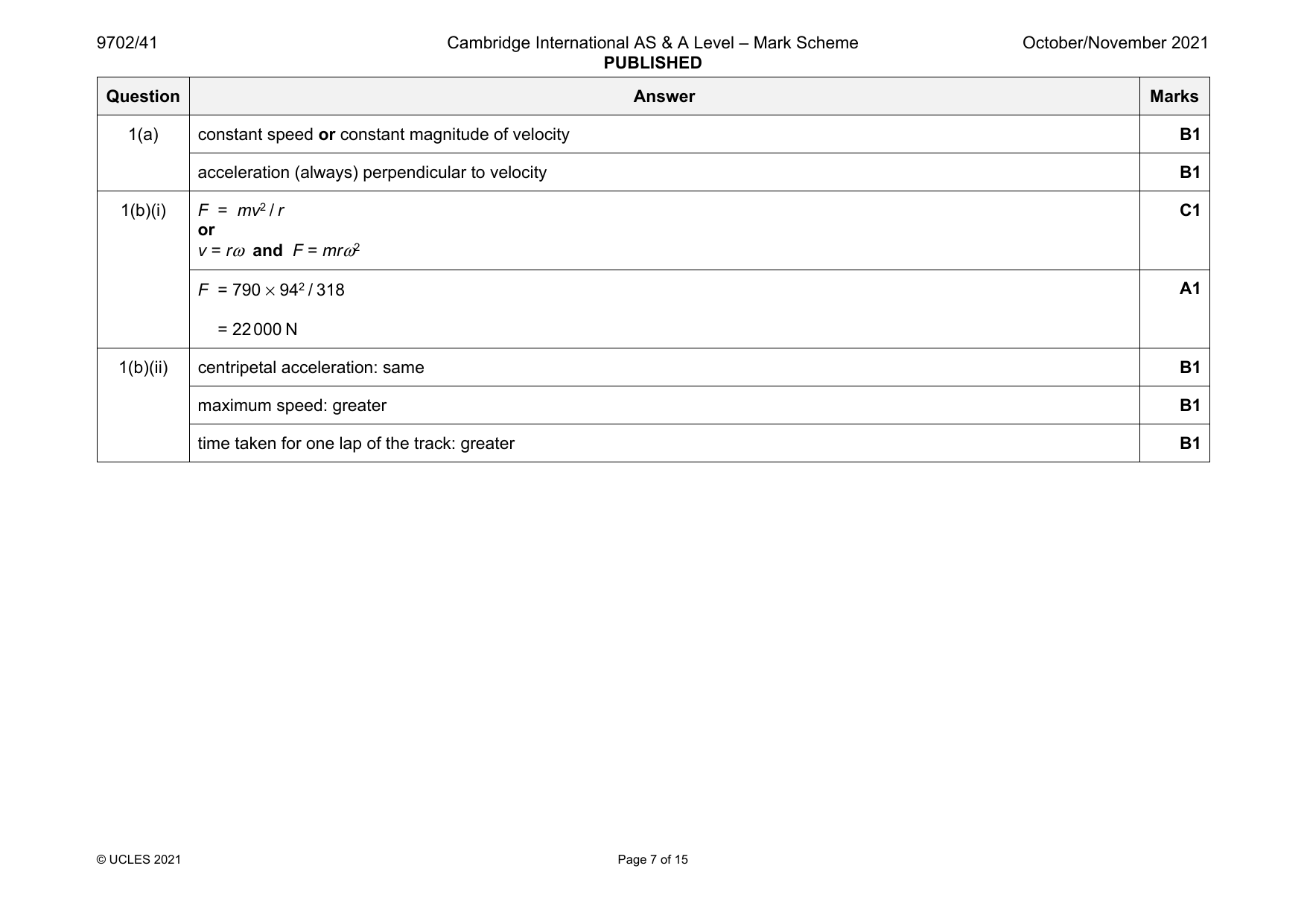
1(a) constant speed or constant magnitude of velocity B1
acceleration (always) perpendicular to velocity B1
1(b)(i) F = mv2 / r C1
or
v = rω and F = mrω2
F = 790 × 942 / 318 A1
= 22000 N
1(b)(ii) centripetal acceleration: same B1
maximum speed: greater B1
time taken for one lap of the track: greater B1
© UCLES 2021 Page 7 of 15
Official mark scheme pages: 7 · source PDF URL
9702-2021-on-42-q01
Oct/Nov 2021 · Paper 42 · Question 1 · 8 marks
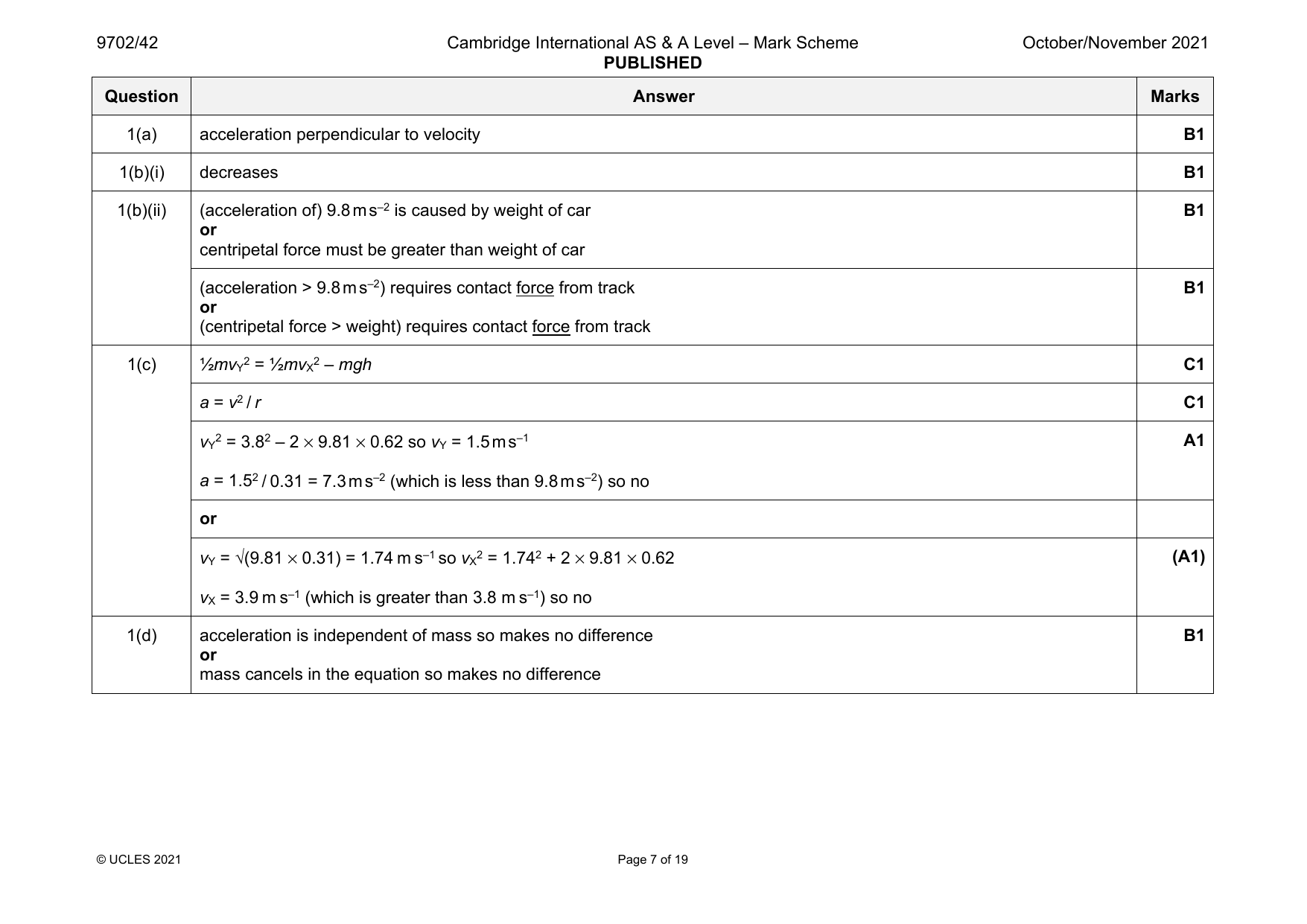
1(a) acceleration perpendicular to velocity B1
1(b)(i) decreases B1
1(b)(ii) (acceleration of) 9.8ms–2 is caused by weight of car B1
or
centripetal force must be greater than weight of car
(acceleration > 9.8ms–2) requires contact force from track B1
or
(centripetal force > weight) requires contact force from track
1(c) ½mv 2 = ½mv 2 – mgh C1
Y X
a = v2 / r C1
v 2 = 3.82 – 2 × 9.81 × 0.62 so v = 1.5ms–1 A1
Y Y
a = 1.52 / 0.31 = 7.3ms–2 (which is less than 9.8ms–2) so no
or
v = √(9.81 × 0.31) = 1.74 m s–1 so v 2 = 1.742 + 2 × 9.81 × 0.62 (A1)
Y X
v = 3.9 m s–1 (which is greater than 3.8 m s–1) so no
X
1(d) acceleration is independent of mass so makes no difference B1
or
mass cancels in the equation so makes no difference
© UCLES 2021 Page 7 of 19
Official mark scheme pages: 7 · source PDF URL
9702-2021-on-43-q01
Oct/Nov 2021 · Paper 43 · Question 1 · 7 marks
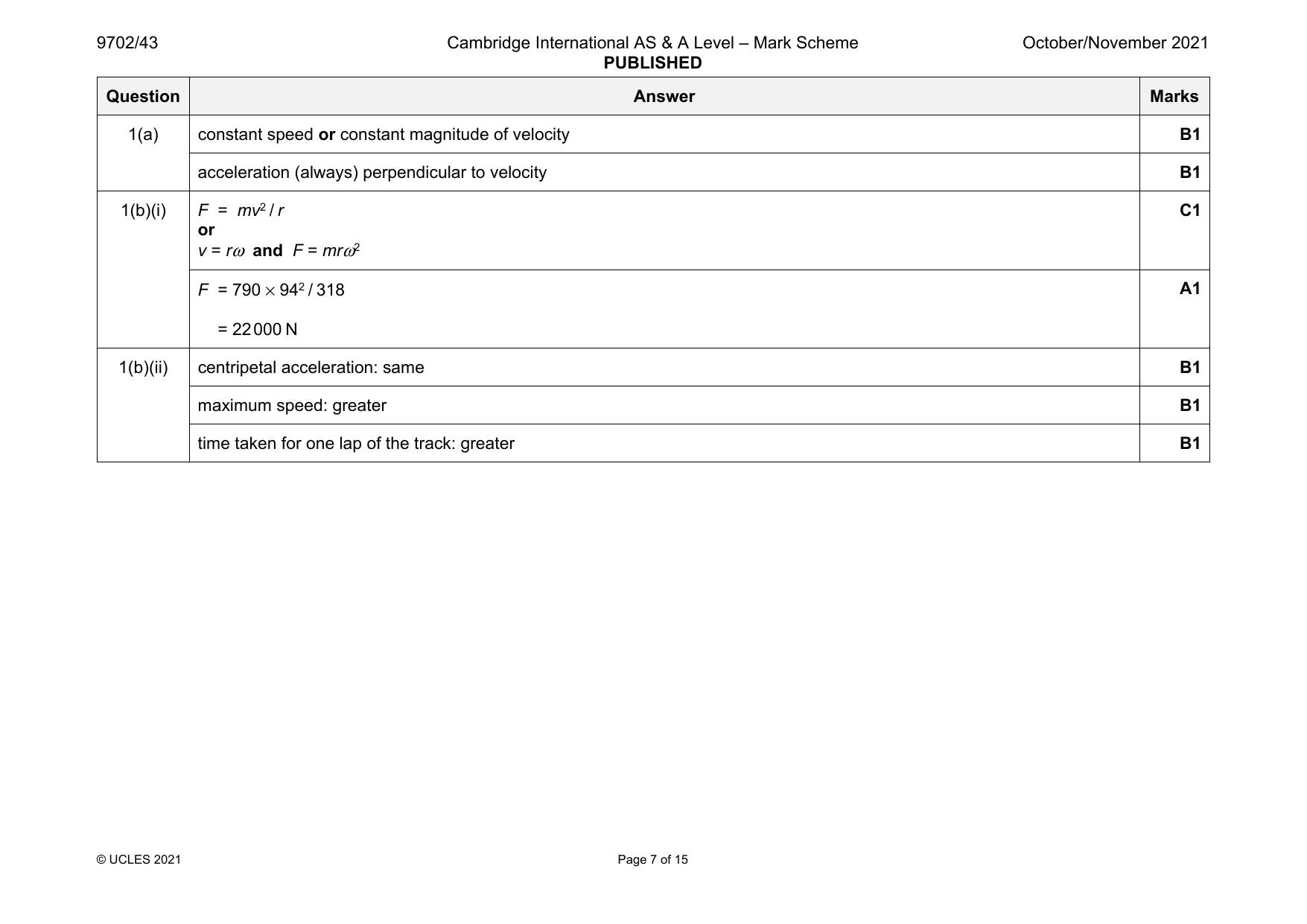
1(a) constant speed or constant magnitude of velocity B1
acceleration (always) perpendicular to velocity B1
1(b)(i) F = mv2 / r C1
or
v = rω and F = mrω2
F = 790 × 942 / 318 A1
= 22000 N
1(b)(ii) centripetal acceleration: same B1
maximum speed: greater B1
time taken for one lap of the track: greater B1
© UCLES 2021 Page 7 of 15
Official mark scheme pages: 7 · source PDF URL
9702-2023-mj-41-q02
May/June 2023 · Paper 41 · Question 2 · 12 marks
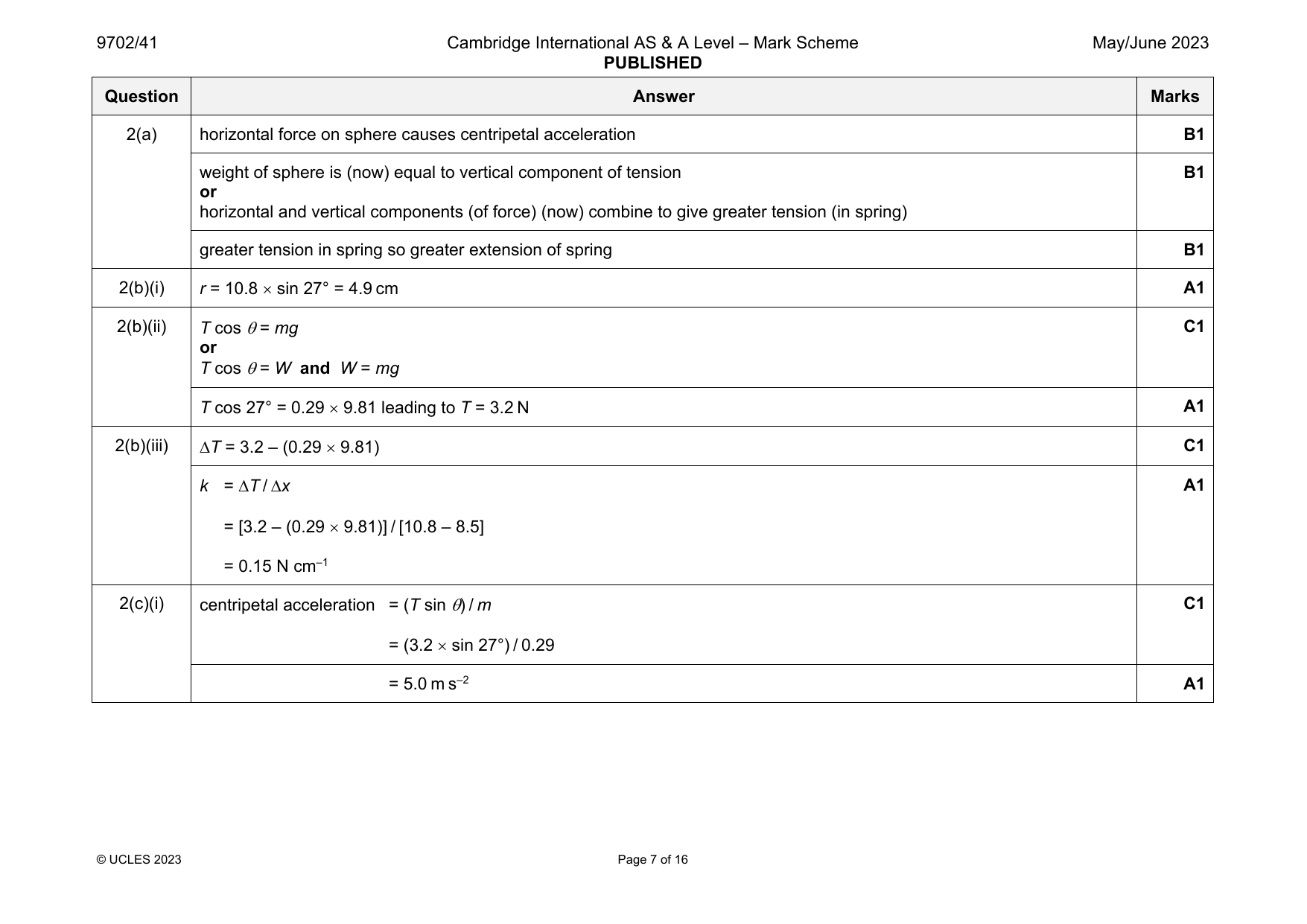
2(a) horizontal force on sphere causes centripetal acceleration B1
weight of sphere is (now) equal to vertical component of tension B1
or
horizontal and vertical components (of force) (now) combine to give greater tension (in spring)
greater tension in spring so greater extension of spring B1
2(b)(i) r = 10.8 sin 27° = 4.9 cm A1
2(b)(ii) T cos = mg C1
or
T cos = W and W = mg
T cos 27° = 0.29 9.81 leading to T = 3.2 N A1
2(b)(iii) T = 3.2 – (0.29 9.81) C1
k = T / x A1
= [3.2 – (0.29 9.81)] / [10.8 – 8.5]
= 0.15 N cm–1
2(c)(i) centripetal acceleration = (T sin ) / m C1
= (3.2 sin 27°) / 0.29
= 5.0 m s–2 A1
© UCLES 2023 Page 7 of 16
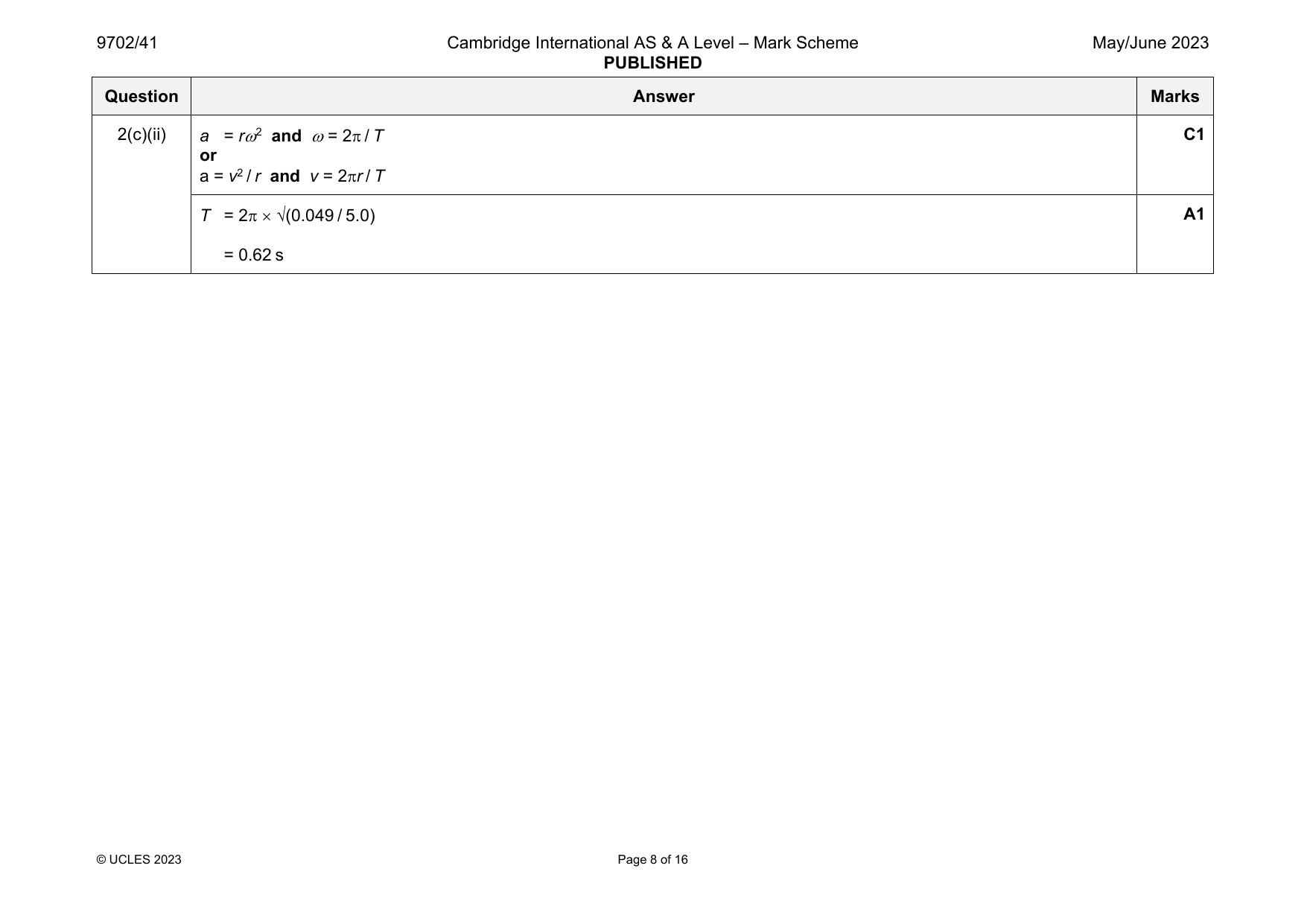
2(c)(ii) a = r2 and = 2 / T C1
or
a = v2 / r and v = 2r / T
T = 2 √(0.049 / 5.0) A1
= 0.62 s
© UCLES 2023 Page 8 of 16
Official mark scheme pages: 7, 8 · source PDF URL
9702-2023-mj-43-q02
May/June 2023 · Paper 43 · Question 2 · 12 marks
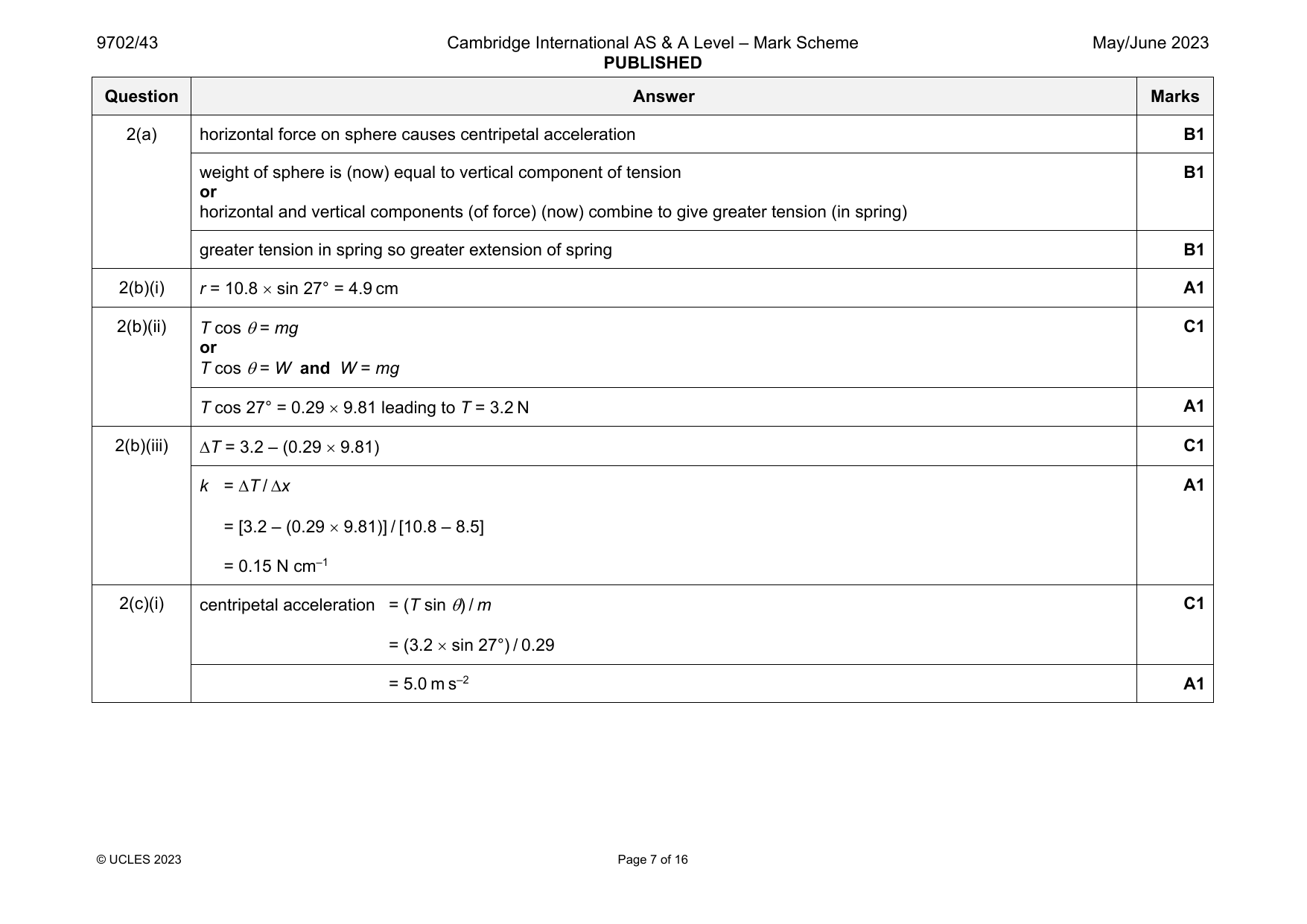
2(a) horizontal force on sphere causes centripetal acceleration B1
weight of sphere is (now) equal to vertical component of tension B1
or
horizontal and vertical components (of force) (now) combine to give greater tension (in spring)
greater tension in spring so greater extension of spring B1
2(b)(i) r = 10.8 sin 27° = 4.9 cm A1
2(b)(ii) T cos = mg C1
or
T cos = W and W = mg
T cos 27° = 0.29 9.81 leading to T = 3.2 N A1
2(b)(iii) T = 3.2 – (0.29 9.81) C1
k = T / x A1
= [3.2 – (0.29 9.81)] / [10.8 – 8.5]
= 0.15 N cm–1
2(c)(i) centripetal acceleration = (T sin ) / m C1
= (3.2 sin 27°) / 0.29
= 5.0 m s–2 A1
© UCLES 2023 Page 7 of 16
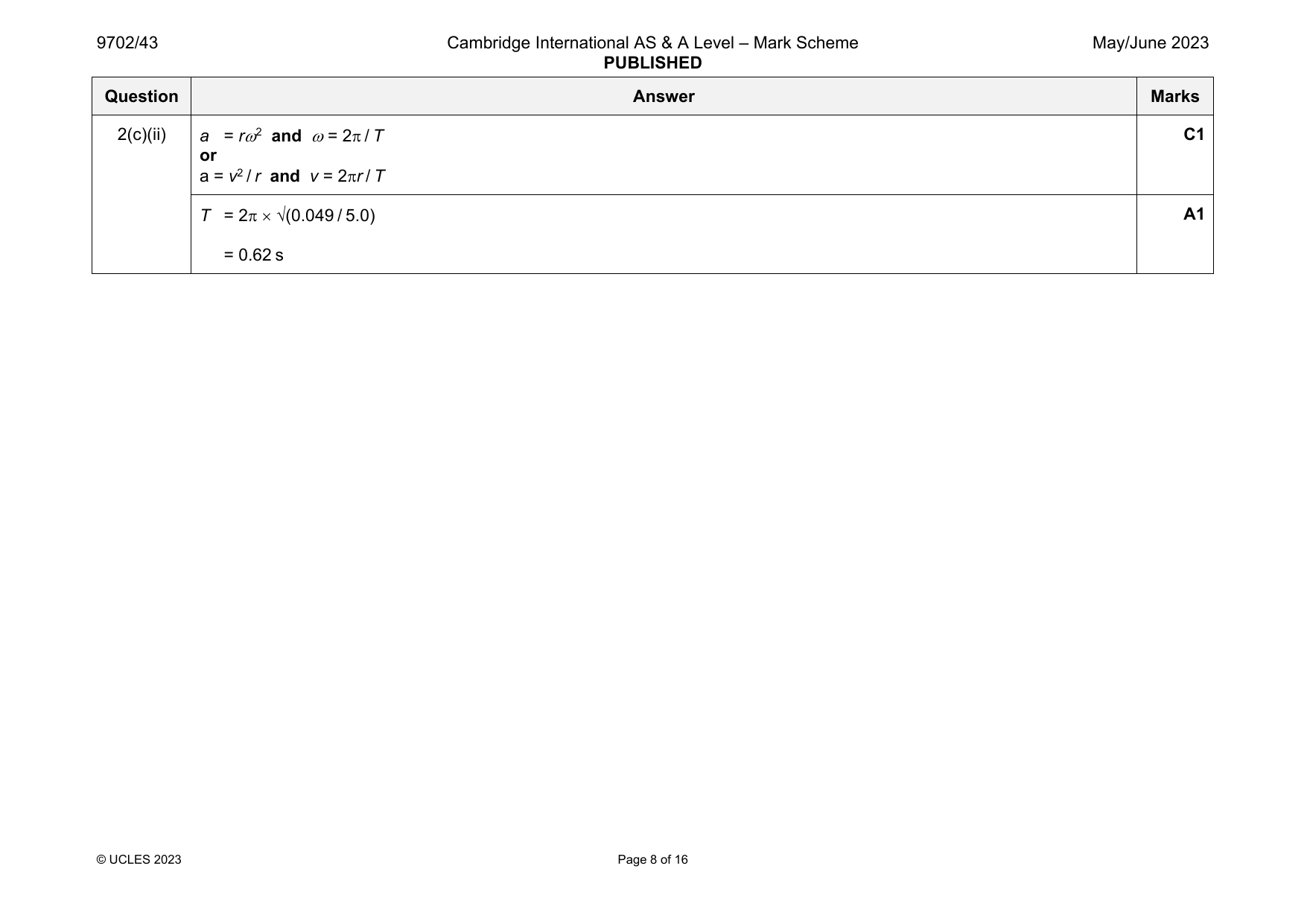
2(c)(ii) a = r2 and = 2 / T C1
or
a = v2 / r and v = 2r / T
T = 2 √(0.049 / 5.0) A1
= 0.62 s
© UCLES 2023 Page 8 of 16
Official mark scheme pages: 7, 8 · source PDF URL
9702-2023-on-42-q01
Oct/Nov 2023 · Paper 42 · Question 1 · 10 marks
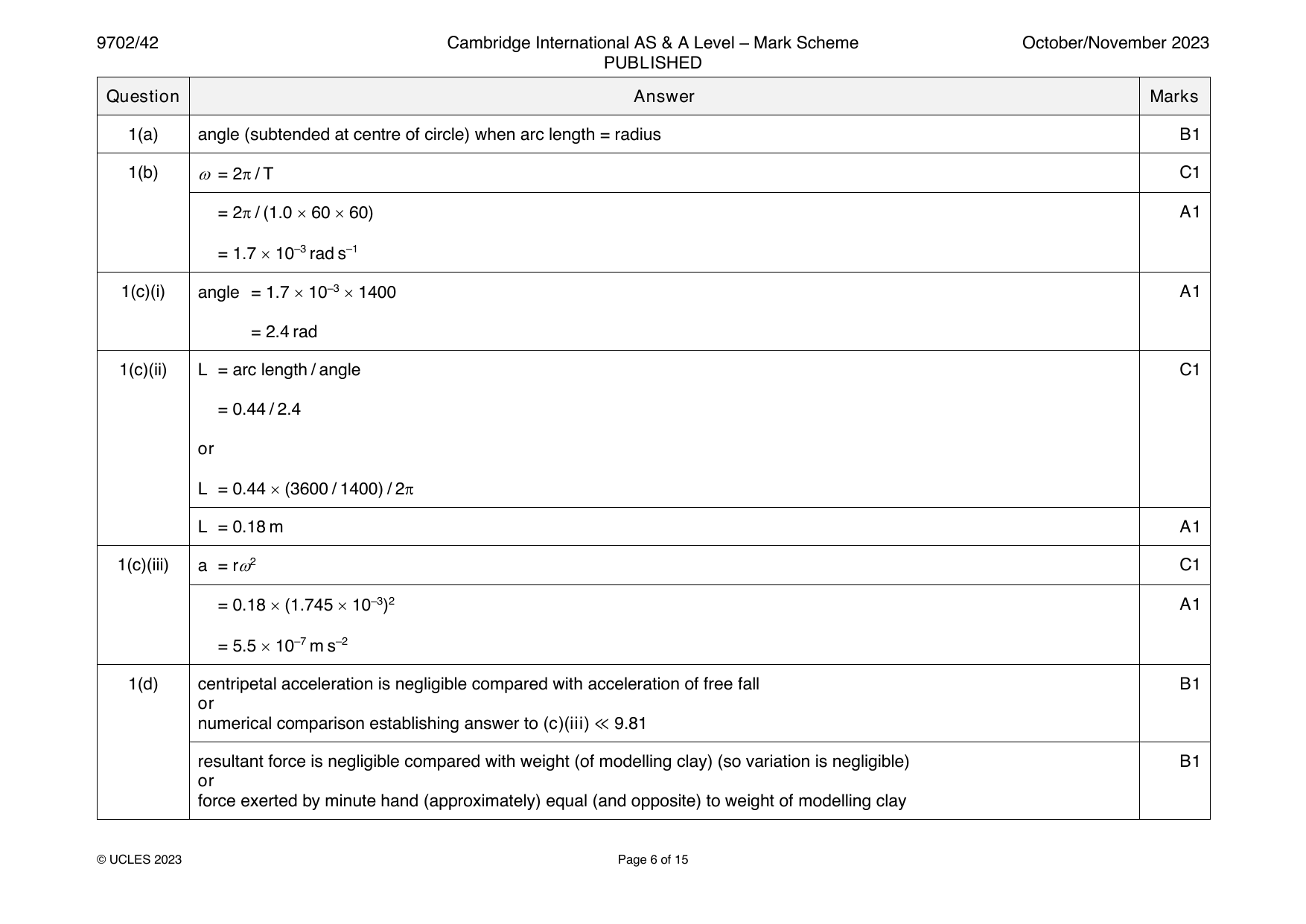
1(a) angle (subtended at centre of circle) when arc length = radius B1
1(b) = 2 / T C1
= 2 / (1.0 60 60) A1
= 1.7 10–3 rad s–1
1(c)(i) angle = 1.7 10–3 1400 A1
= 2.4 rad
1(c)(ii) L = arc length / angle C1
= 0.44 / 2.4
or
L = 0.44 (3600 / 1400) / 2
L = 0.18 m A1
1(c)(iii) a = r2 C1
= 0.18 (1.745 10–3)2 A1
= 5.5 10–7 m s–2
1(d) centripetal acceleration is negligible compared with acceleration of free fall B1
or
numerical comparison establishing answer to (c)(iii) ≪ 9.81
resultant force is negligible compared with weight (of modelling clay) (so variation is negligible) B1
or
force exerted by minute hand (approximately) equal (and opposite) to weight of modelling clay
© UCLES 2023 Page 6 of 15
Official mark scheme pages: 6 · source PDF URL
9702-2024-mj-42-q01
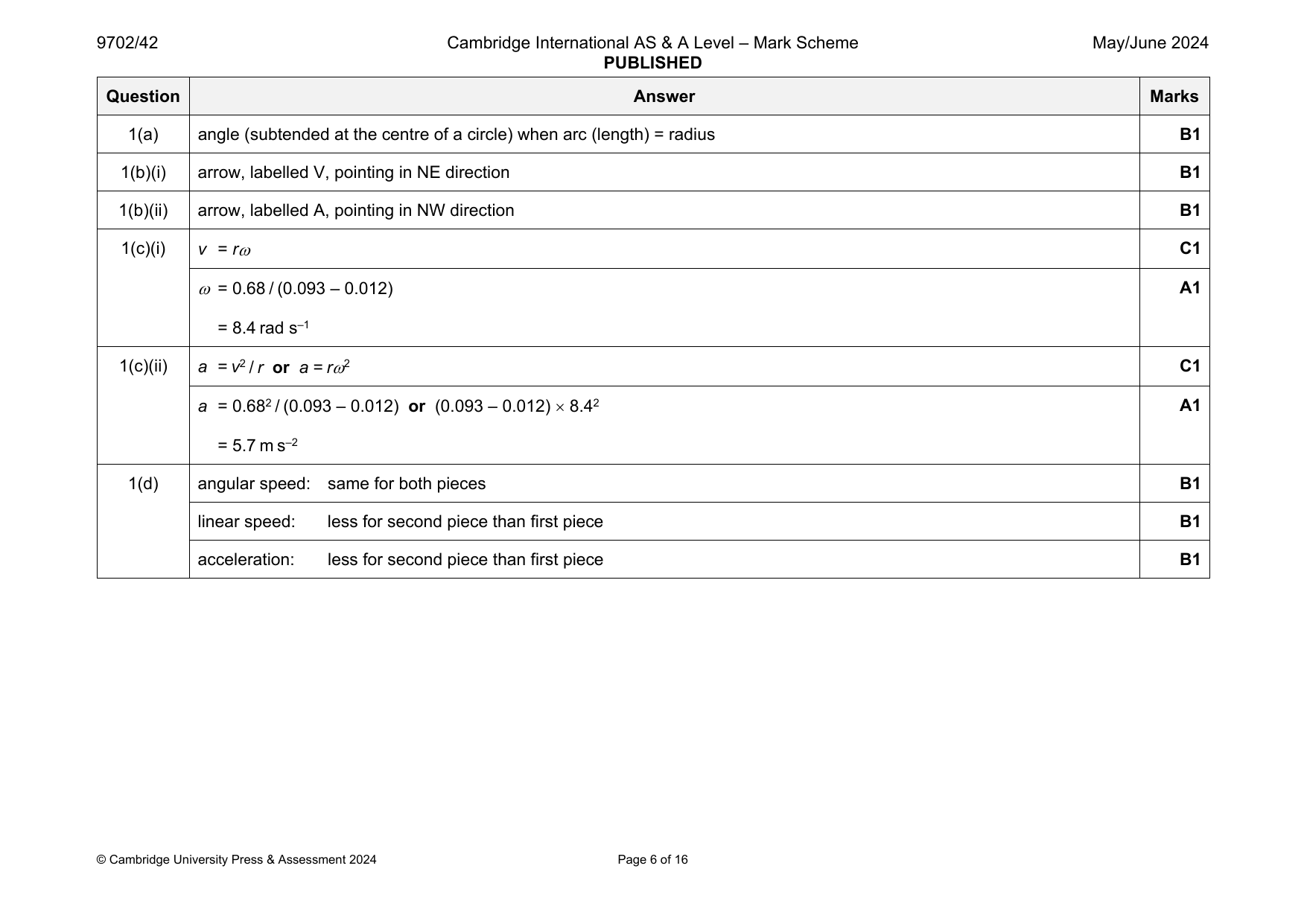
May/June 2024 · Paper 42 · Question 1 · 10 marks
1(a) angle (subtended at the centre of a circle) when arc (length) = radius B1
1(b)(i) arrow, labelled V, pointing in NE direction B1
1(b)(ii) arrow, labelled A, pointing in NW direction B1
1(c)(i) v = r C1
= 0.68 / (0.093 – 0.012) A1
= 8.4 rad s–1
1(c)(ii) a = v2 / r or a = r2 C1
a = 0.682 / (0.093 – 0.012) or (0.093 – 0.012) 8.42 A1
= 5.7 m s–2
1(d) angular speed: same for both pieces B1
linear speed: less for second piece than first piece B1
acceleration: less for second piece than first piece B1
© Cambridge University Press & Assessment 2024 Page 6 of 16
Official mark scheme pages: 6 · source PDF URL
9702-2025-m-42-q01
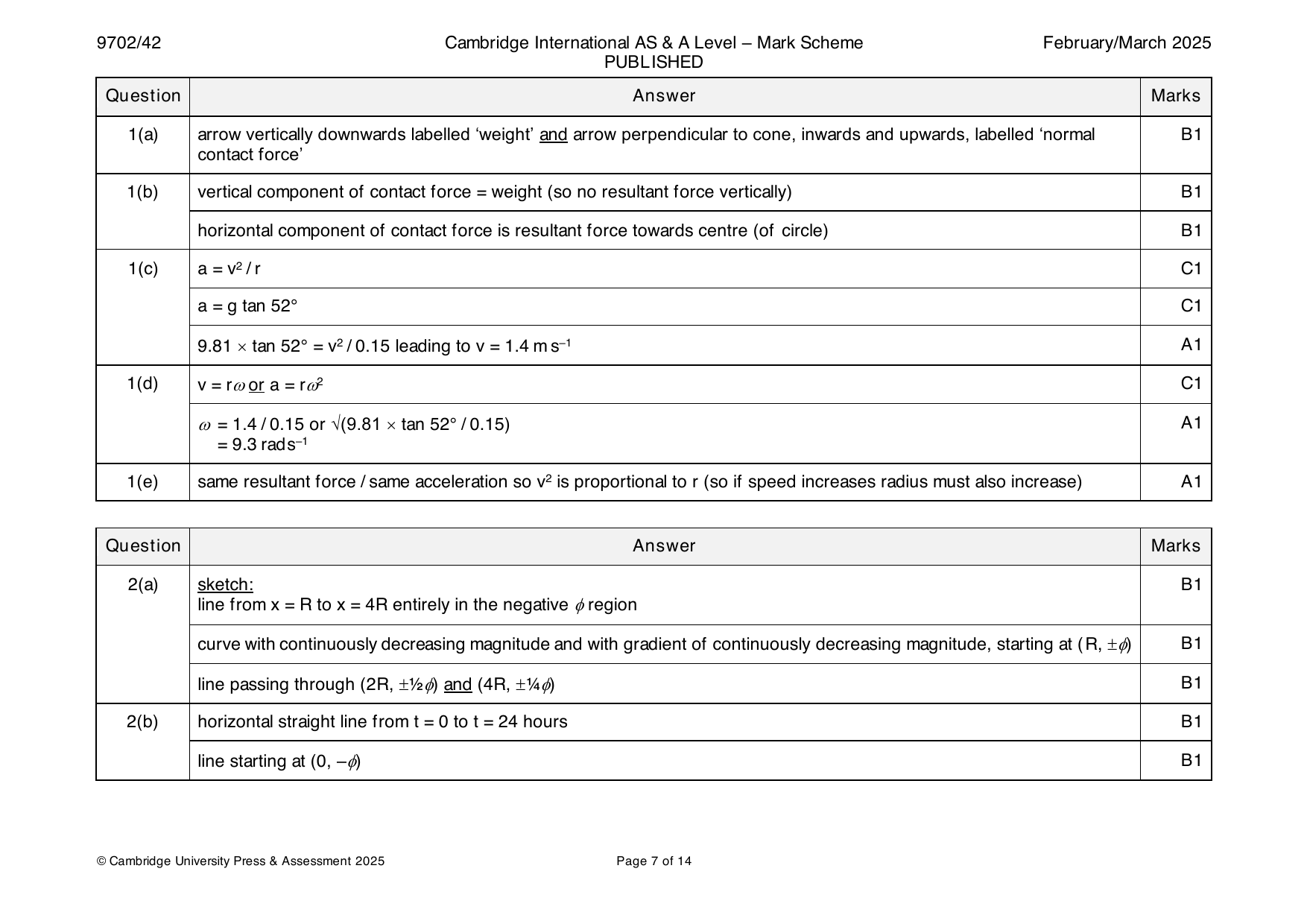
March 2025 · Paper 42 · Question 1 · 9 marks
1(a) arrow vertically downwards labelled ‘weight’ and arrow perpendicular to cone, inwards and upwards, labelled ‘normal B1
contact force’
1(b) vertical component of contact force = weight (so no resultant force vertically) B1
horizontal component of contact force is resultant force towards centre (of circle) B1
1(c) a = v2 / r C1
a = g tan 52° C1
9.81 tan 52° = v2 / 0.15 leading to v = 1.4 m s–1 A1
1(d) v = r or a = r2 C1
= 1.4 / 0.15 or √(9.81 tan 52° / 0.15) A1
= 9.3 rads–1
1(e) same resultant force / same acceleration so v2 is proportional to r (so if speed increases radius must also increase) A1
Question Answer Marks
Official mark scheme pages: 7 · source PDF URL
9702-2025-mj-42-q01
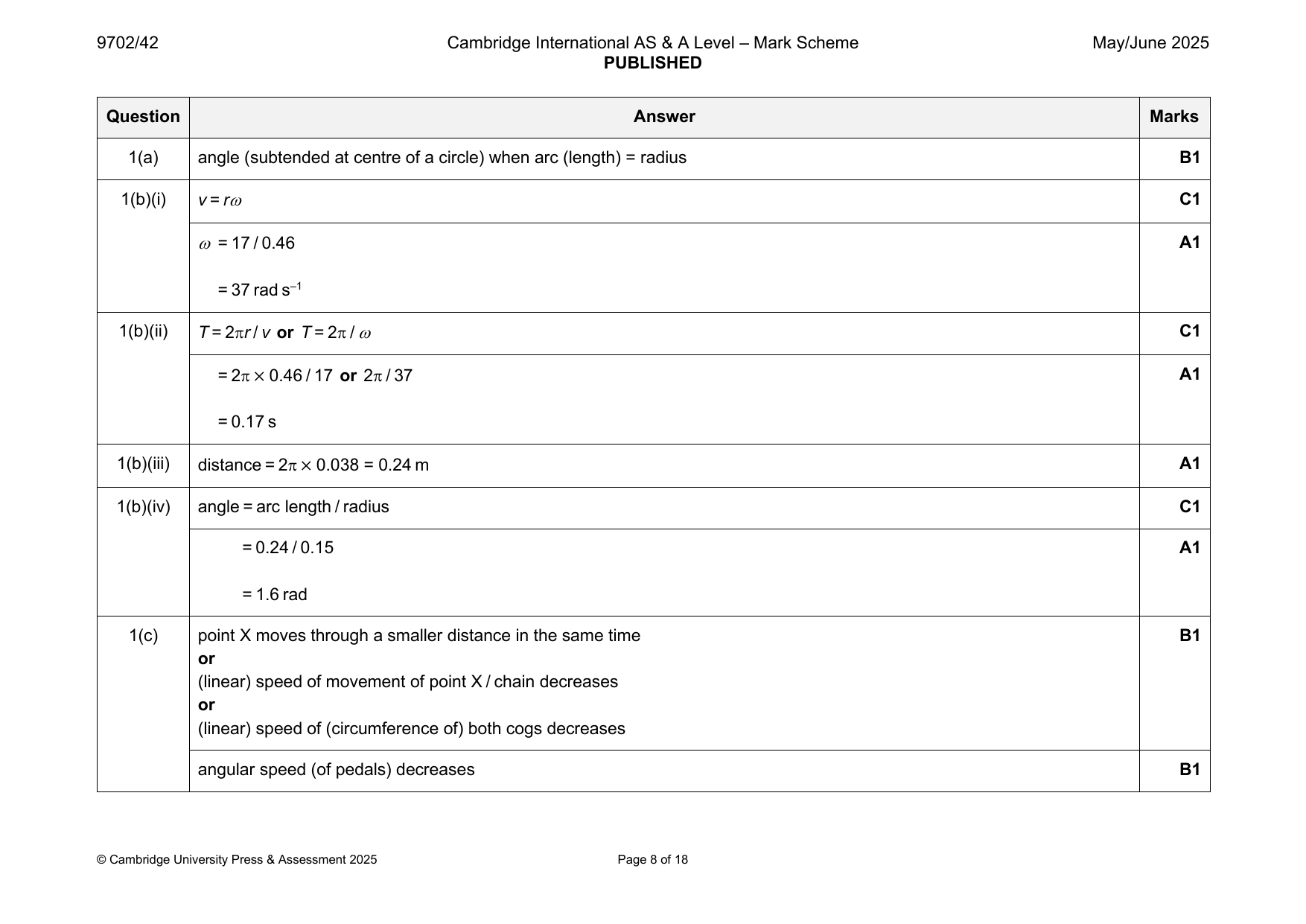
May/June 2025 · Paper 42 · Question 1 · 10 marks
1(a) angle (subtended at centre of a circle) when arc (length) = radius B1
1(b)(i) v = r C1
= 17 / 0.46 A1
= 37 rad s–1
1(b)(ii) T = 2r / v or T = 2 / C1
= 2 × 0.46 / 17 or 2 / 37 A1
= 0.17 s
1(b)(iii) distance = 2 × 0.038 = 0.24 m A1
1(b)(iv) angle = arc length / radius C1
= 0.24 / 0.15 A1
= 1.6 rad
1(c) point X moves through a smaller distance in the same time B1
or
(linear) speed of movement of point X / chain decreases
or
(linear) speed of (circumference of) both cogs decreases
angular speed (of pedals) decreases B1
© Cambridge University Press & Assessment 2025 Page 8 of 18
Official mark scheme pages: 8 · source PDF URL
9702-2025-on-42-q01
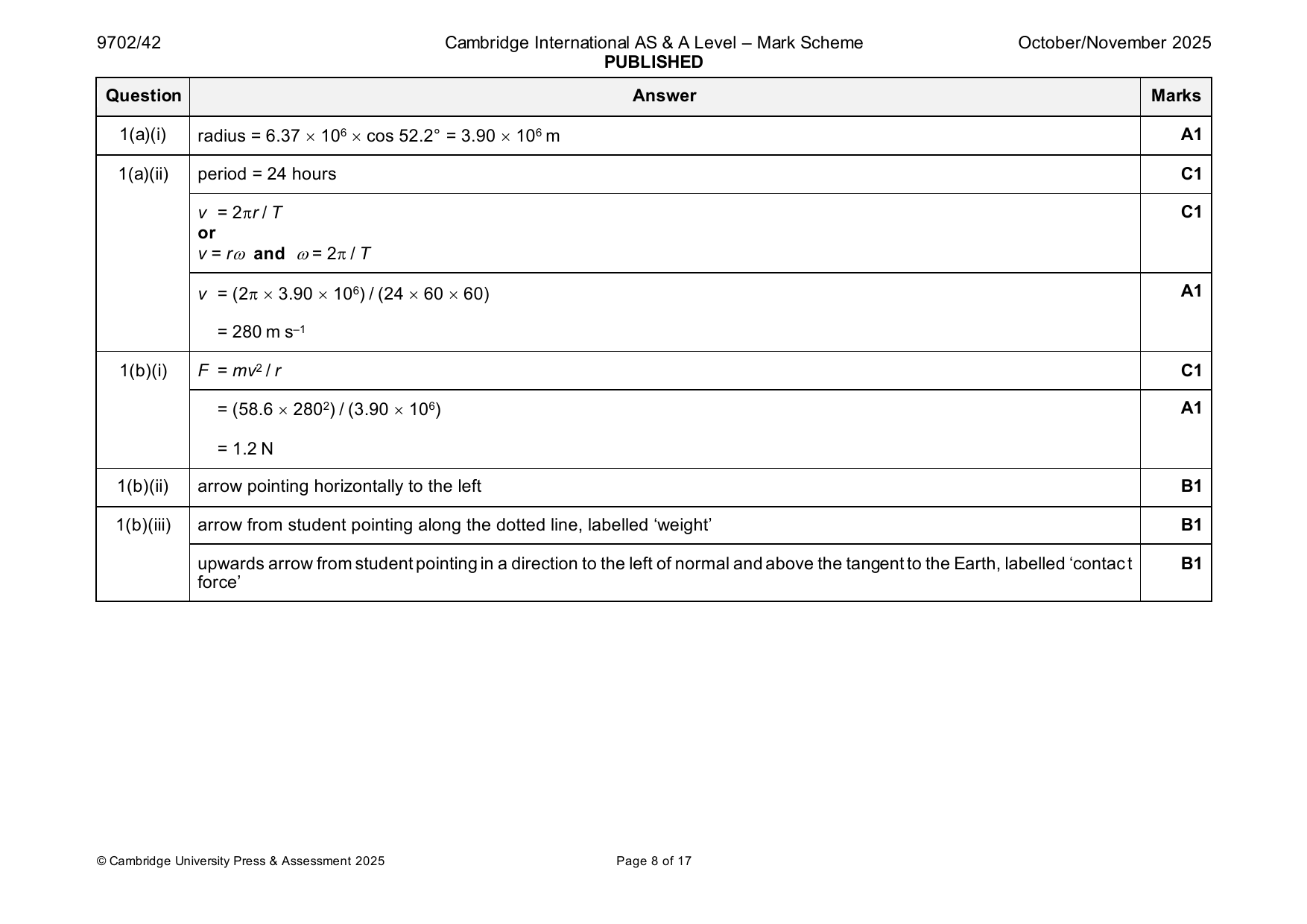
Oct/Nov 2025 · Paper 42 · Question 1 · 9 marks
1(a)(i) radius = 6.37 106 cos 52.2° = 3.90 106 m A1
1(a)(ii) period = 24 hours C1
v = 2r / T C1
or
v = r and = 2 / T
v = (2 3.90 106) / (24 60 60) A1
= 280 m s–1
1(b)(i) F = mv2 / r C1
= (58.6 2802) / (3.90 106) A1
= 1.2 N
1(b)(ii) arrow pointing horizontally to the left B1
1(b)(iii) arrow from student pointing along the dotted line, labelled ‘weight’ B1
upwards arrow from student pointing in a direction to the left of normal and above the tangent to the Earth, labelled ‘contact B1
force’
© Cambridge University Press & Assessment 2025 Page 8 of 17
Official mark scheme pages: 8 · source PDF URL